EP0061252B1 - Vanne à diaphragme tubulaire - Google Patents
Vanne à diaphragme tubulaire Download PDFInfo
- Publication number
- EP0061252B1 EP0061252B1 EP82301186A EP82301186A EP0061252B1 EP 0061252 B1 EP0061252 B1 EP 0061252B1 EP 82301186 A EP82301186 A EP 82301186A EP 82301186 A EP82301186 A EP 82301186A EP 0061252 B1 EP0061252 B1 EP 0061252B1
- Authority
- EP
- European Patent Office
- Prior art keywords
- valve
- tube
- barrier
- central member
- port
- Prior art date
- Legal status (The legal status is an assumption and is not a legal conclusion. Google has not performed a legal analysis and makes no representation as to the accuracy of the status listed.)
- Expired
Links
Images


Classifications
-
- F—MECHANICAL ENGINEERING; LIGHTING; HEATING; WEAPONS; BLASTING
- F16—ENGINEERING ELEMENTS AND UNITS; GENERAL MEASURES FOR PRODUCING AND MAINTAINING EFFECTIVE FUNCTIONING OF MACHINES OR INSTALLATIONS; THERMAL INSULATION IN GENERAL
- F16K—VALVES; TAPS; COCKS; ACTUATING-FLOATS; DEVICES FOR VENTING OR AERATING
- F16K7/00—Diaphragm valves or cut-off apparatus, e.g. with a member deformed, but not moved bodily, to close the passage ; Pinch valves
- F16K7/02—Diaphragm valves or cut-off apparatus, e.g. with a member deformed, but not moved bodily, to close the passage ; Pinch valves with tubular diaphragm
- F16K7/04—Diaphragm valves or cut-off apparatus, e.g. with a member deformed, but not moved bodily, to close the passage ; Pinch valves with tubular diaphragm constrictable by external radial force
- F16K7/07—Diaphragm valves or cut-off apparatus, e.g. with a member deformed, but not moved bodily, to close the passage ; Pinch valves with tubular diaphragm constrictable by external radial force by means of fluid pressure
- F16K7/075—Diaphragm valves or cut-off apparatus, e.g. with a member deformed, but not moved bodily, to close the passage ; Pinch valves with tubular diaphragm constrictable by external radial force by means of fluid pressure a rigid body being located within the tubular diaphragm
-
- F—MECHANICAL ENGINEERING; LIGHTING; HEATING; WEAPONS; BLASTING
- F16—ENGINEERING ELEMENTS AND UNITS; GENERAL MEASURES FOR PRODUCING AND MAINTAINING EFFECTIVE FUNCTIONING OF MACHINES OR INSTALLATIONS; THERMAL INSULATION IN GENERAL
- F16K—VALVES; TAPS; COCKS; ACTUATING-FLOATS; DEVICES FOR VENTING OR AERATING
- F16K47/00—Means in valves for absorbing fluid energy
- F16K47/02—Means in valves for absorbing fluid energy for preventing water-hammer or noise
- F16K47/023—Means in valves for absorbing fluid energy for preventing water-hammer or noise for preventing water-hammer, e.g. damping of the valve movement
Definitions
- This invention is concerned with flow valves and more particularly with the type of flow valves known as tube valves.
- Tube valves are axial flow valves wherein a tube or sleeve is used for controlling flow through the valves.
- Such valves are shown for example in U.S. Patents US-A-3942756 and US-A-3838704 and in French Patent FR-A-2334030.
- the known valves generally have a pervious cage-like core extending from an inlet to an outlet of a casing surrounding the core.
- a resilient tube is fitted over the core between the casing and the core.
- a control chamber defined between the casing and the tube is used for operating the valve between closed and open positions. The closed position occurs when the tube abuts a central impervious barrier portion that transverses the longitudinal direction of the cage-like core.
- Tube valves give excellent control over large volume flows. They are characterized by good reliability and longevity. However, the prior art tube valves are prone to the phenomena known as "water hammer". The water hammer problem can be diminished by using larger valves per volume of flow being controlled but, when a larger valve is used, the head loss through the valve increases in addition to the inherent additional costs of the larger valve.
- US-A-3942756 discloses a superficially similar arrangement but without the particular structure and arrangement of the invention that provides the desired greatly reduced “water hammer” effect.
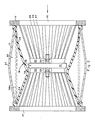
- FIG. 1 the tube valve 11 is shown in cross-section view in its normal closed position.
- the valve comprises a casing having an outer wall 12 and end closures 13 and 14.
- the end closures are shown as having an inlet port 16 in end closure 13 and an outlet port 17 in end closure 14.
- 16 is referred to herein as an inlet port and 17 as an outlet port, the valve is shown as being symmetrically constructed so that flow can occur in either direction.
- the valve further comprises a central core shown generally as 18.
- the core is comprised of a cage-like structure made up of an annular array of fingers extending from end enclosure 13 to a central barrier assembly 19 and from end enclosure 14 to the central barrier assembly 19.
- the central barrier assembly 19 is shown as comprised of a centrally disposed cylindrical section 21 which has a larger diameter than a pair of truncated conical sections 22 and 23 on the inlet and outlet sides of the central cylindrical section 21, respectively.
- the conical sections 22 and 23 have their smaller diameters on those portions of the conical sections that abut the cylindrical section. Accordingly the conical sections flare away from the cylindrical section and grow larger as they extend towards the ends of the valve.
- the conical sections 22 and 23 also have peripheral slots therein shown as slots 24 and 26 on sections 22 and 23, respectively. These slots add to the damping effect that the conical sections have on the movement of the tubing. It should be noted that while two slots are shown, one on each of the conical sections, more slots can be utilized or the area (the cross-sectional area) of the slot can be varied, depending on the characteristic reaction desired from the valve.
- the cage structure 18 is shown as comprising the annular array of fingers such as fingers 27 and 28 on the inlet side defining an inflow slot 29 and such as fingers 31 and 32 on the outlet side defining an outflow slot 33.
- the cage is normally abutted by the sleeve or tube 34 which is an elastic member normally stretched tightly over the cage so as to abut the central barrier assembly 19 and prevent any flow from the inlet to the outlet.
- the casing 12 and the tube 34 define a control chamber 36.
- An aperture means, such as aperture 37 in casing 12 provides an entrance way to the control chamber.
- the valve When the control chamber is attached to a fluid source at the same pressure as the inlet fluid supply, then the valve is retained in the closed position shown in the full line drawing of Fig. 1. If however the control chamber 36 is attached to a drain so that the inlet pressure is greater than the pressure in the control chamber, the valve then opens and the tube assumes the dashed line shape shown at 34a, for example.
- the valve can be used for throttling purposes in which case the tube assumes a position somewhere between the position of tube shown in 34 and 34a.
- tube 34 is shown as held between the end closures and the casing.
- the manner of retaining the tube in place could be done in any manner well known to those skilled in the art.
- Fig. 2 shows the valve in the process of closing.
- the numerical designations in Fig. 2 are the same as those of Fig. 1 wherever possible.
- the aperture 37 has been connected to the line pressure that is also connected to inlet 16. Accordingly, the control chamber 36 is at line pressure. Then the tube 34 moves towards the cage assembly on the outlet side much faster than it does on the inlet side. Because of the head loss across the barrier assembly 19 there is less pressure from the interior of the core toward the casing on the outlet side than there is on the inlet side.
- the new valve of Fig. 4 has the side conical section which slows the tubes descent on the outlet side thereby preventing water hammer.
- sections 22 and 23 are shown as having conical shapes they could also be cylindrical, and produce the desired effects. Similarly they can be wall-like sections or disc-like sections. The major diameter of sections 22 and 23 should however be less than the diameter of central section 21. Also if one side of the valve is always the outlet then only one side section is required, that is of course on the outlet side.
- the slots, shown as 24 and 26 are also important to mute the hammer effect.
- the slots can be of different sizes or more than one slot can be provided depending on the rating of the valve.
- the valve provided retains the relatively small physical dimensions of the tube valves but by slowing the movement of the tube 34 on the outlet side, the hammer effect is minimized, or muted.
- a flowthrough tube valve that does not suffer from the usual hammer effect which has been known to cause extensive damage to hydraulic systems as well as to the valve.
- the muting of the hammer effect is accomplished without enlarging the size of the valve and without materially changing the reaction time of the diaphragm.
Landscapes
- Engineering & Computer Science (AREA)
- General Engineering & Computer Science (AREA)
- Mechanical Engineering (AREA)
- Physics & Mathematics (AREA)
- Fluid Mechanics (AREA)
- Axle Suspensions And Sidecars For Cycles (AREA)
- Details Of Valves (AREA)
- Fluid-Driven Valves (AREA)
- Infusion, Injection, And Reservoir Apparatuses (AREA)
Claims (13)
caractérisée en ce que ladite barrière (19) comprend un élément central (21) contre lequel lesdits moyens tubulaires (34) viennent buter quand ladite vanne se trouve dans ladite position fermée, et au moins un premier élément latéral (23) en contact avec ledit élément central (21 ), disposé sur le côté de l'orifice, servant d'orifice de sortie, le diamètre dudit élément central (21) étant supérieur à celui du premier élément latéral (23) de façon que, lorsque lesdits moyens tubulaires (34) se déplace en direction de ladite position de fermeture de vanne, les différences entre les diamètres dudit élément central (21) et dudit élément latéral (23) de ladite barrière (19) produisent une pression, dans une zone adjacente à l'élément central (21) et située du côté de l'orifice de sortie (17), qui amortit l'effet de coup de bélier provoqué par ladite partie tubulaire (34) lorsqu'elle se déplace de la position d'ouverture de vanne dans la position de fermeture de vanne en réduisant la vitesse à laquelle lesdits moyens tubulaires (34) entre en contact avec ledit élément central (21).
Priority Applications (1)
| Application Number | Priority Date | Filing Date | Title |
|---|---|---|---|
| AT82301186T ATE15532T1 (de) | 1981-03-13 | 1982-03-09 | Schlauch-membran-ventil. |
Applications Claiming Priority (2)
| Application Number | Priority Date | Filing Date | Title |
|---|---|---|---|
| IL62359 | 1981-03-13 | ||
| IL62359A IL62359A (en) | 1981-03-13 | 1981-03-13 | Tube-diaphragm valve |
Publications (2)
| Publication Number | Publication Date |
|---|---|
| EP0061252A1 EP0061252A1 (fr) | 1982-09-29 |
| EP0061252B1 true EP0061252B1 (fr) | 1985-09-11 |
Family
ID=11052495
Family Applications (1)
| Application Number | Title | Priority Date | Filing Date |
|---|---|---|---|
| EP82301186A Expired EP0061252B1 (fr) | 1981-03-13 | 1982-03-09 | Vanne à diaphragme tubulaire |
Country Status (8)
| Country | Link |
|---|---|
| EP (1) | EP0061252B1 (fr) |
| AT (1) | ATE15532T1 (fr) |
| AU (1) | AU7709781A (fr) |
| CA (1) | CA1170959A (fr) |
| DE (1) | DE3266105D1 (fr) |
| ES (1) | ES8207624A1 (fr) |
| IL (1) | IL62359A (fr) |
| ZA (1) | ZA816230B (fr) |
Families Citing this family (1)
| Publication number | Priority date | Publication date | Assignee | Title |
|---|---|---|---|---|
| GB8918960D0 (en) * | 1989-08-19 | 1989-10-04 | Chubb Fire Ltd | Fluid flow control valve |
Family Cites Families (6)
| Publication number | Priority date | Publication date | Assignee | Title |
|---|---|---|---|---|
| US2331291A (en) * | 1942-11-04 | 1943-10-12 | Fluid Control Engineering Co | Fluid flow control device |
| US2360873A (en) * | 1943-09-13 | 1944-10-24 | Fluid Control Engineering Co | Fluid flow control device |
| NL6604164A (fr) * | 1966-03-30 | 1967-10-02 | ||
| US3836113A (en) * | 1969-10-17 | 1974-09-17 | Singer Co | Axial flow valve |
| US3942756A (en) * | 1974-10-21 | 1976-03-09 | Grove Valve And Regulator Company | Expansible tube valve |
| US4050669A (en) * | 1975-12-04 | 1977-09-27 | Grove Valve And Regulator Company | Expansible tube valves |
-
1981
- 1981-03-13 IL IL62359A patent/IL62359A/xx not_active IP Right Cessation
- 1981-06-02 ES ES502714A patent/ES8207624A1/es not_active Expired
- 1981-09-08 ZA ZA816230A patent/ZA816230B/xx unknown
- 1981-11-04 AU AU77097/81A patent/AU7709781A/en not_active Abandoned
- 1981-11-19 CA CA000390418A patent/CA1170959A/fr not_active Expired
-
1982
- 1982-03-09 DE DE8282301186T patent/DE3266105D1/de not_active Expired
- 1982-03-09 AT AT82301186T patent/ATE15532T1/de not_active IP Right Cessation
- 1982-03-09 EP EP82301186A patent/EP0061252B1/fr not_active Expired
Also Published As
| Publication number | Publication date |
|---|---|
| CA1170959A (fr) | 1984-07-17 |
| IL62359A (en) | 1988-01-31 |
| IL62359A0 (en) | 1981-05-20 |
| DE3266105D1 (en) | 1985-10-17 |
| ES502714A0 (es) | 1982-10-01 |
| ZA816230B (en) | 1982-08-25 |
| ATE15532T1 (de) | 1985-09-15 |
| AU7709781A (en) | 1982-09-16 |
| ES8207624A1 (es) | 1982-10-01 |
| EP0061252A1 (fr) | 1982-09-29 |
Similar Documents
| Publication | Publication Date | Title |
|---|---|---|
| US4451023A (en) | Tube-diaphragm valve | |
| US4467899A (en) | Cylinder-piston device | |
| US3722854A (en) | Valve with perforated ribbon silencing element | |
| US4505450A (en) | Solenoid-operated pilot-actuated valve | |
| RU2439407C2 (ru) | Клапанный узел | |
| US5803119A (en) | Fluid flow control device | |
| WO2003081097A1 (fr) | Clapet a bille a haut debit | |
| US3937248A (en) | Fluid flow control system employing a plurality of digital valve elements | |
| US3722545A (en) | Modulating ball valve | |
| US3625264A (en) | Antistatic valve | |
| US3942756A (en) | Expansible tube valve | |
| EP0061252B1 (fr) | Vanne à diaphragme tubulaire | |
| US3792708A (en) | Fluid flow director | |
| US3316936A (en) | Resilient valve member having a plurality of passages | |
| US4148340A (en) | Digital fluid flow control system | |
| CN111594505A (zh) | 一种大流量液压系统及其缓冲阀 | |
| US3791578A (en) | Pilot-operated steam traps | |
| GB2141561A (en) | Vortex valves | |
| GB2168504A (en) | Pressure-reducing-valve | |
| US4507128A (en) | Pneumatic line break control system and method | |
| FR2360023A1 (fr) | Dispositif regulateur de circulation de fluide a resistance fixe et variable | |
| US3120854A (en) | Automatic fluid pressure equalizing assembly | |
| JPH0450470B2 (fr) | ||
| JPS6149539B2 (fr) | ||
| US5427357A (en) | Control valve |
Legal Events
| Date | Code | Title | Description |
|---|---|---|---|
| PUAI | Public reference made under article 153(3) epc to a published international application that has entered the european phase |
Free format text: ORIGINAL CODE: 0009012 |
|
| AK | Designated contracting states |
Designated state(s): AT BE CH DE FR GB IT NL SE |
|
| 17P | Request for examination filed |
Effective date: 19830309 |
|
| ITF | It: translation for a ep patent filed | ||
| EL | Fr: translation of claims filed | ||
| GRAA | (expected) grant |
Free format text: ORIGINAL CODE: 0009210 |
|
| AK | Designated contracting states |
Designated state(s): AT BE CH DE FR GB IT LI NL SE |
|
| REF | Corresponds to: |
Ref document number: 15532 Country of ref document: AT Date of ref document: 19850915 Kind code of ref document: T |
|
| REF | Corresponds to: |
Ref document number: 3266105 Country of ref document: DE Date of ref document: 19851017 |
|
| ET | Fr: translation filed | ||
| PLBE | No opposition filed within time limit |
Free format text: ORIGINAL CODE: 0009261 |
|
| STAA | Information on the status of an ep patent application or granted ep patent |
Free format text: STATUS: NO OPPOSITION FILED WITHIN TIME LIMIT |
|
| 26N | No opposition filed | ||
| PGFP | Annual fee paid to national office [announced via postgrant information from national office to epo] |
Ref country code: AT Payment date: 19870326 Year of fee payment: 6 |
|
| PGFP | Annual fee paid to national office [announced via postgrant information from national office to epo] |
Ref country code: NL Payment date: 19870331 Year of fee payment: 6 |
|
| PG25 | Lapsed in a contracting state [announced via postgrant information from national office to epo] |
Ref country code: AT Effective date: 19880309 |
|
| PG25 | Lapsed in a contracting state [announced via postgrant information from national office to epo] |
Ref country code: SE Effective date: 19880310 |
|
| PG25 | Lapsed in a contracting state [announced via postgrant information from national office to epo] |
Ref country code: LI Effective date: 19880331 Ref country code: CH Effective date: 19880331 |
|
| BERE | Be: lapsed |
Owner name: MIL MUTZARIM TECHNIIM (1971) B.M. Effective date: 19880331 |
|
| PG25 | Lapsed in a contracting state [announced via postgrant information from national office to epo] |
Ref country code: NL Effective date: 19881001 |
|
| NLV4 | Nl: lapsed or anulled due to non-payment of the annual fee | ||
| PG25 | Lapsed in a contracting state [announced via postgrant information from national office to epo] |
Ref country code: GB Free format text: LAPSE BECAUSE OF NON-PAYMENT OF DUE FEES Effective date: 19881121 |
|
| GBPC | Gb: european patent ceased through non-payment of renewal fee | ||
| PG25 | Lapsed in a contracting state [announced via postgrant information from national office to epo] |
Ref country code: FR Free format text: LAPSE BECAUSE OF NON-PAYMENT OF DUE FEES Effective date: 19881130 |
|
| REG | Reference to a national code |
Ref country code: CH Ref legal event code: PL |
|
| PG25 | Lapsed in a contracting state [announced via postgrant information from national office to epo] |
Ref country code: DE Effective date: 19881201 |
|
| REG | Reference to a national code |
Ref country code: FR Ref legal event code: ST |
|
| PG25 | Lapsed in a contracting state [announced via postgrant information from national office to epo] |
Ref country code: BE Effective date: 19890331 |
|
| EUG | Se: european patent has lapsed |
Ref document number: 82301186.1 Effective date: 19881206 |