EP0061349A2 - Dispositif et méthode de transfert thermique pour pré- et sous-refroidir et condensateur à cet effet - Google Patents
Dispositif et méthode de transfert thermique pour pré- et sous-refroidir et condensateur à cet effet Download PDFInfo
- Publication number
- EP0061349A2 EP0061349A2 EP82301525A EP82301525A EP0061349A2 EP 0061349 A2 EP0061349 A2 EP 0061349A2 EP 82301525 A EP82301525 A EP 82301525A EP 82301525 A EP82301525 A EP 82301525A EP 0061349 A2 EP0061349 A2 EP 0061349A2
- Authority
- EP
- European Patent Office
- Prior art keywords
- refrigerant
- fluid
- conduit
- condenser
- heat exchanger
- Prior art date
- Legal status (The legal status is an assumption and is not a legal conclusion. Google has not performed a legal analysis and makes no representation as to the accuracy of the status listed.)
- Withdrawn
Links
- 238000000034 method Methods 0.000 title claims description 31
- 238000012546 transfer Methods 0.000 title abstract description 15
- 239000003507 refrigerant Substances 0.000 claims abstract description 230
- 239000012530 fluid Substances 0.000 claims abstract description 121
- XLYOFNOQVPJJNP-UHFFFAOYSA-N water Substances O XLYOFNOQVPJJNP-UHFFFAOYSA-N 0.000 claims abstract description 97
- 238000004891 communication Methods 0.000 claims abstract description 30
- 238000001816 cooling Methods 0.000 claims abstract description 22
- 238000010438 heat treatment Methods 0.000 claims abstract description 21
- 230000001105 regulatory effect Effects 0.000 claims abstract description 6
- 239000007788 liquid Substances 0.000 claims description 14
- 239000007921 spray Substances 0.000 claims description 13
- 230000003247 decreasing effect Effects 0.000 claims description 3
- 238000005507 spraying Methods 0.000 claims 2
- 238000010586 diagram Methods 0.000 description 20
- 230000008859 change Effects 0.000 description 15
- 239000011555 saturated liquid Substances 0.000 description 10
- 238000005057 refrigeration Methods 0.000 description 9
- 230000008569 process Effects 0.000 description 5
- 230000008901 benefit Effects 0.000 description 4
- 230000000694 effects Effects 0.000 description 4
- 230000001419 dependent effect Effects 0.000 description 3
- 239000002351 wastewater Substances 0.000 description 3
- 238000004378 air conditioning Methods 0.000 description 2
- 230000006835 compression Effects 0.000 description 2
- 238000007906 compression Methods 0.000 description 2
- 238000009833 condensation Methods 0.000 description 2
- 230000005494 condensation Effects 0.000 description 2
- 238000010276 construction Methods 0.000 description 2
- 230000007423 decrease Effects 0.000 description 2
- 238000007599 discharging Methods 0.000 description 2
- 238000001704 evaporation Methods 0.000 description 2
- 230000008020 evaporation Effects 0.000 description 2
- 239000003673 groundwater Substances 0.000 description 2
- 230000009286 beneficial effect Effects 0.000 description 1
- 125000004122 cyclic group Chemical group 0.000 description 1
- 239000006260 foam Substances 0.000 description 1
- 230000006872 improvement Effects 0.000 description 1
- 238000004519 manufacturing process Methods 0.000 description 1
- 238000005259 measurement Methods 0.000 description 1
- 238000012986 modification Methods 0.000 description 1
- 230000004048 modification Effects 0.000 description 1
- 238000005086 pumping Methods 0.000 description 1
- 230000009467 reduction Effects 0.000 description 1
- 229920006395 saturated elastomer Polymers 0.000 description 1
- 238000009834 vaporization Methods 0.000 description 1
- 230000008016 vaporization Effects 0.000 description 1
Images




Classifications
-
- F—MECHANICAL ENGINEERING; LIGHTING; HEATING; WEAPONS; BLASTING
- F25—REFRIGERATION OR COOLING; COMBINED HEATING AND REFRIGERATION SYSTEMS; HEAT PUMP SYSTEMS; MANUFACTURE OR STORAGE OF ICE; LIQUEFACTION SOLIDIFICATION OF GASES
- F25B—REFRIGERATION MACHINES, PLANTS OR SYSTEMS; COMBINED HEATING AND REFRIGERATION SYSTEMS; HEAT PUMP SYSTEMS
- F25B7/00—Compression machines, plants or systems, with cascade operation, i.e. with two or more circuits, the heat from the condenser of one circuit being absorbed by the evaporator of the next circuit
-
- F—MECHANICAL ENGINEERING; LIGHTING; HEATING; WEAPONS; BLASTING
- F25—REFRIGERATION OR COOLING; COMBINED HEATING AND REFRIGERATION SYSTEMS; HEAT PUMP SYSTEMS; MANUFACTURE OR STORAGE OF ICE; LIQUEFACTION SOLIDIFICATION OF GASES
- F25B—REFRIGERATION MACHINES, PLANTS OR SYSTEMS; COMBINED HEATING AND REFRIGERATION SYSTEMS; HEAT PUMP SYSTEMS
- F25B40/00—Subcoolers, desuperheaters or superheaters
-
- F—MECHANICAL ENGINEERING; LIGHTING; HEATING; WEAPONS; BLASTING
- F25—REFRIGERATION OR COOLING; COMBINED HEATING AND REFRIGERATION SYSTEMS; HEAT PUMP SYSTEMS; MANUFACTURE OR STORAGE OF ICE; LIQUEFACTION SOLIDIFICATION OF GASES
- F25B—REFRIGERATION MACHINES, PLANTS OR SYSTEMS; COMBINED HEATING AND REFRIGERATION SYSTEMS; HEAT PUMP SYSTEMS
- F25B29/00—Combined heating and refrigeration systems, e.g. operating alternately or simultaneously
- F25B29/003—Combined heating and refrigeration systems, e.g. operating alternately or simultaneously of the compression type system
-
- F—MECHANICAL ENGINEERING; LIGHTING; HEATING; WEAPONS; BLASTING
- F25—REFRIGERATION OR COOLING; COMBINED HEATING AND REFRIGERATION SYSTEMS; HEAT PUMP SYSTEMS; MANUFACTURE OR STORAGE OF ICE; LIQUEFACTION SOLIDIFICATION OF GASES
- F25B—REFRIGERATION MACHINES, PLANTS OR SYSTEMS; COMBINED HEATING AND REFRIGERATION SYSTEMS; HEAT PUMP SYSTEMS
- F25B2339/00—Details of evaporators; Details of condensers
- F25B2339/04—Details of condensers
- F25B2339/047—Water-cooled condensers
Definitions
- This invention relates to air conditioning systems and heat pumps. More particularly, this invention relates to an apparatus and method for precooling and subcooling the refrigerant which is condensed by the condenser of the air conditioning system or heat pump operating in a cooling mode. Additionally, this invention relates to an apparatus and method for post heating and subcooling the refrigerant which is evaporated by the evaporator of a heat pump operating in a heating mode.
- apparati designed to operate in a thermal transfer cycle to remove heat from one heat sink region and transfer such heat to a different heat sink region.
- apparati include reverse cycle heat pumps and vapor- compression refrigeration systems such as air conditioners, refrigerators, freezers and coolers.
- the thermal transfer cycle is customarily accomplished by a compressor, condenser, throttling device, and evaporator connected in serial fluid communication with one another.
- the system is charged with a refrigerant which circulates through each of the components to remove heat from the evaporator and transfer such heat to the condenser.
- the compressor compresses the refrigerant from a saturated-vapor state to a super-heated vapor state thereby increasing the temperature, enthalpy, and pressure of the refrigerant.
- the refrigerant then flows through the condenser which condenses the refrigerant at a substantially constant pressure to a saturated-liquid state.
- the throttling device reduces the pressure of the refrigerant thereby causing the refrigerant to change to a mixed liquid- vapor state.
- the refrigerant then flows through the evaporator which causes the refrigerant to return at a constant pressure to its saturated-vapor state thereby completing the thermal transfer cycle.
- air-cooled condenser In a refrigerating mode, it is readily apparent that the condenser plays a major role in the refrigerating effect of the thermal transfer cycle.
- the most common type of condenser presently in use for domestic systems is commonly referred to as an "air-cooled condenser".
- air-cooled condensers typically operate by subjecting the condenser to a flow of free air which absorbs the heat being discharged by the condenser.
- the advantages of such air condensers include the low cost of moving the free air by means of fans powered by electric motors, the availability of air, and the ease of discharging the heat laden air.
- the second most prevalent type of condenser is what is commonly referred to as a water-cooled condenser in which water is circulated about the condenser to absorb the latent heat of condensation of the refrigerant as the refrigerant is condensed within the condenser.
- the advantages of such water cooled condensers is the fact that the condenser drops the head pressure off the compressor very rapidly, thereby reducing the pressure differential across the compressor. The amount of electric current required to power the compressor is therefore substantially reduced.
- water-cooled condensers cool the refrigerant by as much as 30°F or more over an air-cooled condenser. Such subcooling increases the refrigerating effect of the refrigeration cycle by 18 percent to 37 percent or more.
- Typical water tower condensers comprise a reservoir of water which is pumped through a water/refrigerant heat exchanger. The water absorbs heat of condensation of the refrigerant. The absorbed heat in the water is then rejected into the atmosphere by evaporation of some of the water, with the heat evaporization of the water being used to cool the remaining water. It is noted that due to the evanoration of water, a supply of water must be continually fed to the reservoir to maintain the reservoir at a proper water level. The equilibrium water temperature attainable is equal to the ambient wet bulb temperature. This causes similar problems as noted on air-cooled condensers, because as ambient wet bulb temperature increases, the efficiency of the condenser decreases.
- Another object of this invention is to provide: an apparatus and method which utilizes the advantages of an air-cooled condenser and a water-cooled condenser while eliminating the disadvantages of such condensers.
- Another object of this invention is to provide an apparatus and method for precooling the refrigerant prior to the refrigerant flowing into the condenser when the system is operating in a cooling mode.
- Another object of this invention is to provide an apparatus and method for subcooling the refrigerant flowing from the condenser when the system is operating in a cooling mode.
- Another object of this invention is to provide an apparatus and method for subcooling the refrigerant flowing into the evaporator when the system is operating in a heating mode.
- Another object of this invention is to provide an apparatus and method for post heating the refrigerant flowing from the evaporator when the system is operating in a heating mode.
- Another object of this invention is to provide an apparatus and method to prevent damage to a compressor due to excessive subcooling when the heat pump is operated in a cooling mode at extremely low outside temperatures.
- Another object of this invention is to provide an apparatus and method to prevent damage to a compressor when operating the heat pump in a cooling mode at elevated outside air temperatures.
- the invention comprises an apparatus and method for precooling and subcooling the refrigerant as the refrigerant flows into and is discharged from the condenser of a heat pump operating in a cooling mode.
- the apparatus and method of this invention also functions to subcool and post heat the refrigerant as the refrigerant flows into and is discharged from the evaporator of the heat pump operating in a heating mode.
- the apparatus and method of this invention may be incorporated into any type of refrigeration device or straight cooled air conditioner having air-cooled condensers or water-cooled condensers, heat pumps having air-cooled or water-cooled condensers and evaporators which operate in conjunction with expansion valves or capillary tubes, centrifugal chillers, water tower applications, ground grid or waste water applications or basically any system that uses a heat transfer cycle.
- the apparatus when the heat pump is operating in a cooling mode, includes a subcooler having a heat exchanger disposed in a heat exchanging relationship with the output of the condenser.
- a fluid such as water, is circulated through the heat exchanger of the subcooler and then through the heat exchanger of the precooler.
- the precooler and the subcooler of the invention functions to precool the refrigerant flowing from the compressor into the condenser.
- Such precooling operates to reduce the temperature of the refrigerant until the refrigerant begins to change from its gaseous state to a liquid state.
- the refrigerant is further cooled by the condenser whereupon the great majority of the phase change of the refrigerant occurs.
- the refrigerant Upon being discharged-from the condenser, the refrigerant is subcooled to a lower temperature substantially equal to the temperature of the.water flowing into the subcooler. Because the refrigerant is now completely in a liquid state, the subcooler operates to merely reduce the temperature of the refrigerant.
- the precooler and subcooler of this invention operate to primarily reduce the temperature of the refrigerant prior to entering and upon being discharged, respectively, from the condenser with the bulk of the phase changing of the refrigerant occurring in the condenser itself. It should now be apparent that the flow rate of the water through the precooler and subcooler needed for maximum efficiency, is substantially less than a straight water-cooled condenser.
- the precooler and subcooler of this invention when used in conjunction with an air-cooled condenser, uses only 1/20th of the amount of water required for a straight water-cooled condenser. For these reasons, the precooler and subcooler of this invention is able to produce as much as a net 30-96% or more increase in efficiency over existing air-cooled air conditioners or heat pumps when retrofitted thereto.
- heat pump shall be defined to include any type of apparatus designed to operate in a thermal transfer cycle to remove heat from one heat sink region and transfer that heat to a different heat sink region.
- Fig. 1 is a hardware schematic of the precool/ subcool system 10 of the invention incorporated into a typical heat pump 12 operating in a cooling mode.
- the heat pump 12 comprises a compressor 14, condenser 16, throttling device 18, and evaporator 20 connected in serial fluid communication with one another.
- the heat pump 12 is charged with a refrigerant which circulates through the system to remove heat from the evaporator 20 and transfer such heat along with the heat produced upon compression of the refrigerant by compressor 14 to the condenser 16.
- the evaporator 20 is disposed within an air handling unit generally indicated by the numeral 22, which circulates air about the evaporator 20 thereby cooling the air.
- the air handling unit 22 may alternatively comprise a fluid handling unit which circulates a fluid about the evaporator 20 thereby cooling the fluid.
- the precooler 24 of the subject invention is interconnected in fluid communication between the compressor 14 and condenser 16 thereby enabling the gaseous refrigerant to flow therethrough.
- the subcooler 26 of this invention is interconnected between condenser 16 and evaporator 20 enabling the condensed refrigerant to flow therethrough.
- a fluid such as water, is forced into subcooler 26 via input 28 to flow therethrough in a heat exchanging relationship with the refrigerant being discharged from condenser 16.
- the water then exits through output 30 of the subcooler and into input 32 of the precooler.
- the water flows in a heat exchanging relationship with the compressed refrigerant and is discharged from the precooler 24 via output 34.
- Fig. 2 is a process representation of a typical heat pump 12 having the precool/subcool system 10 : of the invention incorporated therein. More particularly, the process representation is represented by a pressure-enthalpy diagram which illustrates the particular thermodynamic characteristics of a typical refrigerant.
- the diagram illustrates a vapor dome of the refrigerant defined by a saturated-liquid line 36 and a saturated-vapor line 38.
- the area represented by numeral 40 to the left of the saturated-liquid line 36 is commonly referred to as the subcooling region and the area 42 to the right of the saturated-vapor line 38 is commonly called the super heated-vapor region.
- the area represented by the numeral 44 contained within the vapor dome between the saturated-liquid line 36 and the saturated-vapor line 38 is commonly called the mixed-phase region.
- the refrigeration cycle of the heat pump 12 (without the invention incorporated therein), can be summarized as follows.
- the compressor 14 compresses the refrigerant from a saturated-vapor state represented by point 1 on the diagram to a superheated-vapor state represented by point 2 thereby increasing the temperature, enthalpy and pressure of the refrigerant.
- the refrigerant then flows through the condenser 16 wherein the enthalpy of the refrigerant is reduced at a constant pressure thereby causing the refrigerant to change from a superheated-vapor state to a saturated-liquid state, represented by point 3 of the diagram.
- the refrigerant flows through a throttling device 18 which reduces the pressure of the refrigerant at constant enthalpy to a mixed-phase state represented by point 4.
- the refrigerant then flows through the evaporator 20 which increases the enthalpy of the refrigerant at a constant pressure until the refrigerant is again .in a saturated-vapor state represented by point 1 on the diagram.
- the compressor 14 compresses the refrigerant to a higher superheated-vapor region represented by point 2A on the diagram.
- the refrigerant then flows through the condenser 16 along line 46 until the refrigerant is in a saturated-liquid state. It is noted that line 46 gradually slopes from point 2A to point 3.
- the refrigeration cycle of the heat pump 12 having the precool/subcool system 10 of the invention incorporated therein is described as follows.
- the water flowing into the input 32 of the precooler 24 of the invention causes the temperature of the refrigerant to be more rapidly decreased, as represented by line 48.
- Such precooling causes the refrigerant to be reduced from its superheated-vapor state to at least a saturated-vapor state represented by point 2B.
- the precooler 24 can further decrease the temperature of the refrigerant thereby causing the refrigerant to change from its super- heated-vapor state to a mixed-phase state composed primarily of vapor.
- the shaded area 50 between lines46 and 48 illustrates the magnitude of the increased efficiency of the heat pump 12 having the precooler 24 incorporated therein.
- the subcooler 26 operates to subcool the refrigerant being discharged from the condenser 16 thereby causing the refrigerant to change from a saturated-liquid state represented by point 3 on the diagram to a subcooled state represented by point 3A.
- the refrigerant then flows through the throttling device 18 which causes the refrigerant to change from a subcooled state to a mixed-phase state, represented by point 4A on the diagram.
- the shaded area 52 on the diagram illustrates the increased efficiency of the heat pump 12 having the subcooler 26 incorporated therein.
- the degree of subcooling is dependent upon the flow rate of the water through the input 28 of the subcooler 26.
- the condenser 16 of the heat pump 12 When the condenser 16 of the heat pump 12 is exposed to elevated outside temperatures, the condenser 16 may only condense the refrigerant to a mixed-phase state composed primarily of liquid, represented by point 3B. When this occurs, the subcooler 26 cools the refrigerant to assure that the refrigerant -changes to at least a saturated-liquid state or further to a subcooled state. The size of the shaded area 52 representing the increased efficiency of the heat pump 12 is therefore greatly increased.
- the precooler 24 and the subcooler 26 of the invention reduces the temperature of the refrigerant as the refrigerant passes therethrough, with the bulk of the phase change of the refrigerant being accomplished by the condenser 16. Accordingly, the flow rate of the water circulated through the subcooler 26 and the precooler 24 needed for maximum efficiency of the refrigeration cycle is greatly reduced from that amount of water needed for a straight water-cooled condenser. Such a reduction in required flow rate of water can be best illustrated by way of example.
- the calculations which follow are based upon a three ton heat pump 12 being charged with R-22 refrigerant and having the precool/subcool system of the invention-incorporated therein.
- the calculations are provided for illustrating the relatively low flow rate of the water through the precooler 24 and the subcooler 26 and the resulting substantial increase in the energy efficient ratio (E.E.R.) of the heat pump 12.
- E.E.R. energy efficient ratio
- the flow rate of the water through the subcooler 26 when the evaporator temperature is equal to 40°F and the liquid temperature is 72°F is computed as follows:
- the flow rate of the water through the subcooler equals 0.1 gal/min per ton whereas the flow rate through the precooler equals 0.0133 gal/min per ton. This should be compared to the 2 gal/min per ton recommended for a straight water-cooled condenser.
- the Energy Efficient Ratio (E.E.R.) of a heat pump 12 having the precool/subcool system 10 of the invention retrofitted thereto is substantially increased as shown by the following data and calculations of a heat pump 12 with and without the invention incorporated therein.
- the actual measurements are tabulated as follows:
- the enthalpy of the air flow through the evaporator is determined by the thermodynamic characteristics of the refrigerant being used. With a R-22 refrigerant, the enthalpy of the air at 75° DB & 68°F WB, 59°DB & 55°F WB, and 54° DB & 50°F WB, is equal to 32.4, 24.2, and 20.2 (Btu/lb), respectively.
- Solving for the E.E.R. of a heat pump 12 with and without the invention retrofitted thereto reveals the following:
- Fig. 3 is a hardware schematic of the heat pump 12 having the precooled/subcool system 10 of the invention incorporated therein wherein the heat pump 12 acts in a reverse cycle in a heating mode. More particularly, by acting in such a reverse cycle, the cyclic flow of the refrigerant throughout the -system is reversed thereby causing the condenser 16 and the evaporator 20 of the heat pump 12 to now function as an evaporator 60 and condenser 62, respectively. It therefore should be appreciated that no modifications need be made to the precooler 24 and the subcooler 26 described previously in order that the heat pump 12 may now operate in a heating mode. It is pointed out however, that the precooler 24 now operates as a post heater which transfers its temperature as energy to the refrigerant flowing from the evaporator 60.
- Fig. 4 is a process representation of the heat pump 12 having the precool/subcool system 10 incorporated therein.
- the compressor 14 compresses the refrigerant from a saturated-vapor state represented by point 2.
- the refrigerant then flows through the condenser . 62 which condenses the refrigerant from a superheated-vapor state to a saturated-liquid state represented by point 3.
- the refrigerant flows through the throttling device 18 which reduces the pressure of the refrigerant at a constant enthalpy to a mixed-phase state represented by point 4 on the diagram.
- the refrigerant then flows through the evaporator 60 which causes the refrigerant to change from a mixed-phase state to return to its saturated-vapor state represented by point 1.
- the compressor 14 compresses the refrigerant to a higher superheated-vapor state represented by point 2A on the diagram.
- the refrigerant changes from a superheated-vapor state to a mixed-phase state more accurately represented by point 3A on the diagram.
- the throttling device 18 reduces the pressure of the refrigerant to another mixed-phase state represented by point 4A at which time the refrigerant is then condensed by the condenser 62 to another mixed-phase state accurately represented by point 1A on the diagram.
- the flow rate of the water through the subcooler 26 is regulated to cool the refrigerant being discharged from the evaporator 60 to at least a saturated-liquid state represented by point 3 but preferably to a subcooled state represented by point 3B on the diagram.
- the shaded area 64 on the diagram illustrates the increased efficiency of the heat pump 12 when the subcooler 26 subcools the refrigerant.
- the post heater 24 operates to assure that the refrigerant will change from a mixed-phase state represented by point 1A to at least a saturated-vapor state represented by point 1 on the diagram after the refrigerant is evaporated within the evaporator 60.
- the post heater 24 may also operate to superheat the refrigerant to a superheated-state represented by point 1B on the diagram prior to the refrigerant entering the compressor 14.
- the shaded area 66 illustrates the increased efficiency of the heat pump 12 when the post heater 24 post heats the refrigerant.
- Fig. 5 is a cut-away perspective view of the preferred embodiment of the precooler 24 and subcooler 26 of the precool/subcool system 10 of the invention which may be retrofitted to an existing heat pump 12.
- the subcooler 26 comprises a first fluid conduit 70 having an input 28 for connection to a water source generally indicated by reference numeral 72.
- the precooler 24 similarly comprises a second fluid conduit 74 having its input 32 connected in fluid communication with output 30 of the first fluid conduit 70.
- fluid from the fluid source 72 first enters the subcooler 26 via input 28, flows through the first fluid conduit 70, and is discharged therefrom via output 30 into the input 32 of the second fluid conduit 74. The fluid then flows through the second fluid conduit 74 and is discharged therefrom via output 34.
- the subcooler 26 further comprises a first refrigerant conduit 76 which is interconnected between the evaporator 20 and the condenser 16 when the heat pump 12 is operating in a cooling mode and between evaporator 60 and condenser 62 when the heat pump 12 is operating in a heating mode.
- the refrigerant being circulated through the heat pump 12 flows through the first refrigerant conduit 76 in a heat exchanging relationship with the fluid flowing through the first fluid conduit 70 thereby subcooling the refrigerant.
- the precooler 24 similarly comprises a second refrigerant conduit 78 which is interconnected in fluid communication between the compressor 14 and the condenser 16 when the heat pump 12 is operating in a cooling mode and between the compressor 14 and the evaporator 60 when the heat pump 12 is operating in the heating mode.
- the refrigerant being circulated through the heat pump 12 flows through the second refrigerant conduit 78 in a heat exchanging relationship with the fluid flowing through the second fluid conduit 74 thereby precooling (or post heating) the refrigerant.
- the first fluid conduit 70 and the first refrigerant conduit are disposed in a heat exchanging relationship with one another by incorporating the first refrigerant conduit 76 within the first fluid conduit 70.
- the second fluid conduit 74 and the second refrigerant conduit 78 are disposed in a heat exchanging relationship by incorporating the second refrigerant conduit 78 within the second fluid conduit 74.
- Typical heat exchangers of the type just described are commonly referred to as tube in tube heat .exchangers. It should be understood that many other types of heat exchangers such as shell and tube heat exchangers may be utilized without departing from the spirit and scope of this invention.
- the refrigerant flowing through refrigerant conduits 76 and 78 flow in a direction opposite to the flow of the fluid through the fluid conduits 70 and 74, respectively, thereby achieving the greatest possible heat exchange between the refrigerant and the fluid.
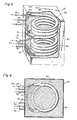
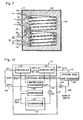
- FIGs. 5, 6 and 7 illustrate the manner in which the conduits 70, 74, 76, and 78 are coiled within a rectangular box 80.
- conduits 70, 74, 76, and 78 are preferably coiled such that conduits 70 and 76 comprising the subcooler 26 are disposed adjacent the conduits 74 and 78 comprising the precooler 24.
- the box 80 is filled with a rigid, insulative foam 82 which secures the conduits 70, 74, 76 and 78 in position within the box 80 while also protecting and insulating conduits 70, 74, 76 and 78 from the environment.
- Fig. 8 is a simplified cut-away perspective view of a typical heat pump 12 having the precool/ subcool system 10 of the invention retrofitted thereto.
- the heat pump 12 comprises a condenser 16 which is air cooled by a fan means 84 which circulates air over the condenser 16.
- the output 85 of the condenser 16 is connected to the input 86 of the first refrigerant conduit 76.
- the output 88 of the first refrigerant conduit 76 is then connected to the input 90 of the evaporator 20 disposed within an air handling unit 22.
- a trough 92, together with a drainpipe 94, is provided for draining off the condensate forming on the evaporator 20.
- the output 96 of the evaporator 20 is then connected to a switching valve 98 which controls the operation of the heat pump 12 to switch to and from a cooling mode and a heating mode.
- the output 100 of the switching valve 98 is connected to the input 102 of the compressor 14.
- the output 104 of the compressor is connected through the switching valve 98 to the input 106 of the second refrigerant conduit 78.
- the output 108 of the second refrigerant conduit 78 is then connected to the input 110 of the condenser 16 thereby completing the refrigeration cycle.
- a fluid such as water
- the fluid flows through_the first fluid conduit 70 and then through the second fluid conduit 74 to precool the refrigerant prior to flowing through the condenser 16.
- the heated fluid is then discharged from the output 34 of the second fluid conduit 74.
- Fig. 9 is a block diagram of the heat pump 12 having the precool/subcool system 10 of the invention installed therein illustrating the different water sources 72 and the manner in which the water is supplied to the subcooler 26 and the precooler/post heater 24.
- the water sources 72 may comprise municipal water 112 supplied by a city or a county, ground water 114 supplied by a well, waste water 116 supplied, for example, by a manufacturing plant, a water tower 118, a ground heat sink 120, or any combination thereof.
- the water supplied by the water sources 112-120 are supplied to the input 28 of the subcooler 26.
- the output 34 of the precooler/post heater 24 is connected to the input of the water tower 118 and the ground heat sink 120 via a return conduit 121.
- the water from the precooler/post heater 24 may be discharged to the environment.
- Fig. 9 also illustrates the manner in which the water is supplied to both the subcooler 26 and the precooler/post heater 24. More particularly, a valve 122 is connected to the input 28 of the subcooler 26 to regulate flow of water therethrough. A three-way valve 124 is interconnected between the output 30 of the subcooler 26 and the input 32 of the precooler/post heater 24. A conduit 126 is connected in fluid communication with the water source 72 and the three-way valve 124. Another three-way valve 128 is interposed within conduit 126 enabling a discharge conduit 130 to be connected in fluid communication with conduit 126. Finally, another valve 132 is connected in fluid communication with the output 34 of the precooler/ post heater 24.
- the output of ' the discharge conduit 130 and/or the output from valve 132 may be connected in fluid communication with the return conduit 121 enabling the heated water to be fed back to the water tower 118 and/or the external heat sink 120.
- Each of the valves, or a combination of them may comprise an electrically operated solenoid gate valve, high side head pressure valve, low side suction pressure valve, a temperature sensing valve, or basically, any type of fluid control device. Accordingly, it should be appreciated that water may be selectively regulated to flow through the subcooler 26 and/or the precooler/post heater 24 at any flow rate. More particularly, the valves 122, 124, 128, and 132 enable the water flow to be regulated such that a greater or lesser amount of water flows through the subcooler 26 than the precooler/post heater 24.
- Figs. 10-12 illustrate an improved combination water and air-cooled condenser 132 of the invention.
- the condenser 132 comprises a plurality of baffles 134 vertically disposed with respect to one another and angularly sloped inwardly from the substantially rectangular framework 135 of the tower 137.
- a condenser conduit 136 is rigidly connected to the lowermost edge 138 of each of the baffles 134 such that the conduit 136 forms a coil within the tower 137.
- the output 34 of the precooler 24 is connected in fluid communication with a plurality of spray heads 140 connected to the upper framework 135 above the baffles 134 such that the water sprayed from the spray heads 140 is directed at the baffles 134.
- a reservoir 142 is positioned below the baffles 134 to catch the sprayed water as the water drips down the baffles 134 and over the condenser conduit 136.
- a return conduit 139 interconnects the reservoir 142 and a heat exchanger 146 buried within the ground.
- a pump 144 is connected in fluid communication with the return conduit 139 for pumping the water contained within the reservoir 142 through the heat exchanger 146 via return conduit 139 and then through the precool/subcool system 10 to the spray heads 140 via conduits 141 and 143, respectively. Accordingly, it should be appreciated that only one pump 144 is required to circulate the water through the heat exchanger 146, air/water-cooled condenser 132, and the subcooler/precooler 10 of the invention.
- a water supply conduit 148 is connected to the input of the heat exchanger 146 to supply make-up water to the system which is lost by evaporation within the condenser 132.
- the novel water and air-cooled condenser 132 achieves all of the benefits of both a straightair- cooled condenser and a water-cooled condenser. More particularly, the water sprayed from the spray heads 140 cools the refrigerant flowing through the condenser conduit 138 thereby causing the refrigerant to change from a gaseous to a liquid state. The sprayed water is simultaneously exposed to the atmosphere such that part of the water is evaporated to the atmosphere. The heat of vaporization lost to the atmosphere therefore reduces the ambient temperature of the water in the reservoir 142. The temperature of the water is further reduced by flowing the water through the heat exchanger 146 buried in the ground.
- the relatively cool water is then forced through the precool/subcool system 10 to precool and subcool the refrigerant flowing into and being discharged from the condenser conduit 138, respectively.
- the water is then sprayed through the spray heads 140 to be returned to the reservoir 142.
- the operating temperature of the refrigerant and the water as they flow throughout the system has been indicated within Figs. 10-12. This should illustrate the fact that the condenser 132 operates to condense the refrigerant to a liquid at approximately 1 ⁇ 5°F.
- the heat exchanger 146 operates to cool the water to approximately 72°F prior to being supplied to the subcooler 26 of the invention.
Landscapes
- Engineering & Computer Science (AREA)
- Physics & Mathematics (AREA)
- Mechanical Engineering (AREA)
- Thermal Sciences (AREA)
- General Engineering & Computer Science (AREA)
- Compression-Type Refrigeration Machines With Reversible Cycles (AREA)
- Air-Conditioning For Vehicles (AREA)
- Other Air-Conditioning Systems (AREA)
Applications Claiming Priority (2)
| Application Number | Priority Date | Filing Date | Title |
|---|---|---|---|
| US06/247,247 US4373346A (en) | 1981-03-25 | 1981-03-25 | Precool/subcool system and condenser therefor |
| US247247 | 1994-05-23 |
Publications (2)
| Publication Number | Publication Date |
|---|---|
| EP0061349A2 true EP0061349A2 (fr) | 1982-09-29 |
| EP0061349A3 EP0061349A3 (fr) | 1983-08-03 |
Family
ID=22934193
Family Applications (1)
| Application Number | Title | Priority Date | Filing Date |
|---|---|---|---|
| EP82301525A Withdrawn EP0061349A3 (fr) | 1981-03-25 | 1982-03-24 | Dispositif et méthode de transfert thermique pour pré- et sous-refroidir et condensateur à cet effet |
Country Status (9)
| Country | Link |
|---|---|
| US (1) | US4373346A (fr) |
| EP (1) | EP0061349A3 (fr) |
| JP (1) | JPS58500453A (fr) |
| KR (1) | KR830009450A (fr) |
| BR (1) | BR8207287A (fr) |
| CA (1) | CA1169668A (fr) |
| IL (1) | IL65280A0 (fr) |
| WO (1) | WO1982003449A1 (fr) |
| ZA (1) | ZA821834B (fr) |
Cited By (3)
| Publication number | Priority date | Publication date | Assignee | Title |
|---|---|---|---|---|
| WO2012101342A1 (fr) * | 2011-01-28 | 2012-08-02 | Peugeot Citroen Automobiles Sa | Installation de chauffage/climatisation à échangeur de chaleur et sous-refroidisseur externes pour augmenter les puissances de chauffage et de réfrigération |
| WO2012113049A1 (fr) * | 2011-02-22 | 2012-08-30 | Whirlpool S.A.S | Système de refroidissement de compresseur utilisant un pré-condenseur d'échangeur de chaleur, et compresseur doté d'un système de refroidissement |
| US20160033166A1 (en) * | 2013-03-15 | 2016-02-04 | Olive Tree Patents 1 Llc | Thermal recovery system and method |
Families Citing this family (52)
| Publication number | Priority date | Publication date | Assignee | Title |
|---|---|---|---|---|
| SE440551B (sv) | 1981-03-20 | 1985-08-05 | Thermia Verken Ab | Vermepump for uppvermning och tappvarmvattenberedning |
| US4553401A (en) * | 1982-03-05 | 1985-11-19 | Fisher Ralph H | Reversible cycle heating and cooling system |
| US4463575A (en) * | 1982-09-28 | 1984-08-07 | Mccord James W | Vapor generating and recovery apparatus including a refrigerant system with refrigerant heat removal means |
| JPS6198955U (fr) * | 1984-12-05 | 1986-06-25 | ||
| US4751823A (en) * | 1985-10-02 | 1988-06-21 | Hans Walter A | Control arrangement affecting operation, safety and efficiency of a heat recovery system |
| US4936109A (en) * | 1986-10-06 | 1990-06-26 | Columbia Energy Storage, Inc. | System and method for reducing gas compressor energy requirements |
| US4761964A (en) * | 1986-10-22 | 1988-08-09 | Pacheco Jerry J | Apparatus for enhancing the performance of a heat pump and the like |
| US4732007A (en) * | 1986-12-23 | 1988-03-22 | Gas Research Institute | Auxiliary thermal interface to cooling/heating systems |
| US4959975A (en) * | 1987-05-14 | 1990-10-02 | Conserve, Inc. | Heat pump system |
| US4745768A (en) * | 1987-08-27 | 1988-05-24 | The Brooklyn Union Gas Company | Combustion-powered refrigeration with decreased fuel consumption |
| US4920757A (en) * | 1988-08-18 | 1990-05-01 | Jimmy Gazes | Geothermal heating and air conditioning system |
| US5004374A (en) * | 1990-02-28 | 1991-04-02 | Bettie Grey | Method of laying out a pathway for piping |
| AU2675492A (en) * | 1991-09-19 | 1993-04-27 | Halozone Recycling Inc. | Thermal inter-cooler |
| US5289699A (en) * | 1991-09-19 | 1994-03-01 | Mayer Holdings S.A. | Thermal inter-cooler |
| US5297397A (en) * | 1991-11-11 | 1994-03-29 | Pointer Ronald J | Efficiency directed supplemental condensing for high ambient refrigeration operation |
| FR2692343B1 (fr) * | 1992-06-16 | 1997-06-13 | Armines | Systeme frigorifique a compression bi-etagee. |
| US5265433A (en) * | 1992-07-10 | 1993-11-30 | Beckwith William R | Air conditioning waste heat/reheat method and apparatus |
| US5386709A (en) * | 1992-12-10 | 1995-02-07 | Baltimore Aircoil Company, Inc. | Subcooling and proportional control of subcooling of liquid refrigerant circuits with thermal storage or low temperature reservoirs |
| US5440894A (en) * | 1993-05-05 | 1995-08-15 | Hussmann Corporation | Strategic modular commercial refrigeration |
| US5558273A (en) * | 1994-11-10 | 1996-09-24 | Advanced Mechanical Technology, Inc. | Two-pipe system for refrigerant isolation |
| US5729987A (en) * | 1996-02-27 | 1998-03-24 | Miller; Joel V. | Desalinization method and apparatus |
| US5689966A (en) * | 1996-03-22 | 1997-11-25 | Battelle Memorial Institute | Method and apparatus for desuperheating refrigerant |
| US6070423A (en) * | 1998-10-08 | 2000-06-06 | Hebert; Thomas H. | Building exhaust and air conditioner condenstate (and/or other water source) evaporative refrigerant subcool/precool system and method therefor |
| US7150160B2 (en) * | 1998-10-08 | 2006-12-19 | Global Energy Group, Inc. | Building exhaust and air conditioner condensate (and/or other water source) evaporative refrigerant subcool/precool system and method therefor |
| US6857285B2 (en) * | 1998-10-08 | 2005-02-22 | Global Energy Group, Inc. | Building exhaust and air conditioner condensate (and/or other water source) evaporative refrigerant subcool/precool system and method therefor |
| US6604376B1 (en) * | 1999-01-08 | 2003-08-12 | Victor M. Demarco | Heat pump using treated water effluent |
| EP1409935B1 (fr) * | 1999-09-24 | 2013-01-02 | Peter Forrest Thompson | Systeme de chauffage du fluide dans une pompe a chaleur |
| US6823684B2 (en) * | 2002-02-08 | 2004-11-30 | Tim Allan Nygaard Jensen | System and method for cooling air |
| US6862894B1 (en) * | 2004-02-04 | 2005-03-08 | Donald R. Miles | Adaptive auxiliary condensing device and method |
| SE527882C2 (sv) * | 2004-11-26 | 2006-07-04 | Foersta Naervaermeverket Ab | Värmeanläggning och uppvärmningsförfarande |
| US7441412B2 (en) | 2005-01-26 | 2008-10-28 | Tim Allan Nygaard Jensen | Heat transfer system and method |
| US7805953B2 (en) * | 2005-08-09 | 2010-10-05 | Tim Allan Nygaard Jensen | Prefilter system for heat transfer unit and method |
| ITBA20060054A1 (it) * | 2006-09-20 | 2008-03-21 | Giuseppe Giovanni Renna | Impianto frigorifero dotato di sottoraffreddamento controllato |
| KR101340725B1 (ko) * | 2006-10-17 | 2013-12-12 | 엘지전자 주식회사 | 수냉식 공기조화기 |
| US8376030B2 (en) * | 2006-12-26 | 2013-02-19 | Jayant Jatkar | Reducing cost of heating and air-conditioning |
| US7658082B2 (en) * | 2007-02-01 | 2010-02-09 | Cotherm Of America Corporation | Heat transfer system and associated methods |
| WO2009113881A1 (fr) * | 2008-03-10 | 2009-09-17 | Matrix Engineering Limited | Elément chauffant pour l’eau d’une pompe à chaleur |
| US20100146996A1 (en) * | 2008-12-11 | 2010-06-17 | International Business Machines Corporation | Data center cooling energy recovery system |
| US20100199693A1 (en) * | 2009-02-09 | 2010-08-12 | David Andrew Benesch | System for Increasing the Efficiency of a Conventional Air Conditioning System |
| EP2400234B1 (fr) * | 2009-02-20 | 2018-05-02 | Mitsubishi Electric Corporation | Unité côté utilisation et climatiseur |
| US8511109B2 (en) * | 2009-07-15 | 2013-08-20 | Whirlpool Corporation | High efficiency refrigerator |
| KR20120061534A (ko) * | 2010-12-03 | 2012-06-13 | 현대자동차주식회사 | 수냉식 응축기 |
| JP5136968B2 (ja) * | 2011-03-31 | 2013-02-06 | 三浦工業株式会社 | 蒸気発生システム |
| US20120047936A1 (en) * | 2011-04-18 | 2012-03-01 | General Electric Company | Appliance refrigeration system with final condenser |
| US20130186122A1 (en) * | 2011-07-25 | 2013-07-25 | David Hamilton | Hot Water Heater Pre-Heating Apparatus |
| US9982897B2 (en) | 2011-12-05 | 2018-05-29 | Timothy Michael Graboski | Solar hot water and recovery system |
| US9618214B2 (en) * | 2013-03-15 | 2017-04-11 | Energy Recovery Systems Inc. | Energy exchange system and method |
| US9016074B2 (en) * | 2013-03-15 | 2015-04-28 | Energy Recovery Systems Inc. | Energy exchange system and method |
| US9612026B2 (en) * | 2015-05-07 | 2017-04-04 | Ahmad Younis Mothfar | Portable evaporative cooler for vehicles |
| US20180187927A1 (en) * | 2017-01-03 | 2018-07-05 | Heatcraft Refrigeration Products Llc | System and method for reusing waste heat of a transcritical refrigeration system |
| CN107763850B (zh) * | 2017-11-07 | 2023-10-27 | 南京航空航天大学 | 制取不低于100℃沸水的方法 |
| DE102022121699A1 (de) * | 2022-08-26 | 2024-02-29 | Konvekta Aktiengesellschaft | Wärmepumpenanlage mit mehrstufiger Wärmeübertragung und Verfahren dazu |
Family Cites Families (26)
| Publication number | Priority date | Publication date | Assignee | Title |
|---|---|---|---|---|
| FR487762A (fr) * | 1916-12-18 | 1918-07-24 | Henri Zoelly | Procédé pour le chauffage de l'eau froide destinée à l'alimentation en eau chaude de batiments, etc. |
| US1394627A (en) * | 1920-10-20 | 1921-10-25 | Koedding William | Surface condenser |
| US2166158A (en) * | 1937-09-21 | 1939-07-18 | Westinghouse Electric & Mfg Co | Refrigerating apparatus |
| CH224584A (de) * | 1941-11-14 | 1942-12-15 | Sulzer Ag | Nach dem Kompressionssystem arbeitende Wärmepumpenanlage. |
| US2548508A (en) * | 1946-03-05 | 1951-04-10 | Alfred S Wolfner | Thermal system |
| US2516093A (en) * | 1949-05-05 | 1950-07-18 | V C Patterson & Associates Inc | Heat pump water heater and method of heat exchange |
| FR1155278A (fr) * | 1955-08-01 | 1958-04-24 | Svenska Flaektfabriken Ab | Procédé et appareil pour le conditionnement de l'air dans les chambres |
| US2893218A (en) * | 1958-02-21 | 1959-07-07 | Borg Warner | Air conditioning systems |
| US3169575A (en) * | 1961-10-27 | 1965-02-16 | Baltimore Aircoil Co Inc | Evaporative heat exchanger |
| US3188829A (en) * | 1964-03-12 | 1965-06-15 | Carrier Corp | Conditioning apparatus |
| US3362184A (en) * | 1966-11-30 | 1968-01-09 | Westinghouse Electric Corp | Air conditioning systems with reheat coils |
| US3976123A (en) * | 1975-05-27 | 1976-08-24 | Davies Thomas D | Refrigeration system for controlled heating using rejected heat of an air conditioner |
| US3979923A (en) * | 1975-08-04 | 1976-09-14 | Jennings John H | Preassembled refrigerant subcooling unit |
| US4089667A (en) * | 1976-10-27 | 1978-05-16 | Sun-Econ, Inc. | Heat extraction or reclamation apparatus for refrigerating and air conditioning systems |
| US4098092A (en) * | 1976-12-09 | 1978-07-04 | Singh Kanwal N | Heating system with water heater recovery |
| FR2406171A1 (fr) * | 1977-10-13 | 1979-05-11 | Madar Alain | Moyen de surrefroidir le condensat par milieux externes dans une installation frigorifique ou de pompe de chaleur et l'application avantageuse de ce surrefroidissement |
| GB1601820A (en) * | 1977-10-29 | 1981-11-04 | Glover E | Reversiblecycle air-conditioning units |
| US4173865A (en) * | 1978-04-25 | 1979-11-13 | General Electric Company | Auxiliary coil arrangement |
| FR2439371A1 (fr) * | 1978-10-16 | 1980-05-16 | Airgel | Moyen d'ameliorer les performances des installations frigorifiques ou de pompe de chaleur |
| US4257239A (en) * | 1979-01-05 | 1981-03-24 | Partin James R | Earth coil heating and cooling system |
| US4270363A (en) * | 1979-04-16 | 1981-06-02 | Schneider Metal Manufacturing Company | Refrigerating machine including energy conserving heat exchange apparatus |
| US4280334A (en) * | 1979-06-26 | 1981-07-28 | Lakdawala Ness R | Water condensate recovery device |
| EP0041957A1 (fr) * | 1979-12-03 | 1981-12-23 | Wemac Finanz-Und Handelsanstalt | Procede d'obtention de chaleur pour le chauffage et dispositif de mise en oeuvre de ce procede |
| WO1981001738A1 (fr) * | 1979-12-15 | 1981-06-25 | Bauer I | Procede de mise en action d'une pompe a chaleur, ainsi que pompe pour la mise en oeuvre du procede |
| DE3016833A1 (de) * | 1980-05-02 | 1981-11-05 | Erwin Brandes, Kühlanlagen GmbH, 2890 Nordenham | Dublex-koaxial-kondensator fuer waermepumpen |
| DE3034965C2 (de) * | 1980-09-17 | 1983-05-05 | Wieland-Werke Ag, 7900 Ulm | Wärmeübertragungseinrichtung für Wärmepumpen |
-
1981
- 1981-03-25 US US06/247,247 patent/US4373346A/en not_active Expired - Lifetime
-
1982
- 1982-03-17 IL IL65280A patent/IL65280A0/xx unknown
- 1982-03-18 ZA ZA821834A patent/ZA821834B/xx unknown
- 1982-03-22 BR BR8207287A patent/BR8207287A/pt unknown
- 1982-03-22 JP JP57501299A patent/JPS58500453A/ja active Pending
- 1982-03-22 WO PCT/US1982/000341 patent/WO1982003449A1/fr not_active Ceased
- 1982-03-24 EP EP82301525A patent/EP0061349A3/fr not_active Withdrawn
- 1982-03-24 KR KR1019820001261A patent/KR830009450A/ko not_active Withdrawn
- 1982-03-24 CA CA000399240A patent/CA1169668A/fr not_active Expired
Cited By (5)
| Publication number | Priority date | Publication date | Assignee | Title |
|---|---|---|---|---|
| WO2012101342A1 (fr) * | 2011-01-28 | 2012-08-02 | Peugeot Citroen Automobiles Sa | Installation de chauffage/climatisation à échangeur de chaleur et sous-refroidisseur externes pour augmenter les puissances de chauffage et de réfrigération |
| FR2971042A1 (fr) * | 2011-01-28 | 2012-08-03 | Peugeot Citroen Automobiles Sa | Installation de chauffage/climatisation a echangeur de chaleur et sous-refroidisseur externes pour augmenter les puissances de chauffage et de refrigeration |
| WO2012113049A1 (fr) * | 2011-02-22 | 2012-08-30 | Whirlpool S.A.S | Système de refroidissement de compresseur utilisant un pré-condenseur d'échangeur de chaleur, et compresseur doté d'un système de refroidissement |
| US20160033166A1 (en) * | 2013-03-15 | 2016-02-04 | Olive Tree Patents 1 Llc | Thermal recovery system and method |
| US9920951B2 (en) * | 2013-03-15 | 2018-03-20 | Olive Tree Patents 1 Llc | Thermal recovery system and method |
Also Published As
| Publication number | Publication date |
|---|---|
| CA1169668A (fr) | 1984-06-26 |
| JPS58500453A (ja) | 1983-03-24 |
| US4373346A (en) | 1983-02-15 |
| EP0061349A3 (fr) | 1983-08-03 |
| IL65280A0 (en) | 1982-05-31 |
| KR830009450A (ko) | 1983-12-21 |
| ZA821834B (en) | 1983-04-27 |
| WO1982003449A1 (fr) | 1982-10-14 |
| BR8207287A (pt) | 1983-03-29 |
Similar Documents
| Publication | Publication Date | Title |
|---|---|---|
| US4373346A (en) | Precool/subcool system and condenser therefor | |
| US9920951B2 (en) | Thermal recovery system and method | |
| US4608836A (en) | Multi-mode off-peak storage heat pump | |
| US6070423A (en) | Building exhaust and air conditioner condenstate (and/or other water source) evaporative refrigerant subcool/precool system and method therefor | |
| US6167715B1 (en) | Direct refrigerant geothermal heat exchange or multiple source subcool/postheat/precool system therefor | |
| US20020033024A1 (en) | Utilization of harvest and/or melt water from an ice machine for a refrigerant subcool/precool system and method therefor | |
| US6116048A (en) | Dual evaporator for indoor units and method therefor | |
| US7150160B2 (en) | Building exhaust and air conditioner condensate (and/or other water source) evaporative refrigerant subcool/precool system and method therefor | |
| US4569207A (en) | Heat pump heating and cooling system | |
| US2359595A (en) | Refrigerating system | |
| US4471630A (en) | Cooling system having combination of compression and absorption type units | |
| US20130061615A1 (en) | Condensate-free outdoor air cooling unit | |
| US3638452A (en) | Series water-cooling circuit for gas heat pump | |
| WO1990007683A1 (fr) | Dispositif a cycle de carnot renverse en conditions transcritiques | |
| KR20070102621A (ko) | 보조냉각기를 이용한 hvac 시스템 | |
| CN105698424B (zh) | 一种超低温制冷方法 | |
| US6314747B1 (en) | Vapor compression system and method | |
| US5852939A (en) | Heating and air conditioning device using geothermal heat exchange | |
| US4318277A (en) | Non-reverse hot gas defrost system | |
| US3065610A (en) | Charge stabilizer for heat pump | |
| US3064446A (en) | Air conditioning apparatus | |
| US4246760A (en) | Non-reverse hot gas defrost system | |
| KR100534003B1 (ko) | 열매체를 사용하는 냉난방시스템 | |
| JP3903292B2 (ja) | 蓄熱式空気調和装置 | |
| AU8334582A (en) | Precool/subcool system and condenser therefor |
Legal Events
| Date | Code | Title | Description |
|---|---|---|---|
| PUAI | Public reference made under article 153(3) epc to a published international application that has entered the european phase |
Free format text: ORIGINAL CODE: 0009012 |
|
| AK | Designated contracting states |
Designated state(s): AT BE CH DE FR GB IT LI LU NL SE |
|
| PUAL | Search report despatched |
Free format text: ORIGINAL CODE: 0009013 |
|
| AK | Designated contracting states |
Designated state(s): AT BE CH DE FR GB IT LI LU NL SE |
|
| 17P | Request for examination filed |
Effective date: 19840201 |
|
| STAA | Information on the status of an ep patent application or granted ep patent |
Free format text: STATUS: THE APPLICATION IS DEEMED TO BE WITHDRAWN |
|
| 18D | Application deemed to be withdrawn |
Effective date: 19851209 |