EP0061414B1 - High clarity colorless polyesters - Google Patents
High clarity colorless polyesters Download PDFInfo
- Publication number
- EP0061414B1 EP0061414B1 EP82630017A EP82630017A EP0061414B1 EP 0061414 B1 EP0061414 B1 EP 0061414B1 EP 82630017 A EP82630017 A EP 82630017A EP 82630017 A EP82630017 A EP 82630017A EP 0061414 B1 EP0061414 B1 EP 0061414B1
- Authority
- EP
- European Patent Office
- Prior art keywords
- polyester
- compound
- cobalt
- amount
- weight
- Prior art date
- Legal status (The legal status is an assumption and is not a legal conclusion. Google has not performed a legal analysis and makes no representation as to the accuracy of the status listed.)
- Expired
Links
- 229920000728 polyester Polymers 0.000 title claims description 59
- -1 phosphorus compound Chemical class 0.000 claims description 35
- IKHGUXGNUITLKF-UHFFFAOYSA-N Acetaldehyde Chemical compound CC=O IKHGUXGNUITLKF-UHFFFAOYSA-N 0.000 claims description 34
- 230000007935 neutral effect Effects 0.000 claims description 28
- 229910052698 phosphorus Inorganic materials 0.000 claims description 26
- 239000011574 phosphorus Substances 0.000 claims description 26
- 229920001225 polyester resin Polymers 0.000 claims description 22
- 239000004645 polyester resin Substances 0.000 claims description 22
- LYCAIKOWRPUZTN-UHFFFAOYSA-N ethylene glycol Natural products OCCO LYCAIKOWRPUZTN-UHFFFAOYSA-N 0.000 claims description 21
- 229910052787 antimony Inorganic materials 0.000 claims description 20
- WATWJIUSRGPENY-UHFFFAOYSA-N antimony atom Chemical compound [Sb] WATWJIUSRGPENY-UHFFFAOYSA-N 0.000 claims description 20
- 229910017052 cobalt Inorganic materials 0.000 claims description 20
- 239000010941 cobalt Substances 0.000 claims description 20
- GUTLYIVDDKVIGB-UHFFFAOYSA-N cobalt atom Chemical compound [Co] GUTLYIVDDKVIGB-UHFFFAOYSA-N 0.000 claims description 20
- OAICVXFJPJFONN-UHFFFAOYSA-N Phosphorus Chemical compound [P] OAICVXFJPJFONN-UHFFFAOYSA-N 0.000 claims description 16
- 150000001869 cobalt compounds Chemical class 0.000 claims description 16
- 125000004432 carbon atom Chemical group C* 0.000 claims description 14
- 150000001463 antimony compounds Chemical class 0.000 claims description 13
- 150000001875 compounds Chemical class 0.000 claims description 13
- NBIIXXVUZAFLBC-UHFFFAOYSA-N Phosphoric acid Chemical compound OP(O)(O)=O NBIIXXVUZAFLBC-UHFFFAOYSA-N 0.000 claims description 12
- OFOBLEOULBTSOW-UHFFFAOYSA-N Malonic acid Chemical compound OC(=O)CC(O)=O OFOBLEOULBTSOW-UHFFFAOYSA-N 0.000 claims description 10
- 238000006243 chemical reaction Methods 0.000 claims description 9
- KKEYFWRCBNTPAC-UHFFFAOYSA-N Terephthalic acid Chemical compound OC(=O)C1=CC=C(C(O)=O)C=C1 KKEYFWRCBNTPAC-UHFFFAOYSA-N 0.000 claims description 7
- 229910000147 aluminium phosphate Inorganic materials 0.000 claims description 6
- 150000002334 glycols Chemical class 0.000 claims description 6
- WGCNASOHLSPBMP-UHFFFAOYSA-N hydroxyacetaldehyde Natural products OCC=O WGCNASOHLSPBMP-UHFFFAOYSA-N 0.000 claims description 6
- 150000005846 sugar alcohols Polymers 0.000 claims description 6
- 125000003118 aryl group Chemical group 0.000 claims description 4
- 229940011182 cobalt acetate Drugs 0.000 claims description 4
- QAHREYKOYSIQPH-UHFFFAOYSA-L cobalt(II) acetate Chemical compound [Co+2].CC([O-])=O.CC([O-])=O QAHREYKOYSIQPH-UHFFFAOYSA-L 0.000 claims description 4
- WYOFTXWVYIGTCT-UHFFFAOYSA-K [OH-].[Sb+3].OCC([O-])=O.OCC([O-])=O Chemical compound [OH-].[Sb+3].OCC([O-])=O.OCC([O-])=O WYOFTXWVYIGTCT-UHFFFAOYSA-K 0.000 claims description 3
- 239000003054 catalyst Substances 0.000 description 22
- 229910019142 PO4 Inorganic materials 0.000 description 18
- 235000021317 phosphate Nutrition 0.000 description 18
- 239000003795 chemical substances by application Substances 0.000 description 14
- WOZVHXUHUFLZGK-UHFFFAOYSA-N dimethyl terephthalate Chemical compound COC(=O)C1=CC=C(C(=O)OC)C=C1 WOZVHXUHUFLZGK-UHFFFAOYSA-N 0.000 description 14
- 239000010452 phosphate Substances 0.000 description 14
- 238000006116 polymerization reaction Methods 0.000 description 12
- 229920000642 polymer Polymers 0.000 description 9
- 235000013305 food Nutrition 0.000 description 8
- NBIIXXVUZAFLBC-UHFFFAOYSA-K phosphate Chemical compound [O-]P([O-])([O-])=O NBIIXXVUZAFLBC-UHFFFAOYSA-K 0.000 description 8
- 239000007787 solid Substances 0.000 description 8
- 238000000034 method Methods 0.000 description 7
- 238000006068 polycondensation reaction Methods 0.000 description 7
- 229920005989 resin Polymers 0.000 description 7
- 239000011347 resin Substances 0.000 description 7
- 238000002360 preparation method Methods 0.000 description 6
- 150000002009 diols Chemical class 0.000 description 5
- 229910052751 metal Inorganic materials 0.000 description 5
- 239000002184 metal Substances 0.000 description 5
- 150000003013 phosphoric acid derivatives Chemical class 0.000 description 5
- 239000002253 acid Substances 0.000 description 4
- 235000013361 beverage Nutrition 0.000 description 4
- WERYXYBDKMZEQL-UHFFFAOYSA-N butane-1,4-diol Chemical compound OCCCCO WERYXYBDKMZEQL-UHFFFAOYSA-N 0.000 description 4
- 230000032050 esterification Effects 0.000 description 4
- 238000005886 esterification reaction Methods 0.000 description 4
- 235000019640 taste Nutrition 0.000 description 4
- MUBZPKHOEPUJKR-UHFFFAOYSA-N Oxalic acid Chemical compound OC(=O)C(O)=O MUBZPKHOEPUJKR-UHFFFAOYSA-N 0.000 description 3
- DNIAPMSPPWPWGF-UHFFFAOYSA-N Propylene glycol Chemical compound CC(O)CO DNIAPMSPPWPWGF-UHFFFAOYSA-N 0.000 description 3
- 150000001991 dicarboxylic acids Chemical class 0.000 description 3
- WPBNNNQJVZRUHP-UHFFFAOYSA-L manganese(2+);methyl n-[[2-(methoxycarbonylcarbamothioylamino)phenyl]carbamothioyl]carbamate;n-[2-(sulfidocarbothioylamino)ethyl]carbamodithioate Chemical compound [Mn+2].[S-]C(=S)NCCNC([S-])=S.COC(=O)NC(=S)NC1=CC=CC=C1NC(=S)NC(=O)OC WPBNNNQJVZRUHP-UHFFFAOYSA-L 0.000 description 3
- XNGIFLGASWRNHJ-UHFFFAOYSA-N phthalic acid Chemical compound OC(=O)C1=CC=CC=C1C(O)=O XNGIFLGASWRNHJ-UHFFFAOYSA-N 0.000 description 3
- 239000002904 solvent Substances 0.000 description 3
- 238000012360 testing method Methods 0.000 description 3
- XLYOFNOQVPJJNP-UHFFFAOYSA-N water Substances O XLYOFNOQVPJJNP-UHFFFAOYSA-N 0.000 description 3
- PUPZLCDOIYMWBV-UHFFFAOYSA-N (+/-)-1,3-Butanediol Chemical compound CC(O)CCO PUPZLCDOIYMWBV-UHFFFAOYSA-N 0.000 description 2
- QPFMBZIOSGYJDE-UHFFFAOYSA-N 1,1,2,2-tetrachloroethane Chemical compound ClC(Cl)C(Cl)Cl QPFMBZIOSGYJDE-UHFFFAOYSA-N 0.000 description 2
- OYPRJOBELJOOCE-UHFFFAOYSA-N Calcium Chemical compound [Ca] OYPRJOBELJOOCE-UHFFFAOYSA-N 0.000 description 2
- FYYHWMGAXLPEAU-UHFFFAOYSA-N Magnesium Chemical compound [Mg] FYYHWMGAXLPEAU-UHFFFAOYSA-N 0.000 description 2
- RTAQQCXQSZGOHL-UHFFFAOYSA-N Titanium Chemical compound [Ti] RTAQQCXQSZGOHL-UHFFFAOYSA-N 0.000 description 2
- WNLRTRBMVRJNCN-UHFFFAOYSA-N adipic acid Chemical compound OC(=O)CCCCC(O)=O WNLRTRBMVRJNCN-UHFFFAOYSA-N 0.000 description 2
- 229940058905 antimony compound for treatment of leishmaniasis and trypanosomiasis Drugs 0.000 description 2
- ADCOVFLJGNWWNZ-UHFFFAOYSA-N antimony trioxide Chemical compound O=[Sb]O[Sb]=O ADCOVFLJGNWWNZ-UHFFFAOYSA-N 0.000 description 2
- OWBTYPJTUOEWEK-UHFFFAOYSA-N butane-2,3-diol Chemical compound CC(O)C(C)O OWBTYPJTUOEWEK-UHFFFAOYSA-N 0.000 description 2
- 229910052791 calcium Inorganic materials 0.000 description 2
- 239000011575 calcium Substances 0.000 description 2
- 230000003197 catalytic effect Effects 0.000 description 2
- 239000003086 colorant Substances 0.000 description 2
- 238000009833 condensation Methods 0.000 description 2
- 230000005494 condensation Effects 0.000 description 2
- 230000009849 deactivation Effects 0.000 description 2
- 150000002148 esters Chemical class 0.000 description 2
- 150000002291 germanium compounds Chemical class 0.000 description 2
- YBMRDBCBODYGJE-UHFFFAOYSA-N germanium dioxide Chemical compound O=[Ge]=O YBMRDBCBODYGJE-UHFFFAOYSA-N 0.000 description 2
- 229910052749 magnesium Inorganic materials 0.000 description 2
- 239000011777 magnesium Substances 0.000 description 2
- 238000004519 manufacturing process Methods 0.000 description 2
- 150000002739 metals Chemical class 0.000 description 2
- 239000000203 mixture Substances 0.000 description 2
- BDJRBEYXGGNYIS-UHFFFAOYSA-N nonanedioic acid Chemical compound OC(=O)CCCCCCCC(O)=O BDJRBEYXGGNYIS-UHFFFAOYSA-N 0.000 description 2
- 239000008188 pellet Substances 0.000 description 2
- WLJVNTCWHIRURA-UHFFFAOYSA-N pimelic acid Chemical compound OC(=O)CCCCCC(O)=O WLJVNTCWHIRURA-UHFFFAOYSA-N 0.000 description 2
- 229920000139 polyethylene terephthalate Polymers 0.000 description 2
- 239000005020 polyethylene terephthalate Substances 0.000 description 2
- YPFDHNVEDLHUCE-UHFFFAOYSA-N propane-1,3-diol Chemical compound OCCCO YPFDHNVEDLHUCE-UHFFFAOYSA-N 0.000 description 2
- 150000003839 salts Chemical class 0.000 description 2
- CXMXRPHRNRROMY-UHFFFAOYSA-N sebacic acid Chemical compound OC(=O)CCCCCCCCC(O)=O CXMXRPHRNRROMY-UHFFFAOYSA-N 0.000 description 2
- TYFQFVWCELRYAO-UHFFFAOYSA-N suberic acid Chemical compound OC(=O)CCCCCCC(O)=O TYFQFVWCELRYAO-UHFFFAOYSA-N 0.000 description 2
- KKEYFWRCBNTPAC-UHFFFAOYSA-L terephthalate(2-) Chemical compound [O-]C(=O)C1=CC=C(C([O-])=O)C=C1 KKEYFWRCBNTPAC-UHFFFAOYSA-L 0.000 description 2
- 239000010936 titanium Substances 0.000 description 2
- 229910052719 titanium Inorganic materials 0.000 description 2
- 150000003609 titanium compounds Chemical class 0.000 description 2
- 238000011179 visual inspection Methods 0.000 description 2
- 229940083957 1,2-butanediol Drugs 0.000 description 1
- RTBFRGCFXZNCOE-UHFFFAOYSA-N 1-methylsulfonylpiperidin-4-one Chemical compound CS(=O)(=O)N1CCC(=O)CC1 RTBFRGCFXZNCOE-UHFFFAOYSA-N 0.000 description 1
- IYZRGMOLITUAPC-UHFFFAOYSA-N 2,3-diethylnaphthalene-1-carboxylic acid Chemical class C1=CC=C2C(C(O)=O)=C(CC)C(CC)=CC2=C1 IYZRGMOLITUAPC-UHFFFAOYSA-N 0.000 description 1
- WWYKARMEFKDXSX-UHFFFAOYSA-N 2,3-diethylterephthalic acid Chemical compound CCC1=C(C(O)=O)C=CC(C(O)=O)=C1CC WWYKARMEFKDXSX-UHFFFAOYSA-N 0.000 description 1
- RBBDPYXZGDGBSL-UHFFFAOYSA-N 2,3-dimethylnaphthalene-1-carboxylic acid Chemical compound C1=CC=C2C(C(O)=O)=C(C)C(C)=CC2=C1 RBBDPYXZGDGBSL-UHFFFAOYSA-N 0.000 description 1
- RYRZSXJVEILFRR-UHFFFAOYSA-N 2,3-dimethylterephthalic acid Chemical compound CC1=C(C)C(C(O)=O)=CC=C1C(O)=O RYRZSXJVEILFRR-UHFFFAOYSA-N 0.000 description 1
- IWEATXLWFWACOA-UHFFFAOYSA-N 2,6-dimethylnaphthalene-1-carboxylic acid Chemical compound OC(=O)C1=C(C)C=CC2=CC(C)=CC=C21 IWEATXLWFWACOA-UHFFFAOYSA-N 0.000 description 1
- SDAMTPCXBPNEQC-UHFFFAOYSA-N 3,4-dimethylphthalic acid Chemical compound CC1=CC=C(C(O)=O)C(C(O)=O)=C1C SDAMTPCXBPNEQC-UHFFFAOYSA-N 0.000 description 1
- HAYIPGIFANTODX-UHFFFAOYSA-N 4,6-dimethylbenzene-1,3-dicarboxylic acid Chemical compound CC1=CC(C)=C(C(O)=O)C=C1C(O)=O HAYIPGIFANTODX-UHFFFAOYSA-N 0.000 description 1
- REPOBJYFXIYYSV-UHFFFAOYSA-N 4-(1-hydroxyethoxy)phenol Chemical compound CC(O)OC1=CC=C(O)C=C1 REPOBJYFXIYYSV-UHFFFAOYSA-N 0.000 description 1
- NKLQILGKAICSCT-UHFFFAOYSA-N C(C)C1=CC(=C(C=C1C(=O)O)C(=O)O)CC Chemical compound C(C)C1=CC(=C(C=C1C(=O)O)C(=O)O)CC NKLQILGKAICSCT-UHFFFAOYSA-N 0.000 description 1
- PWHULOQIROXLJO-UHFFFAOYSA-N Manganese Chemical class [Mn] PWHULOQIROXLJO-UHFFFAOYSA-N 0.000 description 1
- ISWSIDIOOBJBQZ-UHFFFAOYSA-N Phenol Chemical compound OC1=CC=CC=C1 ISWSIDIOOBJBQZ-UHFFFAOYSA-N 0.000 description 1
- KDYFGRWQOYBRFD-UHFFFAOYSA-N Succinic acid Natural products OC(=O)CCC(O)=O KDYFGRWQOYBRFD-UHFFFAOYSA-N 0.000 description 1
- RSWGJHLUYNHPMX-ONCXSQPRSA-N abietic acid Chemical compound C([C@@H]12)CC(C(C)C)=CC1=CC[C@@H]1[C@]2(C)CCC[C@@]1(C)C(O)=O RSWGJHLUYNHPMX-ONCXSQPRSA-N 0.000 description 1
- 238000009825 accumulation Methods 0.000 description 1
- 150000007513 acids Chemical class 0.000 description 1
- 239000001361 adipic acid Substances 0.000 description 1
- 235000011037 adipic acid Nutrition 0.000 description 1
- 125000000217 alkyl group Chemical group 0.000 description 1
- JFCQEDHGNNZCLN-UHFFFAOYSA-N anhydrous glutaric acid Natural products OC(=O)CCCC(O)=O JFCQEDHGNNZCLN-UHFFFAOYSA-N 0.000 description 1
- KIQKNTIOWITBBA-UHFFFAOYSA-K antimony(3+);phosphate Chemical class [Sb+3].[O-]P([O-])([O-])=O KIQKNTIOWITBBA-UHFFFAOYSA-K 0.000 description 1
- 230000015572 biosynthetic process Effects 0.000 description 1
- 238000007664 blowing Methods 0.000 description 1
- BMRWNKZVCUKKSR-UHFFFAOYSA-N butane-1,2-diol Chemical compound CCC(O)CO BMRWNKZVCUKKSR-UHFFFAOYSA-N 0.000 description 1
- 235000019437 butane-1,3-diol Nutrition 0.000 description 1
- KDYFGRWQOYBRFD-NUQCWPJISA-N butanedioic acid Chemical compound O[14C](=O)CC[14C](O)=O KDYFGRWQOYBRFD-NUQCWPJISA-N 0.000 description 1
- 239000006227 byproduct Substances 0.000 description 1
- 235000014171 carbonated beverage Nutrition 0.000 description 1
- 239000003060 catalysis inhibitor Substances 0.000 description 1
- GVPFVAHMJGGAJG-UHFFFAOYSA-L cobalt dichloride Chemical compound [Cl-].[Cl-].[Co+2] GVPFVAHMJGGAJG-UHFFFAOYSA-L 0.000 description 1
- ZBYYWKJVSFHYJL-UHFFFAOYSA-L cobalt(2+);diacetate;tetrahydrate Chemical compound O.O.O.O.[Co+2].CC([O-])=O.CC([O-])=O ZBYYWKJVSFHYJL-UHFFFAOYSA-L 0.000 description 1
- GAYAMOAYBXKUII-UHFFFAOYSA-L cobalt(2+);dibenzoate Chemical compound [Co+2].[O-]C(=O)C1=CC=CC=C1.[O-]C(=O)C1=CC=CC=C1 GAYAMOAYBXKUII-UHFFFAOYSA-L 0.000 description 1
- 239000007859 condensation product Substances 0.000 description 1
- 238000006482 condensation reaction Methods 0.000 description 1
- JVLRYPRBKSMEBF-UHFFFAOYSA-K diacetyloxystibanyl acetate Chemical compound [Sb+3].CC([O-])=O.CC([O-])=O.CC([O-])=O JVLRYPRBKSMEBF-UHFFFAOYSA-K 0.000 description 1
- CRHLEZORXKQUEI-UHFFFAOYSA-N dialuminum;cobalt(2+);oxygen(2-) Chemical compound [O-2].[O-2].[O-2].[O-2].[O-2].[Al+3].[Al+3].[Co+2].[Co+2] CRHLEZORXKQUEI-UHFFFAOYSA-N 0.000 description 1
- 150000005690 diesters Chemical class 0.000 description 1
- FLKPEMZONWLCSK-UHFFFAOYSA-N diethyl phthalate Chemical compound CCOC(=O)C1=CC=CC=C1C(=O)OCC FLKPEMZONWLCSK-UHFFFAOYSA-N 0.000 description 1
- 229940079593 drug Drugs 0.000 description 1
- 239000003814 drug Substances 0.000 description 1
- 230000004438 eyesight Effects 0.000 description 1
- 239000007789 gas Substances 0.000 description 1
- 229940119177 germanium dioxide Drugs 0.000 description 1
- 239000011521 glass Substances 0.000 description 1
- 238000011065 in-situ storage Methods 0.000 description 1
- 239000011261 inert gas Substances 0.000 description 1
- 229910052746 lanthanum Inorganic materials 0.000 description 1
- FZLIPJUXYLNCLC-UHFFFAOYSA-N lanthanum atom Chemical compound [La] FZLIPJUXYLNCLC-UHFFFAOYSA-N 0.000 description 1
- 239000007788 liquid Substances 0.000 description 1
- 229910052748 manganese Inorganic materials 0.000 description 1
- 239000011572 manganese Substances 0.000 description 1
- 239000000463 material Substances 0.000 description 1
- 230000008018 melting Effects 0.000 description 1
- 238000002844 melting Methods 0.000 description 1
- 239000003607 modifier Substances 0.000 description 1
- 239000000178 monomer Substances 0.000 description 1
- HRRDCWDFRIJIQZ-UHFFFAOYSA-N naphthalene-1,8-dicarboxylic acid Chemical compound C1=CC(C(O)=O)=C2C(C(=O)O)=CC=CC2=C1 HRRDCWDFRIJIQZ-UHFFFAOYSA-N 0.000 description 1
- SLCVBVWXLSEKPL-UHFFFAOYSA-N neopentyl glycol Chemical compound OCC(C)(C)CO SLCVBVWXLSEKPL-UHFFFAOYSA-N 0.000 description 1
- 230000006911 nucleation Effects 0.000 description 1
- 238000010899 nucleation Methods 0.000 description 1
- 235000006408 oxalic acid Nutrition 0.000 description 1
- 239000002245 particle Substances 0.000 description 1
- OJMIONKXNSYLSR-UHFFFAOYSA-N phosphorous acid Chemical compound OP(O)O OJMIONKXNSYLSR-UHFFFAOYSA-N 0.000 description 1
- 150000003018 phosphorus compounds Chemical class 0.000 description 1
- 239000000049 pigment Substances 0.000 description 1
- 230000000379 polymerizing effect Effects 0.000 description 1
- 125000002577 pseudohalo group Chemical group 0.000 description 1
- 230000035484 reaction time Effects 0.000 description 1
- 230000001105 regulatory effect Effects 0.000 description 1
- 238000003860 storage Methods 0.000 description 1
- 229910052712 strontium Inorganic materials 0.000 description 1
- CIOAGBVUUVVLOB-UHFFFAOYSA-N strontium atom Chemical compound [Sr] CIOAGBVUUVVLOB-UHFFFAOYSA-N 0.000 description 1
- 125000003107 substituted aryl group Chemical group 0.000 description 1
- 230000001629 suppression Effects 0.000 description 1
- DQWPFSLDHJDLRL-UHFFFAOYSA-N triethyl phosphate Chemical compound CCOP(=O)(OCC)OCC DQWPFSLDHJDLRL-UHFFFAOYSA-N 0.000 description 1
- WVLBCYQITXONBZ-UHFFFAOYSA-N trimethyl phosphate Chemical compound COP(=O)(OC)OC WVLBCYQITXONBZ-UHFFFAOYSA-N 0.000 description 1
- QJAVUVZBMMXBRO-UHFFFAOYSA-N tripentyl phosphate Chemical compound CCCCCOP(=O)(OCCCCC)OCCCCC QJAVUVZBMMXBRO-UHFFFAOYSA-N 0.000 description 1
- XZZNDPSIHUTMOC-UHFFFAOYSA-N triphenyl phosphate Chemical compound C=1C=CC=CC=1OP(OC=1C=CC=CC=1)(=O)OC1=CC=CC=C1 XZZNDPSIHUTMOC-UHFFFAOYSA-N 0.000 description 1
- 230000000007 visual effect Effects 0.000 description 1
- 229910052725 zinc Inorganic materials 0.000 description 1
- 239000011701 zinc Substances 0.000 description 1
Classifications
-
- C—CHEMISTRY; METALLURGY
- C08—ORGANIC MACROMOLECULAR COMPOUNDS; THEIR PREPARATION OR CHEMICAL WORKING-UP; COMPOSITIONS BASED THEREON
- C08G—MACROMOLECULAR COMPOUNDS OBTAINED OTHERWISE THAN BY REACTIONS ONLY INVOLVING UNSATURATED CARBON-TO-CARBON BONDS
- C08G63/00—Macromolecular compounds obtained by reactions forming a carboxylic ester link in the main chain of the macromolecule
- C08G63/78—Preparation processes
- C08G63/82—Preparation processes characterised by the catalyst used
-
- C—CHEMISTRY; METALLURGY
- C08—ORGANIC MACROMOLECULAR COMPOUNDS; THEIR PREPARATION OR CHEMICAL WORKING-UP; COMPOSITIONS BASED THEREON
- C08L—COMPOSITIONS OF MACROMOLECULAR COMPOUNDS
- C08L83/00—Compositions of macromolecular compounds obtained by reactions forming in the main chain of the macromolecule a linkage containing silicon with or without sulfur, nitrogen, oxygen or carbon only; Compositions of derivatives of such polymers
- C08L83/04—Polysiloxanes
-
- C—CHEMISTRY; METALLURGY
- C08—ORGANIC MACROMOLECULAR COMPOUNDS; THEIR PREPARATION OR CHEMICAL WORKING-UP; COMPOSITIONS BASED THEREON
- C08K—Use of inorganic or non-macromolecular organic substances as compounding ingredients
- C08K13/00—Use of mixtures of ingredients not covered by one single of the preceding main groups, each of these compounds being essential
- C08K13/02—Organic and inorganic ingredients
-
- C—CHEMISTRY; METALLURGY
- C08—ORGANIC MACROMOLECULAR COMPOUNDS; THEIR PREPARATION OR CHEMICAL WORKING-UP; COMPOSITIONS BASED THEREON
- C08L—COMPOSITIONS OF MACROMOLECULAR COMPOUNDS
- C08L67/00—Compositions of polyesters obtained by reactions forming a carboxylic ester link in the main chain; Compositions of derivatives of such polymers
- C08L67/02—Polyesters derived from dicarboxylic acids and dihydroxy compounds
-
- C—CHEMISTRY; METALLURGY
- C08—ORGANIC MACROMOLECULAR COMPOUNDS; THEIR PREPARATION OR CHEMICAL WORKING-UP; COMPOSITIONS BASED THEREON
- C08L—COMPOSITIONS OF MACROMOLECULAR COMPOUNDS
- C08L83/00—Compositions of macromolecular compounds obtained by reactions forming in the main chain of the macromolecule a linkage containing silicon with or without sulfur, nitrogen, oxygen or carbon only; Compositions of derivatives of such polymers
- C08L83/04—Polysiloxanes
- C08L83/06—Polysiloxanes containing silicon bound to oxygen-containing groups
Definitions
- the present invention relates to a polyester which has a high clarity, and is transparent when made into an article.
- the article has a neutral color hue, a low haze value, and no greyness therein.
- polyester resins have been used for the preparation of polyester resins.
- high clarity, neutral hue, and low haze polyester articles such as films, sheets, containers, and the like are desirable, especially for containing food or drink, or when replacing glass.
- antimony has been used as a catalyst, at times in combination with a phosphite compound.
- the reaction between these two compounds would often result in some amount of antimony metal being formed which imparted a gray color to the resin and article formed therefrom.
- acetaldehyde was produced which is highly undesirable for use in connection with food containers.
- U.S. Patent 3,795,639 to Chimura, et al relates to a process for preparing linear polyesters wherein the polycondensation of glycol terephthalate is preformed in the presence of (1) an antimony catalyst, (2) a germanium compound and (3) a phosphoric ester.
- This patent is not pertinent in that it does not utilize a bluing agent and does utilize a germanium compound.
- U.S. Patent 3,965,071 to McClelland relates to the preparation of polyesters in the presence of a titanium compound, the deactivation of a catalyst by reaction with phosphoric acid or ester and polycondensation in the presence of an antimony compound.
- this patent relates to a completely different catalyst system as well as to a deactivation of the titanium catalyst.
- U.S. Patent 3,842,043 relates to a white, transparent polyester utilizing a polycondensation catalyst solution containing germanium dioxide, glycol and a solubilizing agent such as calcium, magnesium, strontium and zinc metals or salts thereof. Hence, it is not pertinent.
- U.S. Patent 4,082,724 to Hewertson relates to polyesters containing a trihalide or a tri (pseudohalide) of antimony and an organic oxo compound of phosphorus.
- the mole ratio of the oxo phosphorus compound to antimony is generally in excess of 1.0.
- This patent is not pertinent in that it uses very high amounts of phosphorus compounds and does not utilize a bluing agent.
- U.S. Patent Numbers 3,962,189 to Russin et al, 3,907,754 to Tershansy et al, and 4,010,145 to Russin et al are all very similar in that they relate to catalyst inhibitor systems having a combination of organic or inorganic salts of manganese and cobalt, titanium compounds, antimony compounds, and a phosphate ester.
- the amount of weight of phosphorus is greater than the total weight of cobalt, manganese, and titanium.
- the examples generally show the amount of phosphorus being at least four times as much as the amount of cobalt.
- references are not pertinent in that they use very high amounts of phosphate in comparison to the other metals, as well as use other components not utilized by the present invention. Moreover, they relate to making a polyester from dimethyl terephthalate and not from dicarboxylic acids. Likewise, Japanese Kokai 77 87,495 reveals such a composition which also includes a cobalt compound as a coloring agent.
- U.S. Patent 3,028,366 to Engel et al relates to phosphate modifiers in association with antimony catalysts to produce colorless or white polyesters from dimethyl terephthalate.
- catalysts or catalyst combinations can also be utilized including various metals such as calcium, magnesium, lanthanum, manganese, and cobalt. Since such compounds are utilized as catalysts, high amounts thereof are required.
- This patent is not pertinent in that it fails to specifically teach applicant's use of a bluing agent, very small amounts of phosphate in comparison with any bluing agent as well as small amounts of the bluing agent; and relates only to the use of dimethyl terephthalate.
- This invention discloses a polyester resin containing an antimony compound, a phosphorus compound, and a cobalt compound characterized in that the polyester resin is made from the reaction of a dicarboxylic acid and a polyhydric alcohol compound, said dicarboxylic acid selected from the group consisting of alkyl dicarboxylic acids having a total of from 2 to 16 carbon atoms, aryl or alkyl substituted aryl dicarboxylic acids containing a total of from 8 to 16 carbon atoms, and combinations thereof, and wherein said polyhydric alcohol is selected from the group consisting of glycols having from 2 to 12 carbon atoms, glycol ethers having from 4 to 12 carbon atoms, and combinations thereof, said polyester resin yielding an article of high clarity having a neutral hue.
- the process for making a polyester article having a high clarity, low haze, neutral hue comprises the steps of: preparing a polyester resin, adding a small amount of phosphorus and a cobalt compound bluing agent, wherein the amount of phosphorus to metal in said bluing agent ranges from about 0.35 to about 2.5 parts by weight, for each part by weight of elemental cobalt, and adding from about 120 to about 210 parts by weight of elemental antimony per million part by weight of said polyester in the form of an antimony compound to said polyester during the preparation thereof.
- High clarity polyesters are produced utilizing an antimony catalyst and low amounts of phosphorus and a bluing agent.
- blue agent any compound which upon addition to the polymer during preparation thereof will act as a blue colored compound or pigment and neutralize any otherwise yellow color in the polyester formed to yield a transparent, colorless or neutral hue article.
- the bluing agent although often a blue colored compound, can be a red compound such as cobalt acetate, a green compound, or the like, which upon addition to the polymerization process reacts and forms a blue colored compound which neutralizes yellow and forms a transparent polyester when made into an article.
- polyesters when made into articles have very high clarity, neutral hue, low haze, and low acetaldehyde levels and thus are suitable as films, sheets, or in any other form when a bright high clarity with low haze is desired.
- Particularly suited articles include containers, especially for foods, and bottles.
- the polyester resin is produced in a conventional manner but only from the reaction of dicarboxylic acids having from 2 to about 16 carbon atoms with polyhydric alchols such as glycols or diols containing from 2 to about 12 carbon atoms.
- the alkyl dicarboxylic acids may contain a total of from 2 to 16 carbon atoms.
- the acids are aryl or an alkyl substituted aryl dicarboxylic acid containing from 8 to 16 carbon atoms.
- linear or alkyl dicarboxylic acids include oxalic acid, malonic acid, succinic acid, glutaric acid, adipic acid, pimelic acid, suberic acid, azelaic acid, and sebacic acid.
- an aryl acid include the various isomers of phthalic acid, such as paraphthalic acid (terephthalic acid) and naphthalic acid.
- alkyl substituted aryl acids include the various isomers of dimethylphthalic acid such as dimethylisophthalic acid, dimethylorthophthalic acid, dimethyl- terephthalic acid, the various isomers of diethylphthalic acid such as diethylisophthalic acid, diethylortho- phthalic acid, diethylterephthalic acid, the various isomers of dimethylnaphthalic acid such as 2,6-dimethylnaphthalic acid and 2,5-dimethyinaphthalic acid, and the various isomers of diethylnaphthalic acid.
- terephthalic acid is highly preferred.
- Polyesters made from diesters such as dimethylterephthalate do not form any part of the present invention.
- high amounts of catalyst that is generally the 70 parts per million of the elemental catalyst, are required in order to promote the esterification and condensation reactions.
- Such amounts of catalyst are in excess of the present invention and will impart a color to the polyester and articles formed therefrom.
- the present invention completely avoids any color hue by utilizing the dicarboxylic acids and hence, utilizes low amounts of cobalt, that is generally less than 50 parts per million, and desirably less than 30 parts per million.
- the diols or glycols may be straight chained or branched. Specific examples include ethylene glycol, propylene glycol, trimethylene glycol, 1,2-butane diol, 1,3-butane diol, 1,4-butane diol, 2,3-butane diol and neopentyl glycol. Of the various glycols, those having from 2 to 8 carbon atoms are preferred with ethylene glycol and 1,4-butane diol being highly preferred. In lieu of the various glycols, another class of polyhydric alcohols, such as the glycol ethers containing from 4 to 12 carbon atoms, can be utilized as for example dimethylene glycol and 1,4-dihydroxyethoxy benzene.
- polyesters can be made according to melt polymerization, or melt and solid state polymerization. As known to those skilled in the art, polyesters are generally made in two stages. In the first stage or esterification stage, the diacid is reacted with the diol at elevated temperatures and pressures with water being produced. In the second stage or the polycondensation stage, a vacuum is gradually applied, or generally catalysts are utilized, and water and a diol are withdrawn as a condensation product.
- Various polyesters can be made by such a polymerization including polyethyleneterephthalate, a preferred polyester resin.
- the process may be modified slightly by reacting the dicarboxylic acid with the diol in a solvent which is a low molecular weight linear polyester in a manner as set forth in U.S. Patent No. 4,020,049 to Rinehard. Regardless of the exact process, such reactions can be carried out in situ.
- Solid state polymerization can also be utilized.
- the polycondensation reaction is carried out until generally the intrinsic viscosity of the polymer melt reaches about 0.20 dl/g or higher, for example, up to about 0.80 dl/g.
- the solution melt is cooled to produce a solid which is then pelletized, chopped, etc.
- the pellets are then subjected to a solid state polymerization wherein the vacuum is applied at a temperature below the melting point of the partially formed polymer.
- the polymerization can be accomplished by removal of the by-products, e.g. water, ethylene glycol, by circulating or blowing an inert gas through the pellets.
- the polymer is actually polymerized in a solid state, with the polycondensation reaction being conducted in such a state.
- the solid state polymerization is continued until the intrinsic viscosity reaches any desirable level, such as from about 0.60 dl/g to about 1.0 dl/g or even higher. That is, at times it is desirable to produce very high molecular weight polyesters, for example, a polyester having an intrinsic viscosity of from about 1.0 dl/g to about 1.2 dl/g.
- the intrinsic viscosity ranges from about 0.70 dl/g to about 0.85 dl/g and preferably from about 0.70 dl/g to about 0.80 dl/g.
- the units are deciliters/grams (dl/g) using a 60/40 phenol/tetrachloro- ethane at 25°C.
- the symbol n is for the Greek letter eta.
- polyester resin When the polyester resin is intended for use in contact with food, only those polyesters which are regulated by the Federal Food and Drug Administration should be utilized, such as set forth in Title 21, ⁇ 177.1630, for example, the polyethylenephthalate polymers, and such polyesters are preferred in the present invention.
- the antimony catalyst utilized in the present invention can be generally any trivalent organic antimony compound known to the art.
- specific antimony compounds include antimony triacetate, antimony trioxide and antimony glycolate (either formed separately or during polymerization), with antimony glycolate being preferred.
- the antimony compound desirably is added to the condensation stage or step of the polymerization.
- the present invention also relates to the use of relatively low amounts of a phosphorus compound, for example a phosphate, and a bluing agent in comparison to the weight or amount of the antimony catalyst.
- a phosphorus compound for example a phosphate
- a bluing agent in comparison to the weight or amount of the antimony catalyst.
- the term "phosphate" as utilized in the present invention includes various phosphate compounds known in the art as well as phosphoric acid.
- the bluing agents are generally cobalt compounds which may or may not initially be blue as previously discussed.
- the polyester resins of the present invention can be made to form various articles such as films, sheets, containers, and the like. In some of these applications wherein the polyester is utilized as a container, for example, for containing carbonated beverages, it is highly desirable to maintain or to have low acetaldehyde levels to prevent discernible differences in taste.
- the addition of levels of acetaldehyde as low as 60 parts per billion by weight have altered the tastes of carbonated cola beverages.
- Other food stuffs have different taste threshold levels which may be exceeded if the acetaldehyde level is not minimized.
- the amount of acetaldehyde diffusing from the container walls e.g., a 2 liter bottle
- the amount of acetaldehyde diffusing from the container walls is less than 3 micrograms per liter. This test is conducted by maintaining the container at 70°F (27°C) for twenty-four hours, and then testing the gases content therein to determine the amount by weight of acetaldehyde.
- acetaldehyde content is less than 3 micrograms per liter of volume in a container within twenty-four hours after preparation thereof, any remaining accumulation of acetaldehyde is low and presents no discernible taste in a beverage, food stuff, or the like with longer periods of storage.
- an amount of a phosphate compound (including phosphoric acid) is utilized to suppress the catalytic activity of the cobalt compound.
- one part by weight of elemental cobalt requires approximately 0.35 parts by weight of elemental phosphorus.
- a slight excess of the phosphorus compound is utilized to insure suppression of the catalytic influence of the cobalt compound on acetaldehyde production.
- from about 0.35 to about 2.5 parts by weight and preferably from about 0.4 to about 0.6 parts by weight of elemental phosphorus is desired for every one part of elemental cobalt.
- free phosphate will generally exist which will react with the antimony to produce an antimony phosphate type compound and if sufficient amounts exist in excess of the solubility limit of such a compound, will form particles and/or nucleation of crystallinity upon formation of the polyester. This results in a hazed article.
- the present invention as noted above relates to the articles which when formed from a polyester resin have low haze, a neutral color, and high clarity.
- from about 70 to about 250 parts by weight per million of elemental antimony is desired based upon the produced polyester resin with the preferred range being from about 120 to about 210 parts per million.
- the amount of cobalt ranges from about 5 parts to about 50 parts by weight per million, desirably from about 5 to about 30 parts, and preferably from about 8 parts to about 20 parts per million.
- the amount of the phosphate compound expressed in terms of elemental phosphorus per million parts of polyester polymer ranges from about 5 to about 60 parts, desirably from about 10 to about 50 parts, and preferably from about 8 to about 20 parts by weight.
- Typical cobalt coloring agents include cobalt acetate tetrahydrate, cobalt aluminate, cobalt benzoate and cobalt chloride, with cobalt acetate being preferred.
- typical phosphate compounds include any pentavalent phosphates such as phosphoric acid, trialkylphosphates, for example, trimethylphosphate, triethylphosphate and tripentylphosphate. Triaryl phosphates such as triphenyl phosphate, triaryl phosphate, and the like can also be utilized. Additionally, mono and dialkyl/aryl phosphates may be utilized. Phosphoric acid and the trialkyl phosphates are preferred.
- the phosphate and the cobalt compounds are added before the antimony addition, and preferably during the beginning of the esterification stage although they can be added at the beginning of the condensation stage.
- the preparation of the polyester resin can be conducted in any conventional manner utilizing a dicarboxylic acid. That is, conventional temperatures, pressures, reaction times, and the like are utilized as well known to those skilled in the art.
- the articles made from polyester resins of the present invention exhibit very high clarity, low haze values, and neutral hue.
- the haze value is generally indicated by a haze number according to the Hunter haze test.
- the haze number is generally less than 3.0, desirably less than 2.5, and preferably less than 2.0. Often, haze values are measured by eyesight since they tend to be more accurate than the Hunter values.
- the neutral hue is generally indicated by utilizing a Hunter Lab instrument.
- the hue is neutral as indicated by an "a" coordinate value ranging from about -1.0 to about 1.0, and preferably from about -0.5 to about 1.0, and a "b" coordinate value ranging from about -2.0 to about 2.0, and preferably from about -0.5 to about 2.0. That is, the numbers are basically on the zero-zero coordinates which indicates that the resulting article, for example a beverage bottle has no color.
- the poly(ethylene terephthalate) polyesters described in Table III were prepared in a 200 pound polyester process reactor.
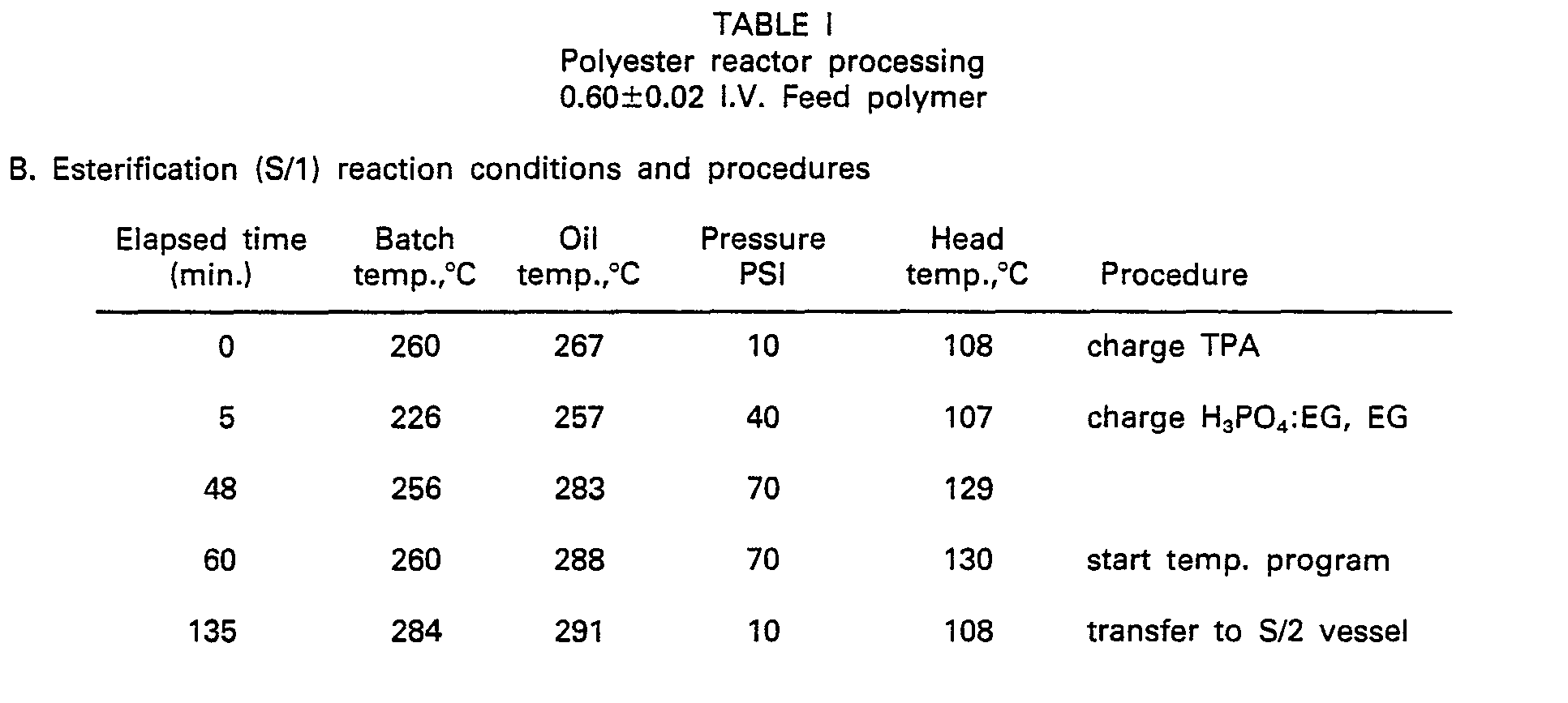
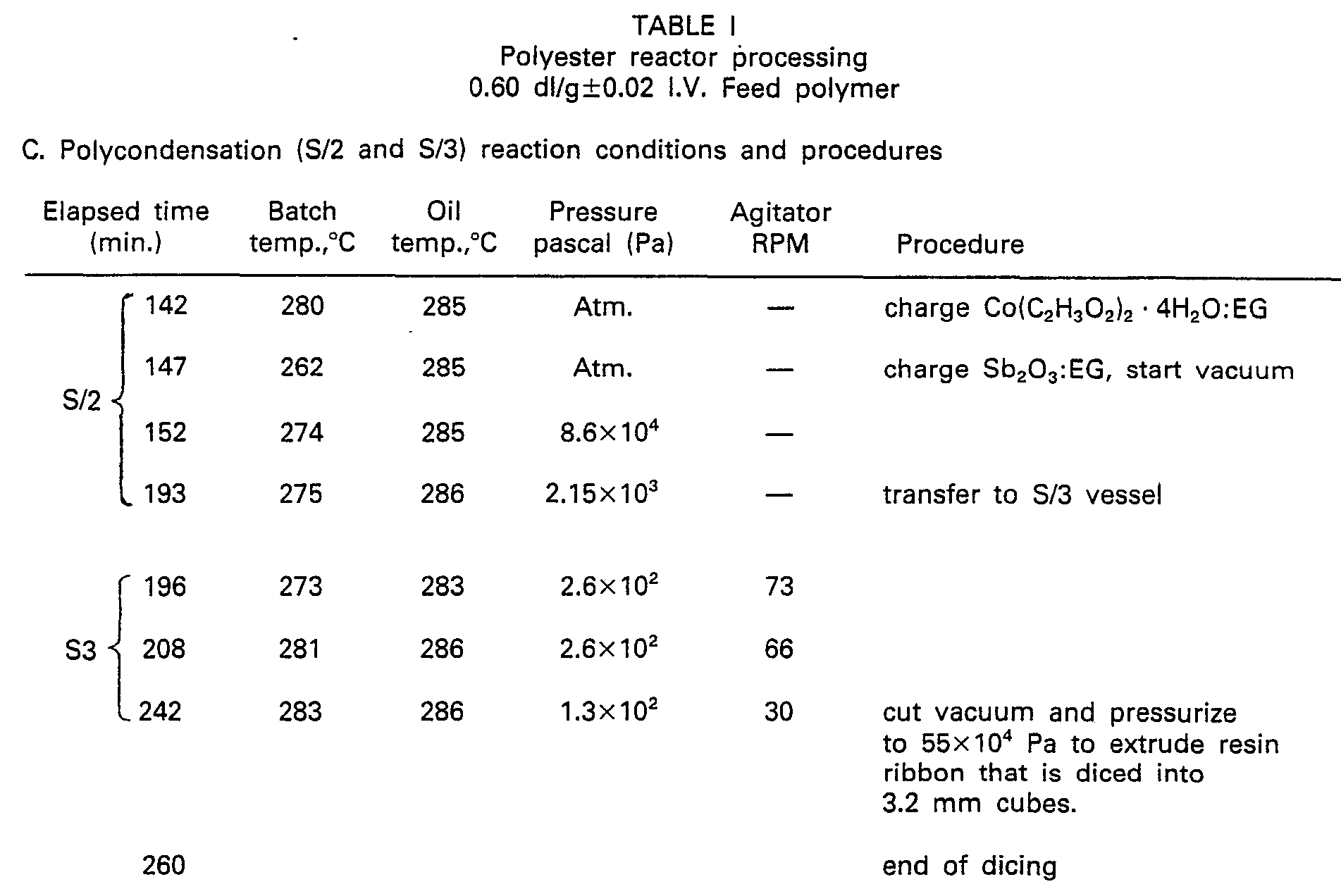
- the processing conditions and procedures for the esterification (S/1) reaction are shown in Table IB, and the same for the polycondensation (S/2 and S/3) reactions are shown in Table IC.
- the 0.60 dl/g ⁇ 0.02 l.V. feed resin is subsequently solid state polymerized to 0.72 dl/g ⁇ 0.02 IV in a 0.08E m 3 blender-dryer reaction vessel using conditions and procedures outlined in Table II.
- the present invention relates to a polyester which produces an article having a high clarity, a low haze, and neutral hue.
- Table III the data sets forth clarity, haze values, and color values, that is neutral hue; with regard to Example 1, a prior art polyester containing antimony and a phosphite; Example 2 relates to a polyester produced merely containing antimony; Example 3 relates to a polyester produced containing only antimony and cobalt; whereas Examples 4 and 5 relate to the present invention.
- the prior art resin has a reduced brightness value.
- Example 2 has yellow resin
- Example 3 has bluish resin and a reduced brightness.
- Examples 4 and 5 have a neutral color as well as good brightness.
- Example 4 and 5 have good brightness and therefore clarity and a neutral hue. Examining now the bottle properties which are taken through the sidewall, it is seen that Example 1 does show a fair amount of haze. The visual inspection also reveals that the bottle is hazy and has reduced brightness. Although Examples 2 and 3 show clear Hunter sidewall values, the visual inspection reveals that the neck and bottom which tend to be thicker are yellow and blue, respectively. Thus, they do not contain a neutral hue.
- Example 3 which contains the cobalt, has an unacceptable amount of acetaldehyde content.
- Examples 4 and 5 both through the instrument readings and visual readings, have clear bottles including the neck and bottom portion and have no haze. The clarity is high and the acetaldehyde levels are low. Thus, it is apparent that the present invention yields a high clarity bright bottle having low haze and a neutral or no color thereto.
Landscapes
- Chemical & Material Sciences (AREA)
- Health & Medical Sciences (AREA)
- Chemical Kinetics & Catalysis (AREA)
- Medicinal Chemistry (AREA)
- Polymers & Plastics (AREA)
- Organic Chemistry (AREA)
- Polyesters Or Polycarbonates (AREA)
- Compositions Of Macromolecular Compounds (AREA)
- Containers Having Bodies Formed In One Piece (AREA)
Description
- The present invention relates to a polyester which has a high clarity, and is transparent when made into an article. The article has a neutral color hue, a low haze value, and no greyness therein.
- Heretofore, numerous compounds and catalysts have been used for the preparation of polyester resins. However, high clarity, neutral hue, and low haze polyester articles such as films, sheets, containers, and the like are desirable, especially for containing food or drink, or when replacing glass. Often, antimony has been used as a catalyst, at times in combination with a phosphite compound. However, the reaction between these two compounds would often result in some amount of antimony metal being formed which imparted a gray color to the resin and article formed therefrom. Moreover, if other catalysts were utilized, a high level of acetaldehyde was produced which is highly undesirable for use in connection with food containers.
- U.S. Patent 3,795,639 to Chimura, et al relates to a process for preparing linear polyesters wherein the polycondensation of glycol terephthalate is preformed in the presence of (1) an antimony catalyst, (2) a germanium compound and (3) a phosphoric ester. This patent is not pertinent in that it does not utilize a bluing agent and does utilize a germanium compound.
- U.S. Patent 3,732,182, to Chimura, et al is not pertinent in that it relates to a novel antimony compound having the formula Sb(OR1)(OR2)(OR3).
- U.S. Patent 3,965,071 to McClelland relates to the preparation of polyesters in the presence of a titanium compound, the deactivation of a catalyst by reaction with phosphoric acid or ester and polycondensation in the presence of an antimony compound. Thus this patent relates to a completely different catalyst system as well as to a deactivation of the titanium catalyst.
- U.S. Patent 3,842,043 relates to a white, transparent polyester utilizing a polycondensation catalyst solution containing germanium dioxide, glycol and a solubilizing agent such as calcium, magnesium, strontium and zinc metals or salts thereof. Hence, it is not pertinent.
- U.S. Patent 4,082,724 to Hewertson relates to polyesters containing a trihalide or a tri (pseudohalide) of antimony and an organic oxo compound of phosphorus. The mole ratio of the oxo phosphorus compound to antimony is generally in excess of 1.0. This patent is not pertinent in that it uses very high amounts of phosphorus compounds and does not utilize a bluing agent.
- An article of Unitika Co., Plasdoc 31808 V/17 Dewent Publications (April 1, 1974), obtains a polyester by polymerizing a bis(W-hydroxyalkyl)terephthalate and/or its oligomer in the presence of an antimony compound, a cobalt compound, and a halide phosphate compound. This article is not pertinent in that a halide phosphate compound is utilized and relates to making polyesters from dimethyl terephthalate.
- U.S. Patent Numbers 3,962,189 to Russin et al, 3,907,754 to Tershansy et al, and 4,010,145 to Russin et al are all very similar in that they relate to catalyst inhibitor systems having a combination of organic or inorganic salts of manganese and cobalt, titanium compounds, antimony compounds, and a phosphate ester. The amount of weight of phosphorus is greater than the total weight of cobalt, manganese, and titanium. Moreover, the examples generally show the amount of phosphorus being at least four times as much as the amount of cobalt. Thus, these references are not pertinent in that they use very high amounts of phosphate in comparison to the other metals, as well as use other components not utilized by the present invention. Moreover, they relate to making a polyester from dimethyl terephthalate and not from dicarboxylic acids. Likewise, Japanese Kokai 77 87,495 reveals such a composition which also includes a cobalt compound as a coloring agent.
- U.S. Patent 2,641,592, to Hofrichter, relates to a cobalt acetate catalyst in association with antimony for the polymerization of dimethyl terephthalate. This patent is not pertinent in that it lacks any suggestion utilizing any phosphate compound. Additionally, such a composition would yield unacceptably high acetaldehyde levels in containers made therefrom.
- U.S. Patent 3,028,366 to Engel et al relates to phosphate modifiers in association with antimony catalysts to produce colorless or white polyesters from dimethyl terephthalate. In passing, the patent states that other well known catalysts or catalyst combinations can also be utilized including various metals such as calcium, magnesium, lanthanum, manganese, and cobalt. Since such compounds are utilized as catalysts, high amounts thereof are required. This patent is not pertinent in that it fails to specifically teach applicant's use of a bluing agent, very small amounts of phosphate in comparison with any bluing agent as well as small amounts of the bluing agent; and relates only to the use of dimethyl terephthalate.
- The above patents and articles all generally relate to the utilization of dimethyl terephthalate in preparing the polyester. Whenever various catalysts are utilized such as manganese, cobalt and the like, relatively high amounts, that is generally in excess of 70 parts per million by weight of the element must be utilized. Such compounds necessarily impart a color to the polyester, for example a blue color, and hence are inherently incapable of producing a neutral hue polyester article, that is a colorless or transparent article, with low acetaldehyde content and generation rate.
- It is therefore an object of the present invention to provide a polyester which yields a high clarity, neutral hue, low haze article.
- It is yet another object of the present invention to provide a polyester which yields a high clarity, neutral hue, low haze article, as above, wherein an antimony catalyst, a phosphorus compound and a bluing agent are utilized to produce the polyester.
- It is yet another object of the present invention to provide a polyester which yields a high clarity, neutral hue, low haze article, as above, wherein said bluing agent is a cobalt compound.
- It is yet another object of the present invention to provide a polyester which yields a high clarity, neutral hue, low haze article, as above, wherein said polyester is made from aryl dicarboxylic acids and polyhydric alcohols.
- It is yet another object of the present invention to provide a polyester which yields a high clarity, neutral hue, low haze article, as above, wherein the amount of elemental cobalt therein ranges from about 5 parts to about 50 parts per million of polymer, wherein the amount of elemental phosphorus ranges from about 5 to about 60 parts per million of polymer and wherein the amount of elemental antimony ranges from about 70 to about 250 parts per million of polymer.
- It is yet another object of the present invention to provide a polyester which yields a high clarity, neutral hue, low haze article, as above, wherein the polyester is particularly suitable for containers, especially for food containers and particularly bottles, and has low acetaldehyde levels.
- It is yet another object of the present invention to provide a polyester which yields a high clarity, neutral hue, low haze article, as above, wherein a slight molar excess of phosphorus is utilized as compared to the cobalt.
- It is yet another object of the present invention to provide a polyester which yields a high clarity, neutral hue, low haze article, as above, wherein the amount of phosphorus ranges from about 0.35 to about 2.5 parts by weight per one part of elemental cobalt.
- It is yet another object of the present invention to provide a polyester which yields a high clarity, neutral hue, low haze article, as above, wherein the cobalt compound is added to the polymerization process before the antimony compound is added.
- These and other objects of the present invention will become apparent from the following description of the invention.
- This invention discloses a polyester resin containing an antimony compound, a phosphorus compound, and a cobalt compound characterized in that the polyester resin is made from the reaction of a dicarboxylic acid and a polyhydric alcohol compound, said dicarboxylic acid selected from the group consisting of alkyl dicarboxylic acids having a total of from 2 to 16 carbon atoms, aryl or alkyl substituted aryl dicarboxylic acids containing a total of from 8 to 16 carbon atoms, and combinations thereof, and wherein said polyhydric alcohol is selected from the group consisting of glycols having from 2 to 12 carbon atoms, glycol ethers having from 4 to 12 carbon atoms, and combinations thereof, said polyester resin yielding an article of high clarity having a neutral hue.
- Generally, the process for making a polyester article having a high clarity, low haze, neutral hue comprises the steps of: preparing a polyester resin, adding a small amount of phosphorus and a cobalt compound bluing agent, wherein the amount of phosphorus to metal in said bluing agent ranges from about 0.35 to about 2.5 parts by weight, for each part by weight of elemental cobalt, and adding from about 120 to about 210 parts by weight of elemental antimony per million part by weight of said polyester in the form of an antimony compound to said polyester during the preparation thereof.
- High clarity polyesters are produced utilizing an antimony catalyst and low amounts of phosphorus and a bluing agent. By the term "bluing agent" as utilized in the present invention, it is meant any compound which upon addition to the polymer during preparation thereof will act as a blue colored compound or pigment and neutralize any otherwise yellow color in the polyester formed to yield a transparent, colorless or neutral hue article. In other words, the bluing agent, although often a blue colored compound, can be a red compound such as cobalt acetate, a green compound, or the like, which upon addition to the polymerization process reacts and forms a blue colored compound which neutralizes yellow and forms a transparent polyester when made into an article. The polyesters when made into articles have very high clarity, neutral hue, low haze, and low acetaldehyde levels and thus are suitable as films, sheets, or in any other form when a bright high clarity with low haze is desired. Particularly suited articles include containers, especially for foods, and bottles.
- The polyester resin is produced in a conventional manner but only from the reaction of dicarboxylic acids having from 2 to about 16 carbon atoms with polyhydric alchols such as glycols or diols containing from 2 to about 12 carbon atoms. The alkyl dicarboxylic acids may contain a total of from 2 to 16 carbon atoms. Preferably, the acids are aryl or an alkyl substituted aryl dicarboxylic acid containing from 8 to 16 carbon atoms. Specific examples of linear or alkyl dicarboxylic acids include oxalic acid, malonic acid, succinic acid, glutaric acid, adipic acid, pimelic acid, suberic acid, azelaic acid, and sebacic acid. Specific examples of an aryl acid include the various isomers of phthalic acid, such as paraphthalic acid (terephthalic acid) and naphthalic acid. Specific examples of alkyl substituted aryl acids include the various isomers of dimethylphthalic acid such as dimethylisophthalic acid, dimethylorthophthalic acid, dimethyl- terephthalic acid, the various isomers of diethylphthalic acid such as diethylisophthalic acid, diethylortho- phthalic acid, diethylterephthalic acid, the various isomers of dimethylnaphthalic acid such as 2,6-dimethylnaphthalic acid and 2,5-dimethyinaphthalic acid, and the various isomers of diethylnaphthalic acid. Generally, terephthalic acid is highly preferred.
- Polyesters made from diesters such as dimethylterephthalate do not form any part of the present invention. When such a monomer is utilized, high amounts of catalyst, that is generally the 70 parts per million of the elemental catalyst, are required in order to promote the esterification and condensation reactions. Such amounts of catalyst are in excess of the present invention and will impart a color to the polyester and articles formed therefrom. The present invention completely avoids any color hue by utilizing the dicarboxylic acids and hence, utilizes low amounts of cobalt, that is generally less than 50 parts per million, and desirably less than 30 parts per million.
- The diols or glycols may be straight chained or branched. Specific examples include ethylene glycol, propylene glycol, trimethylene glycol, 1,2-butane diol, 1,3-butane diol, 1,4-butane diol, 2,3-butane diol and neopentyl glycol. Of the various glycols, those having from 2 to 8 carbon atoms are preferred with ethylene glycol and 1,4-butane diol being highly preferred. In lieu of the various glycols, another class of polyhydric alcohols, such as the glycol ethers containing from 4 to 12 carbon atoms, can be utilized as for example dimethylene glycol and 1,4-dihydroxyethoxy benzene.
- The polyesters can be made according to melt polymerization, or melt and solid state polymerization. As known to those skilled in the art, polyesters are generally made in two stages. In the first stage or esterification stage, the diacid is reacted with the diol at elevated temperatures and pressures with water being produced. In the second stage or the polycondensation stage, a vacuum is gradually applied, or generally catalysts are utilized, and water and a diol are withdrawn as a condensation product. Various polyesters can be made by such a polymerization including polyethyleneterephthalate, a preferred polyester resin. Moreover, the process may be modified slightly by reacting the dicarboxylic acid with the diol in a solvent which is a low molecular weight linear polyester in a manner as set forth in U.S. Patent No. 4,020,049 to Rinehard. Regardless of the exact process, such reactions can be carried out in situ.
- Solid state polymerization can also be utilized. In this process, the polycondensation reaction is carried out until generally the intrinsic viscosity of the polymer melt reaches about 0.20 dl/g or higher, for example, up to about 0.80 dl/g. At this point, the solution melt is cooled to produce a solid which is then pelletized, chopped, etc. The pellets are then subjected to a solid state polymerization wherein the vacuum is applied at a temperature below the melting point of the partially formed polymer. Alternatively, the polymerization can be accomplished by removal of the by-products, e.g. water, ethylene glycol, by circulating or blowing an inert gas through the pellets. Thus, the polymer is actually polymerized in a solid state, with the polycondensation reaction being conducted in such a state. Generally, the solid state polymerization is continued until the intrinsic viscosity reaches any desirable level, such as from about 0.60 dl/g to about 1.0 dl/g or even higher. That is, at times it is desirable to produce very high molecular weight polyesters, for example, a polyester having an intrinsic viscosity of from about 1.0 dl/g to about 1.2 dl/g. Desirably, the intrinsic viscosity ranges from about 0.70 dl/g to about 0.85 dl/g and preferably from about 0.70 dl/g to about 0.80 dl/g. By intrinsic viscosity it is meant that the value obtained when nspeciflc /C or LOG nrel. /C is extrapolated to zero concentration; where the relative viscosity is defined as the quotient of the solution viscosity, nsm". and the viscosity of the solvent nsolv., i.e.,

- When the polyester resin is intended for use in contact with food, only those polyesters which are regulated by the Federal Food and Drug Administration should be utilized, such as set forth in Title 21, §177.1630, for example, the polyethylenephthalate polymers, and such polyesters are preferred in the present invention.
- The antimony catalyst utilized in the present invention can be generally any trivalent organic antimony compound known to the art. Examples of specific antimony compounds include antimony triacetate, antimony trioxide and antimony glycolate (either formed separately or during polymerization), with antimony glycolate being preferred. The antimony compound desirably is added to the condensation stage or step of the polymerization.
- The present invention also relates to the use of relatively low amounts of a phosphorus compound, for example a phosphate, and a bluing agent in comparison to the weight or amount of the antimony catalyst. The term "phosphate" as utilized in the present invention includes various phosphate compounds known in the art as well as phosphoric acid. The bluing agents are generally cobalt compounds which may or may not initially be blue as previously discussed. The polyester resins of the present invention can be made to form various articles such as films, sheets, containers, and the like. In some of these applications wherein the polyester is utilized as a container, for example, for containing carbonated beverages, it is highly desirable to maintain or to have low acetaldehyde levels to prevent discernible differences in taste. For example, the addition of levels of acetaldehyde as low as 60 parts per billion by weight have altered the tastes of carbonated cola beverages. Other food stuffs have different taste threshold levels which may be exceeded if the acetaldehyde level is not minimized. Desirably, when a container is utilized to contain food stuffs or liquids such as beverages, the amount of acetaldehyde diffusing from the container walls (e.g., a 2 liter bottle) of an empty, freshly blown bottle is less than 3 micrograms per liter. This test is conducted by maintaining the container at 70°F (27°C) for twenty-four hours, and then testing the gases content therein to determine the amount by weight of acetaldehyde. Generally it has been found that wherein the acetaldehyde content is less than 3 micrograms per liter of volume in a container within twenty-four hours after preparation thereof, any remaining accumulation of acetaldehyde is low and presents no discernible taste in a beverage, food stuff, or the like with longer periods of storage.
- Since cobalt compounds have been shown to increase the acetaldehyde level in a container, an amount of a phosphate compound (including phosphoric acid) is utilized to suppress the catalytic activity of the cobalt compound. Generally, one part by weight of elemental cobalt requires approximately 0.35 parts by weight of elemental phosphorus. Preferably, a slight excess of the phosphorus compound is utilized to insure suppression of the catalytic influence of the cobalt compound on acetaldehyde production. Thus, according to the present invention, from about 0.35 to about 2.5 parts by weight and preferably from about 0.4 to about 0.6 parts by weight of elemental phosphorus is desired for every one part of elemental cobalt. Should a greater amount be utilized, free phosphate will generally exist which will react with the antimony to produce an antimony phosphate type compound and if sufficient amounts exist in excess of the solubility limit of such a compound, will form particles and/or nucleation of crystallinity upon formation of the polyester. This results in a hazed article.
- The present invention as noted above relates to the articles which when formed from a polyester resin have low haze, a neutral color, and high clarity.
- Desirably, from about 70 to about 250 parts by weight per million of elemental antimony is desired based upon the produced polyester resin with the preferred range being from about 120 to about 210 parts per million. The amount of cobalt ranges from about 5 parts to about 50 parts by weight per million, desirably from about 5 to about 30 parts, and preferably from about 8 parts to about 20 parts per million. The amount of the phosphate compound expressed in terms of elemental phosphorus per million parts of polyester polymer ranges from about 5 to about 60 parts, desirably from about 10 to about 50 parts, and preferably from about 8 to about 20 parts by weight. Typical cobalt coloring agents include cobalt acetate tetrahydrate, cobalt aluminate, cobalt benzoate and cobalt chloride, with cobalt acetate being preferred. Examples of typical phosphate compounds include any pentavalent phosphates such as phosphoric acid, trialkylphosphates, for example, trimethylphosphate, triethylphosphate and tripentylphosphate. Triaryl phosphates such as triphenyl phosphate, triaryl phosphate, and the like can also be utilized. Additionally, mono and dialkyl/aryl phosphates may be utilized. Phosphoric acid and the trialkyl phosphates are preferred.
- Desirably, the phosphate and the cobalt compounds are added before the antimony addition, and preferably during the beginning of the esterification stage although they can be added at the beginning of the condensation stage. The preparation of the polyester resin can be conducted in any conventional manner utilizing a dicarboxylic acid. That is, conventional temperatures, pressures, reaction times, and the like are utilized as well known to those skilled in the art.
- The articles made from polyester resins of the present invention exhibit very high clarity, low haze values, and neutral hue. The haze value is generally indicated by a haze number according to the Hunter haze test. The haze number is generally less than 3.0, desirably less than 2.5, and preferably less than 2.0. Often, haze values are measured by eyesight since they tend to be more accurate than the Hunter values. The neutral hue is generally indicated by utilizing a Hunter Lab instrument. Generally, the hue is neutral as indicated by an "a" coordinate value ranging from about -1.0 to about 1.0, and preferably from about -0.5 to about 1.0, and a "b" coordinate value ranging from about -2.0 to about 2.0, and preferably from about -0.5 to about 2.0. That is, the numbers are basically on the zero-zero coordinates which indicates that the resulting article, for example a beverage bottle has no color.
- The invention will be better understood by reference to the following examples.
- The poly(ethylene terephthalate) polyesters described in Table III were prepared in a 200 pound polyester process reactor. The materials charged to the reactor, identification, amounts and points of addition, are shown in Table IA. The processing conditions and procedures for the esterification (S/1) reaction are shown in Table IB, and the same for the polycondensation (S/2 and S/3) reactions are shown in Table IC.

- The 0.60 dl/g±0.02 l.V. feed resin is subsequently solid state polymerized to 0.72 dl/g±0.02 IV in a 0.08E m3 blender-dryer reaction vessel using conditions and procedures outlined in Table II.


- As previously noted, the present invention relates to a polyester which produces an article having a high clarity, a low haze, and neutral hue. Examining Table III, the data sets forth clarity, haze values, and color values, that is neutral hue; with regard to Example 1, a prior art polyester containing antimony and a phosphite; Example 2 relates to a polyester produced merely containing antimony; Example 3 relates to a polyester produced containing only antimony and cobalt; whereas Examples 4 and 5 relate to the present invention. As apparent from the various data such as the feed resins and solid state resin properties, the prior art resin has a reduced brightness value. Example 2 has yellow resin, whereas Example 3 has bluish resin and a reduced brightness. However, Examples 4 and 5 have a neutral color as well as good brightness. Concerning the preform properties, that is an item made from a resin such as a parison, the prior art article has reduced brightness; Example 2 has a yellow color; and Example 3 has a reduced brightness. However, Example 4 and 5 have good brightness and therefore clarity and a neutral hue. Examining now the bottle properties which are taken through the sidewall, it is seen that Example 1 does show a fair amount of haze. The visual inspection also reveals that the bottle is hazy and has reduced brightness. Although Examples 2 and 3 show clear Hunter sidewall values, the visual inspection reveals that the neck and bottom which tend to be thicker are yellow and blue, respectively. Thus, they do not contain a neutral hue. Moreover, Example 3 which contains the cobalt, has an unacceptable amount of acetaldehyde content. In contrast, Examples 4 and 5, both through the instrument readings and visual readings, have clear bottles including the neck and bottom portion and have no haze. The clarity is high and the acetaldehyde levels are low. Thus, it is apparent that the present invention yields a high clarity bright bottle having low haze and a neutral or no color thereto.
Claims (8)
Applications Claiming Priority (2)
| Application Number | Priority Date | Filing Date | Title |
|---|---|---|---|
| US24583881A | 1981-03-20 | 1981-03-20 | |
| US245838 | 1981-03-20 |
Publications (3)
| Publication Number | Publication Date |
|---|---|
| EP0061414A1 EP0061414A1 (en) | 1982-09-29 |
| EP0061414B1 true EP0061414B1 (en) | 1986-01-29 |
| EP0061414B2 EP0061414B2 (en) | 1993-10-06 |
Family
ID=22928288
Family Applications (1)
| Application Number | Title | Priority Date | Filing Date |
|---|---|---|---|
| EP82630017A Expired - Lifetime EP0061414B2 (en) | 1981-03-20 | 1982-02-26 | High clarity colorless polyesters |
Country Status (7)
| Country | Link |
|---|---|
| EP (1) | EP0061414B2 (en) |
| JP (1) | JPS57165424A (en) |
| KR (1) | KR830009151A (en) |
| BR (1) | BR8201277A (en) |
| DE (1) | DE3268736D1 (en) |
| MX (1) | MX159410A (en) |
| ZA (1) | ZA821086B (en) |
Families Citing this family (14)
| Publication number | Priority date | Publication date | Assignee | Title |
|---|---|---|---|---|
| US4408004A (en) * | 1982-02-24 | 1983-10-04 | The Goodyear Tire & Rubber Company | High clarity, low haze polyesters having reduced infrared heat-up times |
| JPS6289725A (en) * | 1985-10-15 | 1987-04-24 | Teijin Ltd | Production of modifier polyester |
| CA1303771C (en) * | 1986-02-25 | 1992-06-16 | Jerold C. Rosenfeld | Preparation of gray to blue aromatic polyesters by incorporation of cobalt into the catalyst system |
| US4957996A (en) * | 1988-10-12 | 1990-09-18 | Hoechst Celanese Corporation | Preparation of polyarylate of improved color with cobalt salt |
| CN1064917C (en) * | 1995-07-18 | 2001-04-25 | 科尔加特-帕尔莫利弗公司 | Container with three-dimensional pattern design |
| AU735548B2 (en) * | 1997-03-06 | 2001-07-12 | Teijin Limited | Polyethylene-2,6-naphthalene dicarboxylate resin and preform and bottle molded thereof |
| KR100457349B1 (en) | 1997-04-23 | 2005-01-27 | 닛세이 에이. 에스. 비 기카이 가부시키가이샤 | Container with reduced acetaldehyde and its molding method |
| JPH11209465A (en) * | 1997-11-10 | 1999-08-03 | Nippon Ester Co Ltd | Copolyester and production thereof |
| JP3634613B2 (en) * | 1998-02-09 | 2005-03-30 | 帝人株式会社 | Polyethylene naphthalene dicarboxylate |
| WO2001014452A1 (en) * | 1999-08-24 | 2001-03-01 | Eastman Chemical Company | Preparation of polyesters employing antimony catalysts and acidic phosphorus compounds |
| US6384180B1 (en) | 1999-08-24 | 2002-05-07 | Eastman Chemical Company | Method for making polyesters employing acidic phosphorus-containing compounds |
| EP1281725A4 (en) * | 2001-01-25 | 2005-04-06 | Mitsubishi Chem Corp | POLYESTER RESIN, MOLDED ARTICLE BASED ON THIS POLYESTER RESIN, AND PROCESS FOR PRODUCING THE POLYESTER RESIN |
| JP4677726B2 (en) * | 2004-03-01 | 2011-04-27 | 東レ株式会社 | Polyester composition and fibers comprising the same |
| DE102008044487A1 (en) | 2008-08-29 | 2010-03-04 | Lurgi Zimmer Gmbh | Process for the preparation of polymers with neutral color |
Family Cites Families (2)
| Publication number | Priority date | Publication date | Assignee | Title |
|---|---|---|---|---|
| JPS4832781A (en) * | 1971-09-02 | 1973-05-02 | ||
| JPS5287495A (en) * | 1976-01-16 | 1977-07-21 | Nippon Ester Co Ltd | Preparation of polyesters |
-
1982
- 1982-02-18 ZA ZA821086A patent/ZA821086B/en unknown
- 1982-02-23 MX MX191538A patent/MX159410A/en unknown
- 1982-02-26 EP EP82630017A patent/EP0061414B2/en not_active Expired - Lifetime
- 1982-02-26 DE DE8282630017T patent/DE3268736D1/en not_active Expired
- 1982-03-10 BR BR8201277A patent/BR8201277A/en not_active IP Right Cessation
- 1982-03-18 JP JP57041812A patent/JPS57165424A/en active Pending
- 1982-03-20 KR KR1019820001197A patent/KR830009151A/en not_active Ceased
Also Published As
| Publication number | Publication date |
|---|---|
| KR830009151A (en) | 1983-12-17 |
| EP0061414A1 (en) | 1982-09-29 |
| BR8201277A (en) | 1983-01-18 |
| EP0061414B2 (en) | 1993-10-06 |
| JPS57165424A (en) | 1982-10-12 |
| DE3268736D1 (en) | 1986-03-13 |
| ZA821086B (en) | 1983-01-26 |
| MX159410A (en) | 1989-05-25 |
Similar Documents
| Publication | Publication Date | Title |
|---|---|---|
| US4499226A (en) | High clarity colorless polyesters | |
| EP0087383B1 (en) | High clarity, low haze polyesters having reduced infrared heat-up times | |
| US4535118A (en) | High clarity, low haze polyesters having reduced infrared heat-up times | |
| US4476272A (en) | High clarity, low haze polyesters having reduced infrared heat-up times | |
| EP1964870B1 (en) | Process for producing polyester | |
| EP0128109B1 (en) | A composition and process for making an amber colored polyester | |
| EP0061414B1 (en) | High clarity colorless polyesters | |
| EP1099720B1 (en) | Polyester resin and its production process | |
| US4447595A (en) | Polyterephthalates and copolymers thereof having high clarity and process for making same | |
| US4374949A (en) | Composition and process for making a green colored polyester | |
| EP0892000B1 (en) | Ethylene terephthalate/ethylene 2,6-naphthalene-dicarboxylate copolymers for bottles | |
| EP0926179A2 (en) | Method to reduce regenerated acetaldehyde in polyester resins | |
| USRE32765E (en) | High clarity colorless polyesters | |
| EP0850967B1 (en) | Container formed from copolyester composition, copolyester composition therefor and method of producing the same | |
| EP0051038B1 (en) | Green colored polyester | |
| JP2004124067A (en) | Polyester resin and method for producing the same | |
| JP2000256452A (en) | Method for producing polyester resin | |
| MX2008016402A (en) | Non-precipitating alkali/alkaline earth metal and aluminum compositions made with organic hydroxyacids. | |
| JP4135581B2 (en) | Method for producing organic toning agent-containing polyester | |
| JP2000226500A (en) | Polyester resin for hollow molded article | |
| JPH11209465A (en) | Copolyester and production thereof | |
| JP2003147060A (en) | Method for producing copolyester resin | |
| JP2000129103A (en) | Polyester resin for hollow molded products |
Legal Events
| Date | Code | Title | Description |
|---|---|---|---|
| PUAI | Public reference made under article 153(3) epc to a published international application that has entered the european phase |
Free format text: ORIGINAL CODE: 0009012 |
|
| 17P | Request for examination filed |
Effective date: 19820303 |
|
| AK | Designated contracting states |
Designated state(s): BE DE FR GB IT NL |
|
| GRAA | (expected) grant |
Free format text: ORIGINAL CODE: 0009210 |
|
| AK | Designated contracting states |
Designated state(s): BE DE FR GB IT NL |
|
| REF | Corresponds to: |
Ref document number: 3268736 Country of ref document: DE Date of ref document: 19860313 |
|
| ITF | It: translation for a ep patent filed | ||
| ET | Fr: translation filed | ||
| PLBI | Opposition filed |
Free format text: ORIGINAL CODE: 0009260 |
|
| 26 | Opposition filed |
Opponent name: HOECHST AKTIENGESELLSCHAFT, FRANKFURT Effective date: 19861025 Opponent name: AKZO N.V. Effective date: 19861016 |
|
| NLR1 | Nl: opposition has been filed with the epo |
Opponent name: HOECHST AKTIENGESELLSCHAFT Opponent name: AKZO N.V. |
|
| REG | Reference to a national code |
Ref country code: FR Ref legal event code: CL |
|
| ITTA | It: last paid annual fee | ||
| REG | Reference to a national code |
Ref country code: FR Ref legal event code: TP |
|
| PUAH | Patent maintained in amended form |
Free format text: ORIGINAL CODE: 0009272 |
|
| STAA | Information on the status of an ep patent application or granted ep patent |
Free format text: STATUS: PATENT MAINTAINED AS AMENDED |
|
| 27A | Patent maintained in amended form |
Effective date: 19931006 |
|
| AK | Designated contracting states |
Kind code of ref document: B2 Designated state(s): BE DE FR GB IT NL |
|
| ITPR | It: changes in ownership of a european patent |
Owner name: CESSIONE;SHELL INTERNATIONALE RESEARCH MAATSCHAPPI |
|
| NLS | Nl: assignments of ep-patents |
Owner name: SHELL INTERNATIONALE RESEARCH MAATSCHAPPIJ B.V. TE |
|
| ITF | It: translation for a ep patent filed | ||
| ET3 | Fr: translation filed ** decision concerning opposition | ||
| NLR2 | Nl: decision of opposition | ||
| NLR3 | Nl: receipt of modified translations in the netherlands language after an opposition procedure | ||
| REG | Reference to a national code |
Ref country code: GB Ref legal event code: 732E |
|
| K2C2 | Correction of patent specification (partial reprint) published |
Effective date: 19860129 |
|
| K2C0 | Notification of rectification cancelled |
Free format text: 860129 |
|
| K2C3 | Correction of patent specification (complete document) published |
Effective date: 19860129 |
|
| APAC | Appeal dossier modified |
Free format text: ORIGINAL CODE: EPIDOS NOAPO |
|
| APAC | Appeal dossier modified |
Free format text: ORIGINAL CODE: EPIDOS NOAPO |
|
| PGFP | Annual fee paid to national office [announced via postgrant information from national office to epo] |
Ref country code: FR Payment date: 19991126 Year of fee payment: 19 |
|
| PGFP | Annual fee paid to national office [announced via postgrant information from national office to epo] |
Ref country code: BE Payment date: 19991208 Year of fee payment: 19 |
|
| PGFP | Annual fee paid to national office [announced via postgrant information from national office to epo] |
Ref country code: GB Payment date: 19991217 Year of fee payment: 19 |
|
| PGFP | Annual fee paid to national office [announced via postgrant information from national office to epo] |
Ref country code: NL Payment date: 20000228 Year of fee payment: 19 |
|
| PGFP | Annual fee paid to national office [announced via postgrant information from national office to epo] |
Ref country code: DE Payment date: 20000302 Year of fee payment: 19 |
|
| PG25 | Lapsed in a contracting state [announced via postgrant information from national office to epo] |
Ref country code: GB Free format text: LAPSE BECAUSE OF NON-PAYMENT OF DUE FEES Effective date: 20010226 |
|
| PG25 | Lapsed in a contracting state [announced via postgrant information from national office to epo] |
Ref country code: BE Free format text: LAPSE BECAUSE OF NON-PAYMENT OF DUE FEES Effective date: 20010228 |
|
| BERE | Be: lapsed |
Owner name: SHELL INTERNATIONALE RESEARCH MAATSCHAPPIJ B.V. Effective date: 20010228 |
|
| PG25 | Lapsed in a contracting state [announced via postgrant information from national office to epo] |
Ref country code: NL Free format text: LAPSE BECAUSE OF NON-PAYMENT OF DUE FEES Effective date: 20010901 |
|
| GBPC | Gb: european patent ceased through non-payment of renewal fee |
Effective date: 20010226 |
|
| PG25 | Lapsed in a contracting state [announced via postgrant information from national office to epo] |
Ref country code: FR Free format text: LAPSE BECAUSE OF NON-PAYMENT OF DUE FEES Effective date: 20011031 |
|
| NLV4 | Nl: lapsed or anulled due to non-payment of the annual fee |
Effective date: 20010901 |
|
| REG | Reference to a national code |
Ref country code: FR Ref legal event code: ST |
|
| PG25 | Lapsed in a contracting state [announced via postgrant information from national office to epo] |
Ref country code: DE Free format text: LAPSE BECAUSE OF NON-PAYMENT OF DUE FEES Effective date: 20011201 |
|
| APAH | Appeal reference modified |
Free format text: ORIGINAL CODE: EPIDOSCREFNO |
|
| PLAB | Opposition data, opponent's data or that of the opponent's representative modified |
Free format text: ORIGINAL CODE: 0009299OPPO |