EP0061437A1 - Analyseur infrarouge, en particulier pour des matières alimentaires, telle que la farine - Google Patents
Analyseur infrarouge, en particulier pour des matières alimentaires, telle que la farine Download PDFInfo
- Publication number
- EP0061437A1 EP0061437A1 EP82850043A EP82850043A EP0061437A1 EP 0061437 A1 EP0061437 A1 EP 0061437A1 EP 82850043 A EP82850043 A EP 82850043A EP 82850043 A EP82850043 A EP 82850043A EP 0061437 A1 EP0061437 A1 EP 0061437A1
- Authority
- EP
- European Patent Office
- Prior art keywords
- window
- sample
- wall
- light
- analyzer
- Prior art date
- Legal status (The legal status is an assumption and is not a legal conclusion. Google has not performed a legal analysis and makes no representation as to the accuracy of the status listed.)
- Granted
Links
- 235000013312 flour Nutrition 0.000 title claims description 29
- 239000000126 substance Substances 0.000 claims abstract description 6
- 235000013305 food Nutrition 0.000 claims abstract description 4
- 239000011521 glass Substances 0.000 claims description 10
- 235000013339 cereals Nutrition 0.000 claims description 8
- 230000001678 irradiating effect Effects 0.000 claims description 5
- 230000006835 compression Effects 0.000 claims description 4
- 238000007906 compression Methods 0.000 claims description 4
- 239000000523 sample Substances 0.000 claims 19
- 239000011344 liquid material Substances 0.000 claims 1
- 239000011343 solid material Substances 0.000 claims 1
- 238000005259 measurement Methods 0.000 abstract description 8
- 102000004169 proteins and genes Human genes 0.000 abstract description 4
- 108090000623 proteins and genes Proteins 0.000 abstract description 4
- XLYOFNOQVPJJNP-UHFFFAOYSA-N water Substances O XLYOFNOQVPJJNP-UHFFFAOYSA-N 0.000 abstract description 3
- 239000006059 cover glass Substances 0.000 abstract 1
- 238000004458 analytical method Methods 0.000 description 9
- 239000000463 material Substances 0.000 description 7
- 230000005294 ferromagnetic effect Effects 0.000 description 6
- 239000007787 solid Substances 0.000 description 6
- 230000005291 magnetic effect Effects 0.000 description 4
- 238000013461 design Methods 0.000 description 2
- 238000000034 method Methods 0.000 description 2
- 230000003287 optical effect Effects 0.000 description 2
- 206010001497 Agitation Diseases 0.000 description 1
- 241000195493 Cryptophyta Species 0.000 description 1
- 244000141359 Malus pumila Species 0.000 description 1
- 230000032683 aging Effects 0.000 description 1
- 230000003321 amplification Effects 0.000 description 1
- 235000021016 apples Nutrition 0.000 description 1
- 238000004140 cleaning Methods 0.000 description 1
- 239000002131 composite material Substances 0.000 description 1
- 230000001276 controlling effect Effects 0.000 description 1
- 230000008878 coupling Effects 0.000 description 1
- 238000010168 coupling process Methods 0.000 description 1
- 238000005859 coupling reaction Methods 0.000 description 1
- 230000002542 deteriorative effect Effects 0.000 description 1
- 230000003670 easy-to-clean Effects 0.000 description 1
- 230000000694 effects Effects 0.000 description 1
- 238000011156 evaluation Methods 0.000 description 1
- 230000005284 excitation Effects 0.000 description 1
- 230000002349 favourable effect Effects 0.000 description 1
- 239000000945 filler Substances 0.000 description 1
- 230000005484 gravity Effects 0.000 description 1
- 229910052736 halogen Inorganic materials 0.000 description 1
- 150000002367 halogens Chemical class 0.000 description 1
- 230000020169 heat generation Effects 0.000 description 1
- 230000001771 impaired effect Effects 0.000 description 1
- 238000003780 insertion Methods 0.000 description 1
- 230000037431 insertion Effects 0.000 description 1
- 229940056932 lead sulfide Drugs 0.000 description 1
- 229910052981 lead sulfide Inorganic materials 0.000 description 1
- 239000007788 liquid Substances 0.000 description 1
- 235000013372 meat Nutrition 0.000 description 1
- 238000003199 nucleic acid amplification method Methods 0.000 description 1
- 210000000056 organ Anatomy 0.000 description 1
- 235000011837 pasties Nutrition 0.000 description 1
- -1 polytetrafluoroethylene Polymers 0.000 description 1
- 229920001343 polytetrafluoroethylene Polymers 0.000 description 1
- 239000004810 polytetrafluoroethylene Substances 0.000 description 1
- 239000000843 powder Substances 0.000 description 1
- 230000001105 regulatory effect Effects 0.000 description 1
- 235000013580 sausages Nutrition 0.000 description 1
- 229910000679 solder Inorganic materials 0.000 description 1
- 230000003068 static effect Effects 0.000 description 1
- 238000012360 testing method Methods 0.000 description 1
- 229910052724 xenon Inorganic materials 0.000 description 1
- FHNFHKCVQCLJFQ-UHFFFAOYSA-N xenon atom Chemical compound [Xe] FHNFHKCVQCLJFQ-UHFFFAOYSA-N 0.000 description 1
Images
Classifications
-
- G—PHYSICS
- G01—MEASURING; TESTING
- G01N—INVESTIGATING OR ANALYSING MATERIALS BY DETERMINING THEIR CHEMICAL OR PHYSICAL PROPERTIES
- G01N33/00—Investigating or analysing materials by specific methods not covered by groups G01N1/00 - G01N31/00
- G01N33/02—Food
- G01N33/10—Starch-containing substances, e.g. dough
-
- G—PHYSICS
- G01—MEASURING; TESTING
- G01N—INVESTIGATING OR ANALYSING MATERIALS BY DETERMINING THEIR CHEMICAL OR PHYSICAL PROPERTIES
- G01N21/00—Investigating or analysing materials by the use of optical means, i.e. using sub-millimetre waves, infrared, visible or ultraviolet light
- G01N21/17—Systems in which incident light is modified in accordance with the properties of the material investigated
- G01N21/47—Scattering, i.e. diffuse reflection
- G01N21/4738—Diffuse reflection, e.g. also for testing fluids, fibrous materials
-
- G—PHYSICS
- G01—MEASURING; TESTING
- G01N—INVESTIGATING OR ANALYSING MATERIALS BY DETERMINING THEIR CHEMICAL OR PHYSICAL PROPERTIES
- G01N21/00—Investigating or analysing materials by the use of optical means, i.e. using sub-millimetre waves, infrared, visible or ultraviolet light
- G01N21/84—Systems specially adapted for particular applications
- G01N21/85—Investigating moving fluids or granular solids
- G01N2021/8592—Grain or other flowing solid samples
Definitions
- the invention relates to an infrared analyzer according to the preamble of the main claim.
- Such analyzers have long been used for material analysis, especially to determine the presence or the relative (percentage) amount of certain substances such as water, protein and fat in food.
- a sample is irradiated with infrared light, mostly with light of different wavelengths in turn, and the light reflected from the sample is reflected with that from a reference (reference means). Light compared.
- reference reference
- high demands have to be met when irradiating and measuring the reflected light.
- the beam path between the sample itself and the photoelectric device - hereinafter called photocell device - must not be disturbed by substances that influence the infrared light, and if several windows made of glass or the like.
- the sample does not consist of a solid, rigid body or solid coarse grains, but, for example, of flour or other fine powder, sticky grains, algae or a greasy mass such as minced meat or sausage mass.
- a housing, glass pane or similar should not be covered with a housing, glass pane or similar. and, for known reasons, must be pressed together with a certain amount of pressure before they are examined with the analyzer. It is therefore common to place the sample in an open cup, dish or similar container and then compress it before placing it in the analyzer. The organ used for compression is pressed against the surface of the sample to be irradiated and must be removed before the analysis.
- FIG. 2 of US Pat. No. 4,040,747 A typical sample container with a glass pane for resiliently compressing the sample is shown in FIG. 2 of US Pat. No. 4,040,747 and has some of the disadvantages mentioned. It is also complicated and difficult to clean. Therefore, simple open dishes are sometimes used, into which the sample has to be irradiated from above, at least if it is powdery, pasty, sticky granular or liquid substances, otherwise the analysis will be impossible or unreliable. In practice, this method is therefore mostly only used for cereals, apples or the like. applied. A typical example of this is shown in FIGS. 2, 14 and 15 of US Pat. No. 3,776,642.
- Some of the disadvantages mentioned above can also have indirect consequences. For example, one may be forced to irradiate the sample vertically, so that either a standing analyzer or refraction of the beam path using a mirror or prism is required.
- Another problem is that photocells must not be influenced by light other than the infrared measuring light during the analysis, and the measuring light must also be and remain well collimated. But even if no analysis is going on, the photocells should not be able to be hit by ultraviolet light, for example by daylight, fluorescent tubes or other light sources with ultraviolet light, since at least the cheapest lead sulfide photocells to date have been deleteriously affected by such light.
- the invention according to the main claim in particular in connection with one or more of the subclaims, makes it possible to avoid the disadvantages mentioned and to use simpler means for signal evaluation without deteriorating the accuracy. It is also possible to use an analyzer according to the invention regardless of the angle between the surface of the sample to be irradiated and the solder line (vertical direction) and to examine a flowing material repeatedly or continuously.
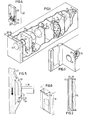
- Fig. 1 of the drawing shows an analyzer schematically.
- Fig. 2 is a longitudinal section through a container for a material sample to be examined.
- 3 illustrates an example of a portion of an analyzer designed to take the sample.
- Fig. 4 shows a sample compressor.
- FIG. 5 shows part of a conveyor pipe system provided with an analyzer for a flowing material to be examined.
- Fig. 6 shows a variety of the sample container.
- flour from cereals
- glass is used for all solids, for infrared Licth are permeable.
- IR and UV refer to infrared or ultraviolet light.
- a light source 1 for example an ordinary incandescent lamp, halogen, xenon or fluorescent lamp, transmits light through an optical system composed of two biconvex lenses 2 and 3, a condenser lens 4 and a light filter disk 5.
- This disc contains several optical monochromatic filters that are only permeable to one IR wavelength.
- This disc 5 is rotated step by step by an electric stepping motor at 6, performing a full rotation in 5 to 15 seconds, which in this case is composed of eight rotation steps. At each pause between two rotation steps, only one of the eight filters on the filter disc is in the beam path. Behind the pane, the monochromatic light is focused by a lens or composite optics 7.
- a light chopper in the form of a piezoelectrically or magnetically moving flag 8, which periodically shields the light at a frequency higher than 100 Hz, expediently 200 Hz, so that electrical signals generated by the light receive this frequency in order to be amplified more easily can.
- This intermittent light continues its way through a collimating condenser 9 into a chamber 10, which here is a hollow so-called Ulbricht sphere 10 with an inlet opening facing the condenser 9 for the incident light.
- the condenser 9 emits the light beam with a larger cross section than the filter.
- the ball 10 Opposite the inlet opening, the ball 10 is provided with a corresponding window 15 which is at least as large.
- This window can be optically covered by an opaque disc 12 which can be pivoted in its own plane and which can be pivoted synchronously between an entirely light-shielding position and a fully releasing position by means of an electromagnet 13 or a mechanical or electrical coupling with the filter disc 5.
- an electromagnet 13 is shown only schematically for pivoting the disk 12 away from the opening, ie for releasing the light, while when the magnet is de-energized, the disk is pivoted back by a return spring 14.
- the side of the disk facing the aforementioned inlet opening and the condenser 9 can be flat or curved with approximately the same radius as the inside of the sphere and serves as the reference explained below.
- This surface of the disc and the inside of the ball are preferably matt gold-plated in order to be diffusely reflective, chemically resistant and non-aging.
- this surface of the disk 12 which serves as a reference, can be made of a different material than the inside of the ball, for example polytetrafluoroethylene.
- the magnetic control of the contact 20 can take place in different ways.
- the magnetic circuit of the permanent magnet 19 can be completely or partially closed when the sample container is closed, so that the magnetic field g e which controls the tongue relay contact 20 is weakened.
- the tongue relay contact can be actuated by increasing the magnetic field controlling it when the wall 17 is placed against the part 16.
- this part and the wall should be "flourproof" against rest against each other, except for the filler opening on the one narrow side of an intermediate space in the drawing, which forms a rectangular shaft, but can taper downwards in one or both vertical shaft levels.
- the inner edges of the shaft are preferably somewhat rounded in order to facilitate cleaning of the shaft.
- the flour, ie the sample is filled into the container through the filling opening at the top of the shaft, preferably through a funnel adapted to the elongated shape of the filling opening.
- the shaft should not contain any protrusions or depressions that could make it difficult to evenly distribute the flour in the shaft or to clean it after use.
- the flour filled in the shaft is compressed with a certain favorable pressure using a compressor, e.g. with a compressor 22 according to FIG. 4, which essentially consists of two rectangular bodies 23 and 24 of different sizes and of the same movably connecting guide pins 25 and compression springs 26.
- the two bodies 23 and 24 can have the same cross-sectional shape as the filling opening of the container 15-17 and its shaft.
- the compressor 22 is inserted into the opening with the lower side of the body 24 and pressed until the two bodies 23 and 24 (or stops on them) bear against one another hardly or only slightly.
- the flour in the container is thereby subjected to a pressure which is determined by the springs 26 in the compressed position of the two parts.
- This pressure and surface finish are quite important for a reliable measurement, although the pressure is not critical, otherwise different measurements for different samples of the same amount of flour can be obtained, i.e. the measuring accuracy of the analyzer would not be better than the greatest difference between the values obtained from several samples of the same flour.
- the bottom of the approximately rectangular shaft can be inclined downwards towards part 16, for example by about 30-60. In principle it is unimportant whether only part 16 or only wall 17 or both form a cavity according to FIGS. 1-3 forming the shaft (intermediate space). Regardless of whether the shaft bottom is inclined or not, it can be formed by a resilient flap that yields and lets a part of the filled-in flour sample to the outside if the sample (21 in FIG. 2) is compressed too much. This could occur if the compressor 22 according to FIG. 4 is used by hand and pushed further into the shaft after the two bodies 23 and 24 of the compressor are already in contact with one another.
- the compressor itself does not need to be resiliently compressible, but rather can consist of a rigid body, so that the sample is compressed with a force which is determined by the spring force of the resilient shaft floor.
- the spring force can be replaced or supplemented in a known manner by gravity, for example by a counterweight.
- the shaft (space) of the sample container between the links 17 and 15-16 is filled with flour.
- the sample consisting of this flour is compressed with the compressor 22 according to FIG. 4, so that it lies with a certain pressure directly against the window 15, which is the only glass in the beam path between the sample and the photocells 15.
- the light source 1 is switched on with a switch button and the stepper motor 6 rotates the filter disk into a position in which one of its filters lies in the beam path.
- the electromagnet 13 swings the reference disk 12 laterally away from the window 15 of the ball 10, so that the monochromatic collimated light coming from the filter and condenser hits the sample.
- the light reflected by the sample is reflected in the sphere through the matt gold-plated inner wall of the sphere with diffuse scattering to the photocells 11. These therefore give a corresponding AC signal with a Frequency from - in this example - 200 Hz due to the vibrations of the light chopper 8.
- the electrical photo cell signal is amplified, filtered, rectified and converted into a digital signal, which is fed to a microprocessor, where it is stored and evaluated.
- Fig. 1 shows the filter disk 5 with eight filters, but depending on the type of sample and the desired analysis, the entire measurement does not of course necessarily have to be carried out with all filters.
- sample and reference measurements are made twice with each of six filters.
- the first and second measurement are designated with index 1 and 2 followed by the number of the filter (No. 1 to 6 for six filters).
- the sample signal is designated P and the reference signal R.
- a microprocessor connected to the actual analyzer 1-18 calculates the value where k 0 .... k 6 are constants determined using the least square method.
- the designation R 12 therefore means the first measurement (No. 1) with the second filter (No. 2).
- the value of the above mathematical expression is thus obtained by primarily forming the logarithm of the quotient: sum of the two reference signal amplitudes divided by the sum of the two sample signal amplitudes.
- a quotient calculation in the narrower sense of the word is not absolutely necessary, since the logarithm of a quotient is known to be equal to the logarithm of the numerator minus the logarithm of the denominator.
- the value obtained according to the above formula indicates the relative protein content (protein content) of flour if the sample consists of cereal flour and is irradiated in sequence with six different IR wavelengths. These six light wavelengths are determined by the six filters used and are each individually selected so that they are suitable for the desired protein analysis.
- a very high accuracy can be achieved with an analyzer according to the invention.
- non-compensated temperature drift deteriorates the accuracy of measuring devices such as analyzers of the above type.
- the temperature drift is preferably, but not necessarily, compensated for by the fact that fluctuations in the reference signal R generated by reference 12 are treated by the data processor in such a way that a corresponding compensating change in the sample signal is caused by the fact that the amplification factor is regulated as a function of any changes in the reference signal.
- the facility can if necessary also be made insensitive to any fluctuations in light intensity of the light source 1. If the temperature drift is compensated in the manner just mentioned, it can easily be avoided that the analyzer, so to speak, confuses the influence of changes in light intensity and temperature on the electrical reference signal.
- Fig. 5 shows how an analyzer according to the invention for testing or analyzing flour or the like. can be used in a flour conveyor channel 27 which is completely closed in cross section, i.e. in a channel 27, which mostly consists of a round or rectangular pipeline, e.g. consists of a chute.
- This pipeline is divided in two at one point in such a way that a branch channel 28 is formed through which part of the flour conveyed either flows continuously or preferably only between two IR measurements.
- the branch line 28 contains a shut-off flap 29, or a similar shut-off device, preferably adjustable by an electrical control member 30, e.g. Gate valve.
- the window 15 according to FIGS.
- the sample container is formed here by the part of the channel provided with the window 15 and by the flap 29, which forms the bottom of the container in the closed state.
- the filling opening of the container consists of the inner cavity of the tubular branch channel 28 above the window.
- the compression of the flour sample before and during the analysis can be brought about by the weight of the amount of flour located in the branch channel above the flap and the window or by a special compacting device, which need not be described in detail.
- the flap 29 can be a resilient flap that opens automatically when the pressure of the flour sample exceeds the desired or required value.
- the branch channel 28 ' can be dispensed with and a zone of the conveying channel 27 itself can be used as a sample container if the analyzer 1-16 is attached directly to this zone with its window 15 and the Butterfly valve 29, provided that it is not entirely unnecessary or can be replaced by a channel narrowing, is provided in the channel 27 in the same way below the window 15 as shown in FIG. 5 for the branch channel 28.
- the channel 27 above the window can be provided with a curvature such that essentially only the amount of flour between the channel curve and the window onto the Flour sample 21 has a squeezing effect in front of the window. If the channel 27 above the flap is sufficiently short or inclined sufficiently, that is to say not vertically, the said curvature may be unnecessary. Takes place the flour feed in the channel 27 forcibly with excessive pressure against the closed shut-off valve 29, it is possible, when the delivery pressure is static, ie when g e-connected flap not constantly increases, in the channel with one cross-sectional widening and is provided on the valve. If the pressure is generated dynamically so that it increases with increasing resistance in the channel, an open channel can be provided in or next to the flap or the flap can be designed as a spring pressure valve in order to prevent overpressure on the flour sample. But there are many other options.
- FIG. 6 shows a sample container for individual flour samples, as is the case in FIGS. 1-3.
- the container particularly with its outer funnel-shaped outer wall 31, which corresponds to wall 17 in FIGS. 1-3, is designed to be displaceable — like a slide valve, approximately like the cassette for photographic glass plates in a plate camera or projector.
- An analyzer according to the invention in the design described with variants above can be carried out more cheaply, with higher measuring accuracy and more versatile uses with regard to the consistency of samples to be examined than the commercial IR analyzers of a similar design for examining the relative protein and / or water content of cereal flour and others Non-solid consistency foods.
Landscapes
- Life Sciences & Earth Sciences (AREA)
- Chemical & Material Sciences (AREA)
- Health & Medical Sciences (AREA)
- Physics & Mathematics (AREA)
- Food Science & Technology (AREA)
- Engineering & Computer Science (AREA)
- Analytical Chemistry (AREA)
- Biochemistry (AREA)
- General Health & Medical Sciences (AREA)
- General Physics & Mathematics (AREA)
- Immunology (AREA)
- Pathology (AREA)
- Medicinal Chemistry (AREA)
- Investigating Or Analysing Materials By Optical Means (AREA)
Applications Claiming Priority (2)
| Application Number | Priority Date | Filing Date | Title |
|---|---|---|---|
| SE8101655A SE458724B (sv) | 1981-03-16 | 1981-03-16 | Infraroedanalysator foer relativ maengdbestaemning av visst eller vissa aemnen i ett prov, saerskilt i livsmedel saasom mjoel |
| SE8101655 | 1981-03-16 |
Publications (2)
| Publication Number | Publication Date |
|---|---|
| EP0061437A1 true EP0061437A1 (fr) | 1982-09-29 |
| EP0061437B1 EP0061437B1 (fr) | 1986-06-18 |
Family
ID=20343347
Family Applications (1)
| Application Number | Title | Priority Date | Filing Date |
|---|---|---|---|
| EP82850043A Expired EP0061437B1 (fr) | 1981-03-16 | 1982-03-08 | Analyseur infrarouge, en particulier pour des matières alimentaires, telle que la farine |
Country Status (6)
| Country | Link |
|---|---|
| US (1) | US4479055A (fr) |
| EP (1) | EP0061437B1 (fr) |
| DE (1) | DE3271728D1 (fr) |
| SE (1) | SE458724B (fr) |
| SU (1) | SU1386049A3 (fr) |
| ZA (1) | ZA821267B (fr) |
Cited By (6)
| Publication number | Priority date | Publication date | Assignee | Title |
|---|---|---|---|---|
| DE3424629A1 (de) * | 1983-07-04 | 1985-01-17 | Peter 2000 Barsbüttel Perten | Vorrichtung in einem infrarotanalysator zur bestimmung des anteils einer bestimmten substanz in pulverfoermigem material |
| WO1985004957A1 (fr) * | 1984-04-19 | 1985-11-07 | Gebrüder Bühler Ag | Installation de mesure aux infrarouges pour l'analyse continue de produits moulus |
| EP0240185A3 (en) * | 1986-03-20 | 1989-10-25 | Satake Engineering Co., Ltd. | Apparatus for evaluating the quality of rice grains |
| FR2737573A1 (fr) * | 1995-07-31 | 1997-02-07 | Alliance Instr Sa | Procede d'analyse par infrarouge d'un echantillon et dispositif pour la mise en oeuvre du procede |
| DE102005042149B4 (de) * | 2004-09-22 | 2007-06-21 | Fagus-Grecon Greten Gmbh & Co Kg | Vorrichtung zum Bestimmen des Feuchtegehaltes einer durch zumindest eine Leitung geführten Materialschüttung |
| CN105044023A (zh) * | 2015-08-06 | 2015-11-11 | 黑龙江大学 | 一种快速无损检测面粉中过氧化苯甲酰含量的方法及应用 |
Families Citing this family (19)
| Publication number | Priority date | Publication date | Assignee | Title |
|---|---|---|---|---|
| GB2150917B (en) * | 1983-12-07 | 1986-08-28 | Ranks Hovis Mcdougall Plc | Sampling and testing particulate material |
| SE468334B (sv) * | 1991-04-23 | 1992-12-14 | Peter Perten | Saett och anordning foer infraroedanalys, speciellt avseende livsmedel |
| US5448069A (en) * | 1991-04-23 | 1995-09-05 | Buhler Ag Maschinenfabrik | Infrared measurement of constituents of particulate foodstuffs |
| DE69312894T2 (de) * | 1992-12-29 | 1998-02-12 | Philips Electronics Nv | Pyrometer mit Emissionsmesser |
| JPH07159309A (ja) * | 1993-12-07 | 1995-06-23 | Shokuhin Sangyo Intelligence Control Gijutsu Kenkyu Kumiai | 粉体サンプル調整装置 |
| JP3328045B2 (ja) * | 1994-02-08 | 2002-09-24 | 日清製粉株式会社 | 粉体サンプル調整装置 |
| US5597237A (en) * | 1995-05-30 | 1997-01-28 | Quantum Logic Corp | Apparatus for measuring the emissivity of a semiconductor wafer |
| DE19714115C2 (de) * | 1997-04-05 | 1999-12-23 | Bran & Luebbe | Vorrichtung zur optischen Bestimmung von Inhaltsstoffen eines rieselfähigen Gutes |
| AU9768098A (en) * | 1997-10-22 | 1999-05-10 | Ashton Group Limited | Integrated sampling system |
| RU2138042C1 (ru) * | 1998-04-14 | 1999-09-20 | Общество с ограниченной ответственностью "Церера" | Способ определения количества клейковины в пшенице и устройство для его осуществления |
| DE10119763A1 (de) * | 2001-04-23 | 2002-10-24 | Hans Joachim Bruins | Verfahren und Vorrichtung zur Getreideanalyse |
| FR2897939B1 (fr) * | 2006-02-24 | 2008-06-27 | Tripette & Renaud Chopin Soc P | Dispositif et procede de mesure des proprietes spectroscopiques d'echantillons de produits et en particulier de produits cerealiers. |
| SE530192C2 (sv) * | 2006-07-19 | 2008-03-25 | Hemocue Ab | Apparat för avbildning av prov där provhållaren är flyttbar medelst magnetisk växelverkan |
| US8148690B2 (en) * | 2009-09-24 | 2012-04-03 | ABB, Ltd. | Method and apparatus for on-line web property measurement |
| JP2013515248A (ja) * | 2009-12-22 | 2013-05-02 | ビューラー・アクチエンゲゼルシャフト | 揺動可能な生成物を測定するための装置及び方法 |
| FI20105599A0 (fi) * | 2010-05-27 | 2010-05-27 | Intelligent Pharmaceutics Oy | Näyteastia ja menetelmä jauhemaisen tai raemaisen materiaalin partikkelikoon ja -muodon tai partikkelijakauman ja pintaominaisuuksien mittaamiseen |
| CN106170692B (zh) * | 2013-11-14 | 2019-06-07 | 格兰森斯股份公司 | 光学分析器、光学分析方法以及样品制备装置 |
| DE102020122041A1 (de) * | 2020-08-24 | 2022-02-24 | Claas Selbstfahrende Erntemaschinen Gmbh | Optische Messeinrichtung |
| US20260225962A1 (en) * | 2025-02-03 | 2026-08-06 | United States Gypsum Company | Systems and methods for manufacturing calcined gypsum and manufacturing gypsum board with material handling chute having in-line measurement device |
Citations (5)
| Publication number | Priority date | Publication date | Assignee | Title |
|---|---|---|---|---|
| US3224324A (en) * | 1962-09-27 | 1965-12-21 | Monsanto Co | Method of presentation of compressionable fibrous samples |
| US3321636A (en) * | 1962-08-31 | 1967-05-23 | Buehler Ag Geb | Photosensitive apparatus for color testing and color control in a processing plant |
| US3328587A (en) * | 1962-03-28 | 1967-06-27 | Simon Ltd Henry | Photoelectric apparatus for continuously monitoring the quality of a flowing particulate material in respect of its granularity and purity |
| US3817628A (en) * | 1972-08-17 | 1974-06-18 | Hoffmann La Roche | Reflectometer for on-line analysis of granular powders |
| US4040747A (en) * | 1972-08-24 | 1977-08-09 | Neotec Corporation | Optical analyzer for agricultural products |
Family Cites Families (5)
| Publication number | Priority date | Publication date | Assignee | Title |
|---|---|---|---|---|
| US3776642A (en) * | 1972-08-01 | 1973-12-04 | Dickey John Corp | Grain analysis computer |
| US4082464A (en) * | 1976-10-07 | 1978-04-04 | Neotec Corporation | Optical analysis system having rotating filters |
| US4236076A (en) * | 1979-02-26 | 1980-11-25 | Technicon Instruments Corporation | Infrared analyzer |
| DE3002559C2 (de) * | 1980-01-25 | 1983-09-22 | Vladimir Dr.-Ing. 5100 Aachen Blazek | Meßkopf zum Messen der Strahlungsleistung und der Strahlungsenergie von Lasern |
| US4404642A (en) * | 1981-05-15 | 1983-09-13 | Trebor Industries, Inc. | Apparatus for near infrared quantitative analysis with temperature variation correction |
-
1981
- 1981-03-16 SE SE8101655A patent/SE458724B/sv not_active IP Right Cessation
-
1982
- 1982-02-25 ZA ZA821267A patent/ZA821267B/xx unknown
- 1982-03-08 EP EP82850043A patent/EP0061437B1/fr not_active Expired
- 1982-03-08 DE DE8282850043T patent/DE3271728D1/de not_active Expired
- 1982-03-11 US US06/357,151 patent/US4479055A/en not_active Expired - Lifetime
- 1982-03-15 SU SU823412841A patent/SU1386049A3/ru active
Patent Citations (5)
| Publication number | Priority date | Publication date | Assignee | Title |
|---|---|---|---|---|
| US3328587A (en) * | 1962-03-28 | 1967-06-27 | Simon Ltd Henry | Photoelectric apparatus for continuously monitoring the quality of a flowing particulate material in respect of its granularity and purity |
| US3321636A (en) * | 1962-08-31 | 1967-05-23 | Buehler Ag Geb | Photosensitive apparatus for color testing and color control in a processing plant |
| US3224324A (en) * | 1962-09-27 | 1965-12-21 | Monsanto Co | Method of presentation of compressionable fibrous samples |
| US3817628A (en) * | 1972-08-17 | 1974-06-18 | Hoffmann La Roche | Reflectometer for on-line analysis of granular powders |
| US4040747A (en) * | 1972-08-24 | 1977-08-09 | Neotec Corporation | Optical analyzer for agricultural products |
Cited By (7)
| Publication number | Priority date | Publication date | Assignee | Title |
|---|---|---|---|---|
| DE3424629A1 (de) * | 1983-07-04 | 1985-01-17 | Peter 2000 Barsbüttel Perten | Vorrichtung in einem infrarotanalysator zur bestimmung des anteils einer bestimmten substanz in pulverfoermigem material |
| WO1985004957A1 (fr) * | 1984-04-19 | 1985-11-07 | Gebrüder Bühler Ag | Installation de mesure aux infrarouges pour l'analyse continue de produits moulus |
| US4742228A (en) * | 1984-04-19 | 1988-05-03 | Gebruder Buhler Ag | Infrared measuring apparatus and process for the continuous quantitative determination of individual components of flour or other groundable food products |
| EP0240185A3 (en) * | 1986-03-20 | 1989-10-25 | Satake Engineering Co., Ltd. | Apparatus for evaluating the quality of rice grains |
| FR2737573A1 (fr) * | 1995-07-31 | 1997-02-07 | Alliance Instr Sa | Procede d'analyse par infrarouge d'un echantillon et dispositif pour la mise en oeuvre du procede |
| DE102005042149B4 (de) * | 2004-09-22 | 2007-06-21 | Fagus-Grecon Greten Gmbh & Co Kg | Vorrichtung zum Bestimmen des Feuchtegehaltes einer durch zumindest eine Leitung geführten Materialschüttung |
| CN105044023A (zh) * | 2015-08-06 | 2015-11-11 | 黑龙江大学 | 一种快速无损检测面粉中过氧化苯甲酰含量的方法及应用 |
Also Published As
| Publication number | Publication date |
|---|---|
| US4479055A (en) | 1984-10-23 |
| EP0061437B1 (fr) | 1986-06-18 |
| SE458724B (sv) | 1989-04-24 |
| SU1386049A3 (ru) | 1988-03-30 |
| DE3271728D1 (en) | 1986-07-24 |
| SE8101655L (sv) | 1982-09-17 |
| ZA821267B (en) | 1983-01-26 |
Similar Documents
| Publication | Publication Date | Title |
|---|---|---|
| EP0061437B1 (fr) | Analyseur infrarouge, en particulier pour des matières alimentaires, telle que la farine | |
| DE3785788T2 (de) | Vorrichtung zur Bewertung der Güte von Reiskörnern. | |
| DE69623329T2 (de) | Verfahren und vorrichtung zum mischen und analysieren von lebensmitteln, futter oder arzneimitteln | |
| DE60033946T2 (de) | On-line prüfeinrichtung für einen inneren teil mit mehreren, auf zwei seiten angeordneten lampen | |
| DE3786624T2 (de) | Vorrichtung zur Messung des Amylose- oder Amylopektingehalts in Reis. | |
| WO2003067228A1 (fr) | Procede pour l'analyse de liquides et dispositif correspondant | |
| DE102007007040A1 (de) | Messeinrichtung zur optischen und spektroskopischen Untersuchung einer Probe | |
| DE1164118B (de) | Truebungsmesser zum Messen der Konzentration von in einer dauernd fliessenden Fluessigkeit enthaltenen Teilchen | |
| DE1498985A1 (de) | Einrichtung zur selbsttaetigen kontinuierlichen UEberwachung der Qualitaet eines Trockenteilchengutes | |
| DE1673038A1 (de) | Verfahren fuer die Qualitaetsbestimmung von Fleisch und Vorrichtung zur Durchfuehrung dieses Verfahrens | |
| DE69627987T2 (de) | Anlage zur untersuchung fliessbarer materialien und vorrichtung zur beförderung von proben | |
| EP1955045B1 (fr) | Procédés et dispositifs pour la détermination automatisée de la forme tridimensionnelle individuelle de particules | |
| DE3441856C2 (de) | Verfahren zum laufenden quantitativen Bestimmen von Inhaltsstoffen, insbesondere von Proteinen und Wasser, in mehlförmigen oder anderen Nahrungsmittel-Mahlgütern durch Infrarotmessung und Vorrichtung zur Durchführung dieses Verfahrens | |
| EP3629006B1 (fr) | Dispositif d'analyse sensorielle d'un échantillon coulant | |
| EP1381850B1 (fr) | Procede et dispositif d'analyse de cereales | |
| DE2043393C3 (de) | Vorrichtung zum Entfernen von Fremdkörpern bestimmter Farbe aus einer verschiedenfarbige Fremdkörper enthaltenden flüssigen farblosen oder nahezu farblosen Substanz | |
| EP1499877B1 (fr) | Dispositif de mesure destine notamment a des mesures spectroscopiques | |
| WO2004004468A2 (fr) | Machine de transformation de la viande equipee d'un dispositif d'analyse de la matiere grasse | |
| DE3201889A1 (de) | Elektronenmikroskop mit roentgendetektor | |
| EP3136083A1 (fr) | Procede et dispositif de determination d'une concentration de matiere ou d'une matiere dans un milieu liquide | |
| DE2556677A1 (de) | Verfahren zur diskriminierung gegenueber den einfluessen von artefakten bei optischen untersuchungen unter ausnutzung von streuung und vorrichtung zur durchfuehrung des verfahrens | |
| DE4215948C2 (de) | Verfahren zur Bestimmung der Qualität eines Kristallgemisches, insbesondere von Zucker, und Vorrichtung zur Durchführung des Verfahrens | |
| DE2621027A1 (de) | Vorrichtung zur quantitativen in-line- roentgenfluoreszenzanalyse von schlaemmen | |
| DE102004020350A1 (de) | Vorrichtung zur optischen Analyse von Propen | |
| DE102004035623B4 (de) | Messvorrichtung und Messverfahren zur Analyse von Eigenschaften einer strömenden Flüssigkeit |
Legal Events
| Date | Code | Title | Description |
|---|---|---|---|
| PUAI | Public reference made under article 153(3) epc to a published international application that has entered the european phase |
Free format text: ORIGINAL CODE: 0009012 |
|
| AK | Designated contracting states |
Designated state(s): CH DE FR GB IT |
|
| 17P | Request for examination filed |
Effective date: 19830301 |
|
| ITF | It: translation for a ep patent filed | ||
| GRAA | (expected) grant |
Free format text: ORIGINAL CODE: 0009210 |
|
| AK | Designated contracting states |
Kind code of ref document: B1 Designated state(s): CH DE FR GB IT LI |
|
| REF | Corresponds to: |
Ref document number: 3271728 Country of ref document: DE Date of ref document: 19860724 |
|
| ET | Fr: translation filed | ||
| PLBE | No opposition filed within time limit |
Free format text: ORIGINAL CODE: 0009261 |
|
| STAA | Information on the status of an ep patent application or granted ep patent |
Free format text: STATUS: NO OPPOSITION FILED WITHIN TIME LIMIT |
|
| 26N | No opposition filed | ||
| REG | Reference to a national code |
Ref country code: CH Ref legal event code: PUE Owner name: LARENA AG |
|
| ITPR | It: changes in ownership of a european patent |
Owner name: CESSIONE;LORVENOR A.G. |
|
| REG | Reference to a national code |
Ref country code: GB Ref legal event code: 732 |
|
| REG | Reference to a national code |
Ref country code: FR Ref legal event code: TP |
|
| ITTA | It: last paid annual fee | ||
| PGFP | Annual fee paid to national office [announced via postgrant information from national office to epo] |
Ref country code: GB Payment date: 20000308 Year of fee payment: 19 |
|
| PGFP | Annual fee paid to national office [announced via postgrant information from national office to epo] |
Ref country code: FR Payment date: 20000331 Year of fee payment: 19 |
|
| PGFP | Annual fee paid to national office [announced via postgrant information from national office to epo] |
Ref country code: CH Payment date: 20000406 Year of fee payment: 19 |
|
| PGFP | Annual fee paid to national office [announced via postgrant information from national office to epo] |
Ref country code: DE Payment date: 20000530 Year of fee payment: 19 |
|
| PG25 | Lapsed in a contracting state [announced via postgrant information from national office to epo] |
Ref country code: GB Free format text: LAPSE BECAUSE OF NON-PAYMENT OF DUE FEES Effective date: 20010308 |
|
| PG25 | Lapsed in a contracting state [announced via postgrant information from national office to epo] |
Ref country code: LI Free format text: LAPSE BECAUSE OF NON-PAYMENT OF DUE FEES Effective date: 20010331 Ref country code: DE Free format text: LAPSE BECAUSE OF NON-PAYMENT OF DUE FEES Effective date: 20010331 Ref country code: CH Free format text: LAPSE BECAUSE OF NON-PAYMENT OF DUE FEES Effective date: 20010331 |
|
| GBPC | Gb: european patent ceased through non-payment of renewal fee |
Effective date: 20010308 |
|
| REG | Reference to a national code |
Ref country code: CH Ref legal event code: PL |
|
| PG25 | Lapsed in a contracting state [announced via postgrant information from national office to epo] |
Ref country code: FR Free format text: LAPSE BECAUSE OF NON-PAYMENT OF DUE FEES Effective date: 20011130 |
|
| REG | Reference to a national code |
Ref country code: FR Ref legal event code: ST |