EP0061533B1 - Essieu fou avec freins à disques multiples refroidis par fluide - Google Patents
Essieu fou avec freins à disques multiples refroidis par fluide Download PDFInfo
- Publication number
- EP0061533B1 EP0061533B1 EP81110397A EP81110397A EP0061533B1 EP 0061533 B1 EP0061533 B1 EP 0061533B1 EP 81110397 A EP81110397 A EP 81110397A EP 81110397 A EP81110397 A EP 81110397A EP 0061533 B1 EP0061533 B1 EP 0061533B1
- Authority
- EP
- European Patent Office
- Prior art keywords
- axle
- brake
- running
- fluid
- running axle
- Prior art date
- Legal status (The legal status is an assumption and is not a legal conclusion. Google has not performed a legal analysis and makes no representation as to the accuracy of the status listed.)
- Expired
Links
- 239000012530 fluid Substances 0.000 title claims abstract description 17
- 239000002826 coolant Substances 0.000 claims abstract description 4
- 239000000314 lubricant Substances 0.000 claims abstract description 3
- 230000005540 biological transmission Effects 0.000 claims description 6
- 238000005096 rolling process Methods 0.000 claims description 4
- 239000007788 liquid Substances 0.000 description 37
- 238000001816 cooling Methods 0.000 description 7
- 239000000110 cooling liquid Substances 0.000 description 3
- 230000000694 effects Effects 0.000 description 3
- 230000001050 lubricating effect Effects 0.000 description 2
- 238000007789 sealing Methods 0.000 description 2
- 241000446313 Lamella Species 0.000 description 1
- 238000010276 construction Methods 0.000 description 1
- 230000002706 hydrostatic effect Effects 0.000 description 1
- 230000007704 transition Effects 0.000 description 1
Images

Classifications
-
- F—MECHANICAL ENGINEERING; LIGHTING; HEATING; WEAPONS; BLASTING
- F16—ENGINEERING ELEMENTS AND UNITS; GENERAL MEASURES FOR PRODUCING AND MAINTAINING EFFECTIVE FUNCTIONING OF MACHINES OR INSTALLATIONS; THERMAL INSULATION IN GENERAL
- F16D—COUPLINGS FOR TRANSMITTING ROTATION; CLUTCHES; BRAKES
- F16D55/00—Brakes with substantially-radial braking surfaces pressed together in axial direction, e.g. disc brakes
- F16D55/02—Brakes with substantially-radial braking surfaces pressed together in axial direction, e.g. disc brakes with axially-movable discs or pads pressed against axially-located rotating members
- F16D55/04—Brakes with substantially-radial braking surfaces pressed together in axial direction, e.g. disc brakes with axially-movable discs or pads pressed against axially-located rotating members by moving discs or pads away from one another against radial walls of drums or cylinders
- F16D55/14—Brakes with substantially-radial braking surfaces pressed together in axial direction, e.g. disc brakes with axially-movable discs or pads pressed against axially-located rotating members by moving discs or pads away from one another against radial walls of drums or cylinders with self-tightening action, e.g. by means of coacting helical surfaces or balls and inclined surfaces
-
- B—PERFORMING OPERATIONS; TRANSPORTING
- B60—VEHICLES IN GENERAL
- B60T—VEHICLE BRAKE CONTROL SYSTEMS OR PARTS THEREOF; BRAKE CONTROL SYSTEMS OR PARTS THEREOF, IN GENERAL; ARRANGEMENT OF BRAKING ELEMENTS ON VEHICLES IN GENERAL; PORTABLE DEVICES FOR PREVENTING UNWANTED MOVEMENT OF VEHICLES; VEHICLE MODIFICATIONS TO FACILITATE COOLING OF BRAKES
- B60T1/00—Arrangements of braking elements, i.e. of those parts where braking effect occurs specially for vehicles
- B60T1/02—Arrangements of braking elements, i.e. of those parts where braking effect occurs specially for vehicles acting by retarding wheels
- B60T1/06—Arrangements of braking elements, i.e. of those parts where braking effect occurs specially for vehicles acting by retarding wheels acting otherwise than on tread, e.g. employing rim, drum, disc, or transmission or on double wheels
- B60T1/062—Arrangements of braking elements, i.e. of those parts where braking effect occurs specially for vehicles acting by retarding wheels acting otherwise than on tread, e.g. employing rim, drum, disc, or transmission or on double wheels acting on transmission parts
-
- F—MECHANICAL ENGINEERING; LIGHTING; HEATING; WEAPONS; BLASTING
- F16—ENGINEERING ELEMENTS AND UNITS; GENERAL MEASURES FOR PRODUCING AND MAINTAINING EFFECTIVE FUNCTIONING OF MACHINES OR INSTALLATIONS; THERMAL INSULATION IN GENERAL
- F16D—COUPLINGS FOR TRANSMITTING ROTATION; CLUTCHES; BRAKES
- F16D65/00—Parts or details
- F16D65/78—Features relating to cooling
- F16D65/84—Features relating to cooling for disc brakes
- F16D65/853—Features relating to cooling for disc brakes with closed cooling system
Definitions
- the invention relates to a running axle with liquid-cooled multi-plate disc brakes, at least two coaxial, non-driven wheels and at least two multi-plate disc brakes, each of which is arranged in a housing filled with liquid, in particular cooling and lubricating liquid, the housing being connected to one another via the interior of an axle tube.
- Such a running axle with liquid-cooled disc brakes is known from DE-A-664 531.
- the axle tube can be rotated overall because the wheels are fixed directly on this axle tube.
- the introduction of the liquid into the various housings and cavities is correspondingly complicated.
- Lines run in the barrel axle to connect the housing of the two brakes of a barrel axle.
- These lines arranged in the interior of the running axis are each connected to the housings of the disk disc brakes via corresponding channels.
- It is therefore essential for cooling to conduct the liquid to a cooler via further lines and channels as well as connections, as a result of which an additional outlay for the connection between moving and non-moving line parts arises.
- the liquid must be under pressure in this case to the line resistances, transition valves and. The like. To be able to overcome, so that the seals are subjected to corresponding loads and can wear out faster due to the dynamic forces arising from the driving movements.
- DE-A-2 835 667 also belongs to the technological background.
- This is a braking device for an axle shaft drive of a motor vehicle that can be used in agriculture and / or construction.
- this braking device has a shaft driven by a differential gear, which has disk-type disc brakes at its end, a cooling liquid being arranged within the housing.
- this axle shaft drive does not carry wheels, but rather serves to transmit braking forces which are applied via a lever arranged on the shaft and can be transmitted to driven wheels via the aforementioned differential.
- the invention has for its object to provide a barrel axis with liquid-cooled disc brakes of the type mentioned, in which a good cooling effect can be achieved in a simple manner, but the seals of the brake housing are subject to only slight stresses, so that the seals are sufficient for low pressures for sealing . Expensive lines for connecting the two brake housings of such a running axle should be avoided as far as possible.
- the wheels can be attached to coaxially arranged stub axles rotatably mounted in the brake housings, that the axle tube is fixedly connected to the brake housings and its interior forms a direct connection of the coaxial brake housing, so that this unit consists of brake housings and axle tube is filled with the liquid.
- An embodiment of the invention can consist in that a device is provided for circulating the liquid filling of the axle tube and the brake housing. This supports the natural movement of the fluid and accelerates the exchange of the fluid heated in the brake housing with the cooler fluid of the axle tube.
- a circulation pump can be provided for moving the liquid, which advantageously brings about practically no pressure increase.
- the amount of liquid can be increased in that, in addition to the liquid-filled axle tube, a container is provided which is connected to the interior of the axle tube and is included in the circulating fluid path. Since the axle tube does not rotate, such a connection is structurally simple and does not cause any sealing problems. Such a container is particularly advantageous if a device for circulating the liquid filling is provided, since it allows the heat capacity to be increased by increasing the amount of liquid. In addition, this enables a further embodiment of the invention in that the additional liquid container can be designed as a cooler. However, the connecting lines to be provided are not to be connected to rotating parts.
- Non-powered vehicles or vehicle parts are an advantage.
- a particularly expedient embodiment of the invention with a device for circulating the liquid can consist in that the driving movement is used for this circulating movement.
- This can be done in that at least one of the stub axles connected to the wheels in a rotationally fixed manner has an eccentric pin or the like, preferably axially directed in the interior of the axle tube, on the circumference of which the piston rod of a piston pump is supported as a circulation pump.
- the inlet of the circulating pump can be arranged inside the barrel axis and the outlet outside the axle tube and can belong to a circuit line. However, a corresponding arrangement can also be provided within the axle tube.
- the invention allows an embodiment of its own importance worthy of protection.
- This can consist in that at least one of the brakes has, in addition to its pneumatic or hydraulic actuation device and preferably independently of it, a mechanical actuation device, in particular for a parking brake.
- a mechanical actuation device in particular for a parking brake.
- the introduction of the mechanical actuation means requires a corresponding seal, which would be subject to the risk of leaks if the internal pressure is high and the mechanical actuation elements can be moved far enough.
- a mechanical actuation device can act simultaneously on the brakes located in a liquid-filled housing.
- a sealed passage for a pivoting, rotating and / or reciprocating actuating rod, in particular for the parking brake device is provided on the upper area of the brake housing in the use position. In the upper part of the brake housing, even the hydrostatic pressure of the liquid filling is low, so that a fairly simple seal at the passage is sufficient for the actuating rod mentioned or the like.
- a particularly expedient solution to the additional invention made possible by the absence of pressure in the cooling liquid can consist in this. that, in addition to a pneumatic or hydraulic working cylinder, a preferably pivotable lever is provided for rotating the spreading disks serving to actuate the disk brake disks, the spreading disks being able to be pressed apart via balls or the like. Rolling bodies running on inclined surfaces and thereby being pressed against the disk disks and the counter letters.
- the pivotable lever can act on a transmission valve which can be rotated about an axis of rotation due to the pivoting movement of the lever and, via at least one pressure pin, finger or the like, a pushing movement lying transversely to its axis of rotation, approximately tangentially to a spreading disc in the sense of its rotation exercises.
- the transmission part can have pressure pins or the like on both sides of its axis of rotation for actuating two oppositely rotatable spreading disks of a double multi-disc brake.
- a correspondingly large braking force can be generated both with the normal vehicle brake and with the parking brake. It is sufficient if the passage of the actuating lever has a lip seal, since, as mentioned several times, no great internal pressure can be absorbed.
- Another embodiment of the invention can consist in that a pull rod or similar pulling element is provided as the locking device for the multi-disc brakes, which has at least one wedge with its inclined surfaces against the spreading discs of the multi-disc brakes, preferably two wedges facing away from one another for oppositely rotatable spreading discs.
- the pull rod or swivel lever can be actuated either via hydraulic or pneumatic working cylinders or via a cable, a linkage or the like.
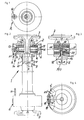
- each case there is a running axle 1 with two coaxial wheels (not shown in more detail) and in each case two multi-disc brakes designated as 2 in total.
- the wheels are fastened to outer disks or hubs 3, which are each mounted on a common axle tube 5 via rotatable stub axles 4.
- the space containing the brakes 2, hereinafter also called the brake housing 6, is filled with liquid.
- the brake housing 6 filled with coolant are in direct connection with one another via the interior of the axle tube 5, so that the axle tube 5 is also filled with the liquid and the liquid in this unit consists of brake housings 6 and Axle tube 5 can circulate.
- the brakes 2 are designed as multi-disc brakes, which are well suited to run within a cooling and lubricating liquid, which liquid also lubricates the bearings 7.
- a device for circulating the liquid filling is provided in the exemplary embodiment, which is designed as a circulating pump 8.
- the entry into this circulation pump 8 is located inside the axle tube 5, while the exit 9 is indicated outside and can belong to a circuit via a line or the like. If necessary, an additional container for increasing the liquid volume can then be provided in this liquid circuit, which can optionally also be designed as a cooler.
- one of the stub axles 4, which is connected non-rotatably to the respective wheel via the outer hub 3, has an axially directed towards the inside of the running tube 5, eccentric pin 10 with respect to the center of the hub 3, on its circumference the piston rod 11 of a piston pump is supported as a circulation pump 8.
- the pump 8 can also be designed as a diaphragm pump, the diaphragm of which is moved by the piston rod 11.
- Another pump could also be connected to the eccentric pin 10. This results in a very simple actuation of a circulation pump 8, since it should not generate high pressure, but only has to deal with an accelerated liquid exchange between warm and cooler zones.
- an actuating device for a parking brake can be provided in addition to the pneumatic or hydraulic actuation of the brakes due to the low fluid pressure.
- a sealed passage 12 for an actuating rod which can be pivoted, rotated and / or moved back and forth or the like is provided for the parking brake device on the upper region A of the brake housing 6 in the use position is.
- a lever 14 that can be pivoted in the horizontal direction according to the double arrow Pf 1 in FIG. 3 is used to turn the plates 15 to compress them or to press them against the fixed plates 16 serving expansion disks 17 are provided, the expansion disks 17 being able to be pressed apart in a manner known per se by way of balls or the like located between rolling elements running on inclined surfaces. It is readily apparent that when the two parallel spreading disks 17 are axially pushed apart, the lamellar disks are pressed against fixed disks which engage between them and finally against the end disks 16 belonging to the housing. During driving operation, this is done via the pneumatic or hydraulic working cylinder 13. To determine, the lever 14 can now be pivoted in the manner according to the invention, and something analogous can thereby be achieved.
- the pivotable lever 14 acts according to FIG. 3 on a transmission part 18, which due to the pivoting movement of the lever 14 an axis of rotation 19 (FIG. 4) is rotatable and, via at least one, in the exemplary embodiment two pressure pins 20, each exerts a thrust movement transverse to its axis of rotation 19 approximately tangentially on the spreading disks 17 and projections 25 arranged thereon. These are thus rotated in opposite directions to one another by the pivoting movement of the lever 14 and pressed away from one another against the respective lamella disks 15 and 16 by the rolling bodies running between them on inclined surfaces.
- the transmission block 18 has such pressure pins 20 on both sides of its axis of rotation 19, both provided spreading disks 17 of the double multi-disc brake can be actuated.
- the passage 12 of the actuating lever 14 has a lip seal 21.
- a pull rod 24 or possibly also another pull element is provided as a locking device for the multi-disc brakes.
- a pole has the advantage of being able to transmit opposite movements.
- the pull rod In the interior of the braking space 6, the pull rod has either itself or a part connected to it with the respective inclined surfaces 22 wedges 23 which act against the spreading disks 17 of the disk or disk disks and which face away from one another in order to be able to act accordingly on the oppositely rotatable spreading disks 17 .
- FIG. 7 If the pull rod is moved in the direction of arrow Pf 2, the wedge surfaces each result in a movement component acting in the circumferential direction of the spreading disks, which on corresponding projections 25 (FIG. 8) of these spreading disks 17 in corresponding Rotational movements are implemented.
- the pull rod 24 can optionally be actuated via hydraulic or pneumatic working cylinders of a service brake during driving operation or via a cable pull, a linkage or the like.
- a parking brake can optionally be actuated via hydraulic or pneumatic working cylinders of a service brake during driving operation or via a cable pull, a linkage or the like.
- the actuating devices of the brake can be mechanical as well as pneumatic as well as hydraulic without having to convert the innards of the entire barrel axis.
- the attachment of the operating device of the service brake e.g. foot brake
- be it inside or outside hydraulically or pneumatically can be done independently of the mechanical one.
Landscapes
- Engineering & Computer Science (AREA)
- General Engineering & Computer Science (AREA)
- Mechanical Engineering (AREA)
- Transportation (AREA)
- Braking Arrangements (AREA)
Claims (16)
Priority Applications (1)
| Application Number | Priority Date | Filing Date | Title |
|---|---|---|---|
| AT81110397T ATE13162T1 (de) | 1981-03-31 | 1981-12-12 | Laufachse mit fluessigkeitsgekuehlten lamellenscheibenbremsen. |
Applications Claiming Priority (2)
| Application Number | Priority Date | Filing Date | Title |
|---|---|---|---|
| DE3112671 | 1981-03-31 | ||
| DE3112671A DE3112671C2 (de) | 1981-03-31 | 1981-03-31 | Laufachse mit flüssigkeitsgkühlten Lamellenscheibenbremsen |
Publications (2)
| Publication Number | Publication Date |
|---|---|
| EP0061533A1 EP0061533A1 (fr) | 1982-10-06 |
| EP0061533B1 true EP0061533B1 (fr) | 1985-05-08 |
Family
ID=6128778
Family Applications (1)
| Application Number | Title | Priority Date | Filing Date |
|---|---|---|---|
| EP81110397A Expired EP0061533B1 (fr) | 1981-03-31 | 1981-12-12 | Essieu fou avec freins à disques multiples refroidis par fluide |
Country Status (3)
| Country | Link |
|---|---|
| EP (1) | EP0061533B1 (fr) |
| AT (1) | ATE13162T1 (fr) |
| DE (2) | DE3112671C2 (fr) |
Families Citing this family (3)
| Publication number | Priority date | Publication date | Assignee | Title |
|---|---|---|---|---|
| GB8725908D0 (en) * | 1987-11-05 | 1987-12-09 | Lucas Ind Plc | Vehicle disc brakes |
| HU216712B (hu) * | 1994-02-24 | 1999-08-30 | RÁBA Magyar Vagon- és Gépgyár Rt. | Speciális olajkeringető rendszer, főként nedvesfékes munkagépfutóművek és nagy terhelésű kerékagy-bolygóműves futóművek hűtésére |
| DE19648212A1 (de) * | 1996-11-21 | 1998-05-28 | Zahnradfabrik Friedrichshafen | Kühlflüssigkeitsfördersystem in einer Fahrzeugachse |
Citations (1)
| Publication number | Priority date | Publication date | Assignee | Title |
|---|---|---|---|---|
| DE664531C (de) * | 1935-04-06 | 1938-09-01 | Hans Kattwinkel | Lamellenbremse |
Family Cites Families (8)
| Publication number | Priority date | Publication date | Assignee | Title |
|---|---|---|---|---|
| US2016359A (en) * | 1933-04-06 | 1935-10-08 | William C Biddle | Brake |
| DE6605173U (de) * | 1966-09-20 | 1970-04-23 | Strick Corp | Fahrzeugbremse. |
| US3580368A (en) * | 1969-06-02 | 1971-05-25 | Gen Motors Corp | Disc brake cooling means and pump drive mechanism |
| CH582315A5 (fr) * | 1972-04-07 | 1976-11-30 | Klaue Hermann | |
| CH551305A (de) * | 1972-02-10 | 1974-07-15 | Klaue Hermann | Fluessigkeitsgekuehlte scheibenbremsanlage fuer nicht angetriebene achsen schwerer kraftfahrzeuge und anhaenger. |
| US4022298A (en) * | 1976-03-29 | 1977-05-10 | D.A.B. Industries, Inc. | Wet disc brake |
| GB1585092A (en) * | 1976-05-05 | 1981-02-25 | Girling Ltd | Disc brakes for vehicles |
| DE2835667A1 (de) * | 1978-08-14 | 1980-02-28 | Kloeckner Humboldt Deutz Ag | Bremseinrichtung fuer einen achswellenantrieb eines land- und/oder bauwirtschaftlich nutzbaren kraftfahrzeugs |
-
1981
- 1981-03-31 DE DE3112671A patent/DE3112671C2/de not_active Expired
- 1981-12-12 DE DE8181110397T patent/DE3170441D1/de not_active Expired
- 1981-12-12 EP EP81110397A patent/EP0061533B1/fr not_active Expired
- 1981-12-12 AT AT81110397T patent/ATE13162T1/de not_active IP Right Cessation
Patent Citations (1)
| Publication number | Priority date | Publication date | Assignee | Title |
|---|---|---|---|---|
| DE664531C (de) * | 1935-04-06 | 1938-09-01 | Hans Kattwinkel | Lamellenbremse |
Also Published As
| Publication number | Publication date |
|---|---|
| DE3170441D1 (en) | 1985-06-13 |
| DE3112671C2 (de) | 1985-02-14 |
| EP0061533A1 (fr) | 1982-10-06 |
| DE3112671A1 (de) | 1982-10-21 |
| ATE13162T1 (de) | 1985-05-15 |
Similar Documents
| Publication | Publication Date | Title |
|---|---|---|
| DE664531C (de) | Lamellenbremse | |
| DE3826256A1 (de) | Antriebsdrehmoment-uebertragungsvorrichtung | |
| DE3617074C2 (fr) | ||
| EP0427116A1 (fr) | Convertisseur d'énergie de freinage | |
| DE1238346B (de) | Ohne Zugkraftunterbrechung schaltbares zweigaengiges Umlaufraedergruppengetriebe, insbesondere zum Zusammenbau mit Kraftfahrzeugwechselgetrieben | |
| EP0383758B1 (fr) | Systeme de freinage | |
| EP0061533B1 (fr) | Essieu fou avec freins à disques multiples refroidis par fluide | |
| DE19504451B4 (de) | Antriebseinrichtung für mobile Arbeitsgeräte | |
| EP1595762B1 (fr) | Moyeu de roue | |
| DE3245720A1 (de) | Antriebssystem fuer einen dreh-, schwenk- und fahrantrieb eines fahrzeugs, insbesondere fuer einen bagger | |
| DE60106994T2 (de) | Radnabe für Kraftfahrzeuge | |
| DE2948895C2 (de) | Bremsanlage | |
| DE102024107553A1 (de) | Nassbremsenkupplung | |
| DE2037641A1 (de) | Verzögerungssystem fur Kraftfahrzeuge | |
| AT393719B (de) | Selbstsperrendes ausgleichgetriebe fuer kraftfahrzeuge | |
| WO2000069695A1 (fr) | Entrainement de roue pour vehicule mobile | |
| EP0684916B1 (fr) | Systeme de freinage pour vehicule sur rails, en particulier pour locomotive, et vehicule sur rails muni d'un tel systeme de freinage | |
| DE1164854B (de) | Teilbelagscheibenbremse, insbesondere fuer Motorfahrzeuge u. dgl. | |
| DE19854781A1 (de) | Lenkbarer Radantrieb | |
| DE3734801A1 (de) | Radbremseinrichtung fuer kraftfahrzeuge | |
| DE1605959C3 (de) | Bremssystem fur Straßenfahrzeuge | |
| DE953857C (de) | Lenkkupplung mit Lenkbremse fuer Kraftfahrzeuge, insbesondere Gleiskettenfahrzeuge | |
| DE2736968A1 (de) | Vier- oder mehrscheiben-vollbelagscheibenbremse, insbesondere fuer schwere nutzfahrzeuge | |
| DE69511618T2 (de) | Verkapselte, trockenlaufende Einscheibenbremse, insbesondere für Achsen industrieller und landwirtschaftlicher Fahrzeuge und dergleichen | |
| DE4319250A1 (de) | Bremsvorrichtung für ein Eisenbahnrad und Bremssystem für eine Radachse eines Drehgestells |
Legal Events
| Date | Code | Title | Description |
|---|---|---|---|
| PUAI | Public reference made under article 153(3) epc to a published international application that has entered the european phase |
Free format text: ORIGINAL CODE: 0009012 |
|
| AK | Designated contracting states |
Designated state(s): AT BE CH DE FR IT |
|
| 17P | Request for examination filed |
Effective date: 19830128 |
|
| ITF | It: translation for a ep patent filed | ||
| GRAA | (expected) grant |
Free format text: ORIGINAL CODE: 0009210 |
|
| AK | Designated contracting states |
Designated state(s): AT BE CH DE FR IT LI |
|
| REF | Corresponds to: |
Ref document number: 13162 Country of ref document: AT Date of ref document: 19850515 Kind code of ref document: T |
|
| REF | Corresponds to: |
Ref document number: 3170441 Country of ref document: DE Date of ref document: 19850613 |
|
| ET | Fr: translation filed | ||
| PLBE | No opposition filed within time limit |
Free format text: ORIGINAL CODE: 0009261 |
|
| STAA | Information on the status of an ep patent application or granted ep patent |
Free format text: STATUS: NO OPPOSITION FILED WITHIN TIME LIMIT |
|
| 26N | No opposition filed | ||
| PGFP | Annual fee paid to national office [announced via postgrant information from national office to epo] |
Ref country code: FR Payment date: 19901129 Year of fee payment: 10 |
|
| PGFP | Annual fee paid to national office [announced via postgrant information from national office to epo] |
Ref country code: DE Payment date: 19901207 Year of fee payment: 10 |
|
| PGFP | Annual fee paid to national office [announced via postgrant information from national office to epo] |
Ref country code: CH Payment date: 19901212 Year of fee payment: 10 |
|
| PGFP | Annual fee paid to national office [announced via postgrant information from national office to epo] |
Ref country code: AT Payment date: 19901228 Year of fee payment: 10 |
|
| ITTA | It: last paid annual fee | ||
| PGFP | Annual fee paid to national office [announced via postgrant information from national office to epo] |
Ref country code: BE Payment date: 19910204 Year of fee payment: 10 |
|
| PG25 | Lapsed in a contracting state [announced via postgrant information from national office to epo] |
Ref country code: AT Effective date: 19911212 |
|
| PG25 | Lapsed in a contracting state [announced via postgrant information from national office to epo] |
Ref country code: LI Effective date: 19911231 Ref country code: CH Effective date: 19911231 Ref country code: BE Effective date: 19911231 |
|
| BERE | Be: lapsed |
Owner name: WELTE ALEXANDER Effective date: 19911231 |
|
| PG25 | Lapsed in a contracting state [announced via postgrant information from national office to epo] |
Ref country code: FR Effective date: 19920831 |
|
| REG | Reference to a national code |
Ref country code: CH Ref legal event code: PL |
|
| PG25 | Lapsed in a contracting state [announced via postgrant information from national office to epo] |
Ref country code: DE Effective date: 19920901 |
|
| REG | Reference to a national code |
Ref country code: FR Ref legal event code: ST |