EP0061611A1 - Verfahren zur Herstellung von kompakten Whiskerkörpern und losen Whiskers aus Siliziumnitrid für Komposit-Verstärkungsmaterialien - Google Patents
Verfahren zur Herstellung von kompakten Whiskerkörpern und losen Whiskers aus Siliziumnitrid für Komposit-Verstärkungsmaterialien Download PDFInfo
- Publication number
- EP0061611A1 EP0061611A1 EP82101830A EP82101830A EP0061611A1 EP 0061611 A1 EP0061611 A1 EP 0061611A1 EP 82101830 A EP82101830 A EP 82101830A EP 82101830 A EP82101830 A EP 82101830A EP 0061611 A1 EP0061611 A1 EP 0061611A1
- Authority
- EP
- European Patent Office
- Prior art keywords
- silicon
- whiskers
- particles
- silicon nitride
- compact
- Prior art date
- Legal status (The legal status is an assumption and is not a legal conclusion. Google has not performed a legal analysis and makes no representation as to the accuracy of the status listed.)
- Ceased
Links
- 229910052581 Si3N4 Inorganic materials 0.000 title claims abstract description 84
- 239000002131 composite material Substances 0.000 title claims abstract description 31
- 238000004519 manufacturing process Methods 0.000 title claims abstract description 15
- 230000002787 reinforcement Effects 0.000 title abstract description 8
- 239000000203 mixture Substances 0.000 claims abstract description 100
- IJGRMHOSHXDMSA-UHFFFAOYSA-N Atomic nitrogen Chemical compound N#N IJGRMHOSHXDMSA-UHFFFAOYSA-N 0.000 claims abstract description 76
- 239000002245 particle Substances 0.000 claims abstract description 60
- 239000011856 silicon-based particle Substances 0.000 claims abstract description 40
- 229910052757 nitrogen Inorganic materials 0.000 claims abstract description 38
- 239000000463 material Substances 0.000 claims abstract description 36
- 229910052710 silicon Inorganic materials 0.000 claims abstract description 36
- 239000010703 silicon Substances 0.000 claims abstract description 36
- XUIMIQQOPSSXEZ-UHFFFAOYSA-N Silicon Chemical compound [Si] XUIMIQQOPSSXEZ-UHFFFAOYSA-N 0.000 claims abstract description 35
- 239000000843 powder Substances 0.000 claims abstract description 35
- 238000000465 moulding Methods 0.000 claims abstract description 23
- 239000012686 silicon precursor Substances 0.000 claims abstract description 20
- 238000002156 mixing Methods 0.000 claims abstract description 19
- HQVNEWCFYHHQES-UHFFFAOYSA-N silicon nitride Chemical class N12[Si]34N5[Si]62N3[Si]51N64 HQVNEWCFYHHQES-UHFFFAOYSA-N 0.000 claims abstract description 11
- 229910021426 porous silicon Inorganic materials 0.000 claims abstract description 6
- UFWIBTONFRDIAS-UHFFFAOYSA-N Naphthalene Chemical compound C1=CC=CC2=CC=CC=C21 UFWIBTONFRDIAS-UHFFFAOYSA-N 0.000 claims description 45
- QGZKDVFQNNGYKY-UHFFFAOYSA-N Ammonia Chemical compound N QGZKDVFQNNGYKY-UHFFFAOYSA-N 0.000 claims description 44
- 238000000034 method Methods 0.000 claims description 35
- 229910021529 ammonia Inorganic materials 0.000 claims description 22
- 239000001257 hydrogen Substances 0.000 claims description 21
- 229910052739 hydrogen Inorganic materials 0.000 claims description 21
- UFHFLCQGNIYNRP-UHFFFAOYSA-N Hydrogen Chemical compound [H][H] UFHFLCQGNIYNRP-UHFFFAOYSA-N 0.000 claims description 19
- 239000011159 matrix material Substances 0.000 claims description 18
- 239000000126 substance Substances 0.000 claims description 18
- 229920005989 resin Polymers 0.000 claims description 16
- 239000011347 resin Substances 0.000 claims description 16
- 229910052751 metal Inorganic materials 0.000 claims description 15
- 239000002184 metal Substances 0.000 claims description 15
- VNWKTOKETHGBQD-UHFFFAOYSA-N methane Chemical compound C VNWKTOKETHGBQD-UHFFFAOYSA-N 0.000 claims description 11
- 238000006243 chemical reaction Methods 0.000 claims description 10
- CURLTUGMZLYLDI-UHFFFAOYSA-N Carbon dioxide Chemical compound O=C=O CURLTUGMZLYLDI-UHFFFAOYSA-N 0.000 claims description 8
- VYPSYNLAJGMNEJ-UHFFFAOYSA-N Silicium dioxide Chemical compound O=[Si]=O VYPSYNLAJGMNEJ-UHFFFAOYSA-N 0.000 claims description 8
- 229910001338 liquidmetal Inorganic materials 0.000 claims description 8
- 239000007787 solid Substances 0.000 claims description 8
- 239000000725 suspension Substances 0.000 claims description 8
- 229920001296 polysiloxane Polymers 0.000 claims description 7
- PNEYBMLMFCGWSK-UHFFFAOYSA-N aluminium oxide Inorganic materials [O-2].[O-2].[O-2].[Al+3].[Al+3] PNEYBMLMFCGWSK-UHFFFAOYSA-N 0.000 claims description 6
- 239000011230 binding agent Substances 0.000 claims description 6
- 239000000919 ceramic Substances 0.000 claims description 6
- 239000011248 coating agent Substances 0.000 claims description 6
- 238000000576 coating method Methods 0.000 claims description 6
- 238000010438 heat treatment Methods 0.000 claims description 6
- VXEGSRKPIUDPQT-UHFFFAOYSA-N 4-[4-(4-methoxyphenyl)piperazin-1-yl]aniline Chemical compound C1=CC(OC)=CC=C1N1CCN(C=2C=CC(N)=CC=2)CC1 VXEGSRKPIUDPQT-UHFFFAOYSA-N 0.000 claims description 5
- 238000001035 drying Methods 0.000 claims description 5
- 239000005049 silicon tetrachloride Substances 0.000 claims description 5
- 238000005245 sintering Methods 0.000 claims description 5
- 239000004593 Epoxy Substances 0.000 claims description 4
- 229910052782 aluminium Inorganic materials 0.000 claims description 4
- XAGFODPZIPBFFR-UHFFFAOYSA-N aluminium Chemical compound [Al] XAGFODPZIPBFFR-UHFFFAOYSA-N 0.000 claims description 4
- 239000008346 aqueous phase Substances 0.000 claims description 4
- KGBXLFKZBHKPEV-UHFFFAOYSA-N boric acid Chemical compound OB(O)O KGBXLFKZBHKPEV-UHFFFAOYSA-N 0.000 claims description 4
- 239000004327 boric acid Substances 0.000 claims description 4
- 239000001569 carbon dioxide Substances 0.000 claims description 4
- 229910002092 carbon dioxide Inorganic materials 0.000 claims description 4
- 229920001721 polyimide Polymers 0.000 claims description 4
- ABTOQLMXBSRXSM-UHFFFAOYSA-N silicon tetrafluoride Chemical compound F[Si](F)(F)F ABTOQLMXBSRXSM-UHFFFAOYSA-N 0.000 claims description 4
- BNGXYYYYKUGPPF-UHFFFAOYSA-M (3-methylphenyl)methyl-triphenylphosphanium;chloride Chemical compound [Cl-].CC1=CC=CC(C[P+](C=2C=CC=CC=2)(C=2C=CC=CC=2)C=2C=CC=CC=2)=C1 BNGXYYYYKUGPPF-UHFFFAOYSA-M 0.000 claims description 3
- DSSYKIVIOFKYAU-XCBNKYQSSA-N (R)-camphor Chemical compound C1C[C@@]2(C)C(=O)C[C@@H]1C2(C)C DSSYKIVIOFKYAU-XCBNKYQSSA-N 0.000 claims description 3
- 241000723346 Cinnamomum camphora Species 0.000 claims description 3
- 229910021586 Nickel(II) chloride Inorganic materials 0.000 claims description 3
- 239000004642 Polyimide Substances 0.000 claims description 3
- 238000000498 ball milling Methods 0.000 claims description 3
- 229960000846 camphor Drugs 0.000 claims description 3
- 229930008380 camphor Natural products 0.000 claims description 3
- 238000002844 melting Methods 0.000 claims description 3
- 230000008018 melting Effects 0.000 claims description 3
- QMMRZOWCJAIUJA-UHFFFAOYSA-L nickel dichloride Chemical compound Cl[Ni]Cl QMMRZOWCJAIUJA-UHFFFAOYSA-L 0.000 claims description 3
- QJGQUHMNIGDVPM-UHFFFAOYSA-N nitrogen group Chemical group [N] QJGQUHMNIGDVPM-UHFFFAOYSA-N 0.000 claims description 3
- 239000000377 silicon dioxide Substances 0.000 claims description 3
- RYGMFSIKBFXOCR-UHFFFAOYSA-N Copper Chemical compound [Cu] RYGMFSIKBFXOCR-UHFFFAOYSA-N 0.000 claims description 2
- FYYHWMGAXLPEAU-UHFFFAOYSA-N Magnesium Chemical compound [Mg] FYYHWMGAXLPEAU-UHFFFAOYSA-N 0.000 claims description 2
- BQCADISMDOOEFD-UHFFFAOYSA-N Silver Chemical compound [Ag] BQCADISMDOOEFD-UHFFFAOYSA-N 0.000 claims description 2
- 229910052802 copper Inorganic materials 0.000 claims description 2
- 239000010949 copper Substances 0.000 claims description 2
- 229910052749 magnesium Inorganic materials 0.000 claims description 2
- 239000011777 magnesium Substances 0.000 claims description 2
- 229910052709 silver Inorganic materials 0.000 claims description 2
- 239000004332 silver Substances 0.000 claims description 2
- 238000009736 wetting Methods 0.000 claims description 2
- 239000000080 wetting agent Substances 0.000 claims description 2
- NIXOWILDQLNWCW-UHFFFAOYSA-N acrylic acid group Chemical group C(C=C)(=O)O NIXOWILDQLNWCW-UHFFFAOYSA-N 0.000 claims 1
- 229940095054 ammoniac Drugs 0.000 claims 1
- 150000002431 hydrogen Chemical class 0.000 claims 1
- ISWSIDIOOBJBQZ-UHFFFAOYSA-N phenol group Chemical group C1(=CC=CC=C1)O ISWSIDIOOBJBQZ-UHFFFAOYSA-N 0.000 claims 1
- 230000000379 polymerizing effect Effects 0.000 claims 1
- 239000002243 precursor Substances 0.000 abstract description 4
- 239000012071 phase Substances 0.000 description 12
- 238000000859 sublimation Methods 0.000 description 6
- 230000008022 sublimation Effects 0.000 description 6
- 230000008595 infiltration Effects 0.000 description 5
- 238000001764 infiltration Methods 0.000 description 5
- 239000000243 solution Substances 0.000 description 5
- XLYOFNOQVPJJNP-UHFFFAOYSA-N water Substances O XLYOFNOQVPJJNP-UHFFFAOYSA-N 0.000 description 5
- 150000002739 metals Chemical class 0.000 description 4
- 230000003014 reinforcing effect Effects 0.000 description 4
- 229910052594 sapphire Inorganic materials 0.000 description 4
- 239000010980 sapphire Substances 0.000 description 4
- 150000001875 compounds Chemical class 0.000 description 3
- 238000000227 grinding Methods 0.000 description 3
- 238000012986 modification Methods 0.000 description 3
- 230000004048 modification Effects 0.000 description 3
- KGDIULMCUSLFSP-UHFFFAOYSA-N naphthalene;silicon Chemical compound [Si].C1=CC=CC2=CC=CC=C21 KGDIULMCUSLFSP-UHFFFAOYSA-N 0.000 description 3
- HBMJWWWQQXIZIP-UHFFFAOYSA-N silicon carbide Chemical compound [Si+]#[C-] HBMJWWWQQXIZIP-UHFFFAOYSA-N 0.000 description 3
- -1 176 - 180°F. Chemical compound 0.000 description 2
- OKTJSMMVPCPJKN-UHFFFAOYSA-N Carbon Chemical compound [C] OKTJSMMVPCPJKN-UHFFFAOYSA-N 0.000 description 2
- PXHVJJICTQNCMI-UHFFFAOYSA-N Nickel Chemical compound [Ni] PXHVJJICTQNCMI-UHFFFAOYSA-N 0.000 description 2
- GQPLMRYTRLFLPF-UHFFFAOYSA-N Nitrous Oxide Chemical compound [O-][N+]#N GQPLMRYTRLFLPF-UHFFFAOYSA-N 0.000 description 2
- 229910000831 Steel Inorganic materials 0.000 description 2
- 230000005587 bubbling Effects 0.000 description 2
- 229910052799 carbon Inorganic materials 0.000 description 2
- 239000008119 colloidal silica Substances 0.000 description 2
- 238000010304 firing Methods 0.000 description 2
- 239000007789 gas Substances 0.000 description 2
- 238000005470 impregnation Methods 0.000 description 2
- TWNQGVIAIRXVLR-UHFFFAOYSA-N oxo(oxoalumanyloxy)alumane Chemical group O=[Al]O[Al]=O TWNQGVIAIRXVLR-UHFFFAOYSA-N 0.000 description 2
- GNRSAWUEBMWBQH-UHFFFAOYSA-N oxonickel Chemical group [Ni]=O GNRSAWUEBMWBQH-UHFFFAOYSA-N 0.000 description 2
- 229920000647 polyepoxide Polymers 0.000 description 2
- 238000002360 preparation method Methods 0.000 description 2
- 229920006395 saturated elastomer Polymers 0.000 description 2
- 229910010271 silicon carbide Inorganic materials 0.000 description 2
- 239000011863 silicon-based powder Substances 0.000 description 2
- 239000010959 steel Substances 0.000 description 2
- 239000004925 Acrylic resin Substances 0.000 description 1
- 229920000178 Acrylic resin Polymers 0.000 description 1
- 229920001342 Bakelite® Polymers 0.000 description 1
- ZOXJGFHDIHLPTG-UHFFFAOYSA-N Boron Chemical compound [B] ZOXJGFHDIHLPTG-UHFFFAOYSA-N 0.000 description 1
- ZAMOUSCENKQFHK-UHFFFAOYSA-N Chlorine atom Chemical compound [Cl] ZAMOUSCENKQFHK-UHFFFAOYSA-N 0.000 description 1
- WHXSMMKQMYFTQS-UHFFFAOYSA-N Lithium Chemical compound [Li] WHXSMMKQMYFTQS-UHFFFAOYSA-N 0.000 description 1
- ZOKXTWBITQBERF-UHFFFAOYSA-N Molybdenum Chemical compound [Mo] ZOKXTWBITQBERF-UHFFFAOYSA-N 0.000 description 1
- RTAQQCXQSZGOHL-UHFFFAOYSA-N Titanium Chemical compound [Ti] RTAQQCXQSZGOHL-UHFFFAOYSA-N 0.000 description 1
- 229920006397 acrylic thermoplastic Polymers 0.000 description 1
- 239000000654 additive Substances 0.000 description 1
- 230000000996 additive effect Effects 0.000 description 1
- 238000013019 agitation Methods 0.000 description 1
- 239000004637 bakelite Substances 0.000 description 1
- 230000015572 biosynthetic process Effects 0.000 description 1
- 229910052796 boron Inorganic materials 0.000 description 1
- 239000000460 chlorine Substances 0.000 description 1
- 229910052801 chlorine Inorganic materials 0.000 description 1
- 239000004927 clay Substances 0.000 description 1
- 239000000084 colloidal system Substances 0.000 description 1
- 238000001816 cooling Methods 0.000 description 1
- 239000013078 crystal Substances 0.000 description 1
- 238000007723 die pressing method Methods 0.000 description 1
- 229920001971 elastomer Polymers 0.000 description 1
- 125000003700 epoxy group Chemical group 0.000 description 1
- 239000003822 epoxy resin Substances 0.000 description 1
- 239000000835 fiber Substances 0.000 description 1
- LNEPOXFFQSENCJ-UHFFFAOYSA-N haloperidol Chemical compound C1CC(O)(C=2C=CC(Cl)=CC=2)CCN1CCCC(=O)C1=CC=C(F)C=C1 LNEPOXFFQSENCJ-UHFFFAOYSA-N 0.000 description 1
- 238000007731 hot pressing Methods 0.000 description 1
- 230000002706 hydrostatic effect Effects 0.000 description 1
- 238000011005 laboratory method Methods 0.000 description 1
- 239000007788 liquid Substances 0.000 description 1
- 229910052744 lithium Inorganic materials 0.000 description 1
- 150000001247 metal acetylides Chemical class 0.000 description 1
- 229910052750 molybdenum Inorganic materials 0.000 description 1
- 239000011733 molybdenum Substances 0.000 description 1
- 239000004570 mortar (masonry) Substances 0.000 description 1
- 229910052759 nickel Inorganic materials 0.000 description 1
- 229910000480 nickel oxide Inorganic materials 0.000 description 1
- 239000010955 niobium Substances 0.000 description 1
- GUCVJGMIXFAOAE-UHFFFAOYSA-N niobium atom Chemical compound [Nb] GUCVJGMIXFAOAE-UHFFFAOYSA-N 0.000 description 1
- 150000004767 nitrides Chemical class 0.000 description 1
- 239000001272 nitrous oxide Substances 0.000 description 1
- 230000001590 oxidative effect Effects 0.000 description 1
- 239000011236 particulate material Substances 0.000 description 1
- 239000013618 particulate matter Substances 0.000 description 1
- 229920001568 phenolic resin Polymers 0.000 description 1
- 239000005011 phenolic resin Substances 0.000 description 1
- 229920003229 poly(methyl methacrylate) Polymers 0.000 description 1
- 239000009719 polyimide resin Substances 0.000 description 1
- 238000006116 polymerization reaction Methods 0.000 description 1
- 235000013824 polyphenols Nutrition 0.000 description 1
- 239000011148 porous material Substances 0.000 description 1
- 238000003825 pressing Methods 0.000 description 1
- 238000000197 pyrolysis Methods 0.000 description 1
- 230000000717 retained effect Effects 0.000 description 1
- 239000012266 salt solution Substances 0.000 description 1
- 239000005368 silicate glass Substances 0.000 description 1
- 229920002050 silicone resin Polymers 0.000 description 1
- 239000002002 slurry Substances 0.000 description 1
- 239000011343 solid material Substances 0.000 description 1
- 238000007711 solidification Methods 0.000 description 1
- 230000008023 solidification Effects 0.000 description 1
- ISXSCDLOGDJUNJ-UHFFFAOYSA-N tert-butyl prop-2-enoate Chemical compound CC(C)(C)OC(=O)C=C ISXSCDLOGDJUNJ-UHFFFAOYSA-N 0.000 description 1
- 238000007669 thermal treatment Methods 0.000 description 1
- 239000010936 titanium Substances 0.000 description 1
- 229910052719 titanium Inorganic materials 0.000 description 1
- 238000009489 vacuum treatment Methods 0.000 description 1
Images

Classifications
-
- C—CHEMISTRY; METALLURGY
- C04—CEMENTS; CONCRETE; ARTIFICIAL STONE; CERAMICS; REFRACTORIES
- C04B—LIME, MAGNESIA; SLAG; CEMENTS; COMPOSITIONS THEREOF, e.g. MORTARS, CONCRETE OR LIKE BUILDING MATERIALS; ARTIFICIAL STONE; CERAMICS; REFRACTORIES; TREATMENT OF NATURAL STONE
- C04B35/00—Shaped ceramic products characterised by their composition; Ceramics compositions; Processing powders of inorganic compounds preparatory to the manufacturing of ceramic products
- C04B35/71—Ceramic products containing macroscopic reinforcing agents
- C04B35/78—Ceramic products containing macroscopic reinforcing agents containing non-metallic materials
- C04B35/80—Fibres, filaments, whiskers, platelets, or the like
-
- C—CHEMISTRY; METALLURGY
- C04—CEMENTS; CONCRETE; ARTIFICIAL STONE; CERAMICS; REFRACTORIES
- C04B—LIME, MAGNESIA; SLAG; CEMENTS; COMPOSITIONS THEREOF, e.g. MORTARS, CONCRETE OR LIKE BUILDING MATERIALS; ARTIFICIAL STONE; CERAMICS; REFRACTORIES; TREATMENT OF NATURAL STONE
- C04B35/00—Shaped ceramic products characterised by their composition; Ceramics compositions; Processing powders of inorganic compounds preparatory to the manufacturing of ceramic products
- C04B35/01—Shaped ceramic products characterised by their composition; Ceramics compositions; Processing powders of inorganic compounds preparatory to the manufacturing of ceramic products based on oxide ceramics
- C04B35/10—Shaped ceramic products characterised by their composition; Ceramics compositions; Processing powders of inorganic compounds preparatory to the manufacturing of ceramic products based on oxide ceramics based on aluminium oxide
- C04B35/111—Fine ceramics
- C04B35/117—Composites
-
- C—CHEMISTRY; METALLURGY
- C04—CEMENTS; CONCRETE; ARTIFICIAL STONE; CERAMICS; REFRACTORIES
- C04B—LIME, MAGNESIA; SLAG; CEMENTS; COMPOSITIONS THEREOF, e.g. MORTARS, CONCRETE OR LIKE BUILDING MATERIALS; ARTIFICIAL STONE; CERAMICS; REFRACTORIES; TREATMENT OF NATURAL STONE
- C04B35/00—Shaped ceramic products characterised by their composition; Ceramics compositions; Processing powders of inorganic compounds preparatory to the manufacturing of ceramic products
- C04B35/01—Shaped ceramic products characterised by their composition; Ceramics compositions; Processing powders of inorganic compounds preparatory to the manufacturing of ceramic products based on oxide ceramics
- C04B35/14—Shaped ceramic products characterised by their composition; Ceramics compositions; Processing powders of inorganic compounds preparatory to the manufacturing of ceramic products based on oxide ceramics based on silica
-
- C—CHEMISTRY; METALLURGY
- C04—CEMENTS; CONCRETE; ARTIFICIAL STONE; CERAMICS; REFRACTORIES
- C04B—LIME, MAGNESIA; SLAG; CEMENTS; COMPOSITIONS THEREOF, e.g. MORTARS, CONCRETE OR LIKE BUILDING MATERIALS; ARTIFICIAL STONE; CERAMICS; REFRACTORIES; TREATMENT OF NATURAL STONE
- C04B35/00—Shaped ceramic products characterised by their composition; Ceramics compositions; Processing powders of inorganic compounds preparatory to the manufacturing of ceramic products
- C04B35/515—Shaped ceramic products characterised by their composition; Ceramics compositions; Processing powders of inorganic compounds preparatory to the manufacturing of ceramic products based on non-oxide ceramics
- C04B35/52—Shaped ceramic products characterised by their composition; Ceramics compositions; Processing powders of inorganic compounds preparatory to the manufacturing of ceramic products based on non-oxide ceramics based on carbon, e.g. graphite
-
- C—CHEMISTRY; METALLURGY
- C04—CEMENTS; CONCRETE; ARTIFICIAL STONE; CERAMICS; REFRACTORIES
- C04B—LIME, MAGNESIA; SLAG; CEMENTS; COMPOSITIONS THEREOF, e.g. MORTARS, CONCRETE OR LIKE BUILDING MATERIALS; ARTIFICIAL STONE; CERAMICS; REFRACTORIES; TREATMENT OF NATURAL STONE
- C04B35/00—Shaped ceramic products characterised by their composition; Ceramics compositions; Processing powders of inorganic compounds preparatory to the manufacturing of ceramic products
- C04B35/515—Shaped ceramic products characterised by their composition; Ceramics compositions; Processing powders of inorganic compounds preparatory to the manufacturing of ceramic products based on non-oxide ceramics
- C04B35/58—Shaped ceramic products characterised by their composition; Ceramics compositions; Processing powders of inorganic compounds preparatory to the manufacturing of ceramic products based on non-oxide ceramics based on borides, nitrides, i.e. nitrides, oxynitrides, carbonitrides or oxycarbonitrides or silicides
- C04B35/581—Shaped ceramic products characterised by their composition; Ceramics compositions; Processing powders of inorganic compounds preparatory to the manufacturing of ceramic products based on non-oxide ceramics based on borides, nitrides, i.e. nitrides, oxynitrides, carbonitrides or oxycarbonitrides or silicides based on aluminium nitride
-
- C—CHEMISTRY; METALLURGY
- C04—CEMENTS; CONCRETE; ARTIFICIAL STONE; CERAMICS; REFRACTORIES
- C04B—LIME, MAGNESIA; SLAG; CEMENTS; COMPOSITIONS THEREOF, e.g. MORTARS, CONCRETE OR LIKE BUILDING MATERIALS; ARTIFICIAL STONE; CERAMICS; REFRACTORIES; TREATMENT OF NATURAL STONE
- C04B35/00—Shaped ceramic products characterised by their composition; Ceramics compositions; Processing powders of inorganic compounds preparatory to the manufacturing of ceramic products
- C04B35/622—Forming processes; Processing powders of inorganic compounds preparatory to the manufacturing of ceramic products
- C04B35/62227—Forming processes; Processing powders of inorganic compounds preparatory to the manufacturing of ceramic products obtaining fibres
- C04B35/62272—Forming processes; Processing powders of inorganic compounds preparatory to the manufacturing of ceramic products obtaining fibres based on non-oxide ceramics
- C04B35/62286—Fibres based on nitrides
- C04B35/62295—Fibres based on nitrides based on silicon nitride
-
- C—CHEMISTRY; METALLURGY
- C04—CEMENTS; CONCRETE; ARTIFICIAL STONE; CERAMICS; REFRACTORIES
- C04B—LIME, MAGNESIA; SLAG; CEMENTS; COMPOSITIONS THEREOF, e.g. MORTARS, CONCRETE OR LIKE BUILDING MATERIALS; ARTIFICIAL STONE; CERAMICS; REFRACTORIES; TREATMENT OF NATURAL STONE
- C04B35/00—Shaped ceramic products characterised by their composition; Ceramics compositions; Processing powders of inorganic compounds preparatory to the manufacturing of ceramic products
- C04B35/622—Forming processes; Processing powders of inorganic compounds preparatory to the manufacturing of ceramic products
- C04B35/626—Preparing or treating the powders individually or as batches ; preparing or treating macroscopic reinforcing agents for ceramic products, e.g. fibres; mechanical aspects section B
- C04B35/62605—Treating the starting powders individually or as mixtures
- C04B35/62645—Thermal treatment of powders or mixtures thereof other than sintering
- C04B35/6268—Thermal treatment of powders or mixtures thereof other than sintering characterised by the applied pressure or type of atmosphere, e.g. in vacuum, hydrogen or a specific oxygen pressure
-
- C—CHEMISTRY; METALLURGY
- C04—CEMENTS; CONCRETE; ARTIFICIAL STONE; CERAMICS; REFRACTORIES
- C04B—LIME, MAGNESIA; SLAG; CEMENTS; COMPOSITIONS THEREOF, e.g. MORTARS, CONCRETE OR LIKE BUILDING MATERIALS; ARTIFICIAL STONE; CERAMICS; REFRACTORIES; TREATMENT OF NATURAL STONE
- C04B35/00—Shaped ceramic products characterised by their composition; Ceramics compositions; Processing powders of inorganic compounds preparatory to the manufacturing of ceramic products
- C04B35/622—Forming processes; Processing powders of inorganic compounds preparatory to the manufacturing of ceramic products
- C04B35/626—Preparing or treating the powders individually or as batches ; preparing or treating macroscopic reinforcing agents for ceramic products, e.g. fibres; mechanical aspects section B
- C04B35/63—Preparing or treating the powders individually or as batches ; preparing or treating macroscopic reinforcing agents for ceramic products, e.g. fibres; mechanical aspects section B using additives specially adapted for forming the products, e.g.. binder binders
- C04B35/6303—Inorganic additives
- C04B35/6316—Binders based on silicon compounds
-
- C—CHEMISTRY; METALLURGY
- C04—CEMENTS; CONCRETE; ARTIFICIAL STONE; CERAMICS; REFRACTORIES
- C04B—LIME, MAGNESIA; SLAG; CEMENTS; COMPOSITIONS THEREOF, e.g. MORTARS, CONCRETE OR LIKE BUILDING MATERIALS; ARTIFICIAL STONE; CERAMICS; REFRACTORIES; TREATMENT OF NATURAL STONE
- C04B35/00—Shaped ceramic products characterised by their composition; Ceramics compositions; Processing powders of inorganic compounds preparatory to the manufacturing of ceramic products
- C04B35/622—Forming processes; Processing powders of inorganic compounds preparatory to the manufacturing of ceramic products
- C04B35/64—Burning or sintering processes
- C04B35/645—Pressure sintering
-
- C—CHEMISTRY; METALLURGY
- C30—CRYSTAL GROWTH
- C30B—SINGLE-CRYSTAL GROWTH; UNIDIRECTIONAL SOLIDIFICATION OF EUTECTIC MATERIAL OR UNIDIRECTIONAL DEMIXING OF EUTECTOID MATERIAL; REFINING BY ZONE-MELTING OF MATERIAL; PRODUCTION OF A HOMOGENEOUS POLYCRYSTALLINE MATERIAL WITH DEFINED STRUCTURE; SINGLE CRYSTALS OR HOMOGENEOUS POLYCRYSTALLINE MATERIAL WITH DEFINED STRUCTURE; AFTER-TREATMENT OF SINGLE CRYSTALS OR A HOMOGENEOUS POLYCRYSTALLINE MATERIAL WITH DEFINED STRUCTURE; APPARATUS THEREFOR
- C30B25/00—Single-crystal growth by chemical reaction of reactive gases, e.g. chemical vapour-deposition growth
- C30B25/005—Growth of whiskers or needles
-
- C—CHEMISTRY; METALLURGY
- C30—CRYSTAL GROWTH
- C30B—SINGLE-CRYSTAL GROWTH; UNIDIRECTIONAL SOLIDIFICATION OF EUTECTIC MATERIAL OR UNIDIRECTIONAL DEMIXING OF EUTECTOID MATERIAL; REFINING BY ZONE-MELTING OF MATERIAL; PRODUCTION OF A HOMOGENEOUS POLYCRYSTALLINE MATERIAL WITH DEFINED STRUCTURE; SINGLE CRYSTALS OR HOMOGENEOUS POLYCRYSTALLINE MATERIAL WITH DEFINED STRUCTURE; AFTER-TREATMENT OF SINGLE CRYSTALS OR A HOMOGENEOUS POLYCRYSTALLINE MATERIAL WITH DEFINED STRUCTURE; APPARATUS THEREFOR
- C30B29/00—Single crystals or homogeneous polycrystalline material with defined structure characterised by the material or by their shape
- C30B29/10—Inorganic compounds or compositions
- C30B29/38—Nitrides
-
- C—CHEMISTRY; METALLURGY
- C04—CEMENTS; CONCRETE; ARTIFICIAL STONE; CERAMICS; REFRACTORIES
- C04B—LIME, MAGNESIA; SLAG; CEMENTS; COMPOSITIONS THEREOF, e.g. MORTARS, CONCRETE OR LIKE BUILDING MATERIALS; ARTIFICIAL STONE; CERAMICS; REFRACTORIES; TREATMENT OF NATURAL STONE
- C04B2235/00—Aspects relating to ceramic starting mixtures or sintered ceramic products
- C04B2235/02—Composition of constituents of the starting material or of secondary phases of the final product
- C04B2235/30—Constituents and secondary phases not being of a fibrous nature
- C04B2235/34—Non-metal oxides, non-metal mixed oxides, or salts thereof that form the non-metal oxides upon heating, e.g. carbonates, nitrates, (oxy)hydroxides, chlorides
- C04B2235/3409—Boron oxide, borates, boric acids, or oxide forming salts thereof, e.g. borax
-
- C—CHEMISTRY; METALLURGY
- C04—CEMENTS; CONCRETE; ARTIFICIAL STONE; CERAMICS; REFRACTORIES
- C04B—LIME, MAGNESIA; SLAG; CEMENTS; COMPOSITIONS THEREOF, e.g. MORTARS, CONCRETE OR LIKE BUILDING MATERIALS; ARTIFICIAL STONE; CERAMICS; REFRACTORIES; TREATMENT OF NATURAL STONE
- C04B2235/00—Aspects relating to ceramic starting mixtures or sintered ceramic products
- C04B2235/02—Composition of constituents of the starting material or of secondary phases of the final product
- C04B2235/30—Constituents and secondary phases not being of a fibrous nature
- C04B2235/42—Non metallic elements added as constituents or additives, e.g. sulfur, phosphor, selenium or tellurium
- C04B2235/428—Silicon
-
- C—CHEMISTRY; METALLURGY
- C04—CEMENTS; CONCRETE; ARTIFICIAL STONE; CERAMICS; REFRACTORIES
- C04B—LIME, MAGNESIA; SLAG; CEMENTS; COMPOSITIONS THEREOF, e.g. MORTARS, CONCRETE OR LIKE BUILDING MATERIALS; ARTIFICIAL STONE; CERAMICS; REFRACTORIES; TREATMENT OF NATURAL STONE
- C04B2235/00—Aspects relating to ceramic starting mixtures or sintered ceramic products
- C04B2235/02—Composition of constituents of the starting material or of secondary phases of the final product
- C04B2235/30—Constituents and secondary phases not being of a fibrous nature
- C04B2235/46—Gases other than oxygen used as reactant, e.g. nitrogen used to make a nitride phase
-
- C—CHEMISTRY; METALLURGY
- C04—CEMENTS; CONCRETE; ARTIFICIAL STONE; CERAMICS; REFRACTORIES
- C04B—LIME, MAGNESIA; SLAG; CEMENTS; COMPOSITIONS THEREOF, e.g. MORTARS, CONCRETE OR LIKE BUILDING MATERIALS; ARTIFICIAL STONE; CERAMICS; REFRACTORIES; TREATMENT OF NATURAL STONE
- C04B2235/00—Aspects relating to ceramic starting mixtures or sintered ceramic products
- C04B2235/02—Composition of constituents of the starting material or of secondary phases of the final product
- C04B2235/30—Constituents and secondary phases not being of a fibrous nature
- C04B2235/46—Gases other than oxygen used as reactant, e.g. nitrogen used to make a nitride phase
- C04B2235/465—Ammonia
-
- C—CHEMISTRY; METALLURGY
- C04—CEMENTS; CONCRETE; ARTIFICIAL STONE; CERAMICS; REFRACTORIES
- C04B—LIME, MAGNESIA; SLAG; CEMENTS; COMPOSITIONS THEREOF, e.g. MORTARS, CONCRETE OR LIKE BUILDING MATERIALS; ARTIFICIAL STONE; CERAMICS; REFRACTORIES; TREATMENT OF NATURAL STONE
- C04B2235/00—Aspects relating to ceramic starting mixtures or sintered ceramic products
- C04B2235/02—Composition of constituents of the starting material or of secondary phases of the final product
- C04B2235/50—Constituents or additives of the starting mixture chosen for their shape or used because of their shape or their physical appearance
- C04B2235/52—Constituents or additives characterised by their shapes
- C04B2235/5208—Fibers
- C04B2235/5216—Inorganic
- C04B2235/524—Non-oxidic, e.g. borides, carbides, silicides or nitrides
-
- C—CHEMISTRY; METALLURGY
- C04—CEMENTS; CONCRETE; ARTIFICIAL STONE; CERAMICS; REFRACTORIES
- C04B—LIME, MAGNESIA; SLAG; CEMENTS; COMPOSITIONS THEREOF, e.g. MORTARS, CONCRETE OR LIKE BUILDING MATERIALS; ARTIFICIAL STONE; CERAMICS; REFRACTORIES; TREATMENT OF NATURAL STONE
- C04B2235/00—Aspects relating to ceramic starting mixtures or sintered ceramic products
- C04B2235/02—Composition of constituents of the starting material or of secondary phases of the final product
- C04B2235/50—Constituents or additives of the starting mixture chosen for their shape or used because of their shape or their physical appearance
- C04B2235/52—Constituents or additives characterised by their shapes
- C04B2235/5208—Fibers
- C04B2235/5268—Orientation of the fibers
-
- C—CHEMISTRY; METALLURGY
- C04—CEMENTS; CONCRETE; ARTIFICIAL STONE; CERAMICS; REFRACTORIES
- C04B—LIME, MAGNESIA; SLAG; CEMENTS; COMPOSITIONS THEREOF, e.g. MORTARS, CONCRETE OR LIKE BUILDING MATERIALS; ARTIFICIAL STONE; CERAMICS; REFRACTORIES; TREATMENT OF NATURAL STONE
- C04B2235/00—Aspects relating to ceramic starting mixtures or sintered ceramic products
- C04B2235/02—Composition of constituents of the starting material or of secondary phases of the final product
- C04B2235/50—Constituents or additives of the starting mixture chosen for their shape or used because of their shape or their physical appearance
- C04B2235/52—Constituents or additives characterised by their shapes
- C04B2235/5276—Whiskers, spindles, needles or pins
-
- C—CHEMISTRY; METALLURGY
- C04—CEMENTS; CONCRETE; ARTIFICIAL STONE; CERAMICS; REFRACTORIES
- C04B—LIME, MAGNESIA; SLAG; CEMENTS; COMPOSITIONS THEREOF, e.g. MORTARS, CONCRETE OR LIKE BUILDING MATERIALS; ARTIFICIAL STONE; CERAMICS; REFRACTORIES; TREATMENT OF NATURAL STONE
- C04B2235/00—Aspects relating to ceramic starting mixtures or sintered ceramic products
- C04B2235/02—Composition of constituents of the starting material or of secondary phases of the final product
- C04B2235/50—Constituents or additives of the starting mixture chosen for their shape or used because of their shape or their physical appearance
- C04B2235/54—Particle size related information
- C04B2235/5418—Particle size related information expressed by the size of the particles or aggregates thereof
- C04B2235/5436—Particle size related information expressed by the size of the particles or aggregates thereof micrometer sized, i.e. from 1 to 100 micron
-
- C—CHEMISTRY; METALLURGY
- C04—CEMENTS; CONCRETE; ARTIFICIAL STONE; CERAMICS; REFRACTORIES
- C04B—LIME, MAGNESIA; SLAG; CEMENTS; COMPOSITIONS THEREOF, e.g. MORTARS, CONCRETE OR LIKE BUILDING MATERIALS; ARTIFICIAL STONE; CERAMICS; REFRACTORIES; TREATMENT OF NATURAL STONE
- C04B2235/00—Aspects relating to ceramic starting mixtures or sintered ceramic products
- C04B2235/60—Aspects relating to the preparation, properties or mechanical treatment of green bodies or pre-forms
- C04B2235/604—Pressing at temperatures other than sintering temperatures
-
- C—CHEMISTRY; METALLURGY
- C04—CEMENTS; CONCRETE; ARTIFICIAL STONE; CERAMICS; REFRACTORIES
- C04B—LIME, MAGNESIA; SLAG; CEMENTS; COMPOSITIONS THEREOF, e.g. MORTARS, CONCRETE OR LIKE BUILDING MATERIALS; ARTIFICIAL STONE; CERAMICS; REFRACTORIES; TREATMENT OF NATURAL STONE
- C04B2235/00—Aspects relating to ceramic starting mixtures or sintered ceramic products
- C04B2235/60—Aspects relating to the preparation, properties or mechanical treatment of green bodies or pre-forms
- C04B2235/616—Liquid infiltration of green bodies or pre-forms
-
- C—CHEMISTRY; METALLURGY
- C04—CEMENTS; CONCRETE; ARTIFICIAL STONE; CERAMICS; REFRACTORIES
- C04B—LIME, MAGNESIA; SLAG; CEMENTS; COMPOSITIONS THEREOF, e.g. MORTARS, CONCRETE OR LIKE BUILDING MATERIALS; ARTIFICIAL STONE; CERAMICS; REFRACTORIES; TREATMENT OF NATURAL STONE
- C04B2235/00—Aspects relating to ceramic starting mixtures or sintered ceramic products
- C04B2235/70—Aspects relating to sintered or melt-casted ceramic products
- C04B2235/96—Properties of ceramic products, e.g. mechanical properties such as strength, toughness, wear resistance
- C04B2235/9607—Thermal properties, e.g. thermal expansion coefficient
- C04B2235/9623—Ceramic setters properties
-
- C—CHEMISTRY; METALLURGY
- C04—CEMENTS; CONCRETE; ARTIFICIAL STONE; CERAMICS; REFRACTORIES
- C04B—LIME, MAGNESIA; SLAG; CEMENTS; COMPOSITIONS THEREOF, e.g. MORTARS, CONCRETE OR LIKE BUILDING MATERIALS; ARTIFICIAL STONE; CERAMICS; REFRACTORIES; TREATMENT OF NATURAL STONE
- C04B38/00—Porous mortars, concrete, artificial stone or ceramic ware; Preparation thereof
- C04B38/0051—Porous mortars, concrete, artificial stone or ceramic ware; Preparation thereof characterised by the pore size, pore shape or kind of porosity
- C04B38/0058—Porous mortars, concrete, artificial stone or ceramic ware; Preparation thereof characterised by the pore size, pore shape or kind of porosity open porosity
Definitions
- This invention relates to a method for producing low cost a-silicon nitride pre-shaped whisker compacts in which the whiskers are omni-directional and can be used as the high-modulus, high-strength reinforcing phase for metal, organic and ceramic matrix phase composites.
- the invention also relates to a method for producing a-silicon nitride whiskers for blending with metal, organic and ceramic molding powders to provide a high-strength, high-modulus reinforcing phase for composite parts produced from the blended molding powders.
- whiskers generally applies to any single-cyrstal fibre having a thickness less than about 0.1 mm. and a length to thickness ratio of at least 100.
- Whiskers are potentially important in the reinforcement of metals and other materials because of their shape, high-modulus of elasticity and high tensile strength. When dispersed in metals, the elongated shape of whiskers renders them difficult particles to displace to the grain boundaries, thus significantly increasing the creep resistant of the metal. Further, the high elastic modulus and tensile strength of many whiskers makes it possible for them to act as reinforcement for producing materials having superior strength to weight and stiffness to weight properties.
- corkers are particularly interested in whiskers made from very stiff and light covalent compounds such as carbides, nitrides and oxides, which have elastic moduli higher than most metals and are also often many times stronger than steel, especially in proportion to their weight.
- a specific compound that has been produced in whisker form is aluminum oxide (sapphire).
- the preparation of sapphire is difficult, however, because slight variations in process conditions affect the quality of sapphire produced.
- the difficulties related to the preparation of sapphire whiskers have also been accompanied by prohibitively high costs.
- Silicon carbide is another compound that has been produced in whisker form. Although produced at low cost, silicon carbide whiskers presently available are unfortunately contaminated by large quantities of non-fibrous particulate material. Silicon carbide, moreover, disadvantageously reacts chemically with some matrix materials and thus may fail to act as an independent reinforcing phase in such applications.
- a-silicon nitride is known to be a highly desirable reinforcement material which does not react chemically with matrix materials.
- Prior art attempts, however, to produce uncontaminated whiskers of a-silicon nitride have been extremely costly. Accordingly, the art has sought an improved method for producing ⁇ -silicon nitride whiskers and an improved method for dispersing the whiskers uniformly in a matrix phase.
- the present invention overcomes the problems and disadvantages of the prior art by producing uncontaminated a-silicon nitride whiskers at a reasonable cost either as uniform preformed shaped compacts ready for infiltration by a binder matrix phase or an individual particles for blending with molding powders.
- the present invention provides for production of uncontaminated a-silicon nitride whiskers at a reasonable cost as either a shaped preform or as individual whiskers. This is accomplished by blending silicon particles with composition particles that can be sublimed without leaving a residue.
- the shaped whisker compact can be impregnated with various materials to form dense isotropic shaped composites. Alternatively, the shaped compact may be broken down to form individual whiskers useful as reinforcement for metal, ceramic or resin molding powders.
- the present invention accordingly provides a method for producing a pre-shaped compact of omni-directional a-silicon nitride whiskers which comprises the steps of (a) blending silicon particles with fugitive composition particles able to sublime without leaving a residue; (b) compacting the blend to a desired shape; (c) subliming the fugitive composition particles from the blend to form a porous silicon compact having the desired shape; and (d) reacting the shaped silicon compact with a substance that releases free nitrogen, the reaction occurring at a temperature sufficiently high to convert the shaped silicon compact to an identically shaped porous compact of a-silicon nitride whiskers but sufficiently low to avoid subliming substantially all of the formed whiskers.
- the present invention also provides a method for producing isotropic composites reinforced by a-silicon nitride whiskers which comprises impregnating the shaped porous compact of a-silicon nitride whiskers with a material selected from the group consisting of a resin binder, a liquid metal, a colloidal suspension, an ionic. salt solution and at least one gaseous material to form an isotropic composite reinforced by a-silicon nitride.
- the present invention further provides for a method for producing individual a-silicon nitride whiskers which comprises the steps of (a) coating silicon particles in powder form with about 5 to 20 weight percent of fine fugitive composition particles able to sublime without leaving a residue; (b) blending the coated silicon particles with additional fugitive composition particles; (c) compacting the blend; (d) subliming the fugitive composition particles from the blend to form a loosely-compacted silicon precursor; (e) reacting the silicon precursor with a substance that releases free nitrogen, the reaction occurring at a temperature sufficiently high toconvert the loosely-compacted silicon precursor to loosely-compacted a-silicon nitride whiskers but sufficiently low to avoid subliming substantially all of the whiskers which are formed; and (f) break.ing down the loosely-compacted a-silicon nitride whiskers to obtain individual whiskers.
- Also provided in the present invention is a method for producing composite parts using a molding powder reinforced by a-silicon nitride whiskers which comprises mixing the individual whiskers obtained with a molding powder and forming the mixture of whiskers and molding powder into a reinforced composite part.
- silicon particles are blended with fugitive composition particles able to sublime without leaving a residue. Any commercially available silicon particles may be employed. Silicon particles in powder form are preferred.
- particles of numerous fugitive compositions able to sublime without leaving a residue including naphthalene, camphor and carbon dioxide, provided that the carbon dioxide is maintained under cryogenic conditions, are suitable.
- naphthalene particles are blended with the silicon particles.
- silicon particles of sufficient fineness are blended by conventional means to coat the composition particles. At least about 25% by weight silicon is needed to maintain a network of the desired shape after sublimation of composition particles that is capable of subsequently reacting with free nitrogen, to form a similar shaped a-silicon nitride whisker compact. If more than 90% by weight silicon particles is used, however, the silicon matrix remaining after sublimation of the composition is too dense for practical use. Most preferably, about 25% to 60% by weight silicon particles are blended.
- the density of the compact of a-silicon nitride whiskers ultimately produced which density controls the concentration of the reinforcing phase in the final composite, is itself controlled by varying the amount of silicon used within the 25% to 90% by weight range. Utilizing silicon amounts in the lower portion of the range results in compacts with more open space, whereas utilizing silicon amounts in the higher portion of the range results in closer pacted compacts that require less matrix phase addition.
- the composition particles be from 100 to 10,000 times larger than the silicon particles.
- the preferred average size of the silicon particles is from about 2 to 6 microns (equivalent diameter).
- the naphthalene particles are preferably from about 0.20 to 0.60 mm. (equivalent diameter) in size. Since silicon and naphthalene powders have opposite electrostatic charges, the smaller silicon particles adhere to and coat"the larger naphthalene particles.
- the silicon-composition blend is compacted to a desired shape, as is shown in Fig. 1.
- Conventional means may be employed, such as die pressing or hydro- statuc pressing. Pressures ranging from about 1,000 to 30,000 psi may be used.
- the composition particles are removed from the shaped compact by sublimation to leave an openly porous silicon precursor compact that maintains the desired shape.
- silicon-naphthalene compacts are baked at a temperature below the melting temperature of naphthalene, i.e., 176 - 180°F., preferably in a vacuum.
- Sublimation of the composition particles leaves a porous skeletal compact of silicon. Often, the skeletal compact is highly porous.
- the porous shaped silicon compact is reacted with a substance that releases free nitrogen.
- the reaction occurs at a temperature sufficiently high to convert the shaped Silicon compact to an identically shaped porous compact of a-silicon nitride whiskers but sufficiently low to avoid subliming substantially all of the formed whiskers.
- Suitable reactive substances that release free nitrogen include nitrogen, dry ammonia, a mixture of hydrogen and dry ammonia, a mixture of nitrogen and dry ammonia, a mixture of hydrogen and nitrogen, and a mixture of nitrogen, dry ammonia and hydrogen.
- a preferred reactive substance is nitrogen containing from about 1 to 10 Volume percent of a chemical selected from the group consisting of hydrogen and dry ammonia.
- a preferred temperature range for reacting the silicon matrix with nitrogen is about 2100°F. - 2750°F. Below 2100°F., although some reaction occurs, not all free nitrogen and silicon react. Above 2750°F., the a-silicon nitride formed begins to sublime.
- a particularly preferred temperature range is about 2550°F. to 2600°F.
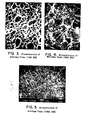
- the reaction of the silicon matrix with nitrogen is carried out long enough to completely transform the silicon precursor to an identically shaped compact of a-silicon nitride whiskers, as shown in Figs. 2-5.
- the silicon matrix and nitrogen are reacted for a period of time ranging from about 1 to 8 hours.
- reinforced, isotropic composites are formed.
- the reinforced isotropic composites are dense reinforced isotropic composites.
- s shaped compact of a-silicon nitride whiskers, formed as described above is, impregnated with a material selected from the group consisting of resin binders, liquid metals, aqueous colloidal suspensions, ionic solutions and at least one gaseous material to form an isotropic composite material in which the whiskers provide reinforcement for the added matrix phase.
- Suitable resin binders include acrylic resins, polyimide resins, phenolic resins, epoxy resins and silicone resins.
- Conventional vacuum infiltration means can be utilized to pull uncured resin into the porous compact of a-silicon nitride whiskers, followed by polymerization or curing of the resin within the whisker matrix by conventional means.
- Suitable liquid metals include those having low melting points, such as aluminum, magnesium, silver and copper.
- the porous compact of a-silicon nitride whiskers is impregnated by a liquid metal. Solidification of the metal is accomplished by such means as a cooling step.
- a wetting agent such as lithium, prior to impregnating the porous compact of whiskers, to facilitate the wetting of the whiskers by the metal.
- Suitable aqueous colloidal suspensions are those having colloids small enough to penetrate the pore size of the a-silicon nitride whiskers compact.
- Preferred aqueous colloidal suspensions are selected from the group consisting of silica and alumina.
- the whisker compact is impregnated by an aqueous colloidal suspension, followed by a drying step to remove the aqueous phase. If necessary, the dried impregnated compact can be consolidated by sintering to form the desired composite. Multiple cycles of impregnation, drying and sintering may be used to produce the desired density and strength properties.
- aqueous colloidal silica is used, the aqueous phase is removed by a drying step and then consolidated by sintering at a temperature of about 1800° to 2200°F.
- a sintering temperature of about 2500° to 2700°F is employed for consolidating the alumina matrix phase.
- Suitable ionic solutions useful in the process of the present invention include aluminum nitrate, nickel chloride and boric acid. After impregnation of the solution into the whisker compact by conventional means, the aqueous phase is removed by a drying step, leaving the desired residue in the whisker compact to be converted to the matrix phase.
- aluminum nitrate may be introduced into the whisker compact by such conventional means as vacuum infiltration, followed by a heating step to drive off water and nitrous oxide, leaving aluminum oxide reinforced by the matrix of a-silicon nitride whiskers.
- Nickel chloride may be introduced into the whisker compact by appropriate means, followed by a thermal treatment in an oxidizing atmosphere to drive off water and chlorine and produce nickel oxide residue in the whisker compact.
- the remaining nickel oxide can be redbced to nickel metal by an appropriate step such as firing in a reducing atmosphere containing hydrogen. Severl cycles may be required to achieve the desired densities.
- a secondary forming step such as hot pressing may be desired for certain applications to further increase density and strength.
- Suitable gaseous materials are selected from the group consisting of any gaseous material which can be cracked to convert it to a solid and at least two gaseous materials which react to form a solid material.
- the gaseous material is selected from the group consisting of silicon tetrachloride, silicon tetrafluoride, ammonia, nitrogen, hydrogen and methane. More preferably, methane gas (CH 4 ) that disassociates on striking the heated whisker structure to form carbon (C) and silicon tetrachloride and ammonia which form silicon nitride (Si3N4) are employed.
- the gaseous material is a mixture containting at least one gaseous material selected from the group consisting of silicon tetrachloride and silicon tetrafluoride and at least one gaseous material selected from the group consisting of ammonia, nitrogen and hydrogen and further including the step of heating the porous shaped compact of a-silicon nitride, whereby the gaseous material mixture reacts to form a dense form of silicon nitride, the silicon nitride being reinforced with a-silicon nitride whiskers.
- the gaseous materials are passed through the heated whisker compact under reduced pressure.
- methane gas may be introduced into the a-silicon nitride shaped whisker compact, followed by pyrolysis of the methane to form a carbon matrix reinforced by the a-silicon nitride whiskers.
- any two gaseous materials which react to form a solid can be introduced into the whisker compact, followed by reaction. - to form a reinforced solid.
- individual a-silicon nitride whiskers are produced.
- silicon particles in powder form are premixed with about 5 to 20 weight percent of the above-described fugitive composition,particles which are able to sublime without leaving a residue.
- the fugitive composition particles are present in a fine form.
- naphthalene is preferably used.
- the silicon-composition mixture is treated to ensure coating of the silicon particles by the composition.
- conventional ball milling is utilized to coat the silicon particles by the milled composition particles.
- the silicon particles mixed with the composition particles are 2 to 6 microns (equivalent diameter) in size. Since the composition particles are soft, they are readily reduced during ball-milling to very fine powder, wheras little change occurs in the 2 to 6 micron silicon, resulting in a fine coating of composition on the silicon.
- the composition-coated silicon is then blended with more particles of the above-described composition.
- the composition particles blended with the composition-coated silicon have a size ranging from 100 to 10,000 times larger than the size of the silicon particles. More preferably, the composition particles have a size ranging from 0.20 to 0.60 mm.
- the sizes of the composition particles after completion of the treatment step are relatively smaller than the sizes of the composition particles blended with the coated silicon particles.
- the composition-coated blend is compacted and baked to achieve sublimation of the composition particles leaving a loosely compacted silicon precursor.
- sublimation of the fugitive composition particles results in an exceedingly loose structure of silicon particles.
- the loosely compacted silicon precursor is reacted with a substance releasing free nitrogen as previously described. Owing to the treatment to coat the silicon particles by the composition, a weaker network of whiskers is formed than when silicon and composition particles are blended together without the mixing and treatment steps.
- the loosely compacted a-silicon whiskers network when broken down in accordance with the invention by crushing or grinding, results in more individual whiskers and less particulate matter.
- the invention comprises producing a-silicon nitride whiskers for blending with molding powders to form composite parts reinforced by a-silicon nitride whiskers.
- the individual a-silicon nitride whiskers obtained above are mixed with a molding powder selected from the group consisting of metal, ceramic and resin molding powders and formed by conventional processes applying heat and pressure to form a-silicon nitride-reinforced composite parts.
- a molding powder selected from the group consisting of metal, ceramic and resin molding powders and formed by conventional processes applying heat and pressure to form a-silicon nitride-reinforced composite parts.
- the forming is accomplished by conventional compacting, accompanied by heat and pressure.
- Preferred metal molding powders to be reinforced include aluminum, titanium, molybdenum and columbium.
- Preferred ceramic molding powders include silicate glass, alumina, aluminum silicates and other clay materials.
- Preferred resin molding powders include bakelite, phenolics, epoxys, polyimi
- the resultant material was a compact of randomly oriented silicon nitride whiskers.
- the compact has essentially the same shape and dimensions as the precursor silicon naphthalene compact.
- the structure of the compact was like that shown in Figs. 3-5.
- Example I The procedure described in Example I was repeated except that the silicon skeletal compact was fired from ambient temperature to 2350°F. in approximately 4 hours in an atmosphere of dry ammonia diluted with nitrogen and hydrogen.
- silicon precursors were fabricated using both plate-like particles and spheres of naphthalene ranging in size from material that passes a 28 mesh sieve (595 micron openings) down to material that passes a 100 mesh sieve (149 micron openings).
- the silicon precursors were successfully converted to similarly sized compacts of a-silicon nitride whiskers.
- silicon precursors were fabricated using as low as 25 parts by weight silicon to 75 parts by weight naphthalene to as high as 90 parts by weight silicon to 10 parts by weight naphthalene.
- the silicon precursors were successfully converted to similarly sized compacts of a-silicon whiskers.
- An a-silicon nitride whisker compact produced by the prece- dure described in Example I was immersed in a vessel containing a clear 2 part commercial epoxy, Stycast 1269A.
- the vessel was placed in an oven at 250°F. and the oven was evacuated. When bubbling stopped, the oven was back-filled with air and the temperature was reduced to 215"F. for 72 hours to allow the epoxy to cure and forma solid 2-phase composite material. Excess epoxy was trimmed from the exterior of the a-silicon nitride compact to provide an epoxy-silicon nitride composite part with the shape and size of the original a-silicon nitride compact.
- a-silicon nitride whisker compact produced by the procedure described in Example I was impregnated witha 2 part silicone, Dow Corning Silgard 184, under vacuum at room temperature for 16 hours until the silicone had stopped bubbling and had a tacky consistency. The impregnated part was then heated to 160°F. for 4 hours to set the silicone and form an elastomeric solid. The excess clear rubber-like silicone could be trimmed from the surface of the whisker compact to leave a silicon nitride whisker reinforced silicone composite.
- An ⁇ -silicon nitride whisker compact produced by the procedure described in Example 1 was impregnated with a high viscosity polyimide Dupont NR150 resin by deairing the compact and resin in a vacuum at 27 in. Hg.
- the vessel containing the resin and compact was sealed with a rubber diaphragm and placed under a pressure of 2400 psi in a hydrostatic press to force the high viscosity resin into the deaired porous compact.
- the compact filled with the NR150 resin was then cured under pressure at 500°F. to form a solid polyimide- silicon nitride composite part having the shape of the original whisker compact.
- a-silicon nitride whisker compact produced by the procedure described in Example I was impregnated with a commercial colloidal silica suspension, Ludox AS, under vacuum at 27 in Hg. at ambient temperature.
- the saturated compact was heated in vacuum to 160°F. to remove free water.
- the compact was fired in air to 1800°F. to form a silica- a-silicon nitride composite.
- Other samples were produced by heating in nitrogen to 2200°F. and by heating in air to 2000°F. Density of the porous composites was increased by a second vacuum infiltration and firing step.
- a-silicon nitride whisker compact produced by the procedure described in Example was vacuum impregnated with a 10 percent by weight solution of boric acid in water.
- the whisker compact was placed in a heated solution of boric acid in a vacuum equivalent to 27 inc. Hg and brought to a boil. The vacuum was released, and the saturated compact was removed from the oven and allowed to dry over night under ambient conditions.
- the sample was heated in air to 1000°F. to eliminate chemically-combined water and the fired to 2550°F. in an atmosphere of dry ammonia diluted with nitrogen and hydrogen to form a boron nitride-silicon nitride composite.
- a-silicon nitride whiskers for use as an additive to aluminum powder for hot molding a dense plate of composite material were prepared by the following procedure:
Landscapes
- Chemical & Material Sciences (AREA)
- Engineering & Computer Science (AREA)
- Ceramic Engineering (AREA)
- Materials Engineering (AREA)
- Organic Chemistry (AREA)
- Manufacturing & Machinery (AREA)
- Structural Engineering (AREA)
- Inorganic Chemistry (AREA)
- Chemical Kinetics & Catalysis (AREA)
- Crystallography & Structural Chemistry (AREA)
- Metallurgy (AREA)
- General Chemical & Material Sciences (AREA)
- Physics & Mathematics (AREA)
- Thermal Sciences (AREA)
- Nanotechnology (AREA)
- Composite Materials (AREA)
- Crystals, And After-Treatments Of Crystals (AREA)
- Ceramic Products (AREA)
- Manufacture Of Alloys Or Alloy Compounds (AREA)
Applications Claiming Priority (2)
| Application Number | Priority Date | Filing Date | Title |
|---|---|---|---|
| US248498 | 1981-03-27 | ||
| US06/248,498 US4388255A (en) | 1981-03-27 | 1981-03-27 | Method for producing pre-shaped α-silicon nitride whisker compacts and loose whiskers for composite material reinforcement |
Publications (1)
| Publication Number | Publication Date |
|---|---|
| EP0061611A1 true EP0061611A1 (de) | 1982-10-06 |
Family
ID=22939407
Family Applications (1)
| Application Number | Title | Priority Date | Filing Date |
|---|---|---|---|
| EP82101830A Ceased EP0061611A1 (de) | 1981-03-27 | 1982-03-08 | Verfahren zur Herstellung von kompakten Whiskerkörpern und losen Whiskers aus Siliziumnitrid für Komposit-Verstärkungsmaterialien |
Country Status (4)
| Country | Link |
|---|---|
| US (1) | US4388255A (de) |
| EP (1) | EP0061611A1 (de) |
| JP (1) | JPS57205399A (de) |
| CA (1) | CA1159629A (de) |
Cited By (4)
| Publication number | Priority date | Publication date | Assignee | Title |
|---|---|---|---|---|
| FR2560593A1 (fr) * | 1984-03-03 | 1985-09-06 | Kurosaki Refractories Co | Procede de production d'un produit fritte en nitrure de silicium |
| EP0158698A3 (en) * | 1984-04-18 | 1987-05-27 | Toshiba Ceramics Co., Ltd. | Method of manufacturing b type silicon nitride whiskers |
| US4711665A (en) * | 1985-07-26 | 1987-12-08 | Pennsylvania Research Corporation | Oxidation resistant alloy |
| CN115286409A (zh) * | 2022-08-18 | 2022-11-04 | 广东环波新材料有限责任公司 | 一种氮化硅晶须增强氮化铝的复合陶瓷材料及其制备方法 |
Families Citing this family (24)
| Publication number | Priority date | Publication date | Assignee | Title |
|---|---|---|---|---|
| US4579699A (en) * | 1983-09-29 | 1986-04-01 | The Boeing Company | Method for making α-Si3 N4 whiskers and articles therefrom |
| US4543345A (en) * | 1984-02-09 | 1985-09-24 | The United States Of America As Represented By The Department Of Energy | Silicon carbide whisker reinforced ceramic composites and method for making same |
| USRE34446E (en) * | 1984-02-09 | 1993-11-16 | Martin Marietta Energy Systems, Inc. | Silicon carbide whisker reinforced ceramic composites and method for making same |
| USRE32843E (en) * | 1984-02-09 | 1989-01-24 | Martin Marietta Energy Systems, Inc. | Silicon carbide whisker reinforced ceramic composites and method for making same |
| JPS6119744A (ja) * | 1984-07-07 | 1986-01-28 | Mitsubishi Alum Co Ltd | 金属基複合材用多孔質成形体の製造方法 |
| US4961757A (en) * | 1985-03-14 | 1990-10-09 | Advanced Composite Materials Corporation | Reinforced ceramic cutting tools |
| US4604273A (en) * | 1985-04-19 | 1986-08-05 | Gte Products Corporation | Process for the growth of alpha silicon nitride whiskers |
| US4789277A (en) * | 1986-02-18 | 1988-12-06 | Advanced Composite Materials Corporation | Method of cutting using silicon carbide whisker reinforced ceramic cutting tools |
| US5103239A (en) * | 1986-08-20 | 1992-04-07 | The United States Of America As Represented By The Secretary Of The Air Force | Silicon nitride articles with controlled multi-density regions |
| US4766096A (en) * | 1987-02-24 | 1988-08-23 | The United States Of America As Represented By The Secretary Of The Air Force | Silicon nitride whisker reinforced glass matrix composites |
| US5122326A (en) * | 1987-03-02 | 1992-06-16 | Vacuum Industries Inc. | Method of removing binder material from shaped articles under vacuum pressure conditions |
| US4978643A (en) * | 1987-04-09 | 1990-12-18 | Ceramics Process Systems Corporation | Forming whisker reinforced sintered ceramics with polymerizable binder precursors |
| US4946808A (en) * | 1988-11-10 | 1990-08-07 | Ceramics Process Systems Corporation | Method for preparing dense, pressureless sintered SiC whisker reinforced composite ceramics |
| US5153057A (en) * | 1989-02-15 | 1992-10-06 | Technical Ceramics Laboratories, Inc. | Shaped bodies containing short inorganic fibers or whiskers within a metal matrix |
| IT1230774B (it) * | 1989-05-05 | 1991-10-29 | Sir Ind Spa | Preforme ceramiche ad elevata resistenza meccanica, procedimento per la loro preparazione e compositi a matrice metallica con esse ottenuti. |
| US5332697A (en) * | 1989-05-31 | 1994-07-26 | Smith Rosemary L | Formation of silicon nitride by nitridation of porous silicon |
| US5250278A (en) * | 1991-06-19 | 1993-10-05 | Phillips Petroleum Company | Method for producing a ceramic product |
| SE507706C2 (sv) * | 1994-01-21 | 1998-07-06 | Sandvik Ab | Kiselkarbidwhiskerförstärkt oxidbaserat keramiskt skär |
| JP2882575B2 (ja) * | 1995-12-14 | 1999-04-12 | 工業技術院長 | 高熱伝導窒化ケイ素セラミックスならびにその製造方法 |
| JP2744938B2 (ja) * | 1996-01-30 | 1998-04-28 | 工業技術院長 | 多孔質高強度低熱伝導窒化ケイ素質セラミックス及びその製造方法 |
| JP3373502B2 (ja) * | 1999-12-24 | 2003-02-04 | 旭硝子株式会社 | 窒化ケイ素フィルタおよびその製造法 |
| US20040043888A1 (en) * | 2002-08-28 | 2004-03-04 | Noritake Co., Limited | Compositions and methods for making microporous ceramic materials |
| US11230503B2 (en) | 2017-06-27 | 2022-01-25 | General Electric Company | Resin for production of porous ceramic stereolithography and methods of its use |
| CN114790107B (zh) * | 2022-04-29 | 2023-05-09 | 江苏大学 | 一种利用多晶硅切割废料在低温下制备SiO2-Si3N4复合陶瓷的方法 |
Citations (3)
| Publication number | Priority date | Publication date | Assignee | Title |
|---|---|---|---|---|
| GB1274212A (en) * | 1968-04-03 | 1972-05-17 | Atomic Energy Authority Uk | Production of silicon nitride refractory artefacts |
| DE2356921A1 (de) * | 1972-11-14 | 1974-05-30 | Nat Res Dev | Verfahren zur herstellung von siliciumnitrid-keramiken |
| GB1490543A (en) * | 1975-03-11 | 1977-11-02 | Atomic Energy Authority Uk | Porous materials |
Family Cites Families (14)
| Publication number | Priority date | Publication date | Assignee | Title |
|---|---|---|---|---|
| GB1121293A (en) * | 1963-10-28 | 1968-07-24 | Mini Of Technology | Improvements in the manufacture of silicon nitride |
| US3413090A (en) * | 1965-03-19 | 1968-11-26 | Mallory & Co Inc P R | Preparation of silicon nitride whiskers |
| US3520740A (en) * | 1967-05-18 | 1970-07-14 | Gen Electric | Method of epitaxial growth of alpha silicon carbide by pyrolytic decomposition of a mixture of silane,propane and hydrogen at atmospheric pressure |
| US3519399A (en) * | 1967-05-22 | 1970-07-07 | Hughes Aircraft Co | Method for growing single crystals of semiconductors |
| GB1266506A (de) * | 1968-10-01 | 1972-03-08 | ||
| US3835211A (en) * | 1968-12-11 | 1974-09-10 | Lucas Industries Ltd | Silicon nitride products |
| US3615878A (en) * | 1970-01-30 | 1971-10-26 | Westinghouse Electric Corp | Process for the thermal treatment of a semiconductor material having a volatile component |
| GB1079306A (en) * | 1970-02-09 | 1967-08-16 | Siemens Ag | Improvements in or relating to the manufacture of filiform single crystals |
| GB1340696A (en) * | 1970-07-10 | 1973-12-12 | Lucas Industries Ltd | Method of manufacturing silicon nitride products |
| US4127630A (en) * | 1973-06-18 | 1978-11-28 | Norton Company | Reaction bonded silicon nitride |
| US3959446A (en) * | 1974-03-01 | 1976-05-25 | The United States Of America As Represented By The Secretary Of The Air Force | Synthesis of high purity, alpha phase silicon nitride powder |
| US4145224A (en) * | 1974-11-22 | 1979-03-20 | Gte Sylvania Incorporated | Method for enhancing the crystallization rate of high purity amorphous Si3 N4 powder, powders produced thereby and products therefrom |
| JPS5238500A (en) * | 1975-09-22 | 1977-03-25 | Toshiba Corp | Production of alpha-silicon nitride powder |
| JPS5290499A (en) * | 1976-01-27 | 1977-07-29 | Toshiba Ceramics Co | Process for preparing siliconnitride having high alphaaphase content |
-
1981
- 1981-03-27 US US06/248,498 patent/US4388255A/en not_active Expired - Fee Related
-
1982
- 1982-03-08 EP EP82101830A patent/EP0061611A1/de not_active Ceased
- 1982-03-26 CA CA000399485A patent/CA1159629A/en not_active Expired
- 1982-03-26 JP JP57048785A patent/JPS57205399A/ja active Pending
Patent Citations (3)
| Publication number | Priority date | Publication date | Assignee | Title |
|---|---|---|---|---|
| GB1274212A (en) * | 1968-04-03 | 1972-05-17 | Atomic Energy Authority Uk | Production of silicon nitride refractory artefacts |
| DE2356921A1 (de) * | 1972-11-14 | 1974-05-30 | Nat Res Dev | Verfahren zur herstellung von siliciumnitrid-keramiken |
| GB1490543A (en) * | 1975-03-11 | 1977-11-02 | Atomic Energy Authority Uk | Porous materials |
Cited By (5)
| Publication number | Priority date | Publication date | Assignee | Title |
|---|---|---|---|---|
| FR2560593A1 (fr) * | 1984-03-03 | 1985-09-06 | Kurosaki Refractories Co | Procede de production d'un produit fritte en nitrure de silicium |
| GB2157668A (en) * | 1984-03-03 | 1985-10-30 | Kurosaki Refractories Co | Producing silicon nitride sintered products |
| EP0158698A3 (en) * | 1984-04-18 | 1987-05-27 | Toshiba Ceramics Co., Ltd. | Method of manufacturing b type silicon nitride whiskers |
| US4711665A (en) * | 1985-07-26 | 1987-12-08 | Pennsylvania Research Corporation | Oxidation resistant alloy |
| CN115286409A (zh) * | 2022-08-18 | 2022-11-04 | 广东环波新材料有限责任公司 | 一种氮化硅晶须增强氮化铝的复合陶瓷材料及其制备方法 |
Also Published As
| Publication number | Publication date |
|---|---|
| CA1159629A (en) | 1984-01-03 |
| JPS57205399A (en) | 1982-12-16 |
| US4388255A (en) | 1983-06-14 |
Similar Documents
| Publication | Publication Date | Title |
|---|---|---|
| US4388255A (en) | Method for producing pre-shaped α-silicon nitride whisker compacts and loose whiskers for composite material reinforcement | |
| US4579699A (en) | Method for making α-Si3 N4 whiskers and articles therefrom | |
| CA1208940A (en) | Silicon carbide whisker composites | |
| US4513030A (en) | Method of producing silicon carbide articles | |
| US4179299A (en) | Sintered alpha silicon carbide ceramic body having equiaxed microstructure | |
| DE68926260T2 (de) | Formkörper aus Keramik auf Siliciumnitrid-Basis und Verfahren zu ihrer Herstellung | |
| EP0034328B1 (de) | Verfahren zur Herstellung von Formkörpern auf der Basis von Siliziumkarbid | |
| US4346049A (en) | Sintered alpha silicon carbide ceramic body having equiaxed microstructure | |
| US5294460A (en) | Method for the preparation of silicon carbide-carbon fiber composite | |
| EP1449819B1 (de) | Auf siliciumcarbid basierender wärmebeständiger ultraleichter poröser konstruktionswerkstoff und verfahren zu seiner herstellung | |
| EP0211473A2 (de) | Metall-Keramik-Werkstoffe Borkarbid-Aluminium und borkarbidreaktionsfähiges Metall und Verfahren zu ihrer Herstellung | |
| US4469802A (en) | Process for producing sintered body of boron nitride | |
| EP0344372A1 (de) | Plattenförmige Kristalle und Vorprodukte aus hexagonalem Siliciumcarbid und Methoden zu ihrer Herstellung und Verwendung | |
| JPS59102872A (ja) | 炭化珪素.黒鉛複合焼結体の製造方法 | |
| EP0899251A1 (de) | Verfahren zur Herstellung eines Körpers mit einer porösen Matrix aus mindestens einem rekristallisiertem Werkstoff | |
| WO1993025495A1 (en) | Porous silicon carbide | |
| GB2232979A (en) | Silicon-oxy-carbide glass and articles | |
| EP2308809A2 (de) | Werkstoff, Verfahren zur Herstellung eines Werkstoffs und seine Verwendung | |
| WO1994009169A1 (en) | Phosphate binders for metal-matrix composites | |
| JPS6127453B2 (de) | ||
| US4981665A (en) | Hexagonal silicon carbide platelets and preforms and methods for making and using same | |
| DE69510496T2 (de) | Microporösen Kermamiken und deren Herstellung | |
| US4172109A (en) | Pressureless sintering beryllium containing silicon carbide powder composition | |
| US5972489A (en) | Porous inorganic material and metal-matrix composite material containing the same and process therefor | |
| US4816428A (en) | Process for producing high strength βsialon-silicon carbide composite |
Legal Events
| Date | Code | Title | Description |
|---|---|---|---|
| PUAI | Public reference made under article 153(3) epc to a published international application that has entered the european phase |
Free format text: ORIGINAL CODE: 0009012 |
|
| AK | Designated contracting states |
Designated state(s): AT BE CH DE FR GB IT LU NL SE |
|
| 17P | Request for examination filed |
Effective date: 19830103 |
|
| STAA | Information on the status of an ep patent application or granted ep patent |
Free format text: STATUS: THE APPLICATION HAS BEEN REFUSED |
|
| 18R | Application refused |
Effective date: 19850623 |
|
| RIN1 | Information on inventor provided before grant (corrected) |
Inventor name: SIMPSON, FREDERICK H. |