EP0061613B1 - Verfahren und Anlage zur Akzentuation von Streifen eines schwarzweissen Bildes, das wiedergegeben wird von einer digitalen Umschrift aus - Google Patents
Verfahren und Anlage zur Akzentuation von Streifen eines schwarzweissen Bildes, das wiedergegeben wird von einer digitalen Umschrift aus Download PDFInfo
- Publication number
- EP0061613B1 EP0061613B1 EP82101848A EP82101848A EP0061613B1 EP 0061613 B1 EP0061613 B1 EP 0061613B1 EP 82101848 A EP82101848 A EP 82101848A EP 82101848 A EP82101848 A EP 82101848A EP 0061613 B1 EP0061613 B1 EP 0061613B1
- Authority
- EP
- European Patent Office
- Prior art keywords
- digital
- difference
- value
- analog
- output
- Prior art date
- Legal status (The legal status is an assumption and is not a legal conclusion. Google has not performed a legal analysis and makes no representation as to the accuracy of the status listed.)
- Expired
Links
- 238000013518 transcription Methods 0.000 title claims description 12
- 230000035897 transcription Effects 0.000 title claims description 12
- 238000000034 method Methods 0.000 title 1
- 230000001944 accentuation Effects 0.000 claims description 17
- 238000012546 transfer Methods 0.000 claims description 8
- 230000015654 memory Effects 0.000 claims description 6
- 238000004458 analytical method Methods 0.000 claims description 4
- 238000012545 processing Methods 0.000 claims description 4
- 238000006243 chemical reaction Methods 0.000 claims description 3
- 230000000670 limiting effect Effects 0.000 claims description 3
- 230000001965 increasing effect Effects 0.000 claims description 2
- 238000011144 upstream manufacturing Methods 0.000 claims 1
- 235000021183 entrée Nutrition 0.000 description 6
- 230000011664 signaling Effects 0.000 description 5
- 238000012937 correction Methods 0.000 description 4
- 230000000630 rising effect Effects 0.000 description 3
- 239000000654 additive Substances 0.000 description 2
- 230000000996 additive effect Effects 0.000 description 2
- 239000003086 colorant Substances 0.000 description 2
- 230000000694 effects Effects 0.000 description 2
- 230000010287 polarization Effects 0.000 description 2
- 238000011282 treatment Methods 0.000 description 2
- 241000287107 Passer Species 0.000 description 1
- 230000000903 blocking effect Effects 0.000 description 1
- 230000008859 change Effects 0.000 description 1
- 230000007547 defect Effects 0.000 description 1
- 230000009977 dual effect Effects 0.000 description 1
- 230000001788 irregular Effects 0.000 description 1
- 238000012986 modification Methods 0.000 description 1
- 230000004048 modification Effects 0.000 description 1
- 230000001603 reducing effect Effects 0.000 description 1
- 230000002787 reinforcement Effects 0.000 description 1
- 230000003014 reinforcing effect Effects 0.000 description 1
Images
Classifications
-
- H—ELECTRICITY
- H04—ELECTRIC COMMUNICATION TECHNIQUE
- H04N—PICTORIAL COMMUNICATION, e.g. TELEVISION
- H04N5/00—Details of television systems
- H04N5/14—Picture signal circuitry for video frequency region
Definitions
- the present invention relates to the reproduction of a black and white image stored in digital form.
- the images are transcribed in digital form with the lowest possible definition in order to limit the number of bits required.
- an image is divided, according to a regular grid as tight as possible, in zones to which we assign numerical values representative of their average hues.
- a set of zones is reproduced according to the same grid, to which the average colors corresponding to the numerical values are assigned by a choice between different arbitrary graphics presenting these same average colors.
- the present invention aims to combat this defect, in particular in the case where the original image is a portrait transcribed in digital using a continuous scanning by horizontal lines and where the blurring effect is more particularly manifested on the vertical lines of the nose profile which appear on a background with little contrast.
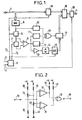
- This circuit makes it possible to accentuate the features of an image by reinforcing the differences existing between the consecutive numbers of a digital sequence of a digital image transcription.
- This reinforcement is carried out by adding to a number a correction value of the same sign and possibly proportional to its difference with respect to the number which precedes it in the following.
- the correction value is calculated in the circuit for all the numbers in the sequence, but it is only taken into account if the number belongs to a certain medium gray range and if its difference compared to the previous number represents a slight variation. but not zero in shade of gray between two successive areas of analysis reflecting the existence of a change in tone and therefore of a slightly marked outline in a medium range of gray.
- the digital image transcription is formed for example of a sequence An of binary numbers applied successively to the digital input 1 of the circuit during the successive periods of a clock signal of symmetrical rectangular shape applied to the input 2 of the circuit time base 8, the number changes taking place for example here on the falling edges of the clock signal.
- the time base circuit 8 also receives on input 3 a rectangular signal symmetrical at twice the clock frequency and generates, by logical combination of these two signals, two control signals C1, C2 at the clock frequency , of asymmetrical rectangular shape, one C1 in the high state during the second half of the half-period in the low state of the clock signal, that is to say during the second quarter of the time when a number is applied to digital input 1, and the other C2 in the high state during the first half of the half-period in the low state of the clock signal, i.e. during the first quarter of the time a number is applied to digital input 1.
- the control signal C1 is applied in control of the sampler 6 and of the register 18 for which the active edges of this signal are the rising edges, as well as in control of the analog-digital converter ADC 15 for which the active edges of this signal are the falling edges.
- the control signal C2 is applied to control the sampler 7 for which the active edges of this signal C2 are the rising edges. It is further specified that the register 20 is sensitive to the rising edges of the supplemented version of the clock signal, which controls it.
- the clock signal and the control signals C1 and C2 control the succession of operations performed by the circuit.
- a (m) be a number applied to digital input 1 during a period of the clock signal.
- the first quarter of the application time of the number A (m) to digital input 1 is used to calculate the corresponding analog value a (m), to verify that this value corresponds to a shade of gray belonging to the range of medium gray to which the line accentuation treatment is limited and for transferring, thanks to the control signal C2, the analog value a (m-1) of the previous number A (m-1) in the sampler 7.
- the second quarter of the time for applying the number A (m) to digital input 1 is used to store, thanks to the control signal C1, the number A (m) in register 18 and the analog value a (m) of the number A (m) in the sampler 6, calculate the analog value e (m) of the difference between the number A (m) and that A (m-1) which precedes it, check that this difference is not zero but remains lower in amplitude than a certain limit, calculate a corrective term by possibly limiting its amplitude.
- the second half of the time for applying the number A (m) to digital input 1 is used to convert the corrective term into digital value and add it or not, depending on the results of the checks, to the number A (m ), the result of the summation being taken into account under the control of the clock signal supplemented at the end of the time of application of the number A (m) to digital input 1 and transmitted to digital output 4 of the circuit.
- the clock frequency is of the order of 10.5 kHz so that an A (m) number is applied for approximately 95 ⁇ s.
- the digital-analog converter DAC 5 for example of the current summation type, provides, in a negligible time with respect to this duration, the corresponding analog value a (m) which is tested, also in a negligible time , by the first double comparator 10.
- the latter emits, for practically the entire duration of application of the number A (m) to the digital input 1, a first signaling in logic state 1 in the case where the analog value has (m) corresponds to a shade of gray not belonging to said medium gray range to which the accentuation treatment of the lines is limited.
- the analog sampler 7 copies in negligible time, under the control of the control signal C2, the analog value a ( m-1) of the number A (m-1) stored in the analog sampler 6.
- the sampler 7 is blocked by the control signal C2 while the first digital register 18 and the first sampler 6 are placed in writing by the control signal C1 and recopy both, in a negligible time compared to the approximately 23 J ls that last a quarter of time interval of application of the number A (m ) at digital input 1, the digital values for one and analog for the other applied to their inputs.
- the analog subtractor 9 also delivers, in a negligible period of time, the analog value of the difference e (m).
- the latter is tested almost instantaneously by the second double analog comparator 11 which emits a second signaling (logic state 1 at its output) in the case where the value e (m) of the difference has an amplitude close to zero indicating that the nuance of gray does not evolve or very slightly between the successive elementary areas of analysis of the image corresponding to the numbers A (m-1) and A (m) of the digital transcription.
- the third dual analog comparator 12 which emits a third signal (logic state 1 at its output) in the case where the value e (m) of the difference is large in absolute value, reflecting an important evolution of the shade of gray which it is useless to accentuate.
- the analog amplifier 13 gain adjustable J f at its output end corrsetif ⁇ e (m) whose maximum amplitude is limited by the limiter 14.
- the analog-digital converter ADC 15 is controlled by the control signal C1. It has almost the entire duration of the second half of the time interval for applying the number A (m) to digital input 1, practically 47 ps, to carry out its conversion since it is followed by rapid elements operating in a negligible time compared to this duration and the taking into account of its result is made only at the end of this second half of time interval. It can be of the type with successive approximations or even faster of the parallel type.
- a five-bit number A (m) For a five-bit number A (m), with a value between 0 and 31, it delivers in five bits, one of which has a sign, on a parallel output, the numerical value of the corrective term whose amplitude is for example limited to 8 , the conditions imposed on the number A (m) for the accentuation being for example to be between 10 and 20 and to present with respect to the number which precedes hereafter a non-zero difference of amplitude less than 8.
- the digital value of the correction term available on the parallel output of the analog digital converter ADC 15 is applied to the transfer circuit 17 which lets it pass in direction of the adder 19 if it receives a level logic 0 on the part of the logic gate "OR" 16 reflecting the fact that the digital value A (m) corresponds to a shade of gray meeting the conditions imposed for the accentuation or which blocks it and delivers on its output a digital signal zero towards the adder 19 if it receives a logic level 1 from the logic gate "OR” 16 reflecting the fact that the numerical value A (m) corresponds to a shade of gray which does not meet the conditions imposed for an accentuation.
- the transfer circuit can be implemented, for example, using a multiplexer with two parallel inputs, one connected to the output of the ADC 15 analog-digital converter and the other brought to logic level 0 and to one input. address connected to the output of the logic gate »OR « 16. It can also be implemented using a network of logic gates.
- the digital adder 19 adds the number present in the first digital register 18 with that which is supplied to it by the transfer circuit 17.
- the first digital register 18 contains the number A (m) and the transfer circuit 17 delivers the digital value of the correction term corresponding to the number A (m) or to a zero number if the numerical value A (m) corresponds to a shade of gray which does not meet the conditions imposed for an accentuation.
- This adder can be realized by means of a programmed read only memory.
- Fig. 2 shows an exemplary embodiment of the double analog comparator 10.
- the double comparator comprises two differential amplifiers 30 and 31 mounted as threshold comparators controlling a "OR" logic gate 32 with two inputs.
- the differential amplifier 30 has its non-inverting input connected to the input 33 of the double analog comparator, its inverting input connected to the adjustment cursor of a potentiometer 34 whose resistor is connected in series with two fixed resistors 35 and 36 between the ground and a + V bias source, and its output connected by a resistor 37 to the + V bias source, this amplifier 30 being for example an open collector output transistor.
- the adjustment voltage VA to which its inverting input is brought determines the upper limit of the window of the double analog comparator.
- the output of the differential amplifier 30 is at zero or very low potential and delivers a logic level 0 at the input of the door. logic "OR" 32.
- the differential amplifier 30 switches, its output becoming positive and applying a logic level 1 to the input of the logic gate " OR “32 which is transmitted at output 38 of the double analog comparator.
- the differential amplifier 31 has its non-inverting input connected to the adjustment cursor of a potentiometer 40 whose resistance is connected in series with two resistors 41 and 42 between ground and the + V bias source, its inverting input connected to the input 33 of the double analog comparator and its output connected by a resistor 43 to the voltage source + V, this amplifier 31 also being with an open collector output transistor.
- the adjustment voltage VB to which its non-inverting input is brought is chosen to be less than the adjustment voltage VA and determines the lower limit of the window of the double comparator. As long as the level applied to the input 33 of the double analog comparator remains higher than the voltage VB, the output of the differential amplifier 31 is at zero or very low potential and delivers a logic level 0 at the input of the logic gate.
- the circuit of FIG. 2 can be modified in order to produce a double analog comparator of the type of that referenced by 12 in FIG. 1 and which compares the signal applied to it at input with two thresholds of opposite polarities and not with two positive thresholds as is the case for comparator 10 of this FIG. 1.
- a double analog comparator of the type of that referenced by 12 in FIG. 1 and which compares the signal applied to it at input with two thresholds of opposite polarities and not with two positive thresholds as is the case for comparator 10 of this FIG. 1.
- the circuit of FIG. 2 can also be modified simply in order to produce a double analog comparator of the type of that referenced by 11 in FIG. 1 and which not only compares the signal which is applied to it at input with two thresholds of opposite polarities but also has an output signal the meaning of which is opposite to that of the output signals of the comparators 10 and 12 of this FIG. 1. It suffices for this to carry out, in addition to the same modification as that described for the comparator 12, the replacement of the logic gate "OR” 32 by a logic gate "no OR".
Landscapes
- Engineering & Computer Science (AREA)
- Multimedia (AREA)
- Signal Processing (AREA)
- Analogue/Digital Conversion (AREA)
- Compression, Expansion, Code Conversion, And Decoders (AREA)
Claims (4)
Applications Claiming Priority (2)
| Application Number | Priority Date | Filing Date | Title |
|---|---|---|---|
| FR8104941A FR2501941B1 (fr) | 1981-03-12 | 1981-03-12 | Procede et dispositif d'accentuation des traits d'une image en noir et blanc reproduite a partir d'une transcription numerique |
| FR8104941 | 1981-03-12 |
Publications (2)
| Publication Number | Publication Date |
|---|---|
| EP0061613A1 EP0061613A1 (de) | 1982-10-06 |
| EP0061613B1 true EP0061613B1 (de) | 1985-07-10 |
Family
ID=9256153
Family Applications (1)
| Application Number | Title | Priority Date | Filing Date |
|---|---|---|---|
| EP82101848A Expired EP0061613B1 (de) | 1981-03-12 | 1982-03-09 | Verfahren und Anlage zur Akzentuation von Streifen eines schwarzweissen Bildes, das wiedergegeben wird von einer digitalen Umschrift aus |
Country Status (5)
| Country | Link |
|---|---|
| US (1) | US4408233A (de) |
| EP (1) | EP0061613B1 (de) |
| CA (1) | CA1173555A (de) |
| DE (1) | DE3264612D1 (de) |
| FR (1) | FR2501941B1 (de) |
Families Citing this family (6)
| Publication number | Priority date | Publication date | Assignee | Title |
|---|---|---|---|---|
| US4504864A (en) * | 1982-12-30 | 1985-03-12 | International Business Machines Corporation | Nonlinear filtering of gray scale images |
| DE3346570A1 (de) * | 1983-12-23 | 1985-07-04 | Philips Patentverwaltung Gmbh, 2000 Hamburg | Verfahren zum erhoehen der aufloesung eines digitalisierten zeitabhaengigen signals |
| US4882626A (en) * | 1988-05-04 | 1989-11-21 | Rca Licensing Corporation | Signal combining circuitry |
| US4868651A (en) * | 1988-05-17 | 1989-09-19 | S&S Inficon, Inc. | Digital radiography with image brightness and contrast normalization |
| JP2522551B2 (ja) * | 1989-08-23 | 1996-08-07 | シャープ株式会社 | 映像信号の歪補正装置 |
| US6441866B1 (en) * | 1999-01-14 | 2002-08-27 | Omnivision Technologies, Inc. | Edge enhancement with background noise suppression in video image processing |
Family Cites Families (12)
| Publication number | Priority date | Publication date | Assignee | Title |
|---|---|---|---|---|
| US3536826A (en) * | 1966-10-05 | 1970-10-27 | Columbia Broadcasting Syst Inc | Vertical aperture correction apparatus |
| AT303141B (de) * | 1970-01-20 | 1972-11-10 | Siemens Ag | Anordnung zum Auswerten bestimmter Bildteile |
| FR2157701B1 (de) * | 1971-10-26 | 1974-05-31 | Thomson Csf | |
| NL158987B (nl) * | 1972-06-10 | 1978-12-15 | Philips Nv | Apertuurcorrector voor een televisiebeeldsignaal, alsmede televisie-opneeminrichting, daarvan voorzien. |
| DE2229674C3 (de) * | 1972-06-19 | 1979-02-15 | Robert Bosch Gmbh, 7000 Stuttgart | Schaltungsanordnung zur Kontrasterhöhung |
| US3996421A (en) * | 1975-09-02 | 1976-12-07 | Hughes Aircraft Company | Television display utilizing local area brightness control |
| JPS56698Y2 (de) * | 1976-01-09 | 1981-01-09 | ||
| US4258394A (en) * | 1977-08-26 | 1981-03-24 | Westinghouse Electric Corp. | Digital circuit for accurately detecting changes in the gray scale of a scanned image |
| FR2406359A1 (fr) * | 1977-10-11 | 1979-05-11 | Thomson Csf | Procede et dispositif de traitement d'image pour systeme de visualisation et systeme de visualisation comprenant un tel dispositif |
| US4210936A (en) * | 1977-12-27 | 1980-07-01 | Pitney Bowes Inc. | Method and apparatus for reproducing an original gray scale image |
| IL58119A (en) * | 1979-08-27 | 1983-03-31 | Yeda Res & Dev | Histogram image enhancement system |
| DE2937958C2 (de) * | 1979-09-20 | 1982-03-25 | Robert Bosch Gmbh, 7000 Stuttgart | Verfahren zur horizontalen und vertikalen Konturkorrektur |
-
1981
- 1981-03-12 FR FR8104941A patent/FR2501941B1/fr not_active Expired
-
1982
- 1982-03-09 EP EP82101848A patent/EP0061613B1/de not_active Expired
- 1982-03-09 DE DE8282101848T patent/DE3264612D1/de not_active Expired
- 1982-03-11 CA CA000398128A patent/CA1173555A/fr not_active Expired
- 1982-03-12 US US06/357,541 patent/US4408233A/en not_active Expired - Fee Related
Also Published As
| Publication number | Publication date |
|---|---|
| FR2501941B1 (fr) | 1986-04-11 |
| FR2501941A1 (fr) | 1982-09-17 |
| DE3264612D1 (en) | 1985-08-14 |
| EP0061613A1 (de) | 1982-10-06 |
| US4408233A (en) | 1983-10-04 |
| CA1173555A (fr) | 1984-08-28 |
Similar Documents
| Publication | Publication Date | Title |
|---|---|---|
| EP0109037B1 (de) | Verfahren und Anordnung zur Beurteilung des Rauschpegels auf einer Fernsprechleitung | |
| US6529237B1 (en) | Complete CDS/PGA sample and hold amplifier | |
| FR2536620A1 (fr) | Televiseur numerique avec convertisseur analogique-numerique ayant un gain multiplexe dans le temps | |
| EP0036354B1 (de) | Schaltung zur Herleitung gemittelter Vergleichswerte für ein rauschbehaftetes periodisches Signal | |
| EP0061613B1 (de) | Verfahren und Anlage zur Akzentuation von Streifen eines schwarzweissen Bildes, das wiedergegeben wird von einer digitalen Umschrift aus | |
| FR2511170A1 (fr) | Systeme de poursuite de seuil automatique | |
| FR2484737A1 (fr) | Circuit de mise en forme d'un signal numerique | |
| FR2713779A1 (fr) | Procédé automatique d'analyse macérale et de détermination du pouvoir réflecteur de la vitrinite dans les charbons. | |
| FR2549316A1 (fr) | Dispositif de creusement de signaux numeriques avec niveau reglable du seuil de creusement | |
| EP0143010A1 (de) | Verfahren und Vorrichtung zum Ermitteln von sich in einem Fernsehbild bewegenden Punkten für digitale Flussverdichtungs-Fernsehsysteme mit konditioneller Auffrischung | |
| FR2557410A1 (fr) | Circuit de traitement de signaux | |
| FR2509890A1 (fr) | Appareil de lecture de donnees pour la transmission de donnees | |
| EP0255045B1 (de) | Logische Detektionsschaltung für ein synchrones Datenübertragungssystem mit ternären Symbolen und zur Prüfung von Nachbarsymbolinterferenzen von Pseudo-Mehrstufencoden der Klasse 1 n=2 | |
| FR2736231A1 (fr) | Systeme de communication numerique comportant un recepteur dote d'un dispositif de recuperation de rythme | |
| FR2491275A1 (fr) | Procede de reduction du bruit et de la diaphonie en codage analogique-numerique et codeur correspondant | |
| FR2599913A1 (fr) | Circuit convertisseur analogique/numerique bipolaire a compensation de decalage automatique | |
| FR2533785A1 (fr) | Circuit adaptatif de creusement de signaux numeriques | |
| US20040146099A1 (en) | Receiver | |
| FR2650143A1 (fr) | Circuit de correction automatique de l'equilibre des couleurs | |
| WO2006114494A1 (fr) | Procede d’adaptation pour une interoperabilite entre modeles de correlation a cout terme de signaux numeriques | |
| FR2736741A1 (fr) | Procede de traitement d'une sequence source d'images numeriques bruitees | |
| FR2515898A1 (fr) | Procede et dispositif de conversion analogique-numerique de type adaptatif | |
| EP0434584B1 (de) | Vorrichtung zur Entzerrung von linearen und nichtlinearen Störungen eines durch einen verzerrten Kanal empfangenen Signals | |
| JPS58104571A (ja) | 画信号2値化方式 | |
| EP0573407A1 (de) | Detektion von digitaler datenanwesenheit in einem videosignal |
Legal Events
| Date | Code | Title | Description |
|---|---|---|---|
| PUAI | Public reference made under article 153(3) epc to a published international application that has entered the european phase |
Free format text: ORIGINAL CODE: 0009012 |
|
| AK | Designated contracting states |
Designated state(s): BE DE FR GB IT NL |
|
| 17P | Request for examination filed |
Effective date: 19830322 |
|
| ITF | It: translation for a ep patent filed | ||
| GRAA | (expected) grant |
Free format text: ORIGINAL CODE: 0009210 |
|
| AK | Designated contracting states |
Designated state(s): BE DE FR GB IT NL |
|
| REF | Corresponds to: |
Ref document number: 3264612 Country of ref document: DE Date of ref document: 19850814 |
|
| PGFP | Annual fee paid to national office [announced via postgrant information from national office to epo] |
Ref country code: NL Payment date: 19860331 Year of fee payment: 5 |
|
| PLBE | No opposition filed within time limit |
Free format text: ORIGINAL CODE: 0009261 |
|
| STAA | Information on the status of an ep patent application or granted ep patent |
Free format text: STATUS: NO OPPOSITION FILED WITHIN TIME LIMIT |
|
| 26N | No opposition filed | ||
| BERE | Be: lapsed |
Owner name: CIE INDUSTRIELLE DES TELECOMMUNICATIONS CIT-ALCA Effective date: 19870331 |
|
| PG25 | Lapsed in a contracting state [announced via postgrant information from national office to epo] |
Ref country code: NL Effective date: 19871001 |
|
| NLV4 | Nl: lapsed or anulled due to non-payment of the annual fee | ||
| GBPC | Gb: european patent ceased through non-payment of renewal fee | ||
| PG25 | Lapsed in a contracting state [announced via postgrant information from national office to epo] |
Ref country code: FR Free format text: LAPSE BECAUSE OF NON-PAYMENT OF DUE FEES Effective date: 19871130 |
|
| PG25 | Lapsed in a contracting state [announced via postgrant information from national office to epo] |
Ref country code: DE Effective date: 19871201 |
|
| REG | Reference to a national code |
Ref country code: FR Ref legal event code: ST |
|
| PG25 | Lapsed in a contracting state [announced via postgrant information from national office to epo] |
Ref country code: GB Effective date: 19881121 |
|
| PG25 | Lapsed in a contracting state [announced via postgrant information from national office to epo] |
Ref country code: BE Effective date: 19890331 |