EP0061619B1 - Formwerkzeug zur Herstellung von Teilen aus thermoplastischem Material - Google Patents
Formwerkzeug zur Herstellung von Teilen aus thermoplastischem Material Download PDFInfo
- Publication number
- EP0061619B1 EP0061619B1 EP82101938A EP82101938A EP0061619B1 EP 0061619 B1 EP0061619 B1 EP 0061619B1 EP 82101938 A EP82101938 A EP 82101938A EP 82101938 A EP82101938 A EP 82101938A EP 0061619 B1 EP0061619 B1 EP 0061619B1
- Authority
- EP
- European Patent Office
- Prior art keywords
- die
- insert
- stamp
- mould according
- spherical
- Prior art date
- Legal status (The legal status is an assumption and is not a legal conclusion. Google has not performed a legal analysis and makes no representation as to the accuracy of the status listed.)
- Expired
Links
- 238000004519 manufacturing process Methods 0.000 title claims description 8
- 239000012815 thermoplastic material Substances 0.000 title claims description 5
- 238000000465 moulding Methods 0.000 claims abstract description 8
- 238000001746 injection moulding Methods 0.000 claims description 4
- 229910052594 sapphire Inorganic materials 0.000 claims description 3
- 239000010980 sapphire Substances 0.000 claims description 3
- 229920001169 thermoplastic Polymers 0.000 abstract 1
- 239000004416 thermosoftening plastic Substances 0.000 abstract 1
- 230000003287 optical effect Effects 0.000 description 4
- 238000005266 casting Methods 0.000 description 3
- 239000000463 material Substances 0.000 description 2
- 229910000831 Steel Inorganic materials 0.000 description 1
- 201000009310 astigmatism Diseases 0.000 description 1
- 230000000694 effects Effects 0.000 description 1
- 239000011521 glass Substances 0.000 description 1
- 239000002241 glass-ceramic Substances 0.000 description 1
- 238000000034 method Methods 0.000 description 1
- 229920003023 plastic Polymers 0.000 description 1
- 229920003229 poly(methyl methacrylate) Polymers 0.000 description 1
- 239000004926 polymethyl methacrylate Substances 0.000 description 1
- 238000000926 separation method Methods 0.000 description 1
- 239000010959 steel Substances 0.000 description 1
- 238000003860 storage Methods 0.000 description 1
Images
Classifications
-
- B—PERFORMING OPERATIONS; TRANSPORTING
- B29—WORKING OF PLASTICS; WORKING OF SUBSTANCES IN A PLASTIC STATE IN GENERAL
- B29D—PRODUCING PARTICULAR ARTICLES FROM PLASTICS OR FROM SUBSTANCES IN A PLASTIC STATE
- B29D11/00—Producing optical elements, e.g. lenses or prisms
- B29D11/00009—Production of simple or compound lenses
-
- B—PERFORMING OPERATIONS; TRANSPORTING
- B29—WORKING OF PLASTICS; WORKING OF SUBSTANCES IN A PLASTIC STATE IN GENERAL
- B29C—SHAPING OR JOINING OF PLASTICS; SHAPING OF MATERIAL IN A PLASTIC STATE, NOT OTHERWISE PROVIDED FOR; AFTER-TREATMENT OF THE SHAPED PRODUCTS, e.g. REPAIRING
- B29C33/00—Moulds or cores; Details thereof or accessories therefor
- B29C33/30—Mounting, exchanging or centering
- B29C33/306—Exchangeable mould parts, e.g. cassette moulds, mould inserts
-
- B—PERFORMING OPERATIONS; TRANSPORTING
- B29—WORKING OF PLASTICS; WORKING OF SUBSTANCES IN A PLASTIC STATE IN GENERAL
- B29C—SHAPING OR JOINING OF PLASTICS; SHAPING OF MATERIAL IN A PLASTIC STATE, NOT OTHERWISE PROVIDED FOR; AFTER-TREATMENT OF THE SHAPED PRODUCTS, e.g. REPAIRING
- B29C45/00—Injection moulding, i.e. forcing the required volume of moulding material through a nozzle into a closed mould; Apparatus therefor
- B29C45/17—Component parts, details or accessories; Auxiliary operations
- B29C45/26—Moulds
- B29C45/37—Mould cavity walls, i.e. the inner surface forming the mould cavity, e.g. linings
-
- B—PERFORMING OPERATIONS; TRANSPORTING
- B29—WORKING OF PLASTICS; WORKING OF SUBSTANCES IN A PLASTIC STATE IN GENERAL
- B29K—INDEXING SCHEME ASSOCIATED WITH SUBCLASSES B29B, B29C OR B29D, RELATING TO MOULDING MATERIALS OR TO MATERIALS FOR MOULDS, REINFORCEMENTS, FILLERS OR PREFORMED PARTS, e.g. INSERTS
- B29K2101/00—Use of unspecified macromolecular compounds as moulding material
- B29K2101/12—Thermoplastic materials
-
- B—PERFORMING OPERATIONS; TRANSPORTING
- B29—WORKING OF PLASTICS; WORKING OF SUBSTANCES IN A PLASTIC STATE IN GENERAL
- B29L—INDEXING SCHEME ASSOCIATED WITH SUBCLASS B29C, RELATING TO PARTICULAR ARTICLES
- B29L2011/00—Optical elements, e.g. lenses, prisms
- B29L2011/0016—Lenses
-
- Y—GENERAL TAGGING OF NEW TECHNOLOGICAL DEVELOPMENTS; GENERAL TAGGING OF CROSS-SECTIONAL TECHNOLOGIES SPANNING OVER SEVERAL SECTIONS OF THE IPC; TECHNICAL SUBJECTS COVERED BY FORMER USPC CROSS-REFERENCE ART COLLECTIONS [XRACs] AND DIGESTS
- Y10—TECHNICAL SUBJECTS COVERED BY FORMER USPC
- Y10S—TECHNICAL SUBJECTS COVERED BY FORMER USPC CROSS-REFERENCE ART COLLECTIONS [XRACs] AND DIGESTS
- Y10S425/00—Plastic article or earthenware shaping or treating: apparatus
- Y10S425/808—Lens mold
Definitions
- the present invention relates to a mold for the production of parts made of thermoplastic material, consisting of two stamps each designed as a carrier for a stamp insert, the surfaces of these stamp inserts facing one another determining the shape of the part to be produced.
- Such tools are known from FR-A-2.170.220 and are used for the production of parts by a casting or injection molding process.
- the latter is particularly useful because it allows extremely short cycle times to be achieved and thus high cost effectiveness.
- the injection molding process enables a drastic reduction in the capital-intensive tool effort through the use of so-called master molds.
- Such a master mold consists of two stamps, which are pressed together during the casting process by machine pressure. Each stamp is equipped with a stamp insert, the surfaces of these stamp inserts facing one another determining the shape of the part to be produced. The stamp inserts are positively connected to the respective stamp. If another part is to be manufactured, the stamp inserts are replaced.
- stamp and the stamp inserts are designed as standard radius surfaces. These spherical surfaces are identical for all stamp inserts, regardless of the shape of the surfaces that determine the interior of the shape. This means that each stamp insert can be quickly and easily exchanged for another stamp insert.
- the spherical surfaces of the stamps and the stamp inserts are particularly advantageously polished so that the stamp inserts adhere to the associated stamps by the so-called "wringing" known from the oak with final dimensions.
- Another useful training provides to provide the spherical surfaces of the stamp with an opening for connection to a vacuum line.
- the necessary vacuum can be taken directly from existing lines in injection molding machines. Since the surfaces of the stamp and stamp insert facing each other have the same radius, a relatively low vacuum is sufficient for the safe storage of the stamp insert in the stamp.
- Sapphire is particularly useful in connection with various transparent plastics, as it ensures easy separation between the mold and the casting.
- the molding tool according to the invention is used particularly advantageously for the production of spectacle lenses.
- the stamp inserts can be exchanged quickly, since lenses with different optical effects have to be produced with one and the same system.
- the molding tool according to the invention offers a very significant advantage in the manufacture of spectacle lenses in that, by rotating the stamp inserts into predetermined positions, practically all toric lenses can be manufactured simply and without changing the stamp insert.
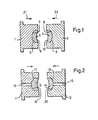
- 1 and 2 denote the stamp of a mold in which the stamp inserts 3 and 4 are held.
- the surfaces 5 and 6 of the stamps 1 and 2 used to receive these stamp inserts are designed as polished spherical surfaces with the radius R N.
- the corresponding surfaces 7 and 8 of the stamp inserts 3 and 4 are also designed as polished spherical surfaces with the radius R N.
- the radius R N is selected as the standard radius.
- stamp inserts 3 and 4 can be exchanged for other stamp inserts whose insert surfaces are also designed as polished spherical surfaces with the standard radius R N , regardless of the shape and shape of the surfaces 9 and 10 that determine the interior of the mold.
- the spherical surfaces 5.7 and 6.8 are so finely polished that the stamp inserts 3 and 4 through Adhesion in stamps 1 and 2 are liable.
- the punches 1 and 2 are moved together by the machine closing pressure in the direction of the arrows 21, 22 and the thermoplastic material is injected under high pressure into the space formed by the surfaces 9 and 10.
- Spectacle lenses made of thermoplastic material such as e.g. known under the name PMMA, PC, etc., are produced. It is possible, for example, to produce 1000 optical lenses with an optical effect of + 1.5 dpt by simply and quickly changing the 3.4 lens to those with other surfaces 9, 10, 1000 or more optical lenses with +2.5 dpt, etc .
- the time required to change the stamp insert 3 and 4 is in the minute range for the molding tool according to the invention.
- toric eyeglass lenses i.e.
- a stamp insert is selected, the surface 9 of which represents a torus which corresponds to the desired correction value for the astigmatism. It is then possible to give the axes of the torus a desired box by turning this stamp insert. This is necessary if the other surface of the spectacle lens also has a non-spherical shape, for example is designed as a varifocal surface.
- the punches 11 and 12 are provided with bores 15 and 16 which are connected to a vacuum line.
- the stamp inserts 13, 14 are held by the vacuum generated in this way.
- the spherical surfaces 17, 19 of the parts 11, 13 have a different radius than the spherical surfaces 18, 20 of the parts 12, 14. This can be necessary, for example, in order to always apply toric surfaces or varifocal surfaces to a predetermined side of an eyeglass lens.
Landscapes
- Engineering & Computer Science (AREA)
- Mechanical Engineering (AREA)
- Manufacturing & Machinery (AREA)
- Health & Medical Sciences (AREA)
- Ophthalmology & Optometry (AREA)
- Moulds For Moulding Plastics Or The Like (AREA)
- Casting Or Compression Moulding Of Plastics Or The Like (AREA)
- Polyoxymethylene Polymers And Polymers With Carbon-To-Carbon Bonds (AREA)
- Processing And Handling Of Plastics And Other Materials For Molding In General (AREA)
- Extrusion Moulding Of Plastics Or The Like (AREA)
- Injection Moulding Of Plastics Or The Like (AREA)
Description
- Die vorliegende Erfindung betrifft ein Formwerkzeug zur Herstellung von Teilen aus thermoplastischem Material, bestehend aus zwei jeweils als Träger für einen Stempeleinsatz ausgebildeten Stempeln, wobei die einander zugewandten Flächen dieser Stempeleinsätze die Form des herzustellenden Teiles bestimmen.
- Solche Werkzeuge sind aus der FR-A-2.170.220 bekannt und finden Anwendung zur Herstellung von Teilen nach einem Gieß- oder nach dem Spritzgießverfahren. Das letztere bietet sich besonders an, da es die Erreichung von extrem niedrigen Zykluszeiten und damit einer hohen Kosteneffektivität erlaubt. Außerdem ermöglicht das Spritzgießverfahren eine drastische Reduzierung des kapitalintensiven Werkzeugaufwandes durch die Verwendung sogenannter Stammformen.
- Eine solche Stammform besteht aus zwei Stempeln, die beim Gießvorgang durch den Maschinenschliendruck zusammengepreßt werden. Jeder Stempel ist mit einem Stempeleinsatz ausgerüstet, wobei die einander zugewandten Flächen dieser Stempeleinsätze die Form des herzustellenden Teiles bestimmen. Die Stempeleinsätze sind dabei formschlüssig mit dem jeweiligen Stempel verbunden. Soll ein anderes Teil hergestellt werden, so werden die Stempeleinsätze ausgewechselt.
- Dieser Auswechselvorgang ist, bedingt durch die formschlüssige Verbindung zwischen Stempel und Stempeleinsatz sehr zeitintensiv. Wechselzeiten von mehreren Stunden Dauer werden noch als normal angesehen.
- Es ist die Aufgabe der vorliegenden Erfindung ein Formwerkzeug zu schaffen, das einen schnellen und problemlosen Wechsel der Stempeleinsätze ermöglicht.
- Diese Aufgabe wird bei einem Formwerkzeug nach dem Oberbegriff des Anspruchs 1 dadurch gelöst, daß die dem Stempel zugewandte Fläche jedes Stempeleinsatzes und die zur Aufnahme dieses Stempeleinsatzes dienende Fläche des Stempels jeweils als polierte Kugelfläche mit demselben Radius ausgebildet sind.
- Es ist dabei vorteilhaft, die Kugelflächen der Stempel und der Stempeleinsätze als Normradienflächen auszubilden. Diese Kugelflächen sind für alle Stempeleinsätze identisch, unabhängig von der Gestalt der Flächen, die das Innere der Form bestimmen. Damit ist jeder Stempeleinsatz jederzeit einfach und schnell gegen einen anderen Stempeleinsatz auswechselbar.
- Um das Auswechseln der Stempeleinsätze zu erleichtern sind besonders vorteilhaft die Kugelflächen der Stempel und der Stempeleinsätze so fein poliert, daß die Stempeleinsätze durch das sogenannte, aus dem Eichen mit Endmassen bekannte "Ansprengen" in den zugeordneten Stempeln haften.
- Eine andere zweckmäßige Ausbildung sieht vor, die Kugelflächen der Stempel mit einer Öffnung zum Anschluß an eine Unterdruckleitung zu versehen. Der notwendige Unterdruck kann bei Spritzgußmaschinen direkt aus vorhandenen Leitungen entnommen werden. Da die einander zugewandten Flächen von Stempel und Stempeleinsatz denselben Radius haben, genügt schon ein verhältnismäßig geringer Unterdruck zur sicheren Lagerung des Stempeleinsatzes im Stempel.
- Es gibt Anwendungsfälle, bei denen ein bestimmter Stempeleinsatz oder eine Serie solcher Stempeleinsätze einem bestimmten Stempel zugeordnet sein muß. In diesem Fall ist es vorteilhaft der Kugelfläche eines Stempels einen anderen Radius zu geben als der Kugelfläche des anderen Stempels.
- Als Materialien für die Stempeleinsätze kommen je nach Art des zu vergießenden Materials beispielsweise Stahl, Spezialglas, Glaskeramik oder auch Saphir in Frage. Saphir findet besonders vorteilhafte Anwendung in Zusammenhang mit verschiedenen transparenten Kunststoffen, da er eine leichte Trennung zwischen Form und Gußteil gewährleistet.
- Das Formwerkzeug nach der Erfindung findet ganz besonders vorteilhaft Verwendung zur Herstellung von Brillenlinsen. Hier kommt es sehr auf eine schnelle Auswechselbarkeit der Stempeleinsätze an, da mit ein- und derselben Anlage Linsen verschiedener optischer Wirkungen hergestellt werden müssen.
- Einen sehr wesentlichen Vorteil bietet das Formwerkzeug nach der Erfindung bei der Herstellung von Brillenlinsen dadurch, daß durch Drehen der Stempeleinsätze in vorgegebene Positionen praktisch alle torischen Linsen einfach und ohne Stempeleinsatzwechsel gefertigt werden können.
- Die Erfindung wird im folgenden anhand der Figuren 1 und 2 der beigefügten Zeichnungen näher erläutert. Es zeigen:
- Fig. 1 einen Schnitt durch ein Ausführungsbeispiel des Formwerkzeugs;
- Fig. 2 einen Schnitt durch ein anderes Ausführungsbeispiel.
- In Fig. 1 sind mit 1 und 2 die Stempel eines Formwerkzeugs bezeichnet, in welchem die Stempeleinsätze 3 und 4 gehaltert sind. Die zur Aufnahme dieser Stempeleinsätze dienenden Flächen 5 und 6 der Stempel 1 und 2 sind als polierte Kugelflächen mit dem Radius RN ausgebildet. Die entsprechenden Flächen 7 und 8 der Stempeleinsätze 3 und 4 sind ebenfalls als polierte Kugelflächen mit dem Radius RN ausgebildet. Der Radius RN ist als Normradius gewählt.
- Die Stempeleinsätze 3 und 4 sind auswechselbar gegen andere Stempeleinsätze deren Einsatzflächen ebenfalls als polierte Kugelflächen mit dem Normradius RN ausgebildet sind und zwar unabhängig von der Form und Gestalt der das Forminnere bestimmenden Flächen 9 und 10.
- Die Kugelflächen 5,7 und 6,8 sind so fein poliert, daß die Stempeleinsätze 3 und 4 durch Ansprengen in den Stempeln 1 und 2 haften.
- Zum Gießen des Teiles werden die Stempel 1 und 2 durch den Maschinenschließdruck in Richtung der Pfeile 21,22 zusammengefahren und in den von den Flächen 9 und 10 gebildeten Raum wird das thermoplastische Material unter hohem Druck eingespritzt.
- Besonders vorteilhaft können mit dem dargestellten Formwerkzeug Brillenlinsen aus thermoplastischem Material, wie es z.B. unter der Bezeichnung PMMA, PC usw. bekannt ist, hergestellt werden. Dabei ist es beispielsweise möglich nach Herstellung van 1000 Brillenlinsen einer optischen Wirkung von + 1,5 dpt durch einfachen und schnellen Wechsel der 3,4 gegen solche mit anderen Flächen 9, 10, 1000 oder mehr Brillenlinsen mit +2,5 dpt zu erzeugen usw.
- Die Zeit, die zum Wechseln der Stempeleinsatz 3 und 4 benätigt wird, liegt bei dem Formwerkzeug nach der Erfindung im Minutenbereich.
- Zur Erzeugung torischer Brillenlinsen, d.h. von Brillenlinsen mit astigmatischer Wirkung wählt man einen Stempeleinsatz, dessen Fläche 9 einen Torus darstellt, der dem gewünschten Korrekturwert für den Astigmatismus entspricht. Es ist dann möglich durch Drehen dieses Stempeleinsatzes den Achsen des Torus eine gewünschte Loge zu geben. Dies ist notwendig, wenn auch die andere Fläche der Brillenlinse eine nicht-sphärische Gestalt hat, beispieisweise als Gleitsichtfläche ausgebildet ist.
- Im Ausführungsbeispiel der Figur 2 sind die Stempel 11 und 12 mit Bohrungen 15 und 16 versehen, die an eine Unterdruckleitung angeschlossen sind. Durch den so erzeugten Unterdruck werden die Stempeleinsätze 13, 14 gehalten.
- Im dargestellten Beispiel haben die Kugelflächen 17,19 der Teile 11,13 einen anderen Radius als die Kugelflächen 18,20 der Teile 12,14. Dies kann beispielsweise erforderlich sein um torische Flächen oder Gleitsichtflächen stets auf eine vorbestimmte Seite einer Brillenlinse aufzubringen.
Claims (9)
Priority Applications (1)
| Application Number | Priority Date | Filing Date | Title |
|---|---|---|---|
| AT82101938T ATE20323T1 (de) | 1981-03-31 | 1982-03-11 | Formwerkzeug zur herstellung von teilen aus thermoplastischem material. |
Applications Claiming Priority (2)
| Application Number | Priority Date | Filing Date | Title |
|---|---|---|---|
| DE19813112751 DE3112751A1 (de) | 1981-03-31 | 1981-03-31 | Formwerkzeug zur herstellung von teilen aus thermoplastischem material |
| DE3112751 | 1981-03-31 |
Publications (3)
| Publication Number | Publication Date |
|---|---|
| EP0061619A2 EP0061619A2 (de) | 1982-10-06 |
| EP0061619A3 EP0061619A3 (en) | 1983-09-07 |
| EP0061619B1 true EP0061619B1 (de) | 1986-06-11 |
Family
ID=6128837
Family Applications (1)
| Application Number | Title | Priority Date | Filing Date |
|---|---|---|---|
| EP82101938A Expired EP0061619B1 (de) | 1981-03-31 | 1982-03-11 | Formwerkzeug zur Herstellung von Teilen aus thermoplastischem Material |
Country Status (7)
| Country | Link |
|---|---|
| US (1) | US4383672A (de) |
| EP (1) | EP0061619B1 (de) |
| JP (1) | JPS57174227A (de) |
| AT (1) | ATE20323T1 (de) |
| AU (1) | AU546164B2 (de) |
| DE (2) | DE3112751A1 (de) |
| ES (1) | ES271047Y (de) |
Families Citing this family (26)
| Publication number | Priority date | Publication date | Assignee | Title |
|---|---|---|---|---|
| US4597730A (en) * | 1982-09-20 | 1986-07-01 | Kelsey-Hayes Company | Assembly for hot consolidating materials |
| US4614630A (en) * | 1984-04-02 | 1986-09-30 | Minnesota Mining And Manufacturing Co. | Mold having ceramic insert, method for injection molding using the same |
| US4704079A (en) * | 1984-04-02 | 1987-11-03 | Minnesota Mining And Manufacturing Company | Mold having ceramic insert |
| US4693446A (en) * | 1985-09-20 | 1987-09-15 | Techna Vision, Inc. | Gasket for molding plastic lenses |
| CA1263208A (en) * | 1985-12-19 | 1989-11-28 | Kirk K.S. Hwang | Method and apparatus for making optical devices |
| US4836960A (en) * | 1987-10-05 | 1989-06-06 | Sola Usa, Inc. | Fabrication of thermoplastic optical components by injection/compression molding |
| JPH04110110A (ja) * | 1990-08-30 | 1992-04-10 | Seiko Epson Corp | プリズム付プラスチックレンズの成形法 |
| JP2846773B2 (ja) * | 1992-09-01 | 1999-01-13 | 三菱電機株式会社 | 半導体装置の樹脂封止装置及び樹脂封止方法 |
| US5441398A (en) * | 1992-10-08 | 1995-08-15 | Gentex Optics, Inc. | Insert for molding convex surfaces of progressive lenses and retainer therefor |
| US5288218A (en) * | 1993-02-11 | 1994-02-22 | Mikron Industries | Extrusion calibrator |
| US5601759A (en) * | 1993-10-05 | 1997-02-11 | Bausch & Lomb Incorporated | Method for molding contact lenses |
| KR100347781B1 (ko) * | 1994-01-31 | 2003-02-05 | 바슈 앤드 롬 인코포레이티드 | 원환체콘택트렌즈의주형성형법 |
| US5861114A (en) * | 1994-06-10 | 1999-01-19 | Johnson&Johnson Vision Products, Inc. | Method of manufacturing complex optical designs in soft contact lenses |
| US5620635A (en) * | 1995-01-11 | 1997-04-15 | Derozier; Gaston | Ophthalmic lens manufacturing equipment and method |
| US5916494A (en) * | 1995-12-29 | 1999-06-29 | Johnson & Johnson Vision Products, Inc. | Rotational indexing base curve deposition array |
| AR013512A1 (es) | 1997-09-24 | 2000-12-27 | Novartis Ag | Metodo para fabricar una lente de contacto astigmatica |
| CA2316205C (en) | 1998-01-16 | 2004-12-07 | Bausch & Lomb Incorporated | Toric axis alignment machine and method |
| US6592356B1 (en) * | 1999-05-05 | 2003-07-15 | Johnson & Johnson Vision Care, Inc. | Mold, molding system and molding machine for making ophthalmic devices |
| JP2000326348A (ja) * | 1999-05-21 | 2000-11-28 | Asahi Optical Co Ltd | レンズ成形型,その作製方法,及びレンズ製造方法 |
| DE19941185C1 (de) * | 1999-08-30 | 2001-04-05 | Framatome Connectors Int | Gesenk für Crimpwerkzeuge |
| US6383419B1 (en) * | 1999-12-09 | 2002-05-07 | Gregg A. Dean | Method for cast molding toric contact lenses |
| DE10107743A1 (de) | 2001-02-16 | 2002-09-05 | Webasto Vehicle Sys Int Gmbh | Vorrichtung zum Umschäumen einer transparenten Scheibe für ein Fahrzeugdach |
| US20040188873A1 (en) * | 2001-07-16 | 2004-09-30 | Kotaro Ono | Method for producing resin lens and the resin lens |
| FR2949703A1 (fr) * | 2009-09-07 | 2011-03-11 | Sidel Participations | Dispositif de moulage equipe de moyens de fixation d'un demi-moule par attaction contre le fond d'un logement associe d'un porte-moule |
| US8814557B2 (en) * | 2010-03-24 | 2014-08-26 | United Technologies Corporation | Die inserts for die casting |
| US20160062138A1 (en) * | 2012-12-10 | 2016-03-03 | Kelly Coty | Hairband and method of manufacture including a single mold with optical lens inserts |
Family Cites Families (19)
| Publication number | Priority date | Publication date | Assignee | Title |
|---|---|---|---|---|
| US2245608A (en) * | 1938-12-19 | 1941-06-17 | George D Rogers | Die |
| US2298429A (en) * | 1940-08-23 | 1942-10-13 | Univis Lens Co | Method and apparatus for automatic pressure control in molding of synthetic resinousmaterials |
| US2304664A (en) * | 1940-10-29 | 1942-12-08 | Univis Lens Co | Lens molding press |
| US2406361A (en) * | 1942-10-16 | 1946-08-27 | Polaroid Corp | Mold for use in the manufacture of optical elements |
| US2394941A (en) * | 1943-07-03 | 1946-02-12 | Univis Lens Co | Molding apparatus |
| US2357950A (en) * | 1943-08-05 | 1944-09-12 | Gerald A Goessling | Process of making metal-coated plastic articles |
| US2443826A (en) * | 1944-06-23 | 1948-06-22 | Combined Optical Ind Ltd | Apparatus for the manufacture of lenses |
| US2424235A (en) * | 1944-11-28 | 1947-07-22 | Teksun Inc | Injection mold |
| GB650692A (en) * | 1944-11-28 | 1951-02-28 | Teksun Inc | Injection mold for use in molding opthalmic lenses and other articles |
| BE586094A (fr) * | 1958-12-29 | 1960-04-19 | Royal S P A | Arrangement pour la fabrication de lentilles |
| US3079503A (en) * | 1962-03-29 | 1963-02-26 | Optomechanisms Inc | Negative to positive microscope |
| US3509593A (en) * | 1967-10-10 | 1970-05-05 | Strickler De Moss Mfg Co | Apparatus for cleaning animal intestines |
| US3605195A (en) * | 1970-08-24 | 1971-09-20 | Charles D Campbell | Mold assembly for casting plastic optical lenses |
| IT990526B (it) * | 1972-02-02 | 1975-07-10 | Deutsche Spiegelglas Ag | Stampo di iniettofusione per la produzione di corpi a forma altamente polimerici in vetroce ramica |
| US3871611A (en) * | 1973-05-07 | 1975-03-18 | Taketa Phyllis | Mold with removable and replaceable core and cavity inserts |
| DE2354987C2 (de) * | 1973-11-02 | 1976-01-02 | Deutsche Spiegelglas Ag, 3224 Gruenenplan | Gießform zur Fertigung von Kunststofflinsen mit optischer Oberflächenqualität sowie Vorrichtung zu ihrer Herstellung |
| JPS5393850A (en) * | 1977-01-25 | 1978-08-17 | Pii Ueebaa Haaman | Method and system of ejecting lens and lens blank |
| JPS5953858B2 (ja) * | 1978-05-13 | 1984-12-27 | ダイセル化学工業株式会社 | 度付レンズの成形方法 |
| FR2449519A1 (fr) * | 1979-02-23 | 1980-09-19 | Essilor Int | Joint annulaire propre au moulage de lentilles ophtalmiques ou optiques en matiere organique, et procede de mise en oeuvre d'un tel joint |
-
1981
- 1981-03-31 DE DE19813112751 patent/DE3112751A1/de not_active Withdrawn
-
1982
- 1982-02-08 ES ES1982271047U patent/ES271047Y/es not_active Expired
- 1982-03-11 AT AT82101938T patent/ATE20323T1/de not_active IP Right Cessation
- 1982-03-11 DE DE8282101938T patent/DE3271614D1/de not_active Expired
- 1982-03-11 EP EP82101938A patent/EP0061619B1/de not_active Expired
- 1982-03-17 US US06/359,059 patent/US4383672A/en not_active Expired - Fee Related
- 1982-03-30 JP JP57050257A patent/JPS57174227A/ja active Pending
- 1982-03-31 AU AU82210/82A patent/AU546164B2/en not_active Ceased
Also Published As
| Publication number | Publication date |
|---|---|
| EP0061619A3 (en) | 1983-09-07 |
| ES271047Y (es) | 1984-03-01 |
| US4383672A (en) | 1983-05-17 |
| ES271047U (es) | 1983-08-16 |
| AU8221082A (en) | 1982-10-07 |
| EP0061619A2 (de) | 1982-10-06 |
| DE3271614D1 (en) | 1986-07-17 |
| AU546164B2 (en) | 1985-08-15 |
| DE3112751A1 (de) | 1982-10-07 |
| ATE20323T1 (de) | 1986-06-15 |
| JPS57174227A (en) | 1982-10-26 |
Similar Documents
| Publication | Publication Date | Title |
|---|---|---|
| EP0061619A2 (de) | Formwerkzeug zur Herstellung von Teilen aus thermoplastischem Material | |
| EP0064247B1 (de) | Vorrichtung zum Herstellen von Formteilen mit asphärischen Oberflächen | |
| DE60004540T2 (de) | Verfahren und vorrichtung zur herstellung eines kunststoffprodukts | |
| DE2734416C2 (de) | Linsengießzelle | |
| DE3121490C2 (de) | ||
| DE69520518T2 (de) | Verfahren und Vorrichtung zur Herstellung opthalmischer Linsen durch Vakuum-Spritzgiessen | |
| DE69807334T2 (de) | Verfahren zum spritzgiessen einer asymmetrischen kontakt-linse | |
| DE69215752T2 (de) | Verfahren zur Herstellung einer Endhülse für Glasfaserstecker und Gussform dafür | |
| DE3532424A1 (de) | Verfahren und vorrichtung zum aufformen einer eingespritzten einfassung mit genauen abmessungen auf den umfang eines ebenen oder gewoelbten teils mit abmessungstoleranzen und danach hergestelltes zusammengesetztes produkt | |
| DE19942153C2 (de) | Verfahren und Vorrichtung zur Herstellung eines zweiteiligen Kunststoffgegenstandes | |
| EP0671249B1 (de) | Verfahren und Vorrichtung zur Herstellung optischen Linsen | |
| DE19610563A1 (de) | Verfahren zum gegenseitigen Positionieren von Paaren gegenüberliegender formbestimmender Formwerkzeug-Teile und Formwerkzeug zur Herstellung von Präzisionsteilen, insbesondere von Kontaktlinsen | |
| EP0458734A1 (de) | Verfahren zur Herstellung von Kontaklinsen | |
| DE3018102A1 (de) | Dichtringanordnung und verfahren zum giessen von linsen zwischen zwei giessformen | |
| EP0447361B1 (de) | Kontaktlinsen-Giessform | |
| DE69904885T2 (de) | Giessform zur Herstellung von opthalmischen Linsen | |
| EP0731746B1 (de) | Handhabungssystem für giessformen | |
| DE2828926C2 (de) | Form zum Gießen von Brillengestell-Mittelteilen aus thermoplastischem Kunststoff | |
| DE69200760T2 (de) | Multifunktionale form. | |
| DE4313185A1 (de) | Form zum Gießen von Hülsen | |
| DE2014136A1 (de) | Formsystem für das Gießen von Brillengestellen und Teilen derselben sowie ein Verfahren zum Herstellen desselben | |
| DE60027185T2 (de) | Vorrichtung zur herstellung von wegwerflinsen | |
| DE19602736A1 (de) | Verfahren und Vorrichtung zur Herstellung von optischen Linsen und optischen Linsenarrays | |
| EP1016473A2 (de) | Verfahren und Vorrichtung zum Formen von Formteilen | |
| DE3117842C1 (de) | Vorrichtung zur Herstellung von Schokoladenkörpern |
Legal Events
| Date | Code | Title | Description |
|---|---|---|---|
| PUAI | Public reference made under article 153(3) epc to a published international application that has entered the european phase |
Free format text: ORIGINAL CODE: 0009012 |
|
| AK | Designated contracting states |
Designated state(s): AT CH DE FR GB IT NL SE |
|
| PUAL | Search report despatched |
Free format text: ORIGINAL CODE: 0009013 |
|
| AK | Designated contracting states |
Designated state(s): AT CH DE FR GB IT LI NL SE |
|
| 17P | Request for examination filed |
Effective date: 19831013 |
|
| ITF | It: translation for a ep patent filed | ||
| GRAA | (expected) grant |
Free format text: ORIGINAL CODE: 0009210 |
|
| AK | Designated contracting states |
Kind code of ref document: B1 Designated state(s): AT CH DE FR GB IT LI NL SE |
|
| REF | Corresponds to: |
Ref document number: 20323 Country of ref document: AT Date of ref document: 19860615 Kind code of ref document: T |
|
| REF | Corresponds to: |
Ref document number: 3271614 Country of ref document: DE Date of ref document: 19860717 |
|
| ET | Fr: translation filed | ||
| PG25 | Lapsed in a contracting state [announced via postgrant information from national office to epo] |
Ref country code: AT Effective date: 19870311 |
|
| PG25 | Lapsed in a contracting state [announced via postgrant information from national office to epo] |
Ref country code: SE Effective date: 19870312 |
|
| PG25 | Lapsed in a contracting state [announced via postgrant information from national office to epo] |
Ref country code: LI Effective date: 19870331 Ref country code: CH Effective date: 19870331 |
|
| PLBE | No opposition filed within time limit |
Free format text: ORIGINAL CODE: 0009261 |
|
| STAA | Information on the status of an ep patent application or granted ep patent |
Free format text: STATUS: NO OPPOSITION FILED WITHIN TIME LIMIT |
|
| 26N | No opposition filed | ||
| PG25 | Lapsed in a contracting state [announced via postgrant information from national office to epo] |
Ref country code: NL Effective date: 19871001 |
|
| NLV4 | Nl: lapsed or anulled due to non-payment of the annual fee | ||
| GBPC | Gb: european patent ceased through non-payment of renewal fee | ||
| PG25 | Lapsed in a contracting state [announced via postgrant information from national office to epo] |
Ref country code: FR Free format text: LAPSE BECAUSE OF NON-PAYMENT OF DUE FEES Effective date: 19871130 |
|
| REG | Reference to a national code |
Ref country code: CH Ref legal event code: PL |
|
| PG25 | Lapsed in a contracting state [announced via postgrant information from national office to epo] |
Ref country code: DE Effective date: 19871201 |
|
| REG | Reference to a national code |
Ref country code: FR Ref legal event code: ST |
|
| PG25 | Lapsed in a contracting state [announced via postgrant information from national office to epo] |
Ref country code: GB Effective date: 19881121 |
|
| EUG | Se: european patent has lapsed |
Ref document number: 82101938.7 Effective date: 19880215 |