EP0061661A1 - Heterocyclisch substituierte (Halogen)Alkyl- und -Alkoxysulfonylharnstoffe, Verfahren zu ihrer Herstellung und ihre Verwendung in der Landwirtschaft - Google Patents
Heterocyclisch substituierte (Halogen)Alkyl- und -Alkoxysulfonylharnstoffe, Verfahren zu ihrer Herstellung und ihre Verwendung in der Landwirtschaft Download PDFInfo
- Publication number
- EP0061661A1 EP0061661A1 EP82102200A EP82102200A EP0061661A1 EP 0061661 A1 EP0061661 A1 EP 0061661A1 EP 82102200 A EP82102200 A EP 82102200A EP 82102200 A EP82102200 A EP 82102200A EP 0061661 A1 EP0061661 A1 EP 0061661A1
- Authority
- EP
- European Patent Office
- Prior art keywords
- formula
- compounds
- sulfonyl
- halogen
- urea
- Prior art date
- Legal status (The legal status is an assumption and is not a legal conclusion. Google has not performed a legal analysis and makes no representation as to the accuracy of the status listed.)
- Withdrawn
Links
- 229910052736 halogen Inorganic materials 0.000 title claims abstract description 18
- 125000000623 heterocyclic group Chemical group 0.000 title claims abstract description 4
- 150000002367 halogens Chemical class 0.000 title claims description 16
- 238000000034 method Methods 0.000 title claims description 14
- 238000002360 preparation method Methods 0.000 title claims description 9
- 125000000217 alkyl group Chemical group 0.000 title abstract description 6
- 229940100389 Sulfonylurea Drugs 0.000 title description 4
- 125000005138 alkoxysulfonyl group Chemical group 0.000 title 1
- 150000001875 compounds Chemical class 0.000 claims abstract description 40
- 239000004009 herbicide Substances 0.000 claims abstract description 7
- 239000001301 oxygen Substances 0.000 claims abstract description 5
- 229910052760 oxygen Inorganic materials 0.000 claims abstract description 5
- QVGXLLKOCUKJST-UHFFFAOYSA-N atomic oxygen Chemical compound [O] QVGXLLKOCUKJST-UHFFFAOYSA-N 0.000 claims abstract description 4
- 125000005843 halogen group Chemical group 0.000 claims abstract description 4
- 239000003630 growth substance Substances 0.000 claims abstract description 3
- 230000012010 growth Effects 0.000 claims description 17
- 125000004453 alkoxycarbonyl group Chemical group 0.000 claims description 7
- 150000003839 salts Chemical class 0.000 claims description 7
- 125000004178 (C1-C4) alkyl group Chemical group 0.000 claims description 6
- 239000012433 hydrogen halide Substances 0.000 claims description 5
- 229910000039 hydrogen halide Inorganic materials 0.000 claims description 5
- 125000004432 carbon atom Chemical group C* 0.000 claims description 4
- 230000001105 regulatory effect Effects 0.000 claims description 4
- 125000006559 (C1-C3) alkylamino group Chemical group 0.000 claims description 3
- 125000004455 (C1-C3) alkylthio group Chemical group 0.000 claims description 3
- 125000006698 (C1-C3) dialkylamino group Chemical group 0.000 claims description 3
- 125000006274 (C1-C3)alkoxy group Chemical group 0.000 claims description 3
- 230000029936 alkylation Effects 0.000 claims description 3
- 238000005804 alkylation reaction Methods 0.000 claims description 3
- 230000015572 biosynthetic process Effects 0.000 claims description 3
- 125000004663 dialkyl amino group Chemical group 0.000 claims description 3
- 239000001257 hydrogen Substances 0.000 claims description 3
- 229910052739 hydrogen Inorganic materials 0.000 claims description 3
- 125000003282 alkyl amino group Chemical group 0.000 claims description 2
- 150000002431 hydrogen Chemical class 0.000 claims description 2
- 125000004433 nitrogen atom Chemical group N* 0.000 claims description 2
- 229920006395 saturated elastomer Polymers 0.000 claims description 2
- 230000008635 plant growth Effects 0.000 claims 2
- 230000001276 controlling effect Effects 0.000 claims 1
- NINIDFKCEFEMDL-UHFFFAOYSA-N Sulfur Chemical group [S] NINIDFKCEFEMDL-UHFFFAOYSA-N 0.000 abstract 1
- 229910052717 sulfur Chemical group 0.000 abstract 1
- 239000011593 sulfur Chemical group 0.000 abstract 1
- 241000196324 Embryophyta Species 0.000 description 34
- -1 4-chloro-6-i-propylamino-1,3,5-triazin-2-yl Chemical group 0.000 description 28
- YMWUJEATGCHHMB-UHFFFAOYSA-N Dichloromethane Chemical compound ClCCl YMWUJEATGCHHMB-UHFFFAOYSA-N 0.000 description 21
- 239000000203 mixture Substances 0.000 description 17
- 239000004480 active ingredient Substances 0.000 description 16
- XSQUKJJJFZCRTK-UHFFFAOYSA-N Urea Chemical compound NC(N)=O XSQUKJJJFZCRTK-UHFFFAOYSA-N 0.000 description 14
- 230000000694 effects Effects 0.000 description 14
- 239000002253 acid Substances 0.000 description 12
- VLKZOEOYAKHREP-UHFFFAOYSA-N n-Hexane Chemical compound CCCCCC VLKZOEOYAKHREP-UHFFFAOYSA-N 0.000 description 10
- YXFVVABEGXRONW-UHFFFAOYSA-N Toluene Chemical compound CC1=CC=CC=C1 YXFVVABEGXRONW-UHFFFAOYSA-N 0.000 description 9
- ZMANZCXQSJIPKH-UHFFFAOYSA-N Triethylamine Chemical compound CCN(CC)CC ZMANZCXQSJIPKH-UHFFFAOYSA-N 0.000 description 9
- 230000002363 herbicidal effect Effects 0.000 description 8
- BWHMMNNQKKPAPP-UHFFFAOYSA-L potassium carbonate Chemical compound [K+].[K+].[O-]C([O-])=O BWHMMNNQKKPAPP-UHFFFAOYSA-L 0.000 description 8
- 239000000126 substance Substances 0.000 description 8
- XLYOFNOQVPJJNP-UHFFFAOYSA-N water Substances O XLYOFNOQVPJJNP-UHFFFAOYSA-N 0.000 description 8
- 239000004202 carbamide Substances 0.000 description 7
- 238000009472 formulation Methods 0.000 description 7
- LFQSCWFLJHTTHZ-UHFFFAOYSA-N Ethanol Chemical compound CCO LFQSCWFLJHTTHZ-UHFFFAOYSA-N 0.000 description 6
- DGAQECJNVWCQMB-PUAWFVPOSA-M Ilexoside XXIX Chemical compound C[C@@H]1CC[C@@]2(CC[C@@]3(C(=CC[C@H]4[C@]3(CC[C@@H]5[C@@]4(CC[C@@H](C5(C)C)OS(=O)(=O)[O-])C)C)[C@@H]2[C@]1(C)O)C)C(=O)O[C@H]6[C@@H]([C@H]([C@@H]([C@H](O6)CO)O)O)O.[Na+] DGAQECJNVWCQMB-PUAWFVPOSA-M 0.000 description 6
- ZMXDDKWLCZADIW-UHFFFAOYSA-N N,N-Dimethylformamide Chemical compound CN(C)C=O ZMXDDKWLCZADIW-UHFFFAOYSA-N 0.000 description 6
- 238000009835 boiling Methods 0.000 description 6
- 239000003795 chemical substances by application Substances 0.000 description 6
- 239000004495 emulsifiable concentrate Substances 0.000 description 6
- 239000008187 granular material Substances 0.000 description 6
- 239000000843 powder Substances 0.000 description 6
- VYPSYNLAJGMNEJ-UHFFFAOYSA-N Silicium dioxide Chemical compound O=[Si]=O VYPSYNLAJGMNEJ-UHFFFAOYSA-N 0.000 description 5
- 239000013543 active substance Substances 0.000 description 5
- 238000006243 chemical reaction Methods 0.000 description 5
- 239000003995 emulsifying agent Substances 0.000 description 5
- 229910052708 sodium Inorganic materials 0.000 description 5
- 239000011734 sodium Substances 0.000 description 5
- HEMHJVSKTPXQMS-UHFFFAOYSA-M sodium hydroxide Inorganic materials [OH-].[Na+] HEMHJVSKTPXQMS-UHFFFAOYSA-M 0.000 description 5
- 239000000243 solution Substances 0.000 description 5
- 239000002904 solvent Substances 0.000 description 5
- HEDRZPFGACZZDS-UHFFFAOYSA-N Chloroform Chemical compound ClC(Cl)Cl HEDRZPFGACZZDS-UHFFFAOYSA-N 0.000 description 4
- JUJWROOIHBZHMG-UHFFFAOYSA-N Pyridine Chemical compound C1=CC=NC=C1 JUJWROOIHBZHMG-UHFFFAOYSA-N 0.000 description 4
- 230000006378 damage Effects 0.000 description 4
- 235000013399 edible fruits Nutrition 0.000 description 4
- 239000012442 inert solvent Substances 0.000 description 4
- 238000002844 melting Methods 0.000 description 4
- 230000008018 melting Effects 0.000 description 4
- 230000017066 negative regulation of growth Effects 0.000 description 4
- 229910000027 potassium carbonate Inorganic materials 0.000 description 4
- 239000007858 starting material Substances 0.000 description 4
- CSCPPACGZOOCGX-UHFFFAOYSA-N Acetone Chemical compound CC(C)=O CSCPPACGZOOCGX-UHFFFAOYSA-N 0.000 description 3
- WEVYAHXRMPXWCK-UHFFFAOYSA-N Acetonitrile Chemical compound CC#N WEVYAHXRMPXWCK-UHFFFAOYSA-N 0.000 description 3
- 241000207199 Citrus Species 0.000 description 3
- XEKOWRVHYACXOJ-UHFFFAOYSA-N Ethyl acetate Chemical compound CCOC(C)=O XEKOWRVHYACXOJ-UHFFFAOYSA-N 0.000 description 3
- 244000068988 Glycine max Species 0.000 description 3
- 235000010469 Glycine max Nutrition 0.000 description 3
- OKKJLVBELUTLKV-UHFFFAOYSA-N Methanol Chemical compound OC OKKJLVBELUTLKV-UHFFFAOYSA-N 0.000 description 3
- 239000007795 chemical reaction product Substances 0.000 description 3
- 239000012141 concentrate Substances 0.000 description 3
- 150000002148 esters Chemical class 0.000 description 3
- 230000009036 growth inhibition Effects 0.000 description 3
- 238000003306 harvesting Methods 0.000 description 3
- NLYAJNPCOHFWQQ-UHFFFAOYSA-N kaolin Chemical compound O.O.O=[Al]O[Si](=O)O[Si](=O)O[Al]=O NLYAJNPCOHFWQQ-UHFFFAOYSA-N 0.000 description 3
- 238000004519 manufacturing process Methods 0.000 description 3
- 239000000463 material Substances 0.000 description 3
- SNQQPOLDUKLAAF-UHFFFAOYSA-N nonylphenol Chemical compound CCCCCCCCCC1=CC=CC=C1O SNQQPOLDUKLAAF-UHFFFAOYSA-N 0.000 description 3
- 238000009331 sowing Methods 0.000 description 3
- RYHBNJHYFVUHQT-UHFFFAOYSA-N 1,4-Dioxane Chemical compound C1COCCO1 RYHBNJHYFVUHQT-UHFFFAOYSA-N 0.000 description 2
- RAQWVJDYDLISFC-UHFFFAOYSA-N 1-(1,2-dichloroethylsulfonyl)-3-[4-(2-methoxyethoxy)-5,6-dimethylpyrimidin-2-yl]urea Chemical compound COCCOC1=NC(NC(=O)NS(=O)(=O)C(Cl)CCl)=NC(C)=C1C RAQWVJDYDLISFC-UHFFFAOYSA-N 0.000 description 2
- FTZKIEZXNACWCZ-UHFFFAOYSA-N 1-(1,2-dichloropropylsulfonyl)-3-(4-methyl-6-methylsulfanyl-1,3,5-triazin-2-yl)urea Chemical compound CSC1=NC(C)=NC(NC(=O)NS(=O)(=O)C(Cl)C(C)Cl)=N1 FTZKIEZXNACWCZ-UHFFFAOYSA-N 0.000 description 2
- QKIHBZVJGRNPNB-UHFFFAOYSA-N 1-(2,2-dichloroethylsulfonyl)-3-[4-methyl-6-(trifluoromethyl)pyrimidin-2-yl]urea Chemical compound CC1=CC(C(F)(F)F)=NC(NC(=O)NS(=O)(=O)CC(Cl)Cl)=N1 QKIHBZVJGRNPNB-UHFFFAOYSA-N 0.000 description 2
- GZAKNDPAKHUCQF-UHFFFAOYSA-N 1-(2,3-dichlorobutylsulfonyl)-3-(4-methylpyrimidin-2-yl)urea Chemical compound CC(Cl)C(Cl)CS(=O)(=O)NC(=O)NC1=NC=CC(C)=N1 GZAKNDPAKHUCQF-UHFFFAOYSA-N 0.000 description 2
- DTVPZUNDPVMGBL-UHFFFAOYSA-N 1-(2,3-dichloropropylsulfonyl)-3-[4-ethoxy-6-(methoxymethyl)-5-methylpyrimidin-2-yl]urea Chemical compound CCOC1=NC(NC(=O)NS(=O)(=O)CC(Cl)CCl)=NC(COC)=C1C DTVPZUNDPVMGBL-UHFFFAOYSA-N 0.000 description 2
- CYCKLPRUSQMELS-UHFFFAOYSA-N 1-(2-chloro-3-methoxypropyl)sulfonyl-3-(4-methoxy-6-methylpyrimidin-2-yl)urea Chemical compound COCC(Cl)CS(=O)(=O)NC(=O)NC1=NC(C)=CC(OC)=N1 CYCKLPRUSQMELS-UHFFFAOYSA-N 0.000 description 2
- MXQGBLWCDWFUAX-UHFFFAOYSA-N 1-(2-chloroethylsulfonyl)-3-(4,6-dichloropyrimidin-2-yl)urea Chemical compound ClCCS(=O)(=O)NC(=O)NC1=NC(Cl)=CC(Cl)=N1 MXQGBLWCDWFUAX-UHFFFAOYSA-N 0.000 description 2
- MOCPPRDVUAUZSB-UHFFFAOYSA-N 1-(2-chloroethylsulfonyl)-3-(4-methoxy-6-methylsulfanylpyrimidin-2-yl)urea Chemical compound COC1=CC(SC)=NC(NC(=O)NS(=O)(=O)CCCl)=N1 MOCPPRDVUAUZSB-UHFFFAOYSA-N 0.000 description 2
- UNGYJCQYVXWFGY-UHFFFAOYSA-N 1-(2-chlorohexylsulfonyl)-3-(4-methoxy-5,6-dimethylpyrimidin-2-yl)urea Chemical compound CCCCC(Cl)CS(=O)(=O)NC(=O)NC1=NC(C)=C(C)C(OC)=N1 UNGYJCQYVXWFGY-UHFFFAOYSA-N 0.000 description 2
- PACNRVTZMAMDQW-UHFFFAOYSA-N 1-(3,4-dichlorobutan-2-ylsulfonyl)-3-(4,6-dimethoxy-1,3,5-triazin-2-yl)urea Chemical compound COC1=NC(NC(=O)NS(=O)(=O)C(C)C(Cl)CCl)=NC(OC)=N1 PACNRVTZMAMDQW-UHFFFAOYSA-N 0.000 description 2
- XSWMIRQWZAIMDG-UHFFFAOYSA-N 1-(3-bromo-2-chlorobutyl)sulfonyl-3-(2,6-dimethylpyrimidin-4-yl)urea Chemical compound CC(Br)C(Cl)CS(=O)(=O)NC(=O)NC1=CC(C)=NC(C)=N1 XSWMIRQWZAIMDG-UHFFFAOYSA-N 0.000 description 2
- WWWBAVBYMJFLDJ-UHFFFAOYSA-N 1-(4,6-diethylpyrimidin-2-yl)-3-prop-1-enylsulfonylurea Chemical compound CCC1=CC(CC)=NC(NC(=O)NS(=O)(=O)C=CC)=N1 WWWBAVBYMJFLDJ-UHFFFAOYSA-N 0.000 description 2
- KHEFXQMZFHGTND-UHFFFAOYSA-N 1-(4-chloro-6-methyl-5-nitropyrimidin-2-yl)-3-(3-chloroprop-1-enylsulfonyl)urea Chemical compound CC1=NC(NC(=O)NS(=O)(=O)C=CCCl)=NC(Cl)=C1[N+]([O-])=O KHEFXQMZFHGTND-UHFFFAOYSA-N 0.000 description 2
- KXAYWKXNWWXAQQ-UHFFFAOYSA-N 1-(5-bromo-4,6-dimethylpyrimidin-2-yl)-3-prop-1-enylsulfonylurea Chemical compound CC=CS(=O)(=O)NC(=O)NC1=NC(C)=C(Br)C(C)=N1 KXAYWKXNWWXAQQ-UHFFFAOYSA-N 0.000 description 2
- IXQFFKIHETUVDI-UHFFFAOYSA-N 1-(5-butyl-4-methoxy-6-methylpyrimidin-2-yl)-3-(3-chlorobut-1-enylsulfonyl)urea Chemical compound CCCCC1=C(C)N=C(NC(=O)NS(=O)(=O)C=CC(C)Cl)N=C1OC IXQFFKIHETUVDI-UHFFFAOYSA-N 0.000 description 2
- IIUOVFQCCQIPSZ-UHFFFAOYSA-N 1-(5-chloro-4,6-dimethylpyrimidin-2-yl)-3-(1,2-dichloropropylsulfonyl)urea Chemical compound CC(Cl)C(Cl)S(=O)(=O)NC(=O)NC1=NC(C)=C(Cl)C(C)=N1 IIUOVFQCCQIPSZ-UHFFFAOYSA-N 0.000 description 2
- SDUCDZGZWKPQEF-UHFFFAOYSA-N 1-(5-chloropyrimidin-2-yl)-3-(2,4-dibromo-2-chlorobutyl)sulfonylurea Chemical compound ClC1=CN=C(NC(=O)NS(=O)(=O)CC(Cl)(Br)CCBr)N=C1 SDUCDZGZWKPQEF-UHFFFAOYSA-N 0.000 description 2
- BDFHJOLCIWAEJZ-UHFFFAOYSA-N 1-[3-chloro-2-(chloromethyl)propyl]sulfonyl-3-(4-methoxy-6-methyl-1,3,5-triazin-2-yl)urea Chemical compound COC1=NC(C)=NC(NC(=O)NS(=O)(=O)CC(CCl)CCl)=N1 BDFHJOLCIWAEJZ-UHFFFAOYSA-N 0.000 description 2
- FUAKPIJTXSDKPL-UHFFFAOYSA-N 1-[4,6-bis(ethylsulfanyl)pyrimidin-2-yl]-3-(2-chloro-3,3,3-trifluoropropyl)sulfonylurea Chemical compound CCSC1=CC(SCC)=NC(NC(=O)NS(=O)(=O)CC(Cl)C(F)(F)F)=N1 FUAKPIJTXSDKPL-UHFFFAOYSA-N 0.000 description 2
- OKPNNYNSQKHYNA-UHFFFAOYSA-N 1-[4,6-bis(methylsulfanyl)-1,3,5-triazin-2-yl]-3-(2,3-dichloro-2-methylpropyl)sulfonylurea Chemical compound CSC1=NC(NC(=O)NS(=O)(=O)CC(C)(Cl)CCl)=NC(SC)=N1 OKPNNYNSQKHYNA-UHFFFAOYSA-N 0.000 description 2
- XADYBZCSMDNJJS-UHFFFAOYSA-N 1-[4-(2-bromoethoxy)-6-methylpyrimidin-2-yl]-3-(2,3,4-trichlorobutylsulfonyl)urea Chemical compound CC1=CC(OCCBr)=NC(NC(=O)NS(=O)(=O)CC(Cl)C(Cl)CCl)=N1 XADYBZCSMDNJJS-UHFFFAOYSA-N 0.000 description 2
- GMIOLKSRCIEXEU-UHFFFAOYSA-N 1-[4-(diethylamino)-6-methyl-1,3,5-triazin-2-yl]-3-ethenylsulfonylurea Chemical compound CCN(CC)C1=NC(C)=NC(NC(=O)NS(=O)(=O)C=C)=N1 GMIOLKSRCIEXEU-UHFFFAOYSA-N 0.000 description 2
- ZEQWYOGIPYZJAY-UHFFFAOYSA-N 1-[4-chloro-6-(propan-2-ylamino)-1,3,5-triazin-2-yl]-1-propan-2-yl-3-prop-1-enylsulfonylurea Chemical compound CC=CS(=O)(=O)NC(=O)N(C(C)C)C1=NC(Cl)=NC(NC(C)C)=N1 ZEQWYOGIPYZJAY-UHFFFAOYSA-N 0.000 description 2
- UNRLWDLRUADZOM-UHFFFAOYSA-N 1-but-2-en-2-ylsulfonyl-3-(5,6-dimethyl-1h-1,2,4-triazin-2-yl)urea Chemical compound CC=C(C)S(=O)(=O)NC(=O)NN1NC(C)=C(C)N=C1 UNRLWDLRUADZOM-UHFFFAOYSA-N 0.000 description 2
- KRNYNXQWSIRNJA-UHFFFAOYSA-N 1-prop-1-enylsulfonyl-3-pyrimidin-2-ylthiourea Chemical compound CC=CS(=O)(=O)NC(=S)NC1=NC=CC=N1 KRNYNXQWSIRNJA-UHFFFAOYSA-N 0.000 description 2
- QIBLBRYKAQDPJZ-UHFFFAOYSA-N 2,2,2-trichloroethyl n-[(4-methoxy-6-methylpyrimidin-2-yl)carbamoyl]sulfamate Chemical compound COC1=CC(C)=NC(NC(=O)NS(=O)(=O)OCC(Cl)(Cl)Cl)=N1 QIBLBRYKAQDPJZ-UHFFFAOYSA-N 0.000 description 2
- MCPQVMHXZSGRJC-UHFFFAOYSA-N 2,2,2-trifluoroethyl n-[(4-methoxy-6-methyl-1,3,5-triazin-2-yl)carbamoyl]sulfamate Chemical compound COC1=NC(C)=NC(NC(=O)NS(=O)(=O)OCC(F)(F)F)=N1 MCPQVMHXZSGRJC-UHFFFAOYSA-N 0.000 description 2
- HZAXFHJVJLSVMW-UHFFFAOYSA-N 2-Aminoethan-1-ol Chemical compound NCCO HZAXFHJVJLSVMW-UHFFFAOYSA-N 0.000 description 2
- ZGQWZPPMHFYFMH-UHFFFAOYSA-N 3-(2-chloroethenylsulfonyl)-1-(4,6-dimethoxy-1,3,5-triazin-2-yl)-1-methylurea Chemical compound COC1=NC(=NC(=N1)OC)N(C(=O)NS(=O)(=O)C=CCl)C ZGQWZPPMHFYFMH-UHFFFAOYSA-N 0.000 description 2
- 239000005995 Aluminium silicate Substances 0.000 description 2
- 240000001592 Amaranthus caudatus Species 0.000 description 2
- 235000009328 Amaranthus caudatus Nutrition 0.000 description 2
- QGZKDVFQNNGYKY-UHFFFAOYSA-N Ammonia Chemical compound N QGZKDVFQNNGYKY-UHFFFAOYSA-N 0.000 description 2
- 244000024671 Brassica kaber Species 0.000 description 2
- XDTMQSROBMDMFD-UHFFFAOYSA-N Cyclohexane Chemical compound C1CCCCC1 XDTMQSROBMDMFD-UHFFFAOYSA-N 0.000 description 2
- 240000005979 Hordeum vulgare Species 0.000 description 2
- 235000007340 Hordeum vulgare Nutrition 0.000 description 2
- UFHFLCQGNIYNRP-UHFFFAOYSA-N Hydrogen Chemical compound [H][H] UFHFLCQGNIYNRP-UHFFFAOYSA-N 0.000 description 2
- LRHPLDYGYMQRHN-UHFFFAOYSA-N N-Butanol Chemical compound CCCCO LRHPLDYGYMQRHN-UHFFFAOYSA-N 0.000 description 2
- IGFHQQFPSIBGKE-UHFFFAOYSA-N Nonylphenol Natural products CCCCCCCCCC1=CC=C(O)C=C1 IGFHQQFPSIBGKE-UHFFFAOYSA-N 0.000 description 2
- 239000004698 Polyethylene Substances 0.000 description 2
- ZLMJMSJWJFRBEC-UHFFFAOYSA-N Potassium Chemical compound [K] ZLMJMSJWJFRBEC-UHFFFAOYSA-N 0.000 description 2
- 235000007238 Secale cereale Nutrition 0.000 description 2
- 244000082988 Secale cereale Species 0.000 description 2
- KEAYESYHFKHZAL-UHFFFAOYSA-N Sodium Chemical compound [Na] KEAYESYHFKHZAL-UHFFFAOYSA-N 0.000 description 2
- 240000006694 Stellaria media Species 0.000 description 2
- WYURNTSHIVDZCO-UHFFFAOYSA-N Tetrahydrofuran Chemical compound C1CCOC1 WYURNTSHIVDZCO-UHFFFAOYSA-N 0.000 description 2
- 235000021307 Triticum Nutrition 0.000 description 2
- 244000098338 Triticum aestivum Species 0.000 description 2
- 208000027418 Wounds and injury Diseases 0.000 description 2
- 240000008042 Zea mays Species 0.000 description 2
- 235000002017 Zea mays subsp mays Nutrition 0.000 description 2
- 235000012211 aluminium silicate Nutrition 0.000 description 2
- 235000012735 amaranth Nutrition 0.000 description 2
- 239000004178 amaranth Substances 0.000 description 2
- 239000002585 base Substances 0.000 description 2
- NBYQXBYMEUOBON-UHFFFAOYSA-N carbamothioyl chloride Chemical class NC(Cl)=S NBYQXBYMEUOBON-UHFFFAOYSA-N 0.000 description 2
- 235000013339 cereals Nutrition 0.000 description 2
- 235000020971 citrus fruits Nutrition 0.000 description 2
- 239000007859 condensation product Substances 0.000 description 2
- 244000038559 crop plants Species 0.000 description 2
- JHIVVAPYMSGYDF-UHFFFAOYSA-N cyclohexanone Chemical compound O=C1CCCCC1 JHIVVAPYMSGYDF-UHFFFAOYSA-N 0.000 description 2
- 239000002270 dispersing agent Substances 0.000 description 2
- 239000000839 emulsion Substances 0.000 description 2
- 150000002170 ethers Chemical class 0.000 description 2
- ATUOSSXIRQCQBF-UHFFFAOYSA-N ethyl 2-[2-(1,2-dibromopropylsulfonylcarbamoylamino)-6-methylpyrimidin-4-yl]oxypropanoate Chemical compound CCOC(=O)C(C)OC1=CC(C)=NC(NC(=O)NS(=O)(=O)C(Br)C(C)Br)=N1 ATUOSSXIRQCQBF-UHFFFAOYSA-N 0.000 description 2
- RSAWHHOSRVSUCU-UHFFFAOYSA-N ethyl 4-methyl-2-(2-methylpropoxysulfonylcarbamoylamino)pyrimidine-5-carboxylate Chemical compound CCOC(=O)C1=CN=C(NC(=O)NS(=O)(=O)OCC(C)C)N=C1C RSAWHHOSRVSUCU-UHFFFAOYSA-N 0.000 description 2
- 150000002191 fatty alcohols Chemical class 0.000 description 2
- 239000003337 fertilizer Substances 0.000 description 2
- 150000002391 heterocyclic compounds Chemical class 0.000 description 2
- ZOAQDBMRHJPDGF-UHFFFAOYSA-N methyl 2-[[4-(2-chloropentylsulfonylcarbamoylamino)-6-methyl-1,3,5-triazin-2-yl]oxy]acetate Chemical compound COC(=O)COC1=NC(=NC(=N1)C)NC(=O)NS(=O)(=O)CC(CCC)Cl ZOAQDBMRHJPDGF-UHFFFAOYSA-N 0.000 description 2
- 239000003960 organic solvent Substances 0.000 description 2
- 229920000573 polyethylene Polymers 0.000 description 2
- 229920000151 polyglycol Polymers 0.000 description 2
- 239000010695 polyglycol Substances 0.000 description 2
- NBFXCWMKMOARSD-UHFFFAOYSA-N propyl n-[(5,6-dimethoxy-1,2,4-triazin-3-yl)carbamoyl]sulfamate Chemical compound CCCOS(=O)(=O)NC(=O)NC1=NN=C(OC)C(OC)=N1 NBFXCWMKMOARSD-UHFFFAOYSA-N 0.000 description 2
- UMJSCPRVCHMLSP-UHFFFAOYSA-N pyridine Natural products COC1=CC=CN=C1 UMJSCPRVCHMLSP-UHFFFAOYSA-N 0.000 description 2
- 239000002689 soil Substances 0.000 description 2
- 239000007787 solid Substances 0.000 description 2
- BUXTXUBQAKIQKS-UHFFFAOYSA-N sulfuryl diisocyanate Chemical class O=C=NS(=O)(=O)N=C=O BUXTXUBQAKIQKS-UHFFFAOYSA-N 0.000 description 2
- 239000000454 talc Substances 0.000 description 2
- 229910052623 talc Inorganic materials 0.000 description 2
- 230000009105 vegetative growth Effects 0.000 description 2
- 239000004563 wettable powder Substances 0.000 description 2
- 239000000080 wetting agent Substances 0.000 description 2
- 125000000229 (C1-C4)alkoxy group Chemical group 0.000 description 1
- JIHQDMXYYFUGFV-UHFFFAOYSA-N 1,3,5-triazine Chemical class C1=NC=NC=N1 JIHQDMXYYFUGFV-UHFFFAOYSA-N 0.000 description 1
- NGIMBFRVHYRHJQ-UHFFFAOYSA-N 1-(1,2-dichloropropylsulfonyl)-3-[4-(dimethylamino)-6-methyl-1,3,5-triazin-2-yl]urea Chemical compound CC(Cl)C(Cl)S(=O)(=O)NC(=O)NC1=NC(C)=NC(N(C)C)=N1 NGIMBFRVHYRHJQ-UHFFFAOYSA-N 0.000 description 1
- VSJAUTPFRSMUNP-UHFFFAOYSA-N 1-(2-chloroethylsulfonyl)-3-(4,6-dimethylpyrimidin-2-yl)urea Chemical compound CC1=CC(C)=NC(NC(=O)NS(=O)(=O)CCCl)=N1 VSJAUTPFRSMUNP-UHFFFAOYSA-N 0.000 description 1
- NFQXAYCZHYBHPG-UHFFFAOYSA-N 1-(2-chloropropylsulfonyl)-3-(4,6-dimethoxy-1,3,5-triazin-2-yl)urea Chemical compound COC1=NC(NC(=O)NS(=O)(=O)CC(C)Cl)=NC(OC)=N1 NFQXAYCZHYBHPG-UHFFFAOYSA-N 0.000 description 1
- FJENSGZDHOCFBM-UHFFFAOYSA-N 1-(4,4-dichlorobut-1-enylsulfonyl)-3-[4-(ethoxymethyl)-6-methylpyrimidin-2-yl]urea Chemical compound CCOCC1=CC(C)=NC(NC(=O)NS(=O)(=O)C=CCC(Cl)Cl)=N1 FJENSGZDHOCFBM-UHFFFAOYSA-N 0.000 description 1
- OTJFNHNKNYSDEZ-UHFFFAOYSA-N 1-(4,6-dimethylpyrimidin-2-yl)-3-ethenylsulfonylurea Chemical compound CC1=CC(C)=NC(NC(=O)NS(=O)(=O)C=C)=N1 OTJFNHNKNYSDEZ-UHFFFAOYSA-N 0.000 description 1
- AWCCDYITPZBLHK-UHFFFAOYSA-N 1-(5-chloro-4,6-dimethylpyrimidin-2-yl)-3-prop-1-enylsulfonylurea Chemical compound CC=CS(=O)(=O)NC(=O)NC1=NC(C)=C(Cl)C(C)=N1 AWCCDYITPZBLHK-UHFFFAOYSA-N 0.000 description 1
- KCDNTGCAQAGKDE-UHFFFAOYSA-N 2,2,2-trichloroethyl n-(oxomethylidene)sulfamate Chemical compound ClC(Cl)(Cl)COS(=O)(=O)N=C=O KCDNTGCAQAGKDE-UHFFFAOYSA-N 0.000 description 1
- FYSUHHDQRVOPNC-UHFFFAOYSA-N 2,2,2-trichloroethyl n-[(4-methoxy-6-methyl-1,3,5-triazin-2-yl)carbamoyl]sulfamate Chemical compound COC1=NC(C)=NC(NC(=O)NS(=O)(=O)OCC(Cl)(Cl)Cl)=N1 FYSUHHDQRVOPNC-UHFFFAOYSA-N 0.000 description 1
- OZAIFHULBGXAKX-UHFFFAOYSA-N 2-(2-cyanopropan-2-yldiazenyl)-2-methylpropanenitrile Chemical compound N#CC(C)(C)N=NC(C)(C)C#N OZAIFHULBGXAKX-UHFFFAOYSA-N 0.000 description 1
- YIKXUAYVCQZXMZ-UHFFFAOYSA-N 2-chloro-n-(oxomethylidene)propane-1-sulfonamide Chemical compound CC(Cl)CS(=O)(=O)N=C=O YIKXUAYVCQZXMZ-UHFFFAOYSA-N 0.000 description 1
- NXFQWRWXEYTOTK-UHFFFAOYSA-N 2-methyl-4-amino-6-methoxy-s-triazine Chemical compound COC1=NC(C)=NC(N)=N1 NXFQWRWXEYTOTK-UHFFFAOYSA-N 0.000 description 1
- FOGYNLXERPKEGN-UHFFFAOYSA-N 3-(2-hydroxy-3-methoxyphenyl)-2-[2-methoxy-4-(3-sulfopropyl)phenoxy]propane-1-sulfonic acid Chemical compound COC1=CC=CC(CC(CS(O)(=O)=O)OC=2C(=CC(CCCS(O)(=O)=O)=CC=2)OC)=C1O FOGYNLXERPKEGN-UHFFFAOYSA-N 0.000 description 1
- KVHFZZUPCXCRIX-UHFFFAOYSA-N 4,6-dimethoxy-1,3,5-triazin-2-amine Chemical compound COC1=NC(N)=NC(OC)=N1 KVHFZZUPCXCRIX-UHFFFAOYSA-N 0.000 description 1
- QGZKDVFQNNGYKY-UHFFFAOYSA-O Ammonium Chemical compound [NH4+] QGZKDVFQNNGYKY-UHFFFAOYSA-O 0.000 description 1
- 244000099147 Ananas comosus Species 0.000 description 1
- 235000007119 Ananas comosus Nutrition 0.000 description 1
- 241000219310 Beta vulgaris subsp. vulgaris Species 0.000 description 1
- 235000005637 Brassica campestris Nutrition 0.000 description 1
- 235000014750 Brassica kaber Nutrition 0.000 description 1
- 235000010149 Brassica rapa subsp chinensis Nutrition 0.000 description 1
- 235000010570 Brassica rapa var. rapa Nutrition 0.000 description 1
- WKBOTKDWSSQWDR-UHFFFAOYSA-N Bromine atom Chemical compound [Br] WKBOTKDWSSQWDR-UHFFFAOYSA-N 0.000 description 1
- 244000025254 Cannabis sativa Species 0.000 description 1
- ZAMOUSCENKQFHK-UHFFFAOYSA-N Chlorine atom Chemical compound [Cl] ZAMOUSCENKQFHK-UHFFFAOYSA-N 0.000 description 1
- 229920000742 Cotton Polymers 0.000 description 1
- FBPFZTCFMRRESA-FSIIMWSLSA-N D-Glucitol Natural products OC[C@H](O)[C@H](O)[C@@H](O)[C@H](O)CO FBPFZTCFMRRESA-FSIIMWSLSA-N 0.000 description 1
- FBPFZTCFMRRESA-JGWLITMVSA-N D-glucitol Chemical compound OC[C@H](O)[C@@H](O)[C@H](O)[C@H](O)CO FBPFZTCFMRRESA-JGWLITMVSA-N 0.000 description 1
- MYMOFIZGZYHOMD-UHFFFAOYSA-N Dioxygen Chemical compound O=O MYMOFIZGZYHOMD-UHFFFAOYSA-N 0.000 description 1
- 244000058871 Echinochloa crus-galli Species 0.000 description 1
- VGGSQFUCUMXWEO-UHFFFAOYSA-N Ethene Chemical compound C=C VGGSQFUCUMXWEO-UHFFFAOYSA-N 0.000 description 1
- 239000005977 Ethylene Substances 0.000 description 1
- PXGOKWXKJXAPGV-UHFFFAOYSA-N Fluorine Chemical compound FF PXGOKWXKJXAPGV-UHFFFAOYSA-N 0.000 description 1
- 244000299507 Gossypium hirsutum Species 0.000 description 1
- 239000005909 Kieselgur Substances 0.000 description 1
- 241000209510 Liliopsida Species 0.000 description 1
- 241001300479 Macroptilium Species 0.000 description 1
- 244000061176 Nicotiana tabacum Species 0.000 description 1
- 235000002637 Nicotiana tabacum Nutrition 0.000 description 1
- CTQNGGLPUBDAKN-UHFFFAOYSA-N O-Xylene Chemical compound CC1=CC=CC=C1C CTQNGGLPUBDAKN-UHFFFAOYSA-N 0.000 description 1
- 240000007594 Oryza sativa Species 0.000 description 1
- 235000007164 Oryza sativa Nutrition 0.000 description 1
- 240000007019 Oxalis corniculata Species 0.000 description 1
- 235000016499 Oxalis corniculata Nutrition 0.000 description 1
- YGYAWVDWMABLBF-UHFFFAOYSA-N Phosgene Chemical compound ClC(Cl)=O YGYAWVDWMABLBF-UHFFFAOYSA-N 0.000 description 1
- RVGRUAULSDPKGF-UHFFFAOYSA-N Poloxamer Chemical compound C1CO1.CC1CO1 RVGRUAULSDPKGF-UHFFFAOYSA-N 0.000 description 1
- 239000004372 Polyvinyl alcohol Substances 0.000 description 1
- KWYUFKZDYYNOTN-UHFFFAOYSA-M Potassium hydroxide Chemical compound [OH-].[K+] KWYUFKZDYYNOTN-UHFFFAOYSA-M 0.000 description 1
- 239000006004 Quartz sand Substances 0.000 description 1
- 240000000111 Saccharum officinarum Species 0.000 description 1
- 229920002125 Sokalan® Polymers 0.000 description 1
- 244000062793 Sorghum vulgare Species 0.000 description 1
- 229930006000 Sucrose Natural products 0.000 description 1
- CZMRCDWAGMRECN-UGDNZRGBSA-N Sucrose Chemical compound O[C@H]1[C@H](O)[C@@H](CO)O[C@@]1(CO)O[C@@H]1[C@H](O)[C@@H](O)[C@H](O)[C@@H](CO)O1 CZMRCDWAGMRECN-UGDNZRGBSA-N 0.000 description 1
- 235000021536 Sugar beet Nutrition 0.000 description 1
- FZNCGRZWXLXZSZ-CIQUZCHMSA-N Voglibose Chemical compound OCC(CO)N[C@H]1C[C@](O)(CO)[C@@H](O)[C@H](O)[C@H]1O FZNCGRZWXLXZSZ-CIQUZCHMSA-N 0.000 description 1
- 235000005824 Zea mays ssp. parviglumis Nutrition 0.000 description 1
- 235000016383 Zea mays subsp huehuetenangensis Nutrition 0.000 description 1
- 238000010521 absorption reaction Methods 0.000 description 1
- 239000000654 additive Substances 0.000 description 1
- 239000000853 adhesive Substances 0.000 description 1
- 230000001070 adhesive effect Effects 0.000 description 1
- 230000001476 alcoholic effect Effects 0.000 description 1
- 239000003513 alkali Substances 0.000 description 1
- 229910052783 alkali metal Inorganic materials 0.000 description 1
- 125000002877 alkyl aryl group Chemical group 0.000 description 1
- 239000002168 alkylating agent Substances 0.000 description 1
- 229940100198 alkylating agent Drugs 0.000 description 1
- 229910021529 ammonia Inorganic materials 0.000 description 1
- 239000000010 aprotic solvent Substances 0.000 description 1
- 239000007900 aqueous suspension Substances 0.000 description 1
- 229960000892 attapulgite Drugs 0.000 description 1
- 150000007514 bases Chemical class 0.000 description 1
- 239000000440 bentonite Substances 0.000 description 1
- 229910000278 bentonite Inorganic materials 0.000 description 1
- SVPXDRXYRYOSEX-UHFFFAOYSA-N bentoquatam Chemical compound O.O=[Si]=O.O=[Al]O[Al]=O SVPXDRXYRYOSEX-UHFFFAOYSA-N 0.000 description 1
- 230000031709 bromination Effects 0.000 description 1
- 238000005893 bromination reaction Methods 0.000 description 1
- GDTBXPJZTBHREO-UHFFFAOYSA-N bromine Substances BrBr GDTBXPJZTBHREO-UHFFFAOYSA-N 0.000 description 1
- 229910052794 bromium Inorganic materials 0.000 description 1
- RDHPKYGYEGBMSE-UHFFFAOYSA-N bromoethane Chemical compound CCBr RDHPKYGYEGBMSE-UHFFFAOYSA-N 0.000 description 1
- 159000000007 calcium salts Chemical class 0.000 description 1
- 239000000969 carrier Substances 0.000 description 1
- 239000003054 catalyst Substances 0.000 description 1
- 150000001768 cations Chemical class 0.000 description 1
- 238000005660 chlorination reaction Methods 0.000 description 1
- 239000000460 chlorine Substances 0.000 description 1
- 229910052801 chlorine Inorganic materials 0.000 description 1
- UHZZMRAGKVHANO-UHFFFAOYSA-M chlormequat chloride Chemical compound [Cl-].C[N+](C)(C)CCCl UHZZMRAGKVHANO-UHFFFAOYSA-M 0.000 description 1
- 239000004927 clay Substances 0.000 description 1
- 239000000470 constituent Substances 0.000 description 1
- 235000005822 corn Nutrition 0.000 description 1
- MGNCLNQXLYJVJD-UHFFFAOYSA-N cyanuric chloride Chemical compound ClC1=NC(Cl)=NC(Cl)=N1 MGNCLNQXLYJVJD-UHFFFAOYSA-N 0.000 description 1
- 235000014113 dietary fatty acids Nutrition 0.000 description 1
- 239000003085 diluting agent Substances 0.000 description 1
- 239000012895 dilution Substances 0.000 description 1
- 238000010790 dilution Methods 0.000 description 1
- VAYGXNSJCAHWJZ-UHFFFAOYSA-N dimethyl sulfate Chemical compound COS(=O)(=O)OC VAYGXNSJCAHWJZ-UHFFFAOYSA-N 0.000 description 1
- 239000006185 dispersion Substances 0.000 description 1
- 241001233957 eudicotyledons Species 0.000 description 1
- 238000011156 evaluation Methods 0.000 description 1
- 239000000284 extract Substances 0.000 description 1
- 239000000194 fatty acid Substances 0.000 description 1
- 229930195729 fatty acid Natural products 0.000 description 1
- 150000004665 fatty acids Chemical class 0.000 description 1
- 239000000945 filler Substances 0.000 description 1
- 229910052731 fluorine Inorganic materials 0.000 description 1
- 239000011737 fluorine Substances 0.000 description 1
- 239000000417 fungicide Substances 0.000 description 1
- 238000005469 granulation Methods 0.000 description 1
- 230000003179 granulation Effects 0.000 description 1
- 238000000227 grinding Methods 0.000 description 1
- 208000037824 growth disorder Diseases 0.000 description 1
- 150000002357 guanidines Chemical class 0.000 description 1
- 229940083094 guanine derivative acting on arteriolar smooth muscle Drugs 0.000 description 1
- 229930195733 hydrocarbon Natural products 0.000 description 1
- 150000002430 hydrocarbons Chemical class 0.000 description 1
- 239000003701 inert diluent Substances 0.000 description 1
- 230000002401 inhibitory effect Effects 0.000 description 1
- 230000005764 inhibitory process Effects 0.000 description 1
- 208000014674 injury Diseases 0.000 description 1
- 150000007529 inorganic bases Chemical class 0.000 description 1
- 239000002917 insecticide Substances 0.000 description 1
- INQOMBQAUSQDDS-UHFFFAOYSA-N iodomethane Chemical compound IC INQOMBQAUSQDDS-UHFFFAOYSA-N 0.000 description 1
- 239000012948 isocyanate Substances 0.000 description 1
- 150000002513 isocyanates Chemical class 0.000 description 1
- 150000002540 isothiocyanates Chemical class 0.000 description 1
- 229910052622 kaolinite Inorganic materials 0.000 description 1
- 239000007788 liquid Substances 0.000 description 1
- 235000009973 maize Nutrition 0.000 description 1
- 230000004060 metabolic process Effects 0.000 description 1
- 229910052751 metal Inorganic materials 0.000 description 1
- 239000002184 metal Substances 0.000 description 1
- BDQYMAKVYZSIEH-UHFFFAOYSA-N methyl n-[(5-chloro-2,6-dimethylpyrimidin-4-yl)carbamoyl]sulfamate Chemical compound COS(=O)(=O)NC(=O)NC1=NC(C)=NC(C)=C1Cl BDQYMAKVYZSIEH-UHFFFAOYSA-N 0.000 description 1
- 235000019713 millet Nutrition 0.000 description 1
- 239000002480 mineral oil Substances 0.000 description 1
- 230000020477 pH reduction Effects 0.000 description 1
- 229910052625 palygorskite Inorganic materials 0.000 description 1
- 150000002978 peroxides Chemical class 0.000 description 1
- 230000000885 phytotoxic effect Effects 0.000 description 1
- 230000008654 plant damage Effects 0.000 description 1
- 239000005648 plant growth regulator Substances 0.000 description 1
- 239000004033 plastic Substances 0.000 description 1
- 229920003023 plastic Polymers 0.000 description 1
- 239000004584 polyacrylic acid Substances 0.000 description 1
- 229920001522 polyglycol ester Polymers 0.000 description 1
- 229920002451 polyvinyl alcohol Polymers 0.000 description 1
- 229910052700 potassium Inorganic materials 0.000 description 1
- 239000011591 potassium Substances 0.000 description 1
- 239000008262 pumice Substances 0.000 description 1
- 238000000746 purification Methods 0.000 description 1
- 239000010453 quartz Substances 0.000 description 1
- 230000005855 radiation Effects 0.000 description 1
- 150000003254 radicals Chemical class 0.000 description 1
- 239000011541 reaction mixture Substances 0.000 description 1
- 238000001953 recrystallisation Methods 0.000 description 1
- 235000009566 rice Nutrition 0.000 description 1
- 239000004576 sand Substances 0.000 description 1
- 238000000926 separation method Methods 0.000 description 1
- 230000037380 skin damage Effects 0.000 description 1
- 239000012312 sodium hydride Substances 0.000 description 1
- 229910000104 sodium hydride Inorganic materials 0.000 description 1
- 229920005552 sodium lignosulfonate Polymers 0.000 description 1
- 159000000000 sodium salts Chemical class 0.000 description 1
- 239000000600 sorbitol Substances 0.000 description 1
- 241000894007 species Species 0.000 description 1
- 239000007921 spray Substances 0.000 description 1
- 238000005507 spraying Methods 0.000 description 1
- 238000003860 storage Methods 0.000 description 1
- 230000036435 stunted growth Effects 0.000 description 1
- 238000006467 substitution reaction Methods 0.000 description 1
- 239000005720 sucrose Substances 0.000 description 1
- 229940124530 sulfonamide Drugs 0.000 description 1
- 150000003456 sulfonamides Chemical class 0.000 description 1
- 239000013589 supplement Substances 0.000 description 1
- 239000004094 surface-active agent Substances 0.000 description 1
- 239000000725 suspension Substances 0.000 description 1
- YLQBMQCUIZJEEH-UHFFFAOYSA-N tetrahydrofuran Natural products C=1C=COC=1 YLQBMQCUIZJEEH-UHFFFAOYSA-N 0.000 description 1
- ZWZVWGITAAIFPS-UHFFFAOYSA-N thiophosgene Chemical compound ClC(Cl)=S ZWZVWGITAAIFPS-UHFFFAOYSA-N 0.000 description 1
- 238000009966 trimming Methods 0.000 description 1
- 238000009736 wetting Methods 0.000 description 1
- 239000008096 xylene Substances 0.000 description 1
Classifications
-
- C—CHEMISTRY; METALLURGY
- C07—ORGANIC CHEMISTRY
- C07C—ACYCLIC OR CARBOCYCLIC COMPOUNDS
- C07C303/00—Preparation of esters or amides of sulfuric acids; Preparation of sulfonic acids or of their esters, halides, anhydrides or amides
- C07C303/36—Preparation of esters or amides of sulfuric acids; Preparation of sulfonic acids or of their esters, halides, anhydrides or amides of amides of sulfonic acids
- C07C303/40—Preparation of esters or amides of sulfuric acids; Preparation of sulfonic acids or of their esters, halides, anhydrides or amides of amides of sulfonic acids by reactions not involving the formation of sulfonamide groups
-
- C—CHEMISTRY; METALLURGY
- C07—ORGANIC CHEMISTRY
- C07D—HETEROCYCLIC COMPOUNDS
- C07D521/00—Heterocyclic compounds containing unspecified hetero rings
-
- A—HUMAN NECESSITIES
- A01—AGRICULTURE; FORESTRY; ANIMAL HUSBANDRY; HUNTING; TRAPPING; FISHING
- A01N—PRESERVATION OF BODIES OF HUMANS OR ANIMALS OR PLANTS OR PARTS THEREOF; BIOCIDES, e.g. AS DISINFECTANTS, AS PESTICIDES OR AS HERBICIDES; PEST REPELLANTS OR ATTRACTANTS; PLANT GROWTH REGULATORS
- A01N47/00—Biocides, pest repellants or attractants, or plant growth regulators containing organic compounds containing a carbon atom not being member of a ring and having no bond to a carbon or hydrogen atom, e.g. derivatives of carbonic acid
- A01N47/08—Biocides, pest repellants or attractants, or plant growth regulators containing organic compounds containing a carbon atom not being member of a ring and having no bond to a carbon or hydrogen atom, e.g. derivatives of carbonic acid the carbon atom having one or more single bonds to nitrogen atoms
- A01N47/28—Ureas or thioureas containing the groups >N—CO—N< or >N—CS—N<
- A01N47/36—Ureas or thioureas containing the groups >N—CO—N< or >N—CS—N< containing the group >N—CO—N< directly attached to at least one heterocyclic ring; Thio analogues thereof
Definitions
- heterocyclically substituted phenylsulfonylureas e.g. N- (4-chloro-6-i-propylamino-1,3,5-triazin-2-yl) -Ni-propyl-N '- (4-chlorophenylsulfonyl) urea, herbicidal or plant growth-regulating properties (cf. NL-PS 121 788, DE-OS 27 15 786, EP 1 485, EP 1 514, EP 1 515, EP 4 163, EP 7 687, EP 9 419, EP 10 560).
- heterocyclically substituted (halogen) alkyl or alkoxysulfonylureas are also suitable as herbicides and plant growth regulators.
- “Aliphatic radicals” in the R 1 position are to be understood as meaning alkyl radicals, alkenyl radicals with a single or conjugated double bond or alkynyl radicals.
- "Halogen” preferably means fluorine, chlorine or bromine. Residues with at least 3 carbon atoms are characterized by a particularly strong herbicidal action.
- the compounds II and III and IV are preferably reacted in inert aprotic solution agents such as acetonitrile, dichloromethane, toluene, tetrahydrofuran or dioxane at temperatures between 0 ° C and the boiling point of the solvent.
- inert aprotic solution agents such as acetonitrile, dichloromethane, toluene, tetrahydrofuran or dioxane at temperatures between 0 ° C and the boiling point of the solvent.
- an acid acceptor such as, for example, potassium carbonate, pyridine or triethylamine.
- Halogen (CI 2 , Br 2 ) or hydrogen halide can be added to existing or subsequently formed multiple bonds in the R 1 position in a likewise known manner, and new compounds of the formula I may thus be obtained.
- the bromination or chlorination is carried out in inert organic solvents such as dichloromethane or chloroform under exposure to light - for example with ultraviolet light - or in the presence of radical-decomposing compounds - for example azodiisobutyronitrile - at temperatures between 0 ° C and the boiling point of the solvent.
- Hydrogen halide can be added in the presence of inert solvents (for example toluene) using gaseous HCl or HBr at low temperatures, if appropriate in the presence of a peroxide catalyst.
- the reaction is preferably carried out in inert aprotic solvents such as, for example, dioxane or dimethylformamide with the addition of an inorganic base, for example sodium hydride or potassium carbonate, at from 20 ° C. to the boiling point of the solvent.
- inert aprotic solvents such as, for example, dioxane or dimethylformamide
- an inorganic base for example sodium hydride or potassium carbonate
- salts of the formula I in which R 2 is hydrogen can form salts in which H is replaced by a cation which is suitable for agriculture.
- These salts are generally metal, ammonium or organic amine salts and are preferably prepared in inert solvents such as water, methanol or acetone at temperatures of 20-100 ° C.
- Suitable bases for the preparation of the salts according to the invention are, for example, potassium carbonate, ammonia or ethanolamine.
- the starting materials of formula IV are known or can be prepared by processes known in principle, e.g. by cyclizing corresponding guanidine derivatives with appropriately substituted 1,3-diketones (cf. for example "The Chemistry of Heterocyclic Compounds", Vol. XVI (1962) and Supplement I (1970)) or by derivatizing cyanuric chloride (cf. for example " The Chemistry of Heterocyclic Compounds "L. Rapoport:” s-Triazines and Derivatives "(1959)).
- sulfonyl isocyanates of the formula II are also known or can be prepared in a simple manner by processes known in principle (cf. DE-AS 1 211 165, DE-AS 1 226 565, DE-AS 1 230 016, DE-AS 1 568 640 and Chem. Ber. 105, 2791, 2800 (1972)).
- the sulfonylcarbamoyl or thiocarbamoyl chlorides of the formula III can be prepared by reaction with phosgene or thiophosgene by customary methods from the alkali metal salts of the corresponding sulfonamides of the formula V , which are known from the literature.
- the isothiocyanates of the formula VI required for the reactions according to b) are known or can be obtained by known processes (cf. Tetrahedron 29, 691 (1973); Japan Kokai Sho-51-143686).
- heterocyclic carbamoyl chlorides and thiocarbamoyl chlorides of the formula VII see e.g. DE-AS 1 149 718 and DE-AS 2 238 870.
- Sulfonylureas of the general formula I which contain one or more asymmetric carbon atoms in the aliphatic radical R 1 are present in enantiomeric or diastereomeric forms.
- the corresponding compounds according to the invention are obtained as racemates or as diastereomer mixtures. If desired, the usual techniques for separating these mixtures into the sterically uniform components can be used. The use of sterically uniform starting materials also enables the compounds mentioned to be shown in pure form.
- aminoheterocycles of the general formula IV are reacted with threo- or erythro-1,2-dichloropropylsulfonyl isocyanate, corresponding threo- or erythro-1,2-dichloropropylsulfonylureas are obtained.
- Further sulphonylureas of general formula I which in the aliphatic radical R 1 is one or more double bonds of olefinic r with appropriate substitution as E- or Z-isomers exist, whose purification or separation is also possible.
- unsaturated sulfonyl isocyanates. of the general formula II used as E or Z isomers the unsaturated sulfonylureas of the formula I are supplied in sterically uniform form.
- the compounds according to the invention show an excellent herbicidal action and very good selectivity in important large crops and are therefore suitable for the selective control of numerous dicotyledonous and grassy plants annual and perennial weeds in agricultural crops such as wheat, barley, rye, rice and maize, sugar beet, soybeans and cotton in the pre-sowing, pre-emergence and post-emergence processes.
- the compounds according to the invention are applied to the earth's surface in a pre-sowing or pre-emergence process before the weed plants germinate, the emergence of the seedlings is not prevented.
- the weeds grow to the cotyledon stage, but then stop growing and eventually die completely after a few weeks.
- the active ingredients are applied to the green parts of the plant in the post-emergence process, there is also a drastic growth stop very quickly after the treatment and the weed plants remain in the growth stage at the time of application or die completely after a certain time, so that one for the crop plants harmful weed competition can be eliminated very early and sustainably.
- the substances according to the invention have. outstanding growth regulatory properties at Kul door plants on. They intervene regulating the plant's own metabolism and can thus be used to influence plant constituents in a targeted manner and to facilitate harvesting, for example by triggering desiccation and stunted growth. Furthermore, they are also suitable for general control and inhibition of undesirable vegetative growth without killing the plants. Inhibiting vegetative growth plays a major role in many monocotyledonous and dicotyledonous crops, as this can reduce or completely prevent storage.
- the invention therefore also relates to herbicidal or growth-regulating agents which are characterized by a content of a compound of the formula I in combination with customary formulation auxiliaries and inert substances, and their use in the agricultural field.
- the agents according to the invention generally contain the active ingredients of the formula I in an amount of 2-95% by weight. You can as wettable powders, emulsifiable concentrates, sprayable Lösun - gen, dusts and granules, are applied in the customary formulations.
- Spray powders are preparations which are uniformly dispersible in water and which, in addition to the active substance, contain a diluent or an inert substance, e.g. wetting agents, e.g. polyoxethylated alkylphenols, polyoxethylated fatty alcohols, alkyl or alkylphenyl sulfonates and dispersants, e.g. sodium lignosulfonate, 2,2'-dinaphthylmethane-6,6'-disulfonic acid sodium, dibutylnaphthalenesulfonic acid sodium or oleylmethyl tauric acid sodium.
- wetting agents e.g. polyoxethylated alkylphenols, polyoxethylated fatty alcohols, alkyl or alkylphenyl sulfonates and dispersants, e.g. sodium lignosulfonate, 2,2'-dinaphthylmethan
- Dusts are obtained by grinding the active ingredient with finely divided, solid substances, e.g. Talc, natural clays, such as kaolin, bentonite, pyrophillite or diatomaceous earth.
- finely divided, solid substances e.g. Talc, natural clays, such as kaolin, bentonite, pyrophillite or diatomaceous earth.
- Granules can either be produced by spraying the active ingredient onto adsorbable, granulated inert material or by applying active ingredient concentrates by means of adhesives, e.g. Polyvinyl alcohol, sodium polyacrylic acid or mineral oils on the surface of carriers such as sand, kaolinite or granulated inert material. Suitable active substances can also be produced in the manner customary for the production of fertilizer granules - if desired in a mixture with fertilizers.
- adhesives e.g. Polyvinyl alcohol, sodium polyacrylic acid or mineral oils
- the concentrations of the active compounds in the commercial formulations can vary.
- the active ingredient concentration in wettable powders varies e.g. between about 10% and 80 the rest consists of the formulation additives given above. In the case of emulsifiable concentrates, the active substance concentration can likewise be approximately 10% to 80%. Dust-like formulations contain about 2 - 20%. In the case of granules, the active ingredient content depends in part on whether the active compound is in liquid or solid form and which granulation aids, fillers, etc. are used.
- the commercially available concentrates are optionally diluted in the customary manner, e.g. for wettable powders and emulsifiable concentrates using water. Dust-like and granulated preparations and sprayable solutions are no longer diluted with other inert substances before use. With the external conditions such as temperature, humidity, etc. the required application rate varies. It is generally between 0.01 and 10 kg / ha, preferably about 0.1 to 5.0 kg / ha of active ingredient.
- the new herbicides together with one or more herbicides, e.g. as a "tank mix" or in the form of a finished formulation in order to achieve further advantageous effects.
- the active compounds according to the invention can be combined with other herbicides, insecticides and fungicides.
- Concentrations between 0.01 and 1.25 kg / ha are suitable for use as growth regulators.
- Aqueous dispersions of wettable powders or dilutions of emulsifiable concentrates are preferably used. The application takes place in the post-emergence.
- Preferred crops are corn and tobacco.
- Seeds or rhizome pieces of monocotyledonous and dicotyledonous weeds were placed in clay soil in plastic pots ( ⁇ 8 cm) and covered with soil.
- the compounds of the invention formulated as wettable powders were applied to the surface of the earth in the form of aqueous suspensions or emulsions.
- the water application rate per pot corresponded to the equivalent of 600 - 800 1 / ha.
- the test pots were placed in the greenhouse and the test plants were cultivated under good growth conditions (temperature: 23 + 1 ° C; relative humidity 60-80%). After approximately 3 weeks, the plant damage was assessed visually. Untreated controls served as a comparison.
- Table 2 summarizes the pre-emergence results. It is clear that the compounds according to the invention have a good herbicidal action both against monocotyledonous and against dicotyledonous harmful plants when the active compounds are applied pre-emergence.
- Seeds or rhizome pieces of mono- and dicotyledon weeds were sown in pots and grown in the greenhouse under good growth conditions. Three weeks after sowing, the test plants were treated at the three-leaf stage.
- preparations according to the invention formulated as wettable powder or as emulsion concentrates were sprayed onto the green parts of the plant in various dosages and, after about 3 weeks in the greenhouse, the effects of the preparations were assessed visually in comparison with untreated controls.
- compositions according to the invention have good herbicidal activity against a broad, economically important annual and perennial weed and weed (Table 3).
- a lawn mixture consisting of 5 representative species, is sprayed to runoff with an active ingredient preparation after trimming three times. After 3-4 weeks, the growth is measured and the growth inhibition is calculated in% of the growth of the control plants. 100% means that growth has stopped and 0% means growth corresponding to that of the untreated control plants.
- Sugar cane plants are grown under greenhouse conditions at 25 ° C - 35 ° C and approx. 65% humidity. Different amounts of the formulated agents were suspended in water that additionally contained about 0.25% by weight of a surface-active agent (nonylphenol).
- a surface-active agent nonylphenol
- the aforementioned compounds showed excellent plant tolerance on citrus trees.
Landscapes
- Chemical & Material Sciences (AREA)
- Organic Chemistry (AREA)
- Life Sciences & Earth Sciences (AREA)
- Dentistry (AREA)
- Pest Control & Pesticides (AREA)
- Plant Pathology (AREA)
- Health & Medical Sciences (AREA)
- Engineering & Computer Science (AREA)
- Agronomy & Crop Science (AREA)
- General Health & Medical Sciences (AREA)
- Wood Science & Technology (AREA)
- Zoology (AREA)
- Environmental Sciences (AREA)
- Chemical Kinetics & Catalysis (AREA)
- Plural Heterocyclic Compounds (AREA)
- Agricultural Chemicals And Associated Chemicals (AREA)
Abstract
Description
- Es ist bereits bekannt, daß heterocyclisch substituierte Phenylsulfonylharnstoffe, wie z.B. N-(4-Chlor-6-i-propyl- amino-1,3,5-triazin-2-yl)-N-i-propyl-N'-(4-chlorphenylsulfonyl)-harnstoff, herbizide oder pflanzenwuchsregulierende Eigenschaften aufweisen (vgl. NL-PS 121 788, DE-OS 27 15 786, EP 1 485, EP 1 514, EP 1 515, EP 4 163, EP 7 687, EP 9 419, EP 10 560).
- Es wurde nun gefunden, daß auch heterocyclisch substituierte (Halogen)Alkyl- bzw. Alkoxysulfonylharnstoffe als Herbizide und Pflanzenwachstumsregulatoren geeignet sind.
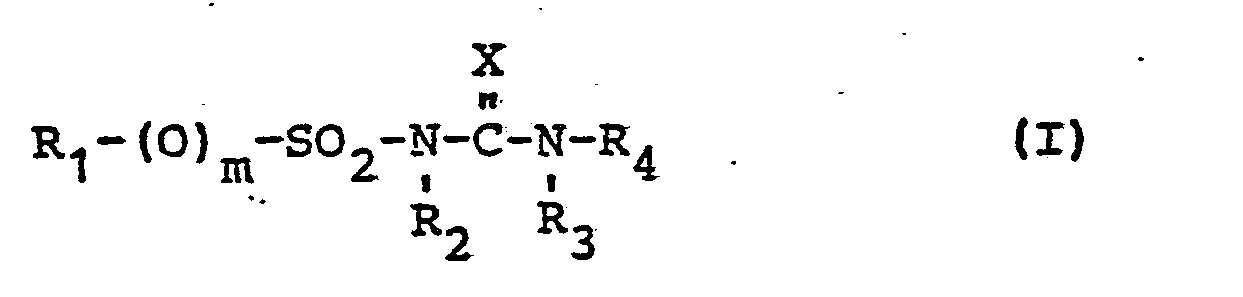
- Gegenstand der vorliegenden Erfindung sind demnach Verbindungen der Formel I

- R1 einen gegebenenfalls durch bis zu 6 Halogenatome substituierten gesättigten oder ungesättigten, verzweigten oder unverzweigten aliphatischen Rest mit bis zu 10 C-Atomen, der ggf. durch Sauerstoff unterbrochen sein kann,
- R2, R3 H oder (C1-C4)-Alkyl
- X O oder S;
- m 0 oder 1;
- R4 einen 2-3 Stickstoffatome enthaltenden heterocyclischen Sechsring, der ggf. 1-3 fach durch Halogen, NO2, CN, CHO, (C1-C4)-Alkylamino, (C1-C4)Dialkylamino,einen (gegebenenfalls durch Halogen, (C1-C3)-Alkoxy, (C1-C3)-Alkylthio, (C1-C3)-Alkylamino, (C1-C3)-Dialkyl- amino oder (C1-C4)Alkoxycarbonyl substituierten) (C1-C4)-Alkylrest, einen (gegebenenfalls durch Halogen oder (C1-C4)Alkoxycarbonyl substituierten) (C1-C4)-Alkoxy- oder (C1-C4)-Alkylthiorest oder (C1-C4)-Alkoxycarbonyl substituiert ist,
- Unter "aliphatischen Resten" in R1-Stellung sind Alkylreste, Alkenylreste mit einfacher oder konjugierter Doppelbindung oder Alkinylreste zu verstehen. "Halogen" bedeutet bevorzugt Fluor, Chlor oder Brom. Reste mit mindestens 3 C-Atomen zeichnen sich durch besonders starke herbizide Wirkung aus.
- Als Beispiele für erfindungsgemäße heterocyclisch substituierte Sulfonylharnstoffe der Formel I seien die folgenden genannt:
- N-(4-Methoxy-6-methyl-pyrimidin-2-yl)-N'-(2,2,2-trichlor- eth-1-oxysulfonyl)-harnstoff;
- N-(4-Methoxy-6-methyl-1,3,5-triazin-2-yl)-N'-(2,2,2-tri- fluoreth-1-oxysulfonyl)-harnstoff;
- N-(2,6-Dimethyl-5-chlor-pyrimidin-4-yl)-N'-(methoxysulfo- nyl)-harnstoff;
- N-(4-Methyl-5-ethoxycarbonyl-pyrimidin-2-yl)-N'-(isobutyl- oxysulfonyl)-harnstoff;
- N-(4-Methoxy-6-methylthio-pyrimidin-2-yl)-N'-(2-chloreth-1-yl-sulfonyl)-harnstoff;
- N-(4,6-Dichlor-pyrimidin-2-yl)-N'-(2-chloreth-1-yl-sulfonyl)-harnstoff;
- N-(4-Methyl-6-methylthio-1,3,5-triazin-2-yl)-N'-(1,2-dichlor-n-prop-1-yl-sulfonyl)-harnstoff;
- N-(4-Methyl-6-dimethylamino-1,3,5-triazin-2-yl)-N'-(1,2-dichlor-n-prop-1-yl-sulfonyl)-harnstöff;
- N-(4-Methoxy-6-methyl-1,3,5-triazin-2-yl)-N'm(1-methyl-2-chlor-n-prop-1-yl-sulfonyl)-harnstoff;
- N-(4-Methoxy-6-methyl-pyrimidin-2-yl)-N'-(2-chlor-3-methoxy- n-prop-1-yl-sulfonyl)-harnstoff;
- N-(5,6-Dimethyl-1,2-,4-triazin-3-yl)-N'-(1,2,2-trichlor-eth-1-yl-sulfonyl,-harnstoff;
- N-(4,6-Dimethoxy-5-chlor-pyrimidin-2-yl)-N'-(2-chlor-n-but-1-yl-sul-fonyl)-harnstoff;
- N-(4,6-Dimethyl-5-nitro-pyrimidin-2-yl)-N'-(2,4,6,6-tetrachlor-n-hex-1-yl-sulfohyl)-harnstoff;
- N-(4,5-Dimethyl-6-methoxy-pyrimidin-2-yl)-N'-(2-chlor-n-hex-1-yl-sulfonyl)-harnstoff;
- N-(4-Methyl-6-diethylamino-1,3,5-triazin-2-yl)-N'-(vinylsulfonyl)-harnstoff;
- N-(4,6-Dimethyl-5-brom-pyrimidin-2-yl)-N'-(prop-1-en-1-yl- sulfonyl)-harnstoff;
- N-(4-Methyl-5-nitro-6-chlor-pyrimidin-2-yl)-N'-(3-chlor- prop-1-en-1-yl-sulfonyl)-harnstoff;
- N-(4-Methyl-6-ethoxymethyl-pyrimidin-2-yl)-N'-(4,4-dichior- but-1-en-1-yl-sulfonyl)-harnstoff;
- N-(4,6-Dimethoxy-1,3,5-triazin-2-yl)-N-methyl-N'-(2-chlor- vinylsulfonyl)-harnstoff;
- N-(4,6-Diethyl-pyrimidin-2-yl)-N'-(prop-1-en-1-yl-sulfonyl)-harnstoff, -Natriumsalz;
- N-(Pyrimidin-2-yl)-N'-(prop-1-en-1-yl-sulfonyl)-thioharnstoff;
- N-(4-Chlor-6-isopropylamino-1,3,5-triazin-2-yl)-N-isopropyl-N'-(prop-1-en-1-yl-sulfonyl)-harnstoff;
- N-(5,6-Dimethoxy-1,2,4-triazin-3-yl)-N'-(n-prop-1-oxysulfonyl)-harnstoff;
- N-(4,6-Dimethoxy-5-fluor-pyrimidin-2-yl)-N'-(n-heptyl-1- oxysulfonyl)-harnstoff;
- N-(4,6-Dimethyl-5-jod-pyrimidin-2-yl)-N'-(2-methoxy- ethoxystilfonyl)-harnstoff;
- N-(4,6-Dichlor-5-(2-chlorethyl)-pyrimidin-2-yl)-N'-(1,3-dichlor-isopropyl-2-oxysulfonyl)-harnstoff;
- N-(4-Methoxy-5-nitro-6-methyl-pyrimidin-2-yl)-N'-(1,1,1,3,3,3-hexachlor-isopropyl-2-oxysulfonyl)-harnstoff;
- N-(4-Trifluormethyl-6-methyl-pyrimidin-2-yl)-N'-(2,2-dichlor-ethyl-sulfonyl)-harnstoff;
- N-(4,5-Dimethyl-6-methoxyethoxy-pyrimidin-2-yl)-N'-(1,2-dichlor-ethyl-sulfonyl)-harnstoff;
- N-(4-Methoxymethyl-5-methyl-6-ethoxy-pyrimidin-2-yl)-N'-(2,3-dichlor-n-prop-1-yl-sulfonyl)-harnstoff;
- N-(4-(1-Ethoxycarbonyl-ethoxy)-6-methyl-pyrimidin-2-yl)-N'-(1,2-dibrom-n-prop-1-yl-sulfonyl)-harnstoff;
- N-(4-(Methoxycarbonyl-methoxy)-6-methyl-1,3,5-triazin-2-yl)-N'-(2-chlor-n-pent-1-yl-sulfonyl)-harnstoff;
- N-(4,6-Diethylmercapto-pyrimidin-2-yl)-N'-(2-chlor-2-trifluormethyl-eth-1-yl-sulfonyl)-harnstoff;
- N-(4-Methyl-6-(2-bromethoxy)-pyrimidin-2-yl)-N'-(2,3,4-trichlor-n-but-1-yl-sulfonyl)-harnstoff;
- N- (4-Methoxy-6-methyl-1,3,5-triazin-2-yl)-N'-(3-chlor-2- chlormethyl-prop-1-yl-sulfonyl)-harnstoff;
- N-(4,6-Dimethylmercapto-1,3,5-triazin-2-yl)-N'-(2-chlor-2-chlormethyl-prop-1-yl-sulfonyl)-harnstoff;
- N-(4-Methyl-pyrimidin-2-yl)-N'-(2,3-dichlor-n-but-1-yl- sulfonyl)-harnstoff;
- N-(4-Methoxy-5-n-butyl-6-methyl-pyrimidin-2-yl)-N'-(3-chlor- n-but-1-en-1-yl-sulfonyl)-harnstoff;
- N-(4,6-Dimethoxy-1,3,5-triazin-2-yl)-N'-(1-methyl-2,3-dichlor-n-prop-1-yl-sulfonyl)-harnstoff;
- N-(2,6-Dimethyl-pyrimidin-4-yl)-N'-(2-chlor-3-brom-n-but-1-yl-sulfonyl)-harnstoff;
- N-(5,6-Dimethyl-1,2,4-triazin-2-yl)-N'-(1-methyl-n-prop-1-en-1-yl-sulfonyl)-harnstoff;
- N-(5-Chlor-pyrimidin-2-yl)-N'-(2-chlor-2,4-dibrom-n-but-1-yl-sulfonyl)-harnstoff.
- Die neuen Verbindungen der allgemeinen Formel I lassen sich aus an sich bekannten bzw. nach bekannten Verfahren hergestellten Ausgangsmaterialien synthetisieren. Die Herstellungsverfahren sind dadurch gekennzeichnet, daß man
- a) Verbindungen der Formel


- b) Verbindungen der Formel


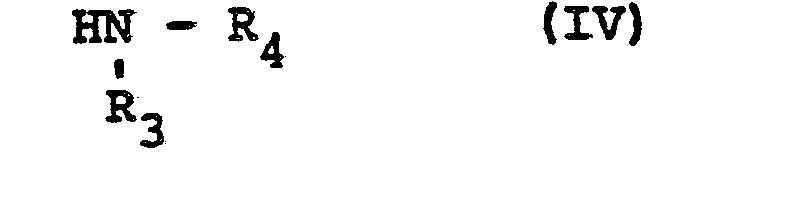
- Zu a) Die Umsetzung der Verbindungen II bzw. III und IV erfolgt vorzugsweise in inerten aprotischen Lösungsmitteln wie z.B. Acetonitril, Dichlormethan, Toluol, Tetrahydrofuran oder Dioxan bei Temperaturen zwischen 0°C und der Siedetemperatur des Lösungsmitteln. Bei Anwendung von Ausgangsstoffen der Formel III arbeitet man in Gegenwart eines Säureakzeptors wie z.B. Kaliumcarbonat, Pyridin oder Triethylamin.
- Zu b) Bei der Umsetzung der Verbindungen V mit VI bzw. VII arbeitet man gleichfalls vorzugsweise in den oben genannten inerten-Lösungsmitteln unter Zusatz basischer Verbindungen, wie z.B. Kaliumcarbonat, Pyridin oder Triethylamin bei Temperaturen zwischen 0°C und der Siedetemperatur des Lösungsmittels.
- Die nachträgliche Abspaltung von Halogenwasserstoff (HCl, HBr) aus halogenhaltigen Resten R1 erfolgt in bekannter Weise, z.B. mit Alkalialkoholat, alkoholischer Natron-oder Kalilauge, Triethylamin oder anderen säureabspaltenden Mitteln, ggf. in Gegenwart eines weiteren inerten Lösungs-oder Verdünnungsmittels (z.B. Toluol) bei Temperaturen zwischen Raum- und Siedetemperatur.
- An vorhandene oder nachträglich gebildete Mehrfachbindungen in R1-Position kann man Halogen (CI2, Br2) oder Halogenwasserstoff in gleichfalls bekannter Weise anlagern und so ggf. zu neuen Verbindungen der Formel I gelangen. Die Bromierung bzw. Chlorierung wird in inerten organischen Lösungsmitteln wie z.B. Dichlormethan oder Chloroform unter Belichtung - beispielsweise mit ultraviolettem Licht - oder in Gegenwart von radikalisch zerfallenden Verbindungen - z.B. Azodiisobutyronitril - bei Temperaturen zwischen 0°C und der Siedetemperatur des Lösungsmittels durchgeführt. Die Anlagerung von Halogenwasserstoff gelingt in Gegenwart inerter Lösungsmittel (z.B. Toluol) mittels gasförmigem HCl oder HBr bei niedrigen Temperaturen, ggf. in Gegenwart eines Peroxidkatalysators.
- Zur nachträglichen Alkylierung in R2-Stellung arbeitet man vorzugsweise in inerten aprotischen Lösungsmitteln wie z.B. Dioxan oder Dimethylformamid unter Zusatz einer anorganischen Base, z.B. Natriumhydrid oder Kaliumcarbonat, bei Temperaturen von 20°C bis zur Siedetemperatur des Lösungsmittels. Als Alkylierungsmittel werden z.B. Dimethylsulfat, Methyljodid oder Ethylbromid eingesetzt.
- Verbindungen der Formel I, in denen R2 Wasserstoff bedeutet, können Salze bilden, bei denen H durch ein für die Landwirtschaft geeignetes Kation ersetzt ist. Diese Salze sind im allgemeinen Metall-, Ammonium- oder organische Aminsalze und werden vorzugsweise in inerten Lösungsmitteln wie z.B. Wasser, Methanol oder Aceton bei Temperaturen von 20 - 100°C hergestellt. Geeignete Basen zur Herstellung der erfindungsgemäßen Salze sind z.B. Kaliumcarbonat, Ammoniak oder Ethanolamin.
- Die Ausgangsstoffe der Formel IV sind bekannt oder lassen sich nach im Prinzip bekannten Verfahren herstellen, z.B. durch Zyklisierung entsprechender Guanidinderivate mit ent-" sprechend substituierten 1,3-Diketonen (vgl. z.B. "The Chemistry of Heterocyclic compounds", Vol. XVI (1962) und Supplement I (1970)) oder durch Derivatisierung von Cyanurchlorid (vgl. z.B. "The Chemistry of Heterocyclic Compounds" L. Rapoport: "s-Triazines and Derivatives" (1959)).
- Die Sulfonylisocyanate der Formel II sind ebenfalls zum großen Teil bekannt oder lassen sich nach im Prinzip bekannten Verfahren in einfacher Weise herstellen (vgl. DE-AS 1 211 165, DE-AS 1 226 565, DE-AS 1 230 016, DE-AS 1 568 640 sowie Chem. Ber. 105, 2791, 2800 (1972)).
- Die Sulfonylcarbamoyl- bzw. -thiocarbamoylchloride der Formel III lassen sich nach üblichen Methoden aus den Alkalisalzen der entsprechenden Sulfonamide der Formel V, welche aus der Literatur bekannt sind, durch Umsetzung mit Phosgen oder Thiophosgen darstellen.
- Die für die Umsetzungen nach b) benötigten Isothiocyanate der Formel VI sind bekannt oder nach bekannten Verfahren zugänglich (vgl. Tetrahedron 29, 691 (1973); Japan Kokai Sho-51-143686).
- Gleiches gilt für die heterocyclischen Carbamoylchloride und Thiocarbamoylchloride der Formel VII (vgl. z.B. DE-AS 1 149 718 und DE-AS 2 238 870).
- Sulfonylharnstoffe der allgemeinen Formel I, welche im aliphatischen Rest R1 eines oder mehrere asymmetrische Kohlenstoffatome enthalten, liegen in enantiomeren oder diastereomeren Formen vor. Im allgemeinen werden die entsprechenden erfindungsgemäßen Verbindungen als Racemate oder als Diastereomerengemische erhalten. Falls erwünscht, können die üblichen Techniken zur Trennung dieser Gemische in die sterisch einheitlichen Bestandteile angewendet werden. Auch durch Verwendung von sterisch einheitlichen Ausgangsmaterialien ist eine Reindarstellung der genannten Verbindungen möglich. Werden z.B. Aminoheterocyclen der allgemeinen Formel IV mit threo- bzw. erythro-1,2-Dichlorpropyl-sulfonyl- isocyanat umgesetzt, so werden diesen entsprechende threo- bzw. erythro-1,2-Dichlorpropylsulfonylharnstoffe erhalten. Ferner können Sulfonylharnstoffe der allgemeinen Formel I, welche im aliphatischen Rest R1 eine oder mehrere Doppelbindungen enthaltenr bei entsprechender olefinischer Substitution als E- oder als Z-Isomere vorkommen, deren Reindarstellung bzw. Trennung ebenfalls möglich ist. Werden z.B. ungesättigte Sulfonylisocyanate. der allgemeinen Formel II als E- oder als Z-Isomere eingesetzt, so werden die ungesättigten Sulfonylharnstoffe der Formel I in sterisch einheitlicher Form geliefert.
- Die erfindungsgemäßen Verbindungen zeigen eine ausgezeichnete herbizide Wirkung und in wichtigen Großkulturen eine sehr gute Selektivität und eignen sich daher zur selektiven Bekämpfung zahlreicher zweikeimblättriger und grasartiger annueller und perennierender Unkräuter in landwirtschaftlich bedeutenden Kulturen wie z.B. Weizen, Gerste, Roggen, Reis und Mais, Zuckerrüben, Soja und Baumwolle im Vorsaat-, Vorauflauf- und Nachauflaufverfahren.
- Werden die erfindungsgemäßen Verbindungen vor dem Keimen der Unkrautpflanzen im Vorsaat- oder Vorauflaufverfahren auf die Erdoberfläche appliziert, so wird das Auflaufen der Keimlinge nicht verhindert. Die Unkräuter wachsen bis zum Keimblattstadium heran, stellen jedoch dann ihr Wachstum ein und sterben schließlich nach einigen Wochen vollkommen ab. Bei Applikation der Wirkstoffe auf die grünen Pflanzenteile im Nachauflaufverfahren tritt ebenfalls sehr rasch nach der Behandlung ein drastischer Wachstumsstop ein und die Unkrautpflanzen bleiben in dem zum Applikationszeitpunkt vorhandenen Wachstumsstadium stehen oder sterben nach einer gewissen Zeit ganz ab, so daß auf diese Weise eine für die Kulturpflanzen schädliche Unkrautkonkurrenz sehr früh und nachhaltig beseitigt werden kann.
- Darüberhinaus weisen die erfindungsgemäßen Substanzen her-. vorragende wachstumsregulatorische Eigenschaften bei Kulturpflanzen auf. Sie greifen regulierend in den pflanzeneigenen Stoffwechsel ein und können damit zur gezielten Beeinflussung von Pflanzeninhaltsstoffen und zur Ernteerleichterung wie z.B. durch Auslösen von Desikkation und Wuchsstauchung eingesetzt werden. Desweiteren eignen siesich auch zur generellen Steuerung und Hemmung von unerwünschtem vegetativen Wachstum, ohne daß sie dabei die Pflanzen'abtöten. Eine Hemmung des vegetativen Wachstums spielt bei vielen mono- und dikotylen Kulturen eine große Rolle, da das Lagern hierdurch verringert oder völlig verhindert werden kann.
- Gegenstand der Erfindung sind daher auch herbizide bzw. wachstumsregulierende Mittel, die gekennzeichnet sind durch einen Behalt an einer Verbindung der Formel I in Kombination mit üblichen Formulierungshilfsmitteln und Inertstoffen sowie.deren Verwendung im landwirtschaftlichen Bereich.
- Die erfindungsgemäßen Mittel enthalten die Wirkstoffe der Formel I im allgemeinen zu 2 - 95 Gew.-%. Sie können als Spritzpulver, emulgierbare Konzentrate, versprühbare Lösun- gen, Stäubemittel oder Granulate in den üblichen Zubereitungen angewendet werden.
- Spritzpulver sind in Wasser gleichmäßig dispergierbare Präparate, die neben dem Wirkstoff außer einem Verdünnungsmittel oder Inertstoff noch Netzmittel z.B. polyoxethylierte Alkylphenole, polyoxethylierte Fettalkohole, Alkyl- oder Alkylphenyl-sulfonate und Dispergiermittel, z.B. ligninsulfonsaures Natrium, 2,2'-dinaphthylmethan-6,6'-disulfonsaures Natrium, dibutylnaphthalinsulfonsaures Natrium oder auch oleylmethyltaurinsaures Natrium enthalten.
- Emulgierbare Konzentrate werden durch Auflösen des Wirkstoffes in einem organischen Lösungsmittel, z.B. Butanol, Cyclohexanon, Dimethylformamid, Xylol oder auch höhersiedenden Aromaten oder Kohlenwasserstoffen unter Zusatz von einem oder mehreren Emulgatoren hergestellt. Als Emulgatoren können beispielsweise verwandt werden:
- Alkylarylsulfonsaure Kalziumsalze wie Ca-dodecylbenzosulfonat oder nichtionische Emulgatoren wie fettsäurepolyglykolester, Alkylarylpolyglykolether, Fettalkoholpolyglykolether, Propylenoxid-Ethylenoxid-Kondensationsprodukte, Fettalkohol-Propylenoxid-Ethylenoxid-Kondensationsprodukte, Alkylpolyether, Sorbitanfettsäureester, Polyoxethylensorbitan-fettsäureester oder Polyoxethylen-sorbitester.
- Stäubemittel erhält man durch Vermahlen des Wirkstoffes mit fein verteilten, festen Stoffen, z.B. Talkum, natürlichen Tonen, wie Kaolin, Bentonit, Pyrophillit oder Diatomeenerde.
- Granulate können entweder durch Verdüsen des Wirkstoffes auf adsorptionsfähiges, granuliertes Inertmaterial hergestellt werden oder durch Aufbringen von Wirkstoffkonzentraten mittels Klebemitteln z.B. Polyvinylalkohol, polyacrylsaurem Natrium oder auch Mineralölen auf die Oberfläche von Trägerstoffen wie Sand, Kaolinite oder von granuliertem Inertmaterial. Auch können geeignete Wirkstoffe in der für die Herstellung von Düngemittelgranalien üblichen Weise - gewünschtenfalls in Mischung mit Düngemitteln - hergestellt werden.
- Bei herbiziden Mitteln können die Konzentrationen der Wirkstoffe in den handelsüblichen Formulierungen verschieden sein.
- In Spritzpulvern variiert die Wirkstoffkonzentration z.B. zwischen etwa 10 % und 80 der Rest besteht aus den oben angegebenen Formulierungszusätzen. Bei emulgierbaren Konzentraten kann die Wirkstoffkonzentration gleichfalls etwa 10 % bis.80 % betragen. Staubförmige Formulierungen enthalten etwa 2 - 20 %. Bei Granulaten hängt der Wirkstoffgehalt zum Teil davon ab, ob die wirksame Verbindung flüssig oder fest vorliegt und welche Granulierhilfsmittel, Füllstoffe usw. verwendet werden.
- als Herbizide Zur Anwendung werden die handelsüblichen Konzentrate gegebenenfalls in üblicher Weise verdünnt, z.B. bei Spritzpulvern und emulgierbaren Konzentraten mittels Wasser. Staub- förmige und granulierte Zubereitungen sowie versprühbare Lösungen werden vor der Anwendung nicht mehr mit weiteren inerten Stoffen verdünnt. Mit den äußeren Bedingungen wie Temperatur, Feuchtigkeit, u.a. variiert die erforderliche Aufwandmenge. Sie beträgt im allgemeinen zwischen 0.01 und 10 kg/ha, vorzugsweise etwa 0.1 bis 5.0 kg/ha Wirkstoff.
- Für einige Anwendungsgebiete kann es zweckmäßig sein, die neuen Herbizide mit einem oder mehreren Herbiziden gemeinsam anzuwenden, z.B. als "Tankmischung" oder in Form einer Fertigformulierung, um weitere vorteilhafte Wirkungen zu erzielen.
- Die erfindungsgemäßen Wirkstoffe können mit anderen Herbiziden, Insektiziden und Fungiziden kombiniert werden.
- Zur Anwendung als Wachstumsregulatoren eignen sich Konzentrationen zwischen 0.01 und 1.25 kg/ha. Bevorzugt verwendet man wäßrige Dispersionen von Spritzpulvern oder Verdünnungen von emulgierbaren Konzentraten. Die Anwendung erfolgt im Nachauflauf. Bevorzugte Kulturen sind Mais und Tabak.
- 14,0 g(0,1 mol) 2-Amino-4-methoxy-6-methyl-1,3,5-triazin werden in 250 ml Dichlormethan suspendiert und bei 0 bis 5°C tropfenweise mit einer Lösung von 25,5 g (0,1 mol) 2,2,2-Trichlor-eth-1-oxy-sulfonylisocycant in 100 ml Dichlormethan versetzt. Man rührt 18 Stunden bei Raumtemperatur nach kühlt das Reaktionsgemisch auf 0 °C und versetzt mit n-Hexan. Das ausgefallene Reaktionsprodukt wird abgesaugt und aus abs.. Ethanol umkristallisiert. Man erhält 35,3 g (89,4 % d.Th.) an N-(4-Methoxy-6-methyl-1,3,5-triazln-2-yl)-N'-(2,2,2-trichlor-eth-1-oxy-sulfonyl)-harnstoff vom Schmelzpunkt 128 °C.
- 15,6 g (0,1 mol) 2-Amino-4,6-dimethoxy-1,3,5-triazin werden in 150 ml Dichlormethan suspendiert und bei 0 °C unter Rühren mit einer Lösung von 19,5 g (0,106 mol) 2-Chlor-n-prop-1-yl-sulfonylisocyanat in 100 ml Dichlormethan versetzt. Man rührt 12 Stunden bei Raumtemperatur nach1 kühlt auf 0 °C und versetzt mit 300 ml n-Hexan. Das ausgefallene Reaktionsprodukt wird abgesaugt, mit n-Hexan gewaschen und getrocknet. Man erhält 30,7 g (90,5 % d.Th.) an N-(4,6-Dimethoxy-1,3,5-triazin-2-yl)-N'-(2-chlor-n-prop-1-yl-sulfonyl)-harnstoff vom Schmelzpunkt 139-41 °C.
- 15,3 g (0,05 mol) N-(4,6-Dimethyl-5-chlorpyrimidin-2-yl)-N'-(n-prop-1-en-1-yl-sulfonyl)-harnstoff (vgl. Beispiel 23) werden in 300 ml Dichlormethan suspendiert und unter UV-Bestrahlung 30 min chloriert. Man saugt das ausge- fallene Reaktionsprodukt ab und wäscht mit n-Hexan. Nach Umkristallisieren aus Chloroform erhält man 14,6 g (78 % d.Th.) an N-(4,6-Dimethyl-5-chlor- pyrimidin-2-yl)-N'-(1,2-dichlor-n-prop-1-yl-sulfonyl)-harnstoff vom Schmelzpunkt 161 - 2 °C.
- 14,6 g (0,05 mol) N-(4,6-Dimethyl-pyrimidin-2-yl)-N'-(2-chlor-eth-1-yl-sulfonyl)-harnstoff (vgl. Beispiel 12) werden in 150 ml Ethanol gelöst und bei Raumtemperatur mit 4 g (0,1 Mol) Natriumhydroxid-gelöst in 10 ml Wasser- versetzt. Anschließend wird das Reaktionsgemisch 4 Stunden auf 40 °C erwärmt, im Vakuum eingeengt und in 150 ml Wasser aufgenommen. Nach dem Ansäuern mit 2 n HCl. (pH 5) wird mit Essigester extrahiert, anschließend werden die Extrakte getrocknet und eingeengt. Nach Zugabe von n-Hexan erhält man 8,9 g (69,5 % d.Th.) an N-(4,6-Dimethyl- pyrimidin-2-yl)-N'-(vinylsulfonyl)-harnstoff vom Schmelzpunkt 131-3°C.


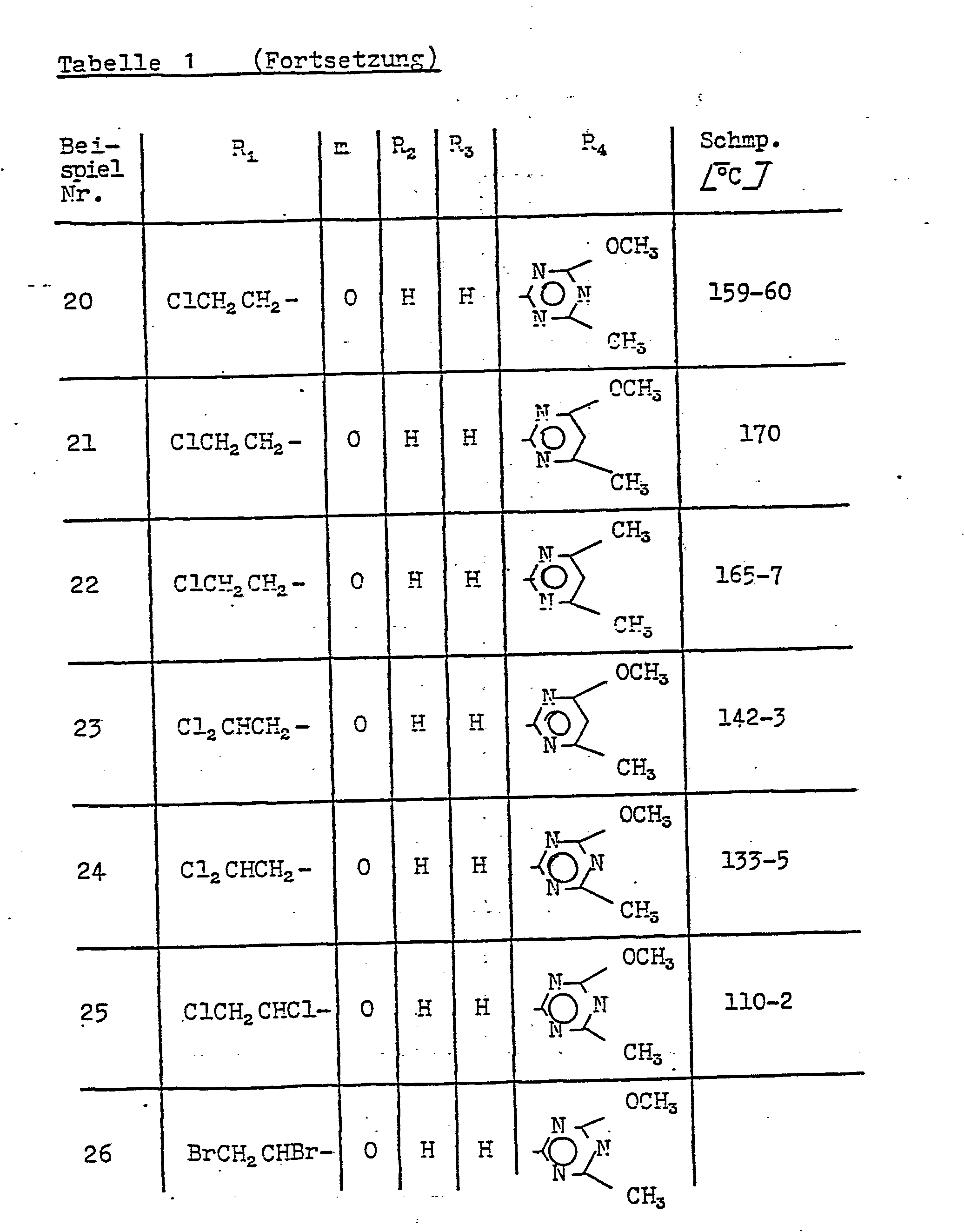
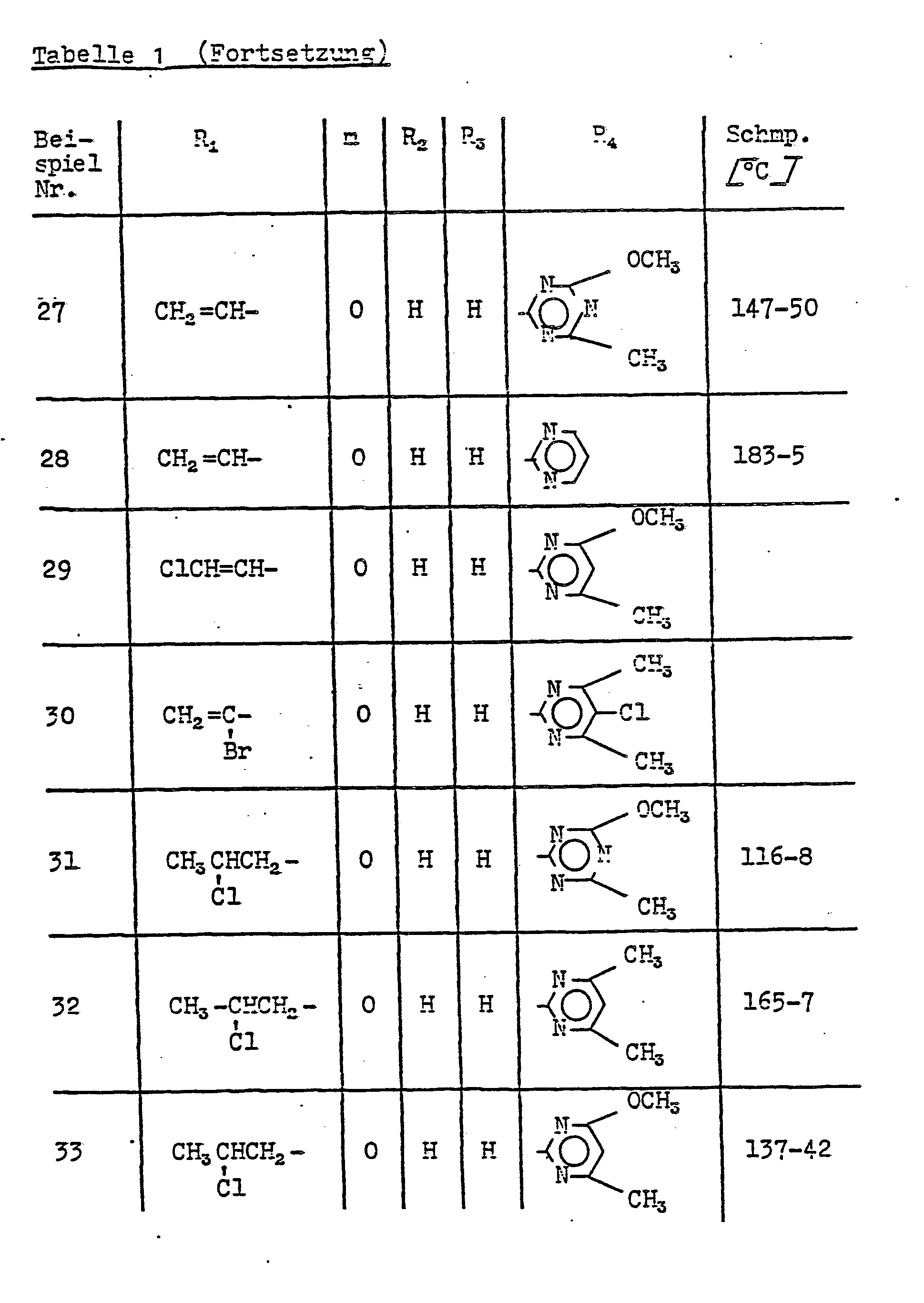

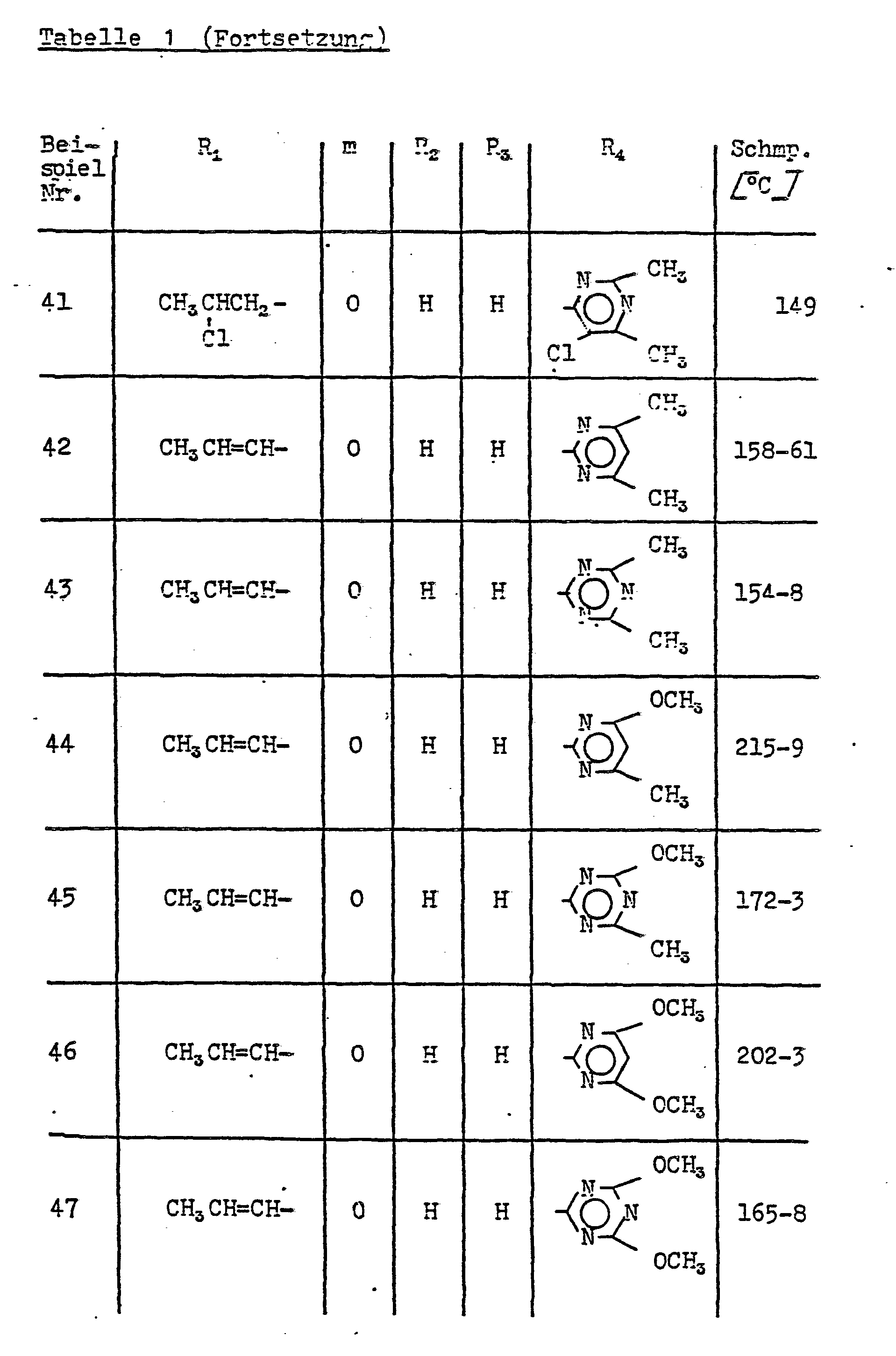
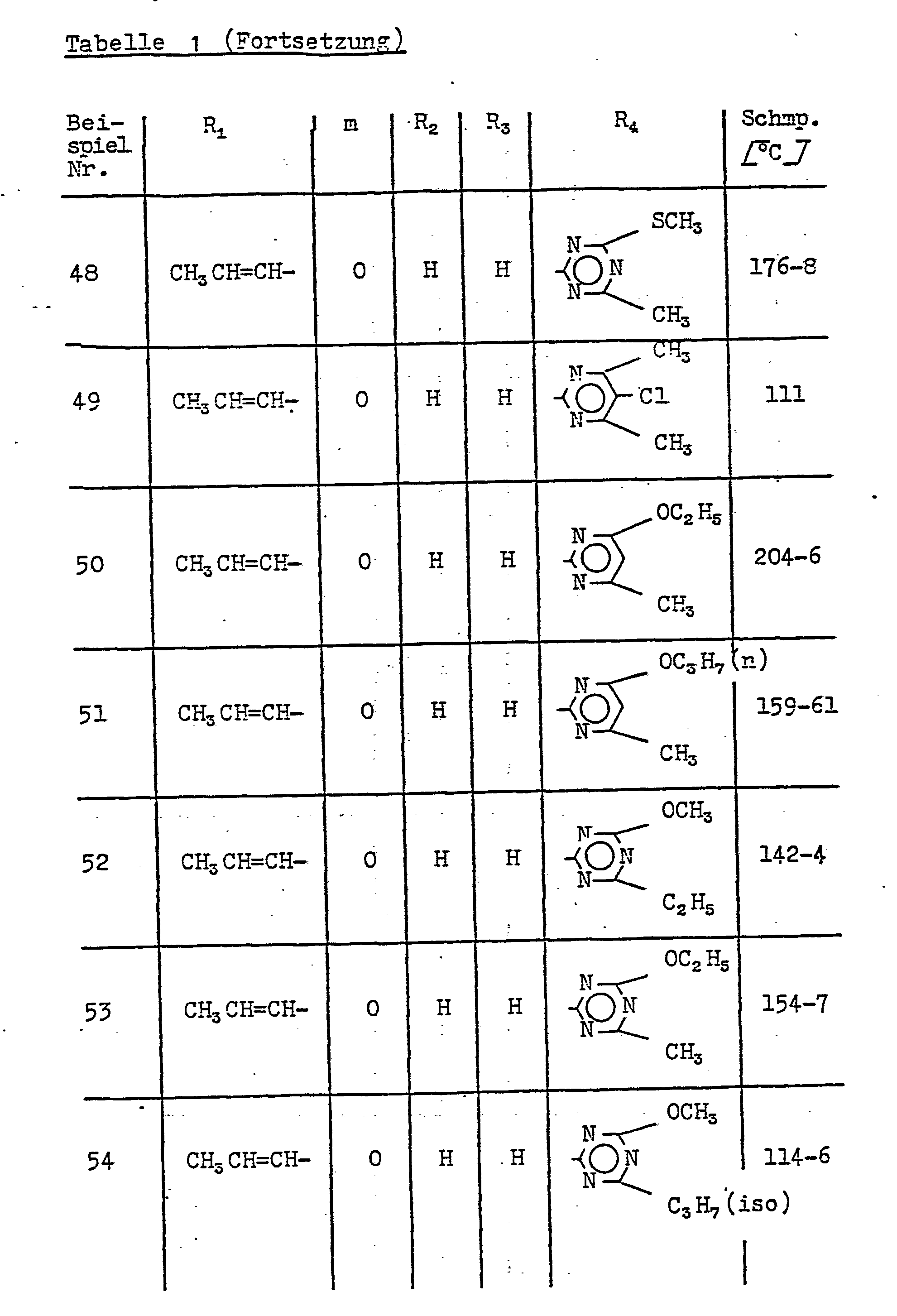


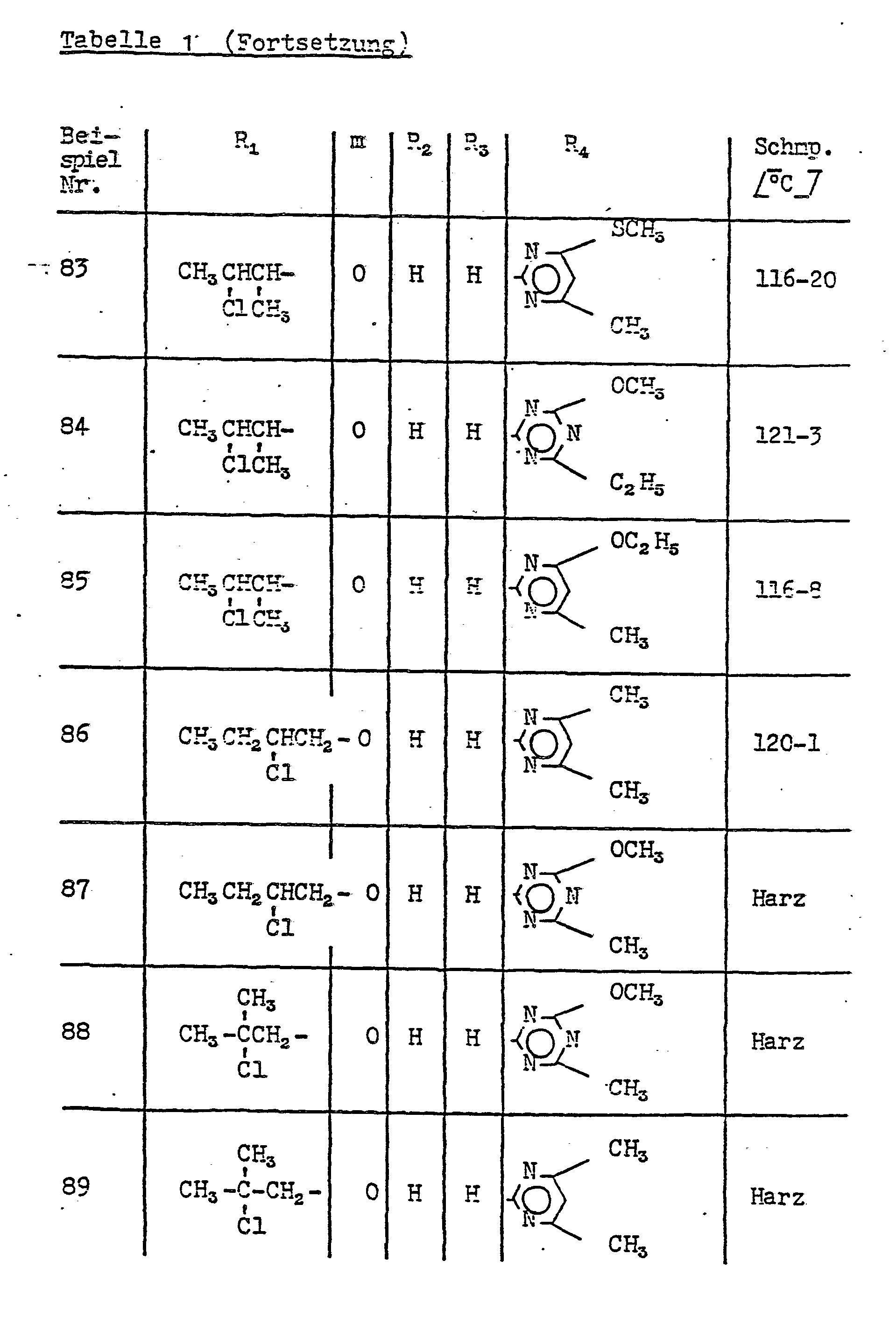


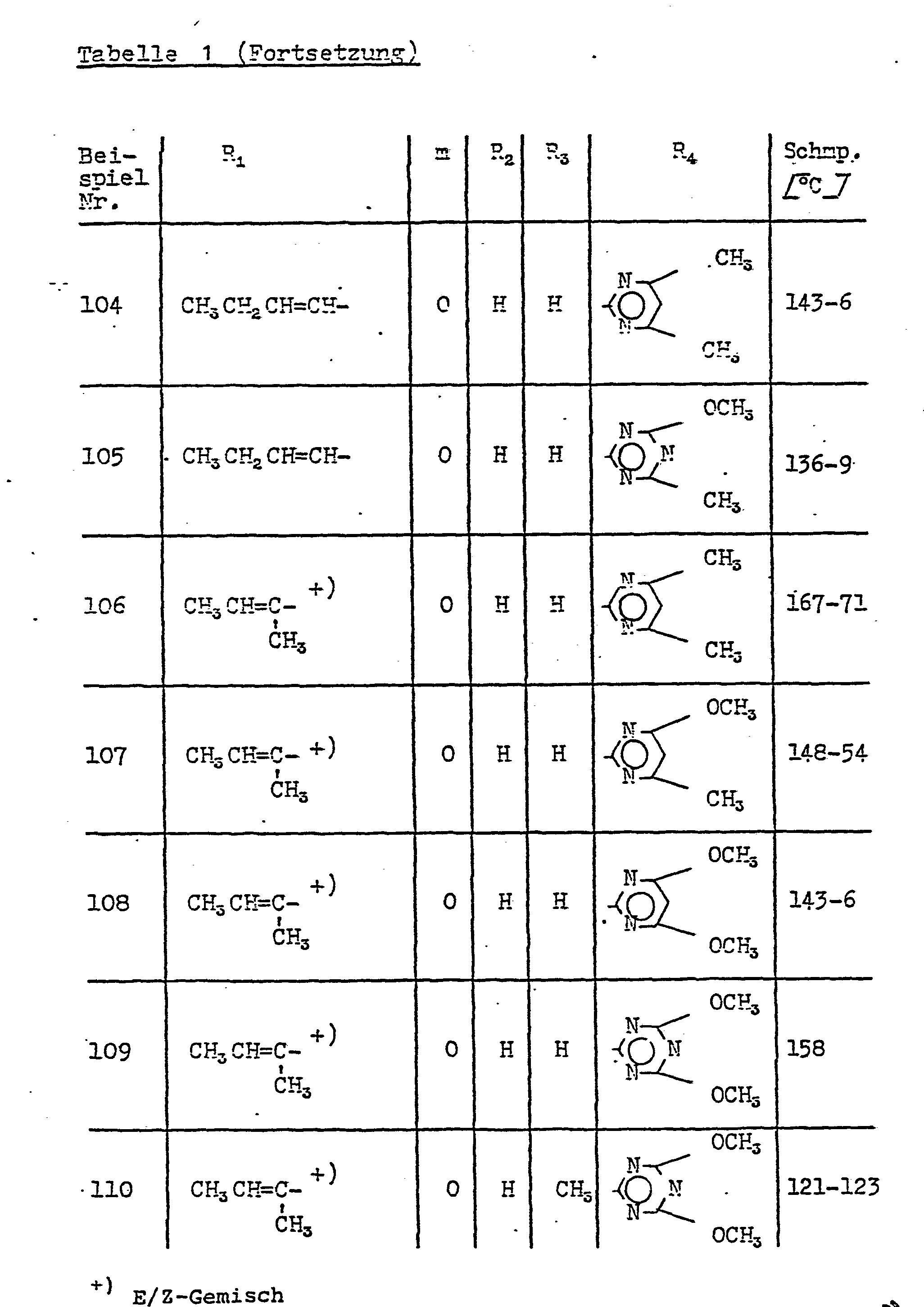


- Ein emulgierbares Konzentrat wird erhalten aus:
- 15 Gew.-Teilen Wirkstoff
- 75 Gew.-Teilen Cyclohexan als Lösungsmittel
- und 10 Gew.-Teilen.oxethyliertes Nonylphenol (10 Ae0) als Emulgator.
- Ein in Wasser leicht dispergierbares benetzbares Pulver wird erhalten, indem man
- 25 Gew.-Teile Wirkstoff
- 64 Gew.-Teile kaolinhaltiges Quarz als Inertstoff
- 10 Gew.-Teile ligninsulfonsaures Kalium
- und 1 Gew.-Teil oleylmethyltaurinsaures Natrium als Netz- und Dispergiermittel
- Ein Stäubemittel wird erhalten, indem man
- 10 Gew.-Teile Wirkstoff und 90 Gew.-Teile Talkum als Inertstoff mischt und in einer Schlagmühle zerkleinert.
- Ein Granulat besteht z. B, aus etwa
- 2 - 15 Gew.-Teilen Wirkstoff
- 98 - 85 Gew.-Teilen inerten Granulatmatcrialien, wie z. B. Attapulgit, Bimsstein und Quarzsand.
- Samen bzw. Rhizomstücke mono- und dikotyler Unkräuter wurden in Lehmerde in Plastiktöpfen (φ 8 cm) ausgelegt und mit Erde abgedeckt. Die als benetzbare Pulver formulierten erfindungsgemäßen Verbindungen wurden in Form wäßriger Suspensionen oder Emulsionen auf die Erdoberfläche appliziert. Die Wasseraufwandmenge pro Topf entsprach dabei umgerechnet 600 - 800 1/ha. Nach der Behandlung wurden die Versuchstöpfe im Gewächshaus aufgestellt und die Versuchspflanzen unter guten Wachstumsbedingungen (Temperatur: 23 + 1°C; rel. Luftfeuchte 60 - 80 %) kultiviert. Nach ca. 3 Wochen wurde die Pflanzenschädigung optisch bonitiert. Als Vergleich dienten dabei unbehandelte Kontrollen.
- Die Schädigung der Unkrautpflanzen bzw. die Kulturpflanzenverträglichkeit wurde in einem Schlüssel von 0 - 5 ausgedrückt.
- Dabei bedeutet
- 0 = ohne Wirkung (Schaden)
- 1 = 0 - 20 % Wirkung
- 2 = 20 - 40 % Wirkung
- 3 = 40 - 60 % Wirkung
- 4 = 60 - 80 % Wirkung
- 5 = 80 - 100 % Wirkung
- Die Abkürzungen bedeuten:
- LOM = Raygras
- ECG = Hühnerhirse
- STM = Sternmiere
- AMR = Amaranth
- SIA = Ackersenf
- CYE = Sauergras (perennierend)
- a.i.= Aktivsubstanz
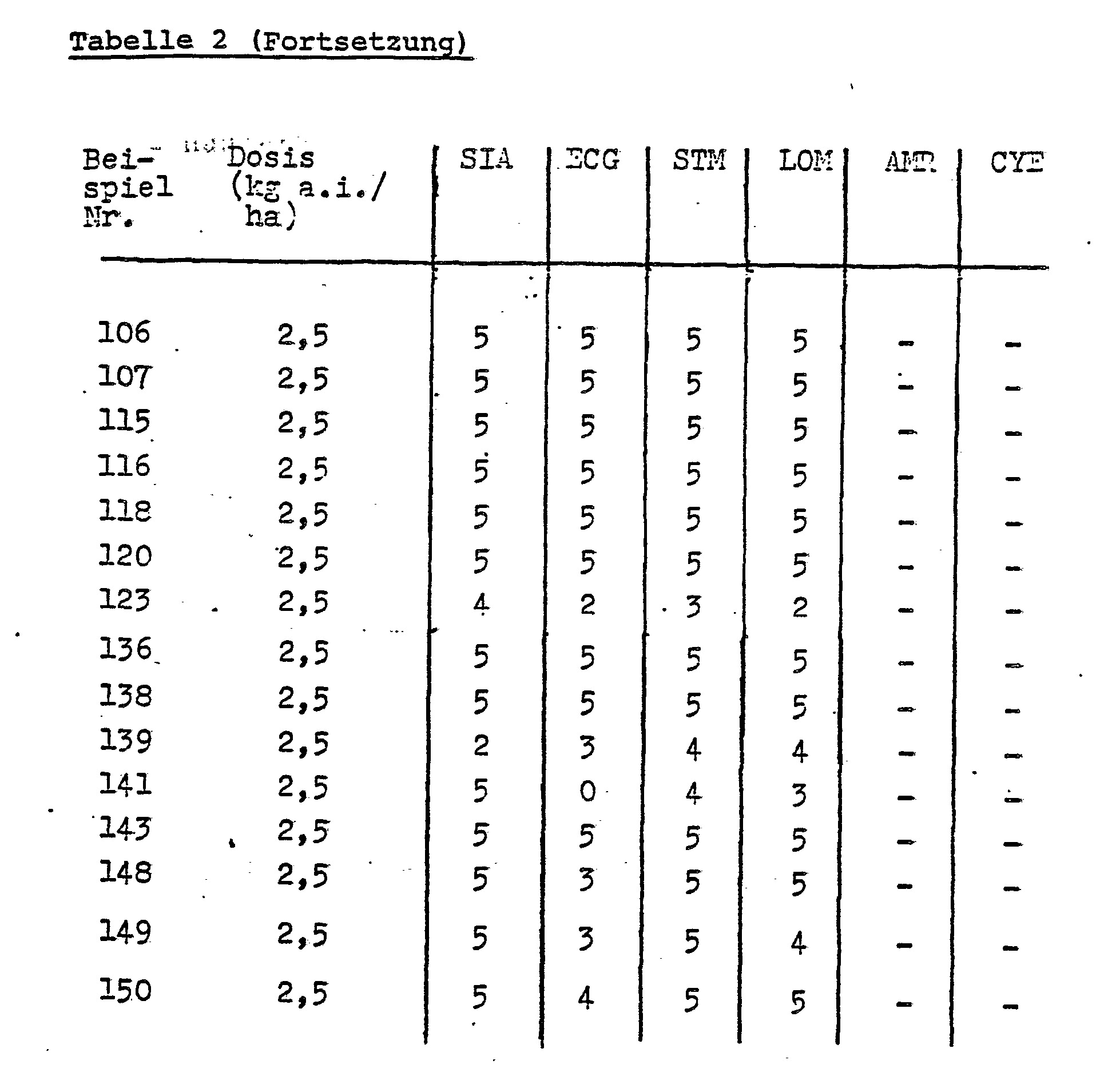
- In Tabelle 2 sind die Vorauflaufergebnisse zusammen gefaßt. Es wird deutlich, daß die erfindungsgemäßen Verbindungen eine gute herbizide Wirkung sowohl gegen monokotyle als auch gegen dikotyle Schadpflanzen aufweisen, wenn die Wirkstoffe im Vorauflaufverfahren appliziert werden.
- Vorauflaufwirkung gegen monokotyle und dikotyle Schadpflanzen. Wirkung in % im Vergleich zur unbehandelten Kontrolle.


- Samen bzw. Rhizomstücke von mono- und dikotylen Unkräutern wurden in Töpfen ausgesät und im Gewächshaus unter guten Wachstumsbedingungen angezogen. 3 Wochen nach der Aussaat wurden die Versuchspflanzen im Dreiblattstadium behandelt.
- Die als Spritzpulver bzw..als Emulsionskonzentrate formulierten erfindungsgemäßen Präparate wurden in verschiedenen Dosierungen auf die grünen Pflanzenteile gesprüht und nach ca. 3 Wochen Standzeit im Gewächshaus die Wirkung der Präparate optisch im Vergleich zu unbehandelten Kontrollen bonitiert.
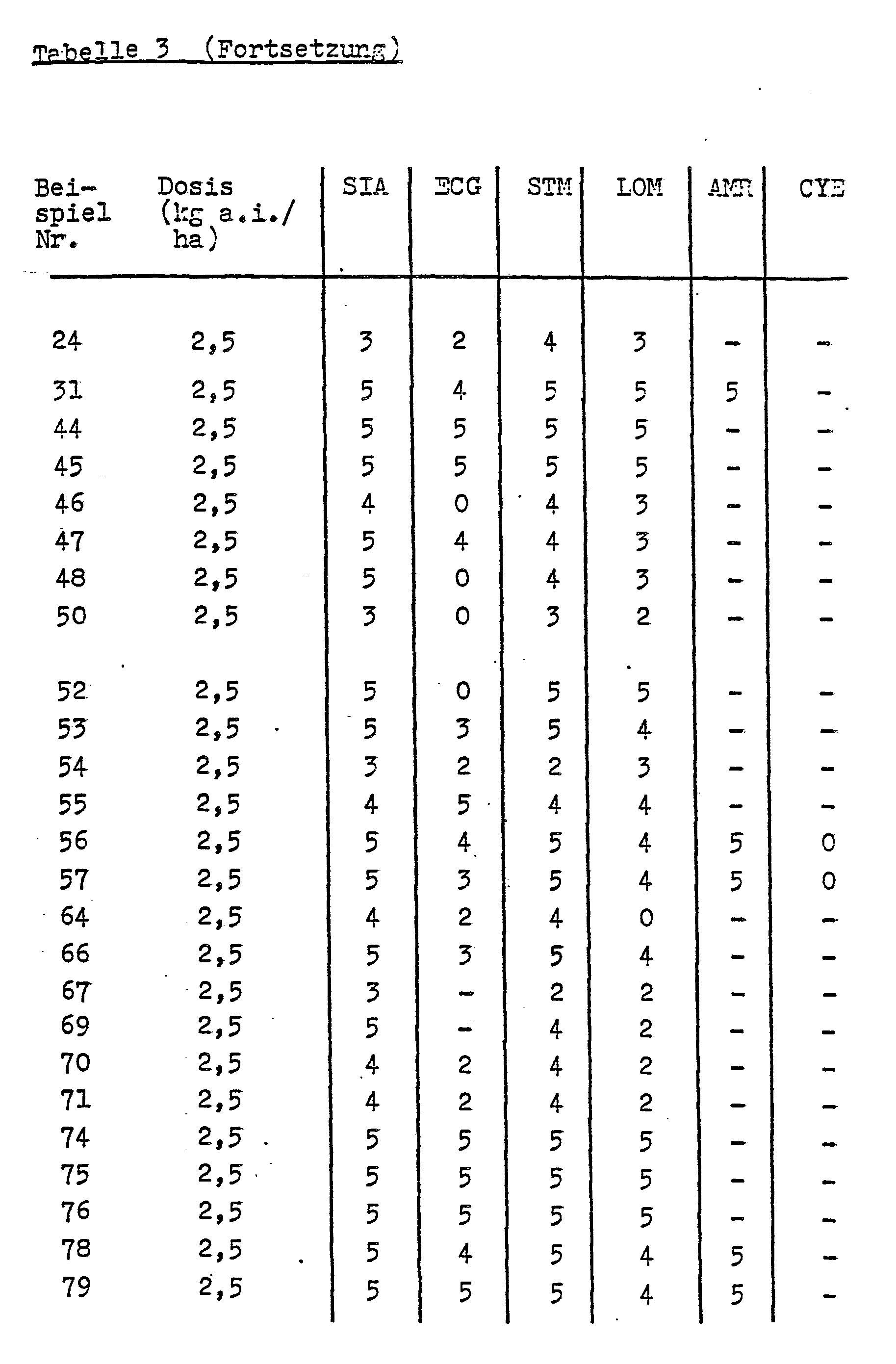
- Die erfindungsgemäßen Mittel weisen eine gute herbizide Wirksamkeit gegen ein breites wirtschaftlich wichtiger annueller und perennierender Unkräuter und Ungräser auf (Tabelle 3).
- Nachauflaufwirkung gegen monokotyle und dikotyle Schadpflanzen Wirkung in % im Vergleich zur unbehandelten Kontrolle.


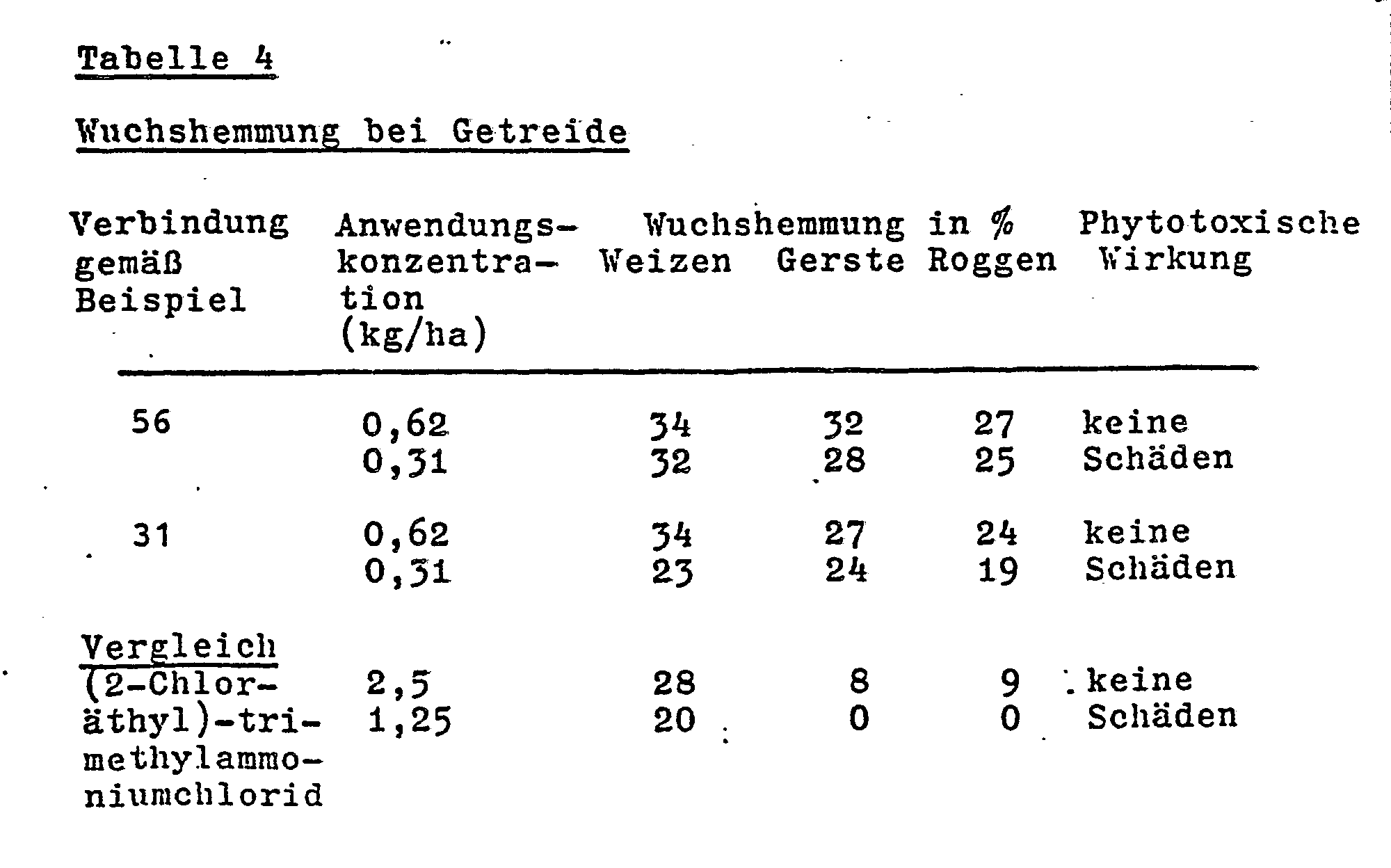
- In Schalenversuchen im Gewächshaus wurden junge Getreidepflanzen (Weizen, Gerste und Roggen) im . 3-Blatt-Stadium mit der in Tabelle 1 genannten Verbindung in den angegebenen Wirkstoffkqnzentrationen (kg/ha) tropfnaß gespritzt. Als Vergleichsverbindungen wurde 2-Chloräthyltrimethylammoniumchlorid eingesetzt. Nachdem die unbehandelten Kontrollpflanzen eine Wuchshöhe von etwa 55 cm erreicht hatten, wurde bei allen Pflanzen der Zuwachs gemessen und die Wuchshemmung in % des Zuwachses der Kontrollpflanzen berechnet. Es wurde außerdem die phytotoxische Wirkung der Verbindungen beobachtet. Die Ergebnisse sind in der Tabelle I zusammengefaßt. Bei der Angabe der Wuchshemmung bedeuten 100 % den Stillstand des Wachstums und 0 % ein Wachstum entsprechend dem der unbehandelten Kontrollpflanzen.
- 10 - 15 cm hohe Soja- bzw. Buschbohnen wurden mit den Wirkstoffzubereitungen tropfhaß bespritzt. Nach 2 Wochen wird der Zuwachs gemessen und die Wuchshemmung in% des Zuwachses der Kontrollpflanzen berechnet. Die Ergebnisse sind in Tabelle 5 zusammengefaßt.

- Eine Rasenmischung, bestehend aus 5 repräsentativen Arten, wird nach 3maligem Rückschnitt mit einer Wirkstoffzubereitung tropfnaß gespritzt. Nach 3 - 4 Wochen wird der Zuwachs gemessen und die Wuchshemmung in % des Zuwachses der Kontrollpflanzen berechnet. Es bedeuten i00 % den Stillstand des Wachstums und 0 % ein Wachstum entsprechend dem der unbehandelten Kontrollpflanzen.

- Zuckerrohrpflanzen werden unter Gewächshausbedingungen bei 25°C - 35°C und ca. 65 % Luftfeuchtigkeit angezogen. Unterschiedliche Mengen der formulierten Mittel wurden in Wasser suspendiert, daß zusätzlich etwa 0,25 Gew.-% eines oberflächenaktiver Mittels (Nonylphenol) enthielt..
- Jeweils 0,3 ml der Suspensionen wurden mit Hilfe einer Spritze in den Spindelbereich in Höhe der letzten sichtbaren Blattspreite ("dewlap") appliziert (10 Pflanzen pro Konzentration) Von den behandelten Pflanzen nach sowie von den nicht behandelten-Kontrollen wurden nach3 Wochen bei der Ernte die Blätter entfernt und die Internodien gruppenweise auf ihren Saccharosegehalt analysiert. Die Ergebnisse sind in Tabelle 7 dargestellt.

- Astpartien von Orangenbäumen (Sorten Hamlin, Pineapple und Valencia) mit mindestens 20 Früchten wurden kurz vor der Ernte mit Wirkstofflösungen bespritzt. Nach 7 Tagen erfolgte die Auswertung durch Messung der Haltekraft.

- Die vorgenannten Verbindungen zeigten eine hervorragende Pflanzenverträglichkeit an Citrusbäumen.
- Sie führten zu keinerlei Schäden an den Blättern und den unreifen Früchten. Im Vergleich zum technischen Standard führten die Substanzen zu weitaus geringeren Schalenverletzungen der reifen Früchte (zumeist überhaupt nicht sichtbar). Über die Schalenverletzung wird bekannterweise von Citrusabscissionsmitteln eine Wundäthylenfreisetzung induziert, die eine Ausbildung des Trenngewebes fördert und so zum Fruchtfall führt.
bedeuten, sowie,falls R2 Wasserstoff bedeutet, deren physiologisch verträgliche Salze mit Basen.
mischt und in einer Stiftmühle mahlt.
Claims (5)





Applications Claiming Priority (2)
| Application Number | Priority Date | Filing Date | Title |
|---|---|---|---|
| DE3111451A DE3111451A1 (de) | 1981-03-24 | 1981-03-24 | "heterocyclisch substituierte (halogen)alkyl- und alkoxysulfonylharnstoffe, verfahren zu ihrer herstellung und ihre verwendung in der landwirtschaft" |
| DE3111451 | 1981-03-24 |
Publications (1)
| Publication Number | Publication Date |
|---|---|
| EP0061661A1 true EP0061661A1 (de) | 1982-10-06 |
Family
ID=6128104
Family Applications (1)
| Application Number | Title | Priority Date | Filing Date |
|---|---|---|---|
| EP82102200A Withdrawn EP0061661A1 (de) | 1981-03-24 | 1982-03-18 | Heterocyclisch substituierte (Halogen)Alkyl- und -Alkoxysulfonylharnstoffe, Verfahren zu ihrer Herstellung und ihre Verwendung in der Landwirtschaft |
Country Status (17)
| Country | Link |
|---|---|
| US (1) | US4440565A (de) |
| EP (1) | EP0061661A1 (de) |
| JP (1) | JPS57169469A (de) |
| KR (1) | KR830009053A (de) |
| AU (1) | AU551443B2 (de) |
| BR (1) | BR8201601A (de) |
| CA (1) | CA1230337A (de) |
| CS (1) | CS227043B2 (de) |
| DD (1) | DD202378A5 (de) |
| DE (1) | DE3111451A1 (de) |
| DK (1) | DK131682A (de) |
| ES (2) | ES510475A0 (de) |
| IL (1) | IL65314A (de) |
| NZ (1) | NZ200087A (de) |
| PT (1) | PT74625B (de) |
| ZA (1) | ZA821956B (de) |
| ZW (1) | ZW5582A1 (de) |
Cited By (8)
| Publication number | Priority date | Publication date | Assignee | Title |
|---|---|---|---|---|
| EP0071958A1 (de) * | 1981-08-08 | 1983-02-16 | Hoechst Aktiengesellschaft | Heterocyclisch substituierte Sulfonylharnstoffe, Verfahren zu ihrer Herstellung und ihre Verwendung in der Landwirtschaft |
| US4474601A (en) * | 1980-07-11 | 1984-10-02 | E. I. Du Pont De Nemours And Company | Herbicidal alkenyl benzenesulfonamide |
| EP0125864A1 (de) * | 1983-05-09 | 1984-11-21 | E.I. Du Pont De Nemours And Company | Herbizide Sulfonamide |
| EP0156521A1 (de) * | 1984-02-27 | 1985-10-02 | E.I. Du Pont De Nemours And Company | Herbizide Selenylsulfonamide |
| US5015284A (en) * | 1988-04-08 | 1991-05-14 | Hoechst Aktiengesellschaft | Alkyl- and alkenylsulfonylureas which are substituted in the heterocycle, and their use as herbicides or plant growth regulators |
| US5129941A (en) * | 1989-07-19 | 1992-07-14 | Hoechst Aktiengesellschaft | Heterocyclically substituted sulfonylureas, and their use as herbicides or plant growth regulators |
| US5223017A (en) * | 1990-07-06 | 1993-06-29 | Hoechst Aktiengesellschaft | Substituted sulfonylalkylsulfonylureas and their use as herbicides and plant growth regulators |
| EP0696589A1 (de) | 1994-07-20 | 1996-02-14 | Kureha Kagaku Kogyo Kabushiki Kaisha | N-(substituierte Amino)Imide Derivate, Verfahren zu ihre Herstellung und herbizide Zusammensetzungen |
Families Citing this family (7)
| Publication number | Priority date | Publication date | Assignee | Title |
|---|---|---|---|---|
| DE3111451A1 (de) * | 1981-03-24 | 1982-10-07 | Hoechst Ag, 6000 Frankfurt | "heterocyclisch substituierte (halogen)alkyl- und alkoxysulfonylharnstoffe, verfahren zu ihrer herstellung und ihre verwendung in der landwirtschaft" |
| DE3324802A1 (de) * | 1983-07-09 | 1985-01-17 | Hoechst Ag, 6230 Frankfurt | Neue n-alkoxy- und n- alkylsulfonylaminosulfonylharnstoffe, und neue (pyrimido) triazino-thiadiazinoxide als vorprodukte |
| DE3826609A1 (de) * | 1988-08-05 | 1990-02-08 | Hoechst Ag | Heterocyclisch substituierte sulfonylharnstoffe, verfahren zu ihrer herstellung und ihre verwendung als herbizide oder pflanzenwachstumsregulatoren |
| JP3355237B2 (ja) * | 1993-10-15 | 2002-12-09 | 呉羽化学工業株式会社 | N−(置換アミノ)ピロール誘導体、その製造方法及び除草剤 |
| US20060025468A1 (en) * | 2004-07-29 | 2006-02-02 | Whitten Jeffrey P | Chiral pyrrolidine derivatives, and methods for preparing compounds thereof |
| US11518739B2 (en) | 2017-08-15 | 2022-12-06 | Inflazome Limited | Sulfonamide carboxamide compounds |
| WO2019043610A1 (en) * | 2017-08-31 | 2019-03-07 | Cadila Healthcare Limited | NEW SUBSTITUTED SULFONYLUREA DERIVATIVES |
Citations (1)
| Publication number | Priority date | Publication date | Assignee | Title |
|---|---|---|---|---|
| DE2715786A1 (de) * | 1976-04-07 | 1977-10-13 | Du Pont | Herbizide sulfonamide |
Family Cites Families (4)
| Publication number | Priority date | Publication date | Assignee | Title |
|---|---|---|---|---|
| US4191553A (en) * | 1978-03-02 | 1980-03-04 | E. I. Du Pont De Nemours And Company | Herbicidal sulfamates |
| US4238621A (en) * | 1979-04-13 | 1980-12-09 | E. I. Du Pont De Nemours And Company | Intermediates for herbicidal sulfonamides |
| CA1221687A (en) * | 1980-11-03 | 1987-05-12 | Richard F. Sauers | Herbicidal sulfonamides |
| DE3111451A1 (de) * | 1981-03-24 | 1982-10-07 | Hoechst Ag, 6000 Frankfurt | "heterocyclisch substituierte (halogen)alkyl- und alkoxysulfonylharnstoffe, verfahren zu ihrer herstellung und ihre verwendung in der landwirtschaft" |
-
1981
- 1981-03-24 DE DE3111451A patent/DE3111451A1/de not_active Withdrawn
-
1982
- 1982-03-16 ES ES510475A patent/ES510475A0/es active Granted
- 1982-03-18 EP EP82102200A patent/EP0061661A1/de not_active Withdrawn
- 1982-03-22 PT PT74625A patent/PT74625B/pt unknown
- 1982-03-22 DD DD82238348A patent/DD202378A5/de unknown
- 1982-03-22 NZ NZ200087A patent/NZ200087A/en unknown
- 1982-03-22 US US06/360,489 patent/US4440565A/en not_active Expired - Fee Related
- 1982-03-22 IL IL65314A patent/IL65314A/xx unknown
- 1982-03-22 CS CS821972A patent/CS227043B2/cs unknown
- 1982-03-22 KR KR1019820001203A patent/KR830009053A/ko not_active Withdrawn
- 1982-03-22 ZW ZW55/82A patent/ZW5582A1/xx unknown
- 1982-03-23 BR BR8201601A patent/BR8201601A/pt unknown
- 1982-03-23 ZA ZA821956A patent/ZA821956B/xx unknown
- 1982-03-23 JP JP57044756A patent/JPS57169469A/ja active Pending
- 1982-03-23 AU AU81820/82A patent/AU551443B2/en not_active Ceased
- 1982-03-23 DK DK131682A patent/DK131682A/da not_active IP Right Cessation
- 1982-03-23 CA CA000399187A patent/CA1230337A/en not_active Expired
-
1983
- 1983-03-15 ES ES520621A patent/ES520621A0/es active Granted
Patent Citations (1)
| Publication number | Priority date | Publication date | Assignee | Title |
|---|---|---|---|---|
| DE2715786A1 (de) * | 1976-04-07 | 1977-10-13 | Du Pont | Herbizide sulfonamide |
Cited By (10)
| Publication number | Priority date | Publication date | Assignee | Title |
|---|---|---|---|---|
| US4474601A (en) * | 1980-07-11 | 1984-10-02 | E. I. Du Pont De Nemours And Company | Herbicidal alkenyl benzenesulfonamide |
| EP0071958A1 (de) * | 1981-08-08 | 1983-02-16 | Hoechst Aktiengesellschaft | Heterocyclisch substituierte Sulfonylharnstoffe, Verfahren zu ihrer Herstellung und ihre Verwendung in der Landwirtschaft |
| EP0125864A1 (de) * | 1983-05-09 | 1984-11-21 | E.I. Du Pont De Nemours And Company | Herbizide Sulfonamide |
| AU571869B2 (en) * | 1983-05-09 | 1988-04-28 | E.I. Du Pont De Nemours And Company | Pyridyl- and pyrimidyl- sulphonamides |
| EP0156521A1 (de) * | 1984-02-27 | 1985-10-02 | E.I. Du Pont De Nemours And Company | Herbizide Selenylsulfonamide |
| US5015284A (en) * | 1988-04-08 | 1991-05-14 | Hoechst Aktiengesellschaft | Alkyl- and alkenylsulfonylureas which are substituted in the heterocycle, and their use as herbicides or plant growth regulators |
| EP0336354B1 (de) * | 1988-04-08 | 1994-11-02 | Hoechst Schering AgrEvo GmbH | Heterocyclisch substituierte Alkyl- und Alkenylsulfonylharnstoffe, Verfahren zu ihrer Herstellung und ihre Verwendung als Herbizide oder Pflanzenwachstumsregulatoren |
| US5129941A (en) * | 1989-07-19 | 1992-07-14 | Hoechst Aktiengesellschaft | Heterocyclically substituted sulfonylureas, and their use as herbicides or plant growth regulators |
| US5223017A (en) * | 1990-07-06 | 1993-06-29 | Hoechst Aktiengesellschaft | Substituted sulfonylalkylsulfonylureas and their use as herbicides and plant growth regulators |
| EP0696589A1 (de) | 1994-07-20 | 1996-02-14 | Kureha Kagaku Kogyo Kabushiki Kaisha | N-(substituierte Amino)Imide Derivate, Verfahren zu ihre Herstellung und herbizide Zusammensetzungen |
Also Published As
| Publication number | Publication date |
|---|---|
| DD202378A5 (de) | 1983-09-14 |
| PT74625B (en) | 1984-01-04 |
| KR830009053A (ko) | 1983-12-17 |
| DK131682A (da) | 1982-09-25 |
| AU551443B2 (en) | 1986-05-01 |
| ZA821956B (en) | 1983-02-23 |
| NZ200087A (en) | 1985-04-30 |
| JPS57169469A (en) | 1982-10-19 |
| US4440565A (en) | 1984-04-03 |
| ES8403464A1 (es) | 1983-06-01 |
| AU8182082A (en) | 1982-09-30 |
| CA1230337A (en) | 1987-12-15 |
| PT74625A (en) | 1982-04-01 |
| CS227043B2 (en) | 1984-04-16 |
| BR8201601A (pt) | 1983-02-08 |
| ES510475A0 (es) | 1983-06-01 |
| ES8402696A1 (es) | 1984-03-16 |
| IL65314A (en) | 1985-12-31 |
| ZW5582A1 (en) | 1982-10-20 |
| ES520621A0 (es) | 1984-03-16 |
| IL65314A0 (en) | 1982-05-31 |
| DE3111451A1 (de) | 1982-10-07 |
Similar Documents
| Publication | Publication Date | Title |
|---|---|---|
| EP0131258B1 (de) | Neue N-Alkoxy- N-Alkylsulfonylaminosulfonylharnstoffe, und neue (Pyrimido) Triazino-thiatriazinoxide als Vorprodukte | |
| DE2715786C2 (de) | ||
| EP0120814B1 (de) | N-Phenylsulfonyl-N'-pyrimidinyl- und -triazinylharnstoffe | |
| EP0342569B1 (de) | Heterocyclische 2-Alkoxyphenoxysulfonylharnstoffe und ihre Verwendung als Herbizide oder Pflanzenwachstumsregulatoren | |
| EP0096003B2 (de) | Neue Sulfonyl(thio)harnstoffe, Verfahren zu deren Herstellung und deren Verwendung als Herbizide und/oder Wachstumsregulatoren | |
| EP0071958B1 (de) | Heterocyclisch substituierte Sulfonylharnstoffe, Verfahren zu ihrer Herstellung und ihre Verwendung in der Landwirtschaft | |
| EP0061661A1 (de) | Heterocyclisch substituierte (Halogen)Alkyl- und -Alkoxysulfonylharnstoffe, Verfahren zu ihrer Herstellung und ihre Verwendung in der Landwirtschaft | |
| EP0347788B1 (de) | Substituierte Sulfonyldiamide, Verfahren zu ihrer Herstellung und ihre Verwendung als Herbizide und Pflanzenwachstumsregulatoren | |
| EP0098569A2 (de) | Neue heterocyclisch substituierte Sulfonylharnstoffe, Verfahren zu ihrer Herstellung und ihre Verwendung in der Landwirtschaft | |
| DD283918A5 (de) | Herbizide und pflanzenwachsumsregulierende mittel und verfahren zur herstellung der wirkstoffe | |
| EP0336354B1 (de) | Heterocyclisch substituierte Alkyl- und Alkenylsulfonylharnstoffe, Verfahren zu ihrer Herstellung und ihre Verwendung als Herbizide oder Pflanzenwachstumsregulatoren | |
| EP0342568B1 (de) | Heterocyclisch substituierte Phenoxysulfonylharnstoffe, Verfahren zu ihrer Herstellung und ihre Verwendung als Herbizide oder Pflanzenwachstumsregulatoren | |
| EP0337946B1 (de) | Harnstoffe | |
| DE3105453A1 (de) | Phenyl- bzw. phenoxysulfonyl-pyrimidyl-harnstoffe, verfahren zu ihrer herstellung und ihre verwendung als herbizide und pflanzenwuchstumsregulatoren | |
| EP0319689B1 (de) | Heterocyclisch substituierte N-Sultam-sulfonamide, Verfahren zu ihrer Herstellung und ihre Verwendung als Herbizide und Pflanzenwachstumsregulatoren | |
| EP0303114B1 (de) | Heterocyclisch substituierte Sulfamidsäurephenylester, Verfahren zu ihrer Herstellung und ihre Verwendung als Herbizide und Pflanzenwachstumsregulatoren | |
| EP0134477A1 (de) | Neue heterocyclisch substituierte Sulfonylharnstoffe | |
| EP0388771B1 (de) | Phenoxysulfonylharnstoffe auf Basis von 3-substituierten Salicylsäurealkylestern, Verfahren zu ihrer Herstellung und ihre Verwendung als Herbizide und Pflanzenwachstumsregulatoren | |
| EP0142629A1 (de) | Neue Pyrazolyl- und Isoxazolylsulfonylharnstoffe | |
| DE3639563A1 (de) | N-arylsulfonyl-n'-pyrimidyl(triazinyl) -harnstoffe | |
| DE3234448A1 (de) | Neue pyrimidinylharnstoffe, verfahren zu ihrer herstellung, sie enthaltende mittel und deren verwendung als herbizide | |
| DD281951A5 (de) | Herbizide oder pflanzenwachstumsregulierende mittel | |
| DE3806323A1 (de) | Heterocyclisch substituierte sulfamidsaeurephenylester, verfahren zu ihrer herstellung und ihre verwendung als herbizide und pflanzenwachstumsregulatoren |
Legal Events
| Date | Code | Title | Description |
|---|---|---|---|
| PUAI | Public reference made under article 153(3) epc to a published international application that has entered the european phase |
Free format text: ORIGINAL CODE: 0009012 |
|
| AK | Designated contracting states |
Designated state(s): AT BE CH DE FR GB IT LU NL SE |
|
| 17P | Request for examination filed |
Effective date: 19830317 |
|
| STAA | Information on the status of an ep patent application or granted ep patent |
Free format text: STATUS: THE APPLICATION HAS BEEN WITHDRAWN |
|
| 18W | Application withdrawn |
Withdrawal date: 19840924 |
|
| RIN1 | Information on inventor provided before grant (corrected) |
Inventor name: GUENTHER, DIETER, DR. Inventor name: WILLMS, LOTHAR, DR. Inventor name: BUERSTELL, HELMUT, DR. Inventor name: BAUER, KLAUS, DR. Inventor name: BIERINGER, HERMANN, DR. Inventor name: MILDENBERGER, HILMAR, DR. |