EP0061704B1 - Procédé et dispositif pour déterminer l'impédance de fuite totale dans un réseau alternatif non mis à la terre - Google Patents
Procédé et dispositif pour déterminer l'impédance de fuite totale dans un réseau alternatif non mis à la terre Download PDFInfo
- Publication number
- EP0061704B1 EP0061704B1 EP82102423A EP82102423A EP0061704B1 EP 0061704 B1 EP0061704 B1 EP 0061704B1 EP 82102423 A EP82102423 A EP 82102423A EP 82102423 A EP82102423 A EP 82102423A EP 0061704 B1 EP0061704 B1 EP 0061704B1
- Authority
- EP
- European Patent Office
- Prior art keywords
- voltage
- frequency
- measurement
- measurement current
- network
- Prior art date
- Legal status (The legal status is an assumption and is not a legal conclusion. Google has not performed a legal analysis and makes no representation as to the accuracy of the status listed.)
- Expired
Links
- 238000000034 method Methods 0.000 title claims abstract description 42
- 238000005259 measurement Methods 0.000 claims abstract description 136
- 239000004020 conductor Substances 0.000 claims abstract description 105
- 230000008569 process Effects 0.000 claims abstract description 8
- 230000035559 beat frequency Effects 0.000 claims abstract description 7
- 238000011156 evaluation Methods 0.000 claims description 45
- 230000008878 coupling Effects 0.000 claims description 32
- 238000010168 coupling process Methods 0.000 claims description 32
- 238000005859 coupling reaction Methods 0.000 claims description 32
- 238000001914 filtration Methods 0.000 claims description 8
- 238000005070 sampling Methods 0.000 claims description 5
- 238000013459 approach Methods 0.000 claims 1
- 238000002347 injection Methods 0.000 claims 1
- 239000007924 injection Substances 0.000 claims 1
- 239000003990 capacitor Substances 0.000 description 16
- 230000015572 biosynthetic process Effects 0.000 description 15
- 230000008859 change Effects 0.000 description 9
- 238000009795 derivation Methods 0.000 description 8
- 230000010363 phase shift Effects 0.000 description 7
- 238000001514 detection method Methods 0.000 description 6
- 238000010586 diagram Methods 0.000 description 5
- 230000015654 memory Effects 0.000 description 5
- 230000005405 multipole Effects 0.000 description 5
- 238000012935 Averaging Methods 0.000 description 4
- 230000002123 temporal effect Effects 0.000 description 4
- 238000012546 transfer Methods 0.000 description 4
- 239000003638 chemical reducing agent Substances 0.000 description 3
- 238000012544 monitoring process Methods 0.000 description 2
- 230000003321 amplification Effects 0.000 description 1
- 238000004458 analytical method Methods 0.000 description 1
- 230000001419 dependent effect Effects 0.000 description 1
- 238000013461 design Methods 0.000 description 1
- 238000002847 impedance measurement Methods 0.000 description 1
- 238000007373 indentation Methods 0.000 description 1
- 238000009413 insulation Methods 0.000 description 1
- 238000012806 monitoring device Methods 0.000 description 1
- 238000003199 nucleic acid amplification method Methods 0.000 description 1
- 230000000737 periodic effect Effects 0.000 description 1
- 230000009467 reduction Effects 0.000 description 1
- 238000012549 training Methods 0.000 description 1
- 230000001960 triggered effect Effects 0.000 description 1
Images

Classifications
-
- G—PHYSICS
- G01—MEASURING; TESTING
- G01R—MEASURING ELECTRIC VARIABLES; MEASURING MAGNETIC VARIABLES
- G01R27/00—Arrangements for measuring resistance, reactance, impedance, or electric characteristics derived therefrom
- G01R27/02—Measuring real or complex resistance, reactance, impedance, or other two-pole characteristics derived therefrom, e.g. time constant
- G01R27/025—Measuring very high resistances, e.g. isolation resistances, i.e. megohm-meters
-
- G—PHYSICS
- G01—MEASURING; TESTING
- G01R—MEASURING ELECTRIC VARIABLES; MEASURING MAGNETIC VARIABLES
- G01R27/00—Arrangements for measuring resistance, reactance, impedance, or electric characteristics derived therefrom
- G01R27/02—Measuring real or complex resistance, reactance, impedance, or other two-pole characteristics derived therefrom, e.g. time constant
- G01R27/16—Measuring impedance of element or network through which a current is passing from another source, e.g. cable, power line
- G01R27/18—Measuring resistance to earth, i.e. line to ground
Definitions
- the invention relates to a method for determining the total lead impedance in an unearthed AC network by means of a measuring AC current that is fed into the network, in particular impressed and flows via the network derivative with a frequency that deviates from the frequency of the AC network voltage and an evaluation of the AC measuring voltage between the network resulting from the AC measuring current and earth.
- the invention relates to a device for carrying out the method with a grounded and alternating current source at least one-pole coupled to the AC network and with a grounded and at least one-pole evaluation circuit coupled to the alternating current network, which between the alternating current voltage resulting from the alternating current flowing through the mains lead between Grid and earth captured.
- a method or a device with these features is known from DE-B2-1 541 742.
- an ideal, isolated or unearthed AC network provides optimum protection for people and equipment. Touching a single network conductor would be completely harmless in itself. However, since the real network inevitably has mixed ohmic-capacitive leakage impedances of the individual conductors to earth, touching even a single network conductor can be dangerous. It can be demonstrated that the maximum possible conductor touch current that occurs when a mains conductor is touched is equal to the maximum conductor voltage divided by the total lead impedance of the network. The total lead impedance is the parallel connection of the lead impedances of the entire AC network. It therefore makes sense to monitor the overall lead impedance of the unearthed AC network for safety reasons.
- the total lead impedance of the AC network can be determined in accordance with the preamble in a known manner with the aid of an AC measurement current impressed between the network and earth, which flows through the network leads and generates an AC measurement voltage proportional to the overall lead impedance. While the detection of the total leakage impedance in the AC voltage-free state of the AC network is not critical, problems arise when the monitoring of the total leakage impedance is to be carried out continuously, that is to say also in the line voltage state of the AC network. In this case, it is possible to use an alternating current with a measuring frequency which differs significantly from the mains frequency and which, for example, is a multiple of the mains frequency. However, the total derivative impedance determined in this way is highly error-prone because of its frequency dependency in relation to the actual total derivative impedance at the network frequency.
- the present invention is therefore based on the object of designing a method and a device of the type mentioned in the preamble in such a way that the overall derivative impedance of the AC network, based on the network frequency, can be determined as precisely as possible using simple measures and means.
- a method of the type mentioned in the preamble according to the invention is characterized in that a measuring alternating current with a measuring frequency approximating the mains frequency is superimposed on the alternating current network in such a way that, when the alternating mains voltage is present, there is a constant change in the relative phase position between the superimposed network - and measuring alternating voltages results in a beat, and that with amplitude-constant measuring alternating current as a measure of the total derivative impedance when mains alternating voltage is present, the voltage amplitude of one of the beat envelopes which limit the beat on both sides, provided that the portion of the measuring alternating voltage present at the measuring point is at most equal to that of the mains alternating voltage, or that the maximum and minimum voltage amplitudes of the beat, resulting in the mean voltage amplitude of the beat, provided that the portion of the AC measuring voltage present at the measuring point is minimally the same h is that of the mains AC voltage, and if the portion of the mains AC voltage disappears at
- the method according to the invention thus uses the formation of a beat.
- Two currents flow through the system derivations at the same time, which are based on the one hand on the mains supply and on the other hand on the alternating current. These alternating currents lead to corresponding voltage drops at the network derivations, which add up to the aforementioned beat when the network and measurement frequencies are sufficiently close to one another and have a non-integer division ratio. It can be shown that the source with the lower current component overlaps the source with the higher current component. This means that the beat envelopes that delimit the beat on both sides have a voltage amplitude that corresponds to that of the smaller AC voltage at the mains lead due to the current.
- the temporal mean voltage amplitude of the entire beat corresponds to the voltage amplitude of the larger alternating voltage at the network derivation.
- the beat frequency that is the frequency of the change in amplitude of the beat, corresponds to the amount of the difference between the mains and measurement frequencies. While there is no shear at the measuring point if there is no AC voltage, can overlay the AC mains voltage component and vice versa if there is a beat.
- the method according to the invention takes these different cases into account and, by virtue of the measurement frequency approximating the network frequency, enables a largely exact detection of the overall lead impedance related to the network frequency.
- the measurement frequency can be approximated to the network frequency practically arbitrarily if there is sufficient phase dynamics of the relative phase positions between the superimposed alternating voltages for the formation of the beat.
- the measuring principle according to the invention accordingly avoids strongly differing network and measurement frequencies and associated measurement errors and safety hazards.
- the amplitudes to be determined in the context of the method according to the invention can be detected quickly and precisely using simple means.
- a measuring alternating current is superimposed with a variable measuring frequency, which is alternately slightly larger and slightly smaller than the mains frequency, and that the overall derivative impedances determined from the resulting beats are averaged.
- This averaging makes it possible to further reduce the small measurement errors based on the frequency dependency of the total derivative impedance and the slight difference between the network and measurement frequencies. It is particularly advantageous if a measuring alternating current is superimposed with a variable measuring frequency, the negative deviation of which from the mains frequency is slightly smaller than its positive deviation from the mains frequency.
- the measurement error which is in any case very small, can thus be reduced even further by taking better account of the nonlinear dependence of the impedance on the frequency.
- the measuring frequency of the alternating current can be changed linearly over time.
- the overall line impedance can be derived from the superimposition if the frequency shift takes place in such a way that the signals are once in phase and once out of phase during a phase of the predetermined superimposition frequency, so that evaluable minima and maxima can be formed.
- the measuring alternating current is preferably impressed symmetrically into the network with multiple moles. This multi-pole indentation, which corresponds to the number of existing network conductors, makes it possible that the internal resistance of the network supply does not influence the measurement.
- the alternating current is evenly distributed due to the symmetry. In principle, however, it is also possible to impress the measuring alternating current only with one pole.
- the network coupling for the evaluation be carried out symmetrically in multiple poles. This measure also has certain measuring advantages.
- the network connection for the evaluation be carried out with one pole.
- the network voltage component of the respective network conductor is detected and that the network coupling is always switched to a different network conductor with a higher network voltage component if the network voltage component detected is smaller than the minimum measurement voltage component determined by the AC measuring current and the minimum total derivative impedance .
- the measuring alternating voltage component always overlaps the mains voltage component and not vice versa. Since the geometric addition of the network voltage components of the network conductors to earth always results in the network voltage, if the network voltage component drops on a network conductor due to asymmetrically distributed network derivatives, a network conductor with a higher network voltage component will always be present.
- the single-pole coupling also always ensures the formation of a beat when the mains voltage is present, in contrast to a multi-pole symmetrical coupling in which the mains voltage portion disappears at the measuring point in the case of symmetrically distributed mains leads.
- a sinusoidal measuring alternating current is superimposed.
- alternating current can also be used in principle, a sinusoidal measuring alternating current, the direct formation of a beat and determining the total derivative impedance, without having to take into account fundamental and harmonics of the measuring alternating current obtained by Fourier analysis.
- the alternating measuring current is clocked, that the maximum voltage amplitude of the beat which results at the measuring point when the alternating current is impressed - or, when the alternating mains voltage disappears - that the alternating voltage is detected at interrupted measuring alternating current at the measuring point resulting voltage amplitude of the mains alternating voltage is detected and that the difference between these voltage amplitudes is formed as a measure of the total derivative impedance.
- This ensures that regardless of the compliance with an amplitude condition, that is, regardless of whether the measuring AC voltage component superimposes the mains voltage component or vice versa, the correct voltage amplitude is always detected.
- the difference gives the voltage amplitude of the beat envelope. If, on the other hand, the mains voltage is superimposed on the AC measurement voltage, the difference formation leads to the temporal mean voltage amplitude of the entire drawing, in which the maximum and minimum voltage amplitudes of the beat are taken into account. If, on the other hand, when the AC network is de-energized or with a multi-pole coupling of the evaluation as well as with symmetrical distribution of the network leads at the measuring point, the network voltage component required for the beat is omitted, the correct value for determining the total lead impedance is nevertheless obtained, since then a size increases when the difference is formed It becomes zero and only the AC measurement voltage is included in the evaluation. Such a method is therefore completely independent of the compliance with an amplitude condition between the measuring alternating voltage component and the mains alternating voltage component at the measuring point, that is to say independent of the formation of a beat and independent of the type thereof.
- the voltage maxima and minima of the beat envelope can be recorded according to the sampling principle and the difference between these voltage values can be formed. Instead, it is also possible with the constant measurement alternating current feed that the beat frequency is filtered out and the voltage amplitude of the envelope is determined. In both cases, the evaluation leads to the correct value of the total derivative impedance if the measurement AC voltage component overlaps the mains voltage component.
- the maximum voltage of the line conductors to earth based on the line AC voltage is determined and divided by the measure corresponding to the total lead impedance and that the resulting maximum possible contact fault current is displayed and / or triggered.
- This measure is particularly important in medically used rooms, since the maximum current is then always displayed, which would flow over a person in the presence of a lead impedance who touches the network at the most unfavorable point.
- a device of the type mentioned in the preamble which, according to the invention, is characterized by a phase-dynamic measuring alternating current source with respect to the alternating current network, the alternating current of which, at approximately the mains frequency, is constantly changing with respect to the alternating current network, with an alternating mains voltage applied to the alternating current network has a phase position which carries a beat, and is characterized by an evaluation circuit for determining the measurement AC voltage component of the beat based on the measurement alternating current.
- Such a device is comparatively simple and, by designing and evaluating the beat, enables the measuring frequency to be optimally adapted to the network frequency and a total derivative impedance largely related to the network frequency can be determined.
- a dynamic phase shift of the alternating current to achieve the beat does not cause any difficulties and does not require a particularly large amount of circuitry. Only when the measuring alternating current is fed in from a low-impedance source does the respective amplitude of the alternating measuring current have to be recorded for the formation of the quotient in accordance with the superordinate method claim.
- a multipolar, symmetrical, network connection of the AC measuring source corresponding to the number of network conductors, which has a high impedance with respect to the total lead impedance.
- the aforementioned high impedance of the network connection enables the amplitude of the AC measurement current to be largely constant, so that it is not necessary to measure its amplitude, which in turn is only included as a proportionality constant in the measurement result of the overall derivative impedance.
- high impedance prevents an excessive load on the network.
- the leakage current generated by the insulation monitor itself can therefore be kept low by a very high impedance, which is particularly important when used in medical networks.
- the measuring alternating current must be selected to be small, so that the percentage of the alternating measuring voltage in the beat can become very small and, in the worst case, is, for example, only 0.5 to 1 percent.
- the multi-pole network connection prevents the internal resistance of the network supply from being included in the measurement result.
- a switch can be connected to the network AC measurement source used. This makes it possible to impress the measuring alternating current only in the event of a measuring process or during the same, in order to always obtain the correct measurement result regardless of the occurrence and the type of beat due to the described difference formation.
- a measuring alternating current source with a sinusoidal alternating measuring current is preferably used in order to achieve a beat which can be evaluated as simply as possible.
- a measuring alternating current source with a measuring frequency that switches between positive and negative frequency deviations with respect to the mains frequency or is modulated can be used.
- the measurement frequency of the network frequency should be optimally approximated with regard to the most accurate measurement result possible and, on the other hand, the formation of a beat must always be ensured, taking into account possible network frequency fluctuations
- a measurement alternating current source with a coupled to the network frequency and from this to use the measuring frequency by frequency multiplication and / or division forming measuring frequency generator.
- a non-integer division ratio of the measurement and network frequencies which is largely approximated to the value 1, can be achieved.
- a network coupling of the evaluation circuit which is high-resistance, voltage-reducing and only allows AC voltage components is proposed in relation to the overall lead impedance. While the high impedance leads to the fact that the derivation via the network coupling can be neglected during the measurement, the voltage reduction enables the AC voltages to be evaluated to be reduced to a level suitable for electronics. Since the network coupling only allows AC voltage, the device can also be used, for example, for DC voltage superimposed on AC networks, for example for mechoelectricity networks with downstream rectifiers, and for DC networks, provided that for some reason the total lead impedance is to be determined there.
- the device preferably also has a voltage comparator and a switch actuated by it, which always switches the single-pole network coupling from one network conductor to another network conductor when the AC network voltage of one network conductor becomes less than a certain reference voltage or less than the AC network voltage of the other network conductor.
- a voltage comparator and a switch actuated by it which always switches the single-pole network coupling from one network conductor to another network conductor when the AC network voltage of one network conductor becomes less than a certain reference voltage or less than the AC network voltage of the other network conductor.
- a multipole, symmetrical network coupling is provided corresponding to the number of network conductors.
- ohmic coupling resistors which form a measuring bridge and an ohmic measuring resistor which is capacitively coupled to the evaluation circuit are preferably used with the individual network leads.
- Such a network connection is very clear and enables a simple evaluation of the alternating voltages while suppressing any existing direct voltages on the alternating current network. It should be pointed out that the coupling resistances do not necessarily have to be ohmic and can be capacitive, for example.
- a measuring alternating current source that constantly feeds the measuring alternating current during the measuring process and either an evaluation circuit that filters out the beat frequency by rectifying and filtering and determines the voltage amplitude of the beat envelope curve, or an evaluation circuit that detects the voltage maxima and minima of the beat envelope curve according to the sampling principle and their difference to use the evaluation circuit.
- the filtering because of the filtering, the amount of the frequency deviation between the network and measurement frequencies must be small compared to the network frequency.
- the amplitude condition must also be met, according to which the measuring AC voltage component must superimpose the beat and not vice versa.
- this device can also be used to determine the correct overall lead impedance when the amplitude condition is not met, i.e. when the mains voltage is the measurement voltage in the beat overlaid.
- an alternating current source that clocks the alternating current and an evaluation circuit with a peak voltage detector can be used to detect the voltage maxima that occur at the measuring point with and without alternating current supply, in connection with two transfer memories that can be alternately connected to the peak voltage detector for temporarily storing the Voltage maxima and by a difference generator to determine the difference of the stored voltage maxima.
- This device is in turn independent of the training and the type of beat, that is to say for example independent of the distribution of the network leads and of compliance with the amplitude condition mentioned.
- a safety circuit with a maximum voltage detector Determine the maximum line voltage of the AC network with respect to earth and use an analog divider to divide this maximum line voltage by the total lead impedance determined by the evaluation circuit. As a result, the maximum possible conductor contact current can be determined in the manner already described.
- the device preferably also has display and / or warning and / or triggering means for the total lead impedance and / or the maximum conductor touch current. This enables constant, safe operation monitoring of the AC network. If desired, of course, in addition to the maximum conductor touch current, the line conductor whose touch would cause this maximum conductor touch current to flow can also be displayed. This is the line conductor on which the greatest line voltage occurs with asymmetrical distribution of the line leads.
- a measuring alternating current source with a measuring frequency that deviates from the mains frequency by up to about ten percent. Accordingly, a measurement frequency of 53 Hertz can be used, for example, at a network frequency of 50 Hertz, which leads to a maximum measurement error of approximately five percent with a purely capacitive network derivation. This measuring error can be reduced by switching or modulating changing the measuring frequency around the mains frequency in the manner described.
- the method according to the invention and the device according to the invention used to carry out the same thus enable, in a relatively simple manner, a very precise determination of the overall lead impedance of an AC network based on the network frequency by utilizing the formation of a beat between the network voltage component and the phase-dynamically superimposed measuring AC voltage component, the measuring frequency of which optimally approximates the mains frequency is.
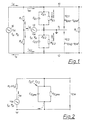
- FIGS. 1 to 4 The principle of the method according to the invention is first explained below with reference to FIGS. 1 to 4, for reasons of simplicity on an insulated AC network with two network conductors 10, 12 which have no direct connection to earth 14.
- a mains AC voltage source 16 feeds a load R L shown in dashed lines via the mains conductors 10, 12.
- R L shown in dashed lines
- These consist of capacitive and ohmic components and are combined for the line conductor 10 to form a line derivative impedance Z E1 with C E1 and R E1 and for the line conductor 12 to form a line derivative impedance Z E2 with CE2 and R E2 .
- the mains alternating voltage source 16 drives a mains leakage current through the series connection of the mains leakage impedances Z E1 and Z E2, which is indicated by pipes shown in solid lines. Accordingly, the line conductors 10 and 12 assume voltage potentials u EN1 and u EN2 with respect to earth 14, which each add to the voltage potential u N of the AC line voltage source 16 and, with regard to their individual sizes, depend on the size relation of the line leakage impedances Z E1 and Z E2 .
- the conductor voltages u EN1 and u EN2 based on the network supply are of the same size.
- the total lead impedance corresponds to the parallel connection of the individual network lead impedances Z E1 and Z E2 . The following therefore applies:
- the total lead impedance of the AC network is of the utmost importance for the operational safety of an ungrounded AC network, it is important to monitor the size of this total lead impedance.
- the AC network When the AC network is without mains voltage, it is relatively unproblematic to detect the total lead impedance. Since the network has a very low internal resistance, it can be seen as a «rail to earth. According to FIG. 1, a measuring alternating current i M can then be fed in between the mains and the earth, which flows through the total derivative impedance according to the equivalent circuit diagram from FIG. 2 and causes a voltage drop UEM thereon. The total lead impedance can then be obtained from the following equation be calculated.
- the total derivative impedance is accordingly proportional to the measured mains conductor voltage u EM based on the measuring alternating current, it being irrelevant whether the mains conductor voltage is measured between the mains conductor 10 or the mains conductor 12 and earth 14 because of the continuous “rail of the network” becomes.
- the magnitude of the measuring alternating current i M is only determined by connecting the coupling resistors R 1 and R 2 in parallel if their total resistance is very much greater than the total lead impedance. If this is not the case, the size of the measuring alternating current would always have to be determined and taken into account in order to determine the total lead impedance.
- the individual network derivatives Z E1 and Z E2 according to FIG. 1 are traversed on the one hand by the measuring alternating current or a part thereof and on the other hand by an unknown AC alternating current i N. Accordingly, the individual network conductors 10, 12 assume, in relation to earth 14, conductor voltages u E1 , u E2 , each of which consists of two superimposed voltage components on the one hand with the network frequency f N and on the other hand with the measurement frequency f M.
- the voltage components u EN1 , UEN2 based on the mains supply depend on the reasons given for their individual sizes on the distribution or relation of the network derivatives Z E1 , Z E2 and add up to the total voltage u N , the voltage components based on the alternating current are u EM identical in u E1 and u E2 .
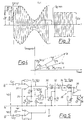
- the pointer image from FIG. 4 shows that the network-related alternating current i N and the measuring alternating current or a portion i M1 or i M2 determined by the size of the coupling resistances R 1 , R 2 of the same each geometrically increase in each line derivative Z E1 , ZE2 add a total current i E , which causes the corresponding conductor voltage u E1 or u E2 .
- This conductor voltage also results from the addition of those voltage components which are caused by the individual currents flowing through the system discharge.
- the individual currents superimposed in the system derivation do not have a fixed phase relationship to one another, i.e. if the division ratio of their frequencies is not an integer, and if the frequencies are close to each other, the total current or the line voltage generated thereby (or by the individual currents) results in E1 or u E2 a beat according to FIG. 3, left part. From this beat, the individual voltage components caused by the individual currents, that is to say in particular also the voltage component u EM ' which is decisive for determining the overall derivative impedance, can be determined.
- the absolute value of the total current i E depends on the instantaneous, constantly changing phase difference between the individual currents (or the voltage components caused thereby).
- the geometric addition results in a maximum for phase equality and a minimum for a phase difference of 180 °, since the pointers then add or subtract algebraically.
- the individual currents each have a constant frequency f N or f M and thus revolve in the illustration from FIG. 4 with a constant angular frequency ⁇ N or ⁇ M
- the resulting pointer i E rotates with a time-varying angular frequency ⁇ E. The same applies to the superimposed voltage components.
- the beat from FIG. 3, left side is thus composed as follows:
- the conductor voltage u E which is composed of the individual voltage components u EN and UEM with the frequencies f N and f M , has a total like the pointer.
- i E from FIG. 4 is a time-variable frequency that is not of interest here.
- the voltage maxima u E max and voltage minima u E min arise whenever there is in-phase or antiphase between the individual, superimposed voltage components (or between the individual currents).
- the individual mains leads are flowed through in series by the alternating mains current caused by the mains supply, while the measuring alternating current or parts thereof flow through them in parallel, the beat patterns of the individual conductor voltages u E1 and u E2 differ only in symmetrically distributed mains leads a mutual phase shift of 180 °. Accordingly, it can be used to determine the total lead impedance.
- relevant voltage component u EM can be determined from the beat pattern of the line conductor 10 or the line conductor 12. If the network derivatives are distributed asymmetrically, the beat patterns for the network conductors 10 and 12 change beyond what has already been said only by the size of the respective network voltage component UE N.
- the individual voltage components of the line voltage u E can be read directly from the beat pattern according to the figure.
- the voltage amplitude of each of the two-sided beat envelopes corresponds to the voltage amplitude of the voltage component u EM which is decisive for the overall lead impedance, as long as this voltage component is smaller than the mains voltage component u EN .
- the temporal mean voltage amplitude of the beat itself corresponds to the voltage amplitude of the mains voltage component u EN .
- the mains voltage component u EN is smaller than the measuring voltage component UEM
- the voltage amplitude of the beat envelope curve corresponds to that of the mains voltage component UEN
- the temporal mean voltage amplitude of the beat itself corresponds to that of the relevant measuring voltage component UEM . If the mains and measurement voltage components are identical, the two beat envelopes come into contact with one another, and the amplitudes of the voltage components then result both from the voltage amplitude of the beat envelope curve and from the temporally average voltage amplitude of the beat itself.
- an alternating measurement current flowing through the system leads with a dynamic phase shift relative to the corresponding alternating current must be fed into the AC network.
- the constant change in the mutual phase position must be sufficiently slow, that is to say that the measurement and network frequencies f M and f N must be sufficiently close together that an evaluable beat envelope curve with the difference frequency results.
- the voltage component u EM is a measure of the total lead impedance when the amplitude is fed into the alternating current. If the incoming measuring alternating current changes in terms of amplitude, its size must be measured and taken into account when determining the total lead impedance by appropriate quotient formation. Since the total lead impedance is frequency-dependent, the measurement frequency should therefore be as close as possible to the line frequency, i.e. the speed of the dynamic phase shift should be as small as possible so that the difference between the total lead impedance is as small as possible at the exact line frequency and at the measurement frequency.
- the small measurement error which is caused by the slight difference frequency required for the formation of the beat can be reduced in the manner already explained by averaging the total lead impedances determined at different measurement frequencies above and below the mains frequency.
- the measurement frequency can be switched over or changed continuously, possibly in conjunction with different frequency deviations above and below the mains frequency, in order to compensate for non-linear frequency dependencies.
- the beat pattern of the conductor voltage u E1 of the conductor 10 from FIG. 1 with respect to earth 14 is evaluated as long as the associated mains voltage component u EN1 is greater than a specific reference voltage. Otherwise there is a switchover to the other line conductor 12, so that the beat pattern of the line voltage u E2 is then evaluated.
- the reason is as follows: In order for the voltage amplitude of the beat envelope curve to correspond to the voltage component u EM that is decisive for the overall derivative impedance, this voltage component must be smaller than the mains voltage component UEN or at most equal to this component. If the line voltage component u EN1 of the line conductor 10 now becomes too small, i.e. the stated amplitude condition is no longer fulfilled, this amplitude condition applies to the other line conductor 12, since the sum of the two line voltage components u EN1 and UEN2 always corresponds to the total line voltage u N.
- the network conductor 10 or 12 is connected to a switch 30 via a coupling capacitor C K1 or CK2 and a suitable high-resistance voltage reducer 20 or 22.
- a sufficiently small portion k 1 ⁇ u E1 of the line voltage u E1 is available at the output of the voltage reducer 20.
- a rectifier and averager 24 with a diode D24, which is connected in parallel with a Capacitor C24 and a resistor R24 is connected in series.
- the resulting on capacitor C24 average k 1 ⁇ u EN1 is a measure of the power present at conductors 10 network voltage component u EN1 and together fed to a threshold switch 28 to the output voltage of a reference voltage source 26th This ensures that the switch 30 is switched from the line conductor 10 to the line conductor 12 whenever the mean value on the capacitor C24 becomes lower than the reference voltage U ref .
- the reference voltage U ref can be selected within the following limits:
- the upper limit indicates that a switchover from the line conductor 10 to the line conductor 12 can always take place when the line voltage component u EN1 is less than-half the line voltage u N , which can only be the case in the case of asymmetrically distributed line leads.
- the lower limit depends on the total derivative impedance to be evaluated and states that a switchover from the mains conductor 10 to the mains conductor 12 must always take place when the mains voltage component UEN1 becomes smaller than the minimum measuring voltage component UEM min occurring on the mains. This minimally occurring measuring voltage component depends on the size of the minimum total lead impedance to be detected for a given measuring alternating current.
- the switch 30 is followed by a rectifier circuit 32 with a diode D32 and a parallel circuit connecting its output to ground 14, comprising a capacitor C32 and a resistor R32.
- the time constant of this circuit is chosen as follows:
- the resulting DC voltage is the overlapping voltage that still contains network components with f N.
- the downstream capacitor CK3 decouples the AC voltage components.
- matched low-pass filter 34 allows only the portion of the superimposed voltage, that is, k 2 ⁇ û EM ' , to pass.
- This heterodyne voltage is rectified in a rectifier 35 with a series circuit comprising a diode D35 and a capacitor C35 and converted into a DC voltage which is proportional to the total derivative impedance Z E tot .
- This DC voltage can be amplified with an amplifier 36 and displayed with a display instrument 38 calibrated in Z E.
- the embodiment from FIG. Can in principle also be used for AC networks with three network conductors.
- the measurement alternating current would then be fed in three-pole analogously to FIG. 1 and corresponding to FIG. 9, while it is sufficient to switch the evaluation circuit A1 according to FIG. Only between two network conductors if necessary.
- the upper limit for the switchover threshold or reference voltage U ref must then be selected differently by replacing the denominator value "2" in Equation 4 with " ⁇ 3".
- the voltage amplitude of the beat envelope curve which is decisive for the determination of the overall derivative impedance, can also be determined by detecting the voltage maxima and minima of the envelope curve. The required voltage amplitude is then obtained by forming the difference and halving it.
- the voltage amplitude relevant for the overall lead impedance can also be determined by detecting the mean voltage amplitude of the beat itself. This can be done, for example, in the sampling method by detecting and averaging the voltage maxima and minima. It would also be possible to rectify the beat and then carry out a suitable averaging.
- the compliance with an amplitude condition does not play a role in the correct detection of the total lead impedance.
- the measurement result is also not affected if the mains voltage is removed.
- the measuring alternating current source 18 is connected via a switch S1 to the connection point of the high-resistance coupling resistors R1, R2, which are preferably of the same size as in FIG. 1. According to the figure, the feeding or impressing of the measuring alternating current can be clocked, that is to say switched on and off.
- the network conductors 10 and 12 are connected to one another via two high-resistance coupling resistors R3 and R4 connected in series.
- the connection point of these two resistors is on the one hand via a measuring resistor R M to earth 14 and on the other hand via a Capacitor C K connected to an evaluation circuit A2.
- the equivalent circuit diagram for the feeding of the measuring alternating current and the decoupling of the measuring voltage component corresponding for the determination of the total lead impedance results from FIG Monitoring device arise, the magnitude of the measuring alternating current is as independent as possible of the magnitude of the total derivative impedance and the superimposition processes are not influenced by the evaluation circuit.
- the measuring resistor R M is in the bridge zero branch of a bridge with the leakage impedances Z EI , ZE2 on the one hand and the coupling resistors R3, R4 on the other.
- switch S1 open and symmetrical distribution of the lead impedances, no voltage drops across R M.
- switch S1 is closed, an amplitude-constant measuring alternating current is impressed in the manner already described, which gives rise to the measuring voltage component UEM , which is decisive for determining the total derivative impedance, on the total derivative impedance, in this case the parallel connection of Z E1 and Z E2 .
- the evaluation circuit A2 When the switch S1 is closed, the evaluation circuit A2 is therefore supplied with a beat in the sense of FIG. 3, left part, in which the measurement voltage component can superimpose the mains voltage component and vice versa.
- the evaluation circuit A2 When switch S1 is open, on the other hand, the evaluation circuit A2 is only supplied with the mains voltage component which is also present in the beat, which is indicated in the right part of FIG. 3.
- the principle of the evaluation of the device from FIG. 6 is based on the one hand on detecting the maximum voltage amplitude of the beat when switch S1 is closed and on the other hand the voltage amplitude of the network component with the switch S1 open and forming the difference between these voltage amplitudes. This always results in the voltage amplitude that is proportional to the total lead impedance when the alternating current is impressed. If the measurement voltage component is superimposed on the network voltage component in the beat, the difference formation gives the voltage amplitude of the beat envelope. If, on the other hand, the network voltage component superimposes the measurement voltage component in the beat, the difference formation leads to the voltage amplitude of the beat itself averaged over time. Accordingly, this measurement principle is independent of an amplitude condition.
- the beat coupled out with C K is fed to a peak voltage detector 40 in the evaluation circuit A2 from FIG.
- This contains a rectifier diode D connected to the capacitor C K and a capacitor C1 connected to its output and to earth 14, to which a controlled switch S2 is connected in parallel.
- the capacitor C1 temporarily stores the respective peak value of the rectified voltage.
- This peak value can be fed via a high-impedance impedance converter N1 to a storage capacitor C3 when switch S3 is closed or to a storage capacitor C2 when switch S4 is closed.
- These capacitors form a take-over memory 42 for storing various peak values, the voltage difference of which can be formed by means of a difference generator 44 and can be displayed in a display instrument 46 calibrated with a total derivative impedance.
- the time grid from FIG. 8 can be shortened since, for example, the time t 3 for the actuation of the switches S1 and S2 can coincide directly with the opening time of the switch S3.
- the time between t 3 and t 4 can be shortened since only one period of the mains frequency has to be waited for the detection of the voltage amplide of the mains voltage component.
- the time t 5 can coincide with the opening time of the switch S4, that is, can be brought forward.
- a uniform time pattern of the type shown in FIG. 8 a measurement cycle between t 1 and t s results, which corresponds to at least twice the period of the beat envelope.
- the correct value of the total lead impedance is nevertheless displayed.
- the voltage amplitude of the measuring voltage component or a correspondingly reduced value is stored in C3.
- the second part of the measuring cycle that is to say when switch S1 is open, there is no voltage component at all, so that the peak value “zero” is stored in the capacitor C2 of the transfer memory 42.
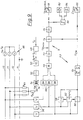
- FIG. 9 The embodiment from FIG. 9 is shown in the context of an unearthed three-phase network with three network conductors 10, 11, 12, which is fed by a three-phase source with a network frequency f N.
- FIG. 9 shows in an exemplary manner that the measurement frequency f M can be derived from the network frequency f N , for example by coupling a dynamic phase shifter or a frequency multiplier 48 to the network and generating a measurement frequency that is slightly shifted from the network frequency.
- a measurement frequency of 52 to 53 Hertz can be derived, which also changes according to possible fluctuations in the network frequency so that the frequency divider ratio remains constant.
- a constant dynamic phase shift of the measuring alternating current with respect to the network can be provided, so that a constant frequency spacing between the network frequency and the measuring frequency is obtained.
- the derivation of the measurement frequency from the mains frequency which is only indicated here by way of example, can also be used in the other embodiments.
- An amplifier 50 amplifies the measurement frequency signal, which is fed to a transformer 54 via a switch 52. This ensures that the measurement signal is transformed up to a measurement voltage UM of approximately 200 V.ff. Via a network of high-resistance coupling elements R K1 and R K2 . which are ohmic resistors in the present case, an alternating current i M is impressed into the three-phase network so that the alternating current flows to earth 14 via the line leads, not shown, as before with the line voltage present, forming a beat on the line leads.
- Coupling amplifiers 56 connected to the network conductors 10, 11, 12 reduce the conductor voltages to earth to an evaluable level. Two of the coupling amplifiers 56 are used to obtain the measurement voltage or beat envelope amplitude, or a measure proportional to this, by means of rectification and filtering, as in the embodiment from FIG. 5, by means of rectification and filtering. In the present case, normally only the line voltage of the line conductor 11 is fed via a switch 58 to a corresponding evaluation circuit A3.
- a comparator 62 compares the reduced conductor voltages of the network conductors 11, 12 with one another in the manner already described or in a manner similar to that in FIG. 5 with a reference voltage.
- the comparator 62 opens the switch 58 and closes a switch 60 which forwards the reduced line voltage of the network conductor 12 to the evaluation circuit A3. It is not necessary to switch over in this regard between three network conductors, which would be possible in principle.
- the evaluation circuit A3 has a rectifier and filter circuit 64 which ensures that is generated from the beat a DC voltage signal U EM which g is proportional to the voltage amplitude of the envelope and thus the total leakage impedance Z E is that thus calibrated directly to one in total leakage impedance Display instrument 66 can be displayed.
- the rectifier and filter circuit 64 can be constructed in different ways and work, for example, as follows:
- the current line voltage of the line conductor 11 or 12 is rectified and fed to a low-pass filter, at the output of which a DC voltage with the superposition is available.
- a high pass only allows the AC voltage component, i.e. the superposition itself, to pass.
- the subsequently amplified signal arrives at an active low-pass filter, which is tuned to the beat or beat frequency, so that behind it the sinusoidal beat voltage, which is proportional to the total derivative impedance, is available.
- a two-way rectifier and a low-pass filter then generate a corresponding DC voltage.
- the DC measurement voltage U EM which is proportional to the overall derivative impedance, is used in the embodiment from FIG. 9 at the same time to determine the maximum possible conductor contact current in a safety circuit S and is supplied to an analog divider 74 for this purpose. This ensures that a DC voltage signal U E mex also supplied to it, which corresponds to the maximum line voltage of the network conductors 10, 11, 12, is divided by the Z-proportional DC voltage U EM . This quotient corresponds to the maximum possible conductor contact current.
- three active rectifiers 68 are connected on the input side to the outputs of the coupling amplifiers 56 and on the output side in direct coupling to the input of a low-pass filter 70, the output signal of which is amplified by an amplifier 72 to U E max .
- the output signal of the analog divider 74 is amplified in an amplifier 76 and displayed as the maximum possible conductor touch current I E max in a display instrument. At the same time, the output signal of the amplifier 76 reaches a threshold switch 80 which, in the event of an impermissible increase in the maximum possible conductor contact current, triggers a warning buzzer 84 and a relay 82 in the present case, which can, for example, provide for a network shutdown.
- the power conductor r 10, 11, 12 can additionally be displayed in a manner not shown with the aid of the output signals of the active rectifiers 68, for example by a flashing lamp which carries the maximum conductor voltage and thus a special structure represents.
- n conductor contact current can of course also be used in the other ' embodiments with constant or clocking measurement alternating current feed.
- the illustrated and described embodiments are exemplary and can be modified in terms of their details and adapted to the respective requirements. This applies, for example, to the type of network connections and decouplings, to the form of the injected or high-resistance impressed alternating current, to the type of generation of the measuring frequency or the dynamic phase shift of the alternating current, for the design of the evaluation circuit used in each case, and to the type of use of the measurement result and the like. It is important that the total lead impedance of the network, which is practically related to the network frequency, or the maximum conductor touch current that can be derived therefrom, can be determined very precisely and relatively easily.
Landscapes
- Physics & Mathematics (AREA)
- General Physics & Mathematics (AREA)
- Measurement Of Resistance Or Impedance (AREA)
- Emergency Protection Circuit Devices (AREA)
- Surgical Instruments (AREA)
- Testing Of Short-Circuits, Discontinuities, Leakage, Or Incorrect Line Connections (AREA)
- Investigating Or Analyzing Materials By The Use Of Electric Means (AREA)
Claims (33)
Priority Applications (1)
| Application Number | Priority Date | Filing Date | Title |
|---|---|---|---|
| AT82102423T ATE15724T1 (de) | 1981-03-31 | 1982-03-24 | Verfahren und einrichtung zum bestimmen der gesamtableitungsimpedanz in einem ungeerdeten wechselstromnetz. |
Applications Claiming Priority (2)
| Application Number | Priority Date | Filing Date | Title |
|---|---|---|---|
| DE3112952A DE3112952C2 (de) | 1981-03-31 | 1981-03-31 | Verfahren und Einrichtung zum Bestimmen der Gesamtableitungsimpedanz in einem ungeerdeten Wechselstromnetz |
| DE3112952 | 1981-03-31 |
Publications (2)
| Publication Number | Publication Date |
|---|---|
| EP0061704A1 EP0061704A1 (fr) | 1982-10-06 |
| EP0061704B1 true EP0061704B1 (fr) | 1985-09-18 |
Family
ID=6128942
Family Applications (1)
| Application Number | Title | Priority Date | Filing Date |
|---|---|---|---|
| EP82102423A Expired EP0061704B1 (fr) | 1981-03-31 | 1982-03-24 | Procédé et dispositif pour déterminer l'impédance de fuite totale dans un réseau alternatif non mis à la terre |
Country Status (7)
| Country | Link |
|---|---|
| US (1) | US4472676A (fr) |
| EP (1) | EP0061704B1 (fr) |
| JP (1) | JPS57190271A (fr) |
| AT (1) | ATE15724T1 (fr) |
| AU (1) | AU555092B2 (fr) |
| CA (1) | CA1195384A (fr) |
| DE (1) | DE3112952C2 (fr) |
Cited By (1)
| Publication number | Priority date | Publication date | Assignee | Title |
|---|---|---|---|---|
| DE102021132161B3 (de) | 2021-12-07 | 2023-06-07 | Bender Gmbh & Co. Kg | Verfahren und Einrichtung zur Impedanzüberwachung zum Schutz gegen elektrischen Schlag |
Families Citing this family (36)
| Publication number | Priority date | Publication date | Assignee | Title |
|---|---|---|---|---|
| GB8428013D0 (en) * | 1984-11-06 | 1984-12-12 | Flotronics Ag | Double-diaphragm pumps |
| FR2616228B1 (fr) * | 1987-06-04 | 1989-09-08 | Merlin Gerin | Dispositif de controle et de mesure de l'isolement d'un reseau electrique |
| US4857830A (en) * | 1988-11-03 | 1989-08-15 | Toyo Communication Equipment Co., Ltd. | Method for measuring insulation resistance of electric line |
| US4851761A (en) * | 1988-11-03 | 1989-07-25 | Toyo Communication Equipment Co., Ltd. | Method for measuring insulation resistance of electric line |
| US4857855A (en) * | 1988-11-03 | 1989-08-15 | Toyo Communication Equipment Co., Ltd. | Method for compensating for phase of insulation resistance measuring circuit |
| FR2647220B1 (fr) * | 1989-05-19 | 1991-07-05 | Merlin Gerin | Controleur d'isolement numerique pour reseau electrique |
| FR2650395B1 (fr) * | 1989-07-31 | 1991-09-27 | Merlin Gerin | Dispositif de mesure de la valeur efficace d'un signal, notamment pour la mesure du courant dans un declencheur statique |
| US5097213A (en) * | 1990-05-24 | 1992-03-17 | Hunting Curtis J | Apparatus for automatic testing of electrical and electronic connectors |
| DE4234808A1 (de) * | 1992-10-15 | 1994-04-21 | Walther Bender Gmbh & Co Kg Di | Verfahren zum Bestimmen der elektrischen Netzableitgrößen in ungeerdeten elektrischen Netzen |
| FR2697341B1 (fr) * | 1992-10-26 | 1995-01-13 | Electricite De France | Procédé et dispositif de mesure de l'accord et du désaccord de compensation d'un réseau de distribution électrique. |
| EP0600726B1 (fr) * | 1992-12-04 | 2000-03-01 | Doble Engineering Company | Mesure d'impédance |
| US5446682A (en) * | 1994-03-21 | 1995-08-29 | Square D Company | System for calibrating a line isolation monitor |
| US5450328A (en) * | 1994-03-21 | 1995-09-12 | Square D Company | System for measuring line to ground impedance |
| US5448491A (en) * | 1994-03-21 | 1995-09-05 | Square D Company | Monitor for an ungrounded system |
| US5982165A (en) * | 1996-11-29 | 1999-11-09 | Wavetek Corporation | RF circuit for use in a combined leakage detector and signal level monitor |
| US6686746B2 (en) | 2001-01-31 | 2004-02-03 | Cm Technologies Corporation | Method and apparatus for monitoring integrity of wires or electrical cables |
| US6972574B2 (en) * | 2001-01-31 | 2005-12-06 | Cm Technologies Corporation | Method and apparatus for monitoring integrity of wires or electrical cables |
| JP4216528B2 (ja) * | 2002-06-21 | 2009-01-28 | ヴェリジー(シンガポール) プライベート リミテッド | 高周波信号測定装置の校正装置 |
| CA2536083C (fr) * | 2003-08-21 | 2011-06-21 | Hubbell Incorporated | Procede et appareil de mesure de l'impedance d'un composant electrique dans des conditions de brouillage intense |
| US9037355B2 (en) * | 2007-11-05 | 2015-05-19 | Deere & Company | Control assembly for auxiliary hydraulics |
| US20090323233A1 (en) * | 2008-06-26 | 2009-12-31 | Shoemaker Jim M | Apparatus and method of determining insulation resistance in an ungrounded mobile vehicle electrical bus system |
| US8537516B1 (en) | 2008-12-05 | 2013-09-17 | Musco Corporation | Apparatus, method, and system for monitoring of equipment and earth ground systems |
| US8040139B2 (en) * | 2009-02-16 | 2011-10-18 | Maxim Integrated Products, Inc. | Fault detection method for detecting leakage paths between power sources and chassis |
| EP2237057B1 (fr) * | 2009-04-03 | 2018-02-21 | Siemens Aktiengesellschaft | Dispositif d'analyse destiné à l'analyse d'un réseau électrique |
| US9523730B2 (en) | 2009-04-08 | 2016-12-20 | Analog Devices, Inc. | Architecture and method to determine leakage impedance and leakage voltage node |
| US8427167B2 (en) | 2009-04-08 | 2013-04-23 | Analog Devices, Inc. | Architecture and method to determine leakage impedance and leakage voltage node |
| US8320089B1 (en) | 2009-04-16 | 2012-11-27 | Musco Corporation | Apparatus, method, and system for integrating ground fault circuit interrupters in equipment-grounded high voltage systems |
| US8598897B2 (en) * | 2010-01-26 | 2013-12-03 | Maxim Integrated Products, Inc. | Isolation monitoring system and method utilizing a variable emulated inductance |
| US8749246B2 (en) | 2011-02-16 | 2014-06-10 | Bender Gmbh & Co. Kg | Method and device for determining a maximum leakage current |
| DE102011054770B4 (de) | 2011-10-25 | 2015-03-05 | isepos GmbH | Verfahren, Vorrichtung und Verwendung eines Verfahrens zur kontinuierlichen Echtzeiterkennung eines unbeabsichtigten Inselbetriebs bei der Einspeisung eines Stromsignals |
| DE102012019095B4 (de) * | 2012-09-27 | 2016-07-21 | E. Dold & Söhne KG | Einrichtung zur Überwachung eines Isolationswiderstandes von Netzen |
| DE102012218107B4 (de) | 2012-10-04 | 2023-04-27 | Bender Gmbh & Co. Kg | Verfahren zur Überwachung und Messung eines Isolationswiderstands mit einem störresistenten Messsignal und zugehöriger Signalgenerator |
| DE102013218525A1 (de) * | 2013-09-16 | 2015-03-19 | Bender Gmbh & Co. Kg | Verfahren und Vorrichtung zur Überwachung eines Isolationswiderstandes in einem ungeerdeten Stromversorgungssystem |
| CN103558498B (zh) * | 2013-11-18 | 2016-02-24 | 华北电力大学 | 基于小波分析的绝缘子污闪泄漏电流信号稀疏表示方法 |
| CN110780223A (zh) * | 2018-07-11 | 2020-02-11 | 西门子股份公司 | 接地故障检测电路及装置 |
| CN110780224A (zh) * | 2018-07-11 | 2020-02-11 | 西门子股份公司 | 接地故障检测电路及装置 |
Family Cites Families (10)
| Publication number | Priority date | Publication date | Assignee | Title |
|---|---|---|---|---|
| US2767374A (en) * | 1951-12-12 | 1956-10-16 | Bell Telephone Labor Inc | Heterodyne measuring circuits |
| FR1467126A (fr) * | 1965-12-13 | 1967-01-27 | Compteurs Comp D | Procédé et dispositif de contrôle de la résistance d'isolement globale d'un réseau électrique |
| CH570723A5 (fr) * | 1974-04-26 | 1975-12-15 | Bbc Brown Boveri & Cie | |
| US3963963A (en) * | 1975-04-22 | 1976-06-15 | Rca Corporation | Ground-fault detection system |
| US3976987A (en) * | 1975-08-29 | 1976-08-24 | Square D Company | Dual channel dynamic line isolation monitor |
| DE2545315B2 (de) * | 1975-10-09 | 1977-11-03 | Siemens AG, 1000 Berlin und 8000 München | Schaltungsanordnung zur erdschlussueberwachung einer erdfreien gleichstromschaltung |
| CH613569A5 (fr) * | 1977-03-01 | 1979-09-28 | Bbc Brown Boveri & Cie | |
| DE2809596A1 (de) * | 1978-03-06 | 1979-09-20 | Merk Gmbh Telefonbau Fried | Schaltungsanordnung zur erfassung von erdschluessen zweiadriger meldeleitungen |
| US4206398A (en) * | 1978-04-26 | 1980-06-03 | Esb Incorporated | Method of and apparatus for detecting ground faults in isolated power supply systems |
| US4200836A (en) * | 1978-06-13 | 1980-04-29 | Fuji Electric Co., Ltd. | Apparatus for measuring insulation resistance in an operating three-phase ungrounded transmission line system |
-
1981
- 1981-03-31 DE DE3112952A patent/DE3112952C2/de not_active Expired - Lifetime
-
1982
- 1982-03-12 US US06/357,529 patent/US4472676A/en not_active Expired - Lifetime
- 1982-03-24 EP EP82102423A patent/EP0061704B1/fr not_active Expired
- 1982-03-24 AT AT82102423T patent/ATE15724T1/de not_active IP Right Cessation
- 1982-03-24 CA CA000399285A patent/CA1195384A/fr not_active Expired
- 1982-03-31 AU AU82205/82A patent/AU555092B2/en not_active Expired
- 1982-03-31 JP JP57054729A patent/JPS57190271A/ja active Pending
Cited By (1)
| Publication number | Priority date | Publication date | Assignee | Title |
|---|---|---|---|---|
| DE102021132161B3 (de) | 2021-12-07 | 2023-06-07 | Bender Gmbh & Co. Kg | Verfahren und Einrichtung zur Impedanzüberwachung zum Schutz gegen elektrischen Schlag |
Also Published As
| Publication number | Publication date |
|---|---|
| DE3112952C2 (de) | 1994-05-05 |
| AU8220582A (en) | 1982-10-07 |
| US4472676A (en) | 1984-09-18 |
| JPS57190271A (en) | 1982-11-22 |
| CA1195384A (fr) | 1985-10-15 |
| EP0061704A1 (fr) | 1982-10-06 |
| AU555092B2 (en) | 1986-09-11 |
| ATE15724T1 (de) | 1985-10-15 |
| DE3112952A1 (de) | 1982-10-07 |
Similar Documents
| Publication | Publication Date | Title |
|---|---|---|
| EP0061704B1 (fr) | Procédé et dispositif pour déterminer l'impédance de fuite totale dans un réseau alternatif non mis à la terre | |
| DE3854702T2 (de) | Alysator zur analyse hochohmiger fehler in einem elektrischen energieversorgungsnetz. | |
| EP0654673B1 (fr) | Méthode et dispositif pour la surveillance de l'isolation dans des réseaux continus et alternatifs non mis à la terre | |
| EP0106790B1 (fr) | Méthode et appareil pour localiser un défaut d'une ligne triphasée à courant | |
| EP0040766B1 (fr) | Dispositif de surveillance des batteries de condensateurs d'un circuit de filtrage à courant triphasé | |
| EP2697661B1 (fr) | Procédé et dispositif de détermination d'une composante de courant de défaut à un courant différentiel | |
| EP0212370B1 (fr) | Surveillance de la respiration | |
| DE2630982A1 (de) | Isolationsueberwachungseinrichtung fuer ein nichtgeerdetes energieversorgungssystem | |
| DE102019117369A1 (de) | Schaltung und Verfahren zur Überwachung eines Zwischenkreiskondensators | |
| EP2923213B1 (fr) | Procédé de mesure de l'isolement d'un onduleur sans transformateur | |
| EP3862763A1 (fr) | Procédé de surveillance de la résistance de la terre d'un système électrique | |
| DE2407399A1 (de) | Verfahren und vorrichtung zur herzfrequenzueberwachung | |
| DE19744152A9 (de) | Schaltungsanordnung zur Erfassung der Kapazität bzw. einer Kapazitätsänderung eines kapazitiven Schaltungs- oder Bauelementes | |
| DE69305911T2 (de) | Einrichtung zur Überwachung eines homopolaren Fehlers im Stromnetz | |
| DE2545325A1 (de) | Schaltungsanordnung zur messung des isolationswiderstandes erdfreier starkstromschaltungen | |
| DE1812503C3 (de) | Verfahren zum Prüfen der Antwort eines Systems auf ein Eingangssignal und Gerät zum Durchführen des Verfahrens | |
| DE69307880T2 (de) | Verfahren und einrichtung zum vermindern von unterstabilisierung eines längsvergleichsschutzes bei externen fehlern und stromwandlersättigung | |
| WO2023100088A1 (fr) | Procédé et dispositif de surveillance d'isolation, et emplacement de défaut d'isolation pour systèmes d'alimentation électrique non mis à la terre | |
| DE2446706C3 (de) | Einrichtung zur Überwachung wenigstens einer im wesentlichen sinusförmigen elektrischen Strom- bzw. Spannungsgröße | |
| DE2357081A1 (de) | Verfahren und einrichtung zur messung des isolationswiderstandes von ungeerdeten gleichstromnetzen | |
| DE102019132071A1 (de) | Vorrichtung zum Überwachen eines Versorgungsnetzes | |
| DE69405998T3 (de) | Elektrisches testgerät | |
| DE2115807B2 (de) | Erdschlußschutzeinrichtung für elektrische Geräte mit in Stern geschalteten Wicklungen | |
| EP0165512B1 (fr) | Procédé d'évaluation de la différence entre une tension alternative et une deuxième tension et dispositif de mesure pour son application | |
| DE19949997B4 (de) | Vorrichtung zur Bestimmung der Wirk-und/oder Blindleistung in einem einphasigen elektrischen Wechselspannungssystem und deren Anwendung |
Legal Events
| Date | Code | Title | Description |
|---|---|---|---|
| PUAI | Public reference made under article 153(3) epc to a published international application that has entered the european phase |
Free format text: ORIGINAL CODE: 0009012 |
|
| AK | Designated contracting states |
Designated state(s): AT BE CH FR GB IT LU NL SE |
|
| 17P | Request for examination filed |
Effective date: 19830209 |
|
| GRAA | (expected) grant |
Free format text: ORIGINAL CODE: 0009210 |
|
| AK | Designated contracting states |
Designated state(s): AT BE CH FR GB IT LI LU NL SE |
|
| PG25 | Lapsed in a contracting state [announced via postgrant information from national office to epo] |
Ref country code: IT Free format text: LAPSE BECAUSE OF FAILURE TO SUBMIT A TRANSLATION OF THE DESCRIPTION OR TO PAY THE FEE WITHIN THE PRESCRIBED TIME-LIMIT;WARNING: LAPSES OF ITALIAN PATENTS WITH EFFECTIVE DATE BEFORE 2007 MAY HAVE OCCURRED AT ANY TIME BEFORE 2007. THE CORRECT EFFECTIVE DATE MAY BE DIFFERENT FROM THE ONE RECORDED. Effective date: 19850918 Ref country code: FR Free format text: THE PATENT HAS BEEN ANNULLED BY A DECISION OF A NATIONAL AUTHORITY Effective date: 19850918 Ref country code: BE Effective date: 19850918 |
|
| REF | Corresponds to: |
Ref document number: 15724 Country of ref document: AT Date of ref document: 19851015 Kind code of ref document: T |
|
| PG25 | Lapsed in a contracting state [announced via postgrant information from national office to epo] |
Ref country code: SE Effective date: 19850930 |
|
| PG25 | Lapsed in a contracting state [announced via postgrant information from national office to epo] |
Ref country code: LU Free format text: LAPSE BECAUSE OF NON-PAYMENT OF DUE FEES Effective date: 19860331 |
|
| PLBE | No opposition filed within time limit |
Free format text: ORIGINAL CODE: 0009261 |
|
| STAA | Information on the status of an ep patent application or granted ep patent |
Free format text: STATUS: NO OPPOSITION FILED WITHIN TIME LIMIT |
|
| EN | Fr: translation not filed | ||
| 26N | No opposition filed | ||
| PGFP | Annual fee paid to national office [announced via postgrant information from national office to epo] |
Ref country code: CH Payment date: 20010312 Year of fee payment: 20 |
|
| PGFP | Annual fee paid to national office [announced via postgrant information from national office to epo] |
Ref country code: GB Payment date: 20010321 Year of fee payment: 20 |
|
| PGFP | Annual fee paid to national office [announced via postgrant information from national office to epo] |
Ref country code: NL Payment date: 20010330 Year of fee payment: 20 Ref country code: AT Payment date: 20010330 Year of fee payment: 20 |
|
| REG | Reference to a national code |
Ref country code: GB Ref legal event code: IF02 |
|
| PG25 | Lapsed in a contracting state [announced via postgrant information from national office to epo] |
Ref country code: LI Free format text: LAPSE BECAUSE OF EXPIRATION OF PROTECTION Effective date: 20020323 Ref country code: GB Free format text: LAPSE BECAUSE OF EXPIRATION OF PROTECTION Effective date: 20020323 Ref country code: CH Free format text: LAPSE BECAUSE OF EXPIRATION OF PROTECTION Effective date: 20020323 |
|
| PG25 | Lapsed in a contracting state [announced via postgrant information from national office to epo] |
Ref country code: NL Free format text: LAPSE BECAUSE OF EXPIRATION OF PROTECTION Effective date: 20020324 Ref country code: AT Free format text: LAPSE BECAUSE OF EXPIRATION OF PROTECTION Effective date: 20020324 |
|
| REG | Reference to a national code |
Ref country code: CH Ref legal event code: PL |
|
| REG | Reference to a national code |
Ref country code: GB Ref legal event code: PE20 Effective date: 20020323 |
|
| NLV7 | Nl: ceased due to reaching the maximum lifetime of a patent |
Effective date: 20020324 |
|
| NLV7 | Nl: ceased due to reaching the maximum lifetime of a patent |
Effective date: 20020324 |