EP0061725B1 - Hermetisch verschlossene elektrochemische Zelle mit Überdruckventil - Google Patents
Hermetisch verschlossene elektrochemische Zelle mit Überdruckventil Download PDFInfo
- Publication number
- EP0061725B1 EP0061725B1 EP82102484A EP82102484A EP0061725B1 EP 0061725 B1 EP0061725 B1 EP 0061725B1 EP 82102484 A EP82102484 A EP 82102484A EP 82102484 A EP82102484 A EP 82102484A EP 0061725 B1 EP0061725 B1 EP 0061725B1
- Authority
- EP
- European Patent Office
- Prior art keywords
- cover
- electrochemical cell
- glass
- flange
- cell
- Prior art date
- Legal status (The legal status is an assumption and is not a legal conclusion. Google has not performed a legal analysis and makes no representation as to the accuracy of the status listed.)
- Expired
Links
- 239000011521 glass Substances 0.000 claims description 35
- 230000002093 peripheral effect Effects 0.000 claims description 10
- 229910052744 lithium Inorganic materials 0.000 claims description 8
- 239000000463 material Substances 0.000 claims description 8
- WHXSMMKQMYFTQS-UHFFFAOYSA-N Lithium Chemical compound [Li] WHXSMMKQMYFTQS-UHFFFAOYSA-N 0.000 claims description 7
- 239000000919 ceramic Substances 0.000 claims description 6
- 229910010293 ceramic material Inorganic materials 0.000 claims description 5
- FYSNRJHAOHDILO-UHFFFAOYSA-N thionyl chloride Chemical group ClS(Cl)=O FYSNRJHAOHDILO-UHFFFAOYSA-N 0.000 claims description 4
- 229910052751 metal Inorganic materials 0.000 description 31
- 239000002184 metal Substances 0.000 description 31
- 238000013022 venting Methods 0.000 description 19
- 238000003466 welding Methods 0.000 description 8
- 239000012212 insulator Substances 0.000 description 7
- 230000000694 effects Effects 0.000 description 5
- 239000007789 gas Substances 0.000 description 5
- 230000035939 shock Effects 0.000 description 4
- 239000011324 bead Substances 0.000 description 2
- 230000001419 dependent effect Effects 0.000 description 2
- 238000013461 design Methods 0.000 description 2
- 238000007789 sealing Methods 0.000 description 2
- 238000012360 testing method Methods 0.000 description 2
- BPKGOZPBGXJDEP-UHFFFAOYSA-N [C].[Zn] Chemical compound [C].[Zn] BPKGOZPBGXJDEP-UHFFFAOYSA-N 0.000 description 1
- PNEYBMLMFCGWSK-UHFFFAOYSA-N aluminium oxide Inorganic materials [O-2].[O-2].[O-2].[Al+3].[Al+3] PNEYBMLMFCGWSK-UHFFFAOYSA-N 0.000 description 1
- 230000000712 assembly Effects 0.000 description 1
- 238000000429 assembly Methods 0.000 description 1
- 238000005452 bending Methods 0.000 description 1
- 239000005388 borosilicate glass Substances 0.000 description 1
- OJIJEKBXJYRIBZ-UHFFFAOYSA-N cadmium nickel Chemical compound [Ni].[Cd] OJIJEKBXJYRIBZ-UHFFFAOYSA-N 0.000 description 1
- 239000010960 cold rolled steel Substances 0.000 description 1
- 239000004020 conductor Substances 0.000 description 1
- 238000007796 conventional method Methods 0.000 description 1
- 239000006184 cosolvent Substances 0.000 description 1
- 238000005336 cracking Methods 0.000 description 1
- 238000009826 distribution Methods 0.000 description 1
- 239000003792 electrolyte Substances 0.000 description 1
- 238000010894 electron beam technology Methods 0.000 description 1
- 150000004820 halides Chemical class 0.000 description 1
- 239000011261 inert gas Substances 0.000 description 1
- 239000004615 ingredient Substances 0.000 description 1
- 239000011810 insulating material Substances 0.000 description 1
- 230000002452 interceptive effect Effects 0.000 description 1
- 239000007788 liquid Substances 0.000 description 1
- 238000000034 method Methods 0.000 description 1
- 239000000203 mixture Substances 0.000 description 1
- 239000003960 organic solvent Substances 0.000 description 1
- 239000012466 permeate Substances 0.000 description 1
- 150000003839 salts Chemical class 0.000 description 1
- 239000007787 solid Substances 0.000 description 1
- 239000002904 solvent Substances 0.000 description 1
- 239000010935 stainless steel Substances 0.000 description 1
- 229910001220 stainless steel Inorganic materials 0.000 description 1
- 238000003860 storage Methods 0.000 description 1
Images
Classifications
-
- H—ELECTRICITY
- H01—ELECTRIC ELEMENTS
- H01M—PROCESSES OR MEANS, e.g. BATTERIES, FOR THE DIRECT CONVERSION OF CHEMICAL ENERGY INTO ELECTRICAL ENERGY
- H01M50/00—Constructional details or processes of manufacture of the non-active parts of electrochemical cells other than fuel cells, e.g. hybrid cells
- H01M50/10—Primary casings; Jackets or wrappings
- H01M50/147—Lids or covers
- H01M50/166—Lids or covers characterised by the methods of assembling casings with lids
- H01M50/169—Lids or covers characterised by the methods of assembling casings with lids by welding, brazing or soldering
-
- H—ELECTRICITY
- H01—ELECTRIC ELEMENTS
- H01M—PROCESSES OR MEANS, e.g. BATTERIES, FOR THE DIRECT CONVERSION OF CHEMICAL ENERGY INTO ELECTRICAL ENERGY
- H01M50/00—Constructional details or processes of manufacture of the non-active parts of electrochemical cells other than fuel cells, e.g. hybrid cells
- H01M50/30—Arrangements for facilitating escape of gases
- H01M50/342—Non-re-sealable arrangements
-
- Y—GENERAL TAGGING OF NEW TECHNOLOGICAL DEVELOPMENTS; GENERAL TAGGING OF CROSS-SECTIONAL TECHNOLOGIES SPANNING OVER SEVERAL SECTIONS OF THE IPC; TECHNICAL SUBJECTS COVERED BY FORMER USPC CROSS-REFERENCE ART COLLECTIONS [XRACs] AND DIGESTS
- Y02—TECHNOLOGIES OR APPLICATIONS FOR MITIGATION OR ADAPTATION AGAINST CLIMATE CHANGE
- Y02E—REDUCTION OF GREENHOUSE GAS [GHG] EMISSIONS, RELATED TO ENERGY GENERATION, TRANSMISSION OR DISTRIBUTION
- Y02E60/00—Enabling technologies; Technologies with a potential or indirect contribution to GHG emissions mitigation
- Y02E60/10—Energy storage using batteries
Definitions
- the invention relates to an electrochemical cell in a closed housing comprising a container having an open end closed by a flexible metallic cover, said cover having its peripheral edge sealed to the upper open end of the container and defining an opening in said cover, and a conductive terminal extending through said opening and hermetically sealed to the cover by a layer of glass or ceramic bonded to said cover and said terminal.
- vents There are many different types of vents on the market for use in cell systems that can vent internal gas pressure buildup during storage, discharge or operating under abusive conditions such as heavy current drains or charging. Many of the vents are made resealable so that after a predetermined gas buildup, the vents will open allowing the gas to escape whereupon the vents will then automatically close. These types of vents are suitable for many different type cell systems such as carbon-zinc, magnesium-Mn0 2 , alkaline Mn0 2 , and nickel-cadmium.
- cell systems such as the lithium/ oxychloride cell system or the lithium/Mn0 2 cell system
- cell systems preferably require a hermetically sealed housing and, therefore, generally cannot utilize many of the resealable seals or vents known in the battery art.
- cell systems employing lithium, high vapor pressure organic solvents and inorganic cathode/solvent materials are required to be hermetically sealed in order to prevent the exposure of the highly reactive and corrosive cell materials to the outside environment and to provide superior shelf life.
- the disadvantage or danger of utilizing a non-venting hermetic seal is that with the buildup of internal pressure within a cell, the force of the pressure could reach a level that could cause the cell to disassemble.
- seals utilizing plugs that are ejected or melt after a predetermined pressure buildup or temperature level is reached have been employed with some success, they may not provide the quality of seal having the required hermeticity for the cell systems referred to above.
- US-A-4,115,629 discloses a cell closure which includes a flexible metal member which has an aperture of predetermined area over which a non-polarized metallic disc of a size larger than the aperture is symmetrically positioned and a glass or ceramic layer is then hermetically bonded to the closure and to the disc.
- the wall structure of the bond is formed so that a predetermined gas buildup within the cell will cause the wall to rupture thereby venting the gas from the cell.
- US-A-4,127,702 and GB-A-2 005 908 disclose a self-venting battery wherein an insulating material such as glass or ceramic is provided between and bonded to the terminals for electrically insulating them from one another and wherein the insulator is constructed such that cracking of the insulator occurs at a pressure of approximately 689,5 kPa to vent the pressure in the battery before causing the bond between the insulator and terminals to fail.
- the second terminal is tubular in shape, the insulator is annular in shape and the casing includes an opening located concentrically around the second terminal, the insulator being positioned concentrically around the second terminal and filling the opening in the casing, the outer circumferential surface of the insulator being bonded to the casing around the said opening and the inner circumferential surface of the insulator being bonded to and around the second terminal.
- Another object of the present invention is to provide a glass-to-metal seal for electrochemical cells. that has a built-in low pressure release mechanism.
- Another object of the present invention is to provide a hermetically sealed electrochemical cell that can safely and dependably vent pressure buildup within the cell in the neighborhood of 2169,83 kPa (300 psig) and lower for lithium oxyhalide systems and 5617,33 kPa (800 psig) and lower for lithium-Mn0 2 systems.
- the invention relates to an electrochemical cell in a closed housing comprising a container having an open end closed by a flexible metallic cover, said cover having its peripheral edge sealed to the upper open end of the container and having a radially inwardly disposed flange extending from the cover substantially parallel to the longitudinal axis of the container and said flange defining an opening in said cover; and a conductive terminal extending through said opening and hermetically sealed to the flange by a layer of glass or ceramic bonded to said flange and said terminal such that a predetermined pressure buildup within the cell will cause the cover to flex sufficiently to fracture the glass or ceramic material or the bond therebetween, thus providing a vent passage from the cell.
- the inner flange could be disposed upward, downward or partially upward and downward from the plane surface of the cover.
- the outer peripheral edge of the cover could terminate with a skirt to facilitate sealing to the rim of the container.
- the peripheral skirt could be disposed upward, downward or partially upward and downward from the plane surface of the cover.
- the metal cover could have a U-shaped cross-section such that the peripheral skirt could be suitably secured to the upper rim of the container by conventional techniques such as laser welding, tungsten-inert gas welding, electron beam welding or the like while the inner disposed flange could be bonded to the protruding center electrode rod using a glass or ceramic material.
- This glass- or ceramic-to-metal seal along with the flexible cover will provide an admirable low pressure release mechanism for cell systems such as the oxyhalide/lithium cell system.
- the novel hermetic seal of this invention can be used to vent oxyhalide/ lithium cells employing thionyl chloride as the liquid depolarizer at pressures between about 790,83 kPa and 2169,83 kPa preferably about 1480,33 kPa.
- glass should be used as the material hermetically sealing the central electrode rod to the flexible cover.
- the glass-to-metal seals with a flexible U-shaped cover in cross-section have a built-in pressure release mechanism. Venting takes place when a rise in internal cell pressure causes the flexible cover to flex sufficiently outward, thereby producing a force strong enough to fracture either the glass member or the bond between the glass and the metal parts (i.e., rod and cover). While the in cross-section U-shaped cover type glass-to-metal seal has the capability of venting, its design, however, has to be tailored to provide the best combination of cell hermeticity (when the cell is on shelf and normal use), and low vent release pressure to preclude cell disassembly when subjected to abuse conditions. Based on actual observations and from numerous tests the ventability of a U-shaped type glass-to-metal seal is dependent on the following interactive factors.
- the thickness of the cover has to be carefully selected so that the best combination of flexing and flexural force is achieved.
- the above discussions were based on U-shaped covers having a 2,845 mm inner diameter and a 1,524 mm inner flange height.
- the inner flange height usually specifies the glass-to-metal interface area in the cover.
- the inner diameter of the cover and inner flange height have significant effects on the strength of the glass-to-metal seal.
- the inside diameter (I.D.) of the cover is equal to the outside diameter of the glass member.
- the pressure required to bend a U-shaped cover in cross-section varies with the inner diameter of the cover. That is, the larger the inner diameter of the cover, the greater is the pressure required to bend the cover. This is rather self evident because pressure by definition is force per unit area. Therefore, the larger the exposed area (smaller I.D.), the less pressure it takes to buckle the cover.
- the height of the inner flange of the cover defines the glass-to-metal interface area.
- the strength of a glass-to-metal seal is partly dependent on the glass-to-metal interface area in that the larger the area, the stronger the seal. In view of this known relationship, it is, therefore, possible to tailor the design of the U-shaped cover type glass-to-metal seal so that it will vent at a certain pressure.
- ventability of the in cross-section U-shaped cover type glass-to-metal seals can be tailored by careful “tuning" of the factors enumerated and discussed above.
- Flexible metallic covers suitable for use in this invention may be made of stainless steel or cold-rolled steel.
- Suitable glass materials would include borosilicate glasses such as type 203KN obtained from Glass Bead Inc.
- Suitable ceramic materials for use in this invention would include those containing alumina as a major ingredient.
- the diameter of the glass ring should be between about 15% and 50% of the diameter of the cover.
- the venting of pressure between 790,83 kPa and 5617,33 kPa the specification of the cover of various cell sizes should be shown as in the Table.
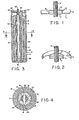
- FIG. 1 there is shown a in cross-section U-shaped cover 1 having an upwardly disposed peripheral skirt 3 and an inner upwardly disposed flange 5.
- the inner disposed flange 5 defines an opening 7 through which a centrally disposed electrode terminal 9 protrudes and is sealed to said flange 5 using a layer 11 of glass or ceramic bonded to both flange 5 and terminal 9.
- Skirt 3 is suitably adapted for being secured to the upper rim of a conventional cell can or container.
- Figure 2 shows a similar type in cross-section U-shaped cover-seal assembly as in Figure 1 except that the cover is inverted.
- the remaining components are identical and therefore have been identified with the same reference numbers.
- the preferable embodiment is the cover-seal assembly shown in Figure 1 because this type cover is easier to weld to the container than is an upright cover of Figure 2. Additionally, it has been found that venting is facilitated with this type of inverted cover-seal assembly as shown in Figure 1.
- FIG. 3 there is shown a cross-sectional view of a cylindrical cell comprising a cylindrical container 2 having disposed therein a cathode collector shell 4 in contact with the inner upstanding circumference of the container 2 thereby adapting the container as the cathodic or positive terminal for the cell.
- a separator liner 6 Disposed within and in contact with the inner circumference of cathode collector 4 is a separator liner 6 with its bottom separator or disc 10.
- the cathode collector material could be extruded within the container 2, rolled with the can material or composed of one or more segments to form a cylindrical tube and then placed in the can.
- a two member anode 12 is shown in Figures 3 and 4 comprising a first half cylindrical annular member 14 having flat end faces 16 and 18 and a second half cylindrical annular member 20 having flat end faces 22 and 24.
- a first half cylindrical annular member 14 having flat end faces 16 and 18
- a second half cylindrical annular member 20 having flat end faces 22 and 24.
- an axial opening 26 is defined between the half cylindrical annular members 14 and 20.
- arcuate type backing sheets 15 and 17, such as inert electrically conductive metal screens or grids, could be disposed against the inner surface wall of the anode bodies 14 and 20, respectively, to provide uniform current distribution over the anode. This will result in a substantially uniform consumption or utilization of the anode while also providing a substantially uniform spring pressure over the inner wall surface of the anode as will be discussed below.
- An electrically conductive spring strip 28 is appropriately bent into a flattened elliptically shaped member having extending ends 30.
- the legs 32, 34 of the conductive strip 28 are squeezed together and forced into the axial opening between the two screen backed anode members arranged in a container as shown in Figures 3 and 4.
- the inserted conductive spring strip 28 resilient biases the two anode members 14 and 20 via backing screens 15 and 17 so as to provide a substantially uniform and continuous pressure contact over the inner wall of the anode members.
- the extended ends 30 of spring strip 28 are shown projected above the surface of anode members 14 and 20 and containing a cylindrical terminal 36.
- Terminal 36 is shown protruding through flexible cover 38 and hermetically sealed to cover 38 using a layer of glass 40 bonded to said terminal 36 and the flange 42 of cover 38 as basically shown in Figure 1.
- the skirt 44 of cover 38 is welded to container 2 thereby adapting the container as a terminal of the cell while terminal 36 is adapted as the other terminal of the cell.
- the cathode-electrolyte comprising a suitable salt dissolved in an oxyhalide, a halide with a cosolvent, or mixtures thereof can be dispensed into the cell whereupon it can permeate through the anode, separator and cathode collector.
- the anode and cathode collector could be interchanged where possible, such that the anode would be disposed adjacent the inner wall of the cell's container and the cathode collector would be disposed within the anode and separated therefrom by a suitable separator as described above.
- Two 12,065 mm (0.475 inch) diameter containers were hermetically sealed using a cover-seal assembly as shown in Figure 1.
- the thickness of the cover for one cell was 0,118 mm (0.007 inch) and that for the second cell was 0,254 mm (0.010 inch), and both covers had a flange height of 1,524 mm (0.060 inch).
- the 0,118 mm (0.007 inch) cover had a flexing pressure (force at which distortion of the cover begins to occur) of 1273,48 kPa (170 psig) while the 0,254 mm (0.010 inch) cover had a flexing pressure of 2514,57 kPa (350 psig).
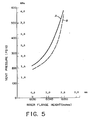
- Three glass-to-metal seal assemblies were produced using 11,43 mm (0.450 inch) diameter covers having an inner flange height of either 0,762 mm (0.030 inch), 1,016 mm (0.040 inch) or 1,27 mm (0.050 inch).
- a central terminal was bonded to the flange using a layer of a glass material measuring 1,905 mm (0.075 inch) high (glass ring).
- the cells were pressurized to determine the vent pressure and the results obtained are shown in Figure 5 as curve A.
- Three additional cells were constructed in a similar manner except that the layer of glass bonded to the central terminal and the flange was 1,524 mm (0.060 inch) high. Again the cells were pressurized to determine the vent pressure and the results obtained are shown in Figure 5 as curve B. These data show lower venting pressures were obtained with shorter glass beads and lower flange heights.
Landscapes
- Chemical & Material Sciences (AREA)
- Chemical Kinetics & Catalysis (AREA)
- Electrochemistry (AREA)
- General Chemical & Material Sciences (AREA)
- Sealing Battery Cases Or Jackets (AREA)
- Gas Exhaust Devices For Batteries (AREA)
Claims (14)
Applications Claiming Priority (2)
| Application Number | Priority Date | Filing Date | Title |
|---|---|---|---|
| US24821581A | 1981-03-27 | 1981-03-27 | |
| US248215 | 2002-12-27 |
Publications (2)
| Publication Number | Publication Date |
|---|---|
| EP0061725A1 EP0061725A1 (de) | 1982-10-06 |
| EP0061725B1 true EP0061725B1 (de) | 1985-10-09 |
Family
ID=22938161
Family Applications (1)
| Application Number | Title | Priority Date | Filing Date |
|---|---|---|---|
| EP82102484A Expired EP0061725B1 (de) | 1981-03-27 | 1982-03-25 | Hermetisch verschlossene elektrochemische Zelle mit Überdruckventil |
Country Status (3)
| Country | Link |
|---|---|
| EP (1) | EP0061725B1 (de) |
| JP (1) | JPS57174857A (de) |
| DE (1) | DE3266753D1 (de) |
Cited By (2)
| Publication number | Priority date | Publication date | Assignee | Title |
|---|---|---|---|---|
| CN110048053A (zh) * | 2019-04-10 | 2019-07-23 | 常州微宙电子科技有限公司 | 用于储能装置的外壳以及储能装置 |
| US20210280934A1 (en) * | 2018-11-23 | 2021-09-09 | Schott Ag | Electrical feedthrough glass-metal electrodes |
Families Citing this family (7)
| Publication number | Priority date | Publication date | Assignee | Title |
|---|---|---|---|---|
| JPS59192267U (ja) * | 1983-06-09 | 1984-12-20 | 日本電池株式会社 | 密閉形リチウム電池 |
| JPS59228357A (ja) * | 1983-06-09 | 1984-12-21 | Japan Storage Battery Co Ltd | 密閉形リチウム電池 |
| US4486514A (en) * | 1984-03-30 | 1984-12-04 | Union Carbide Corporation | Hermetically sealed galvanic cell having safety vent construction |
| US4572877A (en) * | 1985-06-27 | 1986-02-25 | Union Carbide Corporation | Hermetic seal for an electrochemical cell |
| US4672010A (en) * | 1986-07-18 | 1987-06-09 | Eveready Battery Company | Terminal pin-collector plate assembly for hermetically sealed cells |
| CN109980149B (zh) * | 2019-04-02 | 2024-06-11 | 常州微宙电子科技有限公司 | 用于储能装置的防爆外壳以及储能装置 |
| EP4571955A1 (de) * | 2023-12-11 | 2025-06-18 | Renata AG | Batterie |
Citations (1)
| Publication number | Priority date | Publication date | Assignee | Title |
|---|---|---|---|---|
| US4127702A (en) * | 1977-10-11 | 1978-11-28 | Catanzarite Vincent Owen | Self-venting battery |
Family Cites Families (2)
| Publication number | Priority date | Publication date | Assignee | Title |
|---|---|---|---|---|
| US4184010A (en) * | 1976-06-28 | 1980-01-15 | P. R. Mallory & Co. Inc. | Method for preventing explosion in thionyl chloride depolarizer cells |
| US4175166A (en) * | 1978-05-02 | 1979-11-20 | Power Conversion, Inc. | Sealed container construction capable of safely venting internal pressure |
-
1982
- 1982-03-25 DE DE8282102484T patent/DE3266753D1/de not_active Expired
- 1982-03-25 EP EP82102484A patent/EP0061725B1/de not_active Expired
- 1982-03-26 JP JP57048776A patent/JPS57174857A/ja active Pending
Patent Citations (2)
| Publication number | Priority date | Publication date | Assignee | Title |
|---|---|---|---|---|
| US4127702A (en) * | 1977-10-11 | 1978-11-28 | Catanzarite Vincent Owen | Self-venting battery |
| GB2005908A (en) * | 1977-10-11 | 1979-04-25 | Calanzarite V O | Selfventing battery |
Cited By (3)
| Publication number | Priority date | Publication date | Assignee | Title |
|---|---|---|---|---|
| US20210280934A1 (en) * | 2018-11-23 | 2021-09-09 | Schott Ag | Electrical feedthrough glass-metal electrodes |
| CN110048053A (zh) * | 2019-04-10 | 2019-07-23 | 常州微宙电子科技有限公司 | 用于储能装置的外壳以及储能装置 |
| CN110048053B (zh) * | 2019-04-10 | 2022-03-25 | 常州微宙电子科技有限公司 | 用于储能装置的外壳以及储能装置 |
Also Published As
| Publication number | Publication date |
|---|---|
| JPS57174857A (en) | 1982-10-27 |
| EP0061725A1 (de) | 1982-10-06 |
| DE3266753D1 (en) | 1985-11-14 |
Similar Documents
| Publication | Publication Date | Title |
|---|---|---|
| JP5504250B2 (ja) | 密封電気化学セルのための筐体 | |
| KR100317439B1 (ko) | 밀폐형2차전지 | |
| JP5269774B2 (ja) | 密閉通気シール及びアセンブリ | |
| US3081366A (en) | Sealed alkaline battery cell with automatic charging cut-off | |
| EP0360039B1 (de) | Dicht verschlossene flache Batterie mit hermetischer Dichtung | |
| HK1007633A1 (en) | Sealed battery | |
| EP0061725B1 (de) | Hermetisch verschlossene elektrochemische Zelle mit Überdruckventil | |
| EP0049080B1 (de) | Elektrochemische Zelle mit Sicherheitsventilverschluss und Verfahren zu ihrer Herstellung | |
| JPH06196150A (ja) | 電池および電池の製造方法 | |
| US6569562B1 (en) | Electrochemical cell with novel header assembly | |
| US3143441A (en) | Diaphragm valve for venting fluid | |
| US4486514A (en) | Hermetically sealed galvanic cell having safety vent construction | |
| EP0100487B1 (de) | Elektrochemische Zelle mit Sicherheitsventilverschluss und Verfahren zu ihrer Herstellung | |
| US4592970A (en) | Electrochemical cell having a safety vent closure | |
| EP0849818B1 (de) | Elektrochemische Zelle mit spiralförmig gewickelten Elektrodenblock mit mechanischer Stossbeständigkeit | |
| US4182028A (en) | Hermetically sealed button-type electrochemical cell and method for making same | |
| KR20020086470A (ko) | 망간 건전지 | |
| US4437231A (en) | Method of making an electrochemical cell having a safety vent closure | |
| EP0049081B1 (de) | Elektrochemische Zelle und Verfahren zur Herstellung | |
| US4476202A (en) | Two-piece cover-seal construction for galvanic cells | |
| US4971868A (en) | Hermetically sealed nonaqueous cell with positive terminal pin and perchlorate electrolyte | |
| US4672010A (en) | Terminal pin-collector plate assembly for hermetically sealed cells | |
| EP0125037A1 (de) | Elektrochemische Zelle | |
| US3262819A (en) | Sealed alkaline battery cells with excess gas pressure release | |
| EP0067278A1 (de) | Aussenseitig beschichtete hermetische Verschlüsse zur Verwendung bei elektrochemischen Zellen |
Legal Events
| Date | Code | Title | Description |
|---|---|---|---|
| PUAI | Public reference made under article 153(3) epc to a published international application that has entered the european phase |
Free format text: ORIGINAL CODE: 0009012 |
|
| AK | Designated contracting states |
Designated state(s): CH DE FR GB |
|
| 17P | Request for examination filed |
Effective date: 19820902 |
|
| GRAA | (expected) grant |
Free format text: ORIGINAL CODE: 0009210 |
|
| AK | Designated contracting states |
Designated state(s): CH DE FR GB LI |
|
| REF | Corresponds to: |
Ref document number: 3266753 Country of ref document: DE Date of ref document: 19851114 |
|
| ET | Fr: translation filed | ||
| PLBI | Opposition filed |
Free format text: ORIGINAL CODE: 0009260 |
|
| 26 | Opposition filed |
Opponent name: N.V. PHILIPS' GLOEILAMPENFABRIEKEN Effective date: 19860707 |
|
| PG25 | Lapsed in a contracting state [announced via postgrant information from national office to epo] |
Ref country code: LI Effective date: 19870331 Ref country code: CH Effective date: 19870331 |
|
| PLBM | Termination of opposition procedure: date of legal effect published |
Free format text: ORIGINAL CODE: 0009276 |
|
| STAA | Information on the status of an ep patent application or granted ep patent |
Free format text: STATUS: OPPOSITION PROCEDURE CLOSED |
|
| 27C | Opposition proceedings terminated |
Effective date: 19861208 |
|
| GBPC | Gb: european patent ceased through non-payment of renewal fee | ||
| PG25 | Lapsed in a contracting state [announced via postgrant information from national office to epo] |
Ref country code: FR Free format text: LAPSE BECAUSE OF NON-PAYMENT OF DUE FEES Effective date: 19871130 |
|
| REG | Reference to a national code |
Ref country code: CH Ref legal event code: PL |
|
| PG25 | Lapsed in a contracting state [announced via postgrant information from national office to epo] |
Ref country code: DE Effective date: 19871201 |
|
| REG | Reference to a national code |
Ref country code: FR Ref legal event code: ST |
|
| PG25 | Lapsed in a contracting state [announced via postgrant information from national office to epo] |
Ref country code: GB Effective date: 19881121 |