EP0061813A1 - Dynamic anaerobic equipment for waste water treatment - Google Patents
Dynamic anaerobic equipment for waste water treatment Download PDFInfo
- Publication number
- EP0061813A1 EP0061813A1 EP19820200373 EP82200373A EP0061813A1 EP 0061813 A1 EP0061813 A1 EP 0061813A1 EP 19820200373 EP19820200373 EP 19820200373 EP 82200373 A EP82200373 A EP 82200373A EP 0061813 A1 EP0061813 A1 EP 0061813A1
- Authority
- EP
- European Patent Office
- Prior art keywords
- mud
- equipment
- digestion
- waste water
- canalizations
- Prior art date
- Legal status (The legal status is an assumption and is not a legal conclusion. Google has not performed a legal analysis and makes no representation as to the accuracy of the status listed.)
- Withdrawn
Links
- 238000004065 wastewater treatment Methods 0.000 title 1
- 239000000463 material Substances 0.000 claims abstract description 10
- 238000011282 treatment Methods 0.000 claims description 15
- 238000013517 stratification Methods 0.000 claims description 6
- HUTDUHSNJYTCAR-UHFFFAOYSA-N ancymidol Chemical compound C1=CC(OC)=CC=C1C(O)(C=1C=NC=NC=1)C1CC1 HUTDUHSNJYTCAR-UHFFFAOYSA-N 0.000 claims 1
- 230000029087 digestion Effects 0.000 abstract description 16
- 244000005700 microbiome Species 0.000 abstract description 8
- VNWKTOKETHGBQD-UHFFFAOYSA-N methane Chemical compound C VNWKTOKETHGBQD-UHFFFAOYSA-N 0.000 description 14
- 239000000126 substance Substances 0.000 description 10
- 230000006641 stabilisation Effects 0.000 description 9
- 238000011105 stabilization Methods 0.000 description 9
- 238000000034 method Methods 0.000 description 8
- XLYOFNOQVPJJNP-UHFFFAOYSA-N water Substances O XLYOFNOQVPJJNP-UHFFFAOYSA-N 0.000 description 8
- 239000002028 Biomass Substances 0.000 description 5
- 230000015572 biosynthetic process Effects 0.000 description 5
- 239000007788 liquid Substances 0.000 description 5
- 238000004519 manufacturing process Methods 0.000 description 5
- 235000015097 nutrients Nutrition 0.000 description 4
- QVGXLLKOCUKJST-UHFFFAOYSA-N atomic oxygen Chemical compound [O] QVGXLLKOCUKJST-UHFFFAOYSA-N 0.000 description 3
- 239000007789 gas Substances 0.000 description 3
- 229910052760 oxygen Inorganic materials 0.000 description 3
- 239000001301 oxygen Substances 0.000 description 3
- 238000011084 recovery Methods 0.000 description 3
- 238000004062 sedimentation Methods 0.000 description 3
- 239000007787 solid Substances 0.000 description 3
- 230000009466 transformation Effects 0.000 description 3
- 101100165177 Caenorhabditis elegans bath-15 gene Proteins 0.000 description 2
- CURLTUGMZLYLDI-UHFFFAOYSA-N Carbon dioxide Chemical compound O=C=O CURLTUGMZLYLDI-UHFFFAOYSA-N 0.000 description 2
- 238000000605 extraction Methods 0.000 description 2
- WQYVRQLZKVEZGA-UHFFFAOYSA-N hypochlorite Chemical compound Cl[O-] WQYVRQLZKVEZGA-UHFFFAOYSA-N 0.000 description 2
- 238000007654 immersion Methods 0.000 description 2
- 238000011221 initial treatment Methods 0.000 description 2
- 238000002156 mixing Methods 0.000 description 2
- 231100000614 poison Toxicity 0.000 description 2
- 239000010865 sewage Substances 0.000 description 2
- 239000003381 stabilizer Substances 0.000 description 2
- 239000000725 suspension Substances 0.000 description 2
- 239000003440 toxic substance Substances 0.000 description 2
- 239000002351 wastewater Substances 0.000 description 2
- OKTJSMMVPCPJKN-UHFFFAOYSA-N Carbon Chemical compound [C] OKTJSMMVPCPJKN-UHFFFAOYSA-N 0.000 description 1
- CBENFWSGALASAD-UHFFFAOYSA-N Ozone Chemical group [O-][O+]=O CBENFWSGALASAD-UHFFFAOYSA-N 0.000 description 1
- 229910019142 PO4 Inorganic materials 0.000 description 1
- 239000002253 acid Substances 0.000 description 1
- 238000005842 biochemical reaction Methods 0.000 description 1
- 238000006065 biodegradation reaction Methods 0.000 description 1
- 229910052799 carbon Inorganic materials 0.000 description 1
- 229910002092 carbon dioxide Inorganic materials 0.000 description 1
- 239000001569 carbon dioxide Substances 0.000 description 1
- 230000001143 conditioned effect Effects 0.000 description 1
- 238000010276 construction Methods 0.000 description 1
- 230000008030 elimination Effects 0.000 description 1
- 238000003379 elimination reaction Methods 0.000 description 1
- 239000003337 fertilizer Substances 0.000 description 1
- 238000010438 heat treatment Methods 0.000 description 1
- 230000003301 hydrolyzing effect Effects 0.000 description 1
- 239000010842 industrial wastewater Substances 0.000 description 1
- 239000000203 mixture Substances 0.000 description 1
- 150000002823 nitrates Chemical class 0.000 description 1
- 229960003903 oxygen Drugs 0.000 description 1
- 230000000737 periodic effect Effects 0.000 description 1
- 235000021317 phosphate Nutrition 0.000 description 1
- 150000003013 phosphoric acid derivatives Chemical class 0.000 description 1
- 230000000750 progressive effect Effects 0.000 description 1
- 238000000746 purification Methods 0.000 description 1
- 230000029219 regulation of pH Effects 0.000 description 1
- 230000000717 retained effect Effects 0.000 description 1
- 238000000926 separation method Methods 0.000 description 1
- 238000004659 sterilization and disinfection Methods 0.000 description 1
Images


Classifications
-
- C—CHEMISTRY; METALLURGY
- C02—TREATMENT OF WATER, WASTE WATER, SEWAGE, OR SLUDGE
- C02F—TREATMENT OF WATER, WASTE WATER, SEWAGE, OR SLUDGE
- C02F3/00—Biological treatment of water, waste water, or sewage
- C02F3/02—Aerobic processes
- C02F3/08—Aerobic processes using moving contact bodies
- C02F3/082—Rotating biological contactors
-
- C—CHEMISTRY; METALLURGY
- C02—TREATMENT OF WATER, WASTE WATER, SEWAGE, OR SLUDGE
- C02F—TREATMENT OF WATER, WASTE WATER, SEWAGE, OR SLUDGE
- C02F3/00—Biological treatment of water, waste water, or sewage
- C02F3/02—Aerobic processes
- C02F3/12—Activated sludge processes
- C02F3/1278—Provisions for mixing or aeration of the mixed liquor
- C02F3/1284—Mixing devices
-
- C—CHEMISTRY; METALLURGY
- C02—TREATMENT OF WATER, WASTE WATER, SEWAGE, OR SLUDGE
- C02F—TREATMENT OF WATER, WASTE WATER, SEWAGE, OR SLUDGE
- C02F3/00—Biological treatment of water, waste water, or sewage
- C02F3/28—Anaerobic digestion processes
- C02F3/2806—Anaerobic processes using solid supports for microorganisms
-
- Y—GENERAL TAGGING OF NEW TECHNOLOGICAL DEVELOPMENTS; GENERAL TAGGING OF CROSS-SECTIONAL TECHNOLOGIES SPANNING OVER SEVERAL SECTIONS OF THE IPC; TECHNICAL SUBJECTS COVERED BY FORMER USPC CROSS-REFERENCE ART COLLECTIONS [XRACs] AND DIGESTS
- Y02—TECHNOLOGIES OR APPLICATIONS FOR MITIGATION OR ADAPTATION AGAINST CLIMATE CHANGE
- Y02W—CLIMATE CHANGE MITIGATION TECHNOLOGIES RELATED TO WASTEWATER TREATMENT OR WASTE MANAGEMENT
- Y02W10/00—Technologies for wastewater treatment
- Y02W10/10—Biological treatment of water, waste water, or sewage
Definitions
- the present invention relates to an equipment, which is able to operate by anaerobic way, waste water recovery treatments, such as the water purification, the mud stabilization or digestion and the nutrient removal.
- the primary treatment consists in the separation of the water to be purified from the sedimentable solids, which settle onto the bottom of a tank or a sedimentation channel in the form of mud.
- the secondary treatment in its turn consists in a biological depuration of the water and is usually carried out by aerobic way, that is in the presence of oxy gen, for example by periodically immerging and extracting from the water through suitable rotating supports, a flora of microorganisms which are able, in the immer sion phase, to feed on polluting organic substances contained in the water and, in the emerging phase in contact with the oxygen of the air, to cause the biodegradation of the organic substances which have been caught and their consequent transformation into biological mud which can settle.
- the tertiary treatment in its turn consists in the elimination of the nutrient substances, such as phosphates and nitrates, and in the disinfection, usually carried out by ozono or hypochlorite.
- the quaternary treatment finally consists in making the water drinkable.
- a process associated to that of water recovery is represented by the stabilization or "digestion" of the residual mud, mainly produced by the primary or sedimentation treatment and by the secondary or bioio gical depuration treatment.
- Such a process intended as a transformation of the constitutive components of mud into elementary substan ces or stable chemical radicals destined to various uses, for example as fertilizers, has a particular im portance, since its development by anaerobic way, that is without oxygen, give rise to a gas mixture, in which the methane gas is predominant.
- the mud anaerobic digestion is to be considered as, a process of biological and biochemical nature, to which microorganisms of anaerobic kind mainly take active part, even if microorganisms of other kind are not to be excluded.
- Said microorganisms operate on mud to be stabilized in such a way as to transform their organic substratum into methane and carbon dioxide, passing through some intermediate (hydrolitic, acid methanic) phases .
- the digestion process is also conditioned by various elements, such as PH, alkalinity, temperature, carbon/nutrient ratio, toxic substances and so on.
- the mud anaerobic digestion is executed in the inside of sealtight big tanks, where an agitator provides to keep in movement the solid-liquid mass to aid the mixing thereof and to prevent, on the con trary, the stratification, that is the formation of solids (digested mud) on the tank bottom, the formation of slime and mud (the so called “scum”) at the sur face and the formation of a liquid layer (the so called “overfloating”) between solids and scum.
- an agitator provides to keep in movement the solid-liquid mass to aid the mixing thereof and to prevent, on the con trary, the stratification, that is the formation of solids (digested mud) on the tank bottom, the formation of slime and mud (the so called “scum”) at the sur face and the formation of a liquid layer (the so called “overfloating”) between solids and scum.
- the main object of the present invention is to realize an equipment able to execute the mud anaerobic digestion with increased efficiency with respect to the presently used systems.
- a dynamic anaerobic equipment characterized in that it comprises at least one treatment stage including, in the inside of a closed well periodically fed with the material to be treated, a rotating device at least partially immerged in said material and provided with at least one group of shaped parallel e lements which define parallel canalizations developping in the direction of rotation of the group.
- Said rotating device is preferably followed by a rest zone, in which the stratification of the worked material is allowed.
- treatment stages can be two or more, arranged the one following the other in adjacent way.
- the equipment according to the invention allows a better and quicker digestion of the mud , with consequent improved stabilization and increased production of methane.
- the rotating device which is a member of it, not only provides for mud mixing, but thanks to the wide contact area assured by the various canalizations with which it is provided (and in which microorganisms stick to the walls of the shaped elements and the mud enter and exit in continuity) allows also an increased, continuous and repeated biological and biochemical exchange between the anaerobic microorganisms mass (or "biomass”) and the mud in the digestion phase.
- the equipment according to the invention not only leads itself to the mud digestion but also to the contemporaneous biological depuration of waste water or sewages and eventually to nutrient removal.
- sewage that is polluted liquid plus substances in suspension plus substances which can settle
- the final result is represented by stable mud and by the production of methane gas as in case of use as a simple stabilizer, and in addition by the formation of an overfloating with very reduced polluting charge, which requests correspondingly reduced expenses and equipments for the completing of the depuration process.
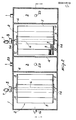
- the equipment illustrated in Figs. 1 and 2 includes two treatment stages situated the one following the other in the inside of a closed well 1, which can be laid partially or completely underground.
- a first stage includes a rotating device 2, followed by a rest zone 3 defined between two parallel vertical walls 4.
- the second stage is equal to the first one.
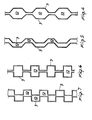
- the rotating device 2 whose constructive details are better shown in Figs. 3-7, comprises a plurality of groups of shaped elements, which are indicated in their assembly by the reference number 5 and are radially disposed (Fig. 1) with respect to an horizontal drive shaft 6 operated by a motor 7 through a reduction unit 8 (Fig. 2).
- the whole group of shaped elements 9 is situated between two end plates 11 and here retained by a pair of tie rods 12 reac ting betwwen a pair of radial strips 13 situated outside the plates 11 and opportunely fixed to disks 14 in their turn fixed on the shaft 6.
- the rotating device 2 of the first stage is rotated partially immerged in a bath of material to be worked 15, which is introduced into the well 1 through a feed mouth 16 provided with a suitable closure (not shown in the drawings). It is therefore possible to provide for its rotation in a condition of total immersion.
- the equipment is used as a simple mud stabilizer so that the bath 15 is formed exclusively by mud settled during a primary treatment of settling and by biological mud produced during a secondary treatment of biological depuration
- the above mentioned biomass continuously comes into contact with the mud which enter and exit from the canalizations 10 and by biological and biochemical reaction causes the progressive stabilization or "digestion" of the same mud and the consequent production of methane.
- the latter can be extracted through mouths 17 provided with suitable closure and safety devices (not shown in the drawings), while the partially worked mud, indicated with 22, set tie on the well bottom, under the rotating device of the first stage, or on the bottom of a following rest zone 3.
- Mouths 21 and 23 allow at the right moment the extraction of desired quantities of mud and overfloating, which are introdu ced in the second stage for a new cycle of stabilization. The scum in its turn is extracted through a mouth 20.
- the equipment is used on the contrary for the depuration of sewages and the stabilization of the relative muds, so that the bath 15 is formed by sewages. containing polluted liquid, substances in suspension and substances which can settle, the biomass attached to the walls of the shaped elements 9 produces also a biological depuration of the sewages, feeding on the polluting substances contained therein and causing the transformation thereof into mud of which the same biomass causes the stabilization. It is produced methane again and in the rest zones 3 the worked material becomes stratified, creating between the scum and the di gested mud an overfloating at low polluting charge, which, if necessary, can then be brought to a complete depuration by equipments of low cost.
Landscapes
- Life Sciences & Earth Sciences (AREA)
- Microbiology (AREA)
- Biodiversity & Conservation Biology (AREA)
- Hydrology & Water Resources (AREA)
- Engineering & Computer Science (AREA)
- Environmental & Geological Engineering (AREA)
- Water Supply & Treatment (AREA)
- Chemical & Material Sciences (AREA)
- Organic Chemistry (AREA)
- Health & Medical Sciences (AREA)
- Molecular Biology (AREA)
- Treatment Of Sludge (AREA)
Applications Claiming Priority (2)
| Application Number | Priority Date | Filing Date | Title |
|---|---|---|---|
| IT2088381 | 1981-04-01 | ||
| IT2088381A IT1137206B (it) | 1981-04-01 | 1981-04-01 | Apparecchiatura dinamica di tipo anaerobio per il trattamento delle acque di scarico |
Publications (1)
| Publication Number | Publication Date |
|---|---|
| EP0061813A1 true EP0061813A1 (en) | 1982-10-06 |
Family
ID=11173510
Family Applications (1)
| Application Number | Title | Priority Date | Filing Date |
|---|---|---|---|
| EP19820200373 Withdrawn EP0061813A1 (en) | 1981-04-01 | 1982-03-26 | Dynamic anaerobic equipment for waste water treatment |
Country Status (2)
| Country | Link |
|---|---|
| EP (1) | EP0061813A1 (it) |
| IT (1) | IT1137206B (it) |
Cited By (1)
| Publication number | Priority date | Publication date | Assignee | Title |
|---|---|---|---|---|
| CN109336248A (zh) * | 2018-12-12 | 2019-02-15 | 刘鹏 | 一种生化污水处理池的曝气系统 |
Citations (4)
| Publication number | Priority date | Publication date | Assignee | Title |
|---|---|---|---|---|
| US3232865A (en) * | 1962-06-11 | 1966-02-01 | Johns Manville | Method of purifying waste water |
| US4013559A (en) * | 1975-11-19 | 1977-03-22 | Johnson Rollin W | Prefabricated panels for sub-surface sewage effluent and waste water disposal |
| GB2035284A (en) * | 1978-11-13 | 1980-06-18 | Goodrich Co B F | Trickle filter medium for sewage treatment |
| CA1080862A (en) * | 1977-12-06 | 1980-07-01 | 3014593 Nova Scotia Company | Septic tank |
-
1981
- 1981-04-01 IT IT2088381A patent/IT1137206B/it active
-
1982
- 1982-03-26 EP EP19820200373 patent/EP0061813A1/en not_active Withdrawn
Patent Citations (4)
| Publication number | Priority date | Publication date | Assignee | Title |
|---|---|---|---|---|
| US3232865A (en) * | 1962-06-11 | 1966-02-01 | Johns Manville | Method of purifying waste water |
| US4013559A (en) * | 1975-11-19 | 1977-03-22 | Johnson Rollin W | Prefabricated panels for sub-surface sewage effluent and waste water disposal |
| CA1080862A (en) * | 1977-12-06 | 1980-07-01 | 3014593 Nova Scotia Company | Septic tank |
| GB2035284A (en) * | 1978-11-13 | 1980-06-18 | Goodrich Co B F | Trickle filter medium for sewage treatment |
Cited By (2)
| Publication number | Priority date | Publication date | Assignee | Title |
|---|---|---|---|---|
| CN109336248A (zh) * | 2018-12-12 | 2019-02-15 | 刘鹏 | 一种生化污水处理池的曝气系统 |
| CN109336248B (zh) * | 2018-12-12 | 2021-08-24 | 九江齐治水务有限公司 | 一种生化污水处理池的曝气系统 |
Also Published As
| Publication number | Publication date |
|---|---|
| IT1137206B (it) | 1986-09-03 |
| IT8120883A0 (it) | 1981-04-01 |
Similar Documents
| Publication | Publication Date | Title |
|---|---|---|
| US5616241A (en) | Treatment of wastewater and sludges | |
| US6015496A (en) | In-sewer treatment of wastewater and sludges | |
| US4042493A (en) | Phosphate removal from BOD-containing wastewater | |
| US3904525A (en) | Waste treatment apparatus | |
| CN102464436B (zh) | 污水处理装置 | |
| US4530762A (en) | Anaerobic reactor | |
| CA1241129A (en) | Staged anaerobic reactor | |
| US5514277A (en) | Treatment of wastewater and sludges | |
| US4029575A (en) | Phosphorus removal from waste water | |
| US4183808A (en) | Phosphate removal from wastewater | |
| EP0051888A1 (en) | Process for the purification of waste water and/or waste water sludge | |
| EP1966094B1 (en) | Apparatus for treatmenting of sewage using semi-batch and method thereof | |
| EP0487705B1 (en) | Process for the removal of hydrogensulphide (h2s) from biogas | |
| GB2143810A (en) | Process for biological reduction of sulphur oxides | |
| US4584271A (en) | Bacterial regeneration apparatus and process | |
| US3409545A (en) | Waste treatment process and process and apparatus for recovering lime | |
| EP0262107B1 (en) | Anaerobic process | |
| EP0061813A1 (en) | Dynamic anaerobic equipment for waste water treatment | |
| US4175041A (en) | Apparatus for degassing floating sludge | |
| CA1155976A (en) | Apparatus for anoxic-aerobic activated sludge process and treatment of waste waters | |
| DE3627253C2 (de) | Verfahren zur biologischen Behandlung von organische Stoffe enthaltenden Substraten | |
| NO157134B (no) | Anordning for rensing av avloepsvann ved hjelp av anaerobisk fermentering. | |
| Coley et al. | Treatment of parathion wastes and other organics | |
| GB1579277A (en) | Installation for anaerobic purification of waste water | |
| KR102400072B1 (ko) | 기포발생장치 및 이를 포함하는 하폐수 정화 장치 |
Legal Events
| Date | Code | Title | Description |
|---|---|---|---|
| PUAI | Public reference made under article 153(3) epc to a published international application that has entered the european phase |
Free format text: ORIGINAL CODE: 0009012 |
|
| AK | Designated contracting states |
Designated state(s): AT BE CH DE FR GB IT LU NL SE |
|
| STAA | Information on the status of an ep patent application or granted ep patent |
Free format text: STATUS: THE APPLICATION IS DEEMED TO BE WITHDRAWN |
|
| 18D | Application deemed to be withdrawn |
Effective date: 19830912 |
|
| RIN1 | Information on inventor provided before grant (corrected) |
Inventor name: DI BELLO, CARMINE |