EP0061896B1 - Erntegerät für Futterpflanzen - Google Patents
Erntegerät für Futterpflanzen Download PDFInfo
- Publication number
- EP0061896B1 EP0061896B1 EP82301563A EP82301563A EP0061896B1 EP 0061896 B1 EP0061896 B1 EP 0061896B1 EP 82301563 A EP82301563 A EP 82301563A EP 82301563 A EP82301563 A EP 82301563A EP 0061896 B1 EP0061896 B1 EP 0061896B1
- Authority
- EP
- European Patent Office
- Prior art keywords
- chassis
- forage
- trailer
- container
- chassis part
- Prior art date
- Legal status (The legal status is an assumption and is not a legal conclusion. Google has not performed a legal analysis and makes no representation as to the accuracy of the status listed.)
- Expired
Links
- 239000004459 forage Substances 0.000 title claims abstract description 90
- 238000003306 harvesting Methods 0.000 claims abstract description 50
- 238000010168 coupling process Methods 0.000 claims description 30
- 238000005859 coupling reaction Methods 0.000 claims description 30
- 230000008878 coupling Effects 0.000 claims description 29
- 239000012530 fluid Substances 0.000 claims description 8
- 230000002787 reinforcement Effects 0.000 description 6
- 241001124569 Lycaenidae Species 0.000 description 2
- 238000010276 construction Methods 0.000 description 2
- 230000000694 effects Effects 0.000 description 2
- 238000000926 separation method Methods 0.000 description 2
- 230000004308 accommodation Effects 0.000 description 1
- 230000004323 axial length Effects 0.000 description 1
- 238000007599 discharging Methods 0.000 description 1
- 230000005484 gravity Effects 0.000 description 1
- 238000003780 insertion Methods 0.000 description 1
- 230000037431 insertion Effects 0.000 description 1
- 244000144972 livestock Species 0.000 description 1
- 238000000034 method Methods 0.000 description 1
- 230000003014 reinforcing effect Effects 0.000 description 1
- 238000007789 sealing Methods 0.000 description 1
- 238000006467 substitution reaction Methods 0.000 description 1
Images

Classifications
-
- A—HUMAN NECESSITIES
- A01—AGRICULTURE; FORESTRY; ANIMAL HUSBANDRY; HUNTING; TRAPPING; FISHING
- A01D—HARVESTING; MOWING
- A01D90/00—Vehicles for carrying harvested crops with means for selfloading or unloading
- A01D90/02—Loading means
Definitions
- the present invention relates in general to forage harvesting apparatus, and in particular to forage harvesting apparatus capable of being converted for use as a general purpose trailer when not being used for forage harvesting.
- Known forage harvesters comprise a mechanism for picking up the crop and for cutting and/or chopping the crop and conveying it to a container.
- This container may be on the forage harvester itself or may be on a separate trailer drawn alongside the forage harvester.
- forage harvesting mechanism will be understood to refer to a mechanism for picking up, cutting and/or chopping and conveying cut and/or chopped forage crop to a container.
- Austrian Patent No. 243 177 there is described a machine arranged to be drawn by a separate tractor vehicle and comprising a trailer having a demountable forage harvester mechanism allowing the trailer to be used for other purposes.
- the present invention seeks to provide forage harvesting apparatus in which a trailer of much simpler construction, which does not need the provision of steerable wheels is employed.
- forage harvesting apparatus adapted to be drawn behind a tractor vehicle and to collect a forage crop in a container of the apparatus, comprising a trailer frame having a single axle or being close-coupled and carrying the container and a forage harvester mechanism removably attachable to the trailer frame and operable to deliver cut and/or chopped forage crop through delivery means on the mechanism when the machine is operated, the forage harvester mechanism being demountable from the trailer frame to allow the latter to be used as an independent trailer without the forage harvester mechanism, characterised in that the forage harvester mechanism is mounted on and carried by the trailer frame so that the latter carries the weight of said mechanism in that the trailer frame has attachment means by which the forage harvester mechanism is attached thereto, the said attachment means including means by which the forage harvester mechanism can be displaced between a raised transport position and a lowered working position, and in that the container is pivotally connected to the trailer frame at or adjacent the rear thereof so that the container is tippable with respect to the trailer frame, a
- the trailer part of the apparatus can thus be used as a general purpose trailer throughout the year and adapted for its forage harvesting purpose by the addition of the forage harvesting mechanism at the appropriate time. This avoids the necessity for the whole of the forage harvester to be idle throughout the year so that the capital invested in the machine can be better utilised.
- close-coupled will be understood to refer to a trailer having a rigid trailer frame and two pairs of wheels on axles which are not pivotable with respect to the trailer frame for steering or cornering purposes, and the wheels of the two axles of which are sufficiently closely spaced in a longitudinal direction as to permit turning of the trailer without the need for such pivotting movement of the axles.
- the forage harvesting mechanism must have means for coupling a suitable drive shaft thereto from the tractor and this coupling preferably accommodates changes in the position of the forage harvesting mechanism between a lowered, cutting position and a raised, transport position on the trailer chassis.
- the wheeled support for the container comprises a single axle or close-coupled trailer frame having a chassis including a first chassis part on which the container is carried, and a second chassis part on which the forage harvesting mechanism is releasably mounted, the said second chassis part being movable with respect to the first chassis part between a first position in which the machine is adapted to receive and support the forage harvesting mechanism and a second position in which it is adapted for use as an independent single axle or close-coupled trailer.
- the longitudinal extension of the chassis is preferably provided by means of telescopically extendable longitudinal chassis members.
- the said telescopically extendable longitudinal chassis members may be channel section members which can partly surround respective relatively fixed longitudinal members of the first chassis part which are carried by the wheels of the trailer vehicle.
- the telescopically extendable longitudinal members and the fixed chassis members may be interconnected by a rack and pinion -coupling mechanism so arranged that rotation of the pinion of the rack and pinion coupling mechanism causes relative longitudinal movement between the said fixed chassis members and the said extendable chassis members.
- the rack of the rack and pinion coupling mechanism may be formed on or carried by the fixed chassis members whilst the pinion cooperating therewith may be mounted so as to be rotatable on, but longitudinally fixed with respect to the extendable chassis members.
- the rack of the rack and pinion coupling may be secured on or formed by one or more of the extendable chassis members, whilst the or each pinion of the rack and pinion coupling may be mounted on one of the fixed chassis members for rotation therewith.
- chassis members there are two longitudinally extendable chassis members, one on either side of the fixed part of the chassis itself, each being coupled to an associated longitudinal chassis member by a respective rack and pinion coupling, the pinions of the two rack and pinion couplings being mounted on a common shaft for rotation together.
- the longitudinally movable chassis members are extended and locked in position to provide accommodation for the forage harvesting mechanism which can be mounted on suitable mounting brackets or plates provided on the movable chassis members.
- the cutter mechanism can be simply removed and the chassis retracted to enable the trailerto be used for any other purpose.
- the discharge of forage from the container may be effected either by tipping the container with respect to the chassis, or by means of a discharge conveyor located in the container.
- the container is a tipping container since a screw discharge auger may constitute a disadvantage for use of the trailer for other purposes particularly if, for example, it may be desired to carry livestock in the trailer.
- a forage harvesting machine is characterised in that the wheeled support for the container comprises a single axle or close-coupled trailer frame having a chassis including a first chassis part on which the container is carried and a second chassis part on which the forage harvesting mechanism is mounted, the second chassis part including a towing coupling and being removably connected to the first chassis part, there being provided a third chassis part having a towing coupling thereon and which is interchangeable with the second chassis part to adapt the machine for use as an independent single axle or close-coupled trailer.
- the forage harvesting machine may be more particularly characterised in that the wheeled support is a close-coupled trailer frame and the said first chassis part includes a container support frame pivotally mounted on a twin-wheel bogie and there are provided means for locking the container support frame with respect to the bogie to prevent relative turning movement thereof in at least one directional sense.
- the said locking means include an adjustable wedge which can be interposed between a main frame member of the bogie and the container support frame of the first chassis part of the close-coupled trailerframe, on one side of the pivotal connection between the said container support frame and the bogie.
- This latter embodiment may be further characterised in that the container is pivotally connected to the container support frame at or adjacent the rear thereof so that the container is tippable with respect to the chassis, a fluid pressure actuator for controlling the inclination of the container with respect to the chassis being provided, this actuator having a coupling by which it can be connected to a fluid pressure source on a tractor vehicle, means being provided for locking the container in an elevated or tipped position with respect to the chassis in sucha way that the trailer is balanced on the bogie when the locking wedge is interposed between the said container support frame and the bogie itself.
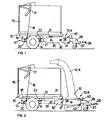
- the machine illustrated generally comprises a trailer part, and a forage harvesting mechanism generally indicated 12.
- the forage harvesting mechanism can be one of a number of commercially available types and the construction of it will not be described in more detail herein as it does not form part of the present invention.
- the trailer part comprises a lower chassis part generally indicated 13 mounted on a pair of ground-engaging wheels 14 and carrying an upper chassis part generally indicated 15 on which is mounted a container 16 having four generally upright sides and an open top.
- the rear wall of the container 16 is pivoted at its upper edge to the side walls, and can be swung open from the bottom by means of a lever arrangement 17 operated by a cord 18.
- the upper chassis part 15 is pivoted to the lower chassis part 13 at the rear end thereof, for which purpose the upper chassis part carries two downwardly projecting lugs 19which are rigidly secured to the upper chassis part 15 and pivoted to the lower chassis part 13 by pivots 20.
- Means such as an hydraulic ram are connected between the upper and lower chassis parts forward of the road wheels 14 for controlling the angular orientation of the upper chassis part 15 with respect to the lower chassis part 13 whereby to effect tipping of the container 16 for emptying its contents when required.
- the cord 18 is secured at its lower end to the corner chassis part so that the rear wall or tail gate of the container 16 is opened automatically as the container 16 is tipped.
- the container 16 could be provided with a screw auger or other conveyor for discharging its contents either laterally or rearwardly, for which purpose the container 16 would be provided with an opening and a discharge chute either in a side wall or in the rear wall.
- the lower chassis part 13 comprises two main longitudinal beam members 21 interconnected by a number of transverse struts 22, only one of which is shown in Figure 3.
- the beam members 21 are channel section members located with the open side of the channel facing outwardly, that is with the web of the channel facing the other longitudinal fixed beam member 21.
- the upper flange of the beam members 21 carries a plurality of spaced stub columns 23 which form supports for the longitudinal members of the upper chassis part 15 when this is lowered to its normal working position.
- a forward portion 13a of the lower chassis part 13, is extendable with respect to the fixed portion carrying the ground engaging wheels 14, and comprises two box section longitudinal members 24 joined at their forward ends by a transverse strut 25 carrying a central forward projecting arm 26 to the lower side of which is connected a box section support 27 carrying a telescopically adjustable towing coupling 28 which, in the illustrated embodiment, comprises a ring for an agricultural coupling.
- the strut 26 is reinforced by triangular reinforcing plates 29 at its coupling with the transverse strut 25 to accommodate transverse loads.
- the two longitudinally extendable box section members 24 are of dimensions to fit slidingly within the channel section fixed longitudinal members 21, and they carry reinforcement plates 30 on the outer faces thereof.
- the shaft 32 carries a pair of straight cut pinions 34 at a position slightly inboard of the lugs 31, which pinions mesh with respective racks 35 formed on the upper edge of rack plates 36 which are secured to the inner faces of the fixed longitudinal chassis members 21 at positions slightly rearwardly of the forward end of these chassis members.
- the longitudinal fixed chassis members 21, the extendable chassis members 24 and the reinforcement plates 30 have two sets of holes which are aligned with one another in the extended and retracted positions of the chassis.
- a bolt 37 passes through these aligned holes to fix the chassis in its extended or its retracted position.
- a suitable reinforcement plate is secured over the aligned holes in the form of a washer.
- a similar locking bolt is provided at the rear end of the reinforcement plate 30, and indicated 39 in the drawings.
- the forage harvesting mechanism can be mounted, on lugs 40 carried by the extendable part of the chassis for this purpose, and the equipment is then usable as a forage harvester to be towed, via the towing coupling 28, by a tractor vehicle which also drives the forage chopping mechanism via a power take-off shaft and coupling (not shown).
- the forage chopping mechanism 12 cuts and chops the crop and delivers it through a chute 12a into the open upper end of the container 16 from which it can be discharged by tipping the container 16 on the upper chassis 15 with respect to the lower chassis 13.
- the forage harvesting mechanism 12 When the machine is no longer required for forage harvesting the forage harvesting mechanism 12 can be removed from the lugs 40.
- the securing bolts 37, 39 can then be removed, and by means of a suitable tool engaged on the splined end 33 of the shaft 32 the two pinions 34 can be caused to rotate to carry them along the rack 35 on the rack plate 36.
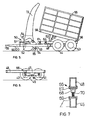
- a forage harvester having a twin wheel bogie is illustrated.
- the bogie has two axles 41, 42 each with a respective pair of ground-engaging wheels 43, 44 at each end thereof.
- the axles are interconnected by respective main frame members 45 of the bogie, which are pivotally connected at an intermediate point 46 to a lug 47 carried by a fixed longitudinal member 48 of a chassis main frame.
- the chassis is formed in two parts, a first part of which the frame member 48 constitutes a longitudinal beam, and a second part generally indicated 49 which supports a forage harvesting mechanism generally indicated 50 by means of a system of linkage levers 51, 52 which constitute a quadrilateral linkage between the forage harvester mechanism 50 and the second chassis part 49.
- a fluid pressure actuator 53 interconnects the second chassis part 49 and the forage harvester mechanism 50, and extension and retraction of the actuator effects raising and lowering of the forage harvester mechanism 50 with respect to the chassis of the forage harvester machine.
- the quadrilateral linkage 51, 52 ensures that the forage harvesting mechanism is tilted slightly as it is raised so that a chute 73 is inclined slightly forwardly as the mechanism is raised and a coupling 54 for connection to a power take-off shaft of a tractor vehicle follows a curved path centred on the coupling point on a tractor vehicle so that raising and lowering of the forage harvesting mechanism can be effected with the tractor vehicle connected by the coupling shaft to the forage harvesting mechanism.
- a container 55 in the form of an open sided box is pivotally mounted by a pivot 56 to the rear of the first chassis part 48 and a fluid pressure actuator 57, preferably a hydraulic actuator, interconnects the first chassis part 48 with a lower support frame 58 of the container 55.
- a fluid pressure actuator 57 preferably a hydraulic actuator
- the chassis of the forage harvester is thus formed in two parts, comprising the first chassis part 48 supported via the bogie on the ground engaging wheels 43, 44 and a second chassis part 49 which carries the forage harvesting mechanism 50 and includes a coupling attachment 59 for connecting the harvester to a towing vehicle (not shown) and a jockey wheel 60 for maintaining the harvester in a desired orientation when the forage harvesting mechanism 50 is in its raised position (so that the wheels of the forage harvesting mechanism are lifted from the ground) and the harvester is not coupled to a tractor vehicle.
- the second chassis part is connected to the first chassis part 48 by means of two lugs 61, 62 on each longitudinal frame member of the second chassis part 49, these having holes therein through which pass respective bolts which also pass through cooperating aligned holes (not shown) in the main frame members 48 of the first chassis part.
- a strut 63 pivotally mounted on the underside of the container support frame 58 is engagable on the first chassis part 48 to hold the container 55 in the tipped position in which it is illustrated in Figure 5, corresponding to extension of the hydraulic actuator 57 even when the connection to the fluid pressure source on the tractor vehicle is disconnected. This serves as a safety feature and reduces the sealing requirements on the coupling to the actuator 57.
- a plate 64 and locking pin 65 are provided for locking the forage harvesting mechanism 50 in its lowered position where its own ground-engaging wheels are in contact with the ground so that when the first and second trailer parts are separated by releasing the bolts passing through the holes in the lugs 61, 62 the second trailer part can be withdrawn and conveyed on these ground-engaging wheels and the jockey wheel 60.
- the first trailer pal-: 48 would now turn about the pivot 46 with respect to the bogie 45 and, in order to prevent this an adjustable locking wedge 66 is provided, this being interpositioned between the forward end of the main bogie frame member 45 and the main frame member 48 of the chassis part.
- This moves the effective pivot point between the first chassis part and the bogie to a vertical position passing through the axis of the forward wheel 44 and the dimensions of the trailer are so chosen that the centre of gravity of the trailer with the container 55 tipped lies between this axle 42 and the pivot point 46 so that the trailer will remain balanced on the two ground-engaging wheels 43, 44.
- a draw bar suitably shaped to span the free ends of the forwardly projecting main frame members 48 of the first chassis part, and itself constituting a third chassis part can now be positioned in substitution for the second chassis part carrying the forage harvesting mechanism 50.
- the same bolt holes as those which secure the lugs 61, 62 in position can be used for this third chassis part.
- FIG. 7 the configuration of suitable adjustable locking wedge 66 is illustrated.
- This comprises a channel section upper support platform 67 having a downwardy projecting boss 68 with an internally threaded blind recess.
- An angle section foot 69 has an upwardly projecting threaded column 70 which is engaged in the blind threaded opening of the boss 68.
- the boss 68 is turnable with respect to the support platform 67 so that adjustment to the vertical separation between the foot 69 and the support platform 67 can be effected by turning the boss 68 with respect to column 70.
- the boss 68 is conveniently provided with a hexagonal cross section for engagement with a conventional key or wrench.
- Adjustment can be effected, once the wedge is located in position, in order to ensure there is no slack in its position prior to separation of the bolts holding the lugs 61, 62 to the main frame members of the first chassis part 48; indeed, by slightly taking the weight of the main chassis part 48 release of the bolts holding the lugs 61, 62 can be facilitated.
- Insertion of the wedge 66 is effected by introducing the platform 67 under the main beams 48 and sliding the angle section foot 69 which comprises a support platform and lateral flange sideways into engagement with the main longitudinal member 45 of the bogie.
Landscapes
- Life Sciences & Earth Sciences (AREA)
- Environmental Sciences (AREA)
- Harvesting Machines For Specific Crops (AREA)
- Acyclic And Carbocyclic Compounds In Medicinal Compositions (AREA)
Claims (9)
Priority Applications (1)
| Application Number | Priority Date | Filing Date | Title |
|---|---|---|---|
| AT82301563T ATE24089T1 (de) | 1981-03-28 | 1982-03-24 | Erntegeraet fuer futterpflanzen. |
Applications Claiming Priority (2)
| Application Number | Priority Date | Filing Date | Title |
|---|---|---|---|
| GB8109799 | 1981-03-28 | ||
| GB8109799 | 1981-03-28 |
Publications (2)
| Publication Number | Publication Date |
|---|---|
| EP0061896A1 EP0061896A1 (de) | 1982-10-06 |
| EP0061896B1 true EP0061896B1 (de) | 1986-12-10 |
Family
ID=10520740
Family Applications (1)
| Application Number | Title | Priority Date | Filing Date |
|---|---|---|---|
| EP82301563A Expired EP0061896B1 (de) | 1981-03-28 | 1982-03-24 | Erntegerät für Futterpflanzen |
Country Status (4)
| Country | Link |
|---|---|
| EP (1) | EP0061896B1 (de) |
| AT (1) | ATE24089T1 (de) |
| DE (1) | DE3274616D1 (de) |
| IE (1) | IE52836B1 (de) |
Family Cites Families (2)
| Publication number | Priority date | Publication date | Assignee | Title |
|---|---|---|---|---|
| AT243177B (de) * | 1964-03-13 | 1965-10-25 | Karl Kirchner Fa | Für Traktorzug eingerichtete Ladeeinrichtung für Grün- oder Trockenfutter |
| DE2020229A1 (de) * | 1970-04-25 | 1971-11-18 | Mengele & Soehne Masch Karl | Selbstfahrender Erntesammelwagen |
-
1982
- 1982-03-24 EP EP82301563A patent/EP0061896B1/de not_active Expired
- 1982-03-24 AT AT82301563T patent/ATE24089T1/de not_active IP Right Cessation
- 1982-03-24 DE DE8282301563T patent/DE3274616D1/de not_active Expired
- 1982-03-25 IE IE707/82A patent/IE52836B1/en unknown
Also Published As
| Publication number | Publication date |
|---|---|
| EP0061896A1 (de) | 1982-10-06 |
| DE3274616D1 (en) | 1987-01-22 |
| IE820707L (en) | 1982-09-28 |
| IE52836B1 (en) | 1988-03-16 |
| ATE24089T1 (de) | 1986-12-15 |
Similar Documents
| Publication | Publication Date | Title |
|---|---|---|
| US4573309A (en) | Pull-type windrower | |
| CA2306310C (en) | Agricultural vehicle and implement with wheels | |
| US7197865B1 (en) | Self contained transport for crop harvesting header | |
| US3720047A (en) | Universal tractors | |
| CA1268071A (en) | Agricultural planter | |
| US7090066B2 (en) | Unloading system for particulate material | |
| US4496004A (en) | Rearwardly folding agricultural implement | |
| US4526265A (en) | Large conveyor assemblies for detachable mounting to a tractor | |
| US5970695A (en) | Self contained transport for crop harvesting header | |
| US20050123385A1 (en) | Unloading system for particulate material | |
| US4662161A (en) | Pull-type windrower | |
| US4662162A (en) | Tomato harvester | |
| US3279158A (en) | Transportable harvester | |
| US3523699A (en) | Implement carrier | |
| US4455034A (en) | Transport device for pull-type swathers and the like | |
| US4084394A (en) | Harvester | |
| AU2006246475B2 (en) | Self contained transport for harvesting header | |
| US4221508A (en) | Crop harvester spout control improvements | |
| CA2245213C (en) | Self contained transport for crop harvesting header | |
| US5528890A (en) | Sprig harvester with pivoting elevator | |
| US4584826A (en) | Tomato harvester | |
| US2702193A (en) | Two-wheel steerable vehicle | |
| DE102004059038B4 (de) | Kombination aus einer Erntemaschine, einem Erntevorsatz und einem Wagen zur Abstützung des Erntevorsatzes | |
| EP3603376B1 (de) | Erntemaschine mit einem erntevorsatz und einem stützrad | |
| DE1482111A1 (de) | Anbauvorrichtung fuer den Seitenanbau von landwirtschaftlichen Geraeten an einen Ackerschlepper |
Legal Events
| Date | Code | Title | Description |
|---|---|---|---|
| PUAI | Public reference made under article 153(3) epc to a published international application that has entered the european phase |
Free format text: ORIGINAL CODE: 0009012 |
|
| AK | Designated contracting states |
Designated state(s): AT BE DE FR GB IT SE |
|
| 17P | Request for examination filed |
Effective date: 19830422 |
|
| R17P | Request for examination filed (corrected) |
Effective date: 19830331 |
|
| GRAA | (expected) grant |
Free format text: ORIGINAL CODE: 0009210 |
|
| AK | Designated contracting states |
Kind code of ref document: B1 Designated state(s): AT BE DE FR GB IT SE |
|
| PG25 | Lapsed in a contracting state [announced via postgrant information from national office to epo] |
Ref country code: IT Free format text: LAPSE BECAUSE OF FAILURE TO SUBMIT A TRANSLATION OF THE DESCRIPTION OR TO PAY THE FEE WITHIN THE PRESCRIBED TIME-LIMIT;WARNING: LAPSES OF ITALIAN PATENTS WITH EFFECTIVE DATE BEFORE 2007 MAY HAVE OCCURRED AT ANY TIME BEFORE 2007. THE CORRECT EFFECTIVE DATE MAY BE DIFFERENT FROM THE ONE RECORDED. Effective date: 19861210 Ref country code: BE Effective date: 19861210 Ref country code: AT Effective date: 19861210 |
|
| REF | Corresponds to: |
Ref document number: 24089 Country of ref document: AT Date of ref document: 19861215 Kind code of ref document: T |
|
| PG25 | Lapsed in a contracting state [announced via postgrant information from national office to epo] |
Ref country code: SE Effective date: 19861231 |
|
| REF | Corresponds to: |
Ref document number: 3274616 Country of ref document: DE Date of ref document: 19870122 |
|
| ET | Fr: translation filed | ||
| PLBE | No opposition filed within time limit |
Free format text: ORIGINAL CODE: 0009261 |
|
| STAA | Information on the status of an ep patent application or granted ep patent |
Free format text: STATUS: NO OPPOSITION FILED WITHIN TIME LIMIT |
|
| 26N | No opposition filed | ||
| PGFP | Annual fee paid to national office [announced via postgrant information from national office to epo] |
Ref country code: FR Payment date: 19900309 Year of fee payment: 9 |
|
| PGFP | Annual fee paid to national office [announced via postgrant information from national office to epo] |
Ref country code: GB Payment date: 19900331 Year of fee payment: 9 |
|
| PGFP | Annual fee paid to national office [announced via postgrant information from national office to epo] |
Ref country code: DE Payment date: 19900529 Year of fee payment: 9 |
|
| PG25 | Lapsed in a contracting state [announced via postgrant information from national office to epo] |
Ref country code: GB Effective date: 19910324 |
|
| GBPC | Gb: european patent ceased through non-payment of renewal fee | ||
| PG25 | Lapsed in a contracting state [announced via postgrant information from national office to epo] |
Ref country code: FR Effective date: 19911129 |
|
| PG25 | Lapsed in a contracting state [announced via postgrant information from national office to epo] |
Ref country code: DE Effective date: 19920101 |
|
| REG | Reference to a national code |
Ref country code: FR Ref legal event code: ST |