EP0061913A2 - Herbicidal heterooxybenzenes - Google Patents
Herbicidal heterooxybenzenes Download PDFInfo
- Publication number
- EP0061913A2 EP0061913A2 EP82301610A EP82301610A EP0061913A2 EP 0061913 A2 EP0061913 A2 EP 0061913A2 EP 82301610 A EP82301610 A EP 82301610A EP 82301610 A EP82301610 A EP 82301610A EP 0061913 A2 EP0061913 A2 EP 0061913A2
- Authority
- EP
- European Patent Office
- Prior art keywords
- compound
- formula
- yloxy
- grams
- compounds
- Prior art date
- Legal status (The legal status is an assumption and is not a legal conclusion. Google has not performed a legal analysis and makes no representation as to the accuracy of the status listed.)
- Withdrawn
Links
- 0 CC*C(C)(C1)[C@@](CCC2)C3C1(*)CC1(C)*3C2C(C)(*)C1 Chemical compound CC*C(C)(C1)[C@@](CCC2)C3C1(*)CC1(C)*3C2C(C)(*)C1 0.000 description 8
- HGCIXCUEYOPUTN-UHFFFAOYSA-N C1CC=CCC1 Chemical compound C1CC=CCC1 HGCIXCUEYOPUTN-UHFFFAOYSA-N 0.000 description 1
Classifications
-
- C—CHEMISTRY; METALLURGY
- C07—ORGANIC CHEMISTRY
- C07D—HETEROCYCLIC COMPOUNDS
- C07D213/00—Heterocyclic compounds containing six-membered rings, not condensed with other rings, with one nitrogen atom as the only ring hetero atom and three or more double bonds between ring members or between ring members and non-ring members
- C07D213/02—Heterocyclic compounds containing six-membered rings, not condensed with other rings, with one nitrogen atom as the only ring hetero atom and three or more double bonds between ring members or between ring members and non-ring members having three double bonds between ring members or between ring members and non-ring members
- C07D213/04—Heterocyclic compounds containing six-membered rings, not condensed with other rings, with one nitrogen atom as the only ring hetero atom and three or more double bonds between ring members or between ring members and non-ring members having three double bonds between ring members or between ring members and non-ring members having no bond between the ring nitrogen atom and a non-ring member or having only hydrogen or carbon atoms directly attached to the ring nitrogen atom
- C07D213/60—Heterocyclic compounds containing six-membered rings, not condensed with other rings, with one nitrogen atom as the only ring hetero atom and three or more double bonds between ring members or between ring members and non-ring members having three double bonds between ring members or between ring members and non-ring members having no bond between the ring nitrogen atom and a non-ring member or having only hydrogen or carbon atoms directly attached to the ring nitrogen atom with hetero atoms or with carbon atoms having three bonds to hetero atoms with at the most one bond to halogen, e.g. ester or nitrile radicals, directly attached to ring carbon atoms
- C07D213/62—Oxygen or sulfur atoms
- C07D213/63—One oxygen atom
- C07D213/64—One oxygen atom attached in position 2 or 6
- C07D213/643—2-Phenoxypyridines; Derivatives thereof
-
- A—HUMAN NECESSITIES
- A01—AGRICULTURE; FORESTRY; ANIMAL HUSBANDRY; HUNTING; TRAPPING; FISHING
- A01N—PRESERVATION OF BODIES OF HUMANS OR ANIMALS OR PLANTS OR PARTS THEREOF; BIOCIDES, e.g. AS DISINFECTANTS, AS PESTICIDES OR AS HERBICIDES; PEST REPELLANTS OR ATTRACTANTS; PLANT GROWTH REGULATORS
- A01N43/00—Biocides, pest repellants or attractants, or plant growth regulators containing heterocyclic compounds
- A01N43/34—Biocides, pest repellants or attractants, or plant growth regulators containing heterocyclic compounds having rings with one nitrogen atom as the only ring hetero atom
- A01N43/40—Biocides, pest repellants or attractants, or plant growth regulators containing heterocyclic compounds having rings with one nitrogen atom as the only ring hetero atom six-membered rings
-
- A—HUMAN NECESSITIES
- A01—AGRICULTURE; FORESTRY; ANIMAL HUSBANDRY; HUNTING; TRAPPING; FISHING
- A01N—PRESERVATION OF BODIES OF HUMANS OR ANIMALS OR PLANTS OR PARTS THEREOF; BIOCIDES, e.g. AS DISINFECTANTS, AS PESTICIDES OR AS HERBICIDES; PEST REPELLANTS OR ATTRACTANTS; PLANT GROWTH REGULATORS
- A01N43/00—Biocides, pest repellants or attractants, or plant growth regulators containing heterocyclic compounds
- A01N43/48—Biocides, pest repellants or attractants, or plant growth regulators containing heterocyclic compounds having rings with two nitrogen atoms as the only ring hetero atoms
- A01N43/54—1,3-Diazines; Hydrogenated 1,3-diazines
-
- C—CHEMISTRY; METALLURGY
- C07—ORGANIC CHEMISTRY
- C07D—HETEROCYCLIC COMPOUNDS
- C07D213/00—Heterocyclic compounds containing six-membered rings, not condensed with other rings, with one nitrogen atom as the only ring hetero atom and three or more double bonds between ring members or between ring members and non-ring members
- C07D213/02—Heterocyclic compounds containing six-membered rings, not condensed with other rings, with one nitrogen atom as the only ring hetero atom and three or more double bonds between ring members or between ring members and non-ring members having three double bonds between ring members or between ring members and non-ring members
- C07D213/04—Heterocyclic compounds containing six-membered rings, not condensed with other rings, with one nitrogen atom as the only ring hetero atom and three or more double bonds between ring members or between ring members and non-ring members having three double bonds between ring members or between ring members and non-ring members having no bond between the ring nitrogen atom and a non-ring member or having only hydrogen or carbon atoms directly attached to the ring nitrogen atom
- C07D213/60—Heterocyclic compounds containing six-membered rings, not condensed with other rings, with one nitrogen atom as the only ring hetero atom and three or more double bonds between ring members or between ring members and non-ring members having three double bonds between ring members or between ring members and non-ring members having no bond between the ring nitrogen atom and a non-ring member or having only hydrogen or carbon atoms directly attached to the ring nitrogen atom with hetero atoms or with carbon atoms having three bonds to hetero atoms with at the most one bond to halogen, e.g. ester or nitrile radicals, directly attached to ring carbon atoms
- C07D213/62—Oxygen or sulfur atoms
- C07D213/70—Sulfur atoms
-
- C—CHEMISTRY; METALLURGY
- C07—ORGANIC CHEMISTRY
- C07D—HETEROCYCLIC COMPOUNDS
- C07D239/00—Heterocyclic compounds containing 1,3-diazine or hydrogenated 1,3-diazine rings
- C07D239/02—Heterocyclic compounds containing 1,3-diazine or hydrogenated 1,3-diazine rings not condensed with other rings
- C07D239/24—Heterocyclic compounds containing 1,3-diazine or hydrogenated 1,3-diazine rings not condensed with other rings having three or more double bonds between ring members or between ring members and non-ring members
- C07D239/28—Heterocyclic compounds containing 1,3-diazine or hydrogenated 1,3-diazine rings not condensed with other rings having three or more double bonds between ring members or between ring members and non-ring members with hetero atoms or with carbon atoms having three bonds to hetero atoms with at the most one bond to halogen, directly attached to ring carbon atoms
- C07D239/32—One oxygen, sulfur or nitrogen atom
- C07D239/34—One oxygen atom
Definitions
- This invention relates to certain pyridinyloxy-(pyrimidinyloxy)benzene derivatives which exhibit pre-emergence and post-emergence control of grasses and broadleaf weeds with safety to crops such as corn (maize). More particularly, this invention relates to compounds such as 5-chloro-2-[2-(5-chloropyridin-2-yloxy)-phenoxy]pyrimidine and to a process for their preparation.
- the present invention relates to pyridinyloxy-(pyrimidinyloxy)benzene derivatives of Formula I, to herbicidal compositions containing them as active ingredient and to methods of using the compounds to control undesirable vegetation.
- This invention also relates to an improved process for preparing ortho-(pyridin-2-yloxy)phenols comprising heating to a melt, under an inert atmosphere, a mixture of catechol and a halopyridine.
- the compounds of Formula I can be prepared by several.different routes, depending on the particular substituents desired in the positions occupied by X, W and Z.
- the condensation is generally carried out in the presence of an alkali material such as sodium hydroxide, potassium hydroxide, sodium carbonate, potassium carbonate, sodium methoxide,.or potassium t-butoxide.
- an alkali material such as sodium hydroxide, potassium hydroxide, sodium carbonate, potassium carbonate, sodium methoxide,.or potassium t-butoxide.
- the pyridin-2-yloxyphenol IV can also be obtained by simply heating the catechol of Formula II and an equimolar amount of the pyridine of Formula III as a melt.
- Suitable solvents for this reaction include dimethylformamide, dimethylsulfoxide, sulfolan, dimethylacetamide, methyl ethyl ketone, and methyl isobutyl ketone.
- the reaction is preferably carried out at a temperature in the range of about 25°C to 150°C and a reaction time of about 1 to 24 hours. Usually, heating facilitates the reaction.
- the present invention includes the improved process for preparing an ortho- (5-halopyridin-2-yloxy)-phenol of Formula VI from catechol and a 2,5-dihalopyridine, such as 2,5-dichloropyridine, by heating the ingredients as a melt, e.g. at about 150°C, under an inert atmosphere such as nitrogen, no alkaline material or cosolvent being necessary.
- Y is a leaving group such as chlorine, bromine, alkylsulfonyl, or iodine
- the condensation is generally carried out in the presence of an alkali material such as sodium hydroxide, potassium hydroxide, sodium carbonate, or potassium carbonate.
- alkali material such as sodium hydroxide, potassium hydroxide, sodium carbonate, or potassium carbonate.
- Appropriate solvents for the reaction include dimethylformamide, ethyl methyl ketone, acetonitrile, dimethylsulfoxide, sulfolan, dimethylacetamide, or methyl isobutyl ketone.
- the reaction is carried out at a temperature in the range of about 25°C to 150°C and a reaction time of about 1 to 24 hours.
- the reaction is carried out in the presence of an alkali material such as sodium hydroxide, potassium hydroxide, sodium carbonate, potassium carbonate, or sodium hydride and a suitable solvent such as dimethylformamide, dimethylsulfoxide, or methyl ethyl ketone.
- an alkali material such as sodium hydroxide, potassium hydroxide, sodium carbonate, potassium carbonate, or sodium hydride
- a suitable solvent such as dimethylformamide, dimethylsulfoxide, or methyl ethyl ketone.
- the temperature of the reaction can be in the range of about 25°C to 150°C with a reaction time of about 1 to 24 hours.
- Equations 1 and 2 When the substituents in Q 1 and Q 2 are the same, the stepwise synthesis shown in Equations 1 and 2 is of course equivalent to a single reaction step using two moles of the pyridine of Formula III.
- the 2-halopyridines and 2-halopyrimidines used in these reactions can be prepared by methods known in the art (See for example, “The Pyrimidines” Heterocyclic Compounds, Chapter VI (1962); “Pyrimidine and its Derivatives” Heterocyclic Compounds, Elderfield, Chapter 7 (1957); “The Pyridines” Heterocyclic Compounds, Part II, Chapter VI (1960)).
- 2,5-dichloropyrimidine can be made according to the following method:
- 2-chloro-5-nitropyridine can be prepared using the procedure described in the Journal Chemical Society 9 (1941), starting with 2-aminopyrimi- dine. Nitration of 2-aminopyridine gives 2aamino-5-nitropyridine, which can be converted into 2-hydroxy-5-nitropyridine by a diazonium reaction. Subsequent heating of 2-hydroxy-5-nitropyridine in a phosphorous pentachloride/phosphorous oxychloride mixture yields 2-chloro-5-nitropyridine. The synthesis is summarized below:
- Nitration of catechol can be carried out under various conditions to yield the 3- and 4-nitrocate- chols (Journal Am. Chem. Soc., 75, 3277 (1953), Journal Chemical Society, 1088 (1971)).
- Example 12 The procedure in Example 12 may be modified and used in preparing the compounds listed in Table V.
- Example 13 illustrates the general procedure for preparing the compounds in Table VI.
- the compounds of this invention can be formulated in a variety of ways for use.
- the compounds can be formulated as dusts, granules, pellets, solutions, suspensions, emulsions, wettable powders, emulsifiable concentrates and the like. Many of the formulations can be applied directly to the area of undesirable vegetation.
- Sprayable formulations on the other hand, can be extended in suitable media and used at spray volumes of from a few liters to several hundred liters per hectare. High strength compositions are used primarily as intermediates for subsequent formulation.
- the formulations will ordinarily contain from about 0.1% to 80% by weight of active ingredient(s) and at least one of (a) about 0.1% to 20% surfactant(s) and (b) about 1% to 99.9% solid or liquid inert diluent(s). More specifically, they will contain these ingredients in the following approximate proportions:
- Typical solid diluents are described in Watkins, et al., "Handbook of Insecticide Dust Diluents and Carriers", 2nd Ed., Dorland Books, Caldwell, New Jersey, but other solids, either mined or manufactured, may be used. The more absorptive diluents are preferred for wettable powders and the denser ones for dusts.
- Typical liquid diluents and solvents are described in Marsden, “Solvents Guide,” 2nd Ed., Interscience, New York, 1950. Solubility under 0.1% is preferred for suspension concentrates; solution concentrates are preferably stable against phase separation at 0°C.
- Solutions can be prepared by simply mixing the ingredients. Fine solid compositions are made by blending and, usually, grinding as in a hammer or fluid energy mill. Suspensions are prepared by wet milling (see, for example, Littler, U.S. Patent 3,060,084). Granules and pellets may be made by spraying the active material upon preformed granular carriers or by agglomeration techniques. See J. E. Browning, "Agglomeration”, Chemical Engineering, December 4, 1967, pp. 147ff. and “Perry's Chemical Engineer's Handbook", 5th Ed., McGraw-Hill, New York, 1973, pp. 8-57ff.
- the ingredients are blended, hammer-milled until practically all the solids are under 50 microns and then reblended.
- the ingredients are blended, coarsely hammer-milled and then air-milled to produce particles of active substantially all below about 10 microns in diameter.
- the product is reblended before packaging.
- a slurry of wettable powder containing about 25% solids is sprayed on the surface of attapulgite granules in a double-cone blender. The granules are dried and packaged.
- the ingredients are blended, hammer-milled and then moistened with about 12% water.
- the mixture is extruded as cylinders about 3 mm diameter which are cut to produce pellets about 3 mm long. These may be used directly after drying, or the dried pellets may be crushed to pass a U.S.S. No. 20 sieve (0.84 mm openings).
- the granules held on a U.S.S. No. 40 sieve (0.42 mm openings) may be packaged for use and the fines recycled.
- the ingredients are thoroughly blended. After grinding in a hammer-mill to produce particles substantially all below about 100 microns, the material is reblended and sifted through a U.S.S. No. 50 sieve (0.3 mm opening) and packaged.
- the active ingredient is dissolved in the solvent and the solution is sprayed upon dedusted granules in a double cone blender. After spraying of the solution has been completed, the blender is allowed to continue runing for a short period, and then the granules are packaged.
- the ingredients are blended and ground together in a sand mill to produce particles substantially all under 5 microns in size.
- the active ingredient is dissolved in a solvent, and the solution is sprayed upon dedusted granules in a double-cone blender. After spraying has been completed, the material is warmed to evaporate the solvent. The material is allowed to cool and then packaged.
- the ingredients are blended and milled to pass through a 100 mesh screen.
- This material is then added to a fluid bed granulator, the air flow is adjusted to gently fluidize the material, and a fine spray of water is sprayed onto the fluidized material.
- the fluidization and spraying are continued until granules of the desired size range are made.
- the spraying is stopped, but fluidization is continued, optionally with heat, until the water content is reduced to the desired level, generally less than 1%.
- the material is then discharged, screened to the desired size range, generally 14-100 mesh (1410-149 microns), and packaged for use.
- the ingredients are thoroughly blended, coarsely hammer-milled and then air-milled to produce particles substantially all below 10 microns in size.
- the material is reblended and then packaged.
- the active ingredient is blended with attapulgite and then passed through a hammer-mill to produce particles substantially all below 200 microns.
- the ground concentrate is then blended with powdered pyro- phyllite until homogeneous.
- the ingredients are combined and stirred to produce a solution which can be emulsified in water for application.
- the compounds of this invention are active herbicides. They have utility for broad-spectrum pre- and/or post-emergence weed control in areas where complete control of all vegetation is desired, such as around fuel storage tanks, ammunition depots, industrial storage areas, oil-well sites, drive-in thea- ters, around billboards, highway and railroad structures.
- compounds of this invention may also be used to modify plant growth beneficially, and also to selectively control weeds in crops such as wheat, barley, sorghum, alfalfa, sunflower and corn (maize).
- the precise amount of the compounds of Formula I to be used in any given situation will vary according to the particular end result desired, the amount of foliage present, the weeds to be controlled, the crop species involved, the soil type, the formulation and mode of application., weather conditions, etc. Since so many variables play a role, it is not possible to state a rate of application suitable for all situations. Ordinarily, the compounds of this invention can be used at levels of about 0.01 to 20 kg/ha with a preferred range of 0.05 to 10 kg/ha. The higher rates from within this range are applied for particularly adverse conditions or where extended persistence in soil is desired.
- the compounds of Formula I may be combined with other herbicides and are particularly useful in combination with the ureas: such as 3-(3,4-dichlorophenyl)-1,1-dimethylurea (diuron); the triazines: such as 2-chloro-4-(ethylamino)-6-(isopropylamino)-s-triazine (atrazine); the uracils: such as 5-bromo-3-sec-butyl-6-methyluracil (bromacil); N-(phosponomethyl)glycine (glyphosate); 3-cyclohexyl-l-methyl-6-dimethylamino- s-triazine-2,4(1H,3H)-dione (hexazinone); N,N-dimethyl-2,2-diphenylacetamide (diphenamid); 2,4-dichlorophenoxyacetic acid (2,4-D) (and closely related compounds); 4-chloro-2-butynyl
- cotton having five leaves including cotyledonary ones
- bush beans with the second trifoliate leaf expanding crabgrass and barnyardgrass with two leaves, wild oats with one leaf, cassia with three leaves (including cotyledonary ones), morningglory and cocklebur with four leaves (including the cotyledonary ones), sorghum and corn with three leaves, soybean with two cotyledonary leaves, rice with two leaves, wheat with one leaf, and nutsedge with three to five leaves were sprayed.
- Treated plants and controls were maintained in a greenhouse for sixteen days, then all species were compared to controls and visually rated for response to treatment.
- Two plastic bulb pans were filled with fertilized and limed Fallsington silt loam soil.
- One pan was planted with corn, sorghum, Kentucky bluegrass and several grassy weeds.
- the other pan was planted with cotton, soybeans, purple nutsedge (Cyperus rotundus), and several broadleaf weeds.
- the following grassy and broadleaf weeds were planted: crabgrass (Digitaria sanguinalis), barnyardgrass (Echinochloa crusgalli), wild oats (Avena fatua), johnsongrass (Sorghum hale- implica), dallisgrass (Paspalum dilatatum), giant foxtail (Setaria faberii), cheatgrass (Bromus secalinus), mustard (Brassica arvensis), cocklebur (Xanthium pensylvanicum), pigweed (Amaranthus retroflexus) , morningglory (Ipomoea hederacea), cassia (Cassia tora), teaweed (Sida spinosa), velvetleaf (Abutilon theophrasti), and jimsonweed (Datura stramonium).
- a 12.5 cm diameter plastic pot was also filled with prepared soil and planted with rice and wheat. Another 12.5 cm pot was planted with sugarbeets. The above four containers were
- Two ten-inch in diameter plastic pans lined with polyethylene liners were filled with prepared Fallsington silt loam soil.
- One pan was planted with seeds of wheat (Triticum aestivum), barley (Hordeum vulgare), wild oats (Avena fatua), downy brome (Bromus tectorum), cheatgrass (Bromus secalinus), blackgrass (Alopecurus myosuroides), annual bluegrass (Poa annua), green foxtail (Setaria viridis), quackgrass (Agropyron re ens), Italian ryegrass (Lolium multi- florum) and ripgut brome (Bromus rigidus).
- the other pan was planted with seeds of Russian thistle (Salsola kali), tansy mustard (Descuraina pinnata), smartweed ( p olygonum pensylvanicum), tumble mustard (Sisymbrium altissium) kochia (Kochia scoparia), shepherd's purse (Capsella bursa-pastoris), Matricaria inodora, black nightshade (Solanum nigrum), yellow rocket (Barbarea vulgaris), wild mustard (Brassica kaber) and wild buckwheat (Polygonum convolvulus).
- Russian thistle Salsola kali
- tansy mustard Descuraina pinnata
- smartweed p olygonum pensylvanicum
- tumble mustard Sisymbrium altissium
- kochia Kechia scoparia
- shepherd's purse Capsella bursa-pastoris
- Matricaria inodora black nightshade (Solanum nigrum)
- the compounds applied were diluted with a non-phytotoxic solvent and sprayed over-the-top of the pans.
- An untreated control and a solvent alone control were included for comparison. All treatments were maintained in the greenhouse for 20 days at which time the treatments were compared to the controls and the effects visually rated.
- the recorded data are presented in Table C. The potential utility of several of the compounds tested for pre- and/or post-emergence weed control in wheat and barley is evident.
Landscapes
- Organic Chemistry (AREA)
- Chemical & Material Sciences (AREA)
- Life Sciences & Earth Sciences (AREA)
- Health & Medical Sciences (AREA)
- Plant Pathology (AREA)
- Engineering & Computer Science (AREA)
- Dentistry (AREA)
- General Health & Medical Sciences (AREA)
- Wood Science & Technology (AREA)
- Zoology (AREA)
- Environmental Sciences (AREA)
- Pest Control & Pesticides (AREA)
- Agronomy & Crop Science (AREA)
- Agricultural Chemicals And Associated Chemicals (AREA)
- Pyridine Compounds (AREA)
- Plural Heterocyclic Compounds (AREA)
Abstract
Compounds of the formula

wherein
- A is H, NO2 or halogen;
- B is H, alkyl, alkenyl, halogen, N02, CN, SCN, CHO, alkoxy, alkylcarbonyl or alkoxycarbonyl;
- Q1 and Q2 are each O or S;
- X is N or CH;
- W and Z are each H, alkyl, alkenyl, halogen, N02, CN, CF3 or alkoxycarbonyl;
- exhibit pre-emergence and post-emergence activity against many grassy and broadleaved weeds. They may be formulated for use in conventional manner.
- The novel compounds may be prepared by reacting a corresponding compound of formula


According to another feature of the invention an ortho-(5-halopyridin-2-yloxy) phenol is prepared by heating to a melt a mixture or catechol and an appropriately substituted 2,5-dihalopyridine under an inert atmosphere.
Description
- This invention relates to certain pyridinyloxy-(pyrimidinyloxy)benzene derivatives which exhibit pre-emergence and post-emergence control of grasses and broadleaf weeds with safety to crops such as corn (maize). More particularly, this invention relates to compounds such as 5-chloro-2-[2-(5-chloropyridin-2-yloxy)-phenoxy]pyrimidine and to a process for their preparation.
- Australian Patent No. 005412 (European Patent Specification No. 8192) to ICI Australia Ltd. discloses the following bis(pyrimidyloxy)benzene derivatives as pre-emergent and post-emergent herbicides.

- wherein A, B, D and E are H, halogen, N02, CN, CNS, HCO, SO3H, alkoxysulphonyl, YR, COYR, alkyl, alkenyl, cycloalkyl, alkylcarbonyl, NH2, Ph, carbamoyl or sulphamoyl;
- Y is 0 or S;
- R is H, cation of inorganic or organic base;
- R1-R6 are H, halogen, OH, NO2, CN, CNS; C02H, alkoxycarbonyl, alknyloxy, alkylthio, cycloalkyl, NH2, Ph, carbamoyl or sulphonyl; and
- W is 0 or S.
- Compounds represented by the following structure are included in the Australian Patent.

- United Kingdom Specification No. 2,009,144 to Ciba-Geigy discloses and claims a process for preparing hydroxydiarylethers which can be used as intermediates for preparing (phenoxy-phenoxy)alkanecarboxylic acids which have herbicidal and plant growth regulating action. The process comprises reacting a diether in a polar aprotic solvent in the presence of 0.1 to 1 mole of alkali per mole of diether to give a hydroxybenzene according to the following equation:

- R is an alkyl group of 1-4 carbon atoms or Cl;
- X is a phenyl group of the structure

- or a 2-pyridinyl group or a 4-pyridinyl group of the structure

- European Patent Application No. 78300378.3 assigned to ICI Australia Limited (priority September 13, 1977, AU 162677) discloses 2-phenoxy and 2-phenylthio pyrimidines and their use as pesticides.

- A, B and D are H, halogen, hydroxy, nitro, cyano, thiocyano, optionally substituted alkyl, alkenyl, alkoxy, alkenyloxy, alkylthio, cycloalkyl, amino, phenyl, carboxy, alkoxycarbonyl, carbamoyl, sulfo, alkylsulfonyl or sulfamoyl;
- R 21 R3, R4, R5 and R6 are H, halogen, nitro, cyano, thiocyano, formyl, optionally substituted alkyl, alkenyl, cycloalkyl, alkylcarbonyl, amino, phenyl, carbamoyl, sulfo, alkoxysulfonyl or sulfamoyl; and
- X is 0 or S.
- The present invention relates to pyridinyloxy-(pyrimidinyloxy)benzene derivatives of Formula I, to herbicidal compositions containing them as active ingredient and to methods of using the compounds to control undesirable vegetation.
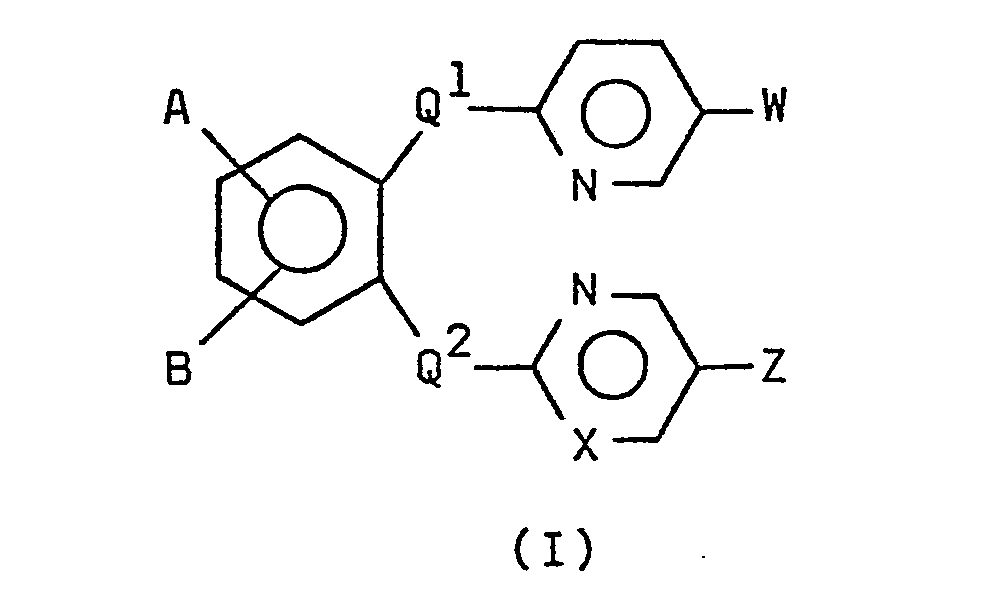
- A is H, NO2, F, Cl or Br;
- B is H, Cl-C4 alkyl, C 3-C 6 alkenyl, halogen, N02, CN, CHO, OR1, COR1, CO2R1 or SCN;
- Q1 is 0 or S;
- Q 2 is 0 or S;
- X is N or CH;
- W is H, C1-C4 alkyl, C 3-C 4 alkenyl, F, Cl, Br, NO2, CN, CF3 or CO2R2:
- Z is H, C1-C4 alkyl, C 3-C 4 alkenyl, F, Cl, Br, NO2, CN, CO2R3 or CF3; and
- R 1, R 2 and R 3 are independently C1-C4 alkyl.
- Preferred for their high level of activity and/or ease of synthesis are those compounds of Formula I wherein:
- A is H;
- B is H, Cl, CH3 or N02;
- Q 1 is 0;
- Q 2 is 0;
- X is N or CH;
- W is F, Cl, Br, N02 or CF3; and
- Z is F, Cl, Br or N02.
- More Preferred for their higher level of activity and/or greater ease of synthesis are those compounds of the preferred group in which:
- A is H;
- B is H;
- W is Cl or N02; and
- Z is Br, Cl or N02.
- The following compounds are specifically preferred for their excellent herbicidal activity and/or greatest ease of synthesis:
- 2,2'-[1,2-phenylenebis(oxy)]bis[5-chloropyridine];
- 5-bromo-2-[2-(5-chloropyridin-2-yloxy)phenoxy]pyrimidine;
- 5-chloro-2-[2-(5-nitropyridin-2-yloxy)phenoxy]pyridine;
- 5-chloro-2-[2-(5-chloropyridin-2-yloxy)phenoxy]pyrimidine; and
- 5-chloro-2-[2-(5-nitropyridin-2-yloxy)phenoxy]pyrimidine.
- This invention also relates to an improved process for preparing ortho-(pyridin-2-yloxy)phenols comprising heating to a melt, under an inert atmosphere, a mixture of catechol and a halopyridine.
- The compounds of Formula I can be prepared by several.different routes, depending on the particular substituents desired in the positions occupied by X, W and Z.
- Compounds of Formula I, wherein the substituents W and Z are different, can be made according to Equation 1. An appropriately substituted catechol (Q1,Q2=O), dimercaptobenzene (Q l,Q 2=S), or mercaptophenol (Q1=S,Q2=O) of Formula II is allowed to react with an equimolar amount of a pyridine of Formula III wherein Y is a leaving group such as chlorine, bromine, alkylsulfonyl, or iodine to give a pyridin-2-yloxyphenol (Q2=0), pyridin-2-ylthio- phenol (Q =0) or a mercaptan of Formula IV.
-

- Suitable solvents for this reaction include dimethylformamide, dimethylsulfoxide, sulfolan, dimethylacetamide, methyl ethyl ketone, and methyl isobutyl ketone.. The reaction is preferably carried out at a temperature in the range of about 25°C to 150°C and a reaction time of about 1 to 24 hours. Usually, heating facilitates the reaction.
- The present invention includes the improved process for preparing an ortho- (5-halopyridin-2-yloxy)-phenol of Formula VI from catechol and a 2,5-dihalopyridine, such as 2,5-dichloropyridine, by heating the ingredients as a melt, e.g. at about 150°C, under an inert atmosphere such as nitrogen, no alkaline material or cosolvent being necessary. An exemplary reaction is shown below:-

- The pyridin-2-yloxyphenol (Q2=0) or mercaptan (Q2=S) of Formula IV can then be allowed to react with a preferably equimolar amount of the pyrimidine (X=N) or pyridine (X=CH) of Formula V, wherein Y is a leaving group such as chlorine, bromine, alkylsulfonyl, or iodine to yield the bis(pyridinyloxy)-benzenes, pyridinylthio(pyrimidinyloxy)benzenes, bis-(pyridinylthio)benzenes, or pyridinylthio(pyrimidinyloxy)benzenes of Formula I. The condensation is generally carried out in the presence of an alkali material such as sodium hydroxide, potassium hydroxide, sodium carbonate, or potassium carbonate. Appropriate solvents for the reaction include dimethylformamide, ethyl methyl ketone, acetonitrile, dimethylsulfoxide, sulfolan, dimethylacetamide, or methyl isobutyl ketone. Preferably, the reaction is carried out at a temperature in the range of about 25°C to 150°C and a reaction time of about 1 to 24 hours.
- An alternative method of synthesizing compounds of Formula I wherein X = N is shown in Equation 2. A suitably substituted catechol (Q1,Q2=O), dimercap- tobenzene (Q ,Q =S), or mercaptophenol (Q =S, Q 2=0) of Formula II is allowed to react with an equimolar amount of a pyrimidine of Formula IX, wherein Y is a leaving group such as chlorine, bromine, alkyl sulfonyl, or iodine to yield a pyri- midin-2-yloxyphenol (Q2=O) or mercaptan (Q 2=S) of Formula X. Ordinarily, the reaction is carried out in the presence of an alkali material such as sodium hydroxide, potassium hydroxide, sodium carbonate, potassium carbonate, or sodium hydride and a suitable solvent such as dimethylformamide, dimethylsulfoxide, or methyl ethyl ketone. The temperature of the reaction can be in the range of about 25°C to 150°C with a reaction time of about 1 to 24 hours.
- Subsequently, the pyrimidinyloxyphenol, pyrimi- dinylthiophenol, or the corresponding mercaptan of Formula X is combined with a pyridine of Formula III to yield the pyrimidinyloxy or pyrimidinylthiobenzene of Formula VIII as illustrated in Equation 2.
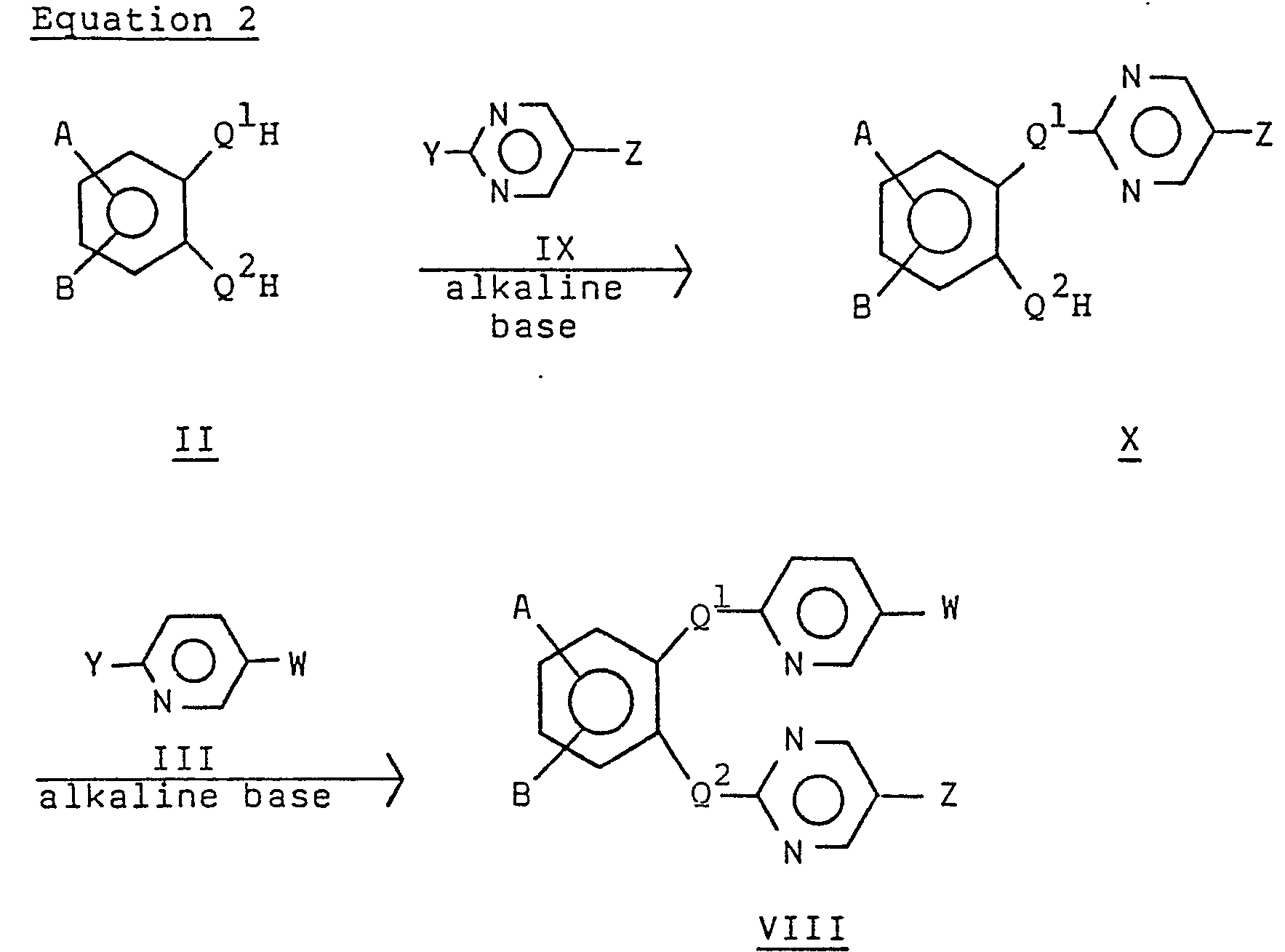
- When the substituents in Q1 and Q2 are the same, the stepwise synthesis shown in Equations 1 and 2 is of course equivalent to a single reaction step using two moles of the pyridine of Formula III.
- As an example of this process, compounds of Formula I, wherein X = CH, Q 1 and Q2 = 0, and the substituents W and Z are the same, can be made by the reaction outlined in Equation 3. An appropriately substituted catechol of Formula XI and two equivalents of the pyridine of Formula XII (wherein Hal is Cl, Br or I) are heated as a melt under nitrogen with hydrogen halide being driven off. As a result, the bis(pyridin-2-yloxy)benzenes of Formula XIII can be obtained directly.

- The 2-halopyridines and 2-halopyrimidines used in these reactions can be prepared by methods known in the art (See for example, "The Pyrimidines" Heterocyclic Compounds, Chapter VI (1962); "Pyrimidine and its Derivatives" Heterocyclic Compounds, Elderfield, Chapter 7 (1957); "The Pyridines" Heterocyclic Compounds, Part II, Chapter VI (1960)).
- As described in the Journal of-Organic-Chemistry 25, 1916 (1960), 2,5-dichloropyrimidine can be made according to the following method:

- By reacting with an aqueous solution of chlorine, 2-hydroxypyrimidine hydrochloride was converted to 2-hydroxy-5-chloropyrimidine. Heating the 2-hydroxy-5-chloropyrimidine in excess phosphorous oxychloride gave 2,5-dichloropyrimidine.
- Alternatively, 2-chloro-5-nitropyridine can be prepared using the procedure described in the Journal Chemical Society 9 (1941), starting with 2-aminopyrimi- dine. Nitration of 2-aminopyridine gives 2aamino-5-nitropyridine, which can be converted into 2-hydroxy-5-nitropyridine by a diazonium reaction. Subsequent heating of 2-hydroxy-5-nitropyridine in a phosphorous pentachloride/phosphorous oxychloride mixture yields 2-chloro-5-nitropyridine. The synthesis is summarized below:

- Preparations of the substituted catechols used in these reactions can also be found in the art (Reactions-of Catechols, Crown Zellerbach Corp., Bulletin, 1977).
- For example, chlorination of catechol with either chlorine or sulfuryl chloride, Berichte 44, 2182 (1911), C.A. 5, 3433 (1911) gives 4-chlorocate- chol as the major product, whereas excess halogen yields the 4,5-dichlorocatechol.

- Nitration of catechol can be carried out under various conditions to yield the 3- and 4-nitrocate- chols (Journal Am. Chem. Soc., 75, 3277 (1953), Journal Chemical Society, 1088 (1971)).

- The following examples illustrate the preparation of the compounds of this invention. Unless otherwise indicated, temperatures are in °C.
- Under nitrogen, a mixture of 15.0 grams (0.136 mole) of catechol, and 22.0 grams of 2,5-dichloropyridine was heated as a melt at 140-150° for 12 hours. The resulting black residue was dissolved in a minimum amount of methylene chloride, i.e., about 50 ml, chromatographed through a silica gel column using methylene chloride as the eluent.. The 2-(5-chloro- pyridin-2-yloxy)phenol was isolated in the latter fraction, whereas starting material 2,5-dichloropyridine eluted with the solvent, front. Yield 8.0 grams, m.p. 97-100°; NMR (CDC13): δ 6.70-7.70 (m's, ArH and OH), 8.0 (d, ArH); ir (Nujol): 3.20-2.80 (OH), 6.30 (C=N), 13.30 microns.
- A mixture of 3.0 grams (0.027 mole) catechol and 9.0 grams (0.06 mole) 2,5-dichloropyridine was heated as a melt under nitrogen for 7 hours at 175° followed by heating at 200° for 5 hours. The black residue was dissolved in a minimum amount of methylene chloride and chromatographed through a silica gel column using methylene chloride as the eluent. From the initial fractions, the desired product was isolated. Yield 1.5 g, m.p. 82-84°; NMR (CDC13): d6.70 (d, 2H, ArH), 7.30 (s, 4H, ArH), 7.60 (AB quartet, 2H, ArH), 8.05 (d, 2H, ArH); ir (Nujol): 6.30 (C=N), 9.90, 11.95, 13.10 microns.
- 2,21-[4-Methyl-l,2-phenylenebis(oxy)]bis[5-chloropyridine]
- In 40 ml of dimethylformamide, a mixture of 4.0 grams (0.032 mole) 4-methylcatechol, 12.0 grams 2,5-dichloropyridine, and 12.0 grams of potassium carbonate was heated between 140° and 145° overnight. To the reaction mixture at room temperature was added excess H20 and the resulting aqueous mixture was extracted with ethyl ether (200 ml) which was washed with H20 (2X), saturated NaHC03, brine, dried (MgSO4), filtered, and the solvent evaporated to yield an oil. Chromatography on a silica gel column using 1-chlorobutane as the eluent gave 5.0 grams of a white solid, m.p. 87-90°; ir (Nujol): 6.30 (C=N), 9.10, 12.25 microns; NMR (CDCl3): δ 2.35 (s, 3H, CH3), 6.60 (d, 2H, pyridine ring protons), 7.00 (broads, 3H, ArH), 7.45 (AB quartet, 2H, pyridine ring protons), 7.95 (d, 2H, pyridine ring protons).
- 5-Chloro-2-[2-(5-nitropyridin-2-yloxy)phenoxy]pyridine
- A mixture of 1.5 grams (0.0068 mole) 2-(5-chloro- pyridin-2-yloxy)phenol, 1.3 grams 2-chloro-5-nitropyridine, 1.0 grams potassium carbonate, and 40 ml of methyl ethyl ketone was heated at reflux overnight. Excess water was added and the aqueous mixture extracted with 200 ml of ethyl ether. The ether extract was washed with saturated NaHCO3, H2O, brine, dried (MgSO4), filtered, and the solvent was evaporated to yield a solid which was suspended in hexane and filtered. Yield 1.4 grams, m.p. 82-84°; ir (Nujol): 6.15, 6.25 (C=N, NO2) , 13.30 (broad), 13.70 microns; NMR (CDC13): δ 6.55 (s, ArH), 6.75 (d, ArH), 6.95 (s, ArH), 7.35 (s, 4H, ArH), 7.40-7.65 (m, ArH), 8.05 (d, ArH), 8.40 (AB quartet, ArH), 8.95 (d, ArH).
- Following the teachings of Examples 1, 2, 3 and 4 and by using the appropriately substituted catechols and pyridines, the title compounds in Table I can be prepared.


- To a mixture of 6.0 grams (0.055 mole) catechol and 7.0 grams of potassium carbonate stirring in 45 ml of dimethylformamide, 7.0 grams of 2,5-dichloropyrimidine was added and the mixture stirred at room temperature overnight followed by heating at 80° for 4 hours. Excess water was added to the reaction mixture, and the aqueous mixture extracted with 300 ml of ethyl ether. The ether extract was washed with H20 (2X), brine, dried (magnesium sulfate), filtered, and the solvent removed to yield a yellow oil which slowly crystallized. From a 1-chlorobutane/cyclohexane mixture, the crude solid was recrystallized to give 6.0 grams of product, m.p. 131-139°; ir (Nujol): 2.90-3.30 (OH), 12.80, 13.30 microns.
- To a mixture of 1.5 grams (0.0068 mole) 2-(5-chloropyridin-2-yloxy)phenol and 1.0 gram potassium carbonate stirring in 40 ml of methyl ethyl ketone, 1.6 grams of 2-chloro-5-bromopyridine was added and the mixture heated at reflux overnight. After addition of excess H20 to the reaction mixture and extraction with 200 ml of ethyl ether, the ether extract was washed with H20, saturated HaHCO3, brine, dried (MgS04), filtered, and evaporated to yield a yellow oil which crystallized from a l-chlorobutane/cyclohexane mixture to give 1.3 grams of a white solid product, m.p. 93-95°; ir (Nujol): 6.30 (C=N), 9,85, 10.45, 10.90, 11.25, 11.85, 12.40, 12.80, 13.10(s) microns; NMR (CDCl3) : δ 6.70 (d, ArH), 7.30 (s, 4H, ArH), 7.45-7.65 (m, ArH), 8.0 (d, ArH), 8.50 (s, 2H, pyrimidine ring protons).
- With stirring, 1.80 grams (0.012 mole) of 2,5-dichloropyrimidine was added to a mixture of 2.0 grams (0.009 mole) 2-(5-chloropyridin-2-yloxy)phenol, 1.5 grams potassium carbonate, and 40 ml of methyl ethyl ketone. After the addition, the mixture was heated at reflux overnight and then poured into excess H20. After extracting with 200 ml of ethyl ether, the extract was washed with saturated NaHCO3, H20, brine, dried (MgS04), filtered, and evaporated to yield a yellow solid which was recrystallized from 1-chlorobutane to give 2.3 grams of product, m.p. 108-111°; ir (Nujol): 6.35, 6.50 (C=N), 13.20 microns; NMR (CDC13): d6.75 (d, 1H, pyridine ring proton), 7.35 (s, 4H, ArH), 7.65 (AB quartet, lH, pyridine ring proton), 8.10 (d, lH, pyridine ring proton), 8.55 (s, 2H, pyrimidine ring protons).
- After heating at reflux a mixture of 1.5 grams (0.0067 mole) 2-(5-chloropyrimidin-2-yloxy)phenol, 1.2 grams potassium carbonate, 1.3 grams 2-chloro-5-nitropyridine and 40 ml of methyl ethyl ketone, the reaction mixture was poured into excess H20 and the aqueous mixture extracted with ethyl ether (200 ml). The ether layer was washed with saturated NaHCO3, H20, brine, dried (MgSO4), filtered, and evaporated to yield 2.3 grams of a yellow-orange oil which was purif.ied by silica gel column chromatography (CH2Cl2 as the eluent). NMR (CDCl3): δ6.90 (d, lH, pyridine ring proton), 7.35 (s, 4H, ArH), 8.25-8.50 (m, 1H, pyridine ring proton), 8.45 (s, 2H, pyrimidine ring protons), 8.95 (d, 1H, pyridine ring proton).
- Following the procedure of Examples 5, 6, 7 and 8 and using suitably substituted catechols, pyridines, and pyrimidines, the following pyrimidinyloxybenzenes were prepared.


- To a mixture of 3.0 grams (0.023 mole) of 2-mercaptophenol and 7.0 grams of potassium carbonate stirring in 50 ml of dimethylformamide, 9.0 grams of 2,5-dichloropyridine is added and the stirred mixture heated at 130° overnight. After pouring into excess H20, the aqueous mixture is extracted with ethyl ether (200 ml) and the extract washed with H20, saturated NaHCO3, and brine, dried (MgS04), filtered, and the solvent evaporated to give the crude product which is recrystallized from 1-chlorobutane.
- To a mixture of 3.0 grams (0.023 mole) of 2-mercaptophenol and 7.0 grams of potassium carbonate stirring in 50 ml of dimethylformamide, 4.0 grams of 2,5-dichloropyridine is added and the mixture stirred overnight at room temperature. After stirring overnight, 4.0 grams of 2-chloro-5-nitropyridine is added and the mixture is again stirred at room temperature overnight. Excess H20 is then added to the reaction mixture and the aqueous mixture extracted with ethyl ether (200 ml), washed with saturated NaHCO3, H20, brine, dried (MgSO4), filtered, and evaporated to yield the crude product.
- By using the procedures described in Examples 9 and 10, the compounds listed in Table III can be prepared.

- At 0°, 4.0 grams (0.027 moles) of 2,5-dichloropyrimidine is added to a mixture of 3.0 grams (0.0023 mole) 2-mercaptophenol and 7.0 grams of potassium carbonate stirring in 50 ml of dimethylformamide. After stirring overnight at room temperature, 4.0 grams of 2-chloro-5-nitropyridine is added and the mixture is heated at 80° for 4 hours. The reaction mixture is then poured into excess H20 and extracted with ethyl ether (200 ml). Washing with H20, saturated NaHCO3, brine, drying (MgS04), and evaporation yields the crude product.
- Following the procedure described in Example 11, the following compounds in Table IV may be prepared.

- At 0°, 4.0 grams (0.025 moles) of 2-chloro-5-nitropyridine is added to a mixture of 3.0 grams (0.0023 mole) 2-mercaptophenol and 7.0 grams of potassium carbonate stirring in 50 ml of dimethylformamide. After stirring overnight at room temperature, 4.0 grams of 2,5-dichloropyrimidine is added and the mixture is heated at 80° for 5 hours. The mixture is then poured into excess H20 and the aqueous mixture is extracted with ethyl ether (200 ml), washed with saturated sodium bicarbonate, brine, dried (MgSO4), and the solvent is evaporated to yield the crude product.
- The procedure in Example 12 may be modified and used in preparing the compounds listed in Table V.

- In 50 ml of stirred dimethylformamide, a mixture of 3.0 grams (0.02 mole) dimercaptobenzene, 7.0 grams potassium carbonate, and 7.0 grams of 2,5-dichloropyridine is heated at 80° for 5 hours. Thereafter pouring into excess H20, the mixture is extracted with ethyl ether (200 ml) and washed with H20, saturated NaHC03, and brine, dried (MgSO4), and evaporated to yield the crude product which can be recrystallized from 1-chlorobutane.
- Example 13 illustrates the general procedure for preparing the compounds in Table VI.

- To a mixture of 3.0 grams (0.02 mole) dimercaptobenzene and 7.0 grams of potassium carbonate stirring in 50 ml of dimethylformamide, 3.5 grams of 2,5-dichloropyrimidine is added at 0° and the mixture stirred for 4 hours, before adding 5.0 grams of 2,5-dibromopyridine and heating at 80° for 4 additional hours. The mixture is added to excess H20 and extracted with ethyl ether. After washing the ether layer with H20, saturated NaHCO3, brine, and drying (MgSO4), evaporating the solvent gives the crude product.
- Following the procedure of Example 14, the compounds in Table VII may be prepared.

- The compounds of this invention can be formulated in a variety of ways for use. For example, the compounds can be formulated as dusts, granules, pellets, solutions, suspensions, emulsions, wettable powders, emulsifiable concentrates and the like. Many of the formulations can be applied directly to the area of undesirable vegetation. Sprayable formulations, on the other hand, can be extended in suitable media and used at spray volumes of from a few liters to several hundred liters per hectare. High strength compositions are used primarily as intermediates for subsequent formulation.
- The formulations, according to this invention will ordinarily contain from about 0.1% to 80% by weight of active ingredient(s) and at least one of (a) about 0.1% to 20% surfactant(s) and (b) about 1% to 99.9% solid or liquid inert diluent(s). More specifically, they will contain these ingredients in the following approximate proportions:

- Lower or higher levels of active ingredient can be used depending on the intended application and the physical properties of the compound. Higher ratios of surfactant to active ingredient are sometimes desirable, and the appropriate ration can be achieved by incorporating the surfactant into the formulation or by tank mixing.
- Typical solid diluents are described in Watkins, et al., "Handbook of Insecticide Dust Diluents and Carriers", 2nd Ed., Dorland Books, Caldwell, New Jersey, but other solids, either mined or manufactured, may be used. The more absorptive diluents are preferred for wettable powders and the denser ones for dusts. Typical liquid diluents and solvents are described in Marsden, "Solvents Guide," 2nd Ed., Interscience, New York, 1950. Solubility under 0.1% is preferred for suspension concentrates; solution concentrates are preferably stable against phase separation at 0°C. "McCutcheon's Detergents and Emulsifiers Annual", MC Publishing Corp., Ridgewood, New Jersey, as well as Sisely and Wood, "Encyclopedia of Surface Active Agents", Chemical Publishing Co., Inc., New York, 1964, list surfactants and recommended uses. All formulations can contain minor amounts of additives to reduce foaming, caking, corrosion, microbiological growth, etc.
- The methods of preparing the formulations are well known. Solutions can be prepared by simply mixing the ingredients. Fine solid compositions are made by blending and, usually, grinding as in a hammer or fluid energy mill. Suspensions are prepared by wet milling (see, for example, Littler, U.S. Patent 3,060,084). Granules and pellets may be made by spraying the active material upon preformed granular carriers or by agglomeration techniques. See J. E. Browning, "Agglomeration", Chemical Engineering, December 4, 1967, pp. 147ff. and "Perry's Chemical Engineer's Handbook", 5th Ed., McGraw-Hill, New York, 1973, pp. 8-57ff.
- In the following examples, all parts are by weight unless otherwise indicated.
-

- The ingredients are blended, hammer-milled until practically all the solids are under 50 microns and then reblended.
-

- The ingredients are blended, coarsely hammer-milled and then air-milled to produce particles of active substantially all below about 10 microns in diameter. The product is reblended before packaging.
-

-

- The ingredients are blended, hammer-milled and then moistened with about 12% water. The mixture is extruded as cylinders about 3 mm diameter which are cut to produce pellets about 3 mm long. These may be used directly after drying, or the dried pellets may be crushed to pass a U.S.S. No. 20 sieve (0.84 mm openings). The granules held on a U.S.S. No. 40 sieve (0.42 mm openings) may be packaged for use and the fines recycled.
-

-

- The active ingredient is dissolved in the solvent and the solution is sprayed upon dedusted granules in a double cone blender. After spraying of the solution has been completed, the blender is allowed to continue runing for a short period, and then the granules are packaged.
-

-

- The active ingredient is dissolved in a solvent, and the solution is sprayed upon dedusted granules in a double-cone blender. After spraying has been completed, the material is warmed to evaporate the solvent. The material is allowed to cool and then packaged.
-

-

-

-

- The compounds of this invention are active herbicides. They have utility for broad-spectrum pre- and/or post-emergence weed control in areas where complete control of all vegetation is desired, such as around fuel storage tanks, ammunition depots, industrial storage areas, oil-well sites, drive-in thea- ters, around billboards, highway and railroad structures. By properly selecting rate and time of application, compounds of this invention may also be used to modify plant growth beneficially, and also to selectively control weeds in crops such as wheat, barley, sorghum, alfalfa, sunflower and corn (maize).
- The precise amount of the compounds of Formula I to be used in any given situation will vary according to the particular end result desired, the amount of foliage present, the weeds to be controlled, the crop species involved, the soil type, the formulation and mode of application., weather conditions, etc. Since so many variables play a role, it is not possible to state a rate of application suitable for all situations. Ordinarily, the compounds of this invention can be used at levels of about 0.01 to 20 kg/ha with a preferred range of 0.05 to 10 kg/ha. The higher rates from within this range are applied for particularly adverse conditions or where extended persistence in soil is desired.
- The compounds of Formula I may be combined with other herbicides and are particularly useful in combination with the ureas: such as 3-(3,4-dichlorophenyl)-1,1-dimethylurea (diuron); the triazines: such as 2-chloro-4-(ethylamino)-6-(isopropylamino)-s-triazine (atrazine); the uracils: such as 5-bromo-3-sec-butyl-6-methyluracil (bromacil); N-(phosponomethyl)glycine (glyphosate); 3-cyclohexyl-l-methyl-6-dimethylamino- s-triazine-2,4(1H,3H)-dione (hexazinone); N,N-dimethyl-2,2-diphenylacetamide (diphenamid); 2,4-dichlorophenoxyacetic acid (2,4-D) (and closely related compounds); 4-chloro-2-butynyl-3-chlorophenylcarbamate (barban); S-(2,3-dichloroallyl)-diisopropylthiocar- bamate (diallate); S-(2,3,3-trichloroallyl-diiso- propylthiocarbamate (triallate); 1,2-dimethyl-3,5-diphenyl-lH-pyrazolium methyl sulfate (difenzoquat, methyl sulfate); methyl 2-[4-(2,4-dichlorophenoxy)-phenoxy]propanoate (diclofop methyl); 4-amino-6-tert-butyl-3-(methylthio)-1,2,4-triazin-5(4H)-one (metribuzin); 3-(3,4-dichlorophenyl)-1-methoxy-1-methylurea (linuron); 3-isopropyl-lH-2,1,3-benzo- thiodiazin-4(3H)-one-2,2-dioxide (bentazon); α,α,α-trifluoro-2,6-dinitro-N,N-dipropyl-p-toluidine (trifluralin); l,l'-dimethyl-4,4'-bipyridinium ion (paraquat); monosodium methanearsonate (MSMA); 2-chloro-2',6'-diethyl (methoxymethyl)acetanilide (alachlor) ; 1,1-dimethyl-3-(α,α,α-trifluoro-m-tolyl)-urea (fluometuron); and 5-[2-chloro-4-(trifluoromethyl)phenoxy]-2-nitrobenzoic acid, methyl ester (acifluorfen-methyl).
- The following examples further illustrate the herbicidal activity of the compounds of this invention.
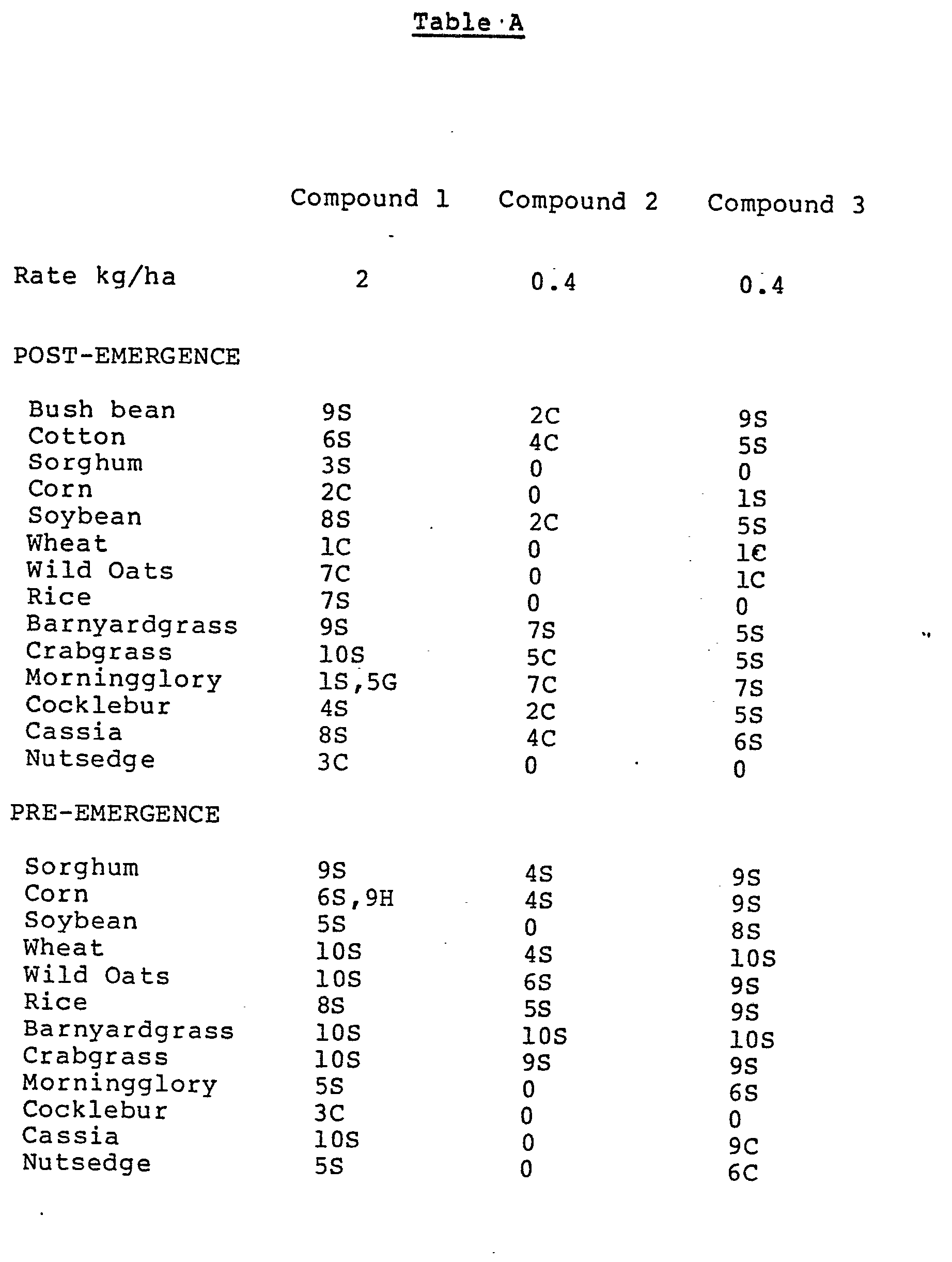
- Seeds of crabgrass (Digitaria spp.), barnyardgrass (Echinochloa crusgalli), wild oats (Avena fatua), cassia (Cassia tora), morningglory (Ipomoea sp.), cocklebur (Xanthium spp.), sorghum, corn, soybean, rice, wheat and nutsedge tubers (Cyperus rotundus) were planted in a growth medium and treated pre-emergence with the chemicals dissolved in a non-phytotoxic solvent. At the same time, cotton having five leaves (including cotyledonary ones), bush beans with the second trifoliate leaf expanding, crabgrass and barnyardgrass with two leaves, wild oats with one leaf, cassia with three leaves (including cotyledonary ones), morningglory and cocklebur with four leaves (including the cotyledonary ones), sorghum and corn with three leaves, soybean with two cotyledonary leaves, rice with two leaves, wheat with one leaf, and nutsedge with three to five leaves were sprayed. Treated plants and controls were maintained in a greenhouse for sixteen days, then all species were compared to controls and visually rated for response to treatment.
- The ratings are based on a numerical scale extending from 0 = no injury, to 10 = complete kill. The accompanying descriptive symbols have the following meanings:
- G = growth retardation;
- C = chlorosis/necrosis;
- S = albinism;
- E = emergence inhibition;
- 6Y = abscised buds or flowers;
- H = hormonal effects; and
- - = not rated.
-

-

-

-

-

-


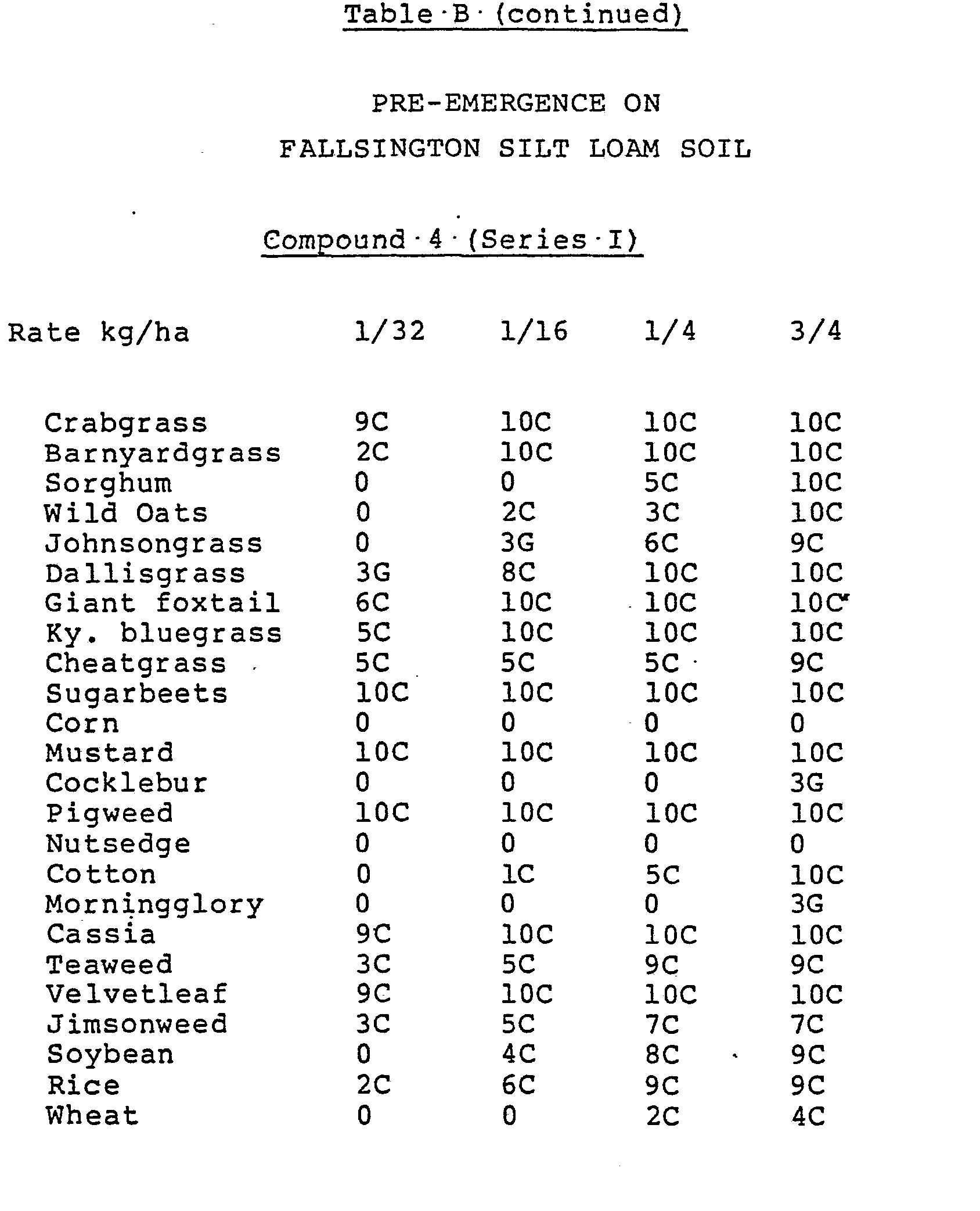
- Two plastic bulb pans were filled with fertilized and limed Fallsington silt loam soil. One pan was planted with corn, sorghum, Kentucky bluegrass and several grassy weeds. The other pan was planted with cotton, soybeans, purple nutsedge (Cyperus rotundus), and several broadleaf weeds. The following grassy and broadleaf weeds were planted: crabgrass (Digitaria sanguinalis), barnyardgrass (Echinochloa crusgalli), wild oats (Avena fatua), johnsongrass (Sorghum hale- pense), dallisgrass (Paspalum dilatatum), giant foxtail (Setaria faberii), cheatgrass (Bromus secalinus), mustard (Brassica arvensis), cocklebur (Xanthium pensylvanicum), pigweed (Amaranthus retroflexus) , morningglory (Ipomoea hederacea), cassia (Cassia tora), teaweed (Sida spinosa), velvetleaf (Abutilon theophrasti), and jimsonweed (Datura stramonium). A 12.5 cm diameter plastic pot was also filled with prepared soil and planted with rice and wheat. Another 12.5 cm pot was planted with sugarbeets. The above four containers were treated pre-emergence with several test compounds within the scope of the invention.
- Twenty-eight days after treatment, the plants were evaluated and visually rated for response to the chemical treatments utilizing the rating system described previously for Test A. The data are summarized in Table B. It may be seen that certain compounds from within the scope of the invention have utility-for selective pre-emergence weed control in crops such as wheat, sorghum and corn.



- Two ten-inch in diameter plastic pans lined with polyethylene liners were filled with prepared Fallsington silt loam soil. One pan was planted with seeds of wheat (Triticum aestivum), barley (Hordeum vulgare), wild oats (Avena fatua), downy brome (Bromus tectorum), cheatgrass (Bromus secalinus), blackgrass (Alopecurus myosuroides), annual bluegrass (Poa annua), green foxtail (Setaria viridis), quackgrass (Agropyron re ens), Italian ryegrass (Lolium multi- florum) and ripgut brome (Bromus rigidus). The other pan was planted with seeds of Russian thistle (Salsola kali), tansy mustard (Descuraina pinnata), smartweed (polygonum pensylvanicum), tumble mustard (Sisymbrium altissium) kochia (Kochia scoparia), shepherd's purse (Capsella bursa-pastoris), Matricaria inodora, black nightshade (Solanum nigrum), yellow rocket (Barbarea vulgaris), wild mustard (Brassica kaber) and wild buckwheat (Polygonum convolvulus). The above two pans were treated pre-emergence. At the same time two pans in which the above plant species were growing were treated post-emergence. Plant height at the time of treatment ranged from 1-15 cm depending on plant species.
- The compounds applied were diluted with a non-phytotoxic solvent and sprayed over-the-top of the pans. An untreated control and a solvent alone control were included for comparison. All treatments were maintained in the greenhouse for 20 days at which time the treatments were compared to the controls and the effects visually rated. The recorded data are presented in Table C. The potential utility of several of the compounds tested for pre- and/or post-emergence weed control in wheat and barley is evident.


- Twenty-five cm diameter plastic pots filled with Fallsington silt loam were planted with soybeans, cotton, alfalfa, corn, rice, wheat, sorghum, sugarbeets, velvetleaf (Abutilon theophrasti), sesbania (Sesbania exaltata), Cassia (Cassia tora), morningglory (Ipomoea hederacea), jimsonweed (Datura stramonium), cocklebur (Xanthium pensylvanicum), crabgrass (Digitaria spp.), nutsedge (Cyperus rotundus), barnyardgrass (Echinochloa crusgalli), giant foxtail (Setaria faberii), mustard (Brassica arvensis), pigweed (Amaranthus retroflexus), sunflower (Helianthus annuus), and wild oats (Avena fatua). Approximately 2-1/2 weeks after planting, the young plants and the soil around them were sprayed overall with the test chemicals dissolved in a non-phytotoxic solvent. Two weeks after treatment, all species were compared to untreated controls and visually rated for response to treatment. The rating system was as described previously for Test A. The data are presented in Table D. Selected compounds from within the scope of the invention have utility for post-emergence weed control in alfalfa, corn, wheat, sorghum and sunflower.

Claims (13)
1. A compound of the formula:

wherein
A is H, NO2, F, Cl or Br;
B is H, C1-C4 alkyl, C3-C6 alkenyl, halogen, NO2, CN, CHO, OR1, COR1, CO2R1 or SCN;
Q1 is 0 or S;
Q 2 is 0 or S;
X is N or CH;
W is H, C1-C4 alkyl, C3-C4 alkenyl, F, Cl, Br, NO2, CN, CF3 or CO2R2;
Z is H, C1-C4 alkyl, C3-C4 alkenyl, F, Cl, Br, N02, CN, CO2R3 or CF3; and
R1, R2 and R3 are independently C1-C4 alkyl.
2. A compound of Claim 1 wherein:
A is H;
B is H, Cl, CH3 or NO2;
Q1 is O;
Q2 is O;
X is N or CH;
W is F, Cl, Br, NO2 or CF3; and
Z is F, Cl, Br or N02.
3. A compound of Claim 2 wherein:
A is H;
B is H;
W is Cl or N02; and
Z is Br, Cl or N02.
4. A compound of Claim 1, 2,2'-[1,2-phenylene- bis(oxy)]bis[5-chloropyridine].
5. A compound of Claim 1, 5-bromo-2-[2-(5-chloropyridin-2-yloxy)phenoxy]pyrimidine.
6. A compound of Claim 1, 5-chloro-2-[2-(5-nitropyridin-2-yloxy)phenoxy]pyridine.
7. A compound of Claim 1, 5-chloro-2-[2-(5-chloropyridin-2-yloxy)phenoxy]pyrimidine.
8. A compound of Claim 1, 5-chloro-2-[2-(5-nitropyridin-2-yloxy)phenoxy]pyrimidine.
9. A composition suitable for controlling the growth of undesired vegetation comprising an effective amount of a herbicidal compound and at least one of the following: surfactant, solid or liquid diluent, characterised in
that said herbicidal compound comprises a compound of any of claims 1 to 8.
10. A method for controlling the growth of undesired vegetation by applying to the locus to be protected an effective amount of a herbicidal compound, characterised in
that said herbicidal compound comprises a compound of any of claims 1 to 8.
ll. A method for the preparation of a compound of claim 1 which comprises reacting a compound of formula

with compounds of formulae

wherein A, B, W, X and Z are as defined in claim 1 and Y is a leaving group.
12. The method of claim 11 wherein a catechol of formula

is heated as a melt with

wherein Hal is Cl, Br or I, in an inert atmosphere, to-obtain a compound of formula I wherein X = CH, Q1 and Q2 = O and W = Z.
13. A process for preparing an ortho-(5-halopyridin-2-yloxy)phenol of the formula:

wherein
W is F, Cl or Br,
comprising heating to a melt a mixture of catechol and an appropriately substituted 2,5-dihalopyridine under an inert atmosphere.Applications Claiming Priority (2)
| Application Number | Priority Date | Filing Date | Title |
|---|---|---|---|
| US06/248,345 US4371736A (en) | 1981-03-27 | 1981-03-27 | Herbicidal pyridinyloxy(pyrimidinyloxy)benzenes |
| US248345 | 1981-03-27 |
Publications (2)
| Publication Number | Publication Date |
|---|---|
| EP0061913A2 true EP0061913A2 (en) | 1982-10-06 |
| EP0061913A3 EP0061913A3 (en) | 1982-12-01 |
Family
ID=22938706
Family Applications (1)
| Application Number | Title | Priority Date | Filing Date |
|---|---|---|---|
| EP82301610A Withdrawn EP0061913A3 (en) | 1981-03-27 | 1982-03-26 | Herbicidal heterooxybenzenes |
Country Status (4)
| Country | Link |
|---|---|
| US (1) | US4371736A (en) |
| EP (1) | EP0061913A3 (en) |
| DK (1) | DK141082A (en) |
| GR (1) | GR75928B (en) |
Cited By (7)
| Publication number | Priority date | Publication date | Assignee | Title |
|---|---|---|---|---|
| EP0255778A1 (en) * | 1986-08-01 | 1988-02-10 | MITSUI TOATSU CHEMICALS, Inc. | Thermoplastic aromatic polyether-pyridines and process for preparing same |
| EP0652216A3 (en) * | 1993-11-02 | 1995-05-17 | BASF Aktiengesellschaft | Substituted Pyridyl salicylic aldehyde and salicylic acid derivatives, methods for preparing them and their use as herbicides |
| EP0656357A1 (en) * | 1993-11-02 | 1995-06-07 | BASF Aktiengesellschaft | Substituted pyridyl-n-oxide salicylic aldehyde and salicylic acid derivatives, methods for preparing them and their use as herbicides |
| US8277645B2 (en) | 2008-12-17 | 2012-10-02 | Jarvis Jr Ernest | Automatic retractable screen system for storm drain inlets |
| WO2020193474A1 (en) | 2019-03-27 | 2020-10-01 | Bayer Aktiengesellschaft | Substituted 2-heteroarylaminobenzenes and the salts thereof and their use as herbicidal agents |
| WO2023186690A1 (en) | 2022-03-28 | 2023-10-05 | Bayer Aktiengesellschaft | Substituted 2-aminoazines and salts thereof, and use thereof as herbicidal active substances |
| WO2023186691A1 (en) | 2022-03-28 | 2023-10-05 | Bayer Aktiengesellschaft | Substituted 2-c-azines and salts thereof, and use thereof as herbicidal active substances |
Families Citing this family (8)
| Publication number | Priority date | Publication date | Assignee | Title |
|---|---|---|---|---|
| SE462894B (en) * | 1985-10-28 | 1990-09-17 | Biogram Ab | MICROCAPPLES, PROCEDURES FOR PREPARING THEREOF AND USING |
| AU2015206757A1 (en) | 2014-01-16 | 2016-06-30 | Fmc Corporation | Pyrimidinyloxy benzene derivatives as herbicides |
| TW201625554A (en) * | 2014-07-14 | 2016-07-16 | 杜邦股份有限公司 | Bis(aryl)catechol derivatives as herbicides |
| MX395250B (en) | 2015-03-18 | 2025-03-25 | Fmc Corp Star | SUBSTITUTED PYRIMIDINYLOXYPYRIDINE DERIVATIVES AS HERBICIDES. |
| TWI713530B (en) | 2015-06-05 | 2020-12-21 | 美商艾佛艾姆希公司 | Pyrimidinyloxy benzene derivatives as herbicides |
| CN108024537A (en) | 2015-07-13 | 2018-05-11 | 纳幕尔杜邦公司 | Aryloxy group pyrimidine radicals ether as herbicide |
| BR112019022493B1 (en) | 2017-05-02 | 2024-01-16 | Fmc Corporation | COMPOUND, HERBICIDAL COMPOSITIONS, HERBICIDAL MIXTURES AND METHODS FOR CONTROLING THE GROWTH OF UNWANTED VEGETATION |
| CN112469712B (en) * | 2018-06-25 | 2024-08-13 | 拜耳公司 | Substituted 2-heteroaryloxypyridines and their salts, and their use as herbicides |
Family Cites Families (4)
| Publication number | Priority date | Publication date | Assignee | Title |
|---|---|---|---|---|
| US4248618A (en) * | 1977-05-06 | 1981-02-03 | Ici Australia Limited | Derivatives of (pyrimidyloxy)phenoxy-alkanecarboxylic acid and herbicidal compositions thereof |
| NZ188244A (en) * | 1977-09-13 | 1981-04-24 | Ici Australia Ltd | 2-substituted pyrimidines compositions growth regulating processes |
| NZ191078A (en) * | 1978-08-08 | 1982-05-31 | Ici Australia Ltd | Bis(pyrimidyloxy) benzenes bis(pyrimidylthio)benzenes and prymidyloxy-pyrimidyl thiobenzens and herbicidal compositions |
| US4326880A (en) * | 1979-08-14 | 1982-04-27 | Ciba-Geigy Corporation | Derivatives of 5-(pyridyl-2-oxy)-2-nitrobenzoic acid, and herbicidal compositions containing them, and herbicidal methods for using same |
-
1981
- 1981-03-27 US US06/248,345 patent/US4371736A/en not_active Expired - Fee Related
-
1982
- 1982-03-23 GR GR67697A patent/GR75928B/el unknown
- 1982-03-26 EP EP82301610A patent/EP0061913A3/en not_active Withdrawn
- 1982-03-26 DK DK141082A patent/DK141082A/en not_active IP Right Cessation
Cited By (13)
| Publication number | Priority date | Publication date | Assignee | Title |
|---|---|---|---|---|
| EP0255778A1 (en) * | 1986-08-01 | 1988-02-10 | MITSUI TOATSU CHEMICALS, Inc. | Thermoplastic aromatic polyether-pyridines and process for preparing same |
| US4803258A (en) * | 1986-08-01 | 1989-02-07 | Mitsui Toatsu Chemicals, Incorporated | Thermoplastic aromatic polyether-pyridine and process for preparing same |
| EP0652216A3 (en) * | 1993-11-02 | 1995-05-17 | BASF Aktiengesellschaft | Substituted Pyridyl salicylic aldehyde and salicylic acid derivatives, methods for preparing them and their use as herbicides |
| EP0656357A1 (en) * | 1993-11-02 | 1995-06-07 | BASF Aktiengesellschaft | Substituted pyridyl-n-oxide salicylic aldehyde and salicylic acid derivatives, methods for preparing them and their use as herbicides |
| US5627136A (en) * | 1993-11-02 | 1997-05-06 | Basf Aktiengesellschaft | Pyridine-N-oxide-substituted salicylaldehyde or salicyclic acid derivatives, their preparation and their use as herbicides |
| US5783521A (en) * | 1993-11-02 | 1998-07-21 | Basf Aktiengesellschaft | Substituted pyridylsalicylaldehyde or -salicylic acid derivatives, their preparation and their use as herbicides |
| US8277645B2 (en) | 2008-12-17 | 2012-10-02 | Jarvis Jr Ernest | Automatic retractable screen system for storm drain inlets |
| WO2020193474A1 (en) | 2019-03-27 | 2020-10-01 | Bayer Aktiengesellschaft | Substituted 2-heteroarylaminobenzenes and the salts thereof and their use as herbicidal agents |
| CN113677665A (en) * | 2019-03-27 | 2021-11-19 | 拜耳公司 | Substituted 2-heteroarylaminobenzenes and their salts and their use as herbicides |
| CN113677665B (en) * | 2019-03-27 | 2024-07-16 | 拜耳公司 | Substituted 2-heteroarylaminobenzenes and their salts, and their use as herbicides |
| US12415786B2 (en) | 2019-03-27 | 2025-09-16 | Bayer Aktiengesellschaft | Substituted 2-heteroarylaminobenzenes and the salts thereof and their use as herbicidal agents |
| WO2023186690A1 (en) | 2022-03-28 | 2023-10-05 | Bayer Aktiengesellschaft | Substituted 2-aminoazines and salts thereof, and use thereof as herbicidal active substances |
| WO2023186691A1 (en) | 2022-03-28 | 2023-10-05 | Bayer Aktiengesellschaft | Substituted 2-c-azines and salts thereof, and use thereof as herbicidal active substances |
Also Published As
| Publication number | Publication date |
|---|---|
| US4371736A (en) | 1983-02-01 |
| DK141082A (en) | 1982-09-28 |
| EP0061913A3 (en) | 1982-12-01 |
| GR75928B (en) | 1984-08-02 |
Similar Documents
| Publication | Publication Date | Title |
|---|---|---|
| EP0084224B1 (en) | Herbicidal sulfonamides | |
| EP0007687B1 (en) | Sulfonamides, processes for their preparation, compositions containing said sulfonamides and a method for controlling the growth of vegetation | |
| EP0004163B1 (en) | Herbicidal sulfamates and preparation and use thereof | |
| EP0023140B1 (en) | Herbicidal sulfonamides, preparation and use thereof, and compositions containing them | |
| EP0064804B1 (en) | Thiophene herbicides | |
| EP0041404A2 (en) | Herbicidal thiophenesulfonamides | |
| US4302241A (en) | Agricultural sulfonamides | |
| EP0117014B1 (en) | Herbicidal n-hydroxy-n'-sulfonylguanidines and sulfonamide inner salts | |
| EP0013480A2 (en) | Herbicidal pyridinesulfonamides, preparation and use thereof and compositions containing them | |
| CA1110627A (en) | Bis-pyrimidyl-oxy(thio)-benzenes | |
| EP0035893A2 (en) | Herbicidal benzene- and pyridine-sulfonamide derivatives | |
| EP0084020A2 (en) | N-arylsulfonyl-N'-pyrimidinyl ureas | |
| EP0046677A2 (en) | Herbicidal sulfonamides | |
| US4496392A (en) | Herbicidal heterocyclic alkylaminocarbonylsulfonamides | |
| US4371736A (en) | Herbicidal pyridinyloxy(pyrimidinyloxy)benzenes | |
| EP0161905B1 (en) | Herbicidal halopyrimidines | |
| US5090993A (en) | Fluoroalkoxy amino triazines for control of weeds in sugar beets | |
| EP0030433B1 (en) | Novel sulfonamides, compositions containing them, and methods for controlling the growth of undesired vegetation using them | |
| EP0106512B1 (en) | Herbicidal ortho-alkyl- and ortho-alkenyl-substituted benzenesulfonamides | |
| EP0044212B1 (en) | Herbicidal o-alkylsulfonyloxy- and o-alkylsulfonylamino-benzenesulfonamides | |
| US4581059A (en) | Herbicidal phenoxy esters of N-(heterocyclic)aminocarbonyl)sulfamic acid | |
| US4668281A (en) | Thiophenesulfonamides | |
| EP0010560B1 (en) | Herbicidal sulfonamides, their preparation, compositions containing them and use thereof | |
| US4747870A (en) | Herbicidal pyrazole sulfonamides | |
| US4565567A (en) | Herbicidal heterocyclic alkylaminocarbonylsulfonamides |
Legal Events
| Date | Code | Title | Description |
|---|---|---|---|
| PUAI | Public reference made under article 153(3) epc to a published international application that has entered the european phase |
Free format text: ORIGINAL CODE: 0009012 |
|
| PUAL | Search report despatched |
Free format text: ORIGINAL CODE: 0009013 |
|
| AK | Designated contracting states |
Designated state(s): AT BE CH DE FR GB IT LU NL SE |
|
| AK | Designated contracting states |
Designated state(s): AT BE CH DE FR GB IT LU NL SE |
|
| STAA | Information on the status of an ep patent application or granted ep patent |
Free format text: STATUS: THE APPLICATION HAS BEEN WITHDRAWN |
|
| 17P | Request for examination filed |
Effective date: 19830308 |
|
| 18W | Application withdrawn |
Withdrawal date: 19830310 |
|
| RIN1 | Information on inventor provided before grant (corrected) |
Inventor name: SELBY, THOMAS PAUL |