EP0061935A2 - Procédé et dispositif pour réduire la rupture du bain de fusion pendant l'extrusion de copolymères linéaires éthylèniques ayant un spectre du poids moléculaire étroit - Google Patents
Procédé et dispositif pour réduire la rupture du bain de fusion pendant l'extrusion de copolymères linéaires éthylèniques ayant un spectre du poids moléculaire étroit Download PDFInfo
- Publication number
- EP0061935A2 EP0061935A2 EP82301705A EP82301705A EP0061935A2 EP 0061935 A2 EP0061935 A2 EP 0061935A2 EP 82301705 A EP82301705 A EP 82301705A EP 82301705 A EP82301705 A EP 82301705A EP 0061935 A2 EP0061935 A2 EP 0061935A2
- Authority
- EP
- European Patent Office
- Prior art keywords
- die
- die lip
- polymer
- film
- melt fracture
- Prior art date
- Legal status (The legal status is an assumption and is not a legal conclusion. Google has not performed a legal analysis and makes no representation as to the accuracy of the status listed.)
- Granted
Links
Images
Classifications
-
- B—PERFORMING OPERATIONS; TRANSPORTING
- B29—WORKING OF PLASTICS; WORKING OF SUBSTANCES IN A PLASTIC STATE IN GENERAL
- B29C—SHAPING OR JOINING OF PLASTICS; SHAPING OF MATERIAL IN A PLASTIC STATE, NOT OTHERWISE PROVIDED FOR; AFTER-TREATMENT OF THE SHAPED PRODUCTS, e.g. REPAIRING
- B29C48/00—Extrusion moulding, i.e. expressing the moulding material through a die or nozzle which imparts the desired form; Apparatus therefor
- B29C48/25—Component parts, details or accessories; Auxiliary operations
- B29C48/30—Extrusion nozzles or dies
-
- B—PERFORMING OPERATIONS; TRANSPORTING
- B29—WORKING OF PLASTICS; WORKING OF SUBSTANCES IN A PLASTIC STATE IN GENERAL
- B29C—SHAPING OR JOINING OF PLASTICS; SHAPING OF MATERIAL IN A PLASTIC STATE, NOT OTHERWISE PROVIDED FOR; AFTER-TREATMENT OF THE SHAPED PRODUCTS, e.g. REPAIRING
- B29C48/00—Extrusion moulding, i.e. expressing the moulding material through a die or nozzle which imparts the desired form; Apparatus therefor
- B29C48/25—Component parts, details or accessories; Auxiliary operations
- B29C48/30—Extrusion nozzles or dies
- B29C48/32—Extrusion nozzles or dies with annular openings, e.g. for forming tubular articles
-
- B—PERFORMING OPERATIONS; TRANSPORTING
- B29—WORKING OF PLASTICS; WORKING OF SUBSTANCES IN A PLASTIC STATE IN GENERAL
- B29C—SHAPING OR JOINING OF PLASTICS; SHAPING OF MATERIAL IN A PLASTIC STATE, NOT OTHERWISE PROVIDED FOR; AFTER-TREATMENT OF THE SHAPED PRODUCTS, e.g. REPAIRING
- B29C48/00—Extrusion moulding, i.e. expressing the moulding material through a die or nozzle which imparts the desired form; Apparatus therefor
- B29C48/022—Extrusion moulding, i.e. expressing the moulding material through a die or nozzle which imparts the desired form; Apparatus therefor characterised by the choice of material
-
- B—PERFORMING OPERATIONS; TRANSPORTING
- B29—WORKING OF PLASTICS; WORKING OF SUBSTANCES IN A PLASTIC STATE IN GENERAL
- B29C—SHAPING OR JOINING OF PLASTICS; SHAPING OF MATERIAL IN A PLASTIC STATE, NOT OTHERWISE PROVIDED FOR; AFTER-TREATMENT OF THE SHAPED PRODUCTS, e.g. REPAIRING
- B29C48/00—Extrusion moulding, i.e. expressing the moulding material through a die or nozzle which imparts the desired form; Apparatus therefor
- B29C48/03—Extrusion moulding, i.e. expressing the moulding material through a die or nozzle which imparts the desired form; Apparatus therefor characterised by the shape of the extruded material at extrusion
- B29C48/07—Flat, e.g. panels
- B29C48/08—Flat, e.g. panels flexible, e.g. films
-
- B—PERFORMING OPERATIONS; TRANSPORTING
- B29—WORKING OF PLASTICS; WORKING OF SUBSTANCES IN A PLASTIC STATE IN GENERAL
- B29C—SHAPING OR JOINING OF PLASTICS; SHAPING OF MATERIAL IN A PLASTIC STATE, NOT OTHERWISE PROVIDED FOR; AFTER-TREATMENT OF THE SHAPED PRODUCTS, e.g. REPAIRING
- B29C48/00—Extrusion moulding, i.e. expressing the moulding material through a die or nozzle which imparts the desired form; Apparatus therefor
- B29C48/03—Extrusion moulding, i.e. expressing the moulding material through a die or nozzle which imparts the desired form; Apparatus therefor characterised by the shape of the extruded material at extrusion
- B29C48/09—Articles with cross-sections having partially or fully enclosed cavities, e.g. pipes or channels
-
- B—PERFORMING OPERATIONS; TRANSPORTING
- B29—WORKING OF PLASTICS; WORKING OF SUBSTANCES IN A PLASTIC STATE IN GENERAL
- B29C—SHAPING OR JOINING OF PLASTICS; SHAPING OF MATERIAL IN A PLASTIC STATE, NOT OTHERWISE PROVIDED FOR; AFTER-TREATMENT OF THE SHAPED PRODUCTS, e.g. REPAIRING
- B29C48/00—Extrusion moulding, i.e. expressing the moulding material through a die or nozzle which imparts the desired form; Apparatus therefor
- B29C48/03—Extrusion moulding, i.e. expressing the moulding material through a die or nozzle which imparts the desired form; Apparatus therefor characterised by the shape of the extruded material at extrusion
- B29C48/09—Articles with cross-sections having partially or fully enclosed cavities, e.g. pipes or channels
- B29C48/10—Articles with cross-sections having partially or fully enclosed cavities, e.g. pipes or channels flexible, e.g. blown foils
-
- B—PERFORMING OPERATIONS; TRANSPORTING
- B29—WORKING OF PLASTICS; WORKING OF SUBSTANCES IN A PLASTIC STATE IN GENERAL
- B29C—SHAPING OR JOINING OF PLASTICS; SHAPING OF MATERIAL IN A PLASTIC STATE, NOT OTHERWISE PROVIDED FOR; AFTER-TREATMENT OF THE SHAPED PRODUCTS, e.g. REPAIRING
- B29C48/00—Extrusion moulding, i.e. expressing the moulding material through a die or nozzle which imparts the desired form; Apparatus therefor
- B29C48/25—Component parts, details or accessories; Auxiliary operations
- B29C48/30—Extrusion nozzles or dies
- B29C48/305—Extrusion nozzles or dies having a wide opening, e.g. for forming sheets
-
- B—PERFORMING OPERATIONS; TRANSPORTING
- B29—WORKING OF PLASTICS; WORKING OF SUBSTANCES IN A PLASTIC STATE IN GENERAL
- B29K—INDEXING SCHEME ASSOCIATED WITH SUBCLASSES B29B, B29C OR B29D, RELATING TO MOULDING MATERIALS OR TO MATERIALS FOR MOULDS, REINFORCEMENTS, FILLERS OR PREFORMED PARTS, e.g. INSERTS
- B29K2023/00—Use of polyalkenes or derivatives thereof as moulding material
-
- B—PERFORMING OPERATIONS; TRANSPORTING
- B29—WORKING OF PLASTICS; WORKING OF SUBSTANCES IN A PLASTIC STATE IN GENERAL
- B29K—INDEXING SCHEME ASSOCIATED WITH SUBCLASSES B29B, B29C OR B29D, RELATING TO MOULDING MATERIALS OR TO MATERIALS FOR MOULDS, REINFORCEMENTS, FILLERS OR PREFORMED PARTS, e.g. INSERTS
- B29K2023/00—Use of polyalkenes or derivatives thereof as moulding material
- B29K2023/04—Polymers of ethylene
- B29K2023/06—PE, i.e. polyethylene
- B29K2023/0608—PE, i.e. polyethylene characterised by its density
- B29K2023/0633—LDPE, i.e. low density polyethylene
Definitions
- This invention relates to.a method for reducing melt fracture, particularly sharkskin melt fracture, during extrusion of a molten narrow molecular weight distribution, linear, ethylene copolymer, under conditions of flow rate and melt temperature which would otherwise produce such melt fracture.
- HP-LDPE high pressure, low density polyethylene
- HP-LDPE's are characterized by an intricate long chain branched molecular architecture. These long chain branches have a dramatic effect on the melt rheology of these resins.
- HP-LDPE's also possess a spectrum of short chain branches, generally 1 to 6 carbon atoms in length. These short chain branches disrupt crystal formation and depress resin density.
- low pressure technology whereby low density polyethylene can now be produced at low pressures and temperatures by copolymerizing ethylene with various alphaolefins.
- LP-LDPE low pressure LDPE
- resins generally possess little, if any, long chain branching. They are short chain branched with branch length and frequency controlled by the type and amount of comonomer used_ during polymerization.
- ethylene copolymers having a density of 0.91 to 0.96, a melt flow ratio of ⁇ 22 to ⁇ 32 and a relatively low residual catalyst content can be produced in granular form, at relatively high productivities, if the monomer(s) are copolymerized in a gas phase process with a specific high-activity Mg-Ti-containing complex catalyst which is impregnated in a porous inert carrier material.
- LP-LDPE resins can be extruded on equipment designed for HP-LDPE resins, certain equipment modifications are often required in order to extrude the low pressure resins at optimum conditions and at rates comparable to the high pressure resins. This is particularly true during extrusion of LP-LDPE which is processed into film. The problem appears to be that during extrusion of these particular resins, two aspects of rheological behavior play a significant role, i.e. shear and extension.
- a polymeric melt undergoes severe shearing deformation.
- the extrusion screw pumps the melt to, and through, the film die, the melt experiences a wide range of shear rates.
- Host film extrusion processes are thought to expose the melt to shear at rates in the 100-5000 sec -1 range.
- Polymeric melts are known to exhibit what is commonly termed shear thinning behavior, i.e., non-Newtonian flow behavior.
- shear rate is increased, viscosity (the ratio of shear stress, ⁇ , to shear rate, ⁇ ) decreases.
- the degree of viscosity decrease depends upon the molecular weight, its distribution, and molecular configuration, i.e., long chain branching of the polymeric material. Short chain branching has little effect on shear viscosity.
- high pressure low density polyethylenes have a broad molecular weight distribution and show enhanced shear thinning behavior in the shear rate range common to film extrusion.
- weight distribution resins used in the present invention exhibit reduced shear thinning behavior at extrusion shear rates.
- the consequences of these differences are that the narrow distribution resins used in the present invention require higher power and develop higher pressures during extrusion than the high pressure low density polyethylene resins of broad molecular weight distribution and of equivalent average molecular weight.
- shear viscosity in terms of shear stress and shear rate, i.i.:
- melt fracture Due to the high shear stress developed during extrusion of a high molecular weight ethylene polymer having a narrow molecular weight distribution, melt fracture, particularly sharkskin melt fracture, occurs.
- Sharkskin melt fracture has been described in the literature for a number of polymers.
- "Sharkskin” is a term used to describe a particular type of surface irregularity which occurs during extrusion of some thermoplastic materials under certain conditions. It is characterized by a series of ridges perpendicular to the flow direction and is described by J.A. Brydson, Flow Properties of Polymer Melts, Van Nostrand-Reinhold Company (1970), pages 78-81.
- the onset of sharkskin melt fracture is determined by visual observation of the surfaces of the film in its final form, i.e. after film winding. Specifically, this procedure for determining sharkskin melt fracture is as follows: The film is viewed and examined under a 20X magnification Nikon Profile Projector Model 6E using transmitted light.
- the film can be held up to light and visually examined by the naked eye to determine the presence, severity or absence of melt fracture.
- the narrow molecular weight distribution ethylene polymers as described herein exhibit the characteristics of sharkskin melt fracture upon extruding using the prior art extrusion processes. These characteristics include a pattern of wave distortion perpendicular to the flow direction; occurrence at low extrusion rates (less than expected for elastic turbulance); not effected by the use of commonly employed metal die materials; and less melt fracture with increasing temperature.
- 012,793 filed on February 16, 1979 discloses a process for forming blown tubular film essentially free of melt fracture by extruding the particular polymer through an extrusion die having a die gap of greater than about 50 mils and at a drawdown ratio of greater than about 2 to less than about 250.
- sharkskin melt fracture is reduced by extruding polymer through a die having a discharge outlet defining an exit die gap formed by opposing die lip surfaces and wherein one surface of the die lip and/or die land in contact with the molten polymer extends beyond the opposing surface of the die lip and/or die land in the direction of the axis of flow of the molten polymer through the die exit whereby melt fracture is reduced on the surface of the polymer leaving the extended die lip surface.
- melt fracture particularly sharkskin melt fracture
- melt fracture can be virtually eliminated on both surfaces of an extruded film formed from the polymers contemplated herein, by geometric changes in the die, i.e., by extruding the narrow molecular weight distribution .
- ethylene polymer at normal film extrusion temperatures through a die having a discharge outlet defining an exit die gap and wherein one surface of the die lip and/or die land in contact with the molten polymer extends beyond the opposing surface of the die lip and/or die land in the direction of the axis of flow of the molten polymer through the die exit and wherein said extended die lip has a groove extending around said extended die lip, said groove being disposed opposite the surface of the opposing die lip and preferably opposite the leading edge of the opposing die lip surface, whereby melt fracture is reduced on both surfaces of the polymer leaving said die lip exit.
- the utility of the process of the present invention arises due to the fact that the stress field at the exit of the die determines the creation of sharkskin melt fracture.
- sharkskin melt fracture can be controlled or eliminated by the geometry at the exit of the die.
- Films suitable for packaging applications must possess a balance of key properties for broad end-use utility and wide commercial acceptance. These properties include film optical quality, for example, haze, gloss, and see-through characteristics. Mechanical strength properties such as puncture resistance, tensile strength, impact strength, stiffness, and tear resistance are important. Vapor transmission and gas permeability characteristics are important considerations in perishable goods packaging. Performance in film converting and packaging equipment is influenced by film properties such as coefficient of friction, blocking, heat sealability and flex resistance. Low density polyethylene has a wide range of utility such as in food packaging and non-food packaging applications. ' Bags commonly produced from low density polyethylene include shipping sacks, textile bags, laundry and dry cleaning bags and trash bags.
- Low density polyethylene film can be used as drum liners for a number of liquid and solid chemicals and as protective wrap inside wooden crates. Low density polyethylene film can be used in a variety of agricultural and horticultural applications such as protecting plants and crops, as mulching, for storing of fruits and vegetables. Additionally, low density polyethylene film can be used in building applications such as a moisture or moisture vapor barrier. Further, low density polyethylene film can be coated and printed for use in newspapers, books, etc.
- high pressure low density polyethylene is the most important of the thermoplastic packaging films. It accounts for about 50% of the total usage of such films in packaging. Films made from the polymers of the present invention, preferably the ethylene hydrocarbon copolymers, offer an improved combination of end-use properties and are especially suited for many of the applications already served by high pressure low density polyethylene.
- An improvement in any one of the properties of a film such as elimination or reduction of sharkskin melt fracture or an improvement in the extrusion characteristics of the resin or an improvement in the film extrusion process itself is of the utmost importance regarding the acceptance of the film as a substitute for high pressure low density polyethylene in many end use applications.
- melt fracture particularly sharkskin melt fracture formed during extrusion of a molten narrow molecular weight distribution, linear, ethylene polymer, at normal film extrusion temperature
- a die having a discharge outlet defining an.exit die gap formed by opposing die lip surfaces and wherein one surface of the die lip and/or die land in contact with the molten polymer extends beyond the opposing surface of the die lip and/or die land in the direction of the axis of flow of the molten polymer through the die exit, said extended die lip having a groove extending around said extended die lip, said groove being disposed opposite the surface of the opposing die lips and preferably opposite the leading edge of the opposing die lip surfaces whereby melt fracture is reduced on the surface of the film leaving.the extended die lip surface. Dies
- the molten ethylene polymer is extruded through a die, preferably an annular die, having an extended die lip and a groove in the extended portion.
- the die which may be used in the present invention may be a spiral annular die, slit die, etc.
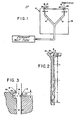
- Figure 1 is a cross-sectional view of a spiral/spider annular die 10 through which the molten thermoplastic ethylene polymer is extruded to form a single layer film, tube or pipe.
- Die block 12 contains channels 14 for directing the polymer to the die exit. As the molten thermoplastic ethylene polymer is extruded, it spreads out as it passes into the die channels 14.
- FIG. 2 which is a cross-section of a spiral die, there is indicated a spiral section J land entry section H and die land G.
- a die discharge outlet identified generally by reference numeral 16.
- the discharge outlet defines an exit die gap 18 which is formed by opposing surfaces of die lips 20 and 20'.
- the die lip 20 is offset from the outer edge of die lip 20' a distance X.
- X can be a distance of from .010 inch to .400 inch and preferably from .050 inch to .250 inch.
- the leading edge A of die lip 20' is offset from the leading edge B of the die lip 20.
- the leading edge defining the furthermost portion of groove 22 coincides with leading edge B.
- the distance W represents the effective die gap which can range from 0,015 to 0.125 inch whereas the letter Y represents the distance between the leading edge A and the furthermost inward distance of the die groove in line with said leading edge. Generally this distance can be from .030 inch to .250 inch preferably .050 inch to .125 inch.
- the groove preferably has a generally trapezoidal configuration (without base). Although other type configurations have some success such as semi-circular, curved, etc., it has been found that the trapezoidal configuration provides the best results.
- the length of the die groove can be from the leading edge B or slightly below the leading edge B to a point below the opposite leading edge 20'.
- extended die lip 20 is shown in connection with the outer surface, it will be understood that the extended die lip can be on the inner surface in which case the geometry of the die exit would be reversed.
- the present method is suitable for the formation of monolayer film although multilayer films can also be effectively processed.
- the films formed as disclosed herein may be extruded by tubular blown film extrusion process.
- a narrow molecular weight distribution polymer is melt extruded through an extruder.
- This extruder may have an extrusion screw therein with a length to diameter ratio of between 15:1 to 21:1, as described in U. S. Patent Application Serial No. 940,005, filed September 6, 1978, and refiled as Serial No. 064,399 on August 8, 1979, in the names of John C. Miller, et al, and entitled "A Process For Extruding Ethylene Polymers".
- This applic ation describes that this extrusion screw contains a feed, transition and metering section.
- the extrusion screw can contain a mixing section such as that described in U. S. Patents 3,486,192; 3,730,492 and 3,756,574, which are incorporated herein by reference.
- the mixing section is placed at the screw tip.
- the extruder which may be used herein may have a 18:1 to 32:1 length to internal diameter barrel ratio.
- the extrusion screw used in the present invention may have a length to diameter ratio of 15:1 to 32:1.
- the remaining space in the extrusion barrel can be partially filled with various types of plugs, torpedoes, or static mixers to reduce residence time of the polymer melt.
- the molten polymer is then extruded through a die, as will hereinafter be described.
- the polymer is extruded at a temperature of from 325° to 500°F.
- the polymer is extruded in an upward vertical direction in the form of a tube although it can be extruded downward or even sideways.
- the tubular film is expanded to the desired extent, cooled, or allowed to cool and flattened.
- The'tubular film is flattened by passing the film through a collapsing frame and a set of nip rolls. These nip rolls are driven, thereby providing means for withdrawing the tubular film away from the annular die.
- a positive pressure of gas for example; air or nitrogen, is maintained inside the tubular bubble.
- gas for example; air or nitrogen
- the pressure of the gas is controlled to give the desired degree of expansion to the tubular film.
- the degree of expansion as measured by the ratio of the fully expanded tube circumference to the circumference of the die annulus, is in the range 1/1 to 6/1 and preferably, 1/1 to 4/1.
- the tubular extrudate is cooled by conventional techniques such as, by air cooling, water quench or mandrel.
- Drawdown defined as the ratio of the die gap to the product of film gauge and blow up ratio, is kept greater than 2 to less than 250 and preferably greater than 25 to less than 15Q.
- Very thin gauge films can be produced at high drawdown from these polymers even when said polymer is highly contaminated with foreigh particles and/or gel.
- Thin gauge films of from 9.5 to 3.0 mils can be processed to exhibit ultimate elongations MD greater than from 4007. to 700% and TD greater than from 500x to 700%. Furthermore, these films are not perceived as "splitty”.
- Splitttiness is a qualitative term which describes.the notched tear response of a film at high deformation rates.
- Splitttiness reflects crack propagation rate. It is an end-use characteristic of certain types of film and is not well understood from a fundamentals perspective.
- the extrudate cools and its temperature falls below its melting point and it solidifies.
- the optical properties of the extrudate change as crystallization occurs and a frost line is formed.
- the position of this frost line above the annular die is a measure of the cooling rate of the film. This cooling rate has a very marked effect on the optical properties of the film produced herein.
- the ethylene polymer can also be extruded in the shape of a rod or other-solid cross section using the same die geometry for only the external surface. Additionally, the ethylene polymer can also be extruded into pipe through annular dies.
- the films formed as disclosed herein may also be extruded by slot cast film extrusion.
- This film extrusion method is veil known in the art and comprises extruding a sheet of molten polymer through a slot die and then quenching the extrudate using, for example, a chilled casting roll or water bath.
- film may be extruded horizontally and laid on top of the chill roll or it may be extruded downward and drawn under the chill roll.
- Extrudate cooling rates in the slot cast process are very high. Chill roll or water bath quenching is so fast that as the extrudate cools below its melting point, crystallites nucleate, very rapidly, supramolecular structures have little time.
- slot cast film is vastly improved over those characterizing films using the slow cooling rate, tubular blown film extrusion process.
- Compound temperatures in the slot cast film extrusion process generally run much higher than those typifying the tubular blown film process. Melt strength is not a process limitation in this film extrusion method. Both shear viscosity and extensional viscosity are lowered. Film can generally be extruded at higher output rate than practiced in.the blown film process. The higher temperatures reduce shear stresses in the die and raise the output threshold for melt fracture.
- the film produced by the method of the present invention has a thickness of greater than from 0.10 mils to 20 mils, preferably greater than from 0.10 to 10 mils, most preferably greater than from 0.10 to 4.0 mils.
- the 0.10 to 4.0 mil film is characterized by the following properties: a puncture resistance value of greater than about 7.0 in-lbs/mil; an ultimate elongation of greater than about 400%; a thermal shrinkage of less than 3% after heating to 105-110°C. and cooling to room temperature; tensile impact strength of greater than from 500 to " 2000 ft-lbs/in 3 and tensile strength greater than from 2000 to about 7000 psi.
- the polymers which may be used in the process of the present invention are linear homopolymers of ethylene or linear copolymers of a major mol percent ( 2 90%) of ethylene and a minor mol percent ( 1 10%) of one or more C 3 to C 8 alpha olefins.
- the C 3 to C 8 alpha olefins should not contain any branching on any of-their carbon atoms which is closer than the fourth carbon atom.
- the preferred C 3 to C 8 alpha olefins are propylene,butene-1, pentene-1, hexene-1, 4-methylpentene-1 and octene-1.
- the ethylene polymers have a melt flow ratio of from ⁇ 22 to ⁇ 32, and preferably of from ⁇ 25 to ⁇ 30.
- the melt flow ratio value is another means of indicating the molecular weight distribution of a polymer.
- the melt flow ratio (MFR) range of ⁇ 22 to ⁇ 32 thus corresponds to a Mw/Mn value range of from. 2.7 to 4.1.
- the homopolymers have a density of from 0.9 58 to ⁇ 0.972 and preferably of from ⁇ 0.961 to ⁇ 0.968.
- the copolymers have a density of from ⁇ 0.91 to ⁇ 0.96 and preferably ⁇ 0.917 to ⁇ 0.955, and most preferably, of from ⁇ 0.917 to ⁇ 0.935.
- the density of the copolymer, at a given melt index level for the copolymer is primarily regulated by the amount of the C 3 to C 8 comonomer which is copolymerized with the ethylene. In. the absence of the comonomer, the ethylene would homopoli- merize with the catalyst of the present invention to provide homopolymers having a density of about ⁇ 0.96.
- the addition of progressively larger amounts of the comonomers to the copolymers results in a progressive lowering of the density of the copolymer.
- the amount of each of the various C3 to C s comonomers needed to achieve the same result will vary from monomer to monomer, under the same reaction conditions.
- the melt index of a homopolymer or copolymer is a reflection of its molecular weight.
- Polymers having a relatively high molecular weight have relatively high viscosities and low melt index.
- Ultrahigh molecular weight ethylene polymers have a high load (HLMI) melt index of about 0.0 and a very high molecular weight,ethylene polymers have a high load melt index (HLMI) of from 0.0 to 1.0.
- the polymers of the present invention have a standard or normal load melt index of ⁇ 0.0 to 50, and preferably of from 0.5 to 35, and a high load melt index (HLMI) of from 11 to 950.
- the melt index of the polymers is a function of a combination of the polymerization temperature of the reaction, the density of the copolymer and the hydrogen/monomer ratio in the reaction system.
- the melt index is raised by increasing the polymerization temperature and/or by decreasing the density of the polymer and/or by increasing the hydrogen/monomer ratio.
- the ethylene polymers of the present invention have an unsaturated group content of ⁇ 1, and usually ⁇ 0.1 to ⁇ 0.3, C-C/1000 carbon atoms, and a cyclohexane extractables content of less than about 3, and preferably less than about 2, weight percent.
- This Example demonstrates the conventional procedures for extruding ethylene polymers into tubes.
- Example II demonstrates the use of an offset die without a groove.
- the resin used in Example I was passed through the same extrusion system of Example I.
- the die utilized was similar to Example I except that one of the die lips was offset by 0.050".
- the resin was extruded through the die at various rates up to 46 R.P.M. extruder screw speeds. Severe melt fracture was observed by visual observa- tion, although no effort was made to distinguish melt fracture levels on either side of the film.
- This Example demonstrates the substantially reduced melt fracture observed by utilizing the die having the offset and groove of the present invention.
- Example I The resin used in Example I was passed through the same extrusion system of Example I.
- the die was similar to Example I except for the differences as illustrated in Figs. I-III.
- the lip offset X was 0.050".
- the distance Y was 0.090 inch.
- Extruder speed was taken from low rates, below 34 R.P.M. to about 56 R.P.M. on the extruder. Very low levels of melt fracture were observed by the visual method at extruder sppeds up to 56 R.P.M. At 56 R.P.M. (running . about 25% higher than in previous examples) melt fracture was at a very low level.
Landscapes
- Engineering & Computer Science (AREA)
- Mechanical Engineering (AREA)
- Manufacturing & Machinery (AREA)
- Extrusion Moulding Of Plastics Or The Like (AREA)
- Addition Polymer Or Copolymer, Post-Treatments, Or Chemical Modifications (AREA)
- Processing And Handling Of Plastics And Other Materials For Molding In General (AREA)
- Blow-Moulding Or Thermoforming Of Plastics Or The Like (AREA)
Applications Claiming Priority (2)
| Application Number | Priority Date | Filing Date | Title |
|---|---|---|---|
| US249914 | 1981-04-01 | ||
| US06/249,914 US4360494A (en) | 1981-04-01 | 1981-04-01 | Process for reducing melt fracture during extrusion of a molten narrow molecular weight distribution, linear, ethylene copolymer |
Publications (3)
| Publication Number | Publication Date |
|---|---|
| EP0061935A2 true EP0061935A2 (fr) | 1982-10-06 |
| EP0061935A3 EP0061935A3 (en) | 1983-03-23 |
| EP0061935B1 EP0061935B1 (fr) | 1985-08-21 |
Family
ID=22945553
Family Applications (1)
| Application Number | Title | Priority Date | Filing Date |
|---|---|---|---|
| EP82301705A Expired EP0061935B1 (fr) | 1981-04-01 | 1982-03-31 | Procédé et dispositif pour réduire la rupture du bain de fusion pendant l'extrusion de copolymères linéaires éthylèniques ayant un spectre du poids moléculaire étroit |
Country Status (12)
| Country | Link |
|---|---|
| US (1) | US4360494A (fr) |
| EP (1) | EP0061935B1 (fr) |
| JP (1) | JPS57201627A (fr) |
| KR (1) | KR830008827A (fr) |
| AU (1) | AU544475B2 (fr) |
| BR (1) | BR8201846A (fr) |
| CA (1) | CA1171218A (fr) |
| DE (1) | DE3265536D1 (fr) |
| DK (1) | DK146882A (fr) |
| GR (1) | GR81398B (fr) |
| NO (1) | NO821045L (fr) |
| ZA (1) | ZA822239B (fr) |
Cited By (1)
| Publication number | Priority date | Publication date | Assignee | Title |
|---|---|---|---|---|
| DE102007029310A1 (de) | 2007-02-13 | 2008-08-14 | Kiefel Extrusion Gmbh | Wendelverteiler für eine Blasfolienanlage |
Families Citing this family (23)
| Publication number | Priority date | Publication date | Assignee | Title |
|---|---|---|---|---|
| US4532189A (en) * | 1982-02-19 | 1985-07-30 | W. R. Grace & Co., Cryovac Div. | Linear polyethylene shrink films |
| US4525257A (en) * | 1982-12-27 | 1985-06-25 | Union Carbide Corporation | Low level irradiated linear low density ethylene/alpha-olefin copolymers and film extruded therefrom |
| US4522776A (en) * | 1983-06-28 | 1985-06-11 | Union Carbide Corporation | Process for substantially eliminating surface melt fracture when extruding ethylene polymers |
| US4554120A (en) * | 1983-06-28 | 1985-11-19 | Union Carbide Corporation | Process for eliminating surface melt fracture during extrusion of thermoplastic polymers |
| US4617241A (en) * | 1984-01-23 | 1986-10-14 | W. R. Grace & Co., Cryovac Div. | Linear polyethylene stretch/shrink films |
| US4832897A (en) * | 1984-02-07 | 1989-05-23 | Stamicarbon B.V. | Process for the preparation of blown film |
| US4590124A (en) * | 1984-05-10 | 1986-05-20 | W. R. Grace & Co., Cryovac Div. | Storm window film |
| US4551380A (en) * | 1984-05-10 | 1985-11-05 | W. R. Grace & Co., Cryovac Div. | Oriented heat-sealable multilayer packaging film |
| US4514465A (en) * | 1984-05-30 | 1985-04-30 | W. R. Grace & Co., Cryovac Div. | Storm window film comprising at least five layers |
| JPS61196070A (ja) * | 1985-02-27 | 1986-08-30 | 大成建設株式会社 | 構造物の止水方法 |
| NL8502191A (nl) * | 1985-08-06 | 1987-03-02 | Stamicarbon | Werkwijze voor het vervaardigen van vlakfolie. |
| US4713205A (en) * | 1985-09-25 | 1987-12-15 | Mobil Oil Corporation | Method for reducing melt fracture during extrusion of linear polyethylene homopolymers and copolymers by varying the geometry of the die exit face |
| US4671918A (en) * | 1985-10-25 | 1987-06-09 | National Distillers And Chemical Corporation | Apparatus and process for producing polyolefin film |
| US4753767A (en) * | 1986-04-03 | 1988-06-28 | The Dow Chemical Company | Extrusion apparatus and method |
| US4711602A (en) * | 1986-07-17 | 1987-12-08 | Precision Rubber Products Corporation | Turbulent flow gate for the injection molding of tubular parts, including parisons suitable for blow molding |
| US4942010A (en) * | 1986-07-17 | 1990-07-17 | Wynn's-Precision, Inc. | Method of injection molding of tubular parts to eliminate weld lines |
| US4780264A (en) * | 1987-05-22 | 1988-10-25 | The Dow Chemical Company | Linear low density polyethylene cast film |
| US4859398A (en) * | 1987-07-02 | 1989-08-22 | Mobil Oil Corporation | High shear extrusion of linear low density polyethylene |
| WO2007074588A1 (fr) * | 2005-12-26 | 2007-07-05 | Konica Minolta Opto, Inc. | Processus de fabrication de film de cellulose, appareil de fabrication de film de cellulose, film optique obtenu par ledit appareil de fabrication, plaque de polarisation à l'aide dudit film optique, et dispositif d'affichage à cristaux liquides |
| US20130325363A1 (en) | 2012-05-31 | 2013-12-05 | Chevron Phillips Chemical Company Lp | Controlling Melt Fracture in Bimodal Resin Pipe |
| JP6776860B2 (ja) * | 2016-12-09 | 2020-10-28 | コニカミノルタ株式会社 | サイジングダイと押出成形装置、およびそれらを用いた管状部材の製造方法 |
| SG11202112115XA (en) | 2019-05-30 | 2021-12-30 | Dow Global Technologies Llc | Method of extruding linear low-density polyethylene (lldpe) without surface fractures in the melt |
| CN110576580B (zh) * | 2019-09-04 | 2024-04-16 | 深圳市特发信息光网科技股份有限公司 | 线缆模具 |
Family Cites Families (17)
| Publication number | Priority date | Publication date | Assignee | Title |
|---|---|---|---|---|
| US3125620A (en) * | 1964-03-17 | Process for providing improved surface | ||
| US2813301A (en) * | 1954-12-13 | 1957-11-19 | Monsanto Chemicals | Sheeting die |
| US3038209A (en) * | 1958-07-10 | 1962-06-12 | Eastman Kodak Co | Method of dope-casting film at high shear rate |
| US3133313A (en) * | 1962-10-30 | 1964-05-19 | Nat Distillers Chem Corp | Extrusion die mechanism |
| AT304753B (de) * | 1968-03-02 | 1973-01-25 | Glanzstoff Ag | Spinndüsenplatte |
| US3859017A (en) * | 1969-02-20 | 1975-01-07 | Rol | Extrusion of sheath onto elongated support using decompression zones |
| GB1441586A (en) * | 1972-07-12 | 1976-07-07 | Ici Ltd | Method for reducing sharkskin on extruded polymeric material |
| US3876740A (en) * | 1972-10-27 | 1975-04-08 | Standard Oil Co | Process for improving interior surface smoothness and gloss in foamed tubular extrudates by the use of extrusion die faces of novel geometry |
| US3879158A (en) * | 1973-01-09 | 1975-04-22 | Enrique Schele | Apparatus for extruding thermoplastic annular shapes |
| US3947214A (en) * | 1974-12-13 | 1976-03-30 | Corning Glass Works | Extrusion die mask |
| US3994654A (en) * | 1975-01-02 | 1976-11-30 | Monsanto Company | Die for extruding thermoplastic sheets |
| DE2522357C3 (de) * | 1975-05-21 | 1980-04-24 | Hoechst Ag, 6000 Frankfurt | Blasextruder |
| US4187269A (en) * | 1975-11-17 | 1980-02-05 | The Dow Chemical Company | Extrusion process for reducing melt fracture |
| US4243619A (en) * | 1978-03-31 | 1981-01-06 | Union Carbide Corporation | Process for making film from low density ethylene hydrocarbon copolymer |
| US4267146A (en) * | 1979-01-08 | 1981-05-12 | Union Carbide Corporation | Method for reducing melt fracture during extrusion of ethylene polymers |
| US4282177A (en) * | 1979-01-08 | 1981-08-04 | Union Carbide Corporation | Method for reducing sharkskin melt fracture during extrusion of ethylene polymers |
| US4348349A (en) * | 1980-10-01 | 1982-09-07 | Union Carbide Corporation | Method for reducing melt fracture during extrusion of a molten narrow molecular weight distribution, linear, ethylene copolymer |
-
1981
- 1981-04-01 US US06/249,914 patent/US4360494A/en not_active Expired - Fee Related
-
1982
- 1982-03-29 NO NO821045A patent/NO821045L/no unknown
- 1982-03-30 GR GR67767A patent/GR81398B/el unknown
- 1982-03-31 EP EP82301705A patent/EP0061935B1/fr not_active Expired
- 1982-03-31 CA CA000400102A patent/CA1171218A/fr not_active Expired
- 1982-03-31 KR KR1019820001419A patent/KR830008827A/ko not_active Withdrawn
- 1982-03-31 AU AU82228/82A patent/AU544475B2/en not_active Expired - Fee Related
- 1982-03-31 DE DE8282301705T patent/DE3265536D1/de not_active Expired
- 1982-03-31 BR BR8201846A patent/BR8201846A/pt unknown
- 1982-03-31 DK DK146882A patent/DK146882A/da not_active IP Right Cessation
- 1982-03-31 ZA ZA822239A patent/ZA822239B/xx unknown
- 1982-03-31 JP JP57051441A patent/JPS57201627A/ja active Pending
Cited By (2)
| Publication number | Priority date | Publication date | Assignee | Title |
|---|---|---|---|---|
| DE102007029310A1 (de) | 2007-02-13 | 2008-08-14 | Kiefel Extrusion Gmbh | Wendelverteiler für eine Blasfolienanlage |
| EP1958756A1 (fr) | 2007-02-13 | 2008-08-20 | Kiefel Extrusion Gmbh | Distributeur réversible hélicoïdal ou axial pour une installation de feuilles de soufflage ainsi que procédé de fabrication d'une feuille multicouches |
Also Published As
| Publication number | Publication date |
|---|---|
| EP0061935B1 (fr) | 1985-08-21 |
| JPS57201627A (en) | 1982-12-10 |
| US4360494A (en) | 1982-11-23 |
| AU544475B2 (en) | 1985-05-30 |
| NO821045L (no) | 1982-10-04 |
| EP0061935A3 (en) | 1983-03-23 |
| CA1171218A (fr) | 1984-07-24 |
| DK146882A (da) | 1982-10-02 |
| ZA822239B (en) | 1983-02-23 |
| DE3265536D1 (en) | 1985-09-26 |
| BR8201846A (pt) | 1983-03-01 |
| KR830008827A (ko) | 1983-12-16 |
| AU8222882A (en) | 1982-10-07 |
| GR81398B (fr) | 1984-12-11 |
Similar Documents
| Publication | Publication Date | Title |
|---|---|---|
| EP0051358B1 (fr) | Procédé pour diminuer la rugosité de surface lors de l'extrusion d'un copolymère linéaire d'éthylène fondu à distribution étroite du poids moléculaire | |
| US4360494A (en) | Process for reducing melt fracture during extrusion of a molten narrow molecular weight distribution, linear, ethylene copolymer | |
| US4339507A (en) | Linear low density ethylene hydrocarbon copolymer containing composition for extrusion coating | |
| US4486377A (en) | Process for reducing draw resonance in polymeric film | |
| US4948543A (en) | Process for eliminating surface melt fracture during extrusion of thermoplastic polymers | |
| US4282177A (en) | Method for reducing sharkskin melt fracture during extrusion of ethylene polymers | |
| US4552712A (en) | Process for reducing surface melt fracture during extrusion of ethylene polymers | |
| US4554120A (en) | Process for eliminating surface melt fracture during extrusion of thermoplastic polymers | |
| US4608221A (en) | Process for reducing draw resonance in polymeric film | |
| US4267146A (en) | Method for reducing melt fracture during extrusion of ethylene polymers | |
| US4522776A (en) | Process for substantially eliminating surface melt fracture when extruding ethylene polymers | |
| KR970702897A (ko) | 실질적인 선형 폴리에틸렌을 포함하는 중간 모듈러스 필름 및 이의 제조방법(medium modulus film comprising substantially linear polyethylene and fabrication method) | |
| EP0133213B1 (fr) | Procédé pour éliminer la structure de rupture de surface pendant l'extrusion de polymères éthyléniques | |
| US5204032A (en) | Process for substantially eliminating surface melt fracture during extrusion of thermoplastic polymers | |
| US4713205A (en) | Method for reducing melt fracture during extrusion of linear polyethylene homopolymers and copolymers by varying the geometry of the die exit face | |
| EP0136412A1 (fr) | Procédé pour réduire la fissure superficielle de la fusion durant l'extrusion des polymères d'éthylène | |
| EP0137120B1 (fr) | Procédé pour réduire la fissure superficielle de la fusion durant l'extrusion des polymères d'éthylène | |
| EP2006070A1 (fr) | Procédé de production d'un film soufflé multicouches en polyéthylène-polypropylène | |
| EP0139089A2 (fr) | Procédé de réduction des marges ondulées durant la fabrication de feuilles en polyéthylènes linéaires à densité basse (lldpe) | |
| US4859398A (en) | High shear extrusion of linear low density polyethylene | |
| FI76955B (fi) | Foerfarande foer att minska ytans smaeltfraktur vid straengsprutning av etylenpolymerer. | |
| JPH04290722A (ja) | 耐圧強度に優れたポリブテン管とその製造方法 |
Legal Events
| Date | Code | Title | Description |
|---|---|---|---|
| PUAI | Public reference made under article 153(3) epc to a published international application that has entered the european phase |
Free format text: ORIGINAL CODE: 0009012 |
|
| AK | Designated contracting states |
Designated state(s): BE DE FR GB IT NL SE |
|
| PUAL | Search report despatched |
Free format text: ORIGINAL CODE: 0009013 |
|
| AK | Designated contracting states |
Designated state(s): BE DE FR GB IT NL SE |
|
| 17P | Request for examination filed |
Effective date: 19830210 |
|
| ITF | It: translation for a ep patent filed | ||
| GRAA | (expected) grant |
Free format text: ORIGINAL CODE: 0009210 |
|
| AK | Designated contracting states |
Designated state(s): BE DE FR GB IT NL SE |
|
| PG25 | Lapsed in a contracting state [announced via postgrant information from national office to epo] |
Ref country code: NL Effective date: 19850821 Ref country code: FR Free format text: THE PATENT HAS BEEN ANNULLED BY A DECISION OF A NATIONAL AUTHORITY Effective date: 19850821 Ref country code: BE Effective date: 19850821 |
|
| PG25 | Lapsed in a contracting state [announced via postgrant information from national office to epo] |
Ref country code: SE Effective date: 19850830 |
|
| REF | Corresponds to: |
Ref document number: 3265536 Country of ref document: DE Date of ref document: 19850926 |
|
| NLV1 | Nl: lapsed or annulled due to failure to fulfill the requirements of art. 29p and 29m of the patents act | ||
| EN | Fr: translation not filed | ||
| PLBE | No opposition filed within time limit |
Free format text: ORIGINAL CODE: 0009261 |
|
| STAA | Information on the status of an ep patent application or granted ep patent |
Free format text: STATUS: NO OPPOSITION FILED WITHIN TIME LIMIT |
|
| 26N | No opposition filed | ||
| GBPC | Gb: european patent ceased through non-payment of renewal fee | ||
| PG25 | Lapsed in a contracting state [announced via postgrant information from national office to epo] |
Ref country code: DE Effective date: 19871201 |
|
| PG25 | Lapsed in a contracting state [announced via postgrant information from national office to epo] |
Ref country code: GB Effective date: 19881121 |
|
| EUG | Se: european patent has lapsed |
Ref document number: 82301705.8 Effective date: 19850816 |