EP0061956A1 - Verfahren zur wirbelstromzerstörungsfreien Prüfung unabhängig von dem Abstand der Sonden relativ zu dem Probenstück und Vorrichtung zur Ausübung des Verfahrens - Google Patents
Verfahren zur wirbelstromzerstörungsfreien Prüfung unabhängig von dem Abstand der Sonden relativ zu dem Probenstück und Vorrichtung zur Ausübung des Verfahrens Download PDFInfo
- Publication number
- EP0061956A1 EP0061956A1 EP82400471A EP82400471A EP0061956A1 EP 0061956 A1 EP0061956 A1 EP 0061956A1 EP 82400471 A EP82400471 A EP 82400471A EP 82400471 A EP82400471 A EP 82400471A EP 0061956 A1 EP0061956 A1 EP 0061956A1
- Authority
- EP
- European Patent Office
- Prior art keywords
- absolute
- measurement
- differential
- signal
- probe
- Prior art date
- Legal status (The legal status is an assumption and is not a legal conclusion. Google has not performed a legal analysis and makes no representation as to the accuracy of the status listed.)
- Granted
Links
- 238000000034 method Methods 0.000 title claims abstract description 18
- 238000012937 correction Methods 0.000 title claims abstract description 15
- 238000009659 non-destructive testing Methods 0.000 title claims abstract description 5
- 238000005259 measurement Methods 0.000 claims abstract description 71
- 239000000523 sample Substances 0.000 claims abstract description 45
- 230000000694 effects Effects 0.000 claims abstract description 14
- 238000004804 winding Methods 0.000 claims description 51
- 230000005284 excitation Effects 0.000 claims description 21
- 238000004458 analytical method Methods 0.000 claims description 13
- 230000009089 cytolysis Effects 0.000 claims 1
- 239000002184 metal Substances 0.000 abstract description 5
- 238000010586 diagram Methods 0.000 description 7
- 230000007547 defect Effects 0.000 description 4
- 230000007423 decrease Effects 0.000 description 3
- 230000003321 amplification Effects 0.000 description 2
- 239000003990 capacitor Substances 0.000 description 2
- 238000001514 detection method Methods 0.000 description 2
- 235000021183 entrée Nutrition 0.000 description 2
- 238000003199 nucleic acid amplification method Methods 0.000 description 2
- 230000035945 sensitivity Effects 0.000 description 2
- 230000006978 adaptation Effects 0.000 description 1
- 238000013459 approach Methods 0.000 description 1
- 239000011248 coating agent Substances 0.000 description 1
- 238000000576 coating method Methods 0.000 description 1
- 238000010276 construction Methods 0.000 description 1
- 230000001066 destructive effect Effects 0.000 description 1
- 238000011161 development Methods 0.000 description 1
- 238000001914 filtration Methods 0.000 description 1
- 230000006870 function Effects 0.000 description 1
- 230000006698 induction Effects 0.000 description 1
- 238000002955 isolation Methods 0.000 description 1
- 239000011347 resin Substances 0.000 description 1
- 229920005989 resin Polymers 0.000 description 1
- 238000005070 sampling Methods 0.000 description 1
- 230000001360 synchronised effect Effects 0.000 description 1
- 238000012800 visualization Methods 0.000 description 1
- 230000003313 weakening effect Effects 0.000 description 1
Images


Classifications
-
- G—PHYSICS
- G01—MEASURING; TESTING
- G01N—INVESTIGATING OR ANALYSING MATERIALS BY DETERMINING THEIR CHEMICAL OR PHYSICAL PROPERTIES
- G01N27/00—Investigating or analysing materials by the use of electric, electrochemical, or magnetic means
- G01N27/72—Investigating or analysing materials by the use of electric, electrochemical, or magnetic means by investigating magnetic variables
- G01N27/82—Investigating or analysing materials by the use of electric, electrochemical, or magnetic means by investigating magnetic variables for investigating the presence of flaws
- G01N27/90—Investigating or analysing materials by the use of electric, electrochemical, or magnetic means by investigating magnetic variables for investigating the presence of flaws using eddy currents
- G01N27/9046—Investigating or analysing materials by the use of electric, electrochemical, or magnetic means by investigating magnetic variables for investigating the presence of flaws using eddy currents by analysing electrical signals
- G01N27/9053—Compensating for probe to workpiece spacing
Definitions
- the subject of the present invention is a method of non-destructive testing by eddy currents with correction of the air gap effects and a device for implementing this method. It finds an application in the control of metal parts, in particular tubes, plates, etc ...
- Eddy current control consists of studying the variations in currents induced in a metal part by the magnetic field of a coil traversed by an alternating excitation current. These currents, in turn, produce a magnetic field which opposes the inductor field, which changes the impedance of the excitation coil. This coil is placed in a probe which is moved along the part to be checked. Any defect in the latter (change in size, variation in electrical conductivity, cracks, etc.) modifies the course or intensity of the eddy currents and, correspondingly, the impedance of the coil.
- the probe generally consists of two neighboring coils, supplied in opposition and placed in the two adjacent branches of a measuring bridge.
- the passage of a fault in the field of the probe unbalances the bridge twice, first in one direction then in the other.
- the voltage delivered by the probe is analyzed and represented on the screen of a cathode ray tube by its resistive component X (or real) which is the component in phase with the excitation current, and its reactive component Y (or imaginary) which is the phase quadrature component with the excitation current.
- the complex voltage delivered by the probe is thus represented by a point with coordinates X, Y.
- the representative point draws a curve with two lobes in the shape of eight. Each defect can then be identified from the phase of the lobes (inclination relative to a reference axis) and their amplitude.
- This figure illustrates two types of probe commonly used in the eddy current control technique. These probes essentially comprise a body 2 provided with two windings Z l and Z 2 . They move in front of or in room 4 to be checked. The air gap is formed by the space separating the probe from the part to be checked. It is noted E in FIG. 1.
- this air gap was constant throughout the measurement, it would only result in a weakening of the signal which could be compensated for by an amplification of the detected signals.
- this air gap is constantly changing. This results in a permanent and unpredictable change in the measurement signal.
- the intensity of this signal depends not only on the fault detected, but also on the distance from the probe to the part to be checked. This is due to the fact that the intensity of the currents induced in an area of the part to be checked depends on the magnetic induction created in this area, and that this decreases when the distance to the inductor windings increases. Similarly, the action of the eddy currents on the windings also depends on this distance.
- the object of the present invention is precisely to remedy these difficulties by proposing a method and a correction device which are very simple.
- the invention proposes to correct a differential measurement from the result obtained by an absolute measurement. This correction is obtained simply by dividing the result of the differential measurement by that of the absolute measurement. One then obtains, surprisingly, a result which is substantially independent of the air gap.
- the method of the invention implies that a differential measurement and an absolute measurement can be carried out simultaneously with the same probe. If the two windings of a probe are sensitive to faults in the part to be checked, the bridge allows differential measurement. If only one of the windings is sensitive to faults in the part to be checked, the bridge allows absolute measurement. Certain bridges are double, in the sense that they comprise both a different measurement bridge and an absolute measurement bridge, these two bridges having in common one of the windings sensitive to the defects of the part to be checked. A bridge of the latter type is therefore very suitable for implementing the invention. But one can also imagine a probe which would include a differential measurement bridge with two windings sensitive to the part to be checked and a particular winding sensitive to the part to be checked, this last winding providing the absolute signal.
- the subject of the invention is a method of non-destructive testing by eddy currents with correction of the air gap effects, in which a probe is used comprising two windings supplied in opposition by an excitation current at a determined frequency , these windings being sensitive to the part to be checked and belonging to a balanced bridge and in which performs a differential measurement by taking an unbalance voltage from the bridge and analyzing this voltage at said frequency, this method being characterized in that an absolute measurement is also carried out by taking a voltage from a winding sensitive to the part to be checked and by analyzing this voltage at said frequency and dividing the result of the differential measurement by that of the absolute measurement.
- the winding used for the absolute measurement is advantageously one of the two windings used for the differential measurement.
- the probe 10 delivers two signals: one from a differential bridge and the other from an absolute bridge.
- Channels 14 and 16 analyze these signals. They therefore measure the component of these signals in phase with the excitation current of the probe and the component in phase quadrature with this same current.
- these channels 14 and 16 receive from the oscillator 12, by two connections 13 and 15, currents respectively in phase and in phase quadrature with the excitation current applied to the probe 10.
- the result of the differential measurement is then divided by that of the absolute measurement in the divider 18.
- the differential measurement thus corrected is then substantially independent of the air gap separating the probe from the part to be checked.
- Figures 3 to 6 illustrate some exemplary embodiments of means that can be used to form the probe 10 and the channels 14 and 16. These means are known if considered in isolation.
- FIG. 3 represents a double bridge comprising both an absolute measurement bridge and a differential measurement bridge.
- the differential measurement bridge consists of two resistors R 1 and R 2 and two windings Z1 and Z 2 crossed by the part 4 to be checked.
- additional resistors R S and R 6 can be connected in parallel on the two windings Z 1 and Z 2 .
- the output for carrying out the differential measurement is designated by Sd.
- the bridge is supplied by the secondary of a transformer 26 whose primary receives an excitation current from the oscillator 12.
- the part corresponding to the absolute measurement bridge consists of two resistors R 3 and R 4 ' by the winding Z 1 (and its associated resistance R 5 ) and by a circuit which makes it possible to compensate for the excitation voltage.
- This circuit includes a potentiometer 30 to which the supply voltage from the primary of the transformer 26 is applied and a variable capacitor 32.
- the absolute signal Sa is taken between the resistors R 3 and R 4 .
- the adjustment of the potentiometer 30 and of the capacitor 32 makes it possible to obtain, under no load, the balance of the absolute bridge so that the voltage appearing on the absolute output connection Sa is freed from the excitation signal.
- probes can be used.
- a probe with an inductor winding and two receiver windings as illustrated in FIG. 4.
- an inductor winding Zi is supplied by the source 12; two receiver windings Z 1 and Z 2 connected in opposition are arranged inside the winding Zi.
- This probe does not have magnetic cores.
- the different windings are wound on resin mandrels holding at high temperature (250 ° C).
- the differential signal Sd is taken between the coils Z 1 and Z 2 and the absolute signal Sa is taken either at the terminals of the inductor winding Zi, or at the terminals of one of the receiver windings Z 1 or Z 2 , or even at terminals of an additional winding Zs wound around the inductor winding.
- the circuit shown in FIG. 5 represents either a channel 14 for measuring the differential signal appearing on the output Sd of the probe, or a channel 16 for measuring the absolute signal appearing at the output Sa, although the latter channel can be simplified as it will be explained about the following figure.
- the circuit shown firstly comprises a preamplifier circuit 34, for example of 30 decibel gain, intended to give the measurement signal a sufficient level for balancing operations to be carried out. These consist in compensating for the imbalance in the construction of the probe and they are carried out in a circuit 36.
- the latter is connected to the oscillator 12 by connections 13 and 15 which convey signals in phase and in phase quadrature respectively. with the excitation current of the probe.
- the measurement signal after balancing is amplified in an amplifier circuit 40, for example gain 60 decibels, this amplification being such that the signal undergoes no saturation.
- the signal delivered by the amplifier 40 is then filtered by means of a bandpass filter 42, centered on the excitation frequency.
- This filter is advantageously steep, for example 24 decibels per octave.
- the filtered signal is applied to an amplifier circuit 44, then analyzed by a sampler circuit with memory 46 or by any other demodulation system (multiplier, synchronous detector, etc.).
- This circuit receives, by connections 13 and 15, two reference signals in phase and in phase quadrature with the excitation current of the probe.
- This memory sampler delivers, on two output connections 50, 52, the part in phase X and the part in quadrature of phase Y with the excitation current.
- This sampler can optionally be followed by a phase shifter 53 which makes it possible to rotate the plane XY obtained, by an angle between 0 and 360 °, this phase shifter itself being followed by a bandpass filter 54 which allows d '' eliminate residual background noise due to sampling or eliminate the differential gap effect.
- the channel shown therefore ultimately delivers the resistive X and reactive Y parts of the signal (differential or absolute).
- These signals X and Y are continuous voltages, slowly varying with the movement of the probe.
- the X component is particularly useful because it decreases when the air gap increases, and therefore constitutes an interesting divisor parameter. Furthermore, a phase rotation obtained by the phase shifter 53 makes it possible to obtain a maximum sensitivity for the component X.
- the channel shown comprises an amplifier 60, a balancing circuit 62, an amplitude detection circuit 64 and a bandpass filter 66.
- the measurement signal module when the sensor is near the workpiece, the measurement signal module would have a large value when the air gap is large and a low value when the air gap is small . Such a signal could not therefore constitute a correct divider since it does not vary in the right direction.
- the balancing operation will therefore be carried out when the sensor is far from the surface examined.
- the components of the excitation signal conveyed by the connections 13 and 15 we contrast the components of the absolute measurement signal with components such that the modulus of the balanced signal is zero. Consequently, when the probe approaches the part to be checked, the module delivered by the circuit 64 will increase and this module may constitute a divider.
- the signal delivered by the differential channel can be amplified by a circuit 70, gain 20dB for example.
- the absolute signal it can first pass through an amplifier 72 of unit gain ensuring an adaptation of the impedances, then be subject to a zero adjustment using an adder 74 supplied by a voltage source.
- adjustable 76 The probe being distant from any metal part, the source 76 is adjusted until obtaining, at the output of circuit 74, a zero signal serving as an origin.
- a protection relay 78 can be arranged, a signal input 78/1 of which receives the corrected differential signal and a control input 78/2 of which receives a voltage delivered by a comparator 80.
- the latter has two inputs , 80/1 and 80/2, the first receiving the signal delivered by the adder 74 and the second receiving a signal delivered by an adjustable source 82.
- the comparator 80 delivers a voltage capable of opening the relay 78. This thus avoids saturation of the recorder 24 which follows and any recording is prohibited when the air gap exceeds a certain value and that the signal to noise ratio becomes too low.
- the threshold is set between a third and a half of the absolute signal corresponding to the probe-room contact (zero or almost zero air gap).
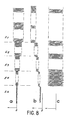
- the curves in FIG. 8 show an example of results obtained thanks to the invention.
- the measurements are made for increasing air gap values E 1 , E 2 , ..., E S , by rotating a metal part near a probe.
- Diagram (a) on the left shows an uncorrected differential signal.
- Diagram (b) in the middle represents the corresponding absolute signal.
- These two diagrams show a decrease in the sensitivity of the measurement when the air gap increases.
- the diagram (c), which appears on the right, represents the corrected differential signal according to the invention, that is to say obtained by dividing the differential signal (a) by the absolute signal (b). It can be seen that the signal thus corrected is of substantially constant intensity, whatever the value of the air gap between E 1 and E4. For the value E5, the corrected signal is interrupted because the absolute signal becomes too weak and the relay 78 of FIG. 7 opens, indicating that the quality of the measurement is no longer sufficient.
- the invention which has just been described can be applied regardless of the surface examined plane or left or at high frequency (from 1 kHz to 1 MHz) for example for the detection of longitudinal or transverse defects, outside or outside. inside cylindrical or conical tubes or bores, either at low frequency (a few Hz to a few kHz) for example for checking joints or welds, as well as for detecting faults under a coating.
Landscapes
- Chemical & Material Sciences (AREA)
- Chemical Kinetics & Catalysis (AREA)
- Electrochemistry (AREA)
- Physics & Mathematics (AREA)
- Health & Medical Sciences (AREA)
- Life Sciences & Earth Sciences (AREA)
- Analytical Chemistry (AREA)
- Biochemistry (AREA)
- General Health & Medical Sciences (AREA)
- General Physics & Mathematics (AREA)
- Immunology (AREA)
- Pathology (AREA)
- Investigating Or Analyzing Materials By The Use Of Magnetic Means (AREA)
Applications Claiming Priority (2)
| Application Number | Priority Date | Filing Date | Title |
|---|---|---|---|
| FR8105753A FR2502337A1 (fr) | 1981-03-23 | 1981-03-23 | Procede de controle non destructif par courants de foucault avec correction des effets d'entrefer et dispositif de mise en oeuvre |
| FR8105753 | 1981-03-23 |
Publications (2)
| Publication Number | Publication Date |
|---|---|
| EP0061956A1 true EP0061956A1 (de) | 1982-10-06 |
| EP0061956B1 EP0061956B1 (de) | 1985-10-23 |
Family
ID=9256521
Family Applications (1)
| Application Number | Title | Priority Date | Filing Date |
|---|---|---|---|
| EP82400471A Expired EP0061956B1 (de) | 1981-03-23 | 1982-03-15 | Verfahren zur wirbelstromzerstörungsfreien Prüfung unabhängig von dem Abstand der Sonden relativ zu dem Probenstück und Vorrichtung zur Ausübung des Verfahrens |
Country Status (7)
| Country | Link |
|---|---|
| US (1) | US4488114A (de) |
| EP (1) | EP0061956B1 (de) |
| JP (1) | JPS57211058A (de) |
| KR (1) | KR880000358B1 (de) |
| DE (1) | DE3266987D1 (de) |
| FR (1) | FR2502337A1 (de) |
| ZA (1) | ZA821958B (de) |
Cited By (2)
| Publication number | Priority date | Publication date | Assignee | Title |
|---|---|---|---|---|
| WO2008015197A1 (fr) * | 2006-08-03 | 2008-02-07 | Commissariat A L'energie Atomique | Procede et dispositif de controle par courants de foucault a fonctions emission/reception separees d'une piece electriquement conductrice |
| FR3040492A1 (fr) * | 2015-08-31 | 2017-03-03 | Snecma | Dispositif et procede de controle non destructif combinant une mesure differentielle et une mesure absolue |
Families Citing this family (4)
| Publication number | Priority date | Publication date | Assignee | Title |
|---|---|---|---|---|
| US4833931A (en) * | 1987-08-14 | 1989-05-30 | Westinghouse Electric Corp. | Thermally self-adjusting mount for proximity sensor |
| JP2929402B2 (ja) * | 1992-07-10 | 1999-08-03 | 日石三菱株式会社 | 炭素繊維強化管状複合材の検査方法及び装置 |
| US5446382A (en) * | 1993-06-23 | 1995-08-29 | The Babcock & Wilcox Company | Eddy current probe having one yoke within another yoke for increased inspection depth, sensitivity and discrimination |
| DE10045715A1 (de) * | 2000-09-15 | 2002-03-28 | Busch Dieter & Co Prueftech | Verfahren und Vorrichtung zur Prüfung eines Werkstücks mittels Wirbelströmen |
Citations (5)
| Publication number | Priority date | Publication date | Assignee | Title |
|---|---|---|---|---|
| US2985824A (en) * | 1958-04-14 | 1961-05-23 | Jr Claus J Renken | Nondestructive eddy current testing |
| FR1308785A (fr) * | 1961-10-13 | 1962-11-09 | Gkn Group Services Ltd | Perfectionnements apportés aux procédés et appareils pour déceler la présence de défauts dans des solides cohérents électriquement conducteurs |
| FR2065234A5 (de) * | 1969-10-10 | 1971-07-23 | Automation Ind Inc | |
| FR2276588A1 (fr) * | 1974-06-27 | 1976-01-23 | British Steel Corp | Appareil de detection de defauts de surface dans des objets metalliques |
| FR2339170A1 (fr) * | 1976-01-22 | 1977-08-19 | Commissariat Energie Atomique | Pont de mesure pour dispositif de controle par courants de foucault |
Family Cites Families (3)
| Publication number | Priority date | Publication date | Assignee | Title |
|---|---|---|---|---|
| US4079312A (en) * | 1976-08-17 | 1978-03-14 | Allegheny Ludlum Industries, Inc. | Continuous testing method and apparatus for determining the magnetic characteristics of a strip of moving material, including flux inducing and pick-up device therefor |
| FR2443682A1 (fr) * | 1978-12-07 | 1980-07-04 | Commissariat Energie Atomique | Circuit de correction automatique d'un signal emis par un capteur differentiel desequilibre |
| FR2451032A1 (fr) * | 1979-03-09 | 1980-10-03 | Commissariat Energie Atomique | Appareil numerique pour le controle de pieces par courants de foucault |
-
1981
- 1981-03-23 FR FR8105753A patent/FR2502337A1/fr active Granted
-
1982
- 1982-03-15 EP EP82400471A patent/EP0061956B1/de not_active Expired
- 1982-03-15 DE DE8282400471T patent/DE3266987D1/de not_active Expired
- 1982-03-23 KR KR828201232A patent/KR880000358B1/ko not_active Expired
- 1982-03-23 JP JP57044794A patent/JPS57211058A/ja active Pending
- 1982-03-23 US US06/360,901 patent/US4488114A/en not_active Expired - Fee Related
- 1982-03-23 ZA ZA821958A patent/ZA821958B/xx unknown
Patent Citations (5)
| Publication number | Priority date | Publication date | Assignee | Title |
|---|---|---|---|---|
| US2985824A (en) * | 1958-04-14 | 1961-05-23 | Jr Claus J Renken | Nondestructive eddy current testing |
| FR1308785A (fr) * | 1961-10-13 | 1962-11-09 | Gkn Group Services Ltd | Perfectionnements apportés aux procédés et appareils pour déceler la présence de défauts dans des solides cohérents électriquement conducteurs |
| FR2065234A5 (de) * | 1969-10-10 | 1971-07-23 | Automation Ind Inc | |
| FR2276588A1 (fr) * | 1974-06-27 | 1976-01-23 | British Steel Corp | Appareil de detection de defauts de surface dans des objets metalliques |
| FR2339170A1 (fr) * | 1976-01-22 | 1977-08-19 | Commissariat Energie Atomique | Pont de mesure pour dispositif de controle par courants de foucault |
Cited By (4)
| Publication number | Priority date | Publication date | Assignee | Title |
|---|---|---|---|---|
| WO2008015197A1 (fr) * | 2006-08-03 | 2008-02-07 | Commissariat A L'energie Atomique | Procede et dispositif de controle par courants de foucault a fonctions emission/reception separees d'une piece electriquement conductrice |
| FR2904694A1 (fr) * | 2006-08-03 | 2008-02-08 | Commissariat Energie Atomique | Procede et dispositif de controle par courants de foucault a fonctions emission/reception separees d'une piece electriquement conductrice |
| US8159217B2 (en) | 2006-08-03 | 2012-04-17 | Commissariat A L'energie Atomique | Method and device with separate emission/reception functions for making eddy current tests on an electrically conducting part |
| FR3040492A1 (fr) * | 2015-08-31 | 2017-03-03 | Snecma | Dispositif et procede de controle non destructif combinant une mesure differentielle et une mesure absolue |
Also Published As
| Publication number | Publication date |
|---|---|
| FR2502337A1 (fr) | 1982-09-24 |
| ZA821958B (en) | 1983-04-27 |
| US4488114A (en) | 1984-12-11 |
| KR880000358B1 (ko) | 1988-03-20 |
| FR2502337B1 (de) | 1983-04-22 |
| EP0061956B1 (de) | 1985-10-23 |
| DE3266987D1 (en) | 1985-11-28 |
| JPS57211058A (en) | 1982-12-24 |
Similar Documents
| Publication | Publication Date | Title |
|---|---|---|
| EP0012665B1 (de) | Stromkreis zur automatischen Korrektion des elektrischen Signals eines nicht abgeglichenen Differenzsignalgebers | |
| EP0195794B1 (de) | Wirbelstromverfahren zur feststellung von oberflächenfehlern und vorrichtung zum durchführen dieses verfahrens | |
| EP0015822B1 (de) | Digitale Wirbelstromvorrichtung zum Prüfen von Gegenständen | |
| EP0608230B1 (de) | Verfahren zum dynamischen kontaktlosen Messen einer Verschiebungs- oder Dielektrizitätskonstanten, mit Hilfe eines kapazitiven Sensors | |
| EP2694988B1 (de) | Verfahren und system zur kurzschlusserfassung in einem sensor | |
| EP2087335B1 (de) | Einrichtung und verfahren zum überwachen des vibrationszustands einer sich drehenden maschine | |
| EP0147294B1 (de) | Vorrichtung und Verfahren zum dynamischen kontaktlosen Messen kleiner Abstände | |
| EP0146091B1 (de) | Verfahren und System zur zerstörungsfreien Prüfung durch Wirbelströme unter Verwendung von überstreichenden Frequenzen | |
| EP0061956B1 (de) | Verfahren zur wirbelstromzerstörungsfreien Prüfung unabhängig von dem Abstand der Sonden relativ zu dem Probenstück und Vorrichtung zur Ausübung des Verfahrens | |
| EP0021893B1 (de) | Verfahren und Vorrichtung zur Wirbelstromprüfung metallischer Produkte und Anwendung der Vorrichtung und des Verfahrens | |
| EP1136820A1 (de) | Gerät zum Testen eines Objektes mit Wirbelströmen | |
| WO2017158287A1 (fr) | Dispositif détecteur inductif de facteur 1 | |
| EP0736173B1 (de) | Verfahren und vorrichtung zur magnetischen kontrolle metallischer produkte | |
| EP3308183B1 (de) | Verfahren zur steuerung der herstellung eines magneten und zugehörige vorrichtung | |
| CA1183210A (fr) | Procede de detection de defauts d'un produit metallique par courants de foucault | |
| EP0469267B1 (de) | Verfahren und Vorrichtung zur kontinuierlichen Messung der Dicke einer Beschichtung | |
| FR2761155A1 (fr) | Detecteur de defauts au voisinage d'un alesage | |
| FR2758882A1 (fr) | Procede de controle non destructif, par courants de foucault, des grappes de commande de reacteurs nucleaires en presence d'elements perturbateurs | |
| FR2607934A1 (fr) | Methode et dispositif de mesure de la difference de potentiel de volta d'un materiau relativement a un materiau de reference | |
| FR3040492A1 (fr) | Dispositif et procede de controle non destructif combinant une mesure differentielle et une mesure absolue | |
| WO2008006973A1 (fr) | Dispositif de mesure de propriétés électriques d'un milieu comportant de l'eau | |
| FR2506942A1 (fr) | Procede et dispositif pour la detection simultanee de contaminations et de phases ferromagnetiques sur ou dans des materiaux paramagnetiques | |
| BE490319A (de) | ||
| FR3040491A1 (fr) | Procede et dispositif de mesure non destructif et local des proprietes electromagnetiques d'un materiau magnetique | |
| FR2463417A1 (fr) | Dispositif pour la mesure d'une impedance |
Legal Events
| Date | Code | Title | Description |
|---|---|---|---|
| PUAI | Public reference made under article 153(3) epc to a published international application that has entered the european phase |
Free format text: ORIGINAL CODE: 0009012 |
|
| AK | Designated contracting states |
Designated state(s): BE DE GB IT NL SE |
|
| 17P | Request for examination filed |
Effective date: 19830311 |
|
| ITF | It: translation for a ep patent filed | ||
| GRAA | (expected) grant |
Free format text: ORIGINAL CODE: 0009210 |
|
| AK | Designated contracting states |
Designated state(s): BE DE GB IT NL SE |
|
| REF | Corresponds to: |
Ref document number: 3266987 Country of ref document: DE Date of ref document: 19851128 |
|
| PLBE | No opposition filed within time limit |
Free format text: ORIGINAL CODE: 0009261 |
|
| STAA | Information on the status of an ep patent application or granted ep patent |
Free format text: STATUS: NO OPPOSITION FILED WITHIN TIME LIMIT |
|
| 26N | No opposition filed | ||
| ITTA | It: last paid annual fee | ||
| PGFP | Annual fee paid to national office [announced via postgrant information from national office to epo] |
Ref country code: BE Payment date: 19940302 Year of fee payment: 13 |
|
| PGFP | Annual fee paid to national office [announced via postgrant information from national office to epo] |
Ref country code: SE Payment date: 19940303 Year of fee payment: 13 |
|
| PGFP | Annual fee paid to national office [announced via postgrant information from national office to epo] |
Ref country code: GB Payment date: 19940307 Year of fee payment: 13 |
|
| PGFP | Annual fee paid to national office [announced via postgrant information from national office to epo] |
Ref country code: DE Payment date: 19940314 Year of fee payment: 13 |
|
| PGFP | Annual fee paid to national office [announced via postgrant information from national office to epo] |
Ref country code: NL Payment date: 19940331 Year of fee payment: 13 |
|
| EAL | Se: european patent in force in sweden |
Ref document number: 82400471.7 |
|
| PG25 | Lapsed in a contracting state [announced via postgrant information from national office to epo] |
Ref country code: GB Effective date: 19950315 |
|
| PG25 | Lapsed in a contracting state [announced via postgrant information from national office to epo] |
Ref country code: SE Effective date: 19950316 |
|
| PG25 | Lapsed in a contracting state [announced via postgrant information from national office to epo] |
Ref country code: BE Effective date: 19950331 |
|
| BERE | Be: lapsed |
Owner name: COMMISSARIAT A L'ENERGIE ATOMIQUE ETABLISSEMENT D Effective date: 19950331 |
|
| PG25 | Lapsed in a contracting state [announced via postgrant information from national office to epo] |
Ref country code: NL Effective date: 19951001 |
|
| GBPC | Gb: european patent ceased through non-payment of renewal fee |
Effective date: 19950315 |
|
| NLV4 | Nl: lapsed or anulled due to non-payment of the annual fee |
Effective date: 19951001 |
|
| PG25 | Lapsed in a contracting state [announced via postgrant information from national office to epo] |
Ref country code: DE Effective date: 19951201 |
|
| EUG | Se: european patent has lapsed |
Ref document number: 82400471.7 |