EP0061998A1 - Use of 1:2-chrome or cobalt complex dyes for dyeing leather or furs - Google Patents
Use of 1:2-chrome or cobalt complex dyes for dyeing leather or furs Download PDFInfo
- Publication number
- EP0061998A1 EP0061998A1 EP82810122A EP82810122A EP0061998A1 EP 0061998 A1 EP0061998 A1 EP 0061998A1 EP 82810122 A EP82810122 A EP 82810122A EP 82810122 A EP82810122 A EP 82810122A EP 0061998 A1 EP0061998 A1 EP 0061998A1
- Authority
- EP
- European Patent Office
- Prior art keywords
- dyes
- dye
- leather
- parts
- formula
- Prior art date
- Legal status (The legal status is an assumption and is not a legal conclusion. Google has not performed a legal analysis and makes no representation as to the accuracy of the status listed.)
- Granted
Links
- 239000000975 dye Substances 0.000 title claims abstract description 46
- 239000010985 leather Substances 0.000 title claims abstract description 21
- 238000004043 dyeing Methods 0.000 title claims abstract description 12
- 150000004700 cobalt complex Chemical class 0.000 title description 6
- VYZAMTAEIAYCRO-UHFFFAOYSA-N Chromium Chemical group [Cr] VYZAMTAEIAYCRO-UHFFFAOYSA-N 0.000 claims description 10
- 229910052804 chromium Inorganic materials 0.000 claims description 9
- 239000011651 chromium Substances 0.000 claims description 9
- 125000002496 methyl group Chemical group [H]C([H])([H])* 0.000 claims description 8
- 150000001768 cations Chemical class 0.000 claims description 6
- ZAMOUSCENKQFHK-UHFFFAOYSA-N Chlorine atom Chemical compound [Cl] ZAMOUSCENKQFHK-UHFFFAOYSA-N 0.000 claims description 5
- 239000000460 chlorine Substances 0.000 claims description 5
- 229910052801 chlorine Inorganic materials 0.000 claims description 5
- 125000000449 nitro group Chemical group [O-][N+](*)=O 0.000 claims description 5
- 125000000217 alkyl group Chemical group 0.000 claims description 3
- 229910017052 cobalt Inorganic materials 0.000 claims description 3
- 239000010941 cobalt Substances 0.000 claims description 3
- GUTLYIVDDKVIGB-UHFFFAOYSA-N cobalt atom Chemical compound [Co] GUTLYIVDDKVIGB-UHFFFAOYSA-N 0.000 claims description 3
- 125000004432 carbon atom Chemical group C* 0.000 claims description 2
- 239000000203 mixture Substances 0.000 abstract description 10
- AJDUTMFFZHIJEM-UHFFFAOYSA-N n-(9,10-dioxoanthracen-1-yl)-4-[4-[[4-[4-[(9,10-dioxoanthracen-1-yl)carbamoyl]phenyl]phenyl]diazenyl]phenyl]benzamide Chemical compound O=C1C2=CC=CC=C2C(=O)C2=C1C=CC=C2NC(=O)C(C=C1)=CC=C1C(C=C1)=CC=C1N=NC(C=C1)=CC=C1C(C=C1)=CC=C1C(=O)NC1=CC=CC2=C1C(=O)C1=CC=CC=C1C2=O AJDUTMFFZHIJEM-UHFFFAOYSA-N 0.000 abstract 1
- 239000001043 yellow dye Substances 0.000 abstract 1
- NYGZLYXAPMMJTE-UHFFFAOYSA-M metanil yellow Chemical group [Na+].[O-]S(=O)(=O)C1=CC=CC(N=NC=2C=CC(NC=3C=CC=CC=3)=CC=2)=C1 NYGZLYXAPMMJTE-UHFFFAOYSA-M 0.000 description 10
- HEMHJVSKTPXQMS-UHFFFAOYSA-M Sodium hydroxide Chemical compound [OH-].[Na+] HEMHJVSKTPXQMS-UHFFFAOYSA-M 0.000 description 9
- XLYOFNOQVPJJNP-UHFFFAOYSA-N water Substances O XLYOFNOQVPJJNP-UHFFFAOYSA-N 0.000 description 9
- 239000000243 solution Substances 0.000 description 6
- RHPXYZMDLOJTFF-UHFFFAOYSA-N 3-amino-4-hydroxy-5-nitrobenzenesulfonic acid Chemical compound NC1=CC(S(O)(=O)=O)=CC([N+]([O-])=O)=C1O RHPXYZMDLOJTFF-UHFFFAOYSA-N 0.000 description 5
- 150000001868 cobalt Chemical class 0.000 description 5
- 238000000034 method Methods 0.000 description 5
- HRBCDVLFVGOSIC-UHFFFAOYSA-N 2-(3-chlorophenyl)-5-methyl-1h-pyrazol-3-one Chemical group N1C(C)=CC(=O)N1C1=CC=CC(Cl)=C1 HRBCDVLFVGOSIC-UHFFFAOYSA-N 0.000 description 4
- QGZKDVFQNNGYKY-UHFFFAOYSA-N Ammonia Chemical compound N QGZKDVFQNNGYKY-UHFFFAOYSA-N 0.000 description 4
- ZLMJMSJWJFRBEC-UHFFFAOYSA-N Potassium Chemical compound [K] ZLMJMSJWJFRBEC-UHFFFAOYSA-N 0.000 description 4
- 230000008878 coupling Effects 0.000 description 4
- 238000010168 coupling process Methods 0.000 description 4
- 238000005859 coupling reaction Methods 0.000 description 4
- 238000006193 diazotization reaction Methods 0.000 description 4
- 229910052751 metal Inorganic materials 0.000 description 4
- 239000002184 metal Substances 0.000 description 4
- 229910052700 potassium Inorganic materials 0.000 description 4
- 239000011591 potassium Substances 0.000 description 4
- KZQYIMCESJLPQH-UHFFFAOYSA-N Demethylated antipyrine Chemical compound N1C(C)=CC(=O)N1C1=CC=CC=C1 KZQYIMCESJLPQH-UHFFFAOYSA-N 0.000 description 3
- 239000003795 chemical substances by application Substances 0.000 description 3
- 238000001465 metallisation Methods 0.000 description 3
- 0 CCC(C)=C*Cl(OC)(OCC)OC=C(C)CC Chemical compound CCC(C)=C*Cl(OC)(OCC)OC=C(C)CC 0.000 description 2
- DGAQECJNVWCQMB-PUAWFVPOSA-M Ilexoside XXIX Chemical compound C[C@@H]1CC[C@@]2(CC[C@@]3(C(=CC[C@H]4[C@]3(CC[C@@H]5[C@@]4(CC[C@@H](C5(C)C)OS(=O)(=O)[O-])C)C)[C@@H]2[C@]1(C)O)C)C(=O)O[C@H]6[C@@H]([C@H]([C@@H]([C@H](O6)CO)O)O)O.[Na+] DGAQECJNVWCQMB-PUAWFVPOSA-M 0.000 description 2
- WCUXLLCKKVVCTQ-UHFFFAOYSA-M Potassium chloride Chemical compound [Cl-].[K+] WCUXLLCKKVVCTQ-UHFFFAOYSA-M 0.000 description 2
- 229910021529 ammonia Inorganic materials 0.000 description 2
- 150000001844 chromium Chemical class 0.000 description 2
- JVTAAEKCZFNVCJ-UHFFFAOYSA-N lactic acid Chemical compound CC(O)C(O)=O JVTAAEKCZFNVCJ-UHFFFAOYSA-N 0.000 description 2
- 239000000434 metal complex dye Substances 0.000 description 2
- BDAGIHXWWSANSR-UHFFFAOYSA-N methanoic acid Natural products OC=O BDAGIHXWWSANSR-UHFFFAOYSA-N 0.000 description 2
- 125000000956 methoxy group Chemical group [H]C([H])([H])O* 0.000 description 2
- 230000007935 neutral effect Effects 0.000 description 2
- 239000000843 powder Substances 0.000 description 2
- JEXVQSWXXUJEMA-UHFFFAOYSA-N pyrazol-3-one Chemical compound O=C1C=CN=N1 JEXVQSWXXUJEMA-UHFFFAOYSA-N 0.000 description 2
- YGSDEFSMJLZEOE-UHFFFAOYSA-N salicylic acid Chemical compound OC(=O)C1=CC=CC=C1O YGSDEFSMJLZEOE-UHFFFAOYSA-N 0.000 description 2
- 150000003839 salts Chemical class 0.000 description 2
- 229910052708 sodium Inorganic materials 0.000 description 2
- 239000011734 sodium Substances 0.000 description 2
- OSWFIVFLDKOXQC-UHFFFAOYSA-N 4-(3-methoxyphenyl)aniline Chemical compound COC1=CC=CC(C=2C=CC(N)=CC=2)=C1 OSWFIVFLDKOXQC-UHFFFAOYSA-N 0.000 description 1
- QTBSBXVTEAMEQO-UHFFFAOYSA-M Acetate Chemical compound CC([O-])=O QTBSBXVTEAMEQO-UHFFFAOYSA-M 0.000 description 1
- QGZKDVFQNNGYKY-UHFFFAOYSA-O Ammonium Chemical compound [NH4+] QGZKDVFQNNGYKY-UHFFFAOYSA-O 0.000 description 1
- 241000283707 Capra Species 0.000 description 1
- -1 Chlor, Methyl Chemical group 0.000 description 1
- FEWJPZIEWOKRBE-JCYAYHJZSA-N Dextrotartaric acid Chemical compound OC(=O)[C@H](O)[C@@H](O)C(O)=O FEWJPZIEWOKRBE-JCYAYHJZSA-N 0.000 description 1
- BDAGIHXWWSANSR-UHFFFAOYSA-M Formate Chemical compound [O-]C=O BDAGIHXWWSANSR-UHFFFAOYSA-M 0.000 description 1
- UFHFLCQGNIYNRP-UHFFFAOYSA-N Hydrogen Chemical compound [H][H] UFHFLCQGNIYNRP-UHFFFAOYSA-N 0.000 description 1
- WHXSMMKQMYFTQS-UHFFFAOYSA-N Lithium Chemical compound [Li] WHXSMMKQMYFTQS-UHFFFAOYSA-N 0.000 description 1
- 239000004952 Polyamide Substances 0.000 description 1
- NPYPAHLBTDXSSS-UHFFFAOYSA-N Potassium ion Chemical compound [K+] NPYPAHLBTDXSSS-UHFFFAOYSA-N 0.000 description 1
- FKNQFGJONOIPTF-UHFFFAOYSA-N Sodium cation Chemical compound [Na+] FKNQFGJONOIPTF-UHFFFAOYSA-N 0.000 description 1
- FEWJPZIEWOKRBE-UHFFFAOYSA-N Tartaric acid Natural products [H+].[H+].[O-]C(=O)C(O)C(O)C([O-])=O FEWJPZIEWOKRBE-UHFFFAOYSA-N 0.000 description 1
- CIUQDSCDWFSTQR-UHFFFAOYSA-N [C]1=CC=CC=C1 Chemical compound [C]1=CC=CC=C1 CIUQDSCDWFSTQR-UHFFFAOYSA-N 0.000 description 1
- 238000009825 accumulation Methods 0.000 description 1
- 239000003929 acidic solution Substances 0.000 description 1
- 239000003513 alkali Substances 0.000 description 1
- 150000001412 amines Chemical class 0.000 description 1
- 150000003863 ammonium salts Chemical class 0.000 description 1
- 229940051880 analgesics and antipyretics pyrazolones Drugs 0.000 description 1
- 239000000987 azo dye Substances 0.000 description 1
- 235000015278 beef Nutrition 0.000 description 1
- 239000001045 blue dye Substances 0.000 description 1
- 235000012745 brilliant blue FCF Nutrition 0.000 description 1
- 238000006243 chemical reaction Methods 0.000 description 1
- 150000001845 chromium compounds Chemical class 0.000 description 1
- GRWVQDDAKZFPFI-UHFFFAOYSA-H chromium(III) sulfate Chemical compound [Cr+3].[Cr+3].[O-]S([O-])(=O)=O.[O-]S([O-])(=O)=O.[O-]S([O-])(=O)=O GRWVQDDAKZFPFI-UHFFFAOYSA-H 0.000 description 1
- KYRMFSOATGQQBV-UHFFFAOYSA-N chromium;2-hydroxybenzoic acid Chemical compound [Cr].OC(=O)C1=CC=CC=C1O KYRMFSOATGQQBV-UHFFFAOYSA-N 0.000 description 1
- FVCBANFRNYWFIS-UHFFFAOYSA-N chromium;2-hydroxybenzoic acid;sodium Chemical compound [Na].[Cr].OC(=O)C1=CC=CC=C1O FVCBANFRNYWFIS-UHFFFAOYSA-N 0.000 description 1
- 229940011182 cobalt acetate Drugs 0.000 description 1
- 229940044175 cobalt sulfate Drugs 0.000 description 1
- 229910000361 cobalt sulfate Inorganic materials 0.000 description 1
- KTVIXTQDYHMGHF-UHFFFAOYSA-L cobalt(2+) sulfate Chemical compound [Co+2].[O-]S([O-])(=O)=O KTVIXTQDYHMGHF-UHFFFAOYSA-L 0.000 description 1
- 239000003086 colorant Substances 0.000 description 1
- 239000008139 complexing agent Substances 0.000 description 1
- 239000007859 condensation product Substances 0.000 description 1
- 125000001495 ethyl group Chemical group [H]C([H])([H])C([H])([H])* 0.000 description 1
- WSFSSNUMVMOOMR-UHFFFAOYSA-N formaldehyde Substances O=C WSFSSNUMVMOOMR-UHFFFAOYSA-N 0.000 description 1
- 235000019253 formic acid Nutrition 0.000 description 1
- 150000002431 hydrogen Chemical group 0.000 description 1
- 239000001257 hydrogen Substances 0.000 description 1
- 229910052739 hydrogen Inorganic materials 0.000 description 1
- 125000000959 isobutyl group Chemical group [H]C([H])([H])C([H])(C([H])([H])[H])C([H])([H])* 0.000 description 1
- 125000001449 isopropyl group Chemical group [H]C([H])([H])C([H])(*)C([H])([H])[H] 0.000 description 1
- 239000004310 lactic acid Substances 0.000 description 1
- 235000014655 lactic acid Nutrition 0.000 description 1
- 239000003446 ligand Substances 0.000 description 1
- 229910052744 lithium Inorganic materials 0.000 description 1
- 125000004108 n-butyl group Chemical group [H]C([H])([H])C([H])([H])C([H])([H])C([H])([H])* 0.000 description 1
- 125000004123 n-propyl group Chemical group [H]C([H])([H])C([H])([H])C([H])([H])* 0.000 description 1
- 125000003854 p-chlorophenyl group Chemical group [H]C1=C([H])C(*)=C([H])C([H])=C1Cl 0.000 description 1
- FJKROLUGYXJWQN-UHFFFAOYSA-N papa-hydroxy-benzoic acid Natural products OC(=O)C1=CC=C(O)C=C1 FJKROLUGYXJWQN-UHFFFAOYSA-N 0.000 description 1
- 229920002647 polyamide Polymers 0.000 description 1
- 235000015277 pork Nutrition 0.000 description 1
- 239000001103 potassium chloride Substances 0.000 description 1
- 235000011164 potassium chloride Nutrition 0.000 description 1
- 229910001414 potassium ion Inorganic materials 0.000 description 1
- 238000010992 reflux Methods 0.000 description 1
- 229960004889 salicylic acid Drugs 0.000 description 1
- 229910001415 sodium ion Inorganic materials 0.000 description 1
- 235000002906 tartaric acid Nutrition 0.000 description 1
- 239000011975 tartaric acid Substances 0.000 description 1
- 125000000999 tert-butyl group Chemical group [H]C([H])([H])C(*)(C([H])([H])[H])C([H])([H])[H] 0.000 description 1
- 210000002268 wool Anatomy 0.000 description 1
Classifications
-
- C—CHEMISTRY; METALLURGY
- C09—DYES; PAINTS; POLISHES; NATURAL RESINS; ADHESIVES; COMPOSITIONS NOT OTHERWISE PROVIDED FOR; APPLICATIONS OF MATERIALS NOT OTHERWISE PROVIDED FOR
- C09B—ORGANIC DYES OR CLOSELY-RELATED COMPOUNDS FOR PRODUCING DYES, e.g. PIGMENTS; MORDANTS; LAKES
- C09B45/00—Complex metal compounds of azo dyes
- C09B45/02—Preparation from dyes containing in o-position a hydroxy group and in o'-position hydroxy, alkoxy, carboxyl, amino or keto groups
- C09B45/14—Monoazo compounds
-
- D—TEXTILES; PAPER
- D06—TREATMENT OF TEXTILES OR THE LIKE; LAUNDERING; FLEXIBLE MATERIALS NOT OTHERWISE PROVIDED FOR
- D06P—DYEING OR PRINTING TEXTILES; DYEING LEATHER, FURS OR SOLID MACROMOLECULAR SUBSTANCES IN ANY FORM
- D06P3/00—Special processes of dyeing or printing textiles, or dyeing leather, furs, or solid macromolecular substances in any form, classified according to the material treated
- D06P3/02—Material containing basic nitrogen
- D06P3/04—Material containing basic nitrogen containing amide groups
- D06P3/30—Material containing basic nitrogen containing amide groups furs feathers, dead hair, furskins, pelts
- D06P3/3008—Material containing basic nitrogen containing amide groups furs feathers, dead hair, furskins, pelts using acid dyes
- D06P3/3016—Material containing basic nitrogen containing amide groups furs feathers, dead hair, furskins, pelts using acid dyes using monazo acid dyes
-
- D—TEXTILES; PAPER
- D06—TREATMENT OF TEXTILES OR THE LIKE; LAUNDERING; FLEXIBLE MATERIALS NOT OTHERWISE PROVIDED FOR
- D06P—DYEING OR PRINTING TEXTILES; DYEING LEATHER, FURS OR SOLID MACROMOLECULAR SUBSTANCES IN ANY FORM
- D06P3/00—Special processes of dyeing or printing textiles, or dyeing leather, furs, or solid macromolecular substances in any form, classified according to the material treated
- D06P3/02—Material containing basic nitrogen
- D06P3/04—Material containing basic nitrogen containing amide groups
- D06P3/32—Material containing basic nitrogen containing amide groups leather skins
- D06P3/3206—Material containing basic nitrogen containing amide groups leather skins using acid dyes
- D06P3/3213—Material containing basic nitrogen containing amide groups leather skins using acid dyes monoazo
Definitions
- the invention relates to the use of dyes, the formula I. ⁇ wherein Me is chromium or cobalt, Ka is a cation, m 1 or 2, n 0, 1 or 2 and Y is methyl, -CONH 2 or -CO-NH-R, where R is an alkyl group with 1-4 C atoms and the nitro groups are arranged in the 5- or 6-position for dyeing leather or furs.
- ⁇ Ka represents a cation, for example an alkali application, such as lithium, or preferably sodium or potassium.
- Ka can be an ammonium cation or the ammonium salt of an organic amine.
- the nitro groups are preferably arranged in the 6 position.
- n and m each represent 1 and the chlorine is preferably bound in the m position.
- the alkyl group R can be straight-chain or branched. It is methyl, ethyl, n-propyl, iso-propyl, n-butyl, iso-butyl or tert-butyl. R is preferably methyl.
- Y is methyl and the phenyl radical on the pyrazolone bears a chlorine in the m position.
- Suitable pyrazolones for the dyes of formula I given above are e.g. 1-phenyl-3-methylpyrazol-5-one, 1- (2'-, 3'- or 4'-chlorophenyl) -3-methylpyrazol-5-one, 1- (2 ', 5'- or 2', 3'- or 3 ', 4'-dichlorophenyl) -3-methylpyrazol-5-one or 1-phenyl-3-carbonamido-pyrazol-5-one. Particularly preferred among these is 1- (3'-chlorophenyl) -3-methylpyrazol-5-one.
- the 1: 2 chromium or cobalt complexes are prepared in the usual way, e.g. by reacting the metal-free azo dyes in a ratio of 1: 2 with a chromium- or cobalt-releasing agent, for example with cobalt sulfate or acetate or chromium sulfate or formate in a weakly alkaline, neutral or weakly acidic solution.
- a chromium- or cobalt-releasing agent for example with cobalt sulfate or acetate or chromium sulfate or formate in a weakly alkaline, neutral or weakly acidic solution.
- the simple salts mentioned above can also be used in the presence of complexing agents, such as tartaric acid, salicylic acid or lactic acid, or as complex salts, such as chromium salicylic acid.
- the metal-donating agents are used in a stoichiometric amount or in excess. Mixtures or uniform monoazo dyes can be metallized. In the first case, a mixture of symmetrical and asymmetrical metal complexes is obtained. Pure asymmetric complexes can be obtained by first using the known method to obtain the 1: 1 complex and then the corresponding one with additional monoazo dye 1: 2 complex. If desired, mixtures of metal-donating agents can also be used.
- the 1: 2 chromium or cobalt complexes are used for dyeing furs or preferably leather, all types of leather being suitable, e.g. Chrome leather, retanned leather or suede from goat, beef or pork.
- Red, reddish brown or yellow-red dyeings of very good fastness properties are obtained, in particular light and wet fastness properties.
- the preferred use of the dyes is in dyeing leather with dye mixtures, in particular in a mixture with a blue and a yellow or yellow-brown 1: 2 metal complex dye, which enables trichromatic dyeing of leather for the first time.
- the gray or violet dyes are also referred to as blue dyes.
- the monoazo dye obtained by diazotization of 6-nitro-2-amino-l-hydroxybenzene-4-sulfonic acid and coupling with 1- (3'-chlorophenyl) -3-methylpyrazol-5-one, are added with the addition of 4 parts Sodium hydroxide dissolved in 1000 parts of 80 ° warm water and mixed with 120 parts of a solution of chromium salicylic acid sodium with a chromium content of 2.6% and kept under reflux until the chroming is complete. The water is drawn off on the rotary evaporator.
- the chrome complex obtained is a dark powder that dissolves well in water and colors leather in full red shades with excellent fastness properties.
- Example 2 If the metallization of the monoazo dye used in Example 1 is carried out with appropriate amounts of cobalt salts instead of chromium salts, a dye is obtained which dyes leather or furs reddish brown.
- Example 3 If the procedure is as in Example 1, but the reaction solution is not evaporated on a rotary evaporator, but the dye is precipitated by adding potassium chloride, the dye obtained is the same as in Example 1, the sodium ion of the dye being largely replaced by the potassium ion is. The corresponding dye dyes leather in the same shade and the resulting fastness properties are equivalent.
- Example 4 If the corresponding cobalt complex from Example 2 is used analogously to Example 3, the corresponding dye is also obtained, but with potassium as the cation.
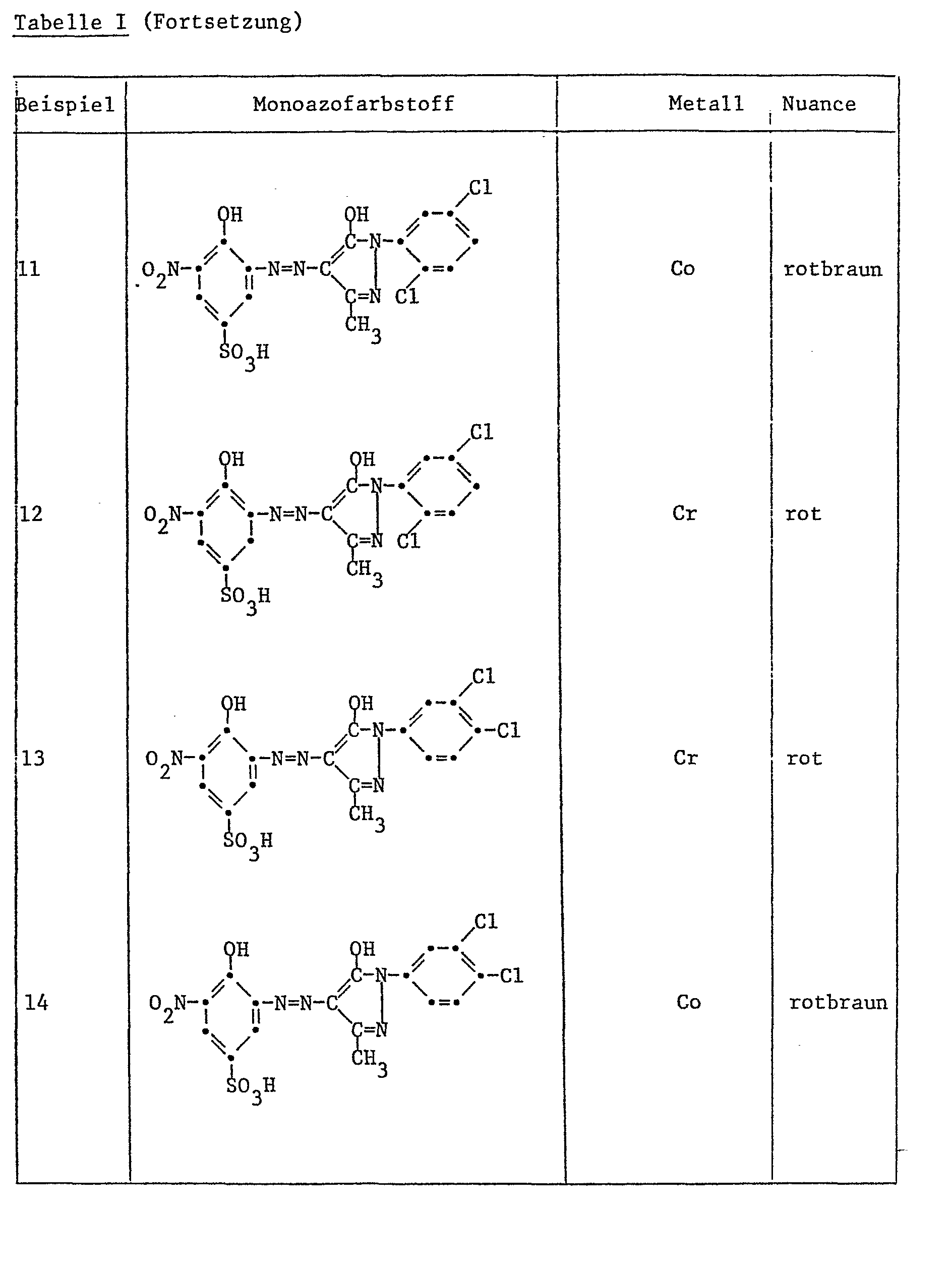
- Example 5-14 If the procedure is as described in Examples 1-4, but using the monoazo dyes listed in Table I, the corresponding 1: 2 metal complexes are obtained after metallization with the metal indicated in column 3, which leather in the Color the shades given in column 4.
- Example 15 22.5 parts of the monoazo dye obtained by diazotization of 6-nitro-2-amino-l-hydroxybenzene-4-sulfonic acid and coupling with 1- (3'-chlorophenyl) -3-methylpyrazol-5-one, and 21 parts of the monoazo dye, obtained by diazotization of 6-nitro-2-amino-l-hydroxybenzene-4-sulfonic acid and coupling with 1-phenyl-3-methylpyrazol-5-one, become 80 in 1000 parts with the addition of 4 parts of sodium hydroxide ° dissolved warm water and metallized and insulated as in Example 1.
- the dye powder obtained dyes wool, polyamide and leather in a red shade with excellent fastness properties and is a mixture of metal complexes of the following formulas:
- Example 16 If the metallization of the monoazo dye mixture used in Example 15 is carried out with the appropriate amounts of cobalt salts instead of chromium salts, the cobalt complexes with the same ligands as in Example 15 are obtained analogously.
- Example 17 The complex 1: 1 chromium compound, which contains 41.9 parts of the dye from diazotized 6-nitro-2-aminophenol-4-sulfonic acid and 1-phenyl-3-methylpyrazol-5-one and 5, are added in succession to 1000 parts of water , Contains 2 parts of chromium, and 45 parts of the monoazo dye, obtained by diazotization of 6-nitro-2-amino-l-hydroxybenzene-4-sulfonic acid and coupling with 1- (3'-chlorophenyl) -3-methylpyrazole-5 -on, registered and heated to 80 °. The pH is kept neutral with 2 molar sodium hydroxide solution. After the accumulation has ended, the water is drawn off on a rotary evaporator. The dye pattern obtained dyes leather with a red color.
- Examples 18-25 If the procedure is analogous to Example 17, but using the 1: 1 chromium complex and monoazo dyes indicated in Table II, the corresponding 1: 2 metal complex dyes are obtained, which dye leather in the shades indicated in column 4.
- 100 parts of suede clothing are rolled on at 50 ° in a solution of 1000 parts of water and 2 parts of 24% ammonia for 2 hours and then at 60 ° in a solution of 1000 parts of water, 2 parts of 24% ammonia and 3 parts of cobalted dye dyed according to Example 2 for 1 hour. Then a solution of 40 parts of water and 4 parts of 85% formic acid is added and dyeing is continued for a further 30 minutes. Then the leather is rinsed well and optionally treated with 2 parts of a dicyandiamino-formaldehyde condensation product for 30 minutes at 50 °. A red-brown color with good fastness properties is obtained.
Landscapes
- Engineering & Computer Science (AREA)
- Textile Engineering (AREA)
- Chemical & Material Sciences (AREA)
- Organic Chemistry (AREA)
- Coloring (AREA)
Abstract
Die Farbstoffe der im Patentanspruch 1 angegebenen Formel I eignen sich zum Färben von Pelzen und insbesondere von Leder. Vorzugsweise werden sie im Gemisch mit einem blauen und einem gelben Farbstoff für das Trichromiefärben von Leder verwendet.The dyes of the formula I specified in claim 1 are suitable for dyeing furs and in particular leather. They are preferably used in a mixture with a blue and a yellow dye for the trichromatic dyeing of leather.
Description
Die Erfindung betrifft die Verwendung von Farbstoffen, der Formel I

Die Nitrogruppen sind vorzugsweise in 6-Stellung angeordnet.The nitro groups are preferably arranged in the 6 position.
Vorzugsweise bedeuten n und m jeweils 1 und das Chlor ist bevorzugt in m-Stellung gebunden.Preferably n and m each represent 1 and the chlorine is preferably bound in the m position.
Die Alkylgruppe R kann geradkettig oder verzweigt sein. Es handelt sich um Methyl, Ethyl, n-Propyl, iso-Propyl, n-Butyl, iso-Butyl oder tert.-Butyl. Vorzugsweise ist R Methyl.The alkyl group R can be straight-chain or branched. It is methyl, ethyl, n-propyl, iso-propyl, n-butyl, iso-butyl or tert-butyl. R is preferably methyl.
In bevorzugten Farbstoffen ist Y Methyl und der Phenylrest am Pyrazolon trägt ein Chlor in m-Stellung.In preferred dyes, Y is methyl and the phenyl radical on the pyrazolone bears a chlorine in the m position.
Geeignete Pyrazolone für die Farbstoffe, der oben angegebenen Formel I sind z.B. 1-Phenyl-3-methylpyrazol-5-on, 1-(2'-, 3'- oder 4'-chlorphenyl)-3-methylpyrazol-5-on, 1-(2',5'- oder 2', 3'- oder 3', 4'-Dichlorphenyl)-3-methylpyrazol-5-on oder 1-Phenyl-3-carbonamido-pyrazol-5-on. Besonders bevorzugt unter diesen ist 1-(3'-chlorphenyl)-3-methylpyrazol-5-on.Suitable pyrazolones for the dyes of formula I given above are e.g. 1-phenyl-3-methylpyrazol-5-one, 1- (2'-, 3'- or 4'-chlorophenyl) -3-methylpyrazol-5-one, 1- (2 ', 5'- or 2', 3'- or 3 ', 4'-dichlorophenyl) -3-methylpyrazol-5-one or 1-phenyl-3-carbonamido-pyrazol-5-one. Particularly preferred among these is 1- (3'-chlorophenyl) -3-methylpyrazol-5-one.
Die 1:2-Chrom- oder -Kobaltkomplexe werden auf übliche Weise hergestellt, z.B. indem man die metallfreien Azofarbstoffe im Verhältnis 1:2 mit einem chrom- oder kobaltabgebenden Mittel umsetzt, beispielsweise mit Kobaltsulfat oder -acetat oder Chromsulfat oder -formiat in schwach alkalischer, neutraler oder schwach saurer Lösung.The 1: 2 chromium or cobalt complexes are prepared in the usual way, e.g. by reacting the metal-free azo dyes in a ratio of 1: 2 with a chromium- or cobalt-releasing agent, for example with cobalt sulfate or acetate or chromium sulfate or formate in a weakly alkaline, neutral or weakly acidic solution.
Die oben erwähnten einfachen Salze können auch in Gegenwart von Komplexbildnern, wie z.B. Weinsäure, Salicylsäure oder Milchsäure, oder als Komplexsalze, wie Chromsalicylsäure, verwendet werden. Die metallabgebenden Mittel werden in stöchiometrischer Menge oder im Ueberschuss eingesetzt. Es können Gemische oder einheitliche Monoazofarbstoffe metallisiert werden. Im ersten Fall erhält man ein Gemisch von symmetrischen und asymmetrischen Metallkomplexen. Reine asymmetrische Komplexe erhält man, indem man nach bekannter Methode zuerst den 1:1 Komplex und dann mit weiterem Monoazofarbstoff den entsprechenden 1:2 Komplex herstellt. Gewünschtenfalls können auch Gemische von metallabgebenden Mitteln eingesetzt werden.The simple salts mentioned above can also be used in the presence of complexing agents, such as tartaric acid, salicylic acid or lactic acid, or as complex salts, such as chromium salicylic acid. The metal-donating agents are used in a stoichiometric amount or in excess. Mixtures or uniform monoazo dyes can be metallized. In the first case, a mixture of symmetrical and asymmetrical metal complexes is obtained. Pure asymmetric complexes can be obtained by first using the known method to obtain the 1: 1 complex and then the corresponding one with additional monoazo dye 1: 2 complex. If desired, mixtures of metal-donating agents can also be used.
Die 1:2-Chrom- oder -Kobaltkomplexe werden zum Färben von Pelzen oder vorzugsweise von Leder verwendet, wobei alle Ledersorten geeignet sind, z.B. Chromleder, nachgegerbtes Leder oder Velourleder von Ziege, Rind oder Schwein.The 1: 2 chromium or cobalt complexes are used for dyeing furs or preferably leather, all types of leather being suitable, e.g. Chrome leather, retanned leather or suede from goat, beef or pork.
Man erhält rote, rotbraune oder gelbrote Färbungen sehr guter Echtheiten, insbesondere Licht- und Nassechtheiten.Red, reddish brown or yellow-red dyeings of very good fastness properties are obtained, in particular light and wet fastness properties.
Die bevorzugte Verwendung der Farbstoffe liegt im Färben von Leder mit Farbstoffmischungen, insbesondere im Gemisch mit einem blauen und einem gelben oder gelb-braunen 1:2-Metallkomplex-Farbstoff, womit erstmals das Trichromiefärben von Leder ermöglicht wird. Als blaue Farbstoffe werden in diesem Zusammenhang auch die grauen oder violetten Farbstoffe bezeichnet.The preferred use of the dyes is in dyeing leather with dye mixtures, in particular in a mixture with a blue and a yellow or yellow-brown 1: 2 metal complex dye, which enables trichromatic dyeing of leather for the first time. In this context, the gray or violet dyes are also referred to as blue dyes.
Vorzugsweise verwendet man eine Farbstoffmischung, enthaltend
- a) einen roten, rotbraunen oder gelbroten l:2-Chrom- oder Kobaltkomplex der oben angegebenen Formel I,
- b) einen blauen 1:2-Chrom- oder Kobaltkomplex des Farbstoffes der Formel II

- c) einen gelben 1:2-Kobaltkomplex des Farbstoffes der Formel III


- worin n die oben angegebene Bedeutung hat.
- a) a red, red-brown or yellow-red 1: 2-chromium or cobalt complex of the formula I given above,
- b) a blue 1: 2 chromium or cobalt complex of the dye of formula II
- c) a yellow 1: 2 cobalt complex of the dye of formula III
- where n has the meaning given above.
Die nachfolgenden Beispiele dienen der Erläuterung der Erfindung, ohne sie darauf zu beschränken. Teile bedeuten Gewichtsteile und Prozente Gewichtsprozente. Die Temperaturen sind in Grad Celsius angegeben.The following examples serve to illustrate the invention without restricting it. Parts mean parts by weight and percentages percent by weight. The temperatures are given in degrees Celsius.

Beispiel 2: Wird die Metallisierung des im Beispiel 1 verwendeten Monoazofarbstoffes mit entsprechenden Mengen Kobaltsalzen an Stelle von Chromsalzen durchgeführt, so erhält man einen Farbstoff der Leder oder Pelze rotbraun färbt.Example 2: If the metallization of the monoazo dye used in Example 1 is carried out with appropriate amounts of cobalt salts instead of chromium salts, a dye is obtained which dyes leather or furs reddish brown.
Beispiel 3: Arbeitet man wie im Beispeil 1, dampft jedoch die Reaktionslösung nicht am Rotationsverdampfer ein, sondern fällt den Farbstoff durch Zugabe von Kaliumchlorid aus, so erhält man den analogen Farbstoff wie im Beispiel 1, wobei das Natriumion des Farbstoffes grösstenteils durch das Kaliumion ersetzt ist. Der entsprechende Farbstoff färbt Leder in der gleichen Nuance und die resultierenden Echtheiten sind gleichwertig.Example 3: If the procedure is as in Example 1, but the reaction solution is not evaporated on a rotary evaporator, but the dye is precipitated by adding potassium chloride, the dye obtained is the same as in Example 1, the sodium ion of the dye being largely replaced by the potassium ion is. The corresponding dye dyes leather in the same shade and the resulting fastness properties are equivalent.
Beispiel 4: Verfährt man mit dem entsprechenden Kobaltkomplex aus Beispiel 2 analog wie im Beispiel 3, so erhält man ebenfalls den entsprechenden Farbstoff, jedoch mit Kalium als Kation.Example 4: If the corresponding cobalt complex from Example 2 is used analogously to Example 3, the corresponding dye is also obtained, but with potassium as the cation.
Beispiel 5-14: Arbeitet man wie in den Beispielen 1-4 beschrieben, verwendet jedoch die in der Tabelle I verzeichneten Monoazofarbstoffe, so erhält man nach der Metallisierung mit dem in Spalte 3 angegebenen Metall die entsprechenden 1:2 Metallkomplexe, welche Leder in den in Spalte 4 angegebenen Nuancen färben.



Die entsprechende Farbstoffmischung mit Kalium anstelle von Natrium als Kation, erhält man, wenn man analog wie im Beispiel 3 arbeitet.The corresponding dye mixture with potassium instead of sodium as the cation is obtained if the procedure is analogous to that in Example 3.
Beispiel 16: Wird die Metallisierung der in Beispiel 15 verwendeten Monoazofarbstoffmischung mit den entsprechenden Mengen Kobaltsalzen an Stelle von Chromsalzen durchgeführt, so erhält man analog die Kobaltkomplexe mit den gleichen Liganden wie im Beispiel 15.Example 16: If the metallization of the monoazo dye mixture used in Example 15 is carried out with the appropriate amounts of cobalt salts instead of chromium salts, the cobalt complexes with the same ligands as in Example 15 are obtained analogously.
Beispiel 17: In 1000 Teilen Wasser werden nacheinander die komplexe 1:1 Chromverbindung, welche 41,9 Teile des Farbstoffes aus diazotierter 6-Nitro-2-aminophenol-4-sulfonsäure und 1-Phenyl-3-methylpyrazol-5-on sowie 5,2 Teile Chrom enthält, und 45 Teile des Monoazofarbstoffes, erhalten durch Diazotierung von 6-Nitro-2-amino-l-hydroxybenzol-4-sulfonsäure und Kupplung mit 1-(3'-Chlorphenyl)-3-methylpyra- zol-5-on, eingetragen und auf 80° erwärmt. Der pH-Wert wird mit 2- molarer Natronlauge neutral gehalten. Nach Beendigung der Anlagerung wird das Wasser am Rotationsverdampfer abgezogen. Das erhaltene Farbstoffmuster färbt Leder mit roter Farbe.

Beim Arbeiten analog Beispiel 3 erhält man den entsprechenden Farbstoff mit Kalium als Kation.When working analogously to Example 3, the corresponding dye with potassium as the cation is obtained.
Beispiele 18-25: Verfährt man analog Beispiel 17,verwendet jedoch die in Tabelle II bezeichneten 1:1 Chromkomplex- und Monoazofarbstoffe, so erhält man die entsprechenden 1:2 Metallkomplexfarbstoffe, welche Leder in den in Spalte 4 angegebenen Nuancen färben.


100 Teile Bekleidungsvelourleder werden bei 50° in einer Lösung von 1000 Teilen Wasser und 2 Teilen 24-%igem Ammoniak während 2 Stunden aufgewalkt und anschliessend bei 60° in einer Lösung von 1000 Teilen Wasser, 2 Teilen 24-%igem Ammoniak und 3 Teilen des kobaltierten Farbstoffes gemäss Beispiel 2 während 1 Stunde gefärbt. Hierauf gibt man eine Lösung von 40 Teilen Wasser und 4 Teilen 85-%iger Ameisensäure zu und färbt noch weitere 30 Minuten. Dann wird das Leder gut gespült und gegebenenfalls noch mit 2 Teilen eines Dicyandiaminoformaldehydkondensationsproduktes während 30 Minuten bei 50° behandelt. Man erhält eine rotbraune Färbung mit guten Echtheiten.100 parts of suede clothing are rolled on at 50 ° in a solution of 1000 parts of water and 2 parts of 24% ammonia for 2 hours and then at 60 ° in a solution of 1000 parts of water, 2 parts of 24% ammonia and 3 parts of cobalted dye dyed according to Example 2 for 1 hour. Then a solution of 40 parts of water and 4 parts of 85% formic acid is added and dyeing is continued for a further 30 minutes. Then the leather is rinsed well and optionally treated with 2 parts of a dicyandiamino-formaldehyde condensation product for 30 minutes at 50 °. A red-brown color with good fastness properties is obtained.
Claims (7)

Applications Claiming Priority (2)
| Application Number | Priority Date | Filing Date | Title |
|---|---|---|---|
| CH195281 | 1981-03-23 | ||
| CH1952/81 | 1981-03-23 |
Publications (2)
| Publication Number | Publication Date |
|---|---|
| EP0061998A1 true EP0061998A1 (en) | 1982-10-06 |
| EP0061998B1 EP0061998B1 (en) | 1985-04-03 |
Family
ID=4222425
Family Applications (1)
| Application Number | Title | Priority Date | Filing Date |
|---|---|---|---|
| EP82810122A Expired EP0061998B1 (en) | 1981-03-23 | 1982-03-17 | Use of 1:2-chrome or cobalt complex dyes for dyeing leather or furs |
Country Status (5)
| Country | Link |
|---|---|
| US (1) | US4425133A (en) |
| EP (1) | EP0061998B1 (en) |
| JP (1) | JPS57171777A (en) |
| BR (1) | BR8201617A (en) |
| DE (1) | DE3262844D1 (en) |
Cited By (2)
| Publication number | Priority date | Publication date | Assignee | Title |
|---|---|---|---|---|
| EP0110822A1 (en) * | 1982-11-02 | 1984-06-13 | Ciba-Geigy Ag | Use of 1:2-chrome complex dyes for dyeing leather or furs |
| EP0260561A3 (en) * | 1986-09-18 | 1990-03-21 | Bayer Ag | Process for dyeing leather with dyestuff mixtures |
Families Citing this family (2)
| Publication number | Priority date | Publication date | Assignee | Title |
|---|---|---|---|---|
| IT1224686B (en) * | 1987-08-08 | 1990-10-18 | Sandoz Ag | PROCESS FOR DYEING OR PRINTING OF LEATHER |
| AT521842B1 (en) * | 2018-11-13 | 2023-01-15 | Blum Gmbh Julius | furniture hinge |
Citations (5)
| Publication number | Priority date | Publication date | Assignee | Title |
|---|---|---|---|---|
| DE600250C (en) * | 1933-03-12 | 1934-07-17 | I G Farbenindustrie Akt Ges | Process for the production of chromium-containing azo dyes |
| FR1220724A (en) * | 1958-04-30 | 1960-05-27 | Ciba Geigy | Metalliferous azo dyes and process for their manufacture |
| FR1246903A (en) * | 1959-10-15 | 1960-11-25 | Ciba Geigy | Novel Cobalt-containing Azo Dyes, Their Preparation and Method for Using Them |
| US3185676A (en) * | 1960-08-12 | 1965-05-25 | Gen Aniline & Film Corp | Method of azo dye chromation |
| FR2433036A1 (en) * | 1978-08-12 | 1980-03-07 | Bayer Ag | CHROME COMPLEX DYES |
Family Cites Families (3)
| Publication number | Priority date | Publication date | Assignee | Title |
|---|---|---|---|---|
| CA642408A (en) | 1962-06-05 | Buehler Arthur | Cobaltiferous azo-dyestuffs | |
| US3939140A (en) | 1971-04-23 | 1976-02-17 | Hoechst Aktiengesellschaft | Process for the preparation of a dyestuff consisting substantially of only unsymmetrical 1:2-chromium complex azo dyestuffs |
| US4171300A (en) | 1975-08-13 | 1979-10-16 | Ciba-Geigy Ag | Process for the manufacture of metal complex dyes |
-
1982
- 1982-03-17 EP EP82810122A patent/EP0061998B1/en not_active Expired
- 1982-03-17 DE DE8282810122T patent/DE3262844D1/en not_active Expired
- 1982-03-19 US US06/359,734 patent/US4425133A/en not_active Expired - Lifetime
- 1982-03-23 JP JP57044747A patent/JPS57171777A/en active Granted
- 1982-03-23 BR BR8201617A patent/BR8201617A/en not_active IP Right Cessation
Patent Citations (5)
| Publication number | Priority date | Publication date | Assignee | Title |
|---|---|---|---|---|
| DE600250C (en) * | 1933-03-12 | 1934-07-17 | I G Farbenindustrie Akt Ges | Process for the production of chromium-containing azo dyes |
| FR1220724A (en) * | 1958-04-30 | 1960-05-27 | Ciba Geigy | Metalliferous azo dyes and process for their manufacture |
| FR1246903A (en) * | 1959-10-15 | 1960-11-25 | Ciba Geigy | Novel Cobalt-containing Azo Dyes, Their Preparation and Method for Using Them |
| US3185676A (en) * | 1960-08-12 | 1965-05-25 | Gen Aniline & Film Corp | Method of azo dye chromation |
| FR2433036A1 (en) * | 1978-08-12 | 1980-03-07 | Bayer Ag | CHROME COMPLEX DYES |
Cited By (3)
| Publication number | Priority date | Publication date | Assignee | Title |
|---|---|---|---|---|
| EP0110822A1 (en) * | 1982-11-02 | 1984-06-13 | Ciba-Geigy Ag | Use of 1:2-chrome complex dyes for dyeing leather or furs |
| US4507125A (en) * | 1982-11-02 | 1985-03-26 | Ciba-Geigy Corporation | Use of 1:2 chrome complex dyes for dyeing leather and furs |
| EP0260561A3 (en) * | 1986-09-18 | 1990-03-21 | Bayer Ag | Process for dyeing leather with dyestuff mixtures |
Also Published As
| Publication number | Publication date |
|---|---|
| US4425133A (en) | 1984-01-10 |
| JPH048550B2 (en) | 1992-02-17 |
| EP0061998B1 (en) | 1985-04-03 |
| JPS57171777A (en) | 1982-10-22 |
| DE3262844D1 (en) | 1985-05-09 |
| BR8201617A (en) | 1983-02-08 |
Similar Documents
| Publication | Publication Date | Title |
|---|---|---|
| DE2313722B2 (en) | CHROME COMPLEX DYES AND THEIR USE FOR COLORING AND PRINTING NITROGEN-CONTAINING FIBER MATERIALS | |
| EP0061999B1 (en) | Use of 1:2-chrome or cobalt complex dyes for dyeing leather or furs | |
| EP0061998B1 (en) | Use of 1:2-chrome or cobalt complex dyes for dyeing leather or furs | |
| DE2704364C2 (en) | ||
| CH649775A5 (en) | WATER-SOLUBLE, ANIONIC CHROME COMPLEXES, THEIR PRODUCTION AND USE. | |
| DE2024047B2 (en) | POLYAZO DYES, THEIR METAL COMPLEX COMPOUNDS, THEIR PRODUCTION AND USE | |
| DE2514008C2 (en) | Organic compounds, their manufacture and use | |
| EP0095441B1 (en) | Asymmetric 1:2 chromium complex dyestuffs | |
| EP0098799B1 (en) | 1:2 metal complexes of azomethine dyestuffs with arylazo groups | |
| EP0110825B1 (en) | Asymmetrical 1:2 chromium complex dyestuffs containing one azo and one azomethine compound | |
| EP0113643B1 (en) | 1:2-cobalt complexes of disazo dyestuffs | |
| EP0061997A1 (en) | Use of 1:2 cobalt complex dyes for dyeing leather or furs | |
| DE848979C (en) | Process for the preparation of chromium-containing monoazo dyes | |
| EP0082819B1 (en) | Use of 1:2 cobalt complex dyes for dyeing leather or furs | |
| EP0110822B1 (en) | Use of 1:2-chrome complex dyes for dyeing leather or furs | |
| DE2608535C2 (en) | New chromium complex dyes, their production and use | |
| DE2542707C3 (en) | Chromium mixed complex dyes and their use for dyeing and printing nitrogen-containing fiber materials and leather | |
| DE2500550C2 (en) | New chromium complex dyes, their production and use | |
| DE3008086C2 (en) | ||
| DE4133167A1 (en) | IRON COMPLEX MIXTURES, THEIR PRODUCTION AND USE | |
| EP0037377B1 (en) | Metal-complex dyestuffs, their preparation and use | |
| EP0099336B1 (en) | 1:2 cobalt complexes of azo dyestuffs | |
| EP0148120B1 (en) | Asymmetrical 1:2 chromium complex dyes | |
| EP0099857B1 (en) | Metal complexes of azo dyestuffs | |
| EP0112281B1 (en) | Assymmetrical 1:2 chromium complex dyestuffs containing one azo and one azomethine compound |
Legal Events
| Date | Code | Title | Description |
|---|---|---|---|
| PUAI | Public reference made under article 153(3) epc to a published international application that has entered the european phase |
Free format text: ORIGINAL CODE: 0009012 |
|
| 17P | Request for examination filed |
Effective date: 19820319 |
|
| AK | Designated contracting states |
Designated state(s): CH DE FR GB IT |
|
| ITF | It: translation for a ep patent filed | ||
| GRAA | (expected) grant |
Free format text: ORIGINAL CODE: 0009210 |
|
| AK | Designated contracting states |
Designated state(s): CH DE FR GB IT LI |
|
| REF | Corresponds to: |
Ref document number: 3262844 Country of ref document: DE Date of ref document: 19850509 |
|
| ET | Fr: translation filed | ||
| PLBE | No opposition filed within time limit |
Free format text: ORIGINAL CODE: 0009261 |
|
| STAA | Information on the status of an ep patent application or granted ep patent |
Free format text: STATUS: NO OPPOSITION FILED WITHIN TIME LIMIT |
|
| 26N | No opposition filed | ||
| ITTA | It: last paid annual fee | ||
| REG | Reference to a national code |
Ref country code: CH Ref legal event code: PUE Owner name: CIBA-GEIGY AG TRANSFER- CIBA SC HOLDING AG |
|
| PGFP | Annual fee paid to national office [announced via postgrant information from national office to epo] |
Ref country code: CH Payment date: 19970206 Year of fee payment: 16 |
|
| REG | Reference to a national code |
Ref country code: FR Ref legal event code: TP |
|
| REG | Reference to a national code |
Ref country code: GB Ref legal event code: 732E |
|
| REG | Reference to a national code |
Ref country code: CH Ref legal event code: PFA Free format text: CIBA SC HOLDING AG TRANSFER- CIBA SPECIALTY CHEMICALS HOLDING INC. |
|
| REG | Reference to a national code |
Ref country code: FR Ref legal event code: CD |
|
| PG25 | Lapsed in a contracting state [announced via postgrant information from national office to epo] |
Ref country code: CH Free format text: LAPSE BECAUSE OF NON-PAYMENT OF DUE FEES Effective date: 19980331 Ref country code: LI Free format text: LAPSE BECAUSE OF NON-PAYMENT OF DUE FEES Effective date: 19980331 |
|
| REG | Reference to a national code |
Ref country code: CH Ref legal event code: PL |
|
| PGFP | Annual fee paid to national office [announced via postgrant information from national office to epo] |
Ref country code: FR Payment date: 20000203 Year of fee payment: 19 |
|
| PGFP | Annual fee paid to national office [announced via postgrant information from national office to epo] |
Ref country code: DE Payment date: 20000218 Year of fee payment: 19 |
|
| PGFP | Annual fee paid to national office [announced via postgrant information from national office to epo] |
Ref country code: GB Payment date: 20000224 Year of fee payment: 19 |
|
| PG25 | Lapsed in a contracting state [announced via postgrant information from national office to epo] |
Ref country code: GB Free format text: LAPSE BECAUSE OF NON-PAYMENT OF DUE FEES Effective date: 20010317 |
|
| PG25 | Lapsed in a contracting state [announced via postgrant information from national office to epo] |
Ref country code: DE Free format text: LAPSE BECAUSE OF NON-PAYMENT OF DUE FEES Effective date: 20010331 |
|
| GBPC | Gb: european patent ceased through non-payment of renewal fee |
Effective date: 20010317 |
|
| PG25 | Lapsed in a contracting state [announced via postgrant information from national office to epo] |
Ref country code: FR Free format text: LAPSE BECAUSE OF NON-PAYMENT OF DUE FEES Effective date: 20011130 |
|
| REG | Reference to a national code |
Ref country code: FR Ref legal event code: ST |