EP0062016A1 - An aluminium chloride composition and a method for its manufacture - Google Patents
An aluminium chloride composition and a method for its manufacture Download PDFInfo
- Publication number
- EP0062016A1 EP0062016A1 EP82850051A EP82850051A EP0062016A1 EP 0062016 A1 EP0062016 A1 EP 0062016A1 EP 82850051 A EP82850051 A EP 82850051A EP 82850051 A EP82850051 A EP 82850051A EP 0062016 A1 EP0062016 A1 EP 0062016A1
- Authority
- EP
- European Patent Office
- Prior art keywords
- aluminium
- solution
- content
- carbonate
- aluminium chloride
- Prior art date
- Legal status (The legal status is an assumption and is not a legal conclusion. Google has not performed a legal analysis and makes no representation as to the accuracy of the status listed.)
- Granted
Links
- VSCWAEJMTAWNJL-UHFFFAOYSA-K aluminium trichloride Chemical compound Cl[Al](Cl)Cl VSCWAEJMTAWNJL-UHFFFAOYSA-K 0.000 title claims abstract description 54
- 239000000203 mixture Substances 0.000 title claims abstract description 18
- 238000000034 method Methods 0.000 title claims abstract description 16
- 238000004519 manufacturing process Methods 0.000 title claims abstract description 5
- 239000000243 solution Substances 0.000 claims abstract description 66
- 229910052782 aluminium Inorganic materials 0.000 claims abstract description 27
- 239000004411 aluminium Substances 0.000 claims abstract description 26
- XAGFODPZIPBFFR-UHFFFAOYSA-N aluminium Chemical compound [Al] XAGFODPZIPBFFR-UHFFFAOYSA-N 0.000 claims abstract description 26
- 229940003214 aluminium chloride Drugs 0.000 claims abstract description 25
- BVKZGUZCCUSVTD-UHFFFAOYSA-L Carbonate Chemical compound [O-]C([O-])=O BVKZGUZCCUSVTD-UHFFFAOYSA-L 0.000 claims abstract description 15
- 229910052783 alkali metal Inorganic materials 0.000 claims abstract description 10
- 150000001340 alkali metals Chemical class 0.000 claims abstract description 10
- 229910052784 alkaline earth metal Inorganic materials 0.000 claims abstract description 9
- 150000001342 alkaline earth metals Chemical class 0.000 claims abstract description 9
- 239000007864 aqueous solution Substances 0.000 claims abstract description 7
- 150000002500 ions Chemical class 0.000 claims abstract description 3
- XLYOFNOQVPJJNP-UHFFFAOYSA-N water Substances O XLYOFNOQVPJJNP-UHFFFAOYSA-N 0.000 claims description 17
- 239000007787 solid Substances 0.000 claims description 4
- 238000005056 compaction Methods 0.000 claims 1
- 239000000835 fiber Substances 0.000 claims 1
- 239000000945 filler Substances 0.000 claims 1
- 238000005469 granulation Methods 0.000 claims 1
- 230000003179 granulation Effects 0.000 claims 1
- 230000014759 maintenance of location Effects 0.000 claims 1
- 239000011369 resultant mixture Substances 0.000 claims 1
- 230000003311 flocculating effect Effects 0.000 description 7
- 230000003113 alkalizing effect Effects 0.000 description 6
- CURLTUGMZLYLDI-UHFFFAOYSA-N Carbon dioxide Chemical compound O=C=O CURLTUGMZLYLDI-UHFFFAOYSA-N 0.000 description 4
- 239000008394 flocculating agent Substances 0.000 description 4
- 239000000126 substance Substances 0.000 description 4
- CDBYLPFSWZWCQE-UHFFFAOYSA-L Sodium Carbonate Chemical group [Na+].[Na+].[O-]C([O-])=O CDBYLPFSWZWCQE-UHFFFAOYSA-L 0.000 description 3
- 239000001164 aluminium sulphate Substances 0.000 description 3
- 235000011128 aluminium sulphate Nutrition 0.000 description 3
- 229910002092 carbon dioxide Inorganic materials 0.000 description 3
- BUACSMWVFUNQET-UHFFFAOYSA-H dialuminum;trisulfate;hydrate Chemical compound O.[Al+3].[Al+3].[O-]S([O-])(=O)=O.[O-]S([O-])(=O)=O.[O-]S([O-])(=O)=O BUACSMWVFUNQET-UHFFFAOYSA-H 0.000 description 3
- BHEPBYXIRTUNPN-UHFFFAOYSA-N hydridophosphorus(.) (triplet) Chemical compound [PH] BHEPBYXIRTUNPN-UHFFFAOYSA-N 0.000 description 3
- 239000010865 sewage Substances 0.000 description 3
- WNROFYMDJYEPJX-UHFFFAOYSA-K aluminium hydroxide Chemical compound [OH-].[OH-].[OH-].[Al+3] WNROFYMDJYEPJX-UHFFFAOYSA-K 0.000 description 2
- 230000015572 biosynthetic process Effects 0.000 description 2
- 239000001569 carbon dioxide Substances 0.000 description 2
- 239000003795 chemical substances by application Substances 0.000 description 2
- 238000002474 experimental method Methods 0.000 description 2
- 238000005189 flocculation Methods 0.000 description 2
- 230000016615 flocculation Effects 0.000 description 2
- 230000001376 precipitating effect Effects 0.000 description 2
- 238000001556 precipitation Methods 0.000 description 2
- 239000000047 product Substances 0.000 description 2
- 229910000029 sodium carbonate Inorganic materials 0.000 description 2
- 230000000087 stabilizing effect Effects 0.000 description 2
- 238000003756 stirring Methods 0.000 description 2
- 229910001854 alkali hydroxide Inorganic materials 0.000 description 1
- 150000008044 alkali metal hydroxides Chemical class 0.000 description 1
- 229910021502 aluminium hydroxide Inorganic materials 0.000 description 1
- YCLAMANSVUJYPT-UHFFFAOYSA-L aluminum chloride hydroxide hydrate Chemical compound O.[OH-].[Al+3].[Cl-] YCLAMANSVUJYPT-UHFFFAOYSA-L 0.000 description 1
- 229940024545 aluminum hydroxide Drugs 0.000 description 1
- -1 ammonium ions Chemical class 0.000 description 1
- 150000004649 carbonic acid derivatives Chemical class 0.000 description 1
- 150000001875 compounds Chemical class 0.000 description 1
- 230000000694 effects Effects 0.000 description 1
- 244000144992 flock Species 0.000 description 1
- 150000004679 hydroxides Chemical class 0.000 description 1
- 230000002093 peripheral effect Effects 0.000 description 1
- 239000002244 precipitate Substances 0.000 description 1
- 238000002360 preparation method Methods 0.000 description 1
- 238000000746 purification Methods 0.000 description 1
- 239000002994 raw material Substances 0.000 description 1
- 238000004062 sedimentation Methods 0.000 description 1
- 238000000926 separation method Methods 0.000 description 1
- 230000000007 visual effect Effects 0.000 description 1
Classifications
-
- C—CHEMISTRY; METALLURGY
- C02—TREATMENT OF WATER, WASTE WATER, SEWAGE, OR SLUDGE
- C02F—TREATMENT OF WATER, WASTE WATER, SEWAGE, OR SLUDGE
- C02F1/00—Treatment of water, waste water, or sewage
- C02F1/52—Treatment of water, waste water, or sewage by flocculation or precipitation of suspended impurities
- C02F1/5236—Treatment of water, waste water, or sewage by flocculation or precipitation of suspended impurities using inorganic agents
- C02F1/5245—Treatment of water, waste water, or sewage by flocculation or precipitation of suspended impurities using inorganic agents using basic salts, e.g. of aluminium and iron
-
- C—CHEMISTRY; METALLURGY
- C01—INORGANIC CHEMISTRY
- C01F—COMPOUNDS OF THE METALS BERYLLIUM, MAGNESIUM, ALUMINIUM, CALCIUM, STRONTIUM, BARIUM, RADIUM, THORIUM, OR OF THE RARE-EARTH METALS
- C01F7/00—Compounds of aluminium
- C01F7/48—Halides, with or without other cations besides aluminium
- C01F7/56—Chlorides
- C01F7/57—Basic aluminium chlorides, e.g. polyaluminium chlorides
-
- D—TEXTILES; PAPER
- D21—PAPER-MAKING; PRODUCTION OF CELLULOSE
- D21F—PAPER-MAKING MACHINES; METHODS OF PRODUCING PAPER THEREON
- D21F1/00—Wet end of machines for making continuous webs of paper
- D21F1/66—Pulp catching, de-watering, or recovering; Re-use of pulp-water
- D21F1/82—Pulp catching, de-watering, or recovering; Re-use of pulp-water adding fibre agglomeration compositions
Definitions
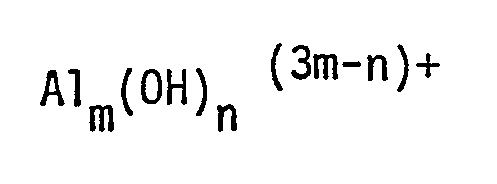
- the present invention relates to an aluminium chloride composition for water-purifying, sludge-dewatering and plant-dewatering purposes, comprising a clear, stable aqueous solution of aluminium chloride containing polynuclear complexes of the kind where m and n are positive integers.
- PAC-solutions which include polynuclear complexes, having a general empirical formula which can be written as: where x is smaller than 3, normally 1 - 2.
- Such compounds are described, for example, in SE,B,7201333-7, SE,B, 7405237-4, SE,B, 7412965-1, SE,B, 7503641-8 and DE,A, 2630768.
- a feature common to all PAC-type compositions containing aluminium chloride and based on polynuclear complexes is that extremely complicated methods are required to produce an effective solution, e.g. a solution which will effectively purify water, and hence the price demanded by the solutions is relatively high when seen against the effect they produce.
- PALC aluminium chloride-solutions
- A is an alkali metal
- B ia an alkaline earth metal
- n is a positive integer
- x is a number in the range 1 - 2.7.
- PALC-type polynuclear aluminium chloride solutions are found described in FR,A1, 7512975, according to which the solutions are produced by alkalizing aluminium chloride solutions with solutions of alkali hydroxide.
- stable solutions cannot be produced, other than in a highly diluted state.
- stable solution is meant here and in the following a solution which remains unchanged with respect to its composition and properties, even when stored for long periods of time.
- a solution containing up to 0.40 mole Al per litre can be obtained under certain conditions.
- this solution has a greatly limited stability, and must be injected directly into the water to be purified. It is apparent from the publication, and in particular from the working examples therein, that solutions having a higher concentration of aluminium than approximately 0.1 mole/1 cannot be expected to be effective and stable in the known PALC-solutions according to the publication.
- PALC-solutions polynuclear aluminium chloride composition
- PALC-solutions an important advantage with this second type of polynuclear aluminium chloride composition, i.e. PALC-solutions, is that it ought to be possible to produce said solutions much more cheaply than the earlier discussed PAC-solutions, owing to the far less complicated production methods required, and thereby to compete with-said PAC-solutions, provided that the PALC-solutions can be made sufficiently effective.
- the effectiveness of the solutions can only be increased by increasing either the total aluminium content of the solutions or the percentage of aluminium present in the form of polynuclear complexes, or by increasing both contents.
- PALC-solutions known hitherto have been unable to compete with the more expensive PAC-solutions because it has not been possible to produce PALC-solutions which will retain their stability at sufficiently high concentrations.
- the invention is based on the surprising stabilizing effect obtained when using carbonates or hydrocarbonates of alkali metals or alkaline earth metals as an alkalizing agent in the preparation of the solutions.
- alkali metal as used here and in the following is also considered to include ammonium ions.
- the stabilizing effect of the carbonate or hydrocarbonate on the solutions has not been fully establised. It has not been possible to show residues of carbonate in the solutions when applying conventional analyzing methods.
- novel PALC-type aluminium compositions including polynuclear complexes according to the invention are thus stable aqueous solutions, which are characterized in that they contain ions of alkali metal and/or alkaline earth metals in an amount which substantially corresponds stoichiometrically to the OH-content of the solutions, and in that the total aluminium content is about 0.3-2 mole per litre. Solutions which are particularly effective can be obtained according to the invention, wherein at least about 40% of the total aluminium content is present in the form of a polynuclear complex of the type described in the introduction. If desired, compositions according to the invention can be obtained in which more than about 80% of the aluminium content is present in the form of said polynucledr complex at a total aluminium content which does not exceed about 1.6 moles per litre.
- novel PALC-solutions according to the invention may thus contain from about 1.5 up to 8.3% by weight A1203, corresponding to an aluminium content of about 0.32 - 2.0 mole/I, depending on the desired polynuclear content, which in turn depends on the maximum extent to which the solutions can be alkalized without hydroxides precipitating out.
- a method for producing the novel aluminium-chloride composition comprising bringing a carbonate or hydrocarbonate of alkali metal or alkaline earth metal and an aluminium chloride into aqueous solution; selecting the amount of aluminium chloride so that the solution contains a given total aluminium content of between about 0.3 and about 2 mole per litre; and selecting the amount of carbonate or hydrocarbonate in relation to the amount of aluminium chloride so that the ratio between the number of moles of OH and the total number of moles of aluminium in the resultant solution does not appreciably exceed the value determined by the following associated values:
- PALC-solutions according to the invention are suitably prepared by alkalizing concentrated A1C1 3 -solutions with carbonate or hydrocarbonate of an alkali metal or alkaline earth metal.
- a suitable alkalizing agent is sodium carbonate, i.e. soda, since this is a particularly cheap raw material.
- the alkalizing process is relatively rapid at room temperature, and is normally finished in less than 1 hour. Carbon dioxide is driven off during the alkalizing process, and hence the solution must be vigorously agitated during said process, so as to accelerate the expulsion of carbon dioxide.
- alkalization may be carried out substantially simultaneously with the solution of solid aluminium chloride, without affecting the properties of the resultant solution.
- Preferred alternative embodiments of the method are set forth in Claims 5 - 8.
- PALC-solutions having different polynuclear contents were tested as flocculating agents on a laboratory scale and compared with three other flocculating agents, namely ALG, i.e. commercial granulated aluminium sulphate, FALS, i.e. alkalized aluminium sulphate solution, and a commercial PAC-quality (SACHTOKLAR).
- ALG i.e. commercial granulated aluminium sulphate
- FALS i.e. alkalized aluminium sulphate solution
- SACHTOKLAR commercial PAC-quality
- Formazin Turbidity Units whereat a high value corresponds to a high degree of turbidity, and secondly as a visual assessment of the formation of flocs, called "Flock".
- the results show that the PALC-solutions with the highest polynuclear content possessed better flocculating properties than both ALG and FALS and are fully comparable with the substantially more expensive PAC-products (SACHTOKLAR).
- Flocculation has been carried out with two different metered quantities of aluminium, namely 3.5 mg/1 and 2.6 mg/l respectively.
- the flocculating chemicals were metered to the contaminated water without previously adjusting the pH, while in two experiments the pH was lowered somewhat prior to introducing the chemicals into the water.
- Example 2 A second series of tests was carried out analogously with the procedure taken in Example 2, whereat flocculation was carried out on biologically purified sewage water taken from Helsingborg's sewage purification plant.
- the test results are set forth in Table III, which shows that the PALC-solutions containing the most polynucleates possessed better flocculating properties than ALG and FALS.
- the precipitation of phosphorous was approximately the same with all flocculating chemicals, but at the time of making the tests the sewage water contained very little phosphorous, less than lmg/l and hence these results are not generally applicable. It has previously been known that products having a high content of polynuclear aluminium-hydroxide complexes, e.g.
Landscapes
- Chemical & Material Sciences (AREA)
- Organic Chemistry (AREA)
- Inorganic Chemistry (AREA)
- Life Sciences & Earth Sciences (AREA)
- Hydrology & Water Resources (AREA)
- Engineering & Computer Science (AREA)
- Environmental & Geological Engineering (AREA)
- Water Supply & Treatment (AREA)
- Geology (AREA)
- Compounds Of Alkaline-Earth Elements, Aluminum Or Rare-Earth Metals (AREA)
- Separation Of Suspended Particles By Flocculating Agents (AREA)
- Compositions Of Macromolecular Compounds (AREA)
Abstract
Description
- The present invention relates to an aluminium chloride composition for water-purifying, sludge-dewatering and plant-dewatering purposes, comprising a clear, stable aqueous solution of aluminium chloride containing polynuclear complexes of the kind
- Two principally different kinds of aluminium chloride solutions containing such polynuclear complexes are known to the art. One kind is the so-called PAC-solutions which include polynuclear complexes, having a general empirical formula which can be written as:

- Such compounds are described, for example, in SE,B,7201333-7, SE,B, 7405237-4, SE,B, 7412965-1, SE,B, 7503641-8 and DE,A, 2630768. A feature common to all PAC-type compositions containing aluminium chloride and based on polynuclear complexes is that extremely complicated methods are required to produce an effective solution, e.g. a solution which will effectively purify water, and hence the price demanded by the solutions is relatively high when seen against the effect they produce.
- The other type of aluminium chloride-solutions, PALC, which are also based on the same polynuclear complex content as the PAC solutions, have the general, empirical formulii


- PALC-type polynuclear aluminium chloride solutions are found described in FR,A1, 7512975, according to which the solutions are produced by alkalizing aluminium chloride solutions with solutions of alkali hydroxide. However, according to this published reference clear, stable solutions cannot be produced, other than in a highly diluted state. By "stable solution" is meant here and in the following a solution which remains unchanged with respect to its composition and properties, even when stored for long periods of time. Thus, it is given in the aforementioned reference that a solution containing up to 0.40 mole Al per litre can be obtained under certain conditions. However, this solution has a greatly limited stability, and must be injected directly into the water to be purified. It is apparent from the publication, and in particular from the working examples therein, that solutions having a higher concentration of aluminium than approximately 0.1 mole/1 cannot be expected to be effective and stable in the known PALC-solutions according to the publication.
- However, an important advantage with this second type of polynuclear aluminium chloride composition, i.e. PALC-solutions, is that it ought to be possible to produce said solutions much more cheaply than the earlier discussed PAC-solutions, owing to the far less complicated production methods required, and thereby to compete with-said PAC-solutions, provided that the PALC-solutions can be made sufficiently effective. The effectiveness of the solutions can only be increased by increasing either the total aluminium content of the solutions or the percentage of aluminium present in the form of polynuclear complexes, or by increasing both contents. Those PALC-solutions known hitherto have been unable to compete with the more expensive PAC-solutions because it has not been possible to produce PALC-solutions which will retain their stability at sufficiently high concentrations.
- It has now surprisingly been found possible to produce substantially improved PALC-solutions which are not encumbered with the disadvantages and limitations normally credited to those above mentioned solutions. The invention is based on the surprising stabilizing effect obtained when using carbonates or hydrocarbonates of alkali metals or alkaline earth metals as an alkalizing agent in the preparation of the solutions. The term alkali metal as used here and in the following is also considered to include ammonium ions. The stabilizing effect of the carbonate or hydrocarbonate on the solutions has not been fully establised. It has not been possible to show residues of carbonate in the solutions when applying conventional analyzing methods. Nevertheless, it would seem probable that extremely small trace quantities of residual carbonate are present and that these trace quantities co-act synergistically with the polynuclear complexes formed during the alkalization process, such that the resultant solutions remain stable over much wider concentration ranges and for a much longer period of time than was previously possible.
- The novel PALC-type aluminium compositions including polynuclear complexes according to the invention are thus stable aqueous solutions, which are characterized in that they contain ions of alkali metal and/or alkaline earth metals in an amount which substantially corresponds stoichiometrically to the OH-content of the solutions, and in that the total aluminium content is about 0.3-2 mole per litre. Solutions which are particularly effective can be obtained according to the invention, wherein at least about 40% of the total aluminium content is present in the form of a polynuclear complex of the type described in the introduction. If desired, compositions according to the invention can be obtained in which more than about 80% of the aluminium content is present in the form of said polynucledr complex at a total aluminium content which does not exceed about 1.6 moles per litre.
- The novel PALC-solutions according to the invention may thus contain from about 1.5 up to 8.3% by weight A1203, corresponding to an aluminium content of about 0.32 - 2.0 mole/I, depending on the desired polynuclear content, which in turn depends on the maximum extent to which the solutions can be alkalized without hydroxides precipitating out.
- According to another aspect of the invention, there is provided a method for producing the novel aluminium-chloride composition, said method being characterized by bringing a carbonate or hydrocarbonate of alkali metal or alkaline earth metal and an aluminium chloride into aqueous solution; selecting the amount of aluminium chloride so that the solution contains a given total aluminium content of between about 0.3 and about 2 mole per litre; and selecting the amount of carbonate or hydrocarbonate in relation to the amount of aluminium chloride so that the ratio between the number of moles of OH and the total number of moles of aluminium in the resultant solution does not appreciably exceed the value determined by the following associated values:

- In the following Table 1 there is given the maximum degree of alkalization, expressed as the mole ratio OH/A1 at different total aluminium contents, Altot' in the solution, and the calculated degree of polynucleation. Polynucleation is expressed as the percentage of the total aluminium content present in the form of polynuclear complexes.

- 77.2 g of AlCl3 6H20 (0.32 moles) were dissolved in 900 ml of water, whereupon 40.7 g of Na2C03 were added successively during violent stirring. C02 is allowed to leave the solution, whereafter the solution becomes clear. Water is added to a total volume of 1000 ml.
- PALC-solutions having different polynuclear contents (40, 80 and 90% respectively) were tested as flocculating agents on a laboratory scale and compared with three other flocculating agents, namely ALG, i.e. commercial granulated aluminium sulphate, FALS, i.e. alkalized aluminium sulphate solution, and a commercial PAC-quality (SACHTOKLAR). Clear solutions containing 0.32 moles Al per litre (corresponding to 100 g of ALG per litre) were prepared from these flocculating agents. The flocculating tests were carried out according to the following procedure. The chemicals were added to the water to be purified while rapidly agitating the water for 10 seconds, whereafter the formation of flocs was allowed to take place for twenty minutes while slowly stirring the water at a peripheral speed of 0.1 m per second. A period of 10 minutes was allowed for sedimentation, whereafter a 200 ml sample was sucked from the surface of the water for analysis. In a first series of tests, flocculating experiments were made on water taken from Lussebacken. The results of these tests are set forth in Table II. This Table shows the flocculating results firstly as the resultant residual turbidity expressed in FTU, i.e. Formazin Turbidity Units, whereat a high value corresponds to a high degree of turbidity, and secondly as a visual assessment of the formation of flocs, called "Flock". The results show that the PALC-solutions with the highest polynuclear content possessed better flocculating properties than both ALG and FALS and are fully comparable with the substantially more expensive PAC-products (SACHTOKLAR). Flocculation has been carried out with two different metered quantities of aluminium, namely 3.5 mg/1 and 2.6 mg/l respectively. In a first series of tests, the flocculating chemicals were metered to the contaminated water without previously adjusting the pH, while in two experiments the pH was lowered somewhat prior to introducing the chemicals into the water.
- A second series of tests was carried out analogously with the procedure taken in Example 2, whereat flocculation was carried out on biologically purified sewage water taken from Helsingborg's sewage purification plant. The test results are set forth in Table III, which shows that the PALC-solutions containing the most polynucleates possessed better flocculating properties than ALG and FALS. The precipitation of phosphorous was approximately the same with all flocculating chemicals, but at the time of making the tests the sewage water contained very little phosphorous, less than lmg/l and hence these results are not generally applicable.

-

Claims (8)


Priority Applications (1)
| Application Number | Priority Date | Filing Date | Title |
|---|---|---|---|
| AT82850051T ATE16172T1 (en) | 1981-03-23 | 1982-03-12 | ALUMINUM CHLORIDE COMPOSITION AND PROCESS OF PRODUCTION. |
Applications Claiming Priority (2)
| Application Number | Priority Date | Filing Date | Title |
|---|---|---|---|
| SE8101829A SE440497B (en) | 1981-03-23 | 1981-03-23 | ALUMINUM CHLORIDE COMPOSITION FOR WATER PURIFICATION, SLAM DRAINAGE AND WATER DRAINAGE AND PROCEDURE FOR ITS PREPARATION |
| SE8101829 | 1981-03-23 |
Publications (2)
| Publication Number | Publication Date |
|---|---|
| EP0062016A1 true EP0062016A1 (en) | 1982-10-06 |
| EP0062016B1 EP0062016B1 (en) | 1985-10-23 |
Family
ID=20343399
Family Applications (1)
| Application Number | Title | Priority Date | Filing Date |
|---|---|---|---|
| EP82850051A Expired EP0062016B1 (en) | 1981-03-23 | 1982-03-12 | An aluminium chloride composition and a method for its manufacture |
Country Status (5)
| Country | Link |
|---|---|
| US (1) | US4390445A (en) |
| EP (1) | EP0062016B1 (en) |
| AT (1) | ATE16172T1 (en) |
| DE (1) | DE3266985D1 (en) |
| SE (1) | SE440497B (en) |
Cited By (1)
| Publication number | Priority date | Publication date | Assignee | Title |
|---|---|---|---|---|
| GB2157278A (en) * | 1984-04-11 | 1985-10-23 | Hydro Int Ltd | Water treatment |
Families Citing this family (10)
| Publication number | Priority date | Publication date | Assignee | Title |
|---|---|---|---|---|
| DE3515341A1 (en) * | 1985-04-27 | 1986-10-30 | Kali-Chemie Ag, 3000 Hannover | METHOD FOR PRODUCING SOLID ALUMINUM CHLORIDE COMPOSITIONS |
| US4655934A (en) * | 1985-09-12 | 1987-04-07 | Nalco Chemical Company | Dimeric aluminum compounds and their use |
| SE8900478L (en) * | 1989-02-13 | 1990-08-14 | Boliden Kemi Ab | PROCEDURES FOR PREPARING POLYALUMINUM COMPOUNDS |
| CA2229266C (en) * | 1995-09-18 | 2001-10-16 | Delta Chemical Corporation | Polyaluminum chlorides and polyaluminum chlorosulfates methods and compositions |
| US20030209499A1 (en) * | 2000-09-29 | 2003-11-13 | Haase Richard A. | Clarification of water and wastewater |
| RU2209187C2 (en) * | 2001-03-20 | 2003-07-27 | Закрытое акционерное общество "Каустик" | Scale removal composition |
| AU2002332426A1 (en) * | 2001-07-25 | 2003-02-17 | Richard A. Haase | Processes and apparatus for the manufacture of polynuclear aluminum compounds and disinfectants, and polynuclear aluminum compounds and disinfectants from such processes and apparatus |
| US6537464B1 (en) | 2001-10-31 | 2003-03-25 | General Chemical Corporation | Mid-basicity aluminum compounds and methods of making |
| RU2238915C1 (en) * | 2003-08-04 | 2004-10-27 | Верхозин Виталий Валерьевич | Descaling composition |
| US8268269B2 (en) * | 2006-01-24 | 2012-09-18 | Clearvalue Technologies, Inc. | Manufacture of water chemistries |
Citations (7)
| Publication number | Priority date | Publication date | Assignee | Title |
|---|---|---|---|---|
| DE2617282A1 (en) * | 1975-04-25 | 1976-11-04 | Degremont | METHOD FOR PRODUCING A SOLUTION OF A HYDROXIMETALLIC POLYMERIZATE AND ITS USE IN WATER TREATMENT |
| US4034067A (en) * | 1973-10-16 | 1977-07-05 | Rhone-Poulenc Industries | Hydroxychlorides of aluminum and method |
| DE1907359B2 (en) * | 1969-02-14 | 1978-09-14 | Taki Fertilizer Manufacturing Co., Ltd., Kakogawa (Japan) | Flocculant solutions and processes for their preparation |
| EP0005419A1 (en) * | 1978-05-03 | 1979-11-14 | Boliden Aktiebolag | Aluminium sulphate compositions containing polynuclear complexes and a method of producing the same and the use thereof |
| FR2428002A1 (en) * | 1976-03-04 | 1980-01-04 | Barcroft Cy | PROCESS FOR THE PREPARATION OF PHARMACEUTICAL ALUMINUM HYDROXIDE GELS |
| EP0017634A1 (en) * | 1979-03-23 | 1980-10-15 | Boliden Aktiebolag | A solid flocculating agent, a method for its manufacture and its use |
| DE2630768B2 (en) * | 1975-07-10 | 1980-12-11 | Rhone-Poulenc Industries, Paris | Process for the preparation of solutions of basic aluminum hydroxychlorides |
Family Cites Families (2)
| Publication number | Priority date | Publication date | Assignee | Title |
|---|---|---|---|---|
| US3497459A (en) * | 1965-12-09 | 1970-02-24 | Taki Fertilizer Mfg Co Ltd | Process for producing water soluble basic salts of aluminum and/or iron |
| FI53963C (en) * | 1971-02-19 | 1978-09-11 | Kali Chemie Ag | ALUMINUM CHLORIDE FRAME STATION |
-
1981
- 1981-03-23 SE SE8101829A patent/SE440497B/en not_active IP Right Cessation
-
1982
- 1982-03-11 US US06/357,179 patent/US4390445A/en not_active Expired - Lifetime
- 1982-03-12 EP EP82850051A patent/EP0062016B1/en not_active Expired
- 1982-03-12 DE DE8282850051T patent/DE3266985D1/en not_active Expired
- 1982-03-12 AT AT82850051T patent/ATE16172T1/en not_active IP Right Cessation
Patent Citations (7)
| Publication number | Priority date | Publication date | Assignee | Title |
|---|---|---|---|---|
| DE1907359B2 (en) * | 1969-02-14 | 1978-09-14 | Taki Fertilizer Manufacturing Co., Ltd., Kakogawa (Japan) | Flocculant solutions and processes for their preparation |
| US4034067A (en) * | 1973-10-16 | 1977-07-05 | Rhone-Poulenc Industries | Hydroxychlorides of aluminum and method |
| DE2617282A1 (en) * | 1975-04-25 | 1976-11-04 | Degremont | METHOD FOR PRODUCING A SOLUTION OF A HYDROXIMETALLIC POLYMERIZATE AND ITS USE IN WATER TREATMENT |
| DE2630768B2 (en) * | 1975-07-10 | 1980-12-11 | Rhone-Poulenc Industries, Paris | Process for the preparation of solutions of basic aluminum hydroxychlorides |
| FR2428002A1 (en) * | 1976-03-04 | 1980-01-04 | Barcroft Cy | PROCESS FOR THE PREPARATION OF PHARMACEUTICAL ALUMINUM HYDROXIDE GELS |
| EP0005419A1 (en) * | 1978-05-03 | 1979-11-14 | Boliden Aktiebolag | Aluminium sulphate compositions containing polynuclear complexes and a method of producing the same and the use thereof |
| EP0017634A1 (en) * | 1979-03-23 | 1980-10-15 | Boliden Aktiebolag | A solid flocculating agent, a method for its manufacture and its use |
Cited By (1)
| Publication number | Priority date | Publication date | Assignee | Title |
|---|---|---|---|---|
| GB2157278A (en) * | 1984-04-11 | 1985-10-23 | Hydro Int Ltd | Water treatment |
Also Published As
| Publication number | Publication date |
|---|---|
| US4390445A (en) | 1983-06-28 |
| ATE16172T1 (en) | 1985-11-15 |
| SE440497B (en) | 1985-08-05 |
| EP0062016B1 (en) | 1985-10-23 |
| DE3266985D1 (en) | 1985-11-28 |
| SE8101829L (en) | 1982-09-24 |
Similar Documents
| Publication | Publication Date | Title |
|---|---|---|
| US5246686A (en) | Basic aluminum chlorosulfate flocculating agents | |
| EP0372715B1 (en) | Polymeric basic aluminum silicate-sulphate | |
| EP0062016B1 (en) | An aluminium chloride composition and a method for its manufacture | |
| EP0490396B1 (en) | Process for recovery of ammonia from process and waste waters | |
| JPS58500358A (en) | Methods and compositions for conditioning aqueous systems | |
| EP0062015B1 (en) | Aluminium sulphate composition for water-purifying, paper-sizing and plant dewatering purposes and a method for producing the composition | |
| EP0110847B1 (en) | A method for producing basic aluminium sulphate (iii) | |
| DE69228470T2 (en) | Process for the preparation of a coagulant | |
| US4877597A (en) | Method for producing aqueous solutions of basic poly aluminum sulphate | |
| US6627085B2 (en) | Treatment of brine to remove metals and silicon therefrom | |
| EP0479218B1 (en) | Flocculant for water treament and method for producing it | |
| KR100206531B1 (en) | Process for preparation of basic polyaluminium chlorosulphates and applications thereof | |
| DE3904575C2 (en) | ||
| DE1907359B2 (en) | Flocculant solutions and processes for their preparation | |
| US6548037B1 (en) | Aluminium polychlorosulphates, process for their preparation and use thereof | |
| AU619518B2 (en) | Basic aluminium chlorosulphate, the process for producing it, and its use as a flocculating agent | |
| US1620332A (en) | Process of treating liquids | |
| US4437997A (en) | Clarification of ammonium polyphosphate solutions | |
| CN1099720A (en) | Preparing method for zinc polysilicate flocculate agent and use | |
| CS216522B2 (en) | Method of cleaning the waste waters containing dissolved organic impurities | |
| US2516988A (en) | Method of producing purified brine | |
| EP0100870A1 (en) | Process for producing calcium monohydrogen orthophosphate dihydrate | |
| US4888421A (en) | Process for making compounds containing chelated metal ions and resultant products which are useful for agricultural, industrial, environmental, and construction purposes | |
| US1930792A (en) | Process of treating liquids | |
| DE2238375C3 (en) | Use of copolymers as complexing agents in water softening |
Legal Events
| Date | Code | Title | Description |
|---|---|---|---|
| PUAI | Public reference made under article 153(3) epc to a published international application that has entered the european phase |
Free format text: ORIGINAL CODE: 0009012 |
|
| AK | Designated contracting states |
Designated state(s): AT BE CH DE FR GB IT LU NL SE |
|
| 17P | Request for examination filed |
Effective date: 19830329 |
|
| GRAA | (expected) grant |
Free format text: ORIGINAL CODE: 0009210 |
|
| AK | Designated contracting states |
Designated state(s): AT BE CH DE FR GB IT LI LU NL SE |
|
| REF | Corresponds to: |
Ref document number: 16172 Country of ref document: AT Date of ref document: 19851115 Kind code of ref document: T |
|
| RIN1 | Information on inventor provided before grant (corrected) |
Inventor name: GYTEL, ULLA BIRGITTA |
|
| REF | Corresponds to: |
Ref document number: 3266985 Country of ref document: DE Date of ref document: 19851128 |
|
| ITF | It: translation for a ep patent filed | ||
| ET | Fr: translation filed | ||
| PLBE | No opposition filed within time limit |
Free format text: ORIGINAL CODE: 0009261 |
|
| STAA | Information on the status of an ep patent application or granted ep patent |
Free format text: STATUS: NO OPPOSITION FILED WITHIN TIME LIMIT |
|
| 26N | No opposition filed | ||
| ITTA | It: last paid annual fee | ||
| PGFP | Annual fee paid to national office [announced via postgrant information from national office to epo] |
Ref country code: NL Payment date: 19940331 Year of fee payment: 13 |
|
| PGFP | Annual fee paid to national office [announced via postgrant information from national office to epo] |
Ref country code: GB Payment date: 19940525 Year of fee payment: 13 |
|
| PGFP | Annual fee paid to national office [announced via postgrant information from national office to epo] |
Ref country code: DE Payment date: 19940531 Year of fee payment: 13 |
|
| PGFP | Annual fee paid to national office [announced via postgrant information from national office to epo] |
Ref country code: AT Payment date: 19940601 Year of fee payment: 13 |
|
| PGFP | Annual fee paid to national office [announced via postgrant information from national office to epo] |
Ref country code: FR Payment date: 19940609 Year of fee payment: 13 |
|
| PGFP | Annual fee paid to national office [announced via postgrant information from national office to epo] |
Ref country code: SE Payment date: 19940615 Year of fee payment: 13 Ref country code: CH Payment date: 19940615 Year of fee payment: 13 |
|
| PGFP | Annual fee paid to national office [announced via postgrant information from national office to epo] |
Ref country code: LU Payment date: 19940630 Year of fee payment: 13 |
|
| PGFP | Annual fee paid to national office [announced via postgrant information from national office to epo] |
Ref country code: BE Payment date: 19940711 Year of fee payment: 13 |
|
| EPTA | Lu: last paid annual fee | ||
| EAL | Se: european patent in force in sweden |
Ref document number: 82850051.2 |
|
| PG25 | Lapsed in a contracting state [announced via postgrant information from national office to epo] |
Ref country code: LU Free format text: LAPSE BECAUSE OF NON-PAYMENT OF DUE FEES Effective date: 19950312 Ref country code: GB Effective date: 19950312 Ref country code: AT Effective date: 19950312 |
|
| PG25 | Lapsed in a contracting state [announced via postgrant information from national office to epo] |
Ref country code: SE Effective date: 19950313 |
|
| PG25 | Lapsed in a contracting state [announced via postgrant information from national office to epo] |
Ref country code: LI Effective date: 19950331 Ref country code: CH Effective date: 19950331 Ref country code: BE Effective date: 19950331 |
|
| BERE | Be: lapsed |
Owner name: BOLIDEN A.B. Effective date: 19950331 |
|
| PG25 | Lapsed in a contracting state [announced via postgrant information from national office to epo] |
Ref country code: NL Effective date: 19951001 |
|
| GBPC | Gb: european patent ceased through non-payment of renewal fee |
Effective date: 19950312 |
|
| PG25 | Lapsed in a contracting state [announced via postgrant information from national office to epo] |
Ref country code: FR Free format text: LAPSE BECAUSE OF NON-PAYMENT OF DUE FEES Effective date: 19951130 |
|
| REG | Reference to a national code |
Ref country code: CH Ref legal event code: PL |
|
| NLV4 | Nl: lapsed or anulled due to non-payment of the annual fee |
Effective date: 19951001 |
|
| PG25 | Lapsed in a contracting state [announced via postgrant information from national office to epo] |
Ref country code: DE Effective date: 19951201 |
|
| EUG | Se: european patent has lapsed |
Ref document number: 82850051.2 |
|
| REG | Reference to a national code |
Ref country code: FR Ref legal event code: ST |