EP0062213B1 - Kletten- bzw. faserförmige, dotierte Polyacetylenteilchen enthaltende thermoplastische Kunststoffe und Verfahren zu ihrer Herstellung - Google Patents
Kletten- bzw. faserförmige, dotierte Polyacetylenteilchen enthaltende thermoplastische Kunststoffe und Verfahren zu ihrer Herstellung Download PDFInfo
- Publication number
- EP0062213B1 EP0062213B1 EP82102338A EP82102338A EP0062213B1 EP 0062213 B1 EP0062213 B1 EP 0062213B1 EP 82102338 A EP82102338 A EP 82102338A EP 82102338 A EP82102338 A EP 82102338A EP 0062213 B1 EP0062213 B1 EP 0062213B1
- Authority
- EP
- European Patent Office
- Prior art keywords
- doped polyacetylene
- shaped
- polyacetylene particles
- particles
- production
- Prior art date
- Legal status (The legal status is an assumption and is not a legal conclusion. Google has not performed a legal analysis and makes no representation as to the accuracy of the status listed.)
- Expired
Links
- HSFWRNGVRCDJHI-UHFFFAOYSA-N alpha-acetylene Natural products C#C HSFWRNGVRCDJHI-UHFFFAOYSA-N 0.000 title claims description 51
- 229920001197 polyacetylene Polymers 0.000 title claims description 49
- 239000002245 particle Substances 0.000 title claims description 25
- 238000004519 manufacturing process Methods 0.000 title claims description 8
- 229920001169 thermoplastic Polymers 0.000 title claims description 8
- 238000000034 method Methods 0.000 title claims description 6
- 239000004416 thermosoftening plastic Substances 0.000 title description 7
- 239000000853 adhesive Substances 0.000 title 1
- 230000001070 adhesive effect Effects 0.000 title 1
- 239000000725 suspension Substances 0.000 claims description 26
- 239000000843 powder Substances 0.000 claims description 18
- 229920000642 polymer Polymers 0.000 claims description 12
- 229920003023 plastic Polymers 0.000 claims description 11
- 239000004033 plastic Substances 0.000 claims description 11
- 239000000375 suspending agent Substances 0.000 claims description 8
- 238000000576 coating method Methods 0.000 claims description 4
- 239000008187 granular material Substances 0.000 claims 6
- 239000007788 liquid Substances 0.000 claims 2
- 238000010137 moulding (plastic) Methods 0.000 claims 1
- YXFVVABEGXRONW-UHFFFAOYSA-N Toluene Chemical compound CC1=CC=CC=C1 YXFVVABEGXRONW-UHFFFAOYSA-N 0.000 description 24
- YMWUJEATGCHHMB-UHFFFAOYSA-N Dichloromethane Chemical compound ClCCl YMWUJEATGCHHMB-UHFFFAOYSA-N 0.000 description 18
- 239000003054 catalyst Substances 0.000 description 13
- OKKJLVBELUTLKV-UHFFFAOYSA-N Methanol Chemical compound OC OKKJLVBELUTLKV-UHFFFAOYSA-N 0.000 description 9
- 229910052782 aluminium Inorganic materials 0.000 description 9
- IJGRMHOSHXDMSA-UHFFFAOYSA-N Atomic nitrogen Chemical compound N#N IJGRMHOSHXDMSA-UHFFFAOYSA-N 0.000 description 8
- 239000004417 polycarbonate Substances 0.000 description 7
- 229920000515 polycarbonate Polymers 0.000 description 7
- UHOVQNZJYSORNB-UHFFFAOYSA-N Benzene Chemical compound C1=CC=CC=C1 UHOVQNZJYSORNB-UHFFFAOYSA-N 0.000 description 6
- 229910052736 halogen Inorganic materials 0.000 description 6
- 150000002367 halogens Chemical class 0.000 description 6
- CXWXQJXEFPUFDZ-UHFFFAOYSA-N tetralin Chemical compound C1=CC=C2CCCCC2=C1 CXWXQJXEFPUFDZ-UHFFFAOYSA-N 0.000 description 6
- ZAMOUSCENKQFHK-UHFFFAOYSA-N Chlorine atom Chemical compound [Cl] ZAMOUSCENKQFHK-UHFFFAOYSA-N 0.000 description 5
- -1 aluminum alkyl halides Chemical class 0.000 description 5
- 125000002534 ethynyl group Chemical group [H]C#C* 0.000 description 5
- 239000000203 mixture Substances 0.000 description 5
- 235000008078 Arctium minus Nutrition 0.000 description 4
- HEDRZPFGACZZDS-UHFFFAOYSA-N Chloroform Chemical compound ClC(Cl)Cl HEDRZPFGACZZDS-UHFFFAOYSA-N 0.000 description 4
- XAGFODPZIPBFFR-UHFFFAOYSA-N aluminium Chemical compound [Al] XAGFODPZIPBFFR-UHFFFAOYSA-N 0.000 description 4
- MVPPADPHJFYWMZ-UHFFFAOYSA-N chlorobenzene Chemical compound ClC1=CC=CC=C1 MVPPADPHJFYWMZ-UHFFFAOYSA-N 0.000 description 4
- 239000002019 doping agent Substances 0.000 description 4
- 239000000835 fiber Substances 0.000 description 4
- 238000000465 moulding Methods 0.000 description 4
- 229910052757 nitrogen Inorganic materials 0.000 description 4
- 239000002904 solvent Substances 0.000 description 4
- 238000003756 stirring Methods 0.000 description 4
- ZCYVEMRRCGMTRW-UHFFFAOYSA-N 7553-56-2 Chemical compound [I] ZCYVEMRRCGMTRW-UHFFFAOYSA-N 0.000 description 3
- 241000208843 Arctium Species 0.000 description 3
- 235000003130 Arctium lappa Nutrition 0.000 description 3
- 229910052801 chlorine Inorganic materials 0.000 description 3
- 239000000460 chlorine Substances 0.000 description 3
- 229910052740 iodine Inorganic materials 0.000 description 3
- 239000011630 iodine Substances 0.000 description 3
- VLKZOEOYAKHREP-UHFFFAOYSA-N n-Hexane Chemical compound CCCCCC VLKZOEOYAKHREP-UHFFFAOYSA-N 0.000 description 3
- 125000002524 organometallic group Chemical group 0.000 description 3
- 229920002239 polyacrylonitrile Polymers 0.000 description 3
- 150000003682 vanadium compounds Chemical class 0.000 description 3
- NLZUEZXRPGMBCV-UHFFFAOYSA-N Butylhydroxytoluene Chemical compound CC1=CC(C(C)(C)C)=C(O)C(C(C)(C)C)=C1 NLZUEZXRPGMBCV-UHFFFAOYSA-N 0.000 description 2
- XDTMQSROBMDMFD-UHFFFAOYSA-N Cyclohexane Chemical compound C1CCCCC1 XDTMQSROBMDMFD-UHFFFAOYSA-N 0.000 description 2
- LFQSCWFLJHTTHZ-UHFFFAOYSA-N Ethanol Chemical compound CCO LFQSCWFLJHTTHZ-UHFFFAOYSA-N 0.000 description 2
- VEXZGXHMUGYJMC-UHFFFAOYSA-N Hydrochloric acid Chemical compound Cl VEXZGXHMUGYJMC-UHFFFAOYSA-N 0.000 description 2
- 239000004952 Polyamide Substances 0.000 description 2
- PPBRXRYQALVLMV-UHFFFAOYSA-N Styrene Chemical compound C=CC1=CC=CC=C1 PPBRXRYQALVLMV-UHFFFAOYSA-N 0.000 description 2
- 235000010354 butylated hydroxytoluene Nutrition 0.000 description 2
- 238000006243 chemical reaction Methods 0.000 description 2
- NNBZCPXTIHJBJL-UHFFFAOYSA-N decalin Chemical compound C1CCCC2CCCCC21 NNBZCPXTIHJBJL-UHFFFAOYSA-N 0.000 description 2
- 238000001035 drying Methods 0.000 description 2
- 125000001495 ethyl group Chemical group [H]C([H])([H])C([H])([H])* 0.000 description 2
- 238000001914 filtration Methods 0.000 description 2
- 125000000959 isobutyl group Chemical group [H]C([H])([H])C([H])(C([H])([H])[H])C([H])([H])* 0.000 description 2
- 125000001449 isopropyl group Chemical group [H]C([H])([H])C([H])(*)C([H])([H])[H] 0.000 description 2
- 125000002496 methyl group Chemical group [H]C([H])([H])* 0.000 description 2
- 125000002347 octyl group Chemical group [H]C([*])([H])C([H])([H])C([H])([H])C([H])([H])C([H])([H])C([H])([H])C([H])([H])C([H])([H])[H] 0.000 description 2
- 229920002647 polyamide Polymers 0.000 description 2
- 238000006116 polymerization reaction Methods 0.000 description 2
- 238000002360 preparation method Methods 0.000 description 2
- 125000001436 propyl group Chemical group [H]C([*])([H])C([H])([H])C([H])([H])[H] 0.000 description 2
- 239000011541 reaction mixture Substances 0.000 description 2
- 238000001694 spray drying Methods 0.000 description 2
- 125000004400 (C1-C12) alkyl group Chemical group 0.000 description 1
- 125000003837 (C1-C20) alkyl group Chemical group 0.000 description 1
- 244000294263 Arctium minus Species 0.000 description 1
- WKBOTKDWSSQWDR-UHFFFAOYSA-N Bromine atom Chemical compound [Br] WKBOTKDWSSQWDR-UHFFFAOYSA-N 0.000 description 1
- CURLTUGMZLYLDI-UHFFFAOYSA-N Carbon dioxide Chemical compound O=C=O CURLTUGMZLYLDI-UHFFFAOYSA-N 0.000 description 1
- DGAQECJNVWCQMB-PUAWFVPOSA-M Ilexoside XXIX Chemical compound C[C@@H]1CC[C@@]2(CC[C@@]3(C(=CC[C@H]4[C@]3(CC[C@@H]5[C@@]4(CC[C@@H](C5(C)C)OS(=O)(=O)[O-])C)C)[C@@H]2[C@]1(C)O)C)C(=O)O[C@H]6[C@@H]([C@H]([C@@H]([C@H](O6)CO)O)O)O.[Na+] DGAQECJNVWCQMB-PUAWFVPOSA-M 0.000 description 1
- XFNIDRHJHBPCBV-UHFFFAOYSA-N O(Cl)Cl.CC(CO[V]OCC(C)(C)C)(C)C Chemical compound O(Cl)Cl.CC(CO[V]OCC(C)(C)C)(C)C XFNIDRHJHBPCBV-UHFFFAOYSA-N 0.000 description 1
- CBENFWSGALASAD-UHFFFAOYSA-N Ozone Chemical compound [O-][O+]=O CBENFWSGALASAD-UHFFFAOYSA-N 0.000 description 1
- 239000005062 Polybutadiene Substances 0.000 description 1
- 239000004698 Polyethylene Substances 0.000 description 1
- 239000004743 Polypropylene Substances 0.000 description 1
- 239000004372 Polyvinyl alcohol Substances 0.000 description 1
- ZLMJMSJWJFRBEC-UHFFFAOYSA-N Potassium Chemical compound [K] ZLMJMSJWJFRBEC-UHFFFAOYSA-N 0.000 description 1
- 238000013019 agitation Methods 0.000 description 1
- 150000001298 alcohols Chemical class 0.000 description 1
- 150000001338 aliphatic hydrocarbons Chemical class 0.000 description 1
- 229910052783 alkali metal Inorganic materials 0.000 description 1
- 150000001340 alkali metals Chemical class 0.000 description 1
- 125000000217 alkyl group Chemical group 0.000 description 1
- 150000001412 amines Chemical class 0.000 description 1
- 239000011260 aqueous acid Substances 0.000 description 1
- 150000004945 aromatic hydrocarbons Chemical class 0.000 description 1
- QVGXLLKOCUKJST-UHFFFAOYSA-N atomic oxygen Chemical compound [O] QVGXLLKOCUKJST-UHFFFAOYSA-N 0.000 description 1
- GDTBXPJZTBHREO-UHFFFAOYSA-N bromine Substances BrBr GDTBXPJZTBHREO-UHFFFAOYSA-N 0.000 description 1
- 229910052794 bromium Inorganic materials 0.000 description 1
- FPCJKVGGYOAWIZ-UHFFFAOYSA-N butan-1-ol;titanium Chemical compound [Ti].CCCCO.CCCCO.CCCCO.CCCCO FPCJKVGGYOAWIZ-UHFFFAOYSA-N 0.000 description 1
- 235000011089 carbon dioxide Nutrition 0.000 description 1
- 229920002678 cellulose Polymers 0.000 description 1
- 239000007795 chemical reaction product Substances 0.000 description 1
- 239000003638 chemical reducing agent Substances 0.000 description 1
- GRWVQDDAKZFPFI-UHFFFAOYSA-H chromium(III) sulfate Chemical compound [Cr+3].[Cr+3].[O-]S([O-])(=O)=O.[O-]S([O-])(=O)=O.[O-]S([O-])(=O)=O GRWVQDDAKZFPFI-UHFFFAOYSA-H 0.000 description 1
- 150000001875 compounds Chemical class 0.000 description 1
- 238000001816 cooling Methods 0.000 description 1
- 229920001577 copolymer Polymers 0.000 description 1
- 125000004122 cyclic group Chemical group 0.000 description 1
- 229920001971 elastomer Polymers 0.000 description 1
- 238000004108 freeze drying Methods 0.000 description 1
- 239000011521 glass Substances 0.000 description 1
- 150000008282 halocarbons Chemical class 0.000 description 1
- 150000002366 halogen compounds Chemical class 0.000 description 1
- 229910001385 heavy metal Inorganic materials 0.000 description 1
- 239000008240 homogeneous mixture Substances 0.000 description 1
- 229930195733 hydrocarbon Natural products 0.000 description 1
- 150000002430 hydrocarbons Chemical class 0.000 description 1
- PNDPGZBMCMUPRI-UHFFFAOYSA-N iodine Chemical compound II PNDPGZBMCMUPRI-UHFFFAOYSA-N 0.000 description 1
- 239000003960 organic solvent Substances 0.000 description 1
- 239000007800 oxidant agent Substances 0.000 description 1
- 239000001301 oxygen Substances 0.000 description 1
- 229910052760 oxygen Inorganic materials 0.000 description 1
- 230000000737 periodic effect Effects 0.000 description 1
- 125000000864 peroxy group Chemical group O(O*)* 0.000 description 1
- 229920002401 polyacrylamide Polymers 0.000 description 1
- 229920002857 polybutadiene Polymers 0.000 description 1
- 229920000728 polyester Polymers 0.000 description 1
- 229920000573 polyethylene Polymers 0.000 description 1
- 229920001195 polyisoprene Polymers 0.000 description 1
- 230000000379 polymerizing effect Effects 0.000 description 1
- 229920000193 polymethacrylate Polymers 0.000 description 1
- 229920001155 polypropylene Polymers 0.000 description 1
- 229920002635 polyurethane Polymers 0.000 description 1
- 239000004814 polyurethane Substances 0.000 description 1
- 229920002451 polyvinyl alcohol Polymers 0.000 description 1
- 229920001291 polyvinyl halide Polymers 0.000 description 1
- 229910052700 potassium Inorganic materials 0.000 description 1
- 239000011591 potassium Substances 0.000 description 1
- 239000002244 precipitate Substances 0.000 description 1
- 230000001376 precipitating effect Effects 0.000 description 1
- 230000000630 rising effect Effects 0.000 description 1
- 239000005060 rubber Substances 0.000 description 1
- 229910052708 sodium Inorganic materials 0.000 description 1
- 239000011734 sodium Substances 0.000 description 1
- QLUMLEDLZDMGDW-UHFFFAOYSA-N sodium;1h-naphthalen-1-ide Chemical compound [Na+].[C-]1=CC=CC2=CC=CC=C21 QLUMLEDLZDMGDW-UHFFFAOYSA-N 0.000 description 1
- 239000007787 solid Substances 0.000 description 1
- SQBBHCOIQXKPHL-UHFFFAOYSA-N tributylalumane Chemical compound CCCC[Al](CCCC)CCCC SQBBHCOIQXKPHL-UHFFFAOYSA-N 0.000 description 1
- VOITXYVAKOUIBA-UHFFFAOYSA-N triethylaluminium Chemical compound CC[Al](CC)CC VOITXYVAKOUIBA-UHFFFAOYSA-N 0.000 description 1
- MCULRUJILOGHCJ-UHFFFAOYSA-N triisobutylaluminium Chemical compound CC(C)C[Al](CC(C)C)CC(C)C MCULRUJILOGHCJ-UHFFFAOYSA-N 0.000 description 1
- LFXVBWRMVZPLFK-UHFFFAOYSA-N trioctylalumane Chemical compound CCCCCCCC[Al](CCCCCCCC)CCCCCCCC LFXVBWRMVZPLFK-UHFFFAOYSA-N 0.000 description 1
- CNWZYDSEVLFSMS-UHFFFAOYSA-N tripropylalumane Chemical compound CCC[Al](CCC)CCC CNWZYDSEVLFSMS-UHFFFAOYSA-N 0.000 description 1
- PXXNTAGJWPJAGM-UHFFFAOYSA-N vertaline Natural products C1C2C=3C=C(OC)C(OC)=CC=3OC(C=C3)=CC=C3CCC(=O)OC1CC1N2CCCC1 PXXNTAGJWPJAGM-UHFFFAOYSA-N 0.000 description 1
- 238000010626 work up procedure Methods 0.000 description 1
Images
Classifications
-
- D—TEXTILES; PAPER
- D01—NATURAL OR MAN-MADE THREADS OR FIBRES; SPINNING
- D01F—CHEMICAL FEATURES IN THE MANUFACTURE OF ARTIFICIAL FILAMENTS, THREADS, FIBRES, BRISTLES OR RIBBONS; APPARATUS SPECIALLY ADAPTED FOR THE MANUFACTURE OF CARBON FILAMENTS
- D01F6/00—Monocomponent artificial filaments or the like of synthetic polymers; Manufacture thereof
- D01F6/02—Monocomponent artificial filaments or the like of synthetic polymers; Manufacture thereof from homopolymers obtained by reactions only involving carbon-to-carbon unsaturated bonds
-
- C—CHEMISTRY; METALLURGY
- C08—ORGANIC MACROMOLECULAR COMPOUNDS; THEIR PREPARATION OR CHEMICAL WORKING-UP; COMPOSITIONS BASED THEREON
- C08J—WORKING-UP; GENERAL PROCESSES OF COMPOUNDING; AFTER-TREATMENT NOT COVERED BY SUBCLASSES C08B, C08C, C08F, C08G or C08H
- C08J3/00—Processes of treating or compounding macromolecular substances
- C08J3/005—Processes for mixing polymers
-
- C—CHEMISTRY; METALLURGY
- C08—ORGANIC MACROMOLECULAR COMPOUNDS; THEIR PREPARATION OR CHEMICAL WORKING-UP; COMPOSITIONS BASED THEREON
- C08L—COMPOSITIONS OF MACROMOLECULAR COMPOUNDS
- C08L101/00—Compositions of unspecified macromolecular compounds
Definitions
- the invention relates to thermoplastics which contain 0.01 to 50% by weight, preferably 0.1 to 20% by weight, and in particular 0.5 to 5% by weight of doped polyacetylene in finely divided burdock or fiber form , as well as a process for their production.
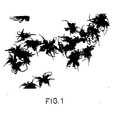
- the starting point for the present invention is a suspension of polyacetylene particles in the form of fiber balls or burdock (Fig. 1).
- This suspension is obtained by passing gaseous acetylene at a temperature of -100 ° C to + 80 ° C into a solution of an organometallic mixed catalyst in an organic solvent with agitation until a maximum of 30 g polyacetylene has formed per liter of solution.
- the solvent for the catalyst and at the same time suspending agent for the polyacetylene particles is generally an aliphatic or aromatic hydrocarbon, which can also be halogenated, for example benzene, toluene, chlorobenzene, tetralin, methylene chloride or chloroform.
- Particularly suitable vanadium compounds are:
- Aluminum alkyls are: triethyl aluminum, tripropyl aluminum, triisopropyl aluminum, tributyl aluminum, triisobutyl aluminum, trioctyl aluminum.
- Suitable solvents are in particular hydrocarbons such as benzene, toluene, hexane, cyclohexane, tetralin, decalin, halogenated hydrocarbons such as methylene chloride, chloroform, chlorobenzene.
- the catalysts are prepared in a manner known per se by reacting the vanadium compound and the aluminum compound in the solvent at temperatures from -100 to + 30 ° C.
- solutions are generally used which contain 5 to 100 mmol aluminum per liter of solvent.
- Acetylene is introduced into this solution under anaerobic conditions, at temperatures from -100 to + 80 ° C, preferably -80 to + 20 ° C. This creates a suspension of polyacetylene.
- the suspended particles look like small burdock under the microscope, with a diameter of approx. 0.01-1.0 mm.
- the suspensions of polyacetylene particles thus obtained generally contain 0.01 to 30 g per liter, preferably 0.1 to 10 g polyacetylene particles per liter. It may be advantageous to mechanically homogenize this suspension again before further treatment, e.g. B. with an Ultraturrax, the fiber structure of the particles should be preserved.
- the Ziegler catalyst Before doping, the Ziegler catalyst must first be deactivated or removed in these suspensions; this can be done in the usual way by adding alcohols such as methanol, ethanol, or mixtures thereof or by shaking with aqueous acids, e.g. B. achieve hydrochloric acid. But you can also replace the suspending agent in which the catalyst is dissolved. This will be done when it is important to remove the catalyst components or when the suspending agent present is unsuitable for further processing.
- the dopant is added to the suspension in bulk or in solution. You can work at temperatures from -78 to + 100 ° C, 10-30 ° C are preferred.
- Excess dopant can remain in the suspension, e.g. B. removed by renewed replacement of the suspending agent or destroyed by suitable measures.
- oxidizing agents can be used for p-doping.
- halogen compounds such as AsF s , SbF s , SbCl s , AsCl s , PF S , POF 3
- oxides such as NO, NO 2 , conc. H 2 S0 4 , H 2 0 2 , Cr0 3 or oxygen, ozone or peroxy compounds.
- Alkali metals or their naphthalides such as sodium, potassium, sodium naphthalide or electron donors such as amines.
- the doped polyacetylene particles can be isolated from their suspensions, but according to the invention the suspension is used in solution. It is combined with the plastic and the suspending agent is then removed, a solid, thermoplastically deformable mass (in granular or powder form) being obtained.
- plastics are polyethylene, polypropylene, polybutadiene, polyisoprene, polyvinyl halides (PVC), polyacrylonitrile, polymethacrylates, polyacrylamides, polyvinyl alcohol, polycarbonates, cellulose esters, polyamides, styrene homo- and copolymers (e.g. ABS), polyesters or polyurethanes.
- Suitable powders are obtained for thermoplastic processing, but can also be processed from solutions. These powders can also serve as powder coatings for the production of coatings.
- the doped polyacetylene-containing plastics according to the invention have very good mechanical properties. The electrical conductivity can be varied within wide limits. Addition of doped polyacetylene is particularly suitable for achieving antistatic properties of plastics.
- the suspension thus obtained contains 4 g of polyacetylene per Liter.
- the reaction is quenched with 0.5 g of 4-methyl-2,6-di-tert-butylphenol (lonol) in 400 ml of absolute toluene and the reaction mixture is blown out with nitrogen, the temperature rising to 20 ° C.
- a solution of 4 g of iodine in 100 ml of toluene is added to 1 l of a polyacetylene suspension prepared according to Example 1 with stirring at 20 ° C. and the mixture is subsequently stirred at room temperature for 2 hours.
- the originally violet solution discolors and a suspension containing doped burdock-shaped polyacetylene particles is obtained.
- Example 3 Analogously to Example 3, a suspension which was prepared according to Example 2 was doped with a solution of 2.5 g iodine in 100 ml methylene chloride.
- H2S04-doped and SbCls-doped polyacetylene suspensions can be prepared and processed.
- polycarbonate 100 g of polycarbonate are added to 1 l of a polyacetylene suspension prepared according to Example 2 and doped with chromosulfuric acid and the mixture is stirred until the polycarbonate is clear. From the suspension thus obtained, a fine, doped polyacetylene particle-containing polycarbonate powder is obtained by spray drying, which can be processed thermoplastic or by solution to form antistatic moldings or coatings.
Landscapes
- Chemical & Material Sciences (AREA)
- Chemical Kinetics & Catalysis (AREA)
- Health & Medical Sciences (AREA)
- Medicinal Chemistry (AREA)
- Polymers & Plastics (AREA)
- Organic Chemistry (AREA)
- General Chemical & Material Sciences (AREA)
- Engineering & Computer Science (AREA)
- Textile Engineering (AREA)
- Addition Polymer Or Copolymer, Post-Treatments, Or Chemical Modifications (AREA)
- Processes Of Treating Macromolecular Substances (AREA)
- Compositions Of Macromolecular Compounds (AREA)
Description
- Es ist bekannt, Polyacetylene durch Polymerisation von Acetylen mit Hilfe von metallorganischen Mischkatalysatoren herzustellen (J. Polym. Sci. Bd. 12, Seiten 11-20). Es ist ferner bekannt, kristalline Folien aus Polyacetylen zu dotieren durch Behandeln mit gasförmigen Elektronenakzeptordotiermitteln, so daß ihre elektrische Leitfähigkeit verbessert wird (US-PS 4 222 903).
- Gegenstand der Erfindung sind thermoplastische Kunststoffe, die 0,01 bis 50 Gew.-%, vorzugsweise 0,1 bis 20 Gew.-%, und insbesondere 0,5 bis 5 Gew.-% dotiertes Polyacetylen in fein verteilter Kletten-oder Faserform enthalten, sowie ein Verfahren zu ihrer Herstellung.
- Ausgangspunkt für die vorliegende Erfindung ist eine Suspension von Polyacetylenteilchen in Form von Faserknäuelchen oder « Kletten (Fig. 1). Diese Suspension erhält man, indem man gasförmiges Acetylen bei Temperaturen von -100 °C bis +80°C in eine Lösung eines metallorganischen Mischkatalysators in einem organischen Lösungsmittel unter Agitation einleitet, bis sich pro Liter Lösung maximal 30 g Polyacetylen gebildet haben. Das Lösungsmittel für den Katalysator und gleichzeitig Suspendiermittel für die Polyacetylenteilchen ist in der Regel ein aliphatischer oder aromatischer Kohlenwasserstoff, der auch halogeniert sein kann, beispielsweise Benzol, Toluol, Chlorbenzol, Tetralin, Methylenchlorid oder Chloroform.
- Der metallorganische Mischkatalysator oder Ziegler-Katalysator ist ein Umsetzungsprodukt aus, einerseits, Verbindungen von Schwermetallen der Gruppen 4b, 5b, 6b, 7b und 8 des Periodensystems der Elemente (Handbook of Chemistry and Physics, 47. Auflage (1966), S. B. 3 - Chem. Rubber Company, Cleveland, Ohio/USA), und, andererseits, Aluminiumalkylen oder Aluminiumalkylhalogeniden. Ziegler-Katalysatoren sind genau bekannt..Bevorzugt verwendet man für die Herstellung von Polyacetylenteilchen Katalysatoren aus 0,05 bis 0,2 Mol Vanadium-Verbindung der Formel
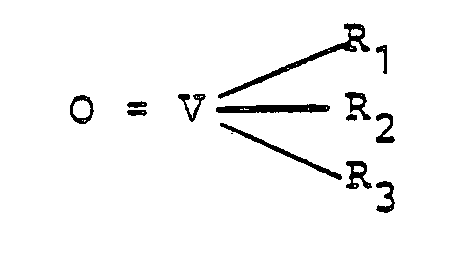
- R1 Halogen (Chlor),
- R2, R3, unabhängig voneinander, Halogen (Chlor), OR5 (Rs = C1-C20-Alkyl, geradkettig, cyclisch oder verzweigt), bedeuten und 0,1 bis 20 Mol, bevorzugt 1-10 Mol, eines Aluminiumalkyts der Formeln Al(R4)3, AlX(R4)2, AIX2(R4), Al2X3(R4)3, worin
- R4 C1-C12-Alkyl, bevorzugt Methyl, Ethyl, Propyl, Isopropyl, Isobutyl, Octyl,
- X Halogen
- Besonders geeignete Vanadiumverbindungen sind :
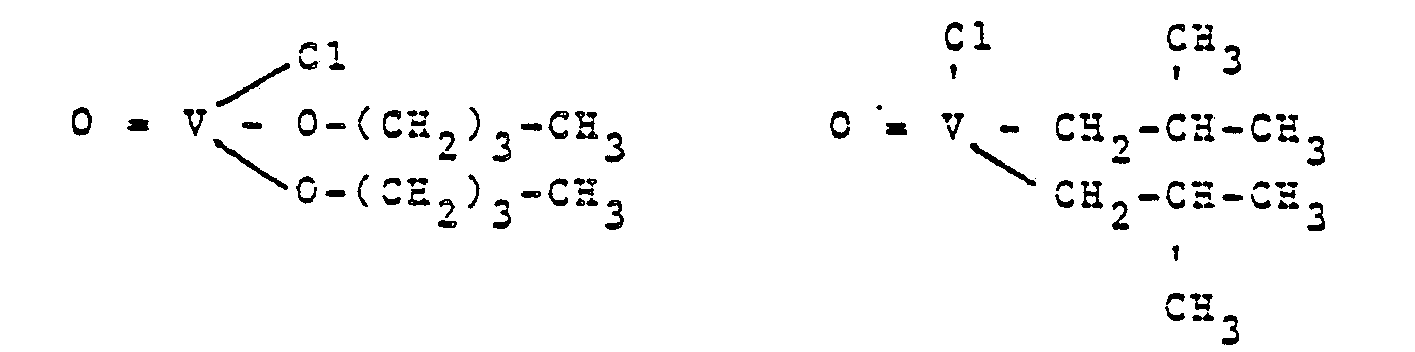

- Besonders geeignete Aluminiumalkyle sind : Triethylaluminium, Tripropylaluminium, Triisopropylaluminium, Tributylaluminium, Triisobutylaluminium, Trioctylaluminium.
- Geeignete Lösungsmittel sind insbesondere Kohlenwasserstoffe wie Benzol, Toluol, Hexan, Cyclohexan, Tetralin, Dekalin, halogenierte Kohlenwasserstoffe, wie Methylenchlorid, Chloroform, Chlorbenzol.
- Die Katalysatoren werden durch Umsetzung der Vanadiumverbindung und der Aluminiumverbindung im Lösungsmittel bei Temperaturen von -100 bis + 30 °C in an sich bekannter Weise hergestellt. Zur nachfolgenden Polymerisation benutzt man im allgemeinen Lösungen, die 5 bis 100 mMol Aluminium pro Liter Lösungsmittel enthalten. In diese Lösung wird Acetylen unter anaeroben Bedingungen eingeleitet, bei Temperaturen von -100 bis + 80 °C, bevorzugt -80 bis + 20 °C. Es entsteht dabei eine Suspension von Polyacetylen. Die suspendierten Teilchen sehen unter dem Mikroskop wie kleine Kletten aus, mit einem Durchmesser von ca. 0,01-1,0 mm.
- Die so erhaltenen Suspensionen von Polyacetylenteilchen enthalten im allgemeinen 0,01 bis 30 g pro Liter, bevorzugt 0,1 bis 10 g Polyacetylenteilchen pro Liter. Es kann vorteilhaft sein, diese Suspension vor ihrer Weiterbehandlung noch einmal mechanisch zu homogenisieren, z. B. mit einem Ultraturrax, dabei soll die Faserstruktur der Teilchen erhalten bleiben.
- Vor Dotierung muß in diesen Suspensionen zunächst der Ziegler-Katalysator desaktiviert bzw. entfernt werden ; dies kann man in üblicher Weise durch Zufügen von Alkoholen wie Methanol, Ethanol, oder Gemischen davon oder durch Ausschütteln mit wäßrigen Säuren, z. B. Salzsäure erreichen. Man kann aber auch das Suspendiermittel, in dem der Katalysator gelöst ist, austauschen. Dies wird man tun, wenn es darauf ankommt, die Katalysatorbestandteile zu entfernen oder wenn das vorhandene Suspendiermittel für die weitere Verarbeitung ungeeignet ist.
- Zur Dotierung setzt man das Dotierungsmittel in Substanz oder in Lösung der Suspension zu. Man kann bei Temperaturen von -78 bis + 100 °C arbeiten, bevorzugt sind 10-30 °C. Die Menge Dotiermittel ist im allgemeinen 1 x 10⁻⁵ bis 4 x 10⁻¹ Mol pro Grammäquivalent an -CH-Einheiten (= 13 g Polyacetylen), bevorzugt 1 x 10⁻³ bis 2 x 10⁻¹ Mol.
- Überschußdotiermittel kann in der Suspension bleiben, z. B. durch erneuten Austausch des Suspendiermittels entfernt oder durch geeignete Maßnahmen zerstört werden.
- Es ist sowohl p-Dotierung als auch n-Dotierung möglich ; zur p-Dotierung kann man Oxidationsmittel verwenden.
- Chlor, Brom, lod, JCI, Halogenverbindungen wie AsFs, SbFs, SbCls, AsCls, PFS, POF3, Oxide wie NO, NO2, konz. H2S04, H202, Cr03 oder auch Sauerstoff, Ozon, bzw. Peroxyverbindungen.
- Zur n-Dotierung verwendet man meist starke Reduktionsmittel.
- Alkalimetalle oder deren Naphthalide, wie Natrium, Kalium, Natriumnaphthalid oder auch Elektronendonatoren wie Amine.
- Man kann die dotierten Polyacetylenteilchen aus ihren Suspensionen isolieren, jedoch wird erfindungsgemäß die Suspension gelöst verwendet. Sie wird mit dem Kunststoff vereinigt und das Suspendiermittel danach entfernt, wobei eine feste, thermoplastisch verformbare Masse (in Granulat-oder Pulverform) erhalten wird.
- Es gibt mehrere Ausführungsformen :
- (1) Wenn das Kunststoffpulver im Suspendiermittel Schwer löslich ist, kann man es in der Polyacetylensuspension suspendieren und gemeinsam mit dem Polyacetylen abfiltrieren. Man erhält dann ein homogenes Gemisch. (2) Wenn der Kunststoff löslich ist, kann man ihn in der Suspension von Polyacetylenteilchen auflösen und dann das Suspendiermittel entfernen, z. B. durch Sprühtrocknung oder Gefriertrocknung oder man fällt (3) das Polymere mit einem geeigneten Fällungsmittel und filtriert es gemeinsam mit dem dotierten Polyacetylen ab.
- Besonders geeignete Kunststoffe sind Polyethylen, Polypropylen, Polybutadien, Polyisopren, Polyvinylhalogenide (PVC), Polyacrylnitril, Polymethacrylate, Polyacrylamide, Polyvinylalkohol, Polycarbonate, Celluloseester, Polyamide, Styrol-Homo- und Copolymerisate (z. B. ABS), Polyester oder Polyurethane.
- Man erhält zur thermoplastischen Verarbeitung geeignete Pulver, die aber auch aus Lösungen verarbeitet werden können. Diese Pulver können auch als Pulverlacke zur Herstellung von Überzügen dienen. Die erfindungsgemäßen, dotiertes Polyacetylen enthaltenden Kunststoffe haben sehr gute mechanische Eigenschaften. Die elektrische Leitfähigkeit läßt sich in weiten Grenzen variieren. Besonders geeignet ist ein Zusatz von dotiertem Polyacetylen zur Erzielung antistatischer Eigenschaften von Kunststoffen.
- In eine 2-I-Becherglasrührapparatur werden 1,3 Liter Toluol vorgelegt und unter einem Stickstoffstrom 300 ml Toluol abdestilliert. Unter Trockeneiskühlung werden bei - 78 °C 4 ml (2 mMol) Bis-(2,2-dimethylpropoxy)-vanadiumoxychlorid 0,5 molar in Toluol und 20 ml (20 mMol) Aluminiumtriisobutyl 1 molar in Toluol zugesetzt. Die Apparatur steht dabei ständig unter einem Stickstoffstrom. Mit einer Geschwindigkeit von 10 I pro Stunde wird unter Rühren 1 Stunde reines Acetylen durchgeleitet. Das Polyacetylen fällt als Niederschlag aus. Es handelt sich um rosa bis violette klettenförmige Gebilde mit einem Durchmesser von ca. 0,05 bis 0,5 mm. Die so erhaltene Suspension enthält 4 g Polyacetylen pro Liter. Die Reaktion wird mit 0,5 g 4-Methyl-2,6-di-tert.-butylphenol (lonol) in 400 ml absolutem Toluol abgestoppt und das Reaktionsgemisch mit Stickstoff ausgeblasen, wobei die Temperatur auf 20 °C ansteigt.
- In eine 2-I-Becherglasrührapparatur werden 1 000 ml absolutes Methylenchlorid vorgelegt. Man kühlt auf -78 °C ab, setzt 4,2 ml (12,5 mMol) Titantetrabutylat (100 %ig) und 50 ml (50 mMol) Aluminiumtriisobutyl 1 molar in Methylenchlorid zu.
- Unter Rühren werden innerhalb einer Stunde 10 g Acetylen bei -78 °C durch die Katalysatorlösung geleitet, wobei dunkles Polyacetylen ausfällt. Die Reaktion wird mit einer Lösung aus 0,5 g 4-Methyl-2,6-di-tert.-butylphenol (lonol) in 5 ml Methanol abgestoppt und die Temperatur unter einem Stickstoffstrom auf 20 °C ansteigen lassen. Unter dem Mikroskop zeigt das Reaktionsgemisch dunkelviolette klettenartige Polyacetylengebilde mit einem Durchmesser von ca. 0,1 mm (Fig. 1). Die Suspension enthält 2,5 g Polyacetylen pro Liter.
- Zu 1 I einer nach Beispiel 1 hergestellten Polyacetylensuspension fügt man unter Rühren bei 20 °C eine Lösung von 4 g lod in 100 ml Toluol und rührt 2 Stunden bei Raumtemperatur nach. Die ursprünglich violette Lösung entfärbt sich und man erhält eine dotierte klettenförmige Polyacetylenteilchen enthaltende Suspension.
- Analog Beispiel 3 wurde eine Suspension, die nach Beispiel 2 hergestellt wurde, mit einer Lösung von 2,5 g lod in 100 ml Methylenchlorid dotiert.
- Zu 1 I einer Polyacetylensuspension nach Beispiel 2, die nach Beispiel 4 mit lod dotiert wurde und 1 g dotiertes Polyacetylen enthält, fügt man 100 g feines Polyamid-Pulver. Durch gemeinsames Absaugen erhält man ein graues Polymerpulver, das nach thermoplastischer Verarbeitung antistatische Formkörper liefert.
- Zu 1 I einer Methylenchloridsuspension nach Beispiel 2 und 4, die 2 g lod-dotiertes Polyacetylen enthält, fügt man 198 g fein verteiltes Polyacrylnitril. Filtrieren und Trocknen liefert 200 g eines grauen, polyacetylenhaltigen Polyacrylnitril-Pulvers, das bei der thermoplastischen Verarbeitung antistatische Formkörper mit einem Oberflächenwiderstand von 107 SZ liefert.
- Zu 1 I einer nach Beispiel 2 und 4 hergestellten Suspension fügt man 100 g eines Polycarbonats und rührt bis zur vollständigen Lösung des Polymeren. Man läßt die so erhaltene Suspension in 5 I Methanol unter Rühren einfließen, wobei sich das Polycarbonat in feiner Form fest abscheidet. Filtrieren und Trocknen liefert ein Polycarbonat-Pulver, das dotiertes Polyacetylen in Kletten- bzw. Faserform enthält und thermoplastisch zu antistatischen Formkörpern verarbeitet werden kann.
- Analog Beispiel 7 lassen sich H2S04-dotierte und SbCls-dotierte Polyacetylensuspensionen herstellen und verarbeiten.
- Zu 1 I einer nach Beispiel 2 hergestellten und mit Chromschwefelsäure dotierten Polyacetylensuspension fügt man 100 g Polycarbonat und rührt bis zur klaren Lösung des Polycarbonats. Aus der so erhaltenen Suspension erhält man durch Sprühtrocknung ein feines, dotierte Polyacetylenteilchen enthaltendes Polycarbonatpulver, das thermoplastisch oder über Lösung zu antistatischen Formkörpern oder Überzügen verarbeitet werden kann.
bedeuten.
Claims (7)
Applications Claiming Priority (2)
| Application Number | Priority Date | Filing Date | Title |
|---|---|---|---|
| DE19813113331 DE3113331A1 (de) | 1981-04-02 | 1981-04-02 | Kletten- bzw. faserfoermige, dotierte polyacetylenteilchen enthaltende thermoplastische kunststoffe und verfahren zu ihrer herstellung |
| DE3113331 | 1981-04-02 |
Publications (3)
| Publication Number | Publication Date |
|---|---|
| EP0062213A2 EP0062213A2 (de) | 1982-10-13 |
| EP0062213A3 EP0062213A3 (en) | 1983-04-27 |
| EP0062213B1 true EP0062213B1 (de) | 1987-08-19 |
Family
ID=6129162
Family Applications (1)
| Application Number | Title | Priority Date | Filing Date |
|---|---|---|---|
| EP82102338A Expired EP0062213B1 (de) | 1981-04-02 | 1982-03-22 | Kletten- bzw. faserförmige, dotierte Polyacetylenteilchen enthaltende thermoplastische Kunststoffe und Verfahren zu ihrer Herstellung |
Country Status (4)
| Country | Link |
|---|---|
| US (1) | US4397971A (de) |
| EP (1) | EP0062213B1 (de) |
| JP (1) | JPS57182324A (de) |
| DE (2) | DE3113331A1 (de) |
Cited By (1)
| Publication number | Priority date | Publication date | Assignee | Title |
|---|---|---|---|---|
| CN108819001A (zh) * | 2018-05-10 | 2018-11-16 | 温州乔建塑料有限公司 | 一种具有抗菌抗静电高光泽的脲醛模塑料颗粒的制造工艺 |
Families Citing this family (8)
| Publication number | Priority date | Publication date | Assignee | Title |
|---|---|---|---|---|
| DE3113329A1 (de) * | 1981-04-02 | 1982-12-30 | Bayer Ag, 5090 Leverkusen | Kletten- oder faserfoermige, dotierte polyacetylenteilchen enthaltende flaechengebilde und fasern, und verfahren zu ihrer herstellung |
| DE3113330A1 (de) * | 1981-04-02 | 1982-10-28 | Bayer Ag, 5090 Leverkusen | Teilchenfoermiges, dotiertes polyacetylen |
| DE3201482A1 (de) * | 1982-01-20 | 1983-09-08 | Bayer Ag, 5090 Leverkusen | Mehrschichten-flaechengebilde |
| DE3227065A1 (de) * | 1982-07-20 | 1984-01-26 | Bayer Ag, 5090 Leverkusen | Mischvliese |
| US4652396A (en) * | 1983-05-06 | 1987-03-24 | Akzona Incorporated | Electrically conductive porous synthetic polymeric compositions, method for making same, and use thereof in an electrodialysis process |
| DE3337245A1 (de) * | 1983-10-13 | 1985-04-25 | Brown, Boveri & Cie Ag, 6800 Mannheim | Verfahren zur herstellung eines kunststoffes |
| DE3542231A1 (de) * | 1985-11-29 | 1987-06-04 | Bayer Ag | Organische polymere mit elektrischen eigenschaften |
| US5269980A (en) * | 1991-08-05 | 1993-12-14 | Northeastern University | Production of polymer particles in powder form using an atomization technique |
Citations (2)
| Publication number | Priority date | Publication date | Assignee | Title |
|---|---|---|---|---|
| EP0017133A1 (de) * | 1979-03-29 | 1980-10-15 | BASF Aktiengesellschaft | Verfahren zur Herstellung von Copolymerisaten des Acetylens |
| EP0023047A1 (de) * | 1979-07-24 | 1981-01-28 | Daikin Kogyo Co., Ltd. | Verfahren zur Herstellung von Füllstoffe enthaltendem Polytetrafluoräthylen-Feinpulver |
Family Cites Families (7)
| Publication number | Priority date | Publication date | Assignee | Title |
|---|---|---|---|---|
| LU34238A1 (de) * | 1955-03-18 | |||
| GB802510A (en) * | 1955-11-08 | 1958-10-08 | Ici Ltd | Improvements in and relating to the polymerisation of acetylenic compounds |
| US3005795A (en) * | 1957-12-10 | 1961-10-24 | Du Pont | Thermoplastic resins containing finely divided, fibrous polytetrafluoroethylene |
| US4113796A (en) * | 1969-11-21 | 1978-09-12 | Bayer Aktiengesellschaft | Process for working up dispersions of elastic-thermoplastic or thermoplastic plastics |
| US4362680A (en) * | 1980-03-21 | 1982-12-07 | Showa Denko K.K. | Process for production of molded articles of acetylene polymer |
| DE3030193A1 (de) * | 1980-08-09 | 1982-03-25 | Bayer Ag, 5090 Leverkusen | Folien aus polyacetylen |
| DE3030194A1 (de) * | 1980-08-09 | 1982-03-25 | Bayer Ag, 5090 Leverkusen | Folien aus polyacetylen |
-
1981
- 1981-04-02 DE DE19813113331 patent/DE3113331A1/de not_active Withdrawn
-
1982
- 1982-03-22 EP EP82102338A patent/EP0062213B1/de not_active Expired
- 1982-03-22 DE DE8282102338T patent/DE3277018D1/de not_active Expired
- 1982-03-29 US US06/362,999 patent/US4397971A/en not_active Expired - Fee Related
- 1982-03-30 JP JP57050298A patent/JPS57182324A/ja active Pending
Patent Citations (2)
| Publication number | Priority date | Publication date | Assignee | Title |
|---|---|---|---|---|
| EP0017133A1 (de) * | 1979-03-29 | 1980-10-15 | BASF Aktiengesellschaft | Verfahren zur Herstellung von Copolymerisaten des Acetylens |
| EP0023047A1 (de) * | 1979-07-24 | 1981-01-28 | Daikin Kogyo Co., Ltd. | Verfahren zur Herstellung von Füllstoffe enthaltendem Polytetrafluoräthylen-Feinpulver |
Cited By (2)
| Publication number | Priority date | Publication date | Assignee | Title |
|---|---|---|---|---|
| CN108819001A (zh) * | 2018-05-10 | 2018-11-16 | 温州乔建塑料有限公司 | 一种具有抗菌抗静电高光泽的脲醛模塑料颗粒的制造工艺 |
| CN108819001B (zh) * | 2018-05-10 | 2020-11-10 | 温州乔建塑料有限公司 | 一种具有抗菌抗静电高光泽的脲醛模塑料颗粒的制造工艺 |
Also Published As
| Publication number | Publication date |
|---|---|
| US4397971A (en) | 1983-08-09 |
| DE3277018D1 (en) | 1987-09-24 |
| EP0062213A2 (de) | 1982-10-13 |
| EP0062213A3 (en) | 1983-04-27 |
| JPS57182324A (en) | 1982-11-10 |
| DE3113331A1 (de) | 1982-10-28 |
Similar Documents
| Publication | Publication Date | Title |
|---|---|---|
| DE2822783C2 (de) | ||
| EP0062213B1 (de) | Kletten- bzw. faserförmige, dotierte Polyacetylenteilchen enthaltende thermoplastische Kunststoffe und Verfahren zu ihrer Herstellung | |
| DE2347577A1 (de) | Verfahren zur stereospezifischen polymerisation von alpha-olefinen | |
| DE2526512A1 (de) | Verfahren zur herstellung eines polyolefins | |
| DE60208649T2 (de) | Verwendung von Sulfon-, Phosphon- und Phosphor-Säuren als Dotierstoffe von Polyanilinen und aus Polyanilinen leitfähigen Verbundmaterialien | |
| DE69730564T2 (de) | Verfahren zur Herstellung von Polybenzimidazolverbindungen in Lösung | |
| DE1141790B (de) | Verfahren zur Herstellung von Polymeren durch Niederdruckpolymerisation von Gemischen aus mindestens einem Olefin und Acetylen | |
| EP0062212B1 (de) | Teilchenförmiges, dotiertes Polyacetylen | |
| EP0062211B1 (de) | Kletten- oder faserförmige, dotierte Polyacetylenteilchen enthaltende Flächengebilde und Fasern und Verfahren zu ihrer Herstellung | |
| EP0708787B1 (de) | Verfahren zur herstellung von homo- und copolymerisaten von alk-1-enen | |
| EP0045905B1 (de) | Herstellung von Polyacetylen | |
| DE69417644T2 (de) | Verfahren zur Isolierung von Polymerharzen aus Lösungen | |
| DE1171158B (de) | Verfahren zur Polymerisation von polaren Vinylverbindungen | |
| DE1906998B1 (de) | Verfahren zur Gastrennung | |
| EP0136626B1 (de) | Gegen HCN-Abspaltung stabilisierte, TCNQ-Komplexe enthaltende organische Polymere | |
| EP0045908B1 (de) | Folien aus Polyacetylen | |
| DE2543219A1 (de) | Verfahren zum herstellen einer uebergangsmetall-katalysatorkomponente fuer ziegler-katalysatoren zur polymerisation von olefinen | |
| DE3526234A1 (de) | Verfahren zur polymerisation von acetylen in gegenwart von polymeren und polyacetylenhaltige polymerprodukte | |
| DE1720376A1 (de) | Verfahren zur Polymerisation von Vinylverbindungen | |
| EP0708131A1 (de) | Rieselfähige Polytetrafluorethylen-Formpulver | |
| EP0915931A1 (de) | Verfahren zur herstellung von porösen polymerkugeln | |
| EP0039805B1 (de) | Verfahren zur Herstellung von alternierenden Butadien-Propylen-Copolymeren | |
| US3347819A (en) | Polyolefines stabilized by diboranes | |
| DE2040353B2 (de) | Verfahren zur Herstellung kata lytisch aktiver organischer Übergangs metallverbindungen und deren Verwendung als Polymerwationskatalysatoren für Olefine | |
| DE1420694C (de) | Verfahren zur Herstellung von halogenierten Olefin-Polymerisaten |
Legal Events
| Date | Code | Title | Description |
|---|---|---|---|
| PUAI | Public reference made under article 153(3) epc to a published international application that has entered the european phase |
Free format text: ORIGINAL CODE: 0009012 |
|
| 17P | Request for examination filed |
Effective date: 19820322 |
|
| AK | Designated contracting states |
Designated state(s): CH DE FR GB IT NL |
|
| PUAL | Search report despatched |
Free format text: ORIGINAL CODE: 0009013 |
|
| AK | Designated contracting states |
Designated state(s): CH DE FR GB IT LI NL |
|
| GRAA | (expected) grant |
Free format text: ORIGINAL CODE: 0009210 |
|
| ITF | It: translation for a ep patent filed | ||
| AK | Designated contracting states |
Kind code of ref document: B1 Designated state(s): CH DE FR GB IT LI NL |
|
| ET | Fr: translation filed | ||
| REF | Corresponds to: |
Ref document number: 3277018 Country of ref document: DE Date of ref document: 19870924 |
|
| PG25 | Lapsed in a contracting state [announced via postgrant information from national office to epo] |
Ref country code: LI Effective date: 19880331 Ref country code: CH Effective date: 19880331 |
|
| PLBE | No opposition filed within time limit |
Free format text: ORIGINAL CODE: 0009261 |
|
| STAA | Information on the status of an ep patent application or granted ep patent |
Free format text: STATUS: NO OPPOSITION FILED WITHIN TIME LIMIT |
|
| 26N | No opposition filed | ||
| PG25 | Lapsed in a contracting state [announced via postgrant information from national office to epo] |
Ref country code: NL Effective date: 19881001 |
|
| NLV4 | Nl: lapsed or anulled due to non-payment of the annual fee | ||
| PG25 | Lapsed in a contracting state [announced via postgrant information from national office to epo] |
Ref country code: GB Free format text: LAPSE BECAUSE OF NON-PAYMENT OF DUE FEES Effective date: 19881121 |
|
| GBPC | Gb: european patent ceased through non-payment of renewal fee | ||
| PG25 | Lapsed in a contracting state [announced via postgrant information from national office to epo] |
Ref country code: FR Free format text: LAPSE BECAUSE OF NON-PAYMENT OF DUE FEES Effective date: 19881130 |
|
| REG | Reference to a national code |
Ref country code: CH Ref legal event code: PL |
|
| REG | Reference to a national code |
Ref country code: FR Ref legal event code: ST |
|
| PG25 | Lapsed in a contracting state [announced via postgrant information from national office to epo] |
Ref country code: DE Effective date: 19891201 |