EP0062365A1 - Procédé de fabrication d'un élément de construction en un alliage à base de titane, ainsi que l'élément et son application - Google Patents
Procédé de fabrication d'un élément de construction en un alliage à base de titane, ainsi que l'élément et son application Download PDFInfo
- Publication number
- EP0062365A1 EP0062365A1 EP82200313A EP82200313A EP0062365A1 EP 0062365 A1 EP0062365 A1 EP 0062365A1 EP 82200313 A EP82200313 A EP 82200313A EP 82200313 A EP82200313 A EP 82200313A EP 0062365 A1 EP0062365 A1 EP 0062365A1
- Authority
- EP
- European Patent Office
- Prior art keywords
- temperature
- phase
- titanium
- deformation
- alloy
- Prior art date
- Legal status (The legal status is an assumption and is not a legal conclusion. Google has not performed a legal analysis and makes no representation as to the accuracy of the status listed.)
- Granted
Links
- 229910045601 alloy Inorganic materials 0.000 title claims abstract description 53
- 239000000956 alloy Substances 0.000 title claims abstract description 53
- 238000000034 method Methods 0.000 title claims abstract description 23
- 230000008569 process Effects 0.000 title claims abstract description 10
- 238000004519 manufacturing process Methods 0.000 title claims description 7
- 230000000694 effects Effects 0.000 claims abstract description 45
- 230000003446 memory effect Effects 0.000 claims abstract description 28
- 229910001040 Beta-titanium Inorganic materials 0.000 claims abstract description 12
- 230000002427 irreversible effect Effects 0.000 claims abstract description 6
- 230000007704 transition Effects 0.000 claims abstract description 6
- 229910001069 Ti alloy Inorganic materials 0.000 claims description 29
- 229910000734 martensite Inorganic materials 0.000 claims description 25
- 238000010438 heat treatment Methods 0.000 claims description 24
- XEEYBQQBJWHFJM-UHFFFAOYSA-N iron Substances [Fe] XEEYBQQBJWHFJM-UHFFFAOYSA-N 0.000 claims description 23
- 239000010936 titanium Substances 0.000 claims description 16
- 229910052782 aluminium Inorganic materials 0.000 claims description 14
- 238000010791 quenching Methods 0.000 claims description 14
- 230000000171 quenching effect Effects 0.000 claims description 13
- 229910052742 iron Inorganic materials 0.000 claims description 12
- 229910052720 vanadium Inorganic materials 0.000 claims description 12
- RTAQQCXQSZGOHL-UHFFFAOYSA-N Titanium Chemical compound [Ti] RTAQQCXQSZGOHL-UHFFFAOYSA-N 0.000 claims description 10
- XAGFODPZIPBFFR-UHFFFAOYSA-N aluminium Chemical compound [Al] XAGFODPZIPBFFR-UHFFFAOYSA-N 0.000 claims description 10
- 229910052719 titanium Inorganic materials 0.000 claims description 10
- LEONUFNNVUYDNQ-UHFFFAOYSA-N vanadium atom Chemical compound [V] LEONUFNNVUYDNQ-UHFFFAOYSA-N 0.000 claims description 10
- 238000000137 annealing Methods 0.000 claims description 8
- 238000006243 chemical reaction Methods 0.000 claims description 8
- 239000010949 copper Substances 0.000 claims description 8
- 239000000203 mixture Substances 0.000 claims description 8
- 230000015572 biosynthetic process Effects 0.000 claims description 7
- 238000001816 cooling Methods 0.000 claims description 7
- 238000007669 thermal treatment Methods 0.000 claims description 6
- 229910052802 copper Inorganic materials 0.000 claims description 5
- 230000002829 reductive effect Effects 0.000 claims description 5
- 229910052748 manganese Inorganic materials 0.000 claims description 4
- 239000011572 manganese Substances 0.000 claims description 4
- 229910052750 molybdenum Inorganic materials 0.000 claims description 4
- 230000009466 transformation Effects 0.000 claims description 4
- 239000000919 ceramic Substances 0.000 claims description 3
- 230000001419 dependent effect Effects 0.000 claims description 3
- 229910052759 nickel Inorganic materials 0.000 claims description 3
- 229910052758 niobium Inorganic materials 0.000 claims description 3
- 229910052726 zirconium Inorganic materials 0.000 claims description 3
- PWHULOQIROXLJO-UHFFFAOYSA-N Manganese Chemical compound [Mn] PWHULOQIROXLJO-UHFFFAOYSA-N 0.000 claims description 2
- ZOKXTWBITQBERF-UHFFFAOYSA-N Molybdenum Chemical compound [Mo] ZOKXTWBITQBERF-UHFFFAOYSA-N 0.000 claims description 2
- 239000011324 bead Substances 0.000 claims description 2
- 229910052804 chromium Inorganic materials 0.000 claims description 2
- 239000005457 ice water Substances 0.000 claims description 2
- 239000011733 molybdenum Substances 0.000 claims description 2
- 230000036961 partial effect Effects 0.000 claims description 2
- 229910052718 tin Inorganic materials 0.000 claims description 2
- 230000029142 excretion Effects 0.000 claims 1
- 239000000463 material Substances 0.000 description 15
- PXHVJJICTQNCMI-UHFFFAOYSA-N nickel Substances [Ni] PXHVJJICTQNCMI-UHFFFAOYSA-N 0.000 description 12
- 229910001285 shape-memory alloy Inorganic materials 0.000 description 9
- 230000008859 change Effects 0.000 description 6
- 238000010586 diagram Methods 0.000 description 5
- 229910000730 Beta brass Inorganic materials 0.000 description 3
- 239000003708 ampul Substances 0.000 description 3
- 229910010293 ceramic material Inorganic materials 0.000 description 3
- 230000006835 compression Effects 0.000 description 3
- 238000007906 compression Methods 0.000 description 3
- 239000007789 gas Substances 0.000 description 3
- 229910052751 metal Inorganic materials 0.000 description 3
- 239000002184 metal Substances 0.000 description 3
- 238000010587 phase diagram Methods 0.000 description 3
- 230000001681 protective effect Effects 0.000 description 3
- QCWXUUIWCKQGHC-UHFFFAOYSA-N Zirconium Chemical compound [Zr] QCWXUUIWCKQGHC-UHFFFAOYSA-N 0.000 description 2
- 238000005275 alloying Methods 0.000 description 2
- 230000008901 benefit Effects 0.000 description 2
- 230000006870 function Effects 0.000 description 2
- 230000007246 mechanism Effects 0.000 description 2
- 238000002844 melting Methods 0.000 description 2
- 230000008018 melting Effects 0.000 description 2
- 239000010955 niobium Substances 0.000 description 2
- 238000005192 partition Methods 0.000 description 2
- 239000004033 plastic Substances 0.000 description 2
- 230000036316 preload Effects 0.000 description 2
- 230000002441 reversible effect Effects 0.000 description 2
- 239000007787 solid Substances 0.000 description 2
- 238000009864 tensile test Methods 0.000 description 2
- 230000000930 thermomechanical effect Effects 0.000 description 2
- XLYOFNOQVPJJNP-UHFFFAOYSA-N water Substances O XLYOFNOQVPJJNP-UHFFFAOYSA-N 0.000 description 2
- RYGMFSIKBFXOCR-UHFFFAOYSA-N Copper Chemical compound [Cu] RYGMFSIKBFXOCR-UHFFFAOYSA-N 0.000 description 1
- 229910000881 Cu alloy Inorganic materials 0.000 description 1
- UFHFLCQGNIYNRP-UHFFFAOYSA-N Hydrogen Chemical compound [H][H] UFHFLCQGNIYNRP-UHFFFAOYSA-N 0.000 description 1
- 229910001257 Nb alloy Inorganic materials 0.000 description 1
- 229910000990 Ni alloy Inorganic materials 0.000 description 1
- VYPSYNLAJGMNEJ-UHFFFAOYSA-N Silicium dioxide Chemical compound O=[Si]=O VYPSYNLAJGMNEJ-UHFFFAOYSA-N 0.000 description 1
- 229910000831 Steel Inorganic materials 0.000 description 1
- 238000004458 analytical method Methods 0.000 description 1
- QVGXLLKOCUKJST-UHFFFAOYSA-N atomic oxygen Chemical compound [O] QVGXLLKOCUKJST-UHFFFAOYSA-N 0.000 description 1
- 230000004323 axial length Effects 0.000 description 1
- 230000006399 behavior Effects 0.000 description 1
- 239000003086 colorant Substances 0.000 description 1
- 238000010276 construction Methods 0.000 description 1
- 230000008602 contraction Effects 0.000 description 1
- 239000002826 coolant Substances 0.000 description 1
- 230000003247 decreasing effect Effects 0.000 description 1
- 238000005516 engineering process Methods 0.000 description 1
- 238000005242 forging Methods 0.000 description 1
- 239000011521 glass Substances 0.000 description 1
- 239000001257 hydrogen Substances 0.000 description 1
- 229910052739 hydrogen Inorganic materials 0.000 description 1
- 230000006698 induction Effects 0.000 description 1
- 230000001939 inductive effect Effects 0.000 description 1
- 238000009996 mechanical pre-treatment Methods 0.000 description 1
- 238000010309 melting process Methods 0.000 description 1
- 238000012544 monitoring process Methods 0.000 description 1
- 229910001000 nickel titanium Inorganic materials 0.000 description 1
- HLXZNVUGXRDIFK-UHFFFAOYSA-N nickel titanium Chemical compound [Ti].[Ti].[Ti].[Ti].[Ti].[Ti].[Ti].[Ti].[Ti].[Ti].[Ti].[Ni].[Ni].[Ni].[Ni].[Ni].[Ni].[Ni].[Ni].[Ni].[Ni].[Ni].[Ni].[Ni].[Ni] HLXZNVUGXRDIFK-UHFFFAOYSA-N 0.000 description 1
- GUCVJGMIXFAOAE-UHFFFAOYSA-N niobium atom Chemical compound [Nb] GUCVJGMIXFAOAE-UHFFFAOYSA-N 0.000 description 1
- 230000003647 oxidation Effects 0.000 description 1
- 238000007254 oxidation reaction Methods 0.000 description 1
- 239000001301 oxygen Substances 0.000 description 1
- 229910052760 oxygen Inorganic materials 0.000 description 1
- 238000004663 powder metallurgy Methods 0.000 description 1
- 239000000047 product Substances 0.000 description 1
- 238000011084 recovery Methods 0.000 description 1
- 230000000717 retained effect Effects 0.000 description 1
- 150000003839 salts Chemical class 0.000 description 1
- 239000011265 semifinished product Substances 0.000 description 1
- 230000000087 stabilizing effect Effects 0.000 description 1
- 239000007858 starting material Substances 0.000 description 1
- 239000010959 steel Substances 0.000 description 1
- 238000005494 tarnishing Methods 0.000 description 1
- 239000011135 tin Substances 0.000 description 1
- 230000001960 triggered effect Effects 0.000 description 1
- 238000010792 warming Methods 0.000 description 1
- 238000003466 welding Methods 0.000 description 1
Images



Classifications
-
- C—CHEMISTRY; METALLURGY
- C22—METALLURGY; FERROUS OR NON-FERROUS ALLOYS; TREATMENT OF ALLOYS OR NON-FERROUS METALS
- C22F—CHANGING THE PHYSICAL STRUCTURE OF NON-FERROUS METALS AND NON-FERROUS ALLOYS
- C22F1/00—Changing the physical structure of non-ferrous metals or alloys by heat treatment or by hot or cold working
- C22F1/006—Resulting in heat recoverable alloys with a memory effect
Definitions
- the invention relates to a method for producing a component from a titanium alloy according to the preamble of claim 1, and a component according to the preamble of claim 11 and the use of a component according to the preamble of claim 18.
- Ni / Ti e.g. Buehler, WJ Cross, WB: 55 Nitinol, unique wire alloy with a memory. Wire J. 2 (1969), p. 41 - 49
- Ni / Ti / Cu the copper-rich or nickel-rich alloys of the ⁇ -brass type based on Cu / Zn / Al, Cu / Al, Cu / Al / Ni with Ni / Al
- a shape memory effect has also been discovered and described in a superconducting titanium alloy containing 35% niobium (see Baker, C .: The shape memory effect in a titanium 35 wt% niobium alloy. Metal Sci. J. 5 (1971), p. 92 -100).
- Memory alloys based on Ni / Ti have a temperature M S of martensitic conversion of theoretically at most 80 ° C (practically usually not above 50 ° C), which is too low for many applications, especially in the field of electrical thermal switches.
- such alloys are expensive, especially if one also takes into account the expensive manufacture of components.
- the copper alloys belonging to the ⁇ -brass type such as Cu / Al / Ni have a tensile strength which is too low for many practical applications with a maximum of 600 MPa.
- their M S temperature is heavily dependent on the accuracy of the composition - in particular on the aluminum content - which makes their reproducibility difficult. Because it is the aluminum that, due to its high vapor pressure, causes losses that are difficult to control and thus deviations from the melting of the alloys Setpoint analysis leads.
- the invention has for its object to provide a manufacturing method for a component made of a titanium alloy and a component and its use, which makes use of the martensitic conversion for the purpose of achieving a memory effect. There is also the task of characterizing the memory effect in its various manifestations in more detail and demonstrating its usability in technology.
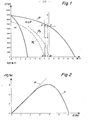
- FIG. 1 shows a section of a schematic, subsumed phase diagram of a binary titanium alloy. It is the titanium page. The ordinate represents the temperature scale and at the same time corresponds to 100% Ti, ie 0% alloying element. The alloy element X is plotted on the abscissa in percent (for example% by weight). The solid curves divide the diagram into the ⁇ -, ( ⁇ + ⁇ ) - and ⁇ -phase area. Two further curves M S and M d , drawn in dashed lines, are related to the phase transition (martensite formation) occurring during quenching from the ⁇ region and are explained in more detail below. You meet the 0 ° C isotherm (abscissa) in points A and B.
- FIG. 2 shows a diagram in which the course of the recoverable strain r (%) as a function of the primary permanent strain ⁇ (%) is shown as curve a for a titanium alloy.
- line b for ideal recovery (100%) is drawn as a 45 ° straight line.
- a S is the temperature at the start of the transformation of the martensite (low temperature phase) into the high temperature phase.
- a F represents the corresponding temperature for the end of this phase transition.
- the arrows indicate the direction of the deformation / temperature loop.
- the dashed line denotes the pure thermal shrinkage of the workpiece after cooling to room temperature.
- the diagram has a fundamental character and applies qualitatively to all mechanically unstable ⁇ -titanium alloys.
- Fig. 6 and Fig. 7 each show a test rod for tensile and. Torsion samples in the length and diameter dimensions, which need no further explanation. Accordingly, the torsion tests were carried out on hollow cylindrical test bars.
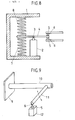
- an electrical switch is shown schematically in section, which uses coil springs as components.
- 1 is a housing in which a support 2 is fastened, which supports the bearing 3 for the contact lever 4.
- 5 each represent a fixed and 6 each a movable contact.
- the contact lever 4 is held by the springs 7 and 8 in a previously selectable rest position. This can be the location shown (both contact points open) or another location (one contact point closed).
- 7 is a coil spring made of a memory alloy. It can be designed both as a compression spring and as a tension spring with or without tension.
- 8 is a common coil spring, which can again act as a tension or compression spring with or without preload. Depending on the intended version of 7 and 8 and the combination of these springs used, 8 counteracts the memory effect of 7 (return or counter spring) or supports it (auxiliary spring).
- 9 shows a schematic perspective illustration of an electrical switch using a torsion bar.
- 9 is a base plate on which a torsion bar 10 made of memory alloy is attached at right angles.
- the latter in turn carries the switching arm 11 at its end, the mobility (pivoting range) of which is indicated by a double arrow.
- It has a movable contact 6 at its end, which faces a fixed contact 5 which is fastened in the holder 12.
- 10 to 13 show the process sequence in the production of a fixed and a releasable connection.
- 14 each represents a pipe to be connected in longitudinal section.
- 13 is a sleeve made of a memory alloy, the inside diameter of which, in the initial state, is undersized compared to the outside pipe diameter.
- 15 shows the sleeve during the expansion process by means of a ball 16.
- FIG. 17 shows the sleeve after the shrinking process (one-way memory effect) above the pipes 14. This corresponds to the state of a firm pipe connection.
- Fig. 13 shows the state after loosening (if necessary) the same connection.
- 18 is the the sleeve is loosened again after the expansion process due to the isothermal memory effect.
- 19 represents a disk made of a memory alloy provided with a groove 20.
- 21 is a hollow body made of ceramic material which engages in the groove 19 in a vacuum-tight manner.
- the disc 22 provided with a conical backward rotation 23 is made of a memory alloy.
- the hollow body 24 to be connected, made of metal, plastic or ceramic material, is indicated by dashed lines before assembly.
- 25 represents a disk made of a memory alloy, which is offset on both sides and each has a cylindrical undercut 23. The ends of the hollow bodies 24 can, as indicated, have different shapes. In the present case, the disc 25 serves both as a connecting element and as a partition.
- 26 is a stepped hollow body made of memory alloy, which has the back turns 23 and a central opening 27.
- the hollow bodies 24 to be connected can be of different diameters and of course of different materials.
- the titanium alloys there are those that show memory effects after a suitable thermal and thermomechanical pretreatment.
- the range of composition of these alloys is relatively narrow.
- the first condition is that they contain at least partially the body-centered / 3-phase in the stable initial state at room temperature. Pure ⁇ alloys thus fail.
- a further limitation in the composition is that the alloys must belong to the class of mechanically unstable / 3-titanium alloys (in the sense of this invention), which are basically defined as follows:
- Alloy characterized by the property that its body-centered cubic ⁇ phase can be at least partially converted into the stress-induced martensitic ⁇ "phase by applying a permanent deformation.
- this can be determined by first subjecting the beta titanium alloy to a thin sheet with a maximum thickness of 1 mm, which is then subjected to solution annealing above the ⁇ transition temperature and then within a cooling time of at most 10 seconds to go through the difference between solution annealing temperature and 100 ° C in ice water is deterred. After quenching, the material must have a maximum of 10% by volume of thermally induced martensite.
- the alloy is characterized in that the ⁇ -phase is converted into martensite ( ⁇ ") during subsequent mechanical deformation.
- the maximum temperature at which mechanically induced martensite ( ⁇ ") can be determined after this deformation is defined as A M d .
- M S represents the temperature at which martensite begins to form.
- M d has already been defined in more detail above. For the alloys in question at room temperature, there is therefore the condition that their composition must fall approximately in the range between A and B (intersection of the M S and M d line with the O O C isotherms).
- At least one should quench from a temperature corresponding to the isothermal CD, since the above condition can no longer be met when quenching lower temperatures. This is indicated by the dash-dotted vertical on the left with an arrow. In the latter case, however, one then loses a small proportion of material indicated by the lever law, which converts into the stable ⁇ phase on the transition via the ⁇ conversion line and is lost for the memory effect. However, the conditions for the subsequent formation of martensite are still optimal for the remaining portion of the ⁇ phase.
- stable ⁇ -titanium alloys are suitable for all alloy elements which have a stabilizing effect on the cubic, body-centered ⁇ phase.
- alloy elements which have a stabilizing effect on the cubic, body-centered ⁇ phase.
- These are V, Al, Fe, Ni, Co, Mn, Cr, Mo, Zr, Nb, Sn, Cu, which can be used both individually and in combination.
- certain concentration limits can be specified which satisfy the above conditions, which can be derived from the thermodynamic equilibria.
- Titanium alloys belonging to the binary type are particularly suitable and, in addition to titanium, also 14 to 20% by weight vanadium or 4 to 6% by weight iron or 6.5 to 9% by weight manganese or 13 to 19% by weight Contain molybdenum.
- Further preferred alloys are those of the ternary type and, in addition to titanium, also 13 to 19% by weight vanadium plus 0.2 to 6% by weight aluminum or 4 to 6% by weight iron plus 0.2 to 6% by weight .-% aluminum or 1.5 to 2.3 wt .-% iron plus 10 to 14 wt .-% vanadium.
- alloys which belong to the quaternary type and, in addition to titanium, also contain 9 to 11% by weight of vanadium plus 1.6 to 2.2% by weight of iron plus 2 to 4% by weight of aluminum.
- the mechanically unstable / 3-titanium alloys defined and characterized above show three shape memory effects depending on the thermomechanical or mechanical pretreatment and depending on the temperature range. If tension is exerted on such an alloy by tension, pressure, shear or a combination of at least two of these operations in such a way that a primary permanent deformation is generated, the prerequisites for the setting of a memory effect are given.
- tension is exerted on such an alloy by tension, pressure, shear or a combination of at least two of these operations in such a way that a primary permanent deformation is generated, the prerequisites for the setting of a memory effect are given.
- the component By heating the component to a temperature above A S following the deformation, the one-way effect is initially established (see FIG. 3). With further heating up to AF , the effect that exists in a deformation opposite to the original direction of deformation has ended.
- a S and A F give the temperature of the beginning or ending reconversion of the martensite into the high temperature phase.
- the component undergoes a deformation which runs in the opposite direction to that of the one-way effect, and is therefore aligned with the originally applied permanent deformation.
- this deformation with temperature takes place continuously and practically without hysteresis: the behavior of the material is therefore more similar to that of a bimetal.
- the curve is not linear but slightly curved, so that it appears concave towards the temperature axis.
- a S which has already been described in general terms above, is intended to be procedural in terms of this invention African size can be defined more precisely.
- a S is to be understood as the temperature at which 1/100 of the previously applied primary permanent mechanical deformation is reduced.
- a 90 which is characteristic of the memory effects, is to be introduced. This is to be understood as the temperature at which the structure of the component still contains a maximum of 10 vol.% Martensite after previous deformation and subsequent heating.
- the workpiece must be heated to a temperature above A S after primary deformation.
- the workpiece In the case of the isothermal effect, the workpiece must be heated to a temperature at which the stable ⁇ phase separates, and it must be kept at this temperature until at least 1 % by volume of the original phase has entered the ⁇ - Have converted phase.
- the two-way effect If the two-way effect is to be used, the workpiece must be heated to a temperature above A 90 after primary deformation and then cooled to a temperature below A S.
- the aforementioned conditions are the minimum conditions in order to achieve the said memory effects at all.
- the optimal one-way effect is only obtained after heating to a temperature around A F.
- the two-way effect can be achieved by heating to a temperature between A S and A F , the structure consisting partly of the aC "phase and partly of the ⁇ phase.
- Beta titanium alloys are generally made by double-arc melting with an consumable electrode.
- the starting material is titanium sponge and corresponding master alloys.
- the melting process takes place under vacuum or protective gas with a low hydrogen partial pressure.
- To produce a component the components are mixed, melted and cast, and the workpiece obtained in this way is thermoformed and subjected to solution annealing in the temperature range at least in part of the stable / 3 phase.
- the workpiece is then quenched to room temperature and subjected to mechanical deformation and further thermal treatment.
- Samples were made from the material in the delivery state, namely tensile samples according to FIG. 6, and hollow torsion samples according to FIG. 7.
- the samples were in the area of the ⁇ phase 850 0 C solution annealed for 60 minutes and then quenched in moving water to room temperature.
- the heat treatment was either carried out in a vacuum oven or the samples were placed in an airtightly sealed quartz glass ampoule filled with protective gas. The glass ampoule breaks immediately when immersed in the quenching medium (water), thus allowing rapid quenching. Both during heat treatment under vacuum and when using the protective gas-filled ampoule, the samples were additionally wrapped loosely in zirconium foil in order to bind residual oxygen due to its high affinity for zirconium.
- Example II Tensile and torsion specimens were produced from the same material and according to the same method as given in Example I.
- a tensile test was stressed at room temperature to produce a permanent set of 3.7%.
- the sample initially showed a one-way effect, i.e. shrinkage occurred in the longitudinal axis (qualitatively similar to Fig. 3).
- After cooling to room temperature there was an expansion in the longitudinal direction.
- the sample was then cyclically heated and cooled a few times. The corresponding expansion or contraction between room temperature and approx. 340 ° C was 0.4% (two-way effect).
- a torsion bar (see FIG. 7) was produced from Til0V2Fe3Al according to Example I.
- Example I tensile specimens were machined from Til0V2Fe3Al and deformed as described therein and heated to 300 c 0th As expected, the one-way effect occurred in the form of a corresponding shrinkage in the longitudinal direction of the rod. The samples were then heated to a temperature of 400 to 450 ° C. and held at this temperature for 100 minutes. The test bars extended in the longitudinal direction from the values which were in the order of magnitude of 1 to 2%, depending on the primary deformation applied. This irreversible isothermal effect, which runs counter to the one-way effect, is shown qualitatively in FIG. 5. Elongation values from to rel. 50% (based on the primary permanent set applied) can be achieved.
- a wire was produced from the material according to Example I and after the pretreatment specified there, and a coil spring 7 was wound therefrom. This spring was then subjected to a treatment according to Example II or III in order to bring about the two-way effect in such a way that the spring 7, which is in the idle state at room temperature under a slight compressive preload, contracts gradually as the temperature rises.
- the spring 7 made of memory alloy was assembled in an electrical switch according to FIG. 8 together with an ordinary compression spring 8. The current is passed through the spring 8. In the normal state, it causes no heating, so that the latter is practically at room temperature and is in equilibrium with the counter spring 8.
- a torsion bar according to FIG. 7 was produced from the material according to Example I and after the pretreatment specified there. The latter was treated further in accordance with Example II or III in order to produce the two-way effect.
- the prepared torsion bar 10 was now provided with a switching arm 11 and mounted on the base plate 9. All other components of the electrical switch result from the description of FIG. 9.
- the torsion bar 10 can be directly flowed through by the current (direct heating) or tightly enclosed by an insulated heating coil (indirect heating).
- the trigger mechanism is basically the same as that given in Example I.
- the counter spring is omitted here. This construction is characterized by great simplicity.
- the trigger temperature can be set within wide limits by suitable selection of the switch geometry (length of the switching arm and swivel range etc.).
- a hollow cylindrical sleeve 13 of 20.25 mm inside and 26.25 mm outside diameter with 30 mm axial length was produced from Til0V2Fe3Al. It served to two pipes 14 (metal, plastic, ceramic material) of 20.6 mm To connect outside diameter.
- the sleeve 13 was pretreated according to Example I (solution annealing, quenching). Thereupon it was expanded by means of a polished steel ball 16 of 21 mm in diameter by axially pushing it through (see arrow in FIG. 11) to an inner diameter of 2.0.79 mm. Now the pipes 14 were inserted axially symmetrically into the sleeve and the whole thing was heated to a temperature at A F (in the present case approx. 260 ° C.).
- the heating of the sleeve 13 made of titanium alloy can be accomplished in a simple manner in any workshop and also outdoors or at the assembly site by means of a blowtorch, welding torch, etc., whereby simple means (tarnishing colors, temperature chalks etc.) are sufficient for temperature monitoring.
- the shrunk-on sleeve 17 (FIG. 12) is brought to a temperature of approx. AF plus 100 to 150 ° C., the irreversible isothermal memory effect occurring and the sleeve expanding (18 in FIG. 13). In this state, the tubes 14 can be pulled out of the sleeve 18. Should If the latter are used again, the process must be repeated from the beginning: solution annealing, quenching, pre-forming etc.
- the component can optionally have at least one of the effects described above, for example the shape of a simple or offset leaf spring or the shape of any torsion bar and that of a cylindrical or conical coil spring.
- connection or termination elements e.g. Hollow bodies
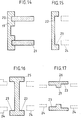
- the components made of memory alloy can have a wide variety of shapes, of which FIGS. 14 to 17 show only a selection.
- the component can have the shape of a simple or stepped cylindrical, square, hexagonal or octagonal hollow body.
- the component can be designed as a solid or perforated cylindrical or polygonal disc provided with a bead on one or both sides.
- the components made of mechanically unstable j.9 titanium alloy can be used, for example, as temperature-dependent triggering elements in electrical switches, as temperature sensors in general, as fixed or detachable connecting sleeves for pipes and rods, and as fixed or detachable seals (disk or socket shape) for ceramic components.
- Beta titanium alloys are also characterized by good hot and cold formability and machinability.
- Til0V2Fe3Al there is also a commercially available alloy, which means significant economic advantages over previous conventional memory alloys based on another alloy.
Landscapes
- Chemical & Material Sciences (AREA)
- Mechanical Engineering (AREA)
- Thermal Sciences (AREA)
- Crystallography & Structural Chemistry (AREA)
- Engineering & Computer Science (AREA)
- Materials Engineering (AREA)
- Physics & Mathematics (AREA)
- Metallurgy (AREA)
- Organic Chemistry (AREA)
- Heat Treatment Of Nonferrous Metals Or Alloys (AREA)
- Materials For Medical Uses (AREA)
- Heat Treatment Of Articles (AREA)
- Heat Treatment Of Steel (AREA)
Applications Claiming Priority (2)
| Application Number | Priority Date | Filing Date | Title |
|---|---|---|---|
| CH1934/81 | 1981-03-23 | ||
| CH193481 | 1981-03-23 |
Publications (2)
| Publication Number | Publication Date |
|---|---|
| EP0062365A1 true EP0062365A1 (fr) | 1982-10-13 |
| EP0062365B1 EP0062365B1 (fr) | 1984-12-27 |
Family
ID=4222006
Family Applications (1)
| Application Number | Title | Priority Date | Filing Date |
|---|---|---|---|
| EP82200313A Expired EP0062365B1 (fr) | 1981-03-23 | 1982-03-11 | Procédé de fabrication d'un élément de construction en un alliage à base de titane, ainsi que l'élément et son application |
Country Status (4)
| Country | Link |
|---|---|
| US (1) | US4412872A (fr) |
| EP (1) | EP0062365B1 (fr) |
| JP (1) | JPS57185965A (fr) |
| DE (1) | DE3261668D1 (fr) |
Cited By (7)
| Publication number | Priority date | Publication date | Assignee | Title |
|---|---|---|---|---|
| EP0110685A1 (fr) * | 1982-11-30 | 1984-06-13 | Beta Phase Inc. | Dispositif à régulation de débit intraveineux employant un élément à mémoire de forme pour le contrôle de l'écoulement |
| EP0143580A1 (fr) * | 1983-11-15 | 1985-06-05 | RAYCHEM CORPORATION (a Delaware corporation) | Alliages à mémoire de forme |
| US4645489A (en) * | 1982-11-30 | 1987-02-24 | Beta Phase, Inc. | Fluid delivery apparatus with shape-memory flow control element |
| EP0246828A1 (fr) * | 1986-05-18 | 1987-11-25 | Daido Tokushuko Kabushiki Kaisha | Objets en titanium ou en alliage de titanium résistant à l'usure |
| US4713063A (en) * | 1985-04-29 | 1987-12-15 | Beta Phase, Inc. | Intravenous tube and controller therefor |
| US4731069A (en) * | 1986-05-01 | 1988-03-15 | Beta Phase, Inc. | Intravenous tube and controller therefor |
| FR2694696A1 (fr) * | 1992-08-14 | 1994-02-18 | Memometal Ind | Pièce contentive pour ostéosynthèse, notamment agrafe, en alliage à transition austénite/martensite proche de la température ambiante. |
Families Citing this family (24)
| Publication number | Priority date | Publication date | Assignee | Title |
|---|---|---|---|---|
| JPS59230189A (ja) * | 1983-06-13 | 1984-12-24 | 松下電器産業株式会社 | 熱感応装置 |
| US4654092A (en) * | 1983-11-15 | 1987-03-31 | Raychem Corporation | Nickel-titanium-base shape-memory alloy composite structure |
| US4895438A (en) * | 1983-12-06 | 1990-01-23 | Cvi/Beta Ventures, Inc. | Eyeglass frame including shape-memory elements |
| US4896955B1 (en) * | 1983-12-06 | 1991-05-21 | Eyeglass frame including shape-memory elements | |
| US4772112A (en) * | 1984-11-30 | 1988-09-20 | Cvi/Beta Ventures, Inc. | Eyeglass frame including shape-memory elements |
| US4617448A (en) * | 1984-12-18 | 1986-10-14 | North American Philips Corporation | Electrically releasable locking device |
| JPS61185720A (ja) * | 1985-02-13 | 1986-08-19 | Sasaki Gankyo Kk | 眼鏡の可調整型超弾性パツドア−ム |
| EP0192475A3 (fr) * | 1985-02-20 | 1987-02-04 | Sampson, Ronald Spencer | Activeur automatique de fermeture |
| US4616499A (en) * | 1985-10-17 | 1986-10-14 | Lockheed Corporation | Isothermal forging method |
| GB2209200A (en) * | 1987-08-28 | 1989-05-04 | Thorn Emi Flow Measurement Ltd | Thermal cut-off valve |
| JPH01155245U (fr) * | 1988-04-14 | 1989-10-25 | ||
| US5114504A (en) * | 1990-11-05 | 1992-05-19 | Johnson Service Company | High transformation temperature shape memory alloy |
| US5344506A (en) * | 1991-10-23 | 1994-09-06 | Martin Marietta Corporation | Shape memory metal actuator and cable cutter |
| US5312152A (en) * | 1991-10-23 | 1994-05-17 | Martin Marietta Corporation | Shape memory metal actuated separation device |
| US5226979A (en) * | 1992-04-06 | 1993-07-13 | Johnson Service Company | Apparatus including a shape memory actuating element made from tubing and a means of heating |
| FR2703184B1 (fr) * | 1993-03-03 | 1995-12-01 | Gen Electric | Contacteur actionné électro-thermiquement. |
| US6149742A (en) * | 1998-05-26 | 2000-11-21 | Lockheed Martin Corporation | Process for conditioning shape memory alloys |
| US6548013B2 (en) | 2001-01-24 | 2003-04-15 | Scimed Life Systems, Inc. | Processing of particulate Ni-Ti alloy to achieve desired shape and properties |
| US7700038B2 (en) * | 2005-03-21 | 2010-04-20 | Ati Properties, Inc. | Formed articles including master alloy, and methods of making and using the same |
| JP2008075173A (ja) * | 2006-01-18 | 2008-04-03 | Nissan Motor Co Ltd | 低ヤング率チタン合金 |
| US7670445B2 (en) * | 2006-01-18 | 2010-03-02 | Nissan Motor Co., Ltd. | Titanium alloy of low Young's modulus |
| JP5831283B2 (ja) * | 2012-02-17 | 2015-12-09 | 新日鐵住金株式会社 | 熱処理により加工方向と同一方向への形状変形するチタン合金部材とその製造方法 |
| US11185608B2 (en) * | 2018-08-09 | 2021-11-30 | Cook Medical Technologies Llc | Method of treating a superelastic medical device to improve fatigue life |
| CN113293324B (zh) * | 2021-05-12 | 2022-05-10 | 东南大学 | 具有高使用温度的可调控热膨胀系数的钛铌钼合金及其制备方法和应用 |
Citations (3)
| Publication number | Priority date | Publication date | Assignee | Title |
|---|---|---|---|---|
| US3652969A (en) * | 1969-05-27 | 1972-03-28 | Robertshaw Controls Co | Method and apparatus for stabilizing and employing temperature sensitive materials exhibiting martensitic transitions |
| US3748197A (en) * | 1969-05-27 | 1973-07-24 | Robertshaw Controls Co | Method for stabilizing and employing temperature sensitive material exhibiting martensitic transistions |
| FR2301602A1 (fr) * | 1975-02-18 | 1976-09-17 | Raychem Corp | Preconditionnement mecanique d'alliages metalliques |
Family Cites Families (2)
| Publication number | Priority date | Publication date | Assignee | Title |
|---|---|---|---|---|
| US4198081A (en) * | 1973-10-29 | 1980-04-15 | Raychem Corporation | Heat recoverable metallic coupling |
| CH616270A5 (fr) * | 1977-05-06 | 1980-03-14 | Bbc Brown Boveri & Cie |
-
1982
- 1982-03-11 DE DE8282200313T patent/DE3261668D1/de not_active Expired
- 1982-03-11 EP EP82200313A patent/EP0062365B1/fr not_active Expired
- 1982-03-19 US US06/359,858 patent/US4412872A/en not_active Expired - Fee Related
- 1982-03-23 JP JP57046180A patent/JPS57185965A/ja active Granted
Patent Citations (3)
| Publication number | Priority date | Publication date | Assignee | Title |
|---|---|---|---|---|
| US3652969A (en) * | 1969-05-27 | 1972-03-28 | Robertshaw Controls Co | Method and apparatus for stabilizing and employing temperature sensitive materials exhibiting martensitic transitions |
| US3748197A (en) * | 1969-05-27 | 1973-07-24 | Robertshaw Controls Co | Method for stabilizing and employing temperature sensitive material exhibiting martensitic transistions |
| FR2301602A1 (fr) * | 1975-02-18 | 1976-09-17 | Raychem Corp | Preconditionnement mecanique d'alliages metalliques |
Cited By (8)
| Publication number | Priority date | Publication date | Assignee | Title |
|---|---|---|---|---|
| EP0110685A1 (fr) * | 1982-11-30 | 1984-06-13 | Beta Phase Inc. | Dispositif à régulation de débit intraveineux employant un élément à mémoire de forme pour le contrôle de l'écoulement |
| US4645489A (en) * | 1982-11-30 | 1987-02-24 | Beta Phase, Inc. | Fluid delivery apparatus with shape-memory flow control element |
| EP0143580A1 (fr) * | 1983-11-15 | 1985-06-05 | RAYCHEM CORPORATION (a Delaware corporation) | Alliages à mémoire de forme |
| US4713063A (en) * | 1985-04-29 | 1987-12-15 | Beta Phase, Inc. | Intravenous tube and controller therefor |
| US4731069A (en) * | 1986-05-01 | 1988-03-15 | Beta Phase, Inc. | Intravenous tube and controller therefor |
| EP0246828A1 (fr) * | 1986-05-18 | 1987-11-25 | Daido Tokushuko Kabushiki Kaisha | Objets en titanium ou en alliage de titanium résistant à l'usure |
| US4902359A (en) * | 1986-05-18 | 1990-02-20 | Daido Tokushuko Kabushiki Kaisha | Wear-resistant titanium or titanium-alloy member and a method for manufacturing the same |
| FR2694696A1 (fr) * | 1992-08-14 | 1994-02-18 | Memometal Ind | Pièce contentive pour ostéosynthèse, notamment agrafe, en alliage à transition austénite/martensite proche de la température ambiante. |
Also Published As
| Publication number | Publication date |
|---|---|
| US4412872A (en) | 1983-11-01 |
| JPS6349741B2 (fr) | 1988-10-05 |
| EP0062365B1 (fr) | 1984-12-27 |
| DE3261668D1 (en) | 1985-02-07 |
| JPS57185965A (en) | 1982-11-16 |
Similar Documents
| Publication | Publication Date | Title |
|---|---|---|
| EP0062365B1 (fr) | Procédé de fabrication d'un élément de construction en un alliage à base de titane, ainsi que l'élément et son application | |
| DE2516749C3 (de) | Verfahren zum Herstellen von Metallkörpern mit wiederholt reversiblem Gestaltwechselvermögen | |
| DE3634635C2 (de) | Nickelaluminide und Nickel-Eisenaluminide zur Verwendung in oxidierenden Umgebungen | |
| DE60108356T2 (de) | Zirkoniumlegierung mit verbesserter Korrosionbeständigkeit und verbesserten mechanischen Eigenschaften und Anfertigungsverfahren eines Hüllrohres aus der Zirkoniumlegierung für einen Kernreaktorbrennstab | |
| DE2644041A1 (de) | Gedaechtnislegierung | |
| DE2603911A1 (de) | Verfahren zum erweitern der hystereseschleife einer metallischen zusammensetzung mit einem reversiblen uebergang zwischen austenitischem und martensitischem zustand | |
| WO2017000932A1 (fr) | Procédé pour la production d'un alliage forgeable à base de nickel-fer-chrome-aluminium présentant un allongement augmenté dans un essai de traction | |
| EP0419789A1 (fr) | Alliage à mémoire de forme | |
| AT411027B (de) | Vorrichtung und verfahren zur herstellung feinkristalliner werkstoffe | |
| DE2021348A1 (de) | Mit der Temperatur ihre Gestalt aendernde Gegenstaende,Verfahren zu deren Herstellung sowie deren Anwendung | |
| DE2500084B2 (de) | Verfahren zur Herstellung von Aluminium-Halbzeug | |
| DE69319051T2 (de) | Verwendung einer Aluminium-Legierung zur Herstellung von Gasflaschen | |
| DE2635947A1 (de) | Aushaertbare, dem neusilber aehnliche cu-zn-ni-mn-legierung | |
| EP0035069B1 (fr) | Alliage à mémoire de forme à base de Cu-Al ou de Cu-Al-Ni et procédé pour la stabilisation de l'effet de réversibilité | |
| CH365880A (de) | Verfahren zur Herstellung von Werkstücken mit hoher Dämpfungsfähigkeit, nach diesem Verfahren hergestelltes Werkstück und dessen Verwendung | |
| DE1290727B (de) | Verfahren zur Herstellung von Nioblegierungen hoher Festigkeit | |
| WO1985003953A1 (fr) | Alliage a base de molybdene resistant a haute temperature | |
| DE2055756B2 (de) | Verfahren zur Herstellung von Gegenständen, die bei Änderung der Temperatur ihre Form zu ändern vermögen, und Anwendung des Verfahrens auf bestimmte Legierungen | |
| DE3530067C2 (de) | Ferngeordnete Legierungen | |
| CH621150A5 (en) | Process for treating an object to extend the austenitic-martensitic hysteresis loop of the metallic composition | |
| DE2603863A1 (de) | Verfahren zum hemmen des verlustes der reversibilitaet zwischen den martensitischen und austenitischen zustaenden in einer metallzusammensetzung | |
| AT360764B (de) | Verfahren zum hemmen des verlustes der rever- sibilitaet zwischen den martensitischen und austenitischen zustaenden in einer metallischen zusammensetzung | |
| DE2622108C3 (de) | Verwendung einer Kupfer und/oder Molybdän enthaltenden Eisenlegierung für Teile mit hoher Dampfungsfahigkeit gegenüber Schwingungen | |
| DE1458562A1 (de) | Hochtemperaturbestaendige Nioblegierungen | |
| DE4217031C2 (de) | Verfahren zur Einstellung des pseudoelastischen Effektes in Fe-Ni-Co-Ti-Legierungen |
Legal Events
| Date | Code | Title | Description |
|---|---|---|---|
| PUAI | Public reference made under article 153(3) epc to a published international application that has entered the european phase |
Free format text: ORIGINAL CODE: 0009012 |
|
| AK | Designated contracting states |
Designated state(s): CH DE FR GB IT |
|
| 17P | Request for examination filed |
Effective date: 19830202 |
|
| ITF | It: translation for a ep patent filed | ||
| GRAA | (expected) grant |
Free format text: ORIGINAL CODE: 0009210 |
|
| AK | Designated contracting states |
Designated state(s): CH DE FR GB IT LI |
|
| REF | Corresponds to: |
Ref document number: 3261668 Country of ref document: DE Date of ref document: 19850207 |
|
| PGFP | Annual fee paid to national office [announced via postgrant information from national office to epo] |
Ref country code: DE Payment date: 19850328 Year of fee payment: 4 |
|
| ET | Fr: translation filed | ||
| PLBE | No opposition filed within time limit |
Free format text: ORIGINAL CODE: 0009261 |
|
| STAA | Information on the status of an ep patent application or granted ep patent |
Free format text: STATUS: NO OPPOSITION FILED WITHIN TIME LIMIT |
|
| 26N | No opposition filed | ||
| PGFP | Annual fee paid to national office [announced via postgrant information from national office to epo] |
Ref country code: FR Payment date: 19890222 Year of fee payment: 8 |
|
| PGFP | Annual fee paid to national office [announced via postgrant information from national office to epo] |
Ref country code: GB Payment date: 19890228 Year of fee payment: 8 |
|
| ITTA | It: last paid annual fee | ||
| PG25 | Lapsed in a contracting state [announced via postgrant information from national office to epo] |
Ref country code: LI Effective date: 19890331 Ref country code: CH Effective date: 19890331 |
|
| REG | Reference to a national code |
Ref country code: CH Ref legal event code: PL |
|
| PG25 | Lapsed in a contracting state [announced via postgrant information from national office to epo] |
Ref country code: DE Effective date: 19891201 |
|
| PG25 | Lapsed in a contracting state [announced via postgrant information from national office to epo] |
Ref country code: GB Effective date: 19900311 |
|
| GBPC | Gb: european patent ceased through non-payment of renewal fee | ||
| PG25 | Lapsed in a contracting state [announced via postgrant information from national office to epo] |
Ref country code: FR Effective date: 19901130 |
|
| REG | Reference to a national code |
Ref country code: FR Ref legal event code: ST |