EP0062406B1 - Stabilisatorzusammensetzungen für Polymere, damit stabilisierte Polymere und aus solchen Polymerer geformte Gegenstände - Google Patents
Stabilisatorzusammensetzungen für Polymere, damit stabilisierte Polymere und aus solchen Polymerer geformte Gegenstände Download PDFInfo
- Publication number
- EP0062406B1 EP0062406B1 EP19820300979 EP82300979A EP0062406B1 EP 0062406 B1 EP0062406 B1 EP 0062406B1 EP 19820300979 EP19820300979 EP 19820300979 EP 82300979 A EP82300979 A EP 82300979A EP 0062406 B1 EP0062406 B1 EP 0062406B1
- Authority
- EP
- European Patent Office
- Prior art keywords
- alkyl
- formula
- organic
- mixture
- methyl
- Prior art date
- Legal status (The legal status is an assumption and is not a legal conclusion. Google has not performed a legal analysis and makes no representation as to the accuracy of the status listed.)
- Expired
Links
- 0 C*[N+]([O-])O** Chemical compound C*[N+]([O-])O** 0.000 description 14
- OZMYUHAJGIZNHK-ARJAWSKDSA-N C/C=C\C[NH+]([O-])OC Chemical compound C/C=C\C[NH+]([O-])OC OZMYUHAJGIZNHK-ARJAWSKDSA-N 0.000 description 1
- XAZKFISIRYLAEE-UHFFFAOYSA-N CC1CC(C)CC1 Chemical compound CC1CC(C)CC1 XAZKFISIRYLAEE-UHFFFAOYSA-N 0.000 description 1
Classifications
-
- C—CHEMISTRY; METALLURGY
- C08—ORGANIC MACROMOLECULAR COMPOUNDS; THEIR PREPARATION OR CHEMICAL WORKING-UP; COMPOSITIONS BASED THEREON
- C08K—Use of inorganic or non-macromolecular organic substances as compounding ingredients
- C08K5/00—Use of organic ingredients
- C08K5/36—Sulfur-, selenium-, or tellurium-containing compounds
- C08K5/37—Thiols
-
- C—CHEMISTRY; METALLURGY
- C08—ORGANIC MACROMOLECULAR COMPOUNDS; THEIR PREPARATION OR CHEMICAL WORKING-UP; COMPOSITIONS BASED THEREON
- C08K—Use of inorganic or non-macromolecular organic substances as compounding ingredients
- C08K5/00—Use of organic ingredients
- C08K5/56—Organo-metallic compounds, i.e. organic compounds containing a metal-to-carbon bond
- C08K5/57—Organo-tin compounds
- C08K5/58—Organo-tin compounds containing sulfur
Definitions
- This invention relates to new and useful polymer stabilizer compositions comprising: 1) an organic tin compound or mixture of organic tin compounds, 2) an organic compound having an aromatic ring which is substituted with a hydroxyl (-OH) group and a mercapto (-SH) group ortho to each other and, optionally, 3) an organotin mercaptide or mixture of organotin mercaptides.
- This invention also relates to polymer compositions comprising: 1) an organic polymer, more particularly a halogenated organic polymer, 2) an organic tin compound stabilizer or mixture of organic tin compound stabilizers, 3) an organic compound having an aromatic ring which is substituted with a hydroxyl (-OH) group and a mercapto (-SH) group ortho to each other and, optionally, 4) an organotin mercaptide or mixture of organotin mercaptides. Additionally, this invention relates to articles of manufacture, e.g.
- pipe made from polymer compositions comprising: 1) an organic polymer, more particularly a halogenated organic polymer, 2) an organic tin compound stabilizer or mixture of organic tin compound stabilizers, 3) an organic compound having an aromatic ring which is substituted with a hydroxyl (-OH) group and a mercapto (-SH) group ortho to each other and, optionally, 4) an organotin mercaptide or mixture of organotin mercaptides.
- compositions for stabilizing halogen-containing organic polymers against thermal deterioration which compositions comprise:
- the stabilizer compositions comprise: 1) an organic tin compound or mixture of organic tin compounds selected from compounds having the formula: wherein
- organotin mercaptide or mixture of organotin mercaptides selected from compounds having the formulae: or wherein
- X in formula VI may still represent at each independent occurrence the set of groups consisting of ⁇ SR 2 , -OR B , Cl, Br and I, or any and all subsets thereof such as, for example, ⁇ SR 2 , and ⁇ OR 8 , or Cl, Br, I and ⁇ OR 8 .
- the stabilizer composition in accordance with this invention has unexpectedly been found to be highly effective in the stabilization of organic polymers exposed to heat during processing. More especially the stabilizer composition of this invention has been unexpectedly found to be highly effective in the early color stabilization of organic polymers exposed to heat during processing (i.e. to be highly effective in reducing or preventing discoloration of an organic polymer during the early stages of the exposure of the organic polymer to heat during processing). There has also now been unexpectedly found in accordance with this invention an advantageous polymer composition having improved stability, more particularly improved resistance to early color formation upon exposure to heat during processing. Additionally, there has now been unexpectedly found in accordance with this invention, articles of manufacture, e.g. pipe, made from polymer, compositions having improved resistance to early color formation upon exposure to heat during the forming of said articles of manufacture.
- articles of manufacture e.g. pipe, made from polymer
- alkyl represents monovalent straight or branched chain hydrocarbon radicals containing, for example, 1 to 20 carbon atoms.
- aryl refers to monovalent C 6 ⁇ C 10 aromatic rings such as benzene and naphthalene.
- alkenyl refers to monovalent straight or branched chain C 2 to C 20 hydrocarbon radicals containing at least one double bond.
- aralkyl represents a monovalent C 1 to C 20 hydrocarbon radical having attached thereto an aryl radical.
- alkaryl refers to monovalent aryl radicals having attached thereto at least one C 1 ⁇ C 20 alkyl group.
- cycloalkyl represents monovalent C 3 -C e saturated cycloaliphatic radicals
- cycloalkenyl represents C 5 ⁇ C 8 cycloaliphatic radicals containing at least one double bond.
- organic tin compounds according to formulae (I) and (II) and (Ila), organic compounds according to formulae (III), (IV) and (V) and the organotin mercaptides according to formulae (VI), (VII) and (VIII) may all be prepared by methods well known in the art.
- methods for preparing the organic tin compounds according to formulae (I) and (II), and the organotin mercaptides according to formulae (VI), (VII) and (VIII) are disclosed in U.S. Patents Nos. 2,267,777, 2,746,946, 3,021,302, 3,565,930, 3,565,931, 3,869,487, 3,979,359, 4,118,371, 4,134,878 and 4,183,846.
- the compounds according to formulae (III), (IV) and (V) have a vicinal OH/SH arrangement (i.e. have an -OH group and an -SH group on adjacent ring carbon atoms).
- compounds according to formulae (III), (IV) and (V) may have, in addition to the first vicinal OH/SH arrangement on the ring, further vicinal OH/SH arrangements on the ring.
- Such additional vicinal OH/SH arrangements on the ring may be separated from the first vicinal OH/SH arrangement on the ring by one or more ring carbon atoms or may occupy a position on the ring adjacent to the first vicinal OH/ SH arrangement on the ring or may include the OH or SH or both OH and SH of the first vincinal OH/SH arrangement.
- These arrangements of OH groups and SH groups may be illustrated by the following examples.
- the ring carbon atoms may be numbered consecutively in a clockwise manner starting at the carbon atom to which the OH group is attached as being number one.
- a compound according to formula (III) having the single vicinal OH/SH arrangement shown therein would have the OH group and SH group at ring carbon atoms numbered one and two respectively.
- Other compounds according to formula (III) having more than one vicinal OH/SH arrangement may, for example, include such compounds according to formula (III) having a further OH group at ring carbon number four and a further SH group at ring carbon number five, a compound according to formula (III) having a further OH group at ring carbon number three, or a compound according to formula (III) having a further SH group at ring carbon number 6.
- multiple vicinal OH/SH arrangements may be present in compound according to formula (IV) and (V) in the practice of this invention.
- Organic tin compounds according to formulae (I) and (II) include, but are not limited to, compounds as shown in the following table I;
- Organic tin compounds according to formula (Ila) include, but are not limited to, compounds shown in the following Table la:
- organic compounds according to formula (III) usable in the practice of this invention, there are included, but are not limited to, the following compounds:
- Examples of compounds according to formula (IV) usable in the practice of this invention include, but are not limited to, compounds as shown in the following Table II:
- Compounds according to formula (III) are preferably used in the practice of this invention. More preferably the compounds according to formula (III) used in the practice of this invention are ortho hydroxythiophenol and lower alkyl (i.e. C 1 to C 9 alkyl) substituted ortho hydroxythiophenols.
- Organotin mercaptides according to formulae (VI), (VII) and (VIII) include, but are not limited to, compounds shown in the following Tables IV, V and VI, respectively.
- radicals ⁇ C 4 H 9 , ⁇ C 8 H 17 , ⁇ C 12 H 25 , ⁇ C 9 H 19 and ⁇ C 10 H 21 represent n-butyl, n-octyl, n-dodecyl, n-nonyl and n-decyl respectively.
- the carboxyl radicals are derived from oleic acid, stearic acid, n-octanoic acid, lauric acid, and pelargonic acid respectively.
- the radicals ⁇ OC 13 H 27 , ⁇ OC 18 H 37 , and ⁇ OC 8 H 17 are derived from tridecanol, stearyl.alcohol and iso-octanol respectively.
- the weight ratio of a) the organic tin compound or mixture of organic tin compounds according to formulae (I), (II) and/or (Ila), to b) the organic compound or mixture of organic compounds according to formulae (III), (IV) and (V) may vary over a wide range. There may be used a weight ratio of a) the organic tin compound or mixture of organic tin compounds according to formulae (I), (II) and/or (Ila) to b) the organic compound or mixture of organic compounds according to formulae (III), (IV) and (V) of from 400:1 to 1:199, preferably from 400:1 to 1:100, more preferably from 400:1 to 1:20.
- organotin mercaptide or mixture of organotin mercaptides according to formulae (VI), (VII) and (VIII) is employed, it is utilized in amounts such that the weight ratio of the organic tin compound or mixture of organic tin compounds according to formulae (I), (II) and/or (Ila) to organotin mercaptide or mixture of organotin mercaptides according to formulae (VI), (VII) and (Vlll) is 99:1 to 1:99.
- Various other substances may be added to or used in combination with the stabilizer composition of this invention including, for example, an innocuous diluent (e.g. hydrocarbon oil or hydrocarbon solvent), plasticizer, wax, lubricant, release agent, antioxidant, U.V. stabilizer and fire retardant well-known in the art.
- an innocuous diluent e.g. hydrocarbon oil or hydrocarbon solvent
- plasticizer e.g. wax, lubricant, release agent, antioxidant, U.V. stabilizer and fire retardant well-known in the art.
- a polymer composition comprising 1) an organic polymer normally susceptible to thermal degradation and discoloration, 2) an organic tin compound or mixture of organic tin compounds according to formulae (I), (II) and/or (Ila), 3) an organic compound or mixture of organic tin compounds according to formulae (I), (II) and/or (Ila), 3) an organic compound or mixture of organic compounds according to formulae (III), (IV) and (V), and, optionally, 4) an organotin mercaptide or mixture of organotin mercaptides according to formulae (VI), (VII) and (VIII).
- the combined amount by weight of the a) organic tin compound or mixture of organic tin compounds according to formulae (I), (II) and/or (Ila) b) organic compound or mixture of organic compounds according to formulae (III), (IV) and (V), and, optionally, c) organotin mercaptide or mixture of organotin mercaptides according to formulae (VI), (VII) and (VIII) used in the polymer composition may vary over a wide range, it being necessary only that there be employed a stabilizingly effective amount.
- organic tin compound or mixture of organic tin compounds according to formulae (I), (II) and/or (Ila), the organic compound or mixture of organic compounds according to formulae (III), (IV) and (V), and the optional organotin mercaptide or mixture of organotin mercaptides according to formulae (VI), (VII) and (VIII) may be separately added to the polymer or they may be premixed and the mixture added to the polymer.
- Other additives well known in the art such as for example plasticizers, fillers, pigments, lubricants, antioxidants, fire retardants, U.V. stabilizers, antistatic agents and cross linking agents may be employed in the polymer composition or this invention.
- Organic polymers normally susceptible to thermal deterioration are generally useful in the practice of the polymer compositions of this invention.
- thermal deterioration i.e. heat induced degradation
- various halogen-containing organic polymers such as vinyl halide and vinylidene halide homopolymers and copolymers could be expected to be useful in the practice of this invention.
- Especially preferred to be used in the polymer composition of this invention is a homopolymer or copolymer or mixture thereof of a vinyl chloride or vinylidene chloride monomer.
- halogen containing organic polymers considered to be useful in the practice of the polymer composition of this invention there are included, for example halogenated olefin homopolymers, halogenated olefin copolymers, vinyl halide homopolymers, vinyl halide copolymers, vinylidene halide homopolymers, vinylidene halide copolymers and polymer mixtures containing said halogen containing organic polymers.
- vinyl halide homopolymers vinyl halide copolymers and polymer blends containing vinyl halide homopolymers or vinyl halide copolymers there, for example, include (1) polyvinyl chloride, polyvinylidene chloride, polyvinyl bromide, polyvinyl fluoride, polyvinylidene fluoride, (2) copolymers of vinyl chloride with a copolymerizable ethylenically unsaturated monomer such as vinylidene chloride, vinyl acetate, vinyl butyrate, vinyl benzoate, diethyl fumarate, diethyl maleate, other alkyl fumarates and maleates, vinyl propionate, methyl acrylate, 2-ethylhexyl acrylate, butyl acrylate, ehtyl acrylate, and other alkyl acrylates, methyl methacrylate, ethyl methacrylate, butyl methacrylate, hydroxyethyl meth
- Typical vinyl halide copolymers include vinyl chloride-vinyl acetate (87-13), vinyl chloride-vinylidene chloride (95-5), vinyl chloride-diethylfumarate (95-5), vinyl chloride-trichloroethylene (95-5) and vinyl chloride-2-ethylhexylacrylate (8020).
- the polymer blends comprise physical blends of at least two distinct polymeric species and contain from 25 to 95 weight percent of vinyl halide homopolymer.
- the vinyl halide copolymers are copolymers comprising from 25 to 95 mole percent vinyl halide units.
- halogen containing polymers may include, for example, chlorinated polyethylene having 14 to 75%, e.g. 27%, chlorine by weight, chlorinated natural and synthetic rubber, chlorinated polystyrene and rubber hydrochloride.
- chlorinated polyethylene having 14 to 75%, e.g. 27%, chlorine by weight
- chlorinated natural and synthetic rubber chlorinated polystyrene and rubber hydrochloride.
- the homopolymers and copolymers of vinyl chloride or vinylidene chloride and polymer mixtures containing said homopolymer or copolymers are preferred in the practice of the polymer composition of this invention.
- the articles of manufacture in accordance with this invention may be produced by any of the well-known, conventional techniques for molding polymers.
Landscapes
- Chemical & Material Sciences (AREA)
- Health & Medical Sciences (AREA)
- Chemical Kinetics & Catalysis (AREA)
- Medicinal Chemistry (AREA)
- Polymers & Plastics (AREA)
- Organic Chemistry (AREA)
- Compositions Of Macromolecular Compounds (AREA)
Claims (30)





mit der Maßgabe, daß 1) in Formel (IV) zwei der Reste D, E, F und F' eine OH-Gruppe und eine SH-Gruppe, die direkt an benachbarte Ring-Kohlenstoffatome gebunden sind, sein müssen, und
2) in Formel (V) zwei der Reste K, K', N, P und Q eine OH-Gruppe und eine SH-Gruppe, die direkt an benachbarte Ring-Kohlenstoffatome gebunden sind, sein müssen,
mit oder ohne


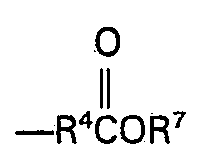


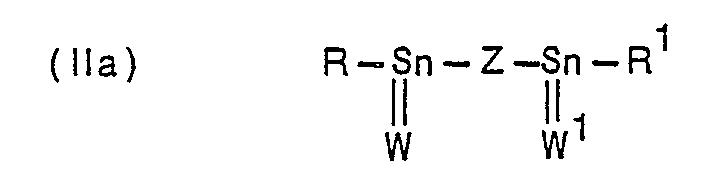




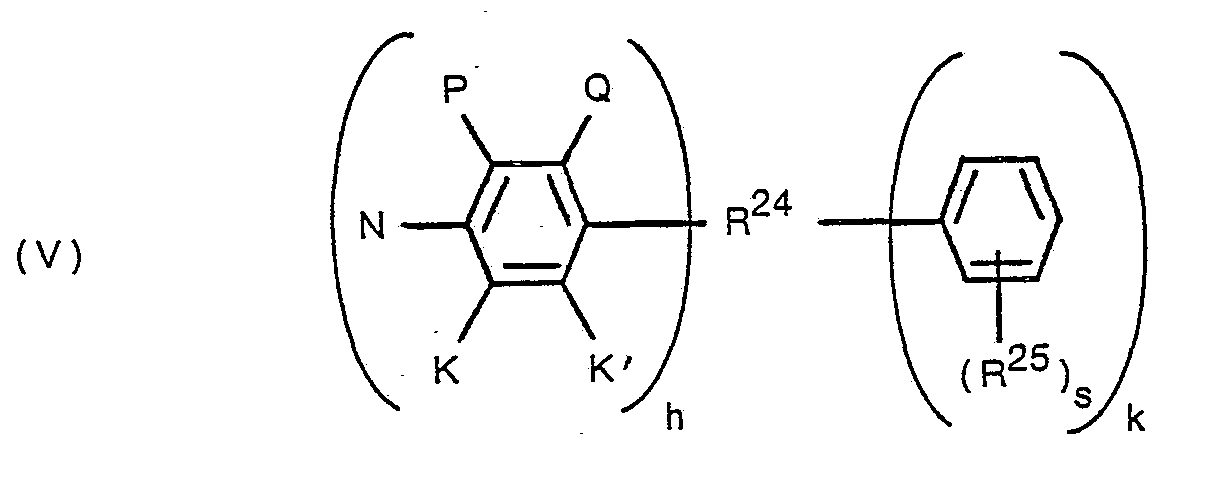
mit der Maßgabe, daß 1) in Formel (IV) zwei der Reste D, E, F und F' eine OH-Gruppe und eine SH-Gruppe, die direkt an benachbarte Ring-Kohlenstoffatome gebunden sind, sein müssen, und
mit oder ohne





Priority Applications (1)
| Application Number | Priority Date | Filing Date | Title |
|---|---|---|---|
| AT82300979T ATE13682T1 (de) | 1981-02-26 | 1982-02-25 | Stabilisatorzusammensetzungen fuer polymere, damit stabilisierte polymere und aus solchen polymerer geformte gegenstaende. |
Applications Claiming Priority (4)
| Application Number | Priority Date | Filing Date | Title |
|---|---|---|---|
| US238517 | 1981-02-26 | ||
| US06/238,517 US4315850A (en) | 1981-02-26 | 1981-02-26 | Organohalide polymers stabilized with an organotin compound and an ortho mercapto phenol compound |
| US34582282A | 1982-02-04 | 1982-02-04 | |
| US345822 | 1982-02-04 |
Publications (2)
| Publication Number | Publication Date |
|---|---|
| EP0062406A1 EP0062406A1 (de) | 1982-10-13 |
| EP0062406B1 true EP0062406B1 (de) | 1985-06-05 |
Family
ID=26931747
Family Applications (1)
| Application Number | Title | Priority Date | Filing Date |
|---|---|---|---|
| EP19820300979 Expired EP0062406B1 (de) | 1981-02-26 | 1982-02-25 | Stabilisatorzusammensetzungen für Polymere, damit stabilisierte Polymere und aus solchen Polymerer geformte Gegenstände |
Country Status (4)
| Country | Link |
|---|---|
| EP (1) | EP0062406B1 (de) |
| AU (1) | AU548728B2 (de) |
| CA (1) | CA1173233A (de) |
| DE (1) | DE3263985D1 (de) |
Families Citing this family (1)
| Publication number | Priority date | Publication date | Assignee | Title |
|---|---|---|---|---|
| JPH028239A (ja) * | 1988-06-27 | 1990-01-11 | Somar Corp | 塩化ビニル系樹脂組成物及び成形品 |
Family Cites Families (1)
| Publication number | Priority date | Publication date | Assignee | Title |
|---|---|---|---|---|
| US4043957A (en) * | 1976-04-27 | 1977-08-23 | Tenneco Chemicals, Inc. | Stabilized vinyl halide resin compositions |
-
1982
- 1982-02-25 AU AU80790/82A patent/AU548728B2/en not_active Ceased
- 1982-02-25 EP EP19820300979 patent/EP0062406B1/de not_active Expired
- 1982-02-25 CA CA000397111A patent/CA1173233A/en not_active Expired
- 1982-02-25 DE DE8282300979T patent/DE3263985D1/de not_active Expired
Also Published As
| Publication number | Publication date |
|---|---|
| DE3263985D1 (en) | 1985-07-11 |
| CA1173233A (en) | 1984-08-28 |
| AU8079082A (en) | 1982-09-02 |
| AU548728B2 (en) | 1986-01-02 |
| EP0062406A1 (de) | 1982-10-13 |
Similar Documents
| Publication | Publication Date | Title |
|---|---|---|
| EP0059610B1 (de) | Stabilisatorzusammensetzungen, halogenhaltige Polymerzusammensetzungen, welche diese enthalten, und geformte Gegenstände, welche die Polymerzusammensetzungen enthalten | |
| US2641588A (en) | Halogen containing resin stabilized with an organo tin compound | |
| EP0182526B1 (de) | Stabilisatoren für halogenhaltige organische Polymere, bestehend aus einer Organozinnverbindung und einem Diester | |
| KR19990078189A (ko) | Pvc 안정화를 개선시키기 위한 금속계 안정화제 또는 루이스 산과 유리 메르캅탄의 상승 혼합물 | |
| US4315850A (en) | Organohalide polymers stabilized with an organotin compound and an ortho mercapto phenol compound | |
| US4515916A (en) | Stabilizers for halogen containing polymers comprising zinc mercaptoesters, basic inorganic alkali or alkaline earth metal compounds and, substituted dihydropyridines | |
| US3632538A (en) | Stabilizer composition containing more than 20% tin and resin compositions containing the same | |
| US3890276A (en) | Synergistic combinations of organic stabilizers for halogenated resins | |
| JP2000159963A (ja) | 透明ハロゲン化ポリマ―の安定剤 | |
| EP0070092B1 (de) | Stabilisatoren für halogenhaltige Polymere, diese enthaltende Polymerzusammensetzungen und daraus hergestellte geformte Gegenstände | |
| US3933741A (en) | Stabilized vinyl chloride polymer compositions | |
| US4440891A (en) | Halogen-containing polymers stabilized with organic antimony compound and an ortho mercapto phenol compound | |
| US3544510A (en) | Mercaptal stabilized halogen-containing resins | |
| US4508863A (en) | Stabilization of polyvinyl chloride | |
| EP0254392A2 (de) | Stabilisatoren für halogenhaltige Polymere | |
| EP0062406A1 (de) | Stabilisatorzusammensetzungen für Polymere, damit stabilisierte Polymere und aus solchen Polymerer geformte Gegenstände | |
| EP0068640B1 (de) | Stabilisatoren für halogenhaltige Polymere und diese enthaltende Polymerzusammensetzungen | |
| US3769263A (en) | Vinyl halide polymers stabilized with two organotin compounds | |
| US4593059A (en) | Stabilizers for halogen-containing organic polymers comprising an organotin mercaptide and a dialkyl ester of an unsaturated dicarboxylic acid | |
| US4183846A (en) | Organotin stabilizer composition | |
| US4558083A (en) | Stabilizer compositions and polymers containing same | |
| EP0059614B1 (de) | Stabilisatorzusammensetzungen für Polymere, damit stabilisierte Polymere und aus solchen Polymeren geformte Gegenstände | |
| US3502616A (en) | Organotin sulfide stabilizer composition and polymers stabilized therewith | |
| CA1333957C (en) | Compositions for stabilizing halogen-containing organic polymers | |
| US2267778A (en) | Stabilized vinyl resin |
Legal Events
| Date | Code | Title | Description |
|---|---|---|---|
| PUAI | Public reference made under article 153(3) epc to a published international application that has entered the european phase |
Free format text: ORIGINAL CODE: 0009012 |
|
| AK | Designated contracting states |
Designated state(s): AT BE CH DE FR GB IT NL SE |
|
| 17P | Request for examination filed |
Effective date: 19830309 |
|
| ITF | It: translation for a ep patent filed | ||
| RAP1 | Party data changed (applicant data changed or rights of an application transferred) |
Owner name: MORTON THIOKOL, INC. |
|
| GRAA | (expected) grant |
Free format text: ORIGINAL CODE: 0009210 |
|
| AK | Designated contracting states |
Designated state(s): AT BE CH DE FR GB IT LI NL SE |
|
| REF | Corresponds to: |
Ref document number: 13682 Country of ref document: AT Date of ref document: 19850615 Kind code of ref document: T |
|
| REF | Corresponds to: |
Ref document number: 3263985 Country of ref document: DE Date of ref document: 19850711 |
|
| ET | Fr: translation filed | ||
| PLBE | No opposition filed within time limit |
Free format text: ORIGINAL CODE: 0009261 |
|
| STAA | Information on the status of an ep patent application or granted ep patent |
Free format text: STATUS: NO OPPOSITION FILED WITHIN TIME LIMIT |
|
| 26N | No opposition filed | ||
| PGFP | Annual fee paid to national office [announced via postgrant information from national office to epo] |
Ref country code: AT Payment date: 19890110 Year of fee payment: 8 |
|
| PGFP | Annual fee paid to national office [announced via postgrant information from national office to epo] |
Ref country code: FR Payment date: 19890111 Year of fee payment: 8 |
|
| PGFP | Annual fee paid to national office [announced via postgrant information from national office to epo] |
Ref country code: SE Payment date: 19890118 Year of fee payment: 8 |
|
| PGFP | Annual fee paid to national office [announced via postgrant information from national office to epo] |
Ref country code: CH Payment date: 19890119 Year of fee payment: 8 |
|
| PGFP | Annual fee paid to national office [announced via postgrant information from national office to epo] |
Ref country code: BE Payment date: 19890127 Year of fee payment: 8 |
|
| PGFP | Annual fee paid to national office [announced via postgrant information from national office to epo] |
Ref country code: GB Payment date: 19890131 Year of fee payment: 8 Ref country code: DE Payment date: 19890131 Year of fee payment: 8 |
|
| ITTA | It: last paid annual fee | ||
| PGFP | Annual fee paid to national office [announced via postgrant information from national office to epo] |
Ref country code: NL Payment date: 19890228 Year of fee payment: 8 |
|
| PG25 | Lapsed in a contracting state [announced via postgrant information from national office to epo] |
Ref country code: GB Effective date: 19900225 Ref country code: AT Effective date: 19900225 |
|
| PG25 | Lapsed in a contracting state [announced via postgrant information from national office to epo] |
Ref country code: SE Effective date: 19900226 |
|
| PG25 | Lapsed in a contracting state [announced via postgrant information from national office to epo] |
Ref country code: LI Effective date: 19900228 Ref country code: CH Effective date: 19900228 Ref country code: BE Effective date: 19900228 |
|
| BERE | Be: lapsed |
Owner name: MORTON THIOKOL INC. Effective date: 19900228 |
|
| PG25 | Lapsed in a contracting state [announced via postgrant information from national office to epo] |
Ref country code: NL Effective date: 19900901 |
|
| NLV4 | Nl: lapsed or anulled due to non-payment of the annual fee | ||
| GBPC | Gb: european patent ceased through non-payment of renewal fee | ||
| PG25 | Lapsed in a contracting state [announced via postgrant information from national office to epo] |
Ref country code: FR Effective date: 19901031 |
|
| REG | Reference to a national code |
Ref country code: CH Ref legal event code: PL |
|
| PG25 | Lapsed in a contracting state [announced via postgrant information from national office to epo] |
Ref country code: DE Effective date: 19901101 |
|
| REG | Reference to a national code |
Ref country code: FR Ref legal event code: ST |
|
| EUG | Se: european patent has lapsed |
Ref document number: 82300979.0 Effective date: 19901107 |