EP0062624A1 - Verfahren zum Entfernen unlöslicher vernetzter Polymere aus der Vorrichtung zur Herstellung von vinylaromatischen Verbindungen - Google Patents
Verfahren zum Entfernen unlöslicher vernetzter Polymere aus der Vorrichtung zur Herstellung von vinylaromatischen Verbindungen Download PDFInfo
- Publication number
- EP0062624A1 EP0062624A1 EP82870015A EP82870015A EP0062624A1 EP 0062624 A1 EP0062624 A1 EP 0062624A1 EP 82870015 A EP82870015 A EP 82870015A EP 82870015 A EP82870015 A EP 82870015A EP 0062624 A1 EP0062624 A1 EP 0062624A1
- Authority
- EP
- European Patent Office
- Prior art keywords
- polymer
- organic solvent
- hours
- solvent
- alcohol
- Prior art date
- Legal status (The legal status is an assumption and is not a legal conclusion. Google has not performed a legal analysis and makes no representation as to the accuracy of the status listed.)
- Granted
Links
- 238000000034 method Methods 0.000 title claims abstract description 46
- 230000008569 process Effects 0.000 title claims abstract description 42
- 150000001875 compounds Chemical class 0.000 title claims abstract description 22
- 229920006037 cross link polymer Polymers 0.000 title claims abstract description 10
- 229920000642 polymer Polymers 0.000 claims abstract description 76
- 238000004519 manufacturing process Methods 0.000 claims abstract description 24
- 239000002904 solvent Substances 0.000 claims abstract description 15
- 239000003960 organic solvent Substances 0.000 claims abstract description 13
- 230000001376 precipitating effect Effects 0.000 claims abstract description 6
- LFQSCWFLJHTTHZ-UHFFFAOYSA-N Ethanol Chemical compound CCO LFQSCWFLJHTTHZ-UHFFFAOYSA-N 0.000 claims description 40
- YXFVVABEGXRONW-UHFFFAOYSA-N Toluene Natural products CC1=CC=CC=C1 YXFVVABEGXRONW-UHFFFAOYSA-N 0.000 claims description 25
- HJWLCRVIBGQPNF-UHFFFAOYSA-N prop-2-enylbenzene Chemical compound C=CCC1=CC=CC=C1 HJWLCRVIBGQPNF-UHFFFAOYSA-N 0.000 claims description 23
- 238000010992 reflux Methods 0.000 claims description 15
- HYFLWBNQFMXCPA-UHFFFAOYSA-N 1-ethyl-2-methylbenzene Chemical compound CCC1=CC=CC=C1C HYFLWBNQFMXCPA-UHFFFAOYSA-N 0.000 claims description 13
- CTQNGGLPUBDAKN-UHFFFAOYSA-N O-Xylene Chemical compound CC1=CC=CC=C1C CTQNGGLPUBDAKN-UHFFFAOYSA-N 0.000 claims description 10
- 239000008096 xylene Substances 0.000 claims description 10
- ZWEHNKRNPOVVGH-UHFFFAOYSA-N 2-Butanone Chemical compound CCC(C)=O ZWEHNKRNPOVVGH-UHFFFAOYSA-N 0.000 claims description 9
- CSCPPACGZOOCGX-UHFFFAOYSA-N Acetone Chemical group CC(C)=O CSCPPACGZOOCGX-UHFFFAOYSA-N 0.000 claims description 6
- 239000000178 monomer Substances 0.000 claims description 6
- 230000035508 accumulation Effects 0.000 claims description 5
- 238000009825 accumulation Methods 0.000 claims description 5
- XLYOFNOQVPJJNP-UHFFFAOYSA-N water Substances O XLYOFNOQVPJJNP-UHFFFAOYSA-N 0.000 claims description 5
- 125000004432 carbon atom Chemical group C* 0.000 claims description 4
- 150000002576 ketones Chemical group 0.000 claims description 4
- 238000001556 precipitation Methods 0.000 claims description 4
- 125000003158 alcohol group Chemical group 0.000 claims 2
- 125000003944 tolyl group Chemical group 0.000 claims 2
- 238000004821 distillation Methods 0.000 description 18
- UHOVQNZJYSORNB-UHFFFAOYSA-N Benzene Chemical compound C1=CC=CC=C1 UHOVQNZJYSORNB-UHFFFAOYSA-N 0.000 description 6
- 229930195733 hydrocarbon Natural products 0.000 description 5
- 150000002430 hydrocarbons Chemical class 0.000 description 5
- MYRTYDVEIRVNKP-UHFFFAOYSA-N 1,2-Divinylbenzene Chemical compound C=CC1=CC=CC=C1C=C MYRTYDVEIRVNKP-UHFFFAOYSA-N 0.000 description 4
- PPBRXRYQALVLMV-UHFFFAOYSA-N Styrene Chemical compound C=CC1=CC=CC=C1 PPBRXRYQALVLMV-UHFFFAOYSA-N 0.000 description 4
- 239000000463 material Substances 0.000 description 4
- 239000004215 Carbon black (E152) Substances 0.000 description 3
- OKKJLVBELUTLKV-UHFFFAOYSA-N Methanol Chemical compound OC OKKJLVBELUTLKV-UHFFFAOYSA-N 0.000 description 3
- 238000004140 cleaning Methods 0.000 description 3
- 238000006356 dehydrogenation reaction Methods 0.000 description 3
- 230000004048 modification Effects 0.000 description 3
- 238000012986 modification Methods 0.000 description 3
- 238000006116 polymerization reaction Methods 0.000 description 3
- YNQLUTRBYVCPMQ-UHFFFAOYSA-N Ethylbenzene Chemical compound CCC1=CC=CC=C1 YNQLUTRBYVCPMQ-UHFFFAOYSA-N 0.000 description 2
- 239000008346 aqueous phase Substances 0.000 description 2
- 230000000694 effects Effects 0.000 description 2
- 238000005194 fractionation Methods 0.000 description 2
- 239000003112 inhibitor Substances 0.000 description 2
- 231100000053 low toxicity Toxicity 0.000 description 2
- 238000000746 purification Methods 0.000 description 2
- 238000000926 separation method Methods 0.000 description 2
- VZGDMQKNWNREIO-UHFFFAOYSA-N tetrachloromethane Chemical compound ClC(Cl)(Cl)Cl VZGDMQKNWNREIO-UHFFFAOYSA-N 0.000 description 2
- 230000001154 acute effect Effects 0.000 description 1
- XYLMUPLGERFSHI-UHFFFAOYSA-N alpha-Methylstyrene Chemical compound CC(=C)C1=CC=CC=C1 XYLMUPLGERFSHI-UHFFFAOYSA-N 0.000 description 1
- 230000004075 alteration Effects 0.000 description 1
- 238000009835 boiling Methods 0.000 description 1
- 229950005499 carbon tetrachloride Drugs 0.000 description 1
- 239000003054 catalyst Substances 0.000 description 1
- 238000009833 condensation Methods 0.000 description 1
- 230000005494 condensation Effects 0.000 description 1
- 238000001816 cooling Methods 0.000 description 1
- 230000008030 elimination Effects 0.000 description 1
- 238000003379 elimination reaction Methods 0.000 description 1
- 239000012530 fluid Substances 0.000 description 1
- 239000000383 hazardous chemical Substances 0.000 description 1
- 231100000206 health hazard Toxicity 0.000 description 1
- 239000012535 impurity Substances 0.000 description 1
- 230000002401 inhibitory effect Effects 0.000 description 1
- 238000012423 maintenance Methods 0.000 description 1
- 239000000203 mixture Substances 0.000 description 1
- 239000012074 organic phase Substances 0.000 description 1
- 239000012071 phase Substances 0.000 description 1
- 229920002102 polyvinyl toluene Polymers 0.000 description 1
- 230000000750 progressive effect Effects 0.000 description 1
- 230000002035 prolonged effect Effects 0.000 description 1
- 230000009467 reduction Effects 0.000 description 1
- 238000009877 rendering Methods 0.000 description 1
- 238000003860 storage Methods 0.000 description 1
- 150000003440 styrenes Chemical class 0.000 description 1
Images
Classifications
-
- C—CHEMISTRY; METALLURGY
- C08—ORGANIC MACROMOLECULAR COMPOUNDS; THEIR PREPARATION OR CHEMICAL WORKING-UP; COMPOSITIONS BASED THEREON
- C08J—WORKING-UP; GENERAL PROCESSES OF COMPOUNDING; AFTER-TREATMENT NOT COVERED BY SUBCLASSES C08B, C08C, C08F, C08G or C08H
- C08J9/00—Working-up of macromolecular substances to porous or cellular articles or materials; After-treatment thereof
- C08J9/04—Working-up of macromolecular substances to porous or cellular articles or materials; After-treatment thereof using blowing gases generated by a previously added blowing agent
- C08J9/12—Working-up of macromolecular substances to porous or cellular articles or materials; After-treatment thereof using blowing gases generated by a previously added blowing agent by a physical blowing agent
- C08J9/14—Working-up of macromolecular substances to porous or cellular articles or materials; After-treatment thereof using blowing gases generated by a previously added blowing agent by a physical blowing agent organic
- C08J9/141—Hydrocarbons
-
- B—PERFORMING OPERATIONS; TRANSPORTING
- B01—PHYSICAL OR CHEMICAL PROCESSES OR APPARATUS IN GENERAL
- B01J—CHEMICAL OR PHYSICAL PROCESSES, e.g. CATALYSIS OR COLLOID CHEMISTRY; THEIR RELEVANT APPARATUS
- B01J19/00—Chemical, physical or physico-chemical processes in general; Their relevant apparatus
- B01J19/0006—Controlling or regulating processes
- B01J19/002—Avoiding undesirable reactions or side-effects, e.g. avoiding explosions, or improving the yield by suppressing side-reactions
-
- C—CHEMISTRY; METALLURGY
- C07—ORGANIC CHEMISTRY
- C07C—ACYCLIC OR CARBOCYCLIC COMPOUNDS
- C07C7/00—Purification; Separation; Use of additives
- C07C7/04—Purification; Separation; Use of additives by distillation
-
- C—CHEMISTRY; METALLURGY
- C08—ORGANIC MACROMOLECULAR COMPOUNDS; THEIR PREPARATION OR CHEMICAL WORKING-UP; COMPOSITIONS BASED THEREON
- C08J—WORKING-UP; GENERAL PROCESSES OF COMPOUNDING; AFTER-TREATMENT NOT COVERED BY SUBCLASSES C08B, C08C, C08F, C08G or C08H
- C08J2325/00—Characterised by the use of homopolymers or copolymers of compounds having one or more unsaturated aliphatic radicals, each having only one carbon-to-carbon double bond, and at least one being terminated by an aromatic carbocyclic ring; Derivatives of such polymers
- C08J2325/02—Homopolymers or copolymers of hydrocarbons
Definitions
- the present invention relates to a process for the production of readily polymerizable vinylaromatic compounds... More particularly, the present invention relates to a process for the removal of polymers which collect in the apparatus utilized in the production of vinylaromatic compounds.
- the cross-linked polymer which may collect in the -production apparatus is a hard-material insoluble in ordinary solvents such as benzene or carbontetrachloride.
- the problem is particularly acute in, for example, the recycle columns of the distillation apparatus..
- the progressive growth of such deposits not only reduces the effective yield of commercial vinylaromatic monomer production processes, but also fouls lines, pumps, fractionators and other distillation equipment, thereby reducing the run length of the production apparatus and increasing the production cost of the desired vinylaromatic monomer.
- cleaning of the production equipment has required manually chipping the hard polymer out of the clogged apparatus.
- a further object of the invention lies in the provision of a method for physically modifying the insoluble polymer, thereby rendering it more easily removable.
- Still a further object of the present invention is to provide a process for modifying insoluble polymer which uses a material having relatively low toxicity.
- a specific object of the invention resides in a method for reducing the down-time required to clean a vinylaromatic compound production apparatus, particularly apparatus for producing vinyltoluene.
- a process for physically modifying accumulated cross-linked polymer in an apparatus used for the production of a vinylaromatic compound comprising the steps of precipitating the polymer with a light polar compound and expanding the precipitated (nucleated) polymer by bringing the polymer in contact with steam.
- the polymer may first be softened by treating it with an organic solvent before the precipitation treatment.
- this process further comprises the step of breaking the expanded polymer to remove the expanded polymer from the apparatus.
- the organic solvent is xylene, toluene or ethyltoluene;
- the light, polar compound is an alcohol having from 1 to 4 carbon atoms; e.g., ethanol or a ketone; e.g., acetone or methylethylketone, and the vinylaromatic compound is vinyltoluene.
- the optional softening step comprises contacting the polymer with refluxing organic solvent
- the precipitating step comprises contacting the polymer with refluxing alcohol
- the cross-linked polymer which collects in apparatus used for the production of vinylaromatic compounds may be modified to form an expanded polymer.
- This modified polymer is much more easily broken and removed from the apparatus than is the unmodified polymer.
- the vinylaromatic polymer modification system of the invention is especially adapted for use in the production equipment of vinylaromatic monomers, especially vinyltoluene.
- the process of the present invention -changes the hard, glassy, cross-linked polymer which accumulates in the process equipment into an expanded, brittle polymer which may easily be fractured and removed.
- the polymer modification system disclosed' may be used in the production apparatus to be cleaned, essentially without necessitating the alteration of that equipment.
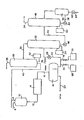
- the figure illustrates an apparatus used in the production of vinyltoluene.
- an ethyltoluene feedstock and steam are introduced through lines 6 and 8 respectively into a dehydrogenation apparatus 10 and reacted in the presence of a suitable catalyst to form vinyltoluene.
- the vinyltoluene product stream is withdrawn via line 12 and condensed in a condenser 14, then transferred via line 16 to separator 18.
- Condenser 14 may comprise any of the known types of condensing apparatus using water, air, heat exchange with other process-fluids, or a combination of two or more of the foregoing to effect condensation.
- the aqueous phase of the vinyltoluene product stream is separated from the crude vinyltoluene organic phase in the separator.
- the aqueous phase is withdrawn through line 20 and is recycled for water treatment and use in the boilers used in the dehydrogenation of ethyltoluene.
- the crude organic product phase from separator 18 is pumped through line 22 via pump 24 into the vinyltoluene distillation train.
- the.crude vinyltoluene is introduced into the intermediate portion of recycle column 32 which is preferably of parallel distillation path design.
- Reboiler 34 provides the necessary heat for distillation in column 32.
- An overhead product comprising ethyltoluene and lower boiling components such as toluene, benzene, xylene; ethylbenzene and nonaromatics is withdrawn through line 35 for subsequent fractionation in distillation column 36.
- column 36 toluene, xylene and other light distillates are separated and withdrawn through line 38.
- An ethyltoluene bottoms product is withdrawn through line 40 and is recycled for use in the ethyltoluene dehydrogenation reactor 10.
- Reboiler 42 provides the bottoms with the necessary heat for the distillation.
- the recycle bottoms product, containing vinyltoluene inhibitor and polyvinyltoluene is withdrawn from the recycle column 32 through line 44 using pump 46 and is charged into the middle portion of finishing column 48.
- a reboiler 50 is attached to finishing column 48 for supplying the necessary heat within the column.
- the .purified vinyltoluene overhead product is withdrawn through line 54.
- the finishing column bottoms product. is directed to flash pot 56 via line 58 and pump 60.
- the flash pot 56 has a reboiler 62 to facilitate the fractionation of. the bottoms.
- the tar produced during the distillation process is withdrawn through line 64 by pump 66 for proper disposal.
- the recycle column 32 is particularly susceptible to polymer buildup.
- a light, polar compound which is substantially a non-solvent for the polymer, such as an alcohol having from 1 to 4 carbon atoms or a ketone such as acetone or methylethylketone is introduced into the recycle column 32 from supply tank 72 through line 74 and line 22.
- a preferred light, polar compound is ethanol, because of its relatively low toxicity.. The use of methanol is not preferred because it poses possible health hazards. This factor is especially important due to the hand labor necessary to fracture and remove the polymer from the column, and the resultant exposure of maintenance personnel to any residual alcohol remaining in the modified polymer.
- the alcohol is preferably refluxed in column 32 . by means of reboiler 34 until the alcohol has sufficiently precipitated the polymer.
- the alcohol reflux is maintained for a time from about 2 to about 100 hours, preferably from about 10 to about 50 hours.
- the alcohol is then withdrawn by means of line 35. Treatment with hot alcohol may be used in equipment where a reflux is not feasible.
- a flow of steam is introduced into the recycle column 32 by means of lines 76 and 22.
- the steam expands the precipitated polymer, and also tends to remove most of the free alcohol and solvent from the polymer.
- the steam treatment may be periodically interrupted by a water wash of the column. After a suitable time, usually from about 1 to about 72 hours, and preferably from about 10 to about 48 hours, the steam treatment is discontinued. After cooling, the expanded polymer may be easily broken into manageable pieces and removed from the equipment.
- the polymer accumulations may initially be subjected to an optional softening treatment before being treated with the light, polar compound.
- An organic solvent which can soften the polymer is introduced from solvent source 68 through line 70 into line 22 and fed into the recycle column 32.
- Suitable solvents include toluene, xylene, xylene bottoms, ethyltoluene and other similar solvents. The use of xylene, toluene or ethyltoluene is preferred.
- Reboiler 34 provides the heat necessary to maintain a reflux of the solvent within the column. The reflux is maintained for a time from about 5 to about 100 hours, preferably from about 10 to about 50 hours, after which the solvent is drawn off through line 35.. When the process is applied to lines and other process equipment in which reflux is not practical, heated solvent may be used to bathe the. accumulated polymer for an appropriate length of time.
- Samples of polymer taken from the recycle column of a vinyltoluene distillation train were refluxed in a 200 ml flask in toluene for 7 hours.
- the toluene was decanted, and replaced with ethanol.
- the samples of polymer were then refluxed in ethanol for 3 hours. After removal of the ethanol, the samples were steamed for 3 ' hours.
- the original hard polymer, having a density of about 1.2 g/cc had expanded into a modified polymer having a density of about 0.75 g/cc.
- the modified polymer exhibited a porous structure and was readily crushed.
- the distillation system was drained of hydrocarbons.
- the recycle column was washed with ethyltoluene to remove polymerizable monomer and was subsequently inventoried with xylene.
- the xylene was heated at reflux with the pressure on the column being adjusted to maintain a bottoms temperature of approximately 105 degrees C. for approximately 48 hours, and the column was then cooled and drained. Vacuum was broken and the column was inventoried with ethanol and heated at reflux for approximately 48 hours. The system was again cooled and drained, and the ethanol was saved for reuse.
- the column was subsequently steamed for approximately 72 hours to effect density adjustment of polymer and to remove ethanol vapors.
- the stored material will be reprocessed when the recycle column is restarted for the next production run, to reclaim the vinyltoluene and ethyltoluene.
- Ethanol is then introduced into the column and refluxed for at least 72 hours after which the ethanol is pumped back to the ethanol storage tanks for subsequent reuse.
- the column is then alternately steamed for periods of 4 hours and washed with water for periods of about 1 hour for a total of about 48 hours until hydrocarbon levels in the column were sufficiently reduced to make the column safe for human entry. Polymer accumulations were then manually removed from the .interior of the column. As a result of the treatment, the normally dense, hard polymer accumulations were found to be somewhat porous and brittle, and .removal of the polymer was greatly facilitated.
Landscapes
- Chemical & Material Sciences (AREA)
- Organic Chemistry (AREA)
- Engineering & Computer Science (AREA)
- Chemical Kinetics & Catalysis (AREA)
- Materials Engineering (AREA)
- Water Supply & Treatment (AREA)
- Oil, Petroleum & Natural Gas (AREA)
- Health & Medical Sciences (AREA)
- Analytical Chemistry (AREA)
- Medicinal Chemistry (AREA)
- Polymers & Plastics (AREA)
- Organic Low-Molecular-Weight Compounds And Preparation Thereof (AREA)
- Addition Polymer Or Copolymer, Post-Treatments, Or Chemical Modifications (AREA)
Applications Claiming Priority (2)
| Application Number | Priority Date | Filing Date | Title |
|---|---|---|---|
| US248474 | 1981-03-27 | ||
| US06/248,474 US4452975A (en) | 1981-03-27 | 1981-03-27 | Polymer modification system for vinylaromatic monomer production apparatus |
Publications (2)
| Publication Number | Publication Date |
|---|---|
| EP0062624A1 true EP0062624A1 (de) | 1982-10-13 |
| EP0062624B1 EP0062624B1 (de) | 1985-06-19 |
Family
ID=22939298
Family Applications (1)
| Application Number | Title | Priority Date | Filing Date |
|---|---|---|---|
| EP82870015A Expired EP0062624B1 (de) | 1981-03-27 | 1982-03-25 | Verfahren zum Entfernen unlöslicher vernetzter Polymere aus der Vorrichtung zur Herstellung von vinylaromatischen Verbindungen |
Country Status (6)
| Country | Link |
|---|---|
| US (1) | US4452975A (de) |
| EP (1) | EP0062624B1 (de) |
| JP (1) | JPS57169435A (de) |
| CA (1) | CA1183432A (de) |
| DE (1) | DE3264229D1 (de) |
| GB (1) | GB2095689B (de) |
Families Citing this family (2)
| Publication number | Priority date | Publication date | Assignee | Title |
|---|---|---|---|---|
| US4558169A (en) * | 1980-12-31 | 1985-12-10 | Cosden Technology, Inc. | Process for the production of vinyltoluene |
| US6380451B1 (en) * | 1999-12-29 | 2002-04-30 | Phillips Petroleum Company | Methods for restoring the heat transfer coefficient of an oligomerization reactor |
Citations (3)
| Publication number | Priority date | Publication date | Assignee | Title |
|---|---|---|---|---|
| US2372524A (en) * | 1941-09-05 | 1945-03-27 | United Gas Improvement Co | Process for removing methyl phenylacetylene from ring substituted methyl styrene |
| US3023175A (en) * | 1957-10-09 | 1962-02-27 | Koppers Co Inc | Process and apparatus for the preexpansion of vinyl polymeric materials |
| US4230836A (en) * | 1979-04-26 | 1980-10-28 | Mobil Oil Corporation | Chemically cross-linked poly(p-methylstyrene) |
Family Cites Families (8)
| Publication number | Priority date | Publication date | Assignee | Title |
|---|---|---|---|---|
| US2749313A (en) * | 1952-04-21 | 1956-06-05 | Polymer Corp | Method of cleaning polymerization reactors |
| US2801234A (en) * | 1955-03-11 | 1957-07-30 | Phillips Petroleum Co | Method of removing olefin polymer from process equipment |
| US3004014A (en) * | 1958-09-26 | 1961-10-10 | Standard Oil Co | Styrene polymerization |
| BE624150A (de) * | 1960-12-07 | |||
| SE346114B (de) * | 1965-05-13 | 1972-06-26 | Hoechst Ag | |
| AT279158B (de) * | 1967-02-09 | 1970-02-25 | Coathylene Sa | Verfahren zur Herstellung von feinverteilten stereospezifischen Styrol-Butadien-Copolymeren |
| US3705190A (en) * | 1969-03-17 | 1972-12-05 | Rohm & Haas | Prevention of polymer fouling of monomer processing apparatus |
| US3764384A (en) * | 1970-07-24 | 1973-10-09 | Gaf Corp | Process for removing polyvinyl halide residues from processing equipment |
-
1981
- 1981-03-27 US US06/248,474 patent/US4452975A/en not_active Expired - Fee Related
-
1982
- 1982-03-22 CA CA000399004A patent/CA1183432A/en not_active Expired
- 1982-03-25 DE DE8282870015T patent/DE3264229D1/de not_active Expired
- 1982-03-25 EP EP82870015A patent/EP0062624B1/de not_active Expired
- 1982-03-26 GB GB8208980A patent/GB2095689B/en not_active Expired
- 1982-03-26 JP JP57047531A patent/JPS57169435A/ja active Pending
Patent Citations (3)
| Publication number | Priority date | Publication date | Assignee | Title |
|---|---|---|---|---|
| US2372524A (en) * | 1941-09-05 | 1945-03-27 | United Gas Improvement Co | Process for removing methyl phenylacetylene from ring substituted methyl styrene |
| US3023175A (en) * | 1957-10-09 | 1962-02-27 | Koppers Co Inc | Process and apparatus for the preexpansion of vinyl polymeric materials |
| US4230836A (en) * | 1979-04-26 | 1980-10-28 | Mobil Oil Corporation | Chemically cross-linked poly(p-methylstyrene) |
Also Published As
| Publication number | Publication date |
|---|---|
| GB2095689B (en) | 1984-08-01 |
| JPS57169435A (en) | 1982-10-19 |
| GB2095689A (en) | 1982-10-06 |
| EP0062624B1 (de) | 1985-06-19 |
| US4452975A (en) | 1984-06-05 |
| CA1183432A (en) | 1985-03-05 |
| DE3264229D1 (en) | 1985-07-25 |
Similar Documents
| Publication | Publication Date | Title |
|---|---|---|
| KR100832559B1 (ko) | 냉각수 전처리방법 | |
| US3515766A (en) | Catalytic conversion process | |
| US4036905A (en) | Process for the manufacture of propylene oxide | |
| JPS62258336A (ja) | アセトンの回収法 | |
| TW593254B (en) | Process and apparatus for the work-up by distillation of cleavage product mixtures produced in the cleavage of alkylaryl hydroperoxides | |
| EP0062626B1 (de) | Verfahren zur Destillation von Vinyltoluol | |
| CN101903321B (zh) | 苯酚的处理 | |
| JP3237768B2 (ja) | 熱可塑性ポリエステルスクラツプからの芳香族酸のメチルエステル及びグリコールの回収 | |
| US4333801A (en) | Recovery of a cumene/alpha-methylstyrene fraction from a mixture thereof with phenol and water | |
| CN101883737B (zh) | 纯化含有聚芳族化合物的水相的方法 | |
| KR19980080447A (ko) | 중합 반응 억제 방법 | |
| US4452975A (en) | Polymer modification system for vinylaromatic monomer production apparatus | |
| US4563517A (en) | Polymer modification system for vinylaromatic monomer production apparatus | |
| JP3334883B2 (ja) | 古い合成樹脂または廃棄合成樹脂の加工処理法 | |
| US3476656A (en) | Fractional distillation and recovery of styrene containing sulfur with subsequent bottoms separation | |
| EP0462734B1 (de) | Azeotrope Destillationsverfahren zur Rückgewinnung von Diamondoid-Verbindungen aus Kohlenwasserstoffströmen | |
| US4418191A (en) | Solvent purification | |
| JPS5980618A (ja) | シクロペンタジエン類を回収する方法 | |
| CN101883748B (zh) | 用于对离开乙苯脱氢反应器的物流进行冷却的方法 | |
| US2445941A (en) | Purification of readily polymerizable vinyl aromatic compounds by distillation | |
| CN101351435A (zh) | 用于生产提纯的甲基异丁基酮的方法和装置 | |
| EP0062625B1 (de) | Verfahren zur Herstellung von Vinyltoluol | |
| US4558169A (en) | Process for the production of vinyltoluene | |
| KR820001640B1 (ko) | α-메틸벤질 알코올 탈수반응 잔류물로부터 스티렌 및 스티렌 선구물질의 회수 방법 | |
| JP3763595B2 (ja) | 重合防止剤の回収方法 |
Legal Events
| Date | Code | Title | Description |
|---|---|---|---|
| PUAI | Public reference made under article 153(3) epc to a published international application that has entered the european phase |
Free format text: ORIGINAL CODE: 0009012 |
|
| 17P | Request for examination filed |
Effective date: 19820405 |
|
| AK | Designated contracting states |
Designated state(s): BE DE FR GB IT NL |
|
| ITF | It: translation for a ep patent filed | ||
| GRAA | (expected) grant |
Free format text: ORIGINAL CODE: 0009210 |
|
| AK | Designated contracting states |
Designated state(s): BE DE FR GB IT NL |
|
| REF | Corresponds to: |
Ref document number: 3264229 Country of ref document: DE Date of ref document: 19850725 |
|
| ET | Fr: translation filed | ||
| PGFP | Annual fee paid to national office [announced via postgrant information from national office to epo] |
Ref country code: NL Payment date: 19860331 Year of fee payment: 5 |
|
| PLBE | No opposition filed within time limit |
Free format text: ORIGINAL CODE: 0009261 |
|
| STAA | Information on the status of an ep patent application or granted ep patent |
Free format text: STATUS: NO OPPOSITION FILED WITHIN TIME LIMIT |
|
| 26N | No opposition filed | ||
| BERE | Be: lapsed |
Owner name: COSDEN TECHNOLOGY INC. Effective date: 19870331 |
|
| PG25 | Lapsed in a contracting state [announced via postgrant information from national office to epo] |
Ref country code: NL Effective date: 19871001 |
|
| NLV4 | Nl: lapsed or anulled due to non-payment of the annual fee | ||
| GBPC | Gb: european patent ceased through non-payment of renewal fee | ||
| PG25 | Lapsed in a contracting state [announced via postgrant information from national office to epo] |
Ref country code: FR Free format text: LAPSE BECAUSE OF NON-PAYMENT OF DUE FEES Effective date: 19871130 |
|
| PG25 | Lapsed in a contracting state [announced via postgrant information from national office to epo] |
Ref country code: DE Effective date: 19871201 |
|
| REG | Reference to a national code |
Ref country code: FR Ref legal event code: ST |
|
| PG25 | Lapsed in a contracting state [announced via postgrant information from national office to epo] |
Ref country code: GB Effective date: 19881121 |
|
| PG25 | Lapsed in a contracting state [announced via postgrant information from national office to epo] |
Ref country code: BE Effective date: 19890331 |