EP0062748A1 - Verfahren zur Herstellung von Antischaummittel für wässrige Systeme - Google Patents
Verfahren zur Herstellung von Antischaummittel für wässrige Systeme Download PDFInfo
- Publication number
- EP0062748A1 EP0062748A1 EP82101470A EP82101470A EP0062748A1 EP 0062748 A1 EP0062748 A1 EP 0062748A1 EP 82101470 A EP82101470 A EP 82101470A EP 82101470 A EP82101470 A EP 82101470A EP 0062748 A1 EP0062748 A1 EP 0062748A1
- Authority
- EP
- European Patent Office
- Prior art keywords
- silica
- jet
- hours
- mixture
- homogenized
- Prior art date
- Legal status (The legal status is an assumption and is not a legal conclusion. Google has not performed a legal analysis and makes no representation as to the accuracy of the status listed.)
- Granted
Links
- 239000002518 antifoaming agent Substances 0.000 title claims abstract description 22
- 238000004519 manufacturing process Methods 0.000 title abstract description 7
- XLYOFNOQVPJJNP-UHFFFAOYSA-N water Substances O XLYOFNOQVPJJNP-UHFFFAOYSA-N 0.000 title description 3
- VYPSYNLAJGMNEJ-UHFFFAOYSA-N Silicium dioxide Chemical compound O=[Si]=O VYPSYNLAJGMNEJ-UHFFFAOYSA-N 0.000 claims abstract description 70
- 239000000377 silicon dioxide Substances 0.000 claims abstract description 33
- 238000000034 method Methods 0.000 claims abstract description 27
- 239000000203 mixture Substances 0.000 claims abstract description 13
- -1 siloxane units Chemical group 0.000 claims abstract description 9
- 239000000126 substance Substances 0.000 claims abstract description 9
- 125000005375 organosiloxane group Chemical group 0.000 claims abstract description 7
- 229920000642 polymer Polymers 0.000 claims abstract description 7
- 238000003756 stirring Methods 0.000 claims abstract description 7
- 239000012670 alkaline solution Substances 0.000 claims abstract description 3
- 238000001816 cooling Methods 0.000 claims abstract description 3
- 238000010902 jet-milling Methods 0.000 claims description 25
- 239000004205 dimethyl polysiloxane Substances 0.000 claims description 12
- 235000013870 dimethyl polysiloxane Nutrition 0.000 claims description 12
- 238000010438 heat treatment Methods 0.000 claims description 12
- 229920000435 poly(dimethylsiloxane) Polymers 0.000 claims description 12
- 238000002360 preparation method Methods 0.000 claims description 3
- 239000011541 reaction mixture Substances 0.000 claims description 3
- 229910000272 alkali metal oxide Inorganic materials 0.000 claims description 2
- 150000001340 alkali metals Chemical class 0.000 claims description 2
- 229910000287 alkaline earth metal oxide Inorganic materials 0.000 claims description 2
- 150000004703 alkoxides Chemical class 0.000 claims description 2
- 125000005265 dialkylamine group Chemical group 0.000 claims description 2
- 150000004679 hydroxides Chemical class 0.000 claims description 2
- 125000005270 trialkylamine group Chemical group 0.000 claims description 2
- 150000005622 tetraalkylammonium hydroxides Chemical class 0.000 claims 1
- 239000011148 porous material Substances 0.000 abstract description 11
- 238000000227 grinding Methods 0.000 abstract description 7
- 239000011163 secondary particle Substances 0.000 abstract description 5
- 238000002156 mixing Methods 0.000 abstract 1
- 238000001556 precipitation Methods 0.000 abstract 1
- 239000006260 foam Substances 0.000 description 12
- 239000000243 solution Substances 0.000 description 6
- 239000003513 alkali Substances 0.000 description 5
- 239000002245 particle Substances 0.000 description 5
- 238000000265 homogenisation Methods 0.000 description 4
- 239000007788 liquid Substances 0.000 description 4
- 239000013530 defoamer Substances 0.000 description 3
- 235000012239 silicon dioxide Nutrition 0.000 description 3
- IGFHQQFPSIBGKE-UHFFFAOYSA-N Nonylphenol Natural products CCCCCCCCCC1=CC=C(O)C=C1 IGFHQQFPSIBGKE-UHFFFAOYSA-N 0.000 description 2
- 239000002202 Polyethylene glycol Substances 0.000 description 2
- 230000015572 biosynthetic process Effects 0.000 description 2
- 238000009835 boiling Methods 0.000 description 2
- 125000004122 cyclic group Chemical group 0.000 description 2
- MTHSVFCYNBDYFN-UHFFFAOYSA-N diethylene glycol Chemical compound OCCOCCO MTHSVFCYNBDYFN-UHFFFAOYSA-N 0.000 description 2
- KPUWHANPEXNPJT-UHFFFAOYSA-N disiloxane Chemical class [SiH3]O[SiH3] KPUWHANPEXNPJT-UHFFFAOYSA-N 0.000 description 2
- 238000009826 distribution Methods 0.000 description 2
- 239000003995 emulsifying agent Substances 0.000 description 2
- 239000011521 glass Substances 0.000 description 2
- SNQQPOLDUKLAAF-UHFFFAOYSA-N nonylphenol Chemical compound CCCCCCCCCC1=CC=CC=C1O SNQQPOLDUKLAAF-UHFFFAOYSA-N 0.000 description 2
- 229920001223 polyethylene glycol Polymers 0.000 description 2
- 229920001296 polysiloxane Polymers 0.000 description 2
- 238000004062 sedimentation Methods 0.000 description 2
- 238000003860 storage Methods 0.000 description 2
- 150000001413 amino acids Chemical class 0.000 description 1
- 239000010426 asphalt Substances 0.000 description 1
- 239000003054 catalyst Substances 0.000 description 1
- 239000003599 detergent Substances 0.000 description 1
- 230000000694 effects Effects 0.000 description 1
- 229920001971 elastomer Polymers 0.000 description 1
- 239000000839 emulsion Substances 0.000 description 1
- 238000005516 engineering process Methods 0.000 description 1
- 239000000945 filler Substances 0.000 description 1
- 238000005187 foaming Methods 0.000 description 1
- 238000009472 formulation Methods 0.000 description 1
- 239000003292 glue Substances 0.000 description 1
- XLYOFNOQVPJJNP-UHFFFAOYSA-M hydroxide Chemical compound [OH-] XLYOFNOQVPJJNP-UHFFFAOYSA-M 0.000 description 1
- 239000011256 inorganic filler Substances 0.000 description 1
- 229910003475 inorganic filler Inorganic materials 0.000 description 1
- 239000004816 latex Substances 0.000 description 1
- 229920000126 latex Polymers 0.000 description 1
- 230000005923 long-lasting effect Effects 0.000 description 1
- 238000001000 micrograph Methods 0.000 description 1
- 238000003801 milling Methods 0.000 description 1
- 239000002480 mineral oil Substances 0.000 description 1
- 238000000879 optical micrograph Methods 0.000 description 1
- 125000006353 oxyethylene group Chemical group 0.000 description 1
- 239000003973 paint Substances 0.000 description 1
- 230000002265 prevention Effects 0.000 description 1
- 239000011347 resin Substances 0.000 description 1
- 229920005989 resin Polymers 0.000 description 1
- 239000013049 sediment Substances 0.000 description 1
- 239000000741 silica gel Substances 0.000 description 1
- 229910002027 silica gel Inorganic materials 0.000 description 1
- RMAQACBXLXPBSY-UHFFFAOYSA-N silicic acid Chemical compound O[Si](O)(O)O RMAQACBXLXPBSY-UHFFFAOYSA-N 0.000 description 1
- 239000000080 wetting agent Substances 0.000 description 1
Images

Classifications
-
- B—PERFORMING OPERATIONS; TRANSPORTING
- B01—PHYSICAL OR CHEMICAL PROCESSES OR APPARATUS IN GENERAL
- B01D—SEPARATION
- B01D19/00—Degasification of liquids
- B01D19/02—Foam dispersion or prevention
- B01D19/04—Foam dispersion or prevention by addition of chemical substances
- B01D19/0404—Foam dispersion or prevention by addition of chemical substances characterised by the nature of the chemical substance
- B01D19/0409—Foam dispersion or prevention by addition of chemical substances characterised by the nature of the chemical substance compounds containing Si-atoms
Definitions
- the invention relates to the production of anti-foaming agents for aqueous alkaline systems.
- US Pat. No. 3,113,930 describes the preparation of an antifoam by heating finely divided filler such as silicon dioxide with a multiple excess of a liquid methylpolysiloxane to above 350 ° C., which is then emulsified with water using a special emulsifier.
- finely divided filler such as silicon dioxide
- a multiple excess of a liquid methylpolysiloxane to above 350 ° C.
- this process is extremely cumbersome and also uses a special emulsifier.
- this process has the disadvantage that a strong depolymerization of the dimethylpolysiloxane takes place at temperatures of 350 ° C. and above.
- DE-PS 17 69 940 describes anti-foaming agents for aqueous alkaline liquids with a long-lasting effect.
- a maximum temperature of 150 ° C is used.
- Optimal defoamers with high effectiveness can only be obtained at temperatures from 180 ° to 220 ° C.
- the invention relates to a process for the preparation of antifoam for aqueous systems, which is characterized in that 90-99.5 parts of an organosiloxane polymer with 2 - 1400 siloxane units, corresponding to a molecular weight of 162 - 103 000 with 0.5 - 10 wt .-% of a precipitated, multi-jet milled silica, which has a pH value of 5 to 7 and which is adjusted to a pH value of 8-11 in the first or second jet milling process by adding alkaline solutions and their physico-chemical characteristics are in the following range: mixed, this mixture then homogenized at a pressure of 20 - 350 bar and at 25 - 100 ° C, heated to 100 - 300 ° C for a period of 0.1 to 24 hours with stirring and homogenized again after cooling.
- the reaction mixture can be evacuated during the heating process.
- the evacuation can be carried out during the entire or even only temporary heating.
- the total heating time to 180 ° C can be 6 hours, of which vacuum is only applied during the last hour.
- the mixture can then be cooled during the evacuation.
- the heating itself can preferably be carried out at a temperature of 160 to 190 ° C.
- the duration of the heating can preferably be 3 to 8 hours.
- pE 8.3-9.0 alkalized silica are mixed with an organosiloxane polymer and the mixture is homogenized for 3 to 6 hours at 160 to 190 ° C., in particular 180 ° C. heated.
- the organopolysiloxane used can be a dimethylpolysiloxane with 90-810 siloxane units corresponding to a molecular weight of 6700-60000 and a viscosity of 100-10000 cSt, in particular a dimethylpolysiloxane with 280-406 Use siloxane units.
- the quantitative ratio of silica to siloxane in the antifoam produced according to the invention can be 0.5 to 10 parts, preferably 5 to 8 parts of silica and 90 to 99.5 parts, preferably 92 to 95 parts of siloxane.
- Another embodiment of the invention is based on the fact that the silicic acid made alkaline during the first grinding process is subjected to a second jet grinding process. However, it is also possible to alkalize the silica only during the second jet milling process.
- the second jet milling process can be carried out at 50 to 100 ° C., preferably at 80 ° C.
- Substances from the group of alkali metal and alkaline earth metal oxide, hydroxide, alkoxides, tetralkylammonium hydroxides and monoalkyl, dialkyl and trialkyl amines can be used for the alkalization of the silica.
- the alkalization of the silica during the jet milling ensures that the aqueous alkali solution can penetrate the pores of the silica completely uniformly. If, on the other hand, silica and alkali are separately incorporated into the dimethylpolysiloxane as described in DE-PS 17 69 940, the silica gel pores are preferably covered by the excess of dimethylpolysiloxane and the alkali causes the formation of cyclic oligomers from the dimethylpolysiloxane rather than the hydrophobization process promotes.
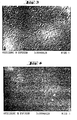
- FIGS. 1 to 4 each show a light microscope image (Orthoplan device from Leitz) of a silica dispersion.
- a double jet-milled silica can be used, the alkalization preferably being carried out in the second jet milling.
- Any known type of jet milling can be carried out during jet milling.
- steam jet milling can be carried out.
- the silica obtained in this way can have an average particle size of at most 3 ⁇ m.
- the silica further processed according to the invention after the jet milling can have a BET surface area of 300 ⁇ 30 m 2 / g, a pore volume of 0.6 to 1.2 ml / g, a pore diameter of 8 to 16 nm, or a BET surface area from 155 to 350 m 2 / g, a pore volume of 0.3 to 0.6 ml / g and a pore diameter of 10 to 14 nm.
- the average particle diameter for both silicas is 11 to 13 nm. Both silicas have a pH of 6.5.
- the distribution of the secondary particles which are very hard in the case of silicas, is practically not changed by a subsequent homogenization process of the almost finished antifoam, but is only slightly smoothed.
- the type of homogenizer used is not critical. Rather, it is of crucial importance that a pressure of at least 250 to 400 bar can be achieved with the homogenizer. In a preferred embodiment of the invention, the pressure during the first homogenization can be from 250 to 350 bar.
- the temperature may be in the homo g ens ist preferably 25 to 35 ° C.
- the pressure can preferably be 250 to 350 bar and the temperature preferably 65 to 100 ° C.
- secondary particles are from 3 ⁇ m required.
- An odor-free anti-foaming agent is required for many areas of application. For this and also for the storage stability, it has been found important that the reaction mixture is evacuated after heating and the second homogenization step is carried out at a temperature between 50-100 ° C.
- the anti-foaming agent produced according to the invention can be used for resin boiling in the paint industry, for latex production in the rubber industry, for paper and glue production, for surface defoaming of mineral oils, for bitumen boiling Prevention of the foam of boiler water in steam boilers in detergent formulations, in the processing of color printing pastes, in pharmaceutical chemistry and chemical technology, for example in the production of amino acids.
- 7.5 kg of a precipitated silica are mixed with 92.5 kg of a dimethylpol y siloxanes with a viscosity of 1000 cSt. stirred at 25 ° C for 12 hours in a suitable container.
- the mixture is then passed through a high-pressure homogenizer at room temperature and 250 bar and then heated to 180 ° C. in a suitable kettle with stirring for 6 hours. After heating, it is evacuated, cooled, decompressed and homogenized in two stages at 250/100 bar.
- the silica used is a precipitated, twice jet-milled silica, which was set to pE 8.3 in the first jet milling process and has the following physico-chemical characteristics:
- the BET surface area is according to Brunnauer, Emmet and Teller, Hournal of American Chemical Soc. Vol. 60 (1938) pp. 309-319.
- the pore volume and pore diameter are determined according to Cranston and Inkley ANderance Katal. Vol. 9, 1957, p. 143.
- the grain size of the secondary particles is determined by taking a scanning electron microscope image at a magnification of 1000 to 3000 times and then evaluating the particles using the particle size counter TG Z3 from Zeiss.
- the jet grinding of the silica is carried out in a Jeto-Mizer 0808 (throughput 500 kg / hour) with 16 bar steam.
- 5.0 kg of a precipitated silica are mixed with 95.0 kg of a dimethylpolysiloxane with a viscosity of 1000 cSt. stirred at 25 ° C for 12 hours in a suitable container.
- the mixture is then passed through a high-pressure homogenizer at room temperature and 350 bar and then heated to 170 ° C. in a suitable kettle with stirring for 5 hours. It is then evacuated, cooled, relaxed and homogenized in one stage at 350 bar.
- the silica used is a precipitated, twice jet-milled silica, which was set to pH 8.6 during the first jet milling process and has the following physico-chemical characteristics:
- the defoamer effectiveness is also improved.
- the anti-foaming agents explained using the examples have a long shelf life. No sedimentation was found after 12 months. After production, the quality is also checked using the centrifuge test mentioned at the beginning.
- Example 1 g of antifoam (Examples 1 - 4) are mixed with 49 g of nonylphenol polyethylene glycol ether with 6 oxyethylene units per molecule and 100 ⁇ l, 300 and 500 ⁇ l of this mixture are mixed into 50 ml of a 0.1% Mersolat H solution using an automatic pipette ( a strongly foaming wetting agent) which is placed in a beaker, pipetted and completely distributed. The contents of the beaker are then poured into a 250 ml shaking cylinder and sealed.
- an automatic pipette a strongly foaming wetting agent
- Table 1 provides information on the effectiveness of the anti-foaming agents according to the invention.
- the foam height can be reduced to 40 ml or after 10 days to 60 ml.
- the foam height can be increased to 20 ml or 40 ml after 10 days be reduced.
- an anti-foaming agent which contains only one jet-milled silica does not have the qualities which the anti-foaming agent shows with a twice jet-milled silica.
- the reading times 90, 180 and 60 seconds were chosen to make the quality differences clearly visible.
Landscapes
- Chemical & Material Sciences (AREA)
- Health & Medical Sciences (AREA)
- Toxicology (AREA)
- Dispersion Chemistry (AREA)
- Chemical Kinetics & Catalysis (AREA)
- Compositions Of Macromolecular Compounds (AREA)
- Manufacture Of Porous Articles, And Recovery And Treatment Of Waste Products (AREA)
- Silicon Compounds (AREA)
- Degasification And Air Bubble Elimination (AREA)
- Organic Low-Molecular-Weight Compounds And Preparation Thereof (AREA)
- Silicon Polymers (AREA)
Abstract
Description
- Die Erfindung betrifft die Herstellung von Antischaummitteln für wäßrig-alkalische Systeme.
- Es ist bekannt, daß feinteilige Kieselsäuren in Organpolysiloxanen, gegebenenfalls unter Erhitzen eingearbeitet, Schaumbildung verhindern bzw. vermeiden können.
- In der US-PS 3 113 930 wird die Herstellung eines Antischaummittels durch Erhitzen von feinverteiltem Füllstoff wie Siliciumdioxid mit einem vielfachen Überschuß an einem flüssigen Methylpolysiloxan auf über 350°C, der dann unter Verwendung eines speziellen Emulgators mit Wasser emulgiert wird, beschrieben. Dieses Verfahren ist jedoch ausserordentlich umständlich und verwendet außerdem einen speziellen Emulgator. Weiterhin weist dieses Verfahren den Nachteil auf, daß bei Temperaturen von 350°C und darüber eine starke Depolymerisierung des Dimethylpolysiloxans stattfindet.
- Die DE-PS 17 69 940 beschreibt Antischaummittel für wäßrig-alkalische Flüssigkeiten mit langanhaltender Wirkung.
- Ein Gemisch von mindestens 70 Gew.-% eines Organosiloxanpolymeren mit einer Viskosität von etwa 5 bis etwa 100 000 Centistokes, gemessen bei 25°C, sowie mindestens 0,5 Gew.-% eines feinverteilten anorganischen Füllstoffes, wie z.B. Siliciumdioxid, und 0,01 bis 1 Gew.-% eines basischen Katalysators, welches auf Temperaturen zwischen 100 und 300°C erhitzt wird. Gemäß den Beispielen der DE-PS 17 69 940 wird eine maximale Temperatur von 150°C verwendet. Optimale Entschäumer mit hoher Wirksamkeit erhält man aber nur bei Temperaturen von 180° bis 220°C. Bei der Zugabe von wässrigem Alkali, wie sie in der DE-PS 17 69 940 beschrieben wird, kann man aber diese Temperaturen nicht anwenden, weil sich sonst - bedingt durch die Reaktion des Alkali mit dem Dimethylpolysiloxan - Gemische von übelriechendem cyclischen Polysiloxanen in nicht unerheblicher Menge bilden.
- Gegenstand der Erfindung ist ein Verfahren zur Herstellung von Antischaummittel für wäßrige Systeme, welches dadurch gekennzeichnet ist, daß man 90 -99,5 Teile eines Organosiloxanpolymeren mit 2 - 1400 Siloxaneinheiten, entsprechend einem Molekulargewicht von 162 - 103 000 mit 0,5 - 10 Gew.-% einer gefällten, mehrfach strahlvermahlenen Kieselsäure, die einen pH-Wert von 5 bis 7 aufweist und die bei dem ersten oder zweiten Strahlvermahlungsvorgang durch Zugabe von alkalischen Lösungen auf einen pH-Wert von 8 - 11 eingestellt wird und deren physikalisch-chemischen Kenndaten in folgendem Bereich liegen:

- Gemäß einer besonderen Ausführungsform der Erfindung kann man.das Reaktionsgemisch während dem Erhitzungsvorgang evakuieren. Das Evakuieren kann während des gesamten oder auch nur zeitweise Erhitzens durchgeführt werden. So kann beispielsweise die gesamte Erhitzungszeit auf 180°C 6 Stunden betragen, davon wird nur während der letzten Stunde Vakuum angelegt. Anschließend kann die Mischung während des Evakuierens abgekühlt werden. Das Erhitzen selbst kann vorzugsweise auf eine Temperatur von 160 bis 190°C erfolgen. Die Dauer des Erhitzens kann vorzugsweise 3 bis 8 Stunden betragen.
- In einer weiteren Ausführungsform der Erfindung werden vorzugsweise 2,5 bis 7,5 % auf pE 8,3 - 9,0 alkalisierter Kieselsäure mit einem Organosiloxanpolymeren vermischt homogenisiert und das Gemisch 3 bis 6 Stunden auf 160 bis 190°C, insbesondere 180°C erhitzt.
- Als Organopolysiloxan kann man ein Dimethylpolysiloxan mit 90 - 810 Siloxaneinheiten entsprechend einem Molekulargewicht von 6700 - 60000 und einer Viskosität von 100 - 10000 cSt., insbesondere ein Dimethylpolysiloxan mit 280 - 406 Siloxaneinheiten verwenden. Das Mengenverhältnis von Kieselsäure zu Siloxan kann in dem erfindungsgemäß hergestellten Antischaummittel 0,5 bis 10 Teile, vorzugsweise 5 bis 8 Teile Kieselsäure und 90 bis 99,5 Teile, vorzugsweise 92 bis 95 Teile Siloxan betragen.
- Eine weitere Ausführungsform der Erfindung beruht darauf, daß die beim ersten Mahlvorgang alkalisch gestellte Kieselsäure einem zweiten Strahlvermahlungsvorgang unterworfen wird. Es ist jedoch auch möglich, die Kieselsäure erst während des zweiten Strahlvermahlungsvorganges zu alkalisieren.
- Den zweiten Strahlvermahlungsvorgang kann man bei 50. bis 100°C, vorzugsweise bei 80°C durchführen.
- Für die Alkalisierung der Kieselsäure kann man Stoffe aus der Gruppe der Alkalimetall- und Erdalkalimetalloxid, -hydroxid, - alkoxyde, Tetralkylammoniumhydroxide und Monoalkyl-, Dialkyl- und Trialkylamine verwenden.
- Durch die Alkalisierung der Kieselsäure während des Strahlvermahlens ist gewährleistet, daß die wäßrige Alkalilösung völlig gleichmäßig in die Poren der Kieselsäure eindringen kann. Wird dagegen Kieselsäure und Alkali getrennt in das Dimethylpolysiloxan eingearbeitet wie in DE-PS 17 69 940 beschrieben, werden die Kieselgelporen bevorzugt von dem in großen Überschuß vorhandenen Dimethylpolysiloxan abgedeckt und das Alkali bewirkt eher die Bildung von cyclischen Oligomeren aus dem Dimethylpolysiloxan als das es den Hydrophobierungsvorgang fördert.
- Eine nach dem Alkalisierungsvorgang angeschlossene zweite-Strahlvermahlung bewirkt eine weitere Zerkleinerung und es ergibt sich gegenüber einer Mahlung eine außerordentliche Verbesserung der Verteilungskurve der Sekundärteilchen und damit die Voraussetzung für einen sedimentationsstabiles und gutes Antischaummittel. Der Vermahlungseffekt kann deutlich aus dem Vergleich der Figuren 1 und 2 mit den Figuren 3 und 4 ersehen werden. Es zeigen die Figuren 1 bis 4 je eine lichtmikroskopische Aufnahme (Gerät Orthoplan der Firma Leitz) einer Kieselsäuredispersion. Die Figuren 1 und 2 zeigen die Kieselsäuredispersion nach der ersten Vermahlung (Fig. 1 = Maßstab 500 : 1, Fig. 2 = Maßstab 200 : 1). Die Figuren 3 und 4 zeigen die Kieselsäuredispersion nach der zweiten Vermahlung. (Fig. 3 = Maßstab 500 : 1 und Fig. 4 = Maßstab 200.: 1).
- In einer bevorzugten Ausführungsform kann man eine zweifach strahlvermahlene Kieselsäure einsetzen, wobei die Alkalisierung vorzugsweise bei der zweiten Strahlvermahlung durchgeführt wird. Bei der Strahlvermahlung kann jede bekannte Art der Strahlvermahlung durchgeführt werden. In einer bevorzugten Ausführungsform der Erfindung kann eine Dampfstrahlvermahlung durchgeführt werden. Die derart erhaltene Kieselsäure kann eine mittlere Teilchengrösse von maximal 3 um aufweisen.
- Die erfindungsgemäß nach der Strahlvermahlung weiterverarbeitete Kieselsäure kann eine'BET-Oberfläche.von 300 ± 30 m2/g, ein Porenvolumen von 0,6 bis 1,2 ml/g, ein Porendurchmesser von 8 bis 16 nm, beziehungsweise eine BET-Oberfläche von 155 bis 350 m2/g, ein Porenvolumen von 0,3 bis 0,6.ml/g und einen Porendurchmesser von 10 bis 14 nm aufweisen.
- Für beide Kieselsäuren beträgt der durchschnittliche Pcrendurchmesser 11 bis 13 nm. Beide Kieselsäuren weisen einen pH-Wert von 6.5 auf.
- überraschenderweise wird nämlich die Verteilung der Sekundärteilchen, die im Falle von Kieselsäuren sehr hart sind, durch einen angeschlossenen Homogenisierungsvorgang des nahezu fertigen Antischaummittels praktisch nicht verändert, sondern nur etwas geglättet. Der.Typ des verwendeten Homogenisators ist nicht entscheidend. Von entscheidender Bedeutung ist vielmehr, daß mit dem Homogenisator ein Druck von mindestens 250 bis 400 bar erreicht werden kann. In einer bevorzugten Ausführungsform der Erfindung kann der Druck bei der ersten Homogenisierung von 250 bis 350 bar betragen. Die Temperatur kann bei der Homogensierung vorzugsweise 25 bis 35°C betragen.
- Bei der zweiten Homogenisierung kann der Druck vorzugsweise 250 bis 350 bar und die Temperatur vorzugsweise 65 bis 100°C betragen. Für eine im Zentrifugat stabile Emulsion sind Sekundärteilchen von3 µm erforderlich.

- Für viele Einsatzgebiete ist ein geruchsfreies Antischaum- mittel erforderlich, hierfür und auch für die Lagerstabilität erwies sich als wichtig, daß das Reaktionsgemisch nach dem Erhitzen evakuiert und der zweiten Homogenisierungsschritt bei einer Temperatur zwischen 50 - 100°C durchgeführt wird. Das erfindungsgemäß hergestellte Antischaummittel kann bei Harzverkochungen in der Lackindustrie, bei der Latexherstellung in der Kautschukindustrie, bei der Papier- und Leimherstellung, zur Oberflächenentschäumung von Mineralölen, bei der Bitumenverkochung, zur Verhinderung des Schaumes von Kesselwasser in Dampfkesseln in Waschmittelformulierungen, bei der Verarbeitung von Farbdruckpasten, in der pharmazeutischen Chemie und der chemischen Technologie, beispielsweise bei der Herstellung von Aminosäuren eingesetzt werden.
- Das erfindungsgemäße Verfahren wird an Hand der folgenden Beispiele näher erläutert und beschrieben:
- 7,5 kg einer gefällten Kieselsäure werden mit 92,5 kg eines Dimethylpolysiloxanes mit einer Viskosität von 1000 cSt. bei 25°C 12 Stunden in einem geeigneten Behälter gerührt. Das Gemisch wird anschließend bei Raumtemperatur und 250 bar durch einen Hochdruckhomogenisator geschleust und darauf in einem geeigneten Kessel unter Rühren 6 Stunden auf 180°C erhitzt. Nach dem Erhitzen wird evakuiert, abgekühlt, entspannt und bei 250/100 bar zweistufig homogenisiert.
- Die verwendete Kieselsäure ist eine gefällte, zweimal strahlvermahlene Kieselsäure, die beim ersten Strahlvermahlungsprozeß auf pE 8,3 gestellt wurde und folgende physikalisch-chemischen Kenndaten aufweist:

- Die BET-Oberfläche wird gemäß Brunnauer, Emmet und Teller, Hournal of American Chemical Soc. Bd. 60 (1938) S. 309 - 319 bestimmt.
- Das Porenvolumen und der Porendurchmesser wird gemäß Cranston und Inkley ANderance Katal. Bd. 9, 1957, S. 143 bestimmt.
- Die Korngröße der Sekundärteilchen wird bestimmt, indem man eine Raster-Elektronenmikroskopische Aufnahme bei 1000 bis 3000-facher Vergrösserung herstellt und dann die Teilchen mittels dem Teilchengrössenzählgerät TG Z3 der Firma Zeiss auswertet.
- Die Strahlvermahlung der Kieselsäure wird in einem Jeto-Mizer 0808 (Durchsatz 500 kg/Std) mit 16 bar Dampf durchgeführt..
- 5,0 kg einer gefällten Kieselsäure werden mit 95,0 kg eines Dimethylpolysiloxans mit einer Viskosität von 1000 cSt. bei 25°C 12 Stunden in einem geeigneten Behälter gerührt. Das Gemisch wird anschließend bei Raumtemperatur und 350 bar durch einen Hochdruckhomogenisator gefahren und darauf in einem geeigneten Kessel unter Rühren 5 Stunden auf 170°C erhitzt. Danach wird evakuiert, augekühlt, entspannt und einstufig .bei 350 bar homogenisiert.
- Die verwendete Kieselsäure ist eine gefällte, zweimal strahlvermahlene Kieselsäure, die beim ersten Strahlvermahlungsvorgang auf pH 8,6 eingestellt wurde und folgende physikalisch-chemische Kenndaten aufweist:

- 2,5 kg der gemäß Beispiel 1 verwendeten gefällten Kieselsäure werden mit 97,5 kg eines Dimethylpolysiloxans mit einer Viskosität von 1000 cSt. bei 25°C 12 Stunden in einem geeigneten Behälter gerührt, darauf bei 350 bar durch einen Hochdruckhomogenisator gefahren und dann in einem geeigneten Kessel unter Rühren 6 Stunden auf 180°C erhitzt. Nach dem Erhitzen wird evakuiert, abgekühlt, entspannt und bei 350 bar homogenisiert.
- 7,5 kg der gemäß Beispiel 1 verwendeten gefällten-Kieselsäure, jedoch nur 1 x strahlvermahlen werden mit 92,5 kg eines Dimethylpolysiloxans mit einer Viskosität von 1000 cSt. bei 25 °C 12 Stunden in einem geeigneten Behälter gerührt. Das Gemisch wird anschließend bei Raumtemperatur und 250 bar durch einen Hochdruckhomogenisator geschleust und darauf in einem geeigneten Kessel unter Rühren 6 Stunden auf 180°C erhitzt. Nach dem Erhitzen wird evakuiert, abgekühlt, entspannt und bei 250/100 bar zweistufig homogenisiert.
- Die 2 x strahlvermahlene Kieselsäure bewirkt gegenüber der 1 x strahlvermahlenen Kieselsäure auf Grund der größeren Teilchenfeinheit eine hohe Lagerstabilität ( = 12 Monate). Die Entschäumerwirksamkeit wird ebenfalls verbessert.
- Die an Hand der Beispiele erläuterten Antischaummittel weisen eine hohe Lagerstabilität auf. Nach 12 Monaten konnte noch keine Sedimentation festgestellt werden. Die Qualität wird nach Herstellung außerdem mit dem eingangs erwähnten Zentrifugentest geprüft.
- In einer Laborzentrifuge werden von jedem zu prüfenden Entschäumer 50 g in ein Zentrifugenglas (95 ml Inhalt) eingewogen und 10 Minuten mit 3000 Umdrehungen/min. zentrifugiert. Bei der Betrachtung darf sich kein Bodensatz gebildet haben. Zur weiteren überprüfung wird der Inhalt vorsichtig ausgegossen und das Zentrifugenglas auf ein Filterpapier auf den Kopf gestellt und vollständig auslaufen lassen. Auch bei diesem Prüfvorgang soll kein Sedimentationsrückstand sichtbar sein.
- Die Entschäumerwirksamkeit wird mit dem nachfolgenden beschriebenen Test geprüft:
- 1 g Antischaummittel (Beisiele 1 - 4) werden mit 49 g Nonylphenolpolyäthylenglykoläther mit 6 Oxäthyleneinheiten je Molekül homogen verrührt und mittels einer automatischen Pipette 100 µl, 300 und 500 µl dieser Mischung zu 50 ml einer 0,1 %igen Mersolat H-Lösung, (ein stark schäumendes Netzmittel) die in einem Becherglas vorgelegt wird, pipettiert und vollständig verteilt. Der Inhalt des Becherglases wird darauf in einem 250 ml Schüttelzylinäer eingefüllt und verschlossen.
- Zur Schaumerzeugung wird 25 mal kräftig auf und nieder geschüttelt (jede Richtungsänderung gleich eine Schüttelbewegung) und das Volumen Flüssigkeit und Schaum aufgezeichnet. Als Schaumhöhe wird Gesamtvolumen minus 50 ml (Volumen der ursprünglichen Flüssigkeit) gewertet. Nach dem Schütteltest am 1. Tag wird die gleiche Lösung am 10. Tag nochmals geschüttelt. Als Blindwert werden 100 µl der reinen Nonylphenolpolyäthylenglykoläther-Lösung zu 50 ml der 0,1 %igen Mersolat H-Lösung pipettiert, vollständig verteilt und wie angegeben geschüttelt.
- Die Ergebnisse des Schaumtestes sind in der Tabelle 1 dargestellt.

- Die Tabelle 1 gibt Auskunft über die Wirksamkeit der erfindungsgemäßen Antischaummittel.
- Mit der reinen Mersolat H-Lösung (Blindwert) wird Schaum erzeut, der nach 90 Sekunden noch eine Höhe von 200 ml aufweist. Mit dem Antischaummittel gemäß Beispiel 1 kann die Schaumhöhe auf 40 ml bzw. nach 10 Tagen auf 60 ml reduziert werden. Mit dem Antischaummittel gemäß Beispiel 2 kann die Schaumhöhe auf 20 ml bzw. 40 ml nach 10 Tagen reduziert werden.
- Aus dem Beispiel ergibt sich, daß ein Antischaummittel, welches nur einmal strahlvermahlene Kieselsäure enthält nicht die Qualitäten aufweist, die das Antischaummittel mit einer zweimal strahlvermahlenen Kieselsäure zeigt.
- Erhöht man die Konzentration des Antischaummittels, so zeigt sich, daß das Antischaummittel gemäß Beispiel 2 das beste Ergebnis bewirkt.
- Die Ablesezeiten 90, 180 und 60 Sekunden wurden gewählt, um die Qualitätsunterschiede deutlich sichtbar zu machen.
- Würde man beispielsweise in der 3. Querspalte statt bei 60 Sekunden erst nach 90 oder 180 Sekunden nach dem Schüttelvorgang ablesen, wäre der Schaum bei allen Beispielen fast vollständig zusammengeschrumpft und es wären keine Unterschiede zu erkennen.
- Das gleiche gilt ebenso für die angewandten Konzentrationen des Antischaummittels. Würde man diese wesentlich erhöhen, z.B. auf 0,1 %, würde sich quasi kein Schaum bilden bzw. nach 1 bis 2 Sekunden zusammenbrechen.
Claims (7)

Priority Applications (1)
| Application Number | Priority Date | Filing Date | Title |
|---|---|---|---|
| AT82101470T ATE13254T1 (de) | 1981-04-09 | 1982-02-26 | Verfahren zur herstellung von antischaummittel fuer waessrige systeme. |
Applications Claiming Priority (2)
| Application Number | Priority Date | Filing Date | Title |
|---|---|---|---|
| DE3114268A DE3114268C2 (de) | 1981-04-09 | 1981-04-09 | Verfahren zur Herstellung von Antischaummitteln für wäßrige Systeme |
| DE3114268 | 1981-04-09 |
Publications (2)
| Publication Number | Publication Date |
|---|---|
| EP0062748A1 true EP0062748A1 (de) | 1982-10-20 |
| EP0062748B1 EP0062748B1 (de) | 1985-05-15 |
Family
ID=6129710
Family Applications (1)
| Application Number | Title | Priority Date | Filing Date |
|---|---|---|---|
| EP82101470A Expired EP0062748B1 (de) | 1981-04-09 | 1982-02-26 | Verfahren zur Herstellung von Antischaummittel für wässrige Systeme |
Country Status (5)
| Country | Link |
|---|---|
| EP (1) | EP0062748B1 (de) |
| AT (1) | ATE13254T1 (de) |
| CA (1) | CA1173325A (de) |
| DE (2) | DE3114268C2 (de) |
| ES (1) | ES8303929A1 (de) |
Cited By (2)
| Publication number | Priority date | Publication date | Assignee | Title |
|---|---|---|---|---|
| EP0091257A3 (en) * | 1982-04-07 | 1984-11-14 | The British Petroleum Company P.L.C. | Oil gas separation |
| US12473654B2 (en) | 2020-08-12 | 2025-11-18 | Evonik Operations Gmbh | Use of silicon dioxide for improving the cathodic anticorrosion effect of ground coats |
Citations (6)
| Publication number | Priority date | Publication date | Assignee | Title |
|---|---|---|---|---|
| US3250727A (en) * | 1961-12-30 | 1966-05-10 | Bayer Ag | Defoaming agents containing methylsiloxanes |
| DE1544001A1 (de) * | 1966-08-31 | 1969-06-26 | Degussa | Verfahren zur Aktivierung von Entschaeumerfluessigkeiten |
| FR1577613A (de) * | 1967-08-11 | 1969-08-08 | ||
| FR2399858A1 (fr) * | 1977-08-09 | 1979-03-09 | Goldschmidt Ag Th | Preparation antimousse et procede permettant sa production |
| EP0023533A1 (de) * | 1979-06-26 | 1981-02-11 | Th. Goldschmidt AG | Mittel zum Entschäumen flüssiger Medien |
| EP0032538A2 (de) * | 1980-01-17 | 1981-07-29 | Degussa Aktiengesellschaft | Verfahren zur Herstellung von sedimentationsstabilen Schaumbekämpfungsmitteln |
Family Cites Families (1)
| Publication number | Priority date | Publication date | Assignee | Title |
|---|---|---|---|---|
| FR1257811A (fr) * | 1960-02-25 | 1961-04-07 | Rhone Poulenc Sa | Compositions organopolysiloxaniques à propriétés antimousses |
-
1981
- 1981-04-09 DE DE3114268A patent/DE3114268C2/de not_active Expired
-
1982
- 1982-02-26 AT AT82101470T patent/ATE13254T1/de not_active IP Right Cessation
- 1982-02-26 EP EP82101470A patent/EP0062748B1/de not_active Expired
- 1982-02-26 DE DE8282101470T patent/DE3263494D1/de not_active Expired
- 1982-03-31 CA CA000400140A patent/CA1173325A/en not_active Expired
- 1982-04-08 ES ES511304A patent/ES8303929A1/es not_active Expired
Patent Citations (6)
| Publication number | Priority date | Publication date | Assignee | Title |
|---|---|---|---|---|
| US3250727A (en) * | 1961-12-30 | 1966-05-10 | Bayer Ag | Defoaming agents containing methylsiloxanes |
| DE1544001A1 (de) * | 1966-08-31 | 1969-06-26 | Degussa | Verfahren zur Aktivierung von Entschaeumerfluessigkeiten |
| FR1577613A (de) * | 1967-08-11 | 1969-08-08 | ||
| FR2399858A1 (fr) * | 1977-08-09 | 1979-03-09 | Goldschmidt Ag Th | Preparation antimousse et procede permettant sa production |
| EP0023533A1 (de) * | 1979-06-26 | 1981-02-11 | Th. Goldschmidt AG | Mittel zum Entschäumen flüssiger Medien |
| EP0032538A2 (de) * | 1980-01-17 | 1981-07-29 | Degussa Aktiengesellschaft | Verfahren zur Herstellung von sedimentationsstabilen Schaumbekämpfungsmitteln |
Cited By (3)
| Publication number | Priority date | Publication date | Assignee | Title |
|---|---|---|---|---|
| EP0091257A3 (en) * | 1982-04-07 | 1984-11-14 | The British Petroleum Company P.L.C. | Oil gas separation |
| US4564665A (en) * | 1982-04-07 | 1986-01-14 | The British Petroleum Company P.L.C. | Oil gas separation |
| US12473654B2 (en) | 2020-08-12 | 2025-11-18 | Evonik Operations Gmbh | Use of silicon dioxide for improving the cathodic anticorrosion effect of ground coats |
Also Published As
| Publication number | Publication date |
|---|---|
| ATE13254T1 (de) | 1985-06-15 |
| EP0062748B1 (de) | 1985-05-15 |
| DE3114268A1 (de) | 1983-01-27 |
| DE3114268C2 (de) | 1986-04-24 |
| ES511304A0 (es) | 1983-02-16 |
| CA1173325A (en) | 1984-08-28 |
| DE3263494D1 (en) | 1985-06-20 |
| ES8303929A1 (es) | 1983-02-16 |
Similar Documents
| Publication | Publication Date | Title |
|---|---|---|
| EP1781393B1 (de) | Entschäumerzusammensetzungen | |
| EP1681083B1 (de) | Entschäumerzusammensetzungen | |
| DE69532516T2 (de) | Schaumregulierendes Agens | |
| EP0036597B1 (de) | Schaumdämpfungsmittel und dessen Verwendung in Kunstharz-, Lack- und Farbdispersionen | |
| DE3887799T2 (de) | Festes Silicon-Antischaummittel. | |
| DE69409309T2 (de) | Stabile dispergierbare Siliconzusammensetzungen | |
| EP2794760B1 (de) | Verfahren zur herstellung von entschäumerzusammensetzungen | |
| DE69202620T2 (de) | Silikon-Entschäumerzusammensetzung. | |
| EP0023533B1 (de) | Mittel zum Entschäumen flüssiger Medien | |
| EP1807164B1 (de) | Entschäumerzusammensetzungen | |
| DE1619859B2 (de) | Verfahren zum verhindern und/oder vermindern der schaumbildung in waesserigen systemen | |
| DE102007061455A1 (de) | Entschäumerformulierung | |
| DE3319788A1 (de) | Mit organischen gruppen modifizierte kieselsaeure, deren herstellung und verwendung zur spaltung von emulsionen | |
| DE1110862B (de) | Verfahren zur Herstellung von waessrigen Organopolysiloxanemulsionen mit verbesserten Antischaumeigenschaften | |
| EP0658361B1 (de) | Entschäumeremulsion auf der Basis organofunktionell modifizierter Polysiloxane | |
| DE2626994A1 (de) | Verfahren zum herstellen waessriger schaumverhuetungsmittel | |
| DE69522503T2 (de) | Schaumregulierendes Mittel | |
| EP0726086B1 (de) | Hydrophobe Kieselsäuren enthaltende Entschäumerzubereitungen auf der Basis von Siloxanen | |
| EP0062748B1 (de) | Verfahren zur Herstellung von Antischaummittel für wässrige Systeme | |
| DE2506203A1 (de) | Entschaeumer | |
| EP1533333B1 (de) | Emulgatorfreie Öl in Wasser-Emulsionen von Organopolysiloxanen und deren Verwendung in technischen Anwendungen | |
| DE102009047638A1 (de) | Entschäumerzusammensetzungen | |
| DE3001573A1 (de) | Verfahren zur herstellung von sedimentationsstabilen schaumbekaempfungsmitteln | |
| EP3679086A1 (de) | Wässrige emulsionen aus oxamidoester-funktionalisierten organopolysiloxanen | |
| EP0597320B1 (de) | Schutzkolloid enthaltende Entschäumeremulsion |
Legal Events
| Date | Code | Title | Description |
|---|---|---|---|
| PUAI | Public reference made under article 153(3) epc to a published international application that has entered the european phase |
Free format text: ORIGINAL CODE: 0009012 |
|
| 17P | Request for examination filed |
Effective date: 19820226 |
|
| AK | Designated contracting states |
Designated state(s): AT BE CH DE FR GB IT NL SE |
|
| ITF | It: translation for a ep patent filed | ||
| GRAA | (expected) grant |
Free format text: ORIGINAL CODE: 0009210 |
|
| AK | Designated contracting states |
Designated state(s): AT BE CH DE FR GB IT LI NL SE |
|
| REF | Corresponds to: |
Ref document number: 13254 Country of ref document: AT Date of ref document: 19850615 Kind code of ref document: T |
|
| REF | Corresponds to: |
Ref document number: 3263494 Country of ref document: DE Date of ref document: 19850620 |
|
| ET | Fr: translation filed | ||
| PLBE | No opposition filed within time limit |
Free format text: ORIGINAL CODE: 0009261 |
|
| STAA | Information on the status of an ep patent application or granted ep patent |
Free format text: STATUS: NO OPPOSITION FILED WITHIN TIME LIMIT |
|
| 26N | No opposition filed | ||
| PGFP | Annual fee paid to national office [announced via postgrant information from national office to epo] |
Ref country code: SE Payment date: 19910111 Year of fee payment: 10 |
|
| PGFP | Annual fee paid to national office [announced via postgrant information from national office to epo] |
Ref country code: CH Payment date: 19910208 Year of fee payment: 10 |
|
| PGFP | Annual fee paid to national office [announced via postgrant information from national office to epo] |
Ref country code: AT Payment date: 19910212 Year of fee payment: 10 |
|
| ITTA | It: last paid annual fee | ||
| PGFP | Annual fee paid to national office [announced via postgrant information from national office to epo] |
Ref country code: BE Payment date: 19920219 Year of fee payment: 11 |
|
| PG25 | Lapsed in a contracting state [announced via postgrant information from national office to epo] |
Ref country code: AT Effective date: 19920226 |
|
| PG25 | Lapsed in a contracting state [announced via postgrant information from national office to epo] |
Ref country code: SE Effective date: 19920227 |
|
| PG25 | Lapsed in a contracting state [announced via postgrant information from national office to epo] |
Ref country code: LI Effective date: 19920229 Ref country code: CH Effective date: 19920229 |
|
| REG | Reference to a national code |
Ref country code: CH Ref legal event code: PL |
|
| PG25 | Lapsed in a contracting state [announced via postgrant information from national office to epo] |
Ref country code: BE Effective date: 19930228 |
|
| BERE | Be: lapsed |
Owner name: DEGUSSA A.G. Effective date: 19930228 |
|
| EUG | Se: european patent has lapsed |
Ref document number: 82101470.1 Effective date: 19920904 |
|
| PGFP | Annual fee paid to national office [announced via postgrant information from national office to epo] |
Ref country code: GB Payment date: 20000114 Year of fee payment: 19 |
|
| PGFP | Annual fee paid to national office [announced via postgrant information from national office to epo] |
Ref country code: DE Payment date: 20000122 Year of fee payment: 19 |
|
| PGFP | Annual fee paid to national office [announced via postgrant information from national office to epo] |
Ref country code: FR Payment date: 20000124 Year of fee payment: 19 |
|
| PGFP | Annual fee paid to national office [announced via postgrant information from national office to epo] |
Ref country code: NL Payment date: 20000125 Year of fee payment: 19 |
|
| PG25 | Lapsed in a contracting state [announced via postgrant information from national office to epo] |
Ref country code: GB Free format text: LAPSE BECAUSE OF NON-PAYMENT OF DUE FEES Effective date: 20010226 |
|
| PG25 | Lapsed in a contracting state [announced via postgrant information from national office to epo] |
Ref country code: NL Free format text: LAPSE BECAUSE OF NON-PAYMENT OF DUE FEES Effective date: 20010901 |
|
| GBPC | Gb: european patent ceased through non-payment of renewal fee |
Effective date: 20010226 |
|
| PG25 | Lapsed in a contracting state [announced via postgrant information from national office to epo] |
Ref country code: FR Free format text: LAPSE BECAUSE OF NON-PAYMENT OF DUE FEES Effective date: 20011031 |
|
| NLV4 | Nl: lapsed or anulled due to non-payment of the annual fee |
Effective date: 20010901 |
|
| REG | Reference to a national code |
Ref country code: FR Ref legal event code: ST |
|
| PG25 | Lapsed in a contracting state [announced via postgrant information from national office to epo] |
Ref country code: DE Free format text: LAPSE BECAUSE OF NON-PAYMENT OF DUE FEES Effective date: 20011201 |