EP0062748B1 - Procédé de fabrication d'une anti-mousse pour des systèmes aqueux - Google Patents
Procédé de fabrication d'une anti-mousse pour des systèmes aqueux Download PDFInfo
- Publication number
- EP0062748B1 EP0062748B1 EP82101470A EP82101470A EP0062748B1 EP 0062748 B1 EP0062748 B1 EP 0062748B1 EP 82101470 A EP82101470 A EP 82101470A EP 82101470 A EP82101470 A EP 82101470A EP 0062748 B1 EP0062748 B1 EP 0062748B1
- Authority
- EP
- European Patent Office
- Prior art keywords
- silica
- jet
- process according
- weight
- hours
- Prior art date
- Legal status (The legal status is an assumption and is not a legal conclusion. Google has not performed a legal analysis and makes no representation as to the accuracy of the status listed.)
- Expired
Links
- 239000002518 antifoaming agent Substances 0.000 title claims abstract description 21
- 238000004519 manufacturing process Methods 0.000 title claims abstract description 9
- XLYOFNOQVPJJNP-UHFFFAOYSA-N water Substances O XLYOFNOQVPJJNP-UHFFFAOYSA-N 0.000 title description 3
- VYPSYNLAJGMNEJ-UHFFFAOYSA-N Silicium dioxide Chemical compound O=[Si]=O VYPSYNLAJGMNEJ-UHFFFAOYSA-N 0.000 claims abstract description 76
- 239000000377 silicon dioxide Substances 0.000 claims abstract description 36
- 238000000034 method Methods 0.000 claims abstract description 26
- 239000000203 mixture Substances 0.000 claims abstract description 13
- 238000000227 grinding Methods 0.000 claims abstract description 10
- 125000005375 organosiloxane group Chemical group 0.000 claims abstract description 9
- 229920000642 polymer Polymers 0.000 claims abstract description 9
- -1 siloxane units Chemical group 0.000 claims abstract description 9
- 239000000126 substance Substances 0.000 claims abstract description 8
- 238000003756 stirring Methods 0.000 claims abstract description 7
- 239000012670 alkaline solution Substances 0.000 claims abstract description 3
- 238000001816 cooling Methods 0.000 claims abstract description 3
- 238000002156 mixing Methods 0.000 claims abstract description 3
- 238000001556 precipitation Methods 0.000 claims abstract description 3
- 239000004205 dimethyl polysiloxane Substances 0.000 claims description 14
- 235000013870 dimethyl polysiloxane Nutrition 0.000 claims description 14
- 229920000435 poly(dimethylsiloxane) Polymers 0.000 claims description 14
- 238000010438 heat treatment Methods 0.000 claims description 12
- 239000003513 alkali Substances 0.000 claims description 6
- 229910000287 alkaline earth metal oxide Inorganic materials 0.000 claims description 3
- 239000011541 reaction mixture Substances 0.000 claims description 3
- 125000005265 dialkylamine group Chemical group 0.000 claims description 2
- 125000005270 trialkylamine group Chemical group 0.000 claims description 2
- 239000000463 material Substances 0.000 claims 1
- 150000005622 tetraalkylammonium hydroxides Chemical class 0.000 claims 1
- 239000011148 porous material Substances 0.000 abstract description 12
- 239000011163 secondary particle Substances 0.000 abstract description 5
- 238000010902 jet-milling Methods 0.000 description 21
- 239000006260 foam Substances 0.000 description 12
- 239000000243 solution Substances 0.000 description 7
- 238000000265 homogenisation Methods 0.000 description 5
- 239000007788 liquid Substances 0.000 description 4
- 239000002245 particle Substances 0.000 description 4
- 239000013530 defoamer Substances 0.000 description 3
- 229920001296 polysiloxane Polymers 0.000 description 3
- IGFHQQFPSIBGKE-UHFFFAOYSA-N Nonylphenol Natural products CCCCCCCCCC1=CC=C(O)C=C1 IGFHQQFPSIBGKE-UHFFFAOYSA-N 0.000 description 2
- 239000002202 Polyethylene glycol Substances 0.000 description 2
- 230000015572 biosynthetic process Effects 0.000 description 2
- 238000009835 boiling Methods 0.000 description 2
- 125000004122 cyclic group Chemical group 0.000 description 2
- MTHSVFCYNBDYFN-UHFFFAOYSA-N diethylene glycol Chemical compound OCCOCCO MTHSVFCYNBDYFN-UHFFFAOYSA-N 0.000 description 2
- KPUWHANPEXNPJT-UHFFFAOYSA-N disiloxane Chemical class [SiH3]O[SiH3] KPUWHANPEXNPJT-UHFFFAOYSA-N 0.000 description 2
- 238000009826 distribution Methods 0.000 description 2
- 239000003995 emulsifying agent Substances 0.000 description 2
- 239000011521 glass Substances 0.000 description 2
- 150000004679 hydroxides Chemical class 0.000 description 2
- SNQQPOLDUKLAAF-UHFFFAOYSA-N nonylphenol Chemical compound CCCCCCCCCC1=CC=CC=C1O SNQQPOLDUKLAAF-UHFFFAOYSA-N 0.000 description 2
- 229920001223 polyethylene glycol Polymers 0.000 description 2
- 238000002360 preparation method Methods 0.000 description 2
- 238000004062 sedimentation Methods 0.000 description 2
- 235000012239 silicon dioxide Nutrition 0.000 description 2
- 238000003860 storage Methods 0.000 description 2
- 229910000272 alkali metal oxide Inorganic materials 0.000 description 1
- 150000001340 alkali metals Chemical class 0.000 description 1
- 150000004703 alkoxides Chemical class 0.000 description 1
- 150000001413 amino acids Chemical class 0.000 description 1
- 239000010426 asphalt Substances 0.000 description 1
- 239000003054 catalyst Substances 0.000 description 1
- 238000006243 chemical reaction Methods 0.000 description 1
- 239000003795 chemical substances by application Substances 0.000 description 1
- 239000003599 detergent Substances 0.000 description 1
- 230000000694 effects Effects 0.000 description 1
- 229920001971 elastomer Polymers 0.000 description 1
- 239000000839 emulsion Substances 0.000 description 1
- 238000005516 engineering process Methods 0.000 description 1
- 239000000945 filler Substances 0.000 description 1
- 238000005187 foaming Methods 0.000 description 1
- 238000009472 formulation Methods 0.000 description 1
- 239000003292 glue Substances 0.000 description 1
- 230000002209 hydrophobic effect Effects 0.000 description 1
- 239000011256 inorganic filler Substances 0.000 description 1
- 229910003475 inorganic filler Inorganic materials 0.000 description 1
- 239000004816 latex Substances 0.000 description 1
- 229920000126 latex Polymers 0.000 description 1
- 230000005923 long-lasting effect Effects 0.000 description 1
- 125000002496 methyl group Chemical group [H]C([H])([H])* 0.000 description 1
- 238000003801 milling Methods 0.000 description 1
- 239000002480 mineral oil Substances 0.000 description 1
- 230000009965 odorless effect Effects 0.000 description 1
- 239000003921 oil Substances 0.000 description 1
- 238000000879 optical micrograph Methods 0.000 description 1
- 125000006353 oxyethylene group Chemical group 0.000 description 1
- 239000003973 paint Substances 0.000 description 1
- 239000011347 resin Substances 0.000 description 1
- 229920005989 resin Polymers 0.000 description 1
- 239000013049 sediment Substances 0.000 description 1
- 239000000741 silica gel Substances 0.000 description 1
- 229910002027 silica gel Inorganic materials 0.000 description 1
- RMAQACBXLXPBSY-UHFFFAOYSA-N silicic acid Chemical compound O[Si](O)(O)O RMAQACBXLXPBSY-UHFFFAOYSA-N 0.000 description 1
- 239000000080 wetting agent Substances 0.000 description 1
Images

Classifications
-
- B—PERFORMING OPERATIONS; TRANSPORTING
- B01—PHYSICAL OR CHEMICAL PROCESSES OR APPARATUS IN GENERAL
- B01D—SEPARATION
- B01D19/00—Degasification of liquids
- B01D19/02—Foam dispersion or prevention
- B01D19/04—Foam dispersion or prevention by addition of chemical substances
- B01D19/0404—Foam dispersion or prevention by addition of chemical substances characterised by the nature of the chemical substance
- B01D19/0409—Foam dispersion or prevention by addition of chemical substances characterised by the nature of the chemical substance compounds containing Si-atoms
Definitions
- the invention relates to the production of anti-foaming agents for aqueous alkaline systems.
- US-A-3113 930 describes the preparation of an antifoam by heating finely divided filler such as silica with a multiple excess of a liquid methyl polysiloxane to above 350 ° C which is then emulsified with water using a special emulsifier.
- finely divided filler such as silica
- a multiple excess of a liquid methyl polysiloxane to above 350 ° C
- water emulsifier
- this process is extremely cumbersome and also uses a special emulsifier.
- this process has the disadvantage that a strong depolymerization of the dimethylpolysiloxane takes place at temperatures of 350 ° C. and above.
- DE-C-1769940 describes anti-foaming agents for aqueous alkaline liquids with a long-lasting effect.
- the invention relates to a process for the preparation of antifoams for aqueous systems by mixing organosiloxane polymers with a finely divided silica, which is characterized in that 90-99.5 wt .-% of an organosiloxane polymer with 2-1 400 siloxane units, corresponding to one Molecular weight of 162-103000, with 0.5-10 wt .-% of a precipitated, multi-jet milled silica, which has a pH of 5 to 7 after the precipitation and which in the first or second jet milling process by adding alkaline solutions a pH value of 8-11 is set and their physico-chemical characteristics are in the following range: mixed, this mixture then homogenized at a pressure of 250-350 bar and at 25-100 ° C, heated with stirring to 100-300 ° C for a period of 0.1 to 24 hours and homogenized again after cooling.
- the reaction mixture can be evacuated during the heating process.
- the evacuation can be carried out during the entire or even temporary heating.
- the total heating time to 180 ° C can be 6 hours, of which vacuum is only applied during the last hour.
- the mixture can then be cooled during the evacuation.
- the heating itself can preferably be carried out at a temperature of 160 to 190 ° C.
- the duration of the heating can preferably be 3 to 8 hours.
- silica alkalized to pH 8.3-9.0 are mixed with an organosiloxane polymer, homogenized and the mixture is heated to 160 to 190 ° C. for 3 to 6 hours, especially heated to 180 ° C.
- the organopolysiloxane used can be a dimethylpolysiloxane with 90-810 siloxane units corresponding to a molecular weight of 6,700-60,000 and a viscosity of 1 to 100 cm 2 / s (100-10,000 cSt), in particular a dimethylpolysiloxane with 280-406 siloxane units.
- the quantitative ratio of silica to siloxane in the anti-foaming agent produced according to the invention can be 0.5 to 10 parts, preferably 5 to 8 parts of silica and 90 to 99.5 parts, preferably 92 to 95 parts of siloxane.
- Another embodiment of the invention is based on the fact that the silicic acid made alkaline during the first grinding process is subjected to a second jet grinding process. However, it is also possible to alkalize the silica only during the second jet milling process.
- the second jet milling process can be carried out at 50 to 100 ° C, preferably at 80 ° C.
- Substances from the group of alkali metal and alkaline earth metal oxides, hydroxides, alkoxides, tetralkylammonium hydroxides and monoalkyl, dialkyl and trialkyl amines can be used for the alkalization of the silica.
- the alkalization of the silica during the jet milling ensures that the aqueous alkali solution can penetrate the pores of the silica completely uniformly. If, on the other hand, silica and alkali are separately incorporated into the dimethylpolysiloxane as described in DE-C-17 69 940, the silica gel pores are preferably covered by the excess of dimethylpolysiloxane and the alkali causes the formation of cyclic oligomers from the dimethylpolysiloxane rather than that Hydrophobic process promotes.
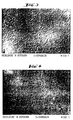
- FIGS. 1 to 4 each show a light microscope image (Orthoplan device from Leitz) of a silica dispersion.
- a double jet-milled silica can be used, the alkalization preferably being carried out in the second jet milling.
- Any known type of jet milling can be carried out in jet milling.
- steam jet milling can be carried out.
- the silica obtained in this way can have an average particle size of at most 3 fLm.
- the silica further processed according to the invention after the jet milling can have a BET surface area of 300 ⁇ 30 m 2 / g, a pore volume of 0.6 to 1.2 ml / g, a pore diameter of 8 to 16 nm, or a BET surface area of 155 up to 350 m 2 / g, a pore volume of 0.3 to 0.6 ml / g and a pore diameter of 10 to 14 nm.
- the average pore diameter for both silicas is 11 to 13 nm. Both silicas have a pH of 6.5.
- the distribution of the secondary particles which are very hard in the case of silicas, is practically not changed by a subsequent homogenization process of the almost finished antifoam, but is only slightly smoothed.
- the type of homogenizer used is not critical. Rather, it is of crucial importance that a pressure of at least 250 to 400 bar can be achieved with the homogenizer. In the process according to the invention, the pressure during the first homogenization is 250 to 350 bar.
- the temperature during the homogenization can preferably be 25 to 35 ° C.
- the pressure can preferably be 250 to 350 bar and the temperature preferably 65 to 100 ° C.
- secondary particles of 3 3 wm are required.
- An odorless anti-foaming agent is required for many areas of application. For this and also for the storage stability, it turned out to be important that the reaction mixture is evacuated after heating and the second homogenization step is carried out at a temperature between 50-100 ° C.
- the anti-foaming agent produced according to the invention can be used for resin boiling in the paint industry, for latex production in the rubber industry, for paper and glue production, for defoaming mineral oils, for bitumen boiling, for preventing the foam of boiler water in steam boilers in detergent formulations, for processing color printing pastes , are used in pharmaceutical chemistry and chemical technology, for example in the production of amino acids.
- 7.5 kg of a precipitated silica are stirred with 92.5 kg of a dimethylpolysiloxane with a viscosity of 10 cm 2 / s (1,000 cSt) at 25 ° C. for 12 hours in a suitable container.
- the mixture is then passed through a high-pressure homogenizer at room temperature and 250 bar and then heated to 180 ° C. in a suitable kettle with stirring for 6 hours. After heating, it is evacuated, cooled, decompressed and homogenized in two stages at 250/100 bar.
- the BET surface area is according to Brunnauer, Emmet and Teller, Hournal of American Chemical Soc. Vol. 60 (1938) pp. 309-319.
- the pore volume and pore diameter are determined according to Cranston and Inkley Anderance Katal. Vol. 9, 1957, p. 143.
- the grain size of the secondary particles is determined by taking a scanning electron microspic at 1000 to 3000 times magnification and then evaluating the particles by means of the particle size counter TG Z3 from Zeiss.
- the jet grinding of the silica is carried out in a Jeto-Mizer 0808 (throughput 500 kg / h) with 16 bar steam.
- 5.0 kg of a precipitated silica are stirred with 95.0 kg of a dimethylpolysiloxane with a viscosity of 10 cm 2 / s (1000 cSt) at 25 ° C. for 12 hours in a suitable container.
- the mixture is then passed through a high-pressure homogenizer at room temperature and 350 bar and then heated in a suitable kettle at 170 ° C. for 5 hours with stirring. It is then evacuated, cooled, decompressed and homogenized in one stage at 350 bar.
- the silica used is a precipitated, twice jet-milled silica, which was set to pH 8.6 during the first jet milling process and has the following physico-chemical characteristics:
- Example 2 2.5 kg of the precipitated silica used in Example 1 are stirred with 97.5 kg of a dimethylpolysiloxane with a viscosity of 10 cm 2 / s (1,000 cSt) at 25 ° C. for 12 hours in a suitable container, then at 350 bar passed through a high-pressure homogenizer and then heated in a suitable kettle with stirring at 180 ° C. for 6 hours. After heating, it is evacuated, cooled, decompressed and homogenized at 350 bar.
- the defoamer effectiveness is also improved.
- the anti-foaming agents explained using the examples have a long shelf life. No sedimentation was found after 12 months. After production, the quality is also checked using the centrifuge test mentioned at the beginning.
- Table 1 provides information on the effectiveness of the anti-foaming agents according to the invention.
- the foam height can be reduced to 40 ml or after 10 days to 60 ml.
- the foam height can be reduced to 20 ml or 40 ml after 10 days.
- an anti-foaming agent which contains only one jet-milled silica does not have the qualities which the anti-foaming agent shows with a twice jet-milled silica.
- the reading times 90, 180 and 60 seconds were chosen to make the quality differences clearly visible.
Landscapes
- Chemical & Material Sciences (AREA)
- Health & Medical Sciences (AREA)
- Toxicology (AREA)
- Dispersion Chemistry (AREA)
- Chemical Kinetics & Catalysis (AREA)
- Compositions Of Macromolecular Compounds (AREA)
- Manufacture Of Porous Articles, And Recovery And Treatment Of Waste Products (AREA)
- Silicon Compounds (AREA)
- Degasification And Air Bubble Elimination (AREA)
- Organic Low-Molecular-Weight Compounds And Preparation Thereof (AREA)
- Silicon Polymers (AREA)
Claims (7)

Priority Applications (1)
| Application Number | Priority Date | Filing Date | Title |
|---|---|---|---|
| AT82101470T ATE13254T1 (de) | 1981-04-09 | 1982-02-26 | Verfahren zur herstellung von antischaummittel fuer waessrige systeme. |
Applications Claiming Priority (2)
| Application Number | Priority Date | Filing Date | Title |
|---|---|---|---|
| DE3114268A DE3114268C2 (de) | 1981-04-09 | 1981-04-09 | Verfahren zur Herstellung von Antischaummitteln für wäßrige Systeme |
| DE3114268 | 1981-04-09 |
Publications (2)
| Publication Number | Publication Date |
|---|---|
| EP0062748A1 EP0062748A1 (fr) | 1982-10-20 |
| EP0062748B1 true EP0062748B1 (fr) | 1985-05-15 |
Family
ID=6129710
Family Applications (1)
| Application Number | Title | Priority Date | Filing Date |
|---|---|---|---|
| EP82101470A Expired EP0062748B1 (fr) | 1981-04-09 | 1982-02-26 | Procédé de fabrication d'une anti-mousse pour des systèmes aqueux |
Country Status (5)
| Country | Link |
|---|---|
| EP (1) | EP0062748B1 (fr) |
| AT (1) | ATE13254T1 (fr) |
| CA (1) | CA1173325A (fr) |
| DE (2) | DE3114268C2 (fr) |
| ES (1) | ES8303929A1 (fr) |
Families Citing this family (2)
| Publication number | Priority date | Publication date | Assignee | Title |
|---|---|---|---|---|
| CA1219788A (fr) * | 1982-04-07 | 1987-03-31 | Ian C. Callaghan | Separation du petrole et du gaz |
| EP3954743A1 (fr) | 2020-08-12 | 2022-02-16 | Evonik Operations GmbH | Utilisation de dioxyde de silicium pour améliorer la conductivité des revêtements |
Family Cites Families (7)
| Publication number | Priority date | Publication date | Assignee | Title |
|---|---|---|---|---|
| FR1257811A (fr) * | 1960-02-25 | 1961-04-07 | Rhone Poulenc Sa | Compositions organopolysiloxaniques à propriétés antimousses |
| BE626473A (fr) * | 1961-12-30 | |||
| DE1544001C3 (de) * | 1966-08-31 | 1978-09-21 | Deutsche Gold- Und Silber-Scheideanstalt Vormals Roessler, 6000 Frankfurt | Aktivierung von Entschäumerflüssigkeiten |
| US3560401A (en) * | 1967-08-11 | 1971-02-02 | Union Carbide Corp | Persistent antifoam compositions and methods of making same utilizing basic materials |
| NL181173C (nl) * | 1977-08-09 | 1987-07-01 | Goldschmidt Ag Th | Werkwijze voor het bereiden van een ontschuimingspreparaat. |
| DE2925722A1 (de) * | 1979-06-26 | 1981-02-05 | Goldschmidt Ag Th | Mittel zum entschaeumen fluessiger medien |
| DE3001573A1 (de) * | 1980-01-17 | 1981-07-23 | Degussa Ag, 6000 Frankfurt | Verfahren zur herstellung von sedimentationsstabilen schaumbekaempfungsmitteln |
-
1981
- 1981-04-09 DE DE3114268A patent/DE3114268C2/de not_active Expired
-
1982
- 1982-02-26 AT AT82101470T patent/ATE13254T1/de not_active IP Right Cessation
- 1982-02-26 EP EP82101470A patent/EP0062748B1/fr not_active Expired
- 1982-02-26 DE DE8282101470T patent/DE3263494D1/de not_active Expired
- 1982-03-31 CA CA000400140A patent/CA1173325A/fr not_active Expired
- 1982-04-08 ES ES511304A patent/ES8303929A1/es not_active Expired
Also Published As
| Publication number | Publication date |
|---|---|
| EP0062748A1 (fr) | 1982-10-20 |
| ATE13254T1 (de) | 1985-06-15 |
| DE3114268A1 (de) | 1983-01-27 |
| DE3114268C2 (de) | 1986-04-24 |
| ES511304A0 (es) | 1983-02-16 |
| CA1173325A (fr) | 1984-08-28 |
| DE3263494D1 (en) | 1985-06-20 |
| ES8303929A1 (es) | 1983-02-16 |
Similar Documents
| Publication | Publication Date | Title |
|---|---|---|
| EP1781393B1 (fr) | Compositions antimousse | |
| EP1681083B1 (fr) | Compositions anti-mousse | |
| DE69016623T2 (de) | Silikon-Antischaummittel. | |
| DE3887799T2 (de) | Festes Silicon-Antischaummittel. | |
| EP0036597B1 (fr) | Antimousse et son utilisation dans des dispersions de plastique, de vernis et de couleur | |
| DE69202620T2 (de) | Silikon-Entschäumerzusammensetzung. | |
| DE69409309T2 (de) | Stabile dispergierbare Siliconzusammensetzungen | |
| EP0023533B1 (fr) | Agent pour le traitement anti-moussant de milieux liquides | |
| DE1619859B2 (de) | Verfahren zum verhindern und/oder vermindern der schaumbildung in waesserigen systemen | |
| EP1807164B1 (fr) | Compositions d'antimousses | |
| DE1519987B2 (de) | Stabile schaumregulierungsmittel | |
| DE102007061455A1 (de) | Entschäumerformulierung | |
| DE2626942A1 (de) | Verfahren zum herstellen waessriger schaumverhuetungsmittel | |
| EP1052005B1 (fr) | Utilisation de copolymères séquencés de polyoxyalkylene-polysiloxane insolubles dans l'eau comme agents anti-mousse pour milieu aqueux | |
| DE2626994A1 (de) | Verfahren zum herstellen waessriger schaumverhuetungsmittel | |
| DE1110862B (de) | Verfahren zur Herstellung von waessrigen Organopolysiloxanemulsionen mit verbesserten Antischaumeigenschaften | |
| EP0658361B1 (fr) | Emulsion anti-mousse à base d'organopolysiloxanes modifiés à fonctions organiques | |
| DE2427294A1 (de) | Schaumbildungsverhinderungsmittel | |
| EP0062748B1 (fr) | Procédé de fabrication d'une anti-mousse pour des systèmes aqueux | |
| EP1052006A2 (fr) | Utilisation de copolymères blocs mixtes polyoxyalkylène-polysiloxane insolubles dans l'eau dans le démoussage de systèmes aqueux | |
| EP0726086B1 (fr) | Composé anti-mousse à base de siloxanes contenant de la silice hydrophobe | |
| DE69522503T2 (de) | Schaumregulierendes Mittel | |
| WO2003029338A1 (fr) | Composes a base de polyorganosiloxanes, procedes de production et utilisation desdits composes | |
| EP1533333B1 (fr) | Emulsions à base d'organopolysiloxanes du type huile dans eau exemptés d'émulsifiants et leurs utilisation dans des applications techniques | |
| DE1769153B2 (de) | Antischaummittel für wäßrige Systeme |
Legal Events
| Date | Code | Title | Description |
|---|---|---|---|
| PUAI | Public reference made under article 153(3) epc to a published international application that has entered the european phase |
Free format text: ORIGINAL CODE: 0009012 |
|
| 17P | Request for examination filed |
Effective date: 19820226 |
|
| AK | Designated contracting states |
Designated state(s): AT BE CH DE FR GB IT NL SE |
|
| ITF | It: translation for a ep patent filed | ||
| GRAA | (expected) grant |
Free format text: ORIGINAL CODE: 0009210 |
|
| AK | Designated contracting states |
Designated state(s): AT BE CH DE FR GB IT LI NL SE |
|
| REF | Corresponds to: |
Ref document number: 13254 Country of ref document: AT Date of ref document: 19850615 Kind code of ref document: T |
|
| REF | Corresponds to: |
Ref document number: 3263494 Country of ref document: DE Date of ref document: 19850620 |
|
| ET | Fr: translation filed | ||
| PLBE | No opposition filed within time limit |
Free format text: ORIGINAL CODE: 0009261 |
|
| STAA | Information on the status of an ep patent application or granted ep patent |
Free format text: STATUS: NO OPPOSITION FILED WITHIN TIME LIMIT |
|
| 26N | No opposition filed | ||
| PGFP | Annual fee paid to national office [announced via postgrant information from national office to epo] |
Ref country code: SE Payment date: 19910111 Year of fee payment: 10 |
|
| PGFP | Annual fee paid to national office [announced via postgrant information from national office to epo] |
Ref country code: CH Payment date: 19910208 Year of fee payment: 10 |
|
| PGFP | Annual fee paid to national office [announced via postgrant information from national office to epo] |
Ref country code: AT Payment date: 19910212 Year of fee payment: 10 |
|
| ITTA | It: last paid annual fee | ||
| PGFP | Annual fee paid to national office [announced via postgrant information from national office to epo] |
Ref country code: BE Payment date: 19920219 Year of fee payment: 11 |
|
| PG25 | Lapsed in a contracting state [announced via postgrant information from national office to epo] |
Ref country code: AT Effective date: 19920226 |
|
| PG25 | Lapsed in a contracting state [announced via postgrant information from national office to epo] |
Ref country code: SE Effective date: 19920227 |
|
| PG25 | Lapsed in a contracting state [announced via postgrant information from national office to epo] |
Ref country code: LI Effective date: 19920229 Ref country code: CH Effective date: 19920229 |
|
| REG | Reference to a national code |
Ref country code: CH Ref legal event code: PL |
|
| PG25 | Lapsed in a contracting state [announced via postgrant information from national office to epo] |
Ref country code: BE Effective date: 19930228 |
|
| BERE | Be: lapsed |
Owner name: DEGUSSA A.G. Effective date: 19930228 |
|
| EUG | Se: european patent has lapsed |
Ref document number: 82101470.1 Effective date: 19920904 |
|
| PGFP | Annual fee paid to national office [announced via postgrant information from national office to epo] |
Ref country code: GB Payment date: 20000114 Year of fee payment: 19 |
|
| PGFP | Annual fee paid to national office [announced via postgrant information from national office to epo] |
Ref country code: DE Payment date: 20000122 Year of fee payment: 19 |
|
| PGFP | Annual fee paid to national office [announced via postgrant information from national office to epo] |
Ref country code: FR Payment date: 20000124 Year of fee payment: 19 |
|
| PGFP | Annual fee paid to national office [announced via postgrant information from national office to epo] |
Ref country code: NL Payment date: 20000125 Year of fee payment: 19 |
|
| PG25 | Lapsed in a contracting state [announced via postgrant information from national office to epo] |
Ref country code: GB Free format text: LAPSE BECAUSE OF NON-PAYMENT OF DUE FEES Effective date: 20010226 |
|
| PG25 | Lapsed in a contracting state [announced via postgrant information from national office to epo] |
Ref country code: NL Free format text: LAPSE BECAUSE OF NON-PAYMENT OF DUE FEES Effective date: 20010901 |
|
| GBPC | Gb: european patent ceased through non-payment of renewal fee |
Effective date: 20010226 |
|
| PG25 | Lapsed in a contracting state [announced via postgrant information from national office to epo] |
Ref country code: FR Free format text: LAPSE BECAUSE OF NON-PAYMENT OF DUE FEES Effective date: 20011031 |
|
| NLV4 | Nl: lapsed or anulled due to non-payment of the annual fee |
Effective date: 20010901 |
|
| REG | Reference to a national code |
Ref country code: FR Ref legal event code: ST |
|
| PG25 | Lapsed in a contracting state [announced via postgrant information from national office to epo] |
Ref country code: DE Free format text: LAPSE BECAUSE OF NON-PAYMENT OF DUE FEES Effective date: 20011201 |