EP0062768A1 - Circuit pour la surveillance de circuits de commutation - Google Patents
Circuit pour la surveillance de circuits de commutation Download PDFInfo
- Publication number
- EP0062768A1 EP0062768A1 EP82101915A EP82101915A EP0062768A1 EP 0062768 A1 EP0062768 A1 EP 0062768A1 EP 82101915 A EP82101915 A EP 82101915A EP 82101915 A EP82101915 A EP 82101915A EP 0062768 A1 EP0062768 A1 EP 0062768A1
- Authority
- EP
- European Patent Office
- Prior art keywords
- register
- circuit
- clock
- flip
- switching
- Prior art date
- Legal status (The legal status is an assumption and is not a legal conclusion. Google has not performed a legal analysis and makes no representation as to the accuracy of the status listed.)
- Granted
Links
- 238000012544 monitoring process Methods 0.000 title claims abstract description 8
- 230000007246 mechanism Effects 0.000 claims abstract description 31
- 238000000034 method Methods 0.000 claims abstract description 8
- 101100398412 Arabidopsis thaliana ASK1 gene Proteins 0.000 claims description 5
- 238000001514 detection method Methods 0.000 claims description 5
- 238000010586 diagram Methods 0.000 description 14
- 101100110018 Arabidopsis thaliana ASK3 gene Proteins 0.000 description 4
- 238000010276 construction Methods 0.000 description 1
- 238000005516 engineering process Methods 0.000 description 1
- 230000006870 function Effects 0.000 description 1
- 230000007257 malfunction Effects 0.000 description 1
- 230000002123 temporal effect Effects 0.000 description 1
- 230000001960 triggered effect Effects 0.000 description 1
Images

Classifications
-
- H—ELECTRICITY
- H03—ELECTRONIC CIRCUITRY
- H03K—PULSE TECHNIQUE
- H03K19/00—Logic circuits, i.e. having at least two inputs acting on one output; Inverting circuits
- H03K19/007—Fail-safe circuits
- H03K19/0075—Fail-safe circuits by using two redundant chains
-
- H—ELECTRICITY
- H03—ELECTRONIC CIRCUITRY
- H03K—PULSE TECHNIQUE
- H03K21/00—Details of pulse counters or frequency dividers
- H03K21/40—Monitoring; Error detection; Preventing or correcting improper counter operation
Definitions
- the invention relates to a circuit arrangement for monitoring two-channel switching mechanisms, which process the same data with a clock offset and, at predetermined times, provide the same information via comparable outputs when operated correctly, using an error detection circuit which prevents information output in the event of malfunction.
- DE-OS 26 39 064 describes, for example, a circuit arrangement for monitoring and for detecting errors in counter circuits as the two-channel switching mechanism to be monitored. It is essential in this known arrangement that two identically constructed counter circuits are provided which can be controlled by clock pulses of different clock phases of a common system clock.
- an error detection circuit is provided, which is constructed from a plurality of storing switching elements and a linking switching element. This additional circuit measure ensures that the failures impairing the counting function of one of the two counters can be recognized.
- the known circuit has the disadvantage that it does not meet the desired safety requirements under newly accepted error assumptions for integrated circuits is enough. This is due on the one hand to the principle of the known error detection circuit itself and, on the other hand, to the fact that the error detection circuit cannot already block the clock pulses effective at the counter inputs in the clock pulse source if a counter failure is detected.
- the invention has for its object to improve a circuit arrangement of the type specified in such a way that in the event of a fault the clock pulses required for the operation of the two switching mechanisms are switched off, the monitoring of the clock pulse frequency being made possible at the same time.
- the object is achieved in that the clock supply of both switchgear takes place via different memory cells of at least one multi-level register which has its own time standard and receives via a gate circuit pulses from a clock generator forming a second time standard, the period of which corresponds to the total running time of the register, one being on
- the memory cell provided at the last position of the register supplies the gate circuit with pulses via at least one amplifier, the duration of which is greater than the sum of the runtime tolerances of the register, and that the amplifier is supplied with power via a rectifier circuit, which is connected to an output of the one switching mechanism and to the same , but negated output of the other switching mechanism is connected.
- This circuit arrangement can be used not only in an advantageous manner for monitoring two-channel counter circuits, but also for any other digital switching mechanisms of identical or non-identical construction, for example also for microcomputers. It is very advantageous not only to provide a multi-level register for the clock supply of the switching mechanisms, but also two multi-level registers, each of which only supplies an assigned switching mechanism with clock pulses.
- the multi-stage register consists of a predetermined number of monostable flip-flops, such that the times of the unstable switching positions add up.
- the multi-stage register consists of a predetermined number of bistable switching elements connected in series, which can be switched by a separate clock current source forming the time standard.
- An advantageous embodiment of the invention provides that between the clock generator and the register made up of monostable flip-flops and between its first and second flip-flops, a first or second D-flip-flop controllable by the pulses passed through the amplifier is connected, the first D- The flip-flop controls the first monostable flip-flop of the register or the second D-flip-flop together with a start circuit connected to the clock generator via a respective switching element.
- the circuit diagram according to FIG. 1 shows in block form two switching mechanisms SK1 and SK2, which process the same data with a clock offset.
- special data sources and data sinks have been omitted.
- each such switching mechanism such as a microcomputer, requires several different system clocks; in the exemplary embodiment, however, only one clock pulse is supplied in each case with a view to a better overview.
- These clock pulses are generated practically by the fact that two different circuit parts with their own time standards work together via a gate circuit and form a kind of latching circuit when operated correctly.
- a clock generator G is provided as the first time standard, which continuously outputs clock pulses to a first D-flip-flop DF1 and to a start circuit EG.
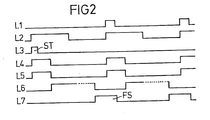
- the second time standard is practically given by a multi-level register, which consists of a predetermined number of monostable multivibrators MK1, MK2 and MK3. Depending on requirements, it can of course also be significantly more monostable flip-flops which are connected in series in such a way that the times of the unstable switching positions add up. It is also important for the dimensioning of the circuit that the period of the pulses emitted by the clock generator G corresponds to the total running time of the register representing the second time standard. When the circuit is operating correctly, this ensures that a so-called window pulse FS in diagram line L7 of FIG. 2 is available at certain points in time. If it is present, a further pulse emitted by the clock generator G can be taken over by the register.
- the stated window pulse FS must be dimensioned by dimensioning the monostable flip-flop MK3 provided in the last position of the multi-stage register so that it is greater than the sum of the runtime tolerances of the entire register.
- An AND gate U1 and an OR gate 01 the second input of which is connected to the output of the first D flip-flop DF1, is connected to the start circuit EG with its negating input.
- the other input of the AND gate U1 is connected to the negated output of the D flip-flop DF1.
- an OR gate with a negated output can also be used, which is connected to the start circuit EG and to the non-negated output of the D flip-flop DF1.
- the output of the switching element U1 is connected to the negated set input S of a second D flip-flop DF2, the clock input of which is connected to the negated output of the monostable flip-flop MK1 located in the first position of the register.
- This flip-flop MK1 is in turn connected on the input side to the OR gate 01.
- the clock input of the switching mechanism SK1 and the input of the monostable switching element MK2 are connected to the negated output of the D flip-flop DF2, the negated output of which is in turn connected to the clock input of the switching mechanism SK2 and the input of the flip-flop MK3 provided at the last position in the register.
- the output of this flip-flop MK3 is connected to the input of an amplifier VR, the power supply of which is via a rectifier circuit formed from four diodes D1, D2, D3 and D4. This is connected on the one hand to the output SK11 of the switching mechanism SK1 and on the other hand to the negating output SK12 of the switching mechanism SK2.
- the SK11 and SK12 outputs are related to one information to be submitted identical except for the negation. This means that a potential difference is only available on the rectifier circuit when the two switching mechanisms SK1 and SK2 are operated correctly, in such a way that the power supply of the amplifier VR is ensured regardless of their direction.
- Diagram line L7 in Figure 2 leads, is connected to the negated R input of the D flip-flop DF1 and to the D input of the D flip-flop DF2.
- the circuit described above can be modified in such a way that further switching amplifiers with rectifier circuits are assigned to switching mechanisms with several outputs, as shown in the circuit arrangement according to FIG. 1.
- the amplifiers are connected in series, so that the window pulse FS must first pass through all series-connected amplifiers, in order to finally be available for control purposes in the two D flip-flops DF1 and DF2.
- Diagram line L3 pulse ST, which is delivered to the downstream switching elements U1 and 01. If there is a leading edge of a pulse emitted by the clock generator G, cf. Diagram line L2, while the start pulse ST is present, the monostable multivibrator MK1 is controlled into the unstable position via the OR gate 01, cf. Diagram line L4. Furthermore, the D flip-flop DF2 is set via the AND gate U1, whose output is at the L level during the start pulse ST, cf. Diagram line L5. If the monostable multivibrator MK1 returns to its stable position and the start pulse ST has already ended, the D multivibrator DF2 is switched back to the other position.
- a delay is expediently provided such that the bistable flip-flop MK3 only switches to the unstable state when the two switching mechanisms SK1 and SK2 have assumed clear states at their outputs SK11 and SK12.
- the signal output by the monostable multivibrator MK3 and output by the amplifier VR serves as a window pulse FS, cf.
- Diagram line L7 in the temporal area of which the next leading edge of the clock generator G is output benen signal must fall if the above-mentioned latch circuit of the overall circuit is to come about.
- the window pulse FS is at the negated R input of the D flip-flop DF1 H level, so that this can be set, cf.
- Diagram line L1 If an undesired change in time occurs as a result of a disturbance between the two time standards, the D flip-flop DF1 cannot be set, since in this case the window pulse FS is either too early or too late.
- the D flip-flop DF2 When working properly, the D flip-flop DF2 is then set again via the AND gate U1 at the L level then present at the S input. Furthermore, when switching the D flip-flop DF1, the monostable flip-flop MK1 was switched to the unstable position via the OR gate 01, cf. Diagram line L4. Before this monostable flip-flop MK1 falls back into its stable position, the window pulse FS, cf. Diagram line L7 have stopped again, so that L level is again present at the D input of the D flip-flop DF2. When the monostable rocker MK1 falls back into the stable position, the D rocker DF2 is reset. Subsequently, processes start that were already described when the starting process was explained.
Landscapes
- Physics & Mathematics (AREA)
- Engineering & Computer Science (AREA)
- Computer Hardware Design (AREA)
- Computing Systems (AREA)
- General Engineering & Computer Science (AREA)
- Mathematical Physics (AREA)
- Manipulation Of Pulses (AREA)
Applications Claiming Priority (2)
| Application Number | Priority Date | Filing Date | Title |
|---|---|---|---|
| DE3114230 | 1981-04-08 | ||
| DE3114230A DE3114230C2 (de) | 1981-04-08 | 1981-04-08 | Schaltungsanordnung zum sicheren Betrieb eines zweikanaligen Schaltwerkes |
Publications (2)
| Publication Number | Publication Date |
|---|---|
| EP0062768A1 true EP0062768A1 (fr) | 1982-10-20 |
| EP0062768B1 EP0062768B1 (fr) | 1985-06-26 |
Family
ID=6129698
Family Applications (1)
| Application Number | Title | Priority Date | Filing Date |
|---|---|---|---|
| EP82101915A Expired EP0062768B1 (fr) | 1981-04-08 | 1982-03-10 | Circuit pour la surveillance de circuits de commutation |
Country Status (3)
| Country | Link |
|---|---|
| EP (1) | EP0062768B1 (fr) |
| DE (1) | DE3114230C2 (fr) |
| ZA (1) | ZA822385B (fr) |
Cited By (2)
| Publication number | Priority date | Publication date | Assignee | Title |
|---|---|---|---|---|
| US8313268B2 (en) | 2007-05-16 | 2012-11-20 | Bayer Materialscience Ag | Method for filling and emptying transport containers with plastics granular material |
| CN103293476A (zh) * | 2013-06-13 | 2013-09-11 | 重庆长安汽车股份有限公司 | 一种基于双计数器的电机系统故障诊断方法 |
Citations (5)
| Publication number | Priority date | Publication date | Assignee | Title |
|---|---|---|---|---|
| DE2135683B1 (de) * | 1971-07-16 | 1973-01-04 | Siemens Ag, 1000 Berlin U. 8000 Muenchen | Taktstromversorgung für ein zweikanaliges Schaltkreissystem |
| DE2602169B1 (de) * | 1976-01-21 | 1977-07-14 | Siemens Ag | Schaltungsanordnung zum zyklischen erzeugen einer signaltechnisch sicheren folge von steuerimpulsen |
| DE2651314B1 (de) * | 1976-11-10 | 1977-12-08 | Siemens Ag | Sicherheits-Ausgabeschaltung fuer eine Binaersignale abgebende Datenverarbeitungsanlage |
| DE2639064A1 (de) * | 1976-08-30 | 1978-03-09 | Siemens Ag | Schaltungsanordnung zur ueberwachung und zur erkennung von fehlern in zaehlschaltungen |
| DE2729362B1 (de) * | 1977-06-29 | 1978-10-12 | Siemens Ag | Digitale Datenverarbeitungsanordnung,insbesondere fuer die Eisenbahnsicherungstechnik,mit in zwei Kanaelen dieselben Informationen verarbeitenden Schaltwerken |
Family Cites Families (1)
| Publication number | Priority date | Publication date | Assignee | Title |
|---|---|---|---|---|
| DE1537379C3 (de) * | 1967-09-22 | 1980-07-03 | Siemens Ag, 1000 Berlin Und 8000 Muenchen | Sicherheitsschaltung zum Durchführen logischer Verknüpfungen für binäre Schaltvariable und deren antivalente Schaltvariable |
-
1981
- 1981-04-08 DE DE3114230A patent/DE3114230C2/de not_active Expired
-
1982
- 1982-03-10 EP EP82101915A patent/EP0062768B1/fr not_active Expired
- 1982-04-07 ZA ZA822385A patent/ZA822385B/xx unknown
Patent Citations (5)
| Publication number | Priority date | Publication date | Assignee | Title |
|---|---|---|---|---|
| DE2135683B1 (de) * | 1971-07-16 | 1973-01-04 | Siemens Ag, 1000 Berlin U. 8000 Muenchen | Taktstromversorgung für ein zweikanaliges Schaltkreissystem |
| DE2602169B1 (de) * | 1976-01-21 | 1977-07-14 | Siemens Ag | Schaltungsanordnung zum zyklischen erzeugen einer signaltechnisch sicheren folge von steuerimpulsen |
| DE2639064A1 (de) * | 1976-08-30 | 1978-03-09 | Siemens Ag | Schaltungsanordnung zur ueberwachung und zur erkennung von fehlern in zaehlschaltungen |
| DE2651314B1 (de) * | 1976-11-10 | 1977-12-08 | Siemens Ag | Sicherheits-Ausgabeschaltung fuer eine Binaersignale abgebende Datenverarbeitungsanlage |
| DE2729362B1 (de) * | 1977-06-29 | 1978-10-12 | Siemens Ag | Digitale Datenverarbeitungsanordnung,insbesondere fuer die Eisenbahnsicherungstechnik,mit in zwei Kanaelen dieselben Informationen verarbeitenden Schaltwerken |
Non-Patent Citations (1)
| Title |
|---|
| ELEKTRONIK, Nr. 11, 1977, K. MEYER: "Sicherheitssysteme für elektronisch gesteuerte Anlagen" Seiten 59 bis 64 * |
Cited By (3)
| Publication number | Priority date | Publication date | Assignee | Title |
|---|---|---|---|---|
| US8313268B2 (en) | 2007-05-16 | 2012-11-20 | Bayer Materialscience Ag | Method for filling and emptying transport containers with plastics granular material |
| CN103293476A (zh) * | 2013-06-13 | 2013-09-11 | 重庆长安汽车股份有限公司 | 一种基于双计数器的电机系统故障诊断方法 |
| CN103293476B (zh) * | 2013-06-13 | 2015-12-23 | 重庆长安汽车股份有限公司 | 一种基于双计数器的电机系统故障诊断方法 |
Also Published As
| Publication number | Publication date |
|---|---|
| ZA822385B (en) | 1983-03-30 |
| DE3114230A1 (de) | 1982-10-28 |
| DE3114230C2 (de) | 1983-02-03 |
| EP0062768B1 (fr) | 1985-06-26 |
Similar Documents
| Publication | Publication Date | Title |
|---|---|---|
| DE2258917B2 (de) | Regelvorrichtung mit mindestens zwei parallelen signalkanaelen | |
| DE2324906C3 (de) | Datenverarbeitungsanlage nut Wiederholung beim Auftreten eines Fehlers | |
| DE2729362C2 (de) | Digitale Datenverarbeitungsanordnung, insbesondere für die Eisenbahnsicherungstechnik, mit in zwei Kanälen dieselben Informationen verarbeitenden Schaltwerken | |
| EP0224707A1 (fr) | Dispositif pour contrôler plusieurs signaux électriques analogues | |
| DE2651314B1 (de) | Sicherheits-Ausgabeschaltung fuer eine Binaersignale abgebende Datenverarbeitungsanlage | |
| DE2228320A1 (de) | Rundsteuerempfaenger | |
| DE2135683B1 (de) | Taktstromversorgung für ein zweikanaliges Schaltkreissystem | |
| EP0062768B1 (fr) | Circuit pour la surveillance de circuits de commutation | |
| EP0077450B1 (fr) | Circuit de sortie de sécurité pour une installation de traitement de données produisant des paires de signaux binaires | |
| EP0033125A1 (fr) | Bascule Bistable Type D | |
| DE3731097C2 (de) | Schaltungsanordnung zur Überwachung einer von zwei Mikroprozessoren gesteuerten Einrichtung, insbesondere einer Kraftfahrzeug-Elektronik | |
| DE2023117A1 (de) | Ausfallsicheres Steuersystem zur UEbertragung von digitalen Informationen | |
| DE3739227C2 (fr) | ||
| EP0193943A1 (fr) | Montage de circuit pour l'élimination des parasites dans des signaux de données binaires d'un système de transmission binaire | |
| DE2737133C2 (de) | Schaltungsanordnung zum Verhindern von Doppelfehlern in einer Datenverarbeitungsanlage | |
| DE2842370C2 (fr) | ||
| DE2449634A1 (de) | Informations-erfassungssystem | |
| DE2725922B1 (de) | Mehrrechnersystem zur Steuerung von trassengebundenen Verkehrsmitteln | |
| DE2949806C2 (de) | Digitales Ausfiltern von Störimpulsen | |
| DE2217634C3 (de) | Sicherheitsschaltung zum Zählen von Impulsen nach dem Dualzahlensystem in digitalen Datenverarbeitungsanlagen, insbesondere in Eisenbahnanlagen | |
| DE3510524A1 (de) | Vorrichtung zur eigenueberwachung einer schaltungsanordnung mit einem mikrocomputer | |
| DE2311887C3 (de) | Schaltungsanordnung zum gesicherten Zählen von Impulsen nach dem Dualzahlensystem in digitalen Datenverarbeitungsanlagen, insbesondere für Eisenbahnsicherungsanlagen | |
| DE2247540C3 (de) | Schutzschaltung für Ringzähler | |
| DE2266021C3 (de) | Schutzschalter für Ringzähler | |
| DE1499262C (de) | Einrichtung zur Auswahl der richtigen von zwei parallel betriebenen Datenverarbei tungsanlagen |
Legal Events
| Date | Code | Title | Description |
|---|---|---|---|
| PUAI | Public reference made under article 153(3) epc to a published international application that has entered the european phase |
Free format text: ORIGINAL CODE: 0009012 |
|
| AK | Designated contracting states |
Designated state(s): NL |
|
| 17P | Request for examination filed |
Effective date: 19821105 |
|
| GRAA | (expected) grant |
Free format text: ORIGINAL CODE: 0009210 |
|
| AK | Designated contracting states |
Designated state(s): NL |
|
| PLBE | No opposition filed within time limit |
Free format text: ORIGINAL CODE: 0009261 |
|
| STAA | Information on the status of an ep patent application or granted ep patent |
Free format text: STATUS: NO OPPOSITION FILED WITHIN TIME LIMIT |
|
| 26N | No opposition filed | ||
| PGFP | Annual fee paid to national office [announced via postgrant information from national office to epo] |
Ref country code: NL Payment date: 19910331 Year of fee payment: 10 |
|
| PG25 | Lapsed in a contracting state [announced via postgrant information from national office to epo] |
Ref country code: NL Effective date: 19921001 |
|
| NLV4 | Nl: lapsed or anulled due to non-payment of the annual fee |