EP0062838B1 - Thermoplastische Formmassen - Google Patents
Thermoplastische Formmassen Download PDFInfo
- Publication number
- EP0062838B1 EP0062838B1 EP82102698A EP82102698A EP0062838B1 EP 0062838 B1 EP0062838 B1 EP 0062838B1 EP 82102698 A EP82102698 A EP 82102698A EP 82102698 A EP82102698 A EP 82102698A EP 0062838 B1 EP0062838 B1 EP 0062838B1
- Authority
- EP
- European Patent Office
- Prior art keywords
- weight
- styrene
- acrylonitrile
- parts
- component
- Prior art date
- Legal status (The legal status is an assumption and is not a legal conclusion. Google has not performed a legal analysis and makes no representation as to the accuracy of the status listed.)
- Expired
Links
- 238000009757 thermoplastic moulding Methods 0.000 title description 2
- PPBRXRYQALVLMV-UHFFFAOYSA-N Styrene Chemical compound C=CC1=CC=CC=C1 PPBRXRYQALVLMV-UHFFFAOYSA-N 0.000 claims description 59
- 239000000203 mixture Substances 0.000 claims description 33
- NLHHRLWOUZZQLW-UHFFFAOYSA-N Acrylonitrile Chemical compound C=CC#N NLHHRLWOUZZQLW-UHFFFAOYSA-N 0.000 claims description 25
- 229920001577 copolymer Polymers 0.000 claims description 24
- 239000000178 monomer Substances 0.000 claims description 17
- 229920000515 polycarbonate Polymers 0.000 claims description 16
- 239000004417 polycarbonate Substances 0.000 claims description 16
- 229920000578 graft copolymer Polymers 0.000 claims description 15
- 238000000465 moulding Methods 0.000 claims description 15
- 229920001971 elastomer Polymers 0.000 claims description 13
- NIXOWILDQLNWCW-UHFFFAOYSA-N 2-Propenoic acid Natural products OC(=O)C=C NIXOWILDQLNWCW-UHFFFAOYSA-N 0.000 claims description 12
- 239000005060 rubber Substances 0.000 claims description 12
- 229920001897 terpolymer Polymers 0.000 claims description 10
- SMZOUWXMTYCWNB-UHFFFAOYSA-N 2-(2-methoxy-5-methylphenyl)ethanamine Chemical compound COC1=CC=C(C)C=C1CCN SMZOUWXMTYCWNB-UHFFFAOYSA-N 0.000 claims description 8
- XYLMUPLGERFSHI-UHFFFAOYSA-N alpha-Methylstyrene Chemical compound CC(=C)C1=CC=CC=C1 XYLMUPLGERFSHI-UHFFFAOYSA-N 0.000 claims description 7
- FPYJFEHAWHCUMM-UHFFFAOYSA-N maleic anhydride Chemical compound O=C1OC(=O)C=C1 FPYJFEHAWHCUMM-UHFFFAOYSA-N 0.000 claims description 5
- 239000000654 additive Substances 0.000 claims description 4
- 230000009477 glass transition Effects 0.000 claims description 4
- 239000004415 thermoplastic moulding composition Substances 0.000 claims 1
- 238000007334 copolymerization reaction Methods 0.000 description 12
- 229920000642 polymer Polymers 0.000 description 11
- KAKZBPTYRLMSJV-UHFFFAOYSA-N Butadiene Chemical compound C=CC=C KAKZBPTYRLMSJV-UHFFFAOYSA-N 0.000 description 10
- 239000006185 dispersion Substances 0.000 description 10
- 238000006116 polymerization reaction Methods 0.000 description 10
- ZWEHNKRNPOVVGH-UHFFFAOYSA-N 2-Butanone Chemical compound CCC(C)=O ZWEHNKRNPOVVGH-UHFFFAOYSA-N 0.000 description 8
- 239000000243 solution Substances 0.000 description 8
- ZMXDDKWLCZADIW-UHFFFAOYSA-N N,N-Dimethylformamide Chemical compound CN(C)C=O ZMXDDKWLCZADIW-UHFFFAOYSA-N 0.000 description 7
- 238000000034 method Methods 0.000 description 7
- -1 polyethylenes Polymers 0.000 description 7
- 239000004793 Polystyrene Substances 0.000 description 6
- 229920000126 latex Polymers 0.000 description 6
- 239000002245 particle Substances 0.000 description 6
- 239000002585 base Substances 0.000 description 5
- 125000004432 carbon atom Chemical group C* 0.000 description 5
- 239000000839 emulsion Substances 0.000 description 5
- IJGRMHOSHXDMSA-UHFFFAOYSA-N Atomic nitrogen Chemical compound N#N IJGRMHOSHXDMSA-UHFFFAOYSA-N 0.000 description 4
- 238000005054 agglomeration Methods 0.000 description 4
- 230000002776 aggregation Effects 0.000 description 4
- IISBACLAFKSPIT-UHFFFAOYSA-N bisphenol A Chemical compound C=1C=C(O)C=CC=1C(C)(C)C1=CC=C(O)C=C1 IISBACLAFKSPIT-UHFFFAOYSA-N 0.000 description 4
- 238000002360 preparation method Methods 0.000 description 4
- 239000000725 suspension Substances 0.000 description 4
- YMWUJEATGCHHMB-UHFFFAOYSA-N Dichloromethane Chemical compound ClCCl YMWUJEATGCHHMB-UHFFFAOYSA-N 0.000 description 3
- 229920006222 acrylic ester polymer Polymers 0.000 description 3
- 238000009826 distribution Methods 0.000 description 3
- 239000003995 emulsifying agent Substances 0.000 description 3
- 238000001746 injection moulding Methods 0.000 description 3
- 238000002156 mixing Methods 0.000 description 3
- MYRTYDVEIRVNKP-UHFFFAOYSA-N 1,2-Divinylbenzene Chemical compound C=CC1=CC=CC=C1C=C MYRTYDVEIRVNKP-UHFFFAOYSA-N 0.000 description 2
- VPWNQTHUCYMVMZ-UHFFFAOYSA-N 4,4'-sulfonyldiphenol Chemical class C1=CC(O)=CC=C1S(=O)(=O)C1=CC=C(O)C=C1 VPWNQTHUCYMVMZ-UHFFFAOYSA-N 0.000 description 2
- CSCPPACGZOOCGX-UHFFFAOYSA-N Acetone Chemical compound CC(C)=O CSCPPACGZOOCGX-UHFFFAOYSA-N 0.000 description 2
- NIXOWILDQLNWCW-UHFFFAOYSA-M Acrylate Chemical compound [O-]C(=O)C=C NIXOWILDQLNWCW-UHFFFAOYSA-M 0.000 description 2
- 229930185605 Bisphenol Natural products 0.000 description 2
- 229920002943 EPDM rubber Polymers 0.000 description 2
- JIGUQPWFLRLWPJ-UHFFFAOYSA-N Ethyl acrylate Chemical compound CCOC(=O)C=C JIGUQPWFLRLWPJ-UHFFFAOYSA-N 0.000 description 2
- UIIMBOGNXHQVGW-UHFFFAOYSA-M Sodium bicarbonate Chemical compound [Na+].OC([O-])=O UIIMBOGNXHQVGW-UHFFFAOYSA-M 0.000 description 2
- 150000001298 alcohols Chemical class 0.000 description 2
- 125000005907 alkyl ester group Chemical group 0.000 description 2
- 230000000052 comparative effect Effects 0.000 description 2
- 150000001993 dienes Chemical class 0.000 description 2
- 235000014113 dietary fatty acids Nutrition 0.000 description 2
- 229930195729 fatty acid Chemical class 0.000 description 2
- 239000000194 fatty acid Chemical class 0.000 description 2
- 150000004665 fatty acids Chemical class 0.000 description 2
- 239000003999 initiator Substances 0.000 description 2
- 238000004519 manufacturing process Methods 0.000 description 2
- FQPSGWSUVKBHSU-UHFFFAOYSA-N methacrylamide Chemical compound CC(=C)C(N)=O FQPSGWSUVKBHSU-UHFFFAOYSA-N 0.000 description 2
- 229910052757 nitrogen Inorganic materials 0.000 description 2
- 239000001301 oxygen Substances 0.000 description 2
- 229910052760 oxygen Inorganic materials 0.000 description 2
- PNJWIWWMYCMZRO-UHFFFAOYSA-N pent‐4‐en‐2‐one Natural products CC(=O)CC=C PNJWIWWMYCMZRO-UHFFFAOYSA-N 0.000 description 2
- 229920002857 polybutadiene Polymers 0.000 description 2
- 239000007787 solid Substances 0.000 description 2
- 238000012360 testing method Methods 0.000 description 2
- KOMNUTZXSVSERR-UHFFFAOYSA-N 1,3,5-tris(prop-2-enyl)-1,3,5-triazinane-2,4,6-trione Chemical compound C=CCN1C(=O)N(CC=C)C(=O)N(CC=C)C1=O KOMNUTZXSVSERR-UHFFFAOYSA-N 0.000 description 1
- MEZJQXVOMGUAMP-UHFFFAOYSA-N 1-(2-methylnaphthalen-1-yl)pyrrole-2,5-dione Chemical compound CC1=CC=C2C=CC=CC2=C1N1C(=O)C=CC1=O MEZJQXVOMGUAMP-UHFFFAOYSA-N 0.000 description 1
- BJELTSYBAHKXRW-UHFFFAOYSA-N 2,4,6-triallyloxy-1,3,5-triazine Chemical compound C=CCOC1=NC(OCC=C)=NC(OCC=C)=N1 BJELTSYBAHKXRW-UHFFFAOYSA-N 0.000 description 1
- VXHYVVAUHMGCEX-UHFFFAOYSA-N 2-(2-hydroxyphenoxy)phenol Chemical class OC1=CC=CC=C1OC1=CC=CC=C1O VXHYVVAUHMGCEX-UHFFFAOYSA-N 0.000 description 1
- DBCAQXHNJOFNGC-UHFFFAOYSA-N 4-bromo-1,1,1-trifluorobutane Chemical compound FC(F)(F)CCCBr DBCAQXHNJOFNGC-UHFFFAOYSA-N 0.000 description 1
- JHWGFJBTMHEZME-UHFFFAOYSA-N 4-prop-2-enoyloxybutyl prop-2-enoate Chemical compound C=CC(=O)OCCCCOC(=O)C=C JHWGFJBTMHEZME-UHFFFAOYSA-N 0.000 description 1
- HRPVXLWXLXDGHG-UHFFFAOYSA-N Acrylamide Chemical compound NC(=O)C=C HRPVXLWXLXDGHG-UHFFFAOYSA-N 0.000 description 1
- 239000004641 Diallyl-phthalate Substances 0.000 description 1
- RWSOTUBLDIXVET-UHFFFAOYSA-N Dihydrogen sulfide Chemical class S RWSOTUBLDIXVET-UHFFFAOYSA-N 0.000 description 1
- MYMOFIZGZYHOMD-UHFFFAOYSA-N Dioxygen Chemical compound O=O MYMOFIZGZYHOMD-UHFFFAOYSA-N 0.000 description 1
- VGGSQFUCUMXWEO-UHFFFAOYSA-N Ethene Chemical compound C=C VGGSQFUCUMXWEO-UHFFFAOYSA-N 0.000 description 1
- 239000005977 Ethylene Substances 0.000 description 1
- 244000043261 Hevea brasiliensis Species 0.000 description 1
- CERQOIWHTDAKMF-UHFFFAOYSA-N Methacrylic acid Chemical compound CC(=C)C(O)=O CERQOIWHTDAKMF-UHFFFAOYSA-N 0.000 description 1
- WHNWPMSKXPGLAX-UHFFFAOYSA-N N-Vinyl-2-pyrrolidone Chemical compound C=CN1CCCC1=O WHNWPMSKXPGLAX-UHFFFAOYSA-N 0.000 description 1
- 239000005062 Polybutadiene Substances 0.000 description 1
- 239000004698 Polyethylene Substances 0.000 description 1
- 229920006328 Styrofoam Polymers 0.000 description 1
- QYKIQEUNHZKYBP-UHFFFAOYSA-N Vinyl ether Chemical class C=COC=C QYKIQEUNHZKYBP-UHFFFAOYSA-N 0.000 description 1
- 150000001335 aliphatic alkanes Chemical class 0.000 description 1
- 150000001447 alkali salts Chemical class 0.000 description 1
- 150000008055 alkyl aryl sulfonates Chemical class 0.000 description 1
- 125000000217 alkyl group Chemical class 0.000 description 1
- 150000008051 alkyl sulfates Chemical class 0.000 description 1
- 229940045714 alkyl sulfonate alkylating agent Drugs 0.000 description 1
- 150000008052 alkyl sulfonates Chemical class 0.000 description 1
- 238000004458 analytical method Methods 0.000 description 1
- 239000003963 antioxidant agent Substances 0.000 description 1
- 239000002216 antistatic agent Substances 0.000 description 1
- QVGXLLKOCUKJST-UHFFFAOYSA-N atomic oxygen Chemical compound [O] QVGXLLKOCUKJST-UHFFFAOYSA-N 0.000 description 1
- 230000002902 bimodal effect Effects 0.000 description 1
- 230000015572 biosynthetic process Effects 0.000 description 1
- QUDWYFHPNIMBFC-UHFFFAOYSA-N bis(prop-2-enyl) benzene-1,2-dicarboxylate Chemical compound C=CCOC(=O)C1=CC=CC=C1C(=O)OCC=C QUDWYFHPNIMBFC-UHFFFAOYSA-N 0.000 description 1
- 238000000071 blow moulding Methods 0.000 description 1
- 239000000872 buffer Substances 0.000 description 1
- YFRNYWVKHCQRPE-UHFFFAOYSA-N buta-1,3-diene;prop-2-enoic acid Chemical compound C=CC=C.OC(=O)C=C YFRNYWVKHCQRPE-UHFFFAOYSA-N 0.000 description 1
- 238000003490 calendering Methods 0.000 description 1
- 229910052799 carbon Inorganic materials 0.000 description 1
- 238000006243 chemical reaction Methods 0.000 description 1
- 239000003638 chemical reducing agent Substances 0.000 description 1
- 230000015271 coagulation Effects 0.000 description 1
- 238000005345 coagulation Methods 0.000 description 1
- 150000001875 compounds Chemical class 0.000 description 1
- 238000010276 construction Methods 0.000 description 1
- 238000007796 conventional method Methods 0.000 description 1
- 238000004132 cross linking Methods 0.000 description 1
- 238000007872 degassing Methods 0.000 description 1
- 238000001035 drying Methods 0.000 description 1
- 239000000975 dye Substances 0.000 description 1
- 239000000806 elastomer Substances 0.000 description 1
- 238000007720 emulsion polymerization reaction Methods 0.000 description 1
- 150000002148 esters Chemical class 0.000 description 1
- HQQADJVZYDDRJT-UHFFFAOYSA-N ethene;prop-1-ene Chemical group C=C.CC=C HQQADJVZYDDRJT-UHFFFAOYSA-N 0.000 description 1
- 125000005670 ethenylalkyl group Chemical group 0.000 description 1
- STVZJERGLQHEKB-UHFFFAOYSA-N ethylene glycol dimethacrylate Substances CC(=C)C(=O)OCCOC(=O)C(C)=C STVZJERGLQHEKB-UHFFFAOYSA-N 0.000 description 1
- 238000002474 experimental method Methods 0.000 description 1
- 238000000605 extraction Methods 0.000 description 1
- 238000001125 extrusion Methods 0.000 description 1
- 239000000945 filler Substances 0.000 description 1
- 239000003063 flame retardant Substances 0.000 description 1
- 125000004464 hydroxyphenyl group Chemical group 0.000 description 1
- 238000004898 kneading Methods 0.000 description 1
- 239000004816 latex Substances 0.000 description 1
- 239000000314 lubricant Substances 0.000 description 1
- 239000000463 material Substances 0.000 description 1
- DNTMQTKDNSEIFO-UHFFFAOYSA-N n-(hydroxymethyl)-2-methylprop-2-enamide Chemical compound CC(=C)C(=O)NCO DNTMQTKDNSEIFO-UHFFFAOYSA-N 0.000 description 1
- 229920003052 natural elastomer Polymers 0.000 description 1
- 229920001194 natural rubber Polymers 0.000 description 1
- 150000001451 organic peroxides Chemical class 0.000 description 1
- 238000002103 osmometry Methods 0.000 description 1
- JRKICGRDRMAZLK-UHFFFAOYSA-L persulfate group Chemical group S(=O)(=O)([O-])OOS(=O)(=O)[O-] JRKICGRDRMAZLK-UHFFFAOYSA-L 0.000 description 1
- 239000000049 pigment Substances 0.000 description 1
- 229920002492 poly(sulfone) Polymers 0.000 description 1
- 229920000573 polyethylene Polymers 0.000 description 1
- 229920001195 polyisoprene Polymers 0.000 description 1
- 238000003825 pressing Methods 0.000 description 1
- 238000012545 processing Methods 0.000 description 1
- 238000010526 radical polymerization reaction Methods 0.000 description 1
- 239000011541 reaction mixture Substances 0.000 description 1
- 238000005096 rolling process Methods 0.000 description 1
- 150000003839 salts Chemical class 0.000 description 1
- 238000005245 sintering Methods 0.000 description 1
- 229910000030 sodium bicarbonate Inorganic materials 0.000 description 1
- 235000017557 sodium bicarbonate Nutrition 0.000 description 1
- FQENQNTWSFEDLI-UHFFFAOYSA-J sodium diphosphate Chemical compound [Na+].[Na+].[Na+].[Na+].[O-]P([O-])(=O)OP([O-])([O-])=O FQENQNTWSFEDLI-UHFFFAOYSA-J 0.000 description 1
- 229940048086 sodium pyrophosphate Drugs 0.000 description 1
- 159000000000 sodium salts Chemical class 0.000 description 1
- 210000002023 somite Anatomy 0.000 description 1
- 230000003068 static effect Effects 0.000 description 1
- 239000008261 styrofoam Substances 0.000 description 1
- 238000003786 synthesis reaction Methods 0.000 description 1
- 229920003051 synthetic elastomer Polymers 0.000 description 1
- 239000005061 synthetic rubber Substances 0.000 description 1
- 150000003505 terpenes Chemical class 0.000 description 1
- 235000007586 terpenes Nutrition 0.000 description 1
- 235000019818 tetrasodium diphosphate Nutrition 0.000 description 1
- 239000001577 tetrasodium phosphonato phosphate Substances 0.000 description 1
- 229920001169 thermoplastic Polymers 0.000 description 1
- 239000004416 thermosoftening plastic Substances 0.000 description 1
- XLYOFNOQVPJJNP-UHFFFAOYSA-N water Substances O XLYOFNOQVPJJNP-UHFFFAOYSA-N 0.000 description 1
Classifications
-
- C—CHEMISTRY; METALLURGY
- C08—ORGANIC MACROMOLECULAR COMPOUNDS; THEIR PREPARATION OR CHEMICAL WORKING-UP; COMPOSITIONS BASED THEREON
- C08L—COMPOSITIONS OF MACROMOLECULAR COMPOUNDS
- C08L69/00—Compositions of polycarbonates; Compositions of derivatives of polycarbonates
Definitions
- the invention relates to a thermoplastic molding composition based on impact-resistant polymers containing styrene and acrylonitrile, such as ABS, AES, ASA, and polycarbonates.
- the object of the present invention is therefore to provide molding compositions based on polymers and polycarbonates containing styrene and acrylonitrile, which have improved toughness and heat resistance.
- Component A is a compound having Component A:
- Polycarbonates A in the sense of the molding composition according to the invention are understood to mean polycarbonates based on homopolycarbonates and copolycarbonates.
- suitable bisphenols are: dihydroxydiphenyls, bis (hydroxyphenyl) alkanes, bis (hydroxyphenyl) ethers.
- it is also possible to use all other bisphenols suitable for the production of polycarbonates as described, for example, in the monograph by H. Schnell, " Chemistry and Physics of Polycarbonates", Interscience Publishers, New York, 1964, in the US PS No. 2999835 and in DE-OS No. 2248817 are described.
- Polycarbonates based on 2,2-bis (4-hydroxyphenyl) propane are particularly preferred.
- the synthesis of the polycarbonates is described, for example, in US Pat. No. 2,999,835 and GB Pat. No. 7,72627. 10 to 90 parts by weight, in particular 30 to 80 parts by weight, of component A are used.
- Component B is a compound having Component B:
- Component B of the molding composition according to the invention is one or more known graft copolymers, as are used, for example, in ABS, AES and ASA. Component B uses 10 to 50 parts by weight.
- the rubbers used to produce these impact-resistant graft copolymers must have elastomeric properties in order to improve the impact strength of the molding composition according to the invention. Accordingly, rubbers are to be understood as high-molecular compounds which have a glass transition temperature of less than 0 ° C., preferably less than -40 ° C. (K.H. lllers, "Kolloid-Zeitschrift 176", page 110, 1961).
- Examples include: natural rubber, synthetic rubbers, such as polybutadiene, polyisoprene and copolymers of butadiene with styrene or acrylonitrile, and also elastomers based on alkyl esters of acrylic acid, where the alkyl radical can have 1 to 8 carbon atoms, copolymers of alkyl esters of acrylic acid Butadiene, styrene, acrylonitrile and vinyl ethers, copolymers of ethylene / propylene and a non-conjugated diene (EPDM rubbers) as well as ethylene / vinyl acetate copolymers and chlorinated polyethylenes.
- natural rubber such as polybutadiene, polyisoprene and copolymers of butadiene with styrene or acrylonitrile
- elastomers based on alkyl esters of acrylic acid where the alkyl radical can have 1 to 8 carbon atoms
- Component B to be used according to the invention can be prepared by known processes in emulsion, mass, solution and suspension, or by combined processes, such as in mass suspension. Such processes are described, for example, in DE-AS No. 2427960, 1911882, 1260135, 1238207, 1247021 and in US Pat. No. 3517774.
- the graft copolymer B to be used according to the invention is generally produced. in two stages.
- the graft base b 1 is first prepared; 20 to 60% by weight, based on B, of a mixture of styrene and acrylonitrile are then grafted onto 40 to 80% by weight of this graft base (b 2 ).
- a rubber latex is produced in a conventional manner, preferably in an emulsion.
- the base rubber is defined by its glass transition temperature, which should be below -40, preferably below -60 ° C.
- Butadiene or mixtures of butadiene and esters of acrylic acid are preferably used as monomers. Since butadiene / acrylonitrile rubbers or terpolymers of butadiene, acrylic esters and vinyl alkyl ethers have advantages for some purposes, it is also possible to use such monomer mixtures.
- crosslinking monomers such as divinylbenzene, diallyl phthalate, ethylene glycol dimethacrylate, triallyl cyanurate, triallyl isocyanurate, butanediol diacrylate, tricyclodecenyl acrylate are used in addition to the acrylic monomers in amounts known to the person skilled in the art.
- the polymerization is carried out as usual: at temperatures between 30 and 90 ° C, in the presence of emulsifiers, such as alkali salts of alkyl or alkylarylsulfonates, alkyl sulfates, fatty alcohol sulfonates or fatty acids with 10 to 30 carbon atoms; sodium salts of alkyl sulfonates or fatty acids having 12 to 18 carbon atoms are preferably used.
- the emulsifiers are used in amounts of 0.3 to 5, in particular 0.6 to 2.0% by weight, based on the monomers.
- buffers salts such as sodium bicarbonate and sodium pyrophosphate are used.
- the usual initiators such as persulfates or organic peroxides with reducing agents are also used, and optionally molecular weight regulators such as mercaptans, terpenes or dimeric a-methylstyrene, which are added at the beginning or during the polymerization.
- the weight ratio of water to monomers is preferably between 2: 1 and 1: 1.
- the polymerization is continued until more than 90%, preferably more than 96%, of the monomers have polymerized. This conversion is generally reached after 4 to 20 hours.
- the rubber latex obtained in this way generally has a particle size which is below 0.20, preferably below 0.15, 11 m.
- the particle size distribution of such rubber latexes is relatively narrow, so that one can speak of an almost monodisperse system.
- the dispersion containing the rubber can be agglomerated. This happens e.g. by adding a dispersion of an acrylic ester polymer.
- the agglomerating dispersion can optionally also contain several of the acrylic ester polymers mentioned.
- the concentration of the acrylic ester polymers in the dispersion should generally be between 3 and 40% by weight.
- 0.2 to 10 preferably 1 to 5 parts by weight of the agglomeration dispersion per 100 parts of the rubber latex, calculated in each case on solids, are used.
- the agglomeration is carried out by adding the agglomerating dispersion to the rubber.
- the rate of addition is normally not critical, generally it takes about 1 to 30 minutes at a temperature between 20 and 90 ° C, preferably between 30 and 75 ° C.
- the rubber particles Under the conditions mentioned, only a part of the rubber particles is agglomerated, so that a bimodal or broad distribution results. After agglomeration there are generally more than 50, preferably between 75 and 95% of the particles (number distribution) in the non-agglomerated state.
- the average diameter of the rubber particles is between 0.20 and 0.45, preferably between 0.26 and 0.35 ⁇ m.
- the agglomerated rubber latex obtained is relatively stable, so that it can be easily stored and transported without coagulation occurring.
- graft copolymer B For the preparation of the graft copolymer B is then in a second step in the presence of the latex polymer b 1 thus obtained.
- the graft copolymerization can expediently take place in the same system as the emulsion polymerization for the preparation of the graft base b 1 , it being possible, if necessary, to add further emulsifier and initiator.
- the monomer mixture of styrene and acrylonitrile to be grafted on can be added to the reaction mixture all at once, in several stages or, preferably, continuously during the polymerization.
- the graft copolymerization is carried out in such a way that a degree of grafting of 20 to 60% by weight, preferably 30 to 50% by weight, results in the graft copolymer B.
- graft yield in the graft copolymerization is not 100%, a somewhat larger amount of the monomer mixture of styrene and acrylonitrile must be used in the graft copolymerization than corresponds to the desired degree of grafting.
- the control of the graft yield in the graft copolymerization and thus the degree of grafting of the finished graft copolymer B is familiar to any person skilled in the art and can be carried out, for example, by the metering rate of the monomers or by adding a regulator (Chauvel, Daniel, " ACS Polymer", Preprints 15 [1974], page 329 ff.).
- the emulsion graft copolymerization generally gives about 5 to 15% by weight, based on the graft copolymer B, of free, non-grafted styrene / acrylonitrile copolymer. For the purposes of the present invention, this proportion is taken into account in component C.
- components B and C can also optionally be prepared together in solution, mass, suspension and dispersion. This applies in particular if terpolymers based on ethylene, propylene and dienes (EPDM) are used as the rubber component, as is described, for example, in US Pat. No. 3515774 and in DE-AS No. 1247021.
- EPDM ethylene, propylene and dienes
- - Component C contained in the molding compositions according to the invention in a proportion of 0.5 to 80 parts by weight is a hard component composed of one or more copolymers of styrene and / or ⁇ -methylstyrene with acyl nitrile.
- the acrylonitrile content in these copolymers of hard component C should be 20 to 40, preferably 25 to 35,% by weight, based on the respective copolymer of the hard component.
- this hard component C also includes the free, non-grafted styrene / acrylonitrile copolymers formed in the preparation of component B. Depending on the at Graft copolymerization chosen conditions it may be possible that a sufficient proportion of hard component C is formed.
- the separately produced hard component C can be a styrene / acrylonitrile copolymer, an a-methylstyroi / acrylonitrile copolymer or an ⁇ -methylstyrene / styrene / acrylonitrile terpolymer. These copolymers can be used individually or as a mixture with one another for the hard component.
- the hard component C can be a mixture of a styrene / acrylonitrile copolymer and an a-methylstyrene / acrylonitrile copolymer.
- the hard component C of the compositions according to the invention consists of a mixture of a styrene / acrylonitrile copolymer and an ⁇ -methylstyrene / acrylonitrile copolymer
- the acrylonitrile content of the two copolymers should at most not more than 10, preferably not more than 5 % By weight, based on the copolymer, differ from one another.
- the hard component C can be obtained by the conventional methods.
- the copolymerization of the styrene and / or a-methylstyrene with the acrylonitrile can be carried out in bulk, solution, suspension or aqueous emulsion.
- the hard component C preferably has a viscosity number of 40 to 100, in particular 50 to 85 ml / g.
- the viscosity number is determined in accordance with DIN 53726; 0.5 g of material are dissolved in 100 ml of dimethylformamide.
- Component D contained in the molding compositions according to the invention in a proportion of 0.1 to 5 parts by weight (preferably 0.5 to 2 parts by weight) is at least one terpolymer made from styrene, acrylic acid and maleic anhydride, the styrene content being from 55 to 65, the acrylic acid content from 5 to 20 and the maleic anhydride content from 15 to 40% by weight, based in each case on the terpolymer.
- the molecular weights of the terpolymers are generally between 500 and 20,000 (measured by osmometry). The molecular weights are preferably in the range from 500 to 7000, in particular from 800 to 2000.
- the preparation of these terpolymers is known. It is preferably carried out by free-radical polymerization of the monomers in solution or in bulk, as described, for example, in DE-OS No. 2304535 and DE-PS No. 2502172.
- the molding compositions according to the invention can contain, as further component E, all additives as are customary and customary for ABS polymers and polycarbonates.
- additives are: fillers, other polymers, dyes, pigments, antistatic agents, antioxidants, flame retardants and lubricants.
- the additives are used in customary and effective amounts, preferably in amounts of 0.1 to a total of about 30% by weight, based on the mixture (A + B + C + D).
- Components A, B, C and D can be mixed by all known methods. However, components A, B, C and D are preferably mixed by extruding, kneading or rolling the components together, the components having, if necessary, been isolated beforehand from the solution or aqueous dispersion obtained in the polymerization.
- the products of the graft copolymerization (component B) obtained in aqueous dispersion can also only be partially dewatered and mixed as a moist crumb with the polycarbonate A and components C, D, the complete drying of the graft copolymers then taking place during the mixing.
- the molding compositions according to the invention can be processed by the known methods of thermoplastic processing, e.g. by extrusion, injection molding, calendering, blow molding, pressing or sintering; Moldings are particularly preferably produced by injection molding for automobile construction from the molding compositions produced by the process according to the invention.
- a polycarbonate based on 2,2-bis (4-hydroxyphenyl) propane with a relative viscosity of 1.32 (measured on a 0.5% solution in methylene chloride) was used as component A.
- graft copolymer in which 40 parts by weight of a mixture of styrene / acrylonitrile in a ratio by weight of 70:30 were grafted onto 60 parts by weight of a polybutadiene rubber with an average particle size of 0.3 11 m are.
- the graft copolymer contained 5% by weight of non-grafted component C.
- a styrene / acrylonitrile copolymer with an acrylonitrile content of 35% by weight and a viscosity number of 80 ml / g was used as component C.
- the solids content of the resulting polymer melt is 99.3%.
- the remaining monomers are removed at a pressure of 5 to 20 torr and temperatures between 150 and 200 ° C in a degassing device.
- the polymer has a molecular weight of 1700.
- Test specimens were produced from the mixtures at 250 ° C. using an injection molding machine, on which the notched impact strength at 23 ° C. and the heat resistance, Vicat B, were determined.
Landscapes
- Chemical & Material Sciences (AREA)
- Health & Medical Sciences (AREA)
- Chemical Kinetics & Catalysis (AREA)
- Medicinal Chemistry (AREA)
- Polymers & Plastics (AREA)
- Organic Chemistry (AREA)
- Compositions Of Macromolecular Compounds (AREA)
Description
- Die Erfindung betrifft eine thermoplastische Formmasse auf der Basis von Styrol- und Acrylnitril enthaltenden schlagzähen Polymerisaten, wie ABS, AES, ASA, und von Polycarbonaten.
- Zum Stand der Technik nennen wir:
- 1. DE-PS Nr. 1170141
- 2. DE-PS Nr. 1810993
- 3. DE-AS Nr. 2051890
- 4. DE-AS Nr. 2259564
- 5. DE-OS Nr. 2712171
- Mischungen von Styrol- und Acrylnitril enthaltenden schlagzähen Polymerisaten mit Polycarbonaten sind beispielsweise in 1,2 und 4 und solche mit Polycarbonat/Polysulfon-Copolymerisaten in 3 beschrieben. Aus 5 sind darüber hinaus Mischungen von Polycarbonaten mit Styrol, Acrylnitril und N-Maleinimid enthaltenden schlagzähen Polymerisaten bekannt.
- Diese bekannten Formmassen besitzen im allgemeinen zufriedenstellende Eigenschaften. Häufig wird aber eine höhere Zähigkeit und auch höhere Wärmeformbeständigkeit erwartet.
- Aufgabe der vorliegenden Erfindung ist es also, Formmassen auf der Basis von Styrol- und Acrylnitril enthaltenden Polymerisaten und Polycarbonaten zu schaffen, die eine verbesserte Zähigkeit und Wärmeformbeständigkeit besitzen.
- Diese Aufgabe wird gelöst durch die im Anspruch 1 genannten Massnahmen.
- Nachstehend wird der Aufbau der Formmasse aus den Komponenten A bis E beschrieben:
- Unter Polycarbonaten A im Sinne der erfindungsgemässen Formmasse sollen Polycarbonate auf der Basis von Homopolycarbonaten und Copolycarbonaten verstanden werden. Als Bisphenole kommen dabei beispielsweise in Frage: Dihydroxydiphenyle, Bis(hydroxyphenyl)alkane, Bis-(hydroxyphenyl)ether. Es können aber auch alle anderen, für die Herstellung von Polycarbonaten geeigneten Bisphenole eingesetzt werden, wie sie u.a. in der Monographie von H. Schnell, " Chemis- try and Physics of Polycarbonates", Interscience Publishers, New York, 1964, in der US-PS Nr. 2999835 und in der DE-OS Nr. 2248817 beschrieben sind. Besonders bevorzugt sind Polycarbonate auf der Basis von 2,2-Bis-(4-hydroxyphenyl)propan. Die Synthese der Polycarbonate wird beispielsweise in der US-PS Nr. 2999835 und der GB-PS Nr.772627 beschrieben. Von der Komponente A werden 10 bis 90 Gew.-Teile, insbesondere 30 bis 80 Gew.-Teile angewendet.
- Bei der Komponente B der erfindungsgemässen Formmasse handelt es sich um ein oder mehrere bekannte Pfropfmischpolymerisate, wie sie beispielsweise.in ABS, AES und ASA Verwendung finden. Von der Komponente B werden 10 bis 50 Gew.-Teile angewendet. Die zur Herstellung dieser schlagfest ausgerüsteten Pfropfmischpolymerisate verwendeten Kautschuke müssen elastomere Eigenschaften haben, damit sie eine Verbesserung der Schlagzähigkeit der erfindungsgemässen Formmasse bewirken. Unter Kautschuken sind demzufolge hochmolekulare Verbindungen zu verstehen, die eine Glastemperatur von weniger als 0°C, vorzugsweise weniger als -40°C, aufweisen (K.H. lllers, "Kolloid-Zeitschrift 176", Seite 110,1961). Dabei kommen beispielsweise in Frage: Naturkautschuk, Synthesekautschuke, wie Polybutadien, Polyisopren und Copolymerisate von Butadien mit Styrol oder Acrylnitril, ferner Elastomere auf Basis von Alkylestern der Acrylsäure, wobei der Alkylrest 1 bis 8 C-Atome aufweisen kann, Copolymerisate von Alkylestern der Acrylsäure mit Butadien, Styrol, Acrylnitril und Vinylethern, Copolymerisate aus Ethylen/Propylen und einem nichtkonjugierten Dien (EPDM-Kautschuke) sowie Ethylen/Vinylacetat-Copolymere und chlorierte Polyethylene.
- Die Herstellung der erfindungsgemäss anzuwendenden Komponente B kann nach bekannten Verfahren in Emulsion, Masse, Lösung und Suspension, oder nach kombinierten Verfahren, wie in Massesuspension, erfolgen. Solche Verfahren sind beispielsweise in den DE-AS Nrn. 2427960, 1911882, 1260135, 1238207, 1247021 und in der US-PS Nr. 3517774 beschrieben.
- Die Herstellung des erfindungsgemäss einzusetzenden Pfropfmischpolymerisats B erfolgt i.allg. in zwei Stufen. Hierzu wird zunächst die Pfropfgrundlage b1 hergestellt; auf 40 bis 80 Gew.-% dieser Pfropfgrundlage werden dann 20 bis 60 Gew.-%, bezogen auf B, einer Mischung aus Styrol und Acrylnitril aufgepfropft (b2).
- (b,) Zunächst wird in der Grundstufe ein Kautschuklatex auf herkömmliche Weise, vorzugsweise in Emulsion, hergestellt. Der Grundkautschuk ist durch seine Glastemperatur definiert, die unterhalb von -40, vorzugsweise unterhalb von -60°C liegen soll. Als Monomere werden vorzugsweise Butadien oder Gemische aus Butadien und Estern der Acrylsäure verwendet. Da für manche Zwecke Butadien/Acrylnitril-Kautschuke bzw. Terpolymerisate aus Butadien, Acrylsäureestern und Vinylalkylethern Vorteile zeigen, können auch derartige Monomerengemische eingesetzt werden. Im Falle der Herstellung von Kautschuken auf reiner Acrylatbasis werden zusätzlich zu den Acrylmonomeren noch vernetzende Monomere, wie Divinylbenzol, Diallylphthalat, Ethylenglycoldimethacrylat, Triallylcyanurat, Triallylisocyanurat, Butandioldiacrylat, Tricyclodecenylacrylat in dem Fachmann bekannten Mengen mitverwendet.
- Die Polymerisation wird wie üblich durchgeführt: bei Temperaturen zwischen 30 und 90°C, in Gegenwart von Emulgatoren, wie Alkalisalzen von Alkyl- oder Alkylarylsulfonaten, Alkylsulfaten, Fettalkoholsulfonaten oder Fettsäuren mit 10 bis 30 Kohlenstoffatomen; vorzugsweise nimmt man Natriumsalze von Alkylsulfonaten oder Fettsäuren mit 12 bis 18 Kohlenstoffatomen. Die Emulgatoren werden in Mengen von 0,3 bis 5, insbesondere von 0,6 bis 2,0 Gew.-%, bezogen auf die Monomeren, verwendet. Es werden die üblichen Puffersalze, wie Natriumbicarbonat und Natriumpyrophosphat, verwendet.
- Ebenso werden die üblichen Initiatoren wie Persulfate oder organische Peroxide mit Reduktionsmitteln verwendet sowie gegebenenfalls Molekulargewichtsregler, wie Mercaptane, Terpene oder dimeres a-Methylstyrol, die am Anfang oder während der Polymerisation zugegeben werden. Das Gewichtsverhältnis Wasser zu Monomere(n) liegt vorzugsweise zwischen 2: 1 und 1 : 1. Die Polymerisation wird so lange fortgesetzt, bis mehr als 90%, vorzugsweise mehr als 96% der Monomeren polymerisiert sind. Dieser Umsatz ist im allgemeinen nach 4 bis 20 h erreicht. Der dabei erhaltene Kautschuklatex hat in der Regel eine Teilchengrösse, die unterhalb von 0,20, vorzugsweise unter 0,15 11m liegt. Die Teilchengrössenverteilung solcher Kautschuklatizes ist verhältnismässig eng, so dass man von einem nahezu monodispersen System sprechen kann.
- Vor der Pfropfung kann die den Kautschuk enthaltende Dispersion agglomeriert werden. Dies geschieht z.B. durch Zugabe einer Dispersion eines Acrylesterpolymerisates. Vorzugsweise werden Dispersionen von Copolymerisaten von Acrylestern von Alkoholen mit 1 bis 4 Kohlenstoffatomen, vorzugsweise von Alkoholen mit 1 bis 4 Kohlenstoffatomen, vorzugsweise von Äthylacrylat, mit 0,1 bis 10 Gew.-% wasserlösliche Polymerisate bildenden Monomeren, wie z.B. Acrylsäure, Methacrylsäure, Acrylamid oder Methacrylamid, N-Methylolmethacrylamid oder N-Vinylpyrrolidon, eingesetzt. Besonders bevorzugt ist ein Copolymerisat aus 96% Äthylacrylat und 4% Methacrylamid. Die Agglomerierdispersion kann gegebenenfalls auch mehrere der genannten Acrylesterpolymerisate enthalten.
- Die Konzentration der Acrylesterpolymerisate in der Dispersion soll im allgemeinen zwischen 3 und 40 Gew.-% liegen. Bei der Agglomeration werden 0,2 bis 10, vorzugsweise 1 bis 5 Gew.-Teile der Agglomerierdispersion auf 100 Teile des Kautschuklatex, jeweils berechnet auf Feststoffe, eingesetzt. Die Agglomeration wird durch Zugabe der Agglomerierdispersion zum Kautschuk durchgeführt. Die Geschwindigkeit der Zugabe ist normalerweise nicht kritisch, im allgemeinen dauert sie etwa 1 bis 30 min bei einer Temperatur zwischen 20 und 90°C, vorzugsweise zwischen 30 und 75°C.
- Unter den genannten Bedingungen wird nur ein Teil der Kautschukteilchen agglomeriert, so dass eine bimodale oder breite Verteilung entsteht. Dabei liegen nach der Agglomeration im allgemeinen mehr als 50, vorzugsweise zwischen 75 und 95% der Teilchen (Zahlenverteilung) im nicht agglomerierten Zustand vor. Der mittlere Durchmesser der Kautschukteilchen liegt zwischen 0,20 und 0,45, vorzugsweise zwischen 0,26 und 0,35 µm. Der erhaltene agglomerierte Kautschuklatex ist verhältnismässig stabil, so dass er ohne weiteres gelagert und transportiert werden kann, ohne dass Koagulation eintritt.
- (bz) Zur Herstellung des Pfropfmischpolymerisats B wird dann in einem zweiten Schritt in Gegenwart des so erhaltenen Latexpolymerisates b1. ein Monomerengemisch aus Styrol und Acrylnitril polymerisiert, wobei das Gewichtsverhältnis von Styrol und Acrylnitril in dem Monomerengemisch im Bereich von 88 : 12 bis 65 : 35, vorzugsweise von 75:25 bis 70: 30, liegen soll. Es ist vorteilhaft, diese Pfropfmischpolymerisation von Styrol und Acrylnitril auf das als Pfropfgrundlage dienende Polymerisat b, in wässeriger Emulsion unter den üblichen, oben aufgeführten Bedingungen durchzuführen. Die Pfropfmischpolymerisation kann zweckmässig im gleichen System erfolgen wie die Emulsionspolymerisation zur Herstellung der Pfropfgrundlage b1, wobei, falls notwendig, weiterer Emulgator und Initiator zugegeben werden kann. Das aufzupfropfende Monomerengemisch aus Styrol und Acrylnitril kann dem Reaktionsgemisch auf einmal, in mehreren Stufen oder vorzugsweise kontinuierlich während der Polymerisation zugegeben werden. Die Pfropfmischpolymerisation wird so geführt, dass ein Pfropfgrad von 20 bis 60, vorzugsweise von 30 bis 50 Gew.-% im Pfropfmischpolymerisat B resultiert. Da die Pfropfausbeute bei der Pfropfmischpolymerisation nicht 100%ig ist, muss eine etwas grössere Menge des Monomerengemisches aus Styrol und Acrylnitril bei der Pfropfmischpolymerisation eingesetzt werden, als es dem gewünschten Pfropfgrad entspricht. Die Steuerung der Pfropfausbeute bei der Pfropfmischpolymerisation und somit des Pfropfgrades des fertigen Pfropfmischpolymerisats B ist jedem Fachmann geläufig und kann beispielsweise u.a. durch die Dosiergeschwindigkeit der Monomeren oder durch Reglerzugabe erfolgen (Chauvel, Daniel, "ACS Polymer", Preprints 15 [1974], Seite 329 ff.). Bei der Emulsionspfropfmischpolymerisation entstehen im allgemeinen etwa 5 bis 15 Gew.-%, bezogen auf das Pfropfmischpolymerisat B, an freiem, ungepfropftem Styrol/Acrylnitril-Copolymerisat. Dieser Anteil wird im Sinne der vorliegenden Erfindung bei der Komponente C berücksichtigt.
- Die Komponenten B und C können aber auch gegebenenfalls gemeinsam in Lösung, Masse, Suspension und Dispersion hergestellt werden. Dies gilt vor allem, wenn als Kautschukkomponente Terpolymere auf Basis von Ethylen, Propylen und Dienen (EPDM) verwendet werden, wie es beispielsweise in der US-Patentschrift Nr. 3515774 und in der DE-AS Nr. 1247021 beschrieben wird.
- - Die in den erfindungsgemässen Formmassen in einem Anteil von 0,5 bis 80 Gew.-Teilen enthaltene Komponente C ist eine Hartkomponente aus einem oder mehreren Copolymerisaten von Styrol und/oder α-Methylstyrol mit Accylnitril. Der Acrylnitrilgehalt in diesen Copolymerisaten der Hartkomponente C soll 20 bis 40, vorzugsweise 25 bis 35 Gew.%, bezogen auf das jeweilige Copolymerisatder Hartkomponente, betragen. Zu dieser Hartkomponente C zählen auch, wie weiter oben erläutert, die bei der Herstellung der Komponente B entstehenden freien, nicht gepfropften Styrol/ Acrylnitril-Copolymerisate. Je nach den bei der Pfropfmischpolymerisation gewählten Bedingungen kann es möglich sein, dass dabei schon ein hinreichender Anteil an Hartkomponente C gebildetwird. Im allgemeinen wird es jedoch nötig sein, die bei der Pfropfmischpolymerisation erhaltenen Produkte mit zusätzlicher, separat hergestellter Hartkomponente C zu mischen. Bei der separat hergestellten Hartkomponente C kann es sich um ein Styrol/Acrylnitril-Copolymerisat, ein a-Methylstyroi/Acrylnitril-Copolymerisat oder ein α-Methylstyrol/Styrol/Acrylnitril-Terpolymerisat handeln. Diese Copolymerisate können einzeln oder auch in Mischung miteinander für die Hartkomponente eingesetzt werden. Beispielsweise kann die Hartkomponente C eine Mischung aus einem Styrol/Acrylnitril-Copolymerisat und einem a-Methylstyrol/Acrylnitril-Copolymerisat sein. In dem Fall, in dem die Hartkomponente C der erfindungsgemässen Massen aus einer Mischung von einem Styrol/Acrylnitril-Copolymerisat und einem α-Methylstyrol/Acrylnitril-Copolymerisat besteht, soll der Acrylnitrilgehalt der beiden Copolymerisate tunlichst nicht mehr als 10, vorzugsweise nicht mehr als 5 Gew.-%, bezogen auf das Copolymerisat, voneinander abweichen.
- Die Hartkomponente C kann nach den herkömmlichen Methoden erhalten werden. So kann die Copolymerisation des Styrols und/oder a-Methylstyrols mit dem Acrylnitril in Masse, Lösung, Suspension oder wässeriger Emulsion durchgeführt werden.
- Die Hartkomponente C hat vorzugsweise eine Viskositätszahl von 40 bis 100, insbesondere von 50 bis 85 ml/g. Die Bestimmung der Viskositätszahl erfolgt analog DIN 53726; dabei werden 0,5 g Material in 100 ml Dimethylformamid gelöst.
- Die in den erfindungsgemässen Formmassen in einem Anteil von 0,1 bis 5 Gew.-Teiten (vorzugsweise 0,5 bis 2 Gew.-Teilen) enthaltene Komponente D ist mindestens ein Terpolymerisat aus Styrol, Acrylsäure und Maleinsäureanhydrid, wobei der Styrolanteil von 55 bis 65, der Acrylsäureanteil von 5 bis 20 und der Maleinsäureanhydridanteil von 15 bis 40 Gew.-%, jeweils bezogen auf das Terpolymerisat, beträgt. Die Molekulargewichte der Terpolymerisate liegen im allgemeinen zwischen 500 und 20 000 (osmometrisch gemessen), Vorzugsweise liegen die Molekulargewichte im Bereich von 500 bis 7000, insbesondere von 800 bis 2000. Die Herstellung dieser Terpolymerisate ist bekannt. Sie wird vorzugsweise durch radikalische Polymerisation der Monomeren in Lösung oder Masse vorgenommen, wie es beispielsweise in der DE-OS Nr. 2304535 und der DE-PS Nr. 2502172 beschrieben ist.
- Die erfindungsgemässen Formmassen können als weitere Komponente E alle Zusatzstoffe enthalten, wie sie für ABS-Polymerisate und Polycarbonate üblich und gebräuchlich sind. Als solche Zusatzstoffe seien beispielsweise genannt: Füllstoffe, weitere Polymere, Farbstoffe, Pigmente, Antistatika, Antioxidantien, Flammschutzmittel und Schmiermittel. Die Zusatzstoffe werden in üblichen und wirksamen Mengen, vorzugsweise in Mengen von 0,1 bis zu insgesamt etwa 30 Gew.- %, bezogen auf die Mischung (A + B + C + D), eingesetzt.
- Das Mischen der Komponenten A, B, C und D kann nach allen bekannten Methoden erfolgen. Vorzugsweise geschieht jedoch das Mischen der Komponenten A, B, C und D durch gemeinsames Extrudieren, Kneten oder Verwalzen der Komponenten, wobei die Komponenten notwendigenfalls zuvor aus der bei der Polymerisation erhaltenen Lösung oder wässeriger Dispersion isoliert worden sind. Die in wässeriger Dispersion erhaltenen Produkte der Pfropfmischpolymerisation (Komponente B) können auch nur teilweise entwässert werden und als feuchte Krümel mit dem Polycarbonat A und den Komponenten C, D vermischt werden, wobei dann während des Vermischens die vollständige Trocknung der Pfropfmischpolymerisate erfolgt.
- Die erfindungsgemässen Formmassen können nach den bekannten Verfahren der Thermoplastverarbeitung bearbeitet werden, also z.B. durch Extrudieren, Spritzgiessen, Kalandrieren, Hohlkörperblasen, Pressen oder Sintern; besonders bevorzugt werden aus den nach dem erfindungsgemässen Verfahren hergestellten Formmassen Formteile durch Spritzgiessen für den Automobilbau hergestellt.
- Die in den Beispielen und Vergleichsversuchen aufgeführten Produkteigenschaften wurden wie folgt gemessen:
- 1. Die Ermittlung der Pfropfausbeute und somit des Anteils des Pfropfmischpolymerisats B in dem bei der Pfropfmischpolymerisation erhaltenen Produkt erfolgte durch Extraktion dieses Polymerisationsproduktes mit Methylethylketon bei 25°C. Der Pfropfgrad der Pfropfmischpolymerisate, d.h. der prozentuale Anteil vom im Pfropfmischpolymerisat enthaltenen gepfropften Styrol und Acrylnitril, ergibt sich am einfachsten aus der elementaranaytischen Bestimmung von Stickstoff (ausAcrylnitril) und Sauerstoff (ausAcrylester) im in Methylethylketon unlöslichen Gel.
- 2. Die Viskositätszahl der Hartkomponente wurde in Dimethylformamid bei T = 30°C analog DIN 53 726 gemessen.
- 3. Die Ermittlung der Glasübergangstemperatur der Kautschuke kann z.B. nach der DSC-Methode (K.M. lllers, "Makromol Chemie 127" [1969], Seite 1) erfolgen.
- 4. Das Molekulargewicht des Terpolymerisates D wurde in 0,1 gew.-%iger acetonischer Lösung bei 37°C im Mechrolab-Osmometer bestimmt.
- 5. Die Kerbschlagzähigkeit, aK, wurde bei 23°C nach DI N 53 453 bestimmt.
- 6. Die Wärmeformbeständigkeit, Vicat B, wurde nach DIN 53460 ermittelt.
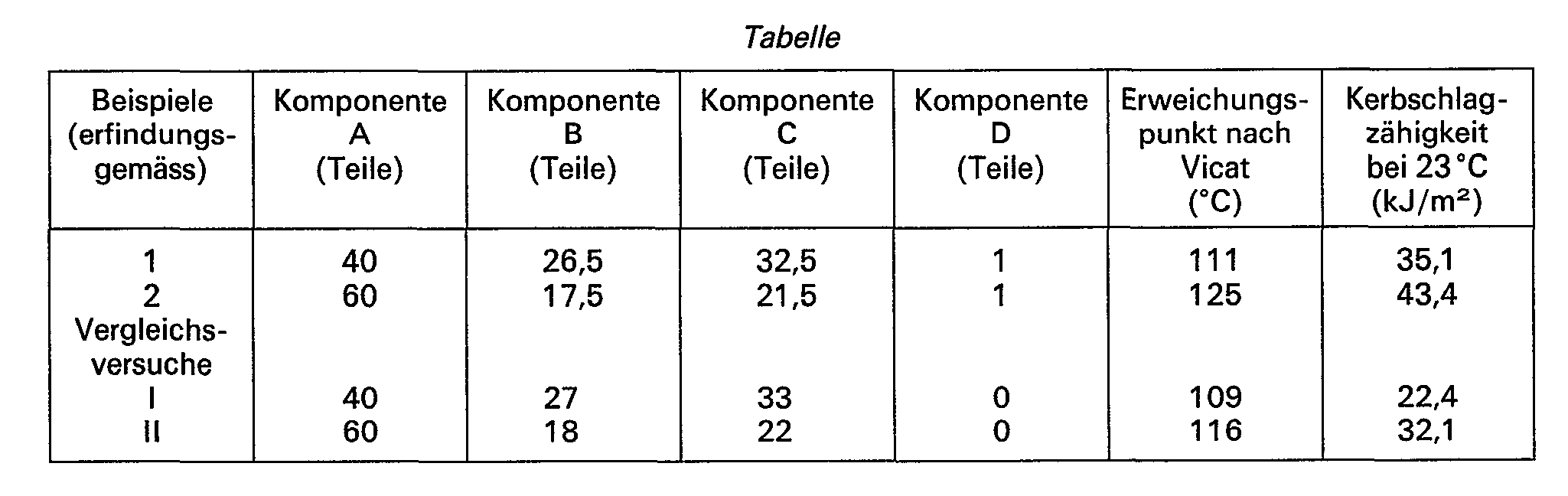
- Es zeigte sich nun, dass die erfindungsgemässen Formmassen eine verbesserte Zähigkeit und Wärmeformbeständigkeit, verglichen mit den Werten herkömmlicher ABS/Polycarbonat-Mischungen, aufweisen.
- Die Erfindung wird durch die nachfolgenden Beispiele näher erläutert. Die in den Beispielen genannten Teile und Prozente beziehen sich, sofern nicht anders angegeben, auf das Gewicht.
- Die in der Tabelle angebegenen Teile der Komponenten A bis D werden auf einem Mischextruder bei 260°C aufgeschmolzen, gemischt und anschliessend granuliert.
- Als Komponente A wurde ein Polycarbonat auf der Basis von 2,2-Bis-(4-hydroxyphenyl)propan mit einer relativen Viskosität von 1,32 (gemessen an einer 0,5%igen Lösung in Methylenchlorid) eingesetzt.
- . Als Komponente B wurde folgendes Pfropfmischpolymerisat verwendet: Pfropfmischpolymerisat, bei dem auf 60 Gew.-Teilen eines Polybutadienkautschuks mit einer mittleren Teilchengrösse von 0,3 11m 40 Gew.-Teile einer Mischung aus Styrol/Acrylnitril im Gew.-Verhältnis 70 : 30 aufgepfropft sind. Das Pfropfmischpolymerisat enthielt 5 Gew.-% nicht gepfropfte Komponente C.
- Als Komponente C wurde ein Styrol/Acrylnitril-Copolymerisat mit einem Acrylnitrilanteil von 35 Gew.-% und einer Viskositätszahl von 80 ml/g eingesetzt.
- Die Komponente D wird folgendermassen her- gestellt:
- Eine Mischung aus 60 Teilen Styroi, 10 Teilen Acrylsäure und 30 Teilen Maleinsäureanhydrid wird kontinuierlich einer Polymerisationseinrichtung zugeführt, die aus einem Druckkessel mit einem nachgeschalteten mit statischen Mischelementen versehenen Druckrohr besteht. Die Polymerisation wird bei einer Temperatur von 260°C durchgeführt. Am Reaktorausgang wird das Copolymerisat abgezogen. Die durchschnittliche Verweilzeit der Monomeren in der Polymerisationszone beträgt 15 min. Der Druck in der Polymerisationszone wird bei 25 bar gehalten.
- Der Feststoffgehalt der entstehenden Polymerschmelze beträgt 99,3%. Die restlichen Monomeren werden bei einem Druck von 5 bis 20 Torr und Temperaturen zwischen 150 und 200°C in einer Entgasungsvorrichtung entfernt. Das Polymerisat hat ein Molekulargewicht von 1700.
- Aus den Mischungen wurden bei 250°C mittels einer Spritzgussmaschine Prüfkörper hergestellt, an denen die Kerbschlagzähigkeit bei 23°C und die Wärmeformbeständigkeit, Vicat B, ermittelt wurden.
Claims (2)
Applications Claiming Priority (2)
| Application Number | Priority Date | Filing Date | Title |
|---|---|---|---|
| DE19813114494 DE3114494A1 (de) | 1981-04-10 | 1981-04-10 | Thermoplastische formmassen |
| DE3114494 | 1981-04-13 |
Publications (2)
| Publication Number | Publication Date |
|---|---|
| EP0062838A1 EP0062838A1 (de) | 1982-10-20 |
| EP0062838B1 true EP0062838B1 (de) | 1985-01-16 |
Family
ID=6129849
Family Applications (1)
| Application Number | Title | Priority Date | Filing Date |
|---|---|---|---|
| EP82102698A Expired EP0062838B1 (de) | 1981-04-10 | 1982-03-31 | Thermoplastische Formmassen |
Country Status (2)
| Country | Link |
|---|---|
| EP (1) | EP0062838B1 (de) |
| DE (2) | DE3114494A1 (de) |
Families Citing this family (7)
| Publication number | Priority date | Publication date | Assignee | Title |
|---|---|---|---|---|
| DE3436454A1 (de) * | 1984-10-05 | 1986-04-10 | Bayer Ag, 5090 Leverkusen | Thermoplastische formmassen mit verbesserter waermeformbestaendigkeit |
| DE3519690A1 (de) * | 1985-02-26 | 1986-08-28 | Bayer Ag, 5090 Leverkusen | Thermoplastische formmassen auf basis von polysiloxan-polycarbonat-blockcopolymeren |
| DE3526552A1 (de) * | 1985-07-25 | 1987-02-05 | Bayer Ag | Thermoplastische formmassen mit verbesserter verarbeitbarkeit |
| DE4221934A1 (de) * | 1992-07-03 | 1994-01-05 | Bayer Ag | Thermoplastische Formmassen |
| DE4434965A1 (de) * | 1994-09-30 | 1996-04-04 | Bayer Ag | Polycarbonat-Formmassen mit verbesserter Zähigkeit |
| KR101528196B1 (ko) * | 2013-10-07 | 2015-06-11 | 금호석유화학 주식회사 | 폴리카보네이트 수지를 함유하는 창호재용 수지 조성물 |
| KR20190099503A (ko) | 2016-12-28 | 2019-08-27 | 코베스트로 도이칠란트 아게 | 우수한 기계적 특성을 갖는 폴리카르보네이트 조성물 |
Family Cites Families (2)
| Publication number | Priority date | Publication date | Assignee | Title |
|---|---|---|---|---|
| DE2329585C2 (de) * | 1973-06-09 | 1984-01-05 | Bayer Ag, 5090 Leverkusen | Polycarbonat-Formmassen |
| DE2712171C2 (de) * | 1977-03-19 | 1984-09-27 | Bayer Ag, 5090 Leverkusen | Thermoplastische Formmassen |
-
1981
- 1981-04-10 DE DE19813114494 patent/DE3114494A1/de not_active Withdrawn
-
1982
- 1982-03-31 DE DE8282102698T patent/DE3261905D1/de not_active Expired
- 1982-03-31 EP EP82102698A patent/EP0062838B1/de not_active Expired
Also Published As
| Publication number | Publication date |
|---|---|
| EP0062838A1 (de) | 1982-10-20 |
| DE3261905D1 (en) | 1985-02-28 |
| DE3114494A1 (de) | 1982-11-04 |
Similar Documents
| Publication | Publication Date | Title |
|---|---|---|
| EP0164513B1 (de) | Thermoplastische Formmassen | |
| EP0062901A2 (de) | Verfahren zur Herstellung von schlagfesten thermoplastischen Formmassen | |
| DE1745504A1 (de) | Verfahren zur Herstellung von modifizierten Styrolpolymerisaten | |
| EP0022200A1 (de) | Thermoplastische Formmassen und Formteile aus diesen | |
| DE2901576C2 (de) | Schlagzähe thermoplastische Kunststoffmassen | |
| DE2010633C3 (de) | Thermoplastische Formmasse | |
| EP0444468A2 (de) | Thermoplastische Formmasse mit verbesserter Zähigkeit | |
| DE3149046A1 (de) | Witterungsbestaendige thermoplastische formmassen | |
| EP0678531A1 (de) | ABS-Formmassen mit verbesserter Zähigkeit | |
| EP0161452B1 (de) | Thermoplastische Formmassen | |
| EP0258741B1 (de) | Thermoplastische Formmasse auf Basis von ABS | |
| EP0062838A1 (de) | Thermoplastische Formmassen | |
| DE2252619C3 (de) | T herrnoplastische Formmasse | |
| DE3149812A1 (de) | Thermoplastische formmassen | |
| DE2342473C3 (de) | Flammwidrige, schlagfeste Formmasse | |
| DE3537100A1 (de) | Formmasse auf basis von polycarbonat, san-copolymerisaten und einem pfropfmischpolymerisat | |
| EP0360074B1 (de) | Zur Herstellung transparenter thermoplastischer Formmassen geeignete Pfropfpolymerisate | |
| EP0129796B1 (de) | Thermoplastische Formmasse | |
| EP0282854A2 (de) | Verfahren zur Herstellung kautschukreicher Propfpolymerisate | |
| EP0129815B1 (de) | Thermoplastische Formmasse | |
| EP0074051A1 (de) | Thermoplastische Formmasse | |
| EP0505799B1 (de) | ABS-Formmassen mit bimodaler Kautschukpartikelgrössenverteilung | |
| DE1269360B (de) | Verfahren zur Herstellung von thermoplastisch-elastischen Formmassen | |
| DE3807233A1 (de) | Copolymerisat aus (alpha)-methylstyrol und acrylnitril und verfahren zu seiner herstellung | |
| EP0402748A2 (de) | Vinylchloridpolymerisat enthaltende Formmassen mit verringertem Fogging |
Legal Events
| Date | Code | Title | Description |
|---|---|---|---|
| PUAI | Public reference made under article 153(3) epc to a published international application that has entered the european phase |
Free format text: ORIGINAL CODE: 0009012 |
|
| AK | Designated contracting states |
Designated state(s): DE GB NL |
|
| 17P | Request for examination filed |
Effective date: 19821111 |
|
| GRAA | (expected) grant |
Free format text: ORIGINAL CODE: 0009210 |
|
| AK | Designated contracting states |
Designated state(s): DE GB NL |
|
| REF | Corresponds to: |
Ref document number: 3261905 Country of ref document: DE Date of ref document: 19850228 |
|
| NLXE | Nl: other communications concerning ep-patents (part 3 heading xe) |
Free format text: A NEW PAGE 3 HAS BEEN RECEIVED ON 850517 |
|
| PLBE | No opposition filed within time limit |
Free format text: ORIGINAL CODE: 0009261 |
|
| STAA | Information on the status of an ep patent application or granted ep patent |
Free format text: STATUS: NO OPPOSITION FILED WITHIN TIME LIMIT |
|
| 26N | No opposition filed | ||
| PGFP | Annual fee paid to national office [announced via postgrant information from national office to epo] |
Ref country code: DE Payment date: 19900326 Year of fee payment: 9 |
|
| PGFP | Annual fee paid to national office [announced via postgrant information from national office to epo] |
Ref country code: NL Payment date: 19900331 Year of fee payment: 9 Ref country code: GB Payment date: 19900331 Year of fee payment: 9 |
|
| PG25 | Lapsed in a contracting state [announced via postgrant information from national office to epo] |
Ref country code: DE Effective date: 19910325 |
|
| PG25 | Lapsed in a contracting state [announced via postgrant information from national office to epo] |
Ref country code: GB Effective date: 19910331 |
|
| PG25 | Lapsed in a contracting state [announced via postgrant information from national office to epo] |
Ref country code: NL Effective date: 19911001 |
|
| NLV4 | Nl: lapsed or anulled due to non-payment of the annual fee | ||
| GBPC | Gb: european patent ceased through non-payment of renewal fee |