EP0062887B1 - Oxindol-Derivate, Verfahren zu ihrer Herstellung und sie enthaltende Arzneimittel mit neuroanaboler Wirkung - Google Patents
Oxindol-Derivate, Verfahren zu ihrer Herstellung und sie enthaltende Arzneimittel mit neuroanaboler Wirkung Download PDFInfo
- Publication number
- EP0062887B1 EP0062887B1 EP82102936A EP82102936A EP0062887B1 EP 0062887 B1 EP0062887 B1 EP 0062887B1 EP 82102936 A EP82102936 A EP 82102936A EP 82102936 A EP82102936 A EP 82102936A EP 0062887 B1 EP0062887 B1 EP 0062887B1
- Authority
- EP
- European Patent Office
- Prior art keywords
- formula
- atoms
- alkyl
- phenyl
- substituted
- Prior art date
- Legal status (The legal status is an assumption and is not a legal conclusion. Google has not performed a legal analysis and makes no representation as to the accuracy of the status listed.)
- Expired
Links
- 0 C[C@@](C*)C=*(C)N Chemical compound C[C@@](C*)C=*(C)N 0.000 description 1
Classifications
-
- C—CHEMISTRY; METALLURGY
- C07—ORGANIC CHEMISTRY
- C07D—HETEROCYCLIC COMPOUNDS
- C07D209/00—Heterocyclic compounds containing five-membered rings, condensed with other rings, with one nitrogen atom as the only ring hetero atom
-
- C—CHEMISTRY; METALLURGY
- C07—ORGANIC CHEMISTRY
- C07D—HETEROCYCLIC COMPOUNDS
- C07D295/00—Heterocyclic compounds containing polymethylene-imine rings with at least five ring members, 3-azabicyclo [3.2.2] nonane, piperazine, morpholine or thiomorpholine rings, having only hydrogen atoms directly attached to the ring carbon atoms
- C07D295/16—Heterocyclic compounds containing polymethylene-imine rings with at least five ring members, 3-azabicyclo [3.2.2] nonane, piperazine, morpholine or thiomorpholine rings, having only hydrogen atoms directly attached to the ring carbon atoms acylated on ring nitrogen atoms
- C07D295/18—Heterocyclic compounds containing polymethylene-imine rings with at least five ring members, 3-azabicyclo [3.2.2] nonane, piperazine, morpholine or thiomorpholine rings, having only hydrogen atoms directly attached to the ring carbon atoms acylated on ring nitrogen atoms by radicals derived from carboxylic acids, or sulfur or nitrogen analogues thereof
- C07D295/182—Radicals derived from carboxylic acids
- C07D295/185—Radicals derived from carboxylic acids from aliphatic carboxylic acids
-
- A—HUMAN NECESSITIES
- A61—MEDICAL OR VETERINARY SCIENCE; HYGIENE
- A61P—SPECIFIC THERAPEUTIC ACTIVITY OF CHEMICAL COMPOUNDS OR MEDICINAL PREPARATIONS
- A61P25/00—Drugs for disorders of the nervous system
- A61P25/28—Drugs for disorders of the nervous system for treating neurodegenerative disorders of the central nervous system, e.g. nootropic agents, cognition enhancers, drugs for treating Alzheimer's disease or other forms of dementia
-
- C—CHEMISTRY; METALLURGY
- C07—ORGANIC CHEMISTRY
- C07D—HETEROCYCLIC COMPOUNDS
- C07D209/00—Heterocyclic compounds containing five-membered rings, condensed with other rings, with one nitrogen atom as the only ring hetero atom
- C07D209/02—Heterocyclic compounds containing five-membered rings, condensed with other rings, with one nitrogen atom as the only ring hetero atom condensed with one carbocyclic ring
- C07D209/04—Indoles; Hydrogenated indoles
- C07D209/30—Indoles; Hydrogenated indoles with hetero atoms or with carbon atoms having three bonds to hetero atoms with at the most one bond to halogen, directly attached to carbon atoms of the hetero ring
- C07D209/32—Oxygen atoms
- C07D209/34—Oxygen atoms in position 2
-
- C—CHEMISTRY; METALLURGY
- C07—ORGANIC CHEMISTRY
- C07D—HETEROCYCLIC COMPOUNDS
- C07D209/00—Heterocyclic compounds containing five-membered rings, condensed with other rings, with one nitrogen atom as the only ring hetero atom
- C07D209/02—Heterocyclic compounds containing five-membered rings, condensed with other rings, with one nitrogen atom as the only ring hetero atom condensed with one carbocyclic ring
- C07D209/04—Indoles; Hydrogenated indoles
- C07D209/30—Indoles; Hydrogenated indoles with hetero atoms or with carbon atoms having three bonds to hetero atoms with at the most one bond to halogen, directly attached to carbon atoms of the hetero ring
- C07D209/32—Oxygen atoms
- C07D209/38—Oxygen atoms in positions 2 and 3, e.g. isatin
Definitions
- the compounds of the formula I according to the invention have an asymmetric carbon atom and therefore occur in stereoisomeric forms.
- the invention encompasses the racemic mixtures as well as the right-handed and left-handed enantiomers.
- the invention also includes their salts with pharmaceutically acceptable acids such as e.g. with hydrohalic acids, especially hydrochloric acid, acetic acid, malic acid, tartaric acid, maleic acid, fumaric acid, methanesulfonic acid and the like.
- pharmaceutically acceptable acids such as e.g. with hydrohalic acids, especially hydrochloric acid, acetic acid, malic acid, tartaric acid, maleic acid, fumaric acid, methanesulfonic acid and the like.
- the reactive derivatives of the carboxylic acids of the formula II are their esters with alcohols with 1-18 carbon atoms, preferably 1-5 carbon atoms, with phenol, benzyl alcohol, phenylethyl alcohol, their halides, preferably chlorides and bromides, internal anhydrides if R 6 is hydrogen, mixed anhydrides with carboxylic acids with 1-6 carbon atoms, preferably with carbonic acid, acetic acid or propionic acid, and the imidazolides, azides or isourea derivatives, preferably dicyclohexylisourea derivatives, of the carboxylic acids of the formula II.
- Z is chlorine, bromine or iodine, or their esters IX, in which R 8 is methyl, ethyl or propyl, brought to reaction (J. Chem. Soc. [London] 1949, 313).
- the acids X obtained in the reaction with the halocarboxylic acids VIII can be converted into the corresponding esters XII under known conditions, for example acid catalysis, with alcohols XI in which R 8 is as defined in IX be transferred; these esters XII are directly accessible when using the halocarboxylic acid esters IX.
- acidic condensing agents such as concentrated sulfuric acid or polyphosphoric acid at 20 to 120 ° C, preferably at 25 to 60 ° C
- 1-oxindolyl carboxylic acid esters of the formula Ila wherein Y Methoxy, ethoxy or propoxy means cyclized: the reaction can be carried out without a solvent with an excess of amine at 25 to 150 ° C, preferably at 80-
- the free carboxylic acids of the formula II are obtained by adding a mineral acid, preferably hydrochloric acid. This who converted into the compounds of formula I by reaction with compounds of the formula XV in the presence of a dehydrating agent such as carbonyldiimidazole (XVI) (Angew. Chem. 74, 407 [1972]).
- Cyclohexylcarbodiimide, 1-hydroxybenthirazole or 1- (4-chlorobenzoyl) -2- (4-methylpiperazino) acetylene are also suitable as condensing agents.
- the carboxylic acids of the formula II can furthermore be converted into the internal anhydrides of the formula XVII by reaction with thionyl chloride or phosphorus oxychloride, which give the oxindole derivatives of the formula I with compounds of the formula XV.
- the reaction with thionyl chloride or phosphorus oxychloride takes place at -50 to + 50 ° C, preferably at -20 to 0 ° C, the subsequent reaction with a compound of formula XV at 0 to 130 ° C, preferably at 20 to 50 ° C in one organic solvents, preferably methylene chloride, chloroform, toluene or hexamethylphosphoric triamide or mixtures thereof.
- the carboxylic acids of the formula II can furthermore be converted into the mixed anhydrides of the formula XIX, advantageously in the presence of tertiary, by reaction with chloroformic acid esters of the formula XVIII, in which R 10 is alkyl with 1-4 C atoms, phenyl or benzyl Amines such as triethylamine, diisopropylethylamine or dicyclohexylethylamine can be converted.
- the compounds of the formula XIX react with compounds of the formula XV to give the compounds of the formula I according to the invention:
- the starting materials of the formula IV for the process b) are prepared from the substituted anilines of the formula Vil by reaction with acylmandelic acid chloride end of the formula XIII and subsequent cyclization with acidic condensing agents analogously to the processes described above.
- the starting compounds of the formula VI for process c) are obtained by reacting compounds of the formula XIV with a compound of the formula XV to give the mandelic acid amide derivatives of the formula VI.
- This reaction is expediently carried out in polar protic solvents, in particular methanol or ethanol, at 25 to 80 ° C:
- the compounds of the formula have neuroanabolic properties. They influence the change of the brain in a favorable way and can therefore be used for the treatment of chronic brain dysfunction of various origins as well as acute brain dysfunction due to traumatic influences. They proved to be highly effective in animal models, as they were used to characterize the properties of neuroanabolically active substances (see DOS 2701 450 and Europ. J. Pharmacol. 16, [1971] 283).
- the compounds of the formula I extend the survival time of rats under hypoxic conditions by up to more than 700% in a dosage of 25 to 1000 mg / kg, preferably 100 to 500 mg / kg with intraperitoneal administration or from 250 to 1000 mg / kg with oral administration.
- the survival time of nitrite-poisoned rats is also significantly extended by the compounds of the formula I in doses of 250 to 1000 mg / kg when administered orally.
- the compounds of the formula I are notable for very low toxicity.
- the LD 50 in mice is often above 2 g / kg body weight when administered intraperitoneally.
- the compounds of the formula can be processed into tablets, dragées or capsules, which may contain conventional pharmaceutical carriers, diluents and / or auxiliaries in addition to the active ingredients.
- the active substance content is 1 to 95 percent, preferably 10 to 80 percent.
- carriers, diluents and auxiliaries come e.g. Calcium carbonate, calcium phosphonate, sodium phosphate, milk sugar, corn starch, alginates, gelatin, aluminum or magnesium stearate, talc or silicone oil.
- Such a medicament can expediently be prepared in dosage units which are tailored to the desired therapy.
- Such medicaments can contain 1 to 1000 mg, advantageously 5 to 500 mg, of a compound of formula I as an active ingredient per single dose.
- the new active substances can be considered as injectable aqueous or oily suspensions, which also contain suspending agents, e.g. Sodium carboxymethyl cellulose, methyl cellulose, hydroxypropyl cellulose, sodium alginate or polyvinyl pyrrolidone, dispersants and wetting agents such as polyoxyethylene stearate and preservatives;
- the oily suspensions can be in peanut, olive, coconut, sesame or paraffin oil.
- Example 4.1 5.4 g of the carboxylic acid from Example 4.1 were reacted with 2.3 g of trans-4-methylcyclohexylamine and 3.4 g of carbonyldiimidazole analogously to the procedure in Example 4.2. F. 215-216 ° C.
- Example 4.1 5.4 g of the carboxylic acid from Example 4.1 were reacted with 3.4 g of carbonyldimidazole and 2.6 g of cyclooctylamine analogously to Example 4.2.
- the crude product was recrystallized from ethanol. Mp 167-168 ° C.
- Example 4.1 2.7 g of the acid from Example 4.1 were reacted with 1.7 g of carbonyldiimidazole and 1.6 g of phenylpiperazine according to the procedure in Example 4.2. After removing the solvent in vacuo, the residue was mixed with water, extracted with tuluene, dried and the toluene was then removed in vacuo. The oily residue was taken up in isopropanol and concentrated with. Hydrochloric acid made weakly acidic, the precipitated salt is suctioned off and washed with acetone. M. 224-227 ° C.
- Example 4.1 8.1 g of the carboxylic acid from Example 4.1 were reacted with 5.1 g of carbonyldiimidazole and 5.3 g of m-tolylpiperazine as in Example 7. Mp 226-228 ° C.
- Example 4.1 5.4 g of the carboxylic acid from Example 4.1 were reacted with 3.4 g of carbonyldiimidazole and 3.6 g of homoveratrylamine as in Example 4.2. M. 170-172 ° C.
- Example 4.1 5.4 of the carboxylic acid from Example 4.1 was reacted with 3.4 g of carbonyldiimidazole and 1.2 ml of 2-aminoethanol as in Example 4.2. After the reaction had ended, the THF was removed in vacuo, the residue was mixed with water, suction filtered and dried. Mp 175-182 ° C.
- 125g g of N-phenylglycine methyl ester were abs in 600 ml. Toluene dissolved, 161 g of acetylmandelic acid chloride were added dropwise dissolved in 80 ml of toluene (ice cooling); then 76.5 g of triethylamine in 200 ml of toluene were added dropwise. After 1 hour, water was added, the organic phase was separated off, dried and concentrated.
Landscapes
- Chemical & Material Sciences (AREA)
- Organic Chemistry (AREA)
- Health & Medical Sciences (AREA)
- Engineering & Computer Science (AREA)
- Bioinformatics & Cheminformatics (AREA)
- Biomedical Technology (AREA)
- Neurology (AREA)
- Neurosurgery (AREA)
- Pharmacology & Pharmacy (AREA)
- General Health & Medical Sciences (AREA)
- General Chemical & Material Sciences (AREA)
- Medicinal Chemistry (AREA)
- Nuclear Medicine, Radiotherapy & Molecular Imaging (AREA)
- Psychiatry (AREA)
- Hospice & Palliative Care (AREA)
- Life Sciences & Earth Sciences (AREA)
- Animal Behavior & Ethology (AREA)
- Chemical Kinetics & Catalysis (AREA)
- Public Health (AREA)
- Veterinary Medicine (AREA)
- Indole Compounds (AREA)
- Pharmaceuticals Containing Other Organic And Inorganic Compounds (AREA)
- Nitrogen And Oxygen Or Sulfur-Condensed Heterocyclic Ring Systems (AREA)
- Fats And Perfumes (AREA)
- Management, Administration, Business Operations System, And Electronic Commerce (AREA)
- Lubricants (AREA)
- Organic Low-Molecular-Weight Compounds And Preparation Thereof (AREA)
- Plural Heterocyclic Compounds (AREA)
Description
- Gegenstand der Erfindung sind Oxindol-Derivate der allgemeinen Formel 1

- Rl, R2 und R3 gleich oder verschieden und von einander unabhängig Wasserstoff, Halogen wie Fluor, Chlor oder Brom, geradkettiges oder verzweigtes Alkyl mit 1 bis 4 C-Atomen, Trifluormethyl, Methylendioxy, Alkoxy mit 1 bis 3 C-Atomen oder Nitro,
- R4 und R5 gleich oder verschieden und von einander unabhängig Wasserstoff, geradkettiges oder verzweigtes Alkyl mit 1 bis 6 C-Atomen, das durch Alkoxy mit 1 bis 3 C-Atomen substituiert sein kann, oder durch Hydroxy substituiertes C2-6 Alkyl, Phenylalkyl mit 1 bis 7 C-Atomen im Alkylrest, der auch verzweigt sein kann, wobei der Phenylkern durch Alkoxy mit 1 bis 3 C-Atomen, Alkyl mit 1 bis 4 C-Atomen, Methylendioxy, Halogen, wie Fluor, Chlor, Brom oder durch Nitro mono-, di- oder trisubstituiert sein kann, Cyclopentyl, Cyclohexyl, Alkylcyclohexyl mit 1 bis 4 C-Atomen im Alkylteil, Cycloheptyl, Cyclooctyl, Adamantyl, Phenyl, wobei der Phenylkern wie oben für Phenylalkyl definiert, substituiert sein kann, Naphthyl oder worin R4 und R5 gemeinsam mit dem sie tragenden N-Atom Pyrrolidino, Piperidino, Hexahydroazepino, Morpholino, das jeweils durch Alkyl oder Alkoxyalkyl mit 1 bis 5 C-Atomen substituiert sein kann. N-Alkylpiperazino mit 1 bis 5 C-Atomen im Alkylteil, N-Phenylpiperazino, gegebenenfalls mit Substituenten im Phenylrest wie bei Rl definiert, mono-, di-oder trisubstituiert, N-Alkanoyl-piperazino mit 1 bis 5 C-Atomen im Alkylteil, N-Benzoylpiperazino, gegebenenfalls mit Substituenten im Phenylrest wie bei Rl definiert, mono-, di- oder trisubstituiert, und
- R6 Wasserstoff, Alkyl mit 1 bis 5 C-Atomen oder Hydroxy bedeuten.
- Bevorzugt sind Verbindungen der Formel I, worin
- Ri, R2 und R3 gleich oder verschieden und von einander unabhängig Wasserstoff, Halogen wie Fluor, Chlor oder Brom, geradkettiges oder verzweigtes Alkyl mit 1 bis 4 C-Atomen,
- R4 und R5 gleich oder verschieden und von einander unabhängig Wasserstoff, geradkettiges oder verzweigtes Alkyl mit 1 bis 4 C-Atomen; Cyclohexyl, Alkylcyclohexyl mit 1 bis 4 C-Atomen im Alkylteil, Cycloheptyl, Cyclooctyl; Phenyl, das durch Halogen, wie Fluor, Chlor oder Brom, geradkettiges oder verzweigtes Alkyl mit 1 bis 4 C-Atomen, Trifluormethyl, Methylendioxy, Alkoxy mit 1 bis 3 C-Atomen mono-, di- oder trisubstituiert sein kann; Phenylalkyl mit 1 bis 3 C-Atomen im Alkylteil, wobei der Phenylkern wie vorstehend bei Phenyl angegeben substituiert sein kann, Hydroxyalkyl mit 1 bis 4 C-Atomen oder
- R4 und R5 gemeinsam mit dem sie tragenden Stickstoffatom Pyrrolidino, Piperidino, Morpholino oder Phenylpiperazino, wobei der Phenylkern wie vorstehend bei Phenyl ausgeführt substituiert sein kann, und
- R6 Wasserstoff, Alkyl mit 1, 2 oder 3 C-Atomen oder Hydroxy bedeuten. Besonders bevorzugt werden Verbindungen
- der Formel I, worin
- Rl Wasserstoff oder Chlor in der 5-Position des Indols;
- R2 und R3 Wasserstoff
- R4 und R5 gleich oder verschieden und voneinander unabhängig Wasserstoff, Alkyl mit 1, 2 oder 3 C-Atomen, Cyclohexyl, Methylcyclohexyl, Cycloheptyl, Cyclooctyl, Hydroxyalkyl mit 2 oder 3 C-Atomen, Benzyl, Phenetyl, worin die Phenylreste jeweils durch Halogen wie Fluor oder Chlor, Methylendioxy, Alkoxy mit 1, 2 oder 3 C-Atomen im Phenylkern mono- oder disubstituiert sein können, oder
- R4 und R5 gemeinsam mit dem sie tragenden Stickstoffatom Piperidino, Pyrrolidino, Morpholino, N-Phenylpiperazino, worin der Phenylkern durch Fluor oder Chlor, Methylendioxy, Alkoxy mit 1, 2 oder 3 Kohlenstoffatome einfach oder zweifach substituiert sein kann, und
- R6 Wasserstoff oder Methyl bedeuten.
- Die erfindungsgemässen Verbindungen der Formel I weisen ein asymetrisches C-Atom und treten daher in stereoisomeren Formen auf. Die Erfindung umfasst die racemischen Gemische sowie die rechts- und linksdrehenden Enantiomeren.
- Soweit die erfindungsgemässen Verbindungen basischen Charakter haben, umfasst die Erfindung auch deren Salze mit pharmazeutisch verträglichen Säuren wie z.B. mit Halogenwasserstoffsäuren, insbesondere Salzsäure, Essigsäure, Äpfelsäure, Weinsäure, Maleinsäure, Fumarsäure, Methansulfonsäure und ähnlichen.
- Gegenstand der Erfindung sind weiterhin Verfahren zur Herstellung von Verbindungen der Formel I, dadurch gekennzeichnet, dass man
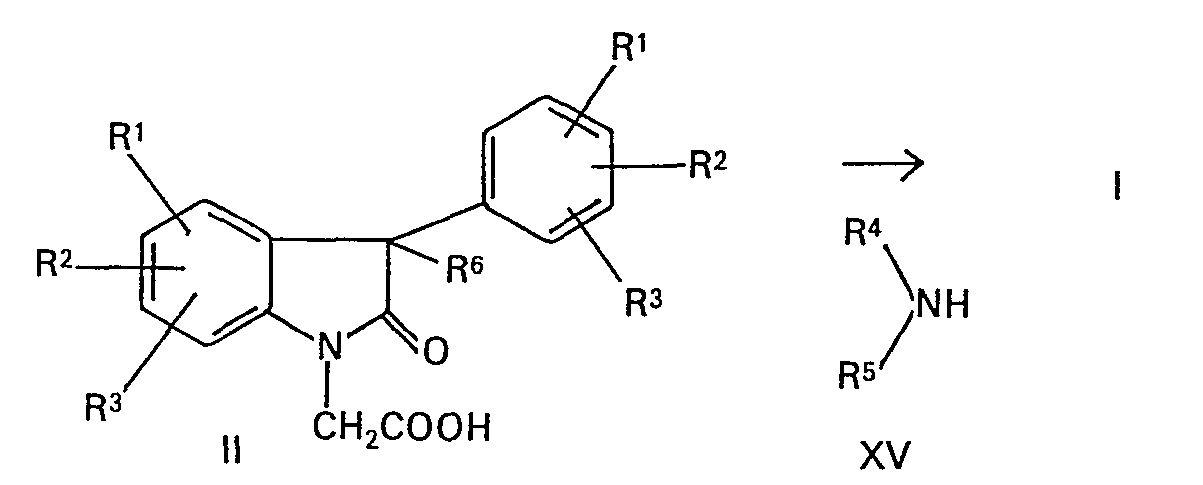
- a) Carbonsäuren der allgemeinen Formel 11 oder deren reaktive Derivate mit Ammoniak, primären oder sekundären Aminen der Formel XV umsetzt.

- Rl, R2, R3 und R6 die gleiche Bedeutung wie in Formel I haben.
- Als reaktive Derivate der Carbonsäuren der Formel II kommen deren Ester mit Alkoholen mit 1-18 Kohlenstoffatomen, vorzugsweise 1-5 Kohlenstoffatomen, mit Phenol, Benzylalkohol, Phenyläthylalkohol, deren Halogenide, vorzugsweise Chloride und Bromide, innere Anhydride falls R6 Wasserstoff bedeutet, gemischte Anhydride mit Carbonsäuren mit 1-6 Kohlenstoffatomen, vorzugsweise mit Kohlensäure, Essigsäure oder Propionsäure, sowie die Imidazolide, Azide oder Isoharnstoffderivate, vorzugsweise Dicyclohexylisoharnstoffderivate, der Carbonsäuren der Formel II in Betracht.
-
- b) Ein weiteres Verfahren ist dadurch gekennzeichnet, dass man Oxindolderivate der Formel IV, in denen R1, R2 und R3 wie in Formel I definiert sind und R6' Alkyl mit 1-5 C-Atomen bedeutet, mit ω-Halogencarbonsäureamiden der Formel V, in denen X Chlor, Brom oder Jod bedeutet, in Gegenwart einer nicht nucleophilen Base wie Natriumhydrid, Natriumamid, Lithiumamiden oder AIkalialkoholaten, in einem organischen Lösungsmittel wie Tetrahydrofuran oder Dimethylformamid zu Verbindungen der Formel I alkyliert:

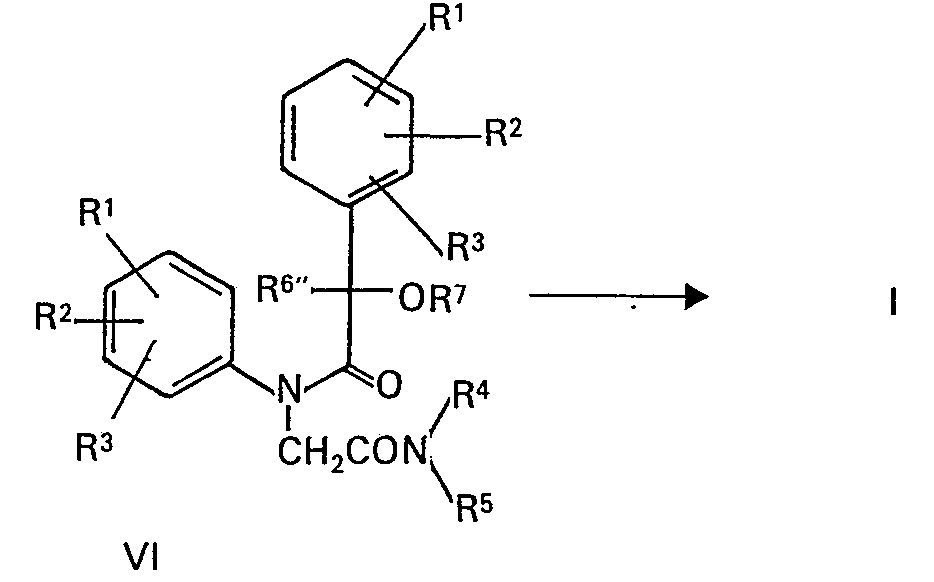
- c) Ein weiteres Verfahren zur Herstellung der Verbindungen der Formel I ist dadurch gekennzeichnet, dass man substituierte Mandelsäure-Derivate der Formel VI, worin R1, R2, R3, R4 und R5 die gleiche Bedeutung wie in Formel haben, R6" Wasserstoff oder Alkyl mit 1-5 Kohlenstoffatomen und R7 Wasserstoff oder eine Acylgruppe mit 1-6 Kohlenstoffatomen, vorzugsweise Acetyl bedeuten, mit sauren Kondensationsmitteln wie Polyphosphorsäure oder konzentrierter Schwefelsäure, bei 25 bis 120°C, vorzugsweise bei 70 bis 80°C, cyclisiert:
- d) Ein weiteres Verfahren zur Herstellung von Verbindungen der Formel I, in denen R6 Hydroxy bedeutet, ist dadurch gekennzeichnet, dass man eine Verbindung der Formel I, worin R6 Wasserstoff bedeutet, in einem indifferenten organischen Lösungsmittel oxidiert. Als Oxidationsmittel sind Luftsauerstoff oder Peroxide geeignet.
- Die Zwischenprodukte der nachstehenden Formel XII und der daraus erhältlichen der Formel XIV für die Verfahren a), c) und d) sind erhältlich aus substituierten Anilinen der Formel VII, worin Rl, R2 und R3 wie für Formel definiert ist. Diese Verbindungen werden entweder mit ω-Halogencarbonsäuren der Formel VIII, wobei
- Z Chlor, Brom oder Jod bedeutet, oder deren Estern IX, bei denen R8 Methyl, Ethyl oder Propyl bedeutet, zur Reaktion gebracht (J. Chem. Soc. [London] 1949, 313). Die bei der Umsetzung mit den Halogencarbonsäuren VIII erhaltenen Säuren X (Chem. Ber. 41, 3792, 3794) können unter bekannten Bedingungen, z.B. saurer Katalyse, mit Alkoholen XI, in denen R8 wie bei IX definiert ist, in die entsprechenden Ester XII überführt werden; diese Ester XII sind bei der Verwendung der Halogencarbonsäureester IX direkt zugänglich.

- Die Umsetzung der ω-Anilinocarbonsäureester XII mit substituierten Acylmandelsäurechloriden der Formel XIII, worin Rl, R2 und R3 wie in Formel definiert sind, R6" Wasserstoff oder Alkyl mit 1-5 C-Atomen, R9 Alkyl mit 1-4 C-Atomen oder Phenyl bedeuten, unter Bedingungen der Schotten-Baumann-Reaktion (in wässriger Natronlauge) oder der Einhorn-Reaktion (in Chloroform und Triäthylamin) führt zu den entsprechenden Acylmandelsäurederivaten der Formel XIV:

- Zur Herstellung von Ausgangsstoffen für Verfahren a) werden die Verbindungen der Formel XIV mit sauren Kondensationsmitteln wie z.B. konzentrierter Schwefelsäure oder Pholyphosphorsäure bei 20 bis 120°C, vorzugsweise bei 25 bis 60°C zu den 1-Oxindolyl-Carbonsäureestern der Formel Ila, worin Y Methoxy, Ethoxy oder Propoxy bedeutet, cyclisiert: Reaktion kann ohne Lösungsmittel mit einem Überschuss Amin bei 25 bis 150°C, vorzugsweise bei 80-100°C, oder, vorzugsweise bei der Umsetzung mit primären Aminen, in einem polaren protischen Lösungsmittel wie Methanol oder Ethanol durchgeführt werden.

- Zur Durchführung des Verfahrens a) werden die Verbindungen der Formellla mit den Verbindungen der Formel XV zu den erfindungsgemässen Verbindungen der Formel I umgesetzt. Die

- Die Ester der Formellla, worin Y = Methoxy, Ethoxy oder Propoxy bedeutet, können auch alkalisch mit Natron- oder Kalilauge bei Zimmertemperatur bis erhöhter Temperatur zu den entsprechenden Salzen der Carbonsäure der Formel II hydrolysiert werden. Durch Zusatz einer Mineralsäure, vorzugsweise Salzsäure, werden die freien Carbonsäuren der Formel II erhalten. Diese werden durch Umsetzung mit Verbindungen der Formel XV in Gegenwart eines wasserentziehenden Mittels wie Carbonyldiimidazol (XVI) in die Verbindungen der Formel I übergeführt (Angew. Chem. 74, 407 [1972]).
- Als weitere Kondensationsmittel kommen Cyclohexylcarbodiimid, 1-Hydroxybenthirazol oder 1-(4-Chlorbenzoyl)-2-(4-methylpiperazino)-acetylen in Betracht.
- Zur Durchführung des Verfahrens a) können weiterhin die Carbonsäuren der Formel II durch Umsetzung mit Thionylchlorid oder Phosphoroxychlorid in die inneren Anhydride der Formel XVII überführt werden, die mit Verbindungen der Formel XV die Oxindol-Derivate der Formel I ergeben.

- Die Umsetzung mit Thionylchlorid oder Phosphoroxychlorid erfolgt bei -50 bis +50°C, vorzugsweise bei -20 bis 0°C, die anschliessende Reaktion mit einer Verbindung der Formel XV bei 0 bis 130°C, vorzugsweise bei 20 bis 50°C in einem organischen Lösungsmittel, vorzugsweise Methylenchlorid, Chloroform, Toluol oder Hexamethylphosphorsäuretriamid oder Gemischen davon.
- Zur Durchführng des Verfahrens a) können weiterhin die Carbonsäuren der Formel II durch Umsetzung mit Chlorameisensäureestern der Formel XVIII, worin R10 Alkyl mit 1-4 C-Atomen, Phenyl oder Benzyl bedeutet, in die gemischten Anhydride der Formel XIX, zweckmässig in Gegenwart tertiärer Amine wie Triethylamin, Diisopropylethylamin oder Dicyclohexylethylamin übergeführt werden. Die Verbindungen der Formel XIX reagieren mit Verbindungen der Formel XV zu den erfindungsgemässen Verbindungen der Formel I:
-

- Die Ausgangsmaterialien der Formel IV für das Verfahren b) werden aus den substituierten Anilinen der Formel Vil durch Umsetzung mit Acylmandelsäurechloridend der Formel XIII und nachfolgende Cyclisierung mit sauren Kondensationsmitteln analog den oben beschriebenen Verfahren hergestellt.
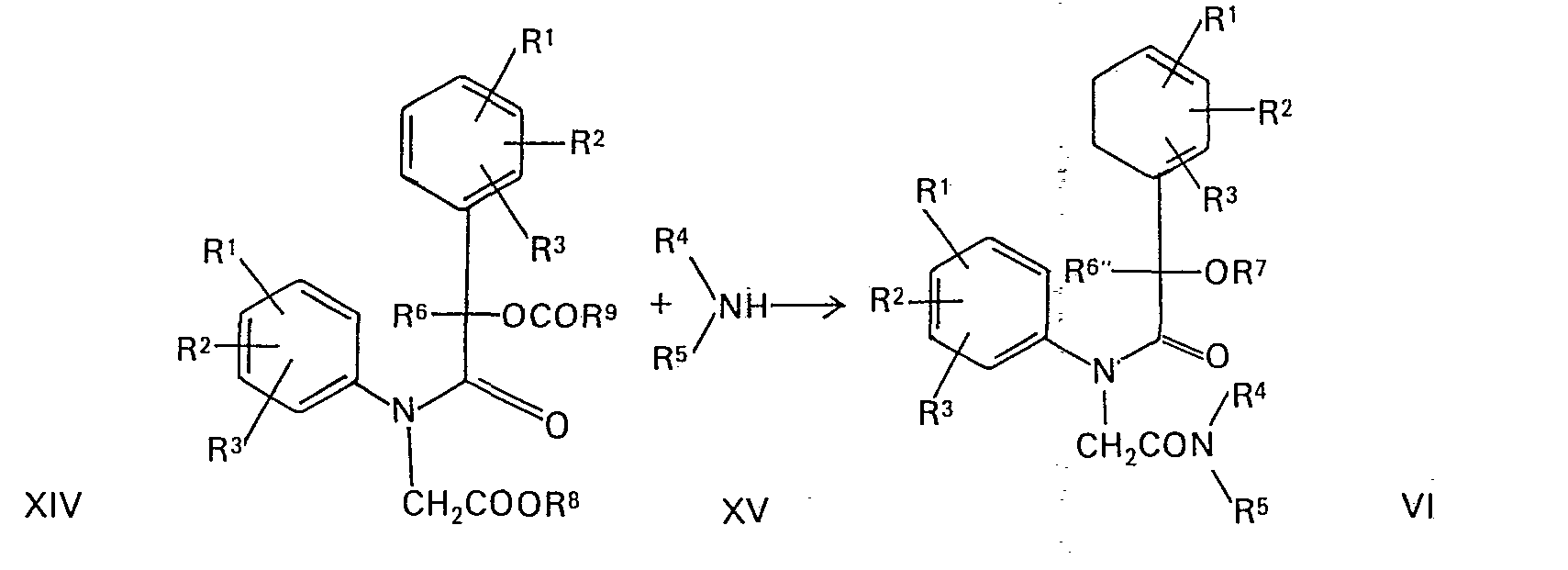
- Die Ausgangsverbindungen der Formel VI für Verfahren c) erhält man durch Umsetzung von Verbindungen der Formel XIV mit einer Verbindung der Formel XV, zu den Mandelsäureamidderivaten der Formel VI. Diese Reaktion wird zweckmässig in polaren protischen Lösungsmitteln, insbesondere Methanol oder Ethanol, bei 25 bis 80°C durchgeführt:
-
- Die Verbindungen der Formel weisen neuroanabole Eigenschaften auf. Sie beeinflussen den Hirnstöffwechsei in günstiger Weise und können daher zur Behandlung von chronischen Hirnfunktionsstörungen verschiedenster Genese sowie akuter Hirnfunktionsstörungen infolge traumatischer Einflüsse angewandt werden. Sie erwiesen sich als hochwirksam in Tiermodellen, wie sie zur Charakterisierung der Eigenschaften von neuroanabolisch wirksamen Substanzen (vergl. DOS 2701 450 und Europ. J. Pharmacol. 16, [1971] 283) herangezogen wurden.
- Die Verbindungen der Formel I verlängern die Überlebenszeit von Ratten unter hypoxischen Bedingungen um bis zu mehr als 700% in einer Dosierung von 25 bis 1000 mg/kg, vorzugsweise 100 bis 500 mg/kg bei intraperitonealer Gabe bzw. von 250 bis 1000 mg/kg bei peroraler Gabe.
- Auch die Überlebenszeit von nitrit-vergifteten Ratten wird von den Verbindungen der Formel I signifikant verlängert in Dosierungen von 250 bis 1000 mg/kg bei peroraler Gabe.
- Die Verbindungen der Formel I zeichnen sich durch sehr geringe Toxizität aus. Die LD50 an Mäusen liegt oft über 2 g/kg Körpergewicht, bei intraperitonealer Gabe.
- Zur Verwendung als Arzneimittel für die perorale Anwendung können die Verbindungen der Formel zu Tabletten, Dragees oder Kapseln verarbeitet werden, die gegebenenfalls neben den Wirkstoffen übliche pharmazeutische Trägerstoffe, Verdünnungsmittel und/oder Hilfsstoffe enthalten. Der Wirkstoffgehalt beträgt 1 bis 95 Prozent, vorzugsweise 10 bis 80 Prozent. Als Trägerstoff, Verdünnungsmittel und Hilfsstoffe kommen z.B. Calciumcarbonat, Calciumphosphonat, Natriumphosphat, Milchzucker, Maisstärke, Alginate, Gelatine, Aluminium- oder Magnesiumstearat, Talkum oder Siliconöl in Betracht.
- Zweckmässig kann ein solches Arzneimittel in Dosierungseinheiten zubereitet werden, die auf die gewünschte Therapie abgestimmt sind.
- Solche Arzneimittel können pro Einzeldosis 1 bis 1000 mg, vorteilhaft 5 bis 500 mg einer Verbindung der Formel I als Wirkstoff enthalten.
- Für die parenterale Verabreichung kommen die neuen Wirkstoffe als injizierbare wässrige oder ölige Suspension in Betracht, die zusätzlich noch Suspendiermittel, wie z.B. Natriumcarboxymethylcellulose, Methylcellulose, Hydroxypropylcellulose, Natriumalginat oder Polyvinylpyrrolidon, Dispergier- und Benetzungsmittel wie Polyoxyethylenstearat und Konservierungsmittel enthalten können; die öligen Suspensionen können in Erdnuss-, Oliven, Kokos-, Sesam- oder Paraffinöl vorliegen.
- 56,2 g (0,26 Mol) N-(4-Chlorphenyl)-glycinethyl- ester wurden in 300 ml abs. Methylenchlorid gelöst. Unter Eiskühlung wurden 66,6 g (0,3 Mol) Acetylmandelsäurechlorid in 30 ml Methylenchlorid zugetropft.
- Anschliessend wurde noch 24Std. bei Raumtemperatur gerührt, wobei sich ein weisser Niederschlag bildet. Das Gemisch wird in Wasser gegeben, die org. Phase wird abgetrennt und noch 3 x mit je 500 ml Wasser gewaschen, getrocknet und eingeengt, das rohe Öl, das noch Restlösungsmittel enthält, wurde direkt weiter umgesetzt.
- 109,2 g N-(4-Chlor-phenyl)-N-(2-phenyl-2-acet- oxy-acetyl)-glycin-ethylester wurden in 465 ml konz. Schwefelsäure unter Eiskühlung eingetragen. Nach 16 Std. bei Raumtemperatur wurde auf 3,51 Eis gegossen, dann mit 31 Methylenchlorid extrahiert. Die org. Phase wurde mit 300 ml 1N Natriumbicarbonatlösung neutralisiert, getrocknet und eingeengt. Das Rohprodukt wurde aus Isopropanol umkristallisiert. F. 125°C.
- 16,5 g (1 H-2,3-Dihydro-2-oxo-3-phenyl-5-chlor-1-indolyl)-essigsäureethylester wurden in 100 ml Piperidin gelöst und auf dem Wasserbad unter Stickstoff 24 Std. erhitzt. Die Lösung wurde in ein Gemisch aus 1,81 Eiswasser und 200ml Eisessig gegossen. Das Gemisch wurde mit 500 ml Essigester extrahiert, die org. Phase 2 x mit je 600 ml 2N Essigsäure und 4 x mit je 500 ml Wasser gewaschen, getrocknet und eingeengt. Das Rohöl wurde aus Toluol/Petroläther umkristallisiert; das Produkt schmilzt bei 153°C.
- 20 g (1 H-2,3-Dihydro-2-oxo-3-phenyl-5-chlor-1-indolyl)-essig-säure-ethylester wurden in 90 ml Morpholin gelöst und unter Stickstoff auf dem Dampfbad 5 Std. erhitzt. Nach Abkühlen wurde auf ein Gemisch aus 1800 ml Eiswasser, 200 ml Eisessig und 800 ml Essigester gegossen. Die organische Phase wurde abgetrennt und mit 2N Essigsäure, gesättigter Natriumbicarbonatlösung und Wasser gewaschen, getrocknet und eingeengt, das Rohprodukt wurde aus Ethanol umkristallisiert. F. 143-144°C.
- 10 g (1H-2,3-Dihydro-2-oxo-3-phenyl-5-chlor-1-indolyl)-essigsäure-ethylester wurden in einer Druckflasche mit einer ges. Lösung von Methylamin in Toluol versetzt und 14 h bei Raumtemperatur aufbewahrt. Die Lösung wurde dann auf die Hälfte eingeengt und das auskristallisierte Produkt abgesaugt und mit Toluol/Petrolether gewaschen. Das Rohprodukt wurde aus Ethanol umkristallisiert; F. 217-218°C.
- 70g (0,25 Mol) (1H-2,3-Dihydro-2-oxo-3-phenyl-1-indolyl)-essigsäuremethylester wurden mit 18 g KOH in 550 ml 90%igem wässr. Methanol 15 Std. bei Raumtemperatur behandelt, die Lösung wurde dann mit 2N HCI sauer gestellt (gegen Kongorot), das ausgefallene Produkt wurde zur Reinigung in NaOH gelöst, mit Aktivkohle geklärt, mit 2N HCI ausgefällt, abgesaugt, mit Wasser gewaschen und getrocknet. F. 180-181 °C.
- Zu 2,7 g (10 mmol) der Carbonsäure in 10 ml trockenem Tetrahydrofuran wurden 1,7 g Carbonyldiimidazol bei Raumtemperatur unter Rühren gegeben. Nach 30 min. wurden 1,1 ml Benzylamin zugetropft, nach weiteren 15 min. in 200 ml Wasser eingerührt. Der Niederschlag wurde abgesaugt, mit Wasser gewaschen und aus Ethanol umkristallisiert. F. 182-183°C.
- 5,4g der Carbonsäure aus Beispiel 4.1 wurden mit 2,3 g trans-4-Methylcyclohexylamin und 3,4 g Carbonyldiimidazol analog der Vorschrift in Beispiel 4.2 umgesetzt. F. 215-216°C.
- 5,4g der Carbonsäure aus Beispiel 4.1 wurden analog Beispiel 4.2 mit 3,4 g Carbonyldümidazol und 2,6 g Cyclooctylamin umgesetzt. Das Rohprodukt wurde aus Ethanol umkristallisiert. F. 167-168°C.
- 2,7 g der Säure aus Beispiel 4.1 wurden mit 1,7 g Carbonyldiimidazol und 1,6g Phenylpiperazin nach der Vorschrift von Beispiel 4.2 umgesetzt. Nach Entfernen des Lösungsmittels im Vakuum wurde der Rückstand mit Wasser versetzt, mit Tuluol extrahiert, getrocknet und das Toluol dann im Vakuum entfernt. Der ölige Rückstand wurde in Isopropanol aufgenommen und mit konz. Salzsäure schwach sauer gestellt, das ausgefallene Salz abgesaugt und mit Aceton gewaschen. F. 224-227°C.
- 8,1 g der Carbonsäure aus Beispiel 4.1 wurden mit 5,1 g Carbonyldiimidazol und 5,3g m-Tolylpiperazin analog Beispiel 7 umgesetzt. F. 226-228°C.
- 5,4g der Carbonsäure aus Beispiel 4.1 wurden mit 3,4 g Carbonyldiimidazol und 3,6 g Homoveratrylamin analog Beispiel 4.2 umgesetzt. F. 170-172°C.
- Analog Beispiel 4.2 wurden 5,4 der Carbonsäure aus Beispiel 4.1 mit 3,4 g Carbonyldiimidazol und 1,2 ml 2-Amino-ethanol zur Reaktion gebracht. Nach beendeter Reaktion wurde das THF im Vakuum entfernt, der Rückstand mit Wasser versetzt, abgesaugt und getrocknet. F. 175-182°C.
- 6,7 g der Carbonsäure aus Beispiel 4.1 wurden in 20 ml Hexamethylphosphorsäuretriamid (HMPTA) und 10 ml Methylenchlorid gelöst, bei -10°C wurden 1,8 ml Thionylchlorid zugegeben. Nach 30 min. Rühren erfolgte Zugabe von 2,86 ml Cyclohexylamin bei -10°C. Die Lösung wurde auf Raumtemperatur aufgewärmt, über Nacht gerührt, mit Wasser versetzt und abgesaugt. Das Rohprodukt wurde durch Chromatographie an Kieselgel mit Essigester/Methanol (4:1) gereinigt. F. 200-201 °C.
- 1,3 g (5 mMol) der Carbonsäure aus Beispiel 4.1 wurden in 15 ml abs. Aceton gelöst, dann wurden unter Stickstoff und Eiskühlung 0,55 ml (5,5 mMol) Triethylamin und 0,52g (5,5 mMol) Chlorameisenesäureethylester nacheinander zugetropft; nach 5min Rühren gab man 0,5g g (5 mMol) Cyclohexylamin zu. Nach 30min. bei 0°C wurde auf Raumtemperatur aufgewärmt, 1 Std. gerührt, mit 30 ml Wasser verdünnt, der Niederschlag abgesaugt und auf Isopropanol umkristallisiert. F. 205-206°C.
- 13.1 3-Methyl-3-phenyl-5-chlor-oxindol 10 g 3-Phenyl-5-chlor-oxoindol wurden in 100 ml Aceton und 20 ml Wasser gelöst, 2,9 g Kaliumcarbonat und 2,9 ml Methyliodid wurden zugegeben, 3 Std. auf 50°C erwärmt, eingeengt, mit Wasser versetzt, mit Essigester extrahiert, über Magnesiumsulfat getrocknet, das Lösungsmittel entfernt. Der Rückstand wurde aus Ethanol umkristallisiert. F. 180-181 °C.
- 13.2 (2,3-Dihydro-2-oxo-3-methyl-3-phenyl-3-chlor-1-indolyl)-essigsäure-N,N-diethylamid 0,4g Natriumhydrid (80% in Öl) wurden zu einer Lösung von 2,6g 3-Methyl-3-phenyl-5-chlor- oxindol in 25 ml THF gegeben. Nach 30 min. erfolgte Zugabe von 1,5g Chloressigsäurediethylamid in 15 ml THF. Nach 3 Std. Rühren bei Raumtemperatur wurde zur Trockne einrotiert, der Rückstand in Toluol aufgenommen, mit Wasser gewaschen, getrocknet und das Lösungsmittel im Vakuum entfernt. Das Rohprodukt wurde durch Säulenchromatographie an Kieselgel mit Toluol/Essigester (4:1) gereinigt und aus Isopropanol/Petrolether umkristallisiert. F. 108-109°C.
- 125g g N-Phenyl-glycinmethylester wurden in 600 ml abs. Toluol gelöst, 161 g Acetylmandelsäurechlorid wurden gelöst in 80 ml Toluol zugetropft (Eiskühlung); danach wurden noch 76,5g Triethylamin in 200 ml Toluol zugetropft. Nach 1 Std. wurde mit Wasser versetzt, die organische Phase abgetrennt, getrocknet und eingeengt.
- Das Rohprodukt, das noch Restlösungsmittel enthält, wurde direkt weiter umgesetzt.
- 14.2 N-Phenyl-N-(2-phenyl-2-hydroxy-acetyl)-glycin-amid
- 15 g (44 mMol) N-Phenyl-N-(2-phenyl-2-acet- oxy-acetyl)-glycin-methylester wurden in eine Lösung von 25 ml flüssigem Ammoniak in 50 ml Toluol eingetragen, die Mischung 7 Std. bei Raumtemperatur gerührt. Der Ammoniak-Überschuss wurde durch Erwärmen vertrieben, wobei das Produkt auskristallisierte. F. 148-151 °C.
- 4g (14mMol) N-Phenyl-N-(2-phenyl-2-hydroxy- acetyl)-glycinamid wurden in 60 g Polyphosphorsäure gelöst, 3 Std. auf 60°C erwärmt, mit Eis versetzt, mit Essigester extrahiert, die organ. Phase getrocknet und eingeengt. Das Rohprodukt wurde aus Ethanol umkristallisiert. F. 184-185°C.
- 7,8 g (23,7 mMol) (2,3-Dihydro-2-oxo-3-phenyl-5-chlor-1-indolyl)-essigsäureethylester wurden in einer Druckflasche mit 60 ml flüss. Ammoniak in 60 mi Toluol zur Reaktion gebracht. Nach 15 Std. bei Raumtemperatur wurde das überschüssige Ammoniak ausgetrieben, der Rückstand eingeengt und aus Isopropanol/Petrolether umkristallisiert. F.247-248°C.
- 11 g (2,3-Dihydro-2-oxo-3-phenyl-1-indolyl)-essigsäure-methylester wurden in 50 ml Morpholin gelöst und auf dem Dampfbad 9 Std. unter Stickstoff erhitzt, dann auf ein Gemisch aus Eisessig und Essigester gegossen, die wässrige Phase mit Methylenchlorid extrahiert, die organ. Phase getrocknet und eingeengt. Das Rohprodukt wurde aus Isopropanol umkristallisiert. F. 153-154°C.
- 12 g (33,5 mMol) N-Phenyl-N-(2-phenyl-2-acet- oxy-acetyl)-glycin-N', N'-diethylamid gelöst in 35 ml Toluol wurden mit 200 g Polyphosphorsäure 10 min. auf 80°C erwärmt, danach mit Eis versetzt, mit Essigester extrahiert, die organische Phase abgetrennt und getrocknet. Nach dem Einengen wurde aus Ethanol/Petrolether umkristallisiert. F. 144-145°C.
- 0,5 g (1,8 mMol) (2,3-Dihydro-2-oxo-3-phenyl-1-indolyl)-acetamid wurden in einer Dimethylformamid-Lösung an der Luft 20 Std. intensiv gerührt, dann wurde mit Wasser verdünnt, mit Kochsalz gesättigt, mit Essigester extrahiert, getrocknet, und eingeengt. Das Rohprodukt wurde aus Essigester/Petrolether umkristallisiert. F. 183-184°C.
- 6,2 g (2,3-Dihydro-2-oxo-3-phenyl-1-indolyl)-essigsäureethyl-ester wurden in einer Druckflasche mit 50 ml flüss. Ammoniak in 50 ml Toluol zur Reaktion gebracht. Nach 15 Std. bei Raumtemperatur wurde der überflüssige Ammoniak entfernt und Rückstand aus Ethanol umkristallisiert. F. 184-185°C.
- (1 H-2,3-Dihydro-2-oxo-3-phenyl-5-chlor-1-indol- yl)-essigsäure-piperidid
- (I, R1=5-Cl, R2=R3=R6=H, R4, R5=-(CH2)5-, n=1
- 25 g N-(4-chlorphenyl)-N-(2-phenyl-2-acetoxy- acetyl)-glicin-ethylester (Beispiel 1.1) werden mit 95 ml Piperidin unter Stickstoff auf dem Wasserbad 18 Std. erhitzt, dann in ein Gemisch aus 1.5 I Eiswasser und 100 ml Eisessig gegossen. Das ausgefallene Produkt wurde abgesaugt und getrocknet und ohne weitere Reinigung weiter umgesetzt.
- 20.2 1 H-2,3-Dihydro-2-oxo-phenyl-5-chlor-1- indolyl)-essig-säure-piperidid
- 13,4g N-(4-chlorphenyl)-N-(2-phenyl-2-hydroxy- acetyl)-glicin-piperidid werden in 200 g Polyphosphorsäure gelöst und 3 Stunden auf 60° erwärmt, mit Eis versetzt, mit Essigester extrahiert, die org. Phase getrocknet und eingeengt. Das Rohprodukt wurde aus Toluol/Petrolether umkristallisiert, das Produkt schwitzt bei 153°C.
- 18,6 g N-(4-Chlorphenyl)-N-(2-phenyl-2-acetoxy- acetyl)-glycin-ethylester (Beispiel 1.1. wurden in 80 ml Morpholin 20 Std. auf 100°C erhitzt. Nach Abkühlen wurde ohne weitere Reinigung weiter umgesetzt.
- 8 g N-(4-Chlorphenyl)-N-(2-phenyl-2-hydroxy- acetyl)-glycin morpholid wurden in 80 ml konz. Schwefelsäure unter Eiskühlung eingetragen. Nach 30 Minuten wurde mit 1 I Eiswasser verdünnt, abgesaugt und aus Ethanol umkristallisiert. F. 143-144°C.
Claims (5)



Priority Applications (1)
| Application Number | Priority Date | Filing Date | Title |
|---|---|---|---|
| AT82102936T ATE8387T1 (de) | 1981-04-09 | 1982-04-06 | Oxindol-derivate, verfahren zu ihrer herstellung und sie enthaltende arzneimittel mit neuroanaboler wirkung. |
Applications Claiming Priority (2)
| Application Number | Priority Date | Filing Date | Title |
|---|---|---|---|
| DE19813114351 DE3114351A1 (de) | 1981-04-09 | 1981-04-09 | "oxindol-derivate, verfahren zu ihrer herstellung und sie enthaltende arzneimittel mit neuroanaboler wirkung" |
| DE3114351 | 1981-04-09 |
Publications (2)
| Publication Number | Publication Date |
|---|---|
| EP0062887A1 EP0062887A1 (de) | 1982-10-20 |
| EP0062887B1 true EP0062887B1 (de) | 1984-07-11 |
Family
ID=6129772
Family Applications (1)
| Application Number | Title | Priority Date | Filing Date |
|---|---|---|---|
| EP82102936A Expired EP0062887B1 (de) | 1981-04-09 | 1982-04-06 | Oxindol-Derivate, Verfahren zu ihrer Herstellung und sie enthaltende Arzneimittel mit neuroanaboler Wirkung |
Country Status (18)
| Country | Link |
|---|---|
| US (2) | US4542148A (de) |
| EP (1) | EP0062887B1 (de) |
| JP (1) | JPS57179158A (de) |
| KR (1) | KR830010069A (de) |
| AT (1) | ATE8387T1 (de) |
| AU (1) | AU548411B2 (de) |
| DE (2) | DE3114351A1 (de) |
| DK (1) | DK162682A (de) |
| ES (2) | ES8307217A1 (de) |
| FI (1) | FI821218L (de) |
| GR (1) | GR75450B (de) |
| HU (1) | HU186053B (de) |
| IL (1) | IL65466A0 (de) |
| NO (1) | NO821158L (de) |
| NZ (1) | NZ200259A (de) |
| PH (1) | PH19471A (de) |
| PT (1) | PT74721B (de) |
| ZA (1) | ZA822427B (de) |
Cited By (1)
| Publication number | Priority date | Publication date | Assignee | Title |
|---|---|---|---|---|
| AU2007279092B2 (en) * | 2006-07-24 | 2012-12-13 | Ucb Pharma S.A. | Substituted aniline derivatives |
Families Citing this family (9)
| Publication number | Priority date | Publication date | Assignee | Title |
|---|---|---|---|---|
| US4619937A (en) * | 1984-02-02 | 1986-10-28 | Warner-Lambert Company | Saturated bicyclic lactam acids and derivatives as cognition activators |
| DE3413572A1 (de) * | 1984-04-11 | 1985-10-24 | Hoechst Ag, 6230 Frankfurt | Oxindol-verbindungen zur behandlung der epilepsie |
| US4686224A (en) * | 1984-10-31 | 1987-08-11 | Pfizer Inc. | Oxindole antiinflammatory agents |
| DE3529994A1 (de) * | 1985-08-22 | 1987-02-26 | Hoechst Ag | Indolinonderivate, verfahren zu ihrer herstellung, sie enthaltende arzneimittel und deren verwendung |
| DE69031649T2 (de) * | 1989-07-25 | 1998-02-26 | Taiho Pharmaceutical Co Ltd | Oxoindolderivate |
| SE514737C2 (sv) * | 1994-03-22 | 2001-04-09 | Sandvik Ab | Belagt skärverktyg av hårdmetall |
| US5565483A (en) * | 1995-06-07 | 1996-10-15 | Bristol-Myers Squibb Company | 3-substituted oxindole derivatives as potassium channel modulators |
| TW457233B (en) * | 1996-10-11 | 2001-10-01 | Bristol Myers Squibb Co | Preparation of 3-fluoro oxindole derivatives |
| US7790726B2 (en) * | 2005-08-16 | 2010-09-07 | Chemocentryx, Inc. | Monocyclic and bicyclic compounds and methods of use |
Family Cites Families (6)
| Publication number | Priority date | Publication date | Assignee | Title |
|---|---|---|---|---|
| US3573310A (en) * | 1967-09-28 | 1971-03-30 | Miles Lab | 1-substituted derivatives of 2-indolinone |
| US3558653A (en) * | 1968-05-20 | 1971-01-26 | Searle & Co | Dialkylaminoalkyl-indolines |
| JPS4876863A (de) * | 1972-01-22 | 1973-10-16 | ||
| US3975531A (en) * | 1973-10-02 | 1976-08-17 | A. H. Robins Company, Incorporated | 4-(5- And 7-)benzoylindolin-2-ones and pharmaceutical uses thereof |
| US4080330A (en) * | 1975-06-23 | 1978-03-21 | Delmar Chemicals Limited | Phenylindolines and process for their production |
| US4110465A (en) * | 1977-11-25 | 1978-08-29 | Eli Lilly And Company | 7-amino and 7-alkanoylamino 2-oxo-3-phenylindolines |
-
1981
- 1981-04-09 DE DE19813114351 patent/DE3114351A1/de not_active Withdrawn
-
1982
- 1982-04-02 ES ES82511097D patent/ES8307217A1/es not_active Expired
- 1982-04-06 FI FI821218A patent/FI821218L/fi not_active Application Discontinuation
- 1982-04-06 DE DE8282102936T patent/DE3260356D1/de not_active Expired
- 1982-04-06 AT AT82102936T patent/ATE8387T1/de active
- 1982-04-06 EP EP82102936A patent/EP0062887B1/de not_active Expired
- 1982-04-06 NO NO821158A patent/NO821158L/no unknown
- 1982-04-07 GR GR67851A patent/GR75450B/el unknown
- 1982-04-07 KR KR1019820001528A patent/KR830010069A/ko not_active Withdrawn
- 1982-04-07 NZ NZ200259A patent/NZ200259A/en unknown
- 1982-04-07 US US06/366,321 patent/US4542148A/en not_active Expired - Fee Related
- 1982-04-07 PH PH27110A patent/PH19471A/en unknown
- 1982-04-07 DK DK162682A patent/DK162682A/da not_active IP Right Cessation
- 1982-04-07 PT PT74721A patent/PT74721B/de unknown
- 1982-04-08 JP JP57057411A patent/JPS57179158A/ja active Pending
- 1982-04-08 ZA ZA822427A patent/ZA822427B/xx unknown
- 1982-04-08 HU HU821080A patent/HU186053B/hu unknown
- 1982-04-08 AU AU82487/82A patent/AU548411B2/en not_active Ceased
- 1982-04-11 IL IL65466A patent/IL65466A0/xx unknown
-
1983
- 1983-03-30 ES ES521198A patent/ES521198A0/es active Granted
-
1985
- 1985-06-18 US US06/745,884 patent/US4614739A/en not_active Expired - Fee Related
Cited By (1)
| Publication number | Priority date | Publication date | Assignee | Title |
|---|---|---|---|---|
| AU2007279092B2 (en) * | 2006-07-24 | 2012-12-13 | Ucb Pharma S.A. | Substituted aniline derivatives |
Also Published As
| Publication number | Publication date |
|---|---|
| ATE8387T1 (de) | 1984-07-15 |
| JPS57179158A (en) | 1982-11-04 |
| IL65466A0 (en) | 1982-07-30 |
| KR830010069A (ko) | 1983-12-26 |
| ES511097A0 (es) | 1983-06-16 |
| DE3260356D1 (en) | 1984-08-16 |
| DK162682A (da) | 1982-10-10 |
| ZA822427B (en) | 1983-02-23 |
| NZ200259A (en) | 1985-07-31 |
| NO821158L (no) | 1982-10-11 |
| US4542148A (en) | 1985-09-17 |
| PT74721A (de) | 1982-05-01 |
| FI821218A7 (fi) | 1982-10-10 |
| PH19471A (en) | 1986-05-14 |
| AU548411B2 (en) | 1985-12-12 |
| EP0062887A1 (de) | 1982-10-20 |
| US4614739A (en) | 1986-09-30 |
| AU8248782A (en) | 1983-04-21 |
| ES8307217A1 (es) | 1983-06-16 |
| ES8401940A1 (es) | 1984-01-01 |
| ES521198A0 (es) | 1984-01-01 |
| HU186053B (en) | 1985-05-28 |
| PT74721B (de) | 1984-05-30 |
| DE3114351A1 (de) | 1982-11-04 |
| FI821218L (fi) | 1982-10-10 |
| GR75450B (de) | 1984-07-19 |
| FI821218A0 (fi) | 1982-04-06 |
Similar Documents
| Publication | Publication Date | Title |
|---|---|---|
| DE69206214T2 (de) | Neue Arylethylaminderivate, Verfahren zu ihrer Herstellung und sie enthaltende pharmazeutische Zusammensetzungen. | |
| DE69219394T2 (de) | Heterozyklische Alkylamide, Verfahren zu ihrer Herstellung und diese enthaltende pharmazeutische Zubereitungen | |
| DE69525355T2 (de) | 1-acyl-4-aliphatische aminopiperidin verbindungen | |
| EP0104342B1 (de) | Triphenylimidazolyloxyalkansäuren und ihre Derivate, Verfahren zu ihrer Herstellung und diese enthaltende pharmazeutische Präparate | |
| DE69734773T2 (de) | Nicht-peptidische Bombesin-Rezeptor-Antagonisten | |
| FI86064C (fi) | Foerfarande foer framstaellning av nya terapeutiskt anvaendbara aminotiazol- och aminooxazolderivat. | |
| FR2619111A1 (fr) | Derives de (piperidinyl-4)methyl-2 tetrahydro-1,2,3,4 9h-pyrido (3,4-b) indole, leur preparation et leur application en therapeutique | |
| DE3650567T2 (de) | Medizinische Indol- und Indazol-Ketosulfonderivate | |
| EP0220066B1 (de) | Carboxamidderivate | |
| EP0062887A1 (de) | Oxindol-Derivate, Verfahren zu ihrer Herstellung und sie enthaltende Arzneimittel mit neuroanaboler Wirkung | |
| EP0008645B1 (de) | Alkoxyphenylpyrrolidone, Verfahren zu ihrer Herstellung und Arzneimittel auf Basis dieser Verbindungen | |
| EP1268422A1 (de) | Indole zur behandlung von krankheiten die mit schilddrüsenhormonen behandeln werden können | |
| EP0740658A1 (de) | N-substituierte azabicycloheptan-derivate wie z.b. neuroleptika | |
| DE68917569T2 (de) | 4-Aminophenol-Derivate und Verfahren zu ihrer Herstellung. | |
| DE68916920T2 (de) | Acyloxypropanolamine. | |
| DE3719699A1 (de) | Indolderivate | |
| EP0062919B1 (de) | Neue Indol-Derivate, Verfahren zu ihrer Herstellung und pharmazeutische Präparate, die diese Verbindungen enthalten | |
| DE3879378T2 (de) | Amid-verbindungen. | |
| EP0071950B1 (de) | Neue Heteroaryloxypropanolamine, Verfahren zu ihrer Herstellung und diese Verbindungen enthaltende Arzneimittel | |
| JPH10512291A (ja) | ロイコトリエンアンタゴニストとしてのインドールカルバメート類 | |
| EP0564499A1 (de) | Neue amine, verfahren zu ihrer herstellung, sowie diese verbindungen enthaltende arzneimittel. | |
| EP0461012B1 (de) | (1-Phenylpyrrolidin-2-yl)methylpiperazinderivate, Verfahren zur Herstellung und therapeutische Anwendung | |
| EP0124479B1 (de) | Iminosulfonamide und Verfahren zu ihrer Herstellung, die pharmazeutische Präparate solche Verbindungen enthalten, sowie die Verbindungen zur Verwendung | |
| EP0276194A1 (de) | 2,1-Benzothiazepin-2,2-dioxid-5-carbonsäurederivate | |
| CH625219A5 (en) | Process for the manufacture of an aromatic amide N-substituted by heterocyclic groups |
Legal Events
| Date | Code | Title | Description |
|---|---|---|---|
| PUAI | Public reference made under article 153(3) epc to a published international application that has entered the european phase |
Free format text: ORIGINAL CODE: 0009012 |
|
| AK | Designated contracting states |
Designated state(s): AT BE CH DE FR GB IT LU NL SE |
|
| 17P | Request for examination filed |
Effective date: 19821028 |
|
| ITF | It: translation for a ep patent filed | ||
| GRAA | (expected) grant |
Free format text: ORIGINAL CODE: 0009210 |
|
| AK | Designated contracting states |
Designated state(s): AT BE CH DE FR GB IT LI LU NL SE |
|
| REF | Corresponds to: |
Ref document number: 8387 Country of ref document: AT Date of ref document: 19840715 Kind code of ref document: T |
|
| REF | Corresponds to: |
Ref document number: 3260356 Country of ref document: DE Date of ref document: 19840816 |
|
| ET | Fr: translation filed | ||
| PG25 | Lapsed in a contracting state [announced via postgrant information from national office to epo] |
Ref country code: LU Free format text: LAPSE BECAUSE OF NON-PAYMENT OF DUE FEES Effective date: 19850430 |
|
| PLBE | No opposition filed within time limit |
Free format text: ORIGINAL CODE: 0009261 |
|
| STAA | Information on the status of an ep patent application or granted ep patent |
Free format text: STATUS: NO OPPOSITION FILED WITHIN TIME LIMIT |
|
| 26N | No opposition filed | ||
| PGFP | Annual fee paid to national office [announced via postgrant information from national office to epo] |
Ref country code: AT Payment date: 19860326 Year of fee payment: 5 |
|
| PGFP | Annual fee paid to national office [announced via postgrant information from national office to epo] |
Ref country code: NL Payment date: 19860430 Year of fee payment: 5 |
|
| PG25 | Lapsed in a contracting state [announced via postgrant information from national office to epo] |
Ref country code: AT Effective date: 19870406 |
|
| PG25 | Lapsed in a contracting state [announced via postgrant information from national office to epo] |
Ref country code: SE Effective date: 19870407 |
|
| PG25 | Lapsed in a contracting state [announced via postgrant information from national office to epo] |
Ref country code: LI Effective date: 19870430 Ref country code: CH Effective date: 19870430 |
|
| BERE | Be: lapsed |
Owner name: HOECHST A.G. Effective date: 19870430 |
|
| PG25 | Lapsed in a contracting state [announced via postgrant information from national office to epo] |
Ref country code: NL Effective date: 19871101 |
|
| NLV4 | Nl: lapsed or anulled due to non-payment of the annual fee | ||
| PG25 | Lapsed in a contracting state [announced via postgrant information from national office to epo] |
Ref country code: FR Free format text: LAPSE BECAUSE OF NON-PAYMENT OF DUE FEES Effective date: 19871230 |
|
| GBPC | Gb: european patent ceased through non-payment of renewal fee | ||
| REG | Reference to a national code |
Ref country code: CH Ref legal event code: PL |
|
| PG25 | Lapsed in a contracting state [announced via postgrant information from national office to epo] |
Ref country code: DE Effective date: 19880101 |
|
| REG | Reference to a national code |
Ref country code: FR Ref legal event code: ST |
|
| PG25 | Lapsed in a contracting state [announced via postgrant information from national office to epo] |
Ref country code: GB Effective date: 19881121 |
|
| PG25 | Lapsed in a contracting state [announced via postgrant information from national office to epo] |
Ref country code: BE Effective date: 19890430 |
|
| EUG | Se: european patent has lapsed |
Ref document number: 82102936.0 Effective date: 19880906 |