EP0062967A2 - Method for producing a bright metallized foil or board - Google Patents
Method for producing a bright metallized foil or board Download PDFInfo
- Publication number
- EP0062967A2 EP0062967A2 EP82301189A EP82301189A EP0062967A2 EP 0062967 A2 EP0062967 A2 EP 0062967A2 EP 82301189 A EP82301189 A EP 82301189A EP 82301189 A EP82301189 A EP 82301189A EP 0062967 A2 EP0062967 A2 EP 0062967A2
- Authority
- EP
- European Patent Office
- Prior art keywords
- coating
- base
- paper
- adhesive
- metal layer
- Prior art date
- Legal status (The legal status is an assumption and is not a legal conclusion. Google has not performed a legal analysis and makes no representation as to the accuracy of the status listed.)
- Granted
Links
Images

Classifications
-
- D—TEXTILES; PAPER
- D21—PAPER-MAKING; PRODUCTION OF CELLULOSE
- D21H—PULP COMPOSITIONS; PREPARATION THEREOF NOT COVERED BY SUBCLASSES D21C OR D21D; IMPREGNATING OR COATING OF PAPER; TREATMENT OF FINISHED PAPER NOT COVERED BY CLASS B31 OR SUBCLASS D21G; PAPER NOT OTHERWISE PROVIDED FOR
- D21H19/00—Coated paper; Coating material
- D21H19/02—Metal coatings
-
- H—ELECTRICITY
- H05—ELECTRIC TECHNIQUES NOT OTHERWISE PROVIDED FOR
- H05K—PRINTED CIRCUITS; CASINGS OR CONSTRUCTIONAL DETAILS OF ELECTRIC APPARATUS; MANUFACTURE OF ASSEMBLAGES OF ELECTRICAL COMPONENTS
- H05K3/00—Apparatus or processes for manufacturing printed circuits
- H05K3/02—Apparatus or processes for manufacturing printed circuits in which the conductive material is applied to the surface of the insulating support and is thereafter removed from such areas of the surface which are not intended for current conducting or shielding
- H05K3/022—Processes for manufacturing precursors of printed circuits, i.e. copper-clad substrates
- H05K3/025—Processes for manufacturing precursors of printed circuits, i.e. copper-clad substrates by transfer of thin metal foil formed on a temporary carrier, e.g. peel-apart copper
-
- Y—GENERAL TAGGING OF NEW TECHNOLOGICAL DEVELOPMENTS; GENERAL TAGGING OF CROSS-SECTIONAL TECHNOLOGIES SPANNING OVER SEVERAL SECTIONS OF THE IPC; TECHNICAL SUBJECTS COVERED BY FORMER USPC CROSS-REFERENCE ART COLLECTIONS [XRACs] AND DIGESTS
- Y10—TECHNICAL SUBJECTS COVERED BY FORMER USPC
- Y10S—TECHNICAL SUBJECTS COVERED BY FORMER USPC CROSS-REFERENCE ART COLLECTIONS [XRACs] AND DIGESTS
- Y10S428/00—Stock material or miscellaneous articles
- Y10S428/914—Transfer or decalcomania
-
- Y—GENERAL TAGGING OF NEW TECHNOLOGICAL DEVELOPMENTS; GENERAL TAGGING OF CROSS-SECTIONAL TECHNOLOGIES SPANNING OVER SEVERAL SECTIONS OF THE IPC; TECHNICAL SUBJECTS COVERED BY FORMER USPC CROSS-REFERENCE ART COLLECTIONS [XRACs] AND DIGESTS
- Y10—TECHNICAL SUBJECTS COVERED BY FORMER USPC
- Y10T—TECHNICAL SUBJECTS COVERED BY FORMER US CLASSIFICATION
- Y10T156/00—Adhesive bonding and miscellaneous chemical manufacture
- Y10T156/11—Methods of delaminating, per se; i.e., separating at bonding face
- Y10T156/1153—Temperature change for delamination [e.g., heating during delaminating, etc.]
-
- Y—GENERAL TAGGING OF NEW TECHNOLOGICAL DEVELOPMENTS; GENERAL TAGGING OF CROSS-SECTIONAL TECHNOLOGIES SPANNING OVER SEVERAL SECTIONS OF THE IPC; TECHNICAL SUBJECTS COVERED BY FORMER USPC CROSS-REFERENCE ART COLLECTIONS [XRACs] AND DIGESTS
- Y10—TECHNICAL SUBJECTS COVERED BY FORMER USPC
- Y10T—TECHNICAL SUBJECTS COVERED BY FORMER US CLASSIFICATION
- Y10T428/00—Stock material or miscellaneous articles
- Y10T428/31504—Composite [nonstructural laminate]
- Y10T428/31551—Of polyamidoester [polyurethane, polyisocyanate, polycarbamate, etc.]
- Y10T428/31573—Next to addition polymer of ethylenically unsaturated monomer
- Y10T428/31576—Ester monomer type [polyvinylacetate, etc.]
-
- Y—GENERAL TAGGING OF NEW TECHNOLOGICAL DEVELOPMENTS; GENERAL TAGGING OF CROSS-SECTIONAL TECHNOLOGIES SPANNING OVER SEVERAL SECTIONS OF THE IPC; TECHNICAL SUBJECTS COVERED BY FORMER USPC CROSS-REFERENCE ART COLLECTIONS [XRACs] AND DIGESTS
- Y10—TECHNICAL SUBJECTS COVERED BY FORMER USPC
- Y10T—TECHNICAL SUBJECTS COVERED BY FORMER US CLASSIFICATION
- Y10T428/00—Stock material or miscellaneous articles
- Y10T428/31504—Composite [nonstructural laminate]
- Y10T428/31551—Of polyamidoester [polyurethane, polyisocyanate, polycarbamate, etc.]
- Y10T428/31605—Next to free metal
-
- Y—GENERAL TAGGING OF NEW TECHNOLOGICAL DEVELOPMENTS; GENERAL TAGGING OF CROSS-SECTIONAL TECHNOLOGIES SPANNING OVER SEVERAL SECTIONS OF THE IPC; TECHNICAL SUBJECTS COVERED BY FORMER USPC CROSS-REFERENCE ART COLLECTIONS [XRACs] AND DIGESTS
- Y10—TECHNICAL SUBJECTS COVERED BY FORMER USPC
- Y10T—TECHNICAL SUBJECTS COVERED BY FORMER US CLASSIFICATION
- Y10T428/00—Stock material or miscellaneous articles
- Y10T428/31504—Composite [nonstructural laminate]
- Y10T428/31678—Of metal
Definitions
- the present method is essentially a "wet process" in that the adhesive emulsion is wet as it contacts the paper or board base, and remains so for a time sufficient to penetrate the paper or board base during the bonding of the metalized layer thereto.
- the penetration of the paper or board base by the wet adhesive is a feature of the invention that is particularly noteworthy in view of the prior art caveats against such a technique, as described earlier.
- Metalized paper or board products prepared by the present technique have uniformly smooth surfaces, and do not exhibit the prior art defects of "cockling", "crowning” and the like, despite the penetration of the wet adhesive into the base.
- the lacquer coat may be clear, in the instance where it is desired to obtain a purely metallic appearance, or may be colored by incorporation of pigments, dyes and the like, to give various decorative appearances to the final paper or board product.
Landscapes
- Laminated Bodies (AREA)
- Application Of Or Painting With Fluid Materials (AREA)
- Paper (AREA)
Abstract
Description
- The present invention relates generally to the production of metalized paper or board products, and particularly to a transfer technique for applying the metal coating to the paper or board substrate, which results in the preparation of a metalized product having improved brilliance.
- In general, the use of transfer techniques to apply metallic coatings to substrates,- such as fabric, leather or plastic surfaces, is well known. Thus, the technique of gold leaf transfer was utilized in the 19th century by bookbinders, who employed gold foil transfer sheets to attach gold letters to leather bindings. The transfer sheets comprised a waxed carrier web over which a sheet of gold foil was placed, the gold foil coated on its free side with a heat-activated adhesive layer. In practice, the transfer sheet was hot pressed with a heated die to adhere the metal foil to the leather, and the carrier was thereafter stripped away. The waxy parting layer that was coated initially over the carrier, served to maintain the gold leaf in position on the carrier prior to its transfer, and to permit release of the carrier after the gold had been affixed to the leather.
- In recent times, the advent of vapor deposition of metals, such as aluminum and the like, has spurred further interest in the use of this metalization technique for the preparation of a variety of metalized substrates. Thus, techniques of both direct and transfer coating have been attempted on a variety of base materials, including porous materials such as cloth, leather, paper and the like. The potential usefulness for these metalized substrates is enormous, as, for example, metalized paper or board is broadly used for decorative packaging, and other applications where the appearance of a metal surface is desired.
- A number of techniques for the metalization of paper and board are known and are disclosed in the art. Thus, U.S. Patent Number 3,043,728, to Stauffer, discloses a specific apparatus and associated method for preparing a metalized paper product, which relies on the initial application of the metalized layer to a drum and the transfer of the metal layer to the paper substrate which has been previously directly coated with an adhesive. U.S. Patent Number 3,235,395, to Scharf, discloses a transfer metalization technique that patentee states is applicable to paper. A heat or pressure sensitive adhesive is utilized in this method.
- Other transfer metalization techniques are disclosed in U.S. Patent Numbers 2,703,772, to Keithly, 3,080,270, to Lorenz, and U.S. Patent Number 3,589,962, to Bonjour. All of these techniques, however, relate primarily to metalization of fabrics, and make secondary reference to metalization of paper, and in the instance of Lorenz, suggests that an initial coating must be placed on the substrate prior to the transfer of the metal layer thereto.
- Direct metalization techniques for the preparation of coated paper products are disclosed in U.S. Patent Number 3,463,659, to Dragoon et al., and U.S. Patent Number 3,730,752, to Guajardo Garza et al. In both instances, however, the patentees suggest that a preliminary coating or base coating of the paper substrate is necessary to facilitate application of the metal layer.
- Finally, U.S. Patent Number 4,153,494, to Oliva, discloses a metalization technique which when carefully reviewed, appears closer to the ancient art of gold leaf transfer. In particular, Oliva utilizes a varnish, interposed between the metal layer and the substrate to be coated, such as paper or board, so that the metal layer will be adhesively bound thereto. Oliva may apply the varnish either directly to the substrate to be coated, or to the metal layer which is subsequently transferred to the substrate.
- Oliva, as well as the remainder of the prior art techniques discussed above, possess certain basic drawbacks, which most of the patentees above already acknowledge. In particular, paper and board substrates are porous materials having residual moisture. The process of applying the metalized surface directly to the paper or board base is complicated by the tendency of the base to exhibit outgassing during the application of the metal coating, that causes coating discontinuities that result in the formation of a dull or matte finish to the metal surface.
- Alternately, when the metal layer is formed on a carrier and a transfer to the paper or board base is'attempted, the conditions under which such transfer is usually conducted, i.e. pressure and/or elevated temperature, results in the undesirable elimination of all moisture from the porous paper or board base, with the result that the paper or board base subsequently absorbs moisture from the atmosphere and develops surface discontinuities, known as "curling", "cockling", and "crowning", all of which substantially detract from the smooth metalized appearance desired in the product.
- In similar fashion, the direct application of adhesives to the paper or board base, as disclosed in certain of the prior art references, causes the same surface discontinuities to develop and the resulting metalized products exhibit the same deficiencies. Attempts to overcome this problem have centered around efforts to apply primer coatings by techniques that subsequently surface treat the paper or board base in an attempt to assure a smooth, sealed surface for the application of the metal layer. Such processes, however, are uneconomical and frequently unreliable, and have enjoyed limited commercial success, if any.
- A need therefore exists for the development of a simple, inexpensive process that results in the preparation of a metalized paper or board product.offering uniform, improved brilliance and smoothness, together with durability and hardness in use.
- In accordance with the present invention, a method for producing a metalized paper or board product with improved surface smoothness and brightness, together with hardness and scratch resistance, is disclosed which comprises applying a lacquer coating to a carrier film to serve as the outer, protective surface of the metalized paper or board product, the lacquer coating being one capable of adherently bonding to a deposited metal surface, as well as receiving other display material that may be printed or otherwise coated on the outer surface thereof. Thereafter, a thin, continuous and adherent metal layer is vapor deposited on the lacquer coating, and a tie coating, preferably comprising a polyurethane film forming composition is thereafter applied thereto.
- An adhesive coating is then applied to the tie coating, the adhesive coating preferably comprising an emulsion. The carrier bearing the coatings and layers just described is then brought in contact with the paper or board base by feeding the two, with the adhesive coated surface facing the base, into the nip of a pair of pressure rollers while the adhesive remains wet, so that the adhesive is wet as it contacts the base, and penetrates the base after the base and the carrier are brought together between the pressure rollers.
- Finally, the carrier and the base may be separated after their emergence from the pressure rollers, with the base having adherently bound thereto a multi-layered article comprising an outer coating of the lacquer, a next adjacent coating of the metal layer, a tie coating next adjacent the metal layer and an adhesive bond disposed between the tie coating and the paper or board base.
- Preferably, the carrier may be a conventional material such as a polyester sheet or strip, the lacquer coating may be selected from cellulosic resins, such as nitrocellulose, or vinyl resins, such as vinylacetate-vinylchloride copolymers, and other equivalent materials. The vapor deposited metal is preferably aluminum, and the tie coat is preferably aliphatic polyurethane compositions. The adhesive may comprise a polymeric emulsion including various vinyl polymers such as polyvinylalcohol and polyvinylacetate homopolymers and copolymers as well as polyacrylic compositions. Preferably, the adhesive coating has an acidic pH, and more particularly a pH ranging from about 4.5 to about 5.5.
- The present method is essentially a "wet process" in that the adhesive emulsion is wet as it contacts the paper or board base, and remains so for a time sufficient to penetrate the paper or board base during the bonding of the metalized layer thereto. The penetration of the paper or board base by the wet adhesive is a feature of the invention that is particularly noteworthy in view of the prior art caveats against such a technique, as described earlier. Metalized paper or board products prepared by the present technique have uniformly smooth surfaces, and do not exhibit the prior art defects of "cockling", "crowning" and the like, despite the penetration of the wet adhesive into the base.
- The adhesive bond formed between the base and the metalized composite is such that the carrier may be simply stripped away after passage of the base and carrier through the pressurized rollers. There is no need for a post-curing operation, or the application of heat together with pressure, as utilized in the prior art. The present method, by contrast, may be practiced with an optional final step wherein the already formed metalized product is heated to achieve further drying, by, for example, exposure of the coated product to a temperature of about 250°F, for a period of about one minute. This is in marked contrast to the heating regimes utilized in the prior art, which achieve curing of the adhesive by exposure to higher temperatures for longer periods of time.
- Accordingly, it is a principal object of the present invention to provide a method for the rapid and inexpensive manufacture of a metalized paper or board product.
- It is a further object of the present invention to provide a method as aforesaid that results in the preparation of a product having improved surface smoothness, brilliance and hardness.
- It is a yet further object of the present invention to provide a method as aforesaid which utilizes a transfer technique employing a wet adhesive without adversely effecting the coated paper or board base.
- It is a still further object of the present invention to provide a method as aforesaid which does not require the imposition of a post-treatment to cure the adhesive binding the metalized layer to the base.
- Other objects and advantages will become apparent to those skilled in the art from a review of the ensuing description which proceeds with reference to the following illustrative drawings.
- FIGURE 1 is a schematic plan view sequentially illustrating the various steps of the present method.
- FIGURE 2 is a schematic fragmentary sectional view partly in phantom, illustrating the various layers of the metalized paper or board product prepared in accordance with the present invention.
- In its broadest aspect, the present invention comprises the preparation of a metalized paper or board product having improved surface smoothness and brightness, and resistance to fracture upon flexure. The method comprises providing and feeding a carrier film, applying a lacquer coating to the carrier film, the lacquer coating to serve as the outer, protective surface of the metalized paper or board product. The lacquer coating should preferably be capable of adherently bonding to a deposited metal layer, as well as receiving other display material that may be printed or otherwise coated on its outer surface.
- After the application of the lacquer coating, a thin, continuous and adherent metal layer is deposited on the lacquer coating, to provide the brilliant metalized appearance to the resulting paper or board product. A tie coating preferably comprising a polyurethane composition, is thereafter applied to the outer surface of the metal layer, and is permitted to dry. Thereafter, an adhesive coating preferably comprising a wet emulsion, is applied over the tie coating to prepare the composite structure for transfer.
- The next step in the method comprises feeding the carrier prepared as described above, and a base such as paper or board into the nip of a pair of pressure rollers, with the surface of the carrier bearing the wet adhesive emulsion facing the paper or board base. As the carrier and the base are united between the rollers, the adhesive coating penetrates the base as it adheres thereto. Subsequently, the carrier may be stripped from the base, leaving the base having adherently bound thereto a multi-layered article, comprising an outer coating of the lacquer, a next adjacent coating of the metal layer, a tie coating next adjacent to the metal layer and an adhesive bond disposed between the tie coating and the base.
- The carriers useful in the present invention includes those materials conventionally employed, that'may be capable of withstanding repeated use in accordance with the present method. Thus, the carrier should be capable of successive coating and stripping, and recoating without exhibiting deterioration during metalizing or under the tension of delamination during the release of the transferred composite to the base. Suitable materials employed in accordance with the present invention as the carrier, include polyester films, various cellulose derivatives, vinyl compounds, elastomers and others. Preferably, a polyester film is employed. While the thickness of the carrier is not critical, a thickness of 1 mil is preferred.
- The lacquer coating useful in the present invention may be selected from a variety of materials capable of providing a durable outer surface for the coated paper or board product, that is receptive to printed, coated and embossed display material. The lacquer must also be capable of cleanly stripping away from the carrier in use, so that a smooth, continuous surface is left. A variety of lacquers are suitable for this purpose, and include cellulose derivatives such as nitrocellulose, and vinyl polymers, including vinylchloride and vinylacetate polymers and copolymers. In particular, a vinylchloride-vinylacetate copolymer may be utilized. The lacquer coat may be applied in various thicknesses, and is preferably applied in a thickness ranging from about 0.0005 to about 0.005 thousandths of an inch. The lacquer coat may be prepared with conventional organic solvents such as methyl ethyl ketone, ethyl alcohol, toluol and the like.
- The lacquer coat may be clear, in the instance where it is desired to obtain a purely metallic appearance, or may be colored by incorporation of pigments, dyes and the like, to give various decorative appearances to the final paper or board product.
- The application of the metal layer to the coated carrier may be accomplished by conventional techniques, and is preferably accomplished by vapor deposition. The invention does not relate to the manner in which the metal coating is applied per se, and thus the techniques of vapor deposition of metal as are known in the art, may be utilized herein, and such conventional techniques are incorporated herein by reference. As is known in the art, the number of metals that may be applied by this technique to form a tightly adherent, continuous coating is broad, and would include both precious and non- precious metals, such as gold, silver, tin, zinc, chromium and aluminum. In accordance with the present invention, aluminum is the preferred metal and is applied by vapor deposition to a thickness that may range, for example, up to about 7 mils or greater. The exact thickness of the layer is discretionary, and may vary with the intended application of the paper or board product.
- The tie coating as noted earlier, provides improved hardness and scratch resistance to the paper or board product. Suitable tie coatings include polyurethane compositions, and in particular, flexible polyurethanes formed with a polyol and an aliphatic isocyanate. Naturally, polyurethanes produced by the reaction of a polyol with an aromatic isocyanate such as toluene di-isocyanate, may be utilized as well, however, polyurethane compositions produced by the reaction of an aliphatic isocyanate with a polyol have been found to result in a tie coating having improved resistance to yellowing. or aging.
- The polyurethane compositions may possess coatings ranging in thickness from about 0.005 thousandths of an inch to about 0.008 thousandths of an inch. The polyurethane tie coatings are particularly receptive and compatible with a subsequently applied emulsion adhesive, and thus favorably coact therewith, in addition to imparting improved hardness and scratch resistance to the resulting paper or board product.
- The adhesive coating of the present invention is preferably applied as a liquid emulsion and as noted earlier, is compatible with the tie coating so that the bond between the metallic layer and the base will be firmly formed. Suitable adhesives include vinyl polymers, such as vinylacetate homopolymers and copolymers, polyvinylalcohol emulsions, shellac emulsions and acrylic emulsions. In accordance with the present invention, the adhesive emulsion may preferably possess a pH in the acidic range, and more particularly a pH ranging from about 4.5 to 5.5. It has been found that the employment of an adhesive emulsion of this pH range reduces the incidence of attack and deterioration of the metal layer during the life of the paper or board product.
- As noted earlier, the adhesive is preferably applied as a wet emulsion, and the present process is accordingly characterized as a "wet process". By this it is meant that the adhesive remains wet from the time of its application, until it is applied against the adjacent surface of the paper or board base, as-the base and the carrier are united between the nip of the pressure rollers. In this way, the wet adhesive emulsion may thoroughly penetrate the base, and preferably must do so, to assist in the formation of the improved bond between the metalized composite and the paper or board base that is characteristic of the present product. The ability of the present product to emerge from the pressure rollers in its completed form, without the exhibition of surface defects or dullness is one of the primary features of the present invention.
- Referring now to FIGURE 1, the production of the paper or board product proceeds in the following manner. A supply roll 11 delivers a sheet, strip or film of a
carrier 12 to a series of coaters. Thecarrier 12 may, as noted earlier, comprise a polyester film. - A
lacquer coating 10 is then applied bycoater 13, and may be applied to the thicknesses suggested earlier herein.Carrier 12 then passes through thevacuum furnace 14 where a vaporizedmetal layer 15, which may comprise aluminum, is condensed on its upper surface. The exact thickness oflayer 15 may vary as indicated earlier. -
Carrier 12 now bearinglacquer coating 10 and vaporizedmetal layer 15 thereover is then fed past asecond coater 16 where a tie coat, preferably a polyurethane composition, is applied thereover. After the application of the tie coat, thecarrier 12 passes to acoater 18 where an emulsion coat or adhesive 19 is applied over thetie coat 17. The emulsion coat remains wet, as indicated earlier, andcarrier 12 is then directed into the nip of opposed rollers 9, 9 simultaneously with the introduction of a sheet or strip of paper or board 20 from a supply roller 21 as illustrated. Thus,carrier 12 and paper or board 20 meet at the nip of rollers 9, 9, and thewet emulsion coat 19 makes contact with and thereafter penetrates the adjacent surface of the paper or board 20. At this point, the bond between the paper or board 20 and the multi-layered composite comprising thelacquer coating 10, the vaporizedmetal layer 15, thetie coat 17 and theemulsion coat 19 is complete, and thecarrier 12 may be stripped away from the base so that it parts cleanly fromlacquer coating 10 and may thereafter be retrieved for reuse in the present method. In such instance,carrier 12 may be a continuous band. - The paper or board base may be used in the form received, as prepared above, or may be given a heat treatment to hasten the drying of the
adhesive coat 19. In such instance, the metalized paper or board product is heated in an oven at approximately 250°F for about one minute. This heating step, however, is optional. - The resulting product exhibits improved brilliance and scratch resistance, and is capable of a variety of uses, including imprinting with colored inks, embossing and the like. Further, though the present invention has been described primarily with respect to the disposition of a metallic coating, it is to be understood that other coatings, such as pearl coatings and paint coatings including irridescent coatings such as "day-glo" may be utilized and the resulting products will possess the same brilliance, smoothness and scratch resistance.
- The following examples illustrate the preparation of certain of the coatings useful in the method of the present invention.
- A lacquer coat was prepared having the following ingredients in the following amounts.

- A second formulation was prepared with a vinyl polymer as follows:

- The tie coats were prepared from polyurethane materials and particularly a material identified such as Mobay Chemical-Desmocoll E 471, and Desmocoll E 477. Preferably, the tie coat is a flexible polyurethane derived from an aliphatic isocyanate and a polyol.
- Two formulations of adhesive coats were prepared which are preferably applied to a weight of approximately 3.5 pounds per 1500 square feet. The coating compositions were as_ follows:
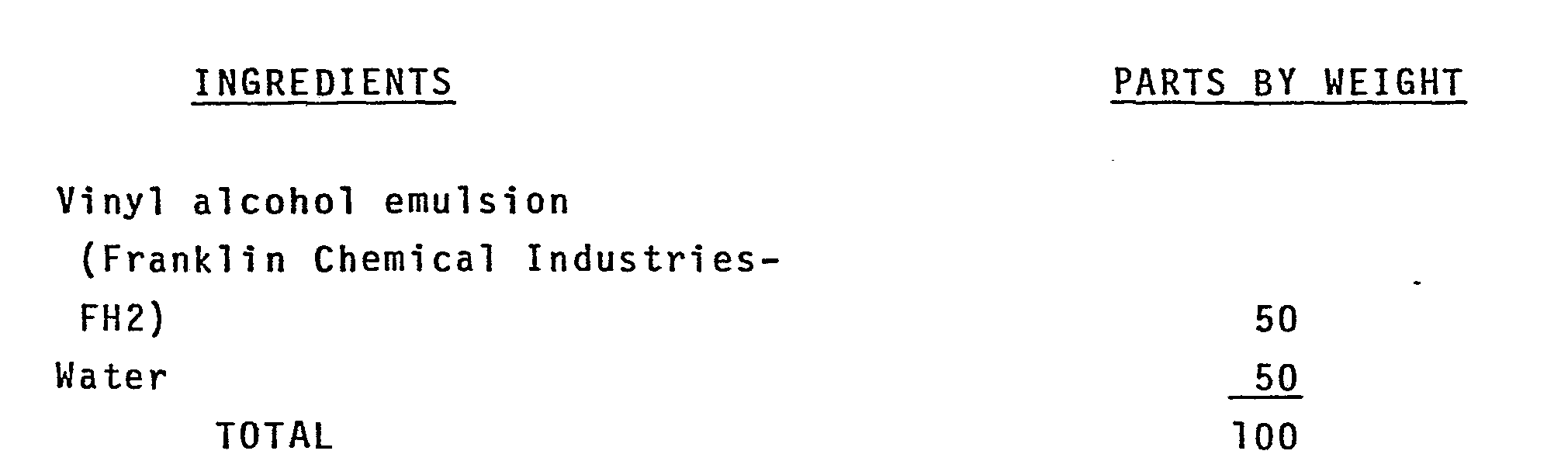
- A second formulation was prepared as follows:

- This invention may be embodied in other forms or carried out in other ways without departing from the spirit or essential characteristics thereof. The present disclosure is therefore to be considered as in all respects illustrative and not restrictive, the scope of the invention being indicated by the appended claims, and all changes which come within the meaning and range of equivalency are intended to be embraced therein.
Claims (11)
Priority Applications (1)
| Application Number | Priority Date | Filing Date | Title |
|---|---|---|---|
| AT82301189T ATE16823T1 (en) | 1981-03-11 | 1982-03-09 | PROCESS FOR MAKING A GLOSSY METALLIZED FOIL OR BOARD. |
Applications Claiming Priority (3)
| Application Number | Priority Date | Filing Date | Title |
|---|---|---|---|
| US11978280A | 1980-02-08 | 1980-02-08 | |
| US06/242,424 US4349402A (en) | 1980-02-08 | 1981-03-11 | Method for producing a bright metalized foil or board |
| US242424 | 1981-03-11 |
Publications (3)
| Publication Number | Publication Date |
|---|---|
| EP0062967A2 true EP0062967A2 (en) | 1982-10-20 |
| EP0062967A3 EP0062967A3 (en) | 1982-12-15 |
| EP0062967B1 EP0062967B1 (en) | 1985-12-04 |
Family
ID=26817690
Family Applications (1)
| Application Number | Title | Priority Date | Filing Date |
|---|---|---|---|
| EP19820301189 Expired EP0062967B1 (en) | 1980-02-08 | 1982-03-09 | Method for producing a bright metallized foil or board |
Country Status (2)
| Country | Link |
|---|---|
| US (1) | US4349402A (en) |
| EP (1) | EP0062967B1 (en) |
Cited By (5)
| Publication number | Priority date | Publication date | Assignee | Title |
|---|---|---|---|---|
| AU580725B2 (en) * | 1986-10-15 | 1989-01-27 | National Starch & Chemical Corporation | Method of manufacture of highly reflective metallized paper |
| EP0703009A1 (en) * | 1994-09-16 | 1996-03-27 | Alcan Deutschland Gmbh | Metallised multilayer coating and process for making it |
| US9416495B2 (en) | 2009-12-23 | 2016-08-16 | Arjo Wiggins Fine Papers Limited | Printable sheet that is ultra-smooth and recyclable, and its method of fabrication |
| US9648751B2 (en) | 2012-01-13 | 2017-05-09 | Arjo Wiggins Fine Papers Limited | Method for producing a sheet |
| EP2287011B1 (en) | 2004-04-30 | 2017-06-28 | Giesecke & Devrient GmbH | Security element and process for manufacturing it |
Families Citing this family (25)
| Publication number | Priority date | Publication date | Assignee | Title |
|---|---|---|---|---|
| US4535024A (en) * | 1982-11-01 | 1985-08-13 | Transfer Print Foils, Inc. | Gloss black metalized product and method of preparation |
| US4505768A (en) * | 1984-04-18 | 1985-03-19 | Champion International Corporation | Method of making a decorative heat resistant laminate |
| US4756856A (en) * | 1984-12-20 | 1988-07-12 | Polaroid Corporation | Method of and apparatus for forming surface of magnetic media |
| US4807745A (en) * | 1987-11-27 | 1989-02-28 | R. J. Reynolds Tobacco Company | Barrier sealed packages for cigarettes and other smoking articles |
| JP3052087B2 (en) * | 1989-02-17 | 2000-06-12 | ベル、ヘリカプタ、テクストロン、インコーパレイティド | Method of inspecting material using eddy current detector and method of protecting surface of uncured composite article sheet by protective backing |
| US5064692A (en) * | 1990-02-15 | 1991-11-12 | International Paper Company | Method for producing paper products having increased gloss in which surface characteristics of a release film are imparted to coated substrates |
| US5981011A (en) * | 1992-01-22 | 1999-11-09 | A*Ware Technologies, L.C. | Coated sheet material |
| US5320869A (en) * | 1992-12-04 | 1994-06-14 | Davidson Textron Inc. | Method for producing high gloss bright colored plastic articles |
| US6071621A (en) * | 1993-06-11 | 2000-06-06 | 3M Innovative Properties Company | Metallized film and decorative articles made therewith |
| US5751256A (en) * | 1994-03-04 | 1998-05-12 | Flexcon Company Inc. | Resonant tag labels and method of making same |
| US5464690A (en) * | 1994-04-04 | 1995-11-07 | Novavision, Inc. | Holographic document and method for forming |
| JP3552151B2 (en) * | 1998-07-21 | 2004-08-11 | セイコーエプソン株式会社 | Inkjet recording method using two liquids and apparatus using the same |
| US6136121A (en) * | 1998-09-25 | 2000-10-24 | Mitsubishi Chemical America, Inc. | Method and apparatus for separating and reclaiming trim from a lamination machine |
| US6224974B1 (en) | 1999-03-10 | 2001-05-01 | Consolidated Papers, Inc. | Water resistant, caustically removable coating, paper label and recyclable labeled glass bottle |
| US7935411B2 (en) | 2006-04-19 | 2011-05-03 | Furio Orologio | Metallized polymeric film reflective insulation material |
| US7935410B2 (en) | 2006-04-19 | 2011-05-03 | Furio Orologio | Metallized polymeric film reflective insulation material |
| US20100112307A1 (en) * | 2008-10-30 | 2010-05-06 | Gary Duncan | Metallized insulative labeling material |
| EP2812185B1 (en) * | 2012-02-07 | 2018-08-15 | Hazen Paper Company | Digitally receptive laminate construction and method of applying a digitally receptive coating to a substrate |
| AT15059U1 (en) * | 2015-06-30 | 2016-11-15 | Kisling Andreas | Method for producing a decorative element |
| CN108472972A (en) | 2015-12-28 | 2018-08-31 | 宝洁公司 | The method and apparatus on product is applied material to the transfering part of predistortion |
| US10086987B2 (en) | 2016-10-13 | 2018-10-02 | Altria Client Services Llc | Reseal label for box in a box re-sealable pack |
| US10124953B2 (en) | 2016-10-13 | 2018-11-13 | Altria Client Services Llc | Box in a box re-sealable cigarette pack |
| DE102018122212A1 (en) * | 2017-09-21 | 2019-03-21 | Mitsubishi Hitec Paper Europe Gmbh | Inkjet recording material with metallic look |
| CN111546759A (en) | 2019-02-12 | 2020-08-18 | 宝洁公司 | Method and apparatus for applying material to articles using a transfer member |
| US11752792B2 (en) | 2020-03-09 | 2023-09-12 | The Procter & Gamble Company | Method and apparatus for applying a material onto articles using a transfer component |
Family Cites Families (17)
| Publication number | Priority date | Publication date | Assignee | Title |
|---|---|---|---|---|
| US1944323A (en) * | 1929-12-30 | 1934-01-23 | Kilchling Karl | Coated metal foil and method of manufacture thereof |
| FR788987A (en) * | 1934-04-18 | 1935-10-21 | Aluminiumwerk Tscheulin G M B | Process for the manufacture of paper-metal or other similar materials |
| US3308004A (en) * | 1937-05-10 | 1967-03-07 | Rhone Poulenc Sa | Translucent panels having selective transmission and their manufacture |
| US2703772A (en) * | 1952-09-12 | 1955-03-08 | Minnesota Mining & Mfg | Transfer method for manufacturing infrared reflecting fabric |
| US3080270A (en) * | 1957-05-14 | 1963-03-05 | Heberlein Patent Corp | Process for making metallic pattern effects on sheet material |
| US3043728A (en) * | 1958-03-17 | 1962-07-10 | Nat Res Corp | Apparatus and process for metallic vapor coating |
| US3235395A (en) * | 1962-03-27 | 1966-02-15 | Walter G Scharf | Transfers for metallic coatings |
| US3463659A (en) * | 1965-10-22 | 1969-08-26 | Oxford Paper Co | Vacuum metallized paper |
| FR1539879A (en) * | 1967-08-08 | 1968-09-20 | Cellophane Sa | Metallization of fabrics by transfer |
| CA929041A (en) * | 1967-09-15 | 1973-06-26 | The Robinson Waxed Paper Company Limited | Processing of web material |
| US3730752A (en) * | 1970-09-29 | 1973-05-01 | A Garza | Method of metal coating a fibrous sheet |
| ES432725A1 (en) * | 1974-12-09 | 1977-04-01 | Complisa Sa | Process for producing a metallised surface on a support |
| US4012552A (en) * | 1975-03-10 | 1977-03-15 | Dennison Manufacturing Company | Decorative metal film heat transfer decalcomania |
| US4153494A (en) * | 1975-12-12 | 1979-05-08 | Enrique Vilaprinyo Oliva | Process for obtaining brightly metallized surfaces |
| DE2747241C2 (en) * | 1977-10-21 | 1986-03-20 | Helmuth 2058 Lauenburg Schmoock | Process for the production of a laminate combination |
| ES465638A1 (en) * | 1977-12-30 | 1978-10-01 | Complisa Sa | Procedure for the specular metalization of any support in bands and sheets. (Machine-translation by Google Translate, not legally binding) |
| US4250209A (en) * | 1978-05-10 | 1981-02-10 | Lurex B.V. | Transfer metallizing process and product produced thereby |
-
1981
- 1981-03-11 US US06/242,424 patent/US4349402A/en not_active Expired - Lifetime
-
1982
- 1982-03-09 EP EP19820301189 patent/EP0062967B1/en not_active Expired
Cited By (6)
| Publication number | Priority date | Publication date | Assignee | Title |
|---|---|---|---|---|
| AU580725B2 (en) * | 1986-10-15 | 1989-01-27 | National Starch & Chemical Corporation | Method of manufacture of highly reflective metallized paper |
| EP0703009A1 (en) * | 1994-09-16 | 1996-03-27 | Alcan Deutschland Gmbh | Metallised multilayer coating and process for making it |
| EP2287011B1 (en) | 2004-04-30 | 2017-06-28 | Giesecke & Devrient GmbH | Security element and process for manufacturing it |
| US9416495B2 (en) | 2009-12-23 | 2016-08-16 | Arjo Wiggins Fine Papers Limited | Printable sheet that is ultra-smooth and recyclable, and its method of fabrication |
| US9648751B2 (en) | 2012-01-13 | 2017-05-09 | Arjo Wiggins Fine Papers Limited | Method for producing a sheet |
| EP2802711B1 (en) | 2012-01-13 | 2017-10-25 | Arjo Wiggins Fine Papers Limited | Method for producing a sheet |
Also Published As
| Publication number | Publication date |
|---|---|
| EP0062967B1 (en) | 1985-12-04 |
| EP0062967A3 (en) | 1982-12-15 |
| US4349402A (en) | 1982-09-14 |
Similar Documents
| Publication | Publication Date | Title |
|---|---|---|
| EP0062967B1 (en) | Method for producing a bright metallized foil or board | |
| US4473422A (en) | Metalized paper or board product and method of preparation | |
| US4215170A (en) | Metallization process | |
| US4012552A (en) | Decorative metal film heat transfer decalcomania | |
| US2303395A (en) | Method of making decorated material | |
| US4177314A (en) | Method of printing paper | |
| CA1176553A (en) | Method for producing a bright metalized foil or board | |
| US5441761A (en) | Method for the partial metallization of a substrate | |
| JPS6189899A (en) | Transfer sheet and manufacture of decorative material using said sheet | |
| US2647848A (en) | Lettering film | |
| US5888623A (en) | Sanitary article or plumbing fitting with a coated surface and a print image applied thereto and a process for making the same | |
| US1376737A (en) | Paper material coated with leaf metal | |
| JP2001145980A (en) | Surface protection sheet and decorative substrate | |
| JPH0284327A (en) | Preparation of metal decorative panel having gloss changeable pattern | |
| JPH0241034B2 (en) | ||
| JP2996430B2 (en) | Aluminum deposited layer transfer film | |
| EP0042759A1 (en) | Process for powder coating substrates | |
| KR100319233B1 (en) | Stamping foil | |
| KR100258725B1 (en) | Stamping foil | |
| NO784412L (en) | PROCEDURE FOR METALIZATION OF PATH OR PLATE SHAPE CARRIERS | |
| JPS5940776B2 (en) | Decorative glass manufacturing method | |
| JP3062323B2 (en) | Manufacturing method of decorative sheet | |
| JPS60240450A (en) | Decorative metallic plate | |
| KR100319234B1 (en) | Hot stamping foil | |
| JPH0114479Y2 (en) |
Legal Events
| Date | Code | Title | Description |
|---|---|---|---|
| PUAI | Public reference made under article 153(3) epc to a published international application that has entered the european phase |
Free format text: ORIGINAL CODE: 0009012 |
|
| PUAL | Search report despatched |
Free format text: ORIGINAL CODE: 0009013 |
|
| AK | Designated contracting states |
Designated state(s): AT BE CH DE FR GB IT LU NL SE |
|
| AK | Designated contracting states |
Designated state(s): AT BE CH DE FR GB IT LI LU NL SE |
|
| 17P | Request for examination filed |
Effective date: 19830603 |
|
| ITF | It: translation for a ep patent filed | ||
| GRAA | (expected) grant |
Free format text: ORIGINAL CODE: 0009210 |
|
| AK | Designated contracting states |
Designated state(s): AT BE CH DE FR GB IT LI LU NL SE |
|
| REF | Corresponds to: |
Ref document number: 16823 Country of ref document: AT Date of ref document: 19851215 Kind code of ref document: T |
|
| ET | Fr: translation filed | ||
| REF | Corresponds to: |
Ref document number: 3267741 Country of ref document: DE Date of ref document: 19860116 |
|
| PG25 | Lapsed in a contracting state [announced via postgrant information from national office to epo] |
Ref country code: LU Free format text: LAPSE BECAUSE OF NON-PAYMENT OF DUE FEES Effective date: 19860331 |
|
| PGFP | Annual fee paid to national office [announced via postgrant information from national office to epo] |
Ref country code: LU Payment date: 19860411 Year of fee payment: 5 |
|
| PLBE | No opposition filed within time limit |
Free format text: ORIGINAL CODE: 0009261 |
|
| STAA | Information on the status of an ep patent application or granted ep patent |
Free format text: STATUS: NO OPPOSITION FILED WITHIN TIME LIMIT |
|
| 26N | No opposition filed | ||
| PGFP | Annual fee paid to national office [announced via postgrant information from national office to epo] |
Ref country code: AT Payment date: 19870312 Year of fee payment: 6 |
|
| PGFP | Annual fee paid to national office [announced via postgrant information from national office to epo] |
Ref country code: NL Payment date: 19870331 Year of fee payment: 6 |
|
| PG25 | Lapsed in a contracting state [announced via postgrant information from national office to epo] |
Ref country code: GB Effective date: 19890309 Ref country code: AT Effective date: 19890309 |
|
| PG25 | Lapsed in a contracting state [announced via postgrant information from national office to epo] |
Ref country code: SE Effective date: 19890310 |
|
| PG25 | Lapsed in a contracting state [announced via postgrant information from national office to epo] |
Ref country code: LI Effective date: 19890331 Ref country code: CH Effective date: 19890331 Ref country code: BE Effective date: 19890331 |
|
| BERE | Be: lapsed |
Owner name: TRANSFER PRINT FOILS INC Effective date: 19890331 |
|
| PG25 | Lapsed in a contracting state [announced via postgrant information from national office to epo] |
Ref country code: NL Effective date: 19891001 |
|
| GBPC | Gb: european patent ceased through non-payment of renewal fee | ||
| NLV4 | Nl: lapsed or anulled due to non-payment of the annual fee | ||
| PG25 | Lapsed in a contracting state [announced via postgrant information from national office to epo] |
Ref country code: FR Free format text: LAPSE BECAUSE OF NON-PAYMENT OF DUE FEES Effective date: 19891130 |
|
| REG | Reference to a national code |
Ref country code: CH Ref legal event code: PL |
|
| PG25 | Lapsed in a contracting state [announced via postgrant information from national office to epo] |
Ref country code: DE Effective date: 19891201 |
|
| REG | Reference to a national code |
Ref country code: FR Ref legal event code: ST |
|
| EUG | Se: european patent has lapsed |
Ref document number: 82301189.5 Effective date: 19900124 |