EP0063035A1 - Gerät und Verfahren zum Beködern von Haken für Langleinen-Fischzeug - Google Patents
Gerät und Verfahren zum Beködern von Haken für Langleinen-Fischzeug Download PDFInfo
- Publication number
- EP0063035A1 EP0063035A1 EP82301848A EP82301848A EP0063035A1 EP 0063035 A1 EP0063035 A1 EP 0063035A1 EP 82301848 A EP82301848 A EP 82301848A EP 82301848 A EP82301848 A EP 82301848A EP 0063035 A1 EP0063035 A1 EP 0063035A1
- Authority
- EP
- European Patent Office
- Prior art keywords
- bait
- separator
- receptacle
- hook
- groundline
- Prior art date
- Legal status (The legal status is an assumption and is not a legal conclusion. Google has not performed a legal analysis and makes no representation as to the accuracy of the status listed.)
- Withdrawn
Links
- 238000000034 method Methods 0.000 title claims abstract description 18
- 241000251468 Actinopterygii Species 0.000 claims description 26
- 238000013016 damping Methods 0.000 claims description 6
- 230000002708 enhancing effect Effects 0.000 claims description 4
- 230000000452 restraining effect Effects 0.000 claims description 4
- 235000019688 fish Nutrition 0.000 description 22
- 238000003860 storage Methods 0.000 description 8
- 229910052782 aluminium Inorganic materials 0.000 description 7
- XAGFODPZIPBFFR-UHFFFAOYSA-N aluminium Chemical compound [Al] XAGFODPZIPBFFR-UHFFFAOYSA-N 0.000 description 7
- 239000004411 aluminium Substances 0.000 description 6
- 238000010276 construction Methods 0.000 description 5
- 229910001220 stainless steel Inorganic materials 0.000 description 5
- 239000010935 stainless steel Substances 0.000 description 5
- 239000000463 material Substances 0.000 description 4
- 241000221484 Tilletiaceae Species 0.000 description 3
- 230000008901 benefit Effects 0.000 description 3
- 230000015556 catabolic process Effects 0.000 description 3
- 229910052751 metal Inorganic materials 0.000 description 3
- 239000002184 metal Substances 0.000 description 3
- 229920003023 plastic Polymers 0.000 description 3
- 230000008439 repair process Effects 0.000 description 3
- 241000252203 Clupea harengus Species 0.000 description 2
- 230000007797 corrosion Effects 0.000 description 2
- 238000005260 corrosion Methods 0.000 description 2
- 235000019514 herring Nutrition 0.000 description 2
- 230000007246 mechanism Effects 0.000 description 2
- 230000008569 process Effects 0.000 description 2
- 241000238366 Cephalopoda Species 0.000 description 1
- 241000238413 Octopus Species 0.000 description 1
- 241001417527 Pempheridae Species 0.000 description 1
- 241000269980 Pleuronectidae Species 0.000 description 1
- 238000005266 casting Methods 0.000 description 1
- 230000008859 change Effects 0.000 description 1
- 230000000694 effects Effects 0.000 description 1
- 229920002457 flexible plastic Polymers 0.000 description 1
- 230000009191 jumping Effects 0.000 description 1
- 230000000670 limiting effect Effects 0.000 description 1
- 238000004519 manufacturing process Methods 0.000 description 1
- 230000007935 neutral effect Effects 0.000 description 1
- 230000002829 reductive effect Effects 0.000 description 1
- 230000000284 resting effect Effects 0.000 description 1
- 230000002441 reversible effect Effects 0.000 description 1
- 230000001932 seasonal effect Effects 0.000 description 1
- 230000000087 stabilizing effect Effects 0.000 description 1
- XLYOFNOQVPJJNP-UHFFFAOYSA-N water Substances O XLYOFNOQVPJJNP-UHFFFAOYSA-N 0.000 description 1
Images




Classifications
-
- A—HUMAN NECESSITIES
- A01—AGRICULTURE; FORESTRY; ANIMAL HUSBANDRY; HUNTING; TRAPPING; FISHING
- A01K—ANIMAL HUSBANDRY; AVICULTURE; APICULTURE; PISCICULTURE; FISHING; REARING OR BREEDING ANIMALS, NOT OTHERWISE PROVIDED FOR; NEW BREEDS OF ANIMALS
- A01K91/00—Lines
- A01K91/18—Trotlines, longlines; Accessories therefor, e.g. baiting devices, lifters or setting reelers
Definitions
- This invention is directed to a novel apparatus and method for semi-automatically baiting the hooks of long-line used in commercial deep sea fishing.
- Long-line gear used in commercial fishing consists of a ground-line that is laid out along the ocean floor and anchored in place at each end. Leaders with baited hooks are attached at intervals along the ground-line. The gear is left on the ocean floor for sufficient time to attract fish, then is hauled back to the boat where the fish are removed and the gear stored. Baiting of the hooks is now done either by hand or by devices available on the market.
- the two main types of long-line gear in use are either fixed gear or snap gear. Both are set out simply by fixing an anchor to one end, casting it off astern and driving the boat away.
- the leaders are tied permanently to the ground- line and either are stored in long racks (2.5 to 4m.) with the hooks on the rack and the ground-line hanging in bunts, or are coiled into tubs with the leaders lain across the coil. This latter procedure requires skill, and is prone to fouling.
- the MUSTAD (Godo) system uses a baiting box that aligns single pieces of precisely cut bait into the path of a hook that also is carefully aligned so that the hook pierces the bait at the strongest spot (through the spine). Although this baits the hook firmly, the heads and tails of the bait fish must be thrown away as they do not fit the aligning mechanism. This represents a loss of approximately 15% of the bait weight. Also, the precision of alignment requires a complex mechanism that is costly, is prone to breakdown, and is limited to expensive herring bait. Also, since MUSTAD uses fixed gear hung in racks, the broken leaders must be replaced each time the gear is hauled and stored, otherwise the bunts of ground-line would hang too low and get fouled.
- MARCO also uses fixed gear, but it is stored on spoked reels. This feature allows a broken leader to go unreplaced as the ground-line is coiled on the hub of the reel and the gear can be worked without fouling even with gaps in the hook spacing. However, this means the gaps where hooks are missing do not catch fish and as the gear is used over and over, more hooks would be lost continually. Therefore, the MARCO gear can be stored and set without replacing broken leaders, but it is not desirable. So the same problem as MUSTAD exists, ie. the hauling process must be frequently halted to repair leaders.
- MARCO uses a bait-box or hopper wherein the ground-line passes above the bait and the leaders hang down. They show the leader occupying a path angled downward about 30° from the ground-line. In fact, this is believed impossible since the leader will follow the ground-line in a parallel path since nothing holds the free end of the leader away from the ground-line once it is into the bait.
- MARCO passes the ground-line above the bait, so that the hook follows upwards, thereby pulling against the bait towards the open top of the hopper.
- the entry and exit sides of the bait box are made of metal, with a slotted entry, causing the problem of hooks catching and blunting their points.
- MARCO because of its metal entry and exit to the hopper is necessarily limited to a narrow range of hook sizes.
- MARCO in using reels, is somewhat more compact than the MUSTAD system, needing a boat of 14 metresor more.
- the reels must be carried from the coiling stand to the setting stand, and they are heavy. This represents extra labour. Also because of their reel system, only two skates may be used to form a string.
- Andrews shows only a baiting device, and nothing for hauling or storing the gear. His baiter is of a type similar to MUSTAD in that it aligns a single bait-piece into the path of a hook that is also carefully aligned, therefore requiring many moving parts that are carefully made. This unit is expensive to manufacture and maintain.
- My system uses a hopper or bait-box wherein the pre-cut bait is disposed in large quantities (22.5 kg or more).
- the hooks are drawn through the midst of this mass of bait chunks. Heads and tails may be used, as can squid, octopus or any other fish that can be cut into chunks. It is not limited to precisely-cut expensive herring chunks. It can use oddly shaped and amorphous pieces of bait material. Also, since the bait-box is simple in construction, the likelihood of breakdown is greatly reduced, as is the initial cost.
- My system using detachable snap-on type leaders, avoids hauling interruptions because it allows broken leaders to be put aside and repaired off the boat. Thus the hauling, can continue uninterrupted and time at sea can be spent fishing.
- the ground-line is passed behind a separator which can be a tube positioned in or fixed to the bottom of the bait receptacle, or mounted or positioned in some other relationship with the bait receptacle.
- the function of the separator is to separate the ground-line and the end of the leader attached to the ground-line from the bait in the bait receptacle.
- the hook end of the leader passes through an elongated slot in the separator. The hook is released from a hook-holder and is released into the bait mass.
- My system can be operated single handedly, since only one man is needed to remove the leaders, with or without fish, as they come up to the rail.
- the ground-line needs no attention as it spools onto a drum. This is an advantage because many small boat longliners already work alone and would welcome a baiter suitable for their operation. This is the only automatic baiting system that can be worked by one man alone.
- flat brushes (as used in an industrial sweeper) form the entry and exit sites.
- the brushes are firm enough to contain the bait and keep it from falling out the ends of the bait-box, but flexible enough to allow the ground-line, leader, snap and hook to pass freely through them. Also, the brushes are soft and cannot damage the hooks, lines or bait.
- My system in using a separate, stationary drum for ground-line, and separate, portable racks for leaders, is most compact, fitting easily onto a 7.5 metre boat. This is a great advantage because'most fishermen engaged in traditional longlining have small boats of about 9 metres.
- the apparatus may include a separator which has therein a slot extending substantially from one end of the separator to the other.
- the apparatus may include a holder for fish hooks located in line with the receptacle and the separator.
- the apparatus may include a bait catching receptacle located in line with the bait receptacle on the end opposite the end of the bait receptacle proximate to the hook-holder, the bait catching receptacle having therein a slotted separator extension that is aligned with the separator associated with the bait receptacle.
- the apparatus may include a groundline fair lead located proximate to the end of the hook-holder removed from the receptacle and separator.
- the apparatus may include a bait catching receptacle located in line with the bait receptacle on the end opposite the end of the bait receptacle proximate to the hook-holder, the separator being disposed within the bait receptacle, the bait catching receptacle having therein a slotted separator extension that is aligned with the separator in the bait receptacle, and the separator extension including damping means for preventing hooks from swinging under the separator extension.
- the damping means may be a perpendicular plate located under the separator extension and extending substantially the length of the separator extension.
- the hook-holder may extend over the bait receptacle.
- the apparatus may include a fair-lead for supporting the weight of and guiding the longline which is located at the end of the apparatus proximate to the hook-holder, and a wear-plate for supporting the weight of and guiding the longline which is located at the end of the apparatus opposite to the fair-lead.
- the invention is directed to a method of baiting the hooks of longline for deep sea fishing comprising moving the groundline for the longline past a bait-groundline separator positioned in association with a receptacle holding pieces of bait and periodically attaching fish hook leaders comprising attaching means, gangion and fish hook to the moving groundline so that the portion of the leader attaching to the groundline passes through the bait-groundline separator, and a portion of the gangion and the fish hook extends beyond the separator whereby the hook by means of movement of the groundline embeds itself in one of the pieces of bait and thereby becomes baited.
- the leaders are stored on a hook holder which orients and positions the hooks for enhancing the bait hooking ability of the hooks, and orients the leader for enhancing the attachment of the leader attachment means to the groundline.
- the groundline and the attached leaders after the hooks thereof become baited by passing through the bait holding receptacle, pass through a separator extension that is axially aligned with the bait-groundline separator and is disposed in association with a receptacle that retains any bait that may fall off the baited hooks.
- baited hook damping means are positioned in association with the separator extension for preventing the baited hooks from swinging freely or becoming entangled with the groundline or the bait catching receptacle.
- groundline fair-lead means are used for supporting the weight of and guiding the groundline by the hook holding means and into the bait-groundline separator, and wearplate means are used to support the weight of and guide the groundline from the bait catching receptacle.
- the semi-automatic long line baiter consists of a table 1, with stabilizing legs 2 at each end, a fairlead 3 at one end, a hook holder 4 (for holding the hook, fastened to the gangion, swivel and snap, all of which collectively are called a leader 16), a slider 5, a plastic spring 6 (not shown in FIGURE 1), a bracket 7, and a notched plate 8 located above the table 1 and the fairlead 3 end, a bait box 9, a set of brushes 10, a hopper 11, a separator 12 (partially concealed from view in FIGURE 1) located in the middle of the table 1, a bait catcher 13 located at the end of the table 1 opposite the fairleads 3, and a storage rack 14 with a bar-like hook holder 4.
- the hook holder 4 may be made of a piece of stainless steel pipe, 6 mm inner diameter X 12 mm outer diameter, for corrosion resistance, with two stainless steel washers welded in place at the left end to keep it in place in the baiter or in the storage rack 14.
- the slider 5 may be made of a piece of 12mmouter diameter stainless steel round bar,0.4 metres long, the left end having a spigot turned onto it so that it will fit easily into the end of the hook holder 4, keeping the right hand end of the holder in place on the baiter. It also extends into the bait box 9 for a certain distance, to allow the hooks to slide easily along the hook holder 4, onto the slider 5, then well into the bait box 9. In this way, the hooks drop into the bait box 9, well away from the walls, thereby eliminating the chance of the hooks becoming caught on the walls of the bait box 9.
- The.plastic spring 6 (shown in FIGURE 2) is typically held in a metal bracket above the hook holder 4 and slider 5 to exert a firm downwardly pressure on the hooks hung on the holder 4, thereby preventing the hooks from jumping off when sliding along the holder 4 and slider 5.
- the bracket 7 may be made of aluminium and bolted to the table 1 to hold the assembled hook holder 4, plastic spring 6 and slider 5 in position.
- the notched plate 8 can be constructed of aluminium and is typically welded to the upper, front, left surface of the bracket 7 to hold the left hand end of the hook holder 4 in place (as seen in FIGURE 1).
- the bait box 9 can also be made of aluminium typically 3 min in thickness and approximately 150 mm wide, 355 mm high, and 508 mm long.
- the bait box 9 is designed to contain a mass of pre-cut bait, through which the hooks will pass.
- the brushes 10 may consist of four sections of industrial-sweeper brushes approximately lO mm thick, 125 mm wide and 355 mm long. These are set in slots at the ends of the bait box 9 to hold the bait in the bait box 9, yet allow the hooks and lines to pass through.
- the separator 12 is preferably made of 16 gauge stainless steel sheet for corrosion resistance. It may be fastened to the bottom of the bait box 9 and is flared at the left hand end to encourage entry of the leader 16. It is slotted along the top in order to permit part of the leader 16 and the hook to extend into the bait in the bait box 9 while conveying the ground-line 15 and attachment through the bait without contacting the bait. This prevents damage to the bait by contact of the bait with the attachment, the ground-line 15, and any knots that may exist.
- the bait catcher 13 can be made of 20 gauge stainless steel sheet. It extends fcom the right hand end of the bait box 9 (as seen in FIGURE 1) to the end of the table 2 and is sloped to allow excess bait to fall back into a basket (not shown). It also contains an extension 25 to the separator 12 that in effect continues the separator 12 to the right hand end of the bait catcher 13 (as seen in FIGURE 1). The walls 25a of the separator extension 25 extend to the floor of the bait catcher 13 so as to prevent the passing hooks, with bait on them, swinging freely underneath the extension 25 and becoming tangled or running under the groundline thereby preventing knocking the bait off the hooks.
- the storage rack 14 can also be made of aluminium. It is preferably flanged at the sides and is notched along the top to hold the hook holders 4.
- FIGURE 2 depicts a side elevation view of the baiter.
- the fairleads 3 are mounted at one end of the table 1.
- the hook holder 4 is mounted above and to the right of the fairleads 3 in association with slider 5, spring 6, bracket 7 and notched plate 8. These lead into the bait box 9, which in turn lead into the bait catcher 13.
- the slider 5 extends out over the bait box 9 to ensure that the hooks drop into the mid-region of the bait box so that the hooks will not catch on the walls of the bait.box 9.
- FIGURE 3 represents a top elevation view of the baiter, with fairleads 3, hook holder 4, slider 5, bracket 7, notched plate 8, bait box 9 and brushes 10.
- This view shows. in good detail the separator 12 which extends in line with and connects to extension 25, thereby providing a continuous aligned passage through bait box 9 and bait catcher 13.
- This view also shows the position of wear plate 24, which is secured to the end of extension 25.
- the wear plate 24 (to be discussed in greater detail in association with FIGURES 20, 20a and 20b) provides a wearing and bearing surface for the ground-line 15 which under operating conditions exerts a substantial force (hundreds of pounds) on the end of extension 25.
- FIGURE 4 illustrates a partially cut-away side view of the baiter which demonstrates the manner in which a ground-line 15 is threaded through the fairleads 3, under the hook holder 4, through separator 12 of the bait box 9 and finally through the extension 25 and bait catcher 13.
- the leader 16 of the hooks 17 that are hung on the hook holder 4 are attached by a suitable attaching device onto the travelling ground-line 15 periodically at desired intervals.
- FIGURE 4 shows in sequence how the hook 17 is pulled off the end of the slider 5 (well over the bait box 9) and after picking up bait from the bait box 9, passes through the bait catcher 13.
- FIGURE 5 represents an exploded perspective view of the principal components that make up the baiter, and the manner in which they are assembled, namely the hook holder 4, the slider 5, the spring 6,. the notched plate 8, the bait box 9 (with brushes 10 and separator 12) and the bait catcher 13 also with extension 25, with support walls 25a. Also shown is the hopper 11, which fits partially within the bait box 9.
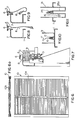
- FIGURES 6 and 6a represent detailed front and top elevation views of the brushes 10 with bristles and their manner of construction.
- the bristles 10b are clamped into linear U-shaped spines 10a.
- FIGURE 12 represents an end elevation view of the baiter taken from the end opposite the fairleads 3. It shows the table 1, legs 2, slider 5, spring 6, brushes 10, extension 25, bait catcher 13, and wearplate 24.
- FIGURE 13 illustrates a detailed view of the preferred manner in which the hook 17 is held onto the hook holder 4 by the flexible plastic 6 which is attached to the bracket 7, the leader 16 hanging by means of the hook 17.
- FIGURE 14 demonstrates how the hook and leader 16 can be hung in reverse on the hook holder 4, with the spring 6 and bracket 7.
- FIGURE 15 illustrates the make-up of typical long-line leader fishing gear.
- the leader 16 is collectively made up of a fish hook 17, which is connected to a gangion 18, which by means of a swivel 19, is connected to the attachment 20.
- the attachment 20 is manually attached to the ground- line 15, which, after baiting of the hooks, is laid out along the ocean floor.
- the ground-line 15 may be made of 6.5 mm or 8 mm diameter woven rope.
- the gangion 18 may be a piece of strong cord or monofilament, braided or twisted.
- the ground-line 15 is wound up on or dispensed from a drum 22, hydraulically powered, that pays out the ground-line 15 when it is being laid on the ocean floor and hauls it in when the ground line 15 is wound onto the drum 22 and stored for future use.
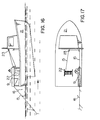
- FIGURES 16 and 17 depict respectively, by means of side and top elevation views, the way in which long-line as baited with the semi-automatic baiter is set out from a fishing boat 21 using drum 22 and pulleys 23.
- FIGURES 18 and 19 illustrate respectively, by means of side and top elevation views, the way in which the long-line with hooked fish is hauled into the fishing boat 21.
- the ground-line 15, when hauling in, bypasses the baiter and is wound directly onto the drum 22.
- FIGURES 20, 20a and 20b illustrate in detail the construction of the wearplate 24 which is secured by some suitable means to the end of the extension 25.
- the wearplate is designed to conform with the shape of the extension 25 and is readily replaceable.
- the wearplate 24 is designed to withstand this force and to provide a smooth replaceable wearing and bearing surface over which the ground-line 15 and the attachments 20 can pass.
- the leaders 16 are stored on the hook holders 4 and the hook holders 4 are stored in the storage rack 14.
- the ground-line 15 and the buoy line are coiled onto the drum 22.
- the anchors and buoys are arrayed at the after rail of the boat 21.
- the bait is cut into buckets, and some is poured into the hopper 11 filling the bait box 9 and the hopper 11.
- the clutch on the drum 22 is then put into neutral, allowing it to freewheel.
- the end of the buoy is seized at the drum 22 and is led through the snatch blocks, then back to the baiter where it is passed round the fairleads 3 and threaded through the tube 12 until it can be seized at the after end of the bait catcher 9.
- Some slack is pulled through, and the buoy line is tied to the buoy and flagpole. The gear is then ready to set.
- the boat 21 is set in motion forward and the buoy and flagpole are cast away astern. Their drag in the water pulls the buoy line off the drum 22 and away from the boat 21. When the buoy line is entirely pulled out, the drum 22 is braked and the line is stopped. The buoy line is tied to the ground-line 15 when stored on the drum 22, so it will have pulled the free end of the ground-line 15 through the blocks, fairleads 3 and tube 12 until it is visible at the aft end of the eaiter. At this point, the anchor is tied onto the ground-line 15 and is also cast away astern.
- the operator takes the far right hand leader 16 by the attachment 20 with his right hand, attaches the attachment 20 to the ground-line 15, and then quickly removes his hand.
- the moving line 15 carries the attachment 20 away into the separator 12 pulling the leader 16 with hook 17 along the holder 4 and slider 5 and through the brushes 10 into the bait box 9.
- the hook 17 falls off the end of the slider 5 and in dragging through the bait, barb-forward, randomly spears a chunk of bait in its path.
- the brushes 10 exert a gentle pressure that sets the bait on the hook 17 and pulls off only lightly hooked pieces.
- the attachment 20 and ground-line 15 continue along in the separator 12 and when the gangion 18 and hook 17 pull through the brushes 10, they carry other loose chunks of bait with them. These fall to the sloped floor of the bait catcher 13 and tumble back into a basket for re-use.
- the end of the leader 16 with the baited hook 17 protrudes up through the slot on top of the separator 12 and hangs down along the side of the separator 12, and subsequently the extension 25.
- the distance from the top of the slot to the bottom of the catcher 13 at the far right end is greater than the length of the leader 16 that is protruding. This is so the baited hook 17 will not hit the edge as it leaves the boat. This reduces bait loss. At this point, the leader 16 leaves the baiter and the boat 21 and, remaining attached to the ground-line 15, falls to the ocean floor.
- the boat operator searches for the flagpoles, and comes alongside one of them. He seizes it and pulls it on board.
- the buoy and flagpole are untied and stowed away at the stern rail.
- the free end of the buoy line is then passed through the blocks and tied to the free end of the line coiled on the drum 22.
- the drive clutch of the drum 22 is engaged and the hydraulic motor started. Coiling in the buoy line begins.
- the anchor pulls up from the bottom, bringing with it the ground-line 15 and any fish that have taken the hooks.
- the drum 22 is stopped, the anchor is untied and stowed aft, and the drum 22 restarted.
Landscapes
- Life Sciences & Earth Sciences (AREA)
- Environmental Sciences (AREA)
- Animal Husbandry (AREA)
- Biodiversity & Conservation Biology (AREA)
- Mechanical Means For Catching Fish (AREA)
- Meat, Egg Or Seafood Products (AREA)
Applications Claiming Priority (2)
| Application Number | Priority Date | Filing Date | Title |
|---|---|---|---|
| CA375164 | 1981-04-10 | ||
| CA000375164A CA1153551A (en) | 1981-04-10 | 1981-04-10 | Apparatus and method for baiting long-line fishing gear |
Publications (1)
| Publication Number | Publication Date |
|---|---|
| EP0063035A1 true EP0063035A1 (de) | 1982-10-20 |
Family
ID=4119704
Family Applications (1)
| Application Number | Title | Priority Date | Filing Date |
|---|---|---|---|
| EP82301848A Withdrawn EP0063035A1 (de) | 1981-04-10 | 1982-04-07 | Gerät und Verfahren zum Beködern von Haken für Langleinen-Fischzeug |
Country Status (5)
| Country | Link |
|---|---|
| US (1) | US4477992A (de) |
| EP (1) | EP0063035A1 (de) |
| JP (1) | JPS5915602B2 (de) |
| CA (1) | CA1153551A (de) |
| NO (1) | NO820203L (de) |
Cited By (3)
| Publication number | Priority date | Publication date | Assignee | Title |
|---|---|---|---|---|
| WO1988001832A1 (fr) * | 1986-09-12 | 1988-03-24 | Lefebvre Gerard A | Procedes et dispositifs pour relier des avançons a une ligne de peche et pour haler ou devider ladite ligne |
| WO1991016817A1 (en) * | 1990-01-16 | 1991-11-14 | Soerensen Trondur Fridrik | Apparatus for setting and hauling long fishing lines |
| WO1999003338A1 (en) * | 1997-07-14 | 1999-01-28 | Poul Bachmann Rasmussen | Method for baiting hooks on long line, method for hauling up long line with hooks, and apparatus for use by each of the methods |
Families Citing this family (15)
| Publication number | Priority date | Publication date | Assignee | Title |
|---|---|---|---|---|
| US4648193A (en) * | 1985-04-19 | 1987-03-10 | Marco Seattle, Inc. | Circle hook baiter |
| US4644677A (en) * | 1985-09-30 | 1987-02-24 | Societe Anonyme Recherche, Montage, Production "Polylignes" | Baiting machine for trawl line fishing using entire fishes |
| US4787165A (en) * | 1987-07-08 | 1988-11-29 | Marco Seattle, Inc. | Artificial bait feeding apparatus |
| US4896449A (en) * | 1989-07-25 | 1990-01-30 | Hopper James H | Automatic fishhook baiting system |
| CN1060610C (zh) * | 1994-03-10 | 2001-01-17 | 科尔比约恩·比约斯霍尔 | 用于将鱼钩送至挂饵机的装置 |
| DK0755183T3 (da) * | 1994-03-10 | 1999-06-07 | Kolbjoern Bjirshol | Apparat til at overføre fiskekroge, især løse fiskekroge, til en maddingsmaskine |
| WO1995024122A1 (en) * | 1994-03-10 | 1995-09-14 | Bjorshol Kolbjorn | Apparatus for conveying fish hooks, especially loose fish hooks, to a baiting machine |
| JP3367582B2 (ja) * | 1995-02-24 | 2003-01-14 | 本田技研工業株式会社 | 車両の動力伝達装置 |
| NO302501B1 (no) * | 1996-05-06 | 1998-03-16 | Mustad & Soen As | Fremgangsmate og egnemaskin til egning av fiskekroker |
| US5813165A (en) * | 1997-05-06 | 1998-09-29 | Dougherty, Sr.; Franklin Wayne | Biodegradable snake trap |
| US8109033B1 (en) | 2011-06-02 | 2012-02-07 | Allyn M David | Automatic precision baiting device |
| KR102176956B1 (ko) * | 2018-12-27 | 2020-11-10 | 한권석 | 주낙용 원줄 제조 장치 |
| KR102626809B1 (ko) * | 2021-08-26 | 2024-01-18 | 전민성 | 자동 챔질 기능을 갖는 낚시용 수중 찌 |
| KR102636610B1 (ko) * | 2021-09-02 | 2024-02-22 | 주식회사 포엠 | 주낙용 연속 투승장치 |
| US20230135857A1 (en) * | 2021-11-04 | 2023-05-04 | Joel Denny | Mechanism For Baiting Bags On A Trotline |
Citations (3)
| Publication number | Priority date | Publication date | Assignee | Title |
|---|---|---|---|---|
| US3377733A (en) * | 1965-09-21 | 1968-04-16 | Godo Einar | Machine for handling a halibut long line and the like |
| US4015359A (en) * | 1975-07-18 | 1977-04-05 | Donald Andrews | Hook baiting machine |
| GB2016881A (en) * | 1978-03-28 | 1979-10-03 | Jacobsen K N | Method and apparatus for baiting hooks |
Family Cites Families (5)
| Publication number | Priority date | Publication date | Assignee | Title |
|---|---|---|---|---|
| US28380A (en) * | 1860-05-22 | Fire-escape | ||
| USRE28380E (en) | 1969-08-22 | 1975-04-01 | Fish like reeling and baiting apparatus | |
| US3841011A (en) * | 1973-04-30 | 1974-10-15 | Marine Constr & Design Co | Long-line setting, baiting and hauling system and apparatus |
| GB1562116A (en) * | 1977-09-15 | 1980-03-05 | White Fish Authority | Fishing method and equipment |
| US4250648A (en) * | 1979-03-26 | 1981-02-17 | Jacobsen Kevin N | Apparatus for use in fishing |
-
1981
- 1981-04-10 CA CA000375164A patent/CA1153551A/en not_active Expired
-
1982
- 1982-01-22 NO NO820203A patent/NO820203L/no unknown
- 1982-02-08 US US06/346,901 patent/US4477992A/en not_active Expired - Fee Related
- 1982-04-07 EP EP82301848A patent/EP0063035A1/de not_active Withdrawn
- 1982-04-09 JP JP57058411A patent/JPS5915602B2/ja not_active Expired
Patent Citations (3)
| Publication number | Priority date | Publication date | Assignee | Title |
|---|---|---|---|---|
| US3377733A (en) * | 1965-09-21 | 1968-04-16 | Godo Einar | Machine for handling a halibut long line and the like |
| US4015359A (en) * | 1975-07-18 | 1977-04-05 | Donald Andrews | Hook baiting machine |
| GB2016881A (en) * | 1978-03-28 | 1979-10-03 | Jacobsen K N | Method and apparatus for baiting hooks |
Cited By (4)
| Publication number | Priority date | Publication date | Assignee | Title |
|---|---|---|---|---|
| WO1988001832A1 (fr) * | 1986-09-12 | 1988-03-24 | Lefebvre Gerard A | Procedes et dispositifs pour relier des avançons a une ligne de peche et pour haler ou devider ladite ligne |
| US4825585A (en) * | 1986-09-12 | 1989-05-02 | Lefebvre Gerard A | Method and apparatus for connecting leaders to a fishing line |
| WO1991016817A1 (en) * | 1990-01-16 | 1991-11-14 | Soerensen Trondur Fridrik | Apparatus for setting and hauling long fishing lines |
| WO1999003338A1 (en) * | 1997-07-14 | 1999-01-28 | Poul Bachmann Rasmussen | Method for baiting hooks on long line, method for hauling up long line with hooks, and apparatus for use by each of the methods |
Also Published As
| Publication number | Publication date |
|---|---|
| US4477992A (en) | 1984-10-23 |
| JPS5915602B2 (ja) | 1984-04-10 |
| CA1153551A (en) | 1983-09-13 |
| JPS57181628A (en) | 1982-11-09 |
| NO820203L (no) | 1982-10-11 |
Similar Documents
| Publication | Publication Date | Title |
|---|---|---|
| US4477992A (en) | Apparatus for baiting longline fishing gear | |
| US9717226B1 (en) | Outrigger line management system | |
| US8109034B1 (en) | Shoreline outrigger rod system | |
| KR101817900B1 (ko) | 갈치 끌낚시용 투승기 | |
| NO844593L (no) | Boeye til opptak av line forbundet med en neddykket gjenstand | |
| JPS5856607B2 (ja) | 釣糸操作装置 | |
| US4297802A (en) | Line routing and storing device | |
| JP2013176353A (ja) | 竿掛け竿保持具。 | |
| USRE28380E (en) | Fish like reeling and baiting apparatus | |
| US5542204A (en) | Fly-fishing line holding device | |
| US3626630A (en) | Fish line reeling and baiting apparatus | |
| US6189258B1 (en) | Fishing line container | |
| US3499242A (en) | Fishing appliance | |
| US4825585A (en) | Method and apparatus for connecting leaders to a fishing line | |
| US5475944A (en) | Trot line reel with hook holders | |
| CA1284273C (en) | Gangion for longline fishing gear | |
| CN217547051U (zh) | 一种渔竿线轮用卷筒 | |
| US4530181A (en) | Attachment device for an auxiliary fishing line | |
| CA2703725C (en) | Stacker clamp | |
| KR20060008845A (ko) | 주낙용 투승장치 | |
| US3654721A (en) | Trot line guide device for boats | |
| KR102725522B1 (ko) | 낚싯바늘 자동 정리장치 | |
| US5873536A (en) | Auxiliary casting reel and supportive mounting attachment therefor | |
| US20140290121A1 (en) | Longline fishing apparatus | |
| KR102706497B1 (ko) | 조상기 일체형 낚시용 장치 |
Legal Events
| Date | Code | Title | Description |
|---|---|---|---|
| PUAI | Public reference made under article 153(3) epc to a published international application that has entered the european phase |
Free format text: ORIGINAL CODE: 0009012 |
|
| AK | Designated contracting states |
Designated state(s): DE FR GB |
|
| 17P | Request for examination filed |
Effective date: 19830420 |
|
| STAA | Information on the status of an ep patent application or granted ep patent |
Free format text: STATUS: THE APPLICATION IS DEEMED TO BE WITHDRAWN |
|
| 18D | Application deemed to be withdrawn |
Effective date: 19840915 |
|
| RIN1 | Information on inventor provided before grant (corrected) |
Inventor name: LANG, CURTIS E. Inventor name: ROE, ROBERT J. |