EP0063149B1 - Bei gegebener temperatur unbegrenzt stabile wässrige mikroemulsionen von fluorcarbiden, verfahren zu deren herstellung und verwendungen - Google Patents
Bei gegebener temperatur unbegrenzt stabile wässrige mikroemulsionen von fluorcarbiden, verfahren zu deren herstellung und verwendungen Download PDFInfo
- Publication number
- EP0063149B1 EP0063149B1 EP19810902972 EP81902972A EP0063149B1 EP 0063149 B1 EP0063149 B1 EP 0063149B1 EP 19810902972 EP19810902972 EP 19810902972 EP 81902972 A EP81902972 A EP 81902972A EP 0063149 B1 EP0063149 B1 EP 0063149B1
- Authority
- EP
- European Patent Office
- Prior art keywords
- microemulsion
- fluorocarbon
- surfactant
- water
- stable
- Prior art date
- Legal status (The legal status is an assumption and is not a legal conclusion. Google has not performed a legal analysis and makes no representation as to the accuracy of the status listed.)
- Expired
Links
- 239000000839 emulsion Substances 0.000 title description 29
- 238000000034 method Methods 0.000 title description 23
- 230000008569 process Effects 0.000 title description 13
- 239000004530 micro-emulsion Substances 0.000 claims abstract description 124
- 239000004094 surface-active agent Substances 0.000 claims abstract description 68
- XLYOFNOQVPJJNP-UHFFFAOYSA-N water Substances O XLYOFNOQVPJJNP-UHFFFAOYSA-N 0.000 claims abstract description 55
- 229910001868 water Inorganic materials 0.000 claims abstract description 47
- 239000000969 carrier Substances 0.000 claims abstract description 3
- NBVXSUQYWXRMNV-UHFFFAOYSA-N fluoromethane Chemical compound FC NBVXSUQYWXRMNV-UHFFFAOYSA-N 0.000 claims description 50
- 239000000203 mixture Substances 0.000 claims description 35
- 239000008156 Ringer's lactate solution Substances 0.000 claims description 25
- ZEWYCNBZMPELPF-UHFFFAOYSA-J calcium;potassium;sodium;2-hydroxypropanoic acid;sodium;tetrachloride Chemical compound [Na].[Na+].[Cl-].[Cl-].[Cl-].[Cl-].[K+].[Ca+2].CC(O)C(O)=O ZEWYCNBZMPELPF-UHFFFAOYSA-J 0.000 claims description 22
- 150000001875 compounds Chemical class 0.000 claims description 19
- 210000004369 blood Anatomy 0.000 claims description 17
- 239000008280 blood Substances 0.000 claims description 16
- 238000002156 mixing Methods 0.000 claims description 10
- 239000003795 chemical substances by application Substances 0.000 claims description 8
- -1 perfluoro heterocyclic compound Chemical class 0.000 claims description 8
- 238000004945 emulsification Methods 0.000 claims description 7
- RVZRBWKZFJCCIB-UHFFFAOYSA-N perfluorotributylamine Chemical compound FC(F)(F)C(F)(F)C(F)(F)C(F)(F)N(C(F)(F)C(F)(F)C(F)(F)C(F)(F)F)C(F)(F)C(F)(F)C(F)(F)C(F)(F)F RVZRBWKZFJCCIB-UHFFFAOYSA-N 0.000 claims description 7
- 229920002472 Starch Polymers 0.000 claims description 4
- 239000000654 additive Substances 0.000 claims description 4
- 235000019698 starch Nutrition 0.000 claims description 4
- 239000008107 starch Substances 0.000 claims description 4
- LWRNQOBXRHWPGE-UHFFFAOYSA-N 1,1,2,2,3,3,4,4,4a,5,5,6,6,7,7,8,8a-heptadecafluoro-8-(trifluoromethyl)naphthalene Chemical compound FC1(F)C(F)(F)C(F)(F)C(F)(F)C2(F)C(C(F)(F)F)(F)C(F)(F)C(F)(F)C(F)(F)C21F LWRNQOBXRHWPGE-UHFFFAOYSA-N 0.000 claims description 3
- 229950008618 perfluamine Drugs 0.000 claims description 3
- FRZFEPXEUZSBLA-UHFFFAOYSA-N perfluoroadamantane Chemical compound FC1(F)C(C2(F)F)(F)C(F)(F)C3(F)C(F)(F)C1(F)C(F)(F)C2(F)C3(F)F FRZFEPXEUZSBLA-UHFFFAOYSA-N 0.000 claims description 3
- BPHQIXJDBIHMLT-UHFFFAOYSA-N perfluorodecane Chemical compound FC(F)(F)C(F)(F)C(F)(F)C(F)(F)C(F)(F)C(F)(F)C(F)(F)C(F)(F)C(F)(F)C(F)(F)F BPHQIXJDBIHMLT-UHFFFAOYSA-N 0.000 claims description 3
- JAJLKEVKNDUJBG-UHFFFAOYSA-N perfluorotripropylamine Chemical compound FC(F)(F)C(F)(F)C(F)(F)N(C(F)(F)C(F)(F)C(F)(F)F)C(F)(F)C(F)(F)C(F)(F)F JAJLKEVKNDUJBG-UHFFFAOYSA-N 0.000 claims description 3
- 239000008194 pharmaceutical composition Substances 0.000 claims description 3
- 239000007864 aqueous solution Substances 0.000 claims description 2
- 230000015572 biosynthetic process Effects 0.000 claims description 2
- 239000001963 growth medium Substances 0.000 claims description 2
- 230000002209 hydrophobic effect Effects 0.000 claims description 2
- 210000000056 organ Anatomy 0.000 claims description 2
- 230000010412 perfusion Effects 0.000 claims description 2
- 229920006395 saturated elastomer Polymers 0.000 claims description 2
- 238000010587 phase diagram Methods 0.000 claims 6
- 229950011087 perflunafene Drugs 0.000 claims 4
- UWEYRJFJVCLAGH-IJWZVTFUSA-N perfluorodecalin Chemical compound FC1(F)C(F)(F)C(F)(F)C(F)(F)[C@@]2(F)C(F)(F)C(F)(F)C(F)(F)C(F)(F)[C@@]21F UWEYRJFJVCLAGH-IJWZVTFUSA-N 0.000 claims 4
- 239000002609 medium Substances 0.000 claims 2
- 241000894006 Bacteria Species 0.000 claims 1
- 229910020587 CmF2m+1 Inorganic materials 0.000 claims 1
- 229920001774 Perfluoroether Polymers 0.000 claims 1
- 125000000217 alkyl group Chemical group 0.000 claims 1
- 125000001153 fluoro group Chemical group F* 0.000 claims 1
- UJMWVICAENGCRF-UHFFFAOYSA-N oxygen difluoride Chemical compound FOF UJMWVICAENGCRF-UHFFFAOYSA-N 0.000 claims 1
- 230000001225 therapeutic effect Effects 0.000 claims 1
- QVGXLLKOCUKJST-UHFFFAOYSA-N atomic oxygen Chemical compound [O] QVGXLLKOCUKJST-UHFFFAOYSA-N 0.000 abstract description 18
- 239000001301 oxygen Substances 0.000 abstract description 18
- 229910052760 oxygen Inorganic materials 0.000 abstract description 18
- 239000012736 aqueous medium Substances 0.000 abstract description 13
- UWEYRJFJVCLAGH-UHFFFAOYSA-N perfluorodecalin Chemical compound FC1(F)C(F)(F)C(F)(F)C(F)(F)C2(F)C(F)(F)C(F)(F)C(F)(F)C(F)(F)C21F UWEYRJFJVCLAGH-UHFFFAOYSA-N 0.000 description 42
- 239000000243 solution Substances 0.000 description 36
- LFQSCWFLJHTTHZ-UHFFFAOYSA-N Ethanol Chemical compound CCO LFQSCWFLJHTTHZ-UHFFFAOYSA-N 0.000 description 18
- 238000010586 diagram Methods 0.000 description 15
- 238000012360 testing method Methods 0.000 description 15
- 239000002245 particle Substances 0.000 description 13
- 239000000470 constituent Substances 0.000 description 11
- 238000003756 stirring Methods 0.000 description 11
- 108010079983 plasmion Proteins 0.000 description 9
- 150000003839 salts Chemical class 0.000 description 9
- 230000000694 effects Effects 0.000 description 8
- 229920002521 macromolecule Polymers 0.000 description 8
- 238000013019 agitation Methods 0.000 description 7
- 239000003633 blood substitute Substances 0.000 description 7
- 238000004519 manufacturing process Methods 0.000 description 7
- 108090000190 Thrombin Proteins 0.000 description 6
- 238000002360 preparation method Methods 0.000 description 6
- 229960004072 thrombin Drugs 0.000 description 6
- 239000002736 nonionic surfactant Substances 0.000 description 5
- 206010018910 Haemolysis Diseases 0.000 description 4
- 238000010790 dilution Methods 0.000 description 4
- 239000012895 dilution Substances 0.000 description 4
- 230000008588 hemolysis Effects 0.000 description 4
- GVNVAWHJIKLAGL-UHFFFAOYSA-N 2-(cyclohexen-1-yl)cyclohexan-1-one Chemical compound O=C1CCCCC1C1=CCCCC1 GVNVAWHJIKLAGL-UHFFFAOYSA-N 0.000 description 3
- 101150065749 Churc1 gene Proteins 0.000 description 3
- 108010010803 Gelatin Proteins 0.000 description 3
- 102100038239 Protein Churchill Human genes 0.000 description 3
- 230000009471 action Effects 0.000 description 3
- 230000001804 emulsifying effect Effects 0.000 description 3
- 125000001033 ether group Chemical group 0.000 description 3
- 238000011049 filling Methods 0.000 description 3
- 229920000159 gelatin Polymers 0.000 description 3
- 239000008273 gelatin Substances 0.000 description 3
- 235000019322 gelatine Nutrition 0.000 description 3
- 235000011852 gelatine desserts Nutrition 0.000 description 3
- 238000010438 heat treatment Methods 0.000 description 3
- 231100000252 nontoxic Toxicity 0.000 description 3
- 230000003000 nontoxic effect Effects 0.000 description 3
- 239000012071 phase Substances 0.000 description 3
- 210000002381 plasma Anatomy 0.000 description 3
- IIZPXYDJLKNOIY-JXPKJXOSSA-N 1-palmitoyl-2-arachidonoyl-sn-glycero-3-phosphocholine Chemical compound CCCCCCCCCCCCCCCC(=O)OC[C@H](COP([O-])(=O)OCC[N+](C)(C)C)OC(=O)CCC\C=C/C\C=C/C\C=C/C\C=C/CCCCC IIZPXYDJLKNOIY-JXPKJXOSSA-N 0.000 description 2
- CURLTUGMZLYLDI-UHFFFAOYSA-N Carbon dioxide Chemical compound O=C=O CURLTUGMZLYLDI-UHFFFAOYSA-N 0.000 description 2
- 238000004220 aggregation Methods 0.000 description 2
- 230000002776 aggregation Effects 0.000 description 2
- 239000008346 aqueous phase Substances 0.000 description 2
- 229910002056 binary alloy Inorganic materials 0.000 description 2
- 125000004432 carbon atom Chemical group C* 0.000 description 2
- 238000005119 centrifugation Methods 0.000 description 2
- 230000015271 coagulation Effects 0.000 description 2
- 238000005345 coagulation Methods 0.000 description 2
- 239000003995 emulsifying agent Substances 0.000 description 2
- 229910052731 fluorine Inorganic materials 0.000 description 2
- 239000011737 fluorine Substances 0.000 description 2
- 238000000338 in vitro Methods 0.000 description 2
- 238000002347 injection Methods 0.000 description 2
- 239000007924 injection Substances 0.000 description 2
- 235000010445 lecithin Nutrition 0.000 description 2
- 239000000787 lecithin Substances 0.000 description 2
- 229940067606 lecithin Drugs 0.000 description 2
- 235000013336 milk Nutrition 0.000 description 2
- 239000008267 milk Substances 0.000 description 2
- 210000004080 milk Anatomy 0.000 description 2
- 125000003367 polycyclic group Chemical group 0.000 description 2
- 229920000642 polymer Polymers 0.000 description 2
- 238000009666 routine test Methods 0.000 description 2
- KKKPPIZSICDRDW-UHFFFAOYSA-N 1,2,2,3,4,4,5,6,6,8,8,9,9,10-tetradecafluoro-7,10-bis(trifluoromethyl)adamantane Chemical compound FC1(F)C(C2(F)F)(F)C(F)(F)C3(F)C(F)(F)C1(F)C(C(F)(F)F)(F)C2(C(F)(F)F)C3(F)F KKKPPIZSICDRDW-UHFFFAOYSA-N 0.000 description 1
- IJGRMHOSHXDMSA-UHFFFAOYSA-N Atomic nitrogen Chemical compound N#N IJGRMHOSHXDMSA-UHFFFAOYSA-N 0.000 description 1
- KRKNYBCHXYNGOX-UHFFFAOYSA-K Citrate Chemical compound [O-]C(=O)CC(O)(CC([O-])=O)C([O-])=O KRKNYBCHXYNGOX-UHFFFAOYSA-K 0.000 description 1
- 102000002322 Egg Proteins Human genes 0.000 description 1
- 108010000912 Egg Proteins Proteins 0.000 description 1
- 235000010469 Glycine max Nutrition 0.000 description 1
- 244000068988 Glycine max Species 0.000 description 1
- 208000032843 Hemorrhage Diseases 0.000 description 1
- 229920003171 Poly (ethylene oxide) Polymers 0.000 description 1
- 239000012891 Ringer solution Substances 0.000 description 1
- FAPWRFPIFSIZLT-UHFFFAOYSA-M Sodium chloride Chemical compound [Na+].[Cl-] FAPWRFPIFSIZLT-UHFFFAOYSA-M 0.000 description 1
- 241001080024 Telles Species 0.000 description 1
- 208000007536 Thrombosis Diseases 0.000 description 1
- 239000013543 active substance Substances 0.000 description 1
- 241001148470 aerobic bacillus Species 0.000 description 1
- 150000001412 amines Chemical class 0.000 description 1
- 238000009835 boiling Methods 0.000 description 1
- 239000001569 carbon dioxide Substances 0.000 description 1
- 229910002092 carbon dioxide Inorganic materials 0.000 description 1
- 239000000084 colloidal system Substances 0.000 description 1
- 230000000295 complement effect Effects 0.000 description 1
- 235000014113 dietary fatty acids Nutrition 0.000 description 1
- 238000009792 diffusion process Methods 0.000 description 1
- 238000009826 distribution Methods 0.000 description 1
- 235000013345 egg yolk Nutrition 0.000 description 1
- 210000002969 egg yolk Anatomy 0.000 description 1
- 230000008030 elimination Effects 0.000 description 1
- 238000003379 elimination reaction Methods 0.000 description 1
- 210000003617 erythrocyte membrane Anatomy 0.000 description 1
- 150000002170 ethers Chemical class 0.000 description 1
- 238000001704 evaporation Methods 0.000 description 1
- 230000008020 evaporation Effects 0.000 description 1
- 238000002474 experimental method Methods 0.000 description 1
- 239000000194 fatty acid Substances 0.000 description 1
- 229930195729 fatty acid Natural products 0.000 description 1
- 239000010419 fine particle Substances 0.000 description 1
- 239000012530 fluid Substances 0.000 description 1
- 239000007789 gas Substances 0.000 description 1
- 150000002391 heterocyclic compounds Chemical class 0.000 description 1
- 238000000265 homogenisation Methods 0.000 description 1
- 238000011534 incubation Methods 0.000 description 1
- 238000001802 infusion Methods 0.000 description 1
- 238000001990 intravenous administration Methods 0.000 description 1
- 239000007788 liquid Substances 0.000 description 1
- 239000002207 metabolite Substances 0.000 description 1
- 238000012986 modification Methods 0.000 description 1
- 230000004048 modification Effects 0.000 description 1
- JCXJVPUVTGWSNB-UHFFFAOYSA-N nitrogen dioxide Inorganic materials O=[N]=O JCXJVPUVTGWSNB-UHFFFAOYSA-N 0.000 description 1
- 238000011017 operating method Methods 0.000 description 1
- LRMQIJUOLGKFKS-UHFFFAOYSA-N perfluoro-1,3-dimethyladamantane Chemical compound FC1(F)C(C2(F)F)(F)C(F)(F)C3(F)C(F)(F)C1(C(F)(F)F)C(F)(F)C2(C(F)(F)F)C3(F)F LRMQIJUOLGKFKS-UHFFFAOYSA-N 0.000 description 1
- 150000003904 phospholipids Chemical class 0.000 description 1
- 230000004962 physiological condition Effects 0.000 description 1
- 239000003058 plasma substitute Substances 0.000 description 1
- 229920001451 polypropylene glycol Polymers 0.000 description 1
- 229920001296 polysiloxane Polymers 0.000 description 1
- 230000009467 reduction Effects 0.000 description 1
- 230000001105 regulatory effect Effects 0.000 description 1
- 238000004904 shortening Methods 0.000 description 1
- 238000001998 small-angle neutron scattering Methods 0.000 description 1
- 239000011780 sodium chloride Substances 0.000 description 1
- 238000000527 sonication Methods 0.000 description 1
- 239000003381 stabilizer Substances 0.000 description 1
- 230000001954 sterilising effect Effects 0.000 description 1
- 238000004659 sterilization and disinfection Methods 0.000 description 1
- 238000003860 storage Methods 0.000 description 1
- 150000005846 sugar alcohols Polymers 0.000 description 1
- 238000003786 synthesis reaction Methods 0.000 description 1
- 150000003512 tertiary amines Chemical class 0.000 description 1
- 231100000331 toxic Toxicity 0.000 description 1
- 230000002588 toxic effect Effects 0.000 description 1
- 231100000419 toxicity Toxicity 0.000 description 1
- 230000001988 toxicity Effects 0.000 description 1
- 241001148471 unidentified anaerobic bacterium Species 0.000 description 1
Images




Classifications
-
- A—HUMAN NECESSITIES
- A61—MEDICAL OR VETERINARY SCIENCE; HYGIENE
- A61K—PREPARATIONS FOR MEDICAL, DENTAL OR TOILETRY PURPOSES
- A61K9/00—Medicinal preparations characterised by special physical form
- A61K9/0012—Galenical forms characterised by the site of application
- A61K9/0019—Injectable compositions; Intramuscular, intravenous, arterial, subcutaneous administration; Compositions to be administered through the skin in an invasive manner
- A61K9/0026—Blood substitute; Oxygen transporting formulations; Plasma extender
-
- A—HUMAN NECESSITIES
- A61—MEDICAL OR VETERINARY SCIENCE; HYGIENE
- A61K—PREPARATIONS FOR MEDICAL, DENTAL OR TOILETRY PURPOSES
- A61K31/00—Medicinal preparations containing organic active ingredients
- A61K31/02—Halogenated hydrocarbons
-
- A—HUMAN NECESSITIES
- A61—MEDICAL OR VETERINARY SCIENCE; HYGIENE
- A61K—PREPARATIONS FOR MEDICAL, DENTAL OR TOILETRY PURPOSES
- A61K31/00—Medicinal preparations containing organic active ingredients
- A61K31/075—Ethers or acetals
Definitions
- the present invention relates to aqueous microemulsions of fluorocarbons. It also relates to a process for obtaining these microemulsions and their application as gas transporters, in particular as an oxygen transporter.
- fluorocarbons are suitable as oxygen transporters in living bodies [L. Clark et al. Triangle XIII n ° 2 p. 85 1973] and that fluorocarbon emulsions have already been used as blood substitutes [Proceedings of the IV t "International Symposium on Perfluorochemicals blood substitutes. Ed. Excerpta Medica 1979].
- patent FR 71.31.983 (published under No. 2.105.287) relates to a process for obtaining an emulsion of a fluorocarbon for injection capable of transporting oxygen, which consists in emulsifying a solution aqueous fluorocarbon with a surfactant, centrifuging the resulting aqueous emulsion so as to divide the fluorocarbon particles in the emulsion and sterilize the resulting emulsion.
- the surfactant used is a polyethylene-polyoxypropylene copolymer having a molecular weight of between 8,200 and 10,500, combined with lecithin from egg yolk or with lecithin from soybeans. This process requires a centrifugation operation and is not suitable for all fluorocarbons.
- Patent FR 74.03.244 (published under No. 2 246 262) relates to a stable emulsion of fluorocarbon compound capable of transporting oxygen.
- This stable emulsion in a physiologically acceptable aqueous medium comprises: a perfluorocarbon compound, a phospholipid and at least one fatty acid compound as an emulsification aid.
- This emulsion is prepared by mixing under high pressure.
- Patent application DE-OS 2,224,182 relates to a process for the manufacture of a stable emulsion of fluorocarbon particles; this process consists in emulsifying under high pressure a dispersed solution containing a fluorocarbon, one or more agents. nonionic surfactants and one or more polyalcohols to form a fluorocarbon emulsion having a particle size of less than 0.2 ⁇ m.
- US Pat. No. 3,778,381 relates to microemulsions of fluorocarbons which require for their manufacture the use of a fluorohalogenocarbon with a low boiling point. They are obtained by mixing a fluorocarbon with a fluorohalocarbon, adding the resulting mixture to an aqueous system containing a surface-active agent and stirring until the microemulsion is formed, then elimination of said fluorohalocarbon by evaporation.
- Patent FR 73.39.533 (published under number 2.249.657) relates to a process for the preparation of liquids for biological application and oxygen carriers. This process consists in emulsifying a fluorinated compound in the presence of two emulsifiers, one of which is hydrophilic in nature and the other of which is lipophilic in nature.
- the emulsifiers used in this process are nonionic fluorinated surfactants of the polyoxyethylene-fluoro-alkyl-ether type.
- US Patents 4,105,798 and FR 7,537,587 (published under No. 2,313,024) relate to aqueous emulsions of perfluorinated polycyclic compounds, which can be used as blood substitutes. These polycyclic compounds have 9 to 18 carbon atoms and at least two bridgehead carbons. They are not microemulsions.
- Patent application JP 73.36.514 published under the number 123.184 / 74 relates to obtaining aqueous emulsions containing a fluorocarbon derivative, as main constituent, a nonionic surfactant and water.
- the preparation of these emulsions requires the use on the one hand of emulsion stabilizing agents, pH regulating agents or other agents and on the other hand mechanical means, such as agitators, homogenizers and the like. .
- the emulsions prepared according to the method described in this patent application JP 73.36.514 are stable for a maximum of one month, and at 25 ° C. as shown by the illustrative examples appearing in this JP patent application.
- the surfactants used in this process are obtained, in accordance with the processes described in this JP patent application in the form of mixtures having a distribution in accordance with a Gauss curve and not in the form of pure products.
- microemulsions is meant in the following description of the present application clear and stable isotropic solutions, composed of an aqueous solution of surfactant in which an oil is dispersed in the form of globules whose size can vary from a few nanometers to a few tens of nanometers.
- aqueous medium denotes in the present description both pure water and filling solutes and all physiologically acceptable aqueous media, for example aqueous saline solutions or aqueous starch solutions.
- any fluorocarbon can be used, that is to say an organic product entirely or almost entirely fluorinated, immiscible with water.
- fluorinated, chemically inert, non-toxic compounds should be used.
- these fluorinated compounds must not or practically not accumulate in the organism; they must have a sufficiently low vapor pressure so that they do not boil in the body and have a significant ability to transport oxygen, for example at least 30%.
- fluorocarbons As examples of such fluorocarbons, mention may be made of the fluorocarbons cited in patents FR-A-2 105 287, A-2 218 903, A-2 246 262.
- nonionic fluorinated surfactants suitable for the purposes of the invention, mention will be made of surfactants of the polyoxyethylene-fluoroalkylether type.
- microemulsions according to the invention are used as oxygen transporters in the body, it is important to choose non-ionic fluorinated non-toxic and pharmaceutically compatible surfactants and a stability temperature close to the temperatures reached by the human body, c that is to say between about 35 and 40 ° C.
- a particularly preferred class of surfactants of the polyoxyethylene-fluoroalkylether type is that of the compounds corresponding to the general formula: in which R F is a partially hydrogenated fluorocarbon or fluorocarbon chain, n is an integer at least equal to 1.
- a nonionic fluorinated surfactant having a cloud point below the temperature of stability of the desired microemulsion and more particularly lower by at least 5 to 10 ° C than this stability temperature.
- the difference between the cloud point of the surfactant and the stability temperature depends on the one hand on the fluorocarbon, for example, in the case of linear fluorocarbons of the same type, on the length of the fluorocarbon chain and on the other hand, various additives present in the aqueous phase (salts, macromolecules).
- this difference must be at least 5 to 10 ° C when the aqueous medium consists only of pure water.
- the surfactant when salts or macromolecules are added to the aqueous medium consisting of pure water, the surfactant, necessary to obtain a microemulsion occupying a position substantially comparable to that of the microemulsion without salt or macromolecule (this is i.e. having substantially the same fluorocarbon concentration and the same stability temperature), must be more hydrophilic (higher HLB), that is to say have a cloud point higher than that of the surfactant used to obtain the microemulsion in pure water.
- the stability temperature of the microemulsion containing the same proportion of fluorocarbon and surfactant but containing more salts or macromolecules will be, if the concentration of additives is notable, lower than that of the microemulsion formed with pure water.
- nonionic fluorinated surfactant is of the polyoxyethylene-fluoro-alkyl-ether type, having a well defined number of ether units, microemulsions can be obtained.
- perfluorodecaline, fluorocarbon of formula C 8 F 17 CH CH 2 or perfluorotributylamine stable at 37 ° C and capable of incorporating significant amounts of oxygen, using surfactants of this type having a lower cloud point or close to 0 ° C.
- surfactants are those having 6 to 7 carbon atoms in the radical R F and 5 or 6 ether units.
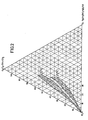
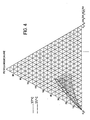
- concentration zones for example binary mixtures are formed with two of the three constituents of the microemulsion and, at the desired temperature of stability, increasing amounts of the third constituent are added and the quantity which allows obtaining the clear microemulsion; this quantity constitutes the lower limit of the concentration zone for the binary system considered.
- concentration of the third constituent is then increased until demixing to fix the upper limit of said zone. Then, we vary the relative concentration of the starting binary system and we operate in the same way. This procedure is repeated a sufficient number of times to precisely obtain the appropriate concentration zone and the diagram is thus established for each corresponding ternary system.
- the microemulsion zone at 37 ° C. exists in a range of composition in the vicinity of a fluorocarbon / surfactant ratio active close to 80/20, i.e. 4 whereas for the ternary system H 2 O / perfluorodecaline / C 6 F 13 CH 2 (OC 2 H 4 ) 5 OH the microemulsion zone at 37 ° C is close to a ratio fluorocarbon / surfactant between 65/35 and 60/40 or from 1.85 to 1.50.
- the increase in hydrophilicity of a given surfactant can be obtained either by increasing the number of ether units, or by reducing the number of CF 2 units .
- Posmion 0 is a blood plasma substitute constituted by the addition of a macromolecule (modified fluid gelatin) to a balanced ionic solution of the Ringer-lactate type.
- microemulsions containing the fluorocarbon as oxygen transporters and the filling solute which constitutes the aqueous medium used for the manufacture of the microemulsion.
- pharmaceutical formulations constituting units of micro-emulsions of 300 ml for example, since it is common to use in blood transfusions units of blood or blood substitutes of 300 ml. These pharmaceutical formulations are produced according to means known to those skilled in the art to comply with pharmaceutical legislation. Examples of units of 300 will bet given below in the illustrative examples.
- the size and shape of the particles of the microemulsions according to the invention can be determined by small angle neutron scattering. Examination of the diffusion curve of the microemulsion makes it possible to determine the value of the number of aggregation and the radius of gyration of the particles from experiments carried out at small angles on very dilute microemulsions (region rich in water).
- microemulsions do not vary during the dilution of the microemulsion in an aqueous medium.
- stability of the microemulsion is not altered during dilution in an aqueous medium.
- microemulsions are used as blood substitutes, their stability and the particle size of these will not be altered in the body, since during the transfusion of these microemulsions there is a dilution of these in the patient's blood.
- Tests carried out with microemulsions according to the diagram in FIG. 2 have in fact shown that, upon dilution in an aqueous medium of these, the size of the particles was not modified and that the stability of these microemulsions was preserved.
- the present invention overcomes the difficulties of emulsification and poor stability of the aqueous fluorocarbon solutions used until now.
- microemulsions of the invention find particular application in the medical field, in particular as an oxygen transporter.
- microemulsions according to the invention have a better oxygen binding capacity than that of the emulsions of the prior art, which makes it possible to work at lower oxygen pressures compared to those necessary with the emulsions of the art. Previously, these lower oxygen pressures are closer to physiological conditions.
- microemulsions according to the invention are also suitable for the perfusion of isolated organs, the transport of nitrogen or carbon dioxide or as additives in the culture media of aerobic or anaerobic bacteria.
- the specific concentration zone of the stability at 37 ° C. of the above ternary system was determined by operating according to the procedure defined above and the ternary diagram of FIG. 2 was established.
- microemulsion thus obtained was cooled to 25 ° C.
- the ternary mixture was then in the form of two phases, a clear upper phase, a milky lower phase. This mixture was then brought to 37 ° C and a stable microemulsion was again obtained which had the same characteristics as those of the microemulsion obtained after mixing the three constituents and heating to 37 ° C.
- a microemulsion stable at 37 ° C. was also obtained by mixing, according to the above procedure, 2.5 g of CBF17CHCH2, 6.5 g of water and 1 g of C 7 F 15 CH 2 (OC 2 H 4 ) 6 OH. It was determined that this microemulsion dissolves 12 ml of oxygen per 100 ml of microemulsion at 37 ° C.
- Ringer lactate / C 8 F 17 CH CH 2 / C 7 F 15 CH 2 (OC 2 H 4 ) 6 OH stable at 37 ° C.
- the specific concentration concentration zone at 37 ° C. of the above ternary system was determined by operating according to the procedure defined above and a part of the ternary diagram shown in FIG. 3 was established.
- the specific concentration zone of the stability at 37 ° C. of the above ternary system was determined by operating according to the procedure defined above and the ternary diagram of FIG. 1 was established.
- microemulsions according to the invention had an action on human blood by carrying out a thromboelastogram, by measuring the dilute thrombin time and by evaluating the hemolysis.
- Hemolysis was evaluated on these plasmas after centrifugation of the blood at 2,000 g for 15 minutes.
- the surfactant alone EF716 was used, that is to say the product of formula C 7 F 15 CH 2 (OC 2 H4) 6 OH, in solution in ethanol, since this surfactant active is not soluble in physiological solutions.
- the above microemulsions were also used on the one hand in the presence of ethanol and on the other hand in the absence of ethanol.
- This emulsion put in the presence of four samples of human blood, at a rate of 0.1 ml for 0.9 ml of blood, made it possible to carry out the tests defined above.
- Microemulsions R 716 C 81 - R 716 C 82
- R 716 C 81 and R 716 C 82 produced the same effects as those already observed with ethanol.
- the dilute thrombin time is very slightly extended compared to the control constituted in this test by water, physiological, R 716 C 82 producing the longest times. These dilute thrombin times are shown in Table I below.
Landscapes
- Health & Medical Sciences (AREA)
- Chemical & Material Sciences (AREA)
- Medicinal Chemistry (AREA)
- Pharmacology & Pharmacy (AREA)
- Epidemiology (AREA)
- Life Sciences & Earth Sciences (AREA)
- Animal Behavior & Ethology (AREA)
- General Health & Medical Sciences (AREA)
- Public Health (AREA)
- Veterinary Medicine (AREA)
- Hematology (AREA)
- Dermatology (AREA)
- Medicinal Preparation (AREA)
- Colloid Chemistry (AREA)
- Acyclic And Carbocyclic Compounds In Medicinal Compositions (AREA)
Claims (14)
besteht, dadurch gekennzeichnet, daß man ein oberflächenaktives Mittel verwendet, das einen hydrophoben fluorierten Teil und einen hydrophilen nicht-ionischen Teil aufweist und einen Trübungspunkt bestitzt, der 5 bis 100C unter der gewünschten Stabilitätstemperatur liegt, und daß man die drei Bestandteile in relativen Verahältnissen mischt, die im Bereich des Vorliegens der Mikroemulsion, das vorher auf einem ternären Diagramm durch die Gesamtheit der drei Bestandteile bei der genannten Temperatur bestimmt wurde, liegen.
und Perfluordecan, der Verbindung der Formal C8F17CH = CH2 oder der Verbindung der Formel C8F17CH2CH3.
in den durch das ternäre Emulgierungsdiagramm bei 37 °C definierten relativen Verhältnissen hergestellt wird.
in den durch das ternäre Emulgierungsdiagramm bei 37 °C definierten relativen Verhältnissen hergestellt wird.
in den durch das ternäre Emulgierungsdiagramm bei 37 °C definierten relativen Verhältnissen hergestellt wird.
bei den durch das ternäre Emulgierungsdiagramm bei 37°C definierten relativen Verhältnissen hergestellt wird.
in den durch das ternäre Emulgierungsdiagramm bei 25 °C definerten relativen Verhältnissen hergestellt wird.
Priority Applications (1)
| Application Number | Priority Date | Filing Date | Title |
|---|---|---|---|
| AT81902972T ATE15595T1 (de) | 1981-10-22 | 1981-10-23 | Bei gegebener temperatur unbegrenzt stabile waessrige mikroemulsionen von fluorcarbiden, verfahren zu deren herstellung und verwendungen. |
Applications Claiming Priority (2)
| Application Number | Priority Date | Filing Date | Title |
|---|---|---|---|
| FR8119878 | 1980-10-24 | ||
| FR8119878A FR2515198A1 (fr) | 1981-10-22 | 1981-10-22 | Microemulsions aqueuses de fluorocarbures indefiniment stables a une temperature donnee, procede d'obtention et application a titre de transporteurs d'oxygene |
Publications (2)
| Publication Number | Publication Date |
|---|---|
| EP0063149A1 EP0063149A1 (de) | 1982-10-27 |
| EP0063149B1 true EP0063149B1 (de) | 1985-09-18 |
Family
ID=9263296
Family Applications (2)
| Application Number | Title | Priority Date | Filing Date |
|---|---|---|---|
| EP81401690A Pending EP0051526A1 (de) | 1980-10-24 | 1981-10-23 | Bei gegebener Temperatur unbegrenzt stabile wässrige Mikroemulsionen von Fluorcarbiden, Verfahren zu deren Herstellung und ihre Verwendungen |
| EP19810902972 Expired EP0063149B1 (de) | 1980-10-24 | 1981-10-23 | Bei gegebener temperatur unbegrenzt stabile wässrige mikroemulsionen von fluorcarbiden, verfahren zu deren herstellung und verwendungen |
Family Applications Before (1)
| Application Number | Title | Priority Date | Filing Date |
|---|---|---|---|
| EP81401690A Pending EP0051526A1 (de) | 1980-10-24 | 1981-10-23 | Bei gegebener Temperatur unbegrenzt stabile wässrige Mikroemulsionen von Fluorcarbiden, Verfahren zu deren Herstellung und ihre Verwendungen |
Country Status (3)
| Country | Link |
|---|---|
| EP (2) | EP0051526A1 (de) |
| FR (1) | FR2515198A1 (de) |
| WO (1) | WO1982001467A1 (de) |
Cited By (1)
| Publication number | Priority date | Publication date | Assignee | Title |
|---|---|---|---|---|
| WO1994019101A1 (en) * | 1993-02-16 | 1994-09-01 | Alliance Pharmaceutical Corp. | Method of microemulsifying fluorinated oils |
Families Citing this family (31)
| Publication number | Priority date | Publication date | Assignee | Title |
|---|---|---|---|---|
| GB8504916D0 (en) * | 1985-02-26 | 1985-03-27 | Isc Chemicals Ltd | Emulsions of perfluorocarbons in aqueous media |
| US5080885A (en) * | 1986-01-14 | 1992-01-14 | Alliance Pharmaceutical Corp. | Brominated perfluorocarbon emulsions for internal animal use for contrast enhancement and oxygen transport |
| US4865836A (en) * | 1986-01-14 | 1989-09-12 | Fluoromed Pharmaceutical, Inc. | Brominated perfluorocarbon emulsions for internal animal use for contrast enhancement and oxygen transport |
| EP0231091B1 (de) * | 1986-01-24 | 1993-03-31 | Children's Hospital Medical Center | Stabile Emulsionen von stark fluorierten, organischen Verbindungen |
| US5684050A (en) * | 1986-01-24 | 1997-11-04 | Hemagen/Pfc | Stable emulsions of highly fluorinated organic compounds |
| US5514720A (en) * | 1986-07-09 | 1996-05-07 | Hemagen/Pfc | Stable emulsions of highly fluorinated organic compounds |
| EP0296661B1 (de) * | 1987-06-23 | 1992-01-22 | ENIRICERCHE S.p.A. | Ein-Phasen-Präparat, das ein perfluoriertes Öl und ein oder mehrere oberflächenaktive Stoffe enthält, verwendbar als Hilfsstoff für kosmetische und dermatologische Mittel sowie für biomedizinische Anwendungen |
| FR2620445B1 (fr) * | 1987-09-16 | 1990-07-20 | Centre Nat Rech Scient | Nouveaux derives fluores d'acides amines, utilisables en particulier comme agents tensioactifs ou cotensioactifs et preparations a usage biomedical comprenant ces derives |
| IT1223325B (it) * | 1987-10-28 | 1990-09-19 | Ausimont Spa | Microemulsioni elettricamente conduttrici a base di perfluoropolieteri |
| US5185099A (en) * | 1988-04-20 | 1993-02-09 | Institut National De Recherche Chimique Appliquee | Visco-elastic, isotropic materials based on water, fluorinate sufactants and fluorinated oils, process for their preparation, and their use in various fields, such as optics, pharmacology and electrodynamics |
| FR2630347B1 (fr) * | 1988-04-20 | 1991-08-30 | Inst Nat Rech Chimique | Materiaux viscoelastiques isotropes a base d'eau, de tensioactifs fluores et d'huiles fluorees, leur procede d'obtention et leurs applications dans divers domaines, tels que ceux de l'optique, de la pharmacologie et de l'electrodynamique |
| US5171755A (en) * | 1988-04-29 | 1992-12-15 | Hemagen/Pfc | Emulsions of highly fluorinated organic compounds |
| US4975468A (en) * | 1989-04-03 | 1990-12-04 | Affinity Biotech, Inc. | Fluorinated microemulsion as oxygen carrier |
| FR2679150A1 (fr) * | 1991-07-17 | 1993-01-22 | Atta | Preparations comprenant un fluorocarbure ou compose hautement fluore et un compose organique lipophile-fluorophile, et leurs utilisations. |
| US5403575A (en) * | 1991-12-12 | 1995-04-04 | Hemagen/Pfc | Highly fluorinated, chloro-substituted organic compound-containing emulsions and methods of using them |
| FR2696931B1 (fr) * | 1992-10-21 | 1994-12-30 | Oreal | Emulsions eau dans l'huile à phase continue fluorohydrocarbonée et utilisation de certains tensioactifs siliconés pour leur préparation. |
| US5635538A (en) * | 1993-03-16 | 1997-06-03 | Alliance Pharmaceutical Corp. | Fluorocarbon emulsions with reduced pulmonary gas-trapping properties |
| FR2702676B1 (fr) * | 1993-03-18 | 1995-05-19 | Oreal | Emulsion huile-dans-eau contenant un perfluoropolyéther, composition en comportant, procédé de préparation et utilisation en cosmétique et dermatologie. |
| EP0856262B1 (de) * | 1993-03-26 | 2005-02-09 | W.L. Gore & Associates, Inc. | Verwendung eines beschichteten Polytetrafluorethylengegenstandes für Kleidung |
| US5539072A (en) * | 1993-03-26 | 1996-07-23 | W. L. Gore & Associates, Inc. | Fabric laminates |
| US5460872A (en) * | 1993-03-26 | 1995-10-24 | W. L. Gore & Associates, Inc. | Process for coating microporous substrates and products therefrom |
| IT1270200B (it) | 1994-06-09 | 1997-04-29 | Ausimont Spa | Preparazione di particelle ultra fini da microemulsioni di acqua in olio |
| FR2720943B1 (fr) * | 1994-06-09 | 1996-08-23 | Applic Transferts Technolo | Emulsions inverses stables à forte concentration en composé(s) fluoré(s) et leur utilisation pour l'administration pulmonaire de médicaments et pour la fabrication d'émulsions multiples. |
| IT1270199B (it) * | 1994-06-09 | 1997-04-29 | Ausimont Spa | Preparazione di particelle miste ultrafini da microemulsioni di pepe |
| IT1270703B (it) * | 1994-11-17 | 1997-05-07 | Ausimont Spa | Microemulsioni di fluoropoliossialchileni in miscela con idrocarburi, e loro uso in processi di (co)polimerizzazione di monomeri fluorurati |
| US5865784A (en) | 1995-06-07 | 1999-02-02 | Alliance Pharmaceutical Corp. | Method of hemodilution facilitated by monitoring oxygenation status |
| IT1276072B1 (it) | 1995-10-31 | 1997-10-24 | Ausimont Spa | Processo di (co)polimerizzazione di monomeri fluorurati per ottenere polimeri contenenti idrogeno |
| US5928279A (en) | 1996-07-03 | 1999-07-27 | Baxter International Inc. | Stented, radially expandable, tubular PTFE grafts |
| US6159917A (en) * | 1998-12-16 | 2000-12-12 | 3M Innovative Properties Company | Dry cleaning compositions containing hydrofluoroether |
| US6127430A (en) * | 1998-12-16 | 2000-10-03 | 3M Innovative Properties Company | Microemulsions containing water and hydrofluroethers |
| EP4382091A1 (de) * | 2022-12-09 | 2024-06-12 | Commissariat à l'Energie Atomique et aux Energies Alternatives | Perfluorinated micellen und ihre medizinischen verwendungen |
Family Cites Families (6)
| Publication number | Priority date | Publication date | Assignee | Title |
|---|---|---|---|---|
| CH604490A5 (de) * | 1970-09-05 | 1978-09-15 | Green Cross Corp | |
| US3778381A (en) * | 1972-04-24 | 1973-12-11 | Allied Chem | Fluorocarbon microemulsions |
| US3911138B1 (en) * | 1973-02-26 | 1996-10-29 | Childrens Hosp Medical Center | Artificial blood and method for supporting oxygen transport in animals |
| JPS5347787B2 (de) * | 1973-03-30 | 1978-12-23 | ||
| IT1050731B (it) * | 1974-12-09 | 1981-03-20 | Childrens Hosp Medical Center | Composti perfluoropoliciclici per l impiego come sangue sintetico e ambiente di ferfusione |
| US4105798A (en) * | 1976-07-19 | 1978-08-08 | Sun Ventures, Inc. | Perfluoro polycyclic compounds for use as synthetic blood and perfusion media |
-
1981
- 1981-10-22 FR FR8119878A patent/FR2515198A1/fr not_active Withdrawn
- 1981-10-23 EP EP81401690A patent/EP0051526A1/de active Pending
- 1981-10-23 EP EP19810902972 patent/EP0063149B1/de not_active Expired
- 1981-10-23 WO PCT/FR1981/000138 patent/WO1982001467A1/fr not_active Ceased
Cited By (1)
| Publication number | Priority date | Publication date | Assignee | Title |
|---|---|---|---|---|
| WO1994019101A1 (en) * | 1993-02-16 | 1994-09-01 | Alliance Pharmaceutical Corp. | Method of microemulsifying fluorinated oils |
Also Published As
| Publication number | Publication date |
|---|---|
| WO1982001467A1 (fr) | 1982-05-13 |
| EP0063149A1 (de) | 1982-10-27 |
| FR2515198A1 (fr) | 1983-04-29 |
| EP0051526A1 (de) | 1982-05-12 |
Similar Documents
| Publication | Publication Date | Title |
|---|---|---|
| EP0063149B1 (de) | Bei gegebener temperatur unbegrenzt stabile wässrige mikroemulsionen von fluorcarbiden, verfahren zu deren herstellung und verwendungen | |
| AU598226B2 (en) | Stable emulsions of highly fluorinated organic compounds | |
| EP0043327B1 (de) | Verfahren zur Herstellung stabiler Dispersionen in einer wässrigen Phase von mindestens einer flüssigen, nicht mit Wasser mischbaren Phase und die entsprechenden Dispersionen | |
| AU665224B2 (en) | Highly fluorinated, chloro-substituted organic compound-containing emulsions and methods of making and using them | |
| US3989843A (en) | Emulsification of fluorocarbon compounds for biological application as oxygen transporters | |
| US3962439A (en) | Oxygen-transferable emulsion | |
| JP4611741B2 (ja) | 非フッ化界面活性剤を有するペルフルオロカーボンエマルジョン | |
| EP0196776A1 (de) | Perfluorkohlenwasserstoffemulsionen in wässrigen Medien | |
| FR2679150A1 (fr) | Preparations comprenant un fluorocarbure ou compose hautement fluore et un compose organique lipophile-fluorophile, et leurs utilisations. | |
| Krafft et al. | The design and engineering of oxygen-delivering fluorocarbon emulsions | |
| FR2494132A1 (fr) | Gel capable de vehiculer des gaz, sa preparation et applications | |
| FR2635458A1 (fr) | Emulsion multiple de transport d'oxygene utile notamment comme succedane du sang et son procede de fabrication | |
| US5684050A (en) | Stable emulsions of highly fluorinated organic compounds | |
| FI58071C (fi) | Foerfarande foer framstaellning av en stabil emulsion av en syre transporterande perfluorkolvaete | |
| CN101014326B (zh) | 医用全氟化合物乳剂及其制备方法 | |
| US5514720A (en) | Stable emulsions of highly fluorinated organic compounds | |
| Riess et al. | A new concept in the stabilization of injectable fluorocarbon emulsions: the use of mixed fluorocarbon-hydrocarbon dowels. | |
| FR2553661A1 (fr) | Nouvelles microemulsions pharmaceutiquement acceptables | |
| RU2162692C1 (ru) | Состав на основе эмульсии перфторорганических соединений для медико-биологических целей | |
| Riess et al. | Fluorocarbon emulsions as in vivo oxygen delivery systems: background and chemistry | |
| FR2532309A1 (fr) | Perfluorocycloamines et preparation d'emulsions therapeutiques contenant ces perfluorocycloamines | |
| LU84615A1 (fr) | Composes perfluorobicycliques et preparation en emulsion contenant des composes | |
| FR3057771A1 (fr) | Emulsions topiques de lidocaine et d'acides gras utiles en tant qu'analgesique, antalgique ou retardant sexuel | |
| JPS59130813A (ja) | 癌化学療法補助剤 | |
| KR100862605B1 (ko) | 가스운반기능을가진불소화합물계통의혼합유제 |
Legal Events
| Date | Code | Title | Description |
|---|---|---|---|
| PUAI | Public reference made under article 153(3) epc to a published international application that has entered the european phase |
Free format text: ORIGINAL CODE: 0009012 |
|
| AK | Designated contracting states |
Designated state(s): AT BE CH DE FR GB IT LI LU NL SE |
|
| 17P | Request for examination filed |
Effective date: 19821110 |
|
| XX | Miscellaneous (additional remarks) |
Free format text: VERBUNDEN MIT 81401690.3/0051526 (EUROPAEISCHE ANMELDENUMMER/VEROEFFENTLICHUNGSNUMMER) DURCH ENTSCHEIDUNG VOM 7.12.83. |
|
| ITF | It: translation for a ep patent filed | ||
| GRAA | (expected) grant |
Free format text: ORIGINAL CODE: 0009210 |
|
| AK | Designated contracting states |
Designated state(s): AT BE CH DE FR GB IT LI LU NL SE |
|
| REF | Corresponds to: |
Ref document number: 15595 Country of ref document: AT Date of ref document: 19851015 Kind code of ref document: T |
|
| XX | Miscellaneous (additional remarks) |
Free format text: VERBUNDEN MIT 81401690.3/0051526 (EUROPAEISCHE ANMELDENUMMER/VEROEFFENTLICHUNGSNUMMER) DURCH ENTSCHEIDUNG VOM 7.12.83. |
|
| REF | Corresponds to: |
Ref document number: 3172360 Country of ref document: DE Date of ref document: 19851024 |
|
| PG25 | Lapsed in a contracting state [announced via postgrant information from national office to epo] |
Ref country code: LU Free format text: LAPSE BECAUSE OF NON-PAYMENT OF DUE FEES Effective date: 19851031 |
|
| PLBE | No opposition filed within time limit |
Free format text: ORIGINAL CODE: 0009261 |
|
| STAA | Information on the status of an ep patent application or granted ep patent |
Free format text: STATUS: NO OPPOSITION FILED WITHIN TIME LIMIT |
|
| 26N | No opposition filed | ||
| PGFP | Annual fee paid to national office [announced via postgrant information from national office to epo] |
Ref country code: FR Payment date: 19900927 Year of fee payment: 10 |
|
| PGFP | Annual fee paid to national office [announced via postgrant information from national office to epo] |
Ref country code: LU Payment date: 19901003 Year of fee payment: 10 |
|
| PGFP | Annual fee paid to national office [announced via postgrant information from national office to epo] |
Ref country code: AT Payment date: 19901009 Year of fee payment: 10 |
|
| PGFP | Annual fee paid to national office [announced via postgrant information from national office to epo] |
Ref country code: GB Payment date: 19901012 Year of fee payment: 10 |
|
| PGFP | Annual fee paid to national office [announced via postgrant information from national office to epo] |
Ref country code: SE Payment date: 19901016 Year of fee payment: 10 |
|
| PGFP | Annual fee paid to national office [announced via postgrant information from national office to epo] |
Ref country code: DE Payment date: 19901019 Year of fee payment: 10 |
|
| PGFP | Annual fee paid to national office [announced via postgrant information from national office to epo] |
Ref country code: CH Payment date: 19901029 Year of fee payment: 10 |
|
| ITTA | It: last paid annual fee | ||
| PGFP | Annual fee paid to national office [announced via postgrant information from national office to epo] |
Ref country code: NL Payment date: 19901031 Year of fee payment: 10 |
|
| PGFP | Annual fee paid to national office [announced via postgrant information from national office to epo] |
Ref country code: BE Payment date: 19901211 Year of fee payment: 10 |
|
| PG25 | Lapsed in a contracting state [announced via postgrant information from national office to epo] |
Ref country code: GB Effective date: 19911023 Ref country code: AT Effective date: 19911023 |
|
| PG25 | Lapsed in a contracting state [announced via postgrant information from national office to epo] |
Ref country code: SE Effective date: 19911024 |
|
| PG25 | Lapsed in a contracting state [announced via postgrant information from national office to epo] |
Ref country code: LI Effective date: 19911031 Ref country code: CH Effective date: 19911031 Ref country code: BE Effective date: 19911031 |
|
| BERE | Be: lapsed |
Owner name: CENTRE NATIONAL DE LA RECHERCHE SCIENTIFIQUE CNRS Effective date: 19911031 |
|
| PG25 | Lapsed in a contracting state [announced via postgrant information from national office to epo] |
Ref country code: NL Effective date: 19920501 |
|
| NLV4 | Nl: lapsed or anulled due to non-payment of the annual fee | ||
| GBPC | Gb: european patent ceased through non-payment of renewal fee | ||
| PG25 | Lapsed in a contracting state [announced via postgrant information from national office to epo] |
Ref country code: FR Effective date: 19920630 |
|
| REG | Reference to a national code |
Ref country code: CH Ref legal event code: PL |
|
| PG25 | Lapsed in a contracting state [announced via postgrant information from national office to epo] |
Ref country code: DE Effective date: 19920701 |
|
| REG | Reference to a national code |
Ref country code: FR Ref legal event code: ST |
|
| EUG | Se: european patent has lapsed |
Ref document number: 81902972.9 Effective date: 19920510 |