EP0063569B1 - Procede de production d'acier en convertisseur basique avec utilisation de latier - Google Patents
Procede de production d'acier en convertisseur basique avec utilisation de latier Download PDFInfo
- Publication number
- EP0063569B1 EP0063569B1 EP81902685A EP81902685A EP0063569B1 EP 0063569 B1 EP0063569 B1 EP 0063569B1 EP 81902685 A EP81902685 A EP 81902685A EP 81902685 A EP81902685 A EP 81902685A EP 0063569 B1 EP0063569 B1 EP 0063569B1
- Authority
- EP
- European Patent Office
- Prior art keywords
- slag
- mgo
- cao
- steel
- converter
- Prior art date
- Legal status (The legal status is an assumption and is not a legal conclusion. Google has not performed a legal analysis and makes no representation as to the accuracy of the status listed.)
- Expired
Links
Images




Classifications
-
- C—CHEMISTRY; METALLURGY
- C21—METALLURGY OF IRON
- C21C—PROCESSING OF PIG-IRON, e.g. REFINING, MANUFACTURE OF WROUGHT-IRON OR STEEL; TREATMENT IN MOLTEN STATE OF FERROUS ALLOYS
- C21C5/00—Manufacture of carbon-steel, e.g. plain mild steel, medium carbon steel or cast steel or stainless steel
- C21C5/28—Manufacture of steel in the converter
- C21C5/42—Constructional features of converters
- C21C5/44—Refractory linings
-
- C—CHEMISTRY; METALLURGY
- C21—METALLURGY OF IRON
- C21C—PROCESSING OF PIG-IRON, e.g. REFINING, MANUFACTURE OF WROUGHT-IRON OR STEEL; TREATMENT IN MOLTEN STATE OF FERROUS ALLOYS
- C21C5/00—Manufacture of carbon-steel, e.g. plain mild steel, medium carbon steel or cast steel or stainless steel
- C21C5/28—Manufacture of steel in the converter
- C21C5/36—Processes yielding slags of special composition
-
- C—CHEMISTRY; METALLURGY
- C21—METALLURGY OF IRON
- C21C—PROCESSING OF PIG-IRON, e.g. REFINING, MANUFACTURE OF WROUGHT-IRON OR STEEL; TREATMENT IN MOLTEN STATE OF FERROUS ALLOYS
- C21C5/00—Manufacture of carbon-steel, e.g. plain mild steel, medium carbon steel or cast steel or stainless steel
- C21C5/28—Manufacture of steel in the converter
- C21C5/36—Processes yielding slags of special composition
- C21C2005/366—Foam slags
Definitions
- the present invention relates to a method for producing steel in a basic converter using liquid converter slag, in which an end slag saturated with MgO and CaO or dicalcium silicate is obtained.
- low-viscosity low-basicity iron oxide-silicate slags behave aggressively towards the basic brick lining, they infiltrate into the stone pores during the blowing process and react there with the CaO of the dolomite. In addition, this slag has a considerable solvency for MgO. This solubility of the slag is greatest at the beginning of the freshening process and decreases at the end of the blowing with increasing basicity. The slag attack on the converter lining is the greatest at the beginning of the fresh season.
- the basicity of the initial slag is also as low as is known from the classic LD process.
- the increase in the basicity of the initial slag and thus the reduction in the MgO and CaO contents leading to saturation can be achieved by using substances with a high basicity and low melting point, e.g. Converter slag can be reached before or at the start of freshness.
- converter slag is known and has been published, for example, in patent specification FR-PS 1 509 342.
- This is a special variant of the LDAC process, in which the final slag always remains in the converter and is slagged after about 50% of the blowing time.
- the object of the present invention is to greatly increase the basicity of the initial slag and to keep the slag as possible over the entire fresh process, but at least in the critical initial region at the saturation limit. Since the invention is intended to apply to all basic brickwork, that is to say to magnesitic and dolomitic infeed, in addition to the MgO saturation, the slag must also be saturated with CaO or with dicalcium silicate. In the known and cited prior art, compliance with the double saturation of 2 Ca0-Si0 2 and at the same time of MgO has not been achieved over the entire fresh process and also not during the critical initial phase.
- the temperature fluctuates around 1525 ° C when the scrap is used, it can oscillate between 1500 and 1550 ° C and increases to around 1625 ° C at the end of the fresh process.
- the higher temperature range at the start of blowing promotes the dissolution of the dolomite and lime used.
- the FeO content of the slag at the start of blowing is very low when sampling after 30% of the blowing time.
- the FeO contents are well over 20% and, in combination with the acidic slags, lead to a strong fire-resistant attack.
- the FeO contents can be reduced to 5%.
- the amount of MgO required to saturate the slag is blown in together with a fresh agent in fine-grained form from the beginning of the blowing up to about 25 to 30% of the blowing time. Furthermore, the amount of MgO required for the saturation of the slag can be introduced in the form of dolomite, the amount of CaO introduced via the dolomite being taken into account when adding CaO.
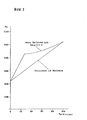
- a quantity of slag is used at the beginning of the blow, as can be seen from the slag quantity diagram a in Figure 1 and which corresponds to approximately twice the amount at the end of the blow compared to the known LD process without using slag ( Figure 1).
- the amount of MgO added is set according to a nomogram to determine the amount of MgO added ( Figure 2) as a function of the silicon content of the pig iron at the start of blowing.
- so much CaO is added that the slag is saturated with CaO or dicalcium silicate.
- the slag guidance is substantially evened out.
- the double saturated slag of 2 CaO ⁇ SiO 2 and MgO is heterogeneous and forms a protective coating on the converter lining.
- MgO is preferably saturated with mervinite, monticellite and magnesiowustite; in the initial slags primarily via mervinite and monticellite and in the final slags only via magnesiowustite.
- the delayed use of scrap compared to the classic LD process continues to favor the dissolving conditions of the dolomite or lime used due to the higher initial temperatures of the process.
- it was found that the sulfur distribution between metal and slag was significantly improved and that much better final sulfur contents could be achieved.
- the dephosphorization is also improved compared to the normal LD process.
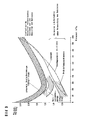
- the slag composition during the blowing process is described in more detail by Figure 4, by the representation of the course of the slag composition in the three-substance system (CaO + MnO + MgO) '- FeO'-SiO 2 . While the slag passes through the unsaturated area of FeO- and Si0 2 -rich slag at the start of blowing in the normal LD process, this area is no longer touched when working with higher basicity and simultaneous use of Mg0 and the slag is reached or remains in the entire melting time Area of 2 CaO.Si02 saturation (-5% MnO and -10% MgO).
- the slags move from the final slag towards the 2 CaO. Si0 2 connection and return to the final slag.
- substantially lower FeO contents are set in the slag over the entire blowing process.
- the change in the slag composition during the blowing process is therefore much less than in the normal LD process and takes place in the area of more basic, more iron-oxidized slags, which result in significantly less converter wear.
- the saturation of the slag with MgO is described in Fig. 5. While in the normal LD process the acidic slags have to dissolve 15 to 20% MgO to achieve the MgO saturation, in the process according to the invention, when working with high basicity, the slag remaining in the converter to only set an MgO content of 8 to 10% in the starting slag. Dolomite is most suitably used as the magnesite carrier. The time of use is before or at the start of blowing.
- MgO contents and the contents of dissolved MgO (MgOg) during the blowing time can be found in Figure 6.
- the MgO contents with different procedures differ, they start from the same contents and end at the same contents. While the MgO saturation of the slag is achieved over the entire melting time by the method according to claim 3, only the initial and final slags of MgO are saturated in a procedure according to claims 1 and 2.
- Example 1 is intended to illustrate the process according to claim 1.
- the final slag has to be formed.
- an LD melt is produced in a 200 t converter using the usual method.
- the dolomite is also set before the start of blowing.
- the required amount of MgO can be found in the nomogram in Figure 2.
- the slag is saturated with MgO in this mode of operation up to 20% and from 80% blowing time.
- Example 3 illustrates the process according to claim 3.
- the formation of the final slag takes place here first as described in Example 1.
- the converter then contains 22 t of slag.
- part of the lime is placed.
- the amount of lime and dolomite is calculated according to the following scheme.
- the necessary amount of MgO can be taken from the nomogram ( Figure 2) with 7.5 kg / t steel, which corresponds to 1500 kg MgO for a 200 t melt. With a share of 37% MgO in the dolomite, the amount of dolomite is 4050 kg. The CaO portion of the dolomite is (at 58%) 2350 kg, corresponding to 2550 kg of lime. The lime scale is 10.45t based on the pig iron analysis; this leaves 2.55 t so that a quantity of 7.9 t lime remains; of this amount, 2.5 tons of lime are used. The calculated quantity of 4.05 t of dolomite is then set. Then the fresh process begins.
- the slag is saturated with MgO from the beginning of the blowing to the end of the blowing.
Landscapes
- Engineering & Computer Science (AREA)
- Chemical & Material Sciences (AREA)
- Manufacturing & Machinery (AREA)
- Materials Engineering (AREA)
- Metallurgy (AREA)
- Organic Chemistry (AREA)
- Carbon Steel Or Casting Steel Manufacturing (AREA)
Claims (6)
Applications Claiming Priority (2)
| Application Number | Priority Date | Filing Date | Title |
|---|---|---|---|
| DE3040630 | 1980-10-29 | ||
| DE3040630A DE3040630C2 (de) | 1980-10-29 | 1980-10-29 | Verfahren zur Erzeugung von Stahl im basischen Konverter unter Verwendung von flüssiger Konverterschlacke |
Publications (2)
| Publication Number | Publication Date |
|---|---|
| EP0063569A1 EP0063569A1 (fr) | 1982-11-03 |
| EP0063569B1 true EP0063569B1 (fr) | 1986-01-08 |
Family
ID=6115389
Family Applications (2)
| Application Number | Title | Priority Date | Filing Date |
|---|---|---|---|
| EP81107683A Pending EP0050743A1 (fr) | 1980-10-29 | 1981-09-28 | Procédé de fabrication d'acier au convertisseur basique avec utilisation de laitier de convertisseur liquide |
| EP81902685A Expired EP0063569B1 (fr) | 1980-10-29 | 1981-09-28 | Procede de production d'acier en convertisseur basique avec utilisation de latier |
Family Applications Before (1)
| Application Number | Title | Priority Date | Filing Date |
|---|---|---|---|
| EP81107683A Pending EP0050743A1 (fr) | 1980-10-29 | 1981-09-28 | Procédé de fabrication d'acier au convertisseur basique avec utilisation de laitier de convertisseur liquide |
Country Status (5)
| Country | Link |
|---|---|
| US (1) | US4421554A (fr) |
| EP (2) | EP0050743A1 (fr) |
| JP (1) | JPH0259201B2 (fr) |
| DE (1) | DE3040630C2 (fr) |
| WO (1) | WO1982001565A1 (fr) |
Cited By (1)
| Publication number | Priority date | Publication date | Assignee | Title |
|---|---|---|---|---|
| US6953039B2 (en) | 1998-05-05 | 2005-10-11 | Trudell Medical International | Medicament dispensing device |
Families Citing this family (7)
| Publication number | Priority date | Publication date | Assignee | Title |
|---|---|---|---|---|
| DE3219409C2 (de) * | 1982-05-19 | 1984-10-11 | Schweizerische Aluminium Ag, Chippis | Verfahren zur Bestimmung der Oxidationsgeschwindigkeit an der Oberfläche einer Metallschmelze |
| US5567222A (en) * | 1994-03-24 | 1996-10-22 | Kawasaki Steel Corporation | Method of controlling slag coating of a steel converter |
| DE4433511C2 (de) * | 1994-09-20 | 1998-02-05 | Klaus Juergen Hanke | Verfahren zur Erzeugung von Stahl |
| US6401329B1 (en) | 1999-12-21 | 2002-06-11 | Vishay Dale Electronics, Inc. | Method for making overlay surface mount resistor |
| CN102212641A (zh) * | 2011-06-15 | 2011-10-12 | 南京钢铁股份有限公司 | 一种快速成渣的方法 |
| RU2545874C2 (ru) * | 2012-04-27 | 2015-04-10 | Закрытое Акционерное Общество "МагнийПром" | Способ получения магнезиального флюса для выплавки стали |
| CN104673966A (zh) * | 2015-01-22 | 2015-06-03 | 河北钢铁股份有限公司承德分公司 | 转炉炉衬的快速维护方法 |
Family Cites Families (9)
| Publication number | Priority date | Publication date | Assignee | Title |
|---|---|---|---|---|
| US3288592A (en) * | 1963-01-16 | 1966-11-29 | Pfizer & Co C | Process for reducing deterioration in equipment handling molten materials |
| FR1346148A (fr) * | 1963-01-31 | 1963-12-13 | Centre Nat Rech Metall | Procédé pour la protection du revêtement intérieur des fours métallurgiques |
| LU50247A1 (fr) * | 1966-01-12 | 1967-07-12 | ||
| FR1536457A (fr) * | 1967-07-07 | 1968-08-16 | Siderurgie Fse Inst Rech | Procédé pour la protection des revêtements réfractaires des récipients métallurgiques d'affinage continu |
| US3507642A (en) * | 1969-06-02 | 1970-04-21 | Allegheny Ludlum Steel | Process for producing corrosion resistant steel |
| US3897244A (en) * | 1973-06-08 | 1975-07-29 | Crawford Brown Murton | Method for refining iron-base metal |
| US3884678A (en) * | 1974-02-04 | 1975-05-20 | Jones & Laughlin Steel Corp | Fluxes |
| FR2271293B1 (fr) * | 1974-05-15 | 1977-06-24 | Lafarge Fondu Int | |
| DE2852248C3 (de) * | 1978-12-02 | 1982-02-11 | Dolomitwerke GmbH, 5603 Wülfrath | Verfahren zur Erhöhung der Haltbarkeit basischer Ausmauerungen von Konvertern beim Frischen von Roheisen |
-
1980
- 1980-10-29 DE DE3040630A patent/DE3040630C2/de not_active Expired
-
1981
- 1981-09-28 EP EP81107683A patent/EP0050743A1/fr active Pending
- 1981-09-28 EP EP81902685A patent/EP0063569B1/fr not_active Expired
- 1981-09-28 WO PCT/EP1981/000152 patent/WO1982001565A1/fr not_active Ceased
- 1981-09-28 JP JP56503181A patent/JPH0259201B2/ja not_active Expired
-
1982
- 1982-06-24 US US06/391,674 patent/US4421554A/en not_active Expired - Fee Related
Cited By (1)
| Publication number | Priority date | Publication date | Assignee | Title |
|---|---|---|---|---|
| US6953039B2 (en) | 1998-05-05 | 2005-10-11 | Trudell Medical International | Medicament dispensing device |
Also Published As
| Publication number | Publication date |
|---|---|
| WO1982001565A1 (fr) | 1982-05-13 |
| JPS57501863A (fr) | 1982-10-21 |
| JPH0259201B2 (fr) | 1990-12-11 |
| DE3040630A1 (de) | 1982-04-29 |
| DE3040630C2 (de) | 1983-03-31 |
| EP0063569A1 (fr) | 1982-11-03 |
| EP0050743A1 (fr) | 1982-05-05 |
| US4421554A (en) | 1983-12-20 |
Similar Documents
| Publication | Publication Date | Title |
|---|---|---|
| DE2209902B2 (de) | Verfahren zur Entschwefelung von Stahlschmelzen | |
| EP0063569B1 (fr) | Procede de production d'acier en convertisseur basique avec utilisation de latier | |
| EP1252343B1 (fr) | Procede de traitement de laitiers ou de melanges de laitiers sur un bain de fer | |
| EP0627012B1 (fr) | Procede de desulfuration de bains de fer en fusion avec production minimale de laitier et dispositif approprie pour ce procede | |
| DE2458513A1 (de) | Zuschlaege fuer die stahlerzeugung | |
| DE2521202A1 (de) | Verfahren zum herstellen von phosphorarmem stahl durch sauerstoff-frischen | |
| DE1303099B (fr) | ||
| DE3836549C1 (en) | Process for desulphurising molten crude iron | |
| DE2037758A1 (en) | Calcium carbide for desulphurisation - of molten metals improved by treatment with quick lime and fluorspar | |
| EP0011779B1 (fr) | Procédé pour prolonger la tenue des garnissages basiques de convertisseurs lors de l'affinage de la fonte en acier | |
| DE2616784A1 (de) | Verfahren zur regenerierung geschmolzener schlacken | |
| DE3216772C2 (de) | Verfahren zur Erzeugung von Stahl im basischen Konverter unter Verwendung von flüssiger Konverterschlacke | |
| DE2612500B2 (de) | Reduktionsmittel fuer die stahlherstellung | |
| DE881797C (de) | Entschwefeln und Desoxydieren einer Eisenschmelze | |
| DE68915234T2 (de) | Verfahren zum Einschmelzen kalter Stoffe, die Eisen enthalten. | |
| DE68906920T2 (de) | Verfahren zur herstellung von chromhaltigem, fluessigem eisen mit geringem schwefelgehalt. | |
| DE69120422T2 (de) | Metallschmelzofen | |
| DE2206081C3 (de) | Verfahren zum Frischen von Hämatitroheisen | |
| DE900352C (de) | Entfernung von Phosphor und Schwefel aus Eisen oder Eisenlegierungen | |
| AT337231B (de) | Verfahren zur herstellung von stahlen hoher reinheit im elektrischen lichtbogenofen | |
| AT144837B (de) | Verfahren zur Herstellung von phosphorarmem Stahl. | |
| AT345868B (de) | verfahren zur nachentschwefelung von eisenschmelzen und herstellung des entschwefelungsmittels | |
| DE2247475C3 (de) | Verfahren zur Beseitigung von CaO-haltigen Restschlacke-Ansätzen aus GefäBen | |
| DE2658315C2 (de) | Reduktionsmittel für die Stahlherstellung | |
| DE69022839T2 (de) | Verfahren zur entphosphorung von chrom-enthaltenden roheisen mit niedrigem oxidationsverlust von chrom. |
Legal Events
| Date | Code | Title | Description |
|---|---|---|---|
| PUAI | Public reference made under article 153(3) epc to a published international application that has entered the european phase |
Free format text: ORIGINAL CODE: 0009012 |
|
| 17P | Request for examination filed |
Effective date: 19820518 |
|
| AK | Designated contracting states |
Designated state(s): FR GB LU NL |
|
| RBV | Designated contracting states (corrected) |
Designated state(s): FR GB LU NL |
|
| RBV | Designated contracting states (corrected) |
Designated state(s): BE FR GB IT LU NL |
|
| XX | Miscellaneous (additional remarks) |
Free format text: VERBUNDEN MIT 81107683.5/0050743 (EUROPAEISCHE ANMELDENUMMER/VEROEFFENTLICHUNGSNUMMER) DURCH ENTSCHEIDUNG VOM 25.07.84. |
|
| GRAA | (expected) grant |
Free format text: ORIGINAL CODE: 0009210 |
|
| ITF | It: translation for a ep patent filed | ||
| AK | Designated contracting states |
Designated state(s): BE FR GB IT LU NL |
|
| XX | Miscellaneous (additional remarks) |
Free format text: VERBUNDEN MIT 81107683.5/0050743 (EUROPAEISCHE ANMELDENUMMER/VEROEFFENTLICHUNGSNUMMER) DURCH ENTSCHEIDUNG VOM 25.07.84. |
|
| ET | Fr: translation filed | ||
| PLBE | No opposition filed within time limit |
Free format text: ORIGINAL CODE: 0009261 |
|
| STAA | Information on the status of an ep patent application or granted ep patent |
Free format text: STATUS: NO OPPOSITION FILED WITHIN TIME LIMIT |
|
| 26N | No opposition filed | ||
| PGFP | Annual fee paid to national office [announced via postgrant information from national office to epo] |
Ref country code: FR Payment date: 19920807 Year of fee payment: 12 |
|
| PGFP | Annual fee paid to national office [announced via postgrant information from national office to epo] |
Ref country code: GB Payment date: 19920814 Year of fee payment: 12 |
|
| PGFP | Annual fee paid to national office [announced via postgrant information from national office to epo] |
Ref country code: BE Payment date: 19920821 Year of fee payment: 12 |
|
| ITTA | It: last paid annual fee | ||
| PGFP | Annual fee paid to national office [announced via postgrant information from national office to epo] |
Ref country code: NL Payment date: 19920930 Year of fee payment: 12 |
|
| EPTA | Lu: last paid annual fee | ||
| PG25 | Lapsed in a contracting state [announced via postgrant information from national office to epo] |
Ref country code: GB Effective date: 19930928 |
|
| PG25 | Lapsed in a contracting state [announced via postgrant information from national office to epo] |
Ref country code: BE Effective date: 19930930 |
|
| PGFP | Annual fee paid to national office [announced via postgrant information from national office to epo] |
Ref country code: LU Payment date: 19930930 Year of fee payment: 13 |
|
| BERE | Be: lapsed |
Owner name: STAHLWERKE PEINE-SALZGITTER A.G. Effective date: 19930930 |
|
| PG25 | Lapsed in a contracting state [announced via postgrant information from national office to epo] |
Ref country code: NL Effective date: 19940401 |
|
| NLV4 | Nl: lapsed or anulled due to non-payment of the annual fee | ||
| GBPC | Gb: european patent ceased through non-payment of renewal fee |
Effective date: 19930928 |
|
| PG25 | Lapsed in a contracting state [announced via postgrant information from national office to epo] |
Ref country code: FR Free format text: LAPSE BECAUSE OF NON-PAYMENT OF DUE FEES Effective date: 19940531 |
|
| REG | Reference to a national code |
Ref country code: FR Ref legal event code: ST |
|
| PG25 | Lapsed in a contracting state [announced via postgrant information from national office to epo] |
Ref country code: LU Free format text: LAPSE BECAUSE OF NON-PAYMENT OF DUE FEES Effective date: 19940928 |