EP0063693A1 - Verfahren zur Herstellung von emulgierbarem Polyethylen durch Oxidation von Polyethylen im Wirbelbettreaktor - Google Patents
Verfahren zur Herstellung von emulgierbarem Polyethylen durch Oxidation von Polyethylen im Wirbelbettreaktor Download PDFInfo
- Publication number
- EP0063693A1 EP0063693A1 EP82102270A EP82102270A EP0063693A1 EP 0063693 A1 EP0063693 A1 EP 0063693A1 EP 82102270 A EP82102270 A EP 82102270A EP 82102270 A EP82102270 A EP 82102270A EP 0063693 A1 EP0063693 A1 EP 0063693A1
- Authority
- EP
- European Patent Office
- Prior art keywords
- polyethylene
- oxidation
- bed reactor
- fluidized bed
- emulsifiable
- Prior art date
- Legal status (The legal status is an assumption and is not a legal conclusion. Google has not performed a legal analysis and makes no representation as to the accuracy of the status listed.)
- Granted
Links
- -1 polyethylene Polymers 0.000 title claims abstract description 40
- 229920000573 polyethylene Polymers 0.000 title claims abstract description 40
- 239000004698 Polyethylene Substances 0.000 title claims abstract description 39
- 238000000034 method Methods 0.000 title claims abstract description 19
- 230000003647 oxidation Effects 0.000 title claims abstract description 18
- 238000007254 oxidation reaction Methods 0.000 title claims abstract description 18
- 238000004519 manufacturing process Methods 0.000 title abstract description 4
- QVGXLLKOCUKJST-UHFFFAOYSA-N atomic oxygen Chemical compound [O] QVGXLLKOCUKJST-UHFFFAOYSA-N 0.000 claims abstract description 10
- 239000001301 oxygen Substances 0.000 claims abstract description 10
- 229910052760 oxygen Inorganic materials 0.000 claims abstract description 10
- 229920001903 high density polyethylene Polymers 0.000 claims abstract description 7
- 239000004700 high-density polyethylene Substances 0.000 claims abstract description 7
- 239000000314 lubricant Substances 0.000 claims abstract description 5
- 150000001875 compounds Chemical class 0.000 claims abstract description 4
- 239000001993 wax Substances 0.000 claims abstract description 3
- OZAIFHULBGXAKX-UHFFFAOYSA-N 2-(2-cyanopropan-2-yldiazenyl)-2-methylpropanenitrile Chemical compound N#CC(C)(C)N=NC(C)(C)C#N OZAIFHULBGXAKX-UHFFFAOYSA-N 0.000 claims description 9
- 150000002894 organic compounds Chemical class 0.000 claims description 2
- 230000007717 exclusion Effects 0.000 claims 1
- XLYOFNOQVPJJNP-UHFFFAOYSA-N water Substances O XLYOFNOQVPJJNP-UHFFFAOYSA-N 0.000 abstract description 3
- 239000002253 acid Substances 0.000 description 8
- 230000000052 comparative effect Effects 0.000 description 5
- 150000003254 radicals Chemical class 0.000 description 5
- IJGRMHOSHXDMSA-UHFFFAOYSA-N Atomic nitrogen Chemical compound N#N IJGRMHOSHXDMSA-UHFFFAOYSA-N 0.000 description 4
- 239000000203 mixture Substances 0.000 description 4
- 125000002915 carbonyl group Chemical group [*:2]C([*:1])=O 0.000 description 3
- 238000006243 chemical reaction Methods 0.000 description 3
- 238000000354 decomposition reaction Methods 0.000 description 3
- 239000007789 gas Substances 0.000 description 3
- 239000003999 initiator Substances 0.000 description 3
- 239000000155 melt Substances 0.000 description 3
- 238000002844 melting Methods 0.000 description 3
- 230000008018 melting Effects 0.000 description 3
- 239000000126 substance Substances 0.000 description 3
- 238000007669 thermal treatment Methods 0.000 description 3
- HEDRZPFGACZZDS-UHFFFAOYSA-N Chloroform Chemical compound ClC(Cl)Cl HEDRZPFGACZZDS-UHFFFAOYSA-N 0.000 description 2
- 125000003178 carboxy group Chemical group [H]OC(*)=O 0.000 description 2
- 239000000839 emulsion Substances 0.000 description 2
- 238000010438 heat treatment Methods 0.000 description 2
- 239000000463 material Substances 0.000 description 2
- 229910052757 nitrogen Inorganic materials 0.000 description 2
- 150000001451 organic peroxides Chemical class 0.000 description 2
- 238000010525 oxidative degradation reaction Methods 0.000 description 2
- 239000002245 particle Substances 0.000 description 2
- 230000035484 reaction time Effects 0.000 description 2
- CIHOLLKRGTVIJN-UHFFFAOYSA-N tert‐butyl hydroperoxide Chemical compound CC(C)(C)OO CIHOLLKRGTVIJN-UHFFFAOYSA-N 0.000 description 2
- ZVQXQPNJHRNGID-UHFFFAOYSA-N tetramethylsuccinonitrile Chemical compound N#CC(C)(C)C(C)(C)C#N ZVQXQPNJHRNGID-UHFFFAOYSA-N 0.000 description 2
- 238000004448 titration Methods 0.000 description 2
- NOBYOEQUFMGXBP-UHFFFAOYSA-N (4-tert-butylcyclohexyl) (4-tert-butylcyclohexyl)oxycarbonyloxy carbonate Chemical compound C1CC(C(C)(C)C)CCC1OC(=O)OOC(=O)OC1CCC(C(C)(C)C)CC1 NOBYOEQUFMGXBP-UHFFFAOYSA-N 0.000 description 1
- DMWVYCCGCQPJEA-UHFFFAOYSA-N 2,5-bis(tert-butylperoxy)-2,5-dimethylhexane Chemical compound CC(C)(C)OOC(C)(C)CCC(C)(C)OOC(C)(C)C DMWVYCCGCQPJEA-UHFFFAOYSA-N 0.000 description 1
- QMYCJCOPYOPWTI-UHFFFAOYSA-N 2-[(1-amino-1-imino-2-methylpropan-2-yl)diazenyl]-2-methylpropanimidamide;hydron;chloride Chemical compound Cl.NC(=N)C(C)(C)N=NC(C)(C)C(N)=N QMYCJCOPYOPWTI-UHFFFAOYSA-N 0.000 description 1
- GYAZFWRAWZSHCP-UHFFFAOYSA-N 2-[(2-cyano-4,4-dimethylpentan-2-yl)diazenyl]-2,4,4-trimethylpentanenitrile Chemical compound CC(C)(C)CC(C)(C#N)N=NC(C)(C#N)CC(C)(C)C GYAZFWRAWZSHCP-UHFFFAOYSA-N 0.000 description 1
- WYGWHHGCAGTUCH-UHFFFAOYSA-N 2-[(2-cyano-4-methylpentan-2-yl)diazenyl]-2,4-dimethylpentanenitrile Chemical compound CC(C)CC(C)(C#N)N=NC(C)(C#N)CC(C)C WYGWHHGCAGTUCH-UHFFFAOYSA-N 0.000 description 1
- FRIBMENBGGCKPD-UHFFFAOYSA-N 3-(2,3-dimethoxyphenyl)prop-2-enal Chemical compound COC1=CC=CC(C=CC=O)=C1OC FRIBMENBGGCKPD-UHFFFAOYSA-N 0.000 description 1
- VFXXTYGQYWRHJP-UHFFFAOYSA-N 4,4'-azobis(4-cyanopentanoic acid) Chemical compound OC(=O)CCC(C)(C#N)N=NC(C)(CCC(O)=O)C#N VFXXTYGQYWRHJP-UHFFFAOYSA-N 0.000 description 1
- MKTOIPPVFPJEQO-UHFFFAOYSA-N 4-(3-carboxypropanoylperoxy)-4-oxobutanoic acid Chemical compound OC(=O)CCC(=O)OOC(=O)CCC(O)=O MKTOIPPVFPJEQO-UHFFFAOYSA-N 0.000 description 1
- ZCYVEMRRCGMTRW-UHFFFAOYSA-N 7553-56-2 Chemical compound [I] ZCYVEMRRCGMTRW-UHFFFAOYSA-N 0.000 description 1
- OZAIFHULBGXAKX-VAWYXSNFSA-N AIBN Substances N#CC(C)(C)\N=N\C(C)(C)C#N OZAIFHULBGXAKX-VAWYXSNFSA-N 0.000 description 1
- OMPJBNCRMGITSC-UHFFFAOYSA-N Benzoylperoxide Chemical compound C=1C=CC=CC=1C(=O)OOC(=O)C1=CC=CC=C1 OMPJBNCRMGITSC-UHFFFAOYSA-N 0.000 description 1
- MYMOFIZGZYHOMD-UHFFFAOYSA-N Dioxygen Chemical compound O=O MYMOFIZGZYHOMD-UHFFFAOYSA-N 0.000 description 1
- YIVJZNGAASQVEM-UHFFFAOYSA-N Lauroyl peroxide Chemical compound CCCCCCCCCCCC(=O)OOC(=O)CCCCCCCCCCC YIVJZNGAASQVEM-UHFFFAOYSA-N 0.000 description 1
- CTQNGGLPUBDAKN-UHFFFAOYSA-N O-Xylene Chemical compound CC1=CC=CC=C1C CTQNGGLPUBDAKN-UHFFFAOYSA-N 0.000 description 1
- KWYUFKZDYYNOTN-UHFFFAOYSA-M Potassium hydroxide Chemical compound [OH-].[K+] KWYUFKZDYYNOTN-UHFFFAOYSA-M 0.000 description 1
- KYIKRXIYLAGAKQ-UHFFFAOYSA-N abcn Chemical compound C1CCCCC1(C#N)N=NC1(C#N)CCCCC1 KYIKRXIYLAGAKQ-UHFFFAOYSA-N 0.000 description 1
- 235000019400 benzoyl peroxide Nutrition 0.000 description 1
- 238000001311 chemical methods and process Methods 0.000 description 1
- 238000001816 cooling Methods 0.000 description 1
- XJOBOFWTZOKMOH-UHFFFAOYSA-N decanoyl decaneperoxoate Chemical compound CCCCCCCCCC(=O)OOC(=O)CCCCCCCCC XJOBOFWTZOKMOH-UHFFFAOYSA-N 0.000 description 1
- LSXWFXONGKSEMY-UHFFFAOYSA-N di-tert-butyl peroxide Chemical compound CC(C)(C)OOC(C)(C)C LSXWFXONGKSEMY-UHFFFAOYSA-N 0.000 description 1
- 239000006185 dispersion Substances 0.000 description 1
- 230000000694 effects Effects 0.000 description 1
- 238000005516 engineering process Methods 0.000 description 1
- 239000012530 fluid Substances 0.000 description 1
- 239000011261 inert gas Substances 0.000 description 1
- 229910052740 iodine Inorganic materials 0.000 description 1
- 239000011630 iodine Substances 0.000 description 1
- 238000010327 methods by industry Methods 0.000 description 1
- 239000012299 nitrogen atmosphere Substances 0.000 description 1
- 239000000843 powder Substances 0.000 description 1
- 239000007921 spray Substances 0.000 description 1
- 238000003860 storage Methods 0.000 description 1
- OPQYOFWUFGEMRZ-UHFFFAOYSA-N tert-butyl 2,2-dimethylpropaneperoxoate Chemical compound CC(C)(C)OOC(=O)C(C)(C)C OPQYOFWUFGEMRZ-UHFFFAOYSA-N 0.000 description 1
- KVWOTUDBCFBGFJ-UHFFFAOYSA-N tert-butyl 2-methylpropanoate Chemical compound CC(C)C(=O)OC(C)(C)C KVWOTUDBCFBGFJ-UHFFFAOYSA-N 0.000 description 1
- GJBRNHKUVLOCEB-UHFFFAOYSA-N tert-butyl benzenecarboperoxoate Chemical compound CC(C)(C)OOC(=O)C1=CC=CC=C1 GJBRNHKUVLOCEB-UHFFFAOYSA-N 0.000 description 1
- BWSZXUOMATYHHI-UHFFFAOYSA-N tert-butyl octaneperoxoate Chemical compound CCCCCCCC(=O)OOC(C)(C)C BWSZXUOMATYHHI-UHFFFAOYSA-N 0.000 description 1
- 230000036962 time dependent Effects 0.000 description 1
- 238000009736 wetting Methods 0.000 description 1
- 239000008096 xylene Substances 0.000 description 1
Classifications
-
- C—CHEMISTRY; METALLURGY
- C08—ORGANIC MACROMOLECULAR COMPOUNDS; THEIR PREPARATION OR CHEMICAL WORKING-UP; COMPOSITIONS BASED THEREON
- C08F—MACROMOLECULAR COMPOUNDS OBTAINED BY REACTIONS ONLY INVOLVING CARBON-TO-CARBON UNSATURATED BONDS
- C08F8/00—Chemical modification by after-treatment
- C08F8/06—Oxidation
-
- C—CHEMISTRY; METALLURGY
- C08—ORGANIC MACROMOLECULAR COMPOUNDS; THEIR PREPARATION OR CHEMICAL WORKING-UP; COMPOSITIONS BASED THEREON
- C08F—MACROMOLECULAR COMPOUNDS OBTAINED BY REACTIONS ONLY INVOLVING CARBON-TO-CARBON UNSATURATED BONDS
- C08F8/00—Chemical modification by after-treatment
-
- C—CHEMISTRY; METALLURGY
- C08—ORGANIC MACROMOLECULAR COMPOUNDS; THEIR PREPARATION OR CHEMICAL WORKING-UP; COMPOSITIONS BASED THEREON
- C08F—MACROMOLECULAR COMPOUNDS OBTAINED BY REACTIONS ONLY INVOLVING CARBON-TO-CARBON UNSATURATED BONDS
- C08F8/00—Chemical modification by after-treatment
- C08F8/50—Partial depolymerisation
-
- C—CHEMISTRY; METALLURGY
- C08—ORGANIC MACROMOLECULAR COMPOUNDS; THEIR PREPARATION OR CHEMICAL WORKING-UP; COMPOSITIONS BASED THEREON
- C08F—MACROMOLECULAR COMPOUNDS OBTAINED BY REACTIONS ONLY INVOLVING CARBON-TO-CARBON UNSATURATED BONDS
- C08F2810/00—Chemical modification of a polymer
- C08F2810/10—Chemical modification of a polymer including a reactive processing step which leads, inter alia, to morphological and/or rheological modifications, e.g. visbreaking
-
- C—CHEMISTRY; METALLURGY
- C08—ORGANIC MACROMOLECULAR COMPOUNDS; THEIR PREPARATION OR CHEMICAL WORKING-UP; COMPOSITIONS BASED THEREON
- C08L—COMPOSITIONS OF MACROMOLECULAR COMPOUNDS
- C08L2201/00—Properties
- C08L2201/54—Aqueous solutions or dispersions
-
- C—CHEMISTRY; METALLURGY
- C08—ORGANIC MACROMOLECULAR COMPOUNDS; THEIR PREPARATION OR CHEMICAL WORKING-UP; COMPOSITIONS BASED THEREON
- C08L—COMPOSITIONS OF MACROMOLECULAR COMPOUNDS
- C08L2207/00—Properties characterising the ingredient of the composition
- C08L2207/06—Properties of polyethylene
- C08L2207/062—HDPE
-
- C—CHEMISTRY; METALLURGY
- C08—ORGANIC MACROMOLECULAR COMPOUNDS; THEIR PREPARATION OR CHEMICAL WORKING-UP; COMPOSITIONS BASED THEREON
- C08L—COMPOSITIONS OF MACROMOLECULAR COMPOUNDS
- C08L23/00—Compositions of homopolymers or copolymers of unsaturated aliphatic hydrocarbons having only one carbon-to-carbon double bond; Compositions of derivatives of such polymers
- C08L23/26—Compositions of homopolymers or copolymers of unsaturated aliphatic hydrocarbons having only one carbon-to-carbon double bond; Compositions of derivatives of such polymers modified by chemical after-treatment
- C08L23/30—Compositions of homopolymers or copolymers of unsaturated aliphatic hydrocarbons having only one carbon-to-carbon double bond; Compositions of derivatives of such polymers modified by chemical after-treatment by oxidation
Definitions
- the invention relates to a process for the production of oxidized polyethylene which is emulsifiable in water and which, as a result of the oxidation being carried out in the fluidized bed and the constant temperature control thereby possible, leads to significantly better products with regard to their constancy of type.
- a high-density polyethylene is mixed with small amounts of an organic peroxide and heated in the presence of oxygen or oxygen-containing gas mixtures (air) for a long time to a temperature which is below the melting point of the polyethylene and above 100 ° C.
- the carboxyl content should be 0.2 to 2.0 milliequivalents per gram.
- the process should be carried out in an oven, a rotating drum or in a fluid bed.
- the first two methods have the disadvantage that the thermal energy has to act on the system from the outside in order to heat the material inside the drum or the furnace to the required reaction temperature.
- the walls of the apparatus are often already at an excessively high temperature, which can lead to sticking if the method of operation is not careful.
- a high-density polyethylene which has been thermally treated in the presence of an organic radical-forming compound which decomposes below the softening point of the polyethylene, at temperatures which are below the softening point and preferably above 90 ° C., in the absence of oxygen.
- a polyethylene pretreated in this way can now be readily oxidized in the fluidized bed reactor to acid numbers between 10 and 50, as is required for emulsifiable polyethylenes. Neither radical-forming substances nor their decay products are detectable in the polyethylene treated in this way, i.e. they escape from the system in the gaseous state. Surprisingly, it was found that this polyethylene does not lose its activity even after one year of storage at room temperature. It is not yet clear which chemical processes take place during the thermal treatment, which takes place in a relatively short time.
- Substances are used as "radical-forming organic compounds" which decompose into radicals under the conditions of the thermal treatment of polyethylene.
- the radical formers should disintegrate within the period of the thermal treatment at temperatures below the softening temperature of the polyethylene.
- Free radical formers that meet these requirements are, for example, organic peroxides, such as dibenzoyl peroxide, lauroyl peroxide, decanoyl peroxide, di-tert-butyl peroxide, tert-butyl peroctoate, tert-butyl isobutyrate, tert-butyl perpivalate, tert-butyl perbenzoate, 2,5- Dimethylhexane-2,5-diperbenzoate, 2,5-dimethyl-2,5-di (t-butylperoxy) hexane, trimethylpentyl hydroneroxide, tert-butyl hydroperoxide, disuccinoyl peroxide, bis- (4-t-butylcyclohexyl) peroxy dicarbonate, cumene hydroperoxide, 1-butylper-2-ethylhexanoate, or aliphatic azo compounds, such as, for example, 2,2'-azo
- the free radical generator is mixed into the powdered polyethylene in small amounts, preferably in amounts of 0.05 to 2% by weight, based on the polyethylene, in particular 0.1 to 1% by weight, and the mixture is heated in the absence of oxygen , ie under inert gas, such as substance, to the temperature mentioned, preferably to 80 to 130 ° C.
- the heating time is preferably 10 to 120 minutes. In most cases, about 1 hour is enough.
- the polyethylene pretreated in this way is fed to a fluidized bed reactor without the need for a further radical generator and at temperatures below the softening point and above 80 ° C., preferably 10 to 5 ° below the softening point with 0.3 to 30 m 3 of oxygen - in the form of for example air - per kg polyethylene up to an acid number of 5 to 50, preferably 10 to 30, oxidized.
- the total oxidation time is approximately 15 to 50 hours.
- the oxidates obtained are bright, temperature-resistant waxes with an iodine color number (150 ° C / 30 min.) Of approx. 3, a Höppler hardness of approx. 1100 bar and a melting range from 125 to 130 ° C. MFI values (160 ° C / 325 p) range from 40 to 100 units.
- the products can be emulsified excellently and free of specks in the pressure autoclave and are added to conventional floor care emulsions to increase the hardness of the film and thus the mechanical strength.
- the products manufactured by the fluidized bed process are characterized firstly by the fact that they are about 100 to 150 bar harder and secondly, with already lower acid numbers, they lead to bright, speck-free emulsions.
- the latter may be attributed to the oxidation procedure, which apparently has the advantage of leading to more homogeneous oxidates than conventional market products.
- these products are also called PVC lubricants used, in particular products with a low acid number being preferred.
- the polyethylene pretreated in this way is transferred to a fluidized bed reactor with a sieve bottom area of 0.25 m 2 and whirled at an air throughput of 1200 m 3 / h.
- the hot air keeps the product temperature between 126 and 128 ° C for the first 15 hours and then reduces it to 124-126 ° C.
- the total oxidation time is 34 hours.
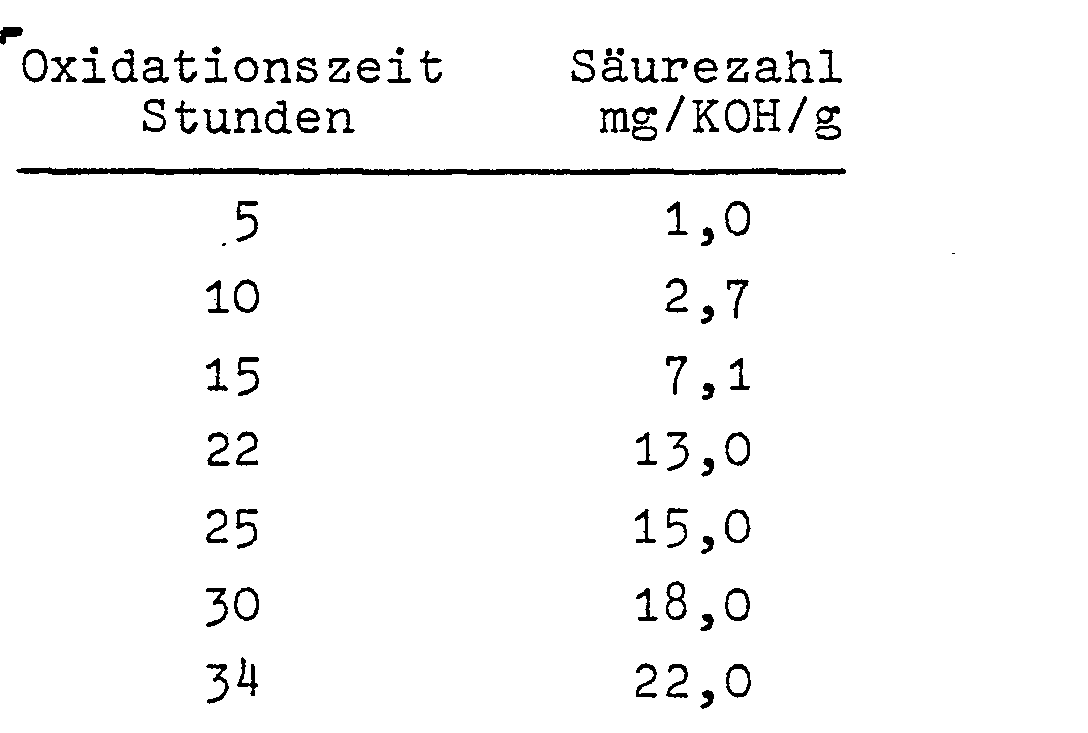
- the course of the oxidation is characterized by the time-dependent course of the acid number, which was determined by titration of the samples hotly dissolved in xylene with ethanolic potassium hydroxide solution.
- polyethylene (comparative example 1) are whirled in a fluidized bed reactor at 25 ° C. (room temperature) and an air throughput of 5000 m 3 / hm 2 and simultaneously sprayed with 2.75 kg of a solution of 0.25 kg of azobisisobutyronitrile in 2.5 kg of chloroform . Then a product temperature of 126 ° C is set by supplying hot air. A sample examined after a reaction time of 11 hours shows no significant content of carboxyl groups.
- Example 1 Depending on the time - after 22, 25, 30 and 34 hours - samples were taken from Example 1 and tested for PVC lubricant action and emulsifiability.
- the PVC lubricant test showed that, irrespective of the acid number, all products have a significantly higher tolerance than the starting product and that the products are therefore of particular importance for the production of transparent PVC articles.
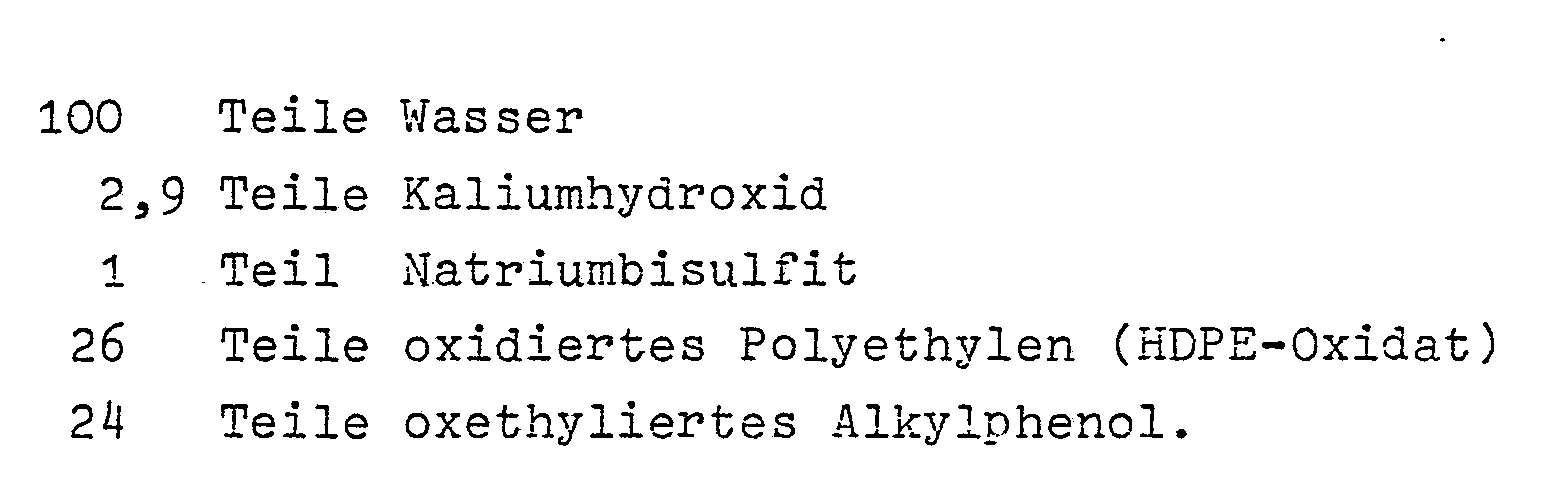
- the oxidates were emulsified in a pressure autoclave according to the following recipe.
Landscapes
- Chemical & Material Sciences (AREA)
- General Chemical & Material Sciences (AREA)
- Health & Medical Sciences (AREA)
- Chemical Kinetics & Catalysis (AREA)
- Medicinal Chemistry (AREA)
- Polymers & Plastics (AREA)
- Organic Chemistry (AREA)
- Addition Polymer Or Copolymer, Post-Treatments, Or Chemical Modifications (AREA)
Abstract
Description
- Die Erfindung betrifft ein Verfahren zur Herstellung von oxidiertem in Wasser emulgierbarem Polyethylen, das infolge der Durchführung der Oxidation im Wirbelbett und der dadurch möglichen konstanten Temperaturführung zu wesentlich besseren Produkten im Hinblick auf ihre Typkonstanz führt.
- Nach der Lehre der DE-OS 14 95 938 wird ein Polyethylen hoher Dichte mit geringen Mengen eines organischen Peroxids vermischt und in Gegenwart von Sauerstoff oder Sauerstoff enthaltenden Gasgemischen (Luft) längere Zeit auf eine Temperatur erhitzt, die unterhalb des Schmelzpunkts des Polyethylens und über 100°C liegt. Am Schluß der Oxidation soll der Gehalt an Carboxyl 0,2 bis 2,0 Milliäquivalente pro Gramm betragen. Technisch soll das Verfahren in einem Ofen, einer rotierenden Trommel oder in einem Fließbett durchgeführt werden. Die ersten beiden Methoden haben aber den Nachteil, daß die Wärmeenergie von außen auf das System einwirken muß, um das im Innern der Trommel oder des Ofens befindliche Material auf die erforderliche Reaktionstemperatur zu erhitzen. Dabei befinden sich die Wandungen der Apparate häufig auf einer bereits zu hohen Temperatur, was bei nicht sorgfältiger Arbeitsweise zu Verklebungen führen kann.
- Das Arbeiten im Fließbett ergibt lt. Tabelle 5 der dasselbe Verfahren beschreibenden DE-OS 14 95 887 gegenüber einer Behandlung im Ofen oder der Trockenbehandlung die relativ geringsten Carbonylgehalte bei gleicher Oxidationszeit (unter Luft); lediglich bei Verwendung reinen Sauerstoffs erhält man Carbonylwerte, die mit den nach den anderen Methoden erhaltenen vergleichbar sind. Es war daher verständlich, daß die Technik später nach wie vor auf die Ofenbehandlung oder Trommelbehandlung zurückgegriffen hat.
- In unserem Hause sind in der letzten Zeit Versuche unternommen worden, die Oxidation von Polyethylen hoher Dichte analog den Bedingungen gemäß DE-OS 14 95 887 in einem Wirbelbettreaktor durchzuführen. Hierbei wird, wie allgemein bekannt, das auf die erforderliche Temperatur vorerwärmte Gasgemisch auf das pulverförmige Reaktionsgut geblasen, welches dann in der geschlossenen, nicht von außen erwärmten Reaktionskammer herumgewirbelt wird. Es zeigte sich dabei, daß trotz langer Reaktionsdauer in Gegenwart von radikalbildenden Initiatoren keine Oxidation stattfand - der Carbonylgehalt bzw. die Säurezahlen waren gleich Null. Dieser Befund ist vermutlich darauf zurückzuführen, daß bei der Wirbelbewegung Initiator und Polyethylen räumlich voneinander getrennt werden und demzufolge nicht mehr miteinander reagieren können.
- Es war das Ziel der Erfindung, die Oxidation des Polyethylens trotzdem in einem Wirbelbettreaktor zu realisieren, da damit die Außenheizung entfällt und somit im gesamten Reaktor eine konstante Temperaturführung möglich ist.
- Da die Sauerstoff-Konzentration in einem Wirbelschichtreaktor um jedes Einzelpartikel (ob groß oder klein) gleich ist, verläuft hier die Oxidation gleichmäßiger als in anderen Reaktoren. Da zudem in der Wirbelschicht selbst (bis auf Randzonen) keine Temperaturgradienten auftreten, sind aus verfahrenstechnischer Sicht ideale Oxidationsbedingungen gegeben. Der im Hinblick auf die spätere Verarbeitung des Polyethylenoxidats unerwünschte Nachteil, daß die großen Teilchen bei gleichen Temperaturen langsamer oxidiert werden als die kleinen, wird durch die geschilderten Verhältnisse im Wirbelbettreaktor ausgeglichen. Der beschriebene Vorteil kann natürlich durch die Verfahrensparamter (insbesondere Fahrweise unter Druck ≤5 bar) noch variiert werden).
- Das Ziel der Erfindung wurde überraschenderweise mit einem Verfahren erreicht, wie es gemäß den Patentansprüchen 1 bis 3 definiert ist.
- Hierbei setzt man ein Polyethylen hoher Dichte ein, das bei Temperaturen, die unterhalb des Erweichungspunktes und vorzugsweise oberhalb 900C liegen, in Gegenwart einer radikalbildenden organischen Verbindung, die sich unterhalb des Erweichungspunktes des Polyethylens zersetzt, thermisch unter Ausschluß von Sauerstoff behandelt worden ist.
- Ein so vorbehandeltes Polyethylen läßt sich nun ohne weiteres im Wirbelbettreaktor zu Säurezahlen zwischen 10 und 50, wie dies für emulgierbare Polyethylene erforderlich ist, oxidieren. In dem so behandelten Polyethylen sind weder radikalbildende Substanzen noch deren Zerfallsprodukte nachweisbar, d.h. sie entweichen im gasförmigen Zustand aus dem System. Überraschenderweise wurde gefunden, daß dieses Polyethylen auch nach einjährigem Lagern bei Raumtemperatur seine Aktivität nicht verliert. Es ist zur Stunde noch nicht geklärt, welche chemischen Vorgänge sich bei der thermischen Behandlung, die in relativ kurzer Zeit abläuft, abspielen.
- Das Verfahren läuft im einzelnen wie folgt ab:
- Als "Polyethylen hoher Dichte" setzt man ein Polyethylen ein, das nach Ziegler oder Phillips unter niedrigem Druck erhalten worden ist, Dichten von ca. 0,93 bis 0,97 und einen Schmelzindex von unter 0,01 besitzt. Solche Polyethylene haben i.a. einen Erweichungspunkt (fälschlich auch als Schmelzpunkt bezeichnet) von ca. 135 bis 145°C.
- Als "radikalbildende organische Verbindungen" setzt man Stoffe ein, die unter den Bedingungen der thermischen Behandlung des Polyethylens in Radikale zerfallen. Im erfindungsgemäßen Sinne sollen die Radikalbildner innerhalb der Zeitdauer der thermischen Behandlung bei Temperaturen unterhalb der Erweichungstemperatur des Polyethylens zerfallen. Radikalbildner, die diesen Forderungen genügen, sind beispielsweise organische Peroxide, wie Dibenzoylperoxid, Lauroylperoxid, Decanoylperoxid, Di-tert.-Butylperoxid, tert.-Butylperoctoat, tert.-Butylisobutyrat, tert.-Butylperpivalat, tert.-Butylperbenzoat, 2,5-Dimethylhexan-2,5-diperbenzoat, 2,5-Dimethyl-2,5-di(t-Butylperoxi)-hexan, Trimethylpentyl-hydroneroxid, tert.-Butylhydroperoxid, Disuccinoylperoxid, Bis-(4-t-butylcyclohexyl)-peroxi- dicarbonat, Cumolhydroperoxid, 1-Butylper-2-ethylhexanoat, oder aliphatische Azoverbindungen, wie beispielsweise 2,2'-Azo-bis-(2,4-Dimethylvaleronitril), 2,2'-Azobis--(4-methyl-2,4-dimethylvaleronitril), 2,2'-Azobis-(2-amidi- nopropan)-hydrochlorid, 1,1'-Azobis-(cyclohexan-1-carbo- nitril), 4,4'-Azobis-(4-cyanvaleriansäure, von denen vor allem Azo-bis-(2-methylpropionitril) ("Azoisobutyronitril", kurz "AIBN" genannt) zu nennen ist.
- Dem pulverförmigen Polyethylen mischt man den Radikalbildner in geringen Mengen, vorzugsweise in Mengen von 0,05 bis 2 Gew.-%, bezogen auf das Polyethylen, insbesondere von 0,1 bis 1 Gew.-% zu und erhitzt das Gemisch unter Ausschluß von Sauerstoff, d.h. unter Inertgas, wie Stick- stoff, auf die genannte Temperatur, vorzugsweise auf 80 bis 130°C. Die Erhitzungsdauer.beträgt vorzugsweise 10 bis 120 Minuten. In den meisten Fällen genügt ca. 1 Stunde. Das so vorbehandelte Polyethylen wird, ohne daß ein weiterer Radikalbildner erforderlich ist, einem Wirbelbettreaktor zugeführt und bei Temperaturen unterhalb des Erweichungspunktes und oberhalb 80°C, vorzugsweise 10 bis 5° unterhalb des Erweichungspunktes mit 0,3 bis 30 m3 Sauerstoff - in Form von beispielsweise Luft - pro kg Polyethylen bis zu Säurezahlen von 5 bis 50, vorzugsweise 10 bis 30 oxidiert. Die Gesamtoxidationszeit beträgt ca. 15 bis 50 Stunden.
- Die erhaltenen Oxidate stellen helle, temperaturbeständige Wachse mit einer Jodfarbzahl (150°C/30 Min.) von ca. 3, einer Höppler-Härte von ca. 1100 bar und einem Schmelzbereich von 125 bis 130°C dar. Die Schmelzindices d.h. MFI-Werte (160°C/325 p) liegen im Bereich von 40 bis 100 Einheiten.
- Die Produkte lassen sich ausgezeichnet stippenfrei und hell im Druckautoklaven emulgieren und werden üblichen Bodenpflegeemulsionen zugesetzt, um die Härte des Filmes und damit die mechanische Festigkeit zu erhöhen. Gegenüber den auf dem Markt befindlichen PE-Oxidaten für den Pflegemittelbereich zeichnen sich die durch das Wirbelschichtverfahren hergestellten Produkte erstens dadurch aus, daß sie um ca. 100 bis 150 bar härter sind und zweitens bei bereits niedrigeren Säurezahlen zu hellen, stippenfreien Emulsionen führen.
- Letzeres dürfte der Verfahrensweise der Oxidation zuzuschreiben sein, die offenbar den Vorzug hat, zu homogeneren Oxidaten zu führen als übliche Marktprodukte. Darüber hinaus werden diese Produkte auch als PVC-Gleitmittel eingesetzt, wobei insbesondere Produkte mit niedriger Säurezahl bevorzugt werden.
- Die nun folgenden Beispiele erläutern die Erfindung.
- 50 kg eines Polyäthylens der Dichte 0,943 g/cm, einem Erweichungspunkt über 135°C und einem Schmelzindex (MFI 1901 21,6 g/10 min) von Null werden mit 0,25 kg Azobisisobutyronitril gemischt und 1 Stunde bei 110 - 120° unter einer Stickstoffatmosphäre erhitzt. Hierbei zersetzt sich der Initiator und es entstehen die Zersetzungsprodukte Tetramethylbernsteinsäuredinitril und Stickstoff. Tetramethylbernsteinsäuredinitril sublimiert bei dieser Temperatur ab, was durch einen zusätzlichen leichten Stickstoffstrom unterstützt wird; schon nach 0,5 Stunden ist gaschromatografisch kein Zersetzungsprodukt im Polyäthylen mehr nachweisbar.
- Das auf diese Weise vorbehandelte Polyäthylen wird in einen Wirbelschichtreaktor mit einer Siebbodenfläche von 0,25 m2 überführt und bei einem Luftdurchsatz von 1200 m3/h gewirbelt. Die Produkttemperatur wird durch die Heißluft in den ersten 15 Stunden zwischen 126 und 128°C gehalten und danach auf 124-126°C abgesenkt. Die Gesamtoxidationszeit beträgt 34 Stunden. Der Verlauf der Oxidation ist gekennzeichnet durch den zeitabhängigen Verlauf der Säurezahl, die durch Titration der in Xylol heiß gelösten Proben mit äthanolischer Kalilauge bestimmt wurde.
- 50 kg eines Polyäthylens der Dichte 0,943 g/cm3 und einem Erweichungspunkt von 136°C und einem Schmelzindex von Null werden mit 0,25 kg Azobisisobutyronitril gemischt und in einem Wirbelbettreaktor mit einer Siebfläche von 0,25 m2 vorgelegt. Das Produktgemisch wird nun bei einem Luftdurchsatz von 1200 m3/h (Normalbedingungen) gewirbelt und gleichzeitig durch die heiße Luft auf eine Temperatur von 124°C aufgeheizt. Nach einer Wirbeldauer von 23 Stunden wird an einer Probe durch Titration der Oxidationsgrad über die Säurezahl bestimmt; es hat praktisch kein oxidativer Abbau stattgefunden.
- 50 kg Polyäthylen (Vergleichsbeispiel 1) werden im Wirbelschichtreaktor bei 25°C (Raumtemperatur) und einem Luftdurchsatz von 5000 m3/h.m2 gewirbelt und gleichzeitig mit 2,75 kg einer Lösung von 0,25 kg Azobisisobutyronitril in 2,5 kg Chloroform besprüht. Danach wird durch Zuführung von heißer Luft eine Produkttemperatur von 126°C eingestellt. Eine nach 11 Stunden Reaktionsdauer untersuchte Probe zeigt keinen signifikanten Gehalt an Carboxylgruppen.
- Man verfährt wie in Vergleichsbeispiel 2 beschrieben mit dem Unterschied, daß jetzt das Produkt während der Sprühdotierung nur gelegentlich umgeschichtet wird, so daß mit Sicherheit eine Benetzung der Produktoberfläche gegeben ist. Danach wird durch Zuführung von Heißluft das Polyäthylenpulver 15 Stunden bei 126 bis 128°C gewirbelt. Eine nach dieser Zeit entnommene Probe zeigt ebenfalls keinerlei oxidativen Abbau.
- Aus dem Beispiel 1 wurden in Abhängigkeit von der Zeit - nach 22, 25, 30 und 34 Stunden - Proben gezogen und auf PVC-Gleitmittelwirkung und Emulgierbarkeit geprüft.
- Bei der PVC-Gleitmittelprüfung zeigte sich, daß unabhängig von der Säurezahl alle Produkte gegenüber dem Ausgangsprodukt eine deutlich höhere Verträglichkeit haben und somit den Produkten für die Herstellung von durchsichtigen PVC-Artikeln besondere Bedeutung zukommt.
- Zur Prüfung auf Emulgierbarkeit wurden die Oxidate in einem Druckautoklaven nach folgendem Rezept emulgiert.
- In einem 1-1-Druckautoklaven mit Rührer, Heizung und Zulaufgefäß wurden vorgelegt

Claims (5)
Applications Claiming Priority (2)
| Application Number | Priority Date | Filing Date | Title |
|---|---|---|---|
| DE19813112163 DE3112163A1 (de) | 1981-03-27 | 1981-03-27 | Verfahren zur herstellung von emulgierbarem polyethylen durch oxidation von polyethylen im wirbelbettreaktor |
| DE3112163 | 1981-03-27 |
Publications (2)
| Publication Number | Publication Date |
|---|---|
| EP0063693A1 true EP0063693A1 (de) | 1982-11-03 |
| EP0063693B1 EP0063693B1 (de) | 1984-07-25 |
Family
ID=6128491
Family Applications (1)
| Application Number | Title | Priority Date | Filing Date |
|---|---|---|---|
| EP82102270A Expired EP0063693B1 (de) | 1981-03-27 | 1982-03-19 | Verfahren zur Herstellung von emulgierbarem Polyethylen durch Oxidation von Polyethylen im Wirbelbettreaktor |
Country Status (4)
| Country | Link |
|---|---|
| US (1) | US4459388A (de) |
| EP (1) | EP0063693B1 (de) |
| JP (1) | JPS57170905A (de) |
| DE (2) | DE3112163A1 (de) |
Families Citing this family (20)
| Publication number | Priority date | Publication date | Assignee | Title |
|---|---|---|---|---|
| FR2597489B1 (fr) * | 1986-04-22 | 1988-07-01 | Charbonnages Ste Chimique | Resines a base de polyethylene, leur procede de preparation et leur application comme liant dans les revetements. |
| DE3720953A1 (de) * | 1987-06-25 | 1989-01-05 | Basf Ag | Verfahren zur oxidation von polyethylen |
| US4945133A (en) * | 1987-09-28 | 1990-07-31 | The Dow Chemical Company | Oxidation of halogenated polymers and anticaking halogenated polymers |
| US4923931A (en) * | 1987-09-28 | 1990-05-08 | The Dow Chemical Company | Oxidation of halogenated polymers |
| USRE34647E (en) * | 1988-11-04 | 1994-06-28 | Petrolite Corporation | Overprint aqueous varnish |
| US5376170A (en) * | 1988-11-04 | 1994-12-27 | Petrolite Corporation | Additive dispersions containing ethoxylated alcohols |
| US4908063A (en) * | 1988-11-04 | 1990-03-13 | Petrolite Corporation | Additive composition for water-based inks |
| US5008144A (en) * | 1988-11-04 | 1991-04-16 | Petrolite Corporation | Overprint aqueous varnish |
| US5087669A (en) * | 1989-09-18 | 1992-02-11 | The Dow Chemical Company | Vinyl chloride polymer composition with improved fusion properties |
| US5401811A (en) * | 1994-05-03 | 1995-03-28 | Eastman Chemical Company | Continuous process for the oxidation of polyethylene |
| DE19644270A1 (de) * | 1996-10-24 | 1998-04-30 | Basf Ag | Verfahren zur Herstellung oxidierter Polyethylenwachse |
| WO2004083301A1 (en) * | 2003-03-14 | 2004-09-30 | Honeywell International, Inc. | Cellulose reinforced resin compositions |
| US7238754B1 (en) * | 2005-12-12 | 2007-07-03 | Equistar Chemicals, Lp | Solid state process to modify the melt characteristics of polyethylene resins and products |
| US7622031B2 (en) * | 2007-01-15 | 2009-11-24 | Honeywell International Inc | Method for preparing oxidized polyolefin waxes |
| DE102008000595A1 (de) | 2008-03-11 | 2009-09-17 | Evonik Degussa Gmbh | Nachvernetzendes Wachs und Verfahren zu seiner Herstellung |
| WO2014151221A1 (en) | 2013-03-15 | 2014-09-25 | The Procter & Gamble Company | Renewable thermoplastic starch - polyolefin compositions comprising compatibilizer and flexible thin films made therefrom |
| WO2015066588A1 (en) | 2013-11-04 | 2015-05-07 | The Procter & Gamble Company | Thermoplastic polymer compositions having co-continuous plate-like morphology |
| AR118828A1 (es) | 2019-05-02 | 2021-11-03 | Tearclear Corp | Extracción de conservante de colirios |
| KR20220144359A (ko) | 2019-12-19 | 2022-10-26 | 티어클리어 코포레이션 | 점안제로부터의 보존제 제거 |
| JP2023536900A (ja) | 2020-08-05 | 2023-08-30 | ティアークリアー コープ. | 眼科用製剤からの防腐剤除去のためのシステムおよび方法 |
Citations (4)
| Publication number | Priority date | Publication date | Assignee | Title |
|---|---|---|---|---|
| DE1197230B (de) * | 1961-09-22 | 1965-07-22 | Eastman Kodak Co | Verfahren zum Herstellen von wasseremulgier-barem Polyaethylenwachs |
| DE1237783B (de) * | 1962-02-03 | 1967-03-30 | Hoechst Ag | Verfahren zur Herstellung von sauerstoffhaltigen Wachsrohstoffen durch Oxydation vonPolyolefinwachsen |
| DE1495887A1 (de) * | 1962-05-14 | 1969-05-14 | Allied Chem | Verfahren zur Herstellung von oxydierten Polyolefinen |
| DE1770028A1 (de) * | 1968-03-22 | 1971-09-16 | Basf Ag | Thermisch-oxydativer Abbau von Polyolefinen in der Pulverphase |
Family Cites Families (11)
| Publication number | Priority date | Publication date | Assignee | Title |
|---|---|---|---|---|
| US3243310A (en) * | 1961-07-27 | 1966-03-29 | Eastman Kodak Co | Stabilized polyethylene waxes and process for preparing same |
| NL129316C (de) * | 1962-02-06 | |||
| US3293112A (en) * | 1963-05-06 | 1966-12-20 | Grace W R & Co | Amino-cross linked oxidized alpha-olefin polymer |
| US3519588A (en) * | 1963-03-08 | 1970-07-07 | Eastman Kodak Co | Emulsifiable waxes from polyolefins |
| US3322711A (en) * | 1963-10-17 | 1967-05-30 | Allied Chem | Polymer oxidation process and emulsion therefrom |
| US3329667A (en) * | 1964-03-09 | 1967-07-04 | Allied Chem | Process for the oxidation of polyethylene |
| US3434993A (en) * | 1964-11-16 | 1969-03-25 | Allied Chem | Aqueous emulsion of emulsifiable oxidized polyethylene |
| US3444155A (en) * | 1966-04-15 | 1969-05-13 | Western Petro Chem Corp The | Process for preparing degraded polyethylene |
| US3562788A (en) * | 1967-06-08 | 1971-02-09 | Eastman Kodak Co | Thermal degradation of polyolefins |
| US3692877A (en) * | 1969-12-25 | 1972-09-19 | Sanyo Chemical Ind Ltd | Emulsifiable oxidized polyolefins |
| US4218353A (en) * | 1976-11-18 | 1980-08-19 | Allied Chemical Corporation | External lubricant compositions for rigid vinyl polymers |
-
1981
- 1981-03-27 DE DE19813112163 patent/DE3112163A1/de not_active Withdrawn
-
1982
- 1982-02-19 US US06/350,357 patent/US4459388A/en not_active Expired - Fee Related
- 1982-03-19 EP EP82102270A patent/EP0063693B1/de not_active Expired
- 1982-03-19 DE DE8282102270T patent/DE3260433D1/de not_active Expired
- 1982-03-26 JP JP57047533A patent/JPS57170905A/ja active Granted
Patent Citations (4)
| Publication number | Priority date | Publication date | Assignee | Title |
|---|---|---|---|---|
| DE1197230B (de) * | 1961-09-22 | 1965-07-22 | Eastman Kodak Co | Verfahren zum Herstellen von wasseremulgier-barem Polyaethylenwachs |
| DE1237783B (de) * | 1962-02-03 | 1967-03-30 | Hoechst Ag | Verfahren zur Herstellung von sauerstoffhaltigen Wachsrohstoffen durch Oxydation vonPolyolefinwachsen |
| DE1495887A1 (de) * | 1962-05-14 | 1969-05-14 | Allied Chem | Verfahren zur Herstellung von oxydierten Polyolefinen |
| DE1770028A1 (de) * | 1968-03-22 | 1971-09-16 | Basf Ag | Thermisch-oxydativer Abbau von Polyolefinen in der Pulverphase |
Also Published As
| Publication number | Publication date |
|---|---|
| DE3260433D1 (en) | 1984-08-30 |
| JPH0155281B2 (de) | 1989-11-24 |
| JPS57170905A (en) | 1982-10-21 |
| EP0063693B1 (de) | 1984-07-25 |
| US4459388A (en) | 1984-07-10 |
| DE3112163A1 (de) | 1982-10-14 |
Similar Documents
| Publication | Publication Date | Title |
|---|---|---|
| EP0063693B1 (de) | Verfahren zur Herstellung von emulgierbarem Polyethylen durch Oxidation von Polyethylen im Wirbelbettreaktor | |
| DE69118418T2 (de) | Verfahren zur Herstellung von Olefin-Pfropfcopolymeren | |
| EP0296492B1 (de) | Verfahren zur Oxidation von Polyethylen | |
| DE69717017T2 (de) | Verfahren zur Herstellung von Polyolefin-pfropfcopolymeren | |
| DE1595808C3 (de) | ||
| DE2542280B2 (de) | Verfahren zur polymerisation von vinylidenfluorid | |
| CH441289A (de) | Verfahren zur Herstellung von Sulfonsäuren | |
| DE69917900T2 (de) | Emulgierbare polyolefinwachse | |
| DE818259C (de) | Verfahren zur Herstellung eines Suspensoids von Polytetrafluoraethylen | |
| DE2433486C3 (de) | Verfahren zur Herstellung von Emulsionen, konzentrierten Dispersionen und Pasten von hydrophilen polymeren Füllstoffen in Weichmachern | |
| DE1595181B2 (de) | Verfahren zur Herstellung von homogenen chlorsulfonierten Polyolefinen | |
| DE1188284B (de) | Verfahren zur Herstellung von Polyaethylen | |
| DE1927684C3 (de) | Verfahren zur Herstellung von Katalysatoren und deren Verwendung | |
| DE2063248A1 (de) | Vinylidenfluorid Homopolymerisate, Verfahren zu ihrer Herstellung und ihre Verwendung in Formmassen und Beschichtungs massen | |
| DE2839430A1 (de) | Verfahren zur herstellung von schaeumendem natriumpercarbonat | |
| DE1197230B (de) | Verfahren zum Herstellen von wasseremulgier-barem Polyaethylenwachs | |
| DE2543823C2 (de) | Verfahren zur Herstellung von Polymeren des Vinylchlorids | |
| DE2064498B2 (de) | Verfahren zur herstellung thermisch stabiler formmassen durch behandlung von vinylchloridpolymerisaten | |
| DE1131407B (de) | Verfahren zur Polymerisation ungesaettigter Verbindungen | |
| DE69318322T2 (de) | Polymerisationsverfahren | |
| DE1570834A1 (de) | Verfahren zur Herstellung aethylenischer Polymere | |
| DE1620989A1 (de) | Verfahren zur Polymerisation und Copolymerisation von Vinylfluorid | |
| DE2145427A1 (de) | Hydroformylierungsverfahren | |
| EP0375829A2 (de) | Verfahren zur Herstellung von phlegmatisierten aliphatischen Diperoxidicarbonsäuren | |
| DE2240246A1 (de) | Verfahren zur herstellung von polyolefinen und dabei verwendeter katalysator |
Legal Events
| Date | Code | Title | Description |
|---|---|---|---|
| PUAI | Public reference made under article 153(3) epc to a published international application that has entered the european phase |
Free format text: ORIGINAL CODE: 0009012 |
|
| AK | Designated contracting states |
Designated state(s): DE FR GB IT |
|
| 17P | Request for examination filed |
Effective date: 19821210 |
|
| ITF | It: translation for a ep patent filed | ||
| GRAA | (expected) grant |
Free format text: ORIGINAL CODE: 0009210 |
|
| AK | Designated contracting states |
Designated state(s): DE FR GB IT |
|
| REF | Corresponds to: |
Ref document number: 3260433 Country of ref document: DE Date of ref document: 19840830 |
|
| ET | Fr: translation filed | ||
| PLBE | No opposition filed within time limit |
Free format text: ORIGINAL CODE: 0009261 |
|
| STAA | Information on the status of an ep patent application or granted ep patent |
Free format text: STATUS: NO OPPOSITION FILED WITHIN TIME LIMIT |
|
| 26N | No opposition filed | ||
| ITTA | It: last paid annual fee | ||
| PGFP | Annual fee paid to national office [announced via postgrant information from national office to epo] |
Ref country code: FR Payment date: 19920218 Year of fee payment: 11 |
|
| PGFP | Annual fee paid to national office [announced via postgrant information from national office to epo] |
Ref country code: GB Payment date: 19920316 Year of fee payment: 11 |
|
| PGFP | Annual fee paid to national office [announced via postgrant information from national office to epo] |
Ref country code: DE Payment date: 19920321 Year of fee payment: 11 |
|
| PG25 | Lapsed in a contracting state [announced via postgrant information from national office to epo] |
Ref country code: DE Effective date: 19930313 |
|
| PG25 | Lapsed in a contracting state [announced via postgrant information from national office to epo] |
Ref country code: GB Effective date: 19930319 |
|
| GBPC | Gb: european patent ceased through non-payment of renewal fee |
Effective date: 19930319 |
|
| PG25 | Lapsed in a contracting state [announced via postgrant information from national office to epo] |
Ref country code: FR Effective date: 19931130 |
|
| REG | Reference to a national code |
Ref country code: FR Ref legal event code: ST |