EP0063710A1 - Electrode for arc furnaces, and method of using it - Google Patents
Electrode for arc furnaces, and method of using it Download PDFInfo
- Publication number
- EP0063710A1 EP0063710A1 EP82102770A EP82102770A EP0063710A1 EP 0063710 A1 EP0063710 A1 EP 0063710A1 EP 82102770 A EP82102770 A EP 82102770A EP 82102770 A EP82102770 A EP 82102770A EP 0063710 A1 EP0063710 A1 EP 0063710A1
- Authority
- EP
- European Patent Office
- Prior art keywords
- electrode according
- electrode
- lower section
- carbon material
- range
- Prior art date
- Legal status (The legal status is an assumption and is not a legal conclusion. Google has not performed a legal analysis and makes no representation as to the accuracy of the status listed.)
- Withdrawn
Links
Images

Classifications
-
- H—ELECTRICITY
- H05—ELECTRIC TECHNIQUES NOT OTHERWISE PROVIDED FOR
- H05B—ELECTRIC HEATING; ELECTRIC LIGHT SOURCES NOT OTHERWISE PROVIDED FOR; CIRCUIT ARRANGEMENTS FOR ELECTRIC LIGHT SOURCES, IN GENERAL
- H05B7/00—Heating by electric discharge
- H05B7/02—Details
- H05B7/06—Electrodes
- H05B7/08—Electrodes non-consumable
- H05B7/085—Electrodes non-consumable mainly consisting of carbon
-
- H—ELECTRICITY
- H05—ELECTRIC TECHNIQUES NOT OTHERWISE PROVIDED FOR
- H05B—ELECTRIC HEATING; ELECTRIC LIGHT SOURCES NOT OTHERWISE PROVIDED FOR; CIRCUIT ARRANGEMENTS FOR ELECTRIC LIGHT SOURCES, IN GENERAL
- H05B7/00—Heating by electric discharge
- H05B7/02—Details
- H05B7/10—Mountings, supports, terminals or arrangements for feeding or guiding electrodes
- H05B7/101—Mountings, supports or terminals at head of electrode, i.e. at the end remote from the arc
Definitions
- the invention relates to an electrode for arc furnaces made of an upper section made of metal and an edible lower section made of carbon material, which have a substantially cylindrical shape and are connected to one another by a screw nipple or the like, the upper section being a liquid cooling device with a flow channel and has a return channel and the upper section can preferably be protected in its lower region by a high-temperature-resistant coating, and methods of using it.
- An electrode string is usually composed of a plurality of graphite units which are connected to one another by screw connections or the like. Often! three electrode strings are used as current-carrying elements per furnace for these electrothermal high-temperature melting processes.
- electrodes for electric arc furnaces have been described in DE-OS 15 65 751, which consist of an upper metallic head piece, a lower metallic head piece, both electrical conductors connecting one another, and a ceramic mass enclosing these conductors and the lower head piece and consist of a lower head piece interchangeably attached electrode tip.
- a liquid-cooled electrode is also known from DE-OS 28 45 367, which has a cylindrical clamping part fastened to the electrode support arm, a metallic cooling system fastened to it, carrying the electrode current, which carries a threaded part at the free end for screwing on the electrode tip, and a tubular heat shield which the cooling system in the area exposed to the furnace atmosphere at a distance and in contains fixed spatial assignment to it.
- a combination electrode emerges from the European patent laid-open specification 12 573, in which the laterally external metallic contact of the metal shaft is mounted in an insulating manner with respect to the internal metallic cooling system.
- a ceramic coating secured with hooks is provided, which extends to approximately the height of the screw nipple connection with which a carbon part is attached.
- Such combination electrodes have in principle been known for a long time, e.g. from DE-PS 268 660 issued in 1912.
- the electrodes have been exposed to increasing electrical (and thus thermal) stress to reduce melting times. Due to the constantly increasing stresses on the electrodes, there have also been extreme demands on the quality of the carbon strands, be they 'those which consist exclusively of carbon material, or be those which are nippled on a cooled metal shaft.
- the requirements for graphite parts with regard to their density, specific electrical resistance, thermal expansion, thermal conductivity, strength and elasticity as well as thermal shock resistance were continuously increased. This has not only led to an intensification of the graphitization processes that have been carried out over longer periods of time at higher temperatures, but also to additional densification processes, etc.
- the invention has for its object to provide electrodes for arc furnace operation that can withstand the considerable mechanical, thermal and electrical stresses prevailing there in a particularly suitable manner.
- an electrode that is particularly suitable for practical operation is to be made available, the production or operation of which can be carried out in a more economical manner than previously.
- This object is achieved by creating an electrode for arc furnaces of the type mentioned at the outset, which is characterized in that the carbon material is formed only partially from graphitic structural elements or is free thereof.
- the invention is based on the surprising finding that, when using carbon materials of inferior quality than was previously considered essential for the operation of the electric arc furnace, there is nevertheless good practical behavior with combination electrodes.
- carbon material which is only partially formed from graphitic structural elements or is completely or almost completely free thereof, the feared formation of cracks or flaking does not occur.
- the carbon material is connected to the metal shaft via a screw nipple known per se, which consists, for example, of graphite or metal and can also be cooled.
- the metal shaft which can also be viewed as a power supply to the carbon part, generally consists of a highly conductive metal, for example copper.
- a liquid cooling system is provided in the metal shaft, which can have a flow and return channel, which can optionally also cool at least part of the screw nipple externally or internally can Such constructions of the metal shaft, which can be at least partially externally protected by a high-temperature-resistant coating, are known.
- the length and the diameter of the lower section made of carbon material are selected such that, compared to electrode strands of the same or corresponding overall dimensions, which consist exclusively of graphitic carbon material, there is at least the same electrical load capacity.
- the dimensioning of the upper section made of metal and the lower section made of carbon material is coordinated with one another in such a way that at least some of the metal shaft is regularly inserted into the arc furnace itself.
- the carbon part advantageously has an output length of approximately 2 to 3 m with total electrode output lengths of approximately 5.5 to 8 m, preferably 6 to 7 m.
- the proportion of graphitic structural elements within the lower section made of carbon material can be in the range from 0 to 90% by weight. It has been found to be particularly advantageous if the proportion of graphitic structural elements is in the range from 50 to 85% by weight, but particularly preferably 60 to 80% by weight, based on the weight of the carbon material.
- graphitic structural elements should essentially be understood to mean natural graphite or electrographite or a mixture thereof. Waste graphite, e.g. from synthetic graphite production.
- non-graphitic structural components of the carbon material consist of anthracite, coal coke and / or normal petroleum coke, and in the context of the invention the lower section can also consist entirely of these materials or mixtures thereof.
- the carbon material in the lower section is in the range from 0 to 90% by weight, preferably 50 to 85% by weight, but particularly preferably 60 to 80% by weight
- Electrographite or natural graphite or a mixture thereof and the rest is formed from anthracite, coal coke and / or normal petroleum coke.
- the lower section of the electrode according to the invention can be produced in a manner known per se. ⁇ Among these, the production by vibration or by extrusion should be emphasized. Such methods are known.
- the carbon material used as the lower section in the electrode according to the invention particularly advantageously has a specific electrical resistance in the range from 10 to 30 ⁇ mm 2 / m.
- the electrodes have a particularly favorable operating behavior, the carbon material of which has a specific electrical resistance in the range from 10 to 20 ⁇ mm 2 / m and in particular 13 to 20 ⁇ mm 2 / m.
- the diameter of the lower section is generally in the range of about 200 to 600 mm. Particularly favorable results were achieved with diameters of the lower section in the range from approximately 300 to 400 mm.
- the diameter of the upper section made of metal can be chosen to be larger, but also smaller, than the diameter of the lower section.
- the bulk density of the carbon material of the lower section is particularly preferably in the range between 1.50 and 1.65 g / cm 3 .
- a particularly advantageous electrode in the context of the invention in which the upper section made of metal accounts for approximately half the total length of the electrode or more, has a carbon part with approx. 50 to 85% of graphitic structural elements made of natural graphite and / or electrographite, the non-graphitic structural components consisting of anthracite, coal coke and / or normal petroleum coke, the specific electrical resistance of the lower section being in the range from 10 to 20 ⁇ mm 2 / m at a bulk density in the range between 1.50 and 1.65 g / cm 3 .
- the electrodes according to the invention are characterized by favorable operating behavior with trouble-free operation.
- the carbon materials in the lower section can be produced from cheaper raw materials by means of simpler production processes than the conventionally used full graphite electrodes. Therefore, the electrode operation can be made cheaper with the same electrical load capacity.
- the electrode according to the invention has its preferred application for the production of steel in the arc furnace operation. But it can also be used for the production of non-ferrous metals such as copper or cobalt, but also for the production of corundum, silicon, etc., can be used.
- the combination electrodes according to the invention are used with particular advantage with diameters of the lower section made of carbon material in the range from 300 to 400 mm, preferably with maximum phase currents in the range from 10 to 30 KA.
- An embodiment of an electrode according to the invention is shown in longitudinal section in the figure, but the invention is not limited to this.
- the cooling medium usually water
- the cooling medium also enters a chamber inside the screw nipple 1, which e.g. is made of cast iron.
- the upper section 5 made of metal here consists of an upper area of larger diameter and a lower-lying area of smaller diameter, which is drawn into the screw nipple 1, which is the connection to the lower section 6 made of carbon material, which is only partially formed from graphitic structural elements is or is free of it.
- the high-temperature-resistant coating 4 is formed from a number of individual molded parts, which can be carried on a bearing 7.
- the high-temperature-resistant insulation 4 is adjoined here by an electrically conductive intermediate layer 11, which is delimited on the inside by the drawn-in, inner metal shaft or its section of smaller diameter 12.
- additional bores can be provided through which inserted pins ensure a good fit of the high-temperature-resistant molded parts via a spring.
- the object of the invention is not limited to the construction shown in the figure.
- the metal shaft has an essentially constant diameter. Rings made of high-temperature-resistant material - preferably graphite - can be screwed onto these.
- the cooling system can preferably be designed in such a way that the cooling medium flows around the nipple in its upper outer region, but this does not enter the nipple itself.
- An electrically conductive intermediate layer is not always provided in such constructions.
- Such and different types of embodiments of the electrode according to the invention are included in the scope of the invention insofar as the carbon material of the consumable lower section is only partially formed from graphitic structural elements or is free thereof.
- a combination electrode made of a water-cooled copper shaft was used, which was cooled with water by a cooling system consisting of the supply and return lines.
- the copper shaft was protected in the area of the furnace by a high temperature resistant coating.
- the copper shaft was screwed to the carbon material via a graphite nipple, which essentially consisted of waste graphite from the synthetic graphite production.
- the carbon material had a bulk density of 1.62 g / cm 3 and a specific electrical resistance of 18.5 ⁇ mm 2 / m.
- Three such electrodes were in an oven at 50 ton capacity and three phases with a maximum "phase current of 50,000 A at an operating voltage of 490 V applied.
Landscapes
- Physics & Mathematics (AREA)
- Engineering & Computer Science (AREA)
- Plasma & Fusion (AREA)
- Discharge Heating (AREA)
- Vertical, Hearth, Or Arc Furnaces (AREA)
- Furnace Details (AREA)
- Refinement Of Pig-Iron, Manufacture Of Cast Iron, And Steel Manufacture Other Than In Revolving Furnaces (AREA)
- Electric Stoves And Ranges (AREA)
- Resistance Heating (AREA)
Abstract
Description
Die Erfindung betrifft eine Elektrode für Lichtbogenöfen aus einem oberen Abschnitt aus Metall und einem verzehrbaren unteren Abschnitt aus Kohlenstoffmaterial, die eine im wesentlichen zylindrische Form aufweisen und durch einen Schraubnippel oder dergleichen miteinander verbunden sind, wobei der obere Abschnitt eine Flüssigkeits-Kühleinrichtung mit einem Vorlaufkanal und einem Rücklaufkanal aufweist und der obere Abschnitt vorzugsweise in dessen unterem Bereich durch eine hochtemperaturfeste Beschichtung geschützt sein kann, sowie Verfahren zu deren Verwendung.The invention relates to an electrode for arc furnaces made of an upper section made of metal and an edible lower section made of carbon material, which have a substantially cylindrical shape and are connected to one another by a screw nipple or the like, the upper section being a liquid cooling device with a flow channel and has a return channel and the upper section can preferably be protected in its lower region by a high-temperature-resistant coating, and methods of using it.
Lichtbogenöfen zur Erzeugung von Elektrostahl, Kupfer, Korund, Kobalt, Silizium, etc., werden bisher mit Graphitelektroden als stromzuführenden Elementen betrieben. i Üblicherweise setzt sich ein Elektrodenstrang aus mehreren, miteinander durch Schraubverbindungen oder dergleichen verbundenden Graphiteinheiten zusammen. Häufig! werden drei Elektrodenstränge als stromführende Elemente pro Ofen für diese elektrothermischen Hochtemperaturschmelzprozesse eingesetzt.Arc furnaces for the production of electrical steel, copper, Corundum, cobalt, silicon, etc., have previously been operated with graphite electrodes as current-supplying elements. i An electrode string is usually composed of a plurality of graphite units which are connected to one another by screw connections or the like. Often! three electrode strings are used as current-carrying elements per furnace for these electrothermal high-temperature melting processes.
Es sind auch bereits Kombinationselektroden aus einem Metallschaft, an denen durch eine Schraubverbindung, wie Nippel, etc., eine Spitze aus Kohlenstoffmaterial angefügt ist, für den Lichtbogenofenbetrieb beschrieben worden.Combination electrodes made of a metal shaft, to which a tip made of carbon material is attached by means of a screw connection, such as nipples, etc., have also been described for arc furnace operation.
So sind in der DE-OS 15 65 751 Elektroden für elektrische Lichtbogenöfen beschrieben worden, die aus einem obe- "ren metallischen Kopfstück, einem unteren metallischen Kopfstück, aus beide miteinander verbindenden elektrischen Leitern, aus einer diese Leiter und das untere Kopfstück einschliessenden keramischen Masse und aus einem unteren Kopfstück auswechselbar befestigten Elektrodenspitze bestehen.For example, electrodes for electric arc furnaces have been described in DE-OS 15 65 751, which consist of an upper metallic head piece, a lower metallic head piece, both electrical conductors connecting one another, and a ceramic mass enclosing these conductors and the lower head piece and consist of a lower head piece interchangeably attached electrode tip.
Eine flüssigkeitsgekühlte Elektrode ist auch aus der DE-OS 28 45 367 bekannt, die einen am Elektrodentragarm befestigten zylindrischen Einspannteil, ein an diesem befestigtes, den Elektrodenstrom führendes metallisches Kühlsystem, das am freien Ende einen Gewindeteil zum Aufschrauben der Elektrodenspitze trägt, und einen rohrförmigen Hitzeschirm, der das Kühlsystem in dem der Ofenatmosphäre ausgesetzten Bereich mit Abstand und in fester räumlicher Zuordnung zu diesem enthält, aufweist.A liquid-cooled electrode is also known from DE-OS 28 45 367, which has a cylindrical clamping part fastened to the electrode support arm, a metallic cooling system fastened to it, carrying the electrode current, which carries a threaded part at the free end for screwing on the electrode tip, and a tubular heat shield which the cooling system in the area exposed to the furnace atmosphere at a distance and in contains fixed spatial assignment to it.
Aus der europäischen Patentoffenlegungsschrift 12 573 geht eine Kombinationselektrode hervor, bei der der seitlich aussenliegende metallische Kontakt des Metallschaftes gegenüber dem innenliegenden metallischen Kühlungssystem isolierend gelagert ist. Im unteren Teil des metallischen Kühlungsschaftes ist eine mit Haken gesicherte keramische Beschichtung vorgesehen, die sich bis etwa auf die Höhe der Schraubnippelverbindung erstreckt, mit der ein Kohlenstoffteil angefügt ist.A combination electrode emerges from the European patent laid-
Derartige Kombinationselektroden sind im Prinzip bereits seit längerer Zeit bekannt, so z.B. aus der im Jahre 1912 ausgegebenen DE-PS 268 660.Such combination electrodes have in principle been known for a long time, e.g. from DE-PS 268 660 issued in 1912.
"Kombinationselektroden sind im Lichtbogenofenbetrieb starker Beanspruchung ausgesetzt. Dies erklärt sich aus , den hohen Arbeitstemperaturen, z.B. bei Elektrostahlerzeugung, bei der solche Elektroden am häufigsten eingesetzt werden."Combination electrodes are exposed to heavy loads in arc furnace operation. This can be explained by the high working temperatures, e.g. in electrical steel production, where such electrodes are used most frequently.
Wegen der hohen Temperaturen ergeben sich Verluste durch Seitenoxidation des Kohlenstoffteils. Auch besteht die Gefahr der Wanderung oder der seitlichen Ansetzung des Lichtbogens, die im Störungsfall auch oberhalb des Kohlenstoffteils erfolgen kann und zu Kurzschlüssen führt. Darüber hinaus sind die Elektroden unterschiedlichen Temperaturen im Vorlauf und Rücklauf des Kühlmittels sowie im Bereich des Kohlenstoffteils gegenüber der Stromzuführungs- und Kühlungseinheit unterworfen. Eine besonders gefährdete Stelle stellt hierbei der Bereich des Schraubnippels dar. :
- Die Elektroden müssen aber auch mannigfachen mechanischen Beanspruchungen genügen, die beim Kippen des Ofens, durch Vibrationen - begünstigt durch zu grosses Spiel der Tragarme, durch Schrottversetzungen beim Einschmelzen, sowie beim Aufsetzen des Stranges auf isolierende Bestandteile beim Schrott unter anderem auftreten.
- However, the electrodes must also be able to withstand a variety of mechanical stresses, which occur when the furnace is tilted, caused by vibrations - favored by excessive play in the support arms, by displaced scrap when melting, and when the strand is placed on insulating components of the scrap, among other things.
Dazu kommt, dass im Verlauf der letzten 10 bis 15 Jahre die Elektroden zur Verringerung der Schmelzzeiten steigender elektrischer (und damit auch thermischer) Belastung ausgesetzt sind. Durch die ständig zunehmenden Beanspruchungen an die Elektroden haben sich auch extreme Forderungen an die Qualität der Kohlenstoffstränge, seien es 'solche, die ausschliesslich aus Kohlenstoffmaterial bestehen, seien es solche die an einen gekühlten Metallschaft angenippelt sind, ergeben. Hierbei wurden die Anforderungen an Graphitteile im Hinblick auf deren Dichte, spezifischen elektrischen Widerstand, thermische Ausdehnung, Wärmeleitfähigkeit, Festigkeit und Elastizität sowie thermische Schockfestigkeit, laufend gesteigert. Dies hat nicht nur zu einer Intensivierung der Graphitierungsprozesse, die über längere Zeiträume bei höheren Temperaturen durchgeführt wurden, sondern auch zu zusätzlichen Nachverdichtungsvorgängen, etc., geführt. Der zur Erfüllung derartiger Anforderungen erforderliche sehr hohe Grad der Umwandlung in Graphit hat mit sich gebracht, dass hierfür lediglich petrochemische Nadelkokse hoher Qualität als Ausgangsstoffe herangezogen werden konnten. Die Verwendung solcher teuren, aus petrochemischen Rohstoffen zugängigen Premiumkokse mit einem hohen Grad an struktureller Vororientierung bringt andere Schwierigkeiten mit sich. Diese liegen unter anderem darin, dass die Herstellung solcher Ausgangskokse aufgrund der begrenzt verfügbaren, schwefelarmen Erdölvorkommen in ihrer Menge limitiert ist. Weiterhin muss in der Graphitierungsstufe des Herstellungsprozesses der Elektrodenteile ein erhebliches Mass an elektrischer Energie zum Erreichen der weitgehenden Graphitierung aufgewandt werden. Schliesslich ergeben sich im übergangsbereich zwischen gekühltem Metallschaft und hieran angefügtem Graphitteil durch eine Temperaturdifferenz in der Grössenordnung von 500 K oder mehr, unterschiedliche thermische Ausdehnungen und elektrische überlastungen des Nippelbereiches.In addition, over the past 10 to 15 years, the electrodes have been exposed to increasing electrical (and thus thermal) stress to reduce melting times. Due to the constantly increasing stresses on the electrodes, there have also been extreme demands on the quality of the carbon strands, be they 'those which consist exclusively of carbon material, or be those which are nippled on a cooled metal shaft. The requirements for graphite parts with regard to their density, specific electrical resistance, thermal expansion, thermal conductivity, strength and elasticity as well as thermal shock resistance were continuously increased. This has not only led to an intensification of the graphitization processes that have been carried out over longer periods of time at higher temperatures, but also to additional densification processes, etc. The very high degree of conversion to graphite required to meet such requirements has meant that only high quality petrochemical needle coke could be used as starting materials. The The use of such expensive premium coke, accessible from petrochemical raw materials, with a high degree of structural pre-orientation brings with it other difficulties. One of the reasons for this is that the production of such starting coke is limited in its quantity due to the limited availability of low-sulfur oil deposits. Furthermore, in the graphitization stage of the manufacturing process of the electrode parts, a considerable amount of electrical energy has to be used to achieve the extensive graphitization. Finally, in the transition area between the cooled metal shaft and the graphite part attached to it, there are different thermal expansions and electrical overloads of the nipple area due to a temperature difference of the order of 500 K or more.
Der Erfindung liegt die Aufgabe zugrunde, Elektroden für den Lichtbogenofenbetrieb zu schaffen, die den dort herrschenden erheblichen mechanischen, thermischen und elektrischen Beanspruchungen in besonders geeigneter Weise gewachsen sind. Hierbei soll durch Abstimmung von gekühltem Metallschaft und Kohlenstoffteil aufeinander, eine für den Praxisbetrieb besonders geeignete Elektrode zur Verfügung gestellt werden, deren Herstellung bzw. Betrieb in wirtschaftlicherer Weise als bislang erfolgen kann.The invention has for its object to provide electrodes for arc furnace operation that can withstand the considerable mechanical, thermal and electrical stresses prevailing there in a particularly suitable manner. In this case, by coordinating the cooled metal shaft and carbon part with one another, an electrode that is particularly suitable for practical operation is to be made available, the production or operation of which can be carried out in a more economical manner than previously.
Diese Aufgabe wird durch die Schaffung einer Elektrode für Lichtbogenöfen der eingangs genannten Art gelöst, die dadurch gekennzeichnet ist, dass das Kohlenstoffmaterial nur zum Teil aus graphitischen Strukturelementen gebildet oder hiervon frei ist.This object is achieved by creating an electrode for arc furnaces of the type mentioned at the outset, which is characterized in that the carbon material is formed only partially from graphitic structural elements or is free thereof.
Die Erfindung baut mit auf der überraschenden Feststel lung auf, dass sich bei Einsatz von Kohlenstoffmaterialien geringerwertiger Qualität, als sie bislang für den Lichtbogenofenbetrieb als unabdingbar erachtet worden ist, gleichwohl ein gutes Praxisverhalten bei Kombinationselektroden ergibt. Insbesondere hat es sich herausgestellt, dass bei Einsatz von Kohlenstoffmaterial, das nur zum Teil aus graphitischen Strukturelementen gebildet oder hiervon völlig oder nahezu frei ist, die befürchtete Rissbildung oder Abplatzungen.nicht auftreten.The invention is based on the surprising finding that, when using carbon materials of inferior quality than was previously considered essential for the operation of the electric arc furnace, there is nevertheless good practical behavior with combination electrodes. In particular, it has been found that when carbon material is used, which is only partially formed from graphitic structural elements or is completely or almost completely free thereof, the feared formation of cracks or flaking does not occur.
Das Kohlenstoffmaterial ist bei der erfindungsgemässen Elektrode über einen an sich bekannten Schraubnippel, der z.B. aus Graphit oder auch aus Metall bestehen und auch gekühlt sein kann, mit dem Metallschaft verbunden. Der Metallschaft, der auch als Stromzuführung zu dem Kohlenstoffteil angesehen werden kann, besteht im allgemeinen aus einem hochleitfähigen Metall, z.B. Kupfer. In dem Metallschaft ist ein Flüssigkeitskühlsystem vorgesehen, das einen Vorlauf- und Rücklaufkanal aufweisen kann, der gegebenenfalls auch zumindest einen Teil des Schraubnippels äusserlich oder auch innerlich zu kühlen vermag. Derartige Konstruktionen des Metallschaftes, der zumindest teilweise durch eine hochtemperaturfeste Beschichtung äusserlich geschützt sein kann, sind bekannt.In the electrode according to the invention, the carbon material is connected to the metal shaft via a screw nipple known per se, which consists, for example, of graphite or metal and can also be cooled. The metal shaft, which can also be viewed as a power supply to the carbon part, generally consists of a highly conductive metal, for example copper. A liquid cooling system is provided in the metal shaft, which can have a flow and return channel, which can optionally also cool at least part of the screw nipple externally or internally can Such constructions of the metal shaft, which can be at least partially externally protected by a high-temperature-resistant coating, are known.
Nach einer bevorzugten Ausführungsform der Erfindung sind die Länge und der Durchmesser des unteren Abschnittes aus Kohlenstoffmaterial derart gewählt, dass im Vergleich zu Elektrodensträngen gleicher oder entsprechender Gesamtdimensionierung, die ausschliesslich aus graphitischem Kohlenstoffmaterial bestehen, eine zumindest gleiche elektrische Belastbarkeit gegeben ist.According to a preferred embodiment of the invention, the length and the diameter of the lower section made of carbon material are selected such that, compared to electrode strands of the same or corresponding overall dimensions, which consist exclusively of graphitic carbon material, there is at least the same electrical load capacity.
Bei der erfindungsgemässen Elektrode ist die Dimensionierung des oberen Abschnittes aus Metall und des unteten Abschnittes aus Kohlenstoffmaterial derart aufeinander abgestimmt, dass der Metallschaft zumindest mit einem Teil in den Lichtbogenofen selbst regelmässig eingeführt ist. Bei Versuchen hat sich gezeigt, dass vorteilhaft der Kohlenstoffteil eine Ausgangslänge von ca. 2 bis 3 m bei Gesamtelektrodenausgangslängen von ca. 5,5 bis 8 m, vorzugsweise 6 bis 7 m, aufweist.In the electrode according to the invention, the dimensioning of the upper section made of metal and the lower section made of carbon material is coordinated with one another in such a way that at least some of the metal shaft is regularly inserted into the arc furnace itself. Experiments have shown that the carbon part advantageously has an output length of approximately 2 to 3 m with total electrode output lengths of approximately 5.5 to 8 m, preferably 6 to 7 m.
Der Anteil an graphitischen Strukturelementen innerhalb des unteren Abschnittes aus Kohlenstoffmaterial kann im Bereich von 0 bis 90 Gew.% liegen. Dabei hat es sich als besonders günstig herausgestellt, wenn der Anteil an graphitischen Strukturelementen im Bereich von 50 bis 85 Gew.%, besonders bevorzugt aber 60 bis 80 Gew.%, bezogen auf das Gewicht des Kohlenstoffmaterials, beträgt.The proportion of graphitic structural elements within the lower section made of carbon material can be in the range from 0 to 90% by weight. It has been found to be particularly advantageous if the proportion of graphitic structural elements is in the range from 50 to 85% by weight, but particularly preferably 60 to 80% by weight, based on the weight of the carbon material.
Als "graphitische Strukturelemente" im Rahmen der Erfin-, dung sollen im wesentlichen Naturgraphit oder Elektrographit oder ein Gemisch hiervon verstanden werden. Als Elektrographit kann beispielsweise Abfallgraphit, z.B. aus der synthetischen Graphiterzeugung, herangezogen werden.In the context of the invention, “graphitic structural elements” should essentially be understood to mean natural graphite or electrographite or a mixture thereof. Waste graphite, e.g. from synthetic graphite production.
Die "nichtgraphitischen" Strukturanteile des Kohlenstoffmaterials bestehen aus Anthrazit, Zechenkoks und/oder Normalpetrolkoks, wobei im Rahmen der Erfindung der untere Abschnitt auch vollständig aus diesen Materialien oder Gemischen hiervon bestehen kann. Wie vorstehend bereits dargelegt worden ist, hat es sich als günstig erwiesen, wenn in dem unteren Abschnitt das Kohlenstoffmaterial im Bereich von 0 bis 90 Gew.%, vorzugsweise 50 bis 85 Gew.%, besonders bevorzugt aber 60 bis 80 Gew.%, aus Elektrographit bzw. Naturgraphit oder einem Gemisch hiervon und der Rest aus Anthrazit, Zechenkoks und/oder Normalpetrolkoks gebildet ist.The “non-graphitic” structural components of the carbon material consist of anthracite, coal coke and / or normal petroleum coke, and in the context of the invention the lower section can also consist entirely of these materials or mixtures thereof. As has already been explained above, it has proven to be advantageous if the carbon material in the lower section is in the range from 0 to 90% by weight, preferably 50 to 85% by weight, but particularly preferably 60 to 80% by weight Electrographite or natural graphite or a mixture thereof and the rest is formed from anthracite, coal coke and / or normal petroleum coke.
Nachstehend werden einige typische Daten für die Qualitäten von Ausgangsmaterialien angegeben, aus denen der untere Abschnitt teilweise oder vollständig bestehen kann:
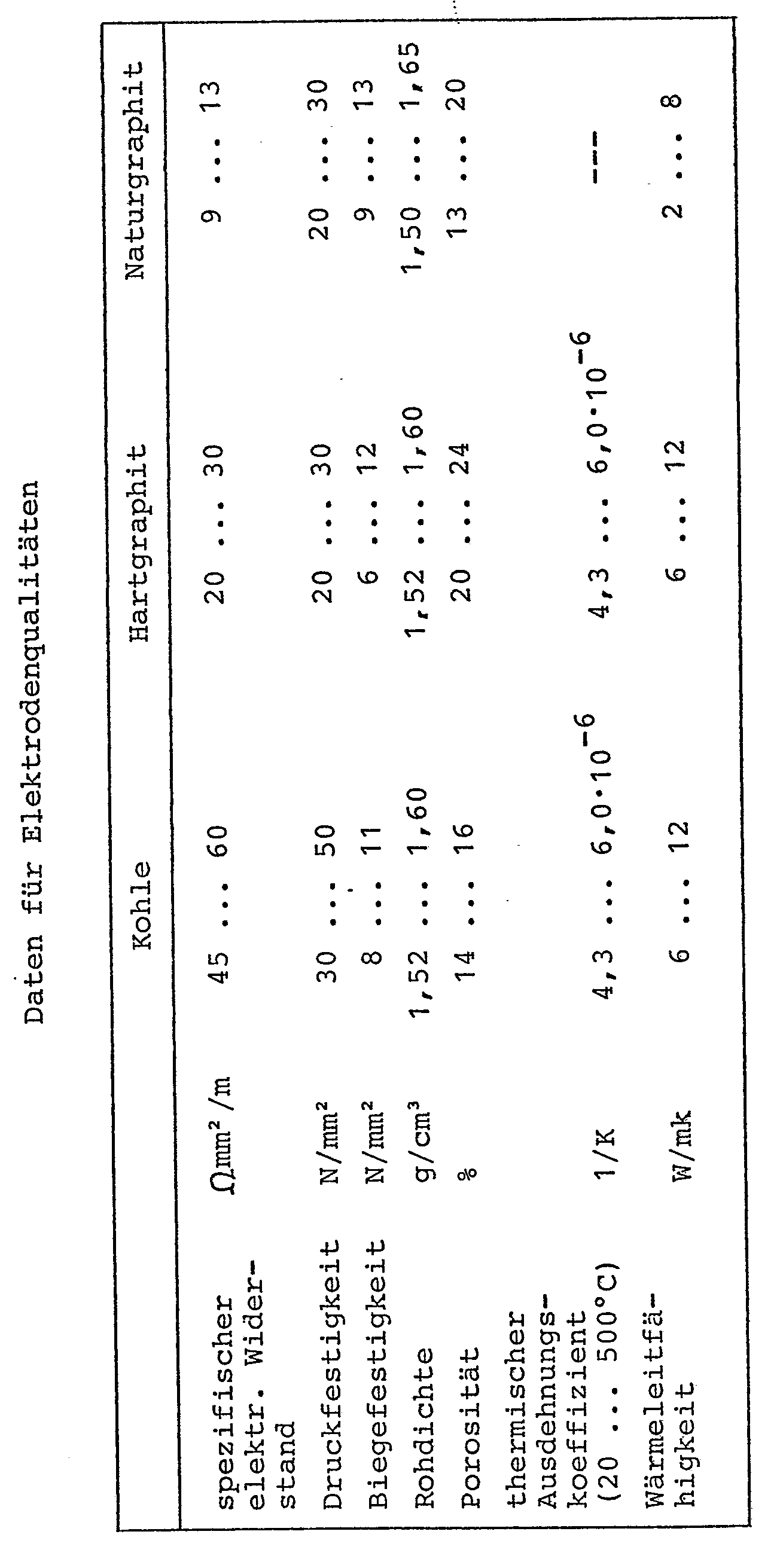
Der untere Abschnitt der erfindungsgemässen Elektrode kann auf an sich bekannte Weise hergestellt werden. ¦ Hierunter sind insbesondere aber die Herstellung durch Vibration oder durch Strangpressung hervorzuheben. Derartige Verfahren sind bekannt.The lower section of the electrode according to the invention can be produced in a manner known per se. ¦ Among these, the production by vibration or by extrusion should be emphasized. Such methods are known.
Das als unterer Abschnitt in der erfindungsgemässen Elektrode verwendete Kohlenstoffmaterial weist besonders vorteilhaft einen spezifischen elektrischen Widerstand im Bereich von 10 bis 30 Ωmm2/m auf. Durch Versuche konnte jedoch ein besonders günstiges Betriebsverhalten der Elektroden festgestellt werden, deren Kohlenstoffmaterial einen spezifischen elektrischen Widerstand im Bereich von 10 bis 20 Ωmm2/m und insbesondere 13 bis 20 Ωmm2/m aufwies.The carbon material used as the lower section in the electrode according to the invention particularly advantageously has a specific electrical resistance in the range from 10 to 30 Ωmm 2 / m. However, tests have shown that the electrodes have a particularly favorable operating behavior, the carbon material of which has a specific electrical resistance in the range from 10 to 20 Ωmm 2 / m and in particular 13 to 20 Ωmm 2 / m.
'Der Durchmesser des unteren Abschnittes liegt im allgemeinen im Bereich von ca. 200 bis 600 mm. Besonders günstige Ergebnisse wurden mit Durchmessern des unteren Abschnittes im Bereich von ca. 300 bis 400 mm erzielt. Der Durchmesser des oberen Abschnittes aus Metall kann gegenüber dem Durchmesser des unteren Abschnittes grösser, aber auch geringer gewählt sein.'The diameter of the lower section is generally in the range of about 200 to 600 mm. Particularly favorable results were achieved with diameters of the lower section in the range from approximately 300 to 400 mm. The diameter of the upper section made of metal can be chosen to be larger, but also smaller, than the diameter of the lower section.
Die Rohdichte des Kohlenstoffmaterials des unteren Abschnittes liegt besonders bevorzugt im Bereich zwischen 1,50 und 1,65 g/cm3.The bulk density of the carbon material of the lower section is particularly preferably in the range between 1.50 and 1.65 g / cm 3 .
Eine im Rahmen der Erfindung besonders günstige Elektrode, bei der der obere Abschnitt aus Metall etwa die Hälfte der Gesamtlänge der Elektrode oder mehr ausmacht, besitzt einen Kohlenstoffteil mit ca. 50 bis 85 % an graphitischen Strukturelementen aus Naturgraphit und/ oder Elektrographit, wobei die nichtgraphitischen Strukturanteile aus Anthrazit, Zechenkoks und/oder Normalpetrolkoks bestehen, wobei der spezifische elektrische Widerstand des unteren Abschnittes im Bereich von 10 bis 20 Ωmm2/m bei einer Rohdichte im Bereich zwischen 1,50 und 1,65 g/cm3 liegt.A particularly advantageous electrode in the context of the invention, in which the upper section made of metal accounts for approximately half the total length of the electrode or more, has a carbon part with approx. 50 to 85% of graphitic structural elements made of natural graphite and / or electrographite, the non-graphitic structural components consisting of anthracite, coal coke and / or normal petroleum coke, the specific electrical resistance of the lower section being in the range from 10 to 20 Ωmm 2 / m at a bulk density in the range between 1.50 and 1.65 g / cm 3 .
Die erfindungsgemässen Elektroden zeichnen sich durch günstiges Betriebsverhalten bei störungsfreiem Betrieb aus. Die Kohlenstoffmaterialien des unteren Abschnittes lassen sich gegenüber den herkömmlich eingesetzten Vollgraphitelektroden aus billigeren Rohstoffen durch einfachere Herstellungsverfahren erzeugen. Daher wird bei gleicher elektrischer Belastbarkeit eine Verbilli--gung des Elektrodenbetriebes ermöglicht.The electrodes according to the invention are characterized by favorable operating behavior with trouble-free operation. The carbon materials in the lower section can be produced from cheaper raw materials by means of simpler production processes than the conventionally used full graphite electrodes. Therefore, the electrode operation can be made cheaper with the same electrical load capacity.
Obwohl gegenüber den herkömmlich eingesetzten, hochwertigen Graphitqualitäten ein Kohlenstoffmaterial geringerer Qualität Einsatz findet, werden Abplatzungen, Rissbildung auch im übergangsbereich zwischen oberem und unterem Abschnitt im wesentlichen nicht beobachtet. Dabei hat sich die Verwendung von Nippeln aus Hochqualitätsgraphit mit einer gegenüber dem Kohlenstoffmaterial des unteren Abschnittes erhöhten Dichte und gleichzeitig vermindertem elektrischen Widerstand besonders bewährt.Although a carbon material of lower quality is used compared to the conventionally used, high-quality graphite qualities, flaking and cracking are essentially not observed even in the transition area between the upper and lower sections. The use of nipples made of high quality graphite with an increased density compared to the carbon material of the lower section and at the same time reduced electrical resistance has proven particularly useful.
Die erfindungsgemässe Elektrode hat ihre bevorzugte Anwendung zur Herstellung von Stahl im Lichtbogenofenbetrieb. Sie kann aber auch zur Herstellung von Buntmetallen, wie Kupfer oder Kobalt, aber auch zur Herstellung von Korund, Silizium, etc., eingesetzt werden.The electrode according to the invention has its preferred application for the production of steel in the arc furnace operation. But it can also be used for the production of non-ferrous metals such as copper or cobalt, but also for the production of corundum, silicon, etc., can be used.
Bei der Herstellung von Elektrostahl werden die erfindungsgemässen Kombinationselektroden bei Durchmessern des unteren Abschnittes aus Kohlenstoffmaterial im Bereich von 300 bis 400 mm vorzugsweise mit maximalen Phasenströmen im Bereich von 10 bis 30 KA mit besonderem Vorteil eingesetzt.In the production of electrical steel, the combination electrodes according to the invention are used with particular advantage with diameters of the lower section made of carbon material in the range from 300 to 400 mm, preferably with maximum phase currents in the range from 10 to 30 KA.
Nachstehend wird eine Ausführungsform einer erfindungsgemässen Elektrode im Längsschnitt in der Figur gezeigt, wobei die Erfindung nicht hierauf beschränkt ist.An embodiment of an electrode according to the invention is shown in longitudinal section in the figure, but the invention is not limited to this.
Bei der gezeigten Elektrode wird das Kühlmedium, im Regelfall Wasser, durch den Vorlaufkanal 2 ein- und durch den Rücklaufkanal 3 zurückgeführt. Dabei tritt -das Kühlmedium auch in eine Kammer innerhalb des Schraubnippels 1, der z.B. aus Gusseisen gebildet ist, ein. Der obere Abschnitt 5 aus Metall besteht hier aus einem oberen Bereich grösseren Durchmessers und einem tieferliegenden Bereich geringeren Durchmessers, der bis in den Schraubnippel 1 eingezogen ist, der die Verbindung zu dem unteren Abschnitt 6 aus Kohlenstoffmaterial darstellt, das nur zum Teil aus graphitischen Strukturelementen gebildet ist oder hiervon frei ist. Die hochtemperaturfeste Beschichtung 4 ist aus einer Anzahl einzelner Formteile gebildet, die auf einem Lager 7 getragen sein können. An die hochtemperaturfeste Isolierung 4 schliesst sich hier eine elektrisch leitende Zwischenschicht 11 an, die nach innen durch den vorgezogenen, innenliegenden Metallschaft bzw. dessen Abschnitt geringeren Durchmessers 12 begrenzt ist.In the electrode shown, the cooling medium, usually water, is introduced through the feed channel 2 and returned through the return channel 3. The cooling medium also enters a chamber inside the screw nipple 1, which e.g. is made of cast iron. The upper section 5 made of metal here consists of an upper area of larger diameter and a lower-lying area of smaller diameter, which is drawn into the screw nipple 1, which is the connection to the
Neben den Kühlbohrungen 15 können zusätzliche Bohrungen vorgesehen sein, durch die eingeführte Stifte über eine Feder für einen guten Sitz der hochtemperaturfesten Formteile sorgen.In addition to the cooling bores 15, additional bores can be provided through which inserted pins ensure a good fit of the high-temperature-resistant molded parts via a spring.
In der Figur sind schliesslich Backen 18 gezeigt, über die der Strom der Elektrode zugeführt wird.Finally, the figure shows jaws 18 via which the current is supplied to the electrode.
Der Gegenstand der Erfindung ist jedoch nicht auf die in der Figur gezeigte Konstruktion beschränkt. So sind z.B. im Rahmen der Erfindung Konstruktionen besonders vorteilhaft, die Abweichungen zu dem in der Figur gezeigten Elektrodentyp aufweisen. Bei solchen Elektroden, die im Rahmen der Erfindung bevorzugt sind, weist der Metallschaft einen im wesentlichen konstanten Durchmesser auf. Auf diesen können Ringe aus hochtemperaturfestem Material - mit Vorzug solche aus Graphit - aufgeschraubt werden. Das Kühlsystem kann hierbei mit Vorzug derart ausgebildet sein, dass der Nippel in seinem oberen äusseren Bereich durch das Kühlmedium umströmt wird, dieses aber in den Nippel selbst nicht eintritt. Eine elektrisch leitende Zwischenschicht ist bei solchen Konstruktionen nicht immer vorgesehen. Solche und andersartige Ausführungsformen der erfindungsgemässen Elektrode sind im Rahmen der Erfindung mit eingeschlossen, soweit das Kohlenstoffmaterial des verzehrbaren unteren Abschnittes nur zum Teil aus graphitischen Strukturelementen gebildet oder hiervon frei ist.However, the object of the invention is not limited to the construction shown in the figure. For example, Particularly advantageous in the context of the invention constructions which have deviations from the electrode type shown in the figure. In such electrodes, which are preferred in the context of the invention, the metal shaft has an essentially constant diameter. Rings made of high-temperature-resistant material - preferably graphite - can be screwed onto these. The cooling system can preferably be designed in such a way that the cooling medium flows around the nipple in its upper outer region, but this does not enter the nipple itself. An electrically conductive intermediate layer is not always provided in such constructions. Such and different types of embodiments of the electrode according to the invention are included in the scope of the invention insofar as the carbon material of the consumable lower section is only partially formed from graphitic structural elements or is free thereof.
Der Einsatz einer erfindungsgemässen Elektrode wird im nachstehenden Beispiel beschrieben.The use of an electrode according to the invention is described in the example below.
Es wurde eine Kombinationselektrode aus einem wassergekühlten Kupferschaft eingesetzt, der durch ein Kühlsystem aus Vor- und Rücklauf mit Wasser gekühlt wurde. Der Kupferschaft war im Bereich des Ofens durch einen hochtemperaturbeständigen Belag geschützt. Der Kupferschaft war über einen Graphitnippel mit dem Kohlenstoffmaterial verschraubt, das im wesentlichen aus Abfallgraphit aus der synthetischen Graphiterzeugung bestand. Das Kohlenstoffmaterial wies eine Rohdichte von 1,62 g/cm3 und einen spezifischen elektrischen Widerstand von 18,5 Ωmm2/m auf.A combination electrode made of a water-cooled copper shaft was used, which was cooled with water by a cooling system consisting of the supply and return lines. The copper shaft was protected in the area of the furnace by a high temperature resistant coating. The copper shaft was screwed to the carbon material via a graphite nipple, which essentially consisted of waste graphite from the synthetic graphite production. The carbon material had a bulk density of 1.62 g / cm 3 and a specific electrical resistance of 18.5 Ωmm 2 / m.
Drei derartige Elektroden wurden in einem Ofen mit 50 t Fassungsvermögen und drei Phasen mit einem maximalen "Phasenstrom von 50.000 A bei einer Betriebsspannung von 490 V eingesetzt.Three such electrodes were in an oven at 50 ton capacity and three phases with a maximum "phase current of 50,000 A at an operating voltage of 490 V applied.
Es ergab sich ein spezifischer Elektrodenverbrauch im Bereich von 4,8 kg/t Stahl, bei im wesentlichen störungsfreiem Betrieb.There was a specific electrode consumption in the range of 4.8 kg / t steel, with essentially trouble-free operation.
Claims (16)
Applications Claiming Priority (2)
| Application Number | Priority Date | Filing Date | Title |
|---|---|---|---|
| DE3116258A DE3116258A1 (en) | 1981-04-23 | 1981-04-23 | ELECTRODE FOR ARC OVENS AND METHOD FOR USE THEREOF |
| DE3116258 | 1981-04-23 |
Publications (1)
| Publication Number | Publication Date |
|---|---|
| EP0063710A1 true EP0063710A1 (en) | 1982-11-03 |
Family
ID=6130714
Family Applications (1)
| Application Number | Title | Priority Date | Filing Date |
|---|---|---|---|
| EP82102770A Withdrawn EP0063710A1 (en) | 1981-04-23 | 1982-04-01 | Electrode for arc furnaces, and method of using it |
Country Status (16)
| Country | Link |
|---|---|
| EP (1) | EP0063710A1 (en) |
| JP (1) | JPS5894793A (en) |
| AU (1) | AU8185782A (en) |
| BR (1) | BR8202308A (en) |
| DD (1) | DD202363A5 (en) |
| DE (1) | DE3116258A1 (en) |
| DK (1) | DK181882A (en) |
| ES (1) | ES511724A0 (en) |
| FI (1) | FI820868A7 (en) |
| GB (1) | GB2098839A (en) |
| HU (1) | HU186609B (en) |
| NO (1) | NO820800L (en) |
| PL (1) | PL236042A1 (en) |
| PT (1) | PT74763B (en) |
| TR (1) | TR21298A (en) |
| ZA (1) | ZA822012B (en) |
Cited By (1)
| Publication number | Priority date | Publication date | Assignee | Title |
|---|---|---|---|---|
| EP0109839A3 (en) * | 1982-11-19 | 1985-06-19 | Union Carbide Corporation | Graphite electrodes and method for their production |
Citations (6)
| Publication number | Priority date | Publication date | Assignee | Title |
|---|---|---|---|---|
| DE268660C (en) * | ||||
| DE1565751A1 (en) * | 1965-07-13 | 1970-02-12 | Oestberg Jan Erik | Electrode for electric arc furnaces |
| FR2176546A1 (en) * | 1972-03-23 | 1973-11-02 | Siderurgie Fse Inst Rech | Composite furnace electrode - esp for steel prodn |
| DE2918757A1 (en) * | 1978-05-09 | 1979-11-22 | Canada Steel Co | ELECTRODE FOR ARC FURNACE |
| EP0012573A1 (en) * | 1978-12-19 | 1980-06-25 | British Steel Corporation | Electric arc furnace electrodes |
| US4256918A (en) * | 1977-06-06 | 1981-03-17 | Korf-Stahl Ag | Electrode for arc furnaces |
-
1981
- 1981-04-23 DE DE3116258A patent/DE3116258A1/en not_active Withdrawn
-
1982
- 1982-03-11 NO NO820800A patent/NO820800L/en unknown
- 1982-03-15 FI FI820868A patent/FI820868A7/en not_active Application Discontinuation
- 1982-03-24 ZA ZA822012A patent/ZA822012B/en unknown
- 1982-03-24 AU AU81857/82A patent/AU8185782A/en not_active Abandoned
- 1982-03-29 GB GB8209202A patent/GB2098839A/en not_active Withdrawn
- 1982-04-01 EP EP82102770A patent/EP0063710A1/en not_active Withdrawn
- 1982-04-02 ES ES511724A patent/ES511724A0/en active Granted
- 1982-04-15 PT PT74763A patent/PT74763B/en unknown
- 1982-04-20 PL PL23604282A patent/PL236042A1/en unknown
- 1982-04-22 DD DD82239230A patent/DD202363A5/en unknown
- 1982-04-22 BR BR8202308A patent/BR8202308A/en unknown
- 1982-04-22 JP JP57068533A patent/JPS5894793A/en active Pending
- 1982-04-23 DK DK181882A patent/DK181882A/en not_active Application Discontinuation
- 1982-04-23 TR TR21298A patent/TR21298A/en unknown
- 1982-04-23 HU HU821297A patent/HU186609B/en unknown
Patent Citations (6)
| Publication number | Priority date | Publication date | Assignee | Title |
|---|---|---|---|---|
| DE268660C (en) * | ||||
| DE1565751A1 (en) * | 1965-07-13 | 1970-02-12 | Oestberg Jan Erik | Electrode for electric arc furnaces |
| FR2176546A1 (en) * | 1972-03-23 | 1973-11-02 | Siderurgie Fse Inst Rech | Composite furnace electrode - esp for steel prodn |
| US4256918A (en) * | 1977-06-06 | 1981-03-17 | Korf-Stahl Ag | Electrode for arc furnaces |
| DE2918757A1 (en) * | 1978-05-09 | 1979-11-22 | Canada Steel Co | ELECTRODE FOR ARC FURNACE |
| EP0012573A1 (en) * | 1978-12-19 | 1980-06-25 | British Steel Corporation | Electric arc furnace electrodes |
Cited By (1)
| Publication number | Priority date | Publication date | Assignee | Title |
|---|---|---|---|---|
| EP0109839A3 (en) * | 1982-11-19 | 1985-06-19 | Union Carbide Corporation | Graphite electrodes and method for their production |
Also Published As
| Publication number | Publication date |
|---|---|
| JPS5894793A (en) | 1983-06-06 |
| GB2098839A (en) | 1982-11-24 |
| DD202363A5 (en) | 1983-09-07 |
| ES8400645A1 (en) | 1983-11-01 |
| HU186609B (en) | 1985-08-28 |
| TR21298A (en) | 1984-03-22 |
| FI820868L (en) | 1982-10-24 |
| DE3116258A1 (en) | 1982-11-11 |
| NO820800L (en) | 1982-10-25 |
| PT74763B (en) | 1983-10-28 |
| ZA822012B (en) | 1983-02-23 |
| PT74763A (en) | 1982-05-01 |
| FI820868A7 (en) | 1982-10-24 |
| AU8185782A (en) | 1982-10-28 |
| BR8202308A (en) | 1983-04-05 |
| ES511724A0 (en) | 1983-11-01 |
| PL236042A1 (en) | 1983-02-28 |
| DK181882A (en) | 1982-10-24 |
Similar Documents
| Publication | Publication Date | Title |
|---|---|---|
| DE1251962B (en) | Cathode for an electrolytic cell for the production of aluminum and process for the production of the same | |
| DE69111720T2 (en) | DC OVEN FOR MELTING METAL. | |
| DE60108085T2 (en) | PROCEDE DE CONVERSION DE CELLULES DE HALL-HEROULT EN CELLULES A ANODES INERTES | |
| EP0151415B1 (en) | Direct current arc furnace or direct current arc ladle | |
| DE3102776A1 (en) | ELECTRODE FOR ARC FURNACE | |
| DE69623868T2 (en) | Graphite electrode with connection | |
| EP0050682B1 (en) | Electrode for arc furnaces | |
| EP0063710A1 (en) | Electrode for arc furnaces, and method of using it | |
| EP0422406A2 (en) | Anode for direct current arc furnace | |
| EP0063711B1 (en) | Electrode for arc furnaces and its use | |
| EP0050681A1 (en) | Electrode for igneous electrolysis | |
| DE3918278A1 (en) | MEDIUM ELECTRODE FOR SPARK PLUGS AND INTERNAL COMBUSTION ENGINES | |
| EP0092704B1 (en) | Use of temperature and corrosion resistant gas-tight material as a protective coating of the metal part of combination electrodes for the production of metals by igneous electrolysis, and guard rings made therefrom | |
| DE19850735C1 (en) | Electrode for electrometallurgical processes | |
| WO1994000400A1 (en) | Refractory ceramic compound for lining the floors of electric-arc furnaces and a method of repairing them | |
| DD201960A5 (en) | ELECTRODE FOR LIGHT BOW OUTS | |
| DE2520655A1 (en) | DC ARC FURNACE | |
| DE2833381A1 (en) | Electrolysis cell for winning aluminium - where carbon cathode hearth is connected to bus=bars via spaced graphite pegs increasing the efficiency of aluminium prodn. | |
| EP0135103B1 (en) | Direct current arc furnace | |
| DE251207C (en) | ||
| DE2040854B2 (en) | Method for determining the baking state of a self-baking electrode of an electric oven through which the operating current flows, and an electrode for carrying out the method | |
| DE102009047320B3 (en) | Radial graded electrode for supplying current during electro-metallurgical process for steel production, has interface layer containing coefficient of thermal expansion lesser than that of sheath component | |
| AT267892B (en) | Melt flow electrolysis cell for the production of aluminum | |
| AT205565B (en) | Pressed insulating part | |
| AT102443B (en) | Combined carbon electrode for electric furnaces and processes for their manufacture. |
Legal Events
| Date | Code | Title | Description |
|---|---|---|---|
| PUAI | Public reference made under article 153(3) epc to a published international application that has entered the european phase |
Free format text: ORIGINAL CODE: 0009012 |
|
| AK | Designated contracting states |
Designated state(s): AT BE CH DE FR IT LI LU NL SE |
|
| 17P | Request for examination filed |
Effective date: 19830416 |
|
| STAA | Information on the status of an ep patent application or granted ep patent |
Free format text: STATUS: THE APPLICATION IS DEEMED TO BE WITHDRAWN |
|
| 18D | Application deemed to be withdrawn |
Effective date: 19841228 |
|
| RIN1 | Information on inventor provided before grant (corrected) |
Inventor name: LAUTERBACH-DAMMLER, INGE, DR. DIPL.-CHEM. Inventor name: SCHIEBER, FRANZ, CHEM. ING. GRAD. Inventor name: ZOELLNER, DIETER H., DR. DIPL.-CHEM. Inventor name: MUEHLENBECK, JOSEF Inventor name: LIPPERT, WOLFGANG, DIPL.-CHEM. Inventor name: OTTO, JOSEF, DR. DIPL.-ING. Inventor name: RITTMANN, FRIEDRICH Inventor name: BAUER, HANNSGEORG, DR. DIPL.-ING. |