EP0063723A1 - Polyesteramide und deren Verwendung zum Verkleben von organischen und anorganischen Substraten und als Vergussmassen - Google Patents
Polyesteramide und deren Verwendung zum Verkleben von organischen und anorganischen Substraten und als Vergussmassen Download PDFInfo
- Publication number
- EP0063723A1 EP0063723A1 EP82102932A EP82102932A EP0063723A1 EP 0063723 A1 EP0063723 A1 EP 0063723A1 EP 82102932 A EP82102932 A EP 82102932A EP 82102932 A EP82102932 A EP 82102932A EP 0063723 A1 EP0063723 A1 EP 0063723A1
- Authority
- EP
- European Patent Office
- Prior art keywords
- diglycolamine
- optionally
- acid
- polyester amides
- another
- Prior art date
- Legal status (The legal status is an assumption and is not a legal conclusion. Google has not performed a legal analysis and makes no representation as to the accuracy of the status listed.)
- Granted
Links
Classifications
-
- C—CHEMISTRY; METALLURGY
- C08—ORGANIC MACROMOLECULAR COMPOUNDS; THEIR PREPARATION OR CHEMICAL WORKING-UP; COMPOSITIONS BASED THEREON
- C08G—MACROMOLECULAR COMPOUNDS OBTAINED OTHERWISE THAN BY REACTIONS ONLY INVOLVING UNSATURATED CARBON-TO-CARBON BONDS
- C08G69/00—Macromolecular compounds obtained by reactions forming a carboxylic amide link in the main chain of the macromolecule
- C08G69/44—Polyester-amides
-
- C—CHEMISTRY; METALLURGY
- C09—DYES; PAINTS; POLISHES; NATURAL RESINS; ADHESIVES; COMPOSITIONS NOT OTHERWISE PROVIDED FOR; APPLICATIONS OF MATERIALS NOT OTHERWISE PROVIDED FOR
- C09J—ADHESIVES; NON-MECHANICAL ASPECTS OF ADHESIVE PROCESSES IN GENERAL; ADHESIVE PROCESSES NOT PROVIDED FOR ELSEWHERE; USE OF MATERIALS AS ADHESIVES
- C09J177/00—Adhesives based on polyamides obtained by reactions forming a carboxylic amide link in the main chain; Adhesives based on derivatives of such polymers
- C09J177/12—Polyester-amides
Definitions
- the invention relates to polyester amides, produced by condensation of dimerized fatty acids with ethylenediamine and aliphatic codiamines, diglycolamine and optionally codicarboxylic acids and their use for bonding organic and inorganic substrates and as casting compounds.
- Polyamide resins which are produced by polycondensation of dimerized fatty acids with polyamines, have been used for a long time, just like the polyesteramides produced by the use of components containing hydroxyl groups, as hot melt adhesives for bonding inorganic or organic substrates.
- DE-AS 1 520 002 discloses polyesteramides of dimerized fatty acids of a precisely defined composition, a dicarboxylic acid, a diamine and alkanolamine of the general formula H 2 rl-R "'- OH, in which R"' is an aliphatic hydrocarbon radical. In combination with good impact resistance, these products should have a higher peel strength on metals.
- thermoplastic components In order to meet the diverse requirements of hot melt adhesive users, it is often necessary to mix the pure polyamide or polyester amide resins with other thermoplastic components.
- the polyamide and polyesteramide resins known hitherto generally show poor compatibility with ethylene-vinyl acetate copolymers. Only EVA copolymers with a very high vinyl acetate content of 35 - 40% can be mixed in small proportions with the polyamide resins.
- polyesteramide resins are mixed with the FVA types which have a lower vinyl acetate content, it must be found that inhomogeneities occur in particular in the solidified melt. The easiest way to recognize this inhomogeneity is to fold a 3 - 5 mm thick film. If the resins are incompatible with FVA, severe milky clouding occurs at the kink.
- the object of the present invention is to overcome the disadvantages of the prior art mentioned.
- the polyester amides according to the invention can contain customary additives and fillers, e.g. B. inorganic fillers, pigments and dyes, antioxidants, UV absorbers, optical brighteners, antistatic agents, flame retardants and plasticizers.
- customary additives and fillers e.g. B. inorganic fillers, pigments and dyes, antioxidants, UV absorbers, optical brighteners, antistatic agents, flame retardants and plasticizers.
- Another object of the invention is the use of the polyester amides according to the invention as casting compounds or for bonding organic and inorganic substrates to one another or to one another.
- the invention furthermore relates to mixtures of the polyesteramides according to the invention with EVA copolymers and to their use for bonding organic or inorganic substrates to one another or to one another and as casting compounds.
- the dimerized fatty acids used in accordance with the invention have dimer contents between 55-100%, preferably 70-96%.
- dimerized fatty acid generally refers to polymerized acids obtained from “fatty acids”.
- fatty acid encompasses unsaturated natural and synthetic monobasic aliphatic acids with 8-22 carbon atoms, preferably 18 carbon atoms. These fatty acids can be polymerized by known processes (cf. DE-OS 1 443 938, DE-OS 1 443 968, DE-PS 2 118 702 and DE-PS 1 280 852).
- the content of dimeric acid can be increased up to 100% by weight by generally known distillation processes.
- the dimeric fatty acid used can also be present in hydrogenated form.
- distilled dimeric fatty acid with a dimeric fatty acid content of 70-96% is preferably used.
- the proportion of monocarboxylic acids which may already be present in the dimerized fatty acid can be increased further by adding further monocarboxylic acids in order to set a desired molecular weight.
- Suitable monocarboxylic acids which can be used according to the invention are in particular straight-chain or branched, saturated or unsaturated monocarboxylic acids having 2 to 22 carbon atoms, such as, for example, B. acetic acid, propionic acid, butyric acid, valeric acid, lauric acid, palmitic acid, palmitoleic acid, erucic acid.
- the C18 monocarboxylic acids such as stearic acid, oleic acid, linoleic acid, linolenic acid and the natural fatty acid mixtures such as, for. B. tall oil fatty acid or soybean oil fatty acid.
- Suitable co-diamines to be used according to the invention are diamines of the general formula (I) in which R an aliphatic hydrocarbon radical having 3 to 36, in particular 6 to 20, and 36 carbon atoms, which is optionally interrupted by heteroatoms, such as in particular oxygen, into consideration, such as, for. B.
- the equivalence ratio of ethylenediamine to codiamine can be between 0.05: 0.25 and 0.25: 0.05 with a diglycolamine content of 0.7 equivalents and between 0.1: 0.8 and 0 with a diglycolamine content of 0.1 equivalents , 8: 0.1.
- diglycolamine is used as the alkanolamine in addition to the diamine components.
- the ratio of the amines to diglycolamine is essentially determined by the desired degree of flexibility both at low and at high temperatures, but also by the adhesion to the determined respective substrates.
- the type and amount of the acids used also influence the ratio.
- the equivalence ratio of the diamine components (component B) + C) to the diglycolamine (component D) can be selected in the range from 0.3: 0.7 to 0.9: 0.1, an equivalence ratio in the range of 0.5 is preferred : 0.5 to 0.8: 0.2.
- polyester amide resins of the invention have surprisingly good compatibility with EVA copolymers have, especially if the co-dicarboxylic acid as low as possible, preferably in polyester amide - equivalent, under 0.3 equivalents, based on Automatklare- lies.
- the proportion of EVA copolymers in the mixture can, depending on the polyester amide type or EVA copolymer type, be brought to more than 50%.
- the mixture itself is preferred in special equipment, such as. B. kneaders or extruders.
- the mixing can also be carried out by vigorous stirring of the melted components.
- polyester amides according to the invention are distinguished from known systems by better flexibility, even at low temperatures, and moreover have excellent resistance to whipped beans as well as good adhesive values on a wide variety of substrates. These good properties are retained even at relatively low melt viscosities.
- the polyamide resins according to the invention show very high elongations at -20 ° C.
- the polyamide resins based on dimeric fatty acids with the use of expensive codiamines, such as. B. Dipiperidylpropane, at -20 ° C elongation values of max. Reach 200%.
- the normal polyamide resins show significantly lower values at minus temperatures.
- the following substrates can be glued to one another or to one another: leather, rubber, textiles, wood, paper, PVC, polyolefins, polyester, ceramic, glass, the ferrous and non-ferrous metals commonly used in technology, such as steel, copper, Zinc, tin or their alloys.
- the diglycolamine content of the polyesteramides according to the invention is advantageously raised to or above approximately 0.5 equivalents.
- R 1 can be an optionally substituted aliphatic, cycloaliphatic, aromatic or araliphatic hydrocarbon radical with 4 to 12 carbon atoms and R 2 can be hydrogen or an alkyl radical with 1 to 8 carbon atoms.
- codicarboxylic acids can be used in amounts of up to 0.9 equivalents, based on the dimerized fatty acid.
- Examples include: adipic acid, pimelic acid, suberic acid, azelaic acid, sebacic acid, decanedicarboxylic acid, brassylic acid, 1,4-cyclohexanedicarboxylic acid, terephthalic acid, isophthalic acid, naphthalenedicarboxylic acid, 1,4-phenylenediacetic acid.
- Azelaic acid, sebacic acid and terephthalic acid are preferred according to the invention.
- the sum of the molar equivalents of the amine and hydroxyl groups of components B), C) and D) used is preferably practically the same as the molar equivalents of the carboxyl groups of components A) and E).
- the components described are condensed to the polyester amides according to the invention at temperatures between 200 and 300 ° C. in the customary manner.
- the dimeric fatty acids used in the examples below have the following composition (according to GLC).
- ELVAX® 260 (commercial product from Du Pont) with a vinyl acetate content of approx. 28% ELVAX® 420 with a vinyl acetate content of approx. 18% and ELVAX @ 40 with a vinyl acetate content of approx. 40% was used as the EVA component.
- a 1 1 three-necked flask equipped with a thermometer, nitrogen inlet, stirrer and cooler with receiver was charged with 400 g of distilled dimeric tall oil fatty acid, 4 g of antioxidant "Naugard 445", 0.1 g of phosphoric acid (85%), 21.13 g of ethylenediamine (0 , 5 equivalents), 8.17 g of hexamethylenediamine (0.1 equivalent) and 30.15 g of diglycolamine (0.4 equivalents).
- reaction mixture was heated to 250 ° C. in 90 minutes with stirring and under nitrogen and left at this temperature for 6 hours. A vacuum of 15 mbar was applied during the last 4 hours.
Landscapes
- Chemical & Material Sciences (AREA)
- Chemical Kinetics & Catalysis (AREA)
- Organic Chemistry (AREA)
- Medicinal Chemistry (AREA)
- Polymers & Plastics (AREA)
- Health & Medical Sciences (AREA)
- Polyamides (AREA)
- Adhesives Or Adhesive Processes (AREA)
- Compositions Of Macromolecular Compounds (AREA)
- Polyesters Or Polycarbonates (AREA)
- Laminated Bodies (AREA)
- Addition Polymer Or Copolymer, Post-Treatments, Or Chemical Modifications (AREA)
- Macromonomer-Based Addition Polymer (AREA)
Abstract
Description
- Gegenstand der Erfindung sind Polyesteramide, hergestellt durch Kondensation von dimerisierten Fettsäuren mit Äthylendiamin und aliphatischen Codiaminen, Diglykolamin und gegebenenfalls Codicarbonsäuren und deren Verwendung zum Verkleben von organischen und anorganischen Substraten und als Vergußmassen.
- Polyamidharze, die durch Polykondensation von dimerisierten Fettsäuren mit Polyaminen hergestellt werden, finden bereits seit langer Zeit ebenso wie die durch Mitverwendung von Hydroxylgruppen enthaltenden Komponenten hergestellten Polyesteramide Verwendung als Schmelzklebstoffe zur Verklebung von anorganischen oder organischen Substraten.
- Diese Produkte entsprechen jedoch in manchen Anwendungsbereichen noch nicht den gestiegenen Forderungen der Praxis.
- Aus der DE-AS 1 520 002 sind Polyesteramide aus dimerisierten Fettsäuren einer genau definierten Zusammensetzung, einer Dicarbonsäure, einem Diamin und Alkanolamin der allgemeinen Formel H2rl-R"'-OH, in welcher R"' ein aliphatischer Kohlenwasserstoffrest ist, bekannt. Diese Produkte sollen in Kombination mit guter Schlagfestigkeit eine höhere Abschälfestigkeit an Metallen aufweisen.
- Diese Produkte zeigen zwar bei Raumtemperatur eine recht gute Flexibilität, die jedoch für bestimmte Anwendungen, insbesondere bei niedrigen Temperaturen um oder unter 0 °C nicht voll befriedigt.
- Weiterhin zeigen diese Produkte keine Verträglichkeit mit Äthylen-Vinylacetat-Copolymeren (EVA).
- Um den vielfältigen Anforderungen der Anwender von Schmelzklebstoffen entsprechen zu können, ist es in vielen Fällen notwendig, die reinen Polyamid- oder Polyesteramid-Harze mit anderen thermoplastischen Komponenten abzumischen.
- Insbesondere zur Herstellung von Schmelzklebstoffen mit speziellen Eigenschaften wird häufig eine Abmischung der Harze mit Äthylen-Vinylacetat-Copolymeren gewünscht. Grundvoraussetzung für solche Formulierungen ist, daß die zu mischenden Stoffe verträglich sind und auch beim Abkühlen der Schmelze keine Fntmischungserscheinungen zeigen.
- Die bisher bekannten Polyamid- und Polyesteramid-Harze zeigen allgemein eine schlechte Verträglichkeit mit Äthylen-Vinylacetat-Copolymeren. Lediglich EVA-Copolymere mit einem sehr hohen Vinylacetatanteil von 35 - 40 % lassen sich in kleinen Anteilen den Polyamidharzen zumischen.
- Vermischt man dagegen die bisher beschriebenen und im Handel befindlichen Polyesteramid-Harze mit den FVA-Typen, die einen niedrigeren Vinylacetatanteil besitzen, so muß man feststellen, daß insbesondere in der erstarrten Schmelze Inhomogenitäten auftreten. Am leichtesten läßt sich diese Inhomogenität durch Knicken einer 3 - 5 mm starken Folie erkennen. Bei einer Unverträglichkeit der Harze mit FVA treten an der Knickstelle starke milchige Eintrübungen auf. Aufgabe der vorliegenden Erfindung ist es, die genannten Nachteile des Standes der Technik zu überwinden.
- Diese Aufgabe wird erfindungsgemäß gelöst durch Polyesteramide, welche hergestellt werden durch Kondensation von
- A) dimerisierten Fettsäuren mit 16 - 44 Kohlenstoffatomen mit
- B) Äthylendiamin und mit
- C) mindestens einem Diamin der allgemeinen Formel I

- D) Diglykolamin und gegebenenfalls mit
- E) mindestens einer der Dicarbonsäuren der allgemeinen Formel II

- Die erfindungsgemäßen Polyesteramide können je nach Erfordernis übliche Zusatzstoffe und Füllstoffe enthalten, z. B. anorganische Füllstoffe, Pigmente und Farbstoffe, Antioxydantien, UV-Absorber, optische Aufheller, Antistatika, Flammschutzmittel und Weichmacher.
- Ein weiterer Gegenstand der Erfindung ist die Verwendung der erfindungsgemäßen Polyesteramide als Vergußmassen oder zur Verklebung von organischen und anorganischen Substraten miteinander oder untereinander.
- Ein weiterer Gegenstand der Erfindung sind Mischungen der erfindungsgemäßen Polyesteramide mit EVA-Copolymeren sowie deren Verwendung zur Verklebung von organischen oder anorganischen Substraten miteinander oder untereinander und als Vergußmassen.
- Die erfindungsgemäß mitverwendeten dimerisierten Fettsäuren haben Dimergehalte zwischen 55 - 100 %, vorzugsweise 70 - 96 %.
- Der Ausdruck dimerisierte Fettsäure bezieht sich in allgemeiner Form auf polymerisierte Säuren, die aus "Fettsäuren" erhalten werden. Der Ausdruck "Fettsäure" umfaßt ungesättigte natürliche und synthetische einbasische aliphatische Säuren mit 8 - 22 Kohlenstoffatomen, bevorzugt 18 Kohlenstoffatomen. Diese Fettsäuren lassen sich nach bekannten Verfahren polymerisieren (vgl. DE-OS 1 443 938, DE-OS 1 443 968, DE-PS 2 118 702 und DE-PS 1 280 852).
- Typische im Handel erhältliche polymere Fettsäuren haben etwa folgende Zusammensetzung:
- monomere Säuren (Mo) 5 bis 15 Gew.-%
- dimere Säuren (Di) 55 bis 80 Gew.-%
- trimere Säuren (Tri) 10 bis 35 Gew.-%
- Der Gehalt an dimerer Säure kann durch allgemein bekannte Destillationsverfahren bis zu 100 Gew.-% erhöht werden. Die eingesetzte dimere Fettsäure kann auch in hydrierter Form vorliegen.
- Bei Verwendung von destillierter dimerer Fettsäure werden - Schmelzkleber mit verbesserter Farbzahl erhalten. Andererseits ist die Verwendung von handelsüblicher technischer polymerisierter Fettsäure zur Herstellung von Schmelzklebern für besondere Zwecke möglich. Bei der Verwendung von technischer dimerer Fettsäure sei nur darauf hingewiesen, daß der Gehalt an trimerer Fettsäure eine maximale Grenze nicht überschreiten sollte. Dieser Grenzwert hängt von dem jeweiligen Gehalt an dimerer und monomerer Fettsäure der polymerisierten Fettsäure ab und kann durch einen orientierenden Versuch, wie er zur handwerklichen Alltagsroutine des Durchschnittsfachmanns gehört, festgestellt werden.
- Bevorzugt wird jedoch destillierte dimere Fettsäure mit einem Gehalt an dimerer Fettsäure von 70 - 96 % verwendet.
- Der gegebenenfalls bereits vorhandene Anteil an Monocarbonsäuren in der dimerisierten Fettsäure kann zur Einstellung eines gewünschten Molekulargewichtes durch Zusatz weiterer Monocarbonsäuren noch erhöht werden. Als erfindungsgemäß mitverwendbare Monocarbonsäuren kommen insbesondere gradkettige oder verzweigte, gesättigte oder ungesättigte Monocarbonsäuren mit 2 - 22 Kohlenstoffatomen in Betracht, wie z. B. Essigsäure, Propionsäure, Buttersäure, Valeriansäure, Laurinsäure, Palmitinsäure, Palmitoleinsäure, Erucasäure. Erfindungsgemäß bevorzugt werden die C18-Monocarbonsäuren wie Stearinsäure, ölsäure, Linolsäure, Linolensäure und die natürlichen Fettsäuregemische wie z. B. Tallölfettsäure oder Sojaölfettsäure.
- Als erfindungsgemäß mitzuverwendende Co-Diamine kommen Diamine der allgemeinen Formel (I)

- Das Äquivalenzverhältnis von Äthylendiamin zum Codiamin kann bei einem Diglykolaminanteil von 0,7 Äquivalenten zwischen 0,05 : 0,25 und 0,25 : 0,05 und bei einem Diglykolaminanteil von 0,1 Äquivalenten zwischen 0,1 : 0,8 und 0,8 : 0,1 liegen.
- Als Alkanolamin wird erfindungsgemäß neben den Diaminkomponenten Diglykolamin eingesetzt. Das Verhältnis der Amine zu Diglykolamin wird im wesentlichen durch den gewünschten Flexibilitätsgrad sowohl bei tiefen als auch bei hohen Temperaturen, aber auch durch die Haftung an den jeweiligen Substraten bestimmt. Weiterhin beeinflussen Art und Menge der mitverwendeten Säuren das Verhältnis.
- Das Äquivalenzverhältnis der Diaminkomponenten (Komponente B) + C) zu dem Diglykolamin (Komponente D) kann im Bereich von 0,3 : 0,7 bis 0,9 : 0,1 gewählt werden, bevorzugt ist ein Äquivalenzverhältnis im Bereich von 0,5 : 0,5 bis 0,8 : 0,2.
- Es wurde gefunden, daß die erfindungsgemäßen Polyesteramid-harze eine überraschend gute Verträglichkeit mit EVA-Copolymeren aufweisen, insbesondere dann, wenn der Co-Dicarbonsäureanteil im Polyesteramid möglichst niedrig, vorzugs- weise unter 0,3 Äquivalenten, bezogen auf Gesamtsäure- äquivalent, liegt. Der Anteil an EVA-Copolymeren in der Mischung kann, je nach Polyesteramid-Typ bzw. EVA-Copolymer-Typ, auf mehr als 50 % gebracht werden.
- Die Mischung selbst wird bevorzugt in speziellen Apparaturen, wie z. B. Knetern oder Extrudern vorgenommen. Bei den erfindungsgemäßen Polyesteramiden kann die Vermischung jedoch auch durch intensives Rühren der aufgeschmolzenen Komponenten vorgenommen werden.
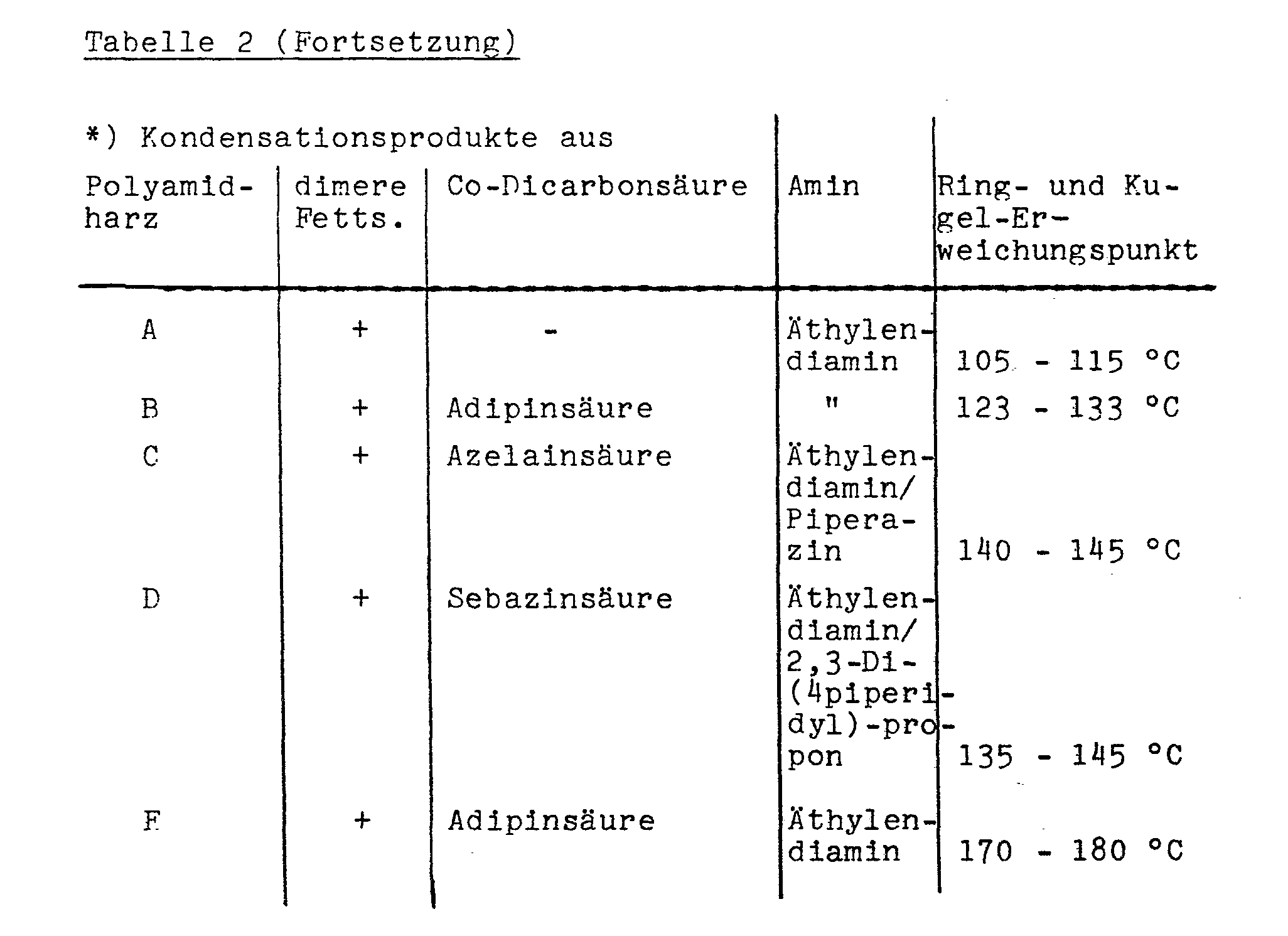
- Sowohl in der Hitze als auch in der Kälte zeigen die aus den erfindungsgemäßen Polyamidharzen und EVA-Copolymeren hergestellten Abmischungen keinerlei Entmischungserscheinungen. Auch beim oben beschriebenen "Knick-Test" sind : keine Unverträglichkeiten zu beobachten (vgl. Tabelle 2).
- Weiterhin zeichnen sich die erfindungsgemäßen Polyesteramide gegenüber bekannten Systemen durch bessere Flexibilitäten, auch bei Tieftemperaturen, aus und weisen darüberhinaus eine hervorragende Resistenz gegenüber Schlagbeanspruchung sowie gute Klebwerte an den verschiedensten Substraten auf. Diese guten Eigenschaften bleiben auch bei relativ niedrigen Schmelzviskositäten erhalten.
- Wie aus der Tabelle (3) ersichtlich, zeigen die erfindungsgemäßen Polyamidharze bei -20 °C sehr hohe Dehnungen. Bei den bisher bekannten Polyamidharzen auf Basis dimerer Fettsäuren lassen sich bei Mitverwendung von teuren Codiaminen, wie z. B. Dipiperidylpropan, bei -20 °C Dehnungswerte von max. 200 % erreichen. Die normalen Polyamidharze zeigen dagegen bei Minus-Temperaturen wesentlich niedrigere Werte.
- Neben Polyäthylen, Blei und Aluminium können die folgenden Substrate miteinander oder untereinander verklebt werden: Leder, Gummi, Textilien, Holz, Papier, PVC, Polyolefine, Polyester, Keramik, Glas, die in der Technik gebräuchlichen Eisen- und Nichteisenmetalle wie Stahl, Kupfer, Zink, Zinn oder deren Legierungen.
- Bei den besonders schwierig zu verklebenden Polyestern wird der Diglykolaminanteil der erfindungsgemäßen Polyesteramide vorteilhafterweise auf oder über ca. 0,5 Äquivalente angehoben.
- Die erfindungsgemäß gegebenenfalls mitverwendbaren Dicarbonsäuren fallen unter die allgemeine Formel (II)

- Diese Codicarbonsäuren können in Mengen von bis zu 0,9 Äauivalenten, bezogen auf die dimerisierte Fettsäure, eingesetzt werden.
- Als Beispiele seien genannt: Adipinsäure, Pimelinsäure, Korksäure, Azelainsäure, Sebazinsäure, Decandicarbonsäure, Brassylsäure, 1,4-Cyclohexandicarbonsäure, Terephthalsäure, Isophthalsäure, Naphthalindicarbonsäure, 1,4-Phenylendiessigsäure. Azelainsäure, Sebazinsäure und Terephthalsäure werden erfindungsgemäß bevorzugt.
- Die Summe der molaren Äquivalente der zur Anwendung kommenden Amin- und Hydroxylgruppen der Komponenten B), C) und D) ist vorzugsweise praktisch gleich den molaren Äquivalenten der Carboxylgruppen der Komponenten A) und E).
- Die Kondensation der beschriebenen Komponenten zu den erfindungsgemäßen Polyesteramiden erfolgt bei Temperaturen zwischen 200 und 300 °C in der üblichen Weise.
- Die in den nachfolgenden Beispielen verwendeten dimeren Fettsäuren haben die folgende Zusammensetzung (nach GLC).

- Als EVA-Komponente wurde ELVAX® 260 (Handelsprodukt der Fa. Du Pont) mit einem Vinylacetatanteil von ca. 28 % ELVAX® 420 mit einem Vinylacetatanteil von ca. 18 % und ELVAX@ 40 mit einem Vinylacetatanteil von etwa 40 % eingesetzt.
- Ein mit Thermometer, Stickstoffeinlaß, Rührer und Kühler mit Vorlage ausgerüsteter 1 1-Dreihalskolben wurde mit 400 g destillierter dimerer Tallölfettsäure, 4 g Antioxydant "Naugard 445", 0,1 g Phosphorsäure (85 %ig), 21,13 g Äthylendiamin (0,5 Äquivalente), 8,17 g Hexamethylendiamin (0,1 Äquivalent) und 30,15 g Diglykolamin (0,4 Äquivalente) beschickt.
- Nach Verdrängen der Luft durch Stickstoff wurde das Reaktionsgemisch in 90 Min. auf 250 °C unter Rühren und unter Stickstoff aufgeheizt und 6 Std. bei dieser Temperatur belassen. Während der letzten 4 Std. wurde ein Vakuum von 15 mbar angelegt.
- Das erhaltene Produkt zeigte folgende Kennzahlen:

- Die in der Tabelle 1 aufgeführten Produkte wurden in analoger Weise hergestellt.



Claims (8)


Priority Applications (1)
| Application Number | Priority Date | Filing Date | Title |
|---|---|---|---|
| AT82102932T ATE14134T1 (de) | 1981-04-24 | 1982-04-06 | Polyesteramide und deren verwendung zum verkleben von organischen und anorganischen substraten und als vergussmassen. |
Applications Claiming Priority (2)
| Application Number | Priority Date | Filing Date | Title |
|---|---|---|---|
| DE19813116349 DE3116349A1 (de) | 1981-04-24 | 1981-04-24 | Polyesteramide und deren verwendung zum verkleben von organischen und anorganischen substraten und als vergussmassen |
| DE3116349 | 1981-04-24 |
Publications (2)
| Publication Number | Publication Date |
|---|---|
| EP0063723A1 true EP0063723A1 (de) | 1982-11-03 |
| EP0063723B1 EP0063723B1 (de) | 1985-07-03 |
Family
ID=6130763
Family Applications (1)
| Application Number | Title | Priority Date | Filing Date |
|---|---|---|---|
| EP82102932A Expired EP0063723B1 (de) | 1981-04-24 | 1982-04-06 | Polyesteramide und deren Verwendung zum Verkleben von organischen und anorganischen Substraten und als Vergussmassen |
Country Status (9)
| Country | Link |
|---|---|
| US (1) | US4397991A (de) |
| EP (1) | EP0063723B1 (de) |
| JP (1) | JPS57182322A (de) |
| AT (1) | ATE14134T1 (de) |
| DE (2) | DE3116349A1 (de) |
| DK (1) | DK152509C (de) |
| ES (1) | ES8302040A1 (de) |
| FI (1) | FI70237C (de) |
| NO (1) | NO155391C (de) |
Cited By (2)
| Publication number | Priority date | Publication date | Assignee | Title |
|---|---|---|---|---|
| EP0156949A3 (en) * | 1984-02-27 | 1987-04-01 | Union Camp Corporation | Poly(ester-amide) hot-melt adhesives |
| CN1038191C (zh) * | 1993-04-21 | 1998-04-29 | 埃尔夫阿托化学有限公司 | 具有聚醚单元的热塑性弹性体 |
Families Citing this family (10)
| Publication number | Priority date | Publication date | Assignee | Title |
|---|---|---|---|---|
| US4656242A (en) * | 1985-06-07 | 1987-04-07 | Henkel Corporation | Poly(ester-amide) compositions |
| US4611051A (en) * | 1985-12-31 | 1986-09-09 | Union Camp Corporation | Novel poly(ester-amide) hot-melt adhesives |
| NL194372C (nl) * | 1987-04-13 | 2002-02-04 | Unichema Chemie Bv | Gedimeriseerde vetzuren met een hoog gehalte aan dicarbonzuur. |
| FR2626778B1 (fr) * | 1988-02-09 | 1990-07-13 | Atochem | Nouvelles semelles de ski, leur procede de fabrication et skis equipes de ces semelles |
| US5082924A (en) * | 1990-01-16 | 1992-01-21 | Texaco Chemical Company | Polyamide-ester from polyethylene glycol monoamine and catalytic process therefor |
| USH1043H (en) | 1990-01-16 | 1992-04-07 | Texaco Chemical Company | Bis-hydroxy diamides and methods therefor |
| DE69127027T2 (de) * | 1990-06-01 | 1998-02-05 | Atochem Elf Sa | Zusammensetzungen thermoplastischer Elastomere auf der Basis von Polyamiden und modifizierten Polyolefinen, geformte oder extrudierte Körper, Filme und Verbundmaterialien hergestellt aus diesen |
| WO2017007648A1 (en) * | 2015-07-09 | 2017-01-12 | Henkel IP & Holding GmbH | Low viscosity transparent polyamide |
| CN111748092B (zh) * | 2019-03-27 | 2023-04-14 | 上海凯赛生物技术股份有限公司 | 聚酯酰胺、其制备方法及其制品纤维 |
| CN113024804B (zh) * | 2021-04-25 | 2023-01-31 | 安徽农业大学 | 一种聚酯酰胺作为可重复使用热熔胶的应用 |
Citations (3)
| Publication number | Priority date | Publication date | Assignee | Title |
|---|---|---|---|---|
| DE1500002U (de) * | ||||
| GB571017A (en) * | 1942-10-21 | 1945-08-02 | Wingfoot Corp | Polymeric condensation products from amino alcohols and dicarboxylic acids |
| DE1719192A1 (de) * | 1964-11-02 | 1971-08-26 | Schering Ag | Klebfolien |
Family Cites Families (12)
| Publication number | Priority date | Publication date | Assignee | Title |
|---|---|---|---|---|
| US2653880A (en) * | 1949-09-15 | 1953-09-29 | Minnesota Mining & Mfg | Heat-activated temporarily pressure-sensitive adhesive tape |
| US3037871A (en) * | 1959-01-13 | 1962-06-05 | Gen Mills Inc | Polyamide resin binder for printing inks |
| US3397816A (en) * | 1963-01-30 | 1968-08-20 | Gen Mills Inc | Can having seams adhesively bonded by the reaction product of alkylene diamine, alkanol amine, dicarboxylic acid, and polymeric fat acid |
| GB1076030A (en) | 1963-01-30 | 1967-07-19 | Gen Mills Inc | Improvements in or relating to copolyamides |
| DE1520933B2 (de) | 1964-05-23 | 1974-05-09 | Schering Ag | Verfahren zur Herstellung von Copolyamiden und deren Verwendung als Schmelzkleber |
| USRE28533E (en) | 1964-10-15 | 1975-08-26 | Synthetic polyamides of a dimeric fatty acid, a lower aliphatic carboxylic acid, ethylene diamine, and a co-diamine | |
| CH465229A (de) | 1965-04-01 | 1968-11-15 | Schering Ag | Verfahren zur Herstellung von Polyamiden |
| NL144642B (nl) * | 1965-06-01 | 1975-01-15 | Gen Mills Inc | Werkwijze ter bereiding van een waterige dispersie uit in hoofdzaak polyamide van gepolymeriseerd vetzuur. |
| US3565837A (en) | 1967-04-01 | 1971-02-23 | Schering Ag | Polyamide resins containing an n,n'-dipiperazyl component |
| US3414867A (en) | 1967-04-13 | 1968-12-03 | Electro Connective Systems Inc | Termination of cable |
| DE2131931A1 (de) * | 1971-06-26 | 1973-01-18 | Schering Ag | Schmelzkleber |
| US4218351A (en) * | 1978-07-17 | 1980-08-19 | Minnesota Mining And Manufacturing Company | Impact resistant, thermoplastic polyamides |
-
1981
- 1981-04-24 DE DE19813116349 patent/DE3116349A1/de not_active Withdrawn
-
1982
- 1982-03-05 FI FI820781A patent/FI70237C/fi not_active IP Right Cessation
- 1982-03-08 ES ES510227A patent/ES8302040A1/es not_active Expired
- 1982-04-01 US US06/364,241 patent/US4397991A/en not_active Expired - Lifetime
- 1982-04-06 AT AT82102932T patent/ATE14134T1/de not_active IP Right Cessation
- 1982-04-06 DE DE8282102932T patent/DE3264525D1/de not_active Expired
- 1982-04-06 EP EP82102932A patent/EP0063723B1/de not_active Expired
- 1982-04-19 JP JP57064109A patent/JPS57182322A/ja active Granted
- 1982-04-22 NO NO821309A patent/NO155391C/no unknown
- 1982-04-22 DK DK178482A patent/DK152509C/da not_active IP Right Cessation
Patent Citations (3)
| Publication number | Priority date | Publication date | Assignee | Title |
|---|---|---|---|---|
| DE1500002U (de) * | ||||
| GB571017A (en) * | 1942-10-21 | 1945-08-02 | Wingfoot Corp | Polymeric condensation products from amino alcohols and dicarboxylic acids |
| DE1719192A1 (de) * | 1964-11-02 | 1971-08-26 | Schering Ag | Klebfolien |
Cited By (2)
| Publication number | Priority date | Publication date | Assignee | Title |
|---|---|---|---|---|
| EP0156949A3 (en) * | 1984-02-27 | 1987-04-01 | Union Camp Corporation | Poly(ester-amide) hot-melt adhesives |
| CN1038191C (zh) * | 1993-04-21 | 1998-04-29 | 埃尔夫阿托化学有限公司 | 具有聚醚单元的热塑性弹性体 |
Also Published As
| Publication number | Publication date |
|---|---|
| JPS57182322A (en) | 1982-11-10 |
| DK178482A (da) | 1982-10-25 |
| DK152509B (da) | 1988-03-07 |
| ES510227A0 (es) | 1983-02-01 |
| EP0063723B1 (de) | 1985-07-03 |
| US4397991A (en) | 1983-08-09 |
| DE3116349A1 (de) | 1982-11-18 |
| ES8302040A1 (es) | 1983-02-01 |
| DE3264525D1 (en) | 1985-08-08 |
| ATE14134T1 (de) | 1985-07-15 |
| NO155391B (no) | 1986-12-15 |
| FI70237B (fi) | 1986-02-28 |
| FI70237C (fi) | 1986-09-15 |
| NO821309L (no) | 1982-10-25 |
| JPS619328B2 (de) | 1986-03-22 |
| DK152509C (da) | 1988-08-08 |
| NO155391C (no) | 1987-03-25 |
| FI820781L (fi) | 1982-10-25 |
Similar Documents
| Publication | Publication Date | Title |
|---|---|---|
| EP0027944B1 (de) | Schmelzkleber auf Basis von Polyesteramiden und deren Verwendung zum Verkleben von organischen und anorganischen Substraten | |
| EP0195218B1 (de) | Schmelzkleber | |
| EP0749453B1 (de) | Polyamid auf der basis von dimerfettsäure | |
| EP0063723B1 (de) | Polyesteramide und deren Verwendung zum Verkleben von organischen und anorganischen Substraten und als Vergussmassen | |
| EP0749463B1 (de) | Polyamid-schmelzklebstoff | |
| EP0061119B1 (de) | Klebstoffmischung auf Basis von thermoplastischen Polyamiden sowie deren Verwendung | |
| DE1520933A1 (de) | Schmelzkleber | |
| EP0030589B1 (de) | Verwendung von Copolyetheresteramiden als Schmelzkleber zum Heissiegeln von Textilien | |
| EP0225434A2 (de) | Schmelzklebstoffmischung | |
| DE3201265A1 (de) | Verfahren zum herstellen von ueberzuegen und klebeverbindung mit polyvinylchlorid-plastisolen mit verbesserter haftung und plastisole fuer das verfahren | |
| EP0046968B1 (de) | Polyesteramide und deren Verwendung zum Verkleben von organischen und anorganischen Substraten | |
| DE69822978T2 (de) | Polyamide als Härtungsmittel auf der Basis von Polyethylenaminen, Piperazin und desaminiertem Bis-(p-amino-cyclohexyl) methan | |
| EP0098372B1 (de) | Verfahren zum Herstellen von Überzügen und Klebeverbindungen mit Polyvinylchlorid-Plastisolen mit verbesserter Haftung und Plastisole für das Verfahren | |
| EP0061118A2 (de) | Thermoplastische Polyamide auf Basis dimerisierter Fettsäuren und deren Herstellung | |
| EP0503235B1 (de) | Polyamide und Polyesteramide auf Basis von trimerisierten Fettsäuren, Verfahren zu ihrer Herstellung und ihre Verwendung als Schmelzklebstoffe | |
| DE2809769A1 (de) | Polyamide | |
| EP0388638B1 (de) | Imidgruppen enthaltende Polyesteramide, Verfahren zu ihrer Herstellung und ihre Verwendung als Schmelzklebstoffe | |
| DE1594022C3 (de) | Klebstoff auf Basis von wäßrigen Polyamidharz-Dispersionen | |
| DE2659464C2 (de) | Verwendung von Polyamiden für die Verklebung von Textilien | |
| DE2659463C2 (de) | ||
| DE1520002A1 (de) | Verfahren zum Herstellen von copolymeren Polyesteramid-Polyamidgemischen,die als Bindemittel fuer Dichtungsnaehte von Metallbehaeltern geeignet sind | |
| EP0210604A2 (de) | Verwendung von Copolyamiden als Heissschmelzkleber und Verfahren zum Verkleben | |
| DE1594008C3 (de) | Verwendung von Polyamidharzen als Klebstoffe | |
| DE3940119A1 (de) | Polyamid-schmelzklebstoffe | |
| DE1645416A1 (de) | Verfahren zur Herstellung von Polyamiden |
Legal Events
| Date | Code | Title | Description |
|---|---|---|---|
| PUAI | Public reference made under article 153(3) epc to a published international application that has entered the european phase |
Free format text: ORIGINAL CODE: 0009012 |
|
| AK | Designated contracting states |
Designated state(s): AT BE DE FR GB IT LU NL SE |
|
| 17P | Request for examination filed |
Effective date: 19830420 |
|
| ITF | It: translation for a ep patent filed | ||
| GRAA | (expected) grant |
Free format text: ORIGINAL CODE: 0009210 |
|
| AK | Designated contracting states |
Designated state(s): AT BE DE FR GB IT LU NL SE |
|
| REF | Corresponds to: |
Ref document number: 14134 Country of ref document: AT Date of ref document: 19850715 Kind code of ref document: T |
|
| REF | Corresponds to: |
Ref document number: 3264525 Country of ref document: DE Date of ref document: 19850808 |
|
| ET | Fr: translation filed | ||
| PLBE | No opposition filed within time limit |
Free format text: ORIGINAL CODE: 0009261 |
|
| STAA | Information on the status of an ep patent application or granted ep patent |
Free format text: STATUS: NO OPPOSITION FILED WITHIN TIME LIMIT |
|
| 26N | No opposition filed | ||
| ITTA | It: last paid annual fee | ||
| REG | Reference to a national code |
Ref country code: FR Ref legal event code: TP |
|
| ITPR | It: changes in ownership of a european patent |
Owner name: CESSIONE;WITCO GMBH |
|
| REG | Reference to a national code |
Ref country code: GB Ref legal event code: 732E |
|
| NLS | Nl: assignments of ep-patents |
Owner name: WITCO GMBH TE BERGKAMEN, BONDSREPUBLIEK DUITSLAND. |
|
| EPTA | Lu: last paid annual fee | ||
| EAL | Se: european patent in force in sweden |
Ref document number: 82102932.9 |
|
| PGFP | Annual fee paid to national office [announced via postgrant information from national office to epo] |
Ref country code: FR Payment date: 19960311 Year of fee payment: 15 |
|
| PGFP | Annual fee paid to national office [announced via postgrant information from national office to epo] |
Ref country code: AT Payment date: 19960314 Year of fee payment: 15 |
|
| PGFP | Annual fee paid to national office [announced via postgrant information from national office to epo] |
Ref country code: SE Payment date: 19960318 Year of fee payment: 15 Ref country code: BE Payment date: 19960318 Year of fee payment: 15 |
|
| PGFP | Annual fee paid to national office [announced via postgrant information from national office to epo] |
Ref country code: GB Payment date: 19960319 Year of fee payment: 15 |
|
| PGFP | Annual fee paid to national office [announced via postgrant information from national office to epo] |
Ref country code: NL Payment date: 19960322 Year of fee payment: 15 |
|
| PGFP | Annual fee paid to national office [announced via postgrant information from national office to epo] |
Ref country code: LU Payment date: 19960401 Year of fee payment: 15 |
|
| PG25 | Lapsed in a contracting state [announced via postgrant information from national office to epo] |
Ref country code: LU Free format text: LAPSE BECAUSE OF NON-PAYMENT OF DUE FEES Effective date: 19970406 Ref country code: GB Effective date: 19970406 Ref country code: AT Effective date: 19970406 |
|
| PG25 | Lapsed in a contracting state [announced via postgrant information from national office to epo] |
Ref country code: SE Effective date: 19970407 |
|
| PG25 | Lapsed in a contracting state [announced via postgrant information from national office to epo] |
Ref country code: BE Effective date: 19970430 |
|
| BERE | Be: lapsed |
Owner name: WITCO G.M.B.H. Effective date: 19970430 |
|
| PG25 | Lapsed in a contracting state [announced via postgrant information from national office to epo] |
Ref country code: NL Effective date: 19971101 |
|
| GBPC | Gb: european patent ceased through non-payment of renewal fee |
Effective date: 19970406 |
|
| PG25 | Lapsed in a contracting state [announced via postgrant information from national office to epo] |
Ref country code: FR Free format text: LAPSE BECAUSE OF NON-PAYMENT OF DUE FEES Effective date: 19971231 |
|
| NLV4 | Nl: lapsed or anulled due to non-payment of the annual fee |
Effective date: 19971101 |
|
| EUG | Se: european patent has lapsed |
Ref document number: 82102932.9 |
|
| REG | Reference to a national code |
Ref country code: FR Ref legal event code: ST |
|
| PGFP | Annual fee paid to national office [announced via postgrant information from national office to epo] |
Ref country code: DE Payment date: 20010309 Year of fee payment: 20 |