EP0063797B1 - Appareil de filtration - Google Patents
Appareil de filtration Download PDFInfo
- Publication number
- EP0063797B1 EP0063797B1 EP82103424A EP82103424A EP0063797B1 EP 0063797 B1 EP0063797 B1 EP 0063797B1 EP 82103424 A EP82103424 A EP 82103424A EP 82103424 A EP82103424 A EP 82103424A EP 0063797 B1 EP0063797 B1 EP 0063797B1
- Authority
- EP
- European Patent Office
- Prior art keywords
- wiper
- chains
- wipers
- filter member
- filter
- Prior art date
- Legal status (The legal status is an assumption and is not a legal conclusion. Google has not performed a legal analysis and makes no representation as to the accuracy of the status listed.)
- Expired
Links
- 238000000926 separation method Methods 0.000 claims description 46
- 239000007788 liquid Substances 0.000 claims description 40
- 238000001914 filtration Methods 0.000 claims description 15
- 239000011343 solid material Substances 0.000 claims description 13
- 230000005540 biological transmission Effects 0.000 claims description 12
- 239000000463 material Substances 0.000 claims description 10
- 238000007599 discharging Methods 0.000 claims description 2
- 239000010730 cutting oil Substances 0.000 description 31
- 239000003921 oil Substances 0.000 description 15
- 238000005192 partition Methods 0.000 description 6
- 230000003449 preventive effect Effects 0.000 description 5
- 238000003754 machining Methods 0.000 description 3
- 239000006061 abrasive grain Substances 0.000 description 2
- 238000004140 cleaning Methods 0.000 description 2
- 238000005520 cutting process Methods 0.000 description 2
- 230000000694 effects Effects 0.000 description 2
- 239000012530 fluid Substances 0.000 description 2
- 239000002184 metal Substances 0.000 description 2
- 238000007790 scraping Methods 0.000 description 2
- 239000002759 woven fabric Substances 0.000 description 2
- JOYRKODLDBILNP-UHFFFAOYSA-N Ethyl urethane Chemical compound CCOC(N)=O JOYRKODLDBILNP-UHFFFAOYSA-N 0.000 description 1
- 239000000835 fiber Substances 0.000 description 1
- 238000000034 method Methods 0.000 description 1
- 239000002244 precipitate Substances 0.000 description 1
- 238000004080 punching Methods 0.000 description 1
- 239000011347 resin Substances 0.000 description 1
- 229920005989 resin Polymers 0.000 description 1
- 239000002002 slurry Substances 0.000 description 1
- 238000003860 storage Methods 0.000 description 1
Images


Classifications
-
- B—PERFORMING OPERATIONS; TRANSPORTING
- B01—PHYSICAL OR CHEMICAL PROCESSES OR APPARATUS IN GENERAL
- B01D—SEPARATION
- B01D36/00—Filter circuits or combinations of filters with other separating devices
- B01D36/02—Combinations of filters of different kinds
-
- B—PERFORMING OPERATIONS; TRANSPORTING
- B01—PHYSICAL OR CHEMICAL PROCESSES OR APPARATUS IN GENERAL
- B01D—SEPARATION
- B01D21/00—Separation of suspended solid particles from liquids by sedimentation
- B01D21/0012—Settling tanks making use of filters, e.g. by floating layers of particulate material
-
- B—PERFORMING OPERATIONS; TRANSPORTING
- B01—PHYSICAL OR CHEMICAL PROCESSES OR APPARATUS IN GENERAL
- B01D—SEPARATION
- B01D21/00—Separation of suspended solid particles from liquids by sedimentation
- B01D21/10—Settling tanks with multiple outlets for the separated liquids
- B01D21/12—Settling tanks with multiple outlets for the separated liquids with moving scrapers
-
- B—PERFORMING OPERATIONS; TRANSPORTING
- B01—PHYSICAL OR CHEMICAL PROCESSES OR APPARATUS IN GENERAL
- B01D—SEPARATION
- B01D29/00—Filters with filtering elements stationary during filtration, e.g. pressure or suction filters, not covered by groups B01D24/00 - B01D27/00; Filtering elements therefor
- B01D29/01—Filters with filtering elements stationary during filtration, e.g. pressure or suction filters, not covered by groups B01D24/00 - B01D27/00; Filtering elements therefor with flat filtering elements
- B01D29/014—Filters with filtering elements stationary during filtration, e.g. pressure or suction filters, not covered by groups B01D24/00 - B01D27/00; Filtering elements therefor with flat filtering elements with curved filtering elements
-
- B—PERFORMING OPERATIONS; TRANSPORTING
- B01—PHYSICAL OR CHEMICAL PROCESSES OR APPARATUS IN GENERAL
- B01D—SEPARATION
- B01D29/00—Filters with filtering elements stationary during filtration, e.g. pressure or suction filters, not covered by groups B01D24/00 - B01D27/00; Filtering elements therefor
- B01D29/62—Regenerating the filter material in the filter
- B01D29/64—Regenerating the filter material in the filter by scrapers, brushes, nozzles, or the like, acting on the cake side of the filtering element
- B01D29/6469—Regenerating the filter material in the filter by scrapers, brushes, nozzles, or the like, acting on the cake side of the filtering element scrapers
- B01D29/6484—Regenerating the filter material in the filter by scrapers, brushes, nozzles, or the like, acting on the cake side of the filtering element scrapers with a translatory movement with respect to the filtering element
-
- B—PERFORMING OPERATIONS; TRANSPORTING
- B01—PHYSICAL OR CHEMICAL PROCESSES OR APPARATUS IN GENERAL
- B01D—SEPARATION
- B01D35/00—Filtering devices having features not specifically covered by groups B01D24/00 - B01D33/00, or for applications not specifically covered by groups B01D24/00 - B01D33/00; Auxiliary devices for filtration; Filter housing constructions
- B01D35/16—Cleaning-out devices, e.g. for removing the cake from the filter casing or for evacuating the last remnants of liquid
Definitions
- the invention relates to a filter apparatus for filtering a liquid containing solid materials, comprising a filter member made of a flexible sheet having a number of through holes which prevent passage of solid materials while allowing passage of the liquid thereby filtering liquid; a first wiper being slidably arranged over the surface of the filter member on the liquid inlet side, a member being slidably arranged over the surface of the filter member on the liquid outlet side, and driving means for sliding the first wiper and the member over the surface of the filter member at the same speed and in the same direction.
- a filter apparatus is widely known as an apparatus which separates solid materials such as chips from a liquid such as cutting oil.
- the filter apparatus generally has a filter with a number of through holes. Filtration performance is improved as these through holes are smaller. However, if the holes are smaller, they are easily clogged, resulting in a great decrease in the filtration rate of the liquid. In order to prevent such clogging, the filter must be frequently cleaned.
- the FR-A-1,361,317 discloses a filter apparatus of the above-mentioned kind in which the first wiper comprises a scraper with an elongate bottom surface directed towards the filter member and the member comprises a first member forced against the bottom plate of the first wiper and a second member having fluid outlet openings directed towards the filter member. Cleaning of the filter member is thus achieved by a combined scraping and ejection operation.
- efficient cleaning operation of the filter member shall be achieved with minimum wear and deformation of the filter member.
- the inventive filter apparatus is characterized in that the first wiper comprises an oil-resistant material plate and the member is formed as a second wiper comprising two oil-resistant material plates supported such that the first and second wipers sandwich the filter member from both of its sides and the first wiper is interposed between the two oil-resistant material plates of the second wiper.
- the filter apparatus of the present invention has the first and second wipers which slide over the surfaces of the filter member.
- the solid materials deposited on the surface of the filter member are scraped off, so that clogging of the filter may be prevented and the diameter of the through holes made smaller.
- the first and second wipers slide over the surfaces of the filter member so that they oppose each other with the filter member disposed therebetween, the filter member may not be deformed (bent or the like) by the sliding movement of the wipers. For this reason, the filter apparatus of the present invention is improved in filtration performance, prevents clogging of the filter member, and can be used over an extended period of time.
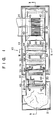
- a filter apparatus 10 has a separation tank 12 in which a liquid containing solid materials is charged.
- the separation tank 12 is arranged inside a cleaned liquid storage tank 14.
- the separation tank 12 has two parallel side walls and a bottom wall 16.
- One end portion of the bottom wall 16 is inclined to extend toward one upper side of the tank 14 and has a chute 18 at the extended end of the bottom wall.
- This one end portion of the bottom wall 16 is supported by support frames 20 which extend therealong from the side walls of the separation tank 12, respectively.
- the support frames 20 are formed integrally with the side walls of the separation tank 12, respectively.
- a chip box 21 is arranged outside the tank 1 and below the chute 18.
- a hopper 22 is mounted on the side walls of the separation tank 1.
- the hopper 22 has an inlet port 24 at its lower end.
- An opening 27 of an oil pipe 26 extending, for instance, from a cutting machine is located above the hopper 22.
- Cutting oil containing chips, which is delivered from the cutting machine by way of the oil pipe 26, is supplied to the hopper 22 through the opening 27.
- the cutting oil supplied to the hopper 22 is then supplied to the separation tank 12 through the inlet port 24.
- a straightening filter 28 depends from the hopper 22, and is made of a foamed resin such as urethane sponge.
- the straightening filter 28 has a cylindrical filter 30 arranged to surround the inlet port 24, a plurality of partition filters 32 dividing the interior of the cylindrical filter 30, and a plurality of turbulence preventive filters 34 arranged on the outer circumference of the cylindrical filter 30.
- the cutting oil supplied through the inlet port 24 flows down inside the cylindrical filter 30.
- the partition filters 32 Bounce of the cutting oil inside the separation tank 12 caused by the falling energy of the cutting oil is reduced by the partition filters.
- the bounce of the cutting oil is prevented to transmit to the outside by the cylindrical filter 30 and the turbulence preventive filters 34. In this manner, the cutting oil supplied to the separation tank 12 smoothly flows down inside the cylindrical tank 12.
- chips of relatively big size contained in the cutting oil precipitate by their own weight and are deposited on the bottom wall 16 of the separation tank 12.
- Part of the cutting oil flowing down inside the cylindrical filter 30 is diffused into the separation tank 12 through. the cylindrical filter 32, the partition filters 32 and the turbulence preventive filters. 34.
- the chips of intermediate size contained in the cutting oil are trapped by the filters when the cutting oil is filtered thereby.
- the chips of small size which are not trapped by the cylindrical filter 30, the partition filters 32, and the turbulence preventive filters 34 float in the cutting oil held in the separation tank 12 or are deposited on the bottom wall 16 by their own weight.
- the filter apparatus 10 has a plurality of first wipers 36 which are slidable on the bottom wall of the separation tank 12.
- Each wiper 36 has oil-resistant rubber plate 35 of a length equal to the width of the bottom wall.
- the oil-resistant rubber plate 35 is mounted on plate-shaped support members 37 by bolts 38.
- Each support member 37 has a length greater than that of the rubber plate 35, and its opposite ends project from the rubber plate.
- Each wiper 36 is mounted on a pair of first wiper chains 40. More particularly, both ends of each support member 37 are mounted to the respective the wiper chains 40.
- the wiper chains 40 are passed round a pair of drive sprockets 42 which are rotatably mounted on the respective inner surfaces of the support frames 20, and a pair of driven sprockets 43 which are rotatably mounted on the respective inner surfaces of side walls of the separating tank 12.
- the drive sprockets 42 are coupled with each other.
- the wiper chains 40 extend along the bottom wall 16.
- the forward movement paths of the wiper chains 40 extend parallel to the bottom wall 16.
- One of the drive sprockets 42 is coupled through a drive chain 45 to a motor 44 which is mounted at one of the extended end portions of the support frames 20. By the normal rotation or intermittent rotation of the motor 44, the wiper chains 40 are driven in the direction indicated by arrow A in Fig.
- the first wipers 36 are mounted on the wiper chains 40 at a predetermined pitch along the direction of movement of the wiper chains 40 and perpendicularly thereto.
- the first wiper 36 at the sides of the forward movement paths thereof are slid on the bottom wall 16 of the separation tank 12 along the direction indicated by arrow A.
- the chips deposited on the bottom wall are scraped by these wipers and are transferred to a chute 18 along the bottom wall to be discharged therethrough. The discharged chips are dropped in the chip box 21.
- the backward movement paths of the respective wiper chains 40 extend above the lower edges of the cylindrical filter 30, the partition filters 32 and the turbulence preventive filters 34.
- the first wipers 36 are driven along the backward movement paths of the wiper chains 40, they are brought into contact with the lower edges of the respective filters 30, 32 and 34. Due to the impact of this contact, the filters 30, 32 and 34 are swung and the chips deposited on these filters are thus separated therefrom. In this manner, clogging of the respective filters 30, 32 and 34 is prevented.
- the chips dropped from the filters 30, 32 and 34 are either deposited on the bottom wall 16 or float in the cutting oil held in the separation tank 12.
- the filter apparatus has a filter member 46 which is arranged inside the separation tank 12.
- the filter member 46 is made of a flexible sheet with a number of through holes, for example, a punched metal sheet.
- the filter member is in a rectangular form having a width substantially the same as that of the separation tank 12. Generally the smaller the diameter of the through hole 48 and the thinner the thickness of the filter member 46, the better the filtration efficiency of the filter member 46. In the embodiment of the present invention, the diameter of the through hole 48 of the filter member 46 is set to about 0.5 mm, and the thickness of the filter member 46 is set to about 0.4 mm.
- the through holes 48 prevent the solid materials from passing therethrough while they allow passage of fluid materials.
- the two longer sides of the filter member 46 are respectively supported by the side walls of the separation tank 12.
- the two shorter sides of the filter members 46 are respectively supported by a support plate 50 mounted on the side walls of the separation tank 12 and a support member 51 mounted on the support frames 20. In this manner, the filter member 46 is suspended between the side walls of the separation tank 12 such that it is inclined to be parallel to the bottom wall 16.
- Outlet ports 54 are formed in opposition to each other in the side walls of the separation tank 12 to be within a space 52 defined by the filter member 46, the support plate 50, and the side walls of the separation tank 12.
- the cutting oil held in the separation tank 12 is discharged to the tank 14 through the outlet ports 54.
- the filter member 46 is arranged so as to separate the outlet ports 54 and the interior of the separation tank 12, that is, to allow the flow path of the cutting oil from the separation tank 12 to the outlet ports 54.
- the cutting oil flowing to the outlet ports 54 always passes through the through holes 48 of the filter member 46.
- the chips in the cutting oil cannot pass through the through holes 48 and is trapped by the filter member 46.
- the trapped chips are deposited on the surface of the filter member at the liquid inlet side or at the side of the separation tank 12.
- the cutting oil flowing toward the outlet ports 54 from the interior of the separation tank 12 is filtered by the filter member 46, and is thereafter supplied to the tank 14 through the outlet ports 54.
- a pair of transmission sprockets 56 and a pair of guide sprockets 58 are rotatably mounted adjacent to each other on the inner surfaces of the support frames 20, respectively.
- the transmission sprockets 56 are coupled with each other.
- These transmission sprockets 56 and guide sprockets 58 are engaged with the first wiper chains 40 at the sides of the backward movement paths thereof.
- the backward movement paths of the wiper chains 40 extend substantially parallel to the filter member 46 at a predetermined pitch.
- the first wipers 36 which are mounted to the wiper chains 40 for movement therewith are slid, at the sides of the backward movement paths of the wiper chains 40 on the surface of the filter member 46 at the inlet side thereof along the direction indicated by arrow B. Upon the sliding movement of the first wipers 36, the chips which have been deposited on the surface of the filter member 46 at the liquid inlet side are scraped by the first wipers 36.
- the first wipers 36 also function as scrapers.
- the filter apparatus 10 also has a plurality of second wipers 60 which are slidable on the surface of the filter member 46 at the side of the liquid outlet, that is, at the side of the outlet ports 54.
- Each wiper 60 has two oil-resistant rubber plates 62 and 63, which are mounted to a U-shaped support member 64 with bolts 65 to be parallel to each other.
- the oil-resistant rubber plates 62 and 63 each have a length substantially equal to the width of the bottom wall 16 of the separation tank 12.
- the support member 64 has a length greater than that of the rubber plates 62, 64, and its opposite ends project from the rubber plates. Both ends of each support member 64 are mounted to a pair of second wiper chains 66.
- a pair of wiper drive sprockets 68 and a pair of wiper driven sprockets 69 are rotatably mounted on the inner surfaces of the side walls of the separation tank 12.
- the wiper drive sprockets 68 are coupled with each other.
- the second wiper chains 66 are passed round these sprockets 68 and 69.
- the forward movement paths of the wiper chains 66 are parallel to the filter member 46.
- An interlocking sprocket 70 is coupled to one of the transmission sprockets 56, while another interlocking sprocket 71 is coupled to one of the wiper drive sprockets 68.
- a transmission chain 72 is passed round these sprockets 70 and 71.
- the driving force of the scraper chains 40 driven by the motor 44 drives the interlocking sprocket 70 together with the transmission sprocket 56.
- the driving force of the interlocking sprocket 70 is transmitted to the interlocking sprocket 71 through the transmission chain 72 and thence to the wiper drive sprockets 68.
- the wiper chains 66 at the sides of the forward movement paths are driven by the wiper drive sprockets 68 in the direction indicated by arrow C along the longitudinal direction of the separation tank 12.
- the respective second wipers 60 are mounted on the wiper chains 66 perpendicularly to the direction of movement of the chains 66 and at a predetermined pitch along the direction of movement of the chains 66.
- the respective second wipers 60 are slid on the surface of the filter member 46 at the side of the liquid outlet in the direction indicated by arrow C.
- the pitch between the respective second wipers 60 along the direction of movement of the wiper chains 66 is set to be equal to the pitch between the respective first wipers 36 along the direction of movement of the first wiper chains 40.
- the second wipers 60 and the first wipers 36 are arranged to oppose each other with the filter member 46 interposed therebetween.
- the first wipers 36 are interposed between the oil-resistant rubber plate 62 and 63, and the first wipers 36 and the wipers 60 sandwich the filter member from its both sides.
- the first wipers 36 and the second wipers 60 are respectively driven at the same speed in the directions indicated by arrows B and C, that is, in the same direction by a drive mechanism 39 having the motor 44, the drive sprockets 42, the driven sprockets 43, the drive chains 45, the first wiper chains 40, the transmission chain 72, the second wiper chains 66, the interlocking sprockets 70 and 71, the wiper drive sprockets 68, and the wiper driven sprockets 69. Therefore, the first wipers 36 and the second wipers 60 are slid on the surfaces of the filter member 46 so that they oppose each other with the filter member being interposed therebetween.
- Reference numeral 74 denotes auxiliary legs mounted on the support frames 20
- reference numeral 76 denotes a removing member mounted on the frames. After passing through the chute 18, the first wipers 36 are brought into contact with this removing member 76 so that the chips deposited thereon may be removed.
- the filter apparatus 10 of the arrangement as described above most of the chips contained in the cutting oil is deposited on the bottom wall of the separation tank 12.
- the thus deposited chips are scraped by the first wipers 36 and are discharged through the chute 18.
- Fine chips which did not deposit on the bottom wall of the separation tank 12 and which are floating in the cutting oil are trapped by the filter member 46 en route from the interior of the separation tank 12 to the outlet ports 54.
- the cutting oil cleaned in the separation tank 12 is supplied to the tank 14 through the outlet ports 54, and may be supplied for reuse.
- the fine chips trapped by the filter member 46 and deposited on the surface of the filter member 46 at the side of the liquid inlet are scraped by the first wipers 36 which are slid on the surface of the filter member 46.
- the diameter of the through holes 48 of the filter member 46 can be reduced to improve the filtration performance of the filter member.
- good filtration performance of the filter member can be maintained over an extended period of time.
- the filter apparatus 10 of this embodiment has the second wipers 60 which are slid on the surface of the filter member at the side of the liquid outlet. These second wipers 60 and the first wipers 36 are slid over both surfaces of the filter member 46 so that they oppose each other with the filter member 46 interposed therebetween. Therefore, the filter member 46 may not be deformed due to the sliding movement of the second wipers 60 and the first wipers 36. Thus, the filter member 46 need not have a high rigidity, so that the filter member can be made thinner and more through holes 48 may be formed. As a consequence, the filtration performance of the filter member 46 may be further improved. If the filter member 46 is made thinner, the size of the through hole 48 along the axial direction of the through hole 48 is made smaller. This facilitates the scraping effects of the chips within the through holes 48 by the first wipers 36 and the second wipers 60, and clogging of the through holes 48 is further prevented.
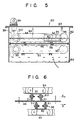
- a filter apparatus 80 according to another embodiment of the present invention is shown in Figs. 5 and 6.
- This filter apparatus 80 is in a unit form and has a frame 82 of hollow rectangular shape.
- the upper end of the frame 82 is covered by a lid 83.
- the frame 82 has an opening 84 through which is introduced the cutting oil containing chips, and an outlet port 85 for discharging the cutting oil introduced inside the frame 82 through the opening 84 to the outside of the frame.
- the filter apparatus 80 has a filter member 46 which made of a metal sheet with a number of through holes formed by punching, for example.
- the filter member 82 is formed in a rectangular form in correspondence with the shape of the frame 82.
- the filter member 46 is suspended on the inner walls of the frame 82 so as to allow the cutting oil to flow therethrough from the opening to the outlet port.
- the cutting oil flowing to the interior of the frame 82 through the opening 84 is filtered by the filter member 46 and is discharged through the outlet port 85.
- the discharged cutting oil is supplied to the cleaned liquid holding tank (not shown).
- the filter apparatus 80 has a plurality of first wipers 36 which are slidable over the surface of the filter member 46 at the side of the liquid inlet, and a plurality of second wipers 60 which are slidable over the surface of the filter member 46 at the side of the liquid outlet.
- Each of these first and second wipers has two oil-resistant rubber plates 91 having a length substantially the same as the width of the filter member 46, and a U-shaped support member 92 supporting these oil-resistant rubber plates parallel to each other.
- the filter apparatus 80 has, as a driving mechanism 39 for sliding the first and second wipers, a pair of first wiper chains 93 and a pair of second wiper chains 94.
- the first wiper chains 93 are passed round a pair of first drive sprockets 95 and a pair of first driven sprockets 96 which are rotatably mounted on the inner surfaces of the frame 82 at the liquid inlet side of the filter member 46, respectively.
- the backward movement path of each first wiper chain 93 extends parallel to the filter member 46.
- the second wiper chains 94 are passed round a pair of second drive sprockets 97 and a pair of second driven sprockets 98 which are rotatably mounted on the inner surfaces of the frame 82 at the liquid outlet side of the filter member 46, respectively.
- the forward movement path of each second wiper chain 94 extends parallel to the filter member 46.
- the filter apparatus 80 further has, as a drive means, a motor 99 mounted on the lid 83, and drive chain 100 which are connected to the motor 99 to be driven thereby.
- One of the first drive sprockets 95 and one of the second drive sprockets 97 engage with the drive chain 100 to be driven thereby.
- the first wiper chains 93 are driven by the first drive sprockets 95 along the longitudinal direction of the filter member 86.
- the second wiper chains 94 are driven by the second drive sprockets 97 along the longitudinal direction of the filter member 46.
- the backward movement path of each first wiper chain 93 and the forward movement path of each second wiper chain 94 are driven in the directions indicated by arrows D and E at the same speed.
- each first wiper 36 is mounted on the first wiper chains 93, respectively.
- the first wipers 36 are arranged at a predetermined pitch along the direction of movement of the first wiper chains 93 and are arranged perpendicularly to the direction of movement of the first wiper chains.
- the first wipers 36 are driven integrally with the first wiper chains.
- Both ends of each second wiper 60 are mounted on the second wiper chains 94, respectively.
- the second wipers 60 are arranged at a predetermined pitch along the direction of movement of the second wiper chains 94 and are arranged perpendicularly to the direction of movement of the second wiper chains.
- the second wipers 60 are driven integrally with the second wiper chains 94.
- the pitch between the first wipers 36 along the direction of movement of the first wiper chains 93 is the same as that between the second wipers 60 along the direction of movement of the second wiper chains 94.
- the first wipers 36 and the second wipers 60 are arranged to oppose each other with the filter member 46 interposed therebetween. Upon the operation of the motor 99, the first and second wipers are slid over both surfaces of the filter member 46 in opposition with each other.
- the filter apparatus of the second embodiment of the apparatus has the similar effects as those of the first embodiment. Since the filter apparatus of the second embodiment is in the form of a unit, it may be easily assembled in various types of equipment.
- the filtering apparatus of the present invention is not limited to those for filtering cutting oil but may be extended to those for filtering machining oil or slurry.
- the flexible sheet constituting the filter member may comprise a woven fabric of synthetic resinous fiber. In this case, since the woven fabric is in the form of fine mesh, filtration performance of the filter member is further improved.
Landscapes
- Chemical & Material Sciences (AREA)
- Chemical Kinetics & Catalysis (AREA)
- Filtration Of Liquid (AREA)
Claims (18)
Applications Claiming Priority (2)
| Application Number | Priority Date | Filing Date | Title |
|---|---|---|---|
| JP56064726A JPS6014603B2 (ja) | 1981-04-28 | 1981-04-28 | メッシュフィルタ装置 |
| JP64726/81 | 1981-04-28 |
Publications (3)
| Publication Number | Publication Date |
|---|---|
| EP0063797A2 EP0063797A2 (fr) | 1982-11-03 |
| EP0063797A3 EP0063797A3 (en) | 1983-05-18 |
| EP0063797B1 true EP0063797B1 (fr) | 1985-09-11 |
Family
ID=13266434
Family Applications (1)
| Application Number | Title | Priority Date | Filing Date |
|---|---|---|---|
| EP82103424A Expired EP0063797B1 (fr) | 1981-04-28 | 1982-04-22 | Appareil de filtration |
Country Status (5)
| Country | Link |
|---|---|
| US (1) | US4437991A (fr) |
| EP (1) | EP0063797B1 (fr) |
| JP (1) | JPS6014603B2 (fr) |
| CA (1) | CA1176576A (fr) |
| DE (1) | DE3266128D1 (fr) |
Cited By (1)
| Publication number | Priority date | Publication date | Assignee | Title |
|---|---|---|---|---|
| DE19635364A1 (de) * | 1995-08-24 | 1997-05-28 | Walter Joistgen | Vorrichtung zum Filtern von verunreinigten flüssigen Medien |
Families Citing this family (11)
| Publication number | Priority date | Publication date | Assignee | Title |
|---|---|---|---|---|
| US4731180A (en) * | 1983-08-03 | 1988-03-15 | Huff Karl C | Water-solids separator and wiper blade |
| JPH0433929Y2 (fr) * | 1985-01-25 | 1992-08-13 | ||
| JPS6272107U (fr) * | 1985-10-18 | 1987-05-08 | ||
| US5217613A (en) * | 1985-10-18 | 1993-06-08 | Bunri Industry Co., Ltd. | Filter apparatus |
| DE20007698U1 (de) | 2000-04-28 | 2000-08-03 | Bürener Maschinenfabrik GmbH, 33142 Büren | Filter zum Reinigen von Emulsionen aus der spangebenden Metallbearbeitung |
| US20060113220A1 (en) * | 2002-11-06 | 2006-06-01 | Eric Scott | Upflow or downflow separator or shaker with piezoelectric or electromagnetic vibrator |
| US20070108105A1 (en) * | 2005-11-16 | 2007-05-17 | Burnett George A | Upflow shakers and separators |
| US20070108104A1 (en) * | 2005-11-16 | 2007-05-17 | Burnett George A | Vibratory separators and operations |
| KR100918742B1 (ko) * | 2006-02-23 | 2009-09-24 | 가부시키가이샤 분리 | 여과 장치 |
| US9707496B2 (en) * | 2009-09-02 | 2017-07-18 | Terry L. Duperon | Thin plate apparatus for removing debris from water |
| CN111545550A (zh) * | 2020-04-29 | 2020-08-18 | 瑞鹄汽车模具股份有限公司 | 冲压工艺数据挖掘的冲压二次废料收集再利用工艺 |
Family Cites Families (13)
| Publication number | Priority date | Publication date | Assignee | Title |
|---|---|---|---|---|
| FR377273A (fr) | 1907-04-29 | 1907-09-03 | Aristide Francois Dumouchel | Diffuseur-défécateur continu pour toutes applications |
| US2412400A (en) | 1943-05-22 | 1946-12-10 | Hock Alvin | Strainer |
| US2598322A (en) | 1945-12-03 | 1952-05-27 | Vokes Ltd | Porous filter |
| US2865509A (en) | 1955-04-15 | 1958-12-23 | Indiana Commercial Filters Cor | Liquid filtering device |
| US2861688A (en) | 1955-12-21 | 1958-11-25 | Henry Mfg Co Inc | Liquid clarification system |
| US2919806A (en) | 1956-07-13 | 1960-01-05 | Brighton Corp | Hop strainer |
| US2994434A (en) | 1959-10-29 | 1961-08-01 | Nestor E Moseres | Filter or screen cleaning assembly |
| GB919471A (en) | 1960-11-22 | 1963-02-27 | Vokes Ltd | Improvements in oil-washed filter systems |
| US3194399A (en) * | 1961-05-17 | 1965-07-13 | Henry Mfg Co Inc | Suction filter apparatus |
| US3221885A (en) | 1962-01-09 | 1965-12-07 | Hirs Gene | Filter apparatus |
| FR1361317A (fr) * | 1962-10-24 | 1964-05-22 | Fmc Corp | Grille de prise d'eau ou tamis pour débarrasser les liquides de corps solides en suspension |
| US3748835A (en) | 1972-02-07 | 1973-07-31 | Peabody Engineering Corp | Liquid filter for gas washing apparatus |
| DE2434308A1 (de) * | 1973-07-20 | 1975-02-06 | Ronald Frederick Worlidge | Vorrichtung zur abscheidung von feststoffen aus fluessigkeiten |
-
1981
- 1981-04-28 JP JP56064726A patent/JPS6014603B2/ja not_active Expired
-
1982
- 1982-04-22 EP EP82103424A patent/EP0063797B1/fr not_active Expired
- 1982-04-22 DE DE8282103424T patent/DE3266128D1/de not_active Expired
- 1982-04-23 US US06/371,270 patent/US4437991A/en not_active Expired - Lifetime
- 1982-04-27 CA CA000401791A patent/CA1176576A/fr not_active Expired
Cited By (2)
| Publication number | Priority date | Publication date | Assignee | Title |
|---|---|---|---|---|
| DE19635364A1 (de) * | 1995-08-24 | 1997-05-28 | Walter Joistgen | Vorrichtung zum Filtern von verunreinigten flüssigen Medien |
| DE19635364C2 (de) * | 1995-08-24 | 1998-09-10 | Walter Joistgen | Vorrichtung zum Filtern von verunreinigten flüssigen Medien |
Also Published As
| Publication number | Publication date |
|---|---|
| EP0063797A2 (fr) | 1982-11-03 |
| CA1176576A (fr) | 1984-10-23 |
| JPS57180411A (en) | 1982-11-06 |
| DE3266128D1 (en) | 1985-10-17 |
| JPS6014603B2 (ja) | 1985-04-15 |
| EP0063797A3 (en) | 1983-05-18 |
| US4437991A (en) | 1984-03-20 |
Similar Documents
| Publication | Publication Date | Title |
|---|---|---|
| US6332983B1 (en) | Chip treatment device | |
| US5992642A (en) | Filtering apparatus and filtering system | |
| US4437991A (en) | Filter apparatus | |
| US4031011A (en) | Magnetic filter apparatus | |
| EP1256417B1 (fr) | Système avec convoyeur de copeaux | |
| US6277276B1 (en) | Filter apparatus with magnetic separation | |
| US6066255A (en) | Belt type filtration apparatus for industrial liquids having multiple sized debris | |
| US4876011A (en) | Oil recovery apparatus | |
| EP1992448B1 (fr) | Appareil de filtration | |
| JPS5830316A (ja) | 冷却・潤滑媒体分離浄化装置 | |
| WO2004054756A1 (fr) | Systeme de transport et d'evacuation de copeaux dote d'une fonction de separation | |
| US2865509A (en) | Liquid filtering device | |
| EP0071442A2 (fr) | Dispositif filtrant | |
| WO2014177199A1 (fr) | Boîtier filtrant pour convoyeur à copeaux avec filtration | |
| US4731180A (en) | Water-solids separator and wiper blade | |
| US4514301A (en) | Continuous media filter | |
| US3768657A (en) | Sludge tank with self-cleaning screen and screen for use therein | |
| GB2421200A (en) | A conveyor belt-type filtering device | |
| US5217613A (en) | Filter apparatus | |
| KR101615863B1 (ko) | 칩 컨베이어장치 | |
| US4921602A (en) | Filter for liquids | |
| CA1302300C (fr) | Appareil de filtrage | |
| JP2799951B2 (ja) | 切り屑除去装置 | |
| EP0244151B1 (fr) | Dispositif filtrant | |
| JPH0352728Y2 (fr) |
Legal Events
| Date | Code | Title | Description |
|---|---|---|---|
| PUAI | Public reference made under article 153(3) epc to a published international application that has entered the european phase |
Free format text: ORIGINAL CODE: 0009012 |
|
| 17P | Request for examination filed |
Effective date: 19820422 |
|
| AK | Designated contracting states |
Designated state(s): DE FR GB IT NL |
|
| PUAL | Search report despatched |
Free format text: ORIGINAL CODE: 0009013 |
|
| AK | Designated contracting states |
Designated state(s): DE FR GB IT NL |
|
| ITF | It: translation for a ep patent filed | ||
| GRAA | (expected) grant |
Free format text: ORIGINAL CODE: 0009210 |
|
| AK | Designated contracting states |
Designated state(s): DE FR GB IT NL |
|
| REF | Corresponds to: |
Ref document number: 3266128 Country of ref document: DE Date of ref document: 19851017 |
|
| ET | Fr: translation filed | ||
| PLBE | No opposition filed within time limit |
Free format text: ORIGINAL CODE: 0009261 |
|
| STAA | Information on the status of an ep patent application or granted ep patent |
Free format text: STATUS: NO OPPOSITION FILED WITHIN TIME LIMIT |
|
| 26N | No opposition filed | ||
| PGFP | Annual fee paid to national office [announced via postgrant information from national office to epo] |
Ref country code: DE Payment date: 19910327 Year of fee payment: 10 |
|
| PGFP | Annual fee paid to national office [announced via postgrant information from national office to epo] |
Ref country code: GB Payment date: 19910415 Year of fee payment: 10 |
|
| PGFP | Annual fee paid to national office [announced via postgrant information from national office to epo] |
Ref country code: FR Payment date: 19910419 Year of fee payment: 10 |
|
| ITTA | It: last paid annual fee | ||
| PGFP | Annual fee paid to national office [announced via postgrant information from national office to epo] |
Ref country code: NL Payment date: 19910430 Year of fee payment: 10 |
|
| PG25 | Lapsed in a contracting state [announced via postgrant information from national office to epo] |
Ref country code: GB Effective date: 19920422 |
|
| PG25 | Lapsed in a contracting state [announced via postgrant information from national office to epo] |
Ref country code: NL Effective date: 19921101 |
|
| GBPC | Gb: european patent ceased through non-payment of renewal fee | ||
| NLV4 | Nl: lapsed or anulled due to non-payment of the annual fee | ||
| PG25 | Lapsed in a contracting state [announced via postgrant information from national office to epo] |
Ref country code: FR Effective date: 19921230 |
|
| PG25 | Lapsed in a contracting state [announced via postgrant information from national office to epo] |
Ref country code: DE Effective date: 19930101 |
|
| REG | Reference to a national code |
Ref country code: FR Ref legal event code: ST |