EP0063896B1 - Amino and substituted amino phosphinyl-alkanoyl compositions - Google Patents
Amino and substituted amino phosphinyl-alkanoyl compositions Download PDFInfo
- Publication number
- EP0063896B1 EP0063896B1 EP82301923A EP82301923A EP0063896B1 EP 0063896 B1 EP0063896 B1 EP 0063896B1 EP 82301923 A EP82301923 A EP 82301923A EP 82301923 A EP82301923 A EP 82301923A EP 0063896 B1 EP0063896 B1 EP 0063896B1
- Authority
- EP
- European Patent Office
- Prior art keywords
- hydrogen
- lower alkyl
- compound according
- mole
- phenyl
- Prior art date
- Legal status (The legal status is an assumption and is not a legal conclusion. Google has not performed a legal analysis and makes no representation as to the accuracy of the status listed.)
- Expired
Links
- 239000000203 mixture Substances 0.000 title description 125
- 125000002924 primary amino group Chemical group [H]N([H])* 0.000 title description 57
- 239000001257 hydrogen Substances 0.000 claims abstract description 150
- 229910052739 hydrogen Inorganic materials 0.000 claims abstract description 150
- 150000001875 compounds Chemical class 0.000 claims abstract description 81
- 125000004435 hydrogen atom Chemical group [H]* 0.000 claims abstract description 54
- 239000002253 acid Substances 0.000 claims abstract description 29
- 125000001841 imino group Chemical group [H]N=* 0.000 claims abstract description 16
- 125000000217 alkyl group Chemical group 0.000 claims description 114
- -1 azido, amino Chemical group 0.000 claims description 108
- 150000002431 hydrogen Chemical group 0.000 claims description 53
- UFHFLCQGNIYNRP-UHFFFAOYSA-N Hydrogen Chemical compound [H][H] UFHFLCQGNIYNRP-UHFFFAOYSA-N 0.000 claims description 46
- 125000002496 methyl group Chemical group [H]C([H])([H])* 0.000 claims description 31
- 125000004432 carbon atom Chemical group C* 0.000 claims description 30
- 125000001797 benzyl group Chemical group [H]C1=C([H])C([H])=C(C([H])=C1[H])C([H])([H])* 0.000 claims description 29
- 125000001309 chloro group Chemical group Cl* 0.000 claims description 23
- 125000001153 fluoro group Chemical group F* 0.000 claims description 23
- 125000001997 phenyl group Chemical group [H]C1=C([H])C([H])=C(*)C([H])=C1[H] 0.000 claims description 23
- 125000001246 bromo group Chemical group Br* 0.000 claims description 17
- 125000005843 halogen group Chemical group 0.000 claims description 13
- 125000000094 2-phenylethyl group Chemical group [H]C1=C([H])C([H])=C(C([H])=C1[H])C([H])([H])C([H])([H])* 0.000 claims description 12
- 150000003839 salts Chemical class 0.000 claims description 12
- 125000003545 alkoxy group Chemical group 0.000 claims description 11
- 125000000956 methoxy group Chemical group [H]C([H])([H])O* 0.000 claims description 11
- ZZVUWRFHKOJYTH-UHFFFAOYSA-N diphenhydramine Chemical group C=1C=CC=CC=1C(OCCN(C)C)C1=CC=CC=C1 ZZVUWRFHKOJYTH-UHFFFAOYSA-N 0.000 claims description 9
- 125000004414 alkyl thio group Chemical group 0.000 claims description 8
- 125000000113 cyclohexyl group Chemical group [H]C1([H])C([H])([H])C([H])([H])C([H])(*)C([H])([H])C1([H])[H] 0.000 claims description 8
- 125000002023 trifluoromethyl group Chemical group FC(F)(F)* 0.000 claims description 8
- 125000003277 amino group Chemical group 0.000 claims description 7
- 229910052736 halogen Inorganic materials 0.000 claims description 7
- 206010020772 Hypertension Diseases 0.000 claims description 6
- NFGODEMQGQNUKK-UHFFFAOYSA-M [6-(diethylamino)-9-(2-octadecoxycarbonylphenyl)xanthen-3-ylidene]-diethylazanium;chloride Chemical compound [Cl-].CCCCCCCCCCCCCCCCCCOC(=O)C1=CC=CC=C1C1=C2C=CC(=[N+](CC)CC)C=C2OC2=CC(N(CC)CC)=CC=C21 NFGODEMQGQNUKK-UHFFFAOYSA-M 0.000 claims description 6
- 125000004043 oxo group Chemical group O=* 0.000 claims description 6
- 229910052717 sulfur Chemical group 0.000 claims description 6
- 125000000999 tert-butyl group Chemical group [H]C([H])([H])C(*)(C([H])([H])[H])C([H])([H])[H] 0.000 claims description 6
- NINIDFKCEFEMDL-UHFFFAOYSA-N Sulfur Chemical group [S] NINIDFKCEFEMDL-UHFFFAOYSA-N 0.000 claims description 5
- 125000003342 alkenyl group Chemical group 0.000 claims description 5
- 125000001495 ethyl group Chemical group [H]C([H])([H])C([H])([H])* 0.000 claims description 5
- 150000002367 halogens Chemical class 0.000 claims description 5
- 229910052760 oxygen Inorganic materials 0.000 claims description 5
- 239000011593 sulfur Chemical group 0.000 claims description 5
- 125000005978 1-naphthyloxy group Chemical group 0.000 claims description 4
- 125000005979 2-naphthyloxy group Chemical group 0.000 claims description 4
- 125000004203 4-hydroxyphenyl group Chemical group [H]OC1=C([H])C([H])=C(*)C([H])=C1[H] 0.000 claims description 4
- VGGSQFUCUMXWEO-UHFFFAOYSA-N Ethene Chemical class C=C VGGSQFUCUMXWEO-UHFFFAOYSA-N 0.000 claims description 4
- 239000005977 Ethylene Substances 0.000 claims description 4
- QVGXLLKOCUKJST-UHFFFAOYSA-N atomic oxygen Chemical group [O] QVGXLLKOCUKJST-UHFFFAOYSA-N 0.000 claims description 4
- 229910052794 bromium Inorganic materials 0.000 claims description 4
- 229910052801 chlorine Inorganic materials 0.000 claims description 4
- 125000000753 cycloalkyl group Chemical group 0.000 claims description 4
- SMBQBQBNOXIFSF-UHFFFAOYSA-N dilithium Chemical class [Li][Li] SMBQBQBNOXIFSF-UHFFFAOYSA-N 0.000 claims description 4
- 229910003002 lithium salt Inorganic materials 0.000 claims description 4
- 159000000002 lithium salts Chemical class 0.000 claims description 4
- 239000001301 oxygen Substances 0.000 claims description 4
- 125000001511 cyclopentyl group Chemical group [H]C1([H])C([H])([H])C([H])([H])C([H])(*)C1([H])[H] 0.000 claims description 3
- 229910052731 fluorine Inorganic materials 0.000 claims description 3
- 125000001637 1-naphthyl group Chemical group [H]C1=C([H])C([H])=C2C(*)=C([H])C([H])=C([H])C2=C1[H] 0.000 claims description 2
- 125000001622 2-naphthyl group Chemical group [H]C1=C([H])C([H])=C2C([H])=C(*)C([H])=C([H])C2=C1[H] 0.000 claims description 2
- KCNKJCHARANTIP-SNAWJCMRSA-N allyl-{4-[3-(4-bromo-phenyl)-benzofuran-6-yloxy]-but-2-enyl}-methyl-amine Chemical compound C=1OC2=CC(OC/C=C/CN(CC=C)C)=CC=C2C=1C1=CC=C(Br)C=C1 KCNKJCHARANTIP-SNAWJCMRSA-N 0.000 claims description 2
- 125000000118 dimethyl group Chemical group [H]C([H])([H])* 0.000 claims description 2
- 239000008194 pharmaceutical composition Substances 0.000 claims description 2
- 125000001424 substituent group Chemical group 0.000 claims description 2
- 125000002887 hydroxy group Chemical group [H]O* 0.000 claims 7
- 230000006229 amino acid addition Effects 0.000 claims 1
- 239000003937 drug carrier Substances 0.000 claims 1
- 150000002148 esters Chemical class 0.000 abstract description 21
- 239000002220 antihypertensive agent Substances 0.000 abstract description 5
- UUUHXMGGBIUAPW-UHFFFAOYSA-N 1-[1-[2-[[5-amino-2-[[1-[5-(diaminomethylideneamino)-2-[[1-[3-(1h-indol-3-yl)-2-[(5-oxopyrrolidine-2-carbonyl)amino]propanoyl]pyrrolidine-2-carbonyl]amino]pentanoyl]pyrrolidine-2-carbonyl]amino]-5-oxopentanoyl]amino]-3-methylpentanoyl]pyrrolidine-2-carbon Chemical compound C1CCC(C(=O)N2C(CCC2)C(O)=O)N1C(=O)C(C(C)CC)NC(=O)C(CCC(N)=O)NC(=O)C1CCCN1C(=O)C(CCCN=C(N)N)NC(=O)C1CCCN1C(=O)C(CC=1C2=CC=CC=C2NC=1)NC(=O)C1CCC(=O)N1 UUUHXMGGBIUAPW-UHFFFAOYSA-N 0.000 abstract description 4
- 102000004270 Peptidyl-Dipeptidase A Human genes 0.000 abstract description 4
- 108090000882 Peptidyl-Dipeptidase A Proteins 0.000 abstract description 4
- 230000000694 effects Effects 0.000 abstract 1
- 230000005764 inhibitory process Effects 0.000 abstract 1
- YMWUJEATGCHHMB-UHFFFAOYSA-N Dichloromethane Chemical compound ClCCl YMWUJEATGCHHMB-UHFFFAOYSA-N 0.000 description 315
- QTBSBXVTEAMEQO-UHFFFAOYSA-N Acetic acid Chemical compound CC(O)=O QTBSBXVTEAMEQO-UHFFFAOYSA-N 0.000 description 201
- XEKOWRVHYACXOJ-UHFFFAOYSA-N Ethyl acetate Chemical compound CCOC(C)=O XEKOWRVHYACXOJ-UHFFFAOYSA-N 0.000 description 195
- 239000000243 solution Substances 0.000 description 164
- OKKJLVBELUTLKV-UHFFFAOYSA-N Methanol Chemical compound OC OKKJLVBELUTLKV-UHFFFAOYSA-N 0.000 description 114
- 125000002777 acetyl group Chemical group [H]C([H])([H])C(*)=O 0.000 description 109
- XLYOFNOQVPJJNP-UHFFFAOYSA-N water Substances O XLYOFNOQVPJJNP-UHFFFAOYSA-N 0.000 description 108
- 239000000047 product Substances 0.000 description 102
- VYPSYNLAJGMNEJ-UHFFFAOYSA-N Silicium dioxide Chemical compound O=[Si]=O VYPSYNLAJGMNEJ-UHFFFAOYSA-N 0.000 description 91
- 239000000741 silica gel Substances 0.000 description 89
- 229910002027 silica gel Inorganic materials 0.000 description 89
- RTZKZFJDLAIYFH-UHFFFAOYSA-N Diethyl ether Chemical compound CCOCC RTZKZFJDLAIYFH-UHFFFAOYSA-N 0.000 description 81
- 239000007787 solid Substances 0.000 description 81
- WEVYAHXRMPXWCK-UHFFFAOYSA-N Acetonitrile Chemical compound CC#N WEVYAHXRMPXWCK-UHFFFAOYSA-N 0.000 description 78
- VEXZGXHMUGYJMC-UHFFFAOYSA-N Hydrochloric acid Chemical compound Cl VEXZGXHMUGYJMC-UHFFFAOYSA-N 0.000 description 76
- CSCPPACGZOOCGX-UHFFFAOYSA-N Acetone Chemical compound CC(C)=O CSCPPACGZOOCGX-UHFFFAOYSA-N 0.000 description 72
- 229960000583 acetic acid Drugs 0.000 description 68
- 229940093499 ethyl acetate Drugs 0.000 description 65
- 235000019439 ethyl acetate Nutrition 0.000 description 65
- LRHPLDYGYMQRHN-UHFFFAOYSA-N N-Butanol Chemical compound CCCCO LRHPLDYGYMQRHN-UHFFFAOYSA-N 0.000 description 56
- WYURNTSHIVDZCO-UHFFFAOYSA-N Tetrahydrofuran Chemical compound C1CCOC1 WYURNTSHIVDZCO-UHFFFAOYSA-N 0.000 description 56
- 229910052943 magnesium sulfate Inorganic materials 0.000 description 55
- 239000002904 solvent Substances 0.000 description 54
- 229960002429 proline Drugs 0.000 description 53
- YXFVVABEGXRONW-UHFFFAOYSA-N Toluene Chemical compound CC1=CC=CC=C1 YXFVVABEGXRONW-UHFFFAOYSA-N 0.000 description 49
- 239000012267 brine Substances 0.000 description 46
- 239000003921 oil Substances 0.000 description 46
- HPALAKNZSZLMCH-UHFFFAOYSA-M sodium;chloride;hydrate Chemical compound O.[Na+].[Cl-] HPALAKNZSZLMCH-UHFFFAOYSA-M 0.000 description 46
- ZMANZCXQSJIPKH-UHFFFAOYSA-N Triethylamine Chemical compound CCN(CC)CC ZMANZCXQSJIPKH-UHFFFAOYSA-N 0.000 description 45
- 238000003756 stirring Methods 0.000 description 39
- UIIMBOGNXHQVGW-UHFFFAOYSA-M Sodium bicarbonate Chemical class [Na+].OC([O-])=O UIIMBOGNXHQVGW-UHFFFAOYSA-M 0.000 description 38
- 125000005328 phosphinyl group Chemical group [PH2](=O)* 0.000 description 38
- UHOVQNZJYSORNB-UHFFFAOYSA-N Benzene Chemical compound C1=CC=CC=C1 UHOVQNZJYSORNB-UHFFFAOYSA-N 0.000 description 36
- DHRLEVQXOMLTIM-UHFFFAOYSA-N phosphoric acid;trioxomolybdenum Chemical compound O=[Mo](=O)=O.O=[Mo](=O)=O.O=[Mo](=O)=O.O=[Mo](=O)=O.O=[Mo](=O)=O.O=[Mo](=O)=O.O=[Mo](=O)=O.O=[Mo](=O)=O.O=[Mo](=O)=O.O=[Mo](=O)=O.O=[Mo](=O)=O.O=[Mo](=O)=O.OP(O)(O)=O DHRLEVQXOMLTIM-UHFFFAOYSA-N 0.000 description 33
- YLQBMQCUIZJEEH-UHFFFAOYSA-N tetrahydrofuran Natural products C=1C=COC=1 YLQBMQCUIZJEEH-UHFFFAOYSA-N 0.000 description 28
- ZMXDDKWLCZADIW-UHFFFAOYSA-N N,N-Dimethylformamide Chemical compound CN(C)C=O ZMXDDKWLCZADIW-UHFFFAOYSA-N 0.000 description 27
- 125000004356 hydroxy functional group Chemical group O* 0.000 description 26
- KDLHZDBZIXYQEI-UHFFFAOYSA-N Palladium Chemical compound [Pd] KDLHZDBZIXYQEI-UHFFFAOYSA-N 0.000 description 24
- 125000002915 carbonyl group Chemical group [*:2]C([*:1])=O 0.000 description 23
- 125000001436 propyl group Chemical group [H]C([*])([H])C([H])([H])C([H])([H])[H] 0.000 description 22
- 238000000034 method Methods 0.000 description 21
- 238000001914 filtration Methods 0.000 description 19
- 239000000725 suspension Substances 0.000 description 19
- XKRFYHLGVUSROY-UHFFFAOYSA-N Argon Chemical compound [Ar] XKRFYHLGVUSROY-UHFFFAOYSA-N 0.000 description 18
- ZAFNJMIOTHYJRJ-UHFFFAOYSA-N Diisopropyl ether Chemical compound CC(C)OC(C)C ZAFNJMIOTHYJRJ-UHFFFAOYSA-N 0.000 description 18
- KRKNYBCHXYNGOX-UHFFFAOYSA-N citric acid Chemical compound OC(=O)CC(O)(C(O)=O)CC(O)=O KRKNYBCHXYNGOX-UHFFFAOYSA-N 0.000 description 18
- 229910000343 potassium bisulfate Inorganic materials 0.000 description 18
- JTNCEQNHURODLX-UHFFFAOYSA-N 2-phenylethanimidamide Chemical compound NC(=N)CC1=CC=CC=C1 JTNCEQNHURODLX-UHFFFAOYSA-N 0.000 description 17
- HEMHJVSKTPXQMS-UHFFFAOYSA-M Sodium hydroxide Chemical compound [OH-].[Na+] HEMHJVSKTPXQMS-UHFFFAOYSA-M 0.000 description 15
- 0 C*[N+]([O-])O*(C)* Chemical compound C*[N+]([O-])O*(C)* 0.000 description 14
- OFBQJSOFQDEBGM-UHFFFAOYSA-N Pentane Chemical compound CCCCC OFBQJSOFQDEBGM-UHFFFAOYSA-N 0.000 description 14
- DTQVDTLACAAQTR-UHFFFAOYSA-N Trifluoroacetic acid Chemical compound OC(=O)C(F)(F)F DTQVDTLACAAQTR-UHFFFAOYSA-N 0.000 description 14
- 239000012298 atmosphere Substances 0.000 description 14
- 239000000706 filtrate Substances 0.000 description 14
- 239000003054 catalyst Substances 0.000 description 13
- 238000010992 reflux Methods 0.000 description 13
- 239000007858 starting material Substances 0.000 description 13
- CURLTUGMZLYLDI-UHFFFAOYSA-N Carbon dioxide Chemical compound O=C=O CURLTUGMZLYLDI-UHFFFAOYSA-N 0.000 description 12
- RDOXTESZEPMUJZ-UHFFFAOYSA-N anisole Chemical compound COC1=CC=CC=C1 RDOXTESZEPMUJZ-UHFFFAOYSA-N 0.000 description 12
- 125000001301 ethoxy group Chemical group [H]C([H])([H])C([H])([H])O* 0.000 description 12
- 239000002808 molecular sieve Substances 0.000 description 12
- URGAHOPLAPQHLN-UHFFFAOYSA-N sodium aluminosilicate Chemical compound [Na+].[Al+3].[O-][Si]([O-])=O.[O-][Si]([O-])=O URGAHOPLAPQHLN-UHFFFAOYSA-N 0.000 description 12
- PFKFTWBEEFSNDU-UHFFFAOYSA-N carbonyldiimidazole Chemical compound C1=CN=CN1C(=O)N1C=CN=C1 PFKFTWBEEFSNDU-UHFFFAOYSA-N 0.000 description 11
- FEMOMIGRRWSMCU-UHFFFAOYSA-N ninhydrin Chemical compound C1=CC=C2C(=O)C(O)(O)C(=O)C2=C1 FEMOMIGRRWSMCU-UHFFFAOYSA-N 0.000 description 11
- CDBYLPFSWZWCQE-UHFFFAOYSA-L Sodium Carbonate Chemical compound [Na+].[Na+].[O-]C([O-])=O CDBYLPFSWZWCQE-UHFFFAOYSA-L 0.000 description 10
- UIIMBOGNXHQVGW-DEQYMQKBSA-M Sodium bicarbonate-14C Chemical class [Na+].O[14C]([O-])=O UIIMBOGNXHQVGW-DEQYMQKBSA-M 0.000 description 10
- VVCLBQFBKZQOAF-NSHDSACASA-N benzyl (2s)-pyrrolidine-2-carboxylate Chemical compound O=C([C@H]1NCCC1)OCC1=CC=CC=C1 VVCLBQFBKZQOAF-NSHDSACASA-N 0.000 description 10
- ZCSHNCUQKCANBX-UHFFFAOYSA-N lithium diisopropylamide Chemical compound [Li+].CC(C)[N-]C(C)C ZCSHNCUQKCANBX-UHFFFAOYSA-N 0.000 description 10
- 229910000030 sodium bicarbonate Inorganic materials 0.000 description 10
- 235000017557 sodium bicarbonate Nutrition 0.000 description 10
- 125000000446 sulfanediyl group Chemical group *S* 0.000 description 10
- WVDDGKGOMKODPV-UHFFFAOYSA-N Benzyl alcohol Chemical compound OCC1=CC=CC=C1 WVDDGKGOMKODPV-UHFFFAOYSA-N 0.000 description 9
- 229910052786 argon Inorganic materials 0.000 description 9
- HEDRZPFGACZZDS-UHFFFAOYSA-N Chloroform Chemical compound ClC(Cl)Cl HEDRZPFGACZZDS-UHFFFAOYSA-N 0.000 description 8
- 239000000538 analytical sample Substances 0.000 description 8
- 238000006243 chemical reaction Methods 0.000 description 8
- 239000000543 intermediate Substances 0.000 description 8
- IUGYQRQAERSCNH-UHFFFAOYSA-N pivalic acid Chemical compound CC(C)(C)C(O)=O IUGYQRQAERSCNH-UHFFFAOYSA-N 0.000 description 8
- 235000013930 proline Nutrition 0.000 description 8
- 239000011541 reaction mixture Substances 0.000 description 8
- 239000012265 solid product Substances 0.000 description 8
- 125000004044 trifluoroacetyl group Chemical group FC(C(=O)*)(F)F 0.000 description 8
- 238000001665 trituration Methods 0.000 description 8
- 239000007864 aqueous solution Substances 0.000 description 7
- PASDCCFISLVPSO-UHFFFAOYSA-N benzoyl chloride Chemical compound ClC(=O)C1=CC=CC=C1 PASDCCFISLVPSO-UHFFFAOYSA-N 0.000 description 7
- 238000005984 hydrogenation reaction Methods 0.000 description 7
- 239000000463 material Substances 0.000 description 7
- 239000012071 phase Substances 0.000 description 7
- 238000010792 warming Methods 0.000 description 7
- XBPCUCUWBYBCDP-UHFFFAOYSA-N Dicyclohexylamine Chemical class C1CCCCC1NC1CCCCC1 XBPCUCUWBYBCDP-UHFFFAOYSA-N 0.000 description 6
- IAZDPXIOMUYVGZ-UHFFFAOYSA-N Dimethylsulphoxide Chemical compound CS(C)=O IAZDPXIOMUYVGZ-UHFFFAOYSA-N 0.000 description 6
- PUJDIJCNWFYVJX-UHFFFAOYSA-N benzyl carbamate Chemical compound NC(=O)OCC1=CC=CC=C1 PUJDIJCNWFYVJX-UHFFFAOYSA-N 0.000 description 6
- IYYIVELXUANFED-UHFFFAOYSA-N bromo(trimethyl)silane Chemical compound C[Si](C)(C)Br IYYIVELXUANFED-UHFFFAOYSA-N 0.000 description 6
- 239000001569 carbon dioxide Substances 0.000 description 6
- 229910002092 carbon dioxide Inorganic materials 0.000 description 6
- UAOMVDZJSHZZME-UHFFFAOYSA-N diisopropylamine Chemical compound CC(C)NC(C)C UAOMVDZJSHZZME-UHFFFAOYSA-N 0.000 description 6
- 125000003187 heptyl group Chemical group [H]C([*])([H])C([H])([H])C([H])([H])C([H])([H])C([H])([H])C([H])([H])C([H])([H])[H] 0.000 description 6
- UZKWTJUDCOPSNM-UHFFFAOYSA-N methoxybenzene Substances CCCCOC=C UZKWTJUDCOPSNM-UHFFFAOYSA-N 0.000 description 6
- PJUPKRYGDFTMTM-UHFFFAOYSA-N 1-hydroxybenzotriazole;hydrate Chemical compound O.C1=CC=C2N(O)N=NC2=C1 PJUPKRYGDFTMTM-UHFFFAOYSA-N 0.000 description 5
- RZYHXKLKJRGJGP-UHFFFAOYSA-N 2,2,2-trifluoro-n,n-bis(trimethylsilyl)acetamide Chemical compound C[Si](C)(C)N([Si](C)(C)C)C(=O)C(F)(F)F RZYHXKLKJRGJGP-UHFFFAOYSA-N 0.000 description 5
- YGCZTXZTJXYWCO-UHFFFAOYSA-N 3-phenylpropanal Chemical compound O=CCCC1=CC=CC=C1 YGCZTXZTJXYWCO-UHFFFAOYSA-N 0.000 description 5
- LFQSCWFLJHTTHZ-UHFFFAOYSA-N Ethanol Chemical compound CCO LFQSCWFLJHTTHZ-UHFFFAOYSA-N 0.000 description 5
- OPAAZIVTEMMZCB-UHFFFAOYSA-N [1-(ethoxycarbonylamino)-3-phenylpropyl]-methylphosphinic acid Chemical compound CCOC(=O)NC(P(C)(O)=O)CCC1=CC=CC=C1 OPAAZIVTEMMZCB-UHFFFAOYSA-N 0.000 description 5
- 238000010521 absorption reaction Methods 0.000 description 5
- 125000000043 benzamido group Chemical group [H]N([*])C(=O)C1=C([H])C([H])=C([H])C([H])=C1[H] 0.000 description 5
- LDECUSDQMXVUMP-UHFFFAOYSA-N benzyl 3-[6-[[2-(butylamino)-1-[3-methoxycarbonyl-4-(2-methoxy-2-oxoethoxy)phenyl]-2-oxoethyl]-hexylamino]-6-oxohexyl]-4-methyl-2-oxo-6-(4-phenylphenyl)-1,6-dihydropyrimidine-5-carboxylate Chemical compound O=C1NC(C=2C=CC(=CC=2)C=2C=CC=CC=2)C(C(=O)OCC=2C=CC=CC=2)=C(C)N1CCCCCC(=O)N(CCCCCC)C(C(=O)NCCCC)C1=CC=C(OCC(=O)OC)C(C(=O)OC)=C1 LDECUSDQMXVUMP-UHFFFAOYSA-N 0.000 description 5
- SIOVKLKJSOKLIF-UHFFFAOYSA-N bis(trimethylsilyl)acetamide Chemical compound C[Si](C)(C)OC(C)=N[Si](C)(C)C SIOVKLKJSOKLIF-UHFFFAOYSA-N 0.000 description 5
- 238000005859 coupling reaction Methods 0.000 description 5
- 125000006638 cyclopentyl carbonyl group Chemical group 0.000 description 5
- 125000003754 ethoxycarbonyl group Chemical group C(=O)(OCC)* 0.000 description 5
- NPZTUJOABDZTLV-UHFFFAOYSA-N hydroxybenzotriazole Substances O=C1C=CC=C2NNN=C12 NPZTUJOABDZTLV-UHFFFAOYSA-N 0.000 description 5
- WQUOYSSHEZICPB-UHFFFAOYSA-N methyl 2-dichlorophosphanylacetate Chemical compound COC(=O)CP(Cl)Cl WQUOYSSHEZICPB-UHFFFAOYSA-N 0.000 description 5
- WSLXZLPONZFFPM-UHFFFAOYSA-N methyl-[3-phenyl-1-(phenylmethoxycarbonylamino)propyl]phosphinic acid Chemical compound C=1C=CC=CC=1COC(=O)NC(P(O)(=O)C)CCC1=CC=CC=C1 WSLXZLPONZFFPM-UHFFFAOYSA-N 0.000 description 5
- 229910000029 sodium carbonate Inorganic materials 0.000 description 5
- 125000000022 2-aminoethyl group Chemical group [H]C([*])([H])C([H])([H])N([H])[H] 0.000 description 4
- MZRVEZGGRBJDDB-UHFFFAOYSA-N N-Butyllithium Chemical compound [Li]CCCC MZRVEZGGRBJDDB-UHFFFAOYSA-N 0.000 description 4
- ONIBWKKTOPOVIA-UHFFFAOYSA-N Proline Natural products OC(=O)C1CCCN1 ONIBWKKTOPOVIA-UHFFFAOYSA-N 0.000 description 4
- 230000002378 acidificating effect Effects 0.000 description 4
- 239000004480 active ingredient Substances 0.000 description 4
- 239000012670 alkaline solution Substances 0.000 description 4
- WPYMKLBDIGXBTP-UHFFFAOYSA-N benzoic acid Chemical compound OC(=O)C1=CC=CC=C1 WPYMKLBDIGXBTP-UHFFFAOYSA-N 0.000 description 4
- GGRHYQCXXYLUTL-UHFFFAOYSA-N chloromethyl 2,2-dimethylpropanoate Chemical compound CC(C)(C)C(=O)OCCl GGRHYQCXXYLUTL-UHFFFAOYSA-N 0.000 description 4
- 238000001816 cooling Methods 0.000 description 4
- CDPKWOKGVUHZFR-UHFFFAOYSA-N dichloro(methyl)phosphane Chemical compound CP(Cl)Cl CDPKWOKGVUHZFR-UHFFFAOYSA-N 0.000 description 4
- 239000002934 diuretic Substances 0.000 description 4
- 239000004615 ingredient Substances 0.000 description 4
- HQKMJHAJHXVSDF-UHFFFAOYSA-L magnesium stearate Chemical compound [Mg+2].CCCCCCCCCCCCCCCCCC([O-])=O.CCCCCCCCCCCCCCCCCC([O-])=O HQKMJHAJHXVSDF-UHFFFAOYSA-L 0.000 description 4
- 229910021645 metal ion Inorganic materials 0.000 description 4
- CPUHOSNIMWUHBR-UHFFFAOYSA-N methyl-[1-(phenylmethoxycarbonylamino)pentyl]phosphinic acid Chemical compound CCCCC(P(C)(O)=O)NC(=O)OCC1=CC=CC=C1 CPUHOSNIMWUHBR-UHFFFAOYSA-N 0.000 description 4
- UHZYTMXLRWXGPK-UHFFFAOYSA-N phosphorus pentachloride Chemical compound ClP(Cl)(Cl)(Cl)Cl UHZYTMXLRWXGPK-UHFFFAOYSA-N 0.000 description 4
- 150000003148 prolines Chemical class 0.000 description 4
- 238000011084 recovery Methods 0.000 description 4
- 239000000523 sample Substances 0.000 description 4
- FYSNRJHAOHDILO-UHFFFAOYSA-N thionyl chloride Chemical compound ClS(Cl)=O FYSNRJHAOHDILO-UHFFFAOYSA-N 0.000 description 4
- WTLVCRDMMHUJKD-UHFFFAOYSA-N 1-benzyl-3-(4-methylphenyl)-2,4-dihydrotriazine Chemical compound C1=CC(C)=CC=C1N1NN(CC=2C=CC=CC=2)C=CC1 WTLVCRDMMHUJKD-UHFFFAOYSA-N 0.000 description 3
- BABOMLMDSANCMI-UHFFFAOYSA-N 2-[ethoxy-[3-phenyl-1-(phenylmethoxycarbonylamino)propyl]phosphoryl]acetic acid Chemical compound C=1C=CC=CC=1COC(=O)NC(P(=O)(CC(O)=O)OCC)CCC1=CC=CC=C1 BABOMLMDSANCMI-UHFFFAOYSA-N 0.000 description 3
- 101800000734 Angiotensin-1 Proteins 0.000 description 3
- 102400000344 Angiotensin-1 Human genes 0.000 description 3
- 108010064733 Angiotensins Proteins 0.000 description 3
- 102000015427 Angiotensins Human genes 0.000 description 3
- YVIVRJLWYJGJTJ-UHFFFAOYSA-N CC(CC1)NC1=O Chemical compound CC(CC1)NC1=O YVIVRJLWYJGJTJ-UHFFFAOYSA-N 0.000 description 3
- JZUFKLXOESDKRF-UHFFFAOYSA-N Chlorothiazide Chemical compound C1=C(Cl)C(S(=O)(=O)N)=CC2=C1NCNS2(=O)=O JZUFKLXOESDKRF-UHFFFAOYSA-N 0.000 description 3
- 229920002261 Corn starch Polymers 0.000 description 3
- QOSSAOTZNIDXMA-UHFFFAOYSA-N Dicylcohexylcarbodiimide Chemical compound C1CCCCC1N=C=NC1CCCCC1 QOSSAOTZNIDXMA-UHFFFAOYSA-N 0.000 description 3
- ONIBWKKTOPOVIA-BYPYZUCNSA-N L-Proline Chemical compound OC(=O)[C@@H]1CCCN1 ONIBWKKTOPOVIA-BYPYZUCNSA-N 0.000 description 3
- WHXSMMKQMYFTQS-UHFFFAOYSA-N Lithium Chemical compound [Li] WHXSMMKQMYFTQS-UHFFFAOYSA-N 0.000 description 3
- WMFOQBRAJBCJND-UHFFFAOYSA-M Lithium hydroxide Chemical compound [Li+].[OH-] WMFOQBRAJBCJND-UHFFFAOYSA-M 0.000 description 3
- 150000001412 amines Chemical class 0.000 description 3
- ORWYRWWVDCYOMK-HBZPZAIKSA-N angiotensin I Chemical compound C([C@@H](C(=O)N[C@@H]([C@@H](C)CC)C(=O)N[C@@H](CC=1NC=NC=1)C(=O)N1[C@@H](CCC1)C(=O)N[C@@H](CC=1C=CC=CC=1)C(=O)N[C@@H](CC=1NC=NC=1)C(=O)N[C@@H](CC(C)C)C(O)=O)NC(=O)[C@@H](NC(=O)[C@H](CCCN=C(N)N)NC(=O)[C@@H](N)CC(O)=O)C(C)C)C1=CC=C(O)C=C1 ORWYRWWVDCYOMK-HBZPZAIKSA-N 0.000 description 3
- 150000008064 anhydrides Chemical class 0.000 description 3
- 239000008346 aqueous phase Substances 0.000 description 3
- 239000002585 base Substances 0.000 description 3
- 235000019445 benzyl alcohol Nutrition 0.000 description 3
- 230000036772 blood pressure Effects 0.000 description 3
- 239000002775 capsule Substances 0.000 description 3
- 239000008120 corn starch Substances 0.000 description 3
- 230000008878 coupling Effects 0.000 description 3
- 238000010168 coupling process Methods 0.000 description 3
- 238000000354 decomposition reaction Methods 0.000 description 3
- 238000004821 distillation Methods 0.000 description 3
- 230000001882 diuretic effect Effects 0.000 description 3
- 238000001035 drying Methods 0.000 description 3
- 239000000284 extract Substances 0.000 description 3
- 239000005457 ice water Substances 0.000 description 3
- 229910052744 lithium Inorganic materials 0.000 description 3
- GRROCVFLOAAZIT-UHFFFAOYSA-N methyl-[3-phenyl-1-[(2,2,2-trifluoroacetyl)amino]propyl]phosphinic acid Chemical compound FC(F)(F)C(=O)NC(P(O)(=O)C)CCC1=CC=CC=C1 GRROCVFLOAAZIT-UHFFFAOYSA-N 0.000 description 3
- 238000002156 mixing Methods 0.000 description 3
- 239000012074 organic phase Substances 0.000 description 3
- 125000001147 pentyl group Chemical group C(CCCC)* 0.000 description 3
- 238000001953 recrystallisation Methods 0.000 description 3
- 238000000926 separation method Methods 0.000 description 3
- 238000005245 sintering Methods 0.000 description 3
- 239000002002 slurry Substances 0.000 description 3
- 241000894007 species Species 0.000 description 3
- 239000000126 substance Substances 0.000 description 3
- 238000012360 testing method Methods 0.000 description 3
- 238000005406 washing Methods 0.000 description 3
- DXLPUDMAEDVREJ-UHFFFAOYSA-N (1-amino-3-phenylpropyl)-methylphosphinic acid Chemical compound CP(O)(=O)C(N)CCC1=CC=CC=C1 DXLPUDMAEDVREJ-UHFFFAOYSA-N 0.000 description 2
- OZAIFHULBGXAKX-UHFFFAOYSA-N 2-(2-cyanopropan-2-yldiazenyl)-2-methylpropanenitrile Chemical compound N#CC(C)(C)N=NC(C)(C)C#N OZAIFHULBGXAKX-UHFFFAOYSA-N 0.000 description 2
- UWYPMQOHDXVSFF-UHFFFAOYSA-N 2-[(1-amino-3-phenylpropyl)-hydroxyphosphoryl]acetic acid Chemical compound OC(=O)CP(O)(=O)C(N)CCC1=CC=CC=C1 UWYPMQOHDXVSFF-UHFFFAOYSA-N 0.000 description 2
- JRKHGYNCKIPISH-UHFFFAOYSA-N 2-[(1-amino-4-phenylbutyl)-hydroxyphosphoryl]acetic acid Chemical compound OC(=O)CP(O)(=O)C(N)CCCC1=CC=CC=C1 JRKHGYNCKIPISH-UHFFFAOYSA-N 0.000 description 2
- RZJOBKDYKJPJEA-UHFFFAOYSA-N 2-[(1-benzamido-3-phenylpropyl)-hydroxyphosphoryl]acetic acid Chemical compound C=1C=CC=CC=1C(=O)NC(P(O)(=O)CC(=O)O)CCC1=CC=CC=C1 RZJOBKDYKJPJEA-UHFFFAOYSA-N 0.000 description 2
- CPOLCADFXHXIRL-UHFFFAOYSA-N 2-[(1-benzamido-4-phenylbutyl)-hydroxyphosphoryl]acetic acid Chemical compound C=1C=CC=CC=1C(=O)NC(P(O)(=O)CC(=O)O)CCCC1=CC=CC=C1 CPOLCADFXHXIRL-UHFFFAOYSA-N 0.000 description 2
- ISMYSDUYNUALGM-UHFFFAOYSA-N 2-[1-aminoheptyl(hydroxy)phosphoryl]acetic acid Chemical compound CCCCCCC(N)P(O)(=O)CC(O)=O ISMYSDUYNUALGM-UHFFFAOYSA-N 0.000 description 2
- NGNBDVOYPDDBFK-UHFFFAOYSA-N 2-[2,4-di(pentan-2-yl)phenoxy]acetyl chloride Chemical compound CCCC(C)C1=CC=C(OCC(Cl)=O)C(C(C)CCC)=C1 NGNBDVOYPDDBFK-UHFFFAOYSA-N 0.000 description 2
- CWOYNSYCQJKSAM-UHFFFAOYSA-N 2-[[1-(ethoxycarbonylamino)-3-phenylpropyl]-phenylmethoxyphosphoryl]acetic acid Chemical compound C=1C=CC=CC=1COP(=O)(CC(O)=O)C(NC(=O)OCC)CCC1=CC=CC=C1 CWOYNSYCQJKSAM-UHFFFAOYSA-N 0.000 description 2
- OSALQGPZPPLOGE-UHFFFAOYSA-N 2-[hydroxy-[3-phenyl-1-(phenylmethoxycarbonylamino)propyl]phosphoryl]acetic acid Chemical compound C=1C=CC=CC=1COC(=O)NC(P(O)(=O)CC(=O)O)CCC1=CC=CC=C1 OSALQGPZPPLOGE-UHFFFAOYSA-N 0.000 description 2
- HXVANIORIDTBDZ-UHFFFAOYSA-N 2-[hydroxy-[4-phenyl-1-(phenylmethoxycarbonylamino)butyl]phosphoryl]acetic acid Chemical compound C=1C=CC=CC=1COC(=O)NC(P(O)(=O)CC(=O)O)CCCC1=CC=CC=C1 HXVANIORIDTBDZ-UHFFFAOYSA-N 0.000 description 2
- DXJYBOJUBFXOPB-UHFFFAOYSA-N 2-[phenylmethoxy-[1-(phenylmethoxycarbonylamino)ethyl]phosphoryl]acetic acid Chemical compound C=1C=CC=CC=1COP(=O)(CC(O)=O)C(C)NC(=O)OCC1=CC=CC=C1 DXJYBOJUBFXOPB-UHFFFAOYSA-N 0.000 description 2
- KQHUUDPBFCMHSK-UHFFFAOYSA-N 2-[phenylmethoxy-[1-(phenylmethoxycarbonylamino)pentyl]phosphoryl]acetic acid Chemical compound C=1C=CC=CC=1COP(=O)(CC(O)=O)C(CCCC)NC(=O)OCC1=CC=CC=C1 KQHUUDPBFCMHSK-UHFFFAOYSA-N 0.000 description 2
- LKSYUSSAQKAHBA-UHFFFAOYSA-N 2-[phenylmethoxy-[3-phenyl-1-[(2,2,2-trifluoroacetyl)amino]propyl]phosphoryl]acetic acid Chemical compound C=1C=CC=CC=1CCC(NC(=O)C(F)(F)F)P(=O)(CC(=O)O)OCC1=CC=CC=C1 LKSYUSSAQKAHBA-UHFFFAOYSA-N 0.000 description 2
- BFSVOASYOCHEOV-UHFFFAOYSA-N 2-diethylaminoethanol Chemical compound CCN(CC)CCO BFSVOASYOCHEOV-UHFFFAOYSA-N 0.000 description 2
- IKHGUXGNUITLKF-UHFFFAOYSA-N Acetaldehyde Chemical compound CC=O IKHGUXGNUITLKF-UHFFFAOYSA-N 0.000 description 2
- GUBGYTABKSRVRQ-XLOQQCSPSA-N Alpha-Lactose Chemical compound O[C@@H]1[C@@H](O)[C@@H](O)[C@@H](CO)O[C@H]1O[C@@H]1[C@@H](CO)O[C@H](O)[C@H](O)[C@H]1O GUBGYTABKSRVRQ-XLOQQCSPSA-N 0.000 description 2
- ATRRKUHOCOJYRX-UHFFFAOYSA-N Ammonium bicarbonate Chemical compound [NH4+].OC([O-])=O ATRRKUHOCOJYRX-UHFFFAOYSA-N 0.000 description 2
- 229910000013 Ammonium bicarbonate Inorganic materials 0.000 description 2
- 239000005711 Benzoic acid Substances 0.000 description 2
- OKTJSMMVPCPJKN-UHFFFAOYSA-N Carbon Chemical compound [C] OKTJSMMVPCPJKN-UHFFFAOYSA-N 0.000 description 2
- 239000004215 Carbon black (E152) Substances 0.000 description 2
- 229930182821 L-proline Natural products 0.000 description 2
- GUBGYTABKSRVRQ-QKKXKWKRSA-N Lactose Natural products OC[C@H]1O[C@@H](O[C@H]2[C@H](O)[C@@H](O)C(O)O[C@@H]2CO)[C@H](O)[C@@H](O)[C@H]1O GUBGYTABKSRVRQ-QKKXKWKRSA-N 0.000 description 2
- 241000124008 Mammalia Species 0.000 description 2
- GNMSLDIYJOSUSW-LURJTMIESA-N N-acetyl-L-proline Chemical compound CC(=O)N1CCC[C@H]1C(O)=O GNMSLDIYJOSUSW-LURJTMIESA-N 0.000 description 2
- JUJWROOIHBZHMG-UHFFFAOYSA-N Pyridine Chemical compound C1=CC=NC=C1 JUJWROOIHBZHMG-UHFFFAOYSA-N 0.000 description 2
- 108090000783 Renin Proteins 0.000 description 2
- 229920005654 Sephadex Polymers 0.000 description 2
- 239000012507 Sephadex™ Substances 0.000 description 2
- KEAYESYHFKHZAL-UHFFFAOYSA-N Sodium Chemical compound [Na] KEAYESYHFKHZAL-UHFFFAOYSA-N 0.000 description 2
- FAPWRFPIFSIZLT-UHFFFAOYSA-M Sodium chloride Chemical compound [Na+].[Cl-] FAPWRFPIFSIZLT-UHFFFAOYSA-M 0.000 description 2
- 235000021355 Stearic acid Nutrition 0.000 description 2
- QAOWNCQODCNURD-UHFFFAOYSA-N Sulfuric acid Chemical compound OS(O)(=O)=O QAOWNCQODCNURD-UHFFFAOYSA-N 0.000 description 2
- 239000013543 active substance Substances 0.000 description 2
- 150000001299 aldehydes Chemical class 0.000 description 2
- 239000002168 alkylating agent Substances 0.000 description 2
- 229940100198 alkylating agent Drugs 0.000 description 2
- 235000012538 ammonium bicarbonate Nutrition 0.000 description 2
- 239000001099 ammonium carbonate Substances 0.000 description 2
- 125000000852 azido group Chemical group *N=[N+]=[N-] 0.000 description 2
- 235000010233 benzoic acid Nutrition 0.000 description 2
- 230000015572 biosynthetic process Effects 0.000 description 2
- 230000037396 body weight Effects 0.000 description 2
- 150000001735 carboxylic acids Chemical class 0.000 description 2
- 239000003153 chemical reaction reagent Substances 0.000 description 2
- 239000003795 chemical substances by application Substances 0.000 description 2
- 239000000460 chlorine Substances 0.000 description 2
- 238000004587 chromatography analysis Methods 0.000 description 2
- 239000007822 coupling agent Substances 0.000 description 2
- 239000012043 crude product Substances 0.000 description 2
- 238000002425 crystallisation Methods 0.000 description 2
- 230000008025 crystallization Effects 0.000 description 2
- JBDSSBMEKXHSJF-UHFFFAOYSA-N cyclopentanecarboxylic acid Chemical compound OC(=O)C1CCCC1 JBDSSBMEKXHSJF-UHFFFAOYSA-N 0.000 description 2
- 238000010511 deprotection reaction Methods 0.000 description 2
- LWNLXVXSCCLRRZ-UHFFFAOYSA-N dichlorophosphane Chemical compound ClPCl LWNLXVXSCCLRRZ-UHFFFAOYSA-N 0.000 description 2
- 150000005690 diesters Chemical class 0.000 description 2
- 229940043279 diisopropylamine Drugs 0.000 description 2
- XBDQKXXYIPTUBI-UHFFFAOYSA-N dimethylselenoniopropionate Natural products CCC(O)=O XBDQKXXYIPTUBI-UHFFFAOYSA-N 0.000 description 2
- 125000004185 ester group Chemical group 0.000 description 2
- 229930195733 hydrocarbon Natural products 0.000 description 2
- 229960002003 hydrochlorothiazide Drugs 0.000 description 2
- 229940102223 injectable solution Drugs 0.000 description 2
- 239000008101 lactose Substances 0.000 description 2
- 239000007788 liquid Substances 0.000 description 2
- 235000019359 magnesium stearate Nutrition 0.000 description 2
- 238000002844 melting Methods 0.000 description 2
- 230000008018 melting Effects 0.000 description 2
- QBEQRRJFZQUBIE-UHFFFAOYSA-N methoxy-[3-phenyl-1-(phenylmethoxycarbonylamino)propyl]phosphinic acid Chemical compound C=1C=CC=CC=1COC(=O)NC(P(O)(=O)OC)CCC1=CC=CC=C1 QBEQRRJFZQUBIE-UHFFFAOYSA-N 0.000 description 2
- FKYFRGSCPCRYJM-UHFFFAOYSA-N methyl 2-tributylstannylacetate Chemical compound CCCC[Sn](CCCC)(CCCC)CC(=O)OC FKYFRGSCPCRYJM-UHFFFAOYSA-N 0.000 description 2
- GWKJZVKDYTZYQR-UHFFFAOYSA-N methyl-[1-(phenylmethoxycarbonylamino)ethyl]phosphinic acid Chemical compound CP(=O)(O)C(C)NC(=O)OCC1=CC=CC=C1 GWKJZVKDYTZYQR-UHFFFAOYSA-N 0.000 description 2
- QIQXTHQIDYTFRH-UHFFFAOYSA-N octadecanoic acid Chemical compound CCCCCCCCCCCCCCCCCC(O)=O QIQXTHQIDYTFRH-UHFFFAOYSA-N 0.000 description 2
- OQCDKBAXFALNLD-UHFFFAOYSA-N octadecanoic acid Natural products CCCCCCCC(C)CCCCCCCCC(O)=O OQCDKBAXFALNLD-UHFFFAOYSA-N 0.000 description 2
- ACVYVLVWPXVTIT-UHFFFAOYSA-N phosphinic acid Chemical compound O[PH2]=O ACVYVLVWPXVTIT-UHFFFAOYSA-N 0.000 description 2
- FAIAAWCVCHQXDN-UHFFFAOYSA-N phosphorus trichloride Chemical compound ClP(Cl)Cl FAIAAWCVCHQXDN-UHFFFAOYSA-N 0.000 description 2
- 238000002360 preparation method Methods 0.000 description 2
- 239000003755 preservative agent Substances 0.000 description 2
- 150000003147 proline derivatives Chemical class 0.000 description 2
- 125000006239 protecting group Chemical group 0.000 description 2
- 150000003254 radicals Chemical class 0.000 description 2
- 238000005057 refrigeration Methods 0.000 description 2
- 238000012552 review Methods 0.000 description 2
- 229920006395 saturated elastomer Polymers 0.000 description 2
- BEOOHQFXGBMRKU-UHFFFAOYSA-N sodium cyanoborohydride Chemical compound [Na+].[B-]C#N BEOOHQFXGBMRKU-UHFFFAOYSA-N 0.000 description 2
- 239000012312 sodium hydride Substances 0.000 description 2
- 229910000104 sodium hydride Inorganic materials 0.000 description 2
- 239000008117 stearic acid Substances 0.000 description 2
- JOXIMZWYDAKGHI-UHFFFAOYSA-N toluene-4-sulfonic acid Chemical compound CC1=CC=C(S(O)(=O)=O)C=C1 JOXIMZWYDAKGHI-UHFFFAOYSA-N 0.000 description 2
- QAEDZJGFFMLHHQ-UHFFFAOYSA-N trifluoroacetic anhydride Chemical compound FC(F)(F)C(=O)OC(=O)C(F)(F)F QAEDZJGFFMLHHQ-UHFFFAOYSA-N 0.000 description 2
- 238000012800 visualization Methods 0.000 description 2
- RPLLCMZOIFOBIF-NSHDSACASA-N (2s)-4-oxo-1-phenylmethoxycarbonylpyrrolidine-2-carboxylic acid Chemical compound OC(=O)[C@@H]1CC(=O)CN1C(=O)OCC1=CC=CC=C1 RPLLCMZOIFOBIF-NSHDSACASA-N 0.000 description 1
- CUKWUWBLQQDQAC-VEQWQPCFSA-N (3s)-3-amino-4-[[(2s)-1-[[(2s)-1-[[(2s)-1-[[(2s,3s)-1-[[(2s)-1-[(2s)-2-[[(1s)-1-carboxyethyl]carbamoyl]pyrrolidin-1-yl]-3-(1h-imidazol-5-yl)-1-oxopropan-2-yl]amino]-3-methyl-1-oxopentan-2-yl]amino]-3-(4-hydroxyphenyl)-1-oxopropan-2-yl]amino]-3-methyl-1-ox Chemical compound C([C@@H](C(=O)N[C@@H]([C@@H](C)CC)C(=O)N[C@@H](CC=1NC=NC=1)C(=O)N1[C@@H](CCC1)C(=O)N[C@@H](C)C(O)=O)NC(=O)[C@@H](NC(=O)[C@H](CCCN=C(N)N)NC(=O)[C@@H](N)CC(O)=O)C(C)C)C1=CC=C(O)C=C1 CUKWUWBLQQDQAC-VEQWQPCFSA-N 0.000 description 1
- ADFXKUOMJKEIND-UHFFFAOYSA-N 1,3-dicyclohexylurea Chemical compound C1CCCCC1NC(=O)NC1CCCCC1 ADFXKUOMJKEIND-UHFFFAOYSA-N 0.000 description 1
- LLAPDLPYIYKTGQ-UHFFFAOYSA-N 1-aminoethyl Chemical group C[CH]N LLAPDLPYIYKTGQ-UHFFFAOYSA-N 0.000 description 1
- 125000000453 2,2,2-trichloroethyl group Chemical group [H]C([H])(*)C(Cl)(Cl)Cl 0.000 description 1
- JSZJJESXOSCLKC-UHFFFAOYSA-N 2-[1-benzamidoheptyl(hydroxy)phosphoryl]acetic acid Chemical compound CCCCCCC(P(O)(=O)CC(O)=O)NC(=O)C1=CC=CC=C1 JSZJJESXOSCLKC-UHFFFAOYSA-N 0.000 description 1
- XEYVLIQZNXOHDH-UHFFFAOYSA-N 2-[hydroxy-[1-(phenylmethoxycarbonylamino)heptyl]phosphoryl]acetic acid Chemical compound CCCCCCC(P(O)(=O)CC(O)=O)NC(=O)OCC1=CC=CC=C1 XEYVLIQZNXOHDH-UHFFFAOYSA-N 0.000 description 1
- MJOAQZDGANXQJE-UHFFFAOYSA-N 2-[phenylmethoxy-[3-phenyl-1-(phenylmethoxycarbonylamino)propyl]phosphoryl]acetic acid Chemical compound C=1C=CC=CC=1CCC(NC(=O)OCC=1C=CC=CC=1)P(=O)(CC(=O)O)OCC1=CC=CC=C1 MJOAQZDGANXQJE-UHFFFAOYSA-N 0.000 description 1
- 125000004974 2-butenyl group Chemical group C(C=CC)* 0.000 description 1
- JIVPVXMEBJLZRO-CQSZACIVSA-N 2-chloro-5-[(1r)-1-hydroxy-3-oxo-2h-isoindol-1-yl]benzenesulfonamide Chemical compound C1=C(Cl)C(S(=O)(=O)N)=CC([C@@]2(O)C3=CC=CC=C3C(=O)N2)=C1 JIVPVXMEBJLZRO-CQSZACIVSA-N 0.000 description 1
- CUGDFDWMNKYVMV-UHFFFAOYSA-N 2-phosphorosoacetic acid Chemical compound OC(=O)CP=O CUGDFDWMNKYVMV-UHFFFAOYSA-N 0.000 description 1
- LHEPIDLYMKSANT-UHFFFAOYSA-N 3-benzyl-1-(4-methylphenyl)-2,4-dihydrotriazine Chemical compound C1=CC(C)=CC=C1N1C=CCN(CC=2C=CC=CC=2)N1 LHEPIDLYMKSANT-UHFFFAOYSA-N 0.000 description 1
- QCQCHGYLTSGIGX-GHXANHINSA-N 4-[[(3ar,5ar,5br,7ar,9s,11ar,11br,13as)-5a,5b,8,8,11a-pentamethyl-3a-[(5-methylpyridine-3-carbonyl)amino]-2-oxo-1-propan-2-yl-4,5,6,7,7a,9,10,11,11b,12,13,13a-dodecahydro-3h-cyclopenta[a]chrysen-9-yl]oxy]-2,2-dimethyl-4-oxobutanoic acid Chemical compound N([C@@]12CC[C@@]3(C)[C@]4(C)CC[C@H]5C(C)(C)[C@@H](OC(=O)CC(C)(C)C(O)=O)CC[C@]5(C)[C@H]4CC[C@@H]3C1=C(C(C2)=O)C(C)C)C(=O)C1=CN=CC(C)=C1 QCQCHGYLTSGIGX-GHXANHINSA-N 0.000 description 1
- HFXAFXVXPMUQCQ-BYPYZUCNSA-N 4-oxo-L-proline Chemical compound OC(=O)[C@@H]1CC(=O)CN1 HFXAFXVXPMUQCQ-BYPYZUCNSA-N 0.000 description 1
- NHFRGTVSKOPUBK-UHFFFAOYSA-N 4-phenylbutanal Chemical compound O=CCCCC1=CC=CC=C1 NHFRGTVSKOPUBK-UHFFFAOYSA-N 0.000 description 1
- ODHCTXKNWHHXJC-VKHMYHEASA-N 5-oxo-L-proline Chemical compound OC(=O)[C@@H]1CCC(=O)N1 ODHCTXKNWHHXJC-VKHMYHEASA-N 0.000 description 1
- HBAQYPYDRFILMT-UHFFFAOYSA-N 8-[3-(1-cyclopropylpyrazol-4-yl)-1H-pyrazolo[4,3-d]pyrimidin-5-yl]-3-methyl-3,8-diazabicyclo[3.2.1]octan-2-one Chemical class C1(CC1)N1N=CC(=C1)C1=NNC2=C1N=C(N=C2)N1C2C(N(CC1CC2)C)=O HBAQYPYDRFILMT-UHFFFAOYSA-N 0.000 description 1
- 102000005862 Angiotensin II Human genes 0.000 description 1
- 101800000733 Angiotensin-2 Proteins 0.000 description 1
- 102000004881 Angiotensinogen Human genes 0.000 description 1
- 108090001067 Angiotensinogen Proteins 0.000 description 1
- 239000004475 Arginine Substances 0.000 description 1
- IJGRMHOSHXDMSA-UHFFFAOYSA-N Atomic nitrogen Chemical compound N#N IJGRMHOSHXDMSA-UHFFFAOYSA-N 0.000 description 1
- WKBOTKDWSSQWDR-UHFFFAOYSA-N Bromine atom Chemical compound [Br] WKBOTKDWSSQWDR-UHFFFAOYSA-N 0.000 description 1
- XPMMAKUHNMSONL-UHFFFAOYSA-N CC(CCC1)NC1=O Chemical compound CC(CCC1)NC1=O XPMMAKUHNMSONL-UHFFFAOYSA-N 0.000 description 1
- DSBOHBZVJVNQRR-UHFFFAOYSA-N CC1CNCCCC1 Chemical compound CC1CNCCCC1 DSBOHBZVJVNQRR-UHFFFAOYSA-N 0.000 description 1
- GKVUQZXKYCDPBJ-UHFFFAOYSA-N CN/C=N/Cc1ccccc1 Chemical compound CN/C=N/Cc1ccccc1 GKVUQZXKYCDPBJ-UHFFFAOYSA-N 0.000 description 1
- OYPRJOBELJOOCE-UHFFFAOYSA-N Calcium Chemical compound [Ca] OYPRJOBELJOOCE-UHFFFAOYSA-N 0.000 description 1
- VEXZGXHMUGYJMC-UHFFFAOYSA-M Chloride anion Chemical compound [Cl-] VEXZGXHMUGYJMC-UHFFFAOYSA-M 0.000 description 1
- ZAMOUSCENKQFHK-UHFFFAOYSA-N Chlorine atom Chemical compound [Cl] ZAMOUSCENKQFHK-UHFFFAOYSA-N 0.000 description 1
- YXHKONLOYHBTNS-UHFFFAOYSA-N Diazomethane Chemical compound C=[N+]=[N-] YXHKONLOYHBTNS-UHFFFAOYSA-N 0.000 description 1
- JOYRKODLDBILNP-UHFFFAOYSA-N Ethyl urethane Chemical compound CCOC(N)=O JOYRKODLDBILNP-UHFFFAOYSA-N 0.000 description 1
- 241000237858 Gastropoda Species 0.000 description 1
- 108010010803 Gelatin Proteins 0.000 description 1
- DGAQECJNVWCQMB-PUAWFVPOSA-M Ilexoside XXIX Chemical compound C[C@@H]1CC[C@@]2(CC[C@@]3(C(=CC[C@H]4[C@]3(CC[C@@H]5[C@@]4(CC[C@@H](C5(C)C)OS(=O)(=O)[O-])C)C)[C@@H]2[C@]1(C)O)C)C(=O)O[C@H]6[C@@H]([C@H]([C@@H]([C@H](O6)CO)O)O)O.[Na+] DGAQECJNVWCQMB-PUAWFVPOSA-M 0.000 description 1
- VQTUBCCKSQIDNK-UHFFFAOYSA-N Isobutene Chemical group CC(C)=C VQTUBCCKSQIDNK-UHFFFAOYSA-N 0.000 description 1
- 229930194542 Keto Natural products 0.000 description 1
- KDXKERNSBIXSRK-UHFFFAOYSA-N Lysine Natural products NCCCCC(N)C(O)=O KDXKERNSBIXSRK-UHFFFAOYSA-N 0.000 description 1
- 239000004472 Lysine Substances 0.000 description 1
- 229920003091 Methocel™ Polymers 0.000 description 1
- CESYKOGBSMNBPD-UHFFFAOYSA-N Methyclothiazide Chemical compound ClC1=C(S(N)(=O)=O)C=C2S(=O)(=O)N(C)C(CCl)NC2=C1 CESYKOGBSMNBPD-UHFFFAOYSA-N 0.000 description 1
- MBBZMMPHUWSWHV-BDVNFPICSA-N N-methylglucamine Chemical compound CNC[C@H](O)[C@@H](O)[C@H](O)[C@H](O)CO MBBZMMPHUWSWHV-BDVNFPICSA-N 0.000 description 1
- CYLWJCABXYDINA-UHFFFAOYSA-N Polythiazide Polymers ClC1=C(S(N)(=O)=O)C=C2S(=O)(=O)N(C)C(CSCC(F)(F)F)NC2=C1 CYLWJCABXYDINA-UHFFFAOYSA-N 0.000 description 1
- XBDQKXXYIPTUBI-UHFFFAOYSA-M Propionate Chemical compound CCC([O-])=O XBDQKXXYIPTUBI-UHFFFAOYSA-M 0.000 description 1
- 102100028255 Renin Human genes 0.000 description 1
- 102000005686 Serum Globulins Human genes 0.000 description 1
- 108010045362 Serum Globulins Proteins 0.000 description 1
- PMZURENOXWZQFD-UHFFFAOYSA-L Sodium Sulfate Chemical compound [Na+].[Na+].[O-]S([O-])(=O)=O PMZURENOXWZQFD-UHFFFAOYSA-L 0.000 description 1
- FNYLWPVRPXGIIP-UHFFFAOYSA-N Triamterene Chemical compound NC1=NC2=NC(N)=NC(N)=C2N=C1C1=CC=CC=C1 FNYLWPVRPXGIIP-UHFFFAOYSA-N 0.000 description 1
- 230000010933 acylation Effects 0.000 description 1
- 238000005917 acylation reaction Methods 0.000 description 1
- YKIOKAURTKXMSB-UHFFFAOYSA-N adams's catalyst Chemical compound O=[Pt]=O YKIOKAURTKXMSB-UHFFFAOYSA-N 0.000 description 1
- 229910052783 alkali metal Inorganic materials 0.000 description 1
- 150000001447 alkali salts Chemical class 0.000 description 1
- 229910052784 alkaline earth metal Inorganic materials 0.000 description 1
- XSDQTOBWRPYKKA-UHFFFAOYSA-N amiloride Chemical compound NC(=N)NC(=O)C1=NC(Cl)=C(N)N=C1N XSDQTOBWRPYKKA-UHFFFAOYSA-N 0.000 description 1
- 229960002576 amiloride Drugs 0.000 description 1
- 229940024606 amino acid Drugs 0.000 description 1
- 235000001014 amino acid Nutrition 0.000 description 1
- 150000001413 amino acids Chemical class 0.000 description 1
- 125000004202 aminomethyl group Chemical group [H]N([H])C([H])([H])* 0.000 description 1
- 150000003863 ammonium salts Chemical class 0.000 description 1
- 229950006323 angiotensin ii Drugs 0.000 description 1
- 229940030600 antihypertensive agent Drugs 0.000 description 1
- ODKSFYDXXFIFQN-UHFFFAOYSA-N arginine Natural products OC(=O)C(N)CCCNC(N)=N ODKSFYDXXFIFQN-UHFFFAOYSA-N 0.000 description 1
- 239000012300 argon atmosphere Substances 0.000 description 1
- VASQYKBJLMDRMP-UHFFFAOYSA-N argon;di(imidazol-1-yl)methanone Chemical compound [Ar].C1=CN=CN1C(=O)N1C=CN=C1 VASQYKBJLMDRMP-UHFFFAOYSA-N 0.000 description 1
- 229960003515 bendroflumethiazide Drugs 0.000 description 1
- HDWIHXWEUNVBIY-UHFFFAOYSA-N bendroflumethiazidum Chemical compound C1=C(C(F)(F)F)C(S(=O)(=O)N)=CC(S(N2)(=O)=O)=C1NC2CC1=CC=CC=C1 HDWIHXWEUNVBIY-UHFFFAOYSA-N 0.000 description 1
- JUHORIMYRDESRB-UHFFFAOYSA-N benzathine Chemical compound C=1C=CC=CC=1CNCCNCC1=CC=CC=C1 JUHORIMYRDESRB-UHFFFAOYSA-N 0.000 description 1
- 229960001541 benzthiazide Drugs 0.000 description 1
- NDTSRXAMMQDVSW-UHFFFAOYSA-N benzthiazide Chemical compound C1=C(Cl)C(S(=O)(=O)N)=CC(S(N2)(=O)=O)=C1N=C2CSCC1=CC=CC=C1 NDTSRXAMMQDVSW-UHFFFAOYSA-N 0.000 description 1
- NEDMOHHWRPHBAL-MERQFXBCSA-N benzyl (2s)-pyrrolidin-1-ium-2-carboxylate;chloride Chemical compound Cl.O=C([C@H]1NCCC1)OCC1=CC=CC=C1 NEDMOHHWRPHBAL-MERQFXBCSA-N 0.000 description 1
- USFRYJRPHFMVBZ-UHFFFAOYSA-M benzyl(triphenyl)phosphanium;chloride Chemical compound [Cl-].C=1C=CC=CC=1[P+](C=1C=CC=CC=1)(C=1C=CC=CC=1)CC1=CC=CC=C1 USFRYJRPHFMVBZ-UHFFFAOYSA-M 0.000 description 1
- 239000011230 binding agent Substances 0.000 description 1
- GDTBXPJZTBHREO-UHFFFAOYSA-N bromine Substances BrBr GDTBXPJZTBHREO-UHFFFAOYSA-N 0.000 description 1
- 125000005997 bromomethyl group Chemical group 0.000 description 1
- 230000005587 bubbling Effects 0.000 description 1
- MAEIEVLCKWDQJH-UHFFFAOYSA-N bumetanide Chemical compound CCCCNC1=CC(C(O)=O)=CC(S(N)(=O)=O)=C1OC1=CC=CC=C1 MAEIEVLCKWDQJH-UHFFFAOYSA-N 0.000 description 1
- 229960004064 bumetanide Drugs 0.000 description 1
- 125000000484 butyl group Chemical group [H]C([*])([H])C([H])([H])C([H])([H])C([H])([H])[H] 0.000 description 1
- 239000011575 calcium Substances 0.000 description 1
- 229910052791 calcium Inorganic materials 0.000 description 1
- 229910052799 carbon Inorganic materials 0.000 description 1
- 150000001721 carbon Chemical group 0.000 description 1
- 238000009903 catalytic hydrogenation reaction Methods 0.000 description 1
- 125000004218 chloromethyl group Chemical group [H]C([H])(Cl)* 0.000 description 1
- 229960002155 chlorothiazide Drugs 0.000 description 1
- 229960001523 chlortalidone Drugs 0.000 description 1
- 239000012230 colorless oil Substances 0.000 description 1
- 239000013066 combination product Substances 0.000 description 1
- 229940127555 combination product Drugs 0.000 description 1
- 238000007796 conventional method Methods 0.000 description 1
- 239000012024 dehydrating agents Substances 0.000 description 1
- 230000001419 dependent effect Effects 0.000 description 1
- 239000002274 desiccant Substances 0.000 description 1
- WBKFWQBXFREOFH-UHFFFAOYSA-N dichloromethane;ethyl acetate Chemical compound ClCCl.CCOC(C)=O WBKFWQBXFREOFH-UHFFFAOYSA-N 0.000 description 1
- 238000010790 dilution Methods 0.000 description 1
- 239000012895 dilution Substances 0.000 description 1
- 229910001873 dinitrogen Inorganic materials 0.000 description 1
- BUBAPAVHHCZZMA-UHFFFAOYSA-N diphenylphosphoryloxymethylbenzene Chemical compound C=1C=CC=CC=1P(C=1C=CC=CC=1)(=O)OCC1=CC=CC=C1 BUBAPAVHHCZZMA-UHFFFAOYSA-N 0.000 description 1
- 231100000676 disease causative agent Toxicity 0.000 description 1
- 239000012153 distilled water Substances 0.000 description 1
- 229940030606 diuretics Drugs 0.000 description 1
- 239000002552 dosage form Substances 0.000 description 1
- 239000012154 double-distilled water Substances 0.000 description 1
- 229920001971 elastomer Polymers 0.000 description 1
- AVOLMBLBETYQHX-UHFFFAOYSA-N etacrynic acid Chemical compound CCC(=C)C(=O)C1=CC=C(OCC(O)=O)C(Cl)=C1Cl AVOLMBLBETYQHX-UHFFFAOYSA-N 0.000 description 1
- 229960003199 etacrynic acid Drugs 0.000 description 1
- CCGKOQOJPYTBIH-UHFFFAOYSA-N ethenone Chemical compound C=C=O CCGKOQOJPYTBIH-UHFFFAOYSA-N 0.000 description 1
- 125000004494 ethyl ester group Chemical group 0.000 description 1
- 239000012467 final product Substances 0.000 description 1
- RGUQWGXAYZNLMI-UHFFFAOYSA-N flumethiazide Chemical compound C1=C(C(F)(F)F)C(S(=O)(=O)N)=CC2=C1NC=NS2(=O)=O RGUQWGXAYZNLMI-UHFFFAOYSA-N 0.000 description 1
- 229960003028 flumethiazide Drugs 0.000 description 1
- 239000006260 foam Substances 0.000 description 1
- 238000001640 fractional crystallisation Methods 0.000 description 1
- 239000007789 gas Substances 0.000 description 1
- 239000000499 gel Substances 0.000 description 1
- 239000008273 gelatin Substances 0.000 description 1
- 229920000159 gelatin Polymers 0.000 description 1
- 239000007903 gelatin capsule Substances 0.000 description 1
- 235000019322 gelatine Nutrition 0.000 description 1
- 235000011852 gelatine desserts Nutrition 0.000 description 1
- 239000012362 glacial acetic acid Substances 0.000 description 1
- 239000011521 glass Substances 0.000 description 1
- 238000005469 granulation Methods 0.000 description 1
- 230000003179 granulation Effects 0.000 description 1
- FXHGMKSSBGDXIY-UHFFFAOYSA-N heptanal Chemical compound CCCCCCC=O FXHGMKSSBGDXIY-UHFFFAOYSA-N 0.000 description 1
- YWGHUJQYGPDNKT-UHFFFAOYSA-N hexanoyl chloride Chemical compound CCCCCC(Cl)=O YWGHUJQYGPDNKT-UHFFFAOYSA-N 0.000 description 1
- XGIHQYAWBCFNPY-AZOCGYLKSA-N hydrabamine Chemical class C([C@@H]12)CC3=CC(C(C)C)=CC=C3[C@@]2(C)CCC[C@@]1(C)CNCCNC[C@@]1(C)[C@@H]2CCC3=CC(C(C)C)=CC=C3[C@@]2(C)CCC1 XGIHQYAWBCFNPY-AZOCGYLKSA-N 0.000 description 1
- 229960003313 hydroflumethiazide Drugs 0.000 description 1
- DMDGGSIALPNSEE-UHFFFAOYSA-N hydroflumethiazide Chemical compound C1=C(C(F)(F)F)C(S(=O)(=O)N)=CC2=C1NCNS2(=O)=O DMDGGSIALPNSEE-UHFFFAOYSA-N 0.000 description 1
- 230000002401 inhibitory effect Effects 0.000 description 1
- 239000007924 injection Substances 0.000 description 1
- 238000002347 injection Methods 0.000 description 1
- 150000007529 inorganic bases Chemical class 0.000 description 1
- 238000007918 intramuscular administration Methods 0.000 description 1
- 238000007912 intraperitoneal administration Methods 0.000 description 1
- 238000001990 intravenous administration Methods 0.000 description 1
- 125000000959 isobutyl group Chemical group [H]C([H])([H])C([H])(C([H])([H])[H])C([H])([H])* 0.000 description 1
- 238000002955 isolation Methods 0.000 description 1
- 125000001972 isopentyl group Chemical group [H]C([H])([H])C([H])(C([H])([H])[H])C([H])([H])C([H])([H])* 0.000 description 1
- 125000001449 isopropyl group Chemical group [H]C([H])([H])C([H])(*)C([H])([H])[H] 0.000 description 1
- 235000015110 jellies Nutrition 0.000 description 1
- 239000008274 jelly Substances 0.000 description 1
- 150000002576 ketones Chemical class 0.000 description 1
- 239000010410 layer Substances 0.000 description 1
- XGZVUEUWXADBQD-UHFFFAOYSA-L lithium carbonate Chemical compound [Li+].[Li+].[O-]C([O-])=O XGZVUEUWXADBQD-UHFFFAOYSA-L 0.000 description 1
- 229910052808 lithium carbonate Inorganic materials 0.000 description 1
- OVEHNNQXLPJPPL-UHFFFAOYSA-N lithium;n-propan-2-ylpropan-2-amine Chemical compound [Li].CC(C)NC(C)C OVEHNNQXLPJPPL-UHFFFAOYSA-N 0.000 description 1
- 159000000003 magnesium salts Chemical class 0.000 description 1
- OHZZTXYKLXZFSZ-UHFFFAOYSA-I manganese(3+) 5,10,15-tris(1-methylpyridin-1-ium-4-yl)-20-(1-methylpyridin-4-ylidene)porphyrin-22-ide pentachloride Chemical compound [Cl-].[Cl-].[Cl-].[Cl-].[Cl-].[Mn+3].C1=CN(C)C=CC1=C1C(C=C2)=NC2=C(C=2C=C[N+](C)=CC=2)C([N-]2)=CC=C2C(C=2C=C[N+](C)=CC=2)=C(C=C2)N=C2C(C=2C=C[N+](C)=CC=2)=C2N=C1C=C2 OHZZTXYKLXZFSZ-UHFFFAOYSA-I 0.000 description 1
- UKVIEHSSVKSQBA-UHFFFAOYSA-N methane;palladium Chemical compound C.[Pd] UKVIEHSSVKSQBA-UHFFFAOYSA-N 0.000 description 1
- HZVOZRGWRWCICA-UHFFFAOYSA-N methanediyl Chemical class [CH2] HZVOZRGWRWCICA-UHFFFAOYSA-N 0.000 description 1
- NBTOZLQBSIZIKS-UHFFFAOYSA-N methoxide Chemical compound [O-]C NBTOZLQBSIZIKS-UHFFFAOYSA-N 0.000 description 1
- 229960003739 methyclothiazide Drugs 0.000 description 1
- GSYSFVSGPABNNL-UHFFFAOYSA-N methyl 2-dimethoxyphosphoryl-2-(phenylmethoxycarbonylamino)acetate Chemical group COC(=O)C(P(=O)(OC)OC)NC(=O)OCC1=CC=CC=C1 GSYSFVSGPABNNL-UHFFFAOYSA-N 0.000 description 1
- 229920000609 methyl cellulose Polymers 0.000 description 1
- 150000004702 methyl esters Chemical class 0.000 description 1
- 239000001923 methylcellulose Substances 0.000 description 1
- 235000010981 methylcellulose Nutrition 0.000 description 1
- 125000001570 methylene group Chemical group [H]C([H])([*:1])[*:2] 0.000 description 1
- IWCGEJKKDAJKJE-UHFFFAOYSA-N n-(benzyldiazenyl)-4-methylaniline Chemical compound C1=CC(C)=CC=C1NN=NCC1=CC=CC=C1 IWCGEJKKDAJKJE-UHFFFAOYSA-N 0.000 description 1
- 125000004433 nitrogen atom Chemical group N* 0.000 description 1
- 231100000252 nontoxic Toxicity 0.000 description 1
- 230000003000 nontoxic effect Effects 0.000 description 1
- 150000007530 organic bases Chemical class 0.000 description 1
- 239000012044 organic layer Substances 0.000 description 1
- 238000007911 parenteral administration Methods 0.000 description 1
- 230000036961 partial effect Effects 0.000 description 1
- 235000019371 penicillin G benzathine Nutrition 0.000 description 1
- 125000006340 pentafluoro ethyl group Chemical group FC(F)(F)C(F)(F)* 0.000 description 1
- HGBOYTHUEUWSSQ-UHFFFAOYSA-N pentanal Chemical compound CCCCC=O HGBOYTHUEUWSSQ-UHFFFAOYSA-N 0.000 description 1
- 239000000546 pharmaceutical excipient Substances 0.000 description 1
- 125000004437 phosphorous atom Chemical group 0.000 description 1
- 229910052698 phosphorus Inorganic materials 0.000 description 1
- 229960005483 polythiazide Drugs 0.000 description 1
- 229920000046 polythiazide Polymers 0.000 description 1
- 229910000028 potassium bicarbonate Inorganic materials 0.000 description 1
- 235000015497 potassium bicarbonate Nutrition 0.000 description 1
- 239000011736 potassium bicarbonate Substances 0.000 description 1
- TYJJADVDDVDEDZ-UHFFFAOYSA-M potassium hydrogencarbonate Chemical compound [K+].OC([O-])=O TYJJADVDDVDEDZ-UHFFFAOYSA-M 0.000 description 1
- 159000000001 potassium salts Chemical class 0.000 description 1
- 239000000843 powder Substances 0.000 description 1
- 239000002244 precipitate Substances 0.000 description 1
- 230000002335 preservative effect Effects 0.000 description 1
- 125000004368 propenyl group Chemical group C(=CC)* 0.000 description 1
- 235000019260 propionic acid Nutrition 0.000 description 1
- 125000001501 propionyl group Chemical group O=C([*])C([H])([H])C([H])([H])[H] 0.000 description 1
- UMJSCPRVCHMLSP-UHFFFAOYSA-N pyridine Natural products COC1=CC=CN=C1 UMJSCPRVCHMLSP-UHFFFAOYSA-N 0.000 description 1
- IUVKMZGDUIUOCP-BTNSXGMBSA-N quinbolone Chemical compound O([C@H]1CC[C@H]2[C@H]3[C@@H]([C@]4(C=CC(=O)C=C4CC3)C)CC[C@@]21C)C1=CCCC1 IUVKMZGDUIUOCP-BTNSXGMBSA-N 0.000 description 1
- 230000002829 reductive effect Effects 0.000 description 1
- 239000011347 resin Substances 0.000 description 1
- 229920005989 resin Polymers 0.000 description 1
- 238000007127 saponification reaction Methods 0.000 description 1
- 238000009491 slugging Methods 0.000 description 1
- 239000011734 sodium Substances 0.000 description 1
- 229910052708 sodium Inorganic materials 0.000 description 1
- 239000011780 sodium chloride Substances 0.000 description 1
- 229910052938 sodium sulfate Inorganic materials 0.000 description 1
- 235000011152 sodium sulphate Nutrition 0.000 description 1
- LXMSZDCAJNLERA-ZHYRCANASA-N spironolactone Chemical compound C([C@@H]1[C@]2(C)CC[C@@H]3[C@@]4(C)CCC(=O)C=C4C[C@H]([C@@H]13)SC(=O)C)C[C@@]21CCC(=O)O1 LXMSZDCAJNLERA-ZHYRCANASA-N 0.000 description 1
- 229960002256 spironolactone Drugs 0.000 description 1
- 239000003381 stabilizer Substances 0.000 description 1
- 239000008174 sterile solution Substances 0.000 description 1
- 238000007920 subcutaneous administration Methods 0.000 description 1
- 238000000967 suction filtration Methods 0.000 description 1
- BGRJTUBHPOOWDU-UHFFFAOYSA-N sulpiride Chemical group CCN1CCCC1CNC(=O)C1=CC(S(N)(=O)=O)=CC=C1OC BGRJTUBHPOOWDU-UHFFFAOYSA-N 0.000 description 1
- 239000003451 thiazide diuretic agent Substances 0.000 description 1
- AGHANLSBXUWXTB-UHFFFAOYSA-N tienilic acid Chemical compound ClC1=C(Cl)C(OCC(=O)O)=CC=C1C(=O)C1=CC=CS1 AGHANLSBXUWXTB-UHFFFAOYSA-N 0.000 description 1
- 229960000356 tienilic acid Drugs 0.000 description 1
- 229960001288 triamterene Drugs 0.000 description 1
- 229960004813 trichlormethiazide Drugs 0.000 description 1
- LMJSLTNSBFUCMU-UHFFFAOYSA-N trichlormethiazide Chemical compound C1=C(Cl)C(S(=O)(=O)N)=CC2=C1NC(C(Cl)Cl)NS2(=O)=O LMJSLTNSBFUCMU-UHFFFAOYSA-N 0.000 description 1
- FIQMHBFVRAXMOP-UHFFFAOYSA-N triphenylphosphane oxide Chemical compound C=1C=CC=CC=1P(C=1C=CC=CC=1)(=O)C1=CC=CC=C1 FIQMHBFVRAXMOP-UHFFFAOYSA-N 0.000 description 1
- 125000000391 vinyl group Chemical group [H]C([*])=C([H])[H] 0.000 description 1
- 239000008215 water for injection Substances 0.000 description 1
Classifications
-
- C—CHEMISTRY; METALLURGY
- C07—ORGANIC CHEMISTRY
- C07F—ACYCLIC, CARBOCYCLIC OR HETEROCYCLIC COMPOUNDS CONTAINING ELEMENTS OTHER THAN CARBON, HYDROGEN, HALOGEN, OXYGEN, NITROGEN, SULFUR, SELENIUM OR TELLURIUM
- C07F9/00—Compounds containing elements of Groups 5 or 15 of the Periodic Table
- C07F9/02—Phosphorus compounds
- C07F9/547—Heterocyclic compounds, e.g. containing phosphorus as a ring hetero atom
- C07F9/553—Heterocyclic compounds, e.g. containing phosphorus as a ring hetero atom having one nitrogen atom as the only ring hetero atom
- C07F9/572—Five-membered rings
-
- A—HUMAN NECESSITIES
- A61—MEDICAL OR VETERINARY SCIENCE; HYGIENE
- A61P—SPECIFIC THERAPEUTIC ACTIVITY OF CHEMICAL COMPOUNDS OR MEDICINAL PREPARATIONS
- A61P9/00—Drugs for disorders of the cardiovascular system
- A61P9/12—Antihypertensives
-
- C—CHEMISTRY; METALLURGY
- C07—ORGANIC CHEMISTRY
- C07D—HETEROCYCLIC COMPOUNDS
- C07D207/00—Heterocyclic compounds containing five-membered rings not condensed with other rings, with one nitrogen atom as the only ring hetero atom
- C07D207/02—Heterocyclic compounds containing five-membered rings not condensed with other rings, with one nitrogen atom as the only ring hetero atom with only hydrogen or carbon atoms directly attached to the ring nitrogen atom
- C07D207/04—Heterocyclic compounds containing five-membered rings not condensed with other rings, with one nitrogen atom as the only ring hetero atom with only hydrogen or carbon atoms directly attached to the ring nitrogen atom having no double bonds between ring members or between ring members and non-ring members
- C07D207/10—Heterocyclic compounds containing five-membered rings not condensed with other rings, with one nitrogen atom as the only ring hetero atom with only hydrogen or carbon atoms directly attached to the ring nitrogen atom having no double bonds between ring members or between ring members and non-ring members with hetero atoms or with carbon atoms having three bonds to hetero atoms with at the most one bond to halogen, e.g. ester or nitrile radicals, directly attached to ring carbon atoms
- C07D207/16—Carbon atoms having three bonds to hetero atoms with at the most one bond to halogen, e.g. ester or nitrile radicals
-
- C—CHEMISTRY; METALLURGY
- C07—ORGANIC CHEMISTRY
- C07D—HETEROCYCLIC COMPOUNDS
- C07D207/00—Heterocyclic compounds containing five-membered rings not condensed with other rings, with one nitrogen atom as the only ring hetero atom
- C07D207/02—Heterocyclic compounds containing five-membered rings not condensed with other rings, with one nitrogen atom as the only ring hetero atom with only hydrogen or carbon atoms directly attached to the ring nitrogen atom
- C07D207/18—Heterocyclic compounds containing five-membered rings not condensed with other rings, with one nitrogen atom as the only ring hetero atom with only hydrogen or carbon atoms directly attached to the ring nitrogen atom having one double bond between ring members or between a ring member and a non-ring member
- C07D207/22—Heterocyclic compounds containing five-membered rings not condensed with other rings, with one nitrogen atom as the only ring hetero atom with only hydrogen or carbon atoms directly attached to the ring nitrogen atom having one double bond between ring members or between a ring member and a non-ring member with hetero atoms or with carbon atoms having three bonds to hetero atoms with at the most one bond to halogen, e.g. ester or nitrile radicals, directly attached to ring carbon atoms
-
- C—CHEMISTRY; METALLURGY
- C07—ORGANIC CHEMISTRY
- C07F—ACYCLIC, CARBOCYCLIC OR HETEROCYCLIC COMPOUNDS CONTAINING ELEMENTS OTHER THAN CARBON, HYDROGEN, HALOGEN, OXYGEN, NITROGEN, SULFUR, SELENIUM OR TELLURIUM
- C07F9/00—Compounds containing elements of Groups 5 or 15 of the Periodic Table
- C07F9/02—Phosphorus compounds
- C07F9/28—Phosphorus compounds with one or more P—C bonds
- C07F9/30—Phosphinic acids [R2P(=O)(OH)]; Thiophosphinic acids ; [R2P(=X1)(X2H) (X1, X2 are each independently O, S or Se)]
- C07F9/301—Acyclic saturated acids which can have further substituents on alkyl
-
- C—CHEMISTRY; METALLURGY
- C07—ORGANIC CHEMISTRY
- C07F—ACYCLIC, CARBOCYCLIC OR HETEROCYCLIC COMPOUNDS CONTAINING ELEMENTS OTHER THAN CARBON, HYDROGEN, HALOGEN, OXYGEN, NITROGEN, SULFUR, SELENIUM OR TELLURIUM
- C07F9/00—Compounds containing elements of Groups 5 or 15 of the Periodic Table
- C07F9/02—Phosphorus compounds
- C07F9/28—Phosphorus compounds with one or more P—C bonds
- C07F9/30—Phosphinic acids [R2P(=O)(OH)]; Thiophosphinic acids ; [R2P(=X1)(X2H) (X1, X2 are each independently O, S or Se)]
- C07F9/306—Arylalkanephosphinic acids, e.g. Ar-(CH2)n-P(=X)(R)(XH), (X = O,S, Se; n>=1)
-
- C—CHEMISTRY; METALLURGY
- C07—ORGANIC CHEMISTRY
- C07F—ACYCLIC, CARBOCYCLIC OR HETEROCYCLIC COMPOUNDS CONTAINING ELEMENTS OTHER THAN CARBON, HYDROGEN, HALOGEN, OXYGEN, NITROGEN, SULFUR, SELENIUM OR TELLURIUM
- C07F9/00—Compounds containing elements of Groups 5 or 15 of the Periodic Table
- C07F9/02—Phosphorus compounds
- C07F9/28—Phosphorus compounds with one or more P—C bonds
- C07F9/30—Phosphinic acids [R2P(=O)(OH)]; Thiophosphinic acids ; [R2P(=X1)(X2H) (X1, X2 are each independently O, S or Se)]
- C07F9/32—Esters thereof
- C07F9/3205—Esters thereof the acid moiety containing a substituent or a structure which is considered as characteristic
- C07F9/3211—Esters of acyclic saturated acids which can have further substituents on alkyl
-
- C—CHEMISTRY; METALLURGY
- C07—ORGANIC CHEMISTRY
- C07F—ACYCLIC, CARBOCYCLIC OR HETEROCYCLIC COMPOUNDS CONTAINING ELEMENTS OTHER THAN CARBON, HYDROGEN, HALOGEN, OXYGEN, NITROGEN, SULFUR, SELENIUM OR TELLURIUM
- C07F9/00—Compounds containing elements of Groups 5 or 15 of the Periodic Table
- C07F9/02—Phosphorus compounds
- C07F9/28—Phosphorus compounds with one or more P—C bonds
- C07F9/30—Phosphinic acids [R2P(=O)(OH)]; Thiophosphinic acids ; [R2P(=X1)(X2H) (X1, X2 are each independently O, S or Se)]
- C07F9/32—Esters thereof
- C07F9/3205—Esters thereof the acid moiety containing a substituent or a structure which is considered as characteristic
- C07F9/3241—Esters of arylalkanephosphinic acids
-
- C—CHEMISTRY; METALLURGY
- C07—ORGANIC CHEMISTRY
- C07F—ACYCLIC, CARBOCYCLIC OR HETEROCYCLIC COMPOUNDS CONTAINING ELEMENTS OTHER THAN CARBON, HYDROGEN, HALOGEN, OXYGEN, NITROGEN, SULFUR, SELENIUM OR TELLURIUM
- C07F9/00—Compounds containing elements of Groups 5 or 15 of the Periodic Table
- C07F9/02—Phosphorus compounds
- C07F9/28—Phosphorus compounds with one or more P—C bonds
- C07F9/30—Phosphinic acids [R2P(=O)(OH)]; Thiophosphinic acids ; [R2P(=X1)(X2H) (X1, X2 are each independently O, S or Se)]
- C07F9/32—Esters thereof
- C07F9/3258—Esters thereof the ester moiety containing a substituent or a structure which is considered as characteristic
- C07F9/3288—Esters with arylalkanols
-
- C—CHEMISTRY; METALLURGY
- C07—ORGANIC CHEMISTRY
- C07F—ACYCLIC, CARBOCYCLIC OR HETEROCYCLIC COMPOUNDS CONTAINING ELEMENTS OTHER THAN CARBON, HYDROGEN, HALOGEN, OXYGEN, NITROGEN, SULFUR, SELENIUM OR TELLURIUM
- C07F9/00—Compounds containing elements of Groups 5 or 15 of the Periodic Table
- C07F9/02—Phosphorus compounds
- C07F9/28—Phosphorus compounds with one or more P—C bonds
- C07F9/50—Organo-phosphines
- C07F9/52—Halophosphines
Definitions
- This invention is directed to new amino and substituted amino phosphinylalkanoyl compounds of formula I and salts thereof
- X is imino-acid of the formula
- R 7 is hydrogen, lower alkyl, halogen, hydroxy, lower alkyl, azido, a 1- or 2-naphthyl of the formula -(CH2) m -cycloalkyl , amino , -O-lower alkyl , a 1- or 2-naphthyloxy of the formula -S-lower alkyl , or a 1- or 2-naphthylthio of the formula and
- R' 7 is hydrogen or R 7 and R' 7 together form an oxo group.
- R 8 is halogen , -O-lower alkyl, a 1- or 2-naphthyloxy of the formula -S-lower alkyl, or a 1- or 2-naphthylthio of the formula and R'8 is hydrogen or R 8 and together form an oxo group. and is hydrogen or R 9 and together form an oxo group.
- phosphonoacyl prolines and related compounds having the general formula wherein R 1 and R 2 each is hydrogen, lower alkyl, lower alkenyl, unsubstituted or substituted phenyl-lower alkyl, or a metal ion, R 3 is hydrogen or lower alkyl; R 4 is hydrogen, lower alkyl, phenyl-lower alkyl or a metal ion; and n is 0 or 1, may be used as hypotensive agents in the treatment of mammals.
- This invention in its broadest aspects relates to the amino and substituted amino phosphinylalkanoyl compounds of formula I above, to pharmaceutical compositions containing such compounds and a carrier and to the use of such compounds as anti-hypertensive agents, and to intermediates useful in preparing such compounds, particularly intermediates of formula II below.
- lower alkyl used in defining various symbols refers to straight or branched chain hydrocarbon radicals having up to ten carbons, for example, methyl, ethyl, propyl, isopropyl, butyl, isobutyl, t-butyl, pentyl, isopentyl, etc.
- the preferred lower alkyl groups are up to four carbons with methyl and ethyl most preferred.
- lower alkoxy and lower alkylthio refer to such lower alkyl groups attached to an oxygen or sulfur.
- cycloalkyl refers to saturated rings of 3 to 7 carbon atoms with cyclopentyl and cyclohexyl being most preferred.
- lower alkenyl refers to straight or branched chain hydrocarbon radicals of 2 to 7 carbons, preferably 2 to 5 carbons, having at least one double bond, for example ethenyl, propenyl, 2-butenyl, etc.
- halogen refers to chloro, bromo and fluoro.
- halo substituted lower alkyl refers to such lower alkyl groups described above in which one or more hydrogens have been replaced by chloro, bromo or fluoro groups such as trifluoromethyl, which is preferred, pentafluoroethyl, 2,2,2-trichloroethyl, chloromethyl, bromomethyl, etc.
- amino substituted lower alkyl refers to such lower alkyl groups described above in which one or more hydrogens have been replaced by an amino group such as aminomethyl, 1-aminoethyl, 2-aminoethyl, etc.
- the compounds of formula I are prepared according to the following procedures.
- An acid or its activated form of formula II wherein R 1 is other than hydrogen and R 3 is hydrogen, lower alkyl, benzyl, or benzhydryl is coupled with an imino acid or ester of the formula
- the term activated form refers to the conversion of the acid to a mixed anhydride, symmetrical anhydride, acid chloride, or activated ester, see Methoden der Organischen Chemie (houben-Weyl), Vol. XV, part II, page 1 et seq. (1974) for a review of the methods of acylation.
- the reaction is performed in the presence of a coupling agent such as 1,1-carbonyldiimidazole, thionyl chloride, or dicyclohexylcarbodiimide.
- the compounds of formula I wherein R 1 is hydrogen are prepared by coupling an acid of formula II wherein R 1 is with the appropriate imino acid ester of formula III. Deprotection of the resulting product, for example, by treating with hydrogen gas in the presence of a palladium on carbon catalyst when R 20 is benzyl yields the product wherein R 1 is hydrogen.
- the products of formula I wherein either or both of R 3 and R 6 are lower alkyl, benzyl, or benzhydryl can be hydrogenated as described above or chemically treated such as with trifluoroacetic acid and anisole to yield the products of formula I wherein R 3 and R 6 are hydrogen.
- ester products of formula I wherein R 6 may be obtained by employing the imino acid of formula III in the coupling reaction with the ester group already in place.
- ester starting materials can be prepared by treating the imino acid with an acid chloride such as so as to protect the N-atom.
- the protected imino acid is then reacted in the presence of base with a compound bf the formula wherein L is a leaving group such as chlorine, bromine, tolylsulfonyl, etc., followed by removal of the N-protecting group such as by treatment with acid or hydrogenation.
- ester products of formula I wherein R 6 is can also be obtained by treating the product of formula I wherein R 6 is hydrogen with a molar equivalent of the compound of formula IV.
- diester products wherein R 3 and R 6 are the same and are can be obtained by treating the product of formula I wherein R 3 and R 6 are both hydrogen with two or more equivalents of the compound of formula IV.
- ester products of formula I wherein R 3 can be obtained by treating the product of formula I wherein R 3 is hydrogen and R 6 is t-butyl, benzyl or benzhydryl with the compound of formula IV in the presence of base. Removal of the R 6 ester group such as by hydrogenation yields the products of formula I wherein R 3 is and R 6 is hydrogen.
- the products of formula I wherein R 7 is the substituted amino group may be obtained by treating the corresponding 4-keto product of formula I with the amine, in the presence of hydrogen and catalyst or in the presence of sodium cyanotrihydridoborate.
- the substituted amino products of formula I wherein R 22 is other than hydrogen may be obtained by treating the corresponding 4-amino product of formula I with the ketone, in the presence of hydrogen and catalyst or in the presence of sodium cyanotrihydridoborate.
- the carboxylic acids of formula II wherein R 1 is other than hydrogen can be prepared by various procedures.
- the substituted amine of the formula can be treated with the aldehyde of the formula and the dichlorophosphine to yield the intermediate
- the intermediate of formula IX can be saponified such as by treatment with sodium hydroxide to yield the desired acid of formula II wherein R 3 is hydrogen or esterified such as by treatment with PCl 5 or an alkyl chloroformate followed by the appropriate alcohol, treatment with a reagent such as diazomethane, 1-benzyl-3-p-tolyltriazine, etc., followed by saponification to yield the acid of formula II wherein R 3 is lower alkyl, benzyl, or benzhydryl.
- the carboxylic acids of formula II wherein n is zero can also be prepared by reacting the substituted amine of formula VI and the aldehyde of formula VII with the dichlorophosphine of the formula to yield the intermediate of the formula
- the intermediate of formula XI is converted to the corresponding ester, i.e., R 3 is lower alkyl, benzyl, or phenethyl, as described above and then treated with lithium diisopropylamide and carbon dioxide to yield the acid of formula II wherein R 3 is.lower alkyl, benzyl, or phenethyl.
- esters where R 6 is t-butyl can be obtained by treating the corresponding N-carbobenzyloxyimino acid with isobutylene under acidic conditions and then removing the N-carbobenzyloxy protecting group by catalytic hydrogenation and the esters wherein R 6 is benzyl can be obtained by treating the imino acid with benzyl alcohol and thionyl chloride.
- Preferred compounds of this invention with respect to the imino acid or ester part of the structure of formula I are those wherein:
- Preferred compounds of this invention with respect to the phosphinylalkanoyl sidechain of the structure of formula I are those wherein:
- the compounds of this invention wherein at least one of R 3 or R 6 is hydrogen form basic salts with various inorganic and organic bases which are also within the scope of the invention.
- Such salts include ammonium salts, alkali metal salts like lithium, sodium and potassium salts (which are preferred), alkaline earth metal salts like the calcium and magnesium salts, salts with oraganic bases, e.g., dicyclohexylamine salt, benzathine, N-methyl-D-glucamine, hydrabamine salts, salts with amino acids like arginine, lysine and the like.
- the nontoxic, physiologically acceptable salts are preferred, although other salts are also useful, e.g., in isolating or purifying the product.
- the salts are formed using conventional techniques.
- the imino acid or ester portion of the molecule of the products of formula I is in the L-configuration.
- one or two asymmetric centers may be present in the phosphinylalkanoyl sidechain.
- some of the compounds can accordingly exist in diastereoisomeric forms or in mixtures thereof.
- the above described processes can utilize racemates, enantiomers or diastereomers as starting materials. When diastereomeric products are prepared, they can be separated by conventional chromatographic or fractional crystallization methods.
- the compounds of formula I are hypotensive agents. They inhibit the conversion of the decapeptide angiotensin I to antiotensin II and, therefore, are useful in reducing or relieving angiotensin related hypertension.
- Angiotensin I is converted by angiotensin converting enzyme (ACE) to antiotensin II.
- ACE angiotensin converting enzyme
- the latter is an active pressor substance which has been implicated as the causative agent in several forms of hypertension in various mammalian species, e.g., humans.
- the compounds of this invention intervene in the angiotensinogen - (renin) ⁇ angiotensin l angiotensin II sequence by inhibiting angiotensin converting enzyme and reducing or eliminating the formation of the pressor substance angiotensin II.
- a composition contining one (or a combination) of the compounds of this invention angiotensin dependent hypertension in a species of mammal (e.g., humans) suffering therefrom is alleviated.
- a single dose, or preferably two to four divided daily doses, provided on a basis of about 0.1 to 100 mg. per kilogram of body weight per day, preferably about 1 to 15 mg. per kilogram of body weight per day is appropriate to reduce blood pressure.
- the substance is preferably administered orally, but parenteral routes such as subcutaneous, intramuscular, intravenous or intraperitoneal routes can also be employed.
- the compounds of this invention can also be formulated in combination with a diuretic for the treatment of hypertension.
- a combination product comprising a compound of this invention and a diuretic can be administered in an effective amount which comprises a total daily dosage of about 30 to 600 mg., preferably about 30 to 330 mg. of a compound of this invention, and about 15 to 300 mg., preferably about 15 to 200 mg. of the diuretic, to a mammalian species in need thereof.
- Exemplary of the diuretics contemplated for use in combination with a compound of this invention are the thiazide diuretics, e.g., chlorothiazide, hydrochlorothiazide, flumethiazide, hydroflumethiazide, bendroflumethiazide, methyclo- thiazide, trichlormethiazide, polythiazide or benzthiazide as well as ethacrynic acid, ticrynafen, chlor- thalidone, furosimide, musolimine, bumetanide, triamterene, amiloride and spironolactone and salts of such compounds.
- thiazide diuretics e.g., chlorothiazide, hydrochlorothiazide, flumethiazide, hydroflumethiazide, bendroflumethiazide, methyclo- thiazide, trichlormethiazi
- the compounds of formula I can be formulated for use in the reduction of blood pressure in compositions such as tablets, capsules or elixers for oral administration, or in sterile solutions or suspensions for parenteral administration.
- compositions such as tablets, capsules or elixers for oral administration, or in sterile solutions or suspensions for parenteral administration.
- About 10 to 500 mg. of a compound of formula I is compounded with physiologically acceptable vehicle, carrier, excipient, binder, preservative, stabilizer, falvor, etc., in a unit dosage form as called for by accepted pharmaceutical practice.
- the amount of active substance in these compositions or preparations is such that a suitable dosage in the range indicated is obtained.
- Pivalic acid (4.08 g., 0.04 mole) and benzyl carbamate (3.02 g., 0.02 mole) are dissolved in 30 ml. of toluene.
- a portion of the toluene (5 ml.) is distilled at atomospheric pressure to remove traces of water.
- the solution is cooled to room temperature under argon, and methyldichlorophosphine (1.8 ml., 0.02 mole) and powdered 4A molecular sieves (2 g.) are added.
- 3-Phenylpropionaldehyde (3.3 ml., 0.025 mole) are then added dropwise over ten minutes. A slight exotherm (to approximately 35°) is observed.
- the reaction mixture is poured into saturated sodium bicarbonate and extracted with dichloromethane.
- the aqueous solution is acidified to pH 3.5 with concentrated HCI and extracted with ether.
- the aqueous solution is then acidified to pH 1 and extracted with dichloromethane.
- the pH 1 extracts are dried (MgS0 4 ) and evaporated to 2.1 g. of white solid product.
- the pH 3.5 extracts are dried (MgS0 4 ) and evaporated (finally at 70°C/1.33 mbar (1 mm.). to remove pivalic acid) to yield an additional 3.2 g. of white solid product.
- a solution of 0.04 moles of lithium diisopropylamine in tetrahydrofuran is prepared by the dropwise addition of N-butyllithium (16 ml. of 2.6 N solution, 0.04 mole) to a cooled (0°) solution of diisopropylamine (5 g., 0.05 mole) in pentane (75 ml.). The solvent is removed in vacuo and replaced by tetrahydrofuran (50 ml.). The solution is cooled to -76° and a solution of the phenylmethyl ester product from part (b) (3.8 g., 0.0084 mole) in tetrahydrofuran (50 ml.) is added over a period of thirty minutes.
- 1,1-Carbonyldiimidazole (0.92 g., 0.0057 mole) is added to a chilled (0°) solution of the product from part (c) (2.75 g., 0.0057 mole) in acetonitrile (25 ml.). The mixture is stirred at 0° for one hour. A solution of L-proline, benzyl ester (1.2 g., 0.0057 mole) in acetonitrile (20 ml.) is added. After stirring at ambient temperature for 16 hours, the solvent is removed in vacuo.
- Pivalic acid (4.08 g., 0.04 mole) is dissolved in 30 ml. of toluene. A portion (5 mi.) of toluene is distilled to remove traces of moisture, and the mixture is cooled to room temperature under argon. Benzyl carbamate (3.02 g., 0.02 mole), powdered 4A molecular sieves (2 g.) and methyldichlorophosphine (1.8 ml. 0.02 mole) are added. Valeraldehyde (2.7 ml., 0.025 mole) is added dropwise over 20 minutes, causing an exothermic reaction which raises the reaction temperature to 55°. After stirred one hour, the mixture solidifies.
- the product from part (a) (4.0 g., 0.0134 mole) is dissolve in 300 ml. of dichloromethane and cooled in an ice bath. 1-Benzyl-3-p-tolyltriazene (8.4 g., 0.0373 mole) is added portionwise. After stirring overnight at room temperature, the solution is washed with 5% potassium bisulfate, saturated sodium bicarbonate, and brine, dried (MgS0 4 ) and evaporated to yield 11 g. of red oil. This material is chromatographed on silica gel using ethyl acetate to yield 5.1 g. of methyl[1-[[(phenylmethoxy)carbonyl]amino]pentyl]phosphinic acid, phenylmethyl ester as a white semi-solid.
- a solution of 0.04 mole of lithium diisopropylyamide in tetrahydrofuran is prepared by the dropwise addition of N-butyllithium (16 ml. of 2.6 N solution, 0.04 mole) to a cooled (0°) solution of diisopropylamine (5 g., 0.05 mole) in pentane (75 ml.). The solvent is removed in vacuo and replaced by tetrahydrofuran (50 ml.). The solution is cooled to -76° and a solution of the phenylmethyl ester product from part (b) (4.2 g., 0.0108 mole) in tetrahydrofuran (50 ml.) is added over a period of 30 minutes.
- 1,1-Carbonyldiimidazole (1.2 g., 0.0074 mole) is added to a chiled (0°) solution of the product from part (c) 3.2 g., 0.0074 mole) in acetonitrile (40 ml.).
- a solution of L-proline, benzyl ester (1.5 g., 0.0074 mole) in acetonitrile (20 ml.) is added.
- the mixture is stirred at ambient temperature for 16 hours.
- the solvent is removed in vacuo.
- the residue is dissolved in dichloromethane (100 ml.), washed with 5% potassium bisulfate, saturated sodium bicarbonate solution, brine, and dried (MgS0 4 ).
- Pivalic acid (10.2 g., 0.1 mole) is added to 100 ml. toluene. A portion of the toluene (10 ml.) is distilled to remove traces of moisture. Benzyl carbamate (7.5 g., 0.05 mole), powdered 4 ⁇ molecular sieves (5.0 g.) and methyl dichlorophosphine (5.8 g., 0.05 mole) are added with stirring at room temperature. Acetaldehyde (3.3 g., 0.075 mole) is then added dropwise with vigorous stirring at ambient temperature over a period of 10 minutes. During the addition the temperature of the reaction mixture increases to 55°. After stirring for one hour, 100 ml.
- a solution of the product from part (a) (9.2 g., 0.036 mole) in 150 ml. of dichloromethane is prepared by warming to reflux and then cooling to room temperature. Three equivalents of 3-benzyl-1-p-tolyltriazine is added portionwise with stirring. The mixture is stirred at ambient temperature overnight, washed with water, 5% potassium bisulfate, satured sodium bicarbonate, dried (MgS0 4 ) and evaporated in vacuo to give an oil residue. The residue is dissolved in ether (500 ml.). After refrigeration, a solid crystallizes from solution (7.6 g.); m.p. 108-110°, partial melt, complete melt at 128-130°.
- a solution of 0.04 moles of lithium diisopropylamide in 50 ml. of tetrahydrofuran is prepared as in Example 1 (c).
- the solution is cooled to -76° and the solution of the phenyl-methyl ester product from part (b) (3.5 g., 0.01 mole) in tetrahydrofuran (100 ml.) is added over a period of 30 minutes.
- carbon dioxide dried over molecular sieves, is bubbled into the reaction mixture for 10 minutes.
- the solvent is removed in vacuo.
- the residue is acidified to a pH of 1 with 10% hydrochloric acid, extracted with dichloromethane (2 x 75 ml.) and dried (MgS0 4 ).
- the solvent is removed in vacuo.
- the residue is dissolved in 75 mi. of saturated sodium bicarbonate solution and washed with dichloromethane.
- the aqueous alkaline solution is acidified to a pH of 1 with concentrated hydrochloric acid, extracted with dichloromethane, washed with brine, and dried (MgS0 4 ).
- 1,1-Carbonyldiimidazole (1 g. 0.066 mole) is added to a chilled (0°) solution of the product from part (c). (2.5 g., 0.063 mole) in 40 ml. of acetonitrile. The mixture is stirred for one hour at 0°. A solution of L-proline, benzyl ester (1.3 g., 0.066 mole) in 20 ml. of acetonitrile is added. The mixture is stirred at ambient temperature for 16 hours. The solvent is removed in vacuo.
- Pivalic acid (10.2 g., 1 mole) and urethan (4,5 g., 0.05 mole) are dissolved in 160 ml. of toluene.
- a portion of the toluene (10 ml.) is distilled at atmospheric pressure to remove traces of water.
- the solution is cooled to room temperature under argon and methyldichlorophosphine (5.6 g., 0.05 mole) and powdered 4A molecular sieves (5 g.) are added, followed by hydrocinnamaldehyde (8 g., 0.06 mole) via syringe. A slight exotherm (to approximately 43°) is observed. After stirring one hour the solids in suspension are removed by filtration.
- Bis (trimethylsilyl)acetamide (11 ml., 0.045 mole) is added via syringe to a solution of the product from part (a) (10 g., 0.035 mole) in dichloromethane (50 ml.) in an atmosphere of argon. The mixture is stirred at ambient temperature for one hour. The solvent and excess bis(trimethylsilyl)acetamide are removed in vacuo at room temperature. After the addition of dichloromethane (50 ml.) to the residue, phosphorous pentachloride (8.5 g. 0.04 mole) is added and the resulting solution is stirred for one hour.
- dichloromethane 50 ml. is added to the residue.
- the resulting solution is stirred at ambient temperature during the drop-wise addition of a solution of benzyl alcohol (4.2 g., 0.039 mole) and triethylamine (5 g., 0.05 mole) in dichloromethane (20 ml.).
- the reaction mixture is diluted to twice its volume with dichloromethane.
- washing with brine, followed by saturated sodium bicarbonate, followed by brine, and drying (MgS0 4 ) the solvent is removed in vacuo.
- the residue is dissolved in ether and washed with water to a negative CI- test.
- the oil that separates from solution is extracted into dichloromethane (200 ml.), washed with brine, and dried (MgS0 4 ).
- the solvent is removed in vacuo.
- the residue is dissolved in 5% sodium bicarbonate solution (100 ml.) and washed with ether (2 x 75 ml.).
- the alkaline aqueous solution is acidified to a pH of 1 with concentrated hydrochloric acid, extracted with dichloromethane, washed with brine, and dried (MgS0 4 ).
- the solvent is removed in vacuo.
- the semi-solid residue (8.6 g.) is recrystallized from ethyl acetate (100 ml.) to yield 4.8 g.
- 1,1-Carbonyldiimidazole (1.8 g., 0.011 mole) is added to a chilled (0°) solution of the product from part (c) (4.6 g., 0.011 mole) in 50 ml. of acetonitrile. The mixture is stirred for one hour at 0° and a solution of L-proline, benzyl ester (2.3 g., 0.011 mole) in 25 ml. of acetonitrile is added. The mixture is stirred at ambient temperature for 16 hours. The solvent is removed in vacuo. The residue is dissolved in 200 ml.
- a portion of the residue (0.3 g., 0.0007 mole) is chromatographed on a column of DEAE Sephadex (Trade Mark) (NH - 4 form) (100 ml.-15 mm diameter column) and eluted with a gradient of 0.005 m to 0.5 m ammonium bicarbonate solution.
- the UV positive fractions are collected, millipore filtered, and lyophilized to give a residue of 0.3 g. Tlc shows a major spot at R f 0.46 and a shadow at R f 0.50.
- the residue is dissolved in 3 ⁇ 4 ml. of double distilled water-and placed on a column of AG 50-W resin (H + form) (30 ml.) and eluted with water.
- a portion (0.4 g.) is recrystallized from absolute ethanol (10 ml.) to yield 0.27 g. of an analytical sample of methyl(1-amino-3-phenylpropyl)phosphinic acid, hydrochloride; m.p. 198-200° (dec.).
- Bis(trimethylsilyl)acetamide (8 ml., 0.033 mole) is added to a suspension of the product from part (b) (7 g., 0.023 mole) in 50 ml. of dichloromethane, in an atmosphere of argon. A solution of the solid occurs rapidly and the mixture is stirred at ambient temperature for one hour. The solvent and excess bis(trimethylsilyl)acetamide are removed in vacuo at room temperature. The residue is dissolved in 50 ml. of dichloromethane and phosphorous pentachloride (5.7 g., 0.027 mole) is added. After stirring for one hour, the solvent and excess pentachloride are removed in vacuo. The residue is dissolved in 50 ml.
- a solution of 0.075 mole of lithium diisopropylamide in 150 ml. of tetrahydrofuran is prepared according to the procedure of Example 1 (c) and cooled to -76°.
- a solution of the product from part (c) (8.4 g., 0.021 mole) in 40 ml. of tetrahydrofuran is added over a period of 50 minutes.
- carbon dioxide dried over molecular sieves, is bubbled into the reaction mixture for 10 minutes.
- stirring for 10 minutes, and warming to room temperature the solvent is removed in vacuo.
- 10% hydrochloric acid 50 ml.
- Tlc silica gel, butanol/acetic acid/water (3:1:1) of the residual oil (8.5 g.) shows a major spot at R f 0.70.
- the material is chromatographed on silica gel, eluting with toluene/ acetic acid (9:1) to give 6.1 g. of [(phenylmethoxy)[3 - phenyl - 1 - [(trifluoroacetyl)amino]propyl]-phosphinyl]acetic acid.
- Tlc shows a single spot at R f 0.70.
- 1,1-Carbonyldiimidazole (2.2 g., 0.0133 mole) is added to a chilled (0°) solution of the product from part (d) (5.9 g., 0.0133 mole) in 50 ml. of acetonitrile. The mixture is stirred for one hour at 0° and a solution of L-proline, benzyl ester (2.7 g., 0.0133 mole) in 20 ml. of acetonitrile is added. The mixture is stirred at ambient temperature for 16 hours. The solvent is removed in vacuo. The residue is dissolved in 200 ml. of dichloromethane, washed with 5% potassium bisulfate solution, brine, and dried (MgS0 4 ).
- Tlc silica gel, ethyl acetate/dichloromethane (1:4) shows a major spot at R f 0.40 with 3 minor additional spots, including one at origin (visualized with PMA plus heat).
- the residue is chromatographed on silica gel, eluting with ethyl acetate/dichloromethane (1:9) to give two fractions, Tlc of one fraction (1.9 g.) shows a single spot at R f 0.40; the other fraction (4.5 g.) shows two spots, a major one at R f 0.40 plus a minor at R f 0.35.
- a solution of water insoluble residue (a glassy solid) is effected in methanol (1.0 g., 0.0022 mole to 4 ml.) plus water (2 ml.) and placed on a column of DEAE Sephadex (NH 4 HC0 3 , 200 ml.) and eluted with a gradient of 0.005 mole to 0.5 mole ammonium bicarbonate solution.
- the UV positive fractions are collected, millipore filtered, and lyophilized to give 1.1 g.
- the solid is dissolved in 5 ml. of water, placed on a column of AG-50 W (H + ) (75 ml.), and eluted with water.
- a solution of the product from part (f) (0.9 g., 0.002 mole) in water is effected by the addition of one equivalent (2 ml.) of 1N lithium hydroxide plus 2 ml. of water.
- the solution is placed on a column of AG-50W (Li + ) (75 ml.) and eluted with water.
- the acidic fractions (pH 4-5.5) are collected, millipore filtered, and lyophilized to give 0.9 g. of ( ⁇ ) - 1 - [[hydroxy[3 - phenyl - 1 - [(trifluoroacetyl)amino]propyl]-phosphinyl]acetyl] - L - proline, dilithium salt.
- Tlc silica gel, ethyl acetate, butanol/-acetic acid/water (3:1:1) shows a single spot at R f 0.50.
- Ketene is passed through a solution oftributyltin methoxide (64 g., 0.199 mole) in 200 ml. of anhydrous ether at 0° until Tlc (silica gel, methanol:dichloromethane; 1:9) indicates complete consumption of starting material (R f equals 0.14).
- Tlc sica gel, methanol:dichloromethane; 1:9
- R f equals 0.14
- the ether is removed in vacuo and the residue distilled to give 62.75 g. of carbomethoxymethyl tributyltin as a pale yellow liquid; b.p. 117-120° (1.07 mbar) (0.8 mm Hg).
- Tic, silica gel, dichloromethane/ methanol/acetic acid (8:1:1) shows a major spot at R f 0.56 plus a minor spot at R f 0.10, and a shadow at R f 0.70.
- the material is recrystallized from toluene (30 ml.) to yield 4 g. [[4-phenyl-1-[[(phenylmethoxy)-carbonyl]amino]butyl]hydroxyphosphinyl]acetic acid, methyl ester; m.p. 107-109°.
- Tlc shows a single spot at R f 0.56, with a shadow at R f 0.08.
- 1,1-Carbonyldiimidazole (0.36 g., 0.0022 mole) is added to a solution of the product from part (d) (0.75 g., 0.002 mole) in acetonitrile/tetrahydrofuran (1:1, 40 ml.), cooled in an ice/water bath. The mixture is stirred in the cold for one hour and followed by the addition of L-proline, benzyl ester (0.45 g., 0.0022 mole) in 5 ml. of tetrahydrofuran. After stirring at ambient temperature for 16 hours, the mixture is concentrated in vacuo.
- Pivalic acid (5.1 g., 0.05 mole) and benzylcarbamate (3.8 g., 0.025 mole) are dissolved in 100 ml. of toluene.
- a portion (10 ml.) of the toluene is removed by distillation at atmospheric pressure to remove traces of water.
- the solution is cooled, under argon, to room temperature, and powdered 4A molecular sieves (5 g.) are added, followed by the addition of carbomethoxymethyldichlorophosphine (prepared according to the procedure of Example 20 (a), 4.4 g., 0.025 mole).
- Freshly distilled heptaldehyde (3.4 g., 0.003 mole) is added dropwise via syringe to the above mixture, with stirring, at the rate of 1.7 ml./min. A slight exotherm (38°) is observed.
- the mixture is stirred at ambient temperature for 16 hours.
- the solids are removed by filtration.
- the filtrate is concentrated in vacuo.
- the residue is dissolved in 5% saturated sodium bicarbonate (50 ml.) plus water (50 ml.).
- the alkaline aqueous solution (pH 8) is washed with ether and acidified to a pH of 3.2 with concentrated hydrochloric acid.
- the oil that separates from solution is extracted into ether (2 x 150 ml.) and diluted to a volume of 300 ml. with ethyl acetate, washed with brine, and dried (MgS0 4 ). Solids are observed to crystallize from the ether/ethyl acetate mixture over the drying agent. After refrigeration overnight, the solids are collected and suspended in 200 ml. of water. The water insoluble solids are washed repeatedly with water to give 3.3 g. of [[1-[[(phenylmethoxy)carbonyl]amino]heptyl]-hydroxyphosphinyl]acetic, methyl ester; m.p. 260-268°, decomposition at 275°. Tlc, silica gel, benzene, acetic acid (7:3) shows a major spot at R f 0.20, with a minor spot at R f 0.30.
- the mixture is cooled to room temperature, and washed with ether to remove an oil that separated from solution.
- the aqueous solution is concentrated in vacuo to give an oil residue. The procedure is repeated several times until the residue gives no positive chloride ion test and becomes semi-solid when triturated with ether. Finally, repeated trituration with refluxing acetonitrile gives 1.1 g.
- 1,1'-Carbonyldiimidazole (0.32 g., 0.002 mole) is added to a chilled (0°) solution of the product from part (c) 0.58 g., 0.00154 mole) in 30 ml. of tetrahydrofuran. The mixture is stirred at 0° for one hour. A solution of L-proline, benzyl ester (0.4 g., 0.002 mole) in 5 ml. of tetrahydrofuran is added. After stirring at ambient temperature for 20 hours, the mixture is concentrated in vacuo.
- Pivalic acid (10.2 g., 0.1 mole) and benzyl carbamate (7.6 g., 0.05 mole) are dissolved in toluene (100 ml.). A portion of the toluene (20 ml.) is distilled at atmospheric pressure to remove traces of water. The solution is cooled to room temperature, under argon, and powdered 4A molecular sieves (10 g.) are added, followed by the addition of carbomethoxymethyldichlorophosphine (prepared according to Example 20 (a), 8.75 g., 0.05 mole).
- 3-Phenylpropionaldehyde (6.9 g., 0.05 mole) is then added dropwise over 5 minutes, a slight exotherm (approximately 45°) is observed.
- the reaction mixture is stirred at ambient temperature for one hour; after 30 minutes additional solids separate from the mixture resulting in the formation of a jelly that is stirred with difficulty.
- the solids are collected by filtration and extracted with refluxing dichloromethane (700 ml.). The dichloromethane solution is concentrated in vacuo. The residue is triturated with diisopropyl ether to give 11.6 g. of solid; m.p. 143-147°.
- Tlc silica gel, dichloromethane/methanol/acetic acid (8:1:1) shows a single spot at R, 0.50.
- a sample (0.4 g.) is recrystallized from ethyl acetate (20 ml.) to give an analytical sample of 0.35 g. of [[3 - phenyl - 1 - [[(phenylmethoxy)carbonyl]amino]propyl]-hydroxyphosphinyl]acetic acid, methyl ester; m.p. 147-149°.
- a suspension of the product from part (a) (3 g., 0.0074 mole) in 10% hydrochloric acid (60 ml.) is stirred at reflux until Tic, silica gel, dichloromethane/methanol/acetic acid (8:1:1) shows the absence of starting material, and an elongated, ninhydrin sensitive, spot from origin to R f 0.20.
- the mixture is cooled to room temperature, washed with ether, and concentrated in vacuo.
- the residue is repeatedly treated with water (20 ml.) and concentrated in vacuo until a white solid separates upon the addition of water.
- the solid is collected by filtration, triturated with acetonitrile, and dried in vacuo at ambient temperature to give 1.2 g.
- 1,1-Carbonyldiimidazole (0.5 g., 0.003 mole) is added to a cooled solution in an ice water bath of the product from part (c) (0.8 g., 0.0023 mole) in 50 ml. of tetrahydrofuran. The mixture is stirred in the cold for one hour, followed by the addition of triethylamine (0.004 mole) and 4-[ethylenebis(thio)]-L-proline, methyl ester, hydrochloric acid salt (0.8 g., 0.003 mole). The mixture is stirred at ambient temperature for 56 hours.
- Tlc silica gel, butanol/acetic acid/water (3:1:1) shows a major spot at R, 0.63 plus a minor spot at R f 0.55.
- the solvent is removed in vacuo.
- the residue is dissolved in ethyl acetate (75 ml.) plus water (10 ml.). After washing with 5% potassium bisulfate to a pH of 1, followed by brine, and drying (MgS0 4 ), the solvent is removed in vacuo.
- amorphous solid residue (1.1 g.) is chromatographed on silica gel, eluted with dichloromethane/methanol (95:5) followed by dichloromethane/methanol/acetic acid (95:5:5) to give 0.45 g. of amorphous solid ( ⁇ ) - 1 - [[[1-(benzoylamino) - 3 - phenylpropyl]hydroxy phosphinyl]acetyl] - 4 - [ethylenebis(thio)] - L - proline, methyl ester.
- Tlc shows a single spot at R f 0.66.
- the 4-[ethylenebis(thio)]-L-proline, methyl ester, hydrochloric acid salt employed in the above procedure is obtained by bubbling hydrochloric acid through a solution of methanol (25 ml.) and 4-[ethylenebis(thio)]-L-proline (1.3 g., 0.0053 mole) at 0° for 30 minutes.
- Tic, dichloromethane/methanol/ acetic acid (8: 1: 1) shows a major spot at R f 0.75. Nitrogen gas is bubbled through the solution to remove hydrochloric acid, then the methanol is stripped. Triturating the slurry several times with ether yields 1.51 g. of brown solid 4-[ethylenebis(thio)]-L-proline, methyl ester, hydrochloric acid salt.
- the above compounds can be prepared by the procedure of Example 19 in which case the acylamino phosphinyl acid employed is of the formula wherein R 3 is lower alkyl such as t-butyl, or benzyl, or benzhydryl. After the coupling reaction is completed, deprotection such as by hydrogenation yields the compounds wherein R 3 is hydrogen.
- imino acid esters of Col. II could be employed in the procedures of Examples 1 to 18 to prepare other compounds within the scope of the invention.
- Example 29 Reduction of the product of Example 29 yields the corresponding 4-amino product. Similarly, the 4- keto product of Example 28 can be reacted to yield various 4-substituted amino products.
- Bis(trimethylsilyl)acetamide (12 g., 0.006 mole) is added via a syringe, with stirring, to a solution of methyl[3-phenyl-1-[[(phenylmethoxy)carbonyl]amino]propyl]phosphonic acid (15 g., 0.047 mole), prepared for example as set forth in Example 1(a), in 75 ml. of dichloromethane. After stirring for 15 minutes the mixture is concentrated in vacuo at ambient temperature. The residue is taken up in 75 ml. of dichloromethane and then phosphorous pentachloride (11.4 g., 0.055 mole) is added portionwise, with stirring.
- a solution of 0.099 mole of lithium diisopropylamide in tetrahydrofuran (150 ml.) is prepared according to the procedure of Example 1)c) and cooled to -76°.
- a solution of the product from part (a) (10.3 g., 0.027 mole) in 60 ml. of tetrahydrofuran is added via a syringe over a period of one hour. After stirring for 10 minutes, and warming to room temperature, the solvent is removed in vacuo. Water (50 mi.) is added to the residue and the mixture is then acidified to a pH of 1 with concentrated hydrochloric acid.
- the oil that separates is extracted with dichloromethane (700 ml.), washed with brine, and dried (MgS0 4 ).
- Tlc silica gel, ethyl acetate, shows a major elongated spot at R f 0.15 and a minor spot at R, 0.55.
- the residue is dissolved in ethyl acetate (200 ml.) and extracted with saturated sodium bicarbonate solution to a pH of 10.
- the aqueous alkaline solution is washed with ether, acidified to a pH of 1 with concentrated hydrochloric acid, and extracted with dichloromethane (400 ml).
- Tlc, silica gel, ethyl acetate shows a single elongated spot at R f 0.15.
- the solution is concentrated in vacuo to give 10.3 g. of [(ethoxy)[3 - phenyl - 1 - [[(phenylmethoxy)carbonyl]amino]propyl]phosphinyl]acetic acid as a viscous oil residue.
- 1,1-Carbodiimidiazole (3.9 g., 0.0238 mole) is added to a chilled (0°) solution of the product from part (b) (10 g., 0.0238 mole) in acetonitrile (100 ml.). The mixture is stirred at 0° for one hour. A solution of L-proline, tert-butyl ester (4.1 g., 0.0238 mole) in acetonitrile (50 ml.) is added. After stirring at ambient temperature for 16 hours, the mixture is concentrated in vacuo. The residue is dissolved in dichloromethane (500 ml.), washed with 5% potassium bisulfate, saturated sodium bicarbonate, brine, and dried (MgS0 4 ).
- Tic, silica gel, ethyl acetate shows a major spot at R f 0.18 (visualized with PMA plus heat).
- the solvent is removed in vacuo.
- the oil residue (12 g.) is chromatographed on silica gel, eluting with ethyl acetate, acetone/ethyl acetate (1:9, 1:4) to give an oil (9.9 g.).
- Tic, silica gel, acetone/ethyl acetate (1:1) shows a single spot at R f 0.44 (visualized with PMA plus heat).
- a portion of the residue (8.1 g.) is dissolved in diisopropyl ether (350 ml.) and allowed to stand at ambient temperature for 40 hours.
- a white solid (1.3 g.) is collected by filtration; m.p. 129-135°. Tlc gives a single spot with the same R f as the mixture (R f 0.44).
- a portion (0.27 g.) is recrystallized from diisopropyl ether (45 ml.), with a recovery of 0.24 g. of 1-[(ethoxy) [3-phenyl-1-[[(phenylmethoxy)carbonyl]amino]propyl]phosphinyl]acetyl]-L-proline, 1,1-dimethylethyl ester (isomer A); m.p. 135-137°, sintering at 133°; [ ⁇ ] D -37° (10 mg/ml. dichloromethane).
- Tlc silica gel, dichloromethane/methanol/acetic acid (8:1:1) shows the absence of starting material with a major spot at R f 0.55 (ninhydrin positive, or visualized with PMA plus heat) with a minor spot at origin.
- the mixture is filtered and the filtrate is concentrated in vacuo to give 3.7 g. of ( ⁇ )-1-[[[1-(amino)-3-phenylpropyl]ethoxyphosphinyl]acetyl]-L-proline, 1,1-dimethylethyl ester as an oil residue.
- Tlc silica gel, ethyl acetate/acetone (1:1) shows a major spot at R f 0.40 plus 3 minor spots at R f 0.64, 0.80, and 0.90. It is chromatographed on silica gel, eluted with ethyl acetate, ethyl acetate/acetone (1: 1) to give 3.5 g. of ( ⁇ )-1-[[[1-(benzoylamino)-3-phenylpropyl]ethoxyphosphinyl]acetyl]-L-proline, 1,1-dimethylethyl ester as an oil. Tlc shows a single spot at R f 0.33 (visualized with PMA plus heat).
- Bis(trimethylsilyl)trifluoroacetamide (1.5 g., 0.006 mole) is added via syringe to a solution of the product from part (e) (3.4 g., 0.006 mole) in dichloromethane (50 ml.). The mixture is stirred for one hour and the solvent is removed in vacuo. The residue is redissolved in dichloromethane (50 ml.), and bromotrimethylsilane (1.5 g., 0.01 mole) is added via syringe. The mixture is stirred at ambient temperature for 16 hours. After concentrating in vacuo, the residue is dissolved in aqueous sodium bicarbonate (50 ml. saturated sodium bicarbonate plus 50 ml. of water).
- Bis(trimethylsilyl)trifluoroacetamide (0.31 g., 0.0012 mole) is added via syringe to a solution of the product from part (b) (0.65 g., 0.012 mole) in dichloromethane (10 ml.). The mixture is stirred for one hour and concentrated in vacuo. The residue is redissolved in dichloromethane (10 ml.) and bromotrimethylsilane (0.3 g., 0.002 mole) is added. The mixture is stirred at ambient temperature for 16 hours. After concentrating in vacuo, the residue is dissolved in saturated sodium bicarbonate solution (10 ml.), washed with ether, and then acidified with concentrated hydrochloric acid to a pH of 1.
- Bis(trimethylsilyl)trifluoroacetamide (0.5 g., 0.002 mole) is added to a solution of the product from part (a) (1.04 g., 0.0019 mole) in dichloromethane (20 ml.). The mixture is stirred for one hour and concentrated in vacuo. The residue is redissolved in dichloromethane (20 ml.), and. bromotrimethylsilane (0.3 g., 0.002 mole) is added. The mixture is stirred at ambient temperature for 16 hours. After concentrating in vacuo, the residue is dissolved in aqueous sodium bicarbonate (15 ml. saturated sodium bicarbonate plus 10 ml.
- Bis(trimethylsilyl)trifluoroacetamide (0.36 g., 0.0014 mole) is added to a solution of the product from part (a) (0.73 g., 0.00136 mole) in dichloromethane (20 ml.). The mixture is stirred for one hour and concentrated, at ambient temperature, in vacuo. The residue is redissolved in dichloromethane (20 ml.), and bromotrimethylsilane (0.25 g., 0.0014 mole) is added. After stirring at ambient temperature for 16 hours, the mixture is concentrated in vacuo and the residue is dissolved in aqueous sodium bicarbonate (10 ml. of water plus 15 ml. of saturated sodium bicarbonate).
- 1,1-Carbonyldiimidazole (0.4 g., 0.00238 mole) is added to a cooled solution (ice/water bath) of ( ⁇ )-[(ethoxy) [3-Phenyl- 1 - [[(phenylmethoxy)carbonyl]amino] propyl] phosphinyl]acetic acid (1 g., 0.00238 mole), prepared for example according to the procedure of Example 85 (b), in acetonitrile (10 ml.).
- cis-4-(phenylmethyl)-L-proline employed above can be prepared as described by Krapcho in U.S. Serial No. 164,985, i.e.:
- This dicyclohexylamine salt (9.4 g.) is suspensed in 100 ml. of ethyl acetate and treated with 100 ml. of 10% potassium bisulfate. The mixture is shaken and the aqueous phase is extracted twice with 50 ml. of ethyl acetate. The organic phases are combined, dried, (MgS0 4 ), filtered and the solvent evaporated to give 6.4 g. (38%) of pale yellow foam-like solid N-carbobenzyloxy-4-(phenylmethylene)-L-proline; [a]p s -2.5° (c, 1% in chloroform); R f 0.29 (85:15 tolune:acetic acid on silica gel).
- Tlc silica gel, dichloromethane/water/acetic acid (8:1:1) shows a major spot at R f 0.50. It is chromatographed on silica gel, eluting with benzene/acetic acid (4:1, 7:3) to give 0.6 g. of the product as an orange solid. Tlc, silica gel, benzene/acetic acid (7:3) shows two spots, R f 0.40 and 0.46 with a minor spot at R f 0.65. The solid is treated with one equivalent of sodium hydroxide, diluted to a volume of 10 ml. with water resulting in the separation of a solid.
- the alkaline mixture is acidified to a pH of 1 with concentrated hydrochloric acid.
- the solid that separates from solution is extracted into dichloromethane (50 ml.), washed with brine, and dried (MgS0 4 ).
- the mixture is concentrated in vacuo to give 0.4 g. of [1( ⁇ ),4S]-1-[[[1-(benzoylamino)-3-phenylpropyl]ethoxyphosphinyl]acetyl]-4-(phenylmethyl)-L-proline as an orange solid.
- Tlc, silica gel, dichloromethane/methanol/acetic acid (8: 1:1) shows a single spot at R f 0.80 (visualized with PMA plus heat).
- Chloromethyl pivalate (0.23 g., 0.0015 mole) is added to a solution of ( ⁇ )-1-[[[1-(benzoylamino)-3-phenylpropyl]hydroxyphosphinyl]acetyl]-L-proline (0.6 g., 0.0013 mole), prepared for example as set forth in Example 85, and triethylamine (0.2 g., 0.002 mole) in dimethylformamide (5 ml.). The mixture is stirred at ambient temperature. An additional quantity of triethylamine (0.2 g., 0.002 mole) is added after four hours. After 16 hours, Tlc shows that the reaction is incomplete.
- Tlc silic gel, butanol/acetic acid/water (3:1:1) shows a single spot at R f 0.62 and a shadow at R f 0.44.
- the solid is placed on a column of HP-20 AG (10 ml.) and eluted with water; water/acetone in a gradient of 1-100% acetone (1;1;4;10;50;100%) to give 46 mg. of ( ⁇ )-1-[[[1-(benzoylamino)-3-phenylpropyl]hydroxyphosphinyl]acetyl]-L-proline, (2,2-dimethyl-1-oxopropoxy)methyl ester, lithium salt.
- Tlc silica gel, butanol/acetic acid/water (3:1:1) shows a single spot at R, 0.62.
- a solution of the diester product from part (a) in methanol is added to a 10% palladium on carbon catalyst and the resulting mixture is shaken in a Parr hydrogenation apparatus for several hours.
- the catalyst is filtered off and the methanol is stripped from the filtrate.
- the crude product is chromatographed on silica gel to yield ( ⁇ )-1-[[[1-(benzoylamino)-4-phenylbutyl][(2,2-dimethyl-1-oxopropyl)methoxy]phosphinyl]acetyl]-L-proline.
- Example 92 Following the procedure of Example 92 but employing the alkylating agent shown in Col. I for the chloromethyl pivalate, one obtains the product listed in Col. II. Similarly, the alkylating agents of Examples 92 to 97 can be employed with ester products of Examples 23 to 84 to yield other compounds within the scope of this invention.
- 1000 tablets each containing the following ingredients are prepared from sufficient bulk quantities by mixing the ( ⁇ )-1-[[[1-(benzoylamino)-3-phenylpropyl]hydroxyphosphinyl]acetyl]-L-proline and corn starch with an aqueous solution of the gelatin. The mixture is dried and ground to a fine powder. The Avicel (Trade Mark) and then the magnesium stearate are admixed with granulation. This mixture is then compressed in a tablet to form 1000 tablets each containing 100 mg. of active ingredient.
- tablets containing 100 mg. of the product of any of Examples 1 to 84 and 86 to 97 can be prepared.
- 1000 tablets each containing the following ingredients are prepared from sufficient bulk quantities by mixing the ( ⁇ )-1-[[[1-(benzoy(amino)-3-phenylpropyl]hydroxyphosphinyl]acetyl-4-[ethylenebis(thio)]-L-proline, lactose, and Avicel (Trade Mark) and then blending with the corn starch. Magnesium stearate is added and the dry mixture is compressed in a tablet press to form 1000 tablets each containing 50 mg. of active ingredient. The tablets are coated with a solution of Methocel E 15 (methyl cellulose) (Trade Mark) including as a color a lake containing yellow #6.
- Methocel E 15 methyl cellulose
- tablets containing 50 mg. of the product of any of Examples 1 to 21 and 23 to 97 can be prepared.
- Two piece #1 gelatin capsules each containing 100 mg. of ( ⁇ )-1-[[[1-(benzoylamino)-4-phenylbutyl]hydroxyphosphinyl]acetyl]-L-proline are filled with a mixture of the following ingredients:
- capsules containing 100 mg. of the product of any of Examples 1 to 19 and 21 to 96 can be prepared.
- An injectable solution is prepared as follows:
- the active substance, preservatives, and sodium chloride are dissolved in 3 liters of water for injection and then the volume is brought up to 5 liters.
- the solution is filtered through a sterile filter and asceptically filled into presterilized vials which are closed with presterilized rubber closures.
- Each vial contains 5 ml. of solution in a concentration of 100 mg. of active ingredient per ml. of solution for injection.
- an injectable solution containing 100 mg. of active ingredient per ml. of solution can be prepared for the product of any of Examples 1 to 17 and 19 to 97.
- Tablets each containing the following ingredients: are prepared from sufficient bulk quantities by slugging the ( ⁇ )-1-[[[-(benzoylamino)-3-phenylpropyl]-hydroxyphosphinyl]acetyl]-L-proline, Avicel (Trade Mark) and a portion of the stearic acid.
- the slugs are ground and passed through a #2 screen, then mixed with the hydrochlorothiazide, lactose, corn starch, and remainder of the stearic acid.
- the mixture is compressed into 350 mg. capsule shaped tablets in a tablet press.
- the tablets are scored for dividing in half.
- tablets can be prepared containing 100 mg. of the product of any of Examples 1 to 84 and 85 to 97.
Landscapes
- Chemical & Material Sciences (AREA)
- Organic Chemistry (AREA)
- Health & Medical Sciences (AREA)
- General Health & Medical Sciences (AREA)
- Life Sciences & Earth Sciences (AREA)
- Biochemistry (AREA)
- Molecular Biology (AREA)
- Engineering & Computer Science (AREA)
- Animal Behavior & Ethology (AREA)
- Nuclear Medicine, Radiotherapy & Molecular Imaging (AREA)
- Chemical Kinetics & Catalysis (AREA)
- Bioinformatics & Cheminformatics (AREA)
- Heart & Thoracic Surgery (AREA)
- Medicinal Chemistry (AREA)
- Public Health (AREA)
- Pharmacology & Pharmacy (AREA)
- Veterinary Medicine (AREA)
- Cardiology (AREA)
- General Chemical & Material Sciences (AREA)
- Pharmaceuticals Containing Other Organic And Inorganic Compounds (AREA)
- Peptides Or Proteins (AREA)
- Saccharide Compounds (AREA)
Abstract
Description
- This invention is directed to new amino and substituted amino phosphinylalkanoyl compounds of formula I and salts thereof
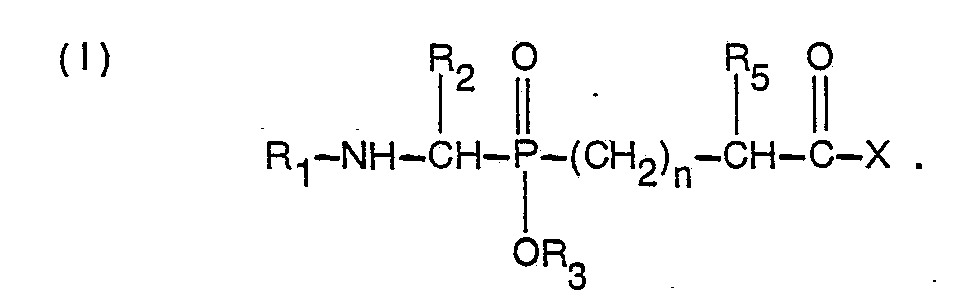


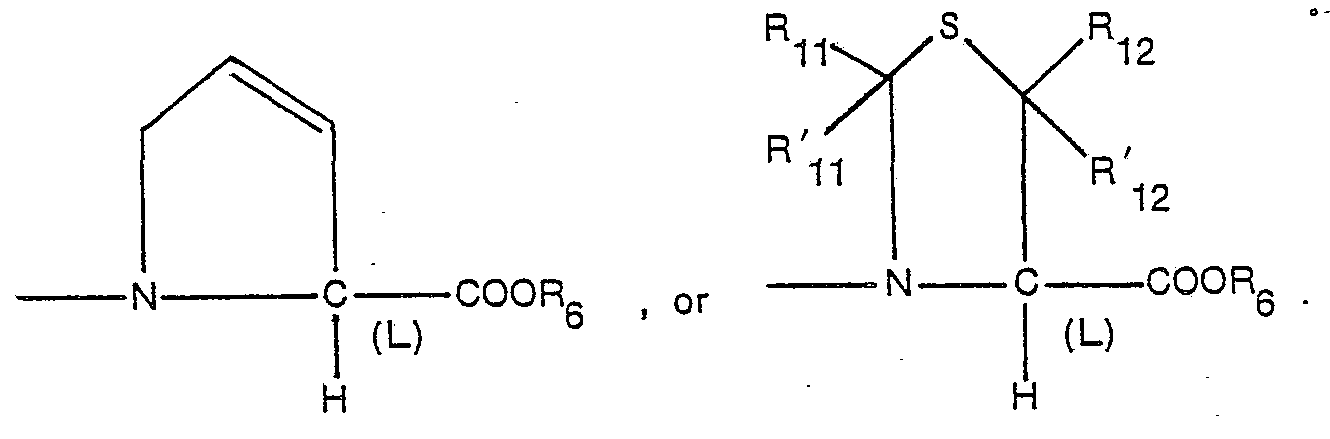


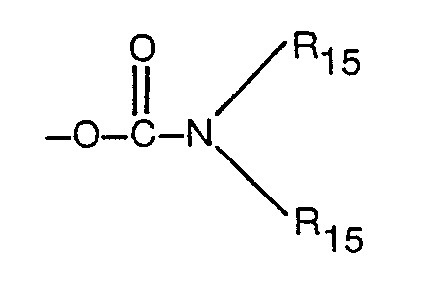


- R10 is halogen or ―Y―R16.
- R11,


- R13 is hydrogen, lower alkyl of 1 to 4 carbons, lower alkoxy or 1 to 4 carbons, lower alkylthio or 1 to 4 carbons, chloro, bromo, fluoro, trifluoromethyl, hydroxy, phenyl, phenoxy, phenylthio, or phenylmethyl.
- R14 is hydrogen, lower alkyl of 1 to 4 carbons, lower alkoxy of 1 to 4 carbons, lower alkylthio of 1 to 4 carbons, chloro, bromo, fluoro, trifluoromethyl, or hydroxy.
- m is zero, one, two or three.
- p is one, two or three provided that p is more than one only if R13 or R14 is hydrogen, methyl, methoxy, chloro, or fluoro.
- R15 is hydrogen or lower alkyl of 1 to 4 carbons.
- Y is oxygen or sulfur.
- R16 is lower alkyl of 1 to 4 carbons, --(CH2)m

- n is zero or one.
- Rs is hydrogen, lower alkyl, halo substituted lower alkyl, benzyl or phenethyl.
- R3 and R6 are independently selected from hydrogen, lower alkyl, benzyl, benzhydryl, or

- R17 is hydrogen, lower alkyl, or phenyl, and R18 is hydrogen, lower alkyl, lower alkoxy, phenyl, or R17 and R18 taken together are -(CH2)2-, -(CH2)3-, -CH=CH-, or

- R1 is hydrogen,
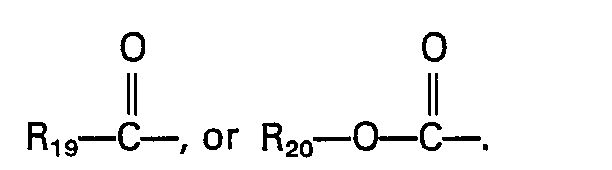
- R19 is hydrogen, lower alkyl, halo substituted lower alkyl, amino substituted lower alkyl,

- R13 and p are as defined above and q is zero or an integer from 1 to 7, cycloalkyl,


- m is as defined above.
- R20 is lower alkyl, phenyl, benzyl or phenethyl.
- R2 is hydrogen, lower alkyl, lower alkenyl, halo substituted lower alkyl,


- q, R13, p and m are as defined above,
- R21 is lower alkyl, benzyl, or phenethyl.
- R22 is hydrogen, lower alkyl, benzyl or phenethyl.
- According to U.S. Patent 4 168 267 phosphinylalkanoyl prolines which have the general formula

- R1 is lower alkyl, phenyl or phenyl-lower alkyl;
- R2 is hydrogen, phenyl-lower alkyl or a metal ion;
- R3 is hydrogen or lower alkyl;
- R4 is hydrogen, lower alkyl, phenyl-lower alkyl or a metal ion; and
- n is 0 or 1,
- Also, according to published European Patent Application 833 phosphonoacyl prolines and related compounds having the general formula

- Neither of these documents suggests the use of a compound in which an optionally acylated amino group is joined to the phosphorus atom through an optionally substituted methylene radical.
- This invention in its broadest aspects relates to the amino and substituted amino phosphinylalkanoyl compounds of formula I above, to pharmaceutical compositions containing such compounds and a carrier and to the use of such compounds as anti-hypertensive agents, and to intermediates useful in preparing such compounds, particularly intermediates of formula II below.
- The term lower alkyl used in defining various symbols refers to straight or branched chain hydrocarbon radicals having up to ten carbons, for example, methyl, ethyl, propyl, isopropyl, butyl, isobutyl, t-butyl, pentyl, isopentyl, etc. The preferred lower alkyl groups are up to four carbons with methyl and ethyl most preferred. Similarly the terms lower alkoxy and lower alkylthio refer to such lower alkyl groups attached to an oxygen or sulfur.
- The term cycloalkyl refers to saturated rings of 3 to 7 carbon atoms with cyclopentyl and cyclohexyl being most preferred.
- The term lower alkenyl.refers to straight or branched chain hydrocarbon radicals of 2 to 7 carbons, preferably 2 to 5 carbons, having at least one double bond, for example ethenyl, propenyl, 2-butenyl, etc.
- The term halogen refers to chloro, bromo and fluoro.
- The term halo substituted lower alkyl refers to such lower alkyl groups described above in which one or more hydrogens have been replaced by chloro, bromo or fluoro groups such as trifluoromethyl, which is preferred, pentafluoroethyl, 2,2,2-trichloroethyl, chloromethyl, bromomethyl, etc. Similarly, the term amino substituted lower alkyl refers to such lower alkyl groups described above in which one or more hydrogens have been replaced by an amino group such as aminomethyl, 1-aminoethyl, 2-aminoethyl, etc.
- The symbols

- The compounds of formula I are prepared according to the following procedures. An acid or its activated form of formula II wherein R1 is other than hydrogen and R3 is hydrogen, lower alkyl, benzyl, or benzhydryl


- The compounds of formula I wherein R1 is hydrogen are prepared by coupling an acid of formula II wherein R1 is

- Similarly, the products of formula I wherein either or both of R3 and R6 are lower alkyl, benzyl, or benzhydryl can be hydrogenated as described above or chemically treated such as with trifluoroacetic acid and anisole to yield the products of formula I wherein R3 and R6 are hydrogen.
- The ester products of formula I wherein R6


- The ester products of formula I wherein R6 is


- The ester products of formula I wherein R3 is


- The products of formula I wherein R1 is hydrogen can be employed as intermediates to yield the products of formula I wherein R1 is


- The products of formula I wherein R7 is amino may be obtained by reducing the corresponding products of formula I wherein R7 is azido.
- The products of formula I wherein R7 is the substituted amino group,


- The carboxylic acids of formula II wherein R1 is other than hydrogen can be prepared by various procedures. For example, the substituted amine of the formula


- The carboxylic acids of formula II wherein n is zero can also be prepared by reacting the substituted amine of formula VI and the aldehyde of formula VII with the dichlorophosphine of the formula


- The various imino acids and esters of formula III are described in the literature and in various patents.
- Various substituted prolines are disclosed by Mauger et al., Chem. Review, Vo. 66, p 47-86 (1966). When the imino acid is known it can be readily converted to the ester by conventional means. For example, the esters where R6 is t-butyl can be obtained by treating the corresponding N-carbobenzyloxyimino acid with isobutylene under acidic conditions and then removing the N-carbobenzyloxy protecting group by catalytic hydrogenation and the esters wherein R6 is benzyl can be obtained by treating the imino acid with benzyl alcohol and thionyl chloride.
- As disclosed in Belgium Patent 889,444 issued December 30,1981, the substituted prolines wherein R, is


- R7 is as defined above and halo is Br or CI to yield


- Preferred compounds of this invention with respect to the imino acid or ester part of the structure of formula I are those wherein:
- R6 is hydrogen or

- R17 is hydrogen or methyl and R18 is straight or branched chain lower alkyl of 1 to 4 carbons or phenyl.
- R7 is amino.
- R7 is hydrogen.
- R7 is hydroxy.
- R7 is chloro or fluoro.
- R7 is lower alkyl of 1 to 4 carbon atoms or cyclohexyl.
- R7 is -O-lower alkyl wherein lower alkyl is straight or branched chain of 1 to 4 carbon atoms. R7 is

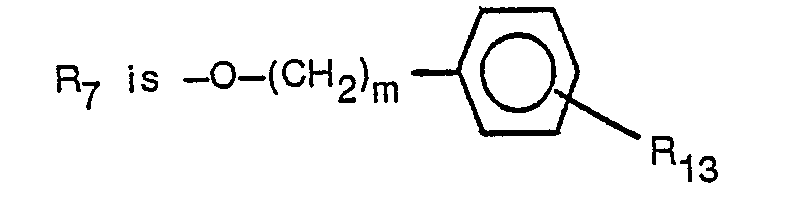
- R7 is -S- lower alkyl wherein lower alkyl is straight or branched chain of 1 to 4 carbon atoms.

- R8 is -O-lower alkyl wherein lower alkyl is straight or branched chain or 1 to 4 carbon atoms.

- R8 is -S-lower alkyl wherein lower alkyl is straight or branched chain of 1 to 4 carbon atoms.

- R9 is phenyl, 2-hydroxyphenyl, or 4-hydroxyphenyl.
- R10 are both fluoro or chloro.
- R10 ar both-Y-R16 wherein Y is 0 or S, R16 is straight or branched chain alkyl of 1 to 4 carbon atoms or the R16 groups taken together form an unsubstituted ethylene or trimethylene radical or such a radical in which one or more of the carbons has a methyl or dimethyl substituent.
- R11,


- Most preferred compounds of this invention with respect to the imino acid or ester part of the structure of formula I are those wherein:
- X is


- R6 is hydrogen or
- R7 is hydrogen.
- R7 is cyclohexyl.
- R7 is lower alkoxy of 1 to 4 carbon atoms.
- R7 is


- Y is oxygen or sulfur and r is two or three, especially wherein Y is sulfur and r is two.
- Preferred compounds of this invention with respect to the phosphinylalkanoyl sidechain of the structure of formula I are those wherein:
- R3 is hydrogen or


- R1 is hydrogen or


- R5 is hydrogen.
- n is zero.
- R2 is lower alkyl of 1 to 7 carbon atoms or


- The compounds of this invention wherein at least one of R3 or R6 is hydrogen, form basic salts with various inorganic and organic bases which are also within the scope of the invention. Such salts include ammonium salts, alkali metal salts like lithium, sodium and potassium salts (which are preferred), alkaline earth metal salts like the calcium and magnesium salts, salts with oraganic bases, e.g., dicyclohexylamine salt, benzathine, N-methyl-D-glucamine, hydrabamine salts, salts with amino acids like arginine, lysine and the like. The nontoxic, physiologically acceptable salts are preferred, although other salts are also useful, e.g., in isolating or purifying the product. The salts are formed using conventional techniques.
- As shown above, the imino acid or ester portion of the molecule of the products of formula I is in the L-configuration. Depending upon the definitions of R2 and R5 one or two asymmetric centers may be present in the phosphinylalkanoyl sidechain. Thus, some of the compounds can accordingly exist in diastereoisomeric forms or in mixtures thereof. The above described processes can utilize racemates, enantiomers or diastereomers as starting materials. When diastereomeric products are prepared, they can be separated by conventional chromatographic or fractional crystallization methods.
- The products of formula I wherein the imino acid ring is monosubstituted give rise to cis-trans isomerism. The configuration of the final product will depend upon the configuration of the R7, R3 and R9 substituent in the starting material of formula III.
- The compounds of formula I, and the physiologically acceptable salts thereof, are hypotensive agents. They inhibit the conversion of the decapeptide angiotensin I to antiotensin II and, therefore, are useful in reducing or relieving angiotensin related hypertension. The action of the enzyme renin on antiotensinogen, a pseudoglobulin in blood pressure, produces angiotensin I. Angiotensin I is converted by angiotensin converting enzyme (ACE) to antiotensin II. The latter is an active pressor substance which has been implicated as the causative agent in several forms of hypertension in various mammalian species, e.g., humans. The compounds of this invention intervene in the angiotensinogen - (renin) → angiotensin l angiotensin II sequence by inhibiting angiotensin converting enzyme and reducing or eliminating the formation of the pressor substance angiotensin II. Thus by the administration of a composition contining one (or a combination) of the compounds of this invention, angiotensin dependent hypertension in a species of mammal (e.g., humans) suffering therefrom is alleviated. A single dose, or preferably two to four divided daily doses, provided on a basis of about 0.1 to 100 mg. per kilogram of body weight per day, preferably about 1 to 15 mg. per kilogram of body weight per day is appropriate to reduce blood pressure. The substance is preferably administered orally, but parenteral routes such as subcutaneous, intramuscular, intravenous or intraperitoneal routes can also be employed.
- The compounds of this invention can also be formulated in combination with a diuretic for the treatment of hypertension. A combination product comprising a compound of this invention and a diuretic can be administered in an effective amount which comprises a total daily dosage of about 30 to 600 mg., preferably about 30 to 330 mg. of a compound of this invention, and about 15 to 300 mg., preferably about 15 to 200 mg. of the diuretic, to a mammalian species in need thereof. Exemplary of the diuretics contemplated for use in combination with a compound of this invention are the thiazide diuretics, e.g., chlorothiazide, hydrochlorothiazide, flumethiazide, hydroflumethiazide, bendroflumethiazide, methyclo- thiazide, trichlormethiazide, polythiazide or benzthiazide as well as ethacrynic acid, ticrynafen, chlor- thalidone, furosimide, musolimine, bumetanide, triamterene, amiloride and spironolactone and salts of such compounds.
- The compounds of formula I can be formulated for use in the reduction of blood pressure in compositions such as tablets, capsules or elixers for oral administration, or in sterile solutions or suspensions for parenteral administration. About 10 to 500 mg. of a compound of formula I is compounded with physiologically acceptable vehicle, carrier, excipient, binder, preservative, stabilizer, falvor, etc., in a unit dosage form as called for by accepted pharmaceutical practice. The amount of active substance in these compositions or preparations is such that a suitable dosage in the range indicated is obtained.
- The following examples are illustrative of the invention. Temperatures are given in degrees centrigrade.
- Pivalic acid (4.08 g., 0.04 mole) and benzyl carbamate (3.02 g., 0.02 mole) are dissolved in 30 ml. of toluene. A portion of the toluene (5 ml.) is distilled at atomospheric pressure to remove traces of water. The solution is cooled to room temperature under argon, and methyldichlorophosphine (1.8 ml., 0.02 mole) and powdered 4A molecular sieves (2 g.) are added. 3-Phenylpropionaldehyde (3.3 ml., 0.025 mole) are then added dropwise over ten minutes. A slight exotherm (to approximately 35°) is observed. After stirring for one hour, the reaction mixture is poured into saturated sodium bicarbonate and extracted with dichloromethane. The aqueous solution is acidified to pH 3.5 with concentrated HCI and extracted with ether. The aqueous solution is then acidified to pH 1 and extracted with dichloromethane. The pH 1 extracts are dried (MgS04) and evaporated to 2.1 g. of white solid product. The pH 3.5 extracts are dried (MgS04) and evaporated (finally at 70°C/1.33 mbar (1 mm.). to remove pivalic acid) to yield an additional 3.2 g. of white solid product. Crystallization from ethyl acetate gives an analytical sample of methyl[3-phenyl-1-[[(phenylmethoxy)carbonyl]amino]propyl]phosphinic acid; m.p., 126-129°.

- The product from part (a) (5.1 g., 0.0147 mole) id dissolverd in dichloromethane and cooled to 0°. 1-Benzyl-3-p-tolyltriazine (3.4 g., 0.015 mole) in 75 ml. of dichloromethane is added dropwise. When gas evolution ceases, two additional portions (3.4 g. each) of the 1-benzyl-3-p-tolyltriazine are added and the mixture is stirred overnight. The solution is then washed with 5% potassium bisulfate, saturated sodium bicarbonate, and brine, dried (MgS04), and evaporated to 11 g. of dark orange semi-solid. Chromatography on silica gel using dichloromethane ethyl acetate mixtures yields 4.0 g. of methyl[3-phenyl-1-[[(phenylmethoxy)carbonyl]amino]propyl]phosphinic acid, phenylmethyl ester as a pale yellow semi-solid. Tlc (ethyl acetate) Rf = 0.35, 0.4.
- A solution of 0.04 moles of lithium diisopropylamine in tetrahydrofuran is prepared by the dropwise addition of N-butyllithium (16 ml. of 2.6 N solution, 0.04 mole) to a cooled (0°) solution of diisopropylamine (5 g., 0.05 mole) in pentane (75 ml.). The solvent is removed in vacuo and replaced by tetrahydrofuran (50 ml.). The solution is cooled to -76° and a solution of the phenylmethyl ester product from part (b) (3.8 g., 0.0084 mole) in tetrahydrofuran (50 ml.) is added over a period of thirty minutes. After stirring for fifteen minutes, carbon dioxide, dried over molecular sieves, is bubbled into the mixture for ten minutes. After stirring for ten minutes, and warming to room temperature, the solvent is removed in vacuo. The residue is acidified to pH of 1 with 10% hydrochloric acid and extracted with dichloromethane, washed with brine, and dried (MgS04). The solvent is removed in vacuo. The oil residue is extracted into 10 mi. of 1 N sodium hydroxide plus 90 ml. of water and washed with dichloromethane/ethyl ether (1:1, 2 x 25 ml.). The alkaline phase is acidified to a pH of 1 with 10% hydrochloric acid. The oil separating from solution is extracted into dichloromethane, washed with brine, and dried (MgS04). The solvent is removed in vacuo to give 3.3 g. of [(phenylmethoxy)[3-phenyl-1-[[(phenylmethoxy)carbonyl]amino]propyl]phosphinyl]acetic acid. Tlc, silica gel, benzene/acetic acid (7:1) shows two spots, Rf = 0.17; 0.15.
- 1,1-Carbonyldiimidazole (0.92 g., 0.0057 mole) is added to a chilled (0°) solution of the product from part (c) (2.75 g., 0.0057 mole) in acetonitrile (25 ml.). The mixture is stirred at 0° for one hour. A solution of L-proline, benzyl ester (1.2 g., 0.0057 mole) in acetonitrile (20 ml.) is added. After stirring at ambient temperature for 16 hours, the solvent is removed in vacuo. The residue is dissolved in dichloromethane (100 ml.), washed with 5% potassium bisulfate, saturated sodium bicarbonate, brine, and dried (MgS04). The solvent is removed in vacuo. The residue (3.8 g.) is chromatographed on silica gel eluting with dichloromethane/ethyl acetate (1:1), followed by ethyl acetate, to give 2.2 g. of (±)-1-[[(phenylmethoxy)[3-phenyl-1-[[(phenylmethoxy)carbonyl]amino]propyl]phosphinyl]acetyl]-L-proline, phenylmethyl ester as a viscous oil.
- A mixture of the L-proline, phenylmethyl ester product from part (d) (2.1 g., 0.0031 mole) and 5% palladium on carbon catalyst (100 mg.) in acetic acid/methanol (1:9, 50 ml.) is stirred vigorously under one atmosphere of hydrogen until the hydrogen is no longer consumed (216 ml.). The mixture is filtred through celite, and concentrated in vacuo. The residue is triturated with acetonitrile. The resulting solid in suspension is collected by filtration with a recovery of 1.1 g., m.p. 160-190° (dec.). A portion (0.6 g.) is dissolved in double distilled water, millipore filtered, and lyophilized to yield 0.5 g. of (±)-1-[[(1-amino-3-phenylpropyl)-hydroxyphosphinyl]acetyl]-L-proline, m.p. 160-190° (dec.); [a]D -43°. Tlc, silica gel, butanol/acetic acid/ water (3:1:1) shows a single spot, Rf 0.44.

- Pivalic acid (4.08 g., 0.04 mole) is dissolved in 30 ml. of toluene. A portion (5 mi.) of toluene is distilled to remove traces of moisture, and the mixture is cooled to room temperature under argon. Benzyl carbamate (3.02 g., 0.02 mole), powdered 4A molecular sieves (2 g.) and methyldichlorophosphine (1.8 ml. 0.02 mole) are added. Valeraldehyde (2.7 ml., 0.025 mole) is added dropwise over 20 minutes, causing an exothermic reaction which raises the reaction temperature to 55°. After stirred one hour, the mixture solidifies. It is diluted with ether and filtered. The solid is crystallized from ethyl acetate to yield 3.4 g. of white solid product; m.p. 134-135. An additional 0.6 g. is obtained by concentrating the filtrate. Crystallization from ethyl acetate yields an analytical sample of methyl[1-[[(phenylmethoxy)carbonyl]amino]pentyl]-phosphinic acid, m.p. 138-150°.

- The product from part (a) (4.0 g., 0.0134 mole) is dissolve in 300 ml. of dichloromethane and cooled in an ice bath. 1-Benzyl-3-p-tolyltriazene (8.4 g., 0.0373 mole) is added portionwise. After stirring overnight at room temperature, the solution is washed with 5% potassium bisulfate, saturated sodium bicarbonate, and brine, dried (MgS04) and evaporated to yield 11 g. of red oil. This material is chromatographed on silica gel using ethyl acetate to yield 5.1 g. of methyl[1-[[(phenylmethoxy)carbonyl]amino]pentyl]phosphinic acid, phenylmethyl ester as a white semi-solid.
- A solution of 0.04 mole of lithium diisopropylyamide in tetrahydrofuran is prepared by the dropwise addition of N-butyllithium (16 ml. of 2.6 N solution, 0.04 mole) to a cooled (0°) solution of diisopropylamine (5 g., 0.05 mole) in pentane (75 ml.). The solvent is removed in vacuo and replaced by tetrahydrofuran (50 ml.). The solution is cooled to -76° and a solution of the phenylmethyl ester product from part (b) (4.2 g., 0.0108 mole) in tetrahydrofuran (50 ml.) is added over a period of 30 minutes. After stirring for 15 minutes, carbon dioxide, dried over molecular sieves, is bubbled into the reaction mixture for 10 minutes. After stirring for 10 minutes, and warming to room temperature, the solvent is removed in vacuo. The residue is acidified to a pH of 1 with 10% hydrochloric acid and extracted with dichloromethane, washed with brine, and dried (MgS04). The solvent is removed in vacuo. The residue is dissolved in saturated sodium bicarbonate solution (75 ml.) and washed with dichloromethane. The alkaline phase is acidified to a pH of 1 with concentrated hydrochloric acid, extracted with dichloromethane, washed with brine, and dried (MgS04). The solvent is removed in vacuo to give 3.7 g. of [(phenylmethoxy)[1-[[(phenylmethoxy)-carbonyl]amino]pentyl]phosphinyl]acetic acid as an oil. Tlc, silica gel, benzene/acetic acid (7:1): 2 spots, Rf 0.17; 0.15.
- 1,1-Carbonyldiimidazole (1.2 g., 0.0074 mole) is added to a chiled (0°) solution of the product from part (c) 3.2 g., 0.0074 mole) in acetonitrile (40 ml.). A solution of L-proline, benzyl ester (1.5 g., 0.0074 mole) in acetonitrile (20 ml.) is added. The mixture is stirred at ambient temperature for 16 hours. The solvent is removed in vacuo. The residue is dissolved in dichloromethane (100 ml.), washed with 5% potassium bisulfate, saturated sodium bicarbonate solution, brine, and dried (MgS04). The solution is concentrated in vacuo to give an oil residue of 4.8 g. Tic, silica gel, ethyl acetate: major spot at Rf 0.28, visualized with phosphomolybdic acid (PMA) and heat. It was chromatographed on silica gel, eluting with ethyl acetate/dichloromethane (1:1), and with ethyl acetate to give 3.2 g. of (±)-1-[[(phenylmethoxy)[1-[((phenylmethoxy)carbonyl]amino]pentyl]phosphinyl]acetyl]-L-proline, phenylmethyl ester.
- A mixture of the phenylmethyl ester product from part (d) (3.1 g., 0.005 mole) and 5% palladium on carbon (150 mg.) in acetic acid/methanol [(1:9), 60 ml.] is stirred vigorously under one atmosphere of hydrogen until hydrogen is no longer consumed (about 350 ml.). The residue is triturated with acetonitrile to give a solid (1.5 g.) with an indefinite melting point (170-190° dec.). Tlc, silica gel, butanol/acetic acid/water (3:1:1); single spot, Rf 0.10, visualized with ninhydrin indicator. The solid is dissolved in water (120 ml.), washed with ethyl acetate, filtered, and lyophilized to give 1.4 g. of (±)-1-[[(1-aminopentyl)-hydroxyphosphinyl]acetyl]-L-proline; m.p. 140-190° (dec.); a]o -65°.

- Pivalic acid (10.2 g., 0.1 mole) is added to 100 ml. toluene. A portion of the toluene (10 ml.) is distilled to remove traces of moisture. Benzyl carbamate (7.5 g., 0.05 mole), powdered 4Å molecular sieves (5.0 g.) and methyl dichlorophosphine (5.8 g., 0.05 mole) are added with stirring at room temperature. Acetaldehyde (3.3 g., 0.075 mole) is then added dropwise with vigorous stirring at ambient temperature over a period of 10 minutes. During the addition the temperature of the reaction mixture increases to 55°. After stirring for one hour, 100 ml. of dichloromethane is added and the mixture is filtered. The filtrate is concentrated in vacuo. The residue is dissolved in saturated sodium bicarbonate solution (125 ml.), washed with dichloromethane (3 x 40 ml.), and the combined dichloromethane wash is reextracted with saturated sodium bicarbonate solution (2 x 15 ml.). THe combined aqueous alkaline phase is adjusted to a pH 3.2 with concentrated hydrochloric acid and extracted with ether (3 x 20 ml.). It is then acidified to a pH of 1 with concentrated hydrochloric acid and extracted with ethyl acetate (3 x 50 ml.), dried (MgS04) and the solvent removed in vacuo. The residue (10.9 g.) solidifies at room temperature. Tlc, silica gel, dichloromethane/methanol/acetic acid (8:1:1) shows a major spot at Rf 0.30. It is recrystallized from acetonitrile (110 ml.) to yield 8.7 g. of product. A second recrystallization from acetonitrile gives an analytically pure sample of methyl[1-[[(phenylmethoxy)carbonyl]amino]phosphinic acid; m.p. 118-119°. Anal. calc'd. for C11H16N04P:

- A solution of the product from part (a) (9.2 g., 0.036 mole) in 150 ml. of dichloromethane is prepared by warming to reflux and then cooling to room temperature. Three equivalents of 3-benzyl-1-p-tolyltriazine is added portionwise with stirring. The mixture is stirred at ambient temperature overnight, washed with water, 5% potassium bisulfate, satured sodium bicarbonate, dried (MgS04) and evaporated in vacuo to give an oil residue. The residue is dissolved in ether (500 ml.). After refrigeration, a solid crystallizes from solution (7.6 g.); m.p. 108-110°, partial melt, complete melt at 128-130°. It is crystallized from ethyl acetate (80 ml.) to yield 6.2 g. of product; m.p. 138-140°, sintering 98-108°. Recrystallization from ethyl acetate a second time gives an analytical sample of methyl[1-[[(phenylmethoxy)carbonyl]amino]ethyl]-phosphinic acid, phenylmethyl ester; m.p. 138-1400. Tlc, silica gel, benzene/acetic acid (7:1) shows a major spot at R, 0.21, visualized with PMA plus heat.

- A solution of 0.04 moles of lithium diisopropylamide in 50 ml. of tetrahydrofuran is prepared as in Example 1 (c). The solution is cooled to -76° and the solution of the phenyl-methyl ester product from part (b) (3.5 g., 0.01 mole) in tetrahydrofuran (100 ml.) is added over a period of 30 minutes. After stirring for 15 minutes, carbon dioxide, dried over molecular sieves, is bubbled into the reaction mixture for 10 minutes. After stirring for 10 minutes, and warming to room temperature, the solvent is removed in vacuo. The residue is acidified to a pH of 1 with 10% hydrochloric acid, extracted with dichloromethane (2 x 75 ml.) and dried (MgS04). The solvent is removed in vacuo. The residue is dissolved in 75 mi. of saturated sodium bicarbonate solution and washed with dichloromethane. The aqueous alkaline solution is acidified to a pH of 1 with concentrated hydrochloric acid, extracted with dichloromethane, washed with brine, and dried (MgS04). The solvent is removed in vacuo to give 3.1 g of [(phenylmethoxy)[1-[[(phenylmethoxy)carbonyl]-amino]ethyl]phosphinyl] acetic acid as an oil. Tlc, silica gel, benzene/acetic acid (7: 1) shows a major spot at R, 0.17.
- 1,1-Carbonyldiimidazole (1 g. 0.066 mole) is added to a chilled (0°) solution of the product from part (c). (2.5 g., 0.063 mole) in 40 ml. of acetonitrile. The mixture is stirred for one hour at 0°. A solution of L-proline, benzyl ester (1.3 g., 0.066 mole) in 20 ml. of acetonitrile is added. The mixture is stirred at ambient temperature for 16 hours. The solvent is removed in vacuo. The residue is dissolved in dichloromethane (125 ml.), washed with 5% potassium bisulfate, saturated sodium bicarbonate solution, brine, and dried (MgS04). The solution is concentrated in vacuo to give an oil residue of 3.3 g. Tic, silica gel, ethyl acetate shows a major spot at Rf 0.10. A portion (2.2 g.) is chromatographed on silica gel, eluting with ethyl acetate to give 1.7 g. of (±)-1-[(phenylmethoxy)[1-[[(phenylmethoxy)carbonyl]amino]ethyl]phosphinyl]acetyl]-L-proline, phenylmethyl ester.
- A mixture of the product from part (d) (1.5 g., 0.0026 mole) and 5% palladium on carbon (100 mg.) in acetic acid/methanol [(1:9), 50 ml.] is stirred vigorously under one atmosphere of hydrogen until hydrogen absorption ceases (about 165 ml.). The mixture is filtered and concentrated in vacuo. The residue is dissolved in distilled water, millipore filtered, and lyophilized to give 0.65 g. of solid with an indefinite melting point, decomposing at 175―200°. Tlc, silica gel, butanol/acetic acid/water (3:1:1) shows a single spot at Rf 0.10, visualized with ninhydrin indicator. A solution of the combined product of two preparations (0.8 g.) in water (2 ml.) is placed on an AG-50 W column (1", 75 ml.) and eluted with water. The aqueous solution is lyophilized to give 0.7 g. of (±)-1-[[(aminoethyl)hydroxyphosphinyl]acetyl]-L-proline; m.p. 175°-200° (dec.). Tlc, silica gel, butanol/acetic acid/water (3:1:1) shows a single spot at Rf 0.13, visualized with ninhvdrin.

- Following the procedure of Examples 1 to 3 but coupling the phosphinylalkanoyl compound of formula I with L-proline, benzyl ester yields the intermediate of formula II. Removal of the protecting groups yields the product of formula III.
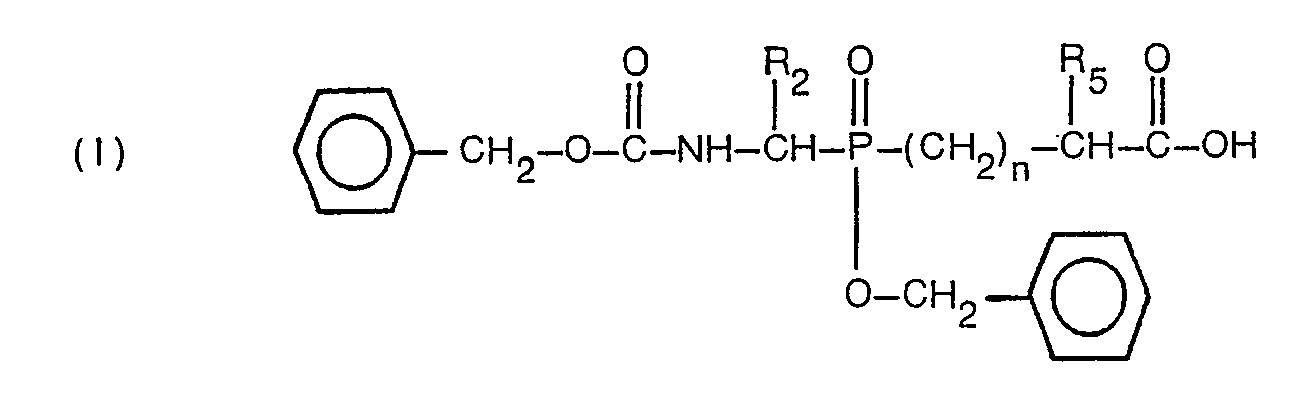


- Pivalic acid (10.2 g., 1 mole) and urethan (4,5 g., 0.05 mole) are dissolved in 160 ml. of toluene. A portion of the toluene (10 ml.) is distilled at atmospheric pressure to remove traces of water. The solution is cooled to room temperature under argon and methyldichlorophosphine (5.6 g., 0.05 mole) and powdered 4A molecular sieves (5 g.) are added, followed by hydrocinnamaldehyde (8 g., 0.06 mole) via syringe. A slight exotherm (to approximately 43°) is observed. After stirring one hour the solids in suspension are removed by filtration. The filtrate is concentrated in vacuo. The residue is triturated with diisopropylether (50 ml.) to give 12.1 g. of solid product; m.p. 119-125°. Tlc, silica gel, butanol/acetic acid/water (3:1:1) shows a major spot at R, 0.50, plus a minor spot at Rf 0.55 visualized with PMA plus heat. A sample is recrystallized from ethyl acetate (10 ml.) to yield 0.3 g. of methyl [1-[(ethoxycarbonyl)amino]-3-phenylpropyl]phosphinic acid; m.p. 127-129°.

- Bis (trimethylsilyl)acetamide (11 ml., 0.045 mole) is added via syringe to a solution of the product from part (a) (10 g., 0.035 mole) in dichloromethane (50 ml.) in an atmosphere of argon. The mixture is stirred at ambient temperature for one hour. The solvent and excess bis(trimethylsilyl)acetamide are removed in vacuo at room temperature. After the addition of dichloromethane (50 ml.) to the residue, phosphorous pentachloride (8.5 g. 0.04 mole) is added and the resulting solution is stirred for one hour. After removal of the solvent in vacuo at room temperature, dichloromethane (50 ml.) is added to the residue. The resulting solution is stirred at ambient temperature during the drop-wise addition of a solution of benzyl alcohol (4.2 g., 0.039 mole) and triethylamine (5 g., 0.05 mole) in dichloromethane (20 ml.). After stirring 16 hours at room temperature, the reaction mixture is diluted to twice its volume with dichloromethane. After washing with brine, followed by saturated sodium bicarbonate, followed by brine, and drying (MgS04), the solvent is removed in vacuo. The residue is dissolved in ether and washed with water to a negative CI- test. The solvent is removed in vacuo to give recovery of the product (11 g.) as an oil. Tlc, silica gel, ethyl acetate, shows a major spot at Rf 0.40, plus a minor spot at origin (PMA visualization). Trituration of the oil with diisopropyl ether results in the separation of a solid (2.3 g., m.p. 124―127°). Tlc, silica gel, ethyl acetate, shows one spot, Rf 0.40. The filtrate is concentrated in vacuo to give recovery of an oil (8.1 g.). A portion of the solid (400 mg.) is recrystallized from benzene to yield 150 mg. of methyl [1-[(ethoxycarbonyl)-amino]-3-phenylpropyl]phosphinic acid, phenylmethyl ester; m.p. 128-130°.

- A solution of 0.09 mole of lithium diisopropylamide in 150 ml. of tetrahydrofuran, prepared according to the procedure of Example 1 (c), is cooled to -76° and a solution of the phenylmethyl ester product from part (b) (10 g., 0.026 mole) in 40 ml. of tetrahydrofuran is added over a period of one hour. After stirring for 15 minutes, carbon dioxide, dried over molecular sieves, is bubbled into the reaction mixture for 10 minutes. After stirring for 10 minutes, and warming to room temperature, the solvent is removed in vacuo. After the addition of water (50 ml.), the residue is acidified to a pH of 1 with concentrated hydrochloric acid. The oil that separates from solution is extracted into dichloromethane (200 ml.), washed with brine, and dried (MgS04). The solvent is removed in vacuo. The residue is dissolved in 5% sodium bicarbonate solution (100 ml.) and washed with ether (2 x 75 ml.). The alkaline aqueous solution is acidified to a pH of 1 with concentrated hydrochloric acid, extracted with dichloromethane, washed with brine, and dried (MgS04). The solvent is removed in vacuo. The semi-solid residue (8.6 g.) is recrystallized from ethyl acetate (100 ml.) to yield 4.8 g. of [(phenylmethoxy)[1-[(ethoxycarbonyl)amino]-3-phenylpropyl]phosphinyl]acetic acid; m.p. 151-153°. Tlc, butanol/acetic acid/water (3:1:1) shows a single spot, Rf 0.70 visualized with PMA plus heat.

- 1,1-Carbonyldiimidazole (1.8 g., 0.011 mole) is added to a chilled (0°) solution of the product from part (c) (4.6 g., 0.011 mole) in 50 ml. of acetonitrile. The mixture is stirred for one hour at 0° and a solution of L-proline, benzyl ester (2.3 g., 0.011 mole) in 25 ml. of acetonitrile is added. The mixture is stirred at ambient temperature for 16 hours. The solvent is removed in vacuo. The residue is dissolved in 200 ml. of dichloromethane, washed with 5% potassium bisulfate, saturated sodium bicarbonate solution, brine, and dried (MgS04). The solvent is removed in vacuo to give an oil residue of 6.5 g. Tlc, silica gel, ethyl acetate, shows a major spot at Rf 0.50 visualized with PMA. The residue is chromatographed on silica gel, eluted with dichloromethane/ethyl acetate (9:1) and (4:1) to give 5.4 g. of (±) -1 - [(phenylmethoxy)[1 - [(ethoxycarbonyl)amino] - 3 - phenylpropyl] phosphinyl]acetyl] - L - proline, phenylmethyl ester. Tlc shows a single spot at Rf 0.50.
- A mixture of the product from part (d) (5.2 g., 0.088 mole) and 5% palladium on carbon (200 mg.) in methanol (65 mi.) plus 1 ml. of glacial acetic acid is stirred vigorously under one atmosphere of hydrogen until hydrogen absorption ceases (about 400 ml.). The mixture is filtered and concentrated in vacuo. Tlc, silica gel, butanol/acetic acid/water (3:1:1 ) of the residue (3.4 g.) shows a major spot at Rf 0.46 and a minor spot at 0.50 (visualized with PMA). A portion of the residue (0.3 g., 0.0007 mole) is chromatographed on a column of DEAE Sephadex (Trade Mark) (NH-4 form) (100 ml.-15 mm diameter column) and eluted with a gradient of 0.005 m to 0.5 m ammonium bicarbonate solution. The UV positive fractions are collected, millipore filtered, and lyophilized to give a residue of 0.3 g. Tlc shows a major spot at Rf 0.46 and a shadow at Rf 0.50. The residue is dissolved in 3―4 ml. of double distilled water-and placed on a column of AG 50-W resin (H+ form) (30 ml.) and eluted with water. The acidic fractions are collected, millipore filtered, and lyophilized to give 168 mg. of (±) - 1 - [[[1 - [(ethoxycarbonyl)amino] - 3 - phenylpropyl]hydroxy- phosphinyl]acetyl] - L - proline.

- A suspension of methyl [1-[(ethoxycarbonyl)amino]-3-phenylpropyl]phosphinic acid from Example 18(a) (9.8 g., 0.034 mole) in 22.2% hydrochloric acid (200 ml.) is heated at reflux for 24 hours. Afterfiltration, the resulting solution is concentrated in vacuo. Water (100 ml.) is added to the residue and the solution is again concentrated in vacuo. Trituration of the residue with refluxing acetonitrile (125 ml.) results in the separation of solid product (7.5 g.); m.p. 196-200° (dec.). A portion (0.4 g.) is recrystallized from absolute ethanol (10 ml.) to yield 0.27 g. of an analytical sample of methyl(1-amino-3-phenylpropyl)phosphinic acid, hydrochloride; m.p. 198-200° (dec.).

- A mixture of the product from part (a) (7.5 g., 0.026 mole) and 25 ml. of trifluoroacetic anhydride is stirred at ambient temperature for two hours. The excess anhydride is removed in vacuo. The residue is triturated with refluxing diisopropyl ether (500 ml.) to give 7.5 g. of solid product; m.p. 138-145°. Tlc, silica gel, butanol/acetic acid/water (3:1:1) shows one spot, Rf 0.70. A portion (0.5 g.) is recrystallized from diisopropyl ether (800 ml.) to yield 0.4 g. of an analytical sample of methyl [3-phenyl-1-[(trifluoroacetyl)-amino]propyl]phosphinic acid, m.p. 145-146°.

- Bis(trimethylsilyl)acetamide (8 ml., 0.033 mole) is added to a suspension of the product from part (b) (7 g., 0.023 mole) in 50 ml. of dichloromethane, in an atmosphere of argon. A solution of the solid occurs rapidly and the mixture is stirred at ambient temperature for one hour. The solvent and excess bis(trimethylsilyl)acetamide are removed in vacuo at room temperature. The residue is dissolved in 50 ml. of dichloromethane and phosphorous pentachloride (5.7 g., 0.027 mole) is added. After stirring for one hour, the solvent and excess pentachloride are removed in vacuo. The residue is dissolved in 50 ml. of dichloromethane and a solution of benzyl alcohol (2.8 g., 0.026 mole) and triethylamine (3.5 g., 0.034 mole) in 20 ml. of dichloromethane is added dropwise with stirring. After stirring at ambient temperature for 16 hours, the mixture is diluted to twice its volume with dichloromethane. The solution is washed with 5% potassium bisulfate, water, brine, and dried (MgS04). After concentrating in vacuo, the semi-solid residue (8.7 g.) is triturated with 200 ml. of diisopropyl ether. A solid (2.4 g., m.p. 145-155°) is collected by filtration (Tlc shows a single spot at Rf 0.60). A portion of the solid product (0.3 g.) is recrystallized from 75 ml. of diisopropyl ether to yield 0.18 g. of an analytical sample of methyl[3-phenyl-1-[(trifluoroacetyl)amino]propyl]phosphinic acid, phenylmethyl ester; m.p. 165-166°.

- A solution of 0.075 mole of lithium diisopropylamide in 150 ml. of tetrahydrofuran is prepared according to the procedure of Example 1 (c) and cooled to -76°. A solution of the product from part (c) (8.4 g., 0.021 mole) in 40 ml. of tetrahydrofuran is added over a period of 50 minutes. After stirring for 15 minutes, carbon dioxide, dried over molecular sieves, is bubbled into the reaction mixture for 10 minutes. After stirring for 10 minutes, and warming to room temperature, the solvent is removed in vacuo. After the addition of 10% hydrochloric acid (50 ml.) to the residue, with cooling, concentrated hydrochloric acid is added to a pH of 1. The mixture is extracted with 300 ml. of dichloromethane, washed with brine, and dried (MgS04). The solvent is removed in vacuo. Tlc, silica gel, butanol/acetic acid/water (3:1:1) of the residual oil (8.5 g.) shows a major spot at Rf 0.70. The material is chromatographed on silica gel, eluting with toluene/ acetic acid (9:1) to give 6.1 g. of [(phenylmethoxy)[3 - phenyl - 1 - [(trifluoroacetyl)amino]propyl]-phosphinyl]acetic acid. Tlc shows a single spot at Rf 0.70.
- 1,1-Carbonyldiimidazole (2.2 g., 0.0133 mole) is added to a chilled (0°) solution of the product from part (d) (5.9 g., 0.0133 mole) in 50 ml. of acetonitrile. The mixture is stirred for one hour at 0° and a solution of L-proline, benzyl ester (2.7 g., 0.0133 mole) in 20 ml. of acetonitrile is added. The mixture is stirred at ambient temperature for 16 hours. The solvent is removed in vacuo. The residue is dissolved in 200 ml. of dichloromethane, washed with 5% potassium bisulfate solution, brine, and dried (MgS04). The solution is concentrated in vacuo to give a syrupy residue of 8.2 g. Tlc, silica gel, ethyl acetate/dichloromethane (1:4) shows a major spot at Rf 0.40 with 3 minor additional spots, including one at origin (visualized with PMA plus heat). The residue is chromatographed on silica gel, eluting with ethyl acetate/dichloromethane (1:9) to give two fractions, Tlc of one fraction (1.9 g.) shows a single spot at Rf 0.40; the other fraction (4.5 g.) shows two spots, a major one at Rf 0.40 plus a minor at Rf 0.35. The chromatographically pure (±) - 1 - [[(phenylmethoxy)[3 - phenyl - 1 - [(trifluoroacetyl)amino]propyl]phosphinyl]acetyl] - L - proline, phenylmethyl ester is employed in the following steps.
- A mixture of the product from part (e) (1.6 g., 0.0025 mole) and 10% palladium on carbon (0.1 g.) in 50 ml. of ethyl acetate is stirred vigorously in an atmosphere of hydrogen until absorption of hydrogen ceases (about 113 ml. of hydrogen). The mixture is filtered and concentrated in vacuo to give 1.1 g. Tlc, silica gel, dichloromethane/methanol/acetic acid (8:1:1) shows a major spot at Rf 0.22 and a minor spot at Rf 0.04 (l2 visualization). A solution of water insoluble residue (a glassy solid) is effected in methanol (1.0 g., 0.0022 mole to 4 ml.) plus water (2 ml.) and placed on a column of DEAE Sephadex (NH4 HC03, 200 ml.) and eluted with a gradient of 0.005 mole to 0.5 mole ammonium bicarbonate solution. The UV positive fractions are collected, millipore filtered, and lyophilized to give 1.1 g. The solid is dissolved in 5 ml. of water, placed on a column of AG-50 W (H+) (75 ml.), and eluted with water. The acidic fractions are collected, millipore filtered, and lyophilized to give 0.9 g. of (±) - 1 - [[hydroxy[3 - phenyl - 1 - [(trifluoroacetyl)amino]propyl]-phosphinyl]acetyl] - L - proline as a glass-like solid. Tlc, silica gel, butanol/acetic acid/water (3:1:1) shows a single spot at Rf 0.50 (visualized with PMA plus heat).
- A solution of the product from part (f) (0.9 g., 0.002 mole) in water is effected by the addition of one equivalent (2 ml.) of 1N lithium hydroxide plus 2 ml. of water. The solution is placed on a column of AG-50W (Li+) (75 ml.) and eluted with water. The acidic fractions (pH 4-5.5) are collected, millipore filtered, and lyophilized to give 0.9 g. of (±) - 1 - [[hydroxy[3 - phenyl - 1 - [(trifluoroacetyl)amino]propyl]-phosphinyl]acetyl] - L - proline, dilithium salt. Tlc, silica gel, ethyl acetate, butanol/-acetic acid/water (3:1:1) shows a single spot at Rf 0.50.

- Ketene is passed through a solution oftributyltin methoxide (64 g., 0.199 mole) in 200 ml. of anhydrous ether at 0° until Tlc (silica gel, methanol:dichloromethane; 1:9) indicates complete consumption of starting material (Rf equals 0.14). The ether is removed in vacuo and the residue distilled to give 62.75 g. of carbomethoxymethyl tributyltin as a pale yellow liquid; b.p. 117-120° (1.07 mbar) (0.8 mm Hg).
- A mixture of carbomethoxymethyl tributyltin (80 g., 0.22 mole) and phosphorus trichloride (80 ml., 0.92 mole) is treated with 2,2'-azobisisobutyronitrile (230 mg., 1.4 mmole) and slowly heated to reflux under argon. After refluxing for 30 minutes, the excess phosphorus trichloride is distilled off under reduced pressure. Distillation of the residue gives carbomethoxymethyldichlorophosphine as a colorless liquid; b.p. 52° (2.67 mbar) (2 mm of Hg).
- A mixture of pivalic acid (5.5 g., 0.054 mole) and benzyl carbamate (4.1 g., 0.027 mole) in 100 ml. of toluene is heated to reflux and a portion of the toluene (10 ml.) is removed by distillation at atmospheric pressure to remove traces of water. The solution is cooled to room temperature, under argon, and powdered 4Å molecular sieves (5 g.) are added, followed by the addition of carbomethoxymethyldichlorophosphine (4.7 g., 0.027 mole) from part (a). 4-Phenylbutyraldehyde (4.4 g., 0.03 mole), prepared according to the procedure in Tetrahedron, Vol. 34, p. 1651 (1978), is added dropwise over five minutes via syringe. A slight exotherm (approximately 38°) is observed. The mixture is stirred at ambient temperature for 16 hours. After filtration and concentration in vacuo, 200 ml. of water is added to the residue followed by the addition of saturated sodium bicarbonate solution to a pH of 8-9. The alkaline aqueous phase is washed with ether and acidified to a pH of 1-2 with concentrated hydrochloric acid. The oil that separated from solution is extracted into ethyl acetate, washed with brine, and dried (MgS04). After concentrating in vacuo, the residue is triturated with diisopropyl ether to yield 5 g. of product. Tic, silica gel, dichloromethane/ methanol/acetic acid (8:1:1) shows a major spot at Rf 0.56 plus a minor spot at Rf 0.10, and a shadow at Rf 0.70. The material is recrystallized from toluene (30 ml.) to yield 4 g. [[4-phenyl-1-[[(phenylmethoxy)-carbonyl]amino]butyl]hydroxyphosphinyl]acetic acid, methyl ester; m.p. 107-109°. Tlc shows a single spot at Rf 0.56, with a shadow at Rf 0.08.

- A suspension of the product from part (b) (2.8 g., 0.0067 moles) in 10% hydrochloric acid (6O ml.) is stirred at reflux until Tlc shows the absence of starting material (about three hours). The mixture is washed with ether and concentrated in vacuo. The residue is repeatedly treated with water (20 ml.) and concentrated in vacuo until a white solid separates when water is added to the residue. After cooling in an ice-water bath, the solid is collected by suction-filtration and dried in vacuo to give 1.05 g. [[1-(amino)-4-phenylbutyl]hydroxyphosphinyl]acetic acid; m.p. 189-190° (dec.).

- To a suspension of the product from part (c) (1 g., 0.0037 mole) in water (30 ml., pH 2.3), solid sodium carbonate is added until solution is effected (pH 8.5). The pH of the solution is maintained at a pH of 8.5-9 by the addition of solid sodium bicarbonate during the dropwise addition of a solution of benzoyl chloride (0.52 g., 0.0037 mole) in 5 ml. of acetone. After the addition is completed an additional equivalent of benzoyl chloride is added dropwise (0.5 g. in 5 ml. of acetone), while maintaining the pH at 8.5-9 by the addition of sodium bicarbonate. The alkaline solution is washed with ether, acidified to a pH with concentrated hydrochloric acid, and the oil that separates is extracted into ethyl acetate, washed with brine, and dried (MgS04). The solvent is removed in vacuo and the residue is triturated with diisopropyl ether to give 1.4 g. of solid [[1-(benzoylamino)-4-phenylbutyl]hydroxyphosphinyl]acetic acid; m.p. 170-175° (turbid melt). Tlc, silica gel, butanol/acetic acid/water (3:1:1), shows a single spot at Rf 0.50.
- 1,1-Carbonyldiimidazole (0.36 g., 0.0022 mole) is added to a solution of the product from part (d) (0.75 g., 0.002 mole) in acetonitrile/tetrahydrofuran (1:1, 40 ml.), cooled in an ice/water bath. The mixture is stirred in the cold for one hour and followed by the addition of L-proline, benzyl ester (0.45 g., 0.0022 mole) in 5 ml. of tetrahydrofuran. After stirring at ambient temperature for 16 hours, the mixture is concentrated in vacuo. The residue is dissolved in ethyl acetate (100 ml.) plus water (10 ml.) and washed to a pH of 2 with 5% potassium bisulfate, brine, and dried (MgS04). The solution is concentrated in vacuo to give a glass-like residue. Tlc, silica gel, dichloromethane/acetic acid/water (8:1:1), shows a major, elongated spot at Rf 0.75, plus a minor spot at Rf 0.10 and several faster moving spots. The residue is chromatographed on silica gel, eluted with dichloromethane/methanol/acetic acid (15:1:1) to give 0.7 g. of (±) -1 - [[[1 - (benzoylamino) - 4 - phenylbutyl]hydroxyphosphinyl]acetyl] - L - proline, phenylmethyl ester. Tlc shows a single spot at Rf 0.75.
- A mixture of the product from part (e) (0.67 g., 0.0012 mole) and 10% palladium on carbon catalyst (50 mg.) in methanol/water (9: 1) is stirred vigorously in an atmosphere of hydrogen at ambient temperature for 16 hours. Tlc shows reduction is incomplete and after filtration, fresh catalyst (50 mg.) is added and the mixture is stirred at an atmosphere of hydrogen for an additional 4 hours. Tlc shows the absence of starting material with a single elongated spot at Rf 0.24. After filtration, the mixture is concentrated in vacuo. The residue is dissolved in dichloromethane and dried (MgS04). Removal of the solid gives 0.35 g. of (±) -1 - [[[(benzoylamino) - 4 - phenylbutyl]hydroxyphosphinyl]acetyl] - L - proline as a gray colored solid. Tlc, silica gel, butanol/acetic acid/water (3:1:1), shows a single spot at Rf 0.50.

- Pivalic acid (5.1 g., 0.05 mole) and benzylcarbamate (3.8 g., 0.025 mole) are dissolved in 100 ml. of toluene. A portion (10 ml.) of the toluene is removed by distillation at atmospheric pressure to remove traces of water. The solution is cooled, under argon, to room temperature, and powdered 4A molecular sieves (5 g.) are added, followed by the addition of carbomethoxymethyldichlorophosphine (prepared according to the procedure of Example 20 (a), 4.4 g., 0.025 mole). Freshly distilled heptaldehyde (3.4 g., 0.003 mole) is added dropwise via syringe to the above mixture, with stirring, at the rate of 1.7 ml./min. A slight exotherm (38°) is observed. The mixture is stirred at ambient temperature for 16 hours. The solids are removed by filtration. The filtrate is concentrated in vacuo. The residue is dissolved in 5% saturated sodium bicarbonate (50 ml.) plus water (50 ml.). The alkaline aqueous solution (pH 8) is washed with ether and acidified to a pH of 3.2 with concentrated hydrochloric acid. The oil that separates from solution is extracted into ether (2 x 150 ml.) and diluted to a volume of 300 ml. with ethyl acetate, washed with brine, and dried (MgS04). Solids are observed to crystallize from the ether/ethyl acetate mixture over the drying agent. After refrigeration overnight, the solids are collected and suspended in 200 ml. of water. The water insoluble solids are washed repeatedly with water to give 3.3 g. of [[1-[[(phenylmethoxy)carbonyl]amino]heptyl]-hydroxyphosphinyl]acetic, methyl ester; m.p. 260-268°, decomposition at 275°. Tlc, silica gel, benzene, acetic acid (7:3) shows a major spot at Rf 0.20, with a minor spot at Rf 0.30.
- A suspension of the product from part (a) (1.8 g., 0.0052 mole) in 10% hydrochloric acid (40 ml.) is stirred at reflux temperature until a turbid solution results and Tic, silica gel, butanol/acetic acid/water shows the absence of starting material (about 6 hours). The mixture is cooled to room temperature, and washed with ether to remove an oil that separated from solution. The aqueous solution is concentrated in vacuo to give an oil residue. The procedure is repeated several times until the residue gives no positive chloride ion test and becomes semi-solid when triturated with ether. Finally, repeated trituration with refluxing acetonitrile gives 1.1 g. of solid [[1-(amino)heptyl]hydroxyphosphinyl]acetic acid; m.p. 180-190°, gradual decomposition. Tic, butanol/acetic acid/water (3:1:1) shows a single, ninhydrin sensitive spot at Rf 0.49.
- To a suspension of the product from part (b) (1 g., 0.004 mole) in 30 ml. of water, solid sodium carbonate is added portionwise until solution is effected (pH 9.5). A solution of benzoyl chloride (0.56 g., 0.004 mole) in 10 ml. of acetone is added dropwise to the above solution, while the pH is maintained at pH 9-9.5 by the addition of solid sodium carbonate. Following the addition and after stirring for 30 minutes, Tlc shows the presence of starting material. Additional benzoyl chloride (0.56 g., 0.004 mole) in 10 ml. of acetone is added and after stirring for 30 minutes, Tlc shows no ninhydrin sensitive product. After filtration and washing ether, the mixture is acidified to a pH of 1 with concentrated hydrochloric acid. The oil that separates from solution is extracted into ethyl acetate and dried (MgS04). The solvent is removed in vacuo and the semi-solid residue is triturated repeatedly with diisopropyl ether to give 0.6 g. of solid [[1-(benzoylamino)heptyllhydroxyphosphinyl]acetic acid. Tlc, silica gel, butanol/acetic acid/water (3:1:1) shows a single spot at Rf 0.50.
- 1,1'-Carbonyldiimidazole (0.32 g., 0.002 mole) is added to a chilled (0°) solution of the product from part (c) 0.58 g., 0.00154 mole) in 30 ml. of tetrahydrofuran. The mixture is stirred at 0° for one hour. A solution of L-proline, benzyl ester (0.4 g., 0.002 mole) in 5 ml. of tetrahydrofuran is added. After stirring at ambient temperature for 20 hours, the mixture is concentrated in vacuo. The residue is dissolved in ethyl acetate (50 ml.) and water (5 ml.), washed with 5% potassium bisulfate (to a pH of 2), brine, and dried (MgS04). The solvent is removed in vacuo to give a glass-like solid residue of 0.8 g. Tlc, silica gel, dichloromethane/ methanol/acetic acid (19:1:1) shows a major spot at Rf 0.14, plus a shadow at 0.33, and a single spot at origin. The solid is chromatographed on silica gel, eluted with dichloromethane/methanol (19:1) until Tlc shows no spot at Rf 0.33, and finally eluted with dichloromethane/methanol/acetic acid (19:1:1) to give 0.66 g. of amorphous solid (±) - 1 - [[[1 - (benzoylamino)heptyl]hydroxyphosphinyl]acetyl] - L - proline, phenylmethyl ester. Tlc shows a single spot at Rf 0.14.
- A mixture of the product from part (d) (0.6 g., 0.0011 mole) and 10% palladium on carbon catalyst (80 mg.) in methanol/water (95:5) is stirred vigorously in one atmosphere of hydrogen at ambient temperature, until hydrogen is no longer consumed (about 6 hours). After concentrating in vacuo, the residue is triturated with ether and collected by filtration to give 0.38 g. of amorphous solid (±) - 1 - [[[1 - (benzoylamino)heptyl]hydroxyphosphinyl]acetyl] - L - proline; m.p. 260-275° (dec.).

- Pivalic acid (10.2 g., 0.1 mole) and benzyl carbamate (7.6 g., 0.05 mole) are dissolved in toluene (100 ml.). A portion of the toluene (20 ml.) is distilled at atmospheric pressure to remove traces of water. The solution is cooled to room temperature, under argon, and powdered 4A molecular sieves (10 g.) are added, followed by the addition of carbomethoxymethyldichlorophosphine (prepared according to Example 20 (a), 8.75 g., 0.05 mole). 3-Phenylpropionaldehyde (6.9 g., 0.05 mole) is then added dropwise over 5 minutes, a slight exotherm (approximately 45°) is observed. The reaction mixture is stirred at ambient temperature for one hour; after 30 minutes additional solids separate from the mixture resulting in the formation of a jelly that is stirred with difficulty. The solids are collected by filtration and extracted with refluxing dichloromethane (700 ml.). The dichloromethane solution is concentrated in vacuo. The residue is triturated with diisopropyl ether to give 11.6 g. of solid; m.p. 143-147°. Tlc, silica gel, dichloromethane/methanol/acetic acid (8:1:1) shows a single spot at R, 0.50. A sample (0.4 g.) is recrystallized from ethyl acetate (20 ml.) to give an analytical sample of 0.35 g. of [[3 - phenyl - 1 - [[(phenylmethoxy)carbonyl]amino]propyl]-hydroxyphosphinyl]acetic acid, methyl ester; m.p. 147-149°.

- A suspension of the product from part (a) (3 g., 0.0074 mole) in 10% hydrochloric acid (60 ml.) is stirred at reflux until Tic, silica gel, dichloromethane/methanol/acetic acid (8:1:1) shows the absence of starting material, and an elongated, ninhydrin sensitive, spot from origin to Rf 0.20. The mixture is cooled to room temperature, washed with ether, and concentrated in vacuo. The residue is repeatedly treated with water (20 ml.) and concentrated in vacuo until a white solid separates upon the addition of water. The solid is collected by filtration, triturated with acetonitrile, and dried in vacuo at ambient temperature to give 1.2 g. of [[1-(amino)-3-phenylpropyl]hydroxyphosphinyl]acetic acid. Tlc, silica gel, butanol/acetic acid/water (3:1:1) shows a single ninhydrin sensitive spot, Rf 0.40.
- To a suspension of the product from part (b) (1.1 g., 0.0043 mole) in 30 ml. of water (pH 2.8), solid sodium carbonate is added until solution is effected (pH 9.0). The pH of the solution is maintained at a pH of 9-9.5 by the addition of solid sodium carbonate during the dropwise addition of a solution of benzoyl chloride (0.7 g., 0.005 mole) in 10 ml. of acetone. Tlc, silica gel, butanol/acetic acid/water (3:1:1) shows a positive ninhydrin spot at Rf 0.40 plus a major PMA plus heat sensitive spot at Rf 0.55. An additional equivalent of benzoyl chloride (0.7 g., 0.005 mole) in 10 ml. of acetone is added while maintaining the pH at 9-9.5 as before. Tlc shows a negative ninhydrin test. The alkaline solution is filtered (to remove solids in suspension), washed with ether and acidified to pH of 1 with concentrated hydrochloric acid. The oil that separates from solution is extracted into ethyl acetate, washed with brine, and dried (MgS04). The solvent is removed in vacuo to give 1 g. of amorphous solid [[1-(benzoylamino)-3-phenylpropyl]hydroxy- phosphinyl]acetic acid. Tlc, silica gel, butanol/acetic acid/water (3:1:1) shows a single spot at Rf 0.55.
- 1,1-Carbonyldiimidazole (0.5 g., 0.003 mole) is added to a cooled solution in an ice water bath of the product from part (c) (0.8 g., 0.0023 mole) in 50 ml. of tetrahydrofuran. The mixture is stirred in the cold for one hour, followed by the addition of triethylamine (0.004 mole) and 4-[ethylenebis(thio)]-L-proline, methyl ester, hydrochloric acid salt (0.8 g., 0.003 mole). The mixture is stirred at ambient temperature for 56 hours. Tlc, silica gel, butanol/acetic acid/water (3:1:1) shows a major spot at R, 0.63 plus a minor spot at Rf 0.55. The solvent is removed in vacuo. The residue is dissolved in ethyl acetate (75 ml.) plus water (10 ml.). After washing with 5% potassium bisulfate to a pH of 1, followed by brine, and drying (MgS04), the solvent is removed in vacuo. The amorphous solid residue (1.1 g.) is chromatographed on silica gel, eluted with dichloromethane/methanol (95:5) followed by dichloromethane/methanol/acetic acid (95:5:5) to give 0.45 g. of amorphous solid (±) - 1 - [[[1-(benzoylamino) - 3 - phenylpropyl]hydroxy phosphinyl]acetyl] - 4 - [ethylenebis(thio)] - L - proline, methyl ester. Tlc shows a single spot at Rf 0.66.
- The 4-[ethylenebis(thio)]-L-proline, methyl ester, hydrochloric acid salt employed in the above procedure is obtained by bubbling hydrochloric acid through a solution of methanol (25 ml.) and 4-[ethylenebis(thio)]-L-proline (1.3 g., 0.0053 mole) at 0° for 30 minutes. Tic, dichloromethane/methanol/ acetic acid (8: 1: 1) shows a major spot at Rf 0.75. Nitrogen gas is bubbled through the solution to remove hydrochloric acid, then the methanol is stripped. Triturating the slurry several times with ether yields 1.51 g. of brown solid 4-[ethylenebis(thio)]-L-proline, methyl ester, hydrochloric acid salt.

- A solution of the product from part (d) (0.4 g., 0.007 mole) in 0.5 N sodium hydroxide (3 ml.) and methanol (5 ml.) is stirred at reflux for one hour. Tlc shows the absence of starting material. The mixture is concentrated in vacuo. After the addition of water to the residue, the turbid solution is washed with ether, filtered to remove a trace of solids, and acidified to a pH of 2 with concentrated hydrochloric acid. A white solid precipitate that separates from solution is extracted into ethyl acetate, washed with brine, and dried (MgS04). The solvent is removed in vacuo to give 0.325 g. of off-white solid (±) - 1 - [[[1 - (benzoylamino) - 3 - phenylpropyl]hydroxyphosphinyl]acetyl] - 4 - [ethylenebis(thio)] - 2 - L - proline; m.p. 118-140°; gradual decomposition.

- Following the procedures of Examples 20 to 22 but coupling the acylamino phosphinyl acid shown in Col. I with the imino acid ester of Col. II one obtains the product shown in Col. III. Hydrogenation of the product of Col. III, in Examples 23 to 77, yields the corresponding acid products (R6 is hydrogen).


- Similarly, the above compounds can be prepared by the procedure of Example 19 in which case the acylamino phosphinyl acid employed is of the formula

- Also, the imino acid esters of Col. II could be employed in the procedures of Examples 1 to 18 to prepare other compounds within the scope of the invention.
- Reduction of the product of Example 29 yields the corresponding 4-amino product. Similarly, the 4- keto product of Example 28 can be reacted to yield various 4-substituted amino products.
- Bis(trimethylsilyl)acetamide (12 g., 0.006 mole) is added via a syringe, with stirring, to a solution of methyl[3-phenyl-1-[[(phenylmethoxy)carbonyl]amino]propyl]phosphonic acid (15 g., 0.047 mole), prepared for example as set forth in Example 1(a), in 75 ml. of dichloromethane. After stirring for 15 minutes the mixture is concentrated in vacuo at ambient temperature. The residue is taken up in 75 ml. of dichloromethane and then phosphorous pentachloride (11.4 g., 0.055 mole) is added portionwise, with stirring. Following the resulting vigorous, exothermic reaction, the mixture is stirred at ambient temperature for one hour. The mixture is concentrated in vacuo, the residue is dissolved in dichloromethane, cooled in an ice/water bath, and a solution of ethanol (2.8 g., 0.06 mole) and triethylamine (6 g., 0.06 mole) in dichloromethane (30 ml.) is added dropwise, with stirring, over a period of 20 minutes. The mixture is stirred at ambient temperature for 16 hours. After dilution to twice its volume with dichloromethane, the mixture is washed with water (2 x 50 ml.), 5% potassium bisulfate (2 x 35 ml.), brine, and dried (MgS04). The mixture is concentrated in vacuo to give 14.5 g. of an oil. Trituration with diisopropyl ether results in the isolation of the solid product (12 g.); m.p. 8795°. Tic, silica gel, ethyl acetate shows two spots, one overlapping the other at R, 0.55 (visualized with PMA plus heat). A sample (0.5 g.) is recrystallized from diisopropyl ether (10 ml.) to give 0.39 g. of an analytical sample of methyl[3-phenyl-1-[[(phenylmethoxy)carbonyl]amino]propyl]phosphonic acid, ethyl ester; m.p. 102-104°, sintering at 94°.

- A solution of 0.099 mole of lithium diisopropylamide in tetrahydrofuran (150 ml.) is prepared according to the procedure of Example 1)c) and cooled to -76°. A solution of the product from part (a) (10.3 g., 0.027 mole) in 60 ml. of tetrahydrofuran is added via a syringe over a period of one hour. After stirring for 10 minutes, and warming to room temperature, the solvent is removed in vacuo. Water (50 mi.) is added to the residue and the mixture is then acidified to a pH of 1 with concentrated hydrochloric acid. The oil that separates is extracted with dichloromethane (700 ml.), washed with brine, and dried (MgS04). Tlc, silica gel, ethyl acetate, shows a major elongated spot at Rf 0.15 and a minor spot at R, 0.55. The residue is dissolved in ethyl acetate (200 ml.) and extracted with saturated sodium bicarbonate solution to a pH of 10. The aqueous alkaline solution is washed with ether, acidified to a pH of 1 with concentrated hydrochloric acid, and extracted with dichloromethane (400 ml). Tlc, silica gel, ethyl acetate shows a single elongated spot at Rf 0.15. The solution is concentrated in vacuo to give 10.3 g. of [(ethoxy)[3 - phenyl - 1 - [[(phenylmethoxy)carbonyl]amino]propyl]phosphinyl]acetic acid as a viscous oil residue.
- 1,1-Carbodiimidiazole (3.9 g., 0.0238 mole) is added to a chilled (0°) solution of the product from part (b) (10 g., 0.0238 mole) in acetonitrile (100 ml.). The mixture is stirred at 0° for one hour. A solution of L-proline, tert-butyl ester (4.1 g., 0.0238 mole) in acetonitrile (50 ml.) is added. After stirring at ambient temperature for 16 hours, the mixture is concentrated in vacuo. The residue is dissolved in dichloromethane (500 ml.), washed with 5% potassium bisulfate, saturated sodium bicarbonate, brine, and dried (MgS04). Tic, silica gel, ethyl acetate, shows a major spot at Rf 0.18 (visualized with PMA plus heat). The solvent is removed in vacuo. The oil residue (12 g.) is chromatographed on silica gel, eluting with ethyl acetate, acetone/ethyl acetate (1:9, 1:4) to give an oil (9.9 g.). Tic, silica gel, acetone/ethyl acetate (1:1) shows a single spot at Rf 0.44 (visualized with PMA plus heat). A portion of the residue (8.1 g.) is dissolved in diisopropyl ether (350 ml.) and allowed to stand at ambient temperature for 40 hours. A white solid (1.3 g.) is collected by filtration; m.p. 129-135°. Tlc gives a single spot with the same Rf as the mixture (Rf 0.44). A portion (0.27 g.) is recrystallized from diisopropyl ether (45 ml.), with a recovery of 0.24 g. of 1-[(ethoxy) [3-phenyl-1-[[(phenylmethoxy)carbonyl]amino]propyl]phosphinyl]acetyl]-L-proline, 1,1-dimethylethyl ester (isomer A); m.p. 135-137°, sintering at 133°; [α]D-37° (10 mg/ml. dichloromethane).

- The filtrate is concentrated in vacuo to give 6 g. of (±)-1-[(ethoxy)[3-phenyl-1-[[(phenylmethoxy)carbonyl]amino]propyl]phosphinyl]acetyl]-L-proline, 1,1-dimethylethyl ester as an oil residue. Tlc, silica gel, acetone/ethyl acetate (1:1) shows a single spot at Rf 0.45 (visualized with PMA plus heat).
- A mixture of (±)-1-[(ethoxy)[3-phenyl-1-[[(phenylmethoxy)carbonyl]amino]propyl]phosphinyl]acetyl]-L-proline, 1,1-dimethylethyl ester from part (c) (4.5 g., 0.0085 mole) and 10% palladium on carbon catalyst (0.5 g.) in methanol/water (9:1) is stirred vigorously under one atmosphere of hydrogen until absorption ceases (overnight). Tlc, silica gel, dichloromethane/methanol/acetic acid (8:1:1) shows the absence of starting material with a major spot at Rf 0.55 (ninhydrin positive, or visualized with PMA plus heat) with a minor spot at origin. The mixture is filtered and the filtrate is concentrated in vacuo to give 3.7 g. of (±)-1-[[[1-(amino)-3-phenylpropyl]ethoxyphosphinyl]acetyl]-L-proline, 1,1-dimethylethyl ester as an oil residue.
- A solution of benzoic acid (1 g., 0.008 mole) and 1-hydroxybenzotriazole hydrate (1.5 g., 0.008 mole) in 30 ml. of tetrahydrofuran is cooled to 0°, followed by the portionwise addition of N,N-dichlorohexylcarbodi- imide (1.7 g., 0.008 mole). The bath is removed and the mixture is stirred at ambient temperature for 70 minutes. After filtration, the filtrate is concentrated in vacuo. To the residue, dissolved in dimethylformamide (25 ml.) plus tetrahydrofuran (50 ml.), is added a solution of the product from part (d) (3.5 g., 0.008 mole) and triethylamine (0.8 g., 0.008 mole) in dimethylformamide (20 ml.). The mixture is stirred at ambient temperature for 16 hours. The solvent is then removed in vacuo. The residue is dissolved in ethyl acetate (100 ml.), washed with water, 10% citric acid, saturated sodium bicarbonate, brine, and dried (MgS04). The solvent is removed in vacuo to give an oil residue (4.2 g.). Tlc, silica gel, ethyl acetate/acetone (1:1) shows a major spot at Rf 0.40 plus 3 minor spots at Rf 0.64, 0.80, and 0.90. It is chromatographed on silica gel, eluted with ethyl acetate, ethyl acetate/acetone (1: 1) to give 3.5 g. of (±)-1-[[[1-(benzoylamino)-3-phenylpropyl]ethoxyphosphinyl]acetyl]-L-proline, 1,1-dimethylethyl ester as an oil. Tlc shows a single spot at Rf 0.33 (visualized with PMA plus heat).
- Bis(trimethylsilyl)trifluoroacetamide (1.5 g., 0.006 mole) is added via syringe to a solution of the product from part (e) (3.4 g., 0.006 mole) in dichloromethane (50 ml.). The mixture is stirred for one hour and the solvent is removed in vacuo. The residue is redissolved in dichloromethane (50 ml.), and bromotrimethylsilane (1.5 g., 0.01 mole) is added via syringe. The mixture is stirred at ambient temperature for 16 hours. After concentrating in vacuo, the residue is dissolved in aqueous sodium bicarbonate (50 ml. saturated sodium bicarbonate plus 50 ml. of water). The solution is washed with ether, cooled, and acidified to a pH of 1. The oil that separates from solution is extracted into dichloromethane (200 ml.), washed with brine, and dried (MgS04). The solvent is -removed in vacuo to give 2.8 g. of (±)-1-[[(1-(benzoylamino)-3-phenylpropyl]hydroxyphosphinyl]acetyl]-L-proline, 1,1-dimethylether ester as an oil. Tlc, silica gel, dichloromethane/methano;/acetic acid (8:1:1 ) shows a single elongated spot at Rf 0.66.
- A solution of the product from part (f) (2.7 g., 0.0053 mole) and anisole (6.2 g., 0.05 mole) in trifluoroacetic acid (50 ml.) is stirred at ambient temperature for one hour. The mixture is concentrated in vacuo. The residue solidifies when triturated with pentane to give 2.1 g. of product. It is then triturated with ether to give 1.9 g. of white solid (±)-1-[[[1-(benzoylamino)-3-phenylpropyl]hydroxyphosphinyl]acetyl]-L-proline; m.p. 120-140°.

- A mixture of 1-[(ethoxy) [3-phenyl-1-[[(phenylmethoxy)carbonyl]amino]propyl]phosphinyl]acetyl]-L-proline, 1,1-dimethylethyl ester (isomer A) (1.4 g., 0.00265 mole), from Example 85 (c), and 10% palladium on carbon (0.1 g.) in methanol/acetic acid (9:1) is stirred vigorously under one atmosphere of hydrogen until absorption ceases. The mixture is filtered and the filtrate is concentrated in vacuo to give 1.2 g. of 1-[[[1-(Amino)-3-phenylpropyl]ethoxyphosphinyl]acetyl]-L-proline,1,1-dimethylethyl ester (isomer A) as an oil residue. Tic, silica gel, dichloromethanelmethanol/acetic acid (8:1:1) shows a major spot at Rf0.50 (ninhydrin positive, or visualized with PMA plus heat).
- To a solution of the product from part (a) (1.16 g., 0.0025 mole) in pyridine (15 mI.) that is cooled to 0°, is added benzoyl chloride (0.06 g., 0.004 mole). After stirring for 16 hours at ambient temperature, the mixture is concentrated in vacuo. The oil residue (1.4 g.) is chromatographed on silica gel, eluted with ethyl acetate, acetone/ethyl acetate (1:1) to give a glass-like brown solid (0.8 g.). It is dissolved in diisopropyl ether (50 ml.), treated with activated carbon, filtered, and concentrated in vacuo to give 0.66 g. of 1-[[(1-(benzoylamino)-3-phenylpropyl]ethoxyphosphinyl]acetyl]-L-proline, 1,1-dimethylethyl ester (isomer A). Tlc, silica gel, acetone/ethyl acetate (1:1) shows a single spot at Rf 0.33 (visualized with PMA plus heat).
- Bis(trimethylsilyl)trifluoroacetamide (0.31 g., 0.0012 mole) is added via syringe to a solution of the product from part (b) (0.65 g., 0.012 mole) in dichloromethane (10 ml.). The mixture is stirred for one hour and concentrated in vacuo. The residue is redissolved in dichloromethane (10 ml.) and bromotrimethylsilane (0.3 g., 0.002 mole) is added. The mixture is stirred at ambient temperature for 16 hours. After concentrating in vacuo, the residue is dissolved in saturated sodium bicarbonate solution (10 ml.), washed with ether, and then acidified with concentrated hydrochloric acid to a pH of 1. The oil that separates from solution is extracted into dichloromethane (50 ml.), washed with brine, and dried (MgS04). The solvent is removed in vacuo to give 0.5 g. of 1-[[[1-(benzoylamino)-3-phenyfpropyl]hydroxyphosphinyl]acetyl]-L-proline, 1,1-dimethylethyl ester (isomer A) as a glass-like solid. Tlc, silica gel, dichloromethane/methanol/ acetic acid shows a major spot at Rf 0.80 and a minor spot at Rf 0.22 (visualized with PMA plus heat).
- A solution of the product from part (c) (0.4 g., 0.008 mole) and anisole (1 ml., 0.01 mole) in trifluoroacetic acid (7 ml.) is stirred at ambient temperature for one hour. The mixture is concentrated in vacuo. The residue is triturated with pentane. The solid that separates is collected by filtration to give 0.36 g. of product; m.p. 140-150°. It is recrystallized from acetonitrile to give 0.097 g. of 1-[[[l-(benzoylamino)-3-phenylpropyllhydroxyphosphinyl]acetyl]-L-proline (isomer A); m.p. 157° (dec.).

- A solution of cyclopentanecarboxylic acid (0.026 g., 0.0023 mole) and 1-hydroxybenzotriazole hydrate (0.31 g., 0.0023 mole) in tetrahydrofuran (10 ml.) is cooled to 0°, followed by the portionwise addition of N,N-dicyclohexylcarbodiimide (0.47 g., 0.0023 mole). The bath is removed and the mixture is stirred at ambient temperature for 70 minutes. After filtration, the mixture is concentrated in vacuo. To the residue, dissolved in dimethylformamide (8 ml.) plus tetrahydrofuran (10 ml.), is added a solution of (±)-1-[[[1-(amino)-3-phenylpropyl]ethoxyphosphinyl]acetyl]-L-proline, 1,1-dimethylethyl ester (1 g., 0.0023 mole), prepared for example as described in Example 85 (d), and triethylamine (0.25 g., 0.0025 mole) in dimethylformamide (10 ml.). The mixture is stirred at ambient temperature for 16 hours. It is then concentrated in vacuo and the residue is dissolved in ethyl acetate (75 ml.), washed with water, 10% citric acid, saturated sodium bicarbonate, brine, and dried (MgS04). The solvent is removed in vacuo to give 1.2 g. of an amber oil residue. It is chromatographed on silica gel, eluted with dichloromethane, dichloromethane/acetone (4:1) to give 1.1 g. of (±)-1-[[[1-(cyc(opentylcarbonyl)amino]-3-phenylpropyl]ethoxy- phosphinyl]acetyl]-L-proline, 1,1,-dimethylethyl ester as an oil in two fractions: 0.8 g., Tlc, silica gel, acetone shows a single spot at Rf 0.55; and 0.3 g., Tlc, shows two spots, Rf 0.55 and Rf 0.52 (visualized with PMA plus heat, or l2 vapor).
- Bis(trimethylsilyl)trifluoroacetamide (0.5 g., 0.002 mole) is added to a solution of the product from part (a) (1.04 g., 0.0019 mole) in dichloromethane (20 ml.). The mixture is stirred for one hour and concentrated in vacuo. The residue is redissolved in dichloromethane (20 ml.), and. bromotrimethylsilane (0.3 g., 0.002 mole) is added. The mixture is stirred at ambient temperature for 16 hours. After concentrating in vacuo, the residue is dissolved in aqueous sodium bicarbonate (15 ml. saturated sodium bicarbonate plus 10 ml. of water), washed with ether, and acidified to a pH of 1 with concentrated hydrochloric acid. The oil that separates from solution is extracted into dichloromethane, washed with brine, and dried(MgS04). The solvent is removed in vacuo to give 0.8 g. of (±)-1-[[[1-[(cyclopentylcarbonyl)amino]-3-phenylpropyl]-hydroxyphosphinyl]acetyl]-L-proline, 1,1-dimethylethyl ester as a glass-like solid. Tlc, silica gel, benzene/acetic acid (7:3) shows a single spot at Rf 0.33 (visualized with PMA plus heat, or l2 vapor).
- A solution of the product from part (b) (0.8 g., 0.0016 mole) and anisole (1.5 ml., 0.013 mole) in trifluoroacetic acid (15 ml.) is stirred at ambient temperature for 2 hours. The mixture is concentrated in vacuo. The residue solidifies after trituration with pentane, followed by trituration with diisopropyl ether, to give 0.72 g. of material. It is dissolved in sodium bicarbonate solution (20 ml. of water plus saturated sodium bicarbonate to a pH of 8-9), washed with ether, and acidifed to a pH of 1 with concentrated hydrochloric acid. The oil that separates from solution is extracted into dichloromethane, washed with brine, and dried (MgS04). The solution is concentrated in vacuo to give 0.35 g. of (±-1-[[[1-[(cyclopentylcarbonyl)amino]-3-phenylpropyl]hydroxyphosphinyl]acetyl]-L-proline. Tic, silica gel, butanol/acetic acid/water (3:1:1) shows a single spot at Rf 0.52 (visualized with PMA plus heat, or with l2 vapor).

- To a solution of (±)-1-[[[1-(amino)-3-phenylpropyl]ethoxyphosphinyl]acetyl]-L-proline, 1,1-dimethylethyl ester (1.2 g., 0.0027 mole), prepared for example as described in Example 85 (d), and triethylamine (0.28 g., 0.0027 mole) in dichloromethane (20 ml.), 1-hydroxybenzotriazole hydrate (0.36 g., 0.0027 mole) is added. The mixture is cooled to 0°, followed by dropwise addition of a solution of hexanoyl chloride (0.36 g., 0.0027 mole) in dichloromethane (10 ml.). After stirring for 16 hours, the mixture is concentrated in vacuo. The residue is dissolved in ethyl acetate, washed with water, 10% citric acid, saturated sodium bicarbonate, brine, and dried (MgS04). The solvent is removed in vacuo to give an oil residue of 1.7 g. It is chromatographed on silica gel, eluted with dichloromethane followed by dichloromethane/acetone (4: 1) to give 0.78 g. of (±)-1-[[ethoxy[1-[(1-oxohexyl)amino]-3-phenylpropyl]phosphinyl]acetyl]-L-proline, 1,1-dimethyl ester. Tlc, silica gel, acetone, shows a single spot at R, 0.60 (visualized with PMA plus heat).
- Bis(trimethylsilyl)trifluoroacetamide (0.36 g., 0.0014 mole) is added to a solution of the product from part (a) (0.73 g., 0.00136 mole) in dichloromethane (20 ml.). The mixture is stirred for one hour and concentrated, at ambient temperature, in vacuo. The residue is redissolved in dichloromethane (20 ml.), and bromotrimethylsilane (0.25 g., 0.0014 mole) is added. After stirring at ambient temperature for 16 hours, the mixture is concentrated in vacuo and the residue is dissolved in aqueous sodium bicarbonate (10 ml. of water plus 15 ml. of saturated sodium bicarbonate). The turbid solution is washed with ether and acidifed to a pH of 1 with concentrated hydrochloric acid. The oil that separates from solution is extracted into dichloromethane, washed with brine, and dried (MgS04). The solvent is removed in vacuo to give 0.6 g. of (±)-1-[[hydroxy[1-[(1-oxohexyl)amino]-3-phenylpropyl]phosphinyl]acetyl]-L-proline, 1,1-dimethylethyl ester as a colorless oil. Tic, silica gel, benzene/acetic acid (7:3) shows a single spot at Rf 0.38 (visualized with PMA plus heat, or 12 vapor).
- A solution of the product from part (b) (0.57 g., 0.0011 mole) and anisole (2 g., 0.018 mole) in trifluoroacetic acid (15 ml.) is stirred at ambient temperature for 2 hours. The mixture is concentrated in vacuo. The residue solidifies after trituration with pentane, followed by trituration with diisopropyl ether, to give 0.46 g. of material. It is dissolved in sodium bicarbonate solution (15 ml. of water plus saturated sodium bicarbonate to a pH of 8-9), washed with ether, and acidified to a pH of 1 with concentrated hydrochloric acid. The oil that separates from solution is extracted into dichloromethane, washed with brine, and dried (MgS04). The solution is concentrated in vacuo to give 0.37 g. of (±)-1-[[hydroxy[1-[(1-oxohexyl)amino]-3-phenylpropyl]phosphinyl]acetyl]-L-proline as an amorphous solid. Tlc, silica gel, butanol/acetic acid/water (3:1:1) shows a single spot at Rf 0.50 (visualized with PMA plus heat, or with l2 vapor).

- A solution of L-2-pyrrolidone-5-carboxylic acid (0.3 g., 0.0023 mole) and 1-hydroxybenzotriazole hydrate (0.31 g., 0.0023 mole) in tetrahydrofuran (10 ml.) is chilled to 0° and 1,1-dicyclohexylcarbodiimide (0.47 g., 0.0023 mole) is added. The cooling bath is removed and the mixture is stirred at ambient temperature for 70 minutes. The solids separating from solution are in excess of an equivalent of dicyclohexylurea. Dimethylformamide (15 ml.) and tetrahydrofuran (10 ml.) are added, followed by a solution of (±)-1-[[[1-(amino)-3-phenylpropyl]ethoxyphosphinyl]acetyl]-L-proline, 1,1-dimethylethyl ester (0.1 g., 0.0023 mole), prepared for example according to the procedure of Example 85 (d), and triethylamine (0.25 g., 0.0024 mole) in dimethylformamide (10 ml.). The mixture is stirred at ambient temperature for 16 hours. After filtration, the filtrate is concentrated in vacuo. The residue is dissolved in ethyl acetate (75 ml.), washed with water, 10% citric acid, sodium bicarbonate, brine, and dried (MgS04). The solvent is removed in vacuo to give 1.1 g. of a glass-like solid residue. Chromatography on silica gel, eluting with dichloromethane, dichloromethane/acetone (4:1), acetone gives 0.58 g. of (±)-1-[[ethoxy[1-[[(5-oxo-2-pyrrolidinyl)carbonyl]amino]-3-phenylpropyl]phosphinyl]acetyl]-L-proline. Tlc, silica gel, acetone shows a single spot at Rf 0.20 (visualized with PMA plus heat, or l2 vapor).
- A solution of the product from part (a)(0.54 g., 0.001 mole) in dichloromethane (10 ml.) is treated with bromotrimethylsilane (0.3 g., 0.002 mole). The mixture is stirred at ambient temperature for 16 hours. After concentrating in vacuo, the residue is treated with water (5 ml.) and extracted into dichloromethane (75 ml.). It is washed with brine, dried (MgS04), and the solvent is removed in vacuo to give 0.38 g. of (±)-1-[[hydroxy[1-[[(5-oxo-2-pyrrolidinyl)carbonyl]amino]-3-phenylpropyl]phosphinyl]acetyl]-L-proline, 1,1-dimethylethyl ester as a glasslike solid. Tlc, silica gel, butanol/acetic acid/water (3:1: 1) shows a single spot at Rf 0.53 (visualized with PMA plus heat or with 12 vapor).
- A solution of the product from part (b) (0.37 g., 0.0007 mole) and anisole (1 g., 0.01 mole) in trifluoroacetic acid (7 ml.) is stirred at ambient temperature for 2 hours. After concentrating in vacuo, the residue solidifies when triturated with pentane and with diisopropyl ether, to give 0.38 g. of material. It is dissolved in water (40 ml.), washed with ether, millipore filtered, and lyophilized to give 0.28 g. of (±)-1-[[hydroxy[1-[[(5-oxo-2-pyrrolidinyl)carbonyl]amino]-3-phenylpropyl]phosphinyl]acetyl]-L-proline. Tlc, silica gel, butanol/acetic acid/water (3:1:1) shows a single spot at Rf 0.28 (visualized with PMA plus heat, or with l2 vapor).

- 1,1-Carbonyldiimidazole (0.4 g., 0.00238 mole) is added to a cooled solution (ice/water bath) of (±)-[(ethoxy) [3-Phenyl- 1 - [[(phenylmethoxy)carbonyl]amino] propyl] phosphinyl]acetic acid (1 g., 0.00238 mole), prepared for example according to the procedure of Example 85 (b), in acetonitrile (10 ml.). The mixture is stirred in the cold for one hour and a suspension of (4S)-4-(phenylmethyl)-L-proline (0.49 g., 0.00238 mole), as its triethylammonium salt) in acetonitrile (10 mI.) is added to the cold solution. The mixture is stirred at ambient temperature for 16 hours and concentrated in vacuo. The residue is dissolved in dichloromethane (100 ml.), washed with 5% potassium bisulfate to a pH of 4, washed with brine, dried (MgS04), and concentrated in vacuo. The residue (1.4 g.) is chromatographed on silica gel, eluting with acetic acid/ benzene (1:9, 3:17, 1:4) to give 1.1 g. of [1(±),4S]-1-[[ethoxy[3-phenyl-1-[[(phenylmethoxy)carbonyl]-amino]propyl]phosphinyl]acetyl]-4-(phenylmethyl)-L-proline as a viscous oil. Tlc, silica gel, benzene/acetic acid (4:1) shows a single elongated spot at Rf 0.22 (visualized with PMA plus heat).
- The cis-4-(phenylmethyl)-L-proline employed above can be prepared as described by Krapcho in U.S. Serial No. 164,985, i.e.:
- To a 1 liter flask are added 7.6 g. (0.16 mole) of sodium hydride (50% suspension) and 150 ml. of dry dimethylsulfoxide. The suspension is stirred and then maintained at 70° for thirty minutes (all of the sodium hydride has reacted at this point). The solution is cooled to 30° and treated portionwise with a suspension of 61.1 g. (0.16 mole) of benzyltriphenyl phosphonium chloride (dried in vacuo overnight) in 150 ml. dimethylsulfoxide and the resulting intense red suspension is heated to 70°. This mixture is cooled to 25° and treated with a solution of 13.2 g. (0.05 mole) of N-carbobenzyloxy-4-keto-L-proline in 40 ml. of dimethylsulfoxide over a period of twenty minutes. This mixture is maintained at 65-70° for four hours, allowed to stand overnight at room temperature, and then poured onto a solution of 10 g. of potassium bicarbonate in 400 ml. of ice-water. Some ice is added to the mixture to bring the volume to 1 liter and it is then extracted three times with 250 ml. portions of ether. The ether phases are discarded and the aqueous phase is cooled and acidified with 50 ml. of 6N hydrochloric acid. The product is extracted with 250 ml. of chloroform and then twice with 100 ml. of chloroform. The organic phases are combined, dried (MgS04), filtered and the solvent evaporated to give 10.2 g. of pale brown viscous residue. The latter is triturated with 500 ml. of ether. The ether is decanted from the brown residue (mostly triphenylphosphineoxide) and the latter is triturated twice with 100 ml. of ether. The ether phases are combined, cooled and treated portionwise with a solution of 10 g. of sodium bicarbonate in 200 ml. of water. The layers are separated and the organic phase is extracted with 10 ml. of water. The ether phase is discarded and the aqeuous phases are combined, cooled, acidified with 18 mi. of 6N hydrochloric acid and extracted three times with 100 ml. of ether. The organic layers are combined, dried (MgS04), filtered and the solvent evaporated to give 8.9 g. (52.6%) of a pale yellow foam. The bulk of this compound (8.6 g.) is dissolved in 20 ml. of acetonitrile and treated with 4.6 g of dicyclohexylamine. The product slowly crystallizes. After standing overnight in the cold, the nearly colorless dicyclohexylamine salt is filtered and dried to yield 11.0 g. of N-carbobenzyloxy-4-(phenylmethylene)-L-proline, dicyclohexylamine; m.p. 142-150°. After recrystallization from 65 ml. of acetonitrile, 9.5 g. of nearly colorless dicyclohexylamine salt are obtained; m.p. 150-155°;


- This dicyclohexylamine salt (9.4 g.) is suspensed in 100 ml. of ethyl acetate and treated with 100 ml. of 10% potassium bisulfate. The mixture is shaken and the aqueous phase is extracted twice with 50 ml. of ethyl acetate. The organic phases are combined, dried, (MgS04), filtered and the solvent evaporated to give 6.4 g. (38%) of pale yellow foam-like solid N-carbobenzyloxy-4-(phenylmethylene)-L-proline; [a]ps -2.5° (c, 1% in chloroform); Rf 0.29 (85:15 tolune:acetic acid on silica gel).
- A solution of 6.1 g. of N-carbobenzyloxy-4-(phenylmethylene)-L-proline in 200 ml. of ethyl acetate is treated with 0.6 g. of platinum dioxide. The mixture is shaken under one atmosphere of hydrogen. Initially the uptake of hydrogen is rapid and essentially ceases in thirty minutes. The colorless solution is filtered and the filtrate is concentrated to give 5.7 g. of N-carbobenzyloxy-cis-4-(phenylmethyl)-L-proline. The latter is dissolved in 200 ml. of methanol and 30 ml. of water and treated with a slurry of 2 g. of 5% palladium- carbon catalyst in 70 ml. of methanol. The mixture is shaken under two atmospheres of hydrogen. The uptake of hydrogen is essentially complete in forty minutes. After seventy minutes, the catalyst is filtered through a celite bed and the filtrate concentrated to give 3.3 g. (89%) of pale gray solid cis-4-(phenyl- methyl)-L-proline; m.p. 200-201° (dec.);

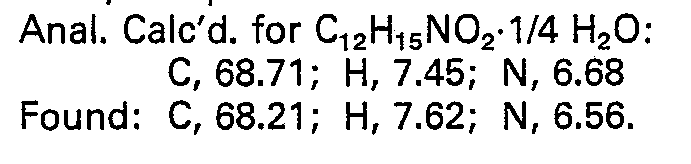
- A solution of the hydrochloride salt of cis-4-(phenylmethyl)-L-proline (0.58 g., 0.0024 mole) in methanol (10 ml.) is treated with two equivalents of triethylamine (0.5 g., 0.0048 mole) in methanol (5 ml.). The mixture is stirred at ambient temperature for 5 minutes and concentrated in vacuo. A suspension of the resulting solid in acetonitrile (10 ml.) is utilized in the reaction described above.
- A mixture of [1(±),4S]-1-[[ethoxy[3-phenyl-1-[[(phenylmethoxy)carbonyl]amino]propyl]phos- Phinyl]acetyl]-4-(phenylmethyl)-L-proline (0.9 g., 0.00148 mole), from part (a), and 10% palladium on carbon catalyst (80 mg.) in methanol/water (9:1) is stirred vigorously in an atmosphere of hydrogen until hydrogen is no longer consumed (overnight). The mixture is filtered and concentrated in vacuo to give 0.7 g. of [1(±),4S]-1-[[[1-(amino)-3-phenylpropyl]ethoxyphosphinyl]acetyl]-4-(phenylmethyl)-L-proline as a glass-like solid. Tlc, silica gel, dichloromethane/methanol/acetic acid (8:1:1) shows a single elongated spot at Rf 0.30 (visualized with ninhydrin indicator plus heat, and/or PMA plus heat).
- A solution of benzoic acid (0.185 g., 0.00148 mole) and 1-hydroxybenzotriazole hydrate (0.2 g., 0.00148 mole) in tetrahydrofuran (10 mI.) is cooled to 0°, followed by the portionwise addition of N,N-dicyclohexylcarbodiimide (0.3 g., 0.00148 mole). The bath is removed and the mixture is stirred at ambient temperature for 70 minutes. After the addition of dimethylformamide (5 ml.) to the resulting slurry, a solution of the product from part (b) (0.7 g., 0.00148 mole) and triethylamine (0.3 g., 0.003 mole) in dimethylformamide (4 ml.) is added and the mixture is stirred at ambient temperature for 16 hours. The solids are removed by filtration, washed with ethyl acetate, and the filtrate is concentrated in vacuo. The residue is dissolved in ethyl acetate (50 ml.). After filtration, the solution is washed with water (2 x 5 ml.), 10% citric acid (2 x 5 ml.), brine, and dried (MgS04). It is concentrated in vacuo to give 0.95 g. of an amber glass-like solid. Tlc, silica gel, dichloromethane/water/acetic acid (8:1:1) shows a major spot at Rf 0.50. It is chromatographed on silica gel, eluting with benzene/acetic acid (4:1, 7:3) to give 0.6 g. of the product as an orange solid. Tlc, silica gel, benzene/acetic acid (7:3) shows two spots, Rf 0.40 and 0.46 with a minor spot at Rf 0.65. The solid is treated with one equivalent of sodium hydroxide, diluted to a volume of 10 ml. with water resulting in the separation of a solid. The alkaline mixture is acidified to a pH of 1 with concentrated hydrochloric acid. The solid that separates from solution is extracted into dichloromethane (50 ml.), washed with brine, and dried (MgS04). The mixture is concentrated in vacuo to give 0.4 g. of [1(±),4S]-1-[[[1-(benzoylamino)-3-phenylpropyl]ethoxyphosphinyl]acetyl]-4-(phenylmethyl)-L-proline as an orange solid. Tlc, silica gel, dichloromethane/methanol/acetic acid (8: 1:1) shows a single spot at Rf 0.80 (visualized with PMA plus heat).
- A solution of the product from part (c) (0.37 g., 0.00064 mole) and bis(trimethylsilyl) trifluoroacetamide (0.33 g., 0.00128 mole) in dichloromethane (6 ml.) is stirred at ambient temperature for one hour. The mixture is concentrated in vacuo. The residue is dissolved in dichloromethane (8 ml.) and bromotrimethylsilane (0.2 g., 0.00128 mole) is added. The mixture is stirred at ambient temperature for 16 hours. After concentrating in vacuo, the residue is dissolved in aqueous sodium bicarbonate (3 ml. of saturated sodium bicarbonate plus 22 ml. of water), washed with ether, followed by dichloromethane, cooled, and acidified to a pH of 1 with concentrated hydrochloric acid. The amber oil that separates from solution is extracted into dichloromethane, washed with brine, and dried (MgS04). The solvent is removed in vacuo to give 0.33 g. of [1(±),4S]-1-[[[1-(benzoylamino)-3-phenylpropyl]hydroxyphosphinyl]acetyl]-4-(phenylmethyl)-L-proline as an amorphous solid; m.p. 127-157°. Tlc, silica gel, butanol/acetic acid/water (3:1:1), shows a single spot at Rf 0.60 (visualized with PMA plus heat, or with l2 vapor).

- In an analogous manner, the procedure of Examples 84 and 86 to 89 could be employed to prepare the compounds of Examples 18 to 83.
- Chloromethyl pivalate (0.23 g., 0.0015 mole) is added to a solution of (±)-1-[[[1-(benzoylamino)-3-phenylpropyl]hydroxyphosphinyl]acetyl]-L-proline (0.6 g., 0.0013 mole), prepared for example as set forth in Example 85, and triethylamine (0.2 g., 0.002 mole) in dimethylformamide (5 ml.). The mixture is stirred at ambient temperature. An additional quantity of triethylamine (0.2 g., 0.002 mole) is added after four hours. After 16 hours, Tlc shows that the reaction is incomplete. Additional triethylamine (0.2 g., 0.002 mole) and chloromethyl pivalate (0.23 g., 0.0015 mole) are added, and the mixture is stirred at ambient temperature for an additional 24 hours (Tlc shows the absence of starting material). After the addition of water (20 ml.), 10% citric acid is added immediately to a pH of 3-4. The mixture is extracted with ethyl acetate, washed with water, brine, and dried (MgS04). After concentration in vacuo, the residue of 0.8 g. of amber oil is chromatographed on silica gel, eluting with dichloromethane/methanol/acetic acid (25:1:1) to give 0.4 g. of (±)-1-[[[1-(benzoylamino)-3-phenylpropyl]hydroxyphosphinyl]acetyl]-L-proline, (2,2-dimethyl-1-oxo- propoxy)methyl ester as a glass-like solid. Tlc, silica gel, butanol/acetic acid/water (3:1:1) shows a single spot at Rf 0.64.
- To a solution of the ester product from part (a) (0.286 g., 0.005 mole) in acetone (10 ml.), a 0.25 M solution of lithium carbonate (10 ml.) is added dropwise, with stirring. As the solution becomes turbid during the addition, the turbidity is clarified by the addition of acetone, so that the final volume of the mixture is 30 ml. After filtration, to remove a trace of solids, the solution is concentrated in vacuo to a volume of 15 ml., and water is added to incipient turbidity. The mixture is millipore filtered and lyophilized to give 0.2 g. of pink colored solid. Tlc, silic gel, butanol/acetic acid/water (3:1:1) shows a single spot at Rf 0.62 and a shadow at Rf 0.44. The solid is placed on a column of HP-20 AG (10 ml.) and eluted with water; water/acetone in a gradient of 1-100% acetone (1;1;4;10;50;100%) to give 46 mg. of (±)-1-[[[1-(benzoylamino)-3-phenylpropyl]hydroxyphosphinyl]acetyl]-L-proline, (2,2-dimethyl-1-oxopropoxy)methyl ester, lithium salt. Tlc, silica gel, butanol/acetic acid/water (3:1:1) shows a single spot at R, 0.62.

- A equimolar mixture of triethylamine and chloromethyl pivalate are added to a solution of (±)-1-[[[1-(benzoylamino)-4-phenylbutyl]hydoxyphosphinyl]acetyl]-L-proline, phenylmethyl ester, prepared for example as set forth in Example 20 (d), indimethylforamide under an argon atmosphere. The mixture is stirred for several hours at room temperature, diluted with ethyl acetate, washed with water, brine, dried (MgS04), and evaporated. The crude product is chromatographed to give (±)-1-[[[1-(benzoylamino)-4-phenylbutyl][(2,2-dimethyl-1-oxopropyl)methoxy]phosphinyl]acetyl]-L-proline, phenylmethyl ester.
- A solution of the diester product from part (a) in methanol is added to a 10% palladium on carbon catalyst and the resulting mixture is shaken in a Parr hydrogenation apparatus for several hours. The catalyst is filtered off and the methanol is stripped from the filtrate. The crude product is chromatographed on silica gel to yield (±)-1-[[[1-(benzoylamino)-4-phenylbutyl][(2,2-dimethyl-1-oxopropyl)methoxy]phosphinyl]acetyl]-L-proline.
- Following the procedure of Example 92 but employing the alkylating agent shown in Col. I for the chloromethyl pivalate, one obtains the product listed in Col. II.

- 1000 tablets each containing the following ingredients:

- In a similar manner, tablets containing 100 mg. of the product of any of Examples 1 to 84 and 86 to 97 can be prepared.
- 1000 tablets each containing the following ingredients:

- In a similar manner, tablets containing 50 mg. of the product of any of Examples 1 to 21 and 23 to 97 can be prepared.
- Two piece #1 gelatin capsules each containing 100 mg. of (±)-1-[[[1-(benzoylamino)-4-phenylbutyl]hydroxyphosphinyl]acetyl]-L-proline are filled with a mixture of the following ingredients:

- An injectable solution is prepared as follows:

- The active substance, preservatives, and sodium chloride are dissolved in 3 liters of water for injection and then the volume is brought up to 5 liters. The solution is filtered through a sterile filter and asceptically filled into presterilized vials which are closed with presterilized rubber closures. Each vial contains 5 ml. of solution in a concentration of 100 mg. of active ingredient per ml. of solution for injection.
- In a similar manner, an injectable solution containing 100 mg. of active ingredient per ml. of solution can be prepared for the product of any of Examples 1 to 17 and 19 to 97.
- 1000 Tablets each containing the following ingredients:

- In a similar manner, tablets can be prepared containing 100 mg. of the product of any of Examples 1 to 84 and 85 to 97.
- 1-[2-[[Methoxy(1-benzloxyamido-3-phenyl)propyl]phosphinylmethyl]propionyl]proline-benzyl ester Methyl-2-[[methoxy(1-benzloxyamido-3-phenyl)propyl]phosphinyfmethyl]propionate is reacted with IN. NaOH to yield the corresponding propionic acid. 220 mgs. of this acid is dissolved in 10 ml. of dry tetrahydrofuran (THF) and the resulting solution is cooled to 0°C and under argon carbonyldiimidazole (90.7 mg., 0.56 mmol) is added. After stirring at 0°C for one hour, 0.16 ml. of triethylamine (0.11 g., 1.08 mmol) is added, followed by prolinebenzylester hydrochloride (139 mg., 0.51 mmol). The mixture is then allowed to warm to room temperature and stirring is continued overnight. The suspension is diluted with ethylacetate and the resulting mixture is washed with KHS04, H20 and saturated NaCI solution. After drying over sodium sulfate, the combined organic extracts are evaporated to yield 240 mgs. of the above titled compound as a glass. Tlc, silica gel, ethylacetate/acetic acid/water (15:1:1), Rf = 0.45.
are useful as hypotensive agents.
Claims (40)


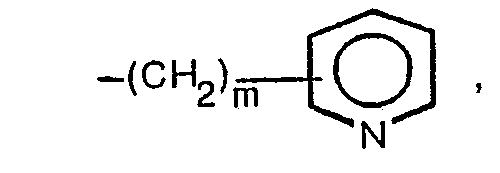


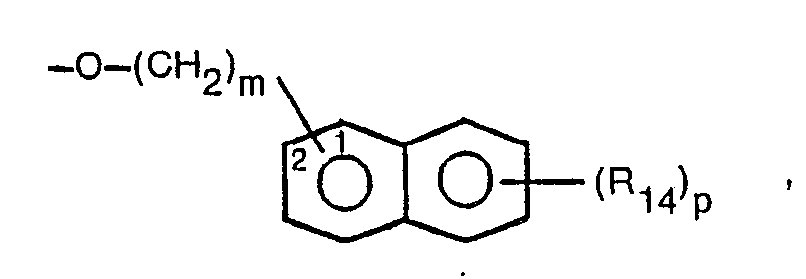
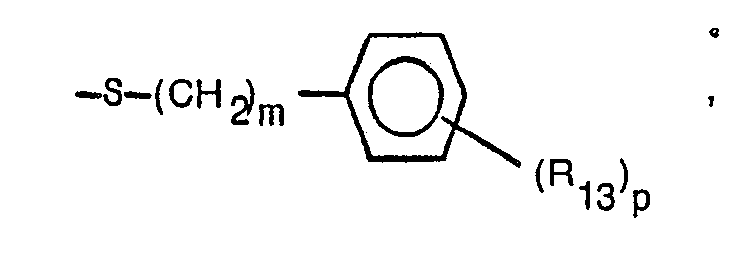


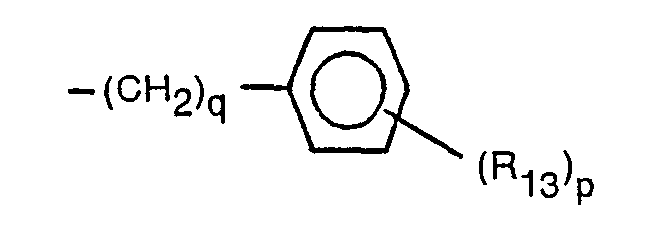






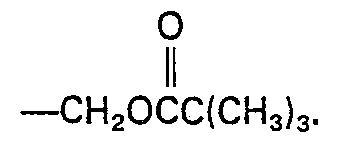

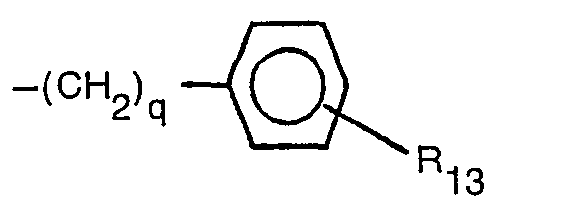


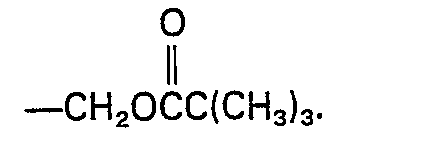


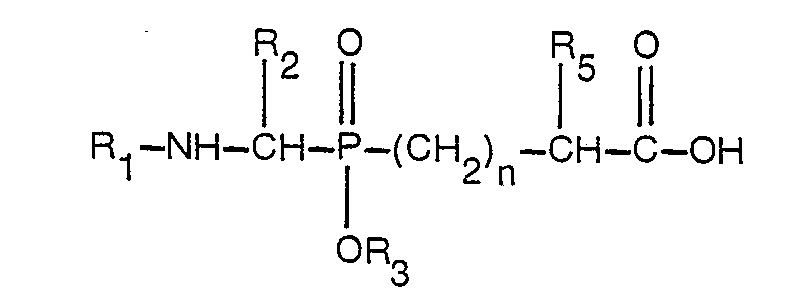


Priority Applications (1)
| Application Number | Priority Date | Filing Date | Title |
|---|---|---|---|
| AT82301923T ATE14882T1 (en) | 1981-04-27 | 1982-04-14 | AMINO AND SUBSTITUTED AMINO PHOSPHINYL ALKANOYL PREPARATIONS. |
Applications Claiming Priority (2)
| Application Number | Priority Date | Filing Date | Title |
|---|---|---|---|
| US258194 | 1981-04-27 | ||
| US06/258,194 US4374131A (en) | 1981-04-27 | 1981-04-27 | Amino and substituted amino phosphinyl-alkanoyl compounds |
Publications (2)
| Publication Number | Publication Date |
|---|---|
| EP0063896A1 EP0063896A1 (en) | 1982-11-03 |
| EP0063896B1 true EP0063896B1 (en) | 1985-08-14 |
Family
ID=22979499
Family Applications (1)
| Application Number | Title | Priority Date | Filing Date |
|---|---|---|---|
| EP82301923A Expired EP0063896B1 (en) | 1981-04-27 | 1982-04-14 | Amino and substituted amino phosphinyl-alkanoyl compositions |
Country Status (11)
| Country | Link |
|---|---|
| US (1) | US4374131A (en) |
| EP (1) | EP0063896B1 (en) |
| JP (1) | JPS57197290A (en) |
| AT (1) | ATE14882T1 (en) |
| AU (2) | AU556756B2 (en) |
| CA (1) | CA1192196A (en) |
| DE (1) | DE3265360D1 (en) |
| DK (1) | DK186082A (en) |
| HU (1) | HU186011B (en) |
| IE (1) | IE53030B1 (en) |
| ZA (1) | ZA822577B (en) |
Families Citing this family (69)
| Publication number | Priority date | Publication date | Assignee | Title |
|---|---|---|---|---|
| US4374131A (en) * | 1981-04-27 | 1983-02-15 | E. R. Squibb & Sons, Inc. | Amino and substituted amino phosphinyl-alkanoyl compounds |
| US4555506A (en) * | 1981-12-24 | 1985-11-26 | E. R. Squibb & Sons, Inc. | Phosphorus containing compounds and use as hypotensives |
| US4716155A (en) * | 1981-12-24 | 1987-12-29 | E. R. Squibb & Sons, Inc. | Phosphorus containing compounds and hypotensive use thereof |
| US4452791A (en) * | 1982-03-15 | 1984-06-05 | E. R. Squibb & Sons, Inc. | Aminoalkyl and related substituted phosphinic acid angiotensin converting enzyme inhibitors |
| US4560680A (en) * | 1982-03-15 | 1985-12-24 | E. R. Squibb & Sons, Inc. | Aminoalkyl and related substituted phosphinic acid angiotensin converting enzyme inhibitors |
| US4560681A (en) * | 1982-04-22 | 1985-12-24 | E. R. Squibb & Sons, Inc. | Phosphinylmethylaminocarbonyl imino acid compounds useful for treating hypertension |
| US4448772A (en) * | 1982-04-22 | 1984-05-15 | E. R. Squibb & Sons, Inc. | Phosphinylmethylaminocarbonyl imino acid compounds useful for treating hypertension |
| US4468519A (en) * | 1982-06-14 | 1984-08-28 | E. R. Squibb & Sons, Inc. | Esters of phosphinylalkanoyl substituted prolines |
| US4703043A (en) * | 1982-06-23 | 1987-10-27 | E. R. Squibb & Sons, Inc. | Phosphonyl hydroxyacyl amino acid derivatives as antihypertensive |
| US4616005A (en) * | 1982-06-23 | 1986-10-07 | E. R. Squibb & Sons, Inc. | Phosphonyl hydroxyacyl amino acid derivatives as antihypertensives |
| US4452790A (en) * | 1982-06-23 | 1984-06-05 | E. R. Squibb & Sons, Inc. | Phosphonyl hydroxyacyl amino acid derivatives as antihypertensives |
| US4444765A (en) * | 1982-07-14 | 1984-04-24 | E. R. Squibb & Sons, Inc. | Amino and substituted amino phosphinylalkanoyl compounds useful for treating hypertension |
| US4567166A (en) * | 1982-07-14 | 1986-01-28 | E. R. Squibb & Sons, Inc. | Amino and substituted amino phosphinylalkanoyl compounds useful for treating hypertension |
| US4547324A (en) * | 1982-07-29 | 1985-10-15 | Stauffer Chemical Company | Method for preparation of N-phosphonomethylglycine |
| EP0210545A3 (en) * | 1985-07-24 | 1988-07-20 | Merck & Co. Inc. | Phosphorous containing enzyme inhibitors |
| EP0209848A3 (en) * | 1985-07-24 | 1988-07-27 | Merck & Co. Inc. | Enzyme inhibitors |
| US4634689A (en) * | 1985-10-31 | 1987-01-06 | Schering Corporation | Phosphinylalkanoyl imino acids |
| US4715994A (en) * | 1986-11-05 | 1987-12-29 | Merck & Co., Inc. | Novel antibacterial agents and potentiators of carbapenem antibiotics |
| US5099063A (en) * | 1986-11-05 | 1992-03-24 | Merck & Co., Inc. | Certain phosphinic acid derivatives having antibacterial activity |
| US5143908A (en) * | 1986-11-05 | 1992-09-01 | Merck & Co., Inc. | Antibacterial agents and potentiators of carbapenem antibiotics |
| US5041644A (en) * | 1987-07-06 | 1991-08-20 | Merck & Co., Inc. | Peptide derivatives of β-chloro-L(Z)-dehydro-glutamic acid |
| JPS6413097A (en) * | 1987-07-06 | 1989-01-17 | Mitsubishi Chem Ind | Phosphonic acid derivative |
| US4849525A (en) * | 1987-09-21 | 1989-07-18 | E. R. Squibb & Sons, Inc. | Phosphinylcycloalkylcarbonyl and phosphinylcycloalkenylcarbonyl dipeptides |
| US5030732A (en) * | 1988-03-03 | 1991-07-09 | Merck & Co., Inc. | Aminoethylphosphinic acid derivatives |
| DE68925240T2 (en) * | 1988-06-23 | 1996-06-13 | Banyu Pharma Co Ltd | Phosphinic acid derivatives |
| US5147867A (en) * | 1988-10-28 | 1992-09-15 | Merck & Co., Inc. | Phosphorus containing enzyme inhibitors |
| US4962097A (en) * | 1988-10-28 | 1990-10-09 | Merck & Co., Inc. | Method of treating bacterial infection with phosphorus containing DHP enzyme inhibitors |
| US5145990A (en) * | 1988-10-28 | 1992-09-08 | Merck & Co., Inc. | Phosphorous containing dhp enzyme inhibitors |
| US5476847A (en) * | 1994-06-29 | 1995-12-19 | Schering Corporation | Derivatives of phosphinic acid useful as endothelin converting enzyme inhibitors |
| US6011021A (en) * | 1996-06-17 | 2000-01-04 | Guilford Pharmaceuticals Inc. | Methods of cancer treatment using naaladase inhibitors |
| US5795877A (en) * | 1996-12-31 | 1998-08-18 | Guilford Pharmaceuticals Inc. | Inhibitors of NAALADase enzyme activity |
| US5672592A (en) * | 1996-06-17 | 1997-09-30 | Guilford Pharmaceuticals Inc. | Certain phosphonomethyl-pentanedioic acid derivatives thereof |
| US5977090A (en) * | 1996-09-27 | 1999-11-02 | Guilford Pharmaceuticals Inc. | Pharmaceutical compositions and methods of treating compulsive disorders using NAALADase inhibitors |
| US6046180A (en) * | 1996-06-17 | 2000-04-04 | Guilford Pharmaceuticals Inc. | NAALADase inhibitors |
| TR199802638T2 (en) | 1996-06-17 | 1999-03-22 | Guilford Pharmaceuticals, Inc. | Use of naaladase inhibitors in cancer treatment. |
| US5902817A (en) * | 1997-04-09 | 1999-05-11 | Guilford Pharmaceuticals Inc. | Certain sulfoxide and sulfone derivatives |
| US6384022B1 (en) | 1996-06-17 | 2002-05-07 | Guilford Pharmaceuticals Inc. | Prodrugs of NAALAdase inhibitors |
| US5863536A (en) * | 1996-12-31 | 1999-01-26 | Guilford Pharmaceuticals Inc. | Phosphoramidate derivatives |
| US6054444A (en) | 1997-04-24 | 2000-04-25 | Guilford Pharmaceuticals Inc. | Phosphonic acid derivatives |
| US6025344A (en) | 1996-06-17 | 2000-02-15 | Guilford Pharmaceuticals Inc. | Certain dioic acid derivatives useful as NAALADase inhibitors |
| US6071965A (en) * | 1996-06-17 | 2000-06-06 | Guilford Pharmaceuticals Inc. | Phosphinic alkanoic acid derivatives |
| US6025345A (en) * | 1996-06-17 | 2000-02-15 | Guilford Pharmaceuticals Inc. | Inhibitors of NAALADase enzyme activity |
| US5962521A (en) * | 1997-04-04 | 1999-10-05 | Guilford Pharmaceuticals Inc. | Hydroxamic acid derivatives |
| US5981209A (en) * | 1997-12-04 | 1999-11-09 | Guilford Pharmaceuticals Inc. | Use of NAALADase activity to identify prostate cancer and benign prostatic hyperplasia |
| US6028216A (en) * | 1997-12-31 | 2000-02-22 | Guilford Pharmaceuticals Inc. | Asymmetric syntheses and intermediates for preparing enantiomer-enriched hydroxyphosphinyl derivatives |
| US6121252A (en) * | 1998-03-30 | 2000-09-19 | Guilford Pharmaceuticals Inc. | Phosphinic acid derivatives |
| TR200100025T2 (en) | 1998-07-06 | 2001-12-21 | Guilford Pharmaceuticals Inc. | Naaladase inhibitors useful as pharmaceutical compounds and compositions. |
| US6265609B1 (en) | 1998-07-06 | 2001-07-24 | Guilford Pharmaceuticals Inc. | Thio-substituted pentanedioic acid derivatives |
| US6395718B1 (en) | 1998-07-06 | 2002-05-28 | Guilford Pharmaceuticals Inc. | Pharmaceutical compositions and methods of inhibiting angiogenesis using naaladase inhibitors |
| US6313159B1 (en) | 1999-08-20 | 2001-11-06 | Guilford Pharmaceuticals Inc. | Metabotropic glutamate receptor ligand derivatives as naaladase inhibitors |
| DE102006010361A1 (en) * | 2006-03-07 | 2007-09-13 | Clariant International Limited | Mixtures of mono-Carboxylfunktionalisierten dialkylphosphinic and other components |
| DE102006010362A1 (en) * | 2006-03-07 | 2007-09-13 | Clariant International Limited | Mixtures of mono-carboxyl-functionalized dialkylphosphinic acids, a process for their preparation and their use |
| EP2346885B1 (en) * | 2008-11-05 | 2013-08-28 | Clariant International Ltd. | Method for producing mono-carboxy-functionalized dialkylphosphinic acids and esters and salts thereof by means of allyl alcohols/acroleins and use thereof |
| DE102008055916A1 (en) * | 2008-11-05 | 2010-05-06 | Clariant International Limited | Process for the preparation of mono-hydroxy-functionalized dialkylphosphinic acids, esters and salts by means of allyl alcohols and their use |
| DE102008055914A1 (en) * | 2008-11-05 | 2010-05-06 | Clariant International Limited | A process for the preparation of mono-hydroxy-functionalized dialkylphosphinic acids, esters and salts by means of acroleins and their use |
| ES2525550T3 (en) * | 2008-11-07 | 2014-12-26 | Clariant Finance (Bvi) Limited | Process for the preparation of acids, esters and dialkyl phosphine salts by means of acrylic acid derivatives and their use |
| DE102008056339A1 (en) * | 2008-11-07 | 2010-05-12 | Clariant International Limited | Process for the preparation of mono-amino-functionalized dialkylphosphinic acids, esters and salts and their use |
| DE102008056341A1 (en) * | 2008-11-07 | 2010-05-12 | Clariant International Limited | Process for the preparation of mono-amino-functionalized dialkylphosphinic acids, esters and salts by means of acrylonitriles and their use |
| DE102008056342A1 (en) * | 2008-11-07 | 2010-05-12 | Clariant International Limited | Process for the preparation of dialkylphosphinic acids, esters and salts by means of acrylonitriles and their use |
| JP5743219B2 (en) | 2008-11-11 | 2015-07-01 | クラリアント・ファイナンス・(ビーブイアイ)・リミテッド | Process for the production of monoallyl-functional dialkylphosphinic acids, their salts and esters using allyl compounds and their use |
| DE102008060035A1 (en) * | 2008-12-02 | 2010-06-10 | Clariant International Limited | Process for the preparation of monohydroxy-functionalized dialkylphosphinic acids, esters and salts by means of vinyl esters of a carboxylic acid and their use |
| DE102008060036A1 (en) * | 2008-12-02 | 2010-06-10 | Clariant International Limited | Process for the preparation of mono-carboxy-functionalized dialkylphosphinic acids, esters and salts by means of vinyl esters of a carboxylic acid and their use |
| DE102008060535A1 (en) * | 2008-12-04 | 2010-06-10 | Clariant International Limited | Process for the preparation of mono-carboxy-functionalized dialkylphosphinic acids, esters and salts by means of vinyl ethers and their use |
| DE102008063642A1 (en) | 2008-12-18 | 2010-06-24 | Clariant International Limited | Process for the preparation of monocarboxy-functionalized dialkylphosphinic acids, esters and salts by means of alkylene oxides and their use |
| JP5619769B2 (en) | 2008-12-18 | 2014-11-05 | クラリアント・ファイナンス・(ビーブイアイ)・リミテッド | Process for producing ethylenedialkylphosphinic acid, ethylenedialkylphosphinic acid ester, and ethylenedialkylphosphinic acid salt using acetylene, and use thereof |
| DE102008063627A1 (en) | 2008-12-18 | 2010-06-24 | Clariant International Limited | Process for the preparation of monohydroxy-functionalized dialkylphosphinic acids, esters and salts by means of ethylene oxide and their use |
| DE102008063668A1 (en) | 2008-12-18 | 2010-07-01 | Clariant International Limited | Process for the preparation of alkylphosphonic acids, esters and salts by oxidation of alkylphosphonous acids and their use |
| DE102008064012A1 (en) | 2008-12-19 | 2010-06-24 | Clariant International Limited | Halogen-free adducts of alkylphosphonous acid derivatives and diester-forming olefins, halogen-free processes for their preparation and their use |
| DE102008064003A1 (en) | 2008-12-19 | 2010-06-24 | Clariant International Limited | Process for the preparation of monofunctionalized dialkylphosphinic acids, esters and salts and their use |
Family Cites Families (17)
| Publication number | Priority date | Publication date | Assignee | Title |
|---|---|---|---|---|
| US4105776A (en) * | 1976-06-21 | 1978-08-08 | E. R. Squibb & Sons, Inc. | Proline derivatives and related compounds |
| US4192878A (en) * | 1976-12-03 | 1980-03-11 | E. R. Squibb & Sons, Inc. | Derivatives of thiazolidinecarboxylic acids and related acids |
| US4129566A (en) * | 1978-02-15 | 1978-12-12 | E. R. Squibb & Sons, Inc. | Derivatives of dehydrocyclicimino acids |
| JPS5834474B2 (en) | 1977-06-29 | 1983-07-27 | ウェルファイド株式会社 | Method for producing thiazolidine derivatives |
| US4151172A (en) * | 1977-08-11 | 1979-04-24 | E. R. Squibb & Sons, Inc. | Phosphonoacyl prolines and related compounds |
| US4154935A (en) * | 1978-02-21 | 1979-05-15 | E. R. Squibb & Sons, Inc. | Halogen substituted mercaptoacylamino acids |
| JPS584711B2 (en) | 1978-08-02 | 1983-01-27 | 参天製薬株式会社 | Pyrrolidine derivative |
| CA1144930A (en) | 1978-08-11 | 1983-04-19 | Miguel A. Ondetti | Mercaptoacyl derivatives of substituted prolines |
| US4316896A (en) * | 1978-09-07 | 1982-02-23 | Merck & Co., Inc. | Aminoacid derivatives as antihypertensives |
| US4168267A (en) * | 1978-10-23 | 1979-09-18 | E. R. Squibb & Sons, Inc. | Phosphinylalkanoyl prolines |
| CA1132985A (en) | 1978-12-22 | 1982-10-05 | John Krapcho | Ketal and thioketal derivatives of mercaptoacyl prolines |
| US4217359A (en) * | 1979-01-15 | 1980-08-12 | E. R. Squibb & Sons, Inc. | Carbamate derivatives of mercaptoacyl hydroxy prolines |
| US4329473A (en) * | 1979-06-01 | 1982-05-11 | Almquist Ronald G | Oxoalkanoic acid derivatives as inhibitors of angiotensin converting enzyme |
| US4234489A (en) * | 1979-06-25 | 1980-11-18 | E. R. Squibb & Sons, Inc. | Pyroglutamic acid derivatives and analogs |
| US4316905A (en) * | 1980-07-01 | 1982-02-23 | E. R. Squibb & Sons, Inc. | Mercaptoacyl derivatives of various 4-substituted prolines |
| US4337201A (en) * | 1980-12-04 | 1982-06-29 | E. R. Squibb & Sons, Inc. | Phosphinylalkanoyl substituted prolines |
| US4374131A (en) * | 1981-04-27 | 1983-02-15 | E. R. Squibb & Sons, Inc. | Amino and substituted amino phosphinyl-alkanoyl compounds |
-
1981
- 1981-04-27 US US06/258,194 patent/US4374131A/en not_active Expired - Lifetime
-
1982
- 1982-04-06 AU AU82379/82A patent/AU556756B2/en not_active Ceased
- 1982-04-08 CA CA000400780A patent/CA1192196A/en not_active Expired
- 1982-04-14 EP EP82301923A patent/EP0063896B1/en not_active Expired
- 1982-04-14 AT AT82301923T patent/ATE14882T1/en not_active IP Right Cessation
- 1982-04-14 DE DE8282301923T patent/DE3265360D1/en not_active Expired
- 1982-04-14 IE IE862/82A patent/IE53030B1/en not_active IP Right Cessation
- 1982-04-15 ZA ZA822577A patent/ZA822577B/en unknown
- 1982-04-26 DK DK186082A patent/DK186082A/en not_active Application Discontinuation
- 1982-04-26 HU HU821315A patent/HU186011B/en not_active IP Right Cessation
- 1982-04-27 JP JP57072541A patent/JPS57197290A/en active Granted
-
1986
- 1986-09-29 AU AU63282/86A patent/AU589686B2/en not_active Ceased
Also Published As
| Publication number | Publication date |
|---|---|
| US4374131A (en) | 1983-02-15 |
| IE820862L (en) | 1982-10-27 |
| AU8237982A (en) | 1982-11-04 |
| JPH0354115B2 (en) | 1991-08-19 |
| EP0063896A1 (en) | 1982-11-03 |
| AU6328286A (en) | 1987-01-08 |
| AU589686B2 (en) | 1989-10-19 |
| ATE14882T1 (en) | 1985-08-15 |
| HU186011B (en) | 1985-05-28 |
| AU556756B2 (en) | 1986-11-20 |
| DK186082A (en) | 1982-10-28 |
| CA1192196A (en) | 1985-08-20 |
| JPS57197290A (en) | 1982-12-03 |
| DE3265360D1 (en) | 1985-09-19 |
| IE53030B1 (en) | 1988-05-11 |
| ZA822577B (en) | 1983-03-30 |
Similar Documents
| Publication | Publication Date | Title |
|---|---|---|
| EP0063896A1 (en) | Amino and substituted amino phosphinyl-alkanoyl compositions | |
| EP0097534B1 (en) | Phosphonyl hydroxyacyl amino acid derivatives as antihypertensives | |
| EP0053902B1 (en) | Phosphinylalkanoyl substituted prolines | |
| EP0083172B1 (en) | Phosphorus containing compounds | |
| EP0099785B1 (en) | Amino and substituted amino phosphinylalkanoyl compounds | |
| US4316896A (en) | Aminoacid derivatives as antihypertensives | |
| US4849525A (en) | Phosphinylcycloalkylcarbonyl and phosphinylcycloalkenylcarbonyl dipeptides | |
| US4427665A (en) | Phosphinylalkanoyl substituted imino acids and their use in hypotensive compositions | |
| US4567166A (en) | Amino and substituted amino phosphinylalkanoyl compounds useful for treating hypertension | |
| US4963539A (en) | Phosphonate and phosphonamide endopeptidase inhibitors | |
| US4384123A (en) | Phosphinylalkanoyl substituted prolines | |
| US4745196A (en) | Orally active phosphonyl hydroxyacyl prolines | |
| EP0253179B1 (en) | A-acylamino aminoalkyl phophonate angiotensin converting enzyme inhibitors | |
| US4416831A (en) | Amino and substituted amino phosphinylalkanoyl compounds | |
| EP0249445A2 (en) | Substituted aminoalkanoylaminoalkyl phosphonate angiotensin converting enzyme inhibitors | |
| US4533661A (en) | Certain 3-phosphinyl-amino-2-oxo-1H-azepine-1-acetic acid derivatives having anti-hypertensive activity | |
| US4567167A (en) | Certain 3-phosphinyl-2-oxo-piperidine-1-acetic acid derivatives having anti-hypertensive activity | |
| US4900860A (en) | Process for preparing phosphonyloxyacyl amino acids | |
| US5436245A (en) | Phosphate substituted amino or imino acids useful as antihypertensives | |
| US5102875A (en) | Phosphonate substituted amino acids useful as antihypertensives | |
| US4885380A (en) | Process for preparing phosphonyloxyacyl amino acids and derivatives thereof | |
| US4598071A (en) | Certain 3-phosphinyl-amino-2-oxo-1H-azocine or azonine-1-acetic acid derivatives having anti-hypertensive properties | |
| EP0237264A2 (en) | Process for preparing phosphonyloxyacyl amino acids and derivates thereof | |
| EP0239109A2 (en) | Phosphonate angiotensin converting enzyme inhibitors |
Legal Events
| Date | Code | Title | Description |
|---|---|---|---|
| PUAI | Public reference made under article 153(3) epc to a published international application that has entered the european phase |
Free format text: ORIGINAL CODE: 0009012 |
|
| AK | Designated contracting states |
Designated state(s): AT BE CH DE FR GB IT LU NL SE |
|
| 17P | Request for examination filed |
Effective date: 19830425 |
|
| ITF | It: translation for a ep patent filed | ||
| GRAA | (expected) grant |
Free format text: ORIGINAL CODE: 0009210 |
|
| AK | Designated contracting states |
Designated state(s): AT BE CH DE FR GB IT LI LU NL SE |
|
| REF | Corresponds to: |
Ref document number: 14882 Country of ref document: AT Date of ref document: 19850815 Kind code of ref document: T |
|
| REF | Corresponds to: |
Ref document number: 3265360 Country of ref document: DE Date of ref document: 19850919 |
|
| ET | Fr: translation filed | ||
| PLBE | No opposition filed within time limit |
Free format text: ORIGINAL CODE: 0009261 |
|
| STAA | Information on the status of an ep patent application or granted ep patent |
Free format text: STATUS: NO OPPOSITION FILED WITHIN TIME LIMIT |
|
| 26N | No opposition filed | ||
| ITTA | It: last paid annual fee | ||
| EPTA | Lu: last paid annual fee | ||
| EAL | Se: european patent in force in sweden |
Ref document number: 82301923.7 |
|
| PGFP | Annual fee paid to national office [announced via postgrant information from national office to epo] |
Ref country code: GB Payment date: 19970407 Year of fee payment: 16 |
|
| PGFP | Annual fee paid to national office [announced via postgrant information from national office to epo] |
Ref country code: FR Payment date: 19970409 Year of fee payment: 16 |
|
| PGFP | Annual fee paid to national office [announced via postgrant information from national office to epo] |
Ref country code: AT Payment date: 19970414 Year of fee payment: 16 |
|
| PGFP | Annual fee paid to national office [announced via postgrant information from national office to epo] |
Ref country code: SE Payment date: 19970418 Year of fee payment: 16 Ref country code: DE Payment date: 19970418 Year of fee payment: 16 |
|
| PGFP | Annual fee paid to national office [announced via postgrant information from national office to epo] |
Ref country code: CH Payment date: 19970422 Year of fee payment: 16 |
|
| PGFP | Annual fee paid to national office [announced via postgrant information from national office to epo] |
Ref country code: NL Payment date: 19970428 Year of fee payment: 16 Ref country code: LU Payment date: 19970428 Year of fee payment: 16 |
|
| PGFP | Annual fee paid to national office [announced via postgrant information from national office to epo] |
Ref country code: BE Payment date: 19970529 Year of fee payment: 16 |
|
| PG25 | Lapsed in a contracting state [announced via postgrant information from national office to epo] |
Ref country code: LU Free format text: LAPSE BECAUSE OF NON-PAYMENT OF DUE FEES Effective date: 19980414 Ref country code: GB Free format text: LAPSE BECAUSE OF NON-PAYMENT OF DUE FEES Effective date: 19980414 Ref country code: AT Free format text: LAPSE BECAUSE OF NON-PAYMENT OF DUE FEES Effective date: 19980414 |
|
| PG25 | Lapsed in a contracting state [announced via postgrant information from national office to epo] |
Ref country code: SE Free format text: LAPSE BECAUSE OF NON-PAYMENT OF DUE FEES Effective date: 19980415 |
|
| PG25 | Lapsed in a contracting state [announced via postgrant information from national office to epo] |
Ref country code: LI Free format text: LAPSE BECAUSE OF NON-PAYMENT OF DUE FEES Effective date: 19980430 Ref country code: FR Free format text: THE PATENT HAS BEEN ANNULLED BY A DECISION OF A NATIONAL AUTHORITY Effective date: 19980430 Ref country code: CH Free format text: LAPSE BECAUSE OF NON-PAYMENT OF DUE FEES Effective date: 19980430 Ref country code: BE Free format text: LAPSE BECAUSE OF NON-PAYMENT OF DUE FEES Effective date: 19980430 |
|
| BERE | Be: lapsed |
Owner name: E.R. SQUIBB & SONS INC. Effective date: 19980430 |
|
| PG25 | Lapsed in a contracting state [announced via postgrant information from national office to epo] |
Ref country code: NL Free format text: LAPSE BECAUSE OF NON-PAYMENT OF DUE FEES Effective date: 19981101 |
|
| GBPC | Gb: european patent ceased through non-payment of renewal fee |
Effective date: 19980414 |
|
| REG | Reference to a national code |
Ref country code: CH Ref legal event code: PL |
|
| NLV4 | Nl: lapsed or anulled due to non-payment of the annual fee |
Effective date: 19981101 |
|
| EUG | Se: european patent has lapsed |
Ref document number: 82301923.7 |
|
| PG25 | Lapsed in a contracting state [announced via postgrant information from national office to epo] |
Ref country code: DE Free format text: LAPSE BECAUSE OF NON-PAYMENT OF DUE FEES Effective date: 19990202 |
|
| REG | Reference to a national code |
Ref country code: FR Ref legal event code: ST |