EP0063915A2 - Transistor MIS - Google Patents
Transistor MIS Download PDFInfo
- Publication number
- EP0063915A2 EP0063915A2 EP82302041A EP82302041A EP0063915A2 EP 0063915 A2 EP0063915 A2 EP 0063915A2 EP 82302041 A EP82302041 A EP 82302041A EP 82302041 A EP82302041 A EP 82302041A EP 0063915 A2 EP0063915 A2 EP 0063915A2
- Authority
- EP
- European Patent Office
- Prior art keywords
- insulating layer
- layer
- silicon
- transistor according
- transistor
- Prior art date
- Legal status (The legal status is an assumption and is not a legal conclusion. Google has not performed a legal analysis and makes no representation as to the accuracy of the status listed.)
- Granted
Links
Images


Classifications
-
- H—ELECTRICITY
- H10—SEMICONDUCTOR DEVICES; ELECTRIC SOLID-STATE DEVICES NOT OTHERWISE PROVIDED FOR
- H10D—INORGANIC ELECTRIC SEMICONDUCTOR DEVICES
- H10D30/00—Field-effect transistors [FET]
- H10D30/01—Manufacture or treatment
- H10D30/021—Manufacture or treatment of FETs having insulated gates [IGFET]
- H10D30/031—Manufacture or treatment of FETs having insulated gates [IGFET] of thin-film transistors [TFT]
- H10D30/0321—Manufacture or treatment of FETs having insulated gates [IGFET] of thin-film transistors [TFT] comprising silicon, e.g. amorphous silicon or polysilicon
- H10D30/0323—Manufacture or treatment of FETs having insulated gates [IGFET] of thin-film transistors [TFT] comprising silicon, e.g. amorphous silicon or polysilicon comprising monocrystalline silicon
-
- H—ELECTRICITY
- H10—SEMICONDUCTOR DEVICES; ELECTRIC SOLID-STATE DEVICES NOT OTHERWISE PROVIDED FOR
- H10D—INORGANIC ELECTRIC SEMICONDUCTOR DEVICES
- H10D30/00—Field-effect transistors [FET]
- H10D30/60—Insulated-gate field-effect transistors [IGFET]
-
- H—ELECTRICITY
- H10—SEMICONDUCTOR DEVICES; ELECTRIC SOLID-STATE DEVICES NOT OTHERWISE PROVIDED FOR
- H10D—INORGANIC ELECTRIC SEMICONDUCTOR DEVICES
- H10D30/00—Field-effect transistors [FET]
- H10D30/60—Insulated-gate field-effect transistors [IGFET]
- H10D30/67—Thin-film transistors [TFT]
- H10D30/6704—Thin-film transistors [TFT] having supplementary regions or layers in the thin films or in the insulated bulk substrates for controlling properties of the device
-
- H—ELECTRICITY
- H10—SEMICONDUCTOR DEVICES; ELECTRIC SOLID-STATE DEVICES NOT OTHERWISE PROVIDED FOR
- H10D—INORGANIC ELECTRIC SEMICONDUCTOR DEVICES
- H10D30/00—Field-effect transistors [FET]
- H10D30/60—Insulated-gate field-effect transistors [IGFET]
- H10D30/67—Thin-film transistors [TFT]
- H10D30/674—Thin-film transistors [TFT] characterised by the active materials
- H10D30/6741—Group IV materials, e.g. germanium or silicon carbide
- H10D30/6743—Silicon
- H10D30/6744—Monocrystalline silicon
-
- H—ELECTRICITY
- H10—SEMICONDUCTOR DEVICES; ELECTRIC SOLID-STATE DEVICES NOT OTHERWISE PROVIDED FOR
- H10D—INORGANIC ELECTRIC SEMICONDUCTOR DEVICES
- H10D30/00—Field-effect transistors [FET]
- H10D30/60—Insulated-gate field-effect transistors [IGFET]
- H10D30/67—Thin-film transistors [TFT]
- H10D30/6758—Thin-film transistors [TFT] characterised by the insulating substrates
-
- H—ELECTRICITY
- H10—SEMICONDUCTOR DEVICES; ELECTRIC SOLID-STATE DEVICES NOT OTHERWISE PROVIDED FOR
- H10P—GENERIC PROCESSES OR APPARATUS FOR THE MANUFACTURE OR TREATMENT OF DEVICES COVERED BY CLASS H10
- H10P34/00—Irradiation with electromagnetic or particle radiation of wafers, substrates or parts of devices
- H10P34/40—Irradiation with electromagnetic or particle radiation of wafers, substrates or parts of devices with high-energy radiation
- H10P34/42—Irradiation with electromagnetic or particle radiation of wafers, substrates or parts of devices with high-energy radiation with electromagnetic radiation, e.g. laser annealing
Definitions
- the present invention relates to a metal insulator - semiconductor (MIS) field effect transistor (FET) formed on an insulator.
- MIS metal insulator - semiconductor
- FET field effect transistor
- MISFET formed on an insulator is a silicon on sapphire metal oxide silicon (SOSMOS) transistor described for example in an article by Alan Capell et al., entitled “Process Refinements Bring C-MOS on Sapphire into Commercial Use", published in Electronics, May 26, 1977, pp 99 - 105.
- SOSMOS transistors since the sapphire acts as an insulating substrate, the parasitic capacitances between the source and the substrate, between the drain and the substrate and between the conductor lines and the substrate are small. Therefore, the switching speed of integrated circuits (IC) composed of SOSMOS transistors is higher than that of IC t s composed of MOS transistors built in a bulk silicon substrate.
- MISFET formed on an insulator is a silicon on insulating substrate (SOIS) type transistor.
- SOIS silicon on insulating substrate
- a silicon epitaxial layer lies on an insulating layer of silicon dioxide or silicon nitride, and an MIS transistor is built in a silicon layer deposited on the insulating layer.
- MIS transistors having a short channel length of 2 ⁇ m or less are produced.
- these devices include some problems, in that feedback occurs between the potential applied to the drain electrode and the conduction through the channel. Also variations of the potential applied to the drain electrode lower the transconductance and punch through voltage of the transistor.
- a metal insulator semiconductor transistor comprising an insulating layer; a semiconductor layer which is formed on the insulating layer and comprises a source region, a drain region and a channel region; a gate insulating layer formed on the channel region; and a gate electrode formed on the gate insulating layer; the portion of the insulating layer lying beneath the channel region is thinner than that lying beneath the other regions and a conducting layer is formed beneath the insulating layer.
- An advantage of a transistor in accordance with the present invention is the reduction of the feedback influencing the channel of a short channel MISFET on an insulator and the prevention of the reduction in the transconductance and punch-through voltage. Another advantage is that the equipotential lines in the channel region of the MISFET are substantially parallel to the gate electrode.
- the portions of the insulating layer lying under the source and drain regions, are thick, so that the parasitic. capacitances between the conductor layer and the source and drain regions are small, whereas the portion of the insulating layer under the channel region is thin, so that the grounded conducting layer influences the equipotential lines in the channel region to be substantially parallel with the gate electrode of the MISFET.
- Figure 1 illustrates a cross-section through a conventional short channel MIS transistor formed on an insulator.
- the reference numerals 1, 2 ,3 , 4, 5, 6 and 7 indicate an insulating substrate of sapphire or silicon dioxide, a silicon layer, a source region, a drain region, a channel region, a gate insulating layer, - and a gate electrode, respectively.
- channel region in the silicon layer means the portion of the silicon layer 2 which lies under the gate insulating layer 6 and in which a channel is generated.
- the insulating substrate 1 is generally set on a metal stage (not shown) and grounded by using solder, e.g. Au-Sb solder.
- the drain region 4 is subjected to a drain voltage (V D ), and the gate electrode 7 is subjected to a gate voltage (V G ), we have discovered that equipotential lines are formed in the channel region as indicated with broken lines in Figure 1. As shown these equipotential lines in the channel region 5 have a large vertical component over most of the length of the channel. Accordingly it can be appreciated that variation of the drain voltage creates feedback influencing the channel, and the transconductance (gm) and the punch-through voltage (V PT ) are lowered.
- the MIS transistor is formed on an insulating layer 11 consisting of a thin portion 12 and a thick portion 13.
- the MIS transistor comprises a source region 14, a drain region 15, a channel region 16, a gate insulating layer 17, and a gate electrode 18 and is formed on the insulating layer 11.
- This part , of the MIS transistor is similar to that of the conventional MIS transistor illustrated in Fig. 1.
- a conductor layer 19 having a projecting portion 20 is formed under the insulating layer 11.
- the thin portion 12 of the insulating layer 11 is under the channel region 16, namely, between the channel region 16 and the projecting portion 20 of the conductor layer 19.
- the length of the channel to be generated (i.e., the length of the channel region 16 between the source and drain regions 14 and 15) is 2.0 ⁇ m or less.
- the insulating layer 11 be made of silicon dioxide or silicon nitride and that the thickness of the thin portion 12 be from 30 to 100 nm and the thickness of the thick portion 13 be from 500 nm to 2.0 um.
- the conductor layer 19 be a substrate of high doped semiconductor (e.g., a silicon wafer having a low electric resistance), metal (e.g., tungsten, molybdenum, tantalum, or aluminum), or graphite. It is possible to make the conductor layer from a substrate (e.g., of silicon, ceramic, glass or high-temperature resin) and a metal film formed on the substrate. In the case where aluminum or a high-temperature resin is used, taking the melting point or the softening point into consideration, the MIS transistor should be produced without high temperature heat-treatment.
- a substrate of high doped semiconductor e.g., a silicon wafer having a low electric resistance
- metal e.g., tungsten, molybdenum, tantalum, or aluminum
- graphite e.g., graphite. It is possible to make the conductor layer from a substrate (e.g., of silicon, ceramic, glass or high-temperature resin) and a metal film formed on the substrate
- the conductor layer 19 be made of a single crystalline silicon substrate and the projecting portion 20 be a high doped region of it or be coated with a metal film.
- another MIS transistor can be built in the silicon substrate at a short distance from the source, drain, and channel regions 14, 15, and 16, thereby producing a three-dimensional semiconductor device.
- a field insulating layer 21 serving as an interdevice dielectric isolation, as illustrated in Fig. 2.
- the configuration of the equipotential lines in the short channel region 16 is similar )to that of equipotential lines in a long channel region case. Accordingly the MIS transistor according to the present invention has a higher transconductance and punch-through voltage compared with the conventional MIS transistor illustrated in Fig. 1. Namely, the structure of the MIS transistor of the present invention prevents the reduction of the trans- conductance and the punch-through voltage caused by the short channel.
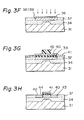
- the short channel MIS transistor according to the present invention is produced, for example, in the manner described below in reference to Figs. 3A to 3H.
- a high doped silicon wafer 31 having an electric resistance of e.g., 0.01 ohm-cm is used as a conductor layer.
- a photoresist layer 32 is formed on the silicon wafer 31, is exposed, and is developed, so as to cover a 2.0 ⁇ m or less wide portion of the silicon wafer 31.
- the uncovered portion of the silicon wafer 31 is then etched by a reactive ion etching process.
- the thickness of the etched portion of the silicon wafer 31 is approximately 1.0 ⁇ m.
- a silicon dioxide layer 33 having a thickness of approximately 1.0 ⁇ m is formed on the silicon wafer 31 and on the remaining photoresist layer 32 by a chemical vapor deposition (CVD) process.
- the remaining photoresist layer 32 is then removed along with the silicon dioxide formed thereon.
- a silicon dioxide layer having a thickness of from 30 to 100 nm is formed on the former silicon dixoide layer 33 and on the exposed portion of the silicon wafer 31 by a CVD process. Consequently a silicon dioxide layer 34 consisting of the former and latter silicon dioxide layers is obtained as an insulating layer. It is possible to form a silicon nitride layer, instead of the latter silicon dioxide layer, on the former silicon dioxide layer 33 and the exposed silicon wafer 31.
- polycrystalline silicon layer 35 having a thickness of approximately 300 nm is formed on the silicon dioxide layer 34 by a pyrolysis process of silane (SiH 4 ) or by a physical vapor deposition (PVD) process. Then a silicon nitride (Si 3 N 4 ) layer 36 having a thickness of approximately 100 nm is formed on the polycrystalline silicon layer 35 by a CVD method.
- the polycrystalline silicon layer 35 is doped with impurities, e.g., boron (P type).
- the silicon nitride layer 36 serves as an antireflecting film and as an anticontamination film, and smooths the surface of the single crystalline silicon layer, when single crystallization of polycrystalline silicon is carried out.
- the silicon nitride layer 36 and the polycrystalline silicon layer 35 are selectively etched by a conventional photoetching process. Approximately half of the original thickness of the polycrystalline silicon layer 35 is removed at the etched portions.
- the remaining half-thickness etched portions of the polycrystalline silicon layer 35 are thermally oxidized down to the silicon dioxide layer 34 to form a silicon dioxide portion 37 which surrounds the polycrystalline silicon island 38 and serves as interdevice dielectric isolation.
- the polycrystalline silicon island 38 is single crystallized by irradiation of a light beam, such as a laser, or of a particle beam, such as an electron beam.
- a light beam such as a laser
- a particle beam such as an electron beam.
- the polycrystalline silicon is laser annealed or electron beam annealed to form a single crystalline silicon island layer 39.
- an argon gas continuous wave laser having an output of lOW, a scanning speed of 10 cm/sec, and a beam spot size of from 50 to 100 ⁇ m, may be irradiated in a 50% overlapping manner to change the polycrystalline silicon to a single crystalline silicon.
- the silicon nitride layer 36 is removed, then the surface portion of the single crystalline layer 39 of P type is thermally oxidized to form a gate insulating layer 40 of silicon dioxide having a thickness of from 30 to 100 nm.
- a polycrystalline silicon layer 41 is formed, as a gate electrode, on the gate insulating layer 40 and on the field silicon oxide layer 37 by the pyrolysis process or the PVD process.
- a photoresist layer is formed on the polycrystalline silicon layer 41, is exposed, and is developed.
- the remaining photoresist layer 42 having a width of 2.0 ⁇ m or less is located above the projecting portion of the silicon wafer 31.
- the polycrystalline silicon layer 41 and the gate insulating layer 40 are selectively etched by a suitable etchant to form, under the remaining photoresist layer 42, a gate electrode 41 and a gate insulating layer portion 40.
- N type impurities e.g., phosphorus
- the gate electrode 41 and the gate insulating layer 40 serve as a mask.
Landscapes
- Thin Film Transistor (AREA)
- Element Separation (AREA)
Applications Claiming Priority (2)
| Application Number | Priority Date | Filing Date | Title |
|---|---|---|---|
| JP62161/81 | 1981-04-24 | ||
| JP56062161A JPS57177559A (en) | 1981-04-24 | 1981-04-24 | Semiconductor device and manufacture thereof |
Publications (3)
| Publication Number | Publication Date |
|---|---|
| EP0063915A2 true EP0063915A2 (fr) | 1982-11-03 |
| EP0063915A3 EP0063915A3 (en) | 1982-12-29 |
| EP0063915B1 EP0063915B1 (fr) | 1985-11-27 |
Family
ID=13192109
Family Applications (1)
| Application Number | Title | Priority Date | Filing Date |
|---|---|---|---|
| EP82302041A Expired EP0063915B1 (fr) | 1981-04-24 | 1982-04-21 | Transistor MIS |
Country Status (3)
| Country | Link |
|---|---|
| EP (1) | EP0063915B1 (fr) |
| JP (1) | JPS57177559A (fr) |
| DE (1) | DE3267657D1 (fr) |
Cited By (7)
| Publication number | Priority date | Publication date | Assignee | Title |
|---|---|---|---|---|
| US4965872A (en) * | 1988-09-26 | 1990-10-23 | Vasudev Prahalad K | MOS-enhanced, self-aligned lateral bipolar transistor made of a semiconductor on an insulator |
| US5164805A (en) * | 1988-08-22 | 1992-11-17 | Massachusetts Institute Of Technology | Near-intrinsic thin-film SOI FETS |
| EP0621644A3 (en) * | 1993-04-23 | 1995-08-16 | Ibm | Semiconductor-on-insulator field-effect transistor. |
| EP0709897A4 (fr) * | 1992-12-24 | 1997-05-28 | Tadahiro Ohmi | Dispositif a semiconducteurs |
| EP0810652A3 (fr) * | 1992-01-28 | 1998-05-20 | Canon Kabushiki Kaisha | Dispositif semi-conducteur et procédé de fabrication |
| EP0747940A3 (fr) * | 1995-06-07 | 1999-05-06 | STMicroelectronics, Inc. | Technologie à FET entièrement isolée par diélectrique |
| EP1402573A4 (fr) * | 2001-06-12 | 2010-09-15 | Ibm | Procede et structure pour circuits et dispositifs enterres |
Families Citing this family (1)
| Publication number | Priority date | Publication date | Assignee | Title |
|---|---|---|---|---|
| JPH08153880A (ja) * | 1994-09-29 | 1996-06-11 | Toshiba Corp | 半導体装置及びその製造方法 |
Family Cites Families (2)
| Publication number | Priority date | Publication date | Assignee | Title |
|---|---|---|---|---|
| US3470609A (en) * | 1967-08-18 | 1969-10-07 | Conductron Corp | Method of producing a control system |
| US4163984A (en) * | 1978-01-27 | 1979-08-07 | Raytheon Company | Field effect transistor |
-
1981
- 1981-04-24 JP JP56062161A patent/JPS57177559A/ja active Pending
-
1982
- 1982-04-21 EP EP82302041A patent/EP0063915B1/fr not_active Expired
- 1982-04-21 DE DE8282302041T patent/DE3267657D1/de not_active Expired
Cited By (10)
| Publication number | Priority date | Publication date | Assignee | Title |
|---|---|---|---|---|
| US5164805A (en) * | 1988-08-22 | 1992-11-17 | Massachusetts Institute Of Technology | Near-intrinsic thin-film SOI FETS |
| US4965872A (en) * | 1988-09-26 | 1990-10-23 | Vasudev Prahalad K | MOS-enhanced, self-aligned lateral bipolar transistor made of a semiconductor on an insulator |
| EP0810652A3 (fr) * | 1992-01-28 | 1998-05-20 | Canon Kabushiki Kaisha | Dispositif semi-conducteur et procédé de fabrication |
| US6096582A (en) * | 1992-01-28 | 2000-08-01 | Canon Kabushiki Kaisha | Method of making a semiconductor device |
| EP0709897A4 (fr) * | 1992-12-24 | 1997-05-28 | Tadahiro Ohmi | Dispositif a semiconducteurs |
| EP0621644A3 (en) * | 1993-04-23 | 1995-08-16 | Ibm | Semiconductor-on-insulator field-effect transistor. |
| US5981318A (en) * | 1995-02-28 | 1999-11-09 | Stmicroelectronics, Inc. | Fully-dielectric-isolated FET technology |
| US6291845B1 (en) | 1995-02-28 | 2001-09-18 | Stmicroelectronics, Inc. | Fully-dielectric-isolated FET technology |
| EP0747940A3 (fr) * | 1995-06-07 | 1999-05-06 | STMicroelectronics, Inc. | Technologie à FET entièrement isolée par diélectrique |
| EP1402573A4 (fr) * | 2001-06-12 | 2010-09-15 | Ibm | Procede et structure pour circuits et dispositifs enterres |
Also Published As
| Publication number | Publication date |
|---|---|
| EP0063915A3 (en) | 1982-12-29 |
| EP0063915B1 (fr) | 1985-11-27 |
| DE3267657D1 (en) | 1986-01-09 |
| JPS57177559A (en) | 1982-11-01 |
Similar Documents
| Publication | Publication Date | Title |
|---|---|---|
| US4149307A (en) | Process for fabricating insulated-gate field-effect transistors with self-aligned contacts | |
| KR900007905B1 (ko) | 반도체장치 | |
| US4954855A (en) | Thin film transistor formed on insulating substrate | |
| US5006913A (en) | Stacked type semiconductor device | |
| US5328861A (en) | Method for forming thin film transistor | |
| US4954867A (en) | Semiconductor device with silicon oxynitride over refractory metal gate electrode in LDD structure | |
| US5559042A (en) | Method of fabricating a thin film semiconductor device using an insulating film which contracts when thermally treated | |
| US4459739A (en) | Thin film transistors | |
| US4654958A (en) | Process for forming isolated silicon regions and field-effect devices on a silicon substrate | |
| US5476802A (en) | Method for forming an insulated gate field effect transistor | |
| US4889829A (en) | Method for producing a semiconductor device having a silicon-on-insulator structure | |
| KR930001559B1 (ko) | 전계효과 트랜지스터 제조방법 | |
| US5158903A (en) | Method for producing a field-effect type semiconductor device | |
| US5518941A (en) | Maskless method for formation of a field implant channel stop region | |
| US4119992A (en) | Integrated circuit structure and method for making same | |
| EP0063915B1 (fr) | Transistor MIS | |
| US4160683A (en) | Method of manufacturing field effect transistors of the MOS-type | |
| US4169746A (en) | Method for making silicon on sapphire transistor utilizing predeposition of leads | |
| US5264721A (en) | Insulated-gate FET on an SOI-structure | |
| KR910006700B1 (ko) | Mos형 반도체장치의 제조방법 | |
| US4722912A (en) | Method of forming a semiconductor structure | |
| US5319231A (en) | Insulated gate semiconductor device having an elevated plateau like portion | |
| JP2560376B2 (ja) | Mosトランジスタの製造方法 | |
| JP2000294782A (ja) | 半導体装置の作製方法 | |
| KR880001956B1 (ko) | 반도체 집적회로의 제조방법 |
Legal Events
| Date | Code | Title | Description |
|---|---|---|---|
| PUAI | Public reference made under article 153(3) epc to a published international application that has entered the european phase |
Free format text: ORIGINAL CODE: 0009012 |
|
| PUAL | Search report despatched |
Free format text: ORIGINAL CODE: 0009013 |
|
| AK | Designated contracting states |
Designated state(s): DE FR GB NL |
|
| RHK1 | Main classification (correction) |
Ipc: H01L 29/78 |
|
| AK | Designated contracting states |
Designated state(s): DE FR GB NL |
|
| 17P | Request for examination filed |
Effective date: 19830307 |
|
| GRAA | (expected) grant |
Free format text: ORIGINAL CODE: 0009210 |
|
| AK | Designated contracting states |
Designated state(s): DE FR GB NL |
|
| REF | Corresponds to: |
Ref document number: 3267657 Country of ref document: DE Date of ref document: 19860109 |
|
| ET | Fr: translation filed | ||
| PLBE | No opposition filed within time limit |
Free format text: ORIGINAL CODE: 0009261 |
|
| STAA | Information on the status of an ep patent application or granted ep patent |
Free format text: STATUS: NO OPPOSITION FILED WITHIN TIME LIMIT |
|
| 26N | No opposition filed | ||
| PGFP | Annual fee paid to national office [announced via postgrant information from national office to epo] |
Ref country code: FR Payment date: 19890427 Year of fee payment: 8 |
|
| PGFP | Annual fee paid to national office [announced via postgrant information from national office to epo] |
Ref country code: NL Payment date: 19890430 Year of fee payment: 8 Ref country code: GB Payment date: 19890430 Year of fee payment: 8 |
|
| PGFP | Annual fee paid to national office [announced via postgrant information from national office to epo] |
Ref country code: DE Payment date: 19890621 Year of fee payment: 8 |
|
| PG25 | Lapsed in a contracting state [announced via postgrant information from national office to epo] |
Ref country code: GB Effective date: 19900421 |
|
| PG25 | Lapsed in a contracting state [announced via postgrant information from national office to epo] |
Ref country code: NL Effective date: 19901101 |
|
| NLV4 | Nl: lapsed or anulled due to non-payment of the annual fee | ||
| GBPC | Gb: european patent ceased through non-payment of renewal fee | ||
| PG25 | Lapsed in a contracting state [announced via postgrant information from national office to epo] |
Ref country code: FR Effective date: 19901228 |
|
| PG25 | Lapsed in a contracting state [announced via postgrant information from national office to epo] |
Ref country code: DE Effective date: 19910101 |
|
| REG | Reference to a national code |
Ref country code: FR Ref legal event code: ST |