EP0063938A2 - Dispositif de dactylographie - Google Patents
Dispositif de dactylographie Download PDFInfo
- Publication number
- EP0063938A2 EP0063938A2 EP82302113A EP82302113A EP0063938A2 EP 0063938 A2 EP0063938 A2 EP 0063938A2 EP 82302113 A EP82302113 A EP 82302113A EP 82302113 A EP82302113 A EP 82302113A EP 0063938 A2 EP0063938 A2 EP 0063938A2
- Authority
- EP
- European Patent Office
- Prior art keywords
- symbols
- series
- typing device
- characters
- typing
- Prior art date
- Legal status (The legal status is an assumption and is not a legal conclusion. Google has not performed a legal analysis and makes no representation as to the accuracy of the status listed.)
- Granted
Links
Images



Classifications
-
- B—PERFORMING OPERATIONS; TRANSPORTING
- B41—PRINTING; LINING MACHINES; TYPEWRITERS; STAMPS
- B41J—TYPEWRITERS; SELECTIVE PRINTING MECHANISMS, i.e. MECHANISMS PRINTING OTHERWISE THAN FROM A FORME; CORRECTION OF TYPOGRAPHICAL ERRORS
- B41J1/00—Typewriters or selective printing mechanisms characterised by the mounting, arrangement or disposition of the types or dies
- B41J1/22—Typewriters or selective printing mechanisms characterised by the mounting, arrangement or disposition of the types or dies with types or dies mounted on carriers rotatable for selection
- B41J1/24—Typewriters or selective printing mechanisms characterised by the mounting, arrangement or disposition of the types or dies with types or dies mounted on carriers rotatable for selection the plane of the type or die face being perpendicular to the axis of rotation
- B41J1/26—Carriers moving for impression
-
- B—PERFORMING OPERATIONS; TRANSPORTING
- B41—PRINTING; LINING MACHINES; TYPEWRITERS; STAMPS
- B41J—TYPEWRITERS; SELECTIVE PRINTING MECHANISMS, i.e. MECHANISMS PRINTING OTHERWISE THAN FROM A FORME; CORRECTION OF TYPOGRAPHICAL ERRORS
- B41J25/00—Actions or mechanisms not otherwise provided for
- B41J25/20—Auxiliary type mechanisms for printing distinguishing marks, e.g. for accenting, using dead or half-dead key arrangements, for printing marks in telegraph printers to indicate that machine is receiving
-
- G—PHYSICS
- G06—COMPUTING OR CALCULATING; COUNTING
- G06F—ELECTRIC DIGITAL DATA PROCESSING
- G06F40/00—Handling natural language data
- G06F40/10—Text processing
- G06F40/103—Formatting, i.e. changing of presentation of documents
- G06F40/109—Font handling; Temporal or kinetic typography
Definitions
- the present invention relates to a typing device having a plurality of characters which can be used for the typing of texts in accordance with one or more scripts.
- a typing device comprising a character-bearing disc having a certain number of symbols and graphical signs allowing typing to be carried out in a specific language or group of languages. Since each group of languages has its own specific series of characters and symbols, the number and the type of languages which can be typed using one particular disc is limited to the number of differing characters which can be carried on the laminae of the disc. For reasons of bulk, this number is in practice substantially less than the number of characters included in the principal scripts derived from one single alphabetical stem, such as for example the Latin alphabet. Where it is necessary to be able to type various groups of languages, it is consequently necessary to provide more character-bearing discs.
- the object of the present invention is to provide an appreciably reduced group of characters which is adapted to allow typing of all the various scripts derived from one single alphabetical stem, and in particular that which is required for the International Teletex Service.
- the typing device in accordance with the present invention is defined in claim 1 below.
- symbol is used generically to encompass all alphanumeric characters, punctuations and diacritical marks, graphical signs and other signs or symbols.
- the typing device shown in Fig 1 comprises a character-bearing disc 20 in a high strength plastics material, having a central portion 21 adapted to be fixed in a known manner to a selector shaft 19, and a peripheral rim bearing incisions in the radial sense so as to define a series of flexible laminae 22, which are equidistantly spaced from each other.
- the laminae 22 terminate in a substantially enlarged portions 23 which bear embossed characters.
- the character-bearing disc 20 is substantially similar to that described in Italian Patent No. 1,016,590, issued on 20th June 1977 in the name of the present applicant, and consequently will not be described here in greater detail.
- the character-bearing disc or daisy wheel 20 comprises one hundred flexible laminae 22 which terminate in one hundred bases 23 or positions from each one of which projects a character, a symbol or a graphical sign, these being indicated by 24. From the face opposite the base 23 (Fig. 2), a positioning wedge 27 projects and this engages with a V-shaped notch 28 of a hammer 29 for striking the selected characters 24 against the platen 31 in front of it, at an exactly defined point of printing.
- the machin 2 is designed to be able to displace the assembly comprising disc 20 and hammer 29 parallel to the platen 31 in order to define the fresh points of printing along one line.
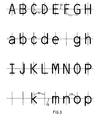
- the shape of the characters 24 (Figs. 3 and 4) is of the "sans serif" type, substantially similar to the shape of the OCR-B series of characters of the ECMA-11 standard, printed in October 1971. These characters are additionally adaptable to be typed at intervals of 1/10" and 1/12".
- the central point of typing is generally indicated by 10 in figures 3,4 and 5 and is defined by a vertical axis 11 and a horizontal axis 12.
- the axes of the printing face of some of the characters on the daisy wheel which are shown in figures 3 and 4 have shapes and locations which are completely identical to those of the corresponding OCR-B characters.
- Other characters and symbols, shown in figure 5 have special shapes and locations, which are different from those of OCR-B characters.
- the distribution of the characters, symbols and graphical signs present on the bases of the daisy wheel is shown in table 1, where, to each position 1, 2, 3...99 and 100 there corresponds one character, one symbol or one graphical sign from figures 3, 4 and 5.
- the arrangement and the shape of the characters, signs and symbols on the typing device is such as to allow all the characters and the graphical combinations derived from one common alphabetical stem to be represented. This is obtained either using individual strikes of the characters carried on the daisy wheel or by using a suitable combination of successive strikes of such characters, signs and symbols at the position of printing, which, depending on the individual case, are in alignment with the axis of typing 11 in figures 3,4 and 5 or are forwards or backwards with respect to the axis of typing 11 by a predetermined multiple of 1/60".
- the example which follows describes the method of transcribing decimal numbers, symbols representing commonly used foreign currencies, punctuation marks, arithmetical signs, fractions, heterogeneous symbols, graphical signs, etc.
- Tables 2,3,4 and 5 show, in column 1, the ISO code for the character, number, sign, etc. whilst the character, number, sign, etc. which is to be struck is shown in column two.
- the ISO codes which start with L indicate the 52 basic upper- case and lower-case characters of the Latin alphabet as well as Latin characters carrying diacritic accents and signs as well as other alphabetical characters which are not direct Latin characters, with any diacritic signs.
- the fifty-two letters of the alphabet are carried on the bases of the character-bearing disc, and the location of these can be seen in table 1. These fifty-two letters are typed each using one single strike with the exception of the "i" (lower case) and of the "X" (capital) as will be described below.
- the first column of table 2 indicates the symbol LA01 from the ISO draft recommendations referred to above, whilst the second column indicates the graphical sign, which in the case of this example is the a.
- the third column indicates that the character-bearing disc will be rotated so as to align the character at location 9, corresponding to the a (table 1), with the hammer 29, whilst the fourth column (table 2) indicates that the character will be printed using one single strike, as shown in figure 6, this being done so as to correspond, with the axis of printing 11 in the absence of other indications in the fourth column.
- the third column of table 5 does not have an entry since this is a composite character
- the fourth column indicates the first strike at location 32, corresponding to the sign "C" in table 1, without any additional indications so that, consequently, printing is carried out in alignment with the printing axis 11 (figures 3 and 5).
- the fifth column of table 5 indicates the second strike at location 85, corresponding to the "°" (degree symbol) in table 1, together with the indication.that the strike is carried out displaced by +1/60" with respect to the first strike. After the two strikes, the resulting character will have a practically continuous outline which defines the "@" in figure 6.
- the third column of table 4 does not include an entry since this is a composite character
- the first strike at location 58 corresponding to the sign "(" (elongated vertical line) of table 1
- the first strike at location 58 is carried out displaced by -2/60" with respect to the printing axis 11 so that the sign "1" is typed displaced backwards by 2/60" with respect to the printing axis 11.
- the second strike at location 18, corresponding to the letter "o" (lower-case) in table 11 is carried out displaced by +2/60" with respect to the first strike and the composite character will be typed in alignment with the print axis 11, as shown in figure 6.
- the third printing operation corresponds to the "1" sign in table 1, and this is carried out displaced by +2/60" with respect to the first and second printing operations, so that it is now on the print axis 11 of the final character.
- the sign "'" an upper dot, is used for the vowels and consonants which are dotted, as a sign of diaeresis and with punctuation marks, for example for forming the "i", the inverted exclamation mark.
- the comma sign ",” is used in combination with consonants which have a cedilla, for the symbol for the florin, for the semi-colon, for the Greek " ⁇ ” and for the Lapp "eng", both in the upper and lower case.
- the acute accent "'” and the grave accent “'” are used for forming the shortening sign "v", the circumflex accent and the double inverted commas.
- the location and distribution of the characters, signs and symbols as given in table 1 can be varied in accordance with various criteria which a person skilled in the art will easily be able to apply to a character-bearing disc employing flexible laminae, to a spherical print head, to a barrel-shaped character-bearing body and to any other type of printing body.
- a change results in the locations and printing positions given in tables 2,3,4 and 5.
- the positions which have been given in table 1 are those which allow the highest speed of printing when typing out texts in a wide range of languages.
Landscapes
- Engineering & Computer Science (AREA)
- Theoretical Computer Science (AREA)
- Health & Medical Sciences (AREA)
- Artificial Intelligence (AREA)
- Audiology, Speech & Language Pathology (AREA)
- Computational Linguistics (AREA)
- General Health & Medical Sciences (AREA)
- Physics & Mathematics (AREA)
- General Engineering & Computer Science (AREA)
- General Physics & Mathematics (AREA)
- Accessory Devices And Overall Control Thereof (AREA)
Applications Claiming Priority (2)
| Application Number | Priority Date | Filing Date | Title |
|---|---|---|---|
| IT5318381U | 1981-04-29 | ||
| ITTO1981U53183U IT8153183U1 (it) | 1981-04-29 | 1981-04-29 | Dispositivo di scrittura. |
Publications (3)
| Publication Number | Publication Date |
|---|---|
| EP0063938A2 true EP0063938A2 (fr) | 1982-11-03 |
| EP0063938A3 EP0063938A3 (en) | 1983-01-12 |
| EP0063938B1 EP0063938B1 (fr) | 1985-09-11 |
Family
ID=11280636
Family Applications (1)
| Application Number | Title | Priority Date | Filing Date |
|---|---|---|---|
| EP82302113A Expired EP0063938B1 (fr) | 1981-04-29 | 1982-04-26 | Dispositif de dactylographie |
Country Status (6)
| Country | Link |
|---|---|
| EP (1) | EP0063938B1 (fr) |
| JP (1) | JPS583244U (fr) |
| BR (1) | BR6200576U (fr) |
| DE (1) | DE3266132D1 (fr) |
| IT (1) | IT8153183U1 (fr) |
| MX (1) | MX153954A (fr) |
Cited By (2)
| Publication number | Priority date | Publication date | Assignee | Title |
|---|---|---|---|---|
| DE3614171A1 (de) * | 1985-05-13 | 1986-11-13 | VEB Kombinat Robotron, DDR 8010 Dresden | Verfahren und anordnung zum schreiben geschlossener schriftzeichen und schriftzuege aus segmentierten schriftzeichen mittels schreibmaschine |
| EP0249497A3 (en) * | 1986-06-13 | 1989-01-18 | Brother Kogyo Kabushiki Kaisha | Printing device for attribute printing |
Family Cites Families (4)
| Publication number | Priority date | Publication date | Assignee | Title |
|---|---|---|---|---|
| US3199446A (en) * | 1962-09-07 | 1965-08-10 | Ibm | Overprinting apparatus for printing a character and an accent |
| JPS6047112B2 (ja) * | 1977-05-25 | 1985-10-19 | 富士通株式会社 | 印字制御方式 |
| DE2847085C2 (de) * | 1977-10-31 | 1983-07-14 | Khaled Mahmud 32809 Orlando Fla. Diab | Verfahren und Vorrichtung zur Verarbeitung arabisch-farsischer Textdaten |
| US4359286A (en) * | 1980-11-20 | 1982-11-16 | International Business Machines Corporation | Character set expansion |
-
1981
- 1981-04-29 IT ITTO1981U53183U patent/IT8153183U1/it unknown
-
1982
- 1982-04-26 EP EP82302113A patent/EP0063938B1/fr not_active Expired
- 1982-04-26 DE DE8282302113T patent/DE3266132D1/de not_active Expired
- 1982-04-28 JP JP1982063130U patent/JPS583244U/ja active Pending
- 1982-04-28 MX MX192478A patent/MX153954A/es unknown
- 1982-04-29 BR BR6200576U patent/BR6200576U/pt unknown
Cited By (2)
| Publication number | Priority date | Publication date | Assignee | Title |
|---|---|---|---|---|
| DE3614171A1 (de) * | 1985-05-13 | 1986-11-13 | VEB Kombinat Robotron, DDR 8010 Dresden | Verfahren und anordnung zum schreiben geschlossener schriftzeichen und schriftzuege aus segmentierten schriftzeichen mittels schreibmaschine |
| EP0249497A3 (en) * | 1986-06-13 | 1989-01-18 | Brother Kogyo Kabushiki Kaisha | Printing device for attribute printing |
Also Published As
| Publication number | Publication date |
|---|---|
| IT8153183U1 (it) | 1982-10-29 |
| IT8153183V0 (it) | 1981-04-29 |
| MX153954A (es) | 1987-02-25 |
| JPS583244U (ja) | 1983-01-10 |
| BR6200576U (pt) | 1983-12-06 |
| DE3266132D1 (en) | 1985-10-17 |
| EP0063938A3 (en) | 1983-01-12 |
| EP0063938B1 (fr) | 1985-09-11 |
Similar Documents
| Publication | Publication Date | Title |
|---|---|---|
| US3945482A (en) | Orthogonal input keyboards | |
| US3929216A (en) | Input keyboards | |
| US4679951A (en) | Electronic keyboard system and method for reproducing selected symbolic language characters | |
| US4332493A (en) | Ten-finger typewriter keyboards | |
| US3970185A (en) | Syllabic typewriter | |
| JPS61502495A (ja) | 暗号解析装置 | |
| US4868913A (en) | System of encoding chinese characters according to their patterns and accompanying keyboard for electronic computer | |
| WO1994029111A1 (fr) | Systeme de clavier multilingue | |
| GB2123754A (en) | Improvements in or relating to a typewriter keyboard layout | |
| CA2404069C (fr) | Clavier convivial | |
| EP0063939B1 (fr) | Disposition pour taper à la machine | |
| AU2001247652A1 (en) | User friendly keyboard | |
| CN85100837A (zh) | 优化五笔字型编码法及其键盘 | |
| Seroul | A Beginner’s Book of TEX | |
| EP0063938B1 (fr) | Dispositif de dactylographie | |
| US3712444A (en) | Arrangement of keys of keyboard, especially for typewriter | |
| US1687939A (en) | Typewriting machine | |
| GB2071018A (en) | Improvements in method and apparatus for information processing | |
| Das et al. | Representing Ahamia, Bengali and Manipuri Text in Line Printer and Daisy-Wheel Printer | |
| GB2158626A (en) | Encoding Chinese and like characters and keyboard therefor | |
| EP0130941A1 (fr) | Dispositif électronique pour écrire automatiquement des idéogrammes chinois, sino-japonais et japonais | |
| US1204326A (en) | Type-writing machine. | |
| JPS6255511B2 (fr) | ||
| US1489616A (en) | Typewriting machine | |
| KR900005768B1 (ko) | 전자식 타자기에서 한글 인자시 리본 절약방법 |
Legal Events
| Date | Code | Title | Description |
|---|---|---|---|
| PUAI | Public reference made under article 153(3) epc to a published international application that has entered the european phase |
Free format text: ORIGINAL CODE: 0009012 |
|
| AK | Designated contracting states |
Designated state(s): CH DE FR GB LI SE |
|
| PUAL | Search report despatched |
Free format text: ORIGINAL CODE: 0009013 |
|
| AK | Designated contracting states |
Designated state(s): CH DE FR GB LI SE |
|
| 17P | Request for examination filed |
Effective date: 19830615 |
|
| GRAA | (expected) grant |
Free format text: ORIGINAL CODE: 0009210 |
|
| AK | Designated contracting states |
Designated state(s): CH DE FR GB LI SE |
|
| REF | Corresponds to: |
Ref document number: 3266132 Country of ref document: DE Date of ref document: 19851017 |
|
| ET | Fr: translation filed | ||
| PLBI | Opposition filed |
Free format text: ORIGINAL CODE: 0009260 |
|
| PLBI | Opposition filed |
Free format text: ORIGINAL CODE: 0009260 |
|
| 26 | Opposition filed |
Opponent name: ALFRED RANSMEYER & ALBERT RODRIAN Effective date: 19860604 |
|
| 26 | Opposition filed |
Opponent name: SIEMENS AKTIENGESELLSCHAFT, BERLIN UND MUENCHEN Effective date: 19860606 |
|
| PG25 | Lapsed in a contracting state [announced via postgrant information from national office to epo] |
Ref country code: SE Effective date: 19870427 |
|
| PG25 | Lapsed in a contracting state [announced via postgrant information from national office to epo] |
Ref country code: LI Effective date: 19870430 Ref country code: CH Effective date: 19870430 |
|
| XX | Miscellaneous (additional remarks) |
Free format text: WIDERRUF DES PATENTS FUER CH/LI, FR, GB, SE UNTER ZURUECKWEISUNG DER EINSPRUECHE BEZUEGLICH DE. |
|
| PG25 | Lapsed in a contracting state [announced via postgrant information from national office to epo] |
Ref country code: FR Free format text: LAPSE BECAUSE OF NON-PAYMENT OF DUE FEES Effective date: 19871230 |
|
| GBPC | Gb: european patent ceased through non-payment of renewal fee | ||
| REG | Reference to a national code |
Ref country code: CH Ref legal event code: PL |
|
| PG25 | Lapsed in a contracting state [announced via postgrant information from national office to epo] |
Ref country code: DE Effective date: 19880101 |
|
| REG | Reference to a national code |
Ref country code: FR Ref legal event code: ST |
|
| PG25 | Lapsed in a contracting state [announced via postgrant information from national office to epo] |
Ref country code: GB Effective date: 19881121 |
|
| PLBN | Opposition rejected |
Free format text: ORIGINAL CODE: 0009273 |
|
| STAA | Information on the status of an ep patent application or granted ep patent |
Free format text: STATUS: OPPOSITION REJECTED |
|
| 27O | Opposition rejected |
Effective date: 19870614 |
|
| EUG | Se: european patent has lapsed |
Ref document number: 82302113.4 Effective date: 19880906 |