EP0063944B1 - Polyhydric alcohols - Google Patents
Polyhydric alcohols Download PDFInfo
- Publication number
- EP0063944B1 EP0063944B1 EP82302126A EP82302126A EP0063944B1 EP 0063944 B1 EP0063944 B1 EP 0063944B1 EP 82302126 A EP82302126 A EP 82302126A EP 82302126 A EP82302126 A EP 82302126A EP 0063944 B1 EP0063944 B1 EP 0063944B1
- Authority
- EP
- European Patent Office
- Prior art keywords
- group
- hydroxymethyl
- formula
- sum
- compounds
- Prior art date
- Legal status (The legal status is an assumption and is not a legal conclusion. Google has not performed a legal analysis and makes no representation as to the accuracy of the status listed.)
- Expired
Links
Classifications
-
- C—CHEMISTRY; METALLURGY
- C07—ORGANIC CHEMISTRY
- C07C—ACYCLIC OR CARBOCYCLIC COMPOUNDS
- C07C255/00—Carboxylic acid nitriles
-
- C—CHEMISTRY; METALLURGY
- C08—ORGANIC MACROMOLECULAR COMPOUNDS; THEIR PREPARATION OR CHEMICAL WORKING-UP; COMPOSITIONS BASED THEREON
- C08G—MACROMOLECULAR COMPOUNDS OBTAINED OTHERWISE THAN BY REACTIONS ONLY INVOLVING UNSATURATED CARBON-TO-CARBON BONDS
- C08G18/00—Polymeric products of isocyanates or isothiocyanates
- C08G18/06—Polymeric products of isocyanates or isothiocyanates with compounds having active hydrogen
- C08G18/28—Polymeric products of isocyanates or isothiocyanates with compounds having active hydrogen characterised by the compounds used containing active hydrogen
- C08G18/30—Low-molecular-weight compounds
- C08G18/32—Polyhydroxy compounds; Polyamines; Hydroxyamines
- C08G18/3203—Polyhydroxy compounds
- C08G18/3206—Polyhydroxy compounds aliphatic
- C08G18/3209—Aliphatic aldehyde condensates and hydrogenation products thereof
-
- C—CHEMISTRY; METALLURGY
- C08—ORGANIC MACROMOLECULAR COMPOUNDS; THEIR PREPARATION OR CHEMICAL WORKING-UP; COMPOSITIONS BASED THEREON
- C08G—MACROMOLECULAR COMPOUNDS OBTAINED OTHERWISE THAN BY REACTIONS ONLY INVOLVING UNSATURATED CARBON-TO-CARBON BONDS
- C08G18/00—Polymeric products of isocyanates or isothiocyanates
- C08G18/06—Polymeric products of isocyanates or isothiocyanates with compounds having active hydrogen
- C08G18/28—Polymeric products of isocyanates or isothiocyanates with compounds having active hydrogen characterised by the compounds used containing active hydrogen
- C08G18/30—Low-molecular-weight compounds
- C08G18/38—Low-molecular-weight compounds having heteroatoms other than oxygen
- C08G18/3819—Low-molecular-weight compounds having heteroatoms other than oxygen having nitrogen
- C08G18/3823—Low-molecular-weight compounds having heteroatoms other than oxygen having nitrogen containing -N-C=O groups
- C08G18/3825—Low-molecular-weight compounds having heteroatoms other than oxygen having nitrogen containing -N-C=O groups containing amide groups
-
- C—CHEMISTRY; METALLURGY
- C08—ORGANIC MACROMOLECULAR COMPOUNDS; THEIR PREPARATION OR CHEMICAL WORKING-UP; COMPOSITIONS BASED THEREON
- C08G—MACROMOLECULAR COMPOUNDS OBTAINED OTHERWISE THAN BY REACTIONS ONLY INVOLVING UNSATURATED CARBON-TO-CARBON BONDS
- C08G18/00—Polymeric products of isocyanates or isothiocyanates
- C08G18/06—Polymeric products of isocyanates or isothiocyanates with compounds having active hydrogen
- C08G18/28—Polymeric products of isocyanates or isothiocyanates with compounds having active hydrogen characterised by the compounds used containing active hydrogen
- C08G18/30—Low-molecular-weight compounds
- C08G18/38—Low-molecular-weight compounds having heteroatoms other than oxygen
- C08G18/3819—Low-molecular-weight compounds having heteroatoms other than oxygen having nitrogen
- C08G18/3838—Low-molecular-weight compounds having heteroatoms other than oxygen having nitrogen containing cyano groups
Definitions
- the present invention relates to polyhydric alcohols and in particular to polyhydric alcohols having a further polar functional group.
- US Patent 4093637 in particular discloses the preparation of C 1 - s alkyl esters, such as the methyl, ethyl and butyl esters, of 9,9(10,10)-bis(hydroxymethyl) octadecanoic acid and describes these esters as being useful as intermediates in the preparation of primary plasticizers for polyvinylchloride. Further disclosure of hydroformylation technology is made in an article entitled "Obtention de derives biofunctionnels" by R. Lai in Rev. Fr. Corporation Gras. 17:455 (1970) b.
- Such compounds however, have carboxyl groups or hydrolyzable ester groups and are thus not fully usable for wetting pigments in polyurethane coatings.
- compounds such as those of the present invention are miscible with polyisocyanates used to formulate coating systems. It is, of course, necessary to have sufficient miscibility to allow the formulations of the polyhydroxy compounds of the present invention into polyurethanes.
- the compounds of the present invention may be utilized in any area where both a polyhydroxyl functionality and a polar group are required.
- polyhydroxymethyl compounds of formula I (wherein X represents a hydrogen atom or a hydroxymethyl group; M represents a cyano, ester or N,N-disubstituted amide group, the CH 2- M bond being a carbon-carbon bond; m, n, p, q, r, s and t are non-negative integers the sum of which is from 11 to 19; and n, q and s each has the value 0 or 1, the sum of n, q and s being 1, 2 or 3; with the provisos that where the sum of n, q and s is 1, X is a hydroxymethyl group, where the sum of n, q and s is 2 or 3, each group represented by X is the same and that where the sum of n, q and s is 1 and the sum of m, p, r and t is 14, M represents a cyano or N,N-disubstituted amide
- the polar group M preferably represents a cyano group, an ester group of formula -COOR or an amide group of formula -CONR 2 (in which R may be the same or different).
- the substituent R is an organic radical, preferably a C 1 - 4 straight chained or branched alkyl group, optionally substituted by a hydroxyl group, or a phenyl group.
- M represents the amide group -CONR 2
- the moiety NR 2 together may further represent a piperidino or morpholino group.
- the sum of m, n, p, q, r, s and t preferably is from 13 to 17.
- the integers m and t are each preferably at least 3, especially preferably 4, 5, 6 or greater. Where q is 1, it is preferred that n and s are each 0.
- the requirement for the compound of formula I to contain at least two hydroxymethyl groups (the proviso that where the sum of n, q and s is 1, X represents a hydroxymethyl group) will be satisfied where the molecule contains a gem bis hydroxymethyl group and/or where hydroxymethyl groups are located at different carbon atoms on the carbon chain backbone of the molecule of formula I.
- the present invention relates to polyhydroxyl compounds which contain a polar functional group which may be introduced into the molecule by one of several methods.
- the hydroxyl functionality may be introduced into the molecule by utilizing an unsaturated material which is hydroformylated e.g. by the use of synthesis gas (a carbon monoxide/hydrogen mixture) to introduce a formyl group at the site of the unsaturation.
- Catalysts may be selected such that a polyunsaturated material is either polyhydroformylated or is monohydroformylated.
- Rhodium catalysts give products which introduce the formyl group at substantially every location of unsaturation in the molecule.
- cobalt catalysts introduce a formyl group only at one site of unsaturation in conjugated polyunsaturated materials.
- the formyl groups can then be reacted via a Tollens' reaction utilizing a strong base and two moles of formaldehyde per mole of the original formyl group, to convert the formyl group directly to the gemina/-bis(hydroxymethyl) structures.
- the formyl group may be converted with selective catalysts such as sodium borohydride to convert the formyl group to a hydroxymethyl group. It is noted, however, that the present invention requires that if such a reaction is conducted the intermediate aldehyde must contain more than one formyl group to ensure that a polyhydroxymethyl compound will be obtained.
- a process for the preparation of polyhydroxymethyl compounds of formula I which process comprises (a) hydroformylating an olefinic compound of formula II (wherein M is as hereinbefore defined; a, b, c, d, e, f and g are non-negative integers, the sum of a, c, e, g, 2b, 2d and 2f being from 11 to 19; and b, d and f each has the value 0 or 1, the sum of b, d and f being 1, or 3) and (b) converting the or each group in the product thereby obtained (i) to a group by reacting with formaldehyde in the presence of a strong base, (ii) to a group by catalytic reduction, or (iii) to a group by reacting with formaldehyde in the presence of a weak base and subsequently to a group be reduction, subject to the proviso that where the product obtained by step (a)
- the starting materials of formula II which may be converted into the desired products of this invention include oleonitrile, a commercially available compound.
- the reactions are shown in the following scheme: Cat.9(10)-formyloctadecanonitrile (I) 9,9(10,10)-bis(hydroxymethyl)octadecanonitrile
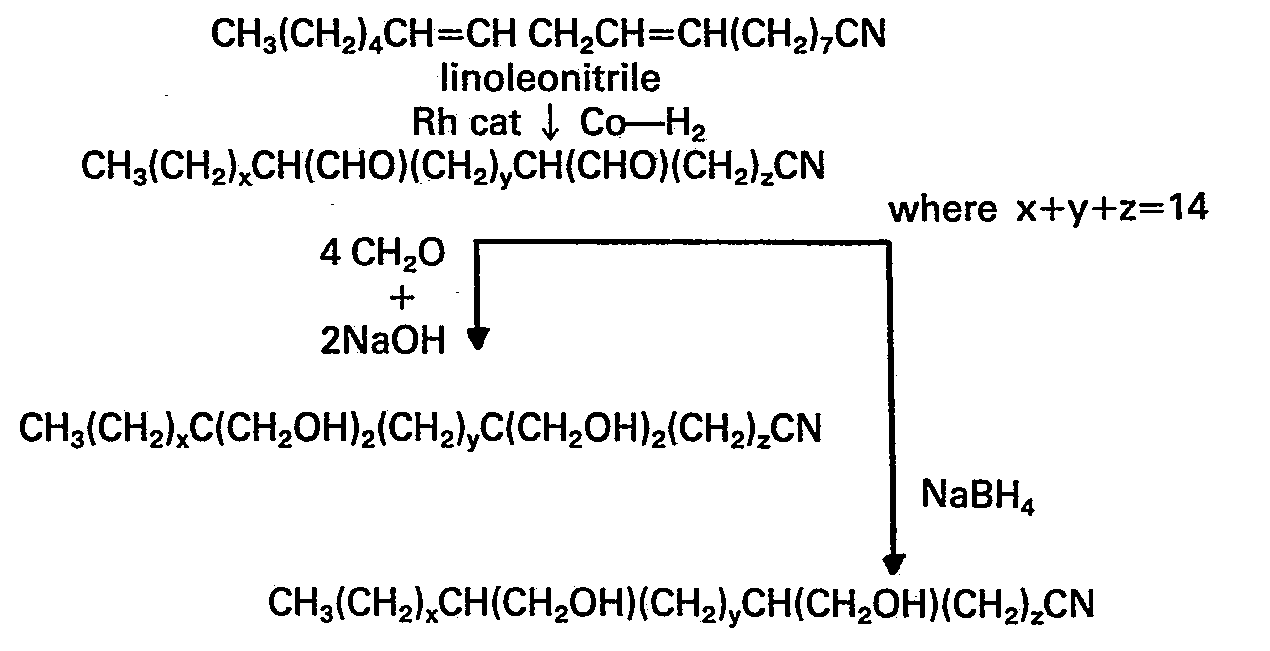
- linoleonitrile can be converted into a tetrahydroxynitrile or a dihydroxy nitrile as shown in the following scheme:
- linolenonitrile can be converted into the triformyl derivative by hydroformylation using a rhodium catalyst and synthesis gas.
- a tri [gem-bis(hydroxymethyl)] octadecanonitrile can be formed by reacting triformyl nitrile with excess formaldehyde and caustic.
- unsaturated fatty compounds having 13-23 carbon atoms excluding those in the polar substituent M
- having the above terminal polar function can be used for the preparation of the polyhydric alcohols of formula I.
- 9,9(10,10)-bis(hydroxymethyl)-N,N-disubstituted octadecanamide can be obtained from oleic acid as a starting material as illustrated in the following scheme:
- R in the disubstituted amide above may be for example dimethyl, diethyl, diphenyl, dibutyl, piperidene or morpholine.
- oleic acid is used as an example of the starting material, linoleic and linolenic acids could alternatively be used.
- ester of oleic acid may be converted very usefully through the use of isobutylene to give the tertiary butyl ester denominated as t-butyl 9,9(10,10)-bis(hydroxymethyl)octadecanoate.
- the t-butyl esters of linolenic and linoleic acids may also be employed analogously.
- Another class of compounds are noted as starting materials for reacting with synthesis gas to obtain compounds having formyl groups in more than one position in the molecule.
- This class includes linoleyl or linolenyl acids and alcohols as such starting materials are required to have more than one site of unsaturation.
- the two or three formyl groups which result from hydroformylation of a starting material containing two or three carbon-carbon double bonds, may be reduced with sodium borohydride to obtain the di- or tri hydroxymethyl product, e.g.
- the product will be, for instance, a 9(10), 12(13) di-hydroxymethyloctadecanonitrile, amide or ester, (such as a tertiary butyl ester).
- R Suggested values for R are those having from 1 to 4 carbon atoms such as methyl, ethyl, propyl, butyl, sec-butyl, hydroxypropyl, hydroxyethyl or mixtures thereof, and, for the moiety NR 2 , morpholino and piperidino groups.
- hydrogen and carbon monoxide are added in a closed vessel at temperatures of from 100 to 150 degrees C.
- the hydrogen and carbon monoxide may be maintained conveniently at molar ratios of from 1.5:0.5to about 0.5:1.5. It is noted that the ratio is not critical so long as the pressure is maintained in the reaction vessel by the component gases and the amount of hydrogen is not so great as to substantially reduce the unsaturated starting materials.
- hydroformylation with the synthesis gas may be conducted at from about 90 degrees C to about 170 degrees C, preferably from 110 degrees C to about 130 degrees C. Above the higher temperatures described above, increased amounts of unwanted by-products are formed in the reaction mixture.
- the pressure conditions suitably are maintained in this sealed system at from about 20 to about 500 atmospheres (20.3 to 506.6 bar), preferably from about 30 to about 100 atmospheres absolute (30.4 to 101.3 bar) during the hydroformylation.
- rhodium-based catalyst Conventional cobalt catalysts may be employed to obtain a single formyl group, but are not particularly suitable for polyunsaturated compounds due to reduction of the unsaturation.
- the practical catalyst to use during the synthesis gas reaction is a rhodium-based catalyst.
- the rhodium may be in any convenient form such as rhodium metal, rhodium oxide, and various other rhodium salts such as rhodium chloride, rhodium dicarbonyl chloride dimer, rhodium nitrate, rhodium trichloride and other similar materials.
- the rhodium catalyst is also best utilized with a ligand such as trisubstituted phosphine or trisubstituted phosphite.
- a ligand such as trisubstituted phosphine or trisubstituted phosphite.
- trisubstituted includes both alkyl and aryl compounds and the substituted compounds of alkyl and aryl compounds.
- a particularly valuable ligand for the rhodium carbonyl hydride is triphenylphosphite or triphenylphosphine in that both compounds are particularly useful in minimizing migration of the double bond thereby avoiding a large number of isomers with respect to the formyl group.
- triarylphosphines or triarylphosphites may be used for this purpose in the formation of the rhodium carbonylhydride ligand.
- the foregoing materials are extremely valuable in minimizing the undesired saturation of the double bond or the reduction of the formyl group.
- materials such as sodium borohydride may be utilized to reduce the formyl group to a hydroxymethyl group thereby obtaining desired compounds of the invention.
- formaldehyde (which is relatively inexpensive) may be used in for example up to 1.5, preferably up to 1.2 times the amount actually required to obtain the hydroxymethyl formyl or the gem-bis(hydroxymethyl) compounds.
- a convenient manner of adding the formaldehyde and conducting the Tollens' reaction is by using a methanol solution of formaldehyde.
- sodium hydroxide conveniently may be employed, although potassium or calcium hydroxide may alternatively be employed.
- the Tollens' reaction is generally conducted at a temperature of from about 0 degrees to about 100 degrees C, preferably from about 20 degrees C to about 70 degrees C.
- the compounds of the present invention are particularly suitable for use in reaction with polyisocyanates to form urethanes.
- a substantial advantage in the compounds of the present invention is that the polar group of the molecule enhances miscibility of the respective urethane forming components.
- Another significant advantage is the wetting ability of the polar groups which allows for the introduction of pigments such as organic or inorganic pigments, e.g. titanium dioxide, chrome yellow, calcium or barium Lithol, phthocyanines and oxide pigments thereby providing urethane coatings with a high pigment carrying capability.
- compositions comprising a compound of formula I or the reaction product thereof with a polyisocyanate.
- the reaction temperature is maintained between 16-27 degrees C for 20 minutes.
- the reaction mixture is stripped under vacuum at 49 degrees C to remove methanol and water.
- the residual product is washed at 54 degrees C with 500 millilitres of water plus 100 millilitres of saturated sodium sulfate solution.
- the upper organic phase is separated and washed successively with 500 millilitres of 0.1 N sodium hydroxide solution and 4x with 500 millilitres portions of water.
- the product is finally dried in partial vacuum (1 mm Hg (1.33 mbar)) at 70 degrees C.
- the yield of crude BHMON was 832 grams.
- Thermoplastic and thermosetting polymers are prepared as shown in the Table.
- BHON is used to indicate 9(10) gem-bis (hydroxymethyl)octadecanonitrile.
- MDI is methylene diisocyanate and PM 1000 is PolyMeg 1000 a polyoxytetramethylene glycol. The ratios are in equivalents.
- BD indicates 1,4 butane diol and C-20 triol is 9(10)gem-bis(hydroxymethyl)octadecanol.
- A is a thermoplastic elastomer and B is thermosetting elastomer.
Landscapes
- Chemical & Material Sciences (AREA)
- Organic Chemistry (AREA)
- Health & Medical Sciences (AREA)
- Chemical Kinetics & Catalysis (AREA)
- Medicinal Chemistry (AREA)
- Polymers & Plastics (AREA)
- Organic Low-Molecular-Weight Compounds And Preparation Thereof (AREA)
- Pigments, Carbon Blacks, Or Wood Stains (AREA)
- Paints Or Removers (AREA)
- Transition And Organic Metals Composition Catalysts For Addition Polymerization (AREA)
Abstract
Description
- The present invention relates to polyhydric alcohols and in particular to polyhydric alcohols having a further polar functional group.
- It is now known that certain polyhydric alcohols, particularly those having a geminal- bis(hydroxymethyl) functionality are highly useful for curing urethane compositions. Such work is described in the United States patent 4,216,343 of Rogier issued August 5, 1980 which discloses gemina/-bis(hydroxymethyl) alcohols which also contain a terminal hydroxyl functionality. An example of such a compound is gem-bis(hydroxymethyl) octadecanol.
- It has been found highly desirable to use such compounds due to the high reactivity of the hydroxyl groups and the stability of the polyol. Additional work concerning such materials is shown in a series of articles from the Northern Regional Research Laboratory (NRRL) of the United States Department of Agriculture at Peoria, Illinois, U.S.A. Representative of such materials worked on by the NRRL are 9,9(10,10)-bis(hydroxymethyl) octadecanoate esters and the corresponding acid. Such work is described by Miller and Pryde [J. Amer. Oil Chemists Soc. 54, 822A-885A (1977); ibid, 55, 469―470 (1978); U.S. Patent 4,093,637]. US Patent 4093637 in particular discloses the preparation of C1-s alkyl esters, such as the methyl, ethyl and butyl esters, of 9,9(10,10)-bis(hydroxymethyl) octadecanoic acid and describes these esters as being useful as intermediates in the preparation of primary plasticizers for polyvinylchloride. Further disclosure of hydroformylation technology is made in an article entitled "Obtention de derives biofunctionnels" by R. Lai in Rev. Fr. Corps Gras. 17:455 (1970) b.
- Such compounds, however, have carboxyl groups or hydrolyzable ester groups and are thus not fully usable for wetting pigments in polyurethane coatings. Furthermore, compounds such as those of the present invention are miscible with polyisocyanates used to formulate coating systems. It is, of course, necessary to have sufficient miscibility to allow the formulations of the polyhydroxy compounds of the present invention into polyurethanes. Of course, the compounds of the present invention may be utilized in any area where both a polyhydroxyl functionality and a polar group are required.
- Throughout the specification and claims, percentages and ratios are by weight, pressure is gauge, and temperatures are in degrees Celsius unless otherwise indicated.
- According to one aspect of the present invention we provide polyhydroxymethyl compounds of formula I

- In the compounds of the invention, the polar group M preferably represents a cyano group, an ester group of formula -COOR or an amide group of formula -CONR2 (in which R may be the same or different). The substituent R is an organic radical, preferably a C1-4 straight chained or branched alkyl group, optionally substituted by a hydroxyl group, or a phenyl group. Where M represents the amide group -CONR2, the moiety NR2 together may further represent a piperidino or morpholino group.
- The sum of m, n, p, q, r, s and t preferably is from 13 to 17. The integers m and t are each preferably at least 3, especially preferably 4, 5, 6 or greater. Where q is 1, it is preferred that n and s are each 0. The requirement for the compound of formula I to contain at least two hydroxymethyl groups (the proviso that where the sum of n, q and s is 1, X represents a hydroxymethyl group) will be satisfied where the molecule contains a gem bis hydroxymethyl group and/or where hydroxymethyl groups are located at different carbon atoms on the carbon chain backbone of the molecule of formula I.
- The present invention relates to polyhydroxyl compounds which contain a polar functional group which may be introduced into the molecule by one of several methods. The hydroxyl functionality may be introduced into the molecule by utilizing an unsaturated material which is hydroformylated e.g. by the use of synthesis gas (a carbon monoxide/hydrogen mixture) to introduce a formyl group at the site of the unsaturation. Catalysts may be selected such that a polyunsaturated material is either polyhydroformylated or is monohydroformylated. Rhodium catalysts give products which introduce the formyl group at substantially every location of unsaturation in the molecule. On the other hand, cobalt catalysts introduce a formyl group only at one site of unsaturation in conjugated polyunsaturated materials.
- The formyl groups can then be reacted via a Tollens' reaction utilizing a strong base and two moles of formaldehyde per mole of the original formyl group, to convert the formyl group directly to the gemina/-bis(hydroxymethyl) structures.
- However, if it is desired, the formyl group may be converted with selective catalysts such as sodium borohydride to convert the formyl group to a hydroxymethyl group. It is noted, however, that the present invention requires that if such a reaction is conducted the intermediate aldehyde must contain more than one formyl group to ensure that a polyhydroxymethyl compound will be obtained.
- According to a further aspect of the present invention we provide a process for the preparation of polyhydroxymethyl compounds of formula I which process comprises (a) hydroformylating an olefinic compound of formula II


- The starting materials of formula II which may be converted into the desired products of this invention include oleonitrile, a commercially available compound. The reactions are shown in the following scheme:


- In a similar fashion, linoleonitrile can be converted into a tetrahydroxynitrile or a dihydroxy nitrile as shown in the following scheme:
- Likewise, linolenonitrile can be converted into the triformyl derivative by hydroformylation using a rhodium catalyst and synthesis gas. A tri [gem-bis(hydroxymethyl)] octadecanonitrile can be formed by reacting triformyl nitrile with excess formaldehyde and caustic.
- In this invention, unsaturated fatty compounds having 13-23 carbon atoms (excluding those in the polar substituent M) and having the above terminal polar function can be used for the preparation of the polyhydric alcohols of formula I.
- Similarly, 9,9(10,10)-bis(hydroxymethyl)-N,N-disubstituted octadecanamide can be obtained from oleic acid as a starting material as illustrated in the following scheme:

- (A 9,9(10,10)-bis(hydroxymethyl)-N,N-disubstituted octadecanamide).
- The value of R in the disubstituted amide above may be for example dimethyl, diethyl, diphenyl, dibutyl, piperidene or morpholine. Again, while oleic acid is used as an example of the starting material, linoleic and linolenic acids could alternatively be used.
- It has been found that one particular ester of oleic acid may be converted very usefully through the use of isobutylene to give the tertiary butyl ester denominated as t-butyl 9,9(10,10)-bis(hydroxymethyl)octadecanoate. The t-butyl esters of linolenic and linoleic acids may also be employed analogously.
- Another class of compounds are noted as starting materials for reacting with synthesis gas to obtain compounds having formyl groups in more than one position in the molecule. This class includes linoleyl or linolenyl acids and alcohols as such starting materials are required to have more than one site of unsaturation. The two or three formyl groups, which result from hydroformylation of a starting material containing two or three carbon-carbon double bonds, may be reduced with sodium borohydride to obtain the di- or tri hydroxymethyl product, e.g. using a linolenyl starting material the product will be, for instance, a 9(10), 12(13) di-hydroxymethyloctadecanonitrile, amide or ester, (such as a tertiary butyl ester).
- Suggested values for R are those having from 1 to 4 carbon atoms such as methyl, ethyl, propyl, butyl, sec-butyl, hydroxypropyl, hydroxyethyl or mixtures thereof, and, for the moiety NR2, morpholino and piperidino groups.
- To conduct the synthesis gas reaction, hydrogen and carbon monoxide are added in a closed vessel at temperatures of from 100 to 150 degrees C. The hydrogen and carbon monoxide may be maintained conveniently at molar ratios of from 1.5:0.5to about 0.5:1.5. It is noted that the ratio is not critical so long as the pressure is maintained in the reaction vessel by the component gases and the amount of hydrogen is not so great as to substantially reduce the unsaturated starting materials.
- In practice, hydroformylation with the synthesis gas may be conducted at from about 90 degrees C to about 170 degrees C, preferably from 110 degrees C to about 130 degrees C. Above the higher temperatures described above, increased amounts of unwanted by-products are formed in the reaction mixture. The pressure conditions suitably are maintained in this sealed system at from about 20 to about 500 atmospheres (20.3 to 506.6 bar), preferably from about 30 to about 100 atmospheres absolute (30.4 to 101.3 bar) during the hydroformylation.
- Conventional cobalt catalysts may be employed to obtain a single formyl group, but are not particularly suitable for polyunsaturated compounds due to reduction of the unsaturation. Conveniently, however, the practical catalyst to use during the synthesis gas reaction is a rhodium-based catalyst. The rhodium may be in any convenient form such as rhodium metal, rhodium oxide, and various other rhodium salts such as rhodium chloride, rhodium dicarbonyl chloride dimer, rhodium nitrate, rhodium trichloride and other similar materials. The rhodium catalyst is also best utilized with a ligand such as trisubstituted phosphine or trisubstituted phosphite. The term trisubstituted includes both alkyl and aryl compounds and the substituted compounds of alkyl and aryl compounds.
- A particularly valuable ligand for the rhodium carbonyl hydride is triphenylphosphite or triphenylphosphine in that both compounds are particularly useful in minimizing migration of the double bond thereby avoiding a large number of isomers with respect to the formyl group. In general, triarylphosphines or triarylphosphites may be used for this purpose in the formation of the rhodium carbonylhydride ligand. In addition, the foregoing materials are extremely valuable in minimizing the undesired saturation of the double bond or the reduction of the formyl group.
- As was previously noted, materials such as sodium borohydride may be utilized to reduce the formyl group to a hydroxymethyl group thereby obtaining desired compounds of the invention.
- However, in most cases it is desirable to convert the formyl group completely to the gem-bis(hydroxymethyl) structure via a Tollens' reaction. Such may be achieved by utilizing a strong base as a reactant. Should it be desired for some reason, weak base and one mole formaldehyde may be used to obtain the hydroxymethyl formyl compound which may be utilized for various purposes including subsequent reduction of the formyl group to give the gem-bis(hydroxymethyl) variety of the claimed compounds.
- In either case, formaldehyde (which is relatively inexpensive) may be used in for example up to 1.5, preferably up to 1.2 times the amount actually required to obtain the hydroxymethyl formyl or the gem-bis(hydroxymethyl) compounds. A convenient manner of adding the formaldehyde and conducting the Tollens' reaction is by using a methanol solution of formaldehyde.
- As a strong base sodium hydroxide conveniently may be employed, although potassium or calcium hydroxide may alternatively be employed. The Tollens' reaction is generally conducted at a temperature of from about 0 degrees to about 100 degrees C, preferably from about 20 degrees C to about 70 degrees C.
- The compounds of the present invention are particularly suitable for use in reaction with polyisocyanates to form urethanes. A substantial advantage in the compounds of the present invention is that the polar group of the molecule enhances miscibility of the respective urethane forming components. Another significant advantage is the wetting ability of the polar groups which allows for the introduction of pigments such as organic or inorganic pigments, e.g. titanium dioxide, chrome yellow, calcium or barium Lithol, phthocyanines and oxide pigments thereby providing urethane coatings with a high pigment carrying capability.
- According to a further aspect of the present invention we therefore provide coating and moulding compositions comprising a compound of formula I or the reaction product thereof with a polyisocyanate.
- The following Examples are provided to illustrate the present invention without serving to restrict the scope of protection sought therefor:-
- Into a 1 litre 316 SS autoclave equipped with stirrer and heat exchange coil is place 617 grams of oleonitrile, 3.0 grams of 5 percent rhodium on aluminium (Englehardt Industries) and 3.2 grams of triphenylphosphite. The autoclave is flushed with nitrogen then pressurized with carbon monoxidehydrogen (1:1) to 1080 psig (7.446 MPa gauge). The temperature is increased to 127-133 degrees C and maintained for 3.3 hours with a CO-H2 pressure of 970-1080 psig (6.688 to 7.446 MPa gauge). At this point a GC analysis indicated complete reaction of oleonitrile with the formation of FON. The reaction was cooled, the pressure vented and the product filtered. The yield of FON is 681 g. Rhodium is removed from the product by vacuum distillation.
- Into a 3 litre glass reaction flask is placed 762 grams (2.60 moles) of formyloctadecanonitrile, 321 grams (5.84 moles) of a 54.6 percent solution of formaldehyde in methanol (Methyl Formcel, a product of Celanese Chemical Company), and 6.6 millilitres of 40 percent solution of sodium hydroxide in water. The temperature of the system is maintained at 40 degrees C for 36 minutes then increased to 50 degrees C.
- After 25 minutes, a 40 percent solution of sodium hydroxide in water is added at a rate of 5.3 millilitres/minute until, including the 6.6 millilitres initially added, a total of 297 grams has been added. Temperature is maintained at 45-50 degrees C throughout the addition and then held at 50 degrees C for an additional 2 hours. The reaction mixture was cooled to 16 degrees C and 27.9 grams of a 12 percent solution of sodium borohydride in 43 percent sodium hydroxide is added.
- The reaction temperature is maintained between 16-27 degrees C for 20 minutes.
- The reaction mixture is stripped under vacuum at 49 degrees C to remove methanol and water. The residual product is washed at 54 degrees C with 500 millilitres of water plus 100 millilitres of saturated sodium sulfate solution. The upper organic phase is separated and washed successively with 500 millilitres of 0.1 N sodium hydroxide solution and 4x with 500 millilitres portions of water. The product is finally dried in partial vacuum (1 mm Hg (1.33 mbar)) at 70 degrees C. The yield of crude BHMON was 832 grams.
- Hydroformylation of 9,12-linoleonitrile was carried out similar to conditions described in Preparative Example A, except that the CO-H2 pressure is maintained at 2000 psig (13.79 MPa gauge).
- Into a solution of 8.86 grams of 9(10),12(13)-diformyloctadecanonitrile (containing about 47 percent 9(10)-formyloctadecanonitrile) in 8.3 grams of isopropyl alcohol at 25 degrees C is added 0.77 grams of sodium borohydride over a period of 5 minutes. After 4 hours at 28 degrees C, additional sodium borohydride (9.24 grams) is added. After 44 minutes the reaction is worked up by addition of 5 millilitres acetone, distillation of the volatiles in vacuo. The residue is dissolved in a mixture of ether-water and the ether layer is washed with water. Evaporation of the ether yielded 7.60 grams of 9(10),12(13)-bis(hydroxymethyl) octadecanonitrile containing some 9(10)-hydroxymethyloctadecanonitrile. Identification of the products was made by I.R., NMR and GC-MS.
- Into a solution of 8.86 grams of 9(10),12(13)-diformyloctadecanonitrile (containing about 47 percent 9(10)-formyloctadecanonitrile) in 8.3 grams of isopropyl alcohol at 25 degrees C is added 0.77 grams of sodium borohydride over a period of 5 minutes. After 4 hours at 28 degrees C, additional sodium borohydride (0.24) grams is added. After 44 minutes the reaction is worked up by addition of 5 millilitres acetone and distillation of the volatiles in vacuo. The residue is dissolved in a mixture of ether-water and the ether layer is washed with water. Evaporation of the ether yielded 7.60 grams of 9(10),12(13)-bis(hydroxymethyl)octadecanonitrile. Identification of the products is made by I.R., NMR and GC-MS.
- Thermoplastic and thermosetting polymers are prepared as shown in the Table.

- These products show exceptional split tear strength.
- BHON is used to indicate 9(10) gem-bis (hydroxymethyl)octadecanonitrile. MDI is methylene diisocyanate and PM 1000 is PolyMeg 1000 a polyoxytetramethylene glycol. The ratios are in equivalents. BD indicates 1,4 butane diol and C-20 triol is 9(10)gem-bis(hydroxymethyl)octadecanol. A is a thermoplastic elastomer and B is thermosetting elastomer.
Claims (9)


Priority Applications (1)
| Application Number | Priority Date | Filing Date | Title |
|---|---|---|---|
| AT82302126T ATE14212T1 (en) | 1981-04-27 | 1982-04-26 | POLYHYDRICAL ALCOHOLS. |
Applications Claiming Priority (2)
| Application Number | Priority Date | Filing Date | Title |
|---|---|---|---|
| US257674 | 1981-04-27 | ||
| US06/257,674 US4356128A (en) | 1981-04-27 | 1981-04-27 | Fatty polyhydric alcohols having a polar functional group |
Publications (2)
| Publication Number | Publication Date |
|---|---|
| EP0063944A1 EP0063944A1 (en) | 1982-11-03 |
| EP0063944B1 true EP0063944B1 (en) | 1985-07-10 |
Family
ID=22977266
Family Applications (1)
| Application Number | Title | Priority Date | Filing Date |
|---|---|---|---|
| EP82302126A Expired EP0063944B1 (en) | 1981-04-27 | 1982-04-26 | Polyhydric alcohols |
Country Status (3)
| Country | Link |
|---|---|
| EP (1) | EP0063944B1 (en) |
| AT (1) | ATE14212T1 (en) |
| DE (1) | DE3264652D1 (en) |
Families Citing this family (4)
| Publication number | Priority date | Publication date | Assignee | Title |
|---|---|---|---|---|
| EP0266436A1 (en) * | 1986-10-03 | 1988-05-11 | HENKEL CORPORATION (a Delaware corp.) | Substituted fatty ethers |
| EP0263192A1 (en) * | 1986-10-03 | 1988-04-13 | HENKEL CORPORATION (a Delaware corp.) | Dicyanoethenyl fatty compounds and derivatives thereof |
| US4626582A (en) * | 1985-02-28 | 1986-12-02 | Henkel Corporation | Acryloxymethyl substituted fatty compounds |
| US7615658B2 (en) | 2003-04-25 | 2009-11-10 | Dow Global Technologies, Inc. | Aldehyde and alcohol compositions derived from seed oils |
Family Cites Families (4)
| Publication number | Priority date | Publication date | Assignee | Title |
|---|---|---|---|---|
| US2605270A (en) * | 1949-06-21 | 1952-07-29 | Swern Daniel | Amides of 9, 10-dihydroxystearic acid |
| FR1184093A (en) * | 1956-10-08 | 1959-07-16 | Rohm & Haas | Process for the hydroxylation of aliphatic acids, esters and nitriles |
| US4093637A (en) * | 1977-01-31 | 1978-06-06 | The United States Of America As Represented By The Secretary Of Agriculture | Alkyl 9,9(10,10)-bis(acyloxymethyl)octadecanoates as primary plasticizers for polyvinylchloride |
| EP0017503B1 (en) * | 1979-04-04 | 1982-12-29 | HENKEL CORPORATION (a Delaware corp.) | Gem-bis (hydroxymethyl) alcohols and mixtures thereof with diols, process for their preparation and a process for the preparation of polyurethanes therefrom |
-
1982
- 1982-04-26 EP EP82302126A patent/EP0063944B1/en not_active Expired
- 1982-04-26 AT AT82302126T patent/ATE14212T1/en not_active IP Right Cessation
- 1982-04-26 DE DE8282302126T patent/DE3264652D1/en not_active Expired
Also Published As
| Publication number | Publication date |
|---|---|
| DE3264652D1 (en) | 1985-08-14 |
| EP0063944A1 (en) | 1982-11-03 |
| ATE14212T1 (en) | 1985-07-15 |
Similar Documents
| Publication | Publication Date | Title |
|---|---|---|
| EP0049631B1 (en) | Polycyclic alcohols | |
| US4356128A (en) | Fatty polyhydric alcohols having a polar functional group | |
| US4216343A (en) | High molecular weight polyhydric alcohols | |
| EP2081882B1 (en) | Hydroformylation process | |
| US4243818A (en) | High molecular weight products | |
| US4229562A (en) | Polyurethanes based on high molecular weight formyl alcohols | |
| US4216344A (en) | High molecular weight polyol mixtures | |
| US3732287A (en) | Bismonocarboxylic esters of 3-formylbutanediol-1,2 | |
| EP3759064B1 (en) | Producing bdo via hydroformylation of allyl alcohol made from glycerin | |
| US3947503A (en) | Manufacture of 1,6-hexanediol from butadiene | |
| EP0063944B1 (en) | Polyhydric alcohols | |
| US4101588A (en) | Production of bis-(dimethyl) acetals of hexane dialdehydes | |
| US4304945A (en) | High molecular weight products | |
| US3966827A (en) | Production of 3-methylpentane-1,5-diol | |
| US4337363A (en) | Process for the preparation of 3-(4-methyl-3-cyclohexen-1-yl) butyraldehyde | |
| JP7247817B2 (en) | Dialdehyde compound having norbornane skeleton and cyclohexadione skeleton and method for producing the same | |
| EP0017503B1 (en) | Gem-bis (hydroxymethyl) alcohols and mixtures thereof with diols, process for their preparation and a process for the preparation of polyurethanes therefrom | |
| JPS5846491B2 (en) | C↓Production method of 6-alkanedial or its acetal | |
| GB1565719A (en) | Process for preparing butanediols | |
| US4642391A (en) | High molecular weight products | |
| EP0151822B1 (en) | Process for the preparation of 1,4-butanediol | |
| US4582946A (en) | Polyhydric alcohols | |
| KR20070079027A (en) | 3 (4), 7 (8) -dihydroxymethylbicyclo [4.3.0] nonane and preparation method thereof | |
| JPH08295683A (en) | Method for producing 3-formyltetrahydrofuran | |
| EP0293818A2 (en) | Process for the preparation of carbonyl compounds by isomerization of allylalcohols |
Legal Events
| Date | Code | Title | Description |
|---|---|---|---|
| PUAI | Public reference made under article 153(3) epc to a published international application that has entered the european phase |
Free format text: ORIGINAL CODE: 0009012 |
|
| AK | Designated contracting states |
Designated state(s): AT BE CH DE FR GB IT LI LU NL SE |
|
| 17P | Request for examination filed |
Effective date: 19830110 |
|
| RAP1 | Party data changed (applicant data changed or rights of an application transferred) |
Owner name: HENKEL CORPORATION |
|
| ITF | It: translation for a ep patent filed | ||
| GRAA | (expected) grant |
Free format text: ORIGINAL CODE: 0009210 |
|
| AK | Designated contracting states |
Designated state(s): AT BE CH DE FR GB IT LI LU NL SE |
|
| REF | Corresponds to: |
Ref document number: 14212 Country of ref document: AT Date of ref document: 19850715 Kind code of ref document: T |
|
| REF | Corresponds to: |
Ref document number: 3264652 Country of ref document: DE Date of ref document: 19850814 |
|
| ET | Fr: translation filed | ||
| PGFP | Annual fee paid to national office [announced via postgrant information from national office to epo] |
Ref country code: AT Payment date: 19860326 Year of fee payment: 5 |
|
| PG25 | Lapsed in a contracting state [announced via postgrant information from national office to epo] |
Ref country code: LU Free format text: LAPSE BECAUSE OF NON-PAYMENT OF DUE FEES Effective date: 19860430 |
|
| PGFP | Annual fee paid to national office [announced via postgrant information from national office to epo] |
Ref country code: NL Payment date: 19860430 Year of fee payment: 5 |
|
| PLBE | No opposition filed within time limit |
Free format text: ORIGINAL CODE: 0009261 |
|
| STAA | Information on the status of an ep patent application or granted ep patent |
Free format text: STATUS: NO OPPOSITION FILED WITHIN TIME LIMIT |
|
| 26N | No opposition filed | ||
| PG25 | Lapsed in a contracting state [announced via postgrant information from national office to epo] |
Ref country code: SE Effective date: 19870427 |
|
| BERE | Be: lapsed |
Owner name: HENKEL CORP. Effective date: 19870430 |
|
| PG25 | Lapsed in a contracting state [announced via postgrant information from national office to epo] |
Ref country code: NL Effective date: 19871101 |
|
| NLV4 | Nl: lapsed or anulled due to non-payment of the annual fee | ||
| PG25 | Lapsed in a contracting state [announced via postgrant information from national office to epo] |
Ref country code: FR Free format text: LAPSE BECAUSE OF NON-PAYMENT OF DUE FEES Effective date: 19871230 |
|
| GBPC | Gb: european patent ceased through non-payment of renewal fee | ||
| REG | Reference to a national code |
Ref country code: FR Ref legal event code: ST |
|
| PG25 | Lapsed in a contracting state [announced via postgrant information from national office to epo] |
Ref country code: AT Effective date: 19880426 |
|
| PG25 | Lapsed in a contracting state [announced via postgrant information from national office to epo] |
Ref country code: LI Effective date: 19880430 Ref country code: CH Effective date: 19880430 |
|
| PG25 | Lapsed in a contracting state [announced via postgrant information from national office to epo] |
Ref country code: GB Effective date: 19881121 |
|
| REG | Reference to a national code |
Ref country code: CH Ref legal event code: PL |
|
| PG25 | Lapsed in a contracting state [announced via postgrant information from national office to epo] |
Ref country code: DE Effective date: 19890103 |
|
| PG25 | Lapsed in a contracting state [announced via postgrant information from national office to epo] |
Ref country code: BE Effective date: 19890430 |
|
| EUG | Se: european patent has lapsed |
Ref document number: 82302126.6 Effective date: 19880906 |