EP0063977A1 - Optische Interferometereinrichtung mit Phasenkonjugierungsspiegel, insbesondere für Laser-Gyrometer - Google Patents
Optische Interferometereinrichtung mit Phasenkonjugierungsspiegel, insbesondere für Laser-Gyrometer Download PDFInfo
- Publication number
- EP0063977A1 EP0063977A1 EP82400626A EP82400626A EP0063977A1 EP 0063977 A1 EP0063977 A1 EP 0063977A1 EP 82400626 A EP82400626 A EP 82400626A EP 82400626 A EP82400626 A EP 82400626A EP 0063977 A1 EP0063977 A1 EP 0063977A1
- Authority
- EP
- European Patent Office
- Prior art keywords
- optical device
- mirror
- interferometric optical
- phase conjugation
- phase
- Prior art date
- Legal status (The legal status is an assumption and is not a legal conclusion. Google has not performed a legal analysis and makes no representation as to the accuracy of the status listed.)
- Granted
Links
- 230000021615 conjugation Effects 0.000 title claims abstract description 53
- 230000003287 optical effect Effects 0.000 title claims abstract description 51
- 230000005855 radiation Effects 0.000 claims abstract description 40
- 239000013307 optical fiber Substances 0.000 claims abstract description 12
- 230000009021 linear effect Effects 0.000 claims abstract description 7
- 239000000835 fiber Substances 0.000 claims abstract description 4
- 102100021943 C-C motif chemokine 2 Human genes 0.000 claims description 12
- 102100034871 C-C motif chemokine 8 Human genes 0.000 claims description 12
- 101710091439 Major capsid protein 1 Proteins 0.000 claims description 12
- 101710091437 Major capsid protein 2 Proteins 0.000 claims description 12
- AEUKDPKXTPNBNY-XEYRWQBLSA-N mcp 2 Chemical compound C([C@@H](C(=O)N[C@@H](CS)C(=O)N[C@@H](CCCNC(N)=N)C(=O)N[C@@H]([C@@H](C)CC)C(=O)N[C@@H](CCCNC(N)=N)C(=O)NCC(=O)N[C@@H](CCCNC(N)=N)C(=O)N[C@@H]([C@@H](C)CC)C(=O)N[C@@H](CC=1NC=NC=1)C(=O)N1[C@@H](CCC1)C(=O)N[C@@H](CC(C)C)C(=O)N[C@@H](CS)C(=O)N[C@@H](CS)C(=O)N[C@@H](CCCNC(N)=N)C(=O)N[C@@H](CCCNC(N)=N)C(O)=O)NC(=O)CNC(=O)[C@H](C)NC(=O)[C@H](CCCNC(N)=N)NC(=O)[C@H](CCCNC(N)=N)NC(=O)[C@H](CCC(O)=O)NC(=O)[C@H](CC(C)C)NC(=O)[C@H]1N(CCC1)C(=O)[C@H](CC(C)C)NC(=O)[C@H](CS)NC(=O)[C@H](CC(C)C)NC(=O)[C@H](C)NC(=O)[C@H](CCCNC(N)=N)NC(=O)[C@H](CCCNC(N)=N)NC(=O)[C@H](CS)NC(=O)[C@H](C)NC(=O)[C@H](CS)NC(=O)[C@@H](NC(=O)[C@@H](N)C(C)C)C(C)C)C1=CC=CC=C1 AEUKDPKXTPNBNY-XEYRWQBLSA-N 0.000 claims description 12
- 230000010363 phase shift Effects 0.000 claims description 4
- 230000001360 synchronised effect Effects 0.000 claims description 3
- 239000013256 coordination polymer Substances 0.000 claims 1
- 238000005070 sampling Methods 0.000 claims 1
- 239000011521 glass Substances 0.000 description 8
- 230000004075 alteration Effects 0.000 description 6
- 239000006185 dispersion Substances 0.000 description 4
- 230000000694 effects Effects 0.000 description 4
- 230000014509 gene expression Effects 0.000 description 4
- 239000000203 mixture Substances 0.000 description 4
- 230000008901 benefit Effects 0.000 description 3
- 238000010586 diagram Methods 0.000 description 3
- 230000010287 polarization Effects 0.000 description 3
- 230000005684 electric field Effects 0.000 description 2
- 230000005672 electromagnetic field Effects 0.000 description 2
- 230000003071 parasitic effect Effects 0.000 description 2
- 230000004044 response Effects 0.000 description 2
- 229920006395 saturated elastomer Polymers 0.000 description 2
- 238000004611 spectroscopical analysis Methods 0.000 description 2
- ZCYVEMRRCGMTRW-UHFFFAOYSA-N 7553-56-2 Chemical compound [I] ZCYVEMRRCGMTRW-UHFFFAOYSA-N 0.000 description 1
- 241000282326 Felis catus Species 0.000 description 1
- 238000001069 Raman spectroscopy Methods 0.000 description 1
- 240000008042 Zea mays Species 0.000 description 1
- 230000009471 action Effects 0.000 description 1
- JRPBQTZRNDNNOP-UHFFFAOYSA-N barium titanate Chemical compound [Ba+2].[Ba+2].[O-][Ti]([O-])([O-])[O-] JRPBQTZRNDNNOP-UHFFFAOYSA-N 0.000 description 1
- 229910002113 barium titanate Inorganic materials 0.000 description 1
- 230000005540 biological transmission Effects 0.000 description 1
- 229910052797 bismuth Inorganic materials 0.000 description 1
- JCXGWMGPZLAOME-UHFFFAOYSA-N bismuth atom Chemical compound [Bi] JCXGWMGPZLAOME-UHFFFAOYSA-N 0.000 description 1
- 238000010276 construction Methods 0.000 description 1
- 239000013078 crystal Substances 0.000 description 1
- 230000001066 destructive effect Effects 0.000 description 1
- 238000001514 detection method Methods 0.000 description 1
- 230000005670 electromagnetic radiation Effects 0.000 description 1
- 235000021183 entrée Nutrition 0.000 description 1
- 230000003993 interaction Effects 0.000 description 1
- PNDPGZBMCMUPRI-UHFFFAOYSA-N iodine Chemical compound II PNDPGZBMCMUPRI-UHFFFAOYSA-N 0.000 description 1
- 229910052740 iodine Inorganic materials 0.000 description 1
- 239000011630 iodine Substances 0.000 description 1
- 238000005259 measurement Methods 0.000 description 1
- 230000007246 mechanism Effects 0.000 description 1
- 230000009022 nonlinear effect Effects 0.000 description 1
- 230000010349 pulsation Effects 0.000 description 1
- 230000035945 sensitivity Effects 0.000 description 1
- LIVNPJMFVYWSIS-UHFFFAOYSA-N silicon monoxide Chemical class [Si-]#[O+] LIVNPJMFVYWSIS-UHFFFAOYSA-N 0.000 description 1
- 229910052814 silicon oxide Inorganic materials 0.000 description 1
- 238000011144 upstream manufacturing Methods 0.000 description 1
- 238000004804 winding Methods 0.000 description 1
Images


Classifications
-
- G—PHYSICS
- G01—MEASURING; TESTING
- G01C—MEASURING DISTANCES, LEVELS OR BEARINGS; SURVEYING; NAVIGATION; GYROSCOPIC INSTRUMENTS; PHOTOGRAMMETRY OR VIDEOGRAMMETRY
- G01C19/00—Gyroscopes; Turn-sensitive devices using vibrating masses; Turn-sensitive devices without moving masses; Measuring angular rate using gyroscopic effects
- G01C19/58—Turn-sensitive devices without moving masses
- G01C19/64—Gyrometers using the Sagnac effect, i.e. rotation-induced shifts between counter-rotating electromagnetic beams
- G01C19/72—Gyrometers using the Sagnac effect, i.e. rotation-induced shifts between counter-rotating electromagnetic beams with counter-rotating light beams in a passive ring, e.g. fibre laser gyrometers
Definitions
- the invention relates to interferometric optical devices excited by laser light, and is particularly interested in passive laser gyrometers.
- the aberrations present on the optical path of the laser beam are troublesome in these devices, especially in gyrometers, where two waves propagate in opposite directions on a substantially closed circuit. It is first of all difficult to render and maintain these two rigorously collinear waves, which results in an offset and a drift of zero. There is also an "optical noise", linked to the optical path fluctuations. Although various expedients make it possible to arrive at satisfactory rate gyros, it remains highly desirable to improve the situation.
- the present invention precisely allows very good compensation for aberrations on the optical paths of the device.
- the phase conjugation mirror includes an optically non-linear medium.
- two reverse pump waves are applied to this medium.
- the pump waves are defined from a sample taken from the input laser radiation.
- the two mirror members are members forming a phase conjugation mirror.
- the comparison means comprise the separating plate already mentioned and another separating plate placed on the path of the laser radiation in its part common to the two different downstream paths and two photodetector devices which respectively receive the radiation extracted by the two blades dividers.
- the two phase conjugation mirrors can, in at least some cases, be combined into one.
- the two phase conjugation mirrors are close to each other, and the two downstream paths together form at least one loop (of non-zero surface). A laser gyrometer is thus obtained.
- the two different downstream paths form two substantially closed circuits, which are substantially of the same geometry, and spatially close to one another (superimposed for example).
- the different downstream paths are defined, at least in part, by optical fibers.
- the optical fibers are multimode fibers.
- the reference E symbolically denotes an input, for example a perforated screen, through which laser radiation RL can enter an interferometer, which is here of the Michelson or more precisely Twyman-Green type.
- a separating plate S1 divides the laser beam into two parts, which respectively follow different optical paths T1 and T2.
- different optical paths are understood here in that the optical paths can be different, or in that, the optical paths being partly the same, the divided laser beam will travel in opposite directions.
- Part of the laser beam therefore crosses the separating plate SI to follow an optical path T1, and go to a first phase conjugation mirror denoted MCP1.
- Part of this incident laser beam is reflected in the opposite direction on the path T1, to be returned back to the separating plate S1.
- the beam having undergone the path T1 will be partly diverted towards a detector D1.
- the other part of the beam will cross the separating plate S1, to resume the path of entry of the radiation.
- another separating plate S2 is also provided, which will make it possible again to divert a part of the same reflected beam to another photodetector D2.
- the part of the incident beam RL which will be reflected by the separating plate S2 can be used for example to serve as a reference on the intensity of the incident laser radiation.
- the other part of this incident radiation will be reflected on the separating plate S1 downwards, along a second optical path T2, ending preferably a second MCP2 phase conjugation mirror.
- the latter reflects part of the beam it receives, and this part is therefore returned by the separating plate S1.
- Part of this reflected radiation will pass through the separating plate S1 to also go to the photodetector D1.
- Another part will be reflected on the separating plate S1, then on the separating plate S2, to strike the photodetector D2.
- the signals obtained at the photodetector D1, and possibly at the photodetector D2 when this is provided are representative of optical non-reciprocities existing on both of the paths T1 and T2.
- the dashed frame noted NR represents such non-reciprocity.
- phase conjugation mirrors can be of different types. Reflection with phase conjugation presupposes, a priori a reversal of the wave front, and also, in all rigor, a phase of the returned wave which is opposite to that of the incident wave, to within a constant phase, specific of the mirror, and independent of the incident wave (but this criterion on the phase is not always considered as imperative).
- phase conjugation mirror one can, for example, explore the wavefront of the laser radiation by means of a heterodyne detector array. Using a laser forming a local oscillator, the phase is measured at each detector, then by servo controls, we act on phase shifters which will produce the returned conjugate wave. It has also been proposed to use a retroreflector mechanism, consisting of a very large number of small cube corner prisms, for certain applications.
- the present invention advantageously uses a non-linear effect in an optical medium.
- a non-linear effect in an optical medium.
- the present invention currently recommends the use of a mirror with strict phase conjugation, based on a degenerate mixture with four waves, as schematically illustrated in the figure. 3.
- the mixture is said to be degenerate when the four waves have the same frequency.
- the optically non-linear media or ONLM are the crystals of bismuth and silicon oxides (Bi 12 Si O 20 ) or barium titanate (Ti 0 3 Ba).
- the wave is defined by the real part of this complex expression.
- U is here a quantity, possibly complex, of the form Eo. f (x, y, z), representing the amplitude of the incident wave (Eo) and its geometry f (x, y, z).
- exp denotes the complex exponential function
- i denotes the usual symbol for complex numbers
- ⁇ denotes the angular pulsation of the incident wave
- t denotes time
- k is the number.
- z denotes a measurement of the spatial coordinate of propagation of the wave along the axis Oz of FIG. 3
- V and W are amplitude parameters, preferably not complex and independent of space as much as possible.
- k denotes each time the wave number of these pump waves in the parallel direction OY, and ⁇ + and tp_ are representative of the initial phases of the two waves.
- This polarization radiates a reflected electromagnetic field (E c ), also proportional to equation (6), and which manifests phase conjugation.
- This reflected conjugate field is in all points, except for a constant complex coefficient, obtained by reversing time in the expression of the incident wave. This means that, spatially, the wavefront will return with exactly the same geometry as it had before meeting the phase conjugation mirror. This is illustrated very schematically ment in FIGS. 4A and 4B, for the reversal of the wave front.
- FIG. 4A an incident plane wave front F 1 ′ which is passed through a glass rod is assumed. Because of the different propagation speed in the glass, at the exit of the glass rod, the plane wave F 1 will be transformed into a wave F 2 , which remains plane, except in a part forming a rear setback at the level where the wave crossed the glass rod. After reflection on a conventional mirror MC, the wave returns to F 3 , the step having now changed sides, according to the laws of reflection of traditional optics. After it has again crossed the glass rod BV, the wave at F 4 will have a step which is now of double amplitude.
- This simple example shows that a reflection on a phase conjugation mirror makes it possible to get rid of any optical anomaly or aberration present on the wave propagation path, of which the example of a glass rod is not than a schematic illustration.
- the pump waves are defined from a fraction of the incident laser radiation RL, reflected first of all by a third separating plate S3.
- the path of the pump waves from S3 is defined by a long dashed line, and firstly includes a reflection on a conventional mirror MC1, the outward crossing of the first phase conjugation mirror MCP2, a new reflection on a second mirror classic MC2, the forward crossing of the phase conjugation mirror MCP1, pure and simple reflection on the same path by an MC3 mirror, which is either a classic mirror, or preferably a cube corner retro-reflector or an eye of cat.
- the cavity generating the input laser radiation can include the path of the pump waves, MC3 being one of the mirrors of the cavity, and the structure being a little different on the input E side and blade S3.
- the return wave is independent of the optical path in this arm, as well as the distance traveled by l wave, except when the T1 and / or T2 paths are subject to non-reciprocities.
- FIGS. 2A and 2B show the shape of the signals detected by the photodetectors D1 and D2 of FIGS. 2 or 1. This amplitude is plotted on the ordinate, the abscissa being representative of a parameter relating to the non-reciprocity of the medium present in one and / or the other of the two arms T1 and T2. More precisely, this parameter represents the difference in optical path between the two arms, created by non-reciprocity.
- this situation is verified by a time reversal operation applied to the device: this time reversal must give back, towards the laser, a wave similar to the incident wave, and conjugate of the latter.
- the only signal obtained at the detector D1 is generally not sufficient, and therefore a second detector is preferably provided in D2, with the associated separating plate S2, to use either only the signal obtained in D2, ie a combination of the two signals obtained in D1 and D2, which can be for example the difference D1 - D2.
- a polarizer such as a Glan prism
- This polarizer makes it possible to obtain selectivity on the conjugate wave, by eliminating any parasitic signals, for example coming from the phase conjugation mirror.
- a polarizer of the same kind can be placed on the other arm T2, of which only the start is illustrated in Figure 5, as in Figures 6 to 8.
- a spatial filter is interposed in the arm T1 of the interferometer, consisting of a pinhole-type diaphragm, placed at the focus of a telescope, shown diagrammatically in FIG. 6 by two lenses and on the other side of the pinhole.
- This makes it possible to carry out the selection of the electromagnetic propagation mode conventionally designated by TEM 00 , and thereby allows better rejection of the parasitic signals.
- TEM 00 electromagnetic propagation mode
- such a filter is advantageously also interposed on the other arm T2 of the interferometer.
- FIG. 7 illustrates another variant, which involves a phase shift of the radiation on at least one of the two arms of the interferometer, here the arm T1.
- the active part of the phase shifter denoted VPM
- VPM is constituted by a medium capable of playing on the phase of the wave, which can also be constituted by a non-reciprocal, but known system, and controlled by a phase control device CDPH .
- a phase shifter one can use for example the Faraday effect, already mentioned, in a manner known per se.
- the arrangement of FIG. 7 has the important advantage of allowing adjustment of the operating point of the interferometer, since it makes it possible to vary the phase on one of the paths, or else to vary it differently on the two. T1 and T2 routes.
- FIG. 8 Another variant is illustrated in FIG. 8, and it involves modulation on the path T1.
- a phase modulator LM is therefore interposed on the path T1 of the interferometer, this modulator being supplied from a frequency source F, a source which is denoted HORL in FIG. 8.
- the electrical signals collected by the photodetectors D1 and D2 are applied respectively to synchronous detection stages shown diagrammatically in SD1 and SD2, stages which also receive the modulation frequency F.
- Such modulation greatly facilitates the use of the detected signals.
- This modulation may or may not be reciprocal, which depends in particular on the response time of the phase conjugation mirrors used.
- phase modulation is performed in one direction on the arm T1 of the interferometer, and phase modulation in opposition to the same frequency on the other arm T2 of l interferometer, which is only sketched in figure 8.
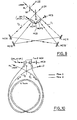
- the preferred embodiment of the present invention relates to passive laser gyrometers, two embodiments of which will now be described, with reference to FIGS. 9 and 10.
- the incident laser radiation RL is applied first to the blade S2, then to the separating blade S1.
- the part of the radiation which passes through SI follows a path T1, which passes over the conventional mirrors MC11, then MC12, to form a substantially closed circuit, which results in a first phase conjugation mirror MCP1, placed near the separating plate S1.
- the part of the incident radiation which is reflected by the separating plate SI follows the path illustrated in center line, and denoted T2, which goes first to a mirror MC21, close to MC12, then to a mirror MC22, close to MC11, to finally lead to a second phase conjugation mirror MCP2, close to the separating plate SI and especially of MCP1.
- the two phase conjugation mirrors respectively return the waves they receive so that they return to the same path as before, which therefore brings them respectively by paths T1 and T2 to the separating plate S1.
- Interference then occurs at the level of the separating plate S1, and the resulting optical signal is perceived by the photodetector D1.
- Other, different interference occurs as previously indicated at the level of the separating plate S2, and the resulting optical signal is perceived by the other photodetector D2.
- This structure with phase conjugation mirrors is very advantageous in the case of a passive gyrometer, since it allows in particular to get rid of all the aberrations encountered by electromagnetic radiation on the separate paths T1 and T2: in d
- the optical device is automatically adjusted whatever the aberrations on the optical paths, and also the differences in reciprocal and stationary steps.
- the interference state detected on D1 or D2 is independent of the position of the mirrors, and of any differences in reciprocal steps likely to occur on the arms.
- a particularly interesting system is thus obtained in that, by construction, the combination of means used is only sensitive to phenomenon to be measured, namely the rotation of the gyrometer.
- FIG. 1C illustrates an even more interesting embodiment of a gyrometer, capable of the same variants as above.
- a single separating blade S has been shown, which corresponds to SI previously, and which receives the incident laser radiation.
- a first optical fiber T1 shown in a thick solid line, receives the radiation which passes through the separating plate S. This fiber makes N turns on itself, finally leading to a phase conjugation mirror MCP.
- a second optical fiber illustrated in thick axis line, defines a path T2, very close to the path T1, having the same number of turns N, but winding in the opposite direction , to also end up on the MCP phase conjugation mirror.
- the two optical paths T1 and T2 are again substantially closed, the MCP mirror being very close to the separating plate S; these optical paths have substantially the same geometry, and are spatially close to one another.
- FIG. 10 shows another characteristic of the invention, according to which a single mirror with phase conjugation MCP can, in certain configurations, play the role of two mirrors MCP1 and MCP2 previously used.
- phase conjugation mirror or mirrors are suitably excited by pump waves OP + and OP_, which can also come from incident laser radiation (variant not shown), while the return of the pump wave to obtain the two directions of propagation is ensured by a conventional mirror MC3, preferably of the cube corner or cat's eye type.
- the interference state present at the level of the plate S of FIG. 10 is detected by a photodetector D, and can be treated as previously, or in any other known way to obtain a signal representative of the rotation of the gyrometer. In the same way as in the other embodiments, it is of course possible to provide another separating plate placed upstream of S, and associated with a second detector.
- FIG. 10 has yet another very important advantage: in combination with the phase conjugation mirrors of such a gyroscope, multimode optical fibers can be used, which was practically not possible with gyrometers liabilities of the prior art.
- phase conjugation mirrors can be produced, the conjugated wave of which is amplified with respect to the incident wave. This makes it possible to use very long optical fibers, and consequently to increase the sensitivity of the gyrometer by at least an order of magnitude.
Landscapes
- Physics & Mathematics (AREA)
- Engineering & Computer Science (AREA)
- Optics & Photonics (AREA)
- Electromagnetism (AREA)
- Power Engineering (AREA)
- General Physics & Mathematics (AREA)
- Radar, Positioning & Navigation (AREA)
- Remote Sensing (AREA)
- Lasers (AREA)
- Instruments For Measurement Of Length By Optical Means (AREA)
- Gyroscopes (AREA)
Applications Claiming Priority (2)
| Application Number | Priority Date | Filing Date | Title |
|---|---|---|---|
| FR8107054 | 1981-04-08 | ||
| FR8107054A FR2503862B1 (fr) | 1981-04-08 | 1981-04-08 | Dispositif optique interferometrique avec miroir(s) a conjugaison de phase, en particulier pour gyrometre laser |
Publications (2)
| Publication Number | Publication Date |
|---|---|
| EP0063977A1 true EP0063977A1 (de) | 1982-11-03 |
| EP0063977B1 EP0063977B1 (de) | 1986-02-26 |
Family
ID=9257164
Family Applications (1)
| Application Number | Title | Priority Date | Filing Date |
|---|---|---|---|
| EP82400626A Expired EP0063977B1 (de) | 1981-04-08 | 1982-04-06 | Optische Interferometereinrichtung mit Phasenkonjugierungsspiegel, insbesondere für Laser-Gyrometer |
Country Status (5)
| Country | Link |
|---|---|
| US (1) | US4575245A (de) |
| EP (1) | EP0063977B1 (de) |
| JP (1) | JPS57184268A (de) |
| DE (1) | DE3269295D1 (de) |
| FR (1) | FR2503862B1 (de) |
Cited By (3)
| Publication number | Priority date | Publication date | Assignee | Title |
|---|---|---|---|---|
| EP0113890A3 (en) * | 1982-12-18 | 1985-01-09 | International Standard Electric Corporation | Rotation speed measuring apparatus |
| US4681446A (en) * | 1984-06-11 | 1987-07-21 | Rockwell International Corporation | Phase conjugate fiber gyroscope |
| US5765030A (en) * | 1996-07-19 | 1998-06-09 | Symantec Corp | Processor emulator module having a variable pre-fetch queue size for program execution |
Families Citing this family (13)
| Publication number | Priority date | Publication date | Assignee | Title |
|---|---|---|---|---|
| US4803429A (en) * | 1986-09-15 | 1989-02-07 | California Institute Of Technology | Recovering polarization of light of arbitrary polarization propagating through distoring medium by phase conjugation reflection back through said medium |
| US4921353A (en) * | 1988-07-05 | 1990-05-01 | Rockwell International Corporation | High speed photorefractive image comparator |
| US4938596A (en) * | 1989-01-05 | 1990-07-03 | The University Of Rochester | Phase conjugate, common path interferometer |
| US5018852A (en) * | 1990-08-16 | 1991-05-28 | The United States Of America As Represented By The Administrator Of The National Aeronautics And Space Administration | Motion detection, novelty filtering, and target tracking using an interferometric technique with GaAs phase conjugate mirror |
| US5120133A (en) * | 1990-12-21 | 1992-06-09 | United States Of America Is Represented By The Secretary Of The Navy | Interferometer with two phase-conjugate mirrors |
| DE4242882C2 (de) * | 1992-12-18 | 1996-02-22 | Fraunhofer Ges Forschung | Verfahren zum Prüfen asphärisch gekrümmter Oberflächen und Interferometer-Anordnung hierfür |
| FR2754893B1 (fr) * | 1996-10-21 | 1999-01-08 | Sfim Ind | Gyroscope a fibre optique multimode |
| FR2788127B1 (fr) * | 1999-01-05 | 2001-03-23 | Sfim Ind | Perfectionnements aux gyroscopes a boucle a fibre optique et a miroir a double conjugaison de phase |
| US6906784B2 (en) * | 2002-03-04 | 2005-06-14 | Zygo Corporation | Spatial filtering in interferometry |
| US7286240B2 (en) * | 2003-06-19 | 2007-10-23 | Zygo Corporation | Compensation for geometric effects of beam misalignments in plane mirror interferometer metrology systems |
| FR2860291B1 (fr) * | 2003-09-26 | 2005-11-18 | Thales Sa | Dispositif capteur de vitesse de rotation interferometrique a fibre optique |
| US7359057B2 (en) * | 2005-08-26 | 2008-04-15 | Ball Aerospace & Technologies Corp. | Method and apparatus for measuring small shifts in optical wavelengths |
| KR100784838B1 (ko) * | 2006-03-08 | 2007-12-14 | 한국과학기술원 | 유도브릴루앙 산란 위상공액거울의 위상 안정화장치를 이용한 광증폭장치 |
Citations (4)
| Publication number | Priority date | Publication date | Assignee | Title |
|---|---|---|---|---|
| US4198162A (en) * | 1978-05-23 | 1980-04-15 | Bell Telephone Laboratories, Incorporated | Tunable wide angular aperture filter by degenerate four-wave mixing |
| FR2446482A1 (fr) * | 1979-01-15 | 1980-08-08 | Max Planck Gesellschaft | Procede et appareil pour la mesure d'angles et de vitesses de rotation a l'aide d'une fibre optique |
| FR2449897A1 (fr) * | 1979-02-23 | 1980-09-19 | Thomson Csf | Gyrometre interferometrique a fibre optique particulierement adapte a la mesure de faibles vitesses de rotation |
| EP0026128A1 (de) * | 1979-09-21 | 1981-04-01 | Thomson-Csf | Holografische Speichervorrichtung und optisches Informationsbehandlungssystem mit einer solchen Vorrichtung |
Family Cites Families (2)
| Publication number | Priority date | Publication date | Assignee | Title |
|---|---|---|---|---|
| US4280764A (en) * | 1980-02-21 | 1981-07-28 | The United States Of America As Represented By The Secretary Of The Navy | Phase-conjugate interferometer |
| US4429393A (en) * | 1981-06-12 | 1984-01-31 | Hughes Aircraft Company | Double phase-conjugate ring resonator |
-
1981
- 1981-04-08 FR FR8107054A patent/FR2503862B1/fr not_active Expired
-
1982
- 1982-04-06 EP EP82400626A patent/EP0063977B1/de not_active Expired
- 1982-04-06 DE DE8282400626T patent/DE3269295D1/de not_active Expired
- 1982-04-08 US US06/366,662 patent/US4575245A/en not_active Expired - Fee Related
- 1982-04-08 JP JP57058922A patent/JPS57184268A/ja active Pending
Patent Citations (4)
| Publication number | Priority date | Publication date | Assignee | Title |
|---|---|---|---|---|
| US4198162A (en) * | 1978-05-23 | 1980-04-15 | Bell Telephone Laboratories, Incorporated | Tunable wide angular aperture filter by degenerate four-wave mixing |
| FR2446482A1 (fr) * | 1979-01-15 | 1980-08-08 | Max Planck Gesellschaft | Procede et appareil pour la mesure d'angles et de vitesses de rotation a l'aide d'une fibre optique |
| FR2449897A1 (fr) * | 1979-02-23 | 1980-09-19 | Thomson Csf | Gyrometre interferometrique a fibre optique particulierement adapte a la mesure de faibles vitesses de rotation |
| EP0026128A1 (de) * | 1979-09-21 | 1981-04-01 | Thomson-Csf | Holografische Speichervorrichtung und optisches Informationsbehandlungssystem mit einer solchen Vorrichtung |
Non-Patent Citations (2)
| Title |
|---|
| JOURNAL OF THE OPTICAL SOCIETY OF AMERICA, vol. 70, no. 11, novembre 1980, pages 1320-1323, New York, USA * |
| OPTICS COMMUNICATIONS, vol. 31, no. 3, decembre 1979, pages 257-258, Amsterdam, NL. * |
Cited By (3)
| Publication number | Priority date | Publication date | Assignee | Title |
|---|---|---|---|---|
| EP0113890A3 (en) * | 1982-12-18 | 1985-01-09 | International Standard Electric Corporation | Rotation speed measuring apparatus |
| US4681446A (en) * | 1984-06-11 | 1987-07-21 | Rockwell International Corporation | Phase conjugate fiber gyroscope |
| US5765030A (en) * | 1996-07-19 | 1998-06-09 | Symantec Corp | Processor emulator module having a variable pre-fetch queue size for program execution |
Also Published As
| Publication number | Publication date |
|---|---|
| US4575245A (en) | 1986-03-11 |
| FR2503862B1 (fr) | 1985-11-22 |
| JPS57184268A (en) | 1982-11-12 |
| FR2503862A1 (fr) | 1982-10-15 |
| EP0063977B1 (de) | 1986-02-26 |
| DE3269295D1 (en) | 1986-04-03 |
Similar Documents
| Publication | Publication Date | Title |
|---|---|---|
| EP0063977B1 (de) | Optische Interferometereinrichtung mit Phasenkonjugierungsspiegel, insbesondere für Laser-Gyrometer | |
| EP0457668B1 (de) | Fiberoptische Messeinrichtung, Gyroskop, Stabilisierungssystem und Strom- oder Magnetfeldsensor | |
| EP2972086B1 (de) | Interferometrische glasfaser-messvorrichtung mit einem ringresonator, gyrometer und trägheitshaltung oder navigationseinheit mit solch einer vorrichtung | |
| EP0120737B1 (de) | Faseroptischer Wasserschallempfänger | |
| EP0031274B1 (de) | Ring-interferometrische Vorrichtung und deren Verwendung zum Nachweisen nicht-gegenseitiger Effekte | |
| EP0050059A1 (de) | Hybrid-optisches Verbindungselement und Anwendung in einem Ring-Interferometer | |
| EP0027763B1 (de) | Verfahren und Apparat zur Abstandsmessung durch Laserinterferometrie mit zwei Wellenlängen | |
| EP0647311B1 (de) | Völlig integrierter optischer kreisel von sagnac typ | |
| CA2649067C (fr) | Procede et dispositif de mesure a fibre optique, et gyrometre asservis en puissance | |
| EP0095960B1 (de) | Einrichtung zum Speichern eines kohärenten Bildes in einem optischen Multimodalhohlraum | |
| EP0266249A1 (de) | Dreiachsiges optisches Fiberringinterferometer | |
| FR2642843A1 (fr) | Appareil de detection de rotation a fibre optique et procede de traitement de signaux representatifs de la difference de phase entre deux ondes se propageant en sens contraires | |
| FR2492522A1 (fr) | Gyroscope a laser en anneau comportant une egalisation de dispersion | |
| EP3657224B1 (de) | Feste oder einstellbare optische verzögerungsleitungsvorrichtung | |
| WO2016005691A1 (fr) | Système interférométrique à fibre optique | |
| FR2990751A1 (fr) | Systeme de mesure interferometrique a fibre optique et systeme inertiel de guidage ou de navigation comprenant un tel systeme de mesure interferometrique | |
| EP0007826B1 (de) | Interferometrischer Gyrometer mit optischer Faser | |
| FR2876447A1 (fr) | Gyrolaser a etat solide stabilise a quatre modes sans zone aveugle | |
| FR2672393A1 (fr) | Capteur de vitesse angulaire a laser en anneau et procede pour le faire fonctionner. | |
| FR2544858A1 (fr) | Capteur de vitesse de rotation a laser en anneau | |
| EP0680038B1 (de) | Vorrichtung zur Überwachung der Lage und/oder der Fokussierung eines fokussierten Lichtstrahls | |
| FR2526938A1 (fr) | Gyroscope a laser a fibre optique | |
| EP0448415B1 (de) | Abstandsdetektionsanordnung einer physikalischen Grösse durch Reflektion | |
| EP0938644B1 (de) | Multimodaler faseroptischer kreisel mit verbesserter auflösung und stabilität | |
| EP0837302B1 (de) | Optischer Faserkreisel mit mehreren Betriebsarten |
Legal Events
| Date | Code | Title | Description |
|---|---|---|---|
| PUAI | Public reference made under article 153(3) epc to a published international application that has entered the european phase |
Free format text: ORIGINAL CODE: 0009012 |
|
| AK | Designated contracting states |
Designated state(s): DE GB NL SE |
|
| 17P | Request for examination filed |
Effective date: 19830316 |
|
| GRAA | (expected) grant |
Free format text: ORIGINAL CODE: 0009210 |
|
| AK | Designated contracting states |
Designated state(s): DE GB NL SE |
|
| REF | Corresponds to: |
Ref document number: 3269295 Country of ref document: DE Date of ref document: 19860403 |
|
| R20 | Corrections of a patent specification |
Effective date: 19860605 |
|
| PLBE | No opposition filed within time limit |
Free format text: ORIGINAL CODE: 0009261 |
|
| STAA | Information on the status of an ep patent application or granted ep patent |
Free format text: STATUS: NO OPPOSITION FILED WITHIN TIME LIMIT |
|
| RAP2 | Party data changed (patent owner data changed or rights of a patent transferred) |
Owner name: ETABLISSEMENT PUBLIC DIT: CENTRE NATIONAL DE LA R |
|
| 26N | No opposition filed | ||
| D20 | Corrections of a patent specification (deleted) | ||
| R20 | Corrections of a patent specification |
Effective date: 19870128 |
|
| PGFP | Annual fee paid to national office [announced via postgrant information from national office to epo] |
Ref country code: GB Payment date: 19900402 Year of fee payment: 9 |
|
| PGFP | Annual fee paid to national office [announced via postgrant information from national office to epo] |
Ref country code: DE Payment date: 19900421 Year of fee payment: 9 |
|
| PGFP | Annual fee paid to national office [announced via postgrant information from national office to epo] |
Ref country code: SE Payment date: 19900426 Year of fee payment: 9 |
|
| PGFP | Annual fee paid to national office [announced via postgrant information from national office to epo] |
Ref country code: NL Payment date: 19900430 Year of fee payment: 9 |
|
| PG25 | Lapsed in a contracting state [announced via postgrant information from national office to epo] |
Ref country code: GB Effective date: 19910406 |
|
| PG25 | Lapsed in a contracting state [announced via postgrant information from national office to epo] |
Ref country code: SE Effective date: 19910407 |
|
| PG25 | Lapsed in a contracting state [announced via postgrant information from national office to epo] |
Ref country code: NL Effective date: 19911101 |
|
| GBPC | Gb: european patent ceased through non-payment of renewal fee | ||
| NLV4 | Nl: lapsed or anulled due to non-payment of the annual fee | ||
| PG25 | Lapsed in a contracting state [announced via postgrant information from national office to epo] |
Ref country code: DE Effective date: 19920201 |
|
| EUG | Se: european patent has lapsed |
Ref document number: 82400626.6 Effective date: 19911108 |