EP0064355A1 - Process for the reduction of sulphur dioxide - Google Patents
Process for the reduction of sulphur dioxide Download PDFInfo
- Publication number
- EP0064355A1 EP0064355A1 EP82302020A EP82302020A EP0064355A1 EP 0064355 A1 EP0064355 A1 EP 0064355A1 EP 82302020 A EP82302020 A EP 82302020A EP 82302020 A EP82302020 A EP 82302020A EP 0064355 A1 EP0064355 A1 EP 0064355A1
- Authority
- EP
- European Patent Office
- Prior art keywords
- reactor
- mixture
- elemental sulfur
- molar ratio
- coal
- Prior art date
- Legal status (The legal status is an assumption and is not a legal conclusion. Google has not performed a legal analysis and makes no representation as to the accuracy of the status listed.)
- Withdrawn
Links
- 238000000034 method Methods 0.000 title claims abstract description 39
- RAHZWNYVWXNFOC-UHFFFAOYSA-N Sulphur dioxide Chemical compound O=S=O RAHZWNYVWXNFOC-UHFFFAOYSA-N 0.000 title abstract description 138
- 235000010269 sulphur dioxide Nutrition 0.000 title description 4
- 239000004291 sulphur dioxide Substances 0.000 title 1
- NINIDFKCEFEMDL-UHFFFAOYSA-N Sulfur Chemical compound [S] NINIDFKCEFEMDL-UHFFFAOYSA-N 0.000 claims abstract description 50
- 239000003245 coal Substances 0.000 claims abstract description 44
- 239000000203 mixture Substances 0.000 claims abstract description 31
- 239000003054 catalyst Substances 0.000 claims abstract description 6
- RHZUVFJBSILHOK-UHFFFAOYSA-N anthracen-1-ylmethanolate Chemical compound C1=CC=C2C=C3C(C[O-])=CC=CC3=CC2=C1 RHZUVFJBSILHOK-UHFFFAOYSA-N 0.000 claims description 11
- 239000003830 anthracite Substances 0.000 claims description 11
- 238000004519 manufacturing process Methods 0.000 claims description 9
- RWSOTUBLDIXVET-UHFFFAOYSA-N Dihydrogen sulfide Chemical compound S RWSOTUBLDIXVET-UHFFFAOYSA-N 0.000 abstract description 35
- 239000008246 gaseous mixture Substances 0.000 abstract description 2
- 229910000037 hydrogen sulfide Inorganic materials 0.000 description 33
- 229910001868 water Inorganic materials 0.000 description 17
- 239000007789 gas Substances 0.000 description 12
- 238000006243 chemical reaction Methods 0.000 description 9
- 229910052717 sulfur Inorganic materials 0.000 description 9
- 239000011593 sulfur Substances 0.000 description 9
- 239000003638 chemical reducing agent Substances 0.000 description 4
- VNWKTOKETHGBQD-UHFFFAOYSA-N methane Chemical compound C VNWKTOKETHGBQD-UHFFFAOYSA-N 0.000 description 4
- 238000004458 analytical method Methods 0.000 description 3
- OKTJSMMVPCPJKN-UHFFFAOYSA-N Carbon Chemical compound [C] OKTJSMMVPCPJKN-UHFFFAOYSA-N 0.000 description 2
- 238000011021 bench scale process Methods 0.000 description 2
- 229910052799 carbon Inorganic materials 0.000 description 2
- 230000001419 dependent effect Effects 0.000 description 2
- 238000010586 diagram Methods 0.000 description 2
- 238000007654 immersion Methods 0.000 description 2
- 239000000463 material Substances 0.000 description 2
- 239000003345 natural gas Substances 0.000 description 2
- XLYOFNOQVPJJNP-UHFFFAOYSA-N water Substances O XLYOFNOQVPJJNP-UHFFFAOYSA-N 0.000 description 2
- PNEYBMLMFCGWSK-UHFFFAOYSA-N aluminium oxide Inorganic materials [O-2].[O-2].[O-2].[Al+3].[Al+3] PNEYBMLMFCGWSK-UHFFFAOYSA-N 0.000 description 1
- 229910001570 bauxite Inorganic materials 0.000 description 1
- 239000002802 bituminous coal Substances 0.000 description 1
- 230000005587 bubbling Effects 0.000 description 1
- 230000003197 catalytic effect Effects 0.000 description 1
- 239000000571 coke Substances 0.000 description 1
- 230000002596 correlated effect Effects 0.000 description 1
- 230000002708 enhancing effect Effects 0.000 description 1
- 239000010453 quartz Substances 0.000 description 1
- VYPSYNLAJGMNEJ-UHFFFAOYSA-N silicon dioxide Inorganic materials O=[Si]=O VYPSYNLAJGMNEJ-UHFFFAOYSA-N 0.000 description 1
- 239000011343 solid material Substances 0.000 description 1
- 229910001220 stainless steel Inorganic materials 0.000 description 1
- 239000010935 stainless steel Substances 0.000 description 1
- 239000000126 substance Substances 0.000 description 1
Images

Classifications
-
- C—CHEMISTRY; METALLURGY
- C01—INORGANIC CHEMISTRY
- C01B—NON-METALLIC ELEMENTS; COMPOUNDS THEREOF; METALLOIDS OR COMPOUNDS THEREOF NOT COVERED BY SUBCLASS C01C
- C01B17/00—Sulfur; Compounds thereof
- C01B17/02—Preparation of sulfur; Purification
- C01B17/04—Preparation of sulfur; Purification from gaseous sulfur compounds including gaseous sulfides
- C01B17/0404—Preparation of sulfur; Purification from gaseous sulfur compounds including gaseous sulfides by processes comprising a dry catalytic conversion of hydrogen sulfide-containing gases, e.g. the Claus process
- C01B17/0408—Pretreatment of the hydrogen sulfide containing gases
-
- C—CHEMISTRY; METALLURGY
- C01—INORGANIC CHEMISTRY
- C01B—NON-METALLIC ELEMENTS; COMPOUNDS THEREOF; METALLOIDS OR COMPOUNDS THEREOF NOT COVERED BY SUBCLASS C01C
- C01B17/00—Sulfur; Compounds thereof
- C01B17/02—Preparation of sulfur; Purification
- C01B17/04—Preparation of sulfur; Purification from gaseous sulfur compounds including gaseous sulfides
- C01B17/0404—Preparation of sulfur; Purification from gaseous sulfur compounds including gaseous sulfides by processes comprising a dry catalytic conversion of hydrogen sulfide-containing gases, e.g. the Claus process
-
- C—CHEMISTRY; METALLURGY
- C01—INORGANIC CHEMISTRY
- C01B—NON-METALLIC ELEMENTS; COMPOUNDS THEREOF; METALLOIDS OR COMPOUNDS THEREOF NOT COVERED BY SUBCLASS C01C
- C01B17/00—Sulfur; Compounds thereof
- C01B17/02—Preparation of sulfur; Purification
- C01B17/04—Preparation of sulfur; Purification from gaseous sulfur compounds including gaseous sulfides
- C01B17/0473—Preparation of sulfur; Purification from gaseous sulfur compounds including gaseous sulfides by reaction of sulfur dioxide or sulfur trioxide containing gases with reducing agents other than hydrogen sulfide
- C01B17/0482—Preparation of sulfur; Purification from gaseous sulfur compounds including gaseous sulfides by reaction of sulfur dioxide or sulfur trioxide containing gases with reducing agents other than hydrogen sulfide with carbon or solid carbonaceous materials
Definitions
- a second method is the so called "Resox process.”
- This process for reducing SO 2 to elemental sulfur with coal is described in U.S. Patent No. 4,147,762, and in Steiner, et al. Removal and Reduction of Sulfur Dioxides from Polluted Gas Streams, 15 American Chemical Society's Advances in Chemistry Series, No. 139, at 180 (1975), both of which are hereby incor- p orated by reference.
- the SO 2 is first mixed with steam and then passed through a reactor containing the coal.
- the molar ratio of steam to SO 2 fed into the reactor and the temperature at which the reactor is maintained are selected to enhance the production of elemental sulfur.
- the process has two significant advantages: 1) relatively inexpensive high sulfur coal can be used as the reducing agent; and 2) the conversion reaction can be conducted at temperatures that are substantially lower than those required in previously known coal conversion processes. There is however, an important disadvantage associated with this process, that is, the yield of elemental sulfur is lower than in the Claus method.
- the present invention seeks to provide a process for reducing SO 2 to elemental sulfur which mitigates the abovementioned drawbacks and problems. More specifically, the invention seeks to provide such a process which uses coal, which is relatively inexpensive, as a reducing agent, and which will produce a yield of elemental sulfur equal to or better than that produced by known processes using relatively expensive natural gas as the reducing agent, for example a better yield rate than could be achiev E in a standard Claus catalytic converter. In some respects, the invention combines features of the Claus method and the Resox process described above.
- a process for reducing SO 2 to elemental sulfur comprises the steps of: feeding a mixture of steam and SO 2 into a first reactor, and contacting the mixture with coal, the molar ratio of steam to SO 2 fed into the first reactor, the temperature of the first reactor, and the residence time in said first reactor being suitable for the production of a product having a molar ratio of H 2 S to S0 2 in excess of 2/1 ; withdrawing elemental sulfur, H 2 S, and SO 2 from the flirst reactor; recovering the elemental sulfur; adding to the H 2 S and SO 2 from the first reactor additional SO 2 such that the.
- molar ratio of H 2 S to SO 2 is approximately 2/1; feeding the mixture of H 2 S and SO 2 to a second-reactor; contacting the mixture of H 2 S and SO 2 in the second reactor with a suitable catalyst, and art a suitable temperature, to form elemental sulfur; and withdrawing the elemental sulfur from the second reactor.
- a process for reducing S0 2 to elemental sulfur comprises the srteps of: feeding a mixture of steam and SO 2 into a first reactor, and contacting the mixture with coal, the molar ratio of steam to SO 2 fed into the first reactor, the temperature of the first.
- the residence time in said first reactor being suitaible for the production of a product having a molar ratio of H 2 S to SO 2 of approximately 2/1; withdrawing elemental sulfur, H 2 S, and SO 2 from the first reactor; recovering the elemental sulfuir; feeding the mixture of H 2 S and SO 2 from the first reactor to a second reactor; contacting the mixture of H 2 S and SO 2 in the second reactor with a suitable catalyst, and at a suitable temperature to form elemental sulfur; and withdrawing the elemental sulfuir from the second reactor.
- a first embodiment of the process for reducing SO 2 to elemental sulfur is illustrated in Fig. 1.
- SO 2 is mixed with a suitable amount of steam, and introduced into reactor 1 where it is contacted with a coal bed for a suitable amount of time, reactor 1 being .maintained at a suitable temperature.
- reactor 1 being .maintained at a suitable temperature.
- SO 2 is reduced to elemental sulfur and H 2 S, and the coal is oxidized.
- U.S. Patent No. 4,147,762 and the Steiner, et al. article cited above describe material and apparatus suitable for performing this stage of the process.
- the sulfur, the H 2 S, and any unreduced SO 2 are withdrawn from reactor 1.
- the sulfur is recovered.
- additional SO 2 is added, such that the molar ratio of H 2 S to SO 2 is approximately 2:1.
- This mixture is then fed into reactor 2, a Claus converter, for conversion to sulfur in accordance with the well-known Claus reaction. (The Claus converter is operated at standard conditions.)
- elemental sulfur is withdrawn from the Claus converter.
- the molar ratio of steam to S0 2 introduced into reactor 1 ( H20/S02 ratio), the temperature at which reactor 1 is maintained, and the residence time for reactor 1 are selected to enhance the production of H 2 S, such that the product gas from reactor 1 contains more than two moles of H 2 S per mole of SO 2 .
- H 2 O/SO 2 ratios of from 1 to 6.
- H 2 O/SO 2 ratios ranging from 1.4 to 4.2. It is expected that most preferably, H 2 O/SO 2 ratios of from 2 to 4 should be used.
- the appropriate temperature required is dependent on the volatility of the coal used in the coal bed.- (Of course, the appropriate temperature also depends on the H 2 O/SO 2 ratio and the residence time.)
- the word "coal”, as used in this application, means anthracite coal, bituminous coal, coke, or any solid materials containing a sufficiently high carbon content as to produce the desirable reaction.
- anthracite coal satisfactory results are expected with temperatures of from 1300° F to 1700° F; the desired results have been obtained with temperatures ranging from 1390° F to 1556° F and it is expected that most preferably, temperatures of from 1400° F to 1600° F should be used. When using a more volatile coal, correspondingly lower temperatures can be used.
- the residence time for reactor 1 may be from 2 to 12 seconds. Satisfactory results were achieved with a residence times ranging from 2.9 to 9.2 seconds (adjusted for coal consumption). But preferably it is expected that a residence time of from 4 to 8 should be used.
- Example 1 illustrates appropriate H 2 O/SO 2 ratios, temperatures, and residence times for enhancing the production of H 2 S such that the product gas from reactor 1 contains more than two moles of H 2 S per mole of sulfur dioxide.
- the feed gases,N 2 and SO 2 were flow controlled with two independent rotameters.
- the dry gases were fed to the humidifier which consisted of a heated flask charged with water and equipped with an immersion thermometer. The proper amount of humidity was maintained by bubbling the gases through the water at a controlled temperature.
- the system pressure was measured by a manometer located between the feed rotometers and the humidifier.
- Fig. 2 the preferred embodiment of the process for reducing S0 2 to elemental sulfur is illustrated in Fig. 2.
- S0 2 is mixed with a suitable amount of steam, and introduced into reactor 1 where it is contacted with a coal bed for a suitable amount of time, reactor 1 being maintained at a suitable temperature.
- S02 is reduced to elemental sulfur and H 2 S, and the coal is oxidized.
- U.S. Patent No. 4,147,762 and the Steiner, et al. article cited above describe material and apparatus suitable for performing this stage of the process.
- the sulfur, the H 2 S, and any unreduced S0 2 are withdrawn from reactor 1.
- the sulfur is recovered.
- the remaining gaseous mixture of H 2 S and SO 2 is fed into reactor 2, a Claus converter, for conversion to sulfur in accordance with the well-known Claus reaction. (The Claus converter is operated at standard conditions.)
- elemental sulfur is withdrawn from the Claus converter.
- An advantage of this preferred'embodiment of the invention is that for a given amount of S0 2 the quantity of H 2 S fed into the Claus converter is reduced because a significant amount of S0 2 is reduced to sulfur in the first process step. As a result, for the same size Claus converter more S0 2 can be treated than in either the first embodiment of this invention or the Claus method. Thus, this embodiment makes more efficient use of the. Claus converter than does either the first embodiment of this invention or the Claus method.
- the molar ratio of steam to S0 2 introduced into reactor 1, the temperature at which reactor 1 is maintained, and the residence time for reactor I are selected so that the product gas from reactor 1 contains approximately two moles of H 2 S per mole of SO 2 , the stochiometric requirement for the Claus reaction.
- the molar ratio of steam to S0 2 introduced into reactor 1, the temperature at which reactor 1 is maintained, and the residence time for reactor I are selected so that the product gas from reactor 1 contains approximately two moles of H 2 S per mole of SO 2 , the stochiometric requirement for the Claus reaction.
- H 2 O/SO 2 ratios ranging from 1 to 6.
- the desired results have been obtained with H 2 O/SO 2 ratios ranging from 1.4 to 3. It is expected that most preferably, H 2 O/SO 2 ratios of from 2 to 4. should be used.
- the appropriate temperature is dependent on the volatility of the coal used in the coal bed.
- Example II illustrates an appropriate H 2 0/S0 2 ratio, temperature, and residence time which may be used in accordance with the present invention to obtain a product gas from reactor 1 having a molar ratio of H 2 S to S0 2 of 2.1/1.
- the coal used was anthracite coal mined in the Wyoming Valley Region of Pennsylvania and having the following approx-
- imate percentage weight analysis moisture - 3.55%; volatile matter - 4.52%; fixed carbon - 81.85%; and ash - 10.08%.
- H 2 O/SO 2 molar ratio of about 2.0, and temperatures varying from 963° F (outlet) to 1431° F (1/4 Bed), and residence time of 6.2 seconds, 2.75 moles of H 2 S and 1.55 moles of SO 2 were produced, a molar ratio of H 2 S to SO 2 of 1.77/1.
Landscapes
- Chemical & Material Sciences (AREA)
- Organic Chemistry (AREA)
- Inorganic Chemistry (AREA)
- Chemical Kinetics & Catalysis (AREA)
- Engineering & Computer Science (AREA)
- Materials Engineering (AREA)
- Treating Waste Gases (AREA)
Abstract
The invention relates to the reduction of sulfur dioxide (SO2) to elemental sulfur in a two-stage method. In the first stage (1), a mixture of steam and SO2 is fed to a reactor and contacted with coal under conditions suitable to generate a mixture of hydrogen sulfide (H2S) and S02 in a molar ratio of, or in excess of substantially 2:1 and some elemental sulfur. In the second stage (2), a molar ratio of substantially 2:1 is established in the gaseous mixture; and the mixture is contacted with a catalyst under conditions suitable for the release of elemental sulfur therefrom.
Description
- Techniques for the reduction of sulfur dioxide (SO2) to elemental sulfur have long been known in the art. One well known method is the "Claus method". In the Claus method, SO2 and hydrogen sulfide (H2S) are catalytically converted to elemental sulfur. Typically, this is done by a multi-stage process. In the initial stages, SO2 is reduced to H2S. The H2S is then reacted with more SO2 in the presence of a bauxite or an alumina catalyst at a temperature of from about 350° to about 700° F to form sulfur via the familiar Claus reaction:

- A second method is the so called "Resox process." This process for reducing SO2 to elemental sulfur with coal is described in U.S. Patent No. 4,147,762, and in Steiner, et al. Removal and Reduction of Sulfur Dioxides from Polluted Gas Streams, 15 American Chemical Society's Advances in Chemistry Series, No. 139, at 180 (1975), both of which are hereby incor- porated by reference. In this process, the SO2 is first mixed with steam and then passed through a reactor containing the coal. The molar ratio of steam to SO2 fed into the reactor and the temperature at which the reactor is maintained are selected to enhance the production of elemental sulfur. The process has two significant advantages: 1) relatively inexpensive high sulfur coal can be used as the reducing agent; and 2) the conversion reaction can be conducted at temperatures that are substantially lower than those required in previously known coal conversion processes. There is however, an important disadvantage associated with this process, that is, the yield of elemental sulfur is lower than in the Claus method.
- The present invention seeks to provide a process for reducing SO2 to elemental sulfur which mitigates the abovementioned drawbacks and problems. More specifically, the invention seeks to provide such a process which uses coal, which is relatively inexpensive, as a reducing agent, and which will produce a yield of elemental sulfur equal to or better than that produced by known processes using relatively expensive natural gas as the reducing agent, for example a better yield rate than could be achievE in a standard Claus catalytic converter. In some respects, the invention combines features of the Claus method and the Resox process described above.
- In accordance with a primary purpose of the invention, a process for reducing SO2 to elemental sulfur comprises the steps of: feeding a mixture of steam and SO2 into a first reactor, and contacting the mixture with coal, the molar ratio of steam to SO2 fed into the first reactor, the temperature of the first reactor, and the residence time in said first reactor being suitable for the production of a product having a molar ratio of H2S to S02 in excess of 2/1; withdrawing elemental sulfur, H2S, and SO2 from the flirst reactor; recovering the elemental sulfur; adding to the H2S and SO2 from the first reactor additional SO2 such that the. molar ratio of H2S to SO2 is approximately 2/1; feeding the mixture of H2S and SO2 to a second-reactor; contacting the mixture of H2 S and SO2 in the second reactor with a suitable catalyst, and art a suitable temperature, to form elemental sulfur; and withdrawing the elemental sulfur from the second reactor.
- To further achieve the objects, and in accordance with the purpoise of the invention, as embodied and broadly described hereirn, a process for reducing S02 to elemental sulfur comprises the srteps of: feeding a mixture of steam and SO2 into a first reactor, and contacting the mixture with coal, the molar ratio of steam to SO2 fed into the first reactor, the temperature of the first. reactor, and the residence time in said first reactor being suitaible for the production of a product having a molar ratio of H2S to SO2 of approximately 2/1; withdrawing elemental sulfur, H2S, and SO2 from the first reactor; recovering the elemental sulfuir; feeding the mixture of H2S and SO2 from the first reactor to a second reactor; contacting the mixture of H2S and SO2 in the second reactor with a suitable catalyst, and at a suitable temperature to form elemental sulfur; and withdrawing the elemental sulfuir from the second reactor.
- The foregoing and other objects, features, and advantages of the present invention will be made more apparent from the following description of the preferred embodiments. The accompanying drawings, which are incorporated in and constitute a part of this specification, illustrate the preferred embodiments of the invention, and, together with the description serve to explain the principles of the invention.
-
- FIG. 1.is a schematic block diagram representing a first embodiment of the invention.
- FIG. 2 is a schematic block diagram representing the preferred embodiment of the invention.
- Reference will now be made in detail to the present preferred embodiments of the invention, examples of which are illustrated in the accompanying drawings.
- In accordance with the invention, a first embodiment of the process for reducing SO2 to elemental sulfur is illustrated in Fig. 1. As embodied herein, SO2 is mixed with a suitable amount of steam, and introduced into
reactor 1 where it is contacted with a coal bed for a suitable amount of time,reactor 1 being .maintained at a suitable temperature. As a result, SO2 is reduced to elemental sulfur and H2S, and the coal is oxidized. U.S. Patent No. 4,147,762, and the Steiner, et al. article cited above describe material and apparatus suitable for performing this stage of the process. - The sulfur, the H2S, and any unreduced SO2 are withdrawn from
reactor 1. The sulfur is recovered. To the remaining H2S/SO2 mixture, additional SO2 is added, such that the molar ratio of H2S to SO2 is approximately 2:1. This mixture is then fed intoreactor 2, a Claus converter, for conversion to sulfur in accordance with the well-known Claus reaction. (The Claus converter is operated at standard conditions.) Lastly, elemental sulfur is withdrawn from the Claus converter. - The molar ratio of steam to S02 introduced into reactor 1 (H20/S02 ratio), the temperature at which
reactor 1 is maintained, and the residence time forreactor 1 are selected to enhance the production of H2S, such that the product gas fromreactor 1 contains more than two moles of H2S per mole of SO2. By selecting an appropriate temperature and residence time, satisfactory results are expected with H2O/SO2 ratios of from 1 to 6. The desired results have been obtained with H2O/SO2 ratios ranging from 1.4 to 4.2. It is expected that most preferably, H2O/SO2 ratios of from 2 to 4 should be used. The appropriate temperature required is dependent on the volatility of the coal used in the coal bed.- (Of course, the appropriate temperature also depends on the H2O/SO2 ratio and the residence time.) The word "coal", as used in this application, means anthracite coal, bituminous coal, coke, or any solid materials containing a sufficiently high carbon content as to produce the desirable reaction. When using anthracite coal: satisfactory results are expected with temperatures of from 1300° F to 1700° F; the desired results have been obtained with temperatures ranging from 1390° F to 1556° F and it is expected that most preferably, temperatures of from 1400° F to 1600° F should be used. When using a more volatile coal, correspondingly lower temperatures can be used. Determination of such temperatures i-s within the skill of one of ordinary skill in the art. It is expected that the residence time forreactor 1 may be from 2 to 12 seconds. Satisfactory results were achieved with a residence times ranging from 2.9 to 9.2 seconds (adjusted for coal consumption). But preferably it is expected that a residence time of from 4 to 8 should be used. - Example 1 illustrates appropriate H2O/SO2 ratios, temperatures, and residence times for enhancing the production of H2S such that the product gas from
reactor 1 contains more than two moles of H2S per mole of sulfur dioxide. - The following compilation of data was obtained from operating a bench scale Resox pilot reactor consisting of a one inch I.D. quartz tube equipped with immersion and skin thermocouples and inserted into a vertical electric furnace of approximately 22 inches of heated length. An 11.7 inch high bed of crushed anthracite coal (thru #5, on #14 Mesh) from Lehigh Valley Coal Company was placed in the tube and supported by a stainless steel screen. The location of the coal bed with respect to the heated length of the furnace was chosen to allow six inches of heated length for the preheat section.
- The feed gases,N2 and SO2, were flow controlled with two independent rotameters. The dry gases were fed to the humidifier which consisted of a heated flask charged with water and equipped with an immersion thermometer. The proper amount of humidity was maintained by bubbling the gases through the water at a controlled temperature. The system pressure was measured by a manometer located between the feed rotometers and the humidifier.
- With the system pressure maintained at 1-2" Hg, the product gases were fed continuously to a flow-through gas syringe that was used to inject samples directly into gas chromatographs. A series of samples were thus taken. When steady state was achieved, these analyses were averaged and correlated with the remaining data.
- This bench scale Resox pilot reactor is illustrated in Fig. 1 of U.S. Patent No. 4,147,762, and is further described at Col. 2, lines 4-68 of that patent.


- In accordance with the invention, the preferred embodiment of the process for reducing S02 to elemental sulfur is illustrated in Fig. 2. As embodied herein, S02 is mixed with a suitable amount of steam, and introduced into
reactor 1 where it is contacted with a coal bed for a suitable amount of time,reactor 1 being maintained at a suitable temperature. As a result, S02 is reduced to elemental sulfur and H2S, and the coal is oxidized. U.S. Patent No. 4,147,762, and the Steiner, et al. article cited above describe material and apparatus suitable for performing this stage of the process. - The sulfur, the H2S, and any unreduced S02 are withdrawn from
reactor 1. The sulfur is recovered. The remaining gaseous mixture of H2S and SO2 is fed intoreactor 2, a Claus converter, for conversion to sulfur in accordance with the well-known Claus reaction. (The Claus converter is operated at standard conditions.) Lastly, elemental sulfur is withdrawn from the Claus converter. - An advantage of this preferred'embodiment of the invention is that for a given amount of S0 2 the quantity of H2S fed into the Claus converter is reduced because a significant amount of S02 is reduced to sulfur in the first process step. As a result, for the same size Claus converter more S02 can be treated than in either the first embodiment of this invention or the Claus method. Thus, this embodiment makes more efficient use of the. Claus converter than does either the first embodiment of this invention or the Claus method.
- The molar ratio of steam to S02 introduced into
reactor 1, the temperature at whichreactor 1 is maintained, and the residence time for reactor I are selected so that the product gas fromreactor 1 contains approximately two moles of H2S per mole of SO2, the stochiometric requirement for the Claus reaction. By selecting an appropriate temperature and residence time, satisfactory results are expected.with H2O/SO2 ratios ranging from 1 to 6. The desired results have been obtained with H2O/SO2 ratios ranging from 1.4 to 3. It is expected that most preferably, H2O/SO2 ratios of from 2 to 4. should be used. The appropriate temperature is dependent on the volatility of the coal used in the coal bed. (Of course, the appropriate temperature also 'depends on the H2O/SO2 ratio and the residence time.) When using anthracite coal: satisfactory results are expected with temperatures of from 1300° F to 1700° F; the desired results have been obtained with temperatures ranging from 963° F to 1550° F. It is expected that most preferably, temperatures of from 1400° F to 1600° F should be used. As noted above, when using a more volatile coal, correspondingly lower temperatures can be used. Determination of such temperatures is within the skill of one of ordinary skill in the art. It is expected that the residence time forreactor 1 may be from 2 to 12 seconds. Satisfatory results were achieved with residence times ranging from 2.9 to ;9.2 seconds. But preferably it is expected that a residence tir of from 4 to 8 should be used. - ' By selecting appropriate H2O/SO2 ratios, temperatures, and residence times a product gas containing approximately two mole of H2S per mole of S02 can be achieved, as is illustrated in
Ru 2 of Example I, and Examples II, III, and IV. - Example II illustrates an appropriate H20/S02 ratio, temperature, and residence time which may be used in accordance with the present invention to obtain a product gas from
reactor 1 having a molar ratio of H2S to S02 of 2.1/1. - This data was obtained from operation of the Resox pilot reactor having a height of 6.33 ft., a cross-sectional area of 0.3171 sq. ft., and a volume of 2.0 cubic ft. The reactor had a coal bed moving at a rate of 2.25 lb. per hr., such that 2.0% of the bed was discharged per hour.
- The coal used was anthracite coal mined in the Wyoming Valley Region of Pennsylvania and having the following approx- | imate percentage weight analysis: moisture - 3.55%; volatile matter - 4.52%; fixed carbon - 81.85%; and ash - 10.08%. Data:

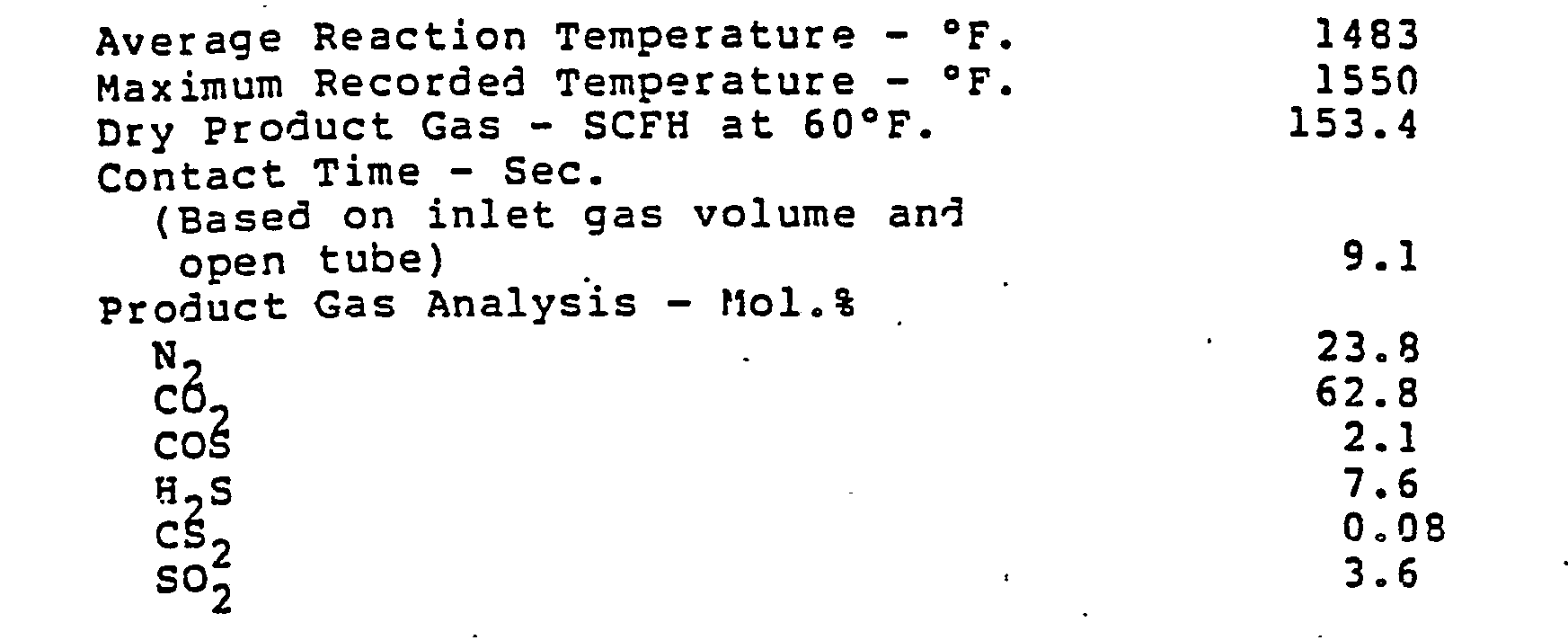
- Thus, with a H2O/SO2 molar ratio of about 3.0, an average recorded temperature of 1483° F, a maximum.recorded temperature of 1550° F, and a residence time of 9.1 seconds, 7.6 moles of H2S and 3.6 moles of SO2 were produced, a molar rati.o of H2S to SO2 of 2.1/1.
- This example is also reported in U.S. Patent No. 4,147,762 as Run 3 of Example II. (Column 7, lines 20-65.)
- The following data was obtained from operating a pilot SO2 reduction reactor having a height of 1.58 ft., a cross-sectional area of 0.3171 sq. ft., and a volume of 0.5 cubic ft. The reactor had a moving coal bed moving at a rate of 6.93 lb. per hr., such that 24.7% of the reaction bed moved per hour. Anthracite coal from Wyoming Valley Region, Pennsylvania was used, the coal containing 3.55 weight % moisture and 4.52 weight % volatile matter. With proper adjustments of conditions, one skilled in the art would be able to achieve approximately 2 moles of H2S per mole of SO2.

- Thus with a H2O/SO2 molar ratio of about 3.0, an average recorded inlet temperature of 1425° F, an average recorded outlet temperature of 1380° F, and a residence time of 2.9 seconds, 3.9 moles of H2S and 2.5 moles of SO2 were produced, a molar ratio of H2S to SO2 of 1.6/1.
- The following data was obtained from operating the Resox pilot reactor described in Example II. Hongay Anthracite Coal having the following percentage weight analysis was used:


- Thus, with a H2O/SO2 molar ratio of about 2.0, and temperatures varying from 963° F (outlet) to 1431° F (1/4 Bed), and residence time of 6.2 seconds, 2.75 moles of H2S and 1.55 moles of SO2 were produced, a molar ratio of H2S to SO2 of 1.77/1.
Claims (8)
1. A process for the reduction of SO2 to elemental sulfur comprising the steps of:
feeding a mixture of steam and SO2 into a first reactor, and contacting said mixture with coal, the molar ratio of steam to SO2 fed into said first reactor, the temperature of said first reactor, being suitable for the production of a product having a molar ratio of H2S to SO2 in excess of 2/1;
withdrawing elemental sulfur, H2S, and S02 from said first reactor;
recovering said elemental sulfur;
adding to said H2S and S02 from said first reactor additional SO2 to produce a mixture of H2S and SO2 such that the molar ratio of H2S to SO2 is approximately 2/1;
feeding said mixture of H2S and SO2 to a second reactor;
contacting said mixture of H2S and SO2 in said second reactor with a suitable catalyst, and at a suitable temperature, to form elemental sulfur; and
withdrawing said elemental sulfur from said second reactor.
2. The process of claim 1 wherein said coal is anthracite coal, the molar ratio of steam to SO2 fe3 into said first reactor is between 1 and 6, the temperature of said first reactor is maintained between 1300° F and 1700° F.
3. The process of claim 1 wherein said coal is anthracite coal, the molar ratio of steam to SO2 fed into said first reactor is between 2 and 4, the temperature of said first reactor is maintained between 1400° F and 1600° F.
4. A process for the reduction of SO2 to elemental sulfur comprising the steps of:
feeding a mixture of steam and SO2 into a first reactor, and contracting said mixture with coal, the molar ratio of steam to SO2 fed into said first reactor, the temperature of said first reactor, being suitable for the production of a product having a molar ratio of H2S to SO2 in excess of 2/1;
withdrawing elemental sulfur, H2S, and S02 from said first reactor;
recovering said elemental sulfur-
adding to said H2S and SO2 from said first reactor additonal SO2 to produce a mixture of H2S and SO2 such that the molar ratio of H2S to SO2 is approximately 2/1;
feeding said mixture of H2S and SO2 to a Claus converter;
withdrawing elemental sulfur from said Claus converter.
5. A process for the reduction of SO2 to elemental sulfur comprising the steps of:
feeding a mixture of steam and S02 into a first reactor, and contacting said mixture with coal, the molar ratio of steam to SO2 fed into said first reactor, the temperature of said first reactor being suitable for the production of a product having a molar ratio of H2S to SO2 of approximately 2/1;
withdrawing elemental sulfur, and a mixture of H2S and SO2 from said first reactor;
recovering said elemental sulfur;
feeding said mixture of H2S and SO2 from said first reactor to a second reactor;
contacting said mixture of H2S and SO2 in said second reactor with a suitable catalyst, and at a suitable temperature to form elemental sulfur; and
withdrawing said elemental sulfur from said second reactor.
6. The process of claim 4 wherein anthracite coal is used, : the molar ratio of steam to SO2 fed into said first reactor is between 1 and 6, the temperature of said first reactor is maintained between 1300° F and 1700° F.
7. The process of claim 4 wherein anthracite coal is used, the molar ratio of steam to SO2 fed into said first reactor is between 2 and 4, the temperature of said first reactor is maintained between 1400° F and 1600° F.
8. A process for the reduction of SO2 to elemental sulfur comprising the steps of:
feeding a mixture of steam and SO2 into a first reactor, and contracting said mixture with coal, the molar ratio of steam to S02 fed into said first reactor, the temperature of said first reactor, being suitable for the production of a product having a molar ratio of H2S to SO2 of approximately 2/1;
withdrawing elemental sulfur, and a mixture of H2S and SO2 from said first reactor;
recovering said elemental sulfur:
feeding said mixture of H2S and SO2 from said first reactor to a Claus converter;
withdrawing said elemental sulfur from said Claus converter.
Applications Claiming Priority (2)
| Application Number | Priority Date | Filing Date | Title |
|---|---|---|---|
| US25621681A | 1981-04-21 | 1981-04-21 | |
| US256216 | 1981-04-21 |
Publications (1)
| Publication Number | Publication Date |
|---|---|
| EP0064355A1 true EP0064355A1 (en) | 1982-11-10 |
Family
ID=22971456
Family Applications (1)
| Application Number | Title | Priority Date | Filing Date |
|---|---|---|---|
| EP82302020A Withdrawn EP0064355A1 (en) | 1981-04-21 | 1982-04-20 | Process for the reduction of sulphur dioxide |
Country Status (4)
| Country | Link |
|---|---|
| EP (1) | EP0064355A1 (en) |
| JP (1) | JPS57175709A (en) |
| AU (1) | AU8220982A (en) |
| ZA (1) | ZA821398B (en) |
Cited By (2)
| Publication number | Priority date | Publication date | Assignee | Title |
|---|---|---|---|---|
| EP0690022A1 (en) * | 1994-06-30 | 1996-01-03 | Metallgesellschaft Ag | Process for the reduction of sulfur dioxide in sulfur |
| RU2137707C1 (en) * | 1998-06-22 | 1999-09-20 | Норильский индустриальный институт | Method of removing sulfur dioxide from gases |
Citations (7)
| Publication number | Priority date | Publication date | Assignee | Title |
|---|---|---|---|---|
| FR760064A (en) * | 1932-08-24 | 1934-02-16 | Ici Ltd | Improvements to the production of sulfur from gases containing sulfur dioxide |
| FR796155A (en) * | 1935-06-14 | 1936-03-31 | Siemens Lurgi Cottrell Elektro | Process for the production of sulfur from sulphurous gas, by reduction of the gases by means of carbon |
| FR825289A (en) * | 1936-08-11 | 1938-02-28 | Metallgesellschaft Ag | Process for removing elemental sulfur from sulfur dioxide and gas containing it |
| US4117101A (en) * | 1975-10-16 | 1978-09-26 | Davy Powergas Gmbh | Process for reduction of SO2 |
| US4147762A (en) * | 1974-07-17 | 1979-04-03 | Foster Wheeler Energy Corporation | Reduction of SO2 with coal |
| DE2923704A1 (en) * | 1979-06-12 | 1980-12-18 | Bergwerksverband Gmbh | METHOD FOR REDUCING SO LOW 2 - GASES TO ELEMENTAL SULFUR |
| DE3029112A1 (en) * | 1979-07-31 | 1981-02-19 | Sumitomo Heavy Industries | Sulphur recovery from relatively conc. sulphur di:oxide gas - by redn. to sulphur vapour and hydrogen sulphide in conjunction with water gas reaction |
-
1981
- 1981-08-18 JP JP56129277A patent/JPS57175709A/en active Pending
-
1982
- 1982-03-03 ZA ZA821398A patent/ZA821398B/en unknown
- 1982-03-31 AU AU82209/82A patent/AU8220982A/en not_active Abandoned
- 1982-04-20 EP EP82302020A patent/EP0064355A1/en not_active Withdrawn
Patent Citations (8)
| Publication number | Priority date | Publication date | Assignee | Title |
|---|---|---|---|---|
| FR760064A (en) * | 1932-08-24 | 1934-02-16 | Ici Ltd | Improvements to the production of sulfur from gases containing sulfur dioxide |
| FR796155A (en) * | 1935-06-14 | 1936-03-31 | Siemens Lurgi Cottrell Elektro | Process for the production of sulfur from sulphurous gas, by reduction of the gases by means of carbon |
| FR825289A (en) * | 1936-08-11 | 1938-02-28 | Metallgesellschaft Ag | Process for removing elemental sulfur from sulfur dioxide and gas containing it |
| US2213787A (en) * | 1936-08-11 | 1940-09-03 | American Lurgi Corp | Process for the recovery of elementary sulphur from sulphur dioxide and gases containing same |
| US4147762A (en) * | 1974-07-17 | 1979-04-03 | Foster Wheeler Energy Corporation | Reduction of SO2 with coal |
| US4117101A (en) * | 1975-10-16 | 1978-09-26 | Davy Powergas Gmbh | Process for reduction of SO2 |
| DE2923704A1 (en) * | 1979-06-12 | 1980-12-18 | Bergwerksverband Gmbh | METHOD FOR REDUCING SO LOW 2 - GASES TO ELEMENTAL SULFUR |
| DE3029112A1 (en) * | 1979-07-31 | 1981-02-19 | Sumitomo Heavy Industries | Sulphur recovery from relatively conc. sulphur di:oxide gas - by redn. to sulphur vapour and hydrogen sulphide in conjunction with water gas reaction |
Cited By (2)
| Publication number | Priority date | Publication date | Assignee | Title |
|---|---|---|---|---|
| EP0690022A1 (en) * | 1994-06-30 | 1996-01-03 | Metallgesellschaft Ag | Process for the reduction of sulfur dioxide in sulfur |
| RU2137707C1 (en) * | 1998-06-22 | 1999-09-20 | Норильский индустриальный институт | Method of removing sulfur dioxide from gases |
Also Published As
| Publication number | Publication date |
|---|---|
| JPS57175709A (en) | 1982-10-28 |
| AU8220982A (en) | 1982-10-28 |
| ZA821398B (en) | 1983-01-26 |
Similar Documents
| Publication | Publication Date | Title |
|---|---|---|
| US3838191A (en) | Continuous process for scrubbing so2 from a gas stream containing so2 and o2 | |
| EP0078690B2 (en) | Process for the reduction of the sulfur content in a gaseous stream | |
| US4130575A (en) | Process for preparing methane rich gases | |
| US4482524A (en) | Autocirculation apparatus | |
| US4098339A (en) | Utilization of low BTU natural gas | |
| US4382912A (en) | Selective combusting of hydrogen sulfide in carbon dioxide injection gas | |
| US6962683B2 (en) | Method of removing and recovering elemental sulfur from highly reducing gas streams containing sulfur gases | |
| EP0049967A1 (en) | Ammonia production process | |
| EP0516441A1 (en) | Improved gas conversion process | |
| US3199955A (en) | Process of reducing sulphur dioxide to elemental sulphur | |
| EP0030447A1 (en) | High pressure process for recovery of sulphur from gases | |
| US4855124A (en) | Process for the desulfurization of gas containing hydrogen sulfide | |
| US3584042A (en) | Conversion of thiosulfate to formate | |
| US4117100A (en) | Process for reduction of sulfur dioxide to sulfur | |
| US7291320B2 (en) | Process for the selective oxidation of hydrogen sulfhide | |
| US4840783A (en) | Process for the production of hydrogen by catalytic reforming of methanol with water vapor | |
| US5366717A (en) | Method for producing elemental sulfur from sulfur-containing gases | |
| US5798088A (en) | Method for producing elemental sulfur from sulfur-containing gases | |
| US2887363A (en) | Conversion of methane to produce hydrogen sulfide | |
| US4082146A (en) | Low temperature oxidation of hydrogen sulfide in the presence of oil shale | |
| US3635820A (en) | Treating a water stream containing a water-soluble sulfite compound | |
| JPH04211645A (en) | Process for producing dimethyl disulfide | |
| Okay et al. | Effect of Water on Sulfur Dioxide Reduction by Carbon Monoxide | |
| US3728433A (en) | Continuous process for scrubbing sulfur dioxide from a gas stream | |
| US4781910A (en) | Hydrogen sulfide removal and sulfur recovery |
Legal Events
| Date | Code | Title | Description |
|---|---|---|---|
| PUAI | Public reference made under article 153(3) epc to a published international application that has entered the european phase |
Free format text: ORIGINAL CODE: 0009012 |
|
| AK | Designated contracting states |
Designated state(s): DE FR GB IT NL SE |
|
| 17P | Request for examination filed |
Effective date: 19830506 |
|
| STAA | Information on the status of an ep patent application or granted ep patent |
Free format text: STATUS: THE APPLICATION IS DEEMED TO BE WITHDRAWN |
|
| 18D | Application deemed to be withdrawn |
Effective date: 19840619 |
|
| RIN1 | Information on inventor provided before grant (corrected) |
Inventor name: GUTTERMAN, CARL Inventor name: STEINER, PETER |