EP0064595A1 - Renvoi d'angle pour la liaison entre tiges de verrouillage et de commande aux fenêtres, portes ou analogues - Google Patents
Renvoi d'angle pour la liaison entre tiges de verrouillage et de commande aux fenêtres, portes ou analogues Download PDFInfo
- Publication number
- EP0064595A1 EP0064595A1 EP82102658A EP82102658A EP0064595A1 EP 0064595 A1 EP0064595 A1 EP 0064595A1 EP 82102658 A EP82102658 A EP 82102658A EP 82102658 A EP82102658 A EP 82102658A EP 0064595 A1 EP0064595 A1 EP 0064595A1
- Authority
- EP
- European Patent Office
- Prior art keywords
- band
- corner deflection
- guide channel
- deflection according
- outer layer
- Prior art date
- Legal status (The legal status is an assumption and is not a legal conclusion. Google has not performed a legal analysis and makes no representation as to the accuracy of the status listed.)
- Granted
Links
- 239000004033 plastic Substances 0.000 claims abstract description 36
- 229920003023 plastic Polymers 0.000 claims abstract description 36
- 239000000463 material Substances 0.000 claims abstract description 14
- 230000008878 coupling Effects 0.000 claims abstract description 8
- 238000010168 coupling process Methods 0.000 claims abstract description 8
- 238000005859 coupling reaction Methods 0.000 claims abstract description 8
- 239000002184 metal Substances 0.000 claims abstract description 3
- 241000446313 Lamella Species 0.000 claims description 34
- 210000002105 tongue Anatomy 0.000 claims description 32
- 230000008719 thickening Effects 0.000 claims description 14
- 230000007704 transition Effects 0.000 claims description 10
- 230000002787 reinforcement Effects 0.000 claims description 9
- 238000003466 welding Methods 0.000 claims description 4
- 230000037431 insertion Effects 0.000 claims 2
- 238000003780 insertion Methods 0.000 claims 2
- 239000000853 adhesive Substances 0.000 claims 1
- 230000001070 adhesive effect Effects 0.000 claims 1
- 230000003014 reinforcing effect Effects 0.000 claims 1
- 238000004519 manufacturing process Methods 0.000 description 7
- 238000001746 injection moulding Methods 0.000 description 4
- 229910000831 Steel Inorganic materials 0.000 description 3
- 230000005540 biological transmission Effects 0.000 description 3
- 239000010959 steel Substances 0.000 description 3
- 238000005452 bending Methods 0.000 description 2
- 230000015572 biosynthetic process Effects 0.000 description 2
- 238000009826 distribution Methods 0.000 description 2
- 230000000694 effects Effects 0.000 description 2
- 238000007765 extrusion coating Methods 0.000 description 2
- 238000005755 formation reaction Methods 0.000 description 2
- 229910001369 Brass Inorganic materials 0.000 description 1
- 238000004026 adhesive bonding Methods 0.000 description 1
- 230000002411 adverse Effects 0.000 description 1
- 239000011324 bead Substances 0.000 description 1
- 239000010951 brass Substances 0.000 description 1
- 230000008859 change Effects 0.000 description 1
- 230000006835 compression Effects 0.000 description 1
- 238000007906 compression Methods 0.000 description 1
- 230000008094 contradictory effect Effects 0.000 description 1
- 238000006073 displacement reaction Methods 0.000 description 1
- 230000005489 elastic deformation Effects 0.000 description 1
- 238000005516 engineering process Methods 0.000 description 1
- 230000002349 favourable effect Effects 0.000 description 1
- 238000002347 injection Methods 0.000 description 1
- 239000007924 injection Substances 0.000 description 1
- 238000009434 installation Methods 0.000 description 1
- 230000007257 malfunction Effects 0.000 description 1
- 238000000034 method Methods 0.000 description 1
- 238000000465 moulding Methods 0.000 description 1
- 230000009972 noncorrosive effect Effects 0.000 description 1
- 230000000149 penetrating effect Effects 0.000 description 1
- 238000009417 prefabrication Methods 0.000 description 1
- 230000008569 process Effects 0.000 description 1
- 238000004080 punching Methods 0.000 description 1
- 230000000717 retained effect Effects 0.000 description 1
- 238000005507 spraying Methods 0.000 description 1
- 229910001220 stainless steel Inorganic materials 0.000 description 1
- 239000010935 stainless steel Substances 0.000 description 1
Images


Classifications
-
- E—FIXED CONSTRUCTIONS
- E05—LOCKS; KEYS; WINDOW OR DOOR FITTINGS; SAFES
- E05F—DEVICES FOR MOVING WINGS INTO OPEN OR CLOSED POSITION; CHECKS FOR WINGS; WING FITTINGS NOT OTHERWISE PROVIDED FOR, CONCERNED WITH THE FUNCTIONING OF THE WING
- E05F7/00—Accessories for wings not provided for in other groups of this subclass
- E05F7/08—Means for transmitting movements between vertical and horizontal sliding bars, rods, or cables
-
- E—FIXED CONSTRUCTIONS
- E05—LOCKS; KEYS; WINDOW OR DOOR FITTINGS; SAFES
- E05Y—INDEXING SCHEME ASSOCIATED WITH SUBCLASSES E05D AND E05F, RELATING TO CONSTRUCTION ELEMENTS, ELECTRIC CONTROL, POWER SUPPLY, POWER SIGNAL OR TRANSMISSION, USER INTERFACES, MOUNTING OR COUPLING, DETAILS, ACCESSORIES, AUXILIARY OPERATIONS NOT OTHERWISE PROVIDED FOR, APPLICATION THEREOF
- E05Y2900/00—Application of doors, windows, wings or fittings thereof
- E05Y2900/10—Application of doors, windows, wings or fittings thereof for buildings or parts thereof
- E05Y2900/13—Type of wing
- E05Y2900/132—Doors
-
- E—FIXED CONSTRUCTIONS
- E05—LOCKS; KEYS; WINDOW OR DOOR FITTINGS; SAFES
- E05Y—INDEXING SCHEME ASSOCIATED WITH SUBCLASSES E05D AND E05F, RELATING TO CONSTRUCTION ELEMENTS, ELECTRIC CONTROL, POWER SUPPLY, POWER SIGNAL OR TRANSMISSION, USER INTERFACES, MOUNTING OR COUPLING, DETAILS, ACCESSORIES, AUXILIARY OPERATIONS NOT OTHERWISE PROVIDED FOR, APPLICATION THEREOF
- E05Y2900/00—Application of doors, windows, wings or fittings thereof
- E05Y2900/10—Application of doors, windows, wings or fittings thereof for buildings or parts thereof
- E05Y2900/13—Type of wing
- E05Y2900/148—Windows
Definitions
- the invention has for its object to develop a smooth, reliable corner drive of the type mentioned in the generic term, which on the one hand meets the apparently contradicting demands for inexpensive manufacture and long life of the corner drives.
- Corner drive for coupling locking and control linkages to windows, doors or the like
- the invention relates to a corner drive for coupling the longitudinally movable connecting rods of two mutually angled locking and control linkages on windows, doors or the like.
- corner drives consist of an angular guide channel which is attached in the corner region of a window or door leaf and has an arch transition in the apex.
- the guide channel which can have a C-shaped profile cross section, receives a flexible band which is connected at both ends to the drive rods of the rods to be coupled, which is why holes are generally provided for an attachment to rivets.
- a flexible band uses numerous superimposed leaf springs which are expensive to manufacture. If you rivet the leaf springs
- the flexible band consists of layers of different types of materials, namely an upper and lower outer layer made of plastic on the one hand and at least one intermediate inner lamella made of metal on the other hand, the two outer layers filling the remaining clear height of the guide channel above the inner lamella without play, the inner lamella in the end regions of the band has at least one opening for connecting the upper outer layer to the lower one and forms a prefabricated assembly unit of the band and the end regions of the outer layers, which remain stretched in the guide channel when the band is used properly, are thickened.
- the flexible band consists of layers of different types of materials, namely an upper and lower outer layer made of plastic on the one hand and at least one intermediate inner lamella made of metal on the other hand, the two outer layers filling the remaining clear height of the guide channel above the inner lamella without play, the inner lamella in the end regions of the band has at least one opening for connecting the upper outer layer to the
- the formations can or the like through welded connections.
- the outer layers are coordinated at their guide points so that the clear width of the guide channel is filled without play and therefore stroke loss is no longer ascertainable, which was previously noticeable in that a movement at the output-side end of the corner deflection only requires a certain stroke distance of the drive-side End of the corner deflection occurred. Because of the favorable friction properties of the plastic of the outer layers with respect to the guide channel, the guide fit can be very narrow and can be precisely adjusted by the injection molding of the outer layers.
- the end-side thickenings of the outer layers first ensure that stiffening is achieved in the area for the connections of the drive rods, without this having an adverse effect on the intermediate middle sections of the band which are to be bent.
- these thickenings in the injection molding of the tongues allow the plastic materials to be conducted well in order to be able to carry out the male and female moldings for mutual coupling without problems.
- the thickening also ensures defined spacing of the connecting rods to be connected with respect to the belt.
- In the area of the end thickening of the Angußstege are provided, with which next to each other in the spraying g Leßwerkmaschinemaschinemaschinen outer layers made adhere to each other.
- One end of the outer layer can be set back in relation to the end of the band, so that the underlying lamella surface is exposed in this end section in order to receive a reinforcement plate which stabilizes the fastening point for the connecting rod to be connected.
- the plug end is expediently provided with an arrow-shaped contour taper. This creates a connection between the reinforcement plate and the
- the guide channel also need not be made of expensive brass in order to establish good sliding properties in the invention.
- the plastic outer layer does this automatically, which is why steel or brass-clad steel can be used to manufacture the guide channel, which is much cheaper.
- This also simplifies the further processing of the guide channel because it can be better welded to a cover bracket that completes the guide channel for the corner deflection.
- the thickness of the outer layers, apart from the already reinforced end regions, can also be designed differently in the remaining part of the band and the outer layer facing the inside of the angle can also be thicker than the opposite outer layer. The application of these measures depends on the operating case.
- the corner deflection 10 comprises an angular cover rail 11, which covers the groove in the corner region of a window or door leaf, in each of which a locking or control linkage is arranged, which deflects the movement coming from a handle from one side of the leaf to the other.
- a flexible band 20 is used to transmit these movements, which can be moved in an angularly curved guide channel 12, the cross-sectional profile of which, shown in enlarged form, can be seen from FIGS. 2 and 3.
- the guide channel While the cover rail 11 runs with its two angle legs up to a sharp corner point 15, the guide channel has in its center piece an arch transition 13 with a given radius of curvature, where the guide channel 12 lifts off from the angle legs of the cover rail 11, which is why in the cross-sectional illustration of FIG. 2 the cover rail further away in the area of the corner point 15 need not be shown.
- the legs 14 of the guide channel 12 adjoining this arch transition 13 on both sides are stretched and the like by spot welding. firmly connected to the angle legs of the cover rail 11 each. This can be seen from the sectional view of FIG. 3.
- connecting rod end pieces 17 which in the exemplary embodiment shown in FIG. 1 are an integral part of the corner deflection 10 and to which, via known coupling pieces, the connecting rods of the locking and control linkage (not shown in more detail) are each connected.
- the drive rod of the locking rod could be connected to the band 20.
- the guide channel 12 has the C profile shown in FIG. 2, whose special feature is the two U-shaped longitudinal edges 18, which have a predetermined clear U-height 19. These U longitudinal edges 18 are connected to one another by the channel base 30, which is provided on the inside with a longitudinal dent 31 for reasons of stiffening or for the purpose of receiving protruding ends of a head of the rivet 16. For manufacturing reasons, the clear U-height 19 in the guide channel 12 cannot be made arbitrarily small.
- the flexible band 20 is designed in a special way. At its core, it comprises a single metallic lamella 25, which is formed from a steel strip of approximately 0.25 mm. In the end sections 22, as shown in FIG. 5, the lamella 25 is provided with a push-through hole 26 for the rivet 16 already mentioned and with one or more openings 27. This slat 25 is further illustrated at least on an angle to the inside-facing side fins 23, as shown in FIG. 6, provided with an applied covering 28 of plastics material which ogenübergang in B 13 bends concave. This covering should always be referred to as inner covering 28 below.
- the outer covering 29 In the present case is also the opposite lamella side 24 which faces in the assembly case to the outside, against the vertex 15 of Fig. 1, provided evidence of FIGS. 2 and 6 here with a lining 29, the ogenübergang in B convexly curved and therefore always referred to below as the outer covering 29.
- the two coverings 28, 29 all have a different layer thickness 32, 33, as can be seen from FIGS. 2, 3 and 6.
- the layer thickness 32 is formed on the inside less than the outer layer thickness 33.
- the outer layer thickness 33 will be chosen to be as small as possible.
- the layer thicknesses 32, 33 change in the longitudinal course of the band already in the illustrated embodiment. It can be seen that both layer thicknesses initially grow in the end section 22 of the band 20, specifically in the outer covering 29 on a large layer thickness 33 'shown in FIG. 6, which allows the rivet head 36 of the fastening member 16, indicated by dash-dotted lines there, as far as possible in its full height in a corresponding receptacle 35 of this outer covering 29.
- the thickness ratios are formed in the inner covering 28 in a similar manner, as can also be seen from FIGS. 6 and 3.
- This final layer thickness 32 ′′ is produced by a shoulder 38 at the end 21 of the band 20, which is necessary for the perfect reception of a thickened shaft piece 39 of the rivet 16, which ensures perfect power transmission between the drive rods 17 and the band 20.
- These thickenings 32, 32 ′′, 33 ′ are advantageous in this area because, when the corner deflection 10 is used as intended, these end sections 22 no longer reach the area of the arch transition 13 of the guide channel 12 and therefore need not be particularly flexible With higher layer thicknesses, an advantageous stiffening of the band can be achieved in these end sections 22.
- these end sections 22 are expediently interrupted
- transverse grooves 40 would advantageously be provided in the concavely curved inner covering 28 of the band 20 , because a compression of a Ma terials of greater layer thickness is difficult. If necessary, such interruptions in the layer thickness could of course also be provided in the outer covering 29, which will occur in particular if greater layer thicknesses occur there, which disrupt the flexibility of the band 20. Such transverse grooves 40 are introduced more or less deeply into the covering 28 or 29. Their number, distribution and spacing sequence depend on the layer thickness and on the desired flexibility of the band 20 in the respective area.
- the mentioned transverse grooves 40 are only provided in the shoulder 38, which extends over the width of the thickened island 41 in the end section 22 of the band 20, which lies in the longitudinal central zone of the band and the two in the U longitudinal edges 18 border areas 42 thereof unaffected.
- the lamella 25 is not arranged exactly in the middle of the stretched band. This also does not need to be uniform over the entire length of the band 20. It is therefore expedient, for the reasons mentioned above, to choose the inner layer thickness 32 in the flexible middle piece 34 to be greater than the outer layer thickness 33, while these coverings 28, 29 in the end section 22 and in particular at the connection end 21 are dimensioned in opposite directions, namely stronger in the outer cover 29 than in the inner lining 28, because this rivet head 36 can be better arranged and, moreover, in the initial state, the lamella 23 already has a pre-curvature within the lining, which in use is then only increased by the arch transition 13 in accordance with the curvature there.
- the covering can be applied to the lamella 25 in various ways, each of which has its own particular advantages.
- One possibility used in the illustrated exemplary embodiment is by "applying the two coverings 28, 29 by extrusion coating onto the lamella 25.
- the aforementioned openings 27 ensure the material bridges between the two coverings 28, 29 shown in FIG. 6, because at Injection molding of the material can occur through the openings 27 mentioned in the lamella 25.
- Such openings 26 could occur be provided in large numbers and arranged in any distribution. They create a material connection between the two coverings.
- outer layers are applied to the two surface sides 23, 24 of the lamella by gluing or welding.
- Such outer layers could also be produced from a film by punching, where the end-side thickenings are subsequently formed by welding deformations.
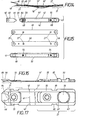
- a flexible band 50 which forms an assembly unit consisting of four layers, which, as shown in FIG. 9, consists of two prefabricated plastic outer layers 51, 52 and a pair of inner slats 45, 46.
- the lamellae 45, 46 have the hole 26 already mentioned for a rivet 16 indicated in its position in FIG. 8, which may initially be missing in the assembly unit 5o.
- the plastic tongues 51, 52 have corresponding, albeit enlarged holes 53.
- the lamellae 45, 46 also have the opening 27 already mentioned.
- the longitudinal spacing of the two openings 27 in the two lamellae 45, 46 is selected to be different by a few tenths of a millimeter to produce the pre-curvature of the band recognizable from FIG. 8 in the assembly unit 5o, which also includes the two plastic tongues 51, 52. This is due to the fact that the two tongues 51, 52 have male and female locking elements 54, 55 which are arranged in a corresponding length to one another and which are in engagement with one another in the case of assembly.
- the male-shaped closure element 54 comprises a cylindrical shaft 56 which is threaded through the openings 27 of the inner lamellae 45, 46 and fixes them in position with respect to one another. At the end of the shaft there is a closing head 57 which, with elastic deformation, engages in a closing opening 58 in the matrix-shaped closure elements 55 of the plastic tongue 51 lying on the other surface side of the band 50. In addition to the closing opening 58 there is also an enlarged receptacle 59 which, in the event of a coupling, receives the closing head 57 of the patrone-shaped closure element 54.
- the plastic tongues 51, 52 similarly to the previous exemplary embodiment, are provided with thickened end regions 22 which take over the stiffening functions already mentioned and are also limited here to a central zone 41 which leaves stepped thinner edge regions 42 on both sides. These have the functions already mentioned in the first exemplary embodiment.
- the thickening 22 in the tongue 51 lying on the inside of the angle has a greater thickness 32 'than the thickness 33' in the other plastic tongue 52.
- the plastic tongues 51, 52 have a continuous longitudinal strip 47 on their respective outwardly facing surfaces, on both sides of which the edge regions 42 pass, because the width of this longitudinal strip 47 limits the width of the aforementioned central zone 41 of the thickening 22 is. This results in the heel height 69 between 47 and 42 that can be seen in FIG. 12.
- the prepared assembly unit 5o is present, which can be easily threaded through the guide channel 12 shown in FIG. 1.
- One end 48 of the plastic tongue 51 'arranged on the inside of the angle is set back relative to the band end 49, which is why the lamella surface 63, according to FIG. 14, is exposed in this section.
- a reinforcement plate 6o is placed on the entire section 63, which is provided with a hole 62 that comes to coincide with the holes 26 of the pair of plates 45, 46, which have also been mentioned several times and which also pass through here the engaging closure elements 54, 55 form an assembly unit with the plastic tongues 51 ', 52. This is where the connecting rod is connected and the reinforcement plate 6o stabilizes this area.
- the plate 6o is provided with an arrow-shaped plug end 61, which is inserted into a pocket 64 at the tongue end 48 and thereby experiences a second position securing on the assembly unit 50 '.
- This pocket 64 has come about in that a top wall 66 is applied over a U-shaped recess, which is engaged behind by the plug end 61 when coupling.
- One hole 53 of the plastic tongue 51 ', where the associated drive rod is connected, is provided with a bead 67 to support the rivet attachment.
- the tongues 51, 51', 52nd be made in a mold from castable plastics.
- these tongues are produced lying side by side in the tool and are thus initially connected by means of sprue bars, which are cut off when the tongues are later separated.
- These sprue webs are provided at the attachment points 68, where they are cut off when the tongues are separated, so that, so that no protruding edges arise, there are edge recesses which can be seen at these attachment points 68 in the figures.
- the feeds of the plastic are in the region of the end-side thickenings 21, which is why relatively large spaces are available here in the injection mold, which ensure good ductility of the pourable plastic.
- the same is done in a corresponding manner in the longitudinal stripes 47 of the tongues 51, 51 ', 52 which run through in the middle.
- only edge areas 42 are made thinner by the heel 69 shown in FIG. 12 in order to provide the clearance shown in FIG. 2 with a clearance-free fit 19 of the guide channel 12 to be filled.
Landscapes
- Connection Of Plates (AREA)
- Operating, Guiding And Securing Of Roll- Type Closing Members (AREA)
- Flexible Shafts (AREA)
- Joining Of Corner Units Of Frames Or Wings (AREA)
Priority Applications (1)
| Application Number | Priority Date | Filing Date | Title |
|---|---|---|---|
| AT82102658T ATE9376T1 (de) | 1981-05-09 | 1982-03-30 | Eckumlenkung zum kuppeln von verschluss- und steuergestaengen an fenstern, tueren od. dgl. |
Applications Claiming Priority (2)
| Application Number | Priority Date | Filing Date | Title |
|---|---|---|---|
| DE3118435A DE3118435A1 (de) | 1981-05-09 | 1981-05-09 | Eckumlenkung zum kuppeln von verschluss- und steuergestaengen an fenstern, tueren o.dgl. |
| DE3118435 | 1981-05-09 |
Publications (3)
| Publication Number | Publication Date |
|---|---|
| EP0064595A1 true EP0064595A1 (fr) | 1982-11-17 |
| EP0064595B1 EP0064595B1 (fr) | 1984-09-12 |
| EP0064595B2 EP0064595B2 (fr) | 1988-05-25 |
Family
ID=6131881
Family Applications (1)
| Application Number | Title | Priority Date | Filing Date |
|---|---|---|---|
| EP82102658A Expired EP0064595B2 (fr) | 1981-05-09 | 1982-03-30 | Renvoi d'angle pour la liaison entre tiges de verrouillage et de commande aux fenêtres, portes ou analogues |
Country Status (3)
| Country | Link |
|---|---|
| EP (1) | EP0064595B2 (fr) |
| AT (1) | ATE9376T1 (fr) |
| DE (2) | DE3118435A1 (fr) |
Cited By (6)
| Publication number | Priority date | Publication date | Assignee | Title |
|---|---|---|---|---|
| FR2556400A1 (fr) * | 1983-12-09 | 1985-06-14 | Ferco Int Usine Ferrures | Renvoi d'angle pour tringle de manoeuvre d'une ferrure de fenetre, porte ou analogue |
| US4602457A (en) * | 1983-08-13 | 1986-07-29 | Ulrich Kreusel | Window fitting for single handed swinging and tilting of the window |
| EP0173236A3 (en) * | 1984-08-22 | 1986-10-01 | Josef Oster | Window or door fitting |
| EP0226785A3 (en) * | 1985-12-23 | 1987-12-09 | Schuco Heinz Schurmann Gmbh & Co. | Corner guide for the sliding bars of a window or door |
| EP0560016A3 (en) * | 1992-03-12 | 1993-10-13 | Siegenia-Frank Kg | Sliding bar for a door- or window-fitting and especially a coupling device for sliding bars and a fitting with such a coupling device |
| US20110204657A1 (en) * | 2008-10-30 | 2011-08-25 | Gsg International S.P.A. | device for connecting door and window operating units |
Citations (3)
| Publication number | Priority date | Publication date | Assignee | Title |
|---|---|---|---|---|
| DE1134295B (de) * | 1957-11-09 | 1962-08-02 | Zuendapp Werke G M B H | Kabelzug zur UEbertragung von Zug- und/oder Druckkraeften, insbesondere fuer Kraftfahrzeuge |
| DE2240345A1 (de) * | 1972-08-17 | 1974-02-28 | Frank Gmbh Wilh | Zugelement fuer fenster, tueren od.dgl. |
| DE2941631B1 (de) * | 1979-10-13 | 1980-07-17 | Siegenia Frank Kg | Winkelfoermiger Fuehrungskanal fuer die Umlenkglieder bei Eckumlenkungen fuer Treibstangenbeschlaege |
-
1981
- 1981-05-09 DE DE3118435A patent/DE3118435A1/de not_active Withdrawn
-
1982
- 1982-03-30 EP EP82102658A patent/EP0064595B2/fr not_active Expired
- 1982-03-30 AT AT82102658T patent/ATE9376T1/de not_active IP Right Cessation
- 1982-03-30 DE DE8282102658T patent/DE3260697D1/de not_active Expired
Patent Citations (3)
| Publication number | Priority date | Publication date | Assignee | Title |
|---|---|---|---|---|
| DE1134295B (de) * | 1957-11-09 | 1962-08-02 | Zuendapp Werke G M B H | Kabelzug zur UEbertragung von Zug- und/oder Druckkraeften, insbesondere fuer Kraftfahrzeuge |
| DE2240345A1 (de) * | 1972-08-17 | 1974-02-28 | Frank Gmbh Wilh | Zugelement fuer fenster, tueren od.dgl. |
| DE2941631B1 (de) * | 1979-10-13 | 1980-07-17 | Siegenia Frank Kg | Winkelfoermiger Fuehrungskanal fuer die Umlenkglieder bei Eckumlenkungen fuer Treibstangenbeschlaege |
Cited By (7)
| Publication number | Priority date | Publication date | Assignee | Title |
|---|---|---|---|---|
| US4602457A (en) * | 1983-08-13 | 1986-07-29 | Ulrich Kreusel | Window fitting for single handed swinging and tilting of the window |
| FR2556400A1 (fr) * | 1983-12-09 | 1985-06-14 | Ferco Int Usine Ferrures | Renvoi d'angle pour tringle de manoeuvre d'une ferrure de fenetre, porte ou analogue |
| EP0173236A3 (en) * | 1984-08-22 | 1986-10-01 | Josef Oster | Window or door fitting |
| EP0226785A3 (en) * | 1985-12-23 | 1987-12-09 | Schuco Heinz Schurmann Gmbh & Co. | Corner guide for the sliding bars of a window or door |
| EP0560016A3 (en) * | 1992-03-12 | 1993-10-13 | Siegenia-Frank Kg | Sliding bar for a door- or window-fitting and especially a coupling device for sliding bars and a fitting with such a coupling device |
| US20110204657A1 (en) * | 2008-10-30 | 2011-08-25 | Gsg International S.P.A. | device for connecting door and window operating units |
| US9151094B2 (en) * | 2008-10-30 | 2015-10-06 | Gsg International S.P.A. | Device for connecting door and window operating units |
Also Published As
| Publication number | Publication date |
|---|---|
| EP0064595B1 (fr) | 1984-09-12 |
| EP0064595B2 (fr) | 1988-05-25 |
| DE3118435A1 (de) | 1982-12-02 |
| DE3260697D1 (en) | 1984-10-18 |
| ATE9376T1 (de) | 1984-09-15 |
Similar Documents
| Publication | Publication Date | Title |
|---|---|---|
| EP0268750B1 (fr) | Dispositif de liaison réglable pour tringles d'espagnolette | |
| EP0064595B1 (fr) | Renvoi d'angle pour la liaison entre tiges de verrouillage et de commande aux fenêtres, portes ou analogues | |
| DE69304954T2 (de) | Profillamelle für einen Vorhang und entsprechender Vorhang | |
| AT409025B (de) | Eckumlenkung von treibstangen-beschlägen für fenster, türen od.dgl. | |
| DE19806727A1 (de) | Fenster- oder Türverschluß | |
| EP1757838A1 (fr) | Chaîne rigide d'entraînement | |
| DE8208893U1 (de) | Eckumlenkung zum kuppeln von verschluss- und steuergestaengen an fenstern, tueren od. dgl. | |
| DE102020200266B4 (de) | Mit einem Kettenantrieb betätigbare schiebesteife Schubkette | |
| EP1223273B1 (fr) | Barre d'accouplement | |
| DE19734647B4 (de) | Beschlagteil an einem Flügel oder einem festen Rahmen eines Fensters, einer Tür od. dgl. | |
| AT407653B (de) | Schwenkhebel-betätigungsvorrichtung für treibstangenbeschläge | |
| DE3015925A1 (de) | Rahmenlatte eines litzenrahmens eines webstuhls | |
| EP0384142B1 (fr) | Tige de commande avec moyens d'accouplement intégraux | |
| EP0348605B1 (fr) | Dispositif pour pivoter une partie d'un sommier | |
| EP1817449A1 (fr) | Cadre a lisses | |
| DE2831652C2 (de) | Aus einzelnen Wandelementen zusammengesetztes Körperelement | |
| EP1577478B9 (fr) | Renvoi d'angle avec pièces de guidage | |
| DE19639893A1 (de) | Eckumlenkung für einen Beschlag, insbesondere Treibstangenbeschlag für Fenster, Türen o. dgl. | |
| DE2613189C3 (de) | Handlauf für Rolltreppen o.dgl | |
| DE19546669C2 (de) | Verbindung zwischen einem Leiterholm und einem Gelenkschenkel eines Leitergelenkes | |
| DE19828267A1 (de) | Fenster- oder Türbeschlag | |
| DE2159244B2 (de) | Eckumlenkung für Triebstangenbeschläge | |
| CH669971A5 (en) | Profiled elastic window sealing component | |
| EP0173236B1 (fr) | Ferrure pour fenêtres ou portes | |
| DE2311595C3 (de) | Türblatt, gebildet aus einer Vielzahl von biegsamen, lotrecht hängenden Streifen |
Legal Events
| Date | Code | Title | Description |
|---|---|---|---|
| PUAI | Public reference made under article 153(3) epc to a published international application that has entered the european phase |
Free format text: ORIGINAL CODE: 0009012 |
|
| AK | Designated contracting states |
Designated state(s): AT BE DE FR GB |
|
| 17P | Request for examination filed |
Effective date: 19821019 |
|
| GRAA | (expected) grant |
Free format text: ORIGINAL CODE: 0009210 |
|
| AK | Designated contracting states |
Designated state(s): AT BE DE FR GB |
|
| PG25 | Lapsed in a contracting state [announced via postgrant information from national office to epo] |
Ref country code: FR Free format text: THE PATENT HAS BEEN ANNULLED BY A DECISION OF A NATIONAL AUTHORITY Effective date: 19840912 Ref country code: BE Effective date: 19840912 |
|
| REF | Corresponds to: |
Ref document number: 9376 Country of ref document: AT Date of ref document: 19840915 Kind code of ref document: T |
|
| REF | Corresponds to: |
Ref document number: 3260697 Country of ref document: DE Date of ref document: 19841018 |
|
| PG25 | Lapsed in a contracting state [announced via postgrant information from national office to epo] |
Ref country code: AT Effective date: 19850330 |
|
| PLBI | Opposition filed |
Free format text: ORIGINAL CODE: 0009260 |
|
| 26 | Opposition filed |
Opponent name: SIEGENIA-FRANK KG Effective date: 19850511 |
|
| EN | Fr: translation not filed | ||
| GBPC | Gb: european patent ceased through non-payment of renewal fee | ||
| PUAH | Patent maintained in amended form |
Free format text: ORIGINAL CODE: 0009272 |
|
| STAA | Information on the status of an ep patent application or granted ep patent |
Free format text: STATUS: PATENT MAINTAINED AS AMENDED |
|
| 27A | Patent maintained in amended form |
Effective date: 19880525 |
|
| AK | Designated contracting states |
Kind code of ref document: B2 Designated state(s): AT BE DE FR GB |
|
| EN3 | Fr: translation not filed ** decision concerning opposition | ||
| PG25 | Lapsed in a contracting state [announced via postgrant information from national office to epo] |
Ref country code: GB Effective date: 19881121 |
|
| PGFP | Annual fee paid to national office [announced via postgrant information from national office to epo] |
Ref country code: DE Payment date: 19920728 Year of fee payment: 11 |
|
| PG25 | Lapsed in a contracting state [announced via postgrant information from national office to epo] |
Ref country code: DE Effective date: 19931201 |