EP0064779B1 - Méthode et système pour l'identification mutuelle chiffrée entre stations de communication de données et stations pour l'utilisation de cette méthode et système - Google Patents
Méthode et système pour l'identification mutuelle chiffrée entre stations de communication de données et stations pour l'utilisation de cette méthode et système Download PDFInfo
- Publication number
- EP0064779B1 EP0064779B1 EP82200425A EP82200425A EP0064779B1 EP 0064779 B1 EP0064779 B1 EP 0064779B1 EP 82200425 A EP82200425 A EP 82200425A EP 82200425 A EP82200425 A EP 82200425A EP 0064779 B1 EP0064779 B1 EP 0064779B1
- Authority
- EP
- European Patent Office
- Prior art keywords
- station
- identification
- ciphering
- function
- key
- Prior art date
- Legal status (The legal status is an assumption and is not a legal conclusion. Google has not performed a legal analysis and makes no representation as to the accuracy of the status listed.)
- Expired
Links
Images


Classifications
-
- G—PHYSICS
- G07—CHECKING-DEVICES
- G07F—COIN-FREED OR LIKE APPARATUS
- G07F7/00—Mechanisms actuated by objects other than coins to free or to actuate vending, hiring, coin or paper currency dispensing or refunding apparatus
- G07F7/08—Mechanisms actuated by objects other than coins to free or to actuate vending, hiring, coin or paper currency dispensing or refunding apparatus by coded identity card or credit card or other personal identification means
- G07F7/10—Mechanisms actuated by objects other than coins to free or to actuate vending, hiring, coin or paper currency dispensing or refunding apparatus by coded identity card or credit card or other personal identification means together with a coded signal, e.g. in the form of personal identification information, like personal identification number [PIN] or biometric data
- G07F7/1008—Active credit-cards provided with means to personalise their use, e.g. with PIN-introduction/comparison system
-
- G—PHYSICS
- G06—COMPUTING OR CALCULATING; COUNTING
- G06Q—INFORMATION AND COMMUNICATION TECHNOLOGY [ICT] SPECIALLY ADAPTED FOR ADMINISTRATIVE, COMMERCIAL, FINANCIAL, MANAGERIAL OR SUPERVISORY PURPOSES; SYSTEMS OR METHODS SPECIALLY ADAPTED FOR ADMINISTRATIVE, COMMERCIAL, FINANCIAL, MANAGERIAL OR SUPERVISORY PURPOSES, NOT OTHERWISE PROVIDED FOR
- G06Q20/00—Payment architectures, schemes or protocols
- G06Q20/30—Payment architectures, schemes or protocols characterised by the use of specific devices or networks
- G06Q20/34—Payment architectures, schemes or protocols characterised by the use of specific devices or networks using cards, e.g. integrated circuit [IC] cards or magnetic cards
- G06Q20/341—Active cards, i.e. cards including their own processing means, e.g. including an IC or chip
-
- G—PHYSICS
- G06—COMPUTING OR CALCULATING; COUNTING
- G06Q—INFORMATION AND COMMUNICATION TECHNOLOGY [ICT] SPECIALLY ADAPTED FOR ADMINISTRATIVE, COMMERCIAL, FINANCIAL, MANAGERIAL OR SUPERVISORY PURPOSES; SYSTEMS OR METHODS SPECIALLY ADAPTED FOR ADMINISTRATIVE, COMMERCIAL, FINANCIAL, MANAGERIAL OR SUPERVISORY PURPOSES, NOT OTHERWISE PROVIDED FOR
- G06Q20/00—Payment architectures, schemes or protocols
- G06Q20/30—Payment architectures, schemes or protocols characterised by the use of specific devices or networks
- G06Q20/36—Payment architectures, schemes or protocols characterised by the use of specific devices or networks using electronic wallets or electronic money safes
- G06Q20/367—Payment architectures, schemes or protocols characterised by the use of specific devices or networks using electronic wallets or electronic money safes involving electronic purses or money safes
- G06Q20/3674—Payment architectures, schemes or protocols characterised by the use of specific devices or networks using electronic wallets or electronic money safes involving electronic purses or money safes involving authentication
-
- G—PHYSICS
- G06—COMPUTING OR CALCULATING; COUNTING
- G06Q—INFORMATION AND COMMUNICATION TECHNOLOGY [ICT] SPECIALLY ADAPTED FOR ADMINISTRATIVE, COMMERCIAL, FINANCIAL, MANAGERIAL OR SUPERVISORY PURPOSES; SYSTEMS OR METHODS SPECIALLY ADAPTED FOR ADMINISTRATIVE, COMMERCIAL, FINANCIAL, MANAGERIAL OR SUPERVISORY PURPOSES, NOT OTHERWISE PROVIDED FOR
- G06Q20/00—Payment architectures, schemes or protocols
- G06Q20/38—Payment protocols; Details thereof
- G06Q20/388—Payment protocols; Details thereof using mutual authentication without cards, e.g. challenge-response
-
- G—PHYSICS
- G06—COMPUTING OR CALCULATING; COUNTING
- G06Q—INFORMATION AND COMMUNICATION TECHNOLOGY [ICT] SPECIALLY ADAPTED FOR ADMINISTRATIVE, COMMERCIAL, FINANCIAL, MANAGERIAL OR SUPERVISORY PURPOSES; SYSTEMS OR METHODS SPECIALLY ADAPTED FOR ADMINISTRATIVE, COMMERCIAL, FINANCIAL, MANAGERIAL OR SUPERVISORY PURPOSES, NOT OTHERWISE PROVIDED FOR
- G06Q20/00—Payment architectures, schemes or protocols
- G06Q20/38—Payment protocols; Details thereof
- G06Q20/40—Authorisation, e.g. identification of payer or payee, verification of customer or shop credentials; Review and approval of payers, e.g. check credit lines or negative lists
- G06Q20/409—Device specific authentication in transaction processing
- G06Q20/4097—Device specific authentication in transaction processing using mutual authentication between devices and transaction partners
- G06Q20/40975—Device specific authentication in transaction processing using mutual authentication between devices and transaction partners using encryption therefor
-
- G—PHYSICS
- G07—CHECKING-DEVICES
- G07F—COIN-FREED OR LIKE APPARATUS
- G07F7/00—Mechanisms actuated by objects other than coins to free or to actuate vending, hiring, coin or paper currency dispensing or refunding apparatus
- G07F7/08—Mechanisms actuated by objects other than coins to free or to actuate vending, hiring, coin or paper currency dispensing or refunding apparatus by coded identity card or credit card or other personal identification means
- G07F7/10—Mechanisms actuated by objects other than coins to free or to actuate vending, hiring, coin or paper currency dispensing or refunding apparatus by coded identity card or credit card or other personal identification means together with a coded signal, e.g. in the form of personal identification information, like personal identification number [PIN] or biometric data
- G07F7/1016—Devices or methods for securing the PIN and other transaction-data, e.g. by encryption
-
- H—ELECTRICITY
- H04—ELECTRIC COMMUNICATION TECHNIQUE
- H04L—TRANSMISSION OF DIGITAL INFORMATION, e.g. TELEGRAPHIC COMMUNICATION
- H04L9/00—Cryptographic mechanisms or cryptographic arrangements for secret or secure communications; Network security protocols
- H04L9/32—Cryptographic mechanisms or cryptographic arrangements for secret or secure communications; Network security protocols including means for verifying the identity or authority of a user of the system or for message authentication, e.g. authorization, entity authentication, data integrity or data verification, non-repudiation, key authentication or verification of credentials
- H04L9/3236—Cryptographic mechanisms or cryptographic arrangements for secret or secure communications; Network security protocols including means for verifying the identity or authority of a user of the system or for message authentication, e.g. authorization, entity authentication, data integrity or data verification, non-repudiation, key authentication or verification of credentials using cryptographic hash functions
-
- H—ELECTRICITY
- H04—ELECTRIC COMMUNICATION TECHNIQUE
- H04L—TRANSMISSION OF DIGITAL INFORMATION, e.g. TELEGRAPHIC COMMUNICATION
- H04L9/00—Cryptographic mechanisms or cryptographic arrangements for secret or secure communications; Network security protocols
- H04L9/32—Cryptographic mechanisms or cryptographic arrangements for secret or secure communications; Network security protocols including means for verifying the identity or authority of a user of the system or for message authentication, e.g. authorization, entity authentication, data integrity or data verification, non-repudiation, key authentication or verification of credentials
- H04L9/3271—Cryptographic mechanisms or cryptographic arrangements for secret or secure communications; Network security protocols including means for verifying the identity or authority of a user of the system or for message authentication, e.g. authorization, entity authentication, data integrity or data verification, non-repudiation, key authentication or verification of credentials using challenge-response
-
- H—ELECTRICITY
- H04—ELECTRIC COMMUNICATION TECHNIQUE
- H04L—TRANSMISSION OF DIGITAL INFORMATION, e.g. TELEGRAPHIC COMMUNICATION
- H04L2209/00—Additional information or applications relating to cryptographic mechanisms or cryptographic arrangements for secret or secure communication H04L9/00
- H04L2209/56—Financial cryptography, e.g. electronic payment or e-cash
Definitions
- the invention relates to a method according to the preamble of Claim 1. Such a method is known from EP Patent Application 2580.
- EFT-system Electronic Fund Transfer system
- bank terminal system bank terminal system
- the method and devices according to the invention are generally applicable in data transmission systems of various types and intended for various purposes.
- a bank terminal system or a system for transmission of data or text comprises a number of terminal stations having data input and data output means. Each terminal station may be connected to a central computer for the exchange of information in both directions.
- a terminal station may also comprise a so-called cash dispenser apparatus, from which a customer may obtain cash by using a personal data carrier, which is temporarily connected to the system. Security of the system is obtained in that a customer is obliged to identify himself towards the system before any transaction is allowed. At a human-operated terminal station this may mean that the customer will have to present an acceptable identification document.
- said identification may comprise the step that the customer supplies a secret personal code, a so-called PIN-code, via a keyboard, the corresponding PIN-code then being accessible in the system for comparison with the code which is supplied.
- PIN-code a secret personal code
- the development is towards an increased number of unsupervised terminal stations which may offer an increased number of different services.
- These personal data carriers are today shaped as cards according to an accepted ISO-standard and comprise magnetizable carriers for data storage.
- a bank terminal system is subject to security risks of different types, or threats. Said threats may then be directed to informations transmitted in the system, or to the hardware comprised in the system, such as transmission lines, terminal stations, or personal data carriers.
- the threats directed to the actual information mean that it could be possible by active or passive tapping to derive, modify or distort the information content.
- the transmission lines and further system elements in question may be protected physically.
- bank terminal systems the usual type of transmission means that a terminal station communicates with the central computer via a public or general data network. To physically protect a network of this type would, if possible at all, demand high costs. As a consequence the practicable solution means enciphering of the information.
- a false cash dispenser apparatus may appear in a bank system.
- POS-system Point of Sales system
- POS-system Point of Sales system
- a customer could then pay for goods at a place for purchase by using his personal data carrier in a false terminal station.
- a different threat is that false personal data carriers may appear.
- the use of false data carriers is prevented by the fact that the customer is obliged to supply his secret personal code in order to obtain access to the system.
- this procedure means no protection against a false terminal.
- the problem of false terminals and false data carriers may be illustrated by the so-called "wardrobe case".
- a customer may meet a false terminal which towards the customer appears as a genuine one.
- This false terminal is connected to the so-called "wardrobe” in which is housed equipment for tapping the information signals supplied by the data carrier and the key set of the terminal station, and also equipment for forwarding correctly information between the false terminal and the central computer of the system. By this tapping the entered, secret, personal code is achieved and further information from the data carrier. Said information may then be used for the provision of a false data carrier.
- this case also illustrates necessity for both identification of the user and his data carrier as being authorized in the system towards the terminal but also for identification of the terminal towards the user and being a genuine one.
- This mutual identification may be obtained by giving the personal data carrier of the user the shape of an active card, on which the identification information supplied by the terminal may be evaluated.
- the card will comprise semiconductor memory and signal processing capability, and will function as a station communicating with a terminal.
- Ciphering of a traditional type means that authorized stations of a system have access to a ciphering algorithm and a deciphering algorithm and also a ciphering key operating as a parameter in said algorithms. If an unciphered or clear-text message is designated by x, the ciphered version thereof or "cipher" is designated by y, the ciphering key is designated as k, the ciphering algorithm is designated E and the deciphering algorithm is designated D, this may be expressed according to the following in which expression D is the inverse function of E for all possible values of k.
- enciphering key distribution is made even worse if the aim is a frequent change of ciphering keys.
- the desirable situation is to use a fresh enciphering key for every single case of transmission.
- Such a key is named a "session key”.
- Dependent on the actual application of use a "session” may comprise the transmission of a given amount of data at one single occasion or different amounts of data at different occasions within a defined time space, for example one day.
- European patent application 0002580 describes a method for verification of the cipherment keys used at two cooperating stations. To this end a random number is sent in a ciphered form from one station to the other, which station operates on the ciphered number using its own key. The result which is obtained is sent back to said one station at which it is checked against the ciphered number which was sent from the beginning. Ifthe check doesn't fail it is thereby verified that both stations have identical ciphering keys.
- the object of the invention is realized in that it is characterized by the characterizing part of Claim 1.
- the present invention advantageously combines the mutual identification of the stations and the formation of the session key in a single process, thereby increasing operational speed.
- cipher as used above is meant to cover also a transmission sequence the information contents of which has been protected by encipherment and/or otherwise in a way such that decipherment or evaluation may be carried out by an authorized receiver only. Further the mutual identification of the parties may also be obtained by having the parties to exchange a known message, which is then enciphered by using the established message enciphering key. If this enciphered message is not received correctly, this means that the message enciphering key has not been established correctly and consequently the transmitting station is not authorized.
- a threat may appear in the form a so-called "twin station".
- a "twin station” to station A is an unauthorized station having access to the secret information of station A and which may accordingly in parallel with the true station A receive and decipher and/or evaluate the information which has to do with the station. Different from the "wardrobe case” mentioned above such a twin station is unknown to the true station.
- the problem of a passively tapping "twin" may be eliminated by converting the second number value in station A by a transformation function when it is transmitted back to station B; by having first number value converted in station B by said transformation function when transmitted back to station A, while identification is obtained in that each station converts its own number value by the transformation function and internally compares this converted number value with the converted number value which is received.
- a “twin station” may also appear actively and replace the true station. Such a threat may be rejected by "looking back" on earlier transactions of the station before any new transmission, which for example may comprise the step of giving a running number to each transaction and sensing of the running member.
- the number of introductory transmission sequencies may be as low as possible by including a data message already in the third cipher, thereby requiring one transmission only from each station in order to obtain a mutual identification and key establishment.
- said first and second ciphers are formed and deciphered by the use of an identification ciphering function and its inverse and different keys for ciphering and deciphering, a public encipherment key being allotted to each station as well as a deciphering key associated therewith and being kept secret in a station, each station having from the beginning a knowledge about its own secret deciphering key, the public ciphering key of the counterpart and said ciphering function and its inverse.
- a drastic decrease of the common secret information in the system is achieved.
- the common secret information may be completely eliminated if the transformation function is of the type one-way function. Thereby is obtained that each station must keep secret its own deciphering key only, while on the contrary said ciphering function, said message ciphering function, said transformation function, said modification function and as already mentioned said ciphering keys all may be publicly known.
- a consequence of the method according to the invention is that a mutual identification of the stations is obtained by the use of a first and a second number value generated in station A and station B, respectively.
- the process of identification has the outcome that each of said stations known about both said number values.
- the number values are put together or modified accordingly at both stations so that a message ciphering key (session key) which is common and which is unique for the occasion of transmission is obtained.
- a message ciphering key session key
- a message enciphering function which is known to both said stations messages may thereafter be transmitted between the stations.
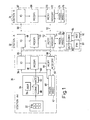
- Fig. 1 shows a simplified block diagram having three cooperating stations AK (30), A (32) and B (34).
- Stations AK, A have identical elements, some thereof have no counterpart in station B. Normally communication takes place between only two stations at any instant.
- Stations AK represents a personal data carrier shaped as an active card.
- Station AK comprises an identification device ID (36) for identification towards a station communicating with station AK, for example, towards station A.
- station AK comprises a modification device modifi (38) which receives number values that are exchanged during the process of mutual identification for by modification thereof generating a message ciphering key.
- the message ciphering key is used thereafter for ciphering and deciphering data in a combined ciphering/deciphering device MCRY/ MDECRY (44/46).
- the data to be transmitted from station AK are produced by a message generator MGEN (40) and messages received are sent to a message receiver MREC (42).
- the station AK also comprises a key set PIN (32) for entering into the card a personal secret code of the owner, that is a so-called PIN code.
- the supplied personal code is transmitted to an evaluation device (34) comprising a comparator circuit COINC 80 and a reference code memory REF 78.
- memory REF the corresponding correct personal code is stored, which code is supplied to said comparator circuit.
- the comparator circuit When equality is detected between the personal code which is entered and the one which is stored, the comparator circuit generates a signal which is supplied to an activating means ACT 82 which will then activate temporarily the further functions on the active card by means of a control signal on line 83. Only during this temporary activation the card AK and the cooperating station A (32) may execute mutual identification and exchange data messages.
- the activating means ACT may be so dimensioned that the card will be activated automatically when the transmission is finished, for example after a predetermined time interval or by means of a reset mechanism triggered by an "end of message" signal. Before the next-following data exchange station AK must be activated again by a renewed supply of said PIN code. In this way an increased safety against unauthorized use of station AK is realized.
- Fig. 1 also shows two stations A and B, which for example may have a form of a bank terminal device or a POS device.
- each of the stations A and B respectively, comprises an identification device ID, 48, 66 a modification device MODIFI 50, 68, a message encipher- ing/deciphering device MCRY, MDECRY 52/54, 70/72 and a message generator/receiver MGEN, MREC 56/58, 74/76.
- the stations A and B may comprise said means for a PIN controlled activation, that is the means PIN, REF, COINC, ACT (60-66) as shown in station A. In certain cases the latter subsystem may be omitted as has been shown for station B.
- the stations may be interconnected via a transmission channel which in Fig. 1 is represented by double arrows 86-92 between the identification and message enciphering/decipher- ing devices thereof.
- the transmisssion channel may comprise a galvanic coupling or a radio connection and may comprise a channel of a time divisional multiplex system or a frequency divisional multiplex system.
- the transmission channel may comprise a part of the general data network.
- lines 86, 88 may be embodied in a single lead or time/frequency slot. It is stressed that a communication may be set up via one or more further stations, which then merely relay the information unchanged. Thus a communication session could be executed directly between stations AK and B, station A then merely relaying the messages.
- the diagram of Fig. 2 shows the introductory operational steps for a transmission between the station A and the station B via the transmission channel CH.
- the diagram comprises a column ST in which the operational steps are numbered sequentially. The numbering of the operational steps has been done without considering the fact that some of the steps may be carried out simultaneously in the respective stations. As a consequence the number of steps may be lower in the time space.
- the diagram comprises for each station a column MEM, in which is indicated what is stored in the station at each step, and a column OPERA indicating the operations carried out by the station.
- the transmission sequences in the transmission channel are shown.
- This embodiment of the identification process uses an identification enciphering function E and its inverse D, operating with double keys, i.e. each station has an enciphering key and a deciphering key associated therewith.
- the ciphering key is public, i.e. it is available (known) to all stations in the system, but the deciphering key of the station is kept secret in the station.
- the relation between the ciphering key k a and the associated deciphering key d a is unique and may be expressed by means of a function F as follows
- the security of a ciphering system using a public key depends on the difficulty of finding out the secret key when knowing the public key. Expressed by means of the function F this means that it should be "computationally unpracticable", according to the definition given above, to calculate from which follows that the function F shall be a so-called one-way function.
- the ciphering function which is used in combination with a pair of keys k, d is a so-called "trap door function".
- a trap door function has the character of a one-way function to anybody not having available the complete information, i.e both of said keys k and d and said function and its inverse.
- C designates the cipher of the message M
- k designates the public ciphering key
- n is an integer
- (mod n) designates a function which is the reminder after a repeated division by n.
- Said ciphering and deciphering function E and D may be according to expressions (1) and (2) above. If so, the key pairs which are used fulfill the relation (3).
- each station knows from the beginning the publicly known functions E, D, f, t, T M , and T M .
- the function f may be realized by the same trap door function as said ciphering function E, which is obtained by selecting one of the keys of a pair of keys as a constant key and by ignoring the other one.
- the message ciphering function T M and the inverse thereof T M , used together with the established so-called session key t m , is of the type which operates with one key which is known to both transmitter and receiver.
- DES ciphering function or algorithm
- DES stands for the United States Data Encryption Algorithm.
- Federal Information Processing Standards Publication 46 January 15, 1977
- United States Dept. of Commerce/National Bureau of Standards United States Dept. of Commerce/National Bureau of Standards.
- each station from start, step 0, has in storage its own secrete deciphering key (d a ; d b ) and the public ciphering key (k b ; k a ) of the other station.
- the mutual identification begins with station A generating and storing a number r 1 , preferably a pseudo-random number.
- r is ciphered by means of k b to produce s 1 .
- a first cipher cg 1 is formed from s 1 and the address a of the station A and is transmitted in step 3 to station B.
- Station B receives cg, and in step 4 calculates r, by deciphering s1 while using d b ; r 1 is stored.
- step 5 the result of the transformation function f from the received number value r, is calculated, which gives s 2 .
- Step number 6 means generation of a second number value r 2 , being preferably a second pseudo-random number, which is also stored.
- the next step (7) means that r 2 is ciphered by using the key k a , which gives s 3 .
- a second cipher cg 2 is transmitted to station A comprising s 2 , s 3 , b.
- the station A receives cg 2 .
- This is followed (9) by a calculation of the result of the transformation function from its own number value r 1 , which result, in the next step (10), is compared with the corresponding result of station B, that is s 2 , which was received in the second cipher.
- the blocking signal BL is generated during step number 11, said signal blocking or breaking the connection between the stations.
- the number value r 2 is calculated (12) by deciphering s 3 received in the second cipher. At the same time the calculated r 2 is stored.
- both of the stations know both r 1 and r 2 .
- the station A calculates the session key t m from r 1 , r 2 .
- t m is stored.
- S4 which is transmitted in a third cipher cg 3 to station B.
- the station B receives cg 3 and calculates during the following step (16), the outcome of the transformation function f from its own number value r 2 which outcome is thereafter compared with the corresponding outcome of station A, that is s 4 , which was received in said third cipher.
- the blocking signal BL is generated during step number 18, which signal blocks or breaks the connection with station A.
- the session key t m is calculated and stored (19).
- the station A has available t m already at step number 13 the first ciphered message T M1 may be transmitted together with the third cipher cg 3 . Consequently, only one separate transmission sequence in each direction is required in order to carry out the identification and the establishment of a session key.
- Fig. 3 shows a more detailed functional block diagram of the station A.
- the cooperation between the blocks is illustrated by the signals which are generated in the station A according to the diagram of Fig. 2. Accordingly, the time of appearance of said signals may be obtained from the diagram.
- Fig. 3 is intended to illustrate cooperating functional blocks, which may also be realized by providing a computer or microcomputer with the necessary software. Consequently respective different blocks in Fig. 3 may be realized by means of the same hardware, and Fig. 3 cannot be considered a one-to-one picture of a device. In consequence the required data paths, control decoders, timing means and the like have not been shown for brevity.
- the identification device ID 36 is indicated by a dotted line.
- ID comprises a number generator NGEN 100 for generating the number value r 1 of the station.
- the number generator comprises a pseudo-random generator built as a feedback coupled shift register.
- the number value r 1 is supplied to a ciphering device CRY (102) comprising the means for ciphering r 1 by means of said trap door function using the public ciphering key k b of the counterpart, which is obtained from a key memory CRYK (104).
- the device ID furthermore comprises a deciphering device DECRY (106), comprising the means for realizing the inverse of said trap door function.
- DECRY deciphering device
- the number value r 2 of the other station is calculated while using the secret deciphering key d a of the station, which is obtained from the key memory CRYK (104).
- the device furthermore comprises a comparator COMP 108.
- a converted version f(r1) or r 1 is supplied from a number converter NCONV (110), the latter converting the number values which are supplied thereto according to the one way function f.
- the comparator COMP receives the information s 2 , that is the information r 1 as converted by the other station.
- the comparator also has means for generating the blocking signal BL on output 112 when inequality is detected.
- the number values r 1 and r 2 are supplied to a modification device MODIFI 114 comprising the means for forming, from said number values, a session key t m according to a fixed modification algorithm t, which may have the meaning of a simple addition, bit-wise EXCLUSIVE ORING, concatenation or a different combination of the number values.
- the formed session key t m is supplied on the one hand to a message ciphering device MCRY (116) and on the other hand to a message deciphering device MDECRY (18) comprising the means for the realisation of said message ciphering algorithm T m and said message deciphering algorithm T M , respectively.
- MCRY message ciphering device
- MDECRY message deciphering device
- message ciphering device 116 To the message ciphering device 116 are supplied data messages to be transmitted in the ciphered form to station B, from a message generator MGEN (120). Correspondingly, the output of message deciphering device is connected to a memory MREC (122) for the data messages which are received.
- the station A also comprises a transmission unit TRU (124) comprising the means for formatting the transmission sequences which are transmitted by the station.
- a transmission unit TRU (124) comprising the means for formatting the transmission sequences which are transmitted by the station.
- an address generator ADRGEN (126) for generating the station address a.
- the transmission unit will for example put together the cipher cg 1 from the signal a received from address generator 126 and s1 received from ciphering device 102.
- a reception unit REU 128 having the means for directing the signals of the received signal sequences to the relevant functional blocks.
- the signal S2 is directed to the comparator COMP (108) and the signal s 3 is directed to the deciphering device DECRY (106), and further messages are forwarded to the message deciphering device 118.
- the transmission unit 124 is also connected to message enciphering unit 116 for therefrom receiving further messages T M1 to be sent to the other station.
- a dotted line has been shown from number converter 110 to transmission unit 124 to communicate the information s4, calculated according to step 14 in Fig. 2.
- the comparator COMP generates a blocking signal BL at non-coincidence, i.e. in case the station B has not been able to identify itself towards the station A by transmitting back a correctly converted r 1 .
- the blocking signal is used for the control of a blocking device BLS 130, which is illustrated as a switch.
- the appearance of signal BL breaks the connection between the transmission unit TRU and the channel CH 132 and thereby also the connection between the stations.
- the channel is bidirectionally operative, while the separation between data-out and data-in is executed in elements 124, 128.
Landscapes
- Engineering & Computer Science (AREA)
- Business, Economics & Management (AREA)
- Accounting & Taxation (AREA)
- General Physics & Mathematics (AREA)
- Physics & Mathematics (AREA)
- Computer Security & Cryptography (AREA)
- General Business, Economics & Management (AREA)
- Strategic Management (AREA)
- Theoretical Computer Science (AREA)
- Finance (AREA)
- Computer Networks & Wireless Communication (AREA)
- Signal Processing (AREA)
- Microelectronics & Electronic Packaging (AREA)
- Storage Device Security (AREA)
- Small-Scale Networks (AREA)
Claims (6)
caractérisé en ce que
Applications Claiming Priority (2)
| Application Number | Priority Date | Filing Date | Title |
|---|---|---|---|
| SE8102268 | 1981-04-08 | ||
| SE8102268A SE426128B (sv) | 1981-04-08 | 1981-04-08 | Metod vid overforing av datameddelanden mellan tva stationer, samt overforingsanleggning for utforande av metoden |
Publications (3)
| Publication Number | Publication Date |
|---|---|
| EP0064779A2 EP0064779A2 (fr) | 1982-11-17 |
| EP0064779A3 EP0064779A3 (en) | 1984-07-25 |
| EP0064779B1 true EP0064779B1 (fr) | 1986-10-29 |
Family
ID=20343561
Family Applications (1)
| Application Number | Title | Priority Date | Filing Date |
|---|---|---|---|
| EP82200425A Expired EP0064779B1 (fr) | 1981-04-08 | 1982-04-07 | Méthode et système pour l'identification mutuelle chiffrée entre stations de communication de données et stations pour l'utilisation de cette méthode et système |
Country Status (5)
| Country | Link |
|---|---|
| US (1) | US4720859A (fr) |
| EP (1) | EP0064779B1 (fr) |
| CA (1) | CA1191916A (fr) |
| DE (1) | DE3274043D1 (fr) |
| SE (1) | SE426128B (fr) |
Families Citing this family (53)
| Publication number | Priority date | Publication date | Assignee | Title |
|---|---|---|---|---|
| DE3300170C2 (de) * | 1983-01-05 | 1986-12-18 | DATA-LÖSCH Gesellschaft für Sicherheitstechniken im Datenschutz mbH, 4420 Coesfeld | Sperrwerk-Steuerungsanlage |
| US4536647A (en) * | 1983-07-15 | 1985-08-20 | Atalla Corporation | Pocket banking terminal, method and system |
| FR2549989B1 (fr) * | 1983-07-29 | 1985-09-13 | Philips Ind Commerciale | Systeme d'authentification entre un lecteur de carte et une carte de paiement echangeant des informations |
| EP0148960B1 (fr) * | 1983-12-21 | 1990-03-14 | International Business Machines Corporation | Sécurité pour systèmes de transmission de données |
| DK152239C (da) * | 1983-12-30 | 1988-07-04 | Sp Radio As | Fremgangsmaade til kryptografisk overfoering af talesignaler og kommunikationsstation til udoevelse af fremgangsmaaden |
| JPS60160491A (ja) * | 1984-01-31 | 1985-08-22 | Toshiba Corp | Icカードとicカード発行装置 |
| US4649233A (en) * | 1985-04-11 | 1987-03-10 | International Business Machines Corporation | Method for establishing user authenication with composite session keys among cryptographically communicating nodes |
| GB8524020D0 (en) * | 1985-09-30 | 1985-11-06 | British Telecomm | Electronic funds transfer |
| US4799061A (en) * | 1985-11-18 | 1989-01-17 | International Business Machines Corporation | Secure component authentication system |
| FR2601795B1 (fr) * | 1986-07-17 | 1988-10-07 | Bull Cp8 | Procede pour diversifier une cle de base et pour authentifier une cle ainsi diversifiee comme ayant ete elaboree a partir d'une cle de base predeterminee, et systeme pour la mise en oeuvre |
| GB8619453D0 (en) * | 1986-08-08 | 1986-09-17 | British Broadcasting Corp | Data encipherment |
| US4916738A (en) * | 1986-11-05 | 1990-04-10 | International Business Machines Corp. | Remote access terminal security |
| DE3889481D1 (de) * | 1987-03-04 | 1994-06-16 | Siemens Nixdorf Inf Syst | Schaltungsanordnung zur Sicherung des Zugangs zu einem Datenverarbeitungssystem mit Hilfe einer Chipkarte. |
| GB8819767D0 (en) * | 1988-08-19 | 1989-07-05 | Ncr Co | Public key diversification method |
| US4910777A (en) * | 1988-09-20 | 1990-03-20 | At&T Bell Laboratories | Packet switching architecture providing encryption across packets |
| EP0386677B1 (fr) * | 1989-03-08 | 1994-01-05 | Siemens Nixdorf Informationssysteme Aktiengesellschaft | Méthode de génération d'un nombre aléatoire pour la communication chiffrée de données, en utilisant un nombre de départ variable |
| US5196840A (en) * | 1990-11-05 | 1993-03-23 | International Business Machines Corporation | Secure communications system for remotely located computers |
| JP2901767B2 (ja) * | 1991-02-08 | 1999-06-07 | 株式会社東芝 | 暗号通信システム及び携帯可能電子装置 |
| US5202921A (en) * | 1991-04-01 | 1993-04-13 | International Business Machines Corporation | Method and apparatus for authenticating users of a communication system to each other |
| EP0537903A2 (fr) * | 1991-10-02 | 1993-04-21 | International Business Machines Corporation | Système de contrôle distribué |
| NL9101796A (nl) * | 1991-10-25 | 1993-05-17 | Nederland Ptt | Werkwijze voor het authenticeren van communicatiedeelnemers, systeem voor toepassing van de werkwijze en eerste communicatiedeelnemer en tweede communicatiedeelnemer voor toepassing in het systeem. |
| US5557518A (en) * | 1994-04-28 | 1996-09-17 | Citibank, N.A. | Trusted agents for open electronic commerce |
| US5396558A (en) * | 1992-09-18 | 1995-03-07 | Nippon Telegraph And Telephone Corporation | Method and apparatus for settlement of accounts by IC cards |
| US5267314A (en) * | 1992-11-17 | 1993-11-30 | Leon Stambler | Secure transaction system and method utilized therein |
| GB2278518B (en) * | 1993-05-14 | 1997-12-10 | Trafford Limited | Encrypted data transfer |
| DE4496863T1 (de) * | 1993-09-14 | 1996-12-05 | Chantilley Corp Ltd | Vorrichtung zur Schlüsselverteilung in einem Verschlüsselungssystem |
| US5481611A (en) * | 1993-12-09 | 1996-01-02 | Gte Laboratories Incorporated | Method and apparatus for entity authentication |
| US5491750A (en) * | 1993-12-30 | 1996-02-13 | International Business Machines Corporation | Method and apparatus for three-party entity authentication and key distribution using message authentication codes |
| US5491749A (en) * | 1993-12-30 | 1996-02-13 | International Business Machines Corporation | Method and apparatus for entity authentication and key distribution secure against off-line adversarial attacks |
| US5689564A (en) * | 1995-02-13 | 1997-11-18 | Eta Technologies Corporation | Personal access management system |
| US5682428A (en) * | 1995-02-13 | 1997-10-28 | Eta Technologies Corporation | Personal access management system |
| US5692049A (en) * | 1995-02-13 | 1997-11-25 | Eta Technologies Corporation | Personal access management system |
| US5778068A (en) * | 1995-02-13 | 1998-07-07 | Eta Technologies Corporation | Personal access management system |
| US5610980A (en) * | 1995-02-13 | 1997-03-11 | Eta Technologies Corporation | Method and apparatus for re-initializing a processing device and a storage device |
| US5694472A (en) * | 1995-02-13 | 1997-12-02 | Eta Technologies Corporation | Personal access management system |
| US5696825A (en) * | 1995-02-13 | 1997-12-09 | Eta Technologies Corporation | Personal access management system |
| US5619574A (en) * | 1995-02-13 | 1997-04-08 | Eta Technologies Corporation | Personal access management system |
| US5923762A (en) * | 1995-12-27 | 1999-07-13 | Pitney Bowes Inc. | Method and apparatus for ensuring debiting in a postage meter prior to its printing a postal indicia |
| US5799290A (en) * | 1995-12-27 | 1998-08-25 | Pitney Bowes Inc. | Method and apparatus for securely authorizing performance of a function in a distributed system such as a postage meter |
| GB9601924D0 (en) * | 1996-01-31 | 1996-04-03 | Certicom Corp | Transaction verification protocol for smart cards |
| US5841872A (en) * | 1996-07-01 | 1998-11-24 | Allsoft Distributing Incorporated | Encryption enhancement system |
| US6041123A (en) * | 1996-07-01 | 2000-03-21 | Allsoft Distributing Incorporated | Centralized secure communications system |
| US6247129B1 (en) | 1997-03-12 | 2001-06-12 | Visa International Service Association | Secure electronic commerce employing integrated circuit cards |
| JP3864401B2 (ja) | 1997-04-23 | 2006-12-27 | ソニー株式会社 | 認証システム、電子機器、認証方法、および記録媒体 |
| JP3951464B2 (ja) * | 1998-07-28 | 2007-08-01 | 株式会社日立製作所 | ディジタル信号処理装置 |
| GB2348568A (en) * | 1999-03-31 | 2000-10-04 | Ibm | Enabling conformance to legislative requirements for mobile devices |
| JP4177514B2 (ja) * | 1999-04-28 | 2008-11-05 | 株式会社東芝 | コンピュータシステムおよびコンテンツ保護方法 |
| DE10164134A1 (de) * | 2001-12-30 | 2003-07-17 | Juergen K Lang | System und Verfahren zur Erstellung und Verbreitung kopier- und nutzungsgeschützter elektronischer Ton- und Bildmedien und deren Dateninhalte |
| DE10164131A1 (de) * | 2001-12-30 | 2003-07-17 | Juergen K Lang | Kryptographisches Modul zur Speicherung und Wiedergabe kopier-und nutzungsgeschützter elektronischer Ton- und Bildmedien |
| DE10164135A1 (de) * | 2001-12-30 | 2003-07-17 | Juergen K Lang | System und Verfahren zur kopier- und nutzungsgeschützten Ver- und Entschlüsselung, Übertragung und Speicherung elektronischer Ton- und Bildmedien |
| DE10164133A1 (de) * | 2001-12-30 | 2003-07-17 | Juergen K Lang | System und Verfahren zur Wiedergabe kopier- und nutzungsgeschützter Ton- und Bildmedien |
| DE10352071A1 (de) * | 2003-11-07 | 2005-06-23 | Daimlerchrysler Ag | Verfahren zur Erkennung von unberechtigten Komponententausch |
| US7761591B2 (en) | 2005-12-16 | 2010-07-20 | Jean A. Graham | Central work-product management system for coordinated collaboration with remote users |
Family Cites Families (15)
| Publication number | Priority date | Publication date | Assignee | Title |
|---|---|---|---|---|
| US4193131A (en) * | 1977-12-05 | 1980-03-11 | International Business Machines Corporation | Cryptographic verification of operational keys used in communication networks |
| US4206315A (en) * | 1978-01-04 | 1980-06-03 | International Business Machines Corporation | Digital signature system and apparatus |
| US4408203A (en) * | 1978-01-09 | 1983-10-04 | Mastercard International, Inc. | Security system for electronic funds transfer system |
| US4186871A (en) * | 1978-03-01 | 1980-02-05 | International Business Machines Corporation | Transaction execution system with secure encryption key storage and communications |
| GB2047506B (en) * | 1978-05-03 | 1982-11-24 | Atalla Technovations | Method and apparatus for securing data transmissions |
| US4288659A (en) * | 1979-05-21 | 1981-09-08 | Atalla Technovations | Method and means for securing the distribution of encoding keys |
| US4264782A (en) * | 1979-06-29 | 1981-04-28 | International Business Machines Corporation | Method and apparatus for transaction and identity verification |
| FR2469760A1 (fr) * | 1979-11-09 | 1981-05-22 | Cii Honeywell Bull | Procede et systeme d'identification de personnes demandant l'acces a certains milieux |
| US4302810A (en) * | 1979-12-28 | 1981-11-24 | International Business Machines Corporation | Method and apparatus for secure message transmission for use in electronic funds transfer systems |
| US4326098A (en) * | 1980-07-02 | 1982-04-20 | International Business Machines Corporation | High security system for electronic signature verification |
| US4393269A (en) * | 1981-01-29 | 1983-07-12 | International Business Machines Corporation | Method and apparatus incorporating a one-way sequence for transaction and identity verification |
| DE3123168C1 (de) * | 1981-06-11 | 1982-11-04 | Siemens AG, 1000 Berlin und 8000 München | Verfahren zur Schluesseluebertragung |
| US4423287A (en) * | 1981-06-26 | 1983-12-27 | Visa U.S.A., Inc. | End-to-end encryption system and method of operation |
| US4652698A (en) * | 1984-08-13 | 1987-03-24 | Ncr Corporation | Method and system for providing system security in a remote terminal environment |
| US4649233A (en) * | 1985-04-11 | 1987-03-10 | International Business Machines Corporation | Method for establishing user authenication with composite session keys among cryptographically communicating nodes |
-
1981
- 1981-04-08 SE SE8102268A patent/SE426128B/sv not_active IP Right Cessation
-
1982
- 1982-03-31 CA CA000400150A patent/CA1191916A/fr not_active Expired
- 1982-04-05 US US06/365,711 patent/US4720859A/en not_active Expired - Lifetime
- 1982-04-07 DE DE8282200425T patent/DE3274043D1/de not_active Expired
- 1982-04-07 EP EP82200425A patent/EP0064779B1/fr not_active Expired
Also Published As
| Publication number | Publication date |
|---|---|
| SE8102268L (sv) | 1982-10-09 |
| US4720859A (en) | 1988-01-19 |
| DE3274043D1 (en) | 1986-12-04 |
| SE426128B (sv) | 1982-12-06 |
| CA1191916A (fr) | 1985-08-13 |
| EP0064779A3 (en) | 1984-07-25 |
| EP0064779A2 (fr) | 1982-11-17 |
Similar Documents
| Publication | Publication Date | Title |
|---|---|---|
| US4720859A (en) | Method and system for the mutual encyphered indentification between data communicating stations and stations for use with such method and system | |
| EP0186981B1 (fr) | Module de sécurité pour un système électronique de transfert de fonds | |
| US4912762A (en) | Management of cryptographic keys | |
| EP0131906B1 (fr) | Terminal bancaire de poche; procédé et système d'utilisation | |
| EP0007002B1 (fr) | Systèmes de terminaux de transactions avec authentification d'un utilisateur potentiel | |
| EP0047285B1 (fr) | Systeme d'authentification d'usager et dispositifs dans des reseaux de transactions en direct | |
| US5745576A (en) | Method and apparatus for initialization of cryptographic terminal | |
| US4747050A (en) | Transaction security system using time variant parameter | |
| US4755940A (en) | Transaction security system | |
| US5371796A (en) | Data communication system | |
| US5493613A (en) | Combination pin pad and terminal | |
| EP0354774B1 (fr) | Cryptographie de données utilisant des vecteurs de commande | |
| US5343529A (en) | Transaction authentication using a centrally generated transaction identifier | |
| US4918728A (en) | Data cryptography operations using control vectors | |
| US6042006A (en) | Authentication system wherein definition signals of two devices are altered, communicated between the two devices, and compared | |
| US5473689A (en) | Method for authentication between two electronic devices | |
| US5196840A (en) | Secure communications system for remotely located computers | |
| US4259720A (en) | Security system for electronic funds transfer system | |
| CA1292790C (fr) | Methode de regie de cles cryptographiques par parametres etablis au poste emetteur | |
| US4438824A (en) | Apparatus and method for cryptographic identity verification | |
| WO1997045979A9 (fr) | Procede et dispositif servant a initialiser un terminal cryptographique | |
| JP2000516734A (ja) | 確実性認証系 | |
| JPH0242261B2 (fr) | ||
| EP0148960B1 (fr) | Sécurité pour systèmes de transmission de données | |
| EP0849713A1 (fr) | Procédé et dispositif pour le chiffrage des codes |
Legal Events
| Date | Code | Title | Description |
|---|---|---|---|
| PUAI | Public reference made under article 153(3) epc to a published international application that has entered the european phase |
Free format text: ORIGINAL CODE: 0009012 |
|
| 17P | Request for examination filed |
Effective date: 19820407 |
|
| AK | Designated contracting states |
Designated state(s): DE FR GB SE |
|
| PUAL | Search report despatched |
Free format text: ORIGINAL CODE: 0009013 |
|
| AK | Designated contracting states |
Designated state(s): DE FR GB SE |
|
| RAP1 | Party data changed (applicant data changed or rights of an application transferred) |
Owner name: N.V. PHILIPS' GLOEILAMPENFABRIEKEN Owner name: PHILIPS NORDEN AB |
|
| GRAA | (expected) grant |
Free format text: ORIGINAL CODE: 0009210 |
|
| AK | Designated contracting states |
Kind code of ref document: B1 Designated state(s): DE FR GB SE |
|
| PG25 | Lapsed in a contracting state [announced via postgrant information from national office to epo] |
Ref country code: SE Effective date: 19861031 |
|
| REF | Corresponds to: |
Ref document number: 3274043 Country of ref document: DE Date of ref document: 19861204 |
|
| ET | Fr: translation filed | ||
| PLBE | No opposition filed within time limit |
Free format text: ORIGINAL CODE: 0009261 |
|
| STAA | Information on the status of an ep patent application or granted ep patent |
Free format text: STATUS: NO OPPOSITION FILED WITHIN TIME LIMIT |
|
| 26N | No opposition filed | ||
| REG | Reference to a national code |
Ref country code: FR Ref legal event code: CD |
|
| REG | Reference to a national code |
Ref country code: FR Ref legal event code: CD |
|
| PGFP | Annual fee paid to national office [announced via postgrant information from national office to epo] |
Ref country code: FR Payment date: 20000426 Year of fee payment: 19 |
|
| PGFP | Annual fee paid to national office [announced via postgrant information from national office to epo] |
Ref country code: GB Payment date: 20000428 Year of fee payment: 19 |
|
| PGFP | Annual fee paid to national office [announced via postgrant information from national office to epo] |
Ref country code: DE Payment date: 20000621 Year of fee payment: 19 |
|
| PG25 | Lapsed in a contracting state [announced via postgrant information from national office to epo] |
Ref country code: GB Free format text: LAPSE BECAUSE OF NON-PAYMENT OF DUE FEES Effective date: 20010407 |
|
| PG25 | Lapsed in a contracting state [announced via postgrant information from national office to epo] |
Ref country code: FR Free format text: THE PATENT HAS BEEN ANNULLED BY A DECISION OF A NATIONAL AUTHORITY Effective date: 20010430 Ref country code: DE Free format text: LAPSE BECAUSE OF NON-PAYMENT OF DUE FEES Effective date: 20010430 |
|
| GBPC | Gb: european patent ceased through non-payment of renewal fee |
Effective date: 20010407 |
|
| REG | Reference to a national code |
Ref country code: FR Ref legal event code: ST |