EP0064952A1 - Neue Monoazopigmente - Google Patents
Neue Monoazopigmente Download PDFInfo
- Publication number
- EP0064952A1 EP0064952A1 EP82810192A EP82810192A EP0064952A1 EP 0064952 A1 EP0064952 A1 EP 0064952A1 EP 82810192 A EP82810192 A EP 82810192A EP 82810192 A EP82810192 A EP 82810192A EP 0064952 A1 EP0064952 A1 EP 0064952A1
- Authority
- EP
- European Patent Office
- Prior art keywords
- formula
- methyl
- hydrogen
- group
- compounds
- Prior art date
- Legal status (The legal status is an assumption and is not a legal conclusion. Google has not performed a legal analysis and makes no representation as to the accuracy of the status listed.)
- Granted
Links
- NYGZLYXAPMMJTE-UHFFFAOYSA-M metanil yellow Chemical group [Na+].[O-]S(=O)(=O)C1=CC=CC(N=NC=2C=CC(NC=3C=CC=CC=3)=CC=2)=C1 NYGZLYXAPMMJTE-UHFFFAOYSA-M 0.000 title description 2
- 150000001875 compounds Chemical class 0.000 claims abstract description 21
- 239000011368 organic material Substances 0.000 claims abstract description 4
- 229910052739 hydrogen Inorganic materials 0.000 claims description 22
- 125000002496 methyl group Chemical group [H]C([H])([H])* 0.000 claims description 17
- 239000001257 hydrogen Substances 0.000 claims description 14
- 150000002431 hydrogen Chemical class 0.000 claims description 10
- 125000000623 heterocyclic group Chemical group 0.000 claims description 8
- ZAMOUSCENKQFHK-UHFFFAOYSA-N Chlorine atom Chemical compound [Cl] ZAMOUSCENKQFHK-UHFFFAOYSA-N 0.000 claims description 6
- 229910052801 chlorine Inorganic materials 0.000 claims description 6
- 239000000460 chlorine Substances 0.000 claims description 6
- 125000001997 phenyl group Chemical group [H]C1=C([H])C([H])=C(*)C([H])=C1[H] 0.000 claims description 6
- 150000001412 amines Chemical class 0.000 claims description 5
- 125000006367 bivalent amino carbonyl group Chemical group [H]N([*:1])C([*:2])=O 0.000 claims description 4
- 238000000034 method Methods 0.000 claims description 4
- 125000000956 methoxy group Chemical group [H]C([H])([H])O* 0.000 claims description 4
- 238000002360 preparation method Methods 0.000 claims description 4
- 239000012954 diazonium Substances 0.000 claims description 3
- 150000001989 diazonium salts Chemical class 0.000 claims description 3
- UFHFLCQGNIYNRP-UHFFFAOYSA-N Hydrogen Chemical compound [H][H] UFHFLCQGNIYNRP-UHFFFAOYSA-N 0.000 claims description 2
- 125000004435 hydrogen atom Chemical group [H]* 0.000 claims description 2
- 239000000049 pigment Substances 0.000 abstract description 22
- 230000005012 migration Effects 0.000 abstract description 3
- 238000013508 migration Methods 0.000 abstract description 3
- 230000000485 pigmenting effect Effects 0.000 abstract description 2
- UHOVQNZJYSORNB-UHFFFAOYSA-N Benzene Chemical compound C1=CC=CC=C1 UHOVQNZJYSORNB-UHFFFAOYSA-N 0.000 description 15
- 230000008878 coupling Effects 0.000 description 15
- 238000010168 coupling process Methods 0.000 description 15
- 238000005859 coupling reaction Methods 0.000 description 15
- ZMXDDKWLCZADIW-UHFFFAOYSA-N N,N-Dimethylformamide Chemical compound CN(C)C=O ZMXDDKWLCZADIW-UHFFFAOYSA-N 0.000 description 12
- PXRKCOCTEMYUEG-UHFFFAOYSA-N 5-aminoisoindole-1,3-dione Chemical compound NC1=CC=C2C(=O)NC(=O)C2=C1 PXRKCOCTEMYUEG-UHFFFAOYSA-N 0.000 description 8
- 229910052757 nitrogen Inorganic materials 0.000 description 8
- 239000000243 solution Substances 0.000 description 8
- -1 aralkyl sulfonates Chemical class 0.000 description 7
- 239000003960 organic solvent Substances 0.000 description 7
- HEMHJVSKTPXQMS-UHFFFAOYSA-M Sodium hydroxide Chemical compound [OH-].[Na+] HEMHJVSKTPXQMS-UHFFFAOYSA-M 0.000 description 6
- YXFVVABEGXRONW-UHFFFAOYSA-N Toluene Chemical compound CC1=CC=CC=C1 YXFVVABEGXRONW-UHFFFAOYSA-N 0.000 description 6
- XLYOFNOQVPJJNP-UHFFFAOYSA-N water Substances O XLYOFNOQVPJJNP-UHFFFAOYSA-N 0.000 description 6
- 238000002156 mixing Methods 0.000 description 5
- 229920000915 polyvinyl chloride Polymers 0.000 description 5
- 239000004800 polyvinyl chloride Substances 0.000 description 5
- GQBONCZDJQXPLV-UHFFFAOYSA-N 4-aminoisoindole-1,3-dione Chemical class NC1=CC=CC2=C1C(=O)NC2=O GQBONCZDJQXPLV-UHFFFAOYSA-N 0.000 description 4
- LFQSCWFLJHTTHZ-UHFFFAOYSA-N Ethanol Chemical compound CCO LFQSCWFLJHTTHZ-UHFFFAOYSA-N 0.000 description 4
- JUJWROOIHBZHMG-UHFFFAOYSA-N Pyridine Chemical compound C1=CC=NC=C1 JUJWROOIHBZHMG-UHFFFAOYSA-N 0.000 description 4
- MYONAGGJKCJOBT-UHFFFAOYSA-N benzimidazol-2-one Chemical compound C1=CC=CC2=NC(=O)N=C21 MYONAGGJKCJOBT-UHFFFAOYSA-N 0.000 description 4
- MVPPADPHJFYWMZ-UHFFFAOYSA-N chlorobenzene Chemical compound ClC1=CC=CC=C1 MVPPADPHJFYWMZ-UHFFFAOYSA-N 0.000 description 4
- 125000000664 diazo group Chemical group [N-]=[N+]=[*] 0.000 description 4
- 150000002148 esters Chemical class 0.000 description 4
- LQNUZADURLCDLV-UHFFFAOYSA-N nitrobenzene Chemical compound [O-][N+](=O)C1=CC=CC=C1 LQNUZADURLCDLV-UHFFFAOYSA-N 0.000 description 4
- 239000000725 suspension Substances 0.000 description 4
- ZWEHNKRNPOVVGH-UHFFFAOYSA-N 2-Butanone Chemical compound CCC(C)=O ZWEHNKRNPOVVGH-UHFFFAOYSA-N 0.000 description 3
- KQNZKBRSEJLVEO-UHFFFAOYSA-N 3-oxo-n-(2-oxobenzimidazol-5-yl)butanamide Chemical compound C1=C(NC(=O)CC(=O)C)C=CC2=NC(=O)N=C21 KQNZKBRSEJLVEO-UHFFFAOYSA-N 0.000 description 3
- CSCPPACGZOOCGX-UHFFFAOYSA-N Acetone Chemical compound CC(C)=O CSCPPACGZOOCGX-UHFFFAOYSA-N 0.000 description 3
- RTZKZFJDLAIYFH-UHFFFAOYSA-N Diethyl ether Chemical compound CCOCC RTZKZFJDLAIYFH-UHFFFAOYSA-N 0.000 description 3
- OKKJLVBELUTLKV-UHFFFAOYSA-N Methanol Chemical compound OC OKKJLVBELUTLKV-UHFFFAOYSA-N 0.000 description 3
- 239000000975 dye Substances 0.000 description 3
- 229920005989 resin Polymers 0.000 description 3
- 239000011347 resin Substances 0.000 description 3
- RFFLAFLAYFXFSW-UHFFFAOYSA-N 1,2-dichlorobenzene Chemical compound ClC1=CC=CC=C1Cl RFFLAFLAYFXFSW-UHFFFAOYSA-N 0.000 description 2
- JFGQHAHJWJBOPD-UHFFFAOYSA-N 3-hydroxy-n-phenylnaphthalene-2-carboxamide Chemical class OC1=CC2=CC=CC=C2C=C1C(=O)NC1=CC=CC=C1 JFGQHAHJWJBOPD-UHFFFAOYSA-N 0.000 description 2
- JNUGUKWPMCPSCH-UHFFFAOYSA-N 4-(3-oxobutanoylamino)-n-phenylbenzamide Chemical compound C1=CC(NC(=O)CC(=O)C)=CC=C1C(=O)NC1=CC=CC=C1 JNUGUKWPMCPSCH-UHFFFAOYSA-N 0.000 description 2
- IQKKTRRHCGJXKQ-UHFFFAOYSA-N 5-amino-6-chloroisoindole-1,3-dione Chemical compound C1=C(Cl)C(N)=CC2=C1C(=O)NC2=O IQKKTRRHCGJXKQ-UHFFFAOYSA-N 0.000 description 2
- YQKSFJJKJVCNRD-UHFFFAOYSA-N 5-amino-6-methoxyisoindole-1,3-dione Chemical compound C1=C(N)C(OC)=CC2=C1C(=O)NC2=O YQKSFJJKJVCNRD-UHFFFAOYSA-N 0.000 description 2
- LPZKZQICLYRDON-UHFFFAOYSA-N 5-amino-6-methylisoindole-1,3-dione Chemical compound C1=C(N)C(C)=CC2=C1C(=O)NC2=O LPZKZQICLYRDON-UHFFFAOYSA-N 0.000 description 2
- QTBSBXVTEAMEQO-UHFFFAOYSA-N Acetic acid Chemical compound CC(O)=O QTBSBXVTEAMEQO-UHFFFAOYSA-N 0.000 description 2
- IAZDPXIOMUYVGZ-UHFFFAOYSA-N Dimethylsulphoxide Chemical compound CS(C)=O IAZDPXIOMUYVGZ-UHFFFAOYSA-N 0.000 description 2
- VEXZGXHMUGYJMC-UHFFFAOYSA-N Hydrochloric acid Chemical compound Cl VEXZGXHMUGYJMC-UHFFFAOYSA-N 0.000 description 2
- KFZMGEQAYNKOFK-UHFFFAOYSA-N Isopropanol Chemical compound CC(C)O KFZMGEQAYNKOFK-UHFFFAOYSA-N 0.000 description 2
- CTQNGGLPUBDAKN-UHFFFAOYSA-N O-Xylene Chemical compound CC1=CC=CC=C1C CTQNGGLPUBDAKN-UHFFFAOYSA-N 0.000 description 2
- 239000004793 Polystyrene Substances 0.000 description 2
- SMWDFEZZVXVKRB-UHFFFAOYSA-N Quinoline Chemical compound N1=CC=CC2=CC=CC=C21 SMWDFEZZVXVKRB-UHFFFAOYSA-N 0.000 description 2
- 229910052783 alkali metal Inorganic materials 0.000 description 2
- 229920002678 cellulose Polymers 0.000 description 2
- 239000003795 chemical substances by application Substances 0.000 description 2
- 239000003086 colorant Substances 0.000 description 2
- JHIVVAPYMSGYDF-UHFFFAOYSA-N cyclohexanone Chemical compound O=C1CCCCC1 JHIVVAPYMSGYDF-UHFFFAOYSA-N 0.000 description 2
- 238000006193 diazotization reaction Methods 0.000 description 2
- 239000006185 dispersion Substances 0.000 description 2
- 238000001035 drying Methods 0.000 description 2
- 238000001914 filtration Methods 0.000 description 2
- 239000000203 mixture Substances 0.000 description 2
- AOICIQIHIFYZAO-UHFFFAOYSA-N n-(4-chlorophenyl)-4-(3-oxobutanoylamino)benzamide Chemical compound C1=CC(NC(=O)CC(=O)C)=CC=C1C(=O)NC1=CC=C(Cl)C=C1 AOICIQIHIFYZAO-UHFFFAOYSA-N 0.000 description 2
- YYCXUYCPBZVZKJ-UHFFFAOYSA-N n-(6-chloro-2-oxobenzimidazol-5-yl)-3-oxobutanamide Chemical compound C1=C(Cl)C(NC(=O)CC(=O)C)=CC2=NC(=O)N=C21 YYCXUYCPBZVZKJ-UHFFFAOYSA-N 0.000 description 2
- GUUDURXMVFSDTE-UHFFFAOYSA-N n-(6-methyl-2-oxobenzimidazol-5-yl)-3-oxobutanamide Chemical compound C1=C(C)C(NC(=O)CC(=O)C)=CC2=NC(=O)N=C21 GUUDURXMVFSDTE-UHFFFAOYSA-N 0.000 description 2
- JSFGMPMWOFAHGQ-UHFFFAOYSA-N n-(7-chloro-4-methyl-2-oxo-1h-quinolin-6-yl)-3-oxobutanamide Chemical compound CC1=CC(=O)NC2=C1C=C(NC(=O)CC(=O)C)C(Cl)=C2 JSFGMPMWOFAHGQ-UHFFFAOYSA-N 0.000 description 2
- 239000000025 natural resin Substances 0.000 description 2
- 229910052760 oxygen Inorganic materials 0.000 description 2
- 229920002239 polyacrylonitrile Polymers 0.000 description 2
- UMJSCPRVCHMLSP-UHFFFAOYSA-N pyridine Natural products COC1=CC=CN=C1 UMJSCPRVCHMLSP-UHFFFAOYSA-N 0.000 description 2
- LPXPTNMVRIOKMN-UHFFFAOYSA-M sodium nitrite Chemical compound [Na+].[O-]N=O LPXPTNMVRIOKMN-UHFFFAOYSA-M 0.000 description 2
- VZGDMQKNWNREIO-UHFFFAOYSA-N tetrachloromethane Chemical compound ClC(Cl)(Cl)Cl VZGDMQKNWNREIO-UHFFFAOYSA-N 0.000 description 2
- 239000008096 xylene Substances 0.000 description 2
- 239000001052 yellow pigment Substances 0.000 description 2
- OCJBOOLMMGQPQU-UHFFFAOYSA-N 1,4-dichlorobenzene Chemical compound ClC1=CC=C(Cl)C=C1 OCJBOOLMMGQPQU-UHFFFAOYSA-N 0.000 description 1
- PKJBRKTYYNRVSN-UHFFFAOYSA-N 10-(aminomethyl)-9,10-dihydroanthracene-1,2-diol Chemical compound OC1=CC=C2C(CN)C3=CC=CC=C3CC2=C1O PKJBRKTYYNRVSN-UHFFFAOYSA-N 0.000 description 1
- XNWFRZJHXBZDAG-UHFFFAOYSA-N 2-METHOXYETHANOL Chemical group COCCO XNWFRZJHXBZDAG-UHFFFAOYSA-N 0.000 description 1
- ZNQVEEAIQZEUHB-UHFFFAOYSA-N 2-ethoxyethanol Chemical compound CCOCCO ZNQVEEAIQZEUHB-UHFFFAOYSA-N 0.000 description 1
- BSKHPKMHTQYZBB-UHFFFAOYSA-N 2-methylpyridine Chemical compound CC1=CC=CC=N1 BSKHPKMHTQYZBB-UHFFFAOYSA-N 0.000 description 1
- BTXXTMOWISPQSJ-UHFFFAOYSA-N 4,4,4-trifluorobutan-2-one Chemical compound CC(=O)CC(F)(F)F BTXXTMOWISPQSJ-UHFFFAOYSA-N 0.000 description 1
- CRXVBLLLPNWFBS-UHFFFAOYSA-N 4-aminobenzimidazol-2-one Chemical class NC1=CC=CC2=NC(=O)N=C12 CRXVBLLLPNWFBS-UHFFFAOYSA-N 0.000 description 1
- KMEBUNSLFRQSEM-UHFFFAOYSA-N 5-amino-2-methylisoindole-1,3-dione Chemical compound C1=C(N)C=C2C(=O)N(C)C(=O)C2=C1 KMEBUNSLFRQSEM-UHFFFAOYSA-N 0.000 description 1
- BQACOLQNOUYJCE-FYZZASKESA-N Abietic acid Natural products CC(C)C1=CC2=CC[C@]3(C)[C@](C)(CCC[C@@]3(C)C(=O)O)[C@H]2CC1 BQACOLQNOUYJCE-FYZZASKESA-N 0.000 description 1
- RSWGJHLUYNHPMX-UHFFFAOYSA-N Abietic-Saeure Natural products C12CCC(C(C)C)=CC2=CCC2C1(C)CCCC2(C)C(O)=O RSWGJHLUYNHPMX-UHFFFAOYSA-N 0.000 description 1
- 0 C*[N+](C1*C1)[O-] Chemical compound C*[N+](C1*C1)[O-] 0.000 description 1
- VGGSQFUCUMXWEO-UHFFFAOYSA-N Ethene Chemical compound C=C VGGSQFUCUMXWEO-UHFFFAOYSA-N 0.000 description 1
- 239000001856 Ethyl cellulose Substances 0.000 description 1
- ZZSNKZQZMQGXPY-UHFFFAOYSA-N Ethyl cellulose Chemical compound CCOCC1OC(OC)C(OCC)C(OCC)C1OC1C(O)C(O)C(OC)C(CO)O1 ZZSNKZQZMQGXPY-UHFFFAOYSA-N 0.000 description 1
- 239000005977 Ethylene Substances 0.000 description 1
- 229920000877 Melamine resin Polymers 0.000 description 1
- SECXISVLQFMRJM-UHFFFAOYSA-N N-Methylpyrrolidone Chemical compound CN1CCCC1=O SECXISVLQFMRJM-UHFFFAOYSA-N 0.000 description 1
- 239000000020 Nitrocellulose Substances 0.000 description 1
- IOVCWXUNBOPUCH-UHFFFAOYSA-N Nitrous acid Chemical compound ON=O IOVCWXUNBOPUCH-UHFFFAOYSA-N 0.000 description 1
- REYJJPSVUYRZGE-UHFFFAOYSA-N Octadecylamine Chemical compound CCCCCCCCCCCCCCCCCCN REYJJPSVUYRZGE-UHFFFAOYSA-N 0.000 description 1
- 239000004952 Polyamide Substances 0.000 description 1
- 239000004698 Polyethylene Substances 0.000 description 1
- 239000004743 Polypropylene Substances 0.000 description 1
- GOOHAUXETOMSMM-UHFFFAOYSA-N Propylene oxide Chemical class CC1CO1 GOOHAUXETOMSMM-UHFFFAOYSA-N 0.000 description 1
- 229920002125 Sokalan® Polymers 0.000 description 1
- XSTXAVWGXDQKEL-UHFFFAOYSA-N Trichloroethylene Chemical group ClC=C(Cl)Cl XSTXAVWGXDQKEL-UHFFFAOYSA-N 0.000 description 1
- XSQUKJJJFZCRTK-UHFFFAOYSA-N Urea Chemical compound NC(N)=O XSQUKJJJFZCRTK-UHFFFAOYSA-N 0.000 description 1
- 229920001807 Urea-formaldehyde Polymers 0.000 description 1
- 229920002433 Vinyl chloride-vinyl acetate copolymer Polymers 0.000 description 1
- SMEGJBVQLJJKKX-HOTMZDKISA-N [(2R,3S,4S,5R,6R)-5-acetyloxy-3,4,6-trihydroxyoxan-2-yl]methyl acetate Chemical compound CC(=O)OC[C@@H]1[C@H]([C@@H]([C@H]([C@@H](O1)O)OC(=O)C)O)O SMEGJBVQLJJKKX-HOTMZDKISA-N 0.000 description 1
- 229960001413 acetanilide Drugs 0.000 description 1
- 229960000583 acetic acid Drugs 0.000 description 1
- 229940081735 acetylcellulose Drugs 0.000 description 1
- 239000002253 acid Substances 0.000 description 1
- 239000003929 acidic solution Substances 0.000 description 1
- 230000002378 acidificating effect Effects 0.000 description 1
- 239000013543 active substance Substances 0.000 description 1
- 229910052784 alkaline earth metal Inorganic materials 0.000 description 1
- 239000012670 alkaline solution Substances 0.000 description 1
- 229920000180 alkyd Polymers 0.000 description 1
- 125000000217 alkyl group Chemical group 0.000 description 1
- 150000001408 amides Chemical class 0.000 description 1
- 229920003180 amino resin Polymers 0.000 description 1
- 150000004945 aromatic hydrocarbons Chemical class 0.000 description 1
- 239000002585 base Substances 0.000 description 1
- 150000001555 benzenes Chemical group 0.000 description 1
- 125000000484 butyl group Chemical group [H]C([*])([H])C([H])([H])C([H])([H])C([H])([H])[H] 0.000 description 1
- 239000004202 carbamide Substances 0.000 description 1
- 239000005018 casein Substances 0.000 description 1
- BECPQYXYKAMYBN-UHFFFAOYSA-N casein, tech. Chemical compound NCCCCC(C(O)=O)N=C(O)C(CC(O)=O)N=C(O)C(CCC(O)=N)N=C(O)C(CC(C)C)N=C(O)C(CCC(O)=O)N=C(O)C(CC(O)=O)N=C(O)C(CCC(O)=O)N=C(O)C(C(C)O)N=C(O)C(CCC(O)=N)N=C(O)C(CCC(O)=N)N=C(O)C(CCC(O)=N)N=C(O)C(CCC(O)=O)N=C(O)C(CCC(O)=O)N=C(O)C(COP(O)(O)=O)N=C(O)C(CCC(O)=N)N=C(O)C(N)CC1=CC=CC=C1 BECPQYXYKAMYBN-UHFFFAOYSA-N 0.000 description 1
- 235000021240 caseins Nutrition 0.000 description 1
- 239000001913 cellulose Substances 0.000 description 1
- 229920002301 cellulose acetate Polymers 0.000 description 1
- 229920003086 cellulose ether Polymers 0.000 description 1
- 239000000084 colloidal system Substances 0.000 description 1
- 238000004040 coloring Methods 0.000 description 1
- 238000009833 condensation Methods 0.000 description 1
- 230000005494 condensation Effects 0.000 description 1
- 229940117389 dichlorobenzene Drugs 0.000 description 1
- 235000014113 dietary fatty acids Nutrition 0.000 description 1
- 239000002270 dispersing agent Substances 0.000 description 1
- YRIUSKIDOIARQF-UHFFFAOYSA-N dodecyl benzenesulfonate Chemical compound CCCCCCCCCCCCOS(=O)(=O)C1=CC=CC=C1 YRIUSKIDOIARQF-UHFFFAOYSA-N 0.000 description 1
- 229940071161 dodecylbenzenesulfonate Drugs 0.000 description 1
- 229920001971 elastomer Polymers 0.000 description 1
- 229920001249 ethyl cellulose Polymers 0.000 description 1
- 235000019325 ethyl cellulose Nutrition 0.000 description 1
- 125000001495 ethyl group Chemical group [H]C([H])([H])C([H])([H])* 0.000 description 1
- 239000000194 fatty acid Substances 0.000 description 1
- 229930195729 fatty acid Natural products 0.000 description 1
- 150000004665 fatty acids Chemical class 0.000 description 1
- 230000002349 favourable effect Effects 0.000 description 1
- 239000012362 glacial acetic acid Substances 0.000 description 1
- 125000005843 halogen group Chemical group 0.000 description 1
- 238000010438 heat treatment Methods 0.000 description 1
- 239000000976 ink Substances 0.000 description 1
- 150000002576 ketones Chemical class 0.000 description 1
- 239000004922 lacquer Substances 0.000 description 1
- 150000002605 large molecules Chemical class 0.000 description 1
- 239000007788 liquid Substances 0.000 description 1
- 239000000463 material Substances 0.000 description 1
- 239000000155 melt Substances 0.000 description 1
- 229920000609 methyl cellulose Polymers 0.000 description 1
- 239000001923 methylcellulose Substances 0.000 description 1
- 235000010981 methylcellulose Nutrition 0.000 description 1
- LZOZLSUWAAMPOA-UHFFFAOYSA-N n-(2-anilino-2-oxoethyl)-3-oxobutanamide Chemical class CC(=O)CC(=O)NCC(=O)NC1=CC=CC=C1 LZOZLSUWAAMPOA-UHFFFAOYSA-N 0.000 description 1
- CSDTZUBPSYWZDX-UHFFFAOYSA-N n-pentyl nitrite Chemical compound CCCCCON=O CSDTZUBPSYWZDX-UHFFFAOYSA-N 0.000 description 1
- 125000000449 nitro group Chemical group [O-][N+](*)=O 0.000 description 1
- 229920001220 nitrocellulos Polymers 0.000 description 1
- 239000003973 paint Substances 0.000 description 1
- 229920001568 phenolic resin Polymers 0.000 description 1
- 229920003023 plastic Polymers 0.000 description 1
- 239000004033 plastic Substances 0.000 description 1
- 239000004584 polyacrylic acid Substances 0.000 description 1
- 229920002647 polyamide Polymers 0.000 description 1
- 229920000515 polycarbonate Polymers 0.000 description 1
- 239000004417 polycarbonate Substances 0.000 description 1
- 238000006068 polycondensation reaction Methods 0.000 description 1
- 229920000728 polyester Polymers 0.000 description 1
- 229920000573 polyethylene Polymers 0.000 description 1
- 238000006116 polymerization reaction Methods 0.000 description 1
- 229920000098 polyolefin Polymers 0.000 description 1
- 229920001155 polypropylene Polymers 0.000 description 1
- 229920001296 polysiloxane Polymers 0.000 description 1
- 229920002223 polystyrene Polymers 0.000 description 1
- 150000003097 polyterpenes Chemical class 0.000 description 1
- 229920002635 polyurethane Polymers 0.000 description 1
- 239000004814 polyurethane Substances 0.000 description 1
- 230000001681 protective effect Effects 0.000 description 1
- 239000011541 reaction mixture Substances 0.000 description 1
- 239000001054 red pigment Substances 0.000 description 1
- 229920002050 silicone resin Polymers 0.000 description 1
- 235000010288 sodium nitrite Nutrition 0.000 description 1
- 238000009987 spinning Methods 0.000 description 1
- HXJUTPCZVOIRIF-UHFFFAOYSA-N sulfolane Chemical compound O=S1(=O)CCCC1 HXJUTPCZVOIRIF-UHFFFAOYSA-N 0.000 description 1
- 229920003002 synthetic resin Polymers 0.000 description 1
- 239000000057 synthetic resin Substances 0.000 description 1
Classifications
-
- C—CHEMISTRY; METALLURGY
- C09—DYES; PAINTS; POLISHES; NATURAL RESINS; ADHESIVES; COMPOSITIONS NOT OTHERWISE PROVIDED FOR; APPLICATIONS OF MATERIALS NOT OTHERWISE PROVIDED FOR
- C09B—ORGANIC DYES OR CLOSELY-RELATED COMPOUNDS FOR PRODUCING DYES, e.g. PIGMENTS; MORDANTS; LAKES
- C09B29/00—Monoazo dyes prepared by diazotising and coupling
- C09B29/32—Monoazo dyes prepared by diazotising and coupling from coupling components containing a reactive methylene group
- C09B29/33—Aceto- or benzoylacetylarylides
- C09B29/335—Aceto- or benzoylacetylarylides free of acid groups
- C09B29/337—Carbocyclic arylides
-
- C—CHEMISTRY; METALLURGY
- C09—DYES; PAINTS; POLISHES; NATURAL RESINS; ADHESIVES; COMPOSITIONS NOT OTHERWISE PROVIDED FOR; APPLICATIONS OF MATERIALS NOT OTHERWISE PROVIDED FOR
- C09B—ORGANIC DYES OR CLOSELY-RELATED COMPOUNDS FOR PRODUCING DYES, e.g. PIGMENTS; MORDANTS; LAKES
- C09B29/00—Monoazo dyes prepared by diazotising and coupling
- C09B29/0025—Monoazo dyes prepared by diazotising and coupling from diazotized amino heterocyclic compounds
- C09B29/0029—Monoazo dyes prepared by diazotising and coupling from diazotized amino heterocyclic compounds the heterocyclic ring containing only nitrogen as heteroatom
- C09B29/0033—Monoazo dyes prepared by diazotising and coupling from diazotized amino heterocyclic compounds the heterocyclic ring containing only nitrogen as heteroatom containing a five-membered heterocyclic ring with one nitrogen atom
-
- C—CHEMISTRY; METALLURGY
- C09—DYES; PAINTS; POLISHES; NATURAL RESINS; ADHESIVES; COMPOSITIONS NOT OTHERWISE PROVIDED FOR; APPLICATIONS OF MATERIALS NOT OTHERWISE PROVIDED FOR
- C09B—ORGANIC DYES OR CLOSELY-RELATED COMPOUNDS FOR PRODUCING DYES, e.g. PIGMENTS; MORDANTS; LAKES
- C09B29/00—Monoazo dyes prepared by diazotising and coupling
- C09B29/10—Monoazo dyes prepared by diazotising and coupling from coupling components containing hydroxy as the only directing group
- C09B29/18—Monoazo dyes prepared by diazotising and coupling from coupling components containing hydroxy as the only directing group ortho-Hydroxy carbonamides
- C09B29/20—Monoazo dyes prepared by diazotising and coupling from coupling components containing hydroxy as the only directing group ortho-Hydroxy carbonamides of the naphthalene series
Definitions
- the present invention relates to new phthalimidazo pigments, their preparation, their use for coloring organic materials and the colored material.
- JP-OS 2191/66 and JP-OS 18717/66 describe azo pigments which are obtained by coupling diazotized aminophthalimides with acetoacetylanilides or 2-hydroxy-3-naphthoic acid anilides.
- CH-PS 611 642 discloses azo pigments which are obtained by coupling diazotized aminobenzimidazolones with acetoacetylaminoacetanilides. It has now been found that pigments with improved properties are obtained if diazotized aminophthalimides are coupled with suitably substituted acetoacetylanilides or 2-hydroxy-3-naphthoic acid anilides.
- the invention thus relates to new monoazo pigments of the formula I.
- n and m are 1.
- Particularly preferred compounds correspond to the formula I in which X has the meaning given above, R and R are hydrogen, R 2 is hydrogen, chlorine or methyl, and Y is methyl, phenyl or in the ortho position to the NHCO group on ring A to the heterocycle bound -S- or -NH- means.
- Y denotes —S — or —NH— bonded ortho to the NHCO group on ring A to form the heterocycle.
- the compound of the formula is of particular interest
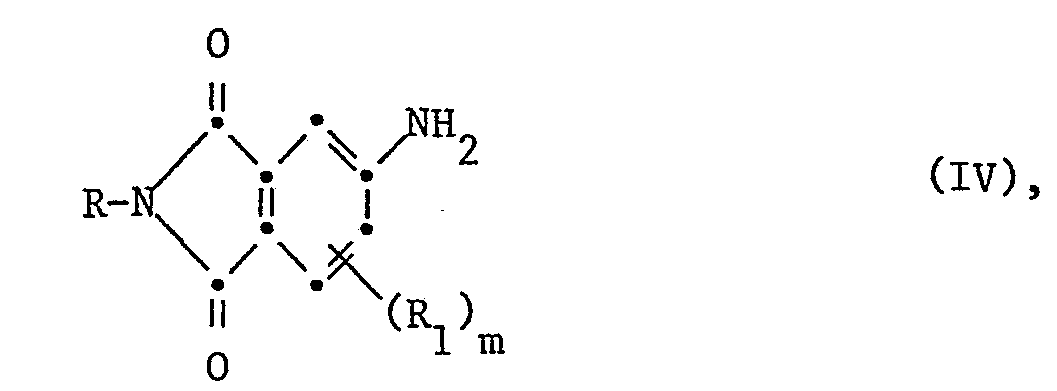
- the compounds of the formula I are prepared by known methods, for example by coupling a diazonium salt of an amine of the formula IV wherein R, R and m have the meaning given above, with a compound of formula V.
- X is a group of formula VI or VII means, and R 29 n and Y have the meaning given above.
- the coupling preferably takes place in a weakly acidic medium, expediently in the presence of customary agents which promote the coupling.
- Dispersants such as aralkyl sulfonates such as dodecylbenzenesulfonate or 1,1'-dinaphthylmethane-2,2'-disulfonic acid or polycondensation products of ethylene or propylene oxides may be mentioned as such.
- the dispersion of the coupling component can also advantageously contain protective colloids, for example methyl cellulose or smaller amounts of inert organic solvents which are sparingly soluble or insoluble in water, for example halogenated or nitrated aromatic hydrocarbons, such as benzene, toluene, xylene, chlorobenzene, dichlorobenzene or nitrobenzene, and aliphatic halogenated hydrocarbons , such as Carbon tetrachloride or trichlorethylene, and also water-miscible organic solvents, such as acetone, methyl ethyl ketone, methanol, ethanol or isopropanol or preferably dimethylformamide.
- protective colloids for example methyl cellulose or smaller amounts of inert organic solvents which are sparingly soluble or insoluble in water, for example halogenated or nitrated aromatic hydrocarbons, such as benzene, toluene, xylene, chlorobenzene
- the coupling can also advantageously be carried out by continuously combining an acidic solution of the diazonium salt with an alkaline solution of the coupling component in a mixing nozzle, the components being coupled immediately. It must be ensured that the diazo component and coupling component are present in the mixing nozzle in equimolecular amounts. It has proven to be advantageous to use the diazo component in a slight excess. The easiest way to do this is to that you control the pH of the liquid in the mixing nozzle. It is also important to ensure that the two solutions are thoroughly swirled in the mixing nozzle. The resulting pigment dispersion is removed from the mixing nozzle continuously and the pigment by filtration g e - separates.
- the coupling can also be carried out by suspending the amine with the coupling component in a molar ratio of 1: 1 in an organic solvent and with a diazotizing agent, in particular an ester of nitrous acid, such as methyl, ethyl, butyl or amyl - or octyl nitrite, treated.
- a diazotizing agent in particular an ester of nitrous acid, such as methyl, ethyl, butyl or amyl - or octyl nitrite, treated.
- the pigments can be isolated from the reaction mixture by filtration. It has proven advantageous to post-treat the isolated pigments in water or in an organic solvent which preferably boils above 80 ° C., if appropriate under pressure.
- organic solvents are benzenes substituted by halogen atoms, alkyl or nitro groups, such as toluene, xylene, chlorobenzene, o-dichlorobenzene or nitrobenzene, and pyridine bases, such as pyridine, picoline or quinoline, and also ketones, such as cyclohexanone, ether, such as ethylene glycol monomethyl or monoethyl ether, amides, such as dimethylformamide or N-methyl-pyrrolidone, sulfolane or dimethyl sulfoxide.
- the aftertreatment can also be carried out in water in the presence of organic solvents and / or with the addition of surface-active substances.
- the aftertreatment is preferably carried out by heating the pigment in water or an organic solvent to 100 to 160 ° C., if appropriate under pressure. Grain coarsening occurs in many cases, which has a favorable effect on the opacity, light and migration fastness of the pigments obtained.
- the new pigments are suitable for pigmenting high molecular weight organic materials, e.g. cellulose ethers and esters, linear Polyamides or linear polyurethanes or polyesters, acetyl cellulose, nitrocellulose, natural resins or synthetic resins, such as polymerization resins or condensation resins, for example aminoplasts, in particular urea and melamine-formaldehyde resins, alkyd resins, phenoplasts, polycarbonates, polyolefins, such as polyethylene, polypropylene, polystyrene, polyvinyl chloride Polyacrylonitrile, polyacrylic acid ester, rubber, casein, silicone and silicone resins. Not only the uniform compounds, but also mixtures thereof can be pigmented.
- organic materials e.g. cellulose ethers and esters, linear Polyamides or linear polyurethanes or polyesters, acetyl cellulose, nitrocellulose, natural resins or synthetic resins, such as polymerization resins or condensation resins
- the preparations can contain, for example, natural resins, such as abietic acid or its esters, ethyl cellulose, cellulose acetobutyrate, alkaline earth metal salts of higher fatty acids, fatty amines, for example stearylamine or rosinamine, vinyl chloride-vinyl acetate copolymers, polyacrylonitrile or polyterpene resins or water-soluble dyes, for example their dye alkali metal sulfonates, for example their dye alkali metal sulfonates.
- natural resins such as abietic acid or its esters, ethyl cellulose, cellulose acetobutyrate, alkaline earth metal salts of higher fatty acids, fatty amines, for example stearylamine or rosinamine, vinyl chloride-vinyl acetate copolymers, polyacrylonitrile or polyterpene resins or water-soluble dyes, for example their dye alkali metal sulfonates, for example their
- the pigments according to the invention are notable for high color strength, good light, migration, weather fastness and heat resistance and good flow properties.
- Example 1 1.62 g of 4-aminophthalimide are heated to 100 ° C. in 60 ml of glacial acetic acid and then stirred with 5 ml of 37 g of aqueous% hydrochloric acid. The mixture is cooled to 5 ° C. and 2.5 ml of aqueous 4N sodium nitrite solution are added dropwise to the suspension within 8 minutes. The diazo solution obtained is filtered clear. 3.82 g 4 ben zoylamino- (2'-hydroxy-3'-naphthoylamino) benzene are dissolved in 4 ml of 30% by weight aqueous sodium hydroxide solution, 50 ml of water and 100 ml of alcohol at 42 ° C.
- the solution is filtered, cooled to 8 ° C. and the diazo solution prepared above is added dropwise at this temperature within 10 minutes.
- the pH of the red suspension is adjusted to 5 with 30 ml of 30% by weight aqueous sodium hydroxide solution.
- the suspension is first stirred for 4 hours until the temperature has risen to 20.degree.
- the suspension is then heated to 75 ° C. within 1 hour and filtered off at this temperature.
- the filter residue is washed salt-free with warm water and then dried in vacuo at 60 ° C.
- Example 2 Analogously to Example 1, 1.62 g of 4-aminophthalimide are diazotized and coupled with 2.34 g of 4-acetoacetylamino-acetanilide. After drying in vacuo at 60 ° C., 3.8 g (94% of theory based on 4-aminophthalimide) of a yellow pigment of the formula are obtained The pigment aftertreated for 10 hours at 120 ° C in ethylene glycol ethyl ether produces real, strong and brilliant green-yellow colorations in polyvinyl chloride.
- Example 3 Analogously to Example 1, 1.62 g of 4-aminophthalimide are diazotized and coupled with 2.33 g of 5-acetoacetylaminobenzimidazolone. After drying in vacuo at 60 ° C., 3.9 g (96% of theory based on 4-aminophthalimide) of a yellow pigment of the formula are obtained The pigment aftertreated in dimethylformamide for 10 hours at 130 ° C produces real, strong and brilliant yellow colors in polyvinyl chloride.
- Example 4 Analogously to Example 1, a violet pigment of the empirical formula C 26 H 19 N is obtained by diazotizing and coupling N-methyl-4-aminophthalimide with 5-methyl-6- (2'-hydroxy-3'-naphthoylamino) benzimidazolone 6 O 5 .
- Examples 5-12 Analogously to Example 1, diazotization and coupling of the amines listed in column I with the coupling components from column II give pigments with the color shades listed in column III (0.2% by weight of pigment rolled into polyvinyl chloride).
Landscapes
- Chemical & Material Sciences (AREA)
- Organic Chemistry (AREA)
- Coloring (AREA)
- Inks, Pencil-Leads, Or Crayons (AREA)
- Plural Heterocyclic Compounds (AREA)
- Compositions Of Macromolecular Compounds (AREA)
Abstract
Description
- Die vorliegende Erfindung betrifft neue Phthalimidazopigmente, deren Herstellung, deren Verwendung zum Färben von organischen Materialien, sowie das gefärbte Material.
- In der JP-OS 2191/66 und in der JP-OS 18717/66 sind Azopigmente beschrieben, die durch Kuppeln von diazotierten Aminophthalimiden mit Acetoacetylaniliden bzw. 2-Hydroxy-3-naphthoesäureaniliden erhalten werden. Aus der CH-PS 611 642 sind Azopigmente bekannt, die durch Kuppeln von diazotierten Aminobenzimidazolonen mit Acetoacetylaminoacetaniliden erhalten werden. Es wurde nun gefunden, dass man Pigmente mit verbesserten Eigenschaften erhält, wenn man diazotierte Aminophthalimide mit geeignet substituierten Acetoacetylaniliden bzw. 2-Hydroxy-3-naphthoesäureaniliden kuppelt.
- Die Erfindung betrifft somit neue Monoazopigmente der Formel I

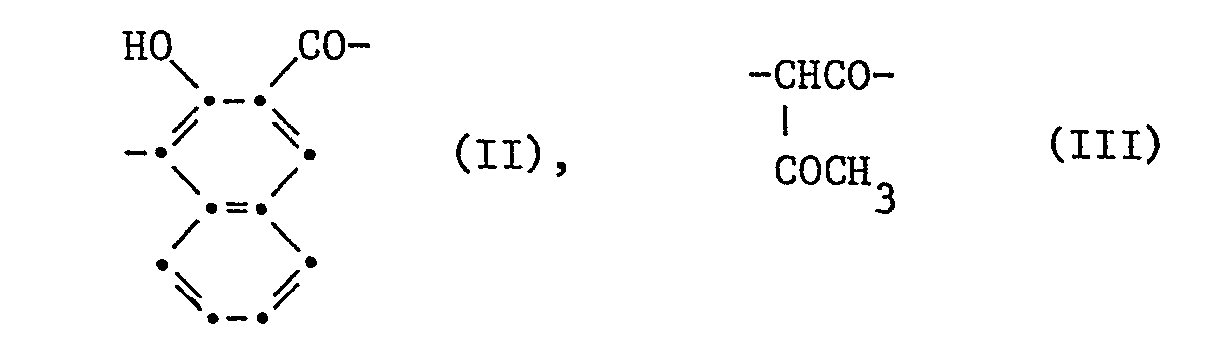
- Die bevorzugte Bedeutung von n und m ist 1.
- Von besonderem Interesse sind Verbindungen der Formel I, worin X die oben angegebene Bedeutung hat, R und R Wasserstoff bedeuten, R2 Wasserstoff, Chlor, Methyl oder Methoxy bedeutet, und Y Methyl, Phenyl oder in ortho-Stellung zur -NHCO-Gruppe am Ring A zum Heterocyclus gebundenes -0-, -S-, -C(CH3)=CH- oder -NH- bedeutet.
- Besonders bevorzugte Verbindungen entsprechen der Formel I, worin X die oben angegebene Bedeutung hat, R und R Wasserstoff sind, R2 Wasserstoff, Chlor oder Methyl bedeutet, und Y Methyl, Phenyl oder in ortho-Stellung zur NHCO-Gruppe am Ring A zum Heterocyclus gebundenes -S- oder -NH- bedeutet.
- In besonders bevorzugten Verbindungen der Formel I bedeutet Y in ortho-Stellung zur NHCO-Gruppe am Ring A zum Heterocyclus gebundenes -S- oder -NH-.
- Von besonderem Interesse ist die Verbindung der Formel


- Die Verbindungen der Formeln IV und V sind bekannt und können nach bekannten Methoden hergestellt werden.
- Beispiele von Verbindungen der Formel IV sind:
- 3-Aminophthalimid
- 4-Aminophthalimid
- 4-Amino-5-Methyl-phthalimid
- 4-Amino-5-chloro-phthalimid
- 4-Amino-5-methoxy-phthalimid.
- Beispiele von Kupplungskomponenten gemäss Formel V sind:
- 4-Acetylamino-(2'-hydroxy-3'-naphthoylamino)-benzol
- 4-Benzoylamino-(2'-hydroxy-3'-naphthoylamino)-benzol
- 4-p-Chlorbenzoylamino-(2'-hydroxy-3'-naphthoylamino)-benzol
- 6-(2'-Hydroxy-3'-naphthoylamino)-benzimidazolon
- 5-Chlor-6-(2'-hydroxy-3'-naphthoylamino)-benzimidazolon
- 5-Methyl-6-(2'-hydroxy-3'-naphthoylamino)-benzimidazolon
- 4-Acetoacetylamino-acetanilid
- 4-Acetoacetylamino-benzanilid
- 4-Acetoacetylamino-p-chlorbenzanilid
- 6-Acetoacetylamino-benzimidazolon
- 6-Acetoacetylamino-5-chlor-benzimidazolon
- 6-Acetoacetylamino-5-methyl-benzimidazolon
- 6-Acetoacetylamino-4-methyl-7-chlor-chinolon.
- Die Diazotierung erfolgt nach bekannten Methoden.
- Die Kupplung findet vorzugsweise in schwach saurem Medium statt, zweckmässig in Gegenwart gebräuchlicher, die Kupplung fördernder Mittel. Als solche seien insbesondere Dispergiermittel genannt, beispielsweise Aralkylsulfonate, wie Dodecylbenzolsulfonat oder 1,1'-Dinaphthylmethan-2,2'-disulfonsäure oder Polykondensationsprodukte von Aethylen- oder Propylenoxiden. Die Dispersion der Kupplungskomponente kann auch vorteilhaft Schutzkolloide, beispielsweise Methylcellulose oder kleinere Mengen inerter, in Wasser schwer löslicher oder unlöslicher organischer Lösungsmittel enthalten, beispielsweise gegebenenfalls halogenierte oder nitrierte aromatische Kohlenwasserstoffe, wie Benzol, Toluol, Xylol, Chlorbenzol, Dichlorbenzol oder Nitrobenzol, sowie aliphatische Halogenkohlenwasserstoffe, wie z.B. Tetrachlorkohlenstoff oder Trichloräthylen, ferner mit Wasser mischbare organische Lösungsmittel, wie Aceton, Methyläthylketon, Methanol, Aethanol oder Isopropanol oder vorzugsweise Dimethylformamid.
- Man kann die Kupplung auch vorteilhaft in der Weise durchführen, dass man eine saure Lösung des Diazoniumsalzes mit einer alkalischen Lösung der Kupplungskomponente in einer Mischdüse kontinuierlich vereinigt, wobei eine sofortige Kupplung der Komponenten erfolgt. Es ist darauf zu achten, dass Diazokomponente und Kupplungskomponente in äquimolekularen Mengen in der Mischdüse vorhanden sind. Dabei hat es sich als vorteilhaft erwiesen, die Diazokomponente in einem geringen Ueberschuss einzusetzen. Dies wird am einfachsten dadurch bewirkt, dass man den pH-Wert der Flüssigkeit in der Mischdüse kontrolliert. Auch ist in der Mischdüse für eine starke Durchwirbelung der beiden Lösungen zu sorgen. Die entstandene Pigmentdispersion wird der Mischdüse laufend entzogen und das Pigment durch Filtration abge- trennt.
- Schliesslich kann die Kupplung auch so vollzogen werden, dass man das Amin mit der Kupplungskomponente im Molverhältnis 1:1 in einem organischen Lösungsmittel suspendiert und mit einem diazotierenden Mittel, insbesondere einem Ester der salpetrigen Säure, wie Methyl-, Aethyl-, Butyl-, Amyl- oder Octylnitrit, behandelt.
- Die Pigmente können durch Abfiltrieren aus dem Reaktionsgemisch isoliert werden. Es erweist sich als vorteilhaft, die isolierten Pigmente in Wasser oder in einem vorzugsweise über 80°C siedenden organischen Lösungsmittel nachzubehandeln, gegebenenfalls unter Druck. Besonders geeignete organische Lösungsmittel sind durch Halogenatome, Alkyl- oder Nitrogruppen substituierte Benzole, wie Toluol, Xylol, Chlorbenzol, o-Dichlorbenzol oder Nitrobenzol sowie Pyridinbasen, wie Pyridin, Picolin oder Chinolin, ferner Ketone, wie Cyclohexanon, Aether, wie Aethylenglykolmonomethyl- oder -monoäthyläther, Amide, wie Dimethylformamid oder N-Methyl-pyrrolidon, Sulfolan oder Dimethylsulfoxyd. Man kann die Nachbehandlung auch in Wasser in Gegenwart von organischen Lösungsmitteln und/oder mit Zusatz von oberflächenaktiven Substanzen durchführen.
- Die Nachbehandlung erfolgt vorzugsweise durch Erhitzen des Pigmentes in Wasser oder einem organischen Lösungsmittel auf 100 bis 160°C, gegebenenfalls unter Druck. In vielen Fällen tritt eine Kornvergröberung auf, was sich günstig auf die Deckkraft, Licht- und Migrationsechtheit der erhaltenen Pigmente auswirkt.
- Die neuen Pigmente eignen sich zum Pigmentieren von hochmolekularen organischen Materialien, z.B. von Celluloseäthern und -estern,linearen Polyamiden bzw. linearen Polyurethanen oder Polyestern, Acetylcellulose, Nitrocellulose, natürlichen Harzen oder Kunstharzen, wie Polymerisationsharzen oder Kondensationsharzen, z.B. Aminoplasten, insbesondere Harnstoff- und Melamin-Formaldehydharzen, Alkydharzen, Phenoplasten, Polycarbonaten, Polyolefinen, wie Polyäthylen, Polypropylen, Polystyrol, Polyvinylchlorid, Polyacrylnitril, Polyacrylsäureester, Gummi, Casein, Silikon und Silikonharzen. Es können nicht nur die einheitlichen Verbindungen, sondern auch Gemische davon pigmentiert werden.
- Dabei spielt es keine Rolle, ob die erwähnten hochmolekularen Verbindungen als plastische Massen, Schmelzen oder in Form von Spinnlösungen, Lacken, Anstrichstoffen oder Druckfarben vorliegen. Je nach Verwendungszweck erweist es sich als vorteilhaft, die neuen Pigmente als Toner oder in Form von Präparaten zu verwenden.
- Die Präparate können neben dem Reinpigment beispielsweise Naturharze, wie Abietinsäure oder deren Ester, Aethylcellulose, Celluloseacetobutyrat, Erdalkalisalze höherer Fettsäuren, Fettamine, beispielsweise Stearylamin oder Rosinamin, Vinylchlorid-Vinylacetat-Copolymerisate, Polyacrylnitril oder Polyterpenharze oder wasserlösliche Farbstoffe, beispielsweise Farbstoffsulfonsäuren oder deren Erdalkalisalze enthalten.
- Die erfindungsgemässen Pigmente zeichnen sich durch hohe Farbstärke, eine gute Licht-, Migrations-, Wetterechtheit und Hitzebeständigkeit und durch gute Fliesseigenschaften aus.
- Die nachfolgenden Beispiele erläutern die Erfindung.
- Beispiel 1: 1,62 g 4-Amino-phthalimid werden in 60 ml Eisessig auf 100°C erwärmt und anschliessend mit 5 ml 37 gew.%iger wässeriger Salzsäure verrührt. Man kühlt auf 5°C ab und versetzt die Suspension tropfenweise innert 8 Minuten mit 2,5 ml wässeriger 4N-Natriumnitritlösung. Die erhaltene Diazolösung wird klarfiltriert. 3,82 g 4-Ben- zoylamino-(2'-hydroxy-3'-naphthoylamino)-benzol werden in 4 ml 30 gew.%iger wässeriger Natronlauge, 50 ml Wasser und 100 ml Alkohol bei 42°C gelöst. Die Lösung wird filtriert, auf 8°C abgekühlt und bei dieser Temperatur tropfenweise innert 10 Minuten mit der oben hergestellten Diazolösung versetzt. Mit 30 ml 30 gew.%iger wässeriger Natriumhydroxidlösung wird der pH-Wert der roten Suspension auf 5 eingestellt. Man rührt die Suspension zuerst während 4 Stunden, bis die Temperatur auf 20°C angestiegen ist. Dann wird die Suspension innert 1 Stunde auf 75°C erwärmt und bei dieser Temperatur abfiltriert. Der Filterrückstand wird mit warmem Wasser salzfrei gewaschen und anschliessend im Vakuum bei 60°C getrocknet. Man erhält 5,1 g (91% der Theorie bezogen auf 4-Aminophthalimid) eines roten Pigmentes der Formel

- Analyse: C32H21N5O5 Berechnet: C 69,2% H 3,8% N 12,6% 0 14,4% Gefunden: C 69,4% H 3,6% N 12,8% 0 14,3%.
- Beispiel 2: Analog zu Beispiel 1 werden 1,62 g 4-Aminophthalimid diazotiert und mit 2,34 g 4-Acetoacetylamino-acetanilid gekuppelt. Nach dem Trocknen im Vakuum bei 60°C erhält man 3,8 g (94% der Theorie bezogen auf 4-Amino-phthalimid) eines gelben Pigmentes der Formel

- Analyse: C 20 H 17 N 5 05 Berechnet: C 59,0% H 4,2% N 17,2% O 19,7% Gefunden: C 58,9% H 4,2% N 17,3% 0 19,7%
- Beispiel 3: Analog zu Beispiel 1 werden 1,62 g 4-Aminophthalimid diazotiert und mit 2,33 g 5-Acetoacetylaminobenzimidazolon gekuppelt. Nach dem Trocknen im Vakuum bei 60°C erhält man 3,9 g (96% der Theorie bezogen auf 4-Aminophthalimid) eines gelben Pigmentes der Formel

- Analyse: C19H14N6O5 Berechnet: C 56,2% H 3,5% N 20,7% O 19,7% Gefunden : C 56,1% H 3,4% N 20,6% 0 20,1%
- Beispiel 4: Analog zu Beispiel 1 erhält man durch Diazotieren und Kuppeln von N-Methyl-4-aminophthalimid mit 5-Methyl-6-(2'-hydroxy-3'-naphthoylamino)benzimidazolon ein violettes Pigment der Summenformel C26H19N6O5.
- Berechnet: C 63,03% H 3,84% N 16,97% 0 16,16% Gefunden: C 62,90% H 3,78% N 17,01% 0 16,05%
- Beispiele 5-12: Analog zu Beispiel 1 erhält man durch Diazotieren und Kuppeln der in Kolonne I aufgeführten Amine mit den Kupplungskomponenten aus Kolonne II Pigmente mit den in Kolonne III angeführten Farbtönen (0,2 Gew.% Pigment in Polyvinylchlorid eingewalzt).

Claims (10)




Applications Claiming Priority (2)
| Application Number | Priority Date | Filing Date | Title |
|---|---|---|---|
| CH3065/81 | 1981-05-12 | ||
| CH306581 | 1981-05-12 |
Publications (2)
| Publication Number | Publication Date |
|---|---|
| EP0064952A1 true EP0064952A1 (de) | 1982-11-17 |
| EP0064952B1 EP0064952B1 (de) | 1985-07-24 |
Family
ID=4247840
Family Applications (1)
| Application Number | Title | Priority Date | Filing Date |
|---|---|---|---|
| EP82810192A Expired EP0064952B1 (de) | 1981-05-12 | 1982-05-06 | Neue Monoazopigmente |
Country Status (5)
| Country | Link |
|---|---|
| US (1) | US4473500A (de) |
| EP (1) | EP0064952B1 (de) |
| JP (1) | JPS57195156A (de) |
| CA (1) | CA1183131A (de) |
| DE (1) | DE3264886D1 (de) |
Cited By (1)
| Publication number | Priority date | Publication date | Assignee | Title |
|---|---|---|---|---|
| WO1999036402A1 (en) * | 1998-01-13 | 1999-07-22 | Ciba Specialty Chemicals Holding Inc. | Process for preparing sparingly soluble aromatic amines |
Families Citing this family (1)
| Publication number | Priority date | Publication date | Assignee | Title |
|---|---|---|---|---|
| AU663869B2 (en) * | 1991-02-21 | 1995-10-26 | Exoxemis, Inc. | Methods and compositions for the treatment of infection and control of flora |
Citations (2)
| Publication number | Priority date | Publication date | Assignee | Title |
|---|---|---|---|---|
| FR2116492A1 (de) * | 1970-12-04 | 1972-07-13 | Basf Ag | |
| FR2370082A1 (fr) * | 1976-11-09 | 1978-06-02 | Ciba Geigy Ag | Pigments mono-azoiques et leur preparation |
Family Cites Families (4)
| Publication number | Priority date | Publication date | Assignee | Title |
|---|---|---|---|---|
| US3551407A (en) * | 1967-04-19 | 1970-12-29 | Basf Ag | Monoazo dyes derived from aminophthalimides |
| CH515309A (de) * | 1967-12-06 | 1971-11-15 | Bayer Ag | Verfahren zur Herstellung von Phthalimid-Azofarbstoffen |
| DE2847284A1 (de) * | 1978-10-31 | 1980-05-14 | Hoechst Ag | Monoazoverbindungen, verfahren zu ihrer herstellung und ihre verwendung |
| DE2847285A1 (de) * | 1978-10-31 | 1980-05-14 | Hoechst Ag | Monoazoverbindungen, verfahren zu ihrer herstellung und ihre verwendung |
-
1982
- 1982-05-03 US US06/374,120 patent/US4473500A/en not_active Expired - Fee Related
- 1982-05-06 EP EP82810192A patent/EP0064952B1/de not_active Expired
- 1982-05-06 DE DE8282810192T patent/DE3264886D1/de not_active Expired
- 1982-05-10 CA CA000402578A patent/CA1183131A/en not_active Expired
- 1982-05-12 JP JP57079810A patent/JPS57195156A/ja active Granted
Patent Citations (2)
| Publication number | Priority date | Publication date | Assignee | Title |
|---|---|---|---|---|
| FR2116492A1 (de) * | 1970-12-04 | 1972-07-13 | Basf Ag | |
| FR2370082A1 (fr) * | 1976-11-09 | 1978-06-02 | Ciba Geigy Ag | Pigments mono-azoiques et leur preparation |
Cited By (1)
| Publication number | Priority date | Publication date | Assignee | Title |
|---|---|---|---|---|
| WO1999036402A1 (en) * | 1998-01-13 | 1999-07-22 | Ciba Specialty Chemicals Holding Inc. | Process for preparing sparingly soluble aromatic amines |
Also Published As
| Publication number | Publication date |
|---|---|
| US4473500A (en) | 1984-09-25 |
| JPH0221422B2 (de) | 1990-05-14 |
| EP0064952B1 (de) | 1985-07-24 |
| JPS57195156A (en) | 1982-11-30 |
| DE3264886D1 (de) | 1985-08-29 |
| CA1183131A (en) | 1985-02-26 |
Similar Documents
| Publication | Publication Date | Title |
|---|---|---|
| DE2451097A1 (de) | Disazopigmente, verfahren zu deren herstellung und verwendung | |
| DE2254625C3 (de) | Disazopigmente und deren Verwendung | |
| DE1544460B2 (de) | Bfs (Acetoacet)-arykliamid-Disazopigmentfarbstoffe | |
| DE2749734A1 (de) | Monoazopigmente, verfahren zu deren herstellung und verwendung | |
| DE2244035C3 (de) | Disazopigmente, Verfahren zu deren Herstellung und ihre Verwendung zum Pigmentieren von hochmolekularem organischen Material | |
| DE2823930A1 (de) | Neue monoazopigmente und verfahren zu deren herstellung | |
| EP0168343B1 (de) | Neue Metallkomplexe, Verfahren zu ihrer Herstellung ihre Verwendung zum Färben von hochmolekularem organischem Material | |
| EP0064952B1 (de) | Neue Monoazopigmente | |
| EP0162806B1 (de) | Monoazoverbindungen enthaltend mindestens eine Carbonamidgruppe | |
| US3923774A (en) | Quinazolone containing phenyl-azo-pyridine compounds | |
| US4206114A (en) | Monoazo pigments from diazotized 5-acylaminoanthranilic acid derivatives and acetoacetylaminobenzimidazolones | |
| DE2145422C3 (de) | Neue Disazopigmente | |
| DE2429286C2 (de) | Neue Disazopigmente, Verfahren zu deren Herstellung und deren Verwendung | |
| US4065449A (en) | Tetrachloro substituted disazo pigments | |
| EP0000737B1 (de) | Monoazopigmente der Acetoacetylaminobenzimidazolonreihe, Verfahren zu deren Herstellung, und deren Verwendung zum Pigmentieren von hochmolekularem organischem Material | |
| CH627200A5 (en) | Process for preparing new monoazo pigments and use thereof for pigmenting macromolecular organic material | |
| EP0172512A2 (de) | Azinpigmente | |
| DE2361433C2 (de) | Schwer lösliche Disazoverbindungen, ihre Herstellung und Verwendung | |
| DE2420941A1 (de) | Neue monoazopigmente, verfahren zu deren herstellung und verwendung | |
| EP0006154B1 (de) | Monoazopigmente und deren Verwendung zum Pigmentieren von hochmolekularem organischem Material | |
| EP0022076B1 (de) | Iminoisoindolinonfarbstoffe, Verfahren zu deren Herstellung und deren Verwendung | |
| DE2606506A1 (de) | Azopigmente und verfahren zu deren herstellung | |
| DE2059708A1 (de) | Azopigmente der ss-Hydroxynaphthoesaeurereihe | |
| DE2429022A1 (de) | Neue disazopigmente und verfahren zu deren herstellung | |
| DE1544600C (de) | Monoazofarbstoffe sowie Ver fahren zu ihrer Herstellung und Verwendung |
Legal Events
| Date | Code | Title | Description |
|---|---|---|---|
| PUAI | Public reference made under article 153(3) epc to a published international application that has entered the european phase |
Free format text: ORIGINAL CODE: 0009012 |
|
| 17P | Request for examination filed |
Effective date: 19820508 |
|
| AK | Designated contracting states |
Designated state(s): CH DE FR GB IT |
|
| ITF | It: translation for a ep patent filed | ||
| GRAA | (expected) grant |
Free format text: ORIGINAL CODE: 0009210 |
|
| AK | Designated contracting states |
Designated state(s): CH DE FR GB IT LI |
|
| REF | Corresponds to: |
Ref document number: 3264886 Country of ref document: DE Date of ref document: 19850829 |
|
| ET | Fr: translation filed | ||
| PLBE | No opposition filed within time limit |
Free format text: ORIGINAL CODE: 0009261 |
|
| STAA | Information on the status of an ep patent application or granted ep patent |
Free format text: STATUS: NO OPPOSITION FILED WITHIN TIME LIMIT |
|
| 26N | No opposition filed | ||
| PGFP | Annual fee paid to national office [announced via postgrant information from national office to epo] |
Ref country code: FR Payment date: 19890227 Year of fee payment: 8 |
|
| ITTA | It: last paid annual fee | ||
| PGFP | Annual fee paid to national office [announced via postgrant information from national office to epo] |
Ref country code: CH Payment date: 19890616 Year of fee payment: 8 |
|
| PG25 | Lapsed in a contracting state [announced via postgrant information from national office to epo] |
Ref country code: LI Effective date: 19900531 Ref country code: CH Effective date: 19900531 |
|
| PG25 | Lapsed in a contracting state [announced via postgrant information from national office to epo] |
Ref country code: FR Effective date: 19910131 |
|
| REG | Reference to a national code |
Ref country code: CH Ref legal event code: PL |
|
| REG | Reference to a national code |
Ref country code: FR Ref legal event code: ST |
|
| PGFP | Annual fee paid to national office [announced via postgrant information from national office to epo] |
Ref country code: GB Payment date: 19910419 Year of fee payment: 10 Ref country code: DE Payment date: 19910419 Year of fee payment: 10 |
|
| PG25 | Lapsed in a contracting state [announced via postgrant information from national office to epo] |
Ref country code: GB Effective date: 19920506 |
|
| GBPC | Gb: european patent ceased through non-payment of renewal fee |
Effective date: 19920506 |
|
| PG25 | Lapsed in a contracting state [announced via postgrant information from national office to epo] |
Ref country code: DE Effective date: 19930202 |