EP0065638B1 - Substituierte 7-(4-substituierte-Cyclopent-2-en-1-on-2-yl)-hept-2-trans-enoate - Google Patents
Substituierte 7-(4-substituierte-Cyclopent-2-en-1-on-2-yl)-hept-2-trans-enoate Download PDFInfo
- Publication number
- EP0065638B1 EP0065638B1 EP82103017A EP82103017A EP0065638B1 EP 0065638 B1 EP0065638 B1 EP 0065638B1 EP 82103017 A EP82103017 A EP 82103017A EP 82103017 A EP82103017 A EP 82103017A EP 0065638 B1 EP0065638 B1 EP 0065638B1
- Authority
- EP
- European Patent Office
- Prior art keywords
- formula
- compound
- trans
- compounds
- acid
- Prior art date
- Legal status (The legal status is an assumption and is not a legal conclusion. Google has not performed a legal analysis and makes no representation as to the accuracy of the status listed.)
- Expired
Links
- 150000001875 compounds Chemical class 0.000 claims description 51
- 239000000203 mixture Substances 0.000 claims description 22
- -1 peroxy organic acid Chemical class 0.000 claims description 19
- 125000006239 protecting group Chemical group 0.000 claims description 7
- 125000003118 aryl group Chemical group 0.000 claims description 6
- 239000002904 solvent Substances 0.000 claims description 6
- 229910052739 hydrogen Inorganic materials 0.000 claims description 5
- 239000001257 hydrogen Substances 0.000 claims description 5
- 238000002360 preparation method Methods 0.000 claims description 5
- 238000010992 reflux Methods 0.000 claims description 5
- 230000000903 blocking effect Effects 0.000 claims description 4
- 125000001997 phenyl group Chemical group [H]C1=C([H])C([H])=C(*)C([H])=C1[H] 0.000 claims description 4
- 125000000217 alkyl group Chemical group 0.000 claims description 3
- 229910052736 halogen Inorganic materials 0.000 claims description 3
- 125000002887 hydroxy group Chemical group [H]O* 0.000 claims description 3
- 125000004178 (C1-C4) alkyl group Chemical group 0.000 claims description 2
- 125000000229 (C1-C4)alkoxy group Chemical group 0.000 claims description 2
- UFHFLCQGNIYNRP-UHFFFAOYSA-N Hydrogen Chemical compound [H][H] UFHFLCQGNIYNRP-UHFFFAOYSA-N 0.000 claims description 2
- 125000005843 halogen group Chemical group 0.000 claims description 2
- 150000002367 halogens Chemical class 0.000 claims description 2
- LWFWUJCJKPUZLV-UHFFFAOYSA-N n-trimethylsilylacetamide Chemical compound CC(=O)N[Si](C)(C)C LWFWUJCJKPUZLV-UHFFFAOYSA-N 0.000 claims description 2
- 125000002023 trifluoromethyl group Chemical group FC(F)(F)* 0.000 claims description 2
- 238000010438 heat treatment Methods 0.000 claims 1
- 238000004519 manufacturing process Methods 0.000 claims 1
- RTZKZFJDLAIYFH-UHFFFAOYSA-N Diethyl ether Chemical compound CCOCC RTZKZFJDLAIYFH-UHFFFAOYSA-N 0.000 description 36
- 239000000243 solution Substances 0.000 description 29
- XLYOFNOQVPJJNP-UHFFFAOYSA-N water Substances O XLYOFNOQVPJJNP-UHFFFAOYSA-N 0.000 description 14
- YMWUJEATGCHHMB-UHFFFAOYSA-N Dichloromethane Chemical compound ClCCl YMWUJEATGCHHMB-UHFFFAOYSA-N 0.000 description 12
- LFQSCWFLJHTTHZ-UHFFFAOYSA-N Ethanol Chemical compound CCO LFQSCWFLJHTTHZ-UHFFFAOYSA-N 0.000 description 12
- XEKOWRVHYACXOJ-UHFFFAOYSA-N Ethyl acetate Chemical compound CCOC(C)=O XEKOWRVHYACXOJ-UHFFFAOYSA-N 0.000 description 12
- YLQBMQCUIZJEEH-UHFFFAOYSA-N Furan Chemical compound C=1C=COC=1 YLQBMQCUIZJEEH-UHFFFAOYSA-N 0.000 description 10
- 239000000047 product Substances 0.000 description 10
- 239000012267 brine Substances 0.000 description 9
- HPALAKNZSZLMCH-UHFFFAOYSA-M sodium;chloride;hydrate Chemical compound O.[Na+].[Cl-] HPALAKNZSZLMCH-UHFFFAOYSA-M 0.000 description 9
- QTBSBXVTEAMEQO-UHFFFAOYSA-N Acetic acid Chemical compound CC(O)=O QTBSBXVTEAMEQO-UHFFFAOYSA-N 0.000 description 8
- 239000003153 chemical reaction reagent Substances 0.000 description 8
- 238000000034 method Methods 0.000 description 8
- 238000006243 chemical reaction Methods 0.000 description 7
- 239000003921 oil Substances 0.000 description 7
- VEXZGXHMUGYJMC-UHFFFAOYSA-N Hydrochloric acid Chemical compound Cl VEXZGXHMUGYJMC-UHFFFAOYSA-N 0.000 description 6
- VYPSYNLAJGMNEJ-UHFFFAOYSA-N Silicium dioxide Chemical compound O=[Si]=O VYPSYNLAJGMNEJ-UHFFFAOYSA-N 0.000 description 6
- UIIMBOGNXHQVGW-UHFFFAOYSA-M Sodium bicarbonate Chemical compound [Na+].OC([O-])=O UIIMBOGNXHQVGW-UHFFFAOYSA-M 0.000 description 6
- 150000008064 anhydrides Chemical class 0.000 description 6
- 239000007788 liquid Substances 0.000 description 6
- 239000000741 silica gel Substances 0.000 description 6
- 229910002027 silica gel Inorganic materials 0.000 description 6
- 239000002253 acid Substances 0.000 description 5
- 230000007062 hydrolysis Effects 0.000 description 5
- 238000006460 hydrolysis reaction Methods 0.000 description 5
- 239000010410 layer Substances 0.000 description 5
- 125000002496 methyl group Chemical group [H]C([H])([H])* 0.000 description 5
- 150000003180 prostaglandins Chemical class 0.000 description 5
- CSCPPACGZOOCGX-UHFFFAOYSA-N Acetone Chemical compound CC(C)=O CSCPPACGZOOCGX-UHFFFAOYSA-N 0.000 description 4
- XTHFKEDIFFGKHM-UHFFFAOYSA-N Dimethoxyethane Chemical compound COCCOC XTHFKEDIFFGKHM-UHFFFAOYSA-N 0.000 description 4
- CDBYLPFSWZWCQE-UHFFFAOYSA-L Sodium Carbonate Chemical compound [Na+].[Na+].[O-]C([O-])=O CDBYLPFSWZWCQE-UHFFFAOYSA-L 0.000 description 4
- 229960000583 acetic acid Drugs 0.000 description 4
- 125000002915 carbonyl group Chemical group [*:2]C([*:1])=O 0.000 description 4
- 238000004587 chromatography analysis Methods 0.000 description 4
- 150000002148 esters Chemical group 0.000 description 4
- BDAGIHXWWSANSR-UHFFFAOYSA-N methanoic acid Natural products OC=O BDAGIHXWWSANSR-UHFFFAOYSA-N 0.000 description 4
- HBAQYPYDRFILMT-UHFFFAOYSA-N 8-[3-(1-cyclopropylpyrazol-4-yl)-1H-pyrazolo[4,3-d]pyrimidin-5-yl]-3-methyl-3,8-diazabicyclo[3.2.1]octan-2-one Chemical class C1(CC1)N1N=CC(=C1)C1=NNC2=C1N=C(N=C2)N1C2C(N(CC1CC2)C)=O HBAQYPYDRFILMT-UHFFFAOYSA-N 0.000 description 3
- BZKFMUIJRXWWQK-UHFFFAOYSA-N Cyclopentenone Chemical class O=C1CCC=C1 BZKFMUIJRXWWQK-UHFFFAOYSA-N 0.000 description 3
- KWYUFKZDYYNOTN-UHFFFAOYSA-M Potassium hydroxide Chemical compound [OH-].[K+] KWYUFKZDYYNOTN-UHFFFAOYSA-M 0.000 description 3
- HEMHJVSKTPXQMS-UHFFFAOYSA-M Sodium hydroxide Chemical compound [OH-].[Na+] HEMHJVSKTPXQMS-UHFFFAOYSA-M 0.000 description 3
- QAOWNCQODCNURD-UHFFFAOYSA-N Sulfuric acid Chemical compound OS(O)(=O)=O QAOWNCQODCNURD-UHFFFAOYSA-N 0.000 description 3
- YXFVVABEGXRONW-UHFFFAOYSA-N Toluene Chemical compound CC1=CC=CC=C1 YXFVVABEGXRONW-UHFFFAOYSA-N 0.000 description 3
- 229910052783 alkali metal Inorganic materials 0.000 description 3
- 238000004440 column chromatography Methods 0.000 description 3
- 238000001704 evaporation Methods 0.000 description 3
- 230000008020 evaporation Effects 0.000 description 3
- 239000012362 glacial acetic acid Substances 0.000 description 3
- OKKJLVBELUTLKV-UHFFFAOYSA-N methanol Natural products OC OKKJLVBELUTLKV-UHFFFAOYSA-N 0.000 description 3
- VLKZOEOYAKHREP-UHFFFAOYSA-N n-Hexane Chemical compound CCCCCC VLKZOEOYAKHREP-UHFFFAOYSA-N 0.000 description 3
- 239000012044 organic layer Substances 0.000 description 3
- 239000003208 petroleum Substances 0.000 description 3
- 239000002243 precursor Substances 0.000 description 3
- 230000008707 rearrangement Effects 0.000 description 3
- 229910000030 sodium bicarbonate Inorganic materials 0.000 description 3
- 235000017557 sodium bicarbonate Nutrition 0.000 description 3
- 239000012258 stirred mixture Substances 0.000 description 3
- RMVRSNDYEFQCLF-UHFFFAOYSA-N thiophenol Chemical compound SC1=CC=CC=C1 RMVRSNDYEFQCLF-UHFFFAOYSA-N 0.000 description 3
- 125000006273 (C1-C3) alkyl group Chemical group 0.000 description 2
- 125000004169 (C1-C6) alkyl group Chemical group 0.000 description 2
- NHQDETIJWKXCTC-UHFFFAOYSA-N 3-chloroperbenzoic acid Chemical compound OOC(=O)C1=CC=CC(Cl)=C1 NHQDETIJWKXCTC-UHFFFAOYSA-N 0.000 description 2
- OSWFIVFLDKOXQC-UHFFFAOYSA-N 4-(3-methoxyphenyl)aniline Chemical compound COC1=CC=CC(C=2C=CC(N)=CC=2)=C1 OSWFIVFLDKOXQC-UHFFFAOYSA-N 0.000 description 2
- RWDDJVXLSIWKLW-UHFFFAOYSA-N 7-(3-hydroxy-5-oxocyclopenten-1-yl)-2-phenylheptanethioic s-acid Chemical compound OC1CC(=O)C(CCCCCC(C(S)=O)C=2C=CC=CC=2)=C1 RWDDJVXLSIWKLW-UHFFFAOYSA-N 0.000 description 2
- GNKGVPISNLFXSC-UHFFFAOYSA-N 8-(furan-2-yl)-8-hydroxy-2-phenyloctanethioic s-acid Chemical compound C=1C=COC=1C(O)CCCCCC(C(S)=O)C1=CC=CC=C1 GNKGVPISNLFXSC-UHFFFAOYSA-N 0.000 description 2
- BBCMFUDGJLGUPH-UHFFFAOYSA-N 8-ethoxy-7-phenyl-8-sulfanylideneoctanoic acid Chemical compound OC(=O)CCCCCC(C(=S)OCC)C1=CC=CC=C1 BBCMFUDGJLGUPH-UHFFFAOYSA-N 0.000 description 2
- 0 C1C**CC1 Chemical compound C1C**CC1 0.000 description 2
- HEDRZPFGACZZDS-UHFFFAOYSA-N Chloroform Chemical compound ClC(Cl)Cl HEDRZPFGACZZDS-UHFFFAOYSA-N 0.000 description 2
- QIGBRXMKCJKVMJ-UHFFFAOYSA-N Hydroquinone Chemical compound OC1=CC=C(O)C=C1 QIGBRXMKCJKVMJ-UHFFFAOYSA-N 0.000 description 2
- MZRVEZGGRBJDDB-UHFFFAOYSA-N N-Butyllithium Chemical compound [Li]CCCC MZRVEZGGRBJDDB-UHFFFAOYSA-N 0.000 description 2
- IMNFDUFMRHMDMM-UHFFFAOYSA-N N-Heptane Chemical compound CCCCCCC IMNFDUFMRHMDMM-UHFFFAOYSA-N 0.000 description 2
- KFSLWBXXFJQRDL-UHFFFAOYSA-N Peracetic acid Chemical compound CC(=O)OO KFSLWBXXFJQRDL-UHFFFAOYSA-N 0.000 description 2
- FAPWRFPIFSIZLT-UHFFFAOYSA-M Sodium chloride Chemical compound [Na+].[Cl-] FAPWRFPIFSIZLT-UHFFFAOYSA-M 0.000 description 2
- WYURNTSHIVDZCO-UHFFFAOYSA-N Tetrahydrofuran Chemical compound C1CCOC1 WYURNTSHIVDZCO-UHFFFAOYSA-N 0.000 description 2
- 230000002378 acidificating effect Effects 0.000 description 2
- 150000001266 acyl halides Chemical class 0.000 description 2
- 150000001340 alkali metals Chemical class 0.000 description 2
- 125000005110 aryl thio group Chemical group 0.000 description 2
- 230000015572 biosynthetic process Effects 0.000 description 2
- 239000012043 crude product Substances 0.000 description 2
- 150000005690 diesters Chemical class 0.000 description 2
- 230000032050 esterification Effects 0.000 description 2
- 238000005886 esterification reaction Methods 0.000 description 2
- IBSKPOOMDHNEDN-UHFFFAOYSA-N ethyl 8-ethoxy-7-phenyl-8-sulfanylideneoctanoate Chemical compound CCOC(=O)CCCCCC(C(=S)OCC)C1=CC=CC=C1 IBSKPOOMDHNEDN-UHFFFAOYSA-N 0.000 description 2
- 235000019253 formic acid Nutrition 0.000 description 2
- 150000002431 hydrogen Chemical group 0.000 description 2
- XLYOFNOQVPJJNP-UHFFFAOYSA-M hydroxide Chemical compound [OH-] XLYOFNOQVPJJNP-UHFFFAOYSA-M 0.000 description 2
- 238000002329 infrared spectrum Methods 0.000 description 2
- INQOMBQAUSQDDS-UHFFFAOYSA-N iodomethane Chemical compound IC INQOMBQAUSQDDS-UHFFFAOYSA-N 0.000 description 2
- WTMXZIRDMYZSEN-UHFFFAOYSA-N o-methyl 7-(3-hydroxy-5-oxocyclopenten-1-yl)-2-phenylheptanethioate Chemical compound C=1C=CC=CC=1C(C(=S)OC)CCCCCC1=CC(O)CC1=O WTMXZIRDMYZSEN-UHFFFAOYSA-N 0.000 description 2
- BWHMMNNQKKPAPP-UHFFFAOYSA-L potassium carbonate Chemical compound [K+].[K+].[O-]C([O-])=O BWHMMNNQKKPAPP-UHFFFAOYSA-L 0.000 description 2
- 238000000926 separation method Methods 0.000 description 2
- 239000012279 sodium borohydride Substances 0.000 description 2
- 229910000033 sodium borohydride Inorganic materials 0.000 description 2
- 229910000029 sodium carbonate Inorganic materials 0.000 description 2
- GEHJYWRUCIMESM-UHFFFAOYSA-L sodium sulfite Chemical compound [Na+].[Na+].[O-]S([O-])=O GEHJYWRUCIMESM-UHFFFAOYSA-L 0.000 description 2
- 239000000126 substance Substances 0.000 description 2
- 230000002194 synthesizing effect Effects 0.000 description 2
- 125000001412 tetrahydropyranyl group Chemical group 0.000 description 2
- 238000001149 thermolysis Methods 0.000 description 2
- QAEDZJGFFMLHHQ-UHFFFAOYSA-N trifluoroacetic anhydride Chemical compound FC(F)(F)C(=O)OC(=O)C(F)(F)F QAEDZJGFFMLHHQ-UHFFFAOYSA-N 0.000 description 2
- 125000000026 trimethylsilyl group Chemical group [H]C([H])([H])[Si]([*])(C([H])([H])[H])C([H])([H])[H] 0.000 description 2
- VIBXNKUTNMXFLZ-UHFFFAOYSA-N (4,4-dimethyl-1-tributylstannyloct-1-en-3-yl)oxy-trimethylsilane Chemical compound CCCCC(C)(C)C(O[Si](C)(C)C)\C=C\[Sn](CCCC)(CCCC)CCCC VIBXNKUTNMXFLZ-UHFFFAOYSA-N 0.000 description 1
- DHNDDRBMUVFQIZ-UHFFFAOYSA-N 4-hydroxycyclopent-2-en-1-one Chemical class OC1CC(=O)C=C1 DHNDDRBMUVFQIZ-UHFFFAOYSA-N 0.000 description 1
- BQNULMKIGLWKRC-UHFFFAOYSA-N 7-(furan-2-yl)-2-phenylheptanethioic s-acid Chemical compound C=1C=CC=CC=1C(C(=O)S)CCCCCC1=CC=CO1 BQNULMKIGLWKRC-UHFFFAOYSA-N 0.000 description 1
- ZCYVEMRRCGMTRW-UHFFFAOYSA-N 7553-56-2 Chemical compound [I] ZCYVEMRRCGMTRW-UHFFFAOYSA-N 0.000 description 1
- JMEYGJNQGRJTDX-UHFFFAOYSA-N 8-(furan-2-yl)-8-oxo-2-phenyloctanethioic s-acid Chemical compound C=1C=CC=CC=1C(C(=O)S)CCCCCC(=O)C1=CC=CO1 JMEYGJNQGRJTDX-UHFFFAOYSA-N 0.000 description 1
- JRLTTZUODKEYDH-UHFFFAOYSA-N 8-methylquinoline Chemical group C1=CN=C2C(C)=CC=CC2=C1 JRLTTZUODKEYDH-UHFFFAOYSA-N 0.000 description 1
- NLXLAEXVIDQMFP-UHFFFAOYSA-N Ammonia chloride Chemical class [NH4+].[Cl-] NLXLAEXVIDQMFP-UHFFFAOYSA-N 0.000 description 1
- 206010002383 Angina Pectoris Diseases 0.000 description 1
- WKBOTKDWSSQWDR-UHFFFAOYSA-N Bromine atom Chemical compound [Br] WKBOTKDWSSQWDR-UHFFFAOYSA-N 0.000 description 1
- ZAMOUSCENKQFHK-UHFFFAOYSA-N Chlorine atom Chemical compound [Cl] ZAMOUSCENKQFHK-UHFFFAOYSA-N 0.000 description 1
- RWSOTUBLDIXVET-UHFFFAOYSA-N Dihydrogen sulfide Chemical compound S RWSOTUBLDIXVET-UHFFFAOYSA-N 0.000 description 1
- DGAQECJNVWCQMB-PUAWFVPOSA-M Ilexoside XXIX Chemical compound C[C@@H]1CC[C@@]2(CC[C@@]3(C(=CC[C@H]4[C@]3(CC[C@@H]5[C@@]4(CC[C@@H](C5(C)C)OS(=O)(=O)[O-])C)C)[C@@H]2[C@]1(C)O)C)C(=O)O[C@H]6[C@@H]([C@H]([C@@H]([C@H](O6)CO)O)O)O.[Na+] DGAQECJNVWCQMB-PUAWFVPOSA-M 0.000 description 1
- WHXSMMKQMYFTQS-UHFFFAOYSA-N Lithium Chemical compound [Li] WHXSMMKQMYFTQS-UHFFFAOYSA-N 0.000 description 1
- ZLMJMSJWJFRBEC-UHFFFAOYSA-N Potassium Chemical compound [K] ZLMJMSJWJFRBEC-UHFFFAOYSA-N 0.000 description 1
- VMHLLURERBWHNL-UHFFFAOYSA-M Sodium acetate Chemical compound [Na+].CC([O-])=O VMHLLURERBWHNL-UHFFFAOYSA-M 0.000 description 1
- 208000007536 Thrombosis Diseases 0.000 description 1
- OKJPEAGHQZHRQV-UHFFFAOYSA-N Triiodomethane Natural products IC(I)I OKJPEAGHQZHRQV-UHFFFAOYSA-N 0.000 description 1
- 239000004015 abortifacient agent Substances 0.000 description 1
- 231100000641 abortifacient agent Toxicity 0.000 description 1
- UGAPHEBNTGUMBB-UHFFFAOYSA-N acetic acid;ethyl acetate Chemical compound CC(O)=O.CCOC(C)=O UGAPHEBNTGUMBB-UHFFFAOYSA-N 0.000 description 1
- RWFPXJAUVOBOLJ-UHFFFAOYSA-N acetic acid;ethyl acetate;heptane Chemical compound CC(O)=O.CCOC(C)=O.CCCCCCC RWFPXJAUVOBOLJ-UHFFFAOYSA-N 0.000 description 1
- UQDAEORWFCPQCU-UHFFFAOYSA-N acetic acid;oxolane;hydrate Chemical compound O.CC(O)=O.C1CCOC1 UQDAEORWFCPQCU-UHFFFAOYSA-N 0.000 description 1
- 238000010306 acid treatment Methods 0.000 description 1
- 238000007259 addition reaction Methods 0.000 description 1
- 230000001476 alcoholic effect Effects 0.000 description 1
- 150000001335 aliphatic alkanes Chemical class 0.000 description 1
- 125000001931 aliphatic group Chemical group 0.000 description 1
- 150000001350 alkyl halides Chemical class 0.000 description 1
- 230000029936 alkylation Effects 0.000 description 1
- 238000005804 alkylation reaction Methods 0.000 description 1
- 239000007864 aqueous solution Substances 0.000 description 1
- 210000001772 blood platelet Anatomy 0.000 description 1
- GDTBXPJZTBHREO-UHFFFAOYSA-N bromine Substances BrBr GDTBXPJZTBHREO-UHFFFAOYSA-N 0.000 description 1
- 229910052794 bromium Inorganic materials 0.000 description 1
- 229910052801 chlorine Inorganic materials 0.000 description 1
- 239000000460 chlorine Substances 0.000 description 1
- TZVCKDHEEWNZDE-UHFFFAOYSA-N copper;pent-1-yne Chemical compound [Cu].CCCC#C TZVCKDHEEWNZDE-UHFFFAOYSA-N 0.000 description 1
- UGPCPOLKJVFJBC-UHFFFAOYSA-N diethyl 2-bromooctanedioate Chemical compound CCOC(=O)CCCCCC(Br)C(=O)OCC UGPCPOLKJVFJBC-UHFFFAOYSA-N 0.000 description 1
- 238000004090 dissolution Methods 0.000 description 1
- 125000001495 ethyl group Chemical group [H]C([H])([H])C([H])([H])* 0.000 description 1
- 239000000706 filtrate Substances 0.000 description 1
- 150000002240 furans Chemical class 0.000 description 1
- XPFVYQJUAUNWIW-UHFFFAOYSA-N furfuryl alcohol Chemical compound OCC1=CC=CO1 XPFVYQJUAUNWIW-UHFFFAOYSA-N 0.000 description 1
- 150000004820 halides Chemical class 0.000 description 1
- 125000004435 hydrogen atom Chemical group [H]* 0.000 description 1
- 230000006698 induction Effects 0.000 description 1
- 239000003112 inhibitor Substances 0.000 description 1
- 229910052740 iodine Inorganic materials 0.000 description 1
- 239000011630 iodine Substances 0.000 description 1
- 238000006317 isomerization reaction Methods 0.000 description 1
- 229910052744 lithium Inorganic materials 0.000 description 1
- 239000000463 material Substances 0.000 description 1
- 210000004914 menses Anatomy 0.000 description 1
- XVDBWWRIXBMVJV-UHFFFAOYSA-N n-[bis(dimethylamino)phosphanyl]-n-methylmethanamine Chemical compound CN(C)P(N(C)C)N(C)C XVDBWWRIXBMVJV-UHFFFAOYSA-N 0.000 description 1
- 150000007524 organic acids Chemical class 0.000 description 1
- 239000012074 organic phase Substances 0.000 description 1
- 229940094443 oxytocics prostaglandins Drugs 0.000 description 1
- 150000004965 peroxy acids Chemical class 0.000 description 1
- XCRBXWCUXJNEFX-UHFFFAOYSA-N peroxybenzoic acid Chemical compound OOC(=O)C1=CC=CC=C1 XCRBXWCUXJNEFX-UHFFFAOYSA-N 0.000 description 1
- 239000008055 phosphate buffer solution Substances 0.000 description 1
- 229910052700 potassium Inorganic materials 0.000 description 1
- 239000011591 potassium Substances 0.000 description 1
- 229910000027 potassium carbonate Inorganic materials 0.000 description 1
- 239000000376 reactant Substances 0.000 description 1
- 238000006722 reduction reaction Methods 0.000 description 1
- 150000003839 salts Chemical class 0.000 description 1
- 229920006395 saturated elastomer Polymers 0.000 description 1
- 229910052708 sodium Inorganic materials 0.000 description 1
- 239000011734 sodium Substances 0.000 description 1
- 239000001632 sodium acetate Substances 0.000 description 1
- 235000017281 sodium acetate Nutrition 0.000 description 1
- 239000011780 sodium chloride Substances 0.000 description 1
- QDRKDTQENPPHOJ-UHFFFAOYSA-N sodium ethoxide Chemical compound [Na+].CC[O-] QDRKDTQENPPHOJ-UHFFFAOYSA-N 0.000 description 1
- 235000010265 sodium sulphite Nutrition 0.000 description 1
- 208000010110 spontaneous platelet aggregation Diseases 0.000 description 1
- 125000001424 substituent group Chemical group 0.000 description 1
- 238000006467 substitution reaction Methods 0.000 description 1
- 238000003786 synthesis reaction Methods 0.000 description 1
- AFCAKJKUYFLYFK-UHFFFAOYSA-N tetrabutyltin Chemical compound CCCC[Sn](CCCC)(CCCC)CCCC AFCAKJKUYFLYFK-UHFFFAOYSA-N 0.000 description 1
- 125000004665 trialkylsilyl group Chemical group 0.000 description 1
Classifications
-
- C—CHEMISTRY; METALLURGY
- C07—ORGANIC CHEMISTRY
- C07C—ACYCLIC OR CARBOCYCLIC COMPOUNDS
- C07C321/00—Thiols, sulfides, hydropolysulfides or polysulfides
-
- C—CHEMISTRY; METALLURGY
- C07—ORGANIC CHEMISTRY
- C07C—ACYCLIC OR CARBOCYCLIC COMPOUNDS
- C07C405/00—Compounds containing a five-membered ring having two side-chains in ortho position to each other, and having oxygen atoms directly attached to the ring in ortho position to one of the side-chains, one side-chain containing, not directly attached to the ring, a carbon atom having three bonds to hetero atoms with at the most one bond to halogen, and the other side-chain having oxygen atoms attached in gamma-position to the ring, e.g. prostaglandins ; Analogues or derivatives thereof
-
- C—CHEMISTRY; METALLURGY
- C07—ORGANIC CHEMISTRY
- C07D—HETEROCYCLIC COMPOUNDS
- C07D307/00—Heterocyclic compounds containing five-membered rings having one oxygen atom as the only ring hetero atom
- C07D307/02—Heterocyclic compounds containing five-membered rings having one oxygen atom as the only ring hetero atom not condensed with other rings
- C07D307/34—Heterocyclic compounds containing five-membered rings having one oxygen atom as the only ring hetero atom not condensed with other rings having two or three double bonds between ring members or between ring members and non-ring members
- C07D307/38—Heterocyclic compounds containing five-membered rings having one oxygen atom as the only ring hetero atom not condensed with other rings having two or three double bonds between ring members or between ring members and non-ring members with substituted hydrocarbon radicals attached to ring carbon atoms
- C07D307/40—Radicals substituted by oxygen atoms
- C07D307/46—Doubly bound oxygen atoms, or two oxygen atoms singly bound to the same carbon atom
-
- C—CHEMISTRY; METALLURGY
- C07—ORGANIC CHEMISTRY
- C07D—HETEROCYCLIC COMPOUNDS
- C07D307/00—Heterocyclic compounds containing five-membered rings having one oxygen atom as the only ring hetero atom
- C07D307/02—Heterocyclic compounds containing five-membered rings having one oxygen atom as the only ring hetero atom not condensed with other rings
- C07D307/34—Heterocyclic compounds containing five-membered rings having one oxygen atom as the only ring hetero atom not condensed with other rings having two or three double bonds between ring members or between ring members and non-ring members
- C07D307/38—Heterocyclic compounds containing five-membered rings having one oxygen atom as the only ring hetero atom not condensed with other rings having two or three double bonds between ring members or between ring members and non-ring members with substituted hydrocarbon radicals attached to ring carbon atoms
- C07D307/54—Radicals substituted by carbon atoms having three bonds to hetero atoms with at the most one bond to halogen, e.g. ester or nitrile radicals
-
- C—CHEMISTRY; METALLURGY
- C07—ORGANIC CHEMISTRY
- C07F—ACYCLIC, CARBOCYCLIC OR HETEROCYCLIC COMPOUNDS CONTAINING ELEMENTS OTHER THAN CARBON, HYDROGEN, HALOGEN, OXYGEN, NITROGEN, SULFUR, SELENIUM OR TELLURIUM
- C07F7/00—Compounds containing elements of Groups 4 or 14 of the Periodic Table
- C07F7/02—Silicon compounds
- C07F7/08—Compounds having one or more C—Si linkages
- C07F7/18—Compounds having one or more C—Si linkages as well as one or more C—O—Si linkages
- C07F7/1804—Compounds having Si-O-C linkages
-
- Y—GENERAL TAGGING OF NEW TECHNOLOGICAL DEVELOPMENTS; GENERAL TAGGING OF CROSS-SECTIONAL TECHNOLOGIES SPANNING OVER SEVERAL SECTIONS OF THE IPC; TECHNICAL SUBJECTS COVERED BY FORMER USPC CROSS-REFERENCE ART COLLECTIONS [XRACs] AND DIGESTS
- Y02—TECHNOLOGIES OR APPLICATIONS FOR MITIGATION OR ADAPTATION AGAINST CLIMATE CHANGE
- Y02P—CLIMATE CHANGE MITIGATION TECHNOLOGIES IN THE PRODUCTION OR PROCESSING OF GOODS
- Y02P20/00—Technologies relating to chemical industry
- Y02P20/50—Improvements relating to the production of bulk chemicals
- Y02P20/55—Design of synthesis routes, e.g. reducing the use of auxiliary or protecting groups
Definitions
- This invention relates to novel compounds as defined in claim 1 useful as precursors in the synthesis of 1-(methyl)-16,16-(dimethyl)-11-a/pha, 15-alpha-dihydroxy-9-oxo-2,13,trans,trans-prostadienoate, the preparation thereof, and racemic mixtures thereof.
- the compound named above has been described in the art to be useful for the inducation of menses, for the induction of labor at term, and as an abortifacient; see the papers by K. Matsumoto, et al., which are referred to at p. 77 of the Abstracts of the fourth International Prostaglandin Conference, May 27-31,1979, and Prostaglandins, 15, 907-912 (1978).
- the compound has the structure which is disclosed in our earlier EP-A-15056.
- the invention also relates to novel processes of synthesizing new compounds, and from them, synthesizing the above-described prostadienoates, especially the compound of formula (II).
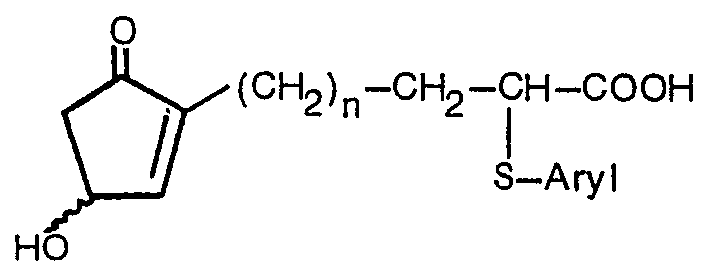
- Novel precursor compounds for the preparation of the subject compounds include the class of 2-arylthio alkane di-esters and mixed acid-esters represented by the formula wherein the subscript n is an integer from 3-5 inclusive, R 1 is hydrogen or R 2 , wherein R 2 and R 3 are C 1 ⁇ C 6 alkyl, and R 2 may be the same as or different from R 3 , and wherein Aryl is phenyl or phenyl substituted with halogen, C 1 -C 4 alkyl, C 1 -C 4 alkoxy, or trifluoromethyl.
- Such novel precursor compounds also include the class of derivatives of furan represented by the formula wherein R 4 is hydrogen, or C 1 ⁇ C 6 alkyl, and wherein -W- is a divalent carbonyl radical or a divalent carbinol radical (-CHOH-).
- protective groups are well-known in the art and may be, for instance, tetrahydropyranyl, trialkylsilyl, such as trimethylsilyl or dimethyl-t-butylsilyl, or alpha-alkoxy ethyl.
- the novel processes of this invention include preparing compounds of formula (12), by reacting a 2-halo-alkanedioate diester with an alkali metal thio monocyclic aryl compound to form the 2- arylthio-alkanedioate diester.
- the ester radical which is less sterically hindered is then cleaved from the alkanedioate by hydrolysis, advantageously with a strong hydroxide, to form a mixed acid-ester.
- the latter is then reacted with an anhydride or an acyl halide to form a mixed anhydride, which in turn is reacted with furan to produce an acyl furan of the class of formula (13) when W is carbonyl.
- the carbonyl group is then reduced by reaction with a carbonyl reducing reagent, preferably a borohydride, to form a furyl carbinol of formula (13) when W is -CHOH-.
- a carbonyl reducing reagent preferably a borohydride
- the carbonol moiety is then subjected to an acid catalyzed rearrangement and isomerization, and optionally esterification, to form, via the intermediate 3-hydroxy isomer (148), the 4-hydroxy cyclopentenone compounds of formula (14A) wherein Y is a divalent aryl thio radical.
- the 4-hydroxy group of the cyclopentenone is then protected (for subsequent reactions) with an appropriate blocking group P 2 .
- lithio-cuprate reagents, or their functional equivalent are disclosed in J. Org. Chem., 43, 3450 (1978).
- Protective group P 3 should have the same characteristics described above in respect of P 2 , and may be the same chemical moiety as, or may be different from, P 2 .
- the blocking groups P 2 and P 3 are then removed by hydrolysis is produced a racemic mixture.
- n 4, m is 3, and R 5 is methyl
- the product of the foregoing comprises a mixture of 11- alpha-hydroxy, 15-alpha,beta-hydroxy isomers of the compound of formula (11). This mixture can be resolved by chromatography into the individual isomers, and dl-(methyl)-16,16-(dimethyl) 11-alpha, 15- a/pha-(dihydroxy)-9-oxo-2,13-trans,trans-prostadienoate isolated therefrom.
- racemic mixtures can be resolved if desired at appropriate stages by methods known to those skilled in the art, to obtain the respective individual enantiomers. It is to be understood that the racemic mixures and the individual enantiomers are encompassed within the scope of the subject matter claimed herein.
- novel compounds disclosed herein may be prepared from a 2-halo-alkane diester having the formula wherein the halo atom may be chlorine, bromine, or iodine.
- the 2-bromo-di-ethyl ester is taught in Ber., 89, 51, (1956).
- a 2-halo-diester of formula (101) is reacted, in Step A, with an alkali metal thioaryloxide to produce a 2-arylthio-alkanedioate of formula (103).
- the alkali metal (AM i ) may be any of sodium, potassium or lithium.
- the aryl moiety of the thioaryloxide is the same as the Aryl moiety defined above.
- the reaction is preferably conducted in an alcoholic solution.
- the 2-arylthio compound of formula (103) is hydrolyzed in Step B to produce the monoester of formula (104), the less-sterically hindered ester moiety being cleaved.
- a strong hydroxide is preferred for the hydrolysis.
- the monoester of formula (104) is reacted in Step C with an anhydride of formula (105A) or an acyl halide of formula (105B) to produce the mixed anhydride of forzmula (106).
- R 6 and R 7 are selected from the class consisting of C 1 -C 3 alkyl and halo-substitued C 1 -C 3 alkyl, and R 6 is preferably the same as but may be different from R,.
- a reactive anhydride such as (F 3 C-CO)20 is employed.
- the mixed anhydride of formula (106) is reacted in Step D with furan to produce a new class of acyl furan compounds of formula (107).
- the compound of formula (107 is hydrolyzed in Step E, to form the acyl furan acid of formula (108).
- Steps C, D and E may optionally and advantageously be conducted in a single reaction zone without intermediate separation of the compounds of formulas (106) and/or (107).
- the carbonyl moiety of formula (108) is reduced in Step F to a carbinol moiety to produce a new class offuryl carbinol compounds of formula (109), employing for the purpose a carbonol reducing reagent, such as a borohydride, e.g., sodium borohydride, in a solvent such as glyme.
- a carbonol reducing reagent such as a borohydride, e.g., sodium borohydride
- the reduction reaction of Step F is conducted in the presence of a salt of a weak acid, such as sodium carbonate or sodium acetate, to aid in the dissolution of the acyl furan of formula (108).
- the furyl carbinol compound of formula (109) is then, in Step G, subjected to an acid catalyzed rearrangement to produce a racemic mixture of the isomers of formulas (110A) and (110B).
- the rearrangement is accomplished with an aqueous solution of a weak organic acid such as formic acid, or alternatively with an aqueous acidic phosphate buffer solution having a pH of about 3 (Step G-1).
- the resulting solution of 3-hydroxy (110A) and 4-hydroxy (110B) cyclopentenone isomers is then isomerized (Step G-2), advantageously in the same reaction zone, to the desired 4-hydroxy isomer of formula (110B) by the addition of a strong acid, such as sulfuric acid.
- the compound of formula ( 110B) is then advantageously esterified by alkylation with, for instance, an alkyl halide (R 2 -X) such as methyliodide, to form a compound of formula (111).
- an alkyl halide R 2 -X
- the alkyl moiety of such halide is selected to be the desired ester moiety (R s ) of the alpha-chain of the ultimately desired prostaglandin-type compound, e.g., a compound of formula (117).
- the 2-arylthio moiety of formula (111) is removed and the 2,3-position carbons reduced to a 2-trans double bond in Step J by reacting the compound of formula (111) with a peroxy organic acid in a suitable solvent to form an intermediate sulfoxide compound, which is then subjected to thermolysis (e.g., heated for an extended period at reflux temperature) until completion of the formation of a new class of 2-trans olefinic compounds of formula (112).
- the peroxy acid may be aliphatic or aromatic, and may be substituted, for example, peroxy acetic acid, peroxybenzoic acid or meta-chloro-peroxybenzoic acid.
- the solvent may be a halogenated lower alkane such as dichloromethane.
- the hydroxyl moiety of the compound of formula (112) is provided in Step K with a protective group P 2 capable of subsequently being easily removed without affecting the rest of the molecule, to form a compound of formula (113).
- P 2 is trimethylsilyl or tetrahydropyranyl.
- a conjugate addition reaction is conducted in Step L by reacting a compound of formula (113) with a lithio-cuprate addition reagent capable of furnishing a prostaglandin beta-chain having the formula (15), advantageously the reagent shown by formula (114), to produce a racemic mixture of compounds of formula (115).
- the protecting groups P 2 and P 3 are then removed, and the hydroxy moieties re-created, by hydrolysis in Step M, employing, for instance, acetic acid, to produce a dl-racemic mixture of 15-alpha, beta-dihydroxy isomers of compounds of formula (116).
- Such mixture is then resolved by chromatography to isolate the desired isomers, which, when in formula (116) n is 4, m is 3, and R 5 is methyl, include the prostandionate of formula (11).
- the compounds of formulas (110A and B), (111), (112) and (113) are racemic mixtures of optically active isomers.
- any of such mixtures can be resolved by the application of known chromatographic techniques into the respective optically active isomers and the process sequence continued with either of the isomers alone.
- the racemic mixture of compounds of formula (115) may be resolved before Step M, rather than after Step M, into the individual 15-alpha and 15-beta isomers. In separations conducted after Step M, such isomers may be obtained in their nat. configuration.
- the compounds of this invention are also useful for the preparation of a compound of formula (118) which is of potential use for the treatment of angina and as an inhibitor of blood platelet aggregation; see Tsuboi, et al., Arch, int. Pharmacodyn., 247, 89 (1980) and Thrombus Research, 20, 573 (1980).
- the compound of formula (118) is prepared in the same manner as the compounds of formula (117) by substitution, for the reagent having the formula (114), of a compound having the formula:
- the solution is stirred at -78°C for one hour and treated with a solution of 0.62 g of methyl 7-(4-trimethylsiloxycyclopent-2-en-1-on-2-yl)hept-2-trans-enoate in 5.0 ml of ether.
- the solution is stirred at -40°C for 1.5 hours, treated at -78°C with a solution of 0.3 ml of glacial acetic acid in 5.0 ml of ether, diluted with ether and poured into a stirred mixture of 15 ml of each of saturated ammonium chloride and 1 N hydrochloric acid.
- the ether layer is washed with cold dilute hydrochloric acid, water and brine, then dried and evaporated, giving 2.14 g of light yellow liquid.
- This liquid is treated with 20 ml of 4:2:1 glacial acetic acid-tetrahydrofuran-water and the resulting mixture is stirred at 40°C for 45 minutes, then diluted with toluene and evaporated to dryness in vacuo.
- the tetrabutylstannane present in the resulting mixture is removed by passage as a heptane solution through 15 g of silica gel.
- the mixture of prostadienoates is eluted from the silica gel with ethyl acetate. Evaporation of the ethyl acetate gives 1.06 g of amber oil comprising a di-racemic mixture of the 11- alpha,15-alpha,beta-dihydroxy compounds, the infrared spectrum of which has peaks at 1740, 1665 and 1020 cm- 1 .
- This oil is subjected to dry column chromatography on silica gel using the solvent 100:1 ethyl acetate- glacial acetic acid to provide the more mobile 15 ⁇ -epimer (147 mg) and the less mobile 15a-epimer (113 mg) as light yellow oils.
Landscapes
- Chemical & Material Sciences (AREA)
- Organic Chemistry (AREA)
- Organic Low-Molecular-Weight Compounds And Preparation Thereof (AREA)
- Pharmaceuticals Containing Other Organic And Inorganic Compounds (AREA)
- Furan Compounds (AREA)
Claims (3)



Applications Claiming Priority (2)
| Application Number | Priority Date | Filing Date | Title |
|---|---|---|---|
| US06/266,004 US4360688A (en) | 1981-05-21 | 1981-05-21 | Precursors and synthesis of d1-(methyl)-16,16-(dimethyl)-11-alpha, 15-alpha, beta-dihydroxy-9-oxo-2,13,-trans, trans-prostadienoates |
| US266004 | 1981-05-21 |
Publications (2)
| Publication Number | Publication Date |
|---|---|
| EP0065638A1 EP0065638A1 (de) | 1982-12-01 |
| EP0065638B1 true EP0065638B1 (de) | 1989-01-25 |
Family
ID=23012768
Family Applications (1)
| Application Number | Title | Priority Date | Filing Date |
|---|---|---|---|
| EP82103017A Expired EP0065638B1 (de) | 1981-05-21 | 1982-04-08 | Substituierte 7-(4-substituierte-Cyclopent-2-en-1-on-2-yl)-hept-2-trans-enoate |
Country Status (5)
| Country | Link |
|---|---|
| US (1) | US4360688A (de) |
| EP (1) | EP0065638B1 (de) |
| JP (1) | JPS57203031A (de) |
| DE (1) | DE3279392D1 (de) |
| HU (1) | HU189582B (de) |
Families Citing this family (6)
| Publication number | Priority date | Publication date | Assignee | Title |
|---|---|---|---|---|
| US4644079A (en) * | 1981-05-21 | 1987-02-17 | American Cyanamid Company | Precursors and synthesis of d1-(methyl)-16,16-(dimethyl)-11-alpha, 15-alpha, beta-dihydroxy-9-oxo-2,13,-trans, trans-prostadienoates |
| US4542155A (en) * | 1984-04-02 | 1985-09-17 | E. R. Squibb & Sons, Inc. | Tetrahydrofuranyl substituted prostaglandin analogs |
| US4681962A (en) * | 1985-06-24 | 1987-07-21 | Hoffmann-La Roche Inc. | Novel 7-fluoro-dihydro PGI compounds |
| US5618959A (en) * | 1995-03-10 | 1997-04-08 | Vivus Incorporated | Process for preparing prostaglandin E1, E2 and analogs thereof using furylcopper reagents |
| KR100395231B1 (ko) * | 1999-03-03 | 2003-08-21 | 함원훈 | 메틸 7-(3-하이드록시-5-옥소-1-사이클로펜텐-1-일)헵타노에이트 |
| DE102005007470A1 (de) * | 2005-02-18 | 2006-08-31 | Bayer Materialscience Ag | Verstärkte Polyurethanharnstoffelastomere und deren Verwendung |
Family Cites Families (4)
| Publication number | Priority date | Publication date | Assignee | Title |
|---|---|---|---|---|
| US3931296A (en) * | 1972-12-29 | 1976-01-06 | Masaki Hayashi | Trans-Δ2 -prostaglandins |
| US3900512A (en) * | 1973-11-12 | 1975-08-19 | Wisconsin Alumni Res Found | 2-(6-carbomethoxy-cis-2-hexenyl)-4(r)-hydroxy-2-cyclopenten-1-one and method for preparing same |
| DE2460285A1 (de) * | 1973-12-25 | 1975-07-03 | Ono Pharmaceutical Co | Trans-delta hoch 2-prostaglandinverbindungen, verfahren zu ihrer herstellung und diese enthaltende arzneimittel |
| US4254036A (en) * | 1977-12-08 | 1981-03-03 | American Cyanamid Company | 1-Hydroxymethyl-1-oxo-prostane-derivatives of the E, A and F-series |
-
1981
- 1981-05-21 US US06/266,004 patent/US4360688A/en not_active Expired - Fee Related
-
1982
- 1982-04-08 DE DE8282103017T patent/DE3279392D1/de not_active Expired
- 1982-04-08 EP EP82103017A patent/EP0065638B1/de not_active Expired
- 1982-05-18 JP JP57082560A patent/JPS57203031A/ja active Pending
- 1982-05-20 HU HU821618A patent/HU189582B/hu unknown
Also Published As
| Publication number | Publication date |
|---|---|
| HU189582B (en) | 1986-07-28 |
| DE3279392D1 (en) | 1989-03-02 |
| EP0065638A1 (de) | 1982-12-01 |
| US4360688A (en) | 1982-11-23 |
| JPS57203031A (en) | 1982-12-13 |
Similar Documents
| Publication | Publication Date | Title |
|---|---|---|
| US4225508A (en) | 19-Hydroxy-PGI2 compounds | |
| US4225507A (en) | 19-Hydroxy-19-methyl-PGI2 compounds | |
| JPH0355458B2 (de) | ||
| US4360688A (en) | Precursors and synthesis of d1-(methyl)-16,16-(dimethyl)-11-alpha, 15-alpha, beta-dihydroxy-9-oxo-2,13,-trans, trans-prostadienoates | |
| US4983753A (en) | Precursors and synthesis of di-(methyl)-16,16-(dimethyl)-11-alpha,15-alpha beta-dihydroxy-9-oxo-2,13-trans,trans-prostadienoates | |
| EP0338796B1 (de) | 2-Substituierte 2-Cyclopentenone | |
| US4474979A (en) | Synthesis of d1-(methyl)-16,16-(dimethyl-11-alpha, 15-alpha, beta-dihydroxy-9-oxo-2,13,-trans,trans-prostadienoates | |
| US4338249A (en) | Cyclopenta[b]furan-2-one and -2-ol intermediates for 16-fluoro-13,14-didehydro-prostaglandins | |
| JPH0451538B2 (de) | ||
| US5166369A (en) | Precursors and synthesis of D1-(methyl)-16,16-(dimethyl)-11-alpha, 15-alpha, beta-dihydroxy-9-oxo-2,13,-trans, trans-prostadienoates | |
| US4644079A (en) | Precursors and synthesis of d1-(methyl)-16,16-(dimethyl)-11-alpha, 15-alpha, beta-dihydroxy-9-oxo-2,13,-trans, trans-prostadienoates | |
| EP0106576A2 (de) | Neue 5-gliedrige Ringverbindungen, ein Verfahren zu ihrer Herstellung und ihre pharmazeutische Anwendung | |
| US4163758A (en) | 2-Nitroethylcyclopentane compounds and process for preparing the same | |
| JPH0141142B2 (de) | ||
| US4100192A (en) | Inter-phenylene-PG amides | |
| JP2503073B2 (ja) | 2―置換―2―シクロペンテノン類およびそれを含有する骨形成促進剤又は制ガン剤 | |
| US4181798A (en) | Methylenecyclopentane derivatives | |
| US4958037A (en) | Precursors and synthesis of methyl-9-oxo-11α, 16-dihydroxy-16-vinyl-5-cis-13-trans-prostadienoates | |
| US4425359A (en) | Fluoro-prostaglandins and process for their preparation | |
| US4195178A (en) | Methylenecyclopentane derivatives | |
| US4237316A (en) | Novel 2-substituted-3,4-epoxycyclopentan-1-ones, 2-substituted-3,4-epoxycyclopentan-1-ols, and various 2-substituted-cyclopentenones | |
| US5532408A (en) | α-chain-modified isocarbacyclins and process for the production thereof | |
| JP2506360B2 (ja) | 新規なプロスタサイクリン類 | |
| US4414407A (en) | Fluoro-prostaglandins and process for their preparation | |
| JPH066552B2 (ja) | 3―オキサイソカルバサイクリン類 |
Legal Events
| Date | Code | Title | Description |
|---|---|---|---|
| PUAI | Public reference made under article 153(3) epc to a published international application that has entered the european phase |
Free format text: ORIGINAL CODE: 0009012 |
|
| AK | Designated contracting states |
Designated state(s): BE CH DE FR GB IT NL SE |
|
| 17P | Request for examination filed |
Effective date: 19830511 |
|
| GRAA | (expected) grant |
Free format text: ORIGINAL CODE: 0009210 |
|
| AK | Designated contracting states |
Kind code of ref document: B1 Designated state(s): BE CH DE FR GB IT LI NL SE |
|
| PG25 | Lapsed in a contracting state [announced via postgrant information from national office to epo] |
Ref country code: NL Effective date: 19890125 Ref country code: IT Free format text: LAPSE BECAUSE OF FAILURE TO SUBMIT A TRANSLATION OF THE DESCRIPTION OR TO PAY THE FEE WITHIN THE PRESCRIBED TIME-LIMIT;WARNING: LAPSES OF ITALIAN PATENTS WITH EFFECTIVE DATE BEFORE 2007 MAY HAVE OCCURRED AT ANY TIME BEFORE 2007. THE CORRECT EFFECTIVE DATE MAY BE DIFFERENT FROM THE ONE RECORDED. Effective date: 19890125 Ref country code: FR Free format text: THE PATENT HAS BEEN ANNULLED BY A DECISION OF A NATIONAL AUTHORITY Effective date: 19890125 Ref country code: BE Effective date: 19890125 |
|
| REF | Corresponds to: |
Ref document number: 3279392 Country of ref document: DE Date of ref document: 19890302 |
|
| PG25 | Lapsed in a contracting state [announced via postgrant information from national office to epo] |
Ref country code: GB Effective date: 19890408 |
|
| PG25 | Lapsed in a contracting state [announced via postgrant information from national office to epo] |
Ref country code: SE Effective date: 19890409 |
|
| PG25 | Lapsed in a contracting state [announced via postgrant information from national office to epo] |
Ref country code: LI Effective date: 19890430 Ref country code: CH Effective date: 19890430 |
|
| EN | Fr: translation not filed | ||
| NLV1 | Nl: lapsed or annulled due to failure to fulfill the requirements of art. 29p and 29m of the patents act | ||
| PLBE | No opposition filed within time limit |
Free format text: ORIGINAL CODE: 0009261 |
|
| STAA | Information on the status of an ep patent application or granted ep patent |
Free format text: STATUS: NO OPPOSITION FILED WITHIN TIME LIMIT |
|
| GBPC | Gb: european patent ceased through non-payment of renewal fee | ||
| REG | Reference to a national code |
Ref country code: CH Ref legal event code: PL |
|
| 26N | No opposition filed | ||
| PG25 | Lapsed in a contracting state [announced via postgrant information from national office to epo] |
Ref country code: DE Effective date: 19900103 |
|
| EUG | Se: european patent has lapsed |
Ref document number: 82103017.8 Effective date: 19900412 |