EP0065643B1 - Composés d'ammonium polymères ayant une structure du type de celle de l'acide silicique, procédé de préparation et leur emploi - Google Patents
Composés d'ammonium polymères ayant une structure du type de celle de l'acide silicique, procédé de préparation et leur emploi Download PDFInfo
- Publication number
- EP0065643B1 EP0065643B1 EP82103295A EP82103295A EP0065643B1 EP 0065643 B1 EP0065643 B1 EP 0065643B1 EP 82103295 A EP82103295 A EP 82103295A EP 82103295 A EP82103295 A EP 82103295A EP 0065643 B1 EP0065643 B1 EP 0065643B1
- Authority
- EP
- European Patent Office
- Prior art keywords
- group
- carbon atoms
- ammonium compounds
- polymeric ammonium
- polymeric
- Prior art date
- Legal status (The legal status is an assumption and is not a legal conclusion. Google has not performed a legal analysis and makes no representation as to the accuracy of the status listed.)
- Expired
Links
Classifications
-
- B—PERFORMING OPERATIONS; TRANSPORTING
- B01—PHYSICAL OR CHEMICAL PROCESSES OR APPARATUS IN GENERAL
- B01J—CHEMICAL OR PHYSICAL PROCESSES, e.g. CATALYSIS OR COLLOID CHEMISTRY; THEIR RELEVANT APPARATUS
- B01J41/00—Anion exchange; Use of material as anion exchangers; Treatment of material for improving the anion exchange properties
- B01J41/08—Use of material as anion exchangers; Treatment of material for improving the anion exchange properties
-
- C—CHEMISTRY; METALLURGY
- C07—ORGANIC CHEMISTRY
- C07F—ACYCLIC, CARBOCYCLIC OR HETEROCYCLIC COMPOUNDS CONTAINING ELEMENTS OTHER THAN CARBON, HYDROGEN, HALOGEN, OXYGEN, NITROGEN, SULFUR, SELENIUM OR TELLURIUM
- C07F7/00—Compounds containing elements of Groups 4 or 14 of the Periodic Table
- C07F7/02—Silicon compounds
- C07F7/08—Compounds having one or more C—Si linkages
- C07F7/0834—Compounds having one or more O-Si linkage
- C07F7/0838—Compounds with one or more Si-O-Si sequences
-
- C—CHEMISTRY; METALLURGY
- C07—ORGANIC CHEMISTRY
- C07F—ACYCLIC, CARBOCYCLIC OR HETEROCYCLIC COMPOUNDS CONTAINING ELEMENTS OTHER THAN CARBON, HYDROGEN, HALOGEN, OXYGEN, NITROGEN, SULFUR, SELENIUM OR TELLURIUM
- C07F7/00—Compounds containing elements of Groups 4 or 14 of the Periodic Table
- C07F7/02—Silicon compounds
- C07F7/08—Compounds having one or more C—Si linkages
- C07F7/0834—Compounds having one or more O-Si linkage
- C07F7/0838—Compounds with one or more Si-O-Si sequences
- C07F7/0872—Preparation and treatment thereof
- C07F7/0889—Reactions not involving the Si atom of the Si-O-Si sequence
-
- C—CHEMISTRY; METALLURGY
- C07—ORGANIC CHEMISTRY
- C07F—ACYCLIC, CARBOCYCLIC OR HETEROCYCLIC COMPOUNDS CONTAINING ELEMENTS OTHER THAN CARBON, HYDROGEN, HALOGEN, OXYGEN, NITROGEN, SULFUR, SELENIUM OR TELLURIUM
- C07F7/00—Compounds containing elements of Groups 4 or 14 of the Periodic Table
- C07F7/02—Silicon compounds
- C07F7/08—Compounds having one or more C—Si linkages
- C07F7/18—Compounds having one or more C—Si linkages as well as one or more C—O—Si linkages
- C07F7/1804—Compounds having Si-O-C linkages
-
- C—CHEMISTRY; METALLURGY
- C08—ORGANIC MACROMOLECULAR COMPOUNDS; THEIR PREPARATION OR CHEMICAL WORKING-UP; COMPOSITIONS BASED THEREON
- C08G—MACROMOLECULAR COMPOUNDS OBTAINED OTHERWISE THAN BY REACTIONS ONLY INVOLVING UNSATURATED CARBON-TO-CARBON BONDS
- C08G77/00—Macromolecular compounds obtained by reactions forming a linkage containing silicon with or without sulfur, nitrogen, oxygen or carbon in the main chain of the macromolecule
- C08G77/04—Polysiloxanes
- C08G77/22—Polysiloxanes containing silicon bound to organic groups containing atoms other than carbon, hydrogen and oxygen
- C08G77/26—Polysiloxanes containing silicon bound to organic groups containing atoms other than carbon, hydrogen and oxygen nitrogen-containing groups
-
- C—CHEMISTRY; METALLURGY
- C08—ORGANIC MACROMOLECULAR COMPOUNDS; THEIR PREPARATION OR CHEMICAL WORKING-UP; COMPOSITIONS BASED THEREON
- C08G—MACROMOLECULAR COMPOUNDS OBTAINED OTHERWISE THAN BY REACTIONS ONLY INVOLVING UNSATURATED CARBON-TO-CARBON BONDS
- C08G77/00—Macromolecular compounds obtained by reactions forming a linkage containing silicon with or without sulfur, nitrogen, oxygen or carbon in the main chain of the macromolecule
- C08G77/04—Polysiloxanes
- C08G77/38—Polysiloxanes modified by chemical after-treatment
-
- C—CHEMISTRY; METALLURGY
- C08—ORGANIC MACROMOLECULAR COMPOUNDS; THEIR PREPARATION OR CHEMICAL WORKING-UP; COMPOSITIONS BASED THEREON
- C08G—MACROMOLECULAR COMPOUNDS OBTAINED OTHERWISE THAN BY REACTIONS ONLY INVOLVING UNSATURATED CARBON-TO-CARBON BONDS
- C08G77/00—Macromolecular compounds obtained by reactions forming a linkage containing silicon with or without sulfur, nitrogen, oxygen or carbon in the main chain of the macromolecule
- C08G77/48—Macromolecular compounds obtained by reactions forming a linkage containing silicon with or without sulfur, nitrogen, oxygen or carbon in the main chain of the macromolecule in which at least two but not all the silicon atoms are connected by linkages other than oxygen atoms
Definitions
- the invention relates to new polymeric ammonium compounds with a silica-like backbone, which have a number of advantages over the known polymeric ammonium compounds on an organic basis. At the same time, processes for the production and use of these new products are described.
- Ammonium compounds bound to organic polymers are widely used in chemical synthesis, application and technology, in particular as ion exchangers, catalyst supports, active substance supports in general and heterogeneous phase transfer catalysts. Examples of these uses are e.g. in overview form in Ullmann's Encyclopedia of Technical Chemistry, 4th edition, Vol. 13, p. 279 or Chem. Ing. Tech. 51, 7, 728 (1979), in DE-OS 1 800 371 and 1 800 379 or in J. Amer. Chem. Soc. 97, 5956 (1975).
- the organic polymer matrix largely fulfills the requirements placed on them with regard to thermal and mechanical stability, inertness to chemical attacks, accessibility of the functional groups and solubility in the solvent used.
- the known polymers of this type also have a serious disadvantage in that, in view of the increasingly scarce oil and coal stocks, availability of suitable raw materials is not necessarily guaranteed in the long term, so that these systems generally switch to an inorganic matrix , made from almost unlimited raw materials would be desirable.
- Inorganic polymer systems e.g. pyrogenic or precipitated silica, aluminum oxide, titanium dioxide etc., also have other advantages such as fixed rigid structure, swellability, high temperature and aging resistance, insolubility and easy accessibility of the functional groups that may be present, since these are usually located on the surface.
- new polymeric ammonium compounds can be obtained that have the expected properties, such as a fixed structure, non-swellability, high temperature resistance of over 200 ° C, insolubility, good accessibility to the functional ones Have groups and high inertness to an amine elimination and can be used in the applications mentioned above.
- a second method according to the invention also enables polymeric ammonium compounds to be prepared.
- This second route first provides for the primary reaction of suitably substituted monomeric amines with organyl halide or protonic acid and only then for the hydrolysis and condensation of the quaternary salts formed.
- Further representatives of polymeric ammonium compounds according to the invention can be prepared in a third way, namely by simple ion exchange on polymer compounds obtained according to one of the two variants mentioned above.
- All of these processes can be used to prepare polymeric ammonium compounds whose physical properties are similar to special silica gels or modified silicas, which have the analytical composition to be expected after the hydrolyzable groups present on the monomeric precursors have been completely split off, and whose chemical behavior confirms that the structure and Functionality of the ammonium units is not changed by the conversion into the polymer form.
- the methods mentioned are explained in more detail below.
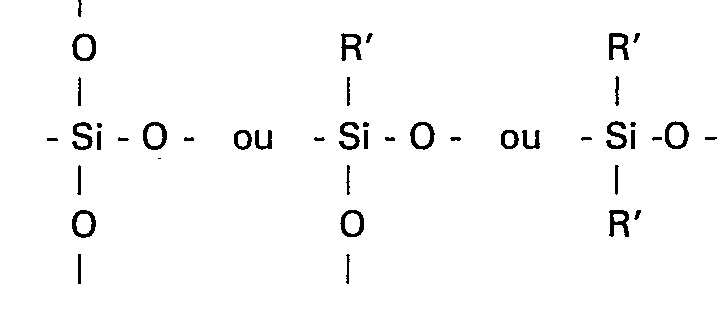
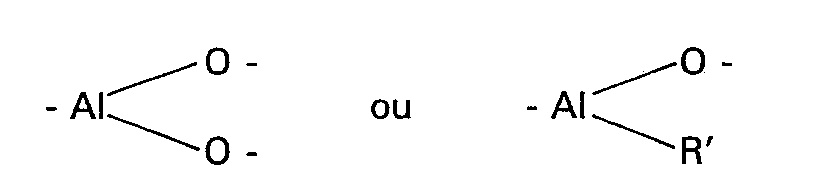
- the matrix of these polymeric ammonium compounds can be quasi tailor-made by inserting heteroatoms such as aluminum or titanium into the matrix or by generally reducing the ammonium group density or by influencing the degree of crosslinking when used as an ion exchanger.
- R 5 can be a linear or branched alkylene group without significant material differences in the end product.
- anion X halide, hydroxide, hypochlorite, sulfate, hydrogen sulfate, nitrite, nitrate, phosphate, dihydrogen phosphate, hydrogen phosphate, carbonate, hydrogen carbonate, chlorate, perchlorate, chromate, dichromate, cyanide, rhodanide, sulfide, hydrogen sulfide, selenide, tellurium , Borate, metaborate, azide, tetrafluoroborate, tetraphenylborate, hexafluorophosphate, acetate, propionate, oxalate, trifluoroacetate, trichloroacetate or benzoate.
- R 1 , R 2 and R 3 have the same meaning and in particular then when R 1 , R 2 and R 3 are identical to each other.
- R 1 , R 2 and R 3 are identical to one another, R 4 is methyl and X is chloride, bromide or iodide.
- R 'to R 3 may be identical to each other and R 4 may have the same meaning as R to R 3 or may be identical to R 1 to R 3 and X may be chloride, bromide or iodide.
- the processes for the preparation of the polymeric ammonium compounds which are also to be regarded as the subject of the invention, are designed in such a way that a polymeric, optionally crosslinked and / or in situ formed amine base is used as the starting material.
- This process for the preparation of polymeric ammonium compounds with a silica-like backbone consists in the fact that a polymeric amine base consisting of polymer units of the general formula (3) in which R 1 to R 3 has the meaning as in claim 1, within hours or days, with stoichiometric or excess amounts of a linear or branched alkyl halide containing 1 to 20 C atoms, a cycloalkyl halide containing 5 to 8 C atoms or Benzyl halide or with an inorganic or organic protonic acid, which is able to form stable quaternary salts with the amine, until all accessible N atoms are quaternized, the polymeric ammonium compound formed is separated from the liquid phase, the remaining solid is optionally dried using a vacuum , optionally ground and classified.
- suspension medium such as water, alkanes, cycloalkanes, aromatics, cyclic or open-chain ethers, chlorinated hydrocarbons, aliphatic or aromatic nitro compounds, aliphatic or aromatic nitriles or dimethylformamide, dimethyl sulfoxide, acetone, diethyl ketone, methyl ethyl ketone, to carry out lower alcohols such as methanol, ethanol, n- and i-propanol, n-, i- and t-butanol or n-pentanol or mixtures thereof, in particular water / alcohol mixtures.
- the suspension medium is said to act as a solubilizer and its choice also depends on the physical properties of the organyl halide. In order to avoid contamination, this should either be gaseous or at least partially dissolve in the solubilizer used.
- the quaternization is best carried out below, at or above room temperature up to a temperature of 300 ° C. under normal pressure or overpressure, which corresponds to the sum of the partial pressures of the individual components of the reaction mixture at the respective temperature.
- the solid is freed of any solvent or excess organyl halide or excess protonic acid present, using conventional techniques such as filtration, centrifugation and / or decanting or by distillation, if appropriate using a vacuum, and then any residues still adhering by heating freed at normal pressure or in vacuum. It can then be dried at temperatures from room temperature to 300 ° C., optionally using a vacuum, and ground and classified as required.
- a tempering of the product This is done by heat treatment for a period of at least one hour to four days at 200-400 ° C and, if necessary, using a vacuum.
- Another general principle of the process according to the invention for the production of some of the polymeric ammonium compounds is based on the monomeric precursors which are obtained in a manner known per se by suitable quaternization of primary, secondary and tertiary (trialkoxisilylorganyl) - (organyl) amines with organyl halide.
- the quaternization can be carried out in pure substance or using a solubilizer, preferably of a polar nature. It has been found to be particularly suitable that the quaternization of the amine using a solvent, such as cyclic or open-chain ethers, chlorinated hydrocarbon compounds, aliphatic or aromatic nitro compounds, aliphatic or aromatic nitriles or dimethylformamide, dimethyl sulfoxide, acetone, diethyl ketone, methyl ethyl ketone, lower alcohols such as methanol , Ethanol, n- and i-propanol, n-, i- and t-butanol or n-pentanol or mixtures thereof is carried out.
- the quaternary salt formed is then hydrolyzed and condensed, optionally after adding a crosslinking agent, preferably at room temperature to the reflux temperature of the reaction mixture.
- a stoichiometric or excess amount of water based on complete hydrolysis and condensation, to the reaction mixture before the quaternization process, since amine component and organyl halide component per se in the water-solubilizer mixture are soluble, but the hydrolyzed and polycondensed quaternary salt formed is insoluble and precipitates. This is particularly the case when a tertiary amine substituted with only one trialkoxisilylorganyl radical is reacted with a halogenorganyl trialkoxisilane.
- the quaternization with inorganic or organic protonic acids can also be carried out with an aqueous solution thereof.
- the polymeric product obtained in both cases can then be worked up analogously to the first-mentioned process. So it can be dried, if necessary in the Vacuum, where a temperature between room temperature and 300 ° C can be applied. The dried product can also be annealed, optionally using a vacuum, for at least one hour to four days at a temperature in the range of 200-400 ° C.
- Another process is based on a secondary amine and is characterized in that a secondary bis (trialkoxisilylorganyl) amine with a halogenorganyltrialkoxisilan, whose organyl groups correspond to R 5 in formula (2), or a linear or branched chain containing 1 to 20 C atoms Alkyl halide, a cycloalkyl halide or benzyl halide containing 5 to 8 carbon atoms or with inorganic or organic protonic acid.
- the measures mentioned above, such as drying, milling, classifying and tempering, can be used in any order for further processing.
- Another variant is also based on a secondary amine and provides that such an amine with substituents consisting of a trialkoxisilylorganyl group and a linear or branched alkyl group containing 1 to 20 C atoms or a 5 to 8 C atom containing Cycloalkyl group or a benzyl group with a halogen organyl trialkoxisilane, the organyl groups corresponding to the group R 5 in claim 1, quaternized. Further processing can be carried out in the same way as for the process variants discussed above.
- a tertiary tris (trialkoxisilylorganyl) amine whose organyl groups correspond to group R 5 in claim 1 and whose alkoxy groups have 1 to 5 C atoms, with a linear or branched, containing 1 to 20 C atoms Alkyl halide or with a cycloalkyl halide containing 5 to 8 carbon atoms, with benzyl halide or with inorganic or organic protonic acid or with a halogen organyltrialkoxisilane, the organyl group of which corresponds to group R 5 in claim 1, quaternized and otherwise provides for processing in accordance with the measures already dealt with.
- a tertiary amine whose substituents consist of 2 trialkoxisilylorganyl radicals, the organyl groups of which correspond to group R 5 in claim 1, and a linear or branched alkyl group containing 1 to 20 carbon atoms or a 5 to 8 carbon atom group Cycloalkyl group or the benzyl group, with a Halogenorganyltrialkoxisilan, whose organyl group corresponds to the group R 5 in claim 1, or with a linear or branched, containing 1 to 20 carbon atoms alkyl halide, a 5 to 8 carbon atoms containing cycloalkyl halide, or with benzyl halide or quaternized with inorganic or organic protonic acid and otherwise it is worked up in accordance with the measures already presented.
- an embodiment variant consists in that a tertiary amine whose substituent consists of 1 trialkoxisilylorganyl radical, whose organyl group corresponds to group R 5 in claim 1, and 2 further mutually identical or different organic radicals in the form of a linear or branched alkyl group containing 1 to 20 C atoms and / or a cycloalkyl group containing 5 to 8 C atoms and / or the benzyl group exist with a halogen organyltrialkoxisilane, the organyl group of which R 5 in claim 1 corresponds to quaternized and otherwise processed according to the possibilities already presented.
- drying can also be carried out here, if appropriate in a vacuum, at room temperature to 300 ° C. and, if appropriate using a vacuum, it can be tempered for a period of at least one hour to four days at a temperature between 200-400 ° C. be provided.
- a further process according to the invention provides access to all other polymeric ammonium compounds which are not obtained by the direct route of quaternization (process principle 1) or quaternization and hydrolysis / condensation (process principle 11).
- this process is used to prepare the polymeric ammonium compounds treated above and those polymeric ammonium compounds in which R 3 and / or R 4 is not hydrogen and in which the anion is not a halide at the same time.
- the process is characterized in that the quaternized, undried, dried and / or tempered polymer ammonium compounds which are completely substituted with organyl and organosilyl groups or only completely substituted with organosilyl groups with an inorganic or organic reagent which can dissociate into a cation and anion, for the mutual exchange of the anions, using the static or dynamic ion-exchange principle, then washing and, if necessary, then completely separating the solid from the liquid or gaseous phase (for example when replacing the CI- by J- from HJ) and drying it, if necessary, and in any order grinds, classifies and anneals.
- This ion exchange process also includes an ion exchange in the form of a neutralization, as can be carried out in known ion exchange resins according to the static or dynamic principle.
- the solid can then be separated using customary techniques, such as filtration, centrifuging and / or decanting, washed free of salt and ground at room temperature or elevated temperature to 300 ° C., optionally dried using a vacuum, annealed at a temperature of 200-400 ° C. as well as be classified.
- customary techniques such as filtration, centrifuging and / or decanting, washed free of salt and ground at room temperature or elevated temperature to 300 ° C., optionally dried using a vacuum, annealed at a temperature of 200-400 ° C. as well as be classified.
- the polymeric starting ammonium compound is used as an exchange bed and is brought into contact with the solution of the at least partially dissolved reaction partner.
- after-treatments can be provided to the extent mentioned.
- the treatment steps still carried out after drying can also be reversed in order or can be omitted in part.
- the polymeric starting product must have a certain minimum grain size, which must also be determined depending on the column dimension, in order to ensure sufficient flow. In general, a minimum grain size of 0.2 mm will be sufficient for laboratory columns.
- the washing is also salt-free and either post-treatment measures or further exchange measures can then be carried out. Grinding of the polymeric ammonium compounds can of course not only be carried out in the dry state, but also wet, specifically immediately after or even before the quaternization or after the polycondensation.
- the invention also relates to the use of the polymeric ammonium compounds as anion exchangers.
- the new polymeric ammonium compounds described can be characterized, in particular, on the basis of the quantity balances during production (it is always completely hydrolyzed and condensed), the elemental analyzes, which usually correspond very precisely to the stoichiometry, and on the basis of the anion exchange results. Your decomposition points are in the air at well over 200 ° C and under a protective gas atmosphere at around 400 ° C.
- the polymeric ammonium compounds have surfaces of 0.1 to 2000 m 2 / g and particle size diameters of approx. 1 cm to 1 ⁇ m. A particle size range of 0.1 - 1.5mm, as required for technical use as an ion exchanger, can be easily adjusted.
- the remaining liquid was charged to a thin-film evaporator, from which the octylamine released during the deprotonation and small amounts of other more volatile impurities were removed overhead at a heating jacket temperature of 120 ° C. and a vacuum of 0.8 mbar.
- the bottom product obtained was mixed directly with 0.6 l of toluene, warmed to 60 ° C. and 500 ml of water were added with stirring within 20 minutes. The mixture was stirred at the same temperature for 1 hour, during which time a yellowish-white precipitate formed. This was then stirred for a further 4 hours at the reflux temperature, then filtered off, first washed with ethanol, then with plenty of water and then dried at 120 ° C./100 mbar for 24 hours. 306.99 g (102.0% of theory) of polymeric product, composed of units of the formula CsH 17 N (CH 2 -Si0 312 ) 2 , could be obtained.
- the methanol was removed by distillation at a bottom temperature of 60-80 ° C. and a pressure of 50 mbar, and the remaining liquid was charged to a Sambay evaporator. 402.5 g of H 2 N-CH 2 CH 2 -CH 2 Si (OCH 3 ) 3 could be recovered as the top product.
- the bottom was mixed with 1 l of methanol and heated to 50 ° C. with stirring. Then 2 l of water were added over the course of 30 min. The spontaneous polycondensation of the amine started after the addition of some of the water. The mixture was heated to reflux temperature with slow stirring and refluxed for 2 hours.
- a dip tube was introduced into the reaction vessel, through which a total of 500 g of methyl chloride was passed through the reaction mixture at a bottom temperature of 70 ° C. over a period of 20 hours.
- the solid was then filtered off through a suction filter, washed with 1 l of demineralized water, dried in a vacuum drying cabinet at 150 ° C./80 mbar for 12 hours, then ground on a cross-beat mill and divided into the particle size ranges 0.25-0.50 mm, 0.1 - 0.25 mm and ⁇ 0.1 mm classified.
- the total weight was 977.9 g (101.2% of theory) of polymeric ammonium compound, consisting of units of the formula [(H 3 C) N (CH 2 CH 2 CH 2 SiO 3/2 ) 3 ] + Cl ⁇
- the product grain size fraction of 0.25 - 0.5 mm had a specific surface area of 80 m 2 / g. According to a DSC investigation, a product sample decomposed in air from a temperature of 241 ° C and in a protective gas atmosphere from a temperature of 416 ° C.
- Example 4 100 g of the polymeric base prepared analogously to Example 4, consisting of units of the formula N (CH 2 CH 2 CH 2 SiO 3/2 ) 3 , and 277.0 g of i-butyl bromide were combined in 500 ml of toluene. The mixture was stirred under reflux for 6 days and then worked up analogously to Example 1. 129.9 g (88.9% of theory) of a polymeric ammonium compound consisting of units of the formula [(H 3 C) 2 CH-CH 2 -N (CH 2 CH 2 CH 2 SiO 3/2 ) 3 ] + Br ⁇ , can be obtained.
- Example 4 150 g of a polymeric amine prepared analogously to Example 4, consisting of units of the formula CH 3 IN (CH 2 CHCH 2 SiO 3/2 ) 3 , was refluxed for 15 hours with 120.0 g of benzyl chloride in 400 ml of toluene. It was then worked up analogously to Example 1. 203.0 g (98.5% of theory) of a polymeric ammonium compound consisting of units of the formula could be obtained receive.
- 75 g of a polymeric base, built up from units of the formula made by polycondensation of the monomer product and 150.0 g of cyclohexyl bromide were refluxed in 100 ml of toluene for 48 hours.
- the grain size fraction of the product with a particle diameter of 0.25-0.5 mm had a specific surface area of 233 m 2 / g according to a surface determination on the aromatic meter.
- a differential calorimetric investigation showed an beginning exothermic decomposition in air from 238 ° C and an endothermic decomposition under N 2 atmosphere from 428 ° C.
- Example 19 The experiment according to Example 19 was repeated. Before the hydrolysis and polycondensation, 8.59 g (0.053 mol) of Al (OC 2 H 5 ) 3 were added to the solution of the monomeric ammonium compound. After otherwise proceeding as in Example 19, a crosslinked polymeric ammonium compound having units of the formula [(H 3 C) N (CH 2 CH 2 CH 2 SiO 3/2 ) 3 ] + J ⁇ ⁇ 0.1 A10 312 was obtained . Yield: 233.2 g (99.2% of theory).
- Example 8 50 g of the crosslinked polymeric ammonium compound prepared according to Example 8, consisting of units of the formula [(H 3 C) N (CH 2 CH 2 CH 2 SiO 3/2 ) 3 ] + Cl ⁇ ⁇ SiO 2 with a grain size of 0.25 - 0.5 mm and a CI content of 8.88% were analogous to Example 23 with 5 times the molar amount of Na 2 S0 4 on the solid existing chloride, a total of 4.44 g, treated in the form of a 5% Na 2 S0 4 solution (total 1778.8 g). According to a Cl ⁇ analysis in the combined run, a 98.9% Cl / SO 4 2- exchange had taken place.
Landscapes
- Chemical & Material Sciences (AREA)
- Organic Chemistry (AREA)
- Chemical Kinetics & Catalysis (AREA)
- Health & Medical Sciences (AREA)
- Medicinal Chemistry (AREA)
- Polymers & Plastics (AREA)
- General Chemical & Material Sciences (AREA)
- Silicon Polymers (AREA)
- Catalysts (AREA)
- Silicon Compounds (AREA)
Claims (25)





et qu'ensuite on procède selon la revendication 11.
Priority Applications (1)
| Application Number | Priority Date | Filing Date | Title |
|---|---|---|---|
| AT82103295T ATE14135T1 (de) | 1981-05-21 | 1982-04-20 | Polymere ammoniumverbindungen mit kieselsaeureartigem grundgeruest, ihre herstellung und verwendung. |
Applications Claiming Priority (2)
| Application Number | Priority Date | Filing Date | Title |
|---|---|---|---|
| DE3120195 | 1981-05-21 | ||
| DE3120195A DE3120195C2 (de) | 1981-05-21 | 1981-05-21 | Polymere Ammoniumverbindungen mit kieselsäureartigem Grundgerüst, Verfahren zu ihrer Herstellung und Verwendung |
Publications (2)
| Publication Number | Publication Date |
|---|---|
| EP0065643A1 EP0065643A1 (fr) | 1982-12-01 |
| EP0065643B1 true EP0065643B1 (fr) | 1985-07-03 |
Family
ID=6132862
Family Applications (1)
| Application Number | Title | Priority Date | Filing Date |
|---|---|---|---|
| EP82103295A Expired EP0065643B1 (fr) | 1981-05-21 | 1982-04-20 | Composés d'ammonium polymères ayant une structure du type de celle de l'acide silicique, procédé de préparation et leur emploi |
Country Status (5)
| Country | Link |
|---|---|
| US (1) | US4410669A (fr) |
| EP (1) | EP0065643B1 (fr) |
| JP (1) | JPS57198730A (fr) |
| AT (1) | ATE14135T1 (fr) |
| DE (2) | DE3120195C2 (fr) |
Cited By (6)
| Publication number | Priority date | Publication date | Assignee | Title |
|---|---|---|---|---|
| EP0098947A1 (fr) * | 1982-07-13 | 1984-01-25 | Degussa Aktiengesellschaft | Polymères ayant des groupements mono-, di-, tri- et tétrasulfides, procédé de préparation et leur emploi |
| EP0098946A3 (en) * | 1982-07-13 | 1984-02-22 | Degussa Aktiengesellschaft | Organopolysiloxanes which contain sulfonate groups, process for preparing them and their use |
| WO1985004393A1 (fr) * | 1984-03-28 | 1985-10-10 | Union Carbide Corporation | Procede de production d'alcene-glycols avec un solide contenant du metalate |
| FR2630121A1 (fr) * | 1988-04-19 | 1989-10-20 | Toshiba Silicone | Poudre fine de resine de silicone contenant un groupe ammonium quaternaire |
| US5874653A (en) * | 1995-11-23 | 1999-02-23 | Shell Oil Company | Process for the preparation of alkylene glycols |
| US9428800B2 (en) | 2002-12-20 | 2016-08-30 | Life Technologies Corporation | Thermal cycling apparatus and method |
Families Citing this family (30)
| Publication number | Priority date | Publication date | Assignee | Title |
|---|---|---|---|---|
| DE3131954C2 (de) * | 1981-08-13 | 1984-10-31 | Degussa Ag, 6000 Frankfurt | Metallkomplexe von polymeren, gegebenenfalls vernetzten Organosiloxanaminen, Verfahren zu ihrer Herstellung und Verwendung |
| DE3404703A1 (de) * | 1984-02-10 | 1985-09-05 | Degussa Ag, 6000 Frankfurt | Verfahren zur herstellung von 3-chlorpropyltrichlorsilan |
| DE3404702A1 (de) * | 1984-02-10 | 1985-09-05 | Degussa Ag, 6000 Frankfurt | Platin- und/oder palladium-haltige organopolysiloxan-ammoniumverbindungen, verfahren zu ihrer herstellung und verwendung |
| US4982021A (en) * | 1984-03-28 | 1991-01-01 | Union Carbide Chemicals And Plastics Company Inc. | Process for the production of alkylene glycols with metalate-containing solid |
| DE3518879A1 (de) * | 1985-05-25 | 1986-11-27 | Degussa Ag, 6000 Frankfurt | Phenylengruppen-haltige organopolysiloxane und verfahren zu ihrer herstellung |
| DE3643894A1 (de) * | 1986-12-22 | 1988-06-23 | Degussa | Rhodium-haltige organopolysiloxan-ammoniumverbindungen, verfahren zu ihrer herstellung und verwendung |
| US4918197A (en) * | 1987-04-03 | 1990-04-17 | General Electric Company | Silylation method |
| DE3800564C1 (fr) * | 1988-01-12 | 1989-03-16 | Degussa Ag, 6000 Frankfurt, De | |
| JPH04169591A (ja) * | 1990-11-01 | 1992-06-17 | Shin Etsu Chem Co Ltd | 有機けい素化合物 |
| US5286885A (en) * | 1990-12-19 | 1994-02-15 | Degussa Aktiengesellschaft | Process for preparing glycide by epoxidation using polymeric organosiloxane ammonium salts of oxoacids of the elements V, Nb, Ta, Mo, and W |
| DE4110705C1 (fr) * | 1991-04-03 | 1992-10-22 | Degussa Ag, 6000 Frankfurt, De | |
| DE4130643A1 (de) * | 1991-09-14 | 1993-03-18 | Degussa | Verfahren zur reinigung von alkoxysilanen |
| DE4142129C1 (fr) * | 1991-12-20 | 1993-07-01 | Degussa Ag, 6000 Frankfurt, De | |
| DE4223539C1 (de) * | 1992-07-17 | 1993-11-25 | Degussa | Geformte Sulfonatgruppen-haltige Organopolysiloxane, Verfahren zu ihrer Herstellung und Verwendung |
| DE4240730A1 (de) * | 1992-12-03 | 1994-06-09 | Wacker Chemie Gmbh | Verfahren zur Herstellung von Dimethylchlorsilan |
| IL111497A (en) * | 1993-12-08 | 2001-01-28 | Rohco Inc Mcgean | Seelan preparations are useful as adhesives |
| DE4409140A1 (de) * | 1994-03-17 | 1995-09-21 | Degussa | Wäßrige Lösungen von Organopolysiloxan-Ammoniumverbindungen, ihre Herstellung und Verwendung |
| DE4419270A1 (de) * | 1994-06-01 | 1995-12-07 | Wacker Chemie Gmbh | Verfahren zur Herstellung von Alkyl- oder Aryldichlorsilanen |
| US6809213B2 (en) * | 2000-05-05 | 2004-10-26 | General Electric Company | Preparation of secondary aminoisobutylalkoxysilanes |
| US6635353B2 (en) * | 2001-06-18 | 2003-10-21 | Vision-Ease Lens, Inc. | Aminosilane coating composition and process for producing coated articles |
| US20050214250A1 (en) * | 2003-11-06 | 2005-09-29 | Harris J M | Method of preparing carboxylic acid functionalized polymers |
| JP5211693B2 (ja) * | 2005-05-31 | 2013-06-12 | 日東紡績株式会社 | 有機シラン化合物とホウ素化合物からなる高分子 |
| JP2010209288A (ja) * | 2009-03-12 | 2010-09-24 | Kagoshima Univ | 酸化チタンを含有する水溶性複合材料及びその製造方法 |
| DE102009002477A1 (de) * | 2009-04-20 | 2010-10-21 | Evonik Degussa Gmbh | Quartäre-aminofunktionelle, siliciumorganische Verbindungen enthaltende Zusammensetzung sowie deren Herstellung und Verwendung |
| DE102009017822A1 (de) * | 2009-04-20 | 2010-10-21 | Evonik Degussa Gmbh | Wässrige Silansysteme basierend auf Tris(alkoxysilylalkyl)aminen und deren Verwendung |
| US9610576B2 (en) * | 2012-09-27 | 2017-04-04 | Agilent Technologies, Inc. | Hydrolytically stable ion-exchange stationary phases and uses thereof |
| FR3029521B1 (fr) * | 2014-12-03 | 2018-02-16 | L'oreal | Utilisation cosmetique de composes alpha- et beta-silanes |
| US20250000091A1 (en) * | 2020-06-05 | 2025-01-02 | Debogy Molecular, Inc. | Graftable biocidal linkers and polymers and uses thereof |
| WO2023102567A2 (fr) * | 2021-12-05 | 2023-06-08 | Debogy Molecular, Inc. | Lieurs et polymères biocides pouvant être greffés et leurs utilisations |
| CN120171118B (zh) * | 2025-05-22 | 2025-08-05 | 浙江麻银佳纺织科技有限公司 | 基于汉麻吸湿复合防皱面料及制备方法 |
Family Cites Families (7)
| Publication number | Priority date | Publication date | Assignee | Title |
|---|---|---|---|---|
| GB882053A (en) * | 1956-10-12 | 1961-11-08 | Union Carbide Corp | Poly-substituted ammonium silicon compounds and process for their preparation |
| US2972598A (en) * | 1956-10-12 | 1961-02-21 | Union Carbide Corp | Organosilicon salts and process for producing the same |
| GB956276A (en) * | 1960-07-06 | 1964-04-22 | Wolfen Filmfab Veb | Process for the manufacture of thermostable organo silicon anion exchangers |
| US3471541A (en) * | 1963-08-27 | 1969-10-07 | Union Carbide Corp | N,n-disubstituted aminoalkoxyalkylsilicon compounds and derivatives thereof |
| IT955385B (it) * | 1972-05-10 | 1973-09-29 | Montedison Spa | Copolimeri di composti di diallil dialchilammonio membrane permose lettive agli anioni a base di tali copolimeri e procedimento di prepa razione di tali membrane |
| FR2236552B1 (fr) * | 1973-07-13 | 1977-05-06 | Rhone Progil | |
| DE2727053C2 (de) * | 1977-06-15 | 1982-11-25 | Süd-Chemie AG, 8000 München | Adsorptiv wirkendes silikatisches Mittel zur Bindung von Erdalkali-Ionen |
-
1981
- 1981-05-21 DE DE3120195A patent/DE3120195C2/de not_active Expired
-
1982
- 1982-04-20 EP EP82103295A patent/EP0065643B1/fr not_active Expired
- 1982-04-20 AT AT82103295T patent/ATE14135T1/de not_active IP Right Cessation
- 1982-04-20 DE DE8282103295T patent/DE3264538D1/de not_active Expired
- 1982-05-10 US US06/376,881 patent/US4410669A/en not_active Expired - Lifetime
- 1982-05-10 JP JP57076744A patent/JPS57198730A/ja active Granted
Cited By (7)
| Publication number | Priority date | Publication date | Assignee | Title |
|---|---|---|---|---|
| EP0098947A1 (fr) * | 1982-07-13 | 1984-01-25 | Degussa Aktiengesellschaft | Polymères ayant des groupements mono-, di-, tri- et tétrasulfides, procédé de préparation et leur emploi |
| EP0098946A3 (en) * | 1982-07-13 | 1984-02-22 | Degussa Aktiengesellschaft | Organopolysiloxanes which contain sulfonate groups, process for preparing them and their use |
| WO1985004393A1 (fr) * | 1984-03-28 | 1985-10-10 | Union Carbide Corporation | Procede de production d'alcene-glycols avec un solide contenant du metalate |
| EP0160330A1 (fr) * | 1984-03-28 | 1985-11-06 | Union Carbide Corporation | Procédé de production d'éthylèneglycols en présence de solides contenant des metalates |
| FR2630121A1 (fr) * | 1988-04-19 | 1989-10-20 | Toshiba Silicone | Poudre fine de resine de silicone contenant un groupe ammonium quaternaire |
| US5874653A (en) * | 1995-11-23 | 1999-02-23 | Shell Oil Company | Process for the preparation of alkylene glycols |
| US9428800B2 (en) | 2002-12-20 | 2016-08-30 | Life Technologies Corporation | Thermal cycling apparatus and method |
Also Published As
| Publication number | Publication date |
|---|---|
| US4410669A (en) | 1983-10-18 |
| DE3264538D1 (en) | 1985-08-08 |
| JPS614846B2 (fr) | 1986-02-13 |
| JPS57198730A (en) | 1982-12-06 |
| EP0065643A1 (fr) | 1982-12-01 |
| DE3120195A1 (de) | 1982-07-08 |
| DE3120195C2 (de) | 1986-09-04 |
| ATE14135T1 (de) | 1985-07-15 |
Similar Documents
| Publication | Publication Date | Title |
|---|---|---|
| EP0065643A1 (fr) | Composés d'ammonium polymères ayant une structure du type de celle de l'acide silicique, procédé de préparation et leur emploi | |
| DE3800564C1 (fr) | ||
| DE69015209T2 (de) | Verfahren zur herstellung hochgleichmässiger kieselsäurekugeln. | |
| EP0098947B1 (fr) | Polymères ayant des groupements mono-, di-, tri- et tétrasulfides, procédé de préparation et leur emploi | |
| EP0066074B1 (fr) | Organosiloxane amines secondaires ou tertiaires polymères, procédé de préparation et leur emploi | |
| DE2606097C2 (de) | Verfahren zur Herstellung von Ferrierit | |
| EP0185935B1 (fr) | Procédé de fabrication de polymères linéaires et basiques en poudre | |
| EP0327795B1 (fr) | Polymères ayant une forme précise et à base de composés contenant du silicium et de l'azote tertiaire ou secondaire, procédé pour leur préparation et leur emploi | |
| EP0582879B1 (fr) | Polycondensats d'organosiloxane granulaire, leur préparation et emploi | |
| DE4223539C1 (de) | Geformte Sulfonatgruppen-haltige Organopolysiloxane, Verfahren zu ihrer Herstellung und Verwendung | |
| EP0098946B1 (fr) | Organopolysiloxanes ayant des groupements sulfonates, procédé de préparation et leur emploi | |
| DE2247872A1 (de) | Verfahren zur herstellung von alkoxysilanen | |
| EP0367105A2 (fr) | Copolycondensats organosiloxane-amine, procédé pour leur fabrication et leur emploi | |
| EP0367106A2 (fr) | Copolycondensats organosiloxane-amine, procédé pour leur fabrication et leur emploi | |
| EP0282737B1 (fr) | Polyorganosiloxanes contenant des groupes acyle-thiourée, leur préparation et leur utilisation | |
| EP0416271A2 (fr) | Produits dérivés d'organopolysiloxane-thiourée ayant des groupes aminoalkyles, leur préparation et leur emploi | |
| DE1493799A1 (de) | Verfahren zur Herstellung von Silikaten organischer Basen | |
| DE69719247T2 (de) | Ionenaustauscher, Verfahren zu dessen Herstellung und Verwendung desselben zur Entfernung von mehrwertigen Anionen | |
| DE69410010T2 (de) | Siliziumdioxid verbrückte Glimmer | |
| EP0056094A1 (fr) | Procédé pour la production de silicates de sodium cristallins et de formes cristallisées du dioxyole de silicium hydraté, les produits obtenus dans le procédé et leur utilisation | |
| EP0207269B1 (fr) | Organopolysiloxanes contenant des groupes phénylsulphonates, procédé de préparation et emploi | |
| CH638691A5 (de) | Gemisch mit niedriger oberflaechenspannung aus fluorierten alkylammonium-monoalkylsulfaten und fluoralkyl-sulfatobetainen. | |
| EP0351621B1 (fr) | Procédé pour préparer des résines échangeuses d'anions bifonctionnelles, résines échangeuses d'anions bifonctionnelles et leur utilisation | |
| DE3878396T2 (de) | Verfahren zur hydroxylierung von phenolen und phenolethern. | |
| DE1091997B (de) | Verfahren zur Herstellung von gelbildenden organophilen Tonen |
Legal Events
| Date | Code | Title | Description |
|---|---|---|---|
| PUAI | Public reference made under article 153(3) epc to a published international application that has entered the european phase |
Free format text: ORIGINAL CODE: 0009012 |
|
| 17P | Request for examination filed |
Effective date: 19820420 |
|
| AK | Designated contracting states |
Designated state(s): AT BE CH DE FR GB IT NL |
|
| TCNL | Nl: translation of patent claims filed | ||
| EL | Fr: translation of claims filed | ||
| ITF | It: translation for a ep patent filed | ||
| GRAA | (expected) grant |
Free format text: ORIGINAL CODE: 0009210 |
|
| AK | Designated contracting states |
Designated state(s): AT BE CH DE FR GB IT LI NL |
|
| REF | Corresponds to: |
Ref document number: 14135 Country of ref document: AT Date of ref document: 19850715 Kind code of ref document: T |
|
| REF | Corresponds to: |
Ref document number: 3264538 Country of ref document: DE Date of ref document: 19850808 |
|
| ET | Fr: translation filed | ||
| PLBE | No opposition filed within time limit |
Free format text: ORIGINAL CODE: 0009261 |
|
| STAA | Information on the status of an ep patent application or granted ep patent |
Free format text: STATUS: NO OPPOSITION FILED WITHIN TIME LIMIT |
|
| 26N | No opposition filed | ||
| ITTA | It: last paid annual fee | ||
| PGFP | Annual fee paid to national office [announced via postgrant information from national office to epo] |
Ref country code: GB Payment date: 19920410 Year of fee payment: 11 |
|
| PGFP | Annual fee paid to national office [announced via postgrant information from national office to epo] |
Ref country code: CH Payment date: 19920413 Year of fee payment: 11 |
|
| PGFP | Annual fee paid to national office [announced via postgrant information from national office to epo] |
Ref country code: FR Payment date: 19920429 Year of fee payment: 11 |
|
| PGFP | Annual fee paid to national office [announced via postgrant information from national office to epo] |
Ref country code: NL Payment date: 19920430 Year of fee payment: 11 |
|
| PGFP | Annual fee paid to national office [announced via postgrant information from national office to epo] |
Ref country code: AT Payment date: 19920713 Year of fee payment: 11 |
|
| PG25 | Lapsed in a contracting state [announced via postgrant information from national office to epo] |
Ref country code: GB Effective date: 19930420 Ref country code: AT Effective date: 19930420 |
|
| PG25 | Lapsed in a contracting state [announced via postgrant information from national office to epo] |
Ref country code: LI Effective date: 19930430 Ref country code: CH Effective date: 19930430 |
|
| PG25 | Lapsed in a contracting state [announced via postgrant information from national office to epo] |
Ref country code: NL Effective date: 19931101 |
|
| GBPC | Gb: european patent ceased through non-payment of renewal fee |
Effective date: 19930420 |
|
| NLV4 | Nl: lapsed or anulled due to non-payment of the annual fee | ||
| PG25 | Lapsed in a contracting state [announced via postgrant information from national office to epo] |
Ref country code: FR Effective date: 19931229 |
|
| REG | Reference to a national code |
Ref country code: CH Ref legal event code: PL |
|
| REG | Reference to a national code |
Ref country code: FR Ref legal event code: ST |
|
| PGFP | Annual fee paid to national office [announced via postgrant information from national office to epo] |
Ref country code: DE Payment date: 19970320 Year of fee payment: 16 Ref country code: BE Payment date: 19970320 Year of fee payment: 16 |
|
| PG25 | Lapsed in a contracting state [announced via postgrant information from national office to epo] |
Ref country code: BE Free format text: LAPSE BECAUSE OF NON-PAYMENT OF DUE FEES Effective date: 19980430 |
|
| BERE | Be: lapsed |
Owner name: DEGUSSA A.G. Effective date: 19980430 |
|
| PG25 | Lapsed in a contracting state [announced via postgrant information from national office to epo] |
Ref country code: DE Free format text: LAPSE BECAUSE OF NON-PAYMENT OF DUE FEES Effective date: 19990202 |