EP0065788A2 - Procédé de filage de filaments conjugués - Google Patents
Procédé de filage de filaments conjugués Download PDFInfo
- Publication number
- EP0065788A2 EP0065788A2 EP82105614A EP82105614A EP0065788A2 EP 0065788 A2 EP0065788 A2 EP 0065788A2 EP 82105614 A EP82105614 A EP 82105614A EP 82105614 A EP82105614 A EP 82105614A EP 0065788 A2 EP0065788 A2 EP 0065788A2
- Authority
- EP
- European Patent Office
- Prior art keywords
- slot
- spun
- stream
- interface
- orifice
- Prior art date
- Legal status (The legal status is an assumption and is not a legal conclusion. Google has not performed a legal analysis and makes no representation as to the accuracy of the status listed.)
- Ceased
Links
Images
Classifications
-
- D—TEXTILES; PAPER
- D01—NATURAL OR MAN-MADE THREADS OR FIBRES; SPINNING
- D01D—MECHANICAL METHODS OR APPARATUS IN THE MANUFACTURE OF ARTIFICIAL FILAMENTS, THREADS, FIBRES, BRISTLES OR RIBBONS
- D01D5/00—Formation of filaments, threads, or the like
- D01D5/28—Formation of filaments, threads, or the like while mixing different spinning solutions or melts during the spinning operation; Spinnerette packs therefor
- D01D5/30—Conjugate filaments; Spinnerette packs therefor
-
- D—TEXTILES; PAPER
- D01—NATURAL OR MAN-MADE THREADS OR FIBRES; SPINNING
- D01F—CHEMICAL FEATURES IN THE MANUFACTURE OF ARTIFICIAL FILAMENTS, THREADS, FIBRES, BRISTLES OR RIBBONS; APPARATUS SPECIALLY ADAPTED FOR THE MANUFACTURE OF CARBON FILAMENTS
- D01F8/00—Conjugated, i.e. bi- or multicomponent, artificial filaments or the like; Manufacture thereof
-
- D—TEXTILES; PAPER
- D01—NATURAL OR MAN-MADE THREADS OR FIBRES; SPINNING
- D01D—MECHANICAL METHODS OR APPARATUS IN THE MANUFACTURE OF ARTIFICIAL FILAMENTS, THREADS, FIBRES, BRISTLES OR RIBBONS
- D01D5/00—Formation of filaments, threads, or the like
- D01D5/24—Formation of filaments, threads, or the like with a hollow structure; Spinnerette packs therefor
Definitions
- the invention relates to the art of spinning conjugate filaments having at least two interfaces between different polymers.
- Conjugate filaments having a single interface between different polymeric components are likewise known, as typified by' Hayashi U.S. Patent 4,051,287, the disclosure of which is incorporated herein by reference.
- alternating segments of polyamide and polyester are spun in side-by-side adhering relationship to form a hollow filament.
- the Hayashi spinning process involves forming a large number of separate polymer interfaces prior to the spinneret orifice, which entails a considerable complexity in the conjugation plates prior to the spinneret itself.
- the conjugation plates upstream of the spinneret can be considerably simplified by appropriate design of the spinneret orifice.
- a spinning process for producing a spun stream comprising a plurality of separate spun interfaces from a given single interface between different polymers in a supply stream, the given interface extending generally parallel to the direction of the supply stream, the process comprising :
- the polymers in the supply stream are in sheath-core relationship.
- the slot meanders back and forth across the interface.
- the solidified spun stream is thereafter separated into a plurality of sub-filaments.
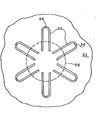
- the preferred spinneret construction includes several generally arched or horseshoe-shaped slots 20 in spinneret blank 22 arranged symmetrically about a central point, the open ends of the horseshoe shape facing inwardly.
- the several slots 20 constitute a combined orifice for spinning a single filament. Slots 20 extend entirely through blank 22 except for a recessed web region 24 at the apex of each slot 20.
- the two different polymers are fed to the combined orifice as a sheath-core supply stream, with dotted circle 26 representing the interface between the two polymers.
- the adjacent ends of adjacent slots 20 are sufficiently close that the streams issuing therefrom unite just below the spinneret.
- the molten spun stream is thus a hollow structure composed of alternating axially extending segments of the two polymers. Surface tension and other effects tend to make the molten spun stream approach a hollow circular cross-section prior to solidffication, substantially as shown in Hayashi U.S. Patent 4051287, Figure 1.
- the spinning process thus produces a spun stream comprising a plurality of separate spun interfaces from the single sheath-core interface between the different polymers in the supply stream, the sheath-core supply interface extending generally parallel to the direction of the supply stream.
- This is accomplished in this embodiment by passing the supply stream through a spinneret orifice having the form of an elongated slot.
- a first portion of the supply interface passes through and extends transversely across the width of the slot at a first location along the length of the slot, and a second portion of the supply interface passes through and extends transversely across the width of the slot at a second location along the length of the slot.
- each individual slot 20 provides for a spun sub-stream having two interfaces, and the illustrated combined orifice provides a combined spun stream having 12 interfaces between different polymeric components.
- Nylon 66 polymer and polyethylene terephthalate polymer are extruded at a temperature of 290°C. through the combined orifice, the nylon polymer being the core of the sheath-core stream approaching the combined orifice.
- Equal volumes of the two polymers are supplied, with the extrusion rate selected to produce a conjugate filament having a denier of 19.5 at a spinning speed of 1500 yards (about 1350 meters) per minute.
- a quench zone just beneath the spinneret and 1.5 meters in height is supplied with quenching air at 20 0 C., the air being directed horizontally onto the polymer stream and having a speed of 25 meters per minute. Below the quench zone, steam is applied to the filament, a conventional finish is applied, and the filament is wound.
- the spun filament is then drawn at 65 meters per minute and at a draw ratio of 2.16 over a contact heater at 132°C., the heater being 0.4 meters long.
- the resulting drawn yarn can be mechanically worked to break the conjugate filament into 12 subfilaments.
- Example II Seventeen of the above spun filaments are spun simultaneously and collected as a multifilament yarn under the spinning conditions of Example I.
- the spun yarn is then draw-textured at 540 meters per minute over a two meter heater set at 220°C.
- the resulting textured yarn when separated into sub-filaments and relaxed, is very voluminous and has high covering power.
- Example I is repeated, except that the spinning speed is increased to 4500 meters per minute while the denier of the conjugate filament is reduced to 4.
- the resulting sub-filaments after separation and immersion in boiling water, form a highly voluminous and lofty yarn.
- Fabrics formed from the conjugate yarn acquire a very soft hand and increased bulk and covering power when the fabric is mechanically worked enough to separate the yarn into sub-filaments. Simple exposure of the fabric to boiling water is adequate in many instances, since the flexing of the yarn involved in certain fabric formations separates the sub-filaments.
Landscapes
- Engineering & Computer Science (AREA)
- Textile Engineering (AREA)
- Mechanical Engineering (AREA)
- Chemical & Material Sciences (AREA)
- Chemical Kinetics & Catalysis (AREA)
- General Chemical & Material Sciences (AREA)
- Spinning Methods And Devices For Manufacturing Artificial Fibers (AREA)
- Multicomponent Fibers (AREA)
Applications Claiming Priority (2)
| Application Number | Priority Date | Filing Date | Title |
|---|---|---|---|
| US84879A | 1979-01-02 | 1979-01-02 | |
| US848 | 1979-01-02 |
Related Parent Applications (2)
| Application Number | Title | Priority Date | Filing Date |
|---|---|---|---|
| EP79303081A Division-Into EP0013186B1 (fr) | 1979-01-02 | 1979-12-31 | Procédé de filage par fusion d'un filament conjugué susceptible de se fendre; filament conjugué, à frisure latente, susceptible de se fendre; procédé de refente d'un tel filament |
| EP79303081A Division EP0013186B1 (fr) | 1979-01-02 | 1979-12-31 | Procédé de filage par fusion d'un filament conjugué susceptible de se fendre; filament conjugué, à frisure latente, susceptible de se fendre; procédé de refente d'un tel filament |
Publications (2)
| Publication Number | Publication Date |
|---|---|
| EP0065788A2 true EP0065788A2 (fr) | 1982-12-01 |
| EP0065788A3 EP0065788A3 (fr) | 1984-11-28 |
Family
ID=21693265
Family Applications (2)
| Application Number | Title | Priority Date | Filing Date |
|---|---|---|---|
| EP79303081A Expired EP0013186B1 (fr) | 1979-01-02 | 1979-12-31 | Procédé de filage par fusion d'un filament conjugué susceptible de se fendre; filament conjugué, à frisure latente, susceptible de se fendre; procédé de refente d'un tel filament |
| EP82105614A Ceased EP0065788A3 (fr) | 1979-01-02 | 1979-12-31 | Procédé de filage de filaments conjugués |
Family Applications Before (1)
| Application Number | Title | Priority Date | Filing Date |
|---|---|---|---|
| EP79303081A Expired EP0013186B1 (fr) | 1979-01-02 | 1979-12-31 | Procédé de filage par fusion d'un filament conjugué susceptible de se fendre; filament conjugué, à frisure latente, susceptible de se fendre; procédé de refente d'un tel filament |
Country Status (5)
| Country | Link |
|---|---|
| EP (2) | EP0013186B1 (fr) |
| JP (1) | JPS55128016A (fr) |
| KR (1) | KR840001633B1 (fr) |
| CA (1) | CA1145907A (fr) |
| DE (1) | DE2966478D1 (fr) |
Families Citing this family (7)
| Publication number | Priority date | Publication date | Assignee | Title |
|---|---|---|---|---|
| US4246219A (en) * | 1979-03-27 | 1981-01-20 | Monsanto Company | Multisegmented filament spinning process |
| EP0074445A1 (fr) * | 1981-09-15 | 1983-03-23 | Monsanto Company | Procédé de filage et fil multifilament |
| EP0074446B1 (fr) * | 1981-09-15 | 1985-05-22 | Monsanto Company | Fil multifilament et procédé de filage |
| US5093061A (en) * | 1982-03-08 | 1992-03-03 | Monsanto | Deep dyeing conjugate yarn processes |
| JPS6075665A (ja) * | 1983-10-01 | 1985-04-30 | 東レ株式会社 | 多成分繊維のフイブリル化絡合方法 |
| EP0376625B1 (fr) * | 1988-12-28 | 1996-09-18 | Asahi Kasei Kogyo Kabushiki Kaisha | Fibre acrylique et procédé pour sa fabrication |
| CN109957856B (zh) * | 2017-12-25 | 2022-07-19 | 上海凯赛生物技术股份有限公司 | 一种并列复合纤维及其制备方法 |
Family Cites Families (4)
| Publication number | Priority date | Publication date | Assignee | Title |
|---|---|---|---|---|
| US3117906A (en) * | 1961-06-20 | 1964-01-14 | Du Pont | Composite filament |
| JPS5228918B2 (fr) * | 1972-05-23 | 1977-07-29 | ||
| JPS581221B2 (ja) * | 1974-12-12 | 1983-01-10 | 帝人株式会社 | シカガワヨウヘンシヨクブツノ セイゾウホウホウ |
| US4246219A (en) * | 1979-03-27 | 1981-01-20 | Monsanto Company | Multisegmented filament spinning process |
-
1979
- 1979-12-28 JP JP17401479A patent/JPS55128016A/ja active Pending
- 1979-12-31 DE DE7979303081T patent/DE2966478D1/de not_active Expired
- 1979-12-31 CA CA000342810A patent/CA1145907A/fr not_active Expired
- 1979-12-31 KR KR7904716A patent/KR840001633B1/ko not_active Expired
- 1979-12-31 EP EP79303081A patent/EP0013186B1/fr not_active Expired
- 1979-12-31 EP EP82105614A patent/EP0065788A3/fr not_active Ceased
Also Published As
| Publication number | Publication date |
|---|---|
| EP0013186B1 (fr) | 1983-12-07 |
| KR830001428A (ko) | 1983-04-30 |
| DE2966478D1 (en) | 1984-01-12 |
| KR840001633B1 (ko) | 1984-10-12 |
| CA1145907A (fr) | 1983-05-10 |
| EP0013186A1 (fr) | 1980-07-09 |
| JPS55128016A (en) | 1980-10-03 |
| EP0065788A3 (fr) | 1984-11-28 |
Similar Documents
| Publication | Publication Date | Title |
|---|---|---|
| US3716317A (en) | Pack for spinning heterofilament fibers | |
| KR880002092B1 (ko) | 폴리에스테르/나일론 이성분 필라멘트 | |
| US4246219A (en) | Multisegmented filament spinning process | |
| EP0357017B1 (fr) | Procédé pour la coagulation de filaments | |
| EP0065788A2 (fr) | Procédé de filage de filaments conjugués | |
| KR100429446B1 (ko) | 전기 방사 장치 및 이를 이용한 부직포의 제조방법 | |
| JPS6158566B2 (fr) | ||
| US4351147A (en) | Spun-like yarn | |
| CA1123280A (fr) | Filament continu a toucher de laine | |
| US4357290A (en) | Splittable conjugate yarn | |
| EP0088744A2 (fr) | Filament conjugué facilement séparable | |
| US3640670A (en) | Spinnerette for extruding t-shaped filaments | |
| US4325765A (en) | High speed spinning of large dpf polyester yarn | |
| CA1108833A (fr) | Fil type filature a filaments de divers deniers | |
| CA1108832A (fr) | File a texture laineuse capillaire | |
| EP0041820B1 (fr) | Procédé pour la production d'un fil de polyester autofrisant | |
| EP0074446B1 (fr) | Fil multifilament et procédé de filage | |
| CA1166431A (fr) | Fil multifilament divisible | |
| EP0074445A1 (fr) | Procédé de filage et fil multifilament | |
| CA1163793A (fr) | File divisible | |
| EP0007237A1 (fr) | Fil texturé | |
| KR820001434B1 (ko) | 자기권축성 필라멘트사의 제조방법 | |
| CA1107471A (fr) | Filature a grande vitesse de gros fils de polyester dpf | |
| CA1123562A (fr) | File auto-crepant, et methode de fabrication connexe | |
| KR830001263B1 (ko) | 가변성 데니어 필라멘트 함유의 스펀라이크사의 제조방법 |
Legal Events
| Date | Code | Title | Description |
|---|---|---|---|
| PUAI | Public reference made under article 153(3) epc to a published international application that has entered the european phase |
Free format text: ORIGINAL CODE: 0009012 |
|
| AC | Divisional application: reference to earlier application |
Ref document number: 13186 Country of ref document: EP |
|
| AK | Designated contracting states |
Designated state(s): DE FR GB IT |
|
| PUAL | Search report despatched |
Free format text: ORIGINAL CODE: 0009013 |
|
| AK | Designated contracting states |
Designated state(s): DE FR GB IT |
|
| 17P | Request for examination filed |
Effective date: 19850330 |
|
| STAA | Information on the status of an ep patent application or granted ep patent |
Free format text: STATUS: THE APPLICATION HAS BEEN REFUSED |
|
| 18R | Application refused |
Effective date: 19861214 |
|
| RIN1 | Information on inventor provided before grant (corrected) |
Inventor name: BROMLEY, JAMES ERNEST Inventor name: YU, JING-PEIR |