EP0065916A2 - Speicherzellen aus Schottkydioden und aus Widerständen von polykristallinem Silizium - Google Patents
Speicherzellen aus Schottkydioden und aus Widerständen von polykristallinem Silizium Download PDFInfo
- Publication number
- EP0065916A2 EP0065916A2 EP82400892A EP82400892A EP0065916A2 EP 0065916 A2 EP0065916 A2 EP 0065916A2 EP 82400892 A EP82400892 A EP 82400892A EP 82400892 A EP82400892 A EP 82400892A EP 0065916 A2 EP0065916 A2 EP 0065916A2
- Authority
- EP
- European Patent Office
- Prior art keywords
- layer
- layers
- impurity
- uppermost
- electrically conductive
- Prior art date
- Legal status (The legal status is an assumption and is not a legal conclusion. Google has not performed a legal analysis and makes no representation as to the accuracy of the status listed.)
- Granted
Links
Images

Classifications
-
- G—PHYSICS
- G11—INFORMATION STORAGE
- G11C—STATIC STORES
- G11C17/00—Read-only memories programmable only once; Semi-permanent stores, e.g. manually-replaceable information cards
- G11C17/14—Read-only memories programmable only once; Semi-permanent stores, e.g. manually-replaceable information cards in which contents are determined by selectively establishing, breaking or modifying connecting links by permanently altering the state of coupling elements, e.g. PROM
- G11C17/16—Read-only memories programmable only once; Semi-permanent stores, e.g. manually-replaceable information cards in which contents are determined by selectively establishing, breaking or modifying connecting links by permanently altering the state of coupling elements, e.g. PROM using electrically-fusible links
- G11C17/165—Memory cells which are electrically programmed to cause a change in resistance, e.g. to permit multiple resistance steps to be programmed rather than conduct to or from non-conduct change of fuses and antifuses
-
- G—PHYSICS
- G11—INFORMATION STORAGE
- G11C—STATIC STORES
- G11C17/00—Read-only memories programmable only once; Semi-permanent stores, e.g. manually-replaceable information cards
- G11C17/14—Read-only memories programmable only once; Semi-permanent stores, e.g. manually-replaceable information cards in which contents are determined by selectively establishing, breaking or modifying connecting links by permanently altering the state of coupling elements, e.g. PROM
- G11C17/16—Read-only memories programmable only once; Semi-permanent stores, e.g. manually-replaceable information cards in which contents are determined by selectively establishing, breaking or modifying connecting links by permanently altering the state of coupling elements, e.g. PROM using electrically-fusible links
-
- H—ELECTRICITY
- H10—SEMICONDUCTOR DEVICES; ELECTRIC SOLID-STATE DEVICES NOT OTHERWISE PROVIDED FOR
- H10B—ELECTRONIC MEMORY DEVICES
- H10B63/00—Resistance change memory devices, e.g. resistive RAM [ReRAM] devices
-
- H—ELECTRICITY
- H10—SEMICONDUCTOR DEVICES; ELECTRIC SOLID-STATE DEVICES NOT OTHERWISE PROVIDED FOR
- H10D—INORGANIC ELECTRIC SEMICONDUCTOR DEVICES
- H10D48/00—Individual devices not covered by groups H10D1/00 - H10D44/00
- H10D48/30—Devices controlled by electric currents or voltages
- H10D48/38—Devices controlled only by variation of the electric current supplied, or only the electric potential applied, to one or more of the electrodes carrying the current to be rectified, amplified, oscillated or switched
- H10D48/381—Multistable devices; Devices having two or more distinct operating states
-
- H—ELECTRICITY
- H10—SEMICONDUCTOR DEVICES; ELECTRIC SOLID-STATE DEVICES NOT OTHERWISE PROVIDED FOR
- H10D—INORGANIC ELECTRIC SEMICONDUCTOR DEVICES
- H10D86/00—Integrated devices formed in or on insulating or conducting substrates, e.g. formed in silicon-on-insulator [SOI] substrates or on stainless steel or glass substrates
Definitions
- This invention relates to integrated circuit structures and processes for fabricating them, and in particular to a compact series connected resistor and diode which may be used as a read only memory cell.
- PROM programmable read only memories
- This invention relates to an integrated circuit structure in which a Schottky diode and a resistor are serially connected between a word line and a bit line in an array of memory cells.
- the resistor By fabricating the resistor from intrinsic polycrystalline silicon, the resistor will operate initially in a first highly resistive state. Application of sufficient potential across the resistor, however, will cause an ir- reversable change in the polycrystalline silicon to substantially lower the resistance of the resistor.
- the two states (high and low resistance) of the resistor may be used to store a binary bit of information.
- an integrated circuit memory cell fabricated according to this invention includes an insulating substrate; a bottom layer of electrically conductive material disposed on the substrate; a plurality of intervening layers of semiconductor material disposed on the bottom layer, a selected layer of the plurality being substantially free of impurities; and an upper layer of electrically conductive material disposed on and in electrical contact with the uppermost of the plurality of intervening layers.
- a method of fabricating an integrated circuit memory cell includes the steps of sequentially depositing on an insulating substrate a bottom layer of electrically conductive material; a plurality of intervening layers of semiconductor material, at least one of which is substantially free of impurities; and an upper layer of electrically conductive material in electrical contact with only the uppermost of the plurality of intervening layers.
- the bottom layer is a metal silicide and the uppermost of the plurality of intervening layers is intrinsic polycrystalline silicon.
- Fig. 1 is a cross-sectional view of an integrated circuit structure which may be fabricated using well-known technology.
- a layer 15 of metal silicide is deposited on an insulating substrate 12, typically silicon dioxide.
- the insulating substrate 12 will comprise a layer of silicon dioxide formed on an underlying region of silicon in which other electronic components, both active and passive, may be fabricated.
- the metal silicide is tungsten silicide deposited using chemical vapor deposition to a thickness of 1,000 angstroms.
- tungsten silicide 15 On the upper surface of tungsten silicide 15 a layer of semiconductor material 18 is deposited. In the preferred embodiment layer 18 is chemical vapor deposited polycrystalline silicon 2,000 angstroms thick.
- phosphorous or another N conductivity type impurity is implanted into'layer 18 to lightly dope it to an impurity concentration of about 10 atoms per cubic centimeter.
- the upper portion of layer 18, typically the top 1,000 angstroms, is more heavily doped by ion implantation with N type impurity, for example to a concentration of 10 20 atoms per cubic centimeter.
- layer 15 provides an electrical connection to layer 18, while the more heavily doped portion of layer 18 provides. an electrical connection between the lower portion of layer 18 and an overlying layer formed on the upper surface of layer 18.
- Layer 21 will typically be intrinsic polycrystalline silicon, and accordingly will have very high resistivity.
- Layer 21 is deposited by chemical vapor deposition to a thickness of about 3,000 angstroms.
- a relatively thin layer of silicon dioxide 23 is formed, typically by a thermal process. In the preferred embodiment layer 23 is 200 angstroms thick and is created by heating the underlying structure to a temperature of 1,000°C for 10 minutes in oxygen.
- a layer 25 of silicon nitride approximately 1,000 angstroms thick is then formed using chemical vapor deposition. Nitride 25 prevents further oxidation of the upper surface of semiconductor material 21 during subsequent processing.
- the structure shown in Fig. 1 is patterned into one or more strips 27a, 27b, etc. In the preferred embodiment this is accomplished by masking and etching silicon nitride layer 25 to remove it from everywhere except where the strips 27a and 27b are desired. Following this step the remaining regions 25b and 25d of nitride layer 25 themselves serve as a mask for the removal of all underlying materials down to the surface of the insulating substrate 12. In the preferred embodiment, the undesired portions of the layers underlying silicon nitride 25 are removed by sequentially plasma etching them, for example, with etch gases containing CF 4 and CC1 4 , respectively.
- the strips will have substantially vertical side walls 28a, 28b, 28c, and 28d.
- Isotropic etching processes for example etching with appropriate solutions, may also be employed to remove the undesired portions of layers 15, 18, 21, and 23, thereby leaving silicide regions 15b and 15d, polycrystalline silicon 18b, 18d, 21b and 21d, and silicon dioxide 23b and 23d, respectively.
- the structure is oxidized to create regions of silicon dioxide 30a, 30b, 30c, and 30d. These regions of silicon dioxide will later serve to prevent short circuiting between an overlying metal layer and the sides of layers 15, 18 and 21.
- the resulting conductive strips as shown in Fig. 2 are termed bit lines herein.
- a subsequently formed strip of metal as shown in Fig. 3 will create a word line.
- the state of any cell on that word line may be determined by sensing the condition of that cell's bit line, or vice versa.
- bit and word
- silicon nitride 25 is then removed from the upper surface of the strips 27 and a layer of silicon dioxide 32 is thermally formed on the upper surface of silicon dioxide 23.
- Layer 32 is not shown in Fig. 3 because, as will be explained, it is subsequently removed.
- Layer 32 is shown in Fig. 4.
- Silicon dioxide 32 will be approximately 1,000 angstroms thick and formed by heating the structure to a temperature of 1,000°C for 60 minutes in steam.
- the silicon dioxide 32 is then removed from regions of the surface of the strips 27a and 27b to form windows 35a and 35b to expose underlying silicon layer 21. This may be accomplished using photolithographic techniques to define windows 35, followed by dip etching the oxide in a 10:1 dilute solution of H 2 0 and HF. Finally, as shown in Figs. 3 and 4, a layer of metal 40, typically aluminum 7,000 angstroms thick, is deposited across the surface of the structure and defined into word lines extending generally perpendicular to the bit lines.
- Fig. 4 is a top view of the structure shown in Fig. 3.
- the word line 40 crosses bit lines 27a and 27b, and as shown, is in electrical contact with silicon 21b and silicon 21d through windows 35a and 35b in silicon dioxide 32b and 32d.
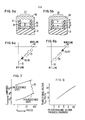
- Figs. 5a and 5b illustrate two embodiments of the invention, with Fig. 5a illustrating the embodiment described in conjunction with Figs. 1 to 4.
- the arrangement of the layers in the strip 50 is different from that depicted in strip 27 in Fig. 5a.
- an underlying layer of tungsten silicide 51 is formed on the surface of silicon dioxide 12.
- a heavily doped layer of polycrystalline silicon 53 about 1,000 angstroms thick is formed on metal silicide 51, followed by a layer of intrinsic polycrystalline silicon 55 approximately 3,000 angstroms thick.
- a layer of lightly doped polycrystalline silicon 57 about 2,000 angstroms thick is deposited on layer 55.
- the upper layer 57 of polycrystalline silicon will be laser annealed.
- An alternate technique for fabricating the embodiment shown in Fig. 5b is to deposit layers 53, 55 and 57 as a single thick layer, and then use ion implantation to create the desired impurity doping.
- the impurity concentrations for layers 53, 55 and 57 in Fig. 5b correspond to those for the upper portion of layer 18, layer 21 and the lower portion of layer 18, respectively, in Fig. 5a.
- the Schottky diode is created by the interface between layer 18 and layer 15, while layer 21 functions as a resistor.
- the Schottky diode is created by the interface between metal 40 and lightly doped polycrystalline silicon 57, while layer 55 functions as a resistor.
- Figs. 6a and 6b are schematics of the memory cells shown in Figs. 5a and 5b, respectively.
- the programmable memory cell is connected between word line 40 and bit line 15 (Fig. 6a) or 51 (Fig. 6b).
- the primary difference between the different embodiments is the arrangement of the individual elements within the cell.
- the Schottky diode is connected to the word line and the resistor 55 is connected to the bit line in Figs. 5b and 6b.
- this arrangement is reversed.
- Fig. 7 illustrates the current-voltage relationship of the polycrystalline silicon resistor 21 (in Fig. 5a) or 55 (in Fig. 5b).
- the resistor will operate in one of two states, termed herein a high resistance state and a low resistance state.
- the resistor's charcteristics are shown in the designated curve in Fig. 7.
- the current flow will be on the order of 10-g amperes.
- a particular threshold voltage (described in conjunction with Fig. 8), for example, that designated by the triangle, the current-voltage characteristics of the resistor will change dramatically and irreversibly to a low resistance state. This is designated in Fig.
- the resistor will thereafter operate, regardless of the applied voltage, in the low resistance state. As shown by Fig. 7, the resistance of the resistor is several orders of magnitude greater in the high resistance state than in the low resistance state. As explained previously, the change of state of the resistor may be used to indicate a binary bit.
- transitional voltage depends upon the temperature at which the polycrystalline silicon resistor is formed and the thickness of the polycrystalline silicon.
- the change of state of the resistor may be most readily utilized in an array of memory cells by programming the desired cells with a suitably high potential to cause the resistors in those cells to change state.
- the memory array is then operated with potentials substantially lower than this threshold voltage to sense the high or low resistance state of the individual resistors within the array.
Landscapes
- Semiconductor Memories (AREA)
- Read Only Memory (AREA)
Applications Claiming Priority (2)
| Application Number | Priority Date | Filing Date | Title |
|---|---|---|---|
| US26394781A | 1981-05-15 | 1981-05-15 | |
| US263947 | 1981-05-15 |
Publications (3)
| Publication Number | Publication Date |
|---|---|
| EP0065916A2 true EP0065916A2 (de) | 1982-12-01 |
| EP0065916A3 EP0065916A3 (en) | 1983-04-20 |
| EP0065916B1 EP0065916B1 (de) | 1988-10-12 |
Family
ID=23003923
Family Applications (1)
| Application Number | Title | Priority Date | Filing Date |
|---|---|---|---|
| EP82400892A Expired EP0065916B1 (de) | 1981-05-15 | 1982-05-14 | Speicherzellen aus Schottkydioden und aus Widerständen von polykristallinem Silizium |
Country Status (4)
| Country | Link |
|---|---|
| EP (1) | EP0065916B1 (de) |
| JP (1) | JPS57194569A (de) |
| CA (1) | CA1197929A (de) |
| DE (1) | DE3279114D1 (de) |
Cited By (8)
| Publication number | Priority date | Publication date | Assignee | Title |
|---|---|---|---|---|
| FR2523357A1 (fr) * | 1982-03-15 | 1983-09-16 | Thomson Csf | Matrice d'elements a memoire integres, a double couche de silicium polycristallin de haute resistivite et procede de fabrication |
| GB2222024A (en) * | 1988-08-18 | 1990-02-21 | Stc Plc | Programmable integrated circuits |
| EP0365932A1 (de) * | 1988-10-14 | 1990-05-02 | Seiko Epson Corporation | Halbleiteranordnung |
| WO2002052625A3 (en) * | 2000-12-22 | 2003-01-30 | Univ California | Process of forming p-n layer |
| WO2003085675A3 (en) * | 2002-04-04 | 2004-04-22 | Toshiba Kk | Phase-change memory device |
| US7623370B2 (en) | 2002-04-04 | 2009-11-24 | Kabushiki Kaisha Toshiba | Resistance change memory device |
| US7663132B2 (en) | 2002-04-04 | 2010-02-16 | Kabushiki Kaisha Toshiba | Resistance change memory device |
| US7767993B2 (en) | 2002-04-04 | 2010-08-03 | Kabushiki Kaisha Toshiba | Resistance change memory device |
Family Cites Families (5)
| Publication number | Priority date | Publication date | Assignee | Title |
|---|---|---|---|---|
| GB1107700A (en) * | 1966-03-29 | 1968-03-27 | Matsushita Electronics Corp | A method for manufacturing semiconductor devices |
| JPS5267532A (en) * | 1975-12-03 | 1977-06-04 | Nippon Telegr & Teleph Corp <Ntt> | Semiconductor memory unit |
| US4110488A (en) * | 1976-04-09 | 1978-08-29 | Rca Corporation | Method for making schottky barrier diodes |
| US4203123A (en) * | 1977-12-12 | 1980-05-13 | Burroughs Corporation | Thin film memory device employing amorphous semiconductor materials |
| US4424579A (en) * | 1981-02-23 | 1984-01-03 | Burroughs Corporation | Mask programmable read-only memory stacked above a semiconductor substrate |
-
1982
- 1982-05-14 DE DE8282400892T patent/DE3279114D1/de not_active Expired
- 1982-05-14 EP EP82400892A patent/EP0065916B1/de not_active Expired
- 1982-05-14 JP JP8033582A patent/JPS57194569A/ja active Pending
- 1982-05-14 CA CA000402946A patent/CA1197929A/en not_active Expired
Cited By (13)
| Publication number | Priority date | Publication date | Assignee | Title |
|---|---|---|---|---|
| FR2523357A1 (fr) * | 1982-03-15 | 1983-09-16 | Thomson Csf | Matrice d'elements a memoire integres, a double couche de silicium polycristallin de haute resistivite et procede de fabrication |
| GB2222024A (en) * | 1988-08-18 | 1990-02-21 | Stc Plc | Programmable integrated circuits |
| GB2222024B (en) * | 1988-08-18 | 1992-02-19 | Stc Plc | Improvements in integrated circuits |
| EP0365932A1 (de) * | 1988-10-14 | 1990-05-02 | Seiko Epson Corporation | Halbleiteranordnung |
| WO2002052625A3 (en) * | 2000-12-22 | 2003-01-30 | Univ California | Process of forming p-n layer |
| US7623370B2 (en) | 2002-04-04 | 2009-11-24 | Kabushiki Kaisha Toshiba | Resistance change memory device |
| WO2003085675A3 (en) * | 2002-04-04 | 2004-04-22 | Toshiba Kk | Phase-change memory device |
| US7663132B2 (en) | 2002-04-04 | 2010-02-16 | Kabushiki Kaisha Toshiba | Resistance change memory device |
| US7767993B2 (en) | 2002-04-04 | 2010-08-03 | Kabushiki Kaisha Toshiba | Resistance change memory device |
| US7989789B2 (en) | 2002-04-04 | 2011-08-02 | Kabushiki Kaisha Toshiba | Phase-change memory device that stores information in a non-volatile manner by changing states of a memory material |
| US7989794B2 (en) | 2002-04-04 | 2011-08-02 | Kabushiki Kaisha Toshiba | Resistance change memory device for storing information in a non-volatile manner by changing resistance of memory material |
| US8269207B2 (en) | 2002-04-04 | 2012-09-18 | Kabushiki Kaisha Toshiba | Memory device having variable resistance memory cells disposed at crosspoint of wirings |
| US8384059B2 (en) | 2002-04-04 | 2013-02-26 | Kabushiki Kaisha Toshiba | Phase-change memory device |
Also Published As
| Publication number | Publication date |
|---|---|
| EP0065916A3 (en) | 1983-04-20 |
| CA1197929A (en) | 1985-12-10 |
| DE3279114D1 (en) | 1988-11-17 |
| EP0065916B1 (de) | 1988-10-12 |
| JPS57194569A (en) | 1982-11-30 |
Similar Documents
| Publication | Publication Date | Title |
|---|---|---|
| US5057451A (en) | Method of forming an antifuse element with substantially reduced capacitance using the locos technique | |
| US4499557A (en) | Programmable cell for use in programmable electronic arrays | |
| US4424578A (en) | Bipolar prom | |
| US5311039A (en) | PROM and ROM memory cells | |
| KR900008019B1 (ko) | 프로그램 가능 반도체 메모리 장치 | |
| US4599705A (en) | Programmable cell for use in programmable electronic arrays | |
| US6525399B2 (en) | Junctionless antifuses and systems containing junctionless antifuses | |
| US5625220A (en) | Sublithographic antifuse | |
| US4292730A (en) | Method of fabricating mesa bipolar memory cell utilizing epitaxial deposition, substrate removal and special metallization | |
| US5049970A (en) | High resistive element | |
| US5198382A (en) | Semiconductor element and manufacture thereof | |
| KR950030267A (ko) | 실리사이드 반응을 이용하는 반도체 디바이스 | |
| JPS5812742B2 (ja) | 半導体装置 | |
| EP0058124B1 (de) | Anordnung von Schottkydioden aus polykristallinem Silizium und Verfahren zur Herstellung | |
| US4673969A (en) | Semiconductor device having multiple conductive layers and the method of manufacturing the semiconductor device | |
| US4403399A (en) | Method of fabricating a vertical fuse utilizing epitaxial deposition and special masking | |
| US4447823A (en) | SOS p--n Junction device with a thick oxide wiring insulation layer | |
| US4538167A (en) | Shorted junction type programmable read only memory semiconductor devices | |
| EP0065916B1 (de) | Speicherzellen aus Schottkydioden und aus Widerständen von polykristallinem Silizium | |
| US4780751A (en) | Semiconductor integrated circuit device | |
| US5140299A (en) | Article comprising a high value resistor | |
| US5622884A (en) | Method for manufacturing a semiconductor memory cell and a polysilicon load resistor of the semiconductor memory cell | |
| EP0078220B1 (de) | Polykristalline Silizium-Verbindungen für Bipolartransistoren in Flip-Flop-Schaltung | |
| EP0078222A2 (de) | Bipolare Speicherzelle für integrierte Schaltungen | |
| US4628339A (en) | Polycrystalline silicon Schottky diode array |
Legal Events
| Date | Code | Title | Description |
|---|---|---|---|
| PUAI | Public reference made under article 153(3) epc to a published international application that has entered the european phase |
Free format text: ORIGINAL CODE: 0009012 |
|
| AK | Designated contracting states |
Designated state(s): DE FR GB IT NL |
|
| PUAL | Search report despatched |
Free format text: ORIGINAL CODE: 0009013 |
|
| AK | Designated contracting states |
Designated state(s): DE FR GB IT NL |
|
| 17P | Request for examination filed |
Effective date: 19830903 |
|
| GRAA | (expected) grant |
Free format text: ORIGINAL CODE: 0009210 |
|
| RAP1 | Party data changed (applicant data changed or rights of an application transferred) |
Owner name: FAIRCHILD SEMICONDUCTOR CORPORATION |
|
| ITF | It: translation for a ep patent filed | ||
| AK | Designated contracting states |
Kind code of ref document: B1 Designated state(s): DE FR GB IT NL |
|
| REF | Corresponds to: |
Ref document number: 3279114 Country of ref document: DE Date of ref document: 19881117 |
|
| ITF | It: translation for a ep patent filed | ||
| ET | Fr: translation filed | ||
| PLBE | No opposition filed within time limit |
Free format text: ORIGINAL CODE: 0009261 |
|
| STAA | Information on the status of an ep patent application or granted ep patent |
Free format text: STATUS: NO OPPOSITION FILED WITHIN TIME LIMIT |
|
| 26N | No opposition filed | ||
| ITTA | It: last paid annual fee | ||
| PGFP | Annual fee paid to national office [announced via postgrant information from national office to epo] |
Ref country code: GB Payment date: 19940412 Year of fee payment: 13 |
|
| PGFP | Annual fee paid to national office [announced via postgrant information from national office to epo] |
Ref country code: FR Payment date: 19940513 Year of fee payment: 13 |
|
| PGFP | Annual fee paid to national office [announced via postgrant information from national office to epo] |
Ref country code: NL Payment date: 19940531 Year of fee payment: 13 |
|
| PG25 | Lapsed in a contracting state [announced via postgrant information from national office to epo] |
Ref country code: GB Effective date: 19950514 |
|
| PG25 | Lapsed in a contracting state [announced via postgrant information from national office to epo] |
Ref country code: NL Effective date: 19951201 |
|
| GBPC | Gb: european patent ceased through non-payment of renewal fee |
Effective date: 19950514 |
|
| NLV4 | Nl: lapsed or anulled due to non-payment of the annual fee |
Effective date: 19951201 |
|
| PG25 | Lapsed in a contracting state [announced via postgrant information from national office to epo] |
Ref country code: FR Effective date: 19960229 |
|
| REG | Reference to a national code |
Ref country code: FR Ref legal event code: ST |
|
| REG | Reference to a national code |
Ref country code: FR Ref legal event code: ST |
|
| PGFP | Annual fee paid to national office [announced via postgrant information from national office to epo] |
Ref country code: DE Payment date: 19990422 Year of fee payment: 18 |
|
| PG25 | Lapsed in a contracting state [announced via postgrant information from national office to epo] |
Ref country code: DE Free format text: LAPSE BECAUSE OF NON-PAYMENT OF DUE FEES Effective date: 20010301 |