EP0065933A2 - Appareil et procédé pour récouper des barres en lopins - Google Patents
Appareil et procédé pour récouper des barres en lopins Download PDFInfo
- Publication number
- EP0065933A2 EP0065933A2 EP82810214A EP82810214A EP0065933A2 EP 0065933 A2 EP0065933 A2 EP 0065933A2 EP 82810214 A EP82810214 A EP 82810214A EP 82810214 A EP82810214 A EP 82810214A EP 0065933 A2 EP0065933 A2 EP 0065933A2
- Authority
- EP
- European Patent Office
- Prior art keywords
- length
- strand
- separation
- bolt
- section
- Prior art date
- Legal status (The legal status is an assumption and is not a legal conclusion. Google has not performed a legal analysis and makes no representation as to the accuracy of the status listed.)
- Withdrawn
Links
Images




Classifications
-
- B—PERFORMING OPERATIONS; TRANSPORTING
- B21—MECHANICAL METAL-WORKING WITHOUT ESSENTIALLY REMOVING MATERIAL; PUNCHING METAL
- B21C—MANUFACTURE OF METAL SHEETS, WIRE, RODS, TUBES, PROFILES OR LIKE SEMI-MANUFACTURED PRODUCTS OTHERWISE THAN BY ROLLING; AUXILIARY OPERATIONS USED IN CONNECTION WITH METAL-WORKING WITHOUT ESSENTIALLY REMOVING MATERIAL
- B21C33/00—Feeding extrusion presses with metal to be extruded ; Loading the dummy block
- B21C33/006—Consecutive billets, e.g. billet profiles allowing air expulsion or bonding of billets
-
- B—PERFORMING OPERATIONS; TRANSPORTING
- B21—MECHANICAL METAL-WORKING WITHOUT ESSENTIALLY REMOVING MATERIAL; PUNCHING METAL
- B21C—MANUFACTURE OF METAL SHEETS, WIRE, RODS, TUBES, PROFILES OR LIKE SEMI-MANUFACTURED PRODUCTS OTHERWISE THAN BY ROLLING; AUXILIARY OPERATIONS USED IN CONNECTION WITH METAL-WORKING WITHOUT ESSENTIALLY REMOVING MATERIAL
- B21C33/00—Feeding extrusion presses with metal to be extruded ; Loading the dummy block
-
- B—PERFORMING OPERATIONS; TRANSPORTING
- B23—MACHINE TOOLS; METAL-WORKING NOT OTHERWISE PROVIDED FOR
- B23D—PLANING; SLOTTING; SHEARING; BROACHING; SAWING; FILING; SCRAPING; LIKE OPERATIONS FOR WORKING METAL BY REMOVING MATERIAL, NOT OTHERWISE PROVIDED FOR
- B23D23/00—Machines or devices for shearing or cutting profiled stock
-
- B—PERFORMING OPERATIONS; TRANSPORTING
- B23—MACHINE TOOLS; METAL-WORKING NOT OTHERWISE PROVIDED FOR
- B23D—PLANING; SLOTTING; SHEARING; BROACHING; SAWING; FILING; SCRAPING; LIKE OPERATIONS FOR WORKING METAL BY REMOVING MATERIAL, NOT OTHERWISE PROVIDED FOR
- B23D33/00—Accessories for shearing machines or shearing devices
- B23D33/10—Stops for positioning work
Definitions
- the present invention relates to a method for separating pressing bolts of a prescribed length from strands fed one after the other to a separating device, and furthermore to a separating system for carrying out this method.
- press bolts When producing profiles by extrusion, the primary material is used in the form of so-called press bolts or press bars in the recipients of the extrusion press.
- press bolts are made from so-called cast strands or continuous cast rods that are several meters, e.g. Can reach 4 - 7 m in length, cut off.
- the length of the individual press bolts is selected depending on the material requirements (length, cross-section) of the currently pressed profile. The cheapest bolt length can therefore change when changing to another extruded profile.
- length adjustments of successive press studs can also be expedient, mainly in the initial phase of pressing an order for certain profiles, in particular to gradually reduce the press residue to a permissible minimum given the optimal extrusion length of the profiles. If the press bolts are cut in standard lengths beforehand, such an optimization of the bolt length cannot be carried out.
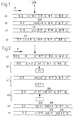
- a to b for example, some cases are shown that can occur in practice in the separation according to previous practice.
- Arrow F indicates the direction of material flow and arrow T indicates the separation point.
- the losses caused by sawdust that result from cutting with a saw were not taken into account.
- the third strand will be operated as in the first and the fourth strand, i.e. generally every second strand, will consist of an unusable remaining piece of 10 cm in length.
- the critically short complementary piece ck separated from the next strand lies behind the remaining piece r9 and then causes difficulties in the further transport to the extrusion press.
- This object is achieved in that - for the transition - from a remainder of the preceding strand, viewed in the direction of material flow, at least before the separation point, at least one section of length ls to L-ls is generated by the first separation operation and the section occurring after the separation station removed from the material track, whereupon at least one complementary piece of length ls to L-ls is cut off from the next strand by a further cutting operation and, by assembling such sections of said length with such complementary pieces, multipart bolts of the prescribed length L are formed for further processing, ls is a predetermined safety length, which is greater than a critical length lk, which is determined on the basis of the conditions of the system available and the size of the strand cross-section.
- the sections are advantageously produced from the end part of the preceding strand and the complementary pieces are separated from the beginning part of the next strand, which also requires the simplest device.
- one does not come out of the scope of the invention if one changes the order of the separation and, for example, separates the sections from the rod length somewhere between two one-piece bolts, so that only entire bolts of the prescribed length are produced at the end of the rod, or from the subsequent strand initially a one-piece bolt the target length and only later separates complementary pieces.
- such types of work mean that several pieces have to be transferred to a waiting position and require additional waiting positions. They are therefore less advantageous.
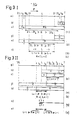
- FIG. 3-1 The conditions of the described embodiment, where the remaining strand part R is divided into two sections a1 and a2, preferably of the same length, and two complementary pieces c separated from the next strand are required, which together correspond to a strand component C, are illustrated in FIG. 3-1 , where the separation point is also indicated by arrow T and the direction of material flow by arrow F.
- a distance 2L corresponding to two bolt lengths L is entered under a in front of the separation point and the critical length lk and the predetermined length ls, where ls> 1k, are drawn in at the ends of this distance 2L.
- Remaining parts the rear end face of which falls within this area 3 or 4 and whose length therefore lies in area (2), can be carried out with a good safety margin compared to the critical length l when the method is carried out in practice, as shown in examples 1 and 2 k divided and processed further.
- the described separation method can be carried out consistently with each transition from one strand to a next strand. However, this leads to the fact that with each transition two composite bolts are formed again and again, which for the quality of the profiles cannot be as cheap as one-piece bolts.
- the separation method described is combined ebergang with conventional previous working method to form a single composite bolt per U, thereby making it possible while completely avoiding critical remnants or critical complementary pieces to reduce the total number of two-part pins.
- the specified length ls is also entered under 1 from distance L from the separation point T, on both sides thereof.
- Remaining parts their rear end face in the area ie in the area 3-1, are divided, and each section thereof is assembled with a complementary piece separated from the next strand, such that in such cases two composite bolts are formed per transition.
- the specified length ls is selected such that it is greater than a third of the bolt length L (ls> L / 3), a remainder can arise, the rear end face of which is either at the limit L - ls and consequently, its length is shorter than 2/3 L, so that after the division, the sections are shorter than 1/3 L, i.e. shorter than ls, or that this rear end face is at the limit L + ls, in which case the Remaining part is longer than 4/3 L and after dividing the sections are longer than 2/3 L, so that then complementary pieces are required that are shorter than 1/3 L, ie are shorter than the length ls preselected with this value.
- the specified length ls is expediently not chosen to be greater than 1/3 L: Since the number of two-part bolts is reduced the smaller ls, the value 0.28 L is preferably maintained as the upper limit of ls, ie
- the combined mode of operation according to FIGS. 3-II therefore has the advantage over the mode of operation according to FIGS. 3-1, that you can work with larger values of the specified length ls, ie up to 1/3 L instead of up to 1/4 L, and can thus distance yourself even more from the critical length l k .
- the remaining part R is expediently divided if it has a length such that its back tere area in the operation of Fig. 3-II in the areas and in the operation according to Fig. 3-II in the areas falls, as shown in Fig. 3-II under o.
- the rear end face is either in the area (6) or in the area (7) or in the tolerance area (13 ) fall, which is possible since there is a distance L between the lower limit ls and the upper limit L + ls.
- the separation method described above and the combined mode of operation are particularly advantageous if the strands are heated in a continuous furnace arranged next to the extrusion press to the temperature required for the extrusion and the pressing bolts are separated from the strands by means of a hot shear attached thereafter.
- a hot shear attached thereafter in order to keep the strand warm, it is possible to move the strand back into the furnace after a bolt has been cut off.
- the section located in the waiting position after the hot shears is removed from this waiting position after the removal of the first two-part bolts and is pushed back into the furnace for keeping warm.
- the section and strand are advanced and the complementary piece required is separated on the strand.
- the invention also relates to a device for carrying out the method according to the invention, and thus to a separation system with a separation station formed by a saw, warm shears or the like, a conveyor device for feeding the strands to be divided one after the other to the separation station and a further conveyor device for the Removal of the separated pieces.
- a measuring device for determining the length of the remaining strand part located in front of the separation point T is arranged in front of the separation station in the area of the feed conveyor, and means for removing separated pieces from the material track are provided after the separation station.
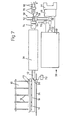
- the strand magazine 10 for the strands 12 to be processed.
- This magazine is usually formed by slightly inclined bars 14 with a device for separating strands and detents 16, not shown, so that the strands, when through the locks released individually, can be transferred under their own weight to a conveyor 18.
- the strand magazine can also be designed as a multi-storey magazine, the strands being superimposed on several floors and being fed to the conveying device 18 by means of a lifting or lowering device (not shown). Through the latter, the strands for separating individual bolts 20 or bolt parts are gradually guided to a saw 22, e.g. be pushed forward by a pusher 26 driven by a spindle 24 or by means known per se.
- the separated bolts are turned into a continuous furnace 34, e.g. fed to an induction furnace, where they are heated to the temperature required for the extrusion.
- the bolts are removed from the furnace 34 and fed to the extruder 38 with the transfer device 36.
- This essentially consists of the pressure cylinder part 40 with press ram 42, the yoke part 44 for the die and the receiver part 46 for receiving the bolt to be pressed.
- a removable pin loading device 48 on which the press-warm pin is placed before it is pushed into the receiver by the punch 42.
- Such a system is now according to the invention, viewed in the direction of material flow, after the saw 22, i.e. on the transport route between the saw 22 and the extruder 38, preferably between the saw and the furnace 34, e.g. Shortly after the saw 22, it is provided with a device 50 with which separated bolt parts can be moved from the normal material flow track into a waiting position and from there back into the normal material flow track.
- FIG. 4 An embodiment of such a device 50 is illustrated in a top view in FIG. 4 and in a front view in FIG. 5.
- This device 50 consists of a carriage 54 which can be moved transversely to the normal conveying direction on rails 52 with two receiving shells 56 and 58 which can optionally be brought into the normal track and, if desired, with driven rollers 60 for the further conveyance of the bolts or bolt parts can be equipped in the longitudinal direction. But bumps can also be provided for this further funding.
- this section is transferred to one of the trays, for example also to the receiving tray 56, whereupon the carriage 54 is moved in such a way that the receiving tray 58 is now in the normal track.
- the carriage 54 is then pushed back, as a result of which the first-mentioned section a1 is brought back into the normal track from its waiting position.
- a complementary piece (c2) on the shell 56 is separated from the said next strand, thereby forming a second two-part bolt which can be conveyed to the furnace and the extruder.
- one-piece and single two-piece bolts can again be separated and transported, in a known manner, until the need arises to form two two-piece bolts in succession and the sliding carriage 54 must therefore be put back into operation, etc.
- a similar pushing device can, however, as indicated at 62, be attached to the longitudinal conveyor 32 located in front of the furnace 34, where the two-part bolts are then assembled. It is also possible to attach a similarly acting device, as indicated at 64, to the cross conveyor 30, in which case the sections have to be moved into their waiting position and back therefrom by a movement in their longitudinal direction.
- the carriage 54 which is equipped with two receiving shells, can also be moved, as shown in FIG. 6, on cross rails 52, which extend from the area of the conveyor device 18 and saw 22 to in front of the continuous furnace 30, and thus replace the cross conveyor 30.
- the receiving shells can be arranged one above the other, the carriage then having to be displaced in the vertical direction.
- the strand is expediently, optionally with the bolt part in front, up to a known, pivotable and pivotable, displaceable on a running rail 68 and there adjusted stop 70 advanced, whereupon the Ab separation process is carried out.
- a holding device for the severing process after the strand has been advanced step by step with another device, for example pliers, which can be moved back and forth by a bolt length, with an open holding device.
- a special measuring device 72 is arranged, which preferably works in conjunction with the pusher 26 and is explained in more detail below.
- the bars 12 are converted from a magazine 10 via a conveyor device 18 to a e.g. electrically or flame-heated and optionally equipped with an internal conveyor continuous furnace 34, where they are heated to the temperature necessary for the extrusion.
- a hot shear 74 Following this continuous furnace is a hot shear 74, with which one-piece bolts 20 or bolt parts to be assembled are separated from the strands and fed to the extrusion press 38.
- a device 50 is arranged downstream of the hot shear 74 which bolt parts can be temporarily moved to a waiting position.
- This device 50 shown in FIG. 8 consists of a carriage 54 which can be moved on a running rail 52 and which is equipped with two receiving shells 56 and 58, which can optionally be moved before the hot shear 74 exits and one of which can be used as a waiting position.
- the operation of this sliding carriage 54 is similar to that described for the carriage 54 in FIG. 5.
- the indicated pivotable bolt loading device 76 is provided for the transfer of the bolts from one of the shells to the extrusion press 38.
- the single-part or multi-part bolts are transferred from the receiving shells 56 and 58 to the loading device 76 by displacement, in the axial direction, by rolling over or by a mechanical gripping device.
- an adjustable stop 70 which is displaceable on guide rails 68 and an adjustable measuring device 72 which is explained in more detail below.
- the stop 70 can also be designed as a pusher so that a section in the waiting position can be pushed back into the furnace until the next bolt is required.
- a separate pusher can also be provided for this.
- FIGS. 4 to 8 For the case of cold as well as warm separation, movable devices were shown and described in FIGS. 4 to 8, which consist of two receiving shells are equipped, one of which can be used as a waiting position, as required for the preferred embodiment of the method according to the invention. However, should it be desirable to have a larger number of waiting positions available, then there is the option of providing the movable carriage with additional receiving trays, or to provide a separate waiting position for which the sections or bolt parts can be provided by means of a single-tray carriage or by other means Funds are transferred and retrieved from them in due course.
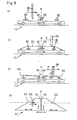
- FIG. 9 shows the principle of a measuring device 72 mentioned in connection with FIGS. 4 and 7 for triggering the steps necessary to carry out the method according to the invention.
- This measuring device has two limiters 80 and 82 which can be displaced towards and offset from a zero point P and which can be set at the desired distance v or ls from the zero point P and thus limit the previously defined range L ⁇ v or L ⁇ ls.
- the measuring device is advantageously provided with two further limiters 84 and 86, which are also adjustable and which determine the tolerance range L ⁇ t.
- the areas (L + ls) to (L + t) and (L - t) to (L - ls) are formed on the measuring device by the limiters 80 and 84 or 86 and 82, which are used for dividing a The remainder in two sections are decisive.
- a sensor 88 acts together with this measuring device.
- the measuring device mounts on a moving part of the bar feed device, e.g. to be attached to the support of the pusher 26 and to mount the sensor 88 so that it can only be adjusted to the desired bolt set length L.
- the measuring device can also be arranged in a stationary manner and the sensor 88 can be coupled to a moving part of the rod feed device, for example to the pusher 26, in such a way that it reproduces its position and thus the position of the rear end face of a rod.
- the zero point P of the measuring device 72 can then also be shifted so that it can be adapted to the desired value of the desired bolt length L.
- the senor 88 with another sensor, e.g. to couple optical or mechanical sensors, which directly scans the position of the rear face.
- the sensors and limiters are e.g. means known per se, which act on one another in an electromechanical way, such as switches, or in a capacitive, or inductive or still opto-electric way.
- the limiters can be arranged in the order 80, 84, 86, 82 when the sensor 88 is advanced Issue the commands on-off-on according to the direction of material flow in accordance with arrow F, such that when the strand 88 which indicates the position of the rear end face of this strand is in one of the areas 74-78 or 80-76 when the strand is stationary for a particular severing operation, the device triggers the operations for splitting a remaining part.
- variable ranges (L + ls) to (L + t) and (L-t) to (L-ls) are embodied by material means and e.g. by means of bands 90 stretched over two delimiters (FIG. 9b) or by slats that can be pushed onto one another in the manner of an aperture 92, the ends of which act as area boundaries (FIG. 9c), or by means of surfaces that can be displaced in relation to the trace of the sensor 88 formed by rectangular trapezoids 94 (Fig. 9d).
- a contact surface that is variable in length or an expandable diaphragm surface for a sensor 88 provided with a photocell is formed.
- the device triggers the processes for dividing a remaining part.
- variable areas in question are possible within the scope of the invention.
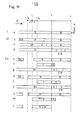
- Arrow F indicates the direction of material flow and arrow T locates the separation point.
- a bolt length L is shown on both sides of T.
- B denotes a one-piece bolt
- ZB a composite bolt
- c a complementary piece.
- a remaining piece is indicated by r and a remaining part by R, this remaining part R is divided into two sections a1 and a2, S means the next bar.
- Stop at L end of strand advanced until stop; Detach the bolt B that is led away.
- the representation m shows very schematically the most important couplings between the measuring device 72, the separation point 22 or 74, the control device 96, the sliding device 50 and the stop 70 for carrying out the steps mentioned under Case II, representations f-h.
- the separating device 22, 74 must be coupled to the measuring device 72 via the control device 46 so that, based on the determinations of the measuring device 72, the sliding device 50 and the stop 70 are displaced at the respectively applicable time.
- the limiters must be inserted at such a distance v from the zero point on the measuring device using the teaching of FIGS be placed, which is greater than 0.5 L, but not greater than L - ls, in any case smaller than L - lk, so that no short pieces of the critical length or less arise.
- This safety distance between ls and lk is particularly important when hot shearing is carried out after a continuous furnace and the position of the rear end face of the remnant or the remnant cannot be determined, or is difficult to determine for other reasons, and this determination is indirect Path takes place at the rear end of an abutting further rod, the length of which is measured and taken into account.
- the tolerance deviations that occur are of no influence since they are absorbed by a sufficiently large predetermined IS value, and they do not add up because the determination of the Length of a rest is done fresh at each end of the strand.
- the complementary pieces can each be cut to length and cut off from the rod S.
- the stop 70 is also to be moved in the direction of the separation point, for example by the amount R / 2. This task can also be left to the control device coupled to the measuring device.
- Such a procedure can be particularly desirable when hot shearing is carried out after a continuous furnace. It is then possible to first separate the complementary piece c2 for the second assembled bolt and place it on the free receptacle and only then to retrieve the first section from its waiting position by first transferring the complementary piece c2 and then the section after transferring it to the bolt loading device 78 a1 is moved behind c2.
- This desired sequence of the bolt parts a1-c2 with respect to the pressing direction can be achieved in particular in a system according to FIGS. 7 and 8 with a sliding device 50, in which the receiving shells 56-58 are mounted together on a rotating platform on the sliding carriage 54.
- the components are placed on a receiving tray in the order (c 1 - a2) or (c2 - a1), with the sections a2 or a1 forward, as with the dar positions g and h shown in Fig. 10. Then the group of the receptacles is rotated by 180 ° so that the components c1 and c2 lie to the front, whereupon the composite bolt formed in each case is conveyed onward.
- the one-piece or multi-piece bolts can be brought to the correct pressing temperature individually in a continuous furnace arranged near the extrusion press, or a so-called "head heating", which is also known per se, can be carried out there.
- Such a rotary movement which may also be desired in the case of cold saws, can take place in a system according to FIG. 4 if the carriage has first been moved out of the area of the main conveyor 28 to the side.
- the rotational movement when moving between saw 22 and furnace 30 and in an arrangement according to FIGS. 7-8 can take place on the way between warm shear 74 and loading device 76.
- the following exemplary embodiment is intended to show how a combined separation process according to FIG. 10 takes place.
- the strand no. 5 then has a length of 511 cm and can be divided exactly into 7 one-piece bolts, after a remaining part of 73 cm has been created after separating 6 bolts, which can be used as one-piece bolts.
- the position for the sixth strand is the same as for strand No. 1 in Table III, i.e. an initial length of 600 cm.
- the described first embodiment of the method and the corresponding separation system are very well suited for automatic operation and also bring the higher advantages because they enable optimal, waste-free subdivision of the strands.
- they require a relatively high outlay in terms of apparatus and corresponding maintenance and upkeep costs, especially if the separation is used on a strand preheated in an oven by means of warm shears. It is then practically necessary to return the first-mentioned section, which has been moved into a waiting position, to keep warm in the oven, which requires the activation of additional operations and corresponding devices.
- the critical short pieces during the separation process - seen in the direction of material flow - are not created behind, but now before the usable section, they are easy to remove and therefore do not interfere with the normal process flow, even if they do in certain cases cause additional severing operation that can readily be done while extruding a previously severed bolt.
- the direction of the material flow is again indicated by arrow F and the separation point is localized by T.
- T On both sides of T there is a bolt length L and, before the separation point, the safety lengths + ls on both sides of the L point.
- the remaining part R is longer than L + ls (b), but at most as long as 2L - ls, since remaining parts with a length between 2L - ls and 2L cannot occur due to the processing according to case III '.
- a bolt B of length L can be cut off and a remaining piece r remains, which is longer than the safety length ls and is therefore usable (c).
- a complementary piece c of length L - r is cut off from the next abutting rod Sn, thereby forming a composite bolt ZB with the remaining piece r, which can be conveyed to the extrusion press.
- the remaining part R has a length that is at least L - ls and at most L + ls. It is a critical residual part that is to be processed according to the invention. For example, this length can be between L - ls and L, as shown under e.
- the inventive separation of a section at the front end of the remaining part R is used: this remaining part is advanced until its rear end face is at least at a distance -ls from the reference point L located on the input side. A section a is then cut off from the front end of the remaining part R and a remaining piece r of length L-ls or somewhat shorter remains. The separated section a is removed as waste (f).
- the remainder piece r is advanced through the next bar Sn up to the stop A and a complementary piece c of length ls or a little longer is cut off from this next bar, which length of complementary piece c is therefore definitely not critical.
- the assembled bolt ZB is thus formed (g), which can then be conveyed onward.
- the length of the remaining part R can be greater than L and lie between L and L + ls. It is then possible to process such a residual part as a residual part just described, the length of which lies between L - Is and L, ie as shown in the illustrations e - g. However, as shown under i, a rela tiv long section a, which is eliminated as waste.
- the remaining piece r is combined with a complementary piece c separated from the next bar to form a composite bolt ZB.
- the remaining part R has the length L, it is preferably conveyed on as a one-piece bolt.
- Such a residual part R can, however, also be processed like a residual part with a length between L-ls and L, with the occurrence of a waste section of length ls being accepted.
- a remaining part can be used as a one-piece bolt even if its actual length is not exactly identical to the nominal length L, but is within a tolerance range L ⁇ t, depending on the requirements for the value from t a few millimeters, for example up to about 5 mm, better up to about 2 mm are acceptable.
- a measuring device is required in front of the separation point, with which the length of the remaining rod part R in the range L - ls to L + ls can be determined, or it can be determined whether and when the rear end face of a remaining rod part in such a distance from the separation point T, and furthermore, after the separation point, a device for removing the separated short sections is expedient.
- FIGS. 12-14 Such a system is explained in more detail below on the basis of an exemplary embodiment shown in FIGS. 12-14 in the form of a hot shear arranged next to a heating furnace.
- a warm shear 104 is arranged - for example of the type described in the German patent application 26 04 418.
- This has a fixed shear ring 105 and a movable shear ring 106 which is fastened in a vertically movable shear ring holder 107 which is actuated by the hydraulics 108.
- Both shear rings 105 and 106 determine the actual parting plane or parting point T in the hot shear, which is symbolized in FIG. 12 by a dash-dotted line.
- the shearing process takes place according to the overcut principle, ie by moving the moveable chen shear ring 6 down.
- the direction of movement during the shearing process is immaterial in connection with the present invention.
- a lower drive roller set 109 is provided on the input side of the hot shears for conveying the bars or bar remnants to the shears.
- a further roller set 110 which presses onto the strand from above and a pair of lateral guide rollers 111 (FIG. 14) attached to the frame of the hot shear 104.
- the hot shear 104 is provided on its outlet side with a solid, fixed arm 112, which is connected to a drive means, e.g. the handwheel 113 carries adjustable stop 115 via a spindle 114.
- This stop 115 can be spring-loaded and act on a switch when it is pushed back through the front end of a rod, which switch then releases the shearing process or triggers itself.
- the adjustable stop 115 can also be attached in a different way. There is also the possibility of setting the stop 115 by means of an electric motor from the control panel.
- a pickup 116 for the separated pieces is also provided on the outlet side of the hot shear 104 .
- This transducer 116 can be fixed, articulated or connected to the movable shear ring holder 107 via a stop, or can be provided with its own drive means for height adjustment, which ensure synchronization with the movable shear ring 106.
- the rod S is first taken out of the furnace and conveyed through the scissors onto the pickup 116 up to the stop 115, whereupon the actual shearing process can take place.
- the shear ring carrier 107 in the embodiment shown is shifted downward, namely to a lower end position E, which is coaxial with an ejection cylinder 117.
- the plunger 118 of this abutment cylinder 117 the separated piece can be ejected from the movable part of the scissors to such an extent that it comes to lie completely on the transducer 116 and is ready for further transport.
- the pickup is formed, for example, by two parallel rails, by a receiving shell, which can be curved or V-shaped in cross section, or by a roller conveyor.
- the separated bolt is removed from this transducer either by an axial or a lateral movement, depending on how the connected conveying means to the extrusion press runs. - Such an axial movement can easily be carried out with the roller conveyor mentioned.
- the pin can be ejected laterally, for example with an eccentric one the ejector lifted up or by an ejector that can be moved approximately horizontally above the rails. It is also possible to mount the one rail so that it can be moved up, in such a way that it throws the bolt beyond the other rail.
- Pickups designed as receiving trays are often designed as transfer devices in that they are mounted on a transport device 19 and can thus be moved back and forth between the hot shears and the loading station of the extrusion press or between the warm shears and an intermediate station.
- a throwing device 20 is now provided after the separating station, in particular the hot shear 4, with which the short sections with a length smaller than the safety length Ls can be thrown outside the normal material track.
- FIGS. 12 and 13 An exemplary embodiment of such a dropping device is illustrated in FIGS. 12 and 13.
- the pickup 116 which is designed as a transfer device and can be moved back and forth between the warm shear and a next station, is provided with a receptacle shell 121 escaping with it and serving as a dropping device 120 and mounted on a tilting device 123 mounted about an axis of rotation 122 and can be actuated, for example, with a hydraulic system 124, the tilting device 123 including the axis of rotation 122 and the hydraulic system 124 are installed on the remaining part of the transducer 116.
- the receiving shell 121 thus becomes part of the reciprocable pickup 116.
- the length of the tiltable pickup shell 121 should expediently be at least somewhat greater than the greatest safety length ls that can be considered in the system in question.
- the receiving shell 121 is tilted, as shown in dashed lines in FIG. 13, in a direction opposite to the normal discharge direction of the bolts B, in such a way that the short section a descends into a waste container 125 falls.
- the tiltable receptacle between the hot shear and the actual transducer in a stationary manner and of building the ejection cylinder so long that it is able to either short sections up to this receptacle or but pushing one-piece or multi-piece bolts forward to the transducer designed as a transfer device. Then the tiltable receptacle remains with the scissors, makes the movement of the movable shear ring with it, but the reciprocation of the pickup designed as a transfer device does not.
- the short sections are also taken over to a sensor known per se, designed for the bolts as a transfer device, an intermediate station with an ejector being provided on the transport route to the extrusion press, with which the short sections from the transfer device into a waste container be pushed away.
- the ejection device For example, if the transducer is fixed to the hot shear and is not used as a transfer device, but the bolts are removed either axially or laterally, it is possible to provide an additional device, which serves as an ejector and which has the short sections outside the normal material track bring away. In particular, it is then possible to design a sensor formed by mounting rails or a shell so that it can be tilted on both sides, and e.g.
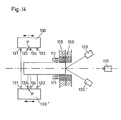
- a measuring device 130 is to be provided with which it can be determined or ascertained whether and when, after a certain number of one-piece bolts have been removed, residual strand parts have a length in front of the separation point have between L + ls and L - ls, or the rear end face of a strand rest, the front end face of which lies in the parting plane, is at such a distance from the parting point, which means that this strand part must be processed in accordance with the invention and the appropriate steps must be taken for the next separation process.
- Such a measuring device 130 can directly scan the rear end face of the strand remnant if it lies within the effective range of the measuring device, or it can also interact with a pusher or other propellant used to advance the strand to be divided.
- This measuring device can work with mechanical, electromechanical, capacitive, inductive, optical and / or optoelectric or equivalent means.
- This measuring device 130 has a zero point P and is longitudinally displaceable with respect to the separation point T, such that its zero point P can be set at a distance L from the separation point T in accordance with the desired desired bolt length L. However, it can also be arranged in a stationary manner and cooperate with a counterpart that takes into account the desired distance L in each case. At least this measuring device is provided with two outer limiters 131 and 132 which can be displaced towards and offset from the zero point P and with which the range L + ls to L - ls is simulated in accordance with the selected ls values.
- the measuring device 130 has at least one or preferably two likewise adjustable inner limiters 133 and 134 at a tolerance distance t from the zero point P.
- FIG. 1 An exemplary embodiment of such a measuring device is shown schematically in FIG.
- the measuring device 130 can be installed close to the point of separation, for example at the level of the strand axis, and also the position of the rear end face of a remaining part of length L + ls until L - ls can determine immediately.
- the measuring device shown works in a preferred manner with light barriers and is for this purpose with the various outer and inner limiters 131, 132, 133, 134 forming photo cells and, on the other side of the strand S, with correspondingly arranged light sources 131 ', 132', 133 'and 134' equipped.
- the input cell 131 seen in the material flow direction is set at a distance + ls from the zero point P of the measuring device, the output cell 132 at a distance -ls therefrom.
- the two middle cells 133 and 134 which are set at a tolerance distance + t or -t from the zero point P. So that the relatively close to each other middle light barriers 133 - 133 'and 134 - 134' do not interfere with each other, they are advantageously offset in height with respect to the strand axis or else mounted in a cross such that the corresponding light beams are at an angle of approximately -15-30 ° run to each other.
- the measuring device 130 - 130 ' which can be displaced as a whole as a whole, is set with its zero point P to the desired stud set length L.
- this measuring device works together with a scanner 135, with which it is determined at what point in time a front end face of the material fed to the scissors (strand or remaining strand part) lies in the parting plane T. At this point in time, the determinations of the measuring device are obtained and evaluated for the further procedure, as will be described in more detail below.
- a photocell 135 can be used as the scanner, which receives the light beam of a light source 135 'reflected on the front end face of the strand or the remaining strand part. It is also possible to incorporate as a scanner to the parting plane T-reaching pivotable auxiliary stop, when the back estossen g, actuates a switch and swings upon further shifting of the material.
- the measuring apparatus by means of light barriers described must operate in order to function correctly, ie M el- can deliver applications, the rear end face of the strand remainder part be free and accessible.
- the strands are fed one after the other in a conventional separation plant in such a way that their mutually facing end faces, i.e. abut the rear face of one strand and the front face of the next strand.
- the photocells behave at a joint as if a full strand stood in front of them, i.e. they don't respond.
- the feed transport means 103, in particular of the continuous furnace 102, and the drive roller set 109 (-110) of the hot shear 104 also run synchronously in a conventional separation system.
- the object of a further development of the invention is to remedy this and to resolve the impact points in the area of the measuring device.
- a strand feed part advanced through the separating device up to the stop 115 is given a feed rate which is greater than the normal feed rate, and thereby one Distance or air gap is formed between this remaining strand part R and the next strand Sn. If this differentiated feed rate has been set, after an advantageous improvement of the feed process, it can further be ensured that only the remaining strand part R is pushed further up to the stop 115 and the feed of the next strand Sn is stopped.
- the drive roller set located on the entry side of the separating station, in particular the hot shear is driven with drive means which permit synchronous operation with the conveying means on the feed path, in particular in the continuous furnace, if a rod extends over both, and rapid run of said drive roller set , if a strand part is mainly or only under the effect of this driving roller set.
- the drive roller set of the hot shears is driven by means of a sliding means.
- An asynchronous motor can be used or a slip clutch can be interposed between the motor and the drive roller set.
- a slip clutch is interposed, it is possible to use the same electric motor as the drive means for the feed conveyor and the drive roller set, a different gear ratio permitting the different speeds of the two conveyor means.
- a special electric motor is preferably provided for each conveyor.
- FIG. 12 A preferred equipment is shown in FIG. 12, where the transport device 103 of the continuous furnace 102 is driven by the motor 136 and the drive roller set 109 (-110) of the hot shear 104 is driven by the asynchronous motor 37.
- the light beam is interrupted as long as a relatively long strand or a strand remnant that is longer than L + ls lies in front of the measuring device.
- the material is processed as shown in FIG. 11, representations a and b to d shown.
- the remaining piece r with a length of less than L - ls, like the strand, is returned to the furnace to keep it warm.
- this remaining piece r is driven faster by the drive roller set, triggering the impact point and forming an air gap, passes in front of the input cell 131 and afterwards in front of the output cell 132, so that when its front end face reaches the parting plane T - which is determined by the scanner 13.5 -, Both cells 131 and 132 have reacted to the light beam.
- the shifting of the next strand continues, which pushes the remainder up to the stop 115, whereupon a shearing process takes place and a multipart bolt is formed.
- a section a is then cut off at the front end of the remaining part, as shown in the representations e, f and h, i of FIG. 11, with a rest of the length L - l remaining in front of the cutting point.
- This section is ejected by the ejection cylinder 117 and ejected by the ejector 120 and ejected by the ejector 120.
- the movable shear ring 106 is brought back into the open shear position.
- the next strand which is now called up, pushes the rest up to the stop 115, whereupon a complementary piece c is cut off and a composite bolt is formed, as shown in the illustration g and j.
- the measuring device is preferably provided with two middle cells 133 and 134 at a distance t from its zero point P. This enables improved straightening shearing of the remaining strand parts, as shown in the representations k and m, or e to g of FIG. 11. In situations such as according to the representations a or b to d of FIG. 11, this improved measuring device behaves like the measuring device described above, which is only equipped with two external limiters 131 - 132.
- the width of the tolerance range must be selected and set at least on its input side, taking into account the inertia of the remaining part. , ie it may be necessary to set the first middle cell 133 at a somewhat greater distance from the zero point P. - Then a section a is separated at the front end of the remaining part, pushed away in the manner described and thrown off. A remaining piece r of the desired length L remains behind the parting plane and can be pushed through the next strand with the scissors open or by means of an auxiliary pusher up to the stop 115. After pushing back the connecting strand or the auxiliary pusher, this remaining piece can be brought in front of the ejection cylinder 117 by an empty shearing process and then ejected by the latter.
- the input cell 131 reacts first, which preferably allows the remaining part to be moved more slowly, and then the two middle cells 133-134. whereupon the scanner 135 determines that the front end face has now reached the parting plane. Based on the combined messages from the scanner 135 and the second middle cell 134, the remainder is moved until its rear end face has passed the exit cell 132 and the latter reacts and stops the feed. A section a is then separated from the front end of the remaining part and ejected and thrown off in the manner described. Behind the parting plane T there remains a remaining piece r of length L-ls, which is then advanced through the next strand up to the stop 115 and is combined into a two-part bolt by separating a complementary piece c from this next strand.
- the second middle cell 134 is dispensed with, whose function is taken over by the first middle cell 133.
- a remainder of the length L is processed like a remainder with a length between L and L - Ls, ie it is pushed forward until its rear surface has passed the exit cell 132, whereupon a section of approximately the end of this remainder Length Ls is separated.
- the measuring device is expediently switched off during the return transport of a strand part located in front of the separation point into the furnace, so that the cells do not give any messages when the front end of this strand part passes it and clears the way for a light beam.
- the measuring device 130 described can, however, be used without a scanner 135, in that it fulfills its functions after a strand or a portion of the strand has been advanced up to the stop 115 and has stopped. Based on the determinations of the measuring device 130, the strand part located in front of the separation point is then processed as previously described. If the desired bolt length is to be changed, the strand part located in front of the separation point is pushed back and led to the measuring device so that it carries out its measurements on the basis of the new data.
- the measuring device with light barriers described here with reference to FIG. 14 and the described opening of a contact point between a remaining strand part and a subsequent strand in front of the separation station by accelerating this remaining part can also be advantageously used for carrying out the first embodiment of the method according to the invention and in the Use the appropriate system because it is also a matter of determining the occurrence of "critical" remaining parts and processing them using a special process.
- the second embodiment of the method and the corresponding special devices have been described here using the example of cutting off by hot shearing, because its advantages are particularly important. However, they can also be used if they are cut by sawing.
- the warm shears have been described in more detail with reference to FIGS. 12 and 13 than was the case in connection with FIG. 8. It is understood that the Kon Structural details of the warm shears according to FIGS. 12-13 can also apply to the warm shears according to FIG. 8.
Landscapes
- Engineering & Computer Science (AREA)
- Mechanical Engineering (AREA)
- Pretreatment Of Seeds And Plants (AREA)
- Extrusion Moulding Of Plastics Or The Like (AREA)
Applications Claiming Priority (4)
| Application Number | Priority Date | Filing Date | Title |
|---|---|---|---|
| CH3308/81 | 1981-05-21 | ||
| CH330881 | 1981-05-21 | ||
| CH698781 | 1981-11-02 | ||
| CH6987/81 | 1981-11-02 |
Publications (2)
| Publication Number | Publication Date |
|---|---|
| EP0065933A2 true EP0065933A2 (fr) | 1982-12-01 |
| EP0065933A3 EP0065933A3 (fr) | 1983-07-20 |
Family
ID=25692706
Family Applications (1)
| Application Number | Title | Priority Date | Filing Date |
|---|---|---|---|
| EP82810214A Withdrawn EP0065933A3 (fr) | 1981-05-21 | 1982-05-19 | Appareil et procédé pour récouper des barres en lopins |
Country Status (1)
| Country | Link |
|---|---|
| EP (1) | EP0065933A3 (fr) |
Cited By (2)
| Publication number | Priority date | Publication date | Assignee | Title |
|---|---|---|---|---|
| WO2009088525A1 (fr) * | 2008-01-04 | 2009-07-16 | G. James Australia Pty. Ltd. | Procédé de soudage de segments de lopin chauffés dans un traitement d'extrusion d'aluminium |
| CN114454344A (zh) * | 2020-11-09 | 2022-05-10 | 上海东河机电科技有限公司 | 一种防倒片机构和切割设备 |
Family Cites Families (5)
| Publication number | Priority date | Publication date | Assignee | Title |
|---|---|---|---|---|
| US2971414A (en) * | 1959-11-04 | 1961-02-14 | Blaw Knox Co | Constant gap control for sheet shearing lines |
| US3226555A (en) * | 1962-04-06 | 1965-12-28 | Gen Electric | Photosensitive system for indicating variations in a dimension of an article |
| GB1230102A (fr) * | 1967-04-29 | 1971-04-28 | ||
| US3415149A (en) * | 1967-08-25 | 1968-12-10 | Uk G Pi Tjazhpromelektroproekt | Device for wasteless cutting of metal |
| DD116410A1 (fr) * | 1974-10-08 | 1975-11-20 |
-
1982
- 1982-05-19 EP EP82810214A patent/EP0065933A3/fr not_active Withdrawn
Cited By (5)
| Publication number | Priority date | Publication date | Assignee | Title |
|---|---|---|---|---|
| WO2009088525A1 (fr) * | 2008-01-04 | 2009-07-16 | G. James Australia Pty. Ltd. | Procédé de soudage de segments de lopin chauffés dans un traitement d'extrusion d'aluminium |
| US7712651B2 (en) | 2008-01-04 | 2010-05-11 | G. James Australia Pty. Ltd. | Method of welding heated log segments in an aluminum extrusion process |
| US7950566B2 (en) | 2008-01-04 | 2011-05-31 | G. James Australia Pty. Ltd. | Method of welding heated log segments in an aluminum extrusion process |
| EP2384831A1 (fr) * | 2008-01-04 | 2011-11-09 | G. James Australia Pty. Ltd. | Méthode de soudage des segments de billettes dans une presse à filer d'aluminium |
| CN114454344A (zh) * | 2020-11-09 | 2022-05-10 | 上海东河机电科技有限公司 | 一种防倒片机构和切割设备 |
Also Published As
| Publication number | Publication date |
|---|---|
| EP0065933A3 (fr) | 1983-07-20 |
Similar Documents
| Publication | Publication Date | Title |
|---|---|---|
| DE10062193B4 (de) | Verfahren und Vorrichtung zum Verbinden von Metallplatten und Warmbandwalzwerk | |
| DE2816497C2 (de) | Vorrichtung zum Vorschub stangenförmigen Werkstückmaterials bei einer Trennmaschine | |
| EP4260995B1 (fr) | Machine de tranchage dotée d'un dispositif de transfert transversal destiné à charger à l'extérieur de la machine et procédé de chargement pour une machine de tranchage | |
| EP3760047B1 (fr) | Dispositif de presse | |
| DE102020115748A1 (de) | Presseinrichtung | |
| DE3618085A1 (de) | Automatisches zufuehrungs- und lagerungssystem fuer bearbeitete materialien | |
| DE68918531T2 (de) | Anlage zum Walzen flacher Produkte. | |
| DE69408104T2 (de) | Hochgeschwindigkeits-Schopfschere und Verfahren zum Anwenden dieser Schopfschere zum Scheren der Anfangs- und Endstücke einer gewalzten Stange | |
| EP1848556B1 (fr) | Machine d'usinage comprenant un dispositif de coupe pour decouper une barre | |
| DE60219651T2 (de) | Biegevorrichtung für profile, wie runde bewehrungsteile oder ähnliches | |
| WO1981002698A1 (fr) | Procede et dispositif pour le transport d'une ligne de moulage composee de moules sans chassis | |
| DE3215798C2 (de) | Verfahren und Vorrichtung zum Scheren von erwärmten Stangen aus Metall in Preßbarren | |
| DE69020816T2 (de) | Verfahren und Vorrichtung zum Scherschneiden von aus dem Walzwerk kommendem Stabstahl in Abschnitte. | |
| DE1752006A1 (de) | Scherenlinie zum Besaeumen und Unterteilen von Blechen,insbesondere Grobblechen | |
| DE2620190B2 (de) | Elektrische Widerstands-Stumpfschweißmaschine | |
| EP0039888B1 (fr) | Procédé et dispositif pour découper et emmener des groupes de profil de section transversale différente, respectivement de dimension en coupe transversale différente, derrière une cisaille à froid | |
| DE2224375A1 (fr) | ||
| EP1521647B1 (fr) | Presse a filage et procede correspondant | |
| DE2946407C2 (fr) | ||
| DE2821290A1 (de) | Verfahren zum pressverschweissen zweier metallknueppel | |
| DE10102073A1 (de) | Vorrichtung zum Querteilen von Metallbändern | |
| DE3120464A1 (de) | Verfahren und vorrichtung zur optimierten schnittverteilung beim aufteilen von stangen in pressbolzen | |
| DE602005004668T2 (de) | Stabpackungsanlage und entsprechendes verfahren | |
| DE602005005483T2 (de) | Vorrichtung zur Änderung der Geschwindigkeit von Stangen | |
| DE69901943T2 (de) | Verfahren und vorrichtung zum zerteilen von walzgut |
Legal Events
| Date | Code | Title | Description |
|---|---|---|---|
| PUAI | Public reference made under article 153(3) epc to a published international application that has entered the european phase |
Free format text: ORIGINAL CODE: 0009012 |
|
| AK | Designated contracting states |
Designated state(s): AT BE CH DE FR GB IT LI NL |
|
| PUAL | Search report despatched |
Free format text: ORIGINAL CODE: 0009013 |
|
| AK | Designated contracting states |
Designated state(s): AT BE CH DE FR GB IT LI NL |
|
| STAA | Information on the status of an ep patent application or granted ep patent |
Free format text: STATUS: THE APPLICATION IS DEEMED TO BE WITHDRAWN |
|
| 18D | Application deemed to be withdrawn |
Effective date: 19840321 |
|
| RIN1 | Information on inventor provided before grant (corrected) |
Inventor name: GRABKA, JOACHIMC/O ALUMINIUM PRODUCTS LTD. Inventor name: BOMHOLT, JENS Inventor name: KAELIN, ANTON |