EP0066061B1 - Abhängige Algebramaschine - Google Patents
Abhängige Algebramaschine Download PDFInfo
- Publication number
- EP0066061B1 EP0066061B1 EP82102957A EP82102957A EP0066061B1 EP 0066061 B1 EP0066061 B1 EP 0066061B1 EP 82102957 A EP82102957 A EP 82102957A EP 82102957 A EP82102957 A EP 82102957A EP 0066061 B1 EP0066061 B1 EP 0066061B1
- Authority
- EP
- European Patent Office
- Prior art keywords
- engine
- memory
- data
- data elements
- sort
- Prior art date
- Legal status (The legal status is an assumption and is not a legal conclusion. Google has not performed a legal analysis and makes no representation as to the accuracy of the status listed.)
- Expired
Links
Images




Classifications
-
- G—PHYSICS
- G06—COMPUTING OR CALCULATING; COUNTING
- G06F—ELECTRIC DIGITAL DATA PROCESSING
- G06F16/00—Information retrieval; Database structures therefor; File system structures therefor
- G06F16/20—Information retrieval; Database structures therefor; File system structures therefor of structured data, e.g. relational data
- G06F16/24—Querying
- G06F16/245—Query processing
- G06F16/2453—Query optimisation
- G06F16/24532—Query optimisation of parallel queries
-
- Y—GENERAL TAGGING OF NEW TECHNOLOGICAL DEVELOPMENTS; GENERAL TAGGING OF CROSS-SECTIONAL TECHNOLOGIES SPANNING OVER SEVERAL SECTIONS OF THE IPC; TECHNICAL SUBJECTS COVERED BY FORMER USPC CROSS-REFERENCE ART COLLECTIONS [XRACs] AND DIGESTS
- Y10—TECHNICAL SUBJECTS COVERED BY FORMER USPC
- Y10S—TECHNICAL SUBJECTS COVERED BY FORMER USPC CROSS-REFERENCE ART COLLECTIONS [XRACs] AND DIGESTS
- Y10S707/00—Data processing: database and file management or data structures
- Y10S707/99931—Database or file accessing
- Y10S707/99937—Sorting
Definitions
- the present invention relates to a relational algebra engine as defined in the precharacterising part of claim 1.
- Such engine performs a set operation at high speed in a data base system which deals with a relational model.
- Data models which are conventionally proposed include hierarchical model, network model and relational model. Among these models, the relational model is most promising. A concept of relation in set theory is applied to this model.
- the present invention provides a relational algebra engine comprising a control processor; a common bus means; a sort engine having a plurality of first processing elements which are connected in series, each of said first processing elements including first and second buffer memories, a first memory which has a FIFO function and a first processor which sorts input data elements in accordance with a predetermined rule by using said first and second buffer memories and said first memory, said first and second buffer and said first memory which has the FIFO function being disposed in parallel; said relational algebra engine being characterized in that a merge engine having two second processing elements which are disposed in parallel is provided; each of said second processing elements includes a third buffer memory, a second memory which has the FIFO function, a second processor which merges data elements processed in said sort engine by using said third buffer memory and said second memory which has the FIFO function, and an output buffer memory which stores the data elements merged in said second processor; said third buffer memory and said second memory which has the FIFO function are disposed in parallel; said control processor controls said sort engine and said merge
- a relational algebra engine comprises a sort engine, a merge engine, a control processor and a common bus.
- the sort engine comprises first processing elements which are mutually connected in series. Each first processing element comprises two buffer memories, a memory which has a FIFO function, and a processor which sorts data elements by using two types of memories as described above.
- the merge engine has two second processing elements which are disposed in parallel. Each second processing element comprises a buffer memory, a memory which has a FIFO function, a processor which merges data elements using the memories, and an output buffer memory which stores the merged results.
- the sort engine, the merge engine and the control processor are connected by the common bus.
- a data base is processed by sorting and merging, but only necessary data is output from the merging engine.
- the relational algebra engine with the above structure performs set operations at high speed and hardware therefore in practice is easy to construct.
- data elements of the set f2 are input.
- a subset which has the same number of data elements as in the set f1 is then formed from the set f2.
- the data elements in the subset are sorted in the same manner as in the set f1.
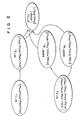
- the subsets of the set f2 are formed in the manner as described above. For example, as shown in Fig. 2, when the data elements of the set f2 are input in the order of (3,7,4,10,9,6,1,2), sorted subsets g2 (3,4,7,10) and g3 (1,2,6,9) are obtained.
- the data elements of the subset g2 and the set g1 are merged to form the common data element (10). Further, the data elements of the subset g3 and the set g1 are merged to form the common data elements (2, 6).
- the set f3 (2, 6, 10) is formed from the common data elements.
- one set element is generally defined as a tuple of data elements having a plurality of attributes. Referring to Figs. 1 and 2, the set elements are thus expressed as 2(a1), 10(a2),... The attributes are expressed as a1, a2,....
- Fig. 3 is a block diagram of a relational algebra engine for performing the sort/merge algorithm according to a first embodiment of the present invention.
- a sort engine SE has a plurality (numbering n) of first processing elements PE1, PE2,..., PEn which are connected in series.
- the memory Bk2 comprises a RAM which simultaneously reads out and writes data, that is, performs parallel accessing and which has the FIFO function.
- the processor Pk compares data stored in the buffer memory Mk1 and the memory Bk2 or in the buffer memory Mk3 and the memory Bk2 and reads out data in accordance with a predetermined rule, that is, a rule in which the smaller data is read out first.
- the first processing element PE1 at the first stage of the sort engine SE sorts a first group of two data elements which are selected from the input data array.
- the first processing element PE2 at the second stage of the sort engine SE sorts a second group of four data elements, that is, two groups of two data elements which are sorted in the first processing element PE1 at the first stage of the sort engine SE.
- a merge engine ME comprises two second processing elements RP1 and RP2 which are disposed parallel to each other.
- the second processing element RP1 or RP2 comprises a buffer memory M01 or M02, a memory B01 or B02 which has the FIFO function, a processor P01 or 1 P02 which merges input data elements by utilizing the buffer memory M01 or M02 and the memory B01 or B02, and an ouput buffer memory OB1 or OB2 which writes the coincident data by the merge algorithm.
- the "coincident data” represent, for instance, the required data set f 3 , as shown in Fig. 1.
- the processor P01 reads out the coincident data by sequential comparing groups of data which are stored in the buffer memory M01 and the memory B01 which has the FIFO function. The coincident data is then written in the output buffer memory OB1.
- the processor P02 operates in the same manner as the processor P01. In particular, the processor P02 reads out the coincident data by sequentially comparing groups of data elements which are stored in the buffer memory M02 and the memory B02 which has the FIFO function. The coincident data is then written in the ouput buffer memory OB2.
- These two processing elements RP1 and RP2 continuously perform the merge operation in synchronism with the processing speed of the sort engine by alternately receiving the sorted subsets transmitted from the sort engine.
- the merge engine ME with the above structure is connected to the sort engine SE and a control processor CP through a common bus.
- the control processor CP first controls the sort engine SE so as to sort the input data elements.
- the sorted data elements are fed to the merge engine. ME wherein these data elements are merged.
- the control processor CP controls the pipeline processing of the algorithm of the set operation.
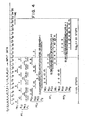
- the set operation of the relational algebra engine according to the present invention will be described with reference to the timing chart of Fig. 4.
- the set operation aims at obtaining the set f3 by selecting the common data elements of the sets f1 and f2.
- the set f1 has data elements (2, 10, 15, 6) and the set f2 has data elements (3, 7, 10, 4, 9, 6, 1, 2).
- time is plotted in the abscissa of the timing chart.
- the processing data elements and their status are plotted in the ordinate of the timing chart.
- the number of data elements in the set f1 is defined as n and the number of data elements in the set f2 is defined as m.
- a set which has a smaller number of data elements is first input.
- the data elements of the set f1 are first input.
- the data elements are sequentially written in the memories M11, B12 and M13 of the first processing element PE1 in the first stage of the sort engine SE in the order of M11, B12, M13, B12, M11, B12,.... Every time a group of two data elements is input to the processor P1 at the first stage, the two data elements are compared.
- the input data elements are then sorted by reading out the smaller data element first, for example.
- the two groups of two data elements (2, 10) and (6, 15) are supplied to the first processing element PE2 at the second stage.
- the first processing element PE2 at the second stage compares the input data elements and reads out the smaller data element first.
- the data elements in the same group such as (2, 10) are already sorted in the first processing element PE1 in the first stage. Therefore, the data elements in the different groups need only be compared.
- a data element which is to be compared is not present in the opposite group, a data element which does not have the corresponding data element is compared with a predetermined value, for example, the infinite ( ⁇ ).
- a predetermined value for example, the infinite ( ⁇ ).
- the above-described predetermined value is zero (0).
- the sorted set f1 (2, 6, 10, 15) is transferred to the merge engine ME and written in the buffer memories M01 and M02, respectively.
- the data elements (3, 7, 10, 4, 9, 6, 1, 2) of the set f2 are then input to the first processing element PE1 at the first stage of the sort engine SE after the data elements (2, 10, 15, 6) of the set f1 have been input.
- the data elements of the set f2 are sorted in the same manner as described above.
- the data elements (3,7,10,4) whose number is the same as that of the data elements of set f1 are sorted from the set f2
- the data elements (3, 4, 7, 10) are written in the memory B01 of the merge engine ME.
- the processor P01 compares data elements of the memories M01 and B01 and detects the common data (10) between the subsets.
- the sort engine SE sorts the remaining data elements (9, 6, 1, 2) of the set f2.
- the sorted data elements (1, 2, 6, 9) are sequentially stored in the memory B02 of the second processing element RP2 at the second stage of the merge engine ME.
- the second processing element RP2 at the second stage of the merge engine ME performs the merge in the same manner as the second processing element RP1 at the first stage of the merge engine ME and 'detects the common data elements (2, 6).
- the set f2 Every time subsets of the set f2 which comprise the same number of data elements as that of the set f1 are obtained, they are alternately written in the memories B01 and B02 and merged therein.
- the common data elements which are obtained by merging are written in the output buffer memories OB1 and OB2.
- the set f3 (10, 2; 6) is produced by the set operation.
- Relation (1) is apparently independent of m, the number of data elements of the set f2.
- log 2 n is the number of the processing elements of the sort engine SE required when the number of data elements is n
- 2n is the number of steps required for the final comparison of data elements in the merge engine ME.
- the relational algebra engine according to the present invention has another advantage in that the memory capacity is made small.
- Each memory has the capacity for storing only twice the number of data elements of the set f1. Referring to Fig. 4, the memory has only the capacity of 8 (4x2) words. Even if the set f2 has 10,000 data elements, the data elements are divided into groups of four data elements. Every four data elements are, respectively, sorted. The sorted results are alternately stored in the memories B01 and B02 of the merge engine ME. Therefore, the storage structure is made simple.
- the output buffer memories OB1 and OB2 store only the coincident data, as defined above which is indicated by a circle, so that the capacities thereof are made compact.
- the above-mentioned advantage is based on the structure in which two second processing elements RP1 and RP2 which are parallel constitute the merge engine ME.
- time required for the merge operation is made longer than that required for the sort operation. Therefore, a memory of large capacity which solves the problem of time lag is required.
- the second processing elements do not receive the inputs since the sort processing time is longer than the merge processing time.
- the merge processing time matches the sort processing time, so that the relational algebra engine properly operates.
- the sort engine SE continuously sorts by the pipeline operation the subsets g2 and g3 which have the same number of data elements as defined by the number of data elements of the set f1. Therefore, time required for the sort operation is very short. Further, while the set f1 and the subset g2 of the set f2 are merged, the sort engine SE sorts the subset g3 of the set f2, thus accomplishing efficient processing. As is apparent from the above description, even if the number of data elements of the set f1 is larger than that in the above embodiment, the processing is continuously performed in a predetermined number of steps in accordance with relation (1). ,
- the device according to the present invention is simple in construction as shown in Fig. 3.
- the operation of this device is easily controlled. Since the processing elements of the same structure are connected in series through the common bus to the control processor, the sort result is read out from an arbitrary processing element. Therefore, the system design and implementation of the device is made simple.
- the number of the processing elements of sort engines is arbitrarily determined in accordance with the amount of data to be handled.
- the set operation for a great amount of data in the data base system based on the relational model is performed at high speed with good efficiency.
- the algebra operation for the common set is described.
- other set operations are also performed.
- a join operation which is the most complicated set operation of the relational algebra of the relational data base system is performed at high speed.
- a new relation is established from two different relations by utilizing the common attribute.
- One set indicates the relation between a record number and a composer, as shown in Table 1.
- Another set indicates the relation between the record number and the title of a musical composition, as shown in Table 2.
- a new set which indicates the relation between the composer and the title of a musical composition is established as shown in Table 3.
- a group of set elements which are based on a tuple as the unit and which have a plurality of attributes are stored in the memory. This group of set elements is sorted and the sorted groups of set elements are merged.
- a relational algebra engine which is capable of sorting data sets based on the attributes will be described with reference to Fig. 5.
- the sort engine SE comprises a plurality of first processing elements PE1, PE2,..., PEn which are connected in series.
- the memory Bk2 is a RAM which is capable of performing parallel access for reading out and writing data and which has the function of first-in/first-out (FIFO).
- the ' processor Pk compares data which are stored in the memories Mk1 and Bk2 or the memories Mk3 and Bk2 by utilizing the FIFO function of the memory Bk2.
- the processor Pk then reads out data in accordance with a predetermined rule, that is, a rule in which the smallest data element is read out first.
- the sort processing steps of the first processing element PEk are sequentially stored in the flag memory FMk which is, in turn, controlled by the address counter ACk.
- the processor Pk sorts other attributes with reference to the previously input attributes in accordance with the storage process of the flag memory FMk.
- the first processing elements PE1, PE2,..., PEn which are connected in series function as the pipeline so as to sort a series of data.
- the first processing element PE1 at the first stage of the sort engine SE sorts two data elements every time two data elements are input.
- the first processing element PE2 at the second stage of the sort engine SE sorts two groups of two data elements every time the groups are input which are sorted in the first processing element PE1 at the first stage. Within the same group, the data elements are already sorted. Therefore, comparison is only made between the data elements in different groups. One data element of one group is, for example, compared with one data element of the other group and the smaller data element is read out. The remaining data element and one data element of the other group are sorted. This operation is sequentially repeated. Therefore, a group of four data elements which are already sorted is read out from the first processing element PE2 at the second stage of the sort engine SE.
- each first processing element at each stage of the sort engine SE receives two groups of data elements, the sort processing is performed.
- the data elements of one group are all read out, the data elements in the other group are compared with the infinitive (co) or zero (0).
- the merge engine ME has the same structure as the merge engine ME in the first embodiment.
- the same reference numerals as in the second embodiment denote the same parts as in the first embodiment, and the detailed description thereof will be omitted.
- the merge engine ME is connected to the sort engine SE and the control processor CP through the common bus.
- the control processor CP transfers the sorted results of the sort engine SE to the merge engine ME.
- the sorted results may be stored in the output buffer memories OB1 and OB2 through the memories B01 and B02.
- the stored data may be accessed as needed.
- the stored results may be directly written in the output buffer memories OB1 and OB2 in accordance with the direct write mode.
- Table 4 shows relations among the attributes such as the record number, the title, the composer, and the record company. Two attributes, for example, the record number and the composer are selected and the data elements are arranged in the order of the record number.
- Table 5 shows the results of this operation.
- the method which has attributes as the basis is more advantageous.
- data for the title and the record company become redundant so that excessive data transfer time is required.
- data for the title and the record company are eliminated and data for the record number and the composer are transferred to execute the set operation. Therefore, the data transfer time between the memories and the processor can be shortened.
- the set operation of the relational algebra engine according to the second embodiment of the present invention will be described with reference to the timing chart of Fig. 6.
- the set f1 has data elements (3, 5, 6, 4, 1, 2) of the record number.
- the set f2 has data elements (a, b, c, d, e, f) of the composer.
- Time is plotted in the abscissa of the timing chart of Fig. 6.
- the processing elements and their statuses are plotted in the ordinate of the timing chart of Fig. 6.
- the data elements (3, 5, 6, 4, 1, 2) of the record number are first input and sorted in the same manner as in the first embodiment.
- the processor Pk compares data from the buffer memory Mk1 or Mk3 with data from the memory Bk2 which has the FIFO function. The smaller data is then supplied to the processing element at the next stage. If data which is to be supplied to the next processing element has been stored in the buffer memory Mk1 or Mk3, the state "1" is written in the flag memory FMk. When this data to be supplied to the processing element has been stored in the memory Bk2, the state "0" is written in the flag memory FMK.
- the data elements (a, b, c, d, e, f) of the composer which are input after the data elements of the record member are processed by the processor Pk on the basis of the sort processing step of the record number which is stored in the flag memory FMk.
- W denotes the operation for writing the sort processing step in the flag memory FMk.
- R denotes the operation for reading out the sort processing step from the flag memory FMk. Therefore, the sets f1 and f2 are sorted in the first processing elements PE1, PE2, and PE3. The sorted results are stored in the memories M41 and B42 of the first processing element-PE4. The stored data is read out through the merge engine ME as needed.
- the sort processing of data is continuously performed in the pipeline manner, accomplishing processing effectively in a short period of time. Further, other attributes may be easily sorted in accordance with the order of the sorted attribute.
- a new relation can be established from one relation. Further, a new relation from a plurality of relations, that is, the join operation, may be also accomplished.
Landscapes
- Engineering & Computer Science (AREA)
- Theoretical Computer Science (AREA)
- Computational Linguistics (AREA)
- Data Mining & Analysis (AREA)
- Databases & Information Systems (AREA)
- Physics & Mathematics (AREA)
- General Engineering & Computer Science (AREA)
- General Physics & Mathematics (AREA)
- Information Retrieval, Db Structures And Fs Structures Therefor (AREA)
Claims (3)
Applications Claiming Priority (4)
| Application Number | Priority Date | Filing Date | Title |
|---|---|---|---|
| JP56074565A JPS57189248A (en) | 1981-05-18 | 1981-05-18 | Relational algebra operating device |
| JP56074564A JPS57189247A (en) | 1981-05-18 | 1981-05-18 | Relational algebra operating device |
| JP74564/81 | 1981-05-18 | ||
| JP74565/81 | 1981-05-18 |
Publications (3)
| Publication Number | Publication Date |
|---|---|
| EP0066061A2 EP0066061A2 (de) | 1982-12-08 |
| EP0066061A3 EP0066061A3 (en) | 1984-03-28 |
| EP0066061B1 true EP0066061B1 (de) | 1986-12-17 |
Family
ID=26415719
Family Applications (1)
| Application Number | Title | Priority Date | Filing Date |
|---|---|---|---|
| EP82102957A Expired EP0066061B1 (de) | 1981-05-18 | 1982-04-06 | Abhängige Algebramaschine |
Country Status (3)
| Country | Link |
|---|---|
| US (1) | US4514826A (de) |
| EP (1) | EP0066061B1 (de) |
| DE (1) | DE3274774D1 (de) |
Families Citing this family (39)
| Publication number | Priority date | Publication date | Assignee | Title |
|---|---|---|---|---|
| US4799152A (en) * | 1984-10-12 | 1989-01-17 | University Of Pittsburgh | Pipeline feedback array sorter with multi-string sort array and merge tree array |
| US5097408A (en) * | 1985-01-11 | 1992-03-17 | Wang Laboratories, Inc. | Apparatus for specifying a result relation in a relational database system by selection of rows |
| US4888690A (en) * | 1985-01-11 | 1989-12-19 | Wang Laboratories, Inc. | Interactive error handling means in database management |
| KR940001563B1 (ko) * | 1985-01-21 | 1994-02-24 | 가부시끼가이샤 히다찌세이사꾸쇼 | 룰 베이스 시스템 |
| US4967341A (en) * | 1986-02-14 | 1990-10-30 | Hitachi, Ltd. | Method and apparatus for processing data base |
| US5084815A (en) * | 1986-05-14 | 1992-01-28 | At&T Bell Laboratories | Sorting and merging of files in a multiprocessor |
| US4791561A (en) * | 1987-04-17 | 1988-12-13 | Wang Laboratories, Inc. | Interactive construction of means for database maintenance |
| US4805099A (en) * | 1987-04-17 | 1989-02-14 | Wang Laboratories, Inc. | Retrieval of related records from a relational database |
| ATE147523T1 (de) * | 1987-10-07 | 1997-01-15 | George G Gorbatenko | Speicherraumfeldanordnung zur speicherung von relationalen daten |
| US5008819A (en) * | 1987-10-07 | 1991-04-16 | Gorbatenko George G | Memory spaced array |
| US5185599A (en) * | 1987-10-26 | 1993-02-09 | Tektronix, Inc. | Local display bus architecture and communications method for Raster display |
| US4991134A (en) * | 1988-03-30 | 1991-02-05 | International Business Machines Corporation | Concurrent sorting apparatus and method using FIFO stacks |
| US5089985A (en) * | 1988-04-07 | 1992-02-18 | International Business Machines Corporation | System and method for performing a sort operation in a relational database manager to pass results directly to a user without writing to disk |
| JP2752634B2 (ja) * | 1988-05-26 | 1998-05-18 | 優 喜連川 | ソート処理装置 |
| US5247665A (en) * | 1988-09-30 | 1993-09-21 | Kabushiki Kaisha Toshiba | Data base processing apparatus using relational operation processing |
| CA2001390C (en) * | 1988-12-19 | 1997-12-30 | Ming-Chien Shan | View composition in a data-base management system |
| JPH0776906B2 (ja) * | 1989-06-30 | 1995-08-16 | ディジタル イクイプメント コーポレーション | 分類加速装置のための速度及びメモリー制御 |
| US5142687A (en) * | 1989-06-30 | 1992-08-25 | Digital Equipment Corporation | Sort accelerator with rebound sorter repeatedly merging sorted strings |
| US5185886A (en) * | 1989-06-30 | 1993-02-09 | Digital Equipment Corporation | Multiple record group rebound sorter |
| US5185887A (en) * | 1989-07-06 | 1993-02-09 | Hitachi, Ltd. | Database generation management method and system |
| US5179712A (en) * | 1989-08-16 | 1993-01-12 | Hughes Aircraft Company | Rank cell array structure for sorting by each cell comparing the cell value to previous cell value, next cell value, in value and out value |
| US5222235A (en) * | 1990-02-01 | 1993-06-22 | Bmc Software, Inc. | Databases system for permitting concurrent indexing and reloading of data by early simulating the reload process to determine final locations of the data |
| US5210870A (en) * | 1990-03-27 | 1993-05-11 | International Business Machines | Database sort and merge apparatus with multiple memory arrays having alternating access |
| US5222233A (en) * | 1990-07-09 | 1993-06-22 | The United States Of America As Represented By The Secretary Of The Navy | Method for restructuring a database using a relational database scheme derived by selecting subscheme joins to avoid cycles |
| JPH06242925A (ja) * | 1993-02-15 | 1994-09-02 | Mitsubishi Electric Corp | ソート処理装置 |
| GB2283118B (en) * | 1993-02-15 | 1997-06-18 | Mitsubishi Electric Corp | Sorting apparatus |
| JP3515810B2 (ja) * | 1994-08-16 | 2004-04-05 | 富士通株式会社 | ソート処理方法および装置 |
| WO1996006394A1 (en) * | 1994-08-23 | 1996-02-29 | Motorola Inc. | Method and system for identifying common data element in data blocks for storage |
| JP3518034B2 (ja) * | 1995-03-30 | 2004-04-12 | 三菱電機株式会社 | ソート方法並びにソート処理装置並びにデータ処理装置 |
| AU3909799A (en) * | 1997-12-22 | 1999-07-12 | Amano Koki Kabushiki Kaisha | Mathematical relation identification apparatus and method |
| JP3504210B2 (ja) * | 2000-03-31 | 2004-03-08 | 理想科学工業株式会社 | 画像処理装置 |
| US6859798B1 (en) | 2001-06-20 | 2005-02-22 | Microstrategy, Inc. | Intelligence server system |
| US7620664B2 (en) * | 2002-04-02 | 2009-11-17 | Mcgoveran David O | Computer-implemented method for translating among multiple representations and storage structures |
| US7263512B2 (en) * | 2002-04-02 | 2007-08-28 | Mcgoveran David O | Accessing and updating views and relations in a relational database |
| US7861253B1 (en) | 2004-11-12 | 2010-12-28 | Microstrategy, Inc. | Systems and methods for accessing a business intelligence system through a business productivity client |
| US8761659B1 (en) | 2005-02-11 | 2014-06-24 | Microstrategy, Inc. | Integration of e-learning with business intelligence system |
| US9465881B2 (en) * | 2012-10-31 | 2016-10-11 | Yahoo! Inc. | User displays using N-way paginated merge of information from diverse sources |
| CN106843803B (zh) * | 2016-12-27 | 2019-04-23 | 南京大学 | 一种基于归并树的全排序加速器及应用 |
| EP4481428A1 (de) * | 2023-06-19 | 2024-12-25 | Infineon Technologies AG | Vorrichtung und verfahren zur os-cfar-detektion und radarsystem |
Family Cites Families (7)
| Publication number | Priority date | Publication date | Assignee | Title |
|---|---|---|---|---|
| US4210961B1 (en) * | 1971-10-08 | 1996-10-01 | Syncsort Inc | Sorting system |
| US3713107A (en) * | 1972-04-03 | 1973-01-23 | Ncr | Firmware sort processor system |
| US3931612A (en) * | 1974-05-10 | 1976-01-06 | Triad Systems Corporation | Sort apparatus and data processing system |
| US4030077A (en) * | 1975-10-16 | 1977-06-14 | The Singer Company | Multistage sorter having pushdown stacks for arranging an input list into numerical order |
| US4078260A (en) * | 1976-05-12 | 1978-03-07 | International Business Machines Corporation | Apparatus for transposition sorting of equal length records in overlap relation with record loading and extraction |
| US4110837A (en) * | 1976-12-30 | 1978-08-29 | International Business Machines Corporation | Apparatus for the sorting of records overlapped with loading and unloading of records into a storage apparatus |
| US4209845A (en) * | 1977-01-25 | 1980-06-24 | International Business Machines Corporation | File qualifying and sorting system |
-
1982
- 1982-04-02 US US06/364,872 patent/US4514826A/en not_active Expired - Fee Related
- 1982-04-06 EP EP82102957A patent/EP0066061B1/de not_active Expired
- 1982-04-06 DE DE8282102957T patent/DE3274774D1/de not_active Expired
Also Published As
| Publication number | Publication date |
|---|---|
| US4514826A (en) | 1985-04-30 |
| EP0066061A2 (de) | 1982-12-08 |
| EP0066061A3 (en) | 1984-03-28 |
| DE3274774D1 (en) | 1987-01-29 |
Similar Documents
| Publication | Publication Date | Title |
|---|---|---|
| EP0066061A2 (de) | Abhängige Algebramaschine | |
| US4870568A (en) | Method for searching a database system including parallel processors | |
| US4221003A (en) | Bubble domain relational data base system | |
| US5842208A (en) | High performance recover/build index system by unloading database files in parallel | |
| JPH02178730A (ja) | 分割法を用いた内部ソート方式 | |
| CN111562898B (zh) | 一种基于fpga实现的多级归并排序方法 | |
| US6424970B1 (en) | Sorting system and method executed by plural computers for sorting and distributing data to selected output nodes | |
| US5247662A (en) | Join processor for a relational database, using multiple auxiliary processors | |
| Burkowski | A hardware hashing scheme in the design of a multiterm string comparator | |
| Naganuma et al. | High-speed CAM-based architecture for a Prolog machine (ASCA) | |
| GB2378789A (en) | Removal of duplicates from large data sets | |
| Hollaar | Hardware systems for text information retrieval | |
| Menon | Sorting and join algorithms for multiprocessor database machines | |
| Bic et al. | A Network-Oriented Dataflow Database System | |
| JPH0580977A (ja) | データ処理装置 | |
| JPH033249B2 (de) | ||
| Zhang et al. | Optimized Basic Event Ordering Strategy for ZTDD Conversion from Incoherent Fault Trees | |
| JPS58146935A (ja) | ソ−ト処理装置 | |
| Koster et al. | The application of a geometric arithmetic parallel systolic array processor to database machine design | |
| JPH033263B2 (de) | ||
| Stephen Huang | A VLSI partition algorithm | |
| JPH0581342A (ja) | データ処理装置 | |
| Lee et al. | Algorithms for Sorting and Sort-Based Database Operations Using a Special-Function Unit | |
| JPS63149728A (ja) | 索引生成方式 | |
| JPH0199125A (ja) | リンク分類方式 |
Legal Events
| Date | Code | Title | Description |
|---|---|---|---|
| PUAI | Public reference made under article 153(3) epc to a published international application that has entered the european phase |
Free format text: ORIGINAL CODE: 0009012 |
|
| AK | Designated contracting states |
Designated state(s): DE FR GB IT NL |
|
| PUAL | Search report despatched |
Free format text: ORIGINAL CODE: 0009013 |
|
| AK | Designated contracting states |
Designated state(s): DE FR GB IT NL |
|
| RAP1 | Party data changed (applicant data changed or rights of an application transferred) |
Owner name: KABUSHIKI KAISHA TOSHIBA |
|
| 17P | Request for examination filed |
Effective date: 19840725 |
|
| GRAA | (expected) grant |
Free format text: ORIGINAL CODE: 0009210 |
|
| AK | Designated contracting states |
Kind code of ref document: B1 Designated state(s): DE FR GB |
|
| ET | Fr: translation filed | ||
| REF | Corresponds to: |
Ref document number: 3274774 Country of ref document: DE Date of ref document: 19870129 |
|
| PLBE | No opposition filed within time limit |
Free format text: ORIGINAL CODE: 0009261 |
|
| STAA | Information on the status of an ep patent application or granted ep patent |
Free format text: STATUS: NO OPPOSITION FILED WITHIN TIME LIMIT |
|
| 26N | No opposition filed | ||
| PGFP | Annual fee paid to national office [announced via postgrant information from national office to epo] |
Ref country code: GB Payment date: 19940329 Year of fee payment: 13 |
|
| PGFP | Annual fee paid to national office [announced via postgrant information from national office to epo] |
Ref country code: DE Payment date: 19940408 Year of fee payment: 13 |
|
| PGFP | Annual fee paid to national office [announced via postgrant information from national office to epo] |
Ref country code: FR Payment date: 19940411 Year of fee payment: 13 |
|
| PG25 | Lapsed in a contracting state [announced via postgrant information from national office to epo] |
Ref country code: GB Effective date: 19950406 |
|
| GBPC | Gb: european patent ceased through non-payment of renewal fee |
Effective date: 19950406 |
|
| PG25 | Lapsed in a contracting state [announced via postgrant information from national office to epo] |
Ref country code: FR Effective date: 19951229 |
|
| PG25 | Lapsed in a contracting state [announced via postgrant information from national office to epo] |
Ref country code: DE Effective date: 19960103 |
|
| REG | Reference to a national code |
Ref country code: FR Ref legal event code: ST |